MARCH/APRIL 2016
PUBLISHED SINCE 1898 | WRITTEN FOR BUYERS OF TRANSPORTATION SERVICES
3PL SURVEY What shippers say about their outsourcing relationships
EAST COAST GATEWAYS Port partnerships, infrastructure growth
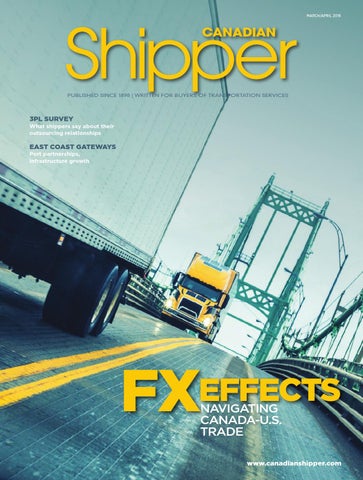
FX
EFFECTS NAVIGATING CANADA-U.S. TRADE
www.canadianshipper.com
p01-02 CdnShipper MarApril2016.indd 1
16-03-03 7:49 AM
When it comes to cargo, ship with Canada’s largest. We provide direct cargo services to over 150 Canadian and international destinations, holding global coverage in more than 450 cities through interline partnerships and a vast trucking network. GO DIGITAL with e-AWB! Our goal: to have ALL domestic shipments booked with an electronic air waybill (e-AWB) starting April 28. Join us! aircanadacargo.com
p01-02 CdnShipper MarApril2016.indd 2
16-03-03 7:49 AM
CONTENTS
MARCH/APRIL 2016
DEPARTMENTS
12
6 | Editor’s Forward An eventful road trip offers food for thought.
COVER STORY
8 | In the News Great Lakes pilotage rates rise April 1-a look at the impact on industry.
FX Effects Whether it’s a high U.S. dollar or a low Canadian one, factoring in exchange rates in cross-border trade will have tremendous effect on operations-what are some strategies to best manage this?
48 | Inside the Numbers Understanding private trucking. 51 | Retrospective In 1965, hijackings and cargo crimes were serious issues for trucking companies in the province of Quebec. A look back, compared to today's stats. 52 | Coaching Corner Marketing your skills in times of uncertainty, or in a toxic workplace.
54 | The Bigger Picture Real synergies remain elusive.
The Outsourcing Relationship Delving into the results from our 2016 Canadian Shipper and MM&D Third Party Logistics Survey.
©Willowpix/Ted Gough/iStock
20 Busy border crossings: a view of truck traffic on the US Crossing of the Thousand Islands Bridge system.
FEATURES U.S. TRADE | 16 Overcoming cross-border trade barriers how do SME’s fare?
TRACKING TRADE | 18 Global Trade Management software tracking and managing free trade agreements.
CLICK AND COLLECT | 30 Retail shippers seek innovative solutions for omni-channel.
continued
www.canadianshipper.com March/April 2016 3
LOOKING FOR OVERNIGHT LTL SERVICE BETWEEN NEW JERSEY AND TORONTO OR MONTREAL? We reduce transit times, damage, and misrouting through our 24 “no break-bulk” terminals.
1.800.822.4512 Canada 1.800.621.8723 USA herculesfreight.com
p03-07 CdnShipper MarApril2016_CONTENTs.indd 4
16-03-03 7:51 AM
WHAT’S ONLINE
continued
EAST COAST INFRASTRUCTURE | 36 The latest developments and partnerships from some of Canada’s East Coast ports.
TECHNOLOGY | 40 Air Canada Cargo’s RFID rollout aims for piece level visibility.
CARGO LOGISTICS CANADA | 42 Coverage from the annual trade show looks at impacts of the IMO deadline on container weight regulations, and updates from air cargo industry stakeholders.
36
WEB TV Transportation Matters
STRATEGIC FOCUS The competitive pressures driving the transportation industry.
SUPPLYING STANDARDS 15 occupational standards now linked to supply chain.
BLOG BITS Search our blog archives at ctl.ca
Dan Goodwill Creating an Effective Shipper-Motor Carrier Freight Agreement – Part 2 Addressing the financial and business issues that need to captured in detail in a shippercarrier freight agreement.
42
Carolina Billings Does your current job title matter? Which ones do? Are old fashioned titles really serving your career or are they hindering your advancement? I have good news and not so good news.
Find us on Twitter at: @CanadianShipper
|
@LouSmyrlis
|
@JuliaKuzeljevic
|
@JamesMenzies
|
@FleetExecutive
www.canadianshipper.com March/April 2016 5
p03-07 CdnShipper MarApril2016_CONTENTs.indd 5
16-03-07 6:43 AM
4977-12
EDITOR'S FORWARD Julia Kuzeljevich March/April 2016 Volume 119 Issue No.2
EDITOR Julia Kuzeljevich (416) 510-6880 julia@newcom.ca
Road warriors
F
or anyone who may harbour the misconception that the life of a trade journalist is all cushy-cushy, let me shatter that illusion once and for all. Canadian Shipper and its sister publication MM&D were the presenting media sponsors of the Cargo Logistics Canada conference in Montreal this February 16-18. For a trade show this size the plan is usually that our publisher (with our occasional participation) holds fort (and forth) at the booth while the editors both report on and moderate a busy series of conference sessions across two days. But first we had to get there from our headquarters in Toronto. Living in a just-in-time environment, and trying to meet press deadlines and various other commitments in preparation for the event, it appears we were all unaware that we planned to carpool to Montreal from Toronto the same day as a massive winter storm was passing through. No time for contingencies, though. So as we drove through the near post-apocalyptic landscape, witnessing abandoned vehicles in ditches, the blaring and flashing of multiple emergency sirens and one nightmarish scene of a pickup truck fully ablaze, we gained a new appreciation for the people who make transport their daily job. As will surprise no one, there are (motor) carriers and heavy duty vehicles (salters, plows) who exercise caution in extreme weather conditions, and there are those who do not. This goes for four-wheeler drivers as well, needless to say. But my driving companions handled the white-knuckle journey with great patience and skill, even as many cars and light trucks around us either drove too fast, or too slowly, for the conditions. Stretching out what can be a long, tedious drive (7.5 hours in our case) with something to eat and drink, and extra sources of heat (for when you argue over car temperatures) definitely helps. When we were able to stop, I am happy to report that Ontario’s ONroute service centres (of which at least five were eventually visited by our team on the return trip) provided bright lighting, clean washrooms, a wide choice of food and drink, ample parking and a chance to take a breather. (For a price, even special diets or food “issues” are accommodated here.) You can learn a lot of new vocabulary on a road trip, especially as you attempt to identify the project cargo perched seemingly precariously on the trailer in front of you. But especially if you are travelling with automotive enthusiasts, as I was, you will learn that: a “center bare” surface condition describes a lane where the pavement is visible in the centre even as snow drifts to the side. (Incidentally, the Ministry of Transportation of Ontario’s provincial performance target is to meet the bare pavement standard 90 percent of the time, each winter across the province. The standard timeframe to restore bare pavement varies depending on winter traffic volume and highway type. Some highways with low traffic remain snow packed for most of the winter.) Considering we were on the 401, MTO’s goal would have been bare pavement within eight hours of the end of a winter storm, it stated on its highway maintenance page. Other related vocabulary I learned was:“bald summers”, referring of course to four-wheelers guilty of driving through a winter storm with their balding summer tires, and “wind row”: a hump of snow that piles up between the lanes. There was a lot of torque and torsion talk as well but I’m afraid that went well over my head. Somehow, the “wheels on the road” theme did not end with the 401-Hyw 20 journey. The most oft-pronounced word I heard at the conference was “wheelhouse”, i.e. area of expertise, or particular skill. As in “that’s not in my wheelhouse” or “that’s something we proudly hold in our wheelhouse.” I’m guessing this may be one of the buzzwords for 2016, so I will try not to overuse it! CS
ART DIRECTOR Ellie Robinson ellie@newcom.ca CONTRIBUTING EDITORS Carroll McCormick, Leo Ryan, James Menzies, John G. Smith, Ian Putzger, Ken Mark, Carolyn Gruske MARKET PRODUCTION MANAGER Kimberly Collins (416) 510-6779 kim@newcom.ca VIDEO PRODUCTION MANAGER Brad Ling CIRCULATION MANAGER Mary Garufi (416) 614-5831 mary@newcom.ca PUBLISHER Nick Krukowski (416) 510-5108 nkrukowski@canadianshipper.com VICE-PRESIDENT PUBLISHING Joe Glionna PRESIDENT Jim Glionna HEAD OFFICE: 80 Valleybrook Drive, Toronto, ON M3B 2S9 Canadian Shipper is written for Canadian transportation and logistics professionals who manage product flow from manufacturer to point-of-sale. Editorial is focused on reporting, analysis and interpretation of Canadian log istics trends and issues. It is published by NEWCOM BUSINESS MEDIA INC.
SUBSCRIPTIONS: Contact us at: mary@newcom.ca Tel: (416) 614-5831 Fax: (416) 614-8861 Website: canadianshipper.com (click on subscription button)
SUBSCRIPTION RATES: Canada: $65.95 + applicable taxes, per year; $107.95 + applicable taxes, for two years. U.S.A.: US$107.95 per year. All other foreign: US$107.95 per year. Single copies $8 except for the annual Logistics Buyers’ Guide (Aug) $60.95 + applicable taxes, (not including HST) plus $2.00 for postage. USA: US$68..95, Foreign: US$68.95 ISSN 2292-2490 (print), ISSN 2292-2504 (Digital), (Canadian Shipper.) Indexed by Canadian Business Periodicals Index. Printed in Canada. All rights reserved. The contents of this publication may not be reproduced either in part or in full without the consent of the copyright owner. POSTMASTER: Please forward forms 29B and 67B to: 80 Valleybrook Drive, Toronto, Ontario, M3B 2S9 Second Class Mail Registration Number 0721.
PUBLICATIONS MAIL AGREEMENT 40063170 We acknowledge the financial support of the Government of Canada through the Canada Periodical Fund of the Department of Canadian Heritage MEMBER CANADIAN BUSINESS PRESS
Write to us at Canadian Shipper, 80 Valleybrook Drive, Toronto, Ontario, M3B 2S9, or e-mail the Editor at : Julia@newcom.ca
6 March/April 2016 www.canadianshipper.com
p06-07 CdnShipper MarchApril2016_Editorial.indd 6
16-03-18 1:51 PM
4977-12 MOL CSh Emp Ad (EDI) F_8.125 x 10.875 2/22/16 12:34 PM Page 1
Shannon Connelly eCommerce Analyst MOL (America) Inc.
% EDI UPTIME JANUARY 2016 TARGET: 99%
What’s behind a number? People. People like Shannon Connelly. Professionals committed to the highest level of service. Whether it’s keeping EDI systems running, successful message processing, or efficient set-up time, a top-notch team is in place to deliver what you need when you need it. Review all of our fresh KPI results at CountOnMOL.com.
p06-07 CdnShipper MarchApril2016_Editorial.indd 7
16-03-03 7:55 AM
IN THE NEWS
PILOTAGE PROTEST
BY LEO RYAN
Polsteam ship in Welland Canal courtesy Paul Beesley
A recent proposal by the U.S. Coast Guard to raise rates by 58% for Great Lakes pilotage services on April 1, coinciding with the kick-off of the 2016 St. Lawrence Seaway season, has provoked an unprecedented outcry from a wide range of stakeholders. Those on the warpath include Canadian and U.S. marine industry associations, ports, terminal operators, shipping lines, grain shippers and such steel giants as Tata Steel. The biggest potential impact will be on foreign-flag operators who cannot obtain exemptions from compulsory pilotage as can some sufficiently qualified masters of domestic shipping companies. Critics have expressed strong concern that any drastic rate increase will generally erode the competitiveness of the North American waterway already hurt by a nearly 10% decline in traffic to 36 million tonnes in 2015. Dozens of comments from interested parties on the September USCG Notice of 8 March/April 2016 www.canadianshipper.com
p08-11 CdnShipper MarApril2016_News.indd 8
Proposed Rulemaking (NPRM) were sent to the U.S. Department of Transportation by late December. In the coming weeks, the USCG will review the comments, and it remains to be seen if adjustments could be on the horizon. In this regard, Todd Haviland, Director of Great Lakes Pilotage, offered this comment: “USCG reviews each comment we receive in order to determine if we need to make adjustments to the NPRM. We have made changes to proposals in the past.” In the meantime, Canada’s Great Lakes Pilotage Authority has indicated it will increase its tariffs by 2.5% this year following a 0.5% increase in 2015. “The NPRM, as drafted, is arbitrary, capricious, unsupported by substantial evidence, and otherwise not in accordance with law,” bluntly states a joint commentary submitted by the American Great Lakes Ports Association (AGLPA), the Ca-
nadian Shipowners Association, Canfornav Ltd., Fednav International Ltd., Polish Steamship Company, Shipping Federation of Canada, Spliethoff Transport, the United States Great Lakes Shipping Association and Wagenborg Shipping. The above stakeholders “respectively suggest that USGC withdraw this NPRM, even if to do so requires a minimum one-year extension of the existing methodology.” “We urgently seek the status quo,” stated Steve Fisher, executive director of the AGLPA, in an interview.“The regulation of pilotage rates is a business the USCG should not be in.” Under federal law, a pilot is required for all ocean-going vessels operating on the Great Lakes. In the United States, pilotage services are provided by three independent organizations regulated by the USCG. Under this scheme, the agency annually sets continued
16-03-03 7:55 AM
YOUR BUSINESS IS OUR BUSINESS. As your partner, CP takes a first-hand approach to understanding your business. And with more route options and border crossings than our competitors, we have Western Canada covered. Get us working with you. cpr.ca/merchandise
p08-11 CdnShipper MarApril2016_News.indd File: 9200540-02_Merch_CanShipper_FP.indd
Project: Magazine ad
16-03-03 7:55 AM
IN THE NEWS
rates and charges for pilotage services. The NPRM proposes a benchmark of US$312,000 for individual target compensation and seeks to render the Great Lakes pilotage compensation levels more comparable notably with Canadian counterparts as well as with pilots in other regions of the United States. In their joint commentary, the stakeholders challenge the option of using Canadian pilot compensation as a benchmark. “Canada has its own unique social programs, tax regime, and currency. Further, U.S. pilots are self-employed while Canadian pilots are employed by a government corporation.” They urge the USCG to retain the current benchmark – the compensation of first mates on U.S.-flag Great Lakes vessels. Between 2006 and 2015, the USCG increased pilotage rates a total of 114% on the Great Lakes while at the same
Pilot, courtesy GLPA
time shrinking the total workforce. “The record clearly illustrates that Great Lakes pilotage has become a runaway cost of users of the Great Lakes-St. Lawrence Seaway navigation system,” said Madeleine Paquin, president and CEO of Logistec Corporation. “Today, the cost of pilotage exceeds the operating costs of the vessel itself during a Great Lakes transit.” In another submission, former Great Lakes pilot Ian Hurt of Chicago said he was “excited” to learn of new pilot compensation plans – but quickly withdrew his support when learning it would result in an $18,500 increase in pilotage costs per vessel call into the Great Lakes. Under present rate levels, the larger ships completing a 2,200 km transit from Montreal to Duluth or Thunder Bay and using up to 12 pilots in short stints during the journey pay estimated total pilotage charges exceeding C$41,000. CS
10 March/April 2016 www.canadianshipper.com
p08-11 CdnShipper MarApril2016_News.indd 10
16-03-03 7:55 AM
p08-11 CdnShipper MarApril2016_News.indd 11
16-03-03 11:27 AM
U.S. TRADE
THE
FX
EFFECT NAVIGATING THE VOLATILE WORLD OF CROSS-BORDER TRADE BY JULIA KUZELJEVICH
C
anada and the United States share the world’s longest border, stretching 8,891 kilometers across land and water. They also share what is perhaps the world’s largest bilateral trade relationship: in 2014 bilateral trade of goods and services totaled just over C$800 billion dollars, equivalent to C$2 billion crossing the border or C$1.4 million every minute, according to the Canadian Federation of Independent Business’ Be12 March/April 2016 www.canadianshipper.com
p12-19 CdnShipper MarcApril2016 USA_Canada2.indd 12
yond the Big Border survey. After previously falling behind Mexico, Canada has regained its historical rank as top trade partner with the U.S. U.S.-Canada freight was valued at $45.1 billion in November 2015. This was down 13.8% from a year earlier as all modes of transportation also carried a lower value, noted the Bureau of Transportation Statistics at the U.S. DOT. Lower crude oil prices contributed to
©iStock/Thinkstock
16-03-03 7:56 AM
U.S. TRADE
the year-over-year decrease. Trucks carried 60.4% of the freight to and from Canada, followed by rail at 16.3%. The top commodity category transported between the U.S. and Canada by all modes was vehicles and parts, of which $5.4 billion, or 59%, moved by truck last November. Increases in the value of the U.S. dollar against both Mexican and Canadian foreign currencies has contributed to yearover-year declines each month through 2015’s reported numbers, and the exchange rate challenge could well rate as the top issue for cross-border players in 2016. The foreign exchange rate has been a huge economic change factor for trade and for freight in general, said Rick Heywood, Ryder System Inc.’s Director of Customer Logistics in Canada. “We hear from our Canadian customers that they are looking for some relief on U.S. carrier bases, if they have to pay in USD. The Canadian customers that also distribute in the U.S. kind of offset a little bit of that with the return on their distribution profits. We’re also building some networks for them as well as trying to build more effective supply chains to get to their customers,” he said. “I have several customers that are taking advantage or have been trying to take advantage of the dollar for six to eight months, hiring more salespeople in the U.S. to put some feet on the street to get more U.S. sales.Those people are leaning on us to engineer networks, consolidate loads, to get them to reach a little bit further into the U.S., to take advantage of that strong U.S. dollar vs. the Canadian product,” Heywood said. The increase in equipment costs of about 50% has certainly got private fleets thinking twice about investing in capital and transportation when their specialty may be manufacturing or distribution. “It’s obviously equally as difficult for companies like Ryder in replacing their fleet with significant capital. Right now, in speaking to other colleagues the sales are really going to slow down as they choose not to refleet. Hopefully the FX normalizes over the year,” Heywood said. Shippers need to understand how their
carrier base has costed the cross-border lane, said John Kelly, Transplace’s President of International (covering Canada, Mexico, air and ocean), Fuel prices have been fast decreasing, but shippers tend not to get to this rapidly enough, Kelly noted. “They should have their finger on the pulse of fuel and look for carrier adjustment as well,” he said. A lot of core manufacturing goods and lots of commodities are now trying to source in the Canadian market vs. buying U.S. goods. “At some point, you’ve got to think where the consumable side of the Canadian economy is, pulling back from the U.S. How much can the Canadian side support that demand until the inventory runs out?” he said. Kelly sees capacity staying fairly generous. “I don’t think capacity will make a swing either way. The strength of the U.S. dollar is what’s hurting the Canadian dollar. What we would like to have is if the dollar can stabilize at 72-73 cents, as this allows us to manage better. The five to seven point swing in one month, as occurred in January, makes it hard to recover. I think that historically, good businesses don’t react on a monthly swing. One month is an anomaly, not a trend. But it’s also important, from a 3PL standpoint, when markets flush like this, that shippers gravitate back to ‘care and control’ mode. They are in the buying position but it will flip back around,” he said. Most of the 3rd party relationships have a very fluid contract so you’re always incented to keep ahead of the market, Kelly noted. Good 3PLs have their eye on exchange rates and capacity all the time, he added. As shippers navigate through the exchange rate fluxes, it will help “If you can find a way to take foreign exchange out of your equation and get absolute clarity on cost, and work with your carrier partner on how to manage to remove exchange as a variable,” Kelly said. “Whenever anyone has to factor in exchange you know there is a buffer. Everyone is hedging the risk and it’s a big variable, with 18% swing in 2015 from the Canadian to the U.S. dollar,” he said. “I think we’re going to see a different
world in 2016 if the dollar stays where they’re forecasting it to stay. Capacity is already a concern. It’s been a concern with the driver shortage for the last year, year and a half here in Canada. We’re also seeing Canadian-bound freight is diminishing, as companies choose to import less, try to import closer to a just-intime (scenario) rather than having product always ready to go,” said Heywood. “I do believe the dollar is going to create a new dynamic to trade this year. We’ve seen it and we’re living it every day. We don’t have to reignite the conversation on driver shortages but that’s still a pain point for us here as well as every other carrier and colleague I speak to,” he added. While the border is a “moving target”, said LTL carrier Polaris Transportation President Larry Cox, “cross-border trade is all we do.” “Every shipment we move is a crossborder shipment, so our perspective is different. The biggest effect on us is not the border itself,” he said. Cox noted he has 15 people in-house just to manage shipments, to make sure freight goes through. In an effort to increase sales south of the border the company has hired some high end people in the U.S., including a Director of Traffic and Pricing who will be responsible for Polaris’s Canadian and USA traffic and pricing requirements and Polaris’s recently purchased TCG Transportation Costing software. Just before Canadian Shipper went to press, the company had introduced a new premium LTL service offering – Priority Plus, guaranteeing delivery by noon the next day from the Greater Toronto Area, to Chicago and New York City. “Our goal is to become a North American carrier primarily but we were way behind in systems and processes. Every customer wants absolute ease of use from every supplier. We were always catching up-we didn’t have the technology in place the Americans do, and frankly we didn’t need to. We did well in Canada. Our investment in IT is way way up, it has to be.That’s what the big American competition does,” Cox noted. “We do so much cross-border business we have become a go-to source for continued
p12-19 CdnShipper MarcApril2016 USA_Canada2.indd 13
www.canadianshipper.com March/April 2016 13
16-03-03 7:56 AM
U.S. TRADE
continued from p. 13
While the exchange rate flux increases the volatility of the cross-border trade environment, government regulation continues to be another challenge stakeholders face going forward. the government, which is hopeful that the lower Canadian dollar will spur on more manufacturing activity, jobs and exports,” said Jon Saunders, CEO at Polaris Global Logistics. The Bank of Canada recently queried Polaris on how the company sees its trade patterns have been changing with respect to the exchange rate, Saunders said. “If you were a customer importing from the U.S., you now are looking to export to the U.S. It’s creating more conversations with our care team, and with customs experts, as people are looking for more advice. All of a sudden sales are good for us, albeit at a very challenging period last year. We continue to bring on a lot of new accounts,” he said. “The net effect of the dollar on us is negative-the way we do business is we buy a lot of U.S. currency to bear U.S. partners, and it is a network that we’ve developed. On the positive side, with the manufacturers in Canada, the ones that are left, we are seeing some increase in their volumes. We are gaining market share, which is really our only growth. We think our future is tied in with that,” said Cox. TOWARDS GREATER HARMONY While the exchange rate flux increases the volatility of the cross-border trade environment, government regulation continues to be another challenge stakeholders face going forward. The Chamber of Marine Commerce, in identifying its top priorities for 2016, noted it would like to see harmonized regulations across borders and the reduction of red tape, and lower fees for government-mandated services. “Our customers are critical to the viability of Great Lakes-Seaway shipping and the underlying economy. As one of our large industrial customers put it: No customer = no ships, no ports, no Seaway,” says Stephen Brooks, President of the Chamber of Marine Commerce. “We use the Great Lakes-Seaway to 14 March/April 2016 www.canadianshipper.com
p12-19 CdnShipper MarcApril2016 USA_Canada2.indd 14
ship 75 percent of our product from our Ojibway Mine in Windsor. It’s crucial to our company that the U.S. and Canadian Coast Guards have the equipment and resources to effectively manage the ice during harsh winters,” said Francois Allard, K&S Windsor Salt’s Vice-President, Administration. Cost-effective regulations based on “sound science” will be key for St. Lawrence Seaway customers. Otherwise, if ballast water regulations unreasonably increase costs, it will hurt the Seaway and all of the industry that depends on it. If the Seaway gets even $2/per metric ton more expensive, significant volumes of Prairie grain could move west or south instead. It doesn’t seem like very much, but those are the margins in the grain trade,” noted Ward Weisensel, SVP of Trading, Procurement and Risk with G3 Canada Ltd. At press time, the Canadian Trucking Alliance had just released a white paper recommending a “made-in-Canada, SMART (Safe, Managed, Adaptable, Reliable, Tested) approach toward implementing the proposed Phase II GHG (greenhouse gases) Reduction Standards and fuel efficiency regulations for heavy trucks and – for the first time – trailers. The Phase I standards which were introduced in 2013 covered tractors and engines from model years 2014 to 2018. Phase II, will encompass the entire vehicle – tractor, engine and trailer. “At no time in our industry’s history have carriers’ economic goals been more aligned with society’s desires in terms of carbon emissions reduction than they are today,” said CTA president David Bradley. “Even with current lower prices, fuel is the second largest operating cost for truck fleets so it is in the industry’s interest to improve fuel economy while also further reducing its carbon footprint.” Bradley has stated that Canada’s reliance on trade, especially with the U.S., for its economic well-being goes without saying,
and that CTA is onside with the aims of the Phase II regulation. But it does not want Environment Canada, as it has done in the past and which it has indicated it is planning to do again, to “simply adopt whatever the US Environmental Protection Agency decides to introduce to the U.S. fleet.” The U.S. fleet is standardized around one configuration whereas in Canada a vast array of much more productive, efficient and innovative multi-axle configurations, trailer body styles, and higher allowable weights are allowed. When payload is considered, the Canadian fleet is 22 per cent more fuel efficient and produces 22 per cent less GHGs than the U.S. fleet, CTA said. In addition, Canadian operating conditions – the climate, topography, distances – are very different than in most parts of the United States and require equipment and technologies that have been tested and certified for use in this country. “Simply taking the U.S. rule and imposing it on the Canadian fleet would be at odds with the goal of reducing GHG emissions from the sector and would undercut Canada’s superior productivity and environmental advantages developed over the past 40 years,” Bradley said. “It would force equipment on Canadian carriers that is potentially either unsuitable or untested for Canadian conditions and which could expose Canadian drivers to unsafe situations.” INFRASTRUCTURE WOES To support the volume of trade moving by truck back and forth across the CanadaU.S. border, the Canadian Trucking Alliance lobbied the U.S. Customs and Border Protection (USCBP) to allow commercial vehicles to ship Canadian domestic goods in-transit through the U.S. using a limited data set at select ports of entry. This followed a January 10 incident that saw bolts break on the newly constructed Nipigon River Bridge, which carries both Ontario Highway 11 and Ontario Highway 17, designated as part of the Trans-Canada Highway, across the Nipigon River near Nipigon, Ontario. The break occurred only 42 days after the bridge was opened to traffic, and is still under investigation by Ontario’s Ministry of Transportation. (While it has been technically legal for Canadian carriers to move Canadian ©iStock/Thinkstock
16-03-03 7:56 AM
O F ©
U.S. TRADE
goods in-transit through the United States, the move by USCBP post 9/11 to treat such shipments as international in nature effectively choked off the ability to move freight with an origin and destination in Canada via the southern route through the United States. In order to conduct in-transit shipments through the United States, a trucking company would have to provide eManifest data to USCBP prior to arrival at the border, including the value for each shipment on board - a major obstacle since such data is not generally available from shippers for what is really a domestic shipment. The problem is particularly acute for less-than-truckload (LTL) carriers who consolidate the goods of many customers for shipment.) CTA hailed the CBP’s decision allowing highway carriers to enter the United States between at Port Huron, Detroit or Sault Ste. Marie, MI; International Falls
or Grand Portage, MN (between 8 am and 4 pm); and Pembina, ND. “Getting people out of their cars is a key part of the solution to relieving congestion, but there is consistently little attention being paid to goods movement strategies, nor does it address the fact we’re the only major industrialized country on the planet not to have a national highway policy,” CTA president David Bradley has said. “The recent problems at the Nipigon River Bridge in Ontario underscore the need for the federal government to provide dedicated support of roads and bridges.” The accepted bond value or $2.00/ pound default value is the result of successful discussions between CTA and USCBP to identify means to reinstate the Canadian carriers’ ability to transit through the U.S. with Canadian domestic goods – a commitment under the 2011 bi-national Beyond the Border Action Plan. A pilot to test
the data and compliance is slated to start early in 2016, but with the Nipigon bridge scenario, USCBP has opted to provide highway carriers the opportunity to take advantage of a version of the program now. In the meantime, USCBP has made it clear this is only a temporarily contingency solution in response to the bridge closure. Once the bridge has been repaired and is functioning per usual, the in-transits using the limited value data will not be allowed to proceed. Once the pilot is launched, in transits using the limited value data will be restricted only to known pilot participants. CS Editor Julia Kuzeljevich has been writing about transportation issues for 15 years. Her articles have garnered several transportation and Canadian Business Press writing awards.
We make a big deal over the tiniest items. Old Dominion’s focus on premium service means every item arrives with one of the lowest claims ratios and one of the best on-time records in the industry. OD Domestic offers: • More than 220 service centers nationwide • Competitive transit times and pricing • Proactive shipping solutions
For more information, visit odfl.com or call 1-800-235-5569. Old Dominion Freight Line, the Old Dominion logo, OD Household Services and Helping The World Keep Promises are service marks or registered service marks of Old Dominion Freight Line, Inc. All other trademarks and service marks identified herein are the intellectual property of their respective owners. www.canadianshipper.com March/April 2016 15 © 2016 Old Dominion Freight Line, Inc., Thomasville, N.C. All rights reserved.
p12-19 CdnShipper MarcApril2016 USA_Canada2.indd 15
16-03-03 7:56 AM
U.S. TRADE
BEYOND THE BIG BORDER Overcoming cross-border trade barriers
The latest report from the Canadian Federation of Independent Business, Beyond the Big Border, shows that despite improvements at both U.S. and Canadian border agencies, some work remains before small businesses can say they are truly engaged in free trade. Administrative hassles, hidden fees and a lack of transparency have forced 60% of Canadian small businesses who trade with the U.S. to increase their prices. More than onethird of small business owners said they would not have engaged in cross-border trade had they been fully aware of the costs. However, the speed at border crossings has improved and the Canadian Border Services Agency (CBSA) “showed progress with accessibility, knowledge and how it treats customers,” the CFIB reported. How can smaller sized shippers maximize their cross-border experience? The CFIB study offers the following tips: • Consider a freight consolidator to reduce the number of shipments (lower fees and shipping costs). • Speak with Customs in advance and take the time to write down the contact’s 16 March/April 2016 www.canadianshipper.com
p12-19 CdnShipper MarcApril2016 USA_Canada2.indd 16
name and the advice provided. • Factor in all of your shipping charges, duties, handling fees, taxes and exchange rates into your product before you order. • If you are only importing small amounts and you are not located far from a border, consider getting your own importer’s license. • Canadian small business owners report it is easier to import from the U.S. than it is to export there. • Only 13% of business owners rated the process of collecting import duties by CBSA as “good”. Notably, the majority of Canadian small businesses remain unaware of six out of seven programs that can make Canada-U.S. trade easier (e.g., FAST, CANPASS, ACI, CTPAT, CSA, and PIP). To improve the flow of information for small businesses, CFIB recommends CBSA implement a fully integrated single-window initiative and provide access to all SMEs and/or at the very least re-introduce a website or webpage specifically directed at SMEs looking to import and export.The single-window approach is supported by 64% of Canadian small business owners.
By Julia Kuzeljevich
In Canada, SMEs drive the economy, employing approximately 10 million Canadians or 90% of the total private labour force. Despite their size, SMEs are the big players for trade in and out of Canada. In fact, about 90% of Canadian exporters are small businesses. The overwhelming majority of SMEs choose the U.S. as their primary exporting or importing partner. Barriers to cross-border trade are almost exclusively reduced to one factor: costs. In fact, small businesses face an abundance of costs, including border tolls, brokerage fees, duties, inspection fees, storage fees, tariffs and taxes. The costs imposed at the border are the same for large firms and small firms yet they have a disproportionately negative impact on smaller firms. This is most obvious for SMEs who import small, low-value shipments and may at times pay more in border fees than what their product is worth. For a business in this situation, it does not make financial sense to trade. On top of this, overall costs include more than just tangible fees. The intangible costs associated with excessive paperwork, delays, ©Dynamic Graphics,2007/liquidlibrary/Thinkstock
16-03-03 7:56 AM
O F ©
U.S. TRADE
and lack of information or consistency all add up for small business. Over half of SMEs (59%) that import from or export to the U.S. either strongly or somewhat agree that border costs were much higher than they had expected. Even more troubling is that over one third of SMEs that trade with the U.S. stated that they would not have traded across the border if they had known about the costs. The data highlight an alarming reality in free trade between Canada and the U.S.: government regulation, paper burden and cost, not simply market forces, likely have a significant influence on SME trade and pricing. More costs likely mean less trade, resulting in fewer choices and higher prices for Canadian consumers. While border fees
are not expected to be eliminated, the CBSA should be committed to continuing to find ways to lower the impact of border costs on SMEs. CFIB suggested that one approach to consider might be to charge a flat fee paid by all businesses that import from the U.S. at the time of crossing the border. The fee would be lower than current inspection fees and inspection fees would be eliminated. The majority (66%) of Canadian SMEs that import from the U.S. support such a concept. As a result, the CBSA should evaluate the feasibility of having a flat, low-cost, border fee to help bring some consistency and predictability of costs to cross-border trade, CFIB said. Unlike staff-related services, information-related services such as availability and
readability/simplicity of information show more modest improvements since 2008. In fact, one service area, the user friendliness of the CBSA website, has worsened, seeing a six percentage point increase in ‘poor’ ratings. Given the advances in technology over the last several years, as well as the increase in internet use by Canadians, including small business owners, the CBSA website has become an even more important tool for SMEs inquiring about crossborder trade, so CFIB suggested the CBSA must ensure that its website is more user friendly for SMEs, especially first-time importers or exporters. The study also suggested that the Single Window Initiative, launched in March 2015, is far too limited in its scope and continued
We’re on time when time is scarce. When you need something shipped immediately, Old Dominion Expedited delivers. Our focus on premium service means every shipment arrives with one of the lowest claims ratios and one of the best on-time records in the industry. OD Expedited offers: • Next-day arrival • Delivery at a guaranteed time • Weekend Promise: guaranteed Friday to Monday delivery
For more information, visit odfl.com or call 1-866-637-7333. Old Dominion Freight Line, the Old Dominion logo, OD Household Services and Helping The World Keep Promises are service marks or registered service marks of Old Dominion Freight Line, Inc. All other trademarks and service marks identified herein are the intellectual property of their respective owners. www.canadianshipper.com March/April 2016 17 © 2016 Old Dominion Freight Line, Inc., Thomasville, N.C. All rights reserved.
p12-19 CdnShipper MarcApril2016 USA_Canada2.indd 17
16-03-03 7:56 AM
U.S. TRADE
continued from p. 17
Some of the biggest barriers to cross-border trade include the cost, time, and inconsistency involved in the inspection of shipments should be expanded to include all government departments and agencies and be accessible to every Canadian importer, not just preapproved customs brokers. CFIB supports the timely implementation of a fully integrated single window initiative that is accessible to SMEs and provides comprehensive and understandable trade-related information and advice. In fact, a majority (64%) of SMEs are either very or somewhat supportive of a single window website initiative, while only five per cent are either not very supportive or not at all supportive. Compared to their Canadian counterparts, CBP performed worse on the amount of paperwork and slightly worse on the process for collecting duties. While many SMEs who gave a rating find these aspects to be ‘acceptable’, the proportion of those who selected ‘poor’ heavily outweighs those who selected ‘good’ on each measure. The best rated aspect, speed of border crossings, was rated similarly for CBP and the CBSA, as did the level of penalties. Even so only 16% of small business owners had a ‘good’ experience. With a perceived higher focus on border security, the U.S. Customs and Border Protection (CBP) can be an intimidating agency to deal with as a small business, the study said. In fact, when it comes to customer service, CBP received worse ratings than the CBSA. On all service levels, around half of Canadian SMEs that export to the U.S. and gave a rating considered their experience to be ‘acceptable’, with more respondents receiving ‘poor’ service than ‘good’. The worst services were CBP’s willingness to give interpretations (44% ‘poor’), followed by readability and simplicity of information (43% ‘poor’). These types of services are essential for small businesses trying to understand complex exporting rules and regulations, and there remains much room for improvement at the CBP. There are a number of different programs administered by the CBSA and CBP aimed at helping speed up cross-border trade. These programs include: Advance 18 March/April 2016 www.canadianshipper.com
p12-19 CdnShipper MarcApril2016 USA_Canada2.indd 18
Commercial Information (ACI) (e.g. eManifest), which provides CBSA officers with electronic pre-arrival information for commercial goods, CANPASS, which expedites the border clearance process for frequent, low-risk, preapproved travellers into Canada through air and marine modes, Customs Self Assessment (CSA), program administered by the CBSA that offers approved (mostly large) importers the benefits of a streamlined accounting and payment process for all imported goods, CustomsTrade Partnership Against Terrorism (CTPAT), a joint business U.S. government program for importers in conjunction with supply chain partners (carriers, brokers, warehouse operators and manufacturers) to ensure the integrity of their security practices.Free and Secure Trade (FAST) is a jointly administered program and supports moving pre-approved eligible goods across the border quickly and verifying trade compliance away from the border. NEXUS is a jointly administered program and is designed to expedite the border clearance process for low-risk, pre-approved travellers (frequent flyers, designated crossing lanes). Partners in Protection (PIP) is a voluntary initiative administered by the Canadian government to help detect and prevent contraband smuggling. For all other trade-related programs, ac-
cording to the study around 80% of Canadian SMEs are unaware that they even exist. This lack of awareness most likely stems from the fact that these programs are often designed for larger commercial traders, involve excessive paperwork and a lengthy approval process, so even if SMEs knew about it, they would not likely sign up. Going forward, CBSA must do a better job of ensuring that their trade programs are relevant and easy to use for Canadian SMEs that trade with the U.S. and do a better job of promoting them to SMEs who may benefit from using them. Some of the biggest barriers to crossborder trade include the cost, time, and inconsistency involved in the inspection of shipments. CFIB asked SMEs that trade with the U.S. if they used a brokerage service or other intermediaries and the results are telling. Approximately 84% of respondents use a brokerage service, which includes UPS, FedEx, and small, local brokerage firms. While customs brokers are a major asset for many Canadian SMEs importing from or exporting to the U.S., there are costs associated with hiring third-party brokers. Even with a broker, the liability still rests with importers; meaning that SMEs need to understand their responsibilities even if they hire someone else to administer their trade obligations. Additionally, for the 16% of trading SMEs who do not use brokers, as well as first-time importers and exporters, navigating the complexities of the border on their own is a challenging task, CFIB said. CS
TRACKING TRADE GTM software can help companies manage and grow their free trade According to an Amber Road Benchmark Report on Trade Agreement Management, reliance on international supply chains continues to increase. Some 48% of companies now do business in more than 50 countries, and 32% do business in more than 100 countries. Meanwhile, some 41% of companies now import over half of their products or materials from foreign suppliers. Global trade management (GTM) software automates the solicitation and qualification processes and extends this implementation to each required trade agreement.
This can benefit companies that are trying to determine the best approach to increasing their use of FTA programs. Over 60% of respondents to the report indicated that they needed to grow their FTA portfolio. The majority of these companies wanted to increase that portfolio by between three and five agreements, while over 10% of companies wanted to implement six or more agreements. U.S. bilateral agreements are by far the most popular, with NAFTA the most widely used FTA, the study said. ©iStock/Thinkstock
16-03-03 7:56 AM
O F ©
U.S. TRADE
While the North American Free Trade Agreement is in and of itself not that complicated, every year the harmonized tariff system changes by each company. Every five years the World Customs Organization makes changes that ripple down, and these changes affect all these rules of origin, which software vendors, providing the content, have to update. Trade is getting more complicated on a global scale. Today, for example, there are more than 600 trade agreements in the world. Keeping up with the proliferation makes it a very difficult challenge. The regulations in and of themselves keep getting bigger.The U.S. probably has the most with some 47 agencies writing the regulations, and with Canada’s growing as well.“The free trade agreement area has probably been our biggest growth area last 5 years, partly related to proliferation of these
around the world,” said Ty Bordner, vice president of solutions consulting, with Amber Road. “With big companies all over the world paying an average of 12% in duties- most of those things they are moving could take advantage of a free trade agreement (with 0% duty), and you can reduce that margin to 0 minus the cost of implementing the program. Then there’s the challenge of managing the regulations. Customs audits companies say ‘you claimed NAFTA, prove to me that you’re doing this legitimately’,” he said. Amber Road has a module which supports tasks that need to be done to take advantage of NAFTA as an agreement, such as meeting the obligations of obtaining and applying the various rules of origin for the products suppliers are buying. “We send out an email to suppliers. They answer questions about their systems.
We are not only the software provider but also the content provider. We design the content and the software together and make it efficient. We have 150 people on staff whose sole job is to maintain these regulations from the 145 countries we support today-their full time job is to monitor these and process the updates as they occur. We take legal text and turn it into data that the software can automate,” Bodner noted. There is a volumetric equation to global trade management software. “The hurdle may be 50-100 transactions a week. The larger the company, with more volume and more companies, the better and the more value a GTM system can provide. We provide software that allows companies to do a quick lookup of regulations, to be a single source for that information. But if they’re only going to do two shipments a week, it wouldn’t make sense to implement a system that plugs into the ERP,” he said. CS
When you’re driven by details, the world is a smaller place. Old Dominion simplifies global shipping by doing more than delivering freight. Our focus on premium service means every shipment arrives with one of the lowest claims ratios and one of the best on-time records in the industry. OD Global offers: • Personalized, single point of contact for status on all shipments • Nationwide Container Drayage from most major rails and ports • Direct service to or from Canada, Mexico, Puerto Rico, Alaska and Hawaii
For more information, visit odfl.com or call 1-800-432-6335. Old Dominion Freight Line, the Old Dominion logo, OD Household Services and Helping The World Keep Promises are service marks or registered service marks of Old Dominion Freight Line, Inc. All other trademarks and service marks identified herein are the intellectual property of their respective owners. www.canadianshipper.com March/April 2016 19 © 2016 Old Dominion Freight Line, Inc., Thomasville, N.C. All rights reserved.
p12-19 CdnShipper MarcApril2016 USA_Canada2.indd 19
16-03-03 7:56 AM
OUTSIDE
3PL SURVEY
DELVING INTO THE RESULTS FROM OUR 2016 CANADIAN SHIPPER AND MM&D THIRD PARTY LOGISTICS SURVEY BY JULIA KUZELJEVICH
20 March/April 2016 www.canadianshipper.com
p20-29 CdnShipper MarApr2016_3PL Survey.indd 20
16-03-04 7:32 AM
3PL SURVEY
O
utsourcing continues to increase in popularity as a solution that addresses supply chain challenges, as our latest Third Party Logistics survey indicates. But respondents still indicate there are concerns around their outsourcing relationships, and many don’t have a concrete handle on costs and other variables within the relationships. Just over two-thirds, or 67.09% of respondents, describe their company’s operations in terms of its use of logistics operations as: “currently outsource some or all logistics functions and will continue to do so”. An almost equal percentage of respondents have outsourced in the past (11.39%) and would consider doing so again, and “have never outsourced and have no immediate plans to do so” (10.55%).
ABOUT THE SPONSOR
RYDER SYSTEM, INC. is a $6.6 billion, FORTUNE 500® commercial fleet management, dedicated transportation, and supply chain solutions company, with operations in the U.S., Canada, Mexico, and the U.K., as well as parts of Asia. The Company, founded in 1933, operates behind the scenes, managing critical
RESPONDENT BACKGROUND • 84.59% indicate they purchase or influence the purchase of transportation and logistics services. • 35.64% responded that the geographic scope of their logistics responsibility is between Canada and the U.S, 22.11% globally, and 17.82% Canada domestic. • 26.97% of respondents belong in the manufacturing sector, with 36.18% saying they are service providers. When asked about the type of industry their company belongs to, 29.41% of respondents came from the transportation industry, 17.97% from consumer products, the next biggest category, and other at 17.65%. The next highest category was industrial products at 11.44%. Just over 22% of our respondents this year said that their company’s estimated annual sales were less than $5 million, with almost 14% indicating their companies sold between $5 and $15 million each year. Just under 10% of respondents worked for companies whose estimated annual sales are at over $2 billion. Approximate annual logistics budgets for our respondents this year, which included inbound/outbound transportation, distribution, warehousing, couriers, LTL, TL, crossdocking, and public warehouses, ranged from less
transportation and logistics functions for more than 50,000 customers, many of which make the products that consumers use every day. Ryder employs more than 33,000 people, manages a fleet of 231,900 commercial vehicles, and operates more than 40 million square feet of warehouse space. Ryder’s stock (NYSE: R) is a component of the Dow Jones Transportation Average and the Standard & Poor’s 500 Index. Ryder operates three business segments: Fleet Management Solutions, Supply Chain Solutions, and Ryder Dedicated. For more information, visit www.ryder.com.
continued
MAJOR SUPPLY CHAIN CHALLENGES
41%
13%
7%
5%
6%
Reduce costs
Enhance customer service
Improve supply chain execution
Expand or improve service to new domestic markets
Expand or improve service to new international markets
of respondents
www.canadianshipper.com March/April 2016 21
p20-29 CdnShipper MarApr2016_3PL Survey.indd 21
16-03-04 7:32 AM
3PL SURVEY
continued from p. 21
than $100,000 for 16% of our respondents, to over $20 million for just under 17% of respondents, with the largest percentage (23.73%) handling from $100,000$500,000 in annual budgets. Of this spend, total transportation costs alone accounted for less than $100,000 for almost 18% of respondents, between $100$500,000 for almost 18% of respondents, and over $20 million at the top range for 15.62% of respondents. MAJOR SUPPLY CHAIN CHALLENGES INDICATED The top challenge for respondents is the need to reduce costs. Just over 41% of respondents responded that they felt the need to do so. Enhancing customer service, improving supply chain management execution, keeping up with logistics software technology, and expansion to new domestic and new international markets were other considerations. Philosophies about outsourcing vary among the companies queried. When it comes to reviewing costs between ownership and outsourcing, 37.13 % of respondents did so, while 37.97% prefer to own/control functions in-house, but will sometimes outsource. Almost a quarter (24.89%) prefer to outsource non-core business activities wherever possible. What services are currently outsourced by companies? Outbound transportation is the most popularly outsourced service with 72.29% of respondents saying they were doing this. Inbound transportation, at 63.64%, and customs brokerage, at 62.77%, were the next most frequently outsourced practices. Fewer than 5% of respondents outsourced the following services: product marketing and labelling, order fulfilment, logistics procurement, distribution control, customer service/call center, inventory management, supply chain management/integration, product assembly/installation, lead logistics, order entry/processing, and trade financing. Looking ahead five years, what services do companies envision they’ll be outsourcing? Outbound transportation remains the top, with 39.19% of respondents saying they expect to outsource this. Some 33.78% expect to outsource inbound transportation, and 32.43% see customs brokerage as something they will
OUTSOURCING PHILOSOPHY
Prefer to own/ control functions in
38%
Review costs between
house, sometimes outsource
ownership and outsourcing
37%
before decision
Prefer to outsource non-core business
25%
activities where
T c p N
possible
OUTSOURCING STRATEGIES
11%
Have outsourced in past and considering doing so again
4%
Have outsourced in past but no plans to outsource in future
7%
11%
Not currently outsourcing but considering doing so
Have never outsourced and no immediate plans to do so
67% of respondents
Outsource some or all logistics functions and will continue to do so
G t c m f
PERCENTAGE OF LOGISTICS EXPENDITURES DIRECTED TO OUTSOURCING Less than 20% 81-100%
36% 24%
61-80%
17% 21-40%
14% 9% 41-60% continued
R C
22 March/April 2016 www.canadianshipper.com
p20-29 CdnShipper MarApr2016_3PL Survey.indd 22
16-03-04 7:32 AM
Thinking about supply chain solutions should put you to sleep. Not keep you awake.
Good supply chains are invisible. They work so well, they disappear. Which is why Ryder is the solutions provider for some of North America’s most sophisticated and demanding supply chain operations. Let us make your logistics worries go away, so you can focus on what really matters: your business. Be Ever Better. Discover how outsourcing with us can improve your fleet management and supply chain performance at Ryder.com.
Ryder and the Ryder logo are registered trademarks of Ryder System, Inc. Copyright Š2016 Ryder System, Inc. Ever better is a trademark of Ryder System, Inc.
p20-29 CdnShipper MarApr2016_3PL Survey.indd 23
16-03-04 7:32 AM
3PL SURVEY
continued from p. 22
MAIN SERVICES CURRENTLY OUTSOURCED
continue to outsource in five years’ time. However, 32.88% say they have no plans to outsource any additional activities. Outsourcing strategies A key outsourcing strategy amongst our respondents is to use multiple providers: 88.18% of respondents indicated this is what they do, vs. 11.82%, who use just a single provider. Using multiple outsourcing providers allows respondents to “serve different geographic areas” (37.84%), to utilize a greater range of expertise (21.62%), and to “gain greater leverage on pricing” (23.24%). Just under 10% said they didn’t want to be reliant on any one provider. How much of total logistics expenditures are currently directed to outsourcing? Just over 20% of respondents indicated that less than 10% of their total logistics expenditures are currently directed to outsourcing. This expenditure rose to between 11% and 20% for 15.23% of respondents. When it comes to outsourcing 91% to 100% of their logistics expenditures, almost 14% indicated that they are currently doing so.
Inbound transportation
63%
Customs brokerage
63%
Customs clearance
56%
Warehousing
30%
Freight forwarding
19%
34%
Shipment consolidation/distribution
Cross docking
19%
Freight bill auditing
7%
Provider performance How are outsourcing providers performing? On a scale of 1 to 5, with 5 being the best performance, just under half of respondents gave a rating of 4 to their providers on their ability to manage and service accounts, to react quickly to changes or problems, and to meet promises on execution and performance. On price competitivity, 43.59% of respondents gave their main outsourcing provider a mark of 4, with 21% indicating their providers were very competitively priced, marking them a 5 on the scale. Has outsourcing improved my logistics operations? Respondents who said that outsourcing led to improved logistics operations pointed to improved service, and declining costs as reasons. Service improved for 31.67% of respondents, while costs declined for 29.44%. Other improvements included shortened average order cycle lengths, decline of overall inventories, and logistics assets declined. Looking at actual cost decline, as a result of outsourcing to a third-party provider, just over 31% of respondents said this decline was less than 10% while 22.5% said
Outbound transportation
72%
Selected manufacturing activities
11%
MAIN REASON FOR USING MULTIPLE 3PL PROVIDERS Less reliance on any one provider
9% Serve different geographic areas
38% 22% Greater range of expertise
6% Compare service levels
23% Greater leverage on pricing
continued
©
24 March/April 2016 www.canadianshipper.com
p20-29 CdnShipper MarApr2016_3PL Survey.indd 24
16-03-04 7:32 AM
WHAT IF YOU COULD AVOID COSTLY ________ AND ACCESSORIAL
MAKE ________ MORE YOUR COMPANY NAME
ATTRACTIVE TO CARRIERS?
ACCELERATE YOUR ADVANTAGE
®
Find out more at accelerateyouradvantage.com 800.323.7587 | solutions@chrobinson.com
© 2016 C.H. Robinson Worldwide, Inc. All Rights Reserved.
p20-29 CdnShipper MarApr2016_3PL Survey.indd 25
16-03-04 7:32 AM
3PL SURVEY
continued from p. 24
RATING OF TOP PROVIDERS (SCALE OF 1 TO 5)
they saw a decline of between 11-20%. As a result of outsourcing, 39.18% of respondents said their overall inventories declined by less than 10%. Just over 9% said the decline was between 11-20% and just over 42% didn’t know. Interestingly, just under 30% of respondents said they didn’t know the approximate amount by which their logistics costs had declined. While outsourcing has resulted in positive outcomes for many respondents, respondents still had several concerns about their main outsourcing contracts. Namely, once relationships had commenced, 35.5% responded that there had been cost “creep” and price increases, and 15% said there was a lack of continuous ongoing improvements and achievements in service offerings. Just over 8% suggested that their service level commitments had not been realized as a result of outsourcing. Why don’t companies outsource? The top reason is that companies are concerned about their loss of control as a result, as 34.41% of respondents indicated. Some believe costs ultimately would not be reduced (30.11%) and 23.66% believe that service levels would be jeopardized if they lost control of this function. With this loss of control, 19.35% responded that they felt customer complaints would increase. Almost 13% (12.90%) felt there is an insufficient level of expertise available from potential outsourcing providers. CS
3.91
3.87
3.85
3.80
3.72
Managing and servicing account
Reacting quickly to changes or problems
Meeting promises on execution
Being price competitive
Understanding intricacies of client business
MAIN WAY OUTSOURCING HAS IMPROVED LOGISTICS OPERATIONS
29%
Logistics costs declined
Service has improved
8%
32%
Logistics assets have declined
Average order cycle length shortened
2%
7%
Overall inventories declined
TOP CONCERN WITH 3PL RELATIONSHIPS
36%
Cost creep and price increases
15%
8%
7%
7%
7%
4%
Lack of continuous ongoing improvements in service
Service level commitments not realized
Cost reductions not realized
Time and effort spent on logistics not reduced
Lack of strategic management skills
Over promising on services due to competitive pressures
26 March/April 2016 www.canadianshipper.com
p20-29 CdnShipper MarApr2016_3PL Survey.indd 26
16-03-04 7:32 AM
CUSTOMS BROKERAGE FREIGHT FORWARDING NORTH AMERICAN TRANSPORT
Do you have a solid supply chain strategy? Visit us online or call us for a consultation to learn more about what Milgram can do for you.
1-888-MILGRAM
www.milgram.com
CUSTOMS BROKERAGE • FREIGHT FORWARDING • NORTH AMERICAN TRANSPORT
p20-29 CdnShipper MarApr2016_3PL Survey.indd 27
16-03-04 7:32 AM
Driving the Economy: The Benefits of Shared Networks The truism that says nobody likes to share might not to be so true after all. And that’s good news for consumers and companies alike. The hottest consumer trends, from house-sharing through AirBnB to ride-sharing with Uber and Lyft, suggest people actually love to share – as long as they’re making or saving money in the process. The benefits of sharing might be new to consumers, but not for business; the supply chain industry has long perfected the practice of sharing space among multiple clients. Companies with goods to ship don’t mind sharing room on ships or in dockyards, for example, if it means access at competitive prices. These days, challenging market conditions in supply chains are putting the sharing principle to the test. Can sharing work even when space is at a premium? Logistics specialists are proving it can, and it’s more important and more highly utilized than ever before. “As consumer demands grow and the speed of business accelerates, companies in some industries are looking at opportunities to share transportation and logistics resources for greater efficiency and faster delivery,“ says Steve Sensing, President of Supply Chain Management Solutions at Ryder Systems, Inc.
With drivers in scarce supply, companies can’t afford to have empty or partially filled trucks on the road. Hence, they’re increasingly using less than truckload (LTL) arrangements to share space in trailers. 30% of companies that outsource logistics are growing their usage of load sharing*. As demand grows, logistics experts, like Ryder are positioning services to ensure their customers reap maximal benefits of sharing. “As time has changed, so have businesses. Companies are beginning to rely on each other instead of being individually focused. As this ‘shared network’ is a new phenomenon, working with a 3PL with the ability and experience to engineer and manage these networks can lead to greater success,” Sensing says. The space-sharing ethos is paying off as 3PLs minimize waste and maximize efficiency on the nation’s highways. Companies find sharing makes sense in warehouses as well. Among those that outsource logistics, 66% use warehouse services, which means a third party supplies the space and manages operations. In effect, the company shares the cost of warehousing with other firms that also use only a fraction of the space. The payoff: a 5% reduction in inventory costs for these firms**. Goodyear Tire for instance, partnered with Ryder to save $5 million on warehousing costs. Ryder employs LEAN guiding principles to maximize efficiencies, which are then passed down to customers in the form of savings. Sharing might not be for everyone but it works for many who see the value in using – and paying for – only as much as needed. Their ranks are poised to keep growing as an experienced industry leads the way. * According to the 2016 Third-Party Logistics Study ** According to the State of Logistics Report
“Multi-client warehousing, and sharing of trucks and drivers is helping companies meet the demands of their customers, and allowing them to work more efficiently.” Some 80% of American communities rely solely on trucks to deliver their goods, but a shortage of drivers is compounding an already tight capacity situation. Today, the industry needs 48,000 more drivers. By 2024, the shortage is projected to reach 330,000*.
Ryder and the Ryder logo are registered trademarks of Ryder System, Inc. Copyright ©2016 Ryder System, Inc. Ever better is a trademark of Ryder System, Inc.
CITT-fullp20-29 CdnShipper MarApr2016_3PL Survey.indd 28
16-03-04 7:32 AM
CITT-full-page-ad-Canadian-Shipper-Mar-Apr-2016-OUTLINES.indd 1 p20-29 CdnShipper MarApr2016_3PL Survey.indd 29
2/29/2016 10:33:52 AM 16-03-04 7:32 AM
RETAIL LOGISTICS
CLICK'n CONNECT Retail shippers are seeking innovative solutions to meet changing shopper priorities. BY KEN MARK
O
mni-channel retailing has added convenience to the basic trio of price, selection and service as market differentiators. Increasingly, consumers are placing greater value on the time they spend shopping. They are demanding more effective delivery and pick-up options for their purchases. It’s not enough for them to browse online at any time from anywhere to find items they want at prices they are willing to pay. They also want better and cheaper ways of getting their purchases into their hot little hands faster. Meeting that ultimatum has become the latest battlefield in today’s retail wars. In response, traditional brick-and-mortar retailers including grocery stores have launched click-and-connect options to compete with Amazon and other onlineonly sellers. The new service enables consumers to order products online, and retailers to fill and pack and then ship their orders to a convenient pick-up location that is not necessarily their homes or offices. Such market disruption is not new. Think of how delivery-only fast food pur-
veyors such as pizza makers have gobbled up market share from eat-in restaurants. Busy consumers order on their smart phones and pick up their selections at the front counter or have it delivered.That eliminates the need to enter a restaurant, wait to be seated, look at a menu, eat and receive a bill. Bricks-andmortar retailers, especially grocers, are now aggressively seeking innovative solutions to meet these changing shopper priorities. Major grocery chains have now stepped forward to meet the challenge.Walmart Canada has recently expanded its Online Grocery Pickup service to 12 Greater Toronto Area stores from its Ottawa trial run. Customers can cruise product aisles online, place their order, and choose a convenient pickup time and location. At the appointed hour, they pull into a dedicated online grocery pickup parking spot, call a dedicated phone line and their order is brought outside and loaded into their vehicle in minutes. The minimum order is $50, the service fee is $3 per order and consumers can order up to 21 days in advance. Says Simon Rodrigue, Mississaugabased senior vice-president, ecommerce,
Walmart Canada, “Our announcement should revolutionize the grocery business. We expect explosive growth for this service. Consumers have told us, ‘We want this.’” Loblaws offers a similar program with a few adjustments. The minimum order is $30 and the service fee ranges from $3 to $5 depending on the time slot. It also offers temperature-controlled food items that are stored in refrigerators, freezers and hot cabinets to meet Canadian food safety rules. In a recent report, Orckestra Inc., a Montreal-based digital market-consulting firm, concluded “Click-and-collect has become so popular because it brings tangible benefits to customers. For shoppers, it is a reasonable alternative to expensive same-day delivery, allowing shoppers to pick-up locally same day at no extra-cost. Moreover, shoppers can now precisely plan their pick-up and integrate it smoothly in their customer journey. “No more waiting at the front-door for the delivery man to show-up. Shoppers also have a richer personalized shopping experience online than when shopping in-store. They can get better deals since grocers are adopting price matching techniques with click-and-collect, giving shoppers cheaper price options as well as more product options.” However, Canadian grocers are currently playing catch up with their European counterparts such as the UK’s largest food chain, Tesco, which already offers the service in several hundred of its stores, and is planning to expand it to hundreds more. Despite click and collect’s growing popularity and growth, according to some reports, click-and-collect represents a fraction of total European grocery sales-3% to 6%. While click-and collect is an achievable e-solution for retailers to compete with online sites and an affordable remedy for consumers loath to enter stores, some logistics practitioners still contend the ultimate solution is delivering orders to actual addresses which are both convenient and secure for shoppers. According to Jennifer Lee, Torontobased national retail leader, Deloitte Canada LLP, the key to success in omni-channel retail is analytics-digging deeper into the huge pile of consumer data stores are collecting. “Most grocery chains lack the necessary inhouse IT systems. They need to develop IT ecosystems with partners to analyze the data and find three or four major scenarios and decide how to implement them. continued
30 March/April 2016 www.canadianshipper.com
p30-39 CdnShipper MarApril2016_Retail_EastCoast.indd 30
©Izabela Habur/iStock
16-03-03 8:13 AM
Whether it’s across town or halfway around the world, with every shipment and every project, our customers place their trust in our hands. My hands. Because at some point, every piece of business I touch becomes a personal responsibility. It’s up to me to keep costs down, performance on schedule, and quality at a premium. Someone’s business is riding on it. And I won’t let them down. I am
pilotdelivers.com / 1-800-HI-PILOT
p30-39 CdnShipper MarApril2016_Retail_EastCoast.indd 31
©2016
16-03-03 8:13 AM
RETAIL LOGISTICS
continued from p. 30
“The goal is to introduce systems that will solve business problems.” Emerging technologies are moving quickly to provide transportation and logistics solutions. For example,Vlocker Pty Ltd. an Australian firm, has established banks of its receptacles “down under,” outside local
OCEAN T H E
RAIL C H O I C E
grocery stores and at various other sites such as car parks. It offers a full range of products including temperature-controlled units, for example chilled lockers set at 2°C to 5°C, similar to refrigerators and freezers at 0°C –2°C, cold enough for storing ice cream. In case of a power failure,
ROAD I S
AIR
Y O U R S
YOUR MULTI-MODAL SPECIALIST
1.877.740.3940 | GXTS.COM LTL | DEDICATED | TL | DIRECT | EXPEDITED | DRY VAN | REEFER | LOGISTICS | DISTRIBUTION | CONSOLIDATIONS
back-up battery packs keep products safe. Although buyers have up to three days to pick up their orders, most of them do so within four to six hours. The firm has already signed up a US mid-western grocery chain and is planning to expand into Western Canada. Says Keith Schupp, Vlocker’s Denver CO-based vice-president of North American Sales, “The software is user friendly. The store ships orders to the location chosen by consumers and sends an alert to their smartphone with a QR symbol barcode or a code number by text messaging. The consumer keys in the code, picks up the order and closes the door.” Locker locations are springing up everywhere. Walmart has about 6,000 of them outside many of its 400 locations across Canada. SmartCentres, Canada’s largest developer/operator of shopping centres, in 2014 launched its Penguin Pick-Up, a network of free convenient pick-up locations for online purchases. Says Deloitte’s Jennifer Lee, “When shopping centres are installing lockers you can be sure that the concept has gone mainstream. Lockers will help them increase traffic to their sites.” For true futurists, other exciting solutions are appearing on the horizon. Despite the recent cancellation of its trial flights, DHL will continue to develop drones to drop packages into lockers located in remote areas. Its strategy differs from that of Amazon and other online vendors seeking to use drones to drop deliveries on buyers’ doorsteps. So far, the DHL drones can carry 2-kg payloads several kilometres. According to DHL Senior Vice President Ole Nordhoff, the new drones can place parcels inside a locker unit through a door in the top. The unit then automatically sorts deliveries into specific lockers. “The locker station is packed with technology,” he says. As their size, scope and payload increase, such drones may one day deliver critical medicines, spare parts, tools etc. to remote construction, mining, logging and research camps as well as indigenous First Nations and even cottages. While most eyes are focused on backend, last-mile delivery challenges, retailers must also focus on front-end inventory concerns. Out-of-stock items lead to a fistful of headaches. But today’s beefed-up RFID technology now offers promises of relief. Consumers can easily find items they want online. Yet retailers often have difficontinued
32 March/April 2016 www.canadianshipper.com
p30-39 CdnShipper MarApril2016_Retail_EastCoast.indd 32
16-03-03 8:13 AM
#CrossBorderPros
1.800.409.2269 info@polaristransport.com
p30-39 CdnShipper MarApril2016_Retail_EastCoast.indd 33
16-03-03 8:13 AM
RETAIL LOGISTICS
continued from p. 32
culty knowing what they actually have on hand. Says Tom O’Boyle, Director of RFID, Barcoding Inc., “Many in-store employees are scared out of their minds because even though the inventory system says the item is in stock, they can’t find any. He cites the example of a major U.S.
sports good retailer whose employees do not respond to customer requests unless the system shows at least five of the items in the proper style colour and size the consumer wants in stock. When that happens, everybody loses. Stores must keep higher inventory levels
CAPACITY
Where you need it. When you need it. Endless possibilities.
Logistics
Special Services
Intermodal
Truckload
Capacity isn’t easy to come by these days. At Bison, our suite of transportation services is expandable and adaptable to provide a capacity solution that is exactly WHAT you are looking for. Call us today for details!
-safety stock-which often results in having to discount leftover items, requires more storage space and higher financial carrying costs, not to mention reducing employee morale and customer satisfaction levels. But now the latest passive-model RFID tags have chips with ink-printed antennae on the backs of paper product labels as opposed to earlier heavy, expensive, thick plastic- coated metal-wired lugs. As well, modern fixed readers are now replacing handhelds. Newer tags are more sensitive even though their power level remains the same. As a result they can link to the same size tag antenna to boost fixed readers’ comprehension range by 30 per cent or more up to a distance of six metres. In addition, current read rates have now reached about 800 tags per second. As well, other innovations now provide fixed RFID readers with “legs” or more accurately, wheels. Last October, German clothing chain Adler Modemärkte launched a pilot project involving two RFID-enabled robots to make daily inventory counts and location confirmations of items on store shelves. The German technology firm MetraLabs GmbH supplied the robot and the supporting data-management software. The robots will eventually augment the store’s existing use of handheld readers at all of its 177 stores. According to Roland Leitz, the store’s head of IT, although checking inventory with RFID handhelds speeds up stocktaking, it is very time consuming. Employees need to walk through store the waving readers at nearby items. In contrast, sensor-enabled robots can roam undisturbed through lights-out store aisles reading tags. Says Leitz,“Our aim is to reduce administrative tasks even further so that resources can be allocated to sales activities. With the help of a robot, stocktaking can be conducted more often so that availability of goods data is always highly up to date.” Retailers are pulling out all stops to improve customer convenience. CS Ken Mark is a veteran
1.800.GO.BISON marketing@bisontransport.com bisontransport.com
technology expert, who has covered supply chain management since it was called distribution and has documented its legitimization as a critical business function. He holds an MBA from York University.
34 March/April 2016 www.canadianshipper.com
p30-39 CdnShipper MarApril2016_Retail_EastCoast.indd 34
16-03-03 8:13 AM
p30-39 CdnShipper MarApril2016_Retail_EastCoast.indd 35
16-03-03 8:13 AM
KLA_201
EAST COAST INFRASTRUCTURE
Making the Map REVIEWING REGULATION; MOBILE APPS TO CHANGE LANDSCAPE BY CARROLL MCCORMICK
CMA CGM Vivaldi, carrying 9,034 TEUs, calls on the Port of Halifax. (Steve Farmer)
P
acked with 100 tonnes of fresh lobster, a Korean Air Cargo Boeing 777F lifts off from the Halifax International Airport’s Runway 05/25 and disappears into the clouds. After a refueling stop in Anchorage, it flies to Seoul, South Korea, its final destination. Gate to gate, the flight will take just 14 hours. Thanks to a $28-million, 1,700-foot runway extension that lengthened the airport’s main runway to 10,500 feet, completed in 2012, larger, more heavily fuelled aircraft can make long-haul flights like these. The project has contributed to a 428% increase in live lobster exports to Asia, and to Korean Air Cargo graduating from charter flights to a schedule that, for example, includes weekly service to Incheon, South Korea. This is just one example of the improvements in the past five years to enhance what is collectively known as the Halifax Gateway: the Port of Halifax, Port of Sheet Harbour, CN Rail, Halifax-area logistics and warehousing and the road network between Nova Scotia and the rest of North America. Since 2010 the Halifax Port Authority (HPA) and the private sector have invested some $350 million in the Port of Halifax. Take the $64-million Richmond Terminals redevelopment, for example. Now with 500 metres of pier frontage and 11 acres of laydown space, Richmond Terminals can now handle breakbulk and project cargo. Its
first major delivery, in October 2014, was crane components for the National Shipbuilding Program at the Halifax Shipyard. In 2015 HPA facilities imported 233,011 tonnes and exported 172,329 tonnes of non-containerised cargo. The two container terminals, operated by Halterm Container Terminal Limited and Ceres Halifax Inc., can each berth two post-Panamax container ships. One of the largest ships to visit the port was CMA CGM Vivaldi, carrying 9,034 TEUs. Last year the Port of Halifax imported 209,904 TEUs and exported 208,455 TEUs, but this is nowhere near the Port’s capacity. “Containerized throughput could triple with no significant changes to infrastructure,” says Lane Farguson, Communications Advisor, HPA. A key goal of the Halifax Gateway Council has been to market and brand the Halifax Gateway. “Creating the brand and telling the world we are ready for business has been a big focus,” says Nancy Phillips, Executive Director, Halifax Gateway. “We are fully ready to go with recent infrastructure upgrades having been completed.” But even a well-equipped port is a work in progress. This February, for example, the HPA announced it had updated its web-based container-tracking tool. “[It] allows importers and exporters to track container[s],” Farguson explains. The Port of Halifax hums with cruise
ship traffic, worth over $100 million a year to the local economy. Last year 141 vessels and 222,309 passengers visited Halifax. It was also the first full year that properly equipped ships could access shore power. The HPA recently marked its third year as port manager of the nearby Port of Sheet Harbour, under its subsidiary company, Port of Sheet Harbour Management Inc. The Port of Sheet Harbour has a 152 metre-long wharf and can accommodate ships up to 240 metres long. The minimum draft is 10 metres, and like Halifax, Sheet Harbour is always ice-free. Upgrades include new lighting, a truck scale, building renovations and improvements to the access road. It has 12 acres of laydown area for project cargo, like the two-dozen wind turbine blades delivered and painted there last year. There are also 30 acres of backup land. “Port of Sheet Harbour is not hampered by urban congestion and land limitations,” Phillips says. “The Port of Sheet Harbour is a wellbuilt facility that complements the existing facilities in Halifax. With convenient highway access, [it] is ideally situated for oversized breakbulk cargo. Common use examples include pipes, tubulars, wind turbines, fabrication modules and dry bulk products. Many of these cargoes can also be handled through Halifax, [providing] shippers and cargo owners with tremendous flexibility,” Farguson says. continued
36 March/April 2016 www.canadianshipper.com
p30-39 CdnShipper MarApril2016_Retail_EastCoast.indd 36
16-03-03 8:13 AM
KLA_2013_All-Around_CanadianTransport
3/21/13
4:57 PM
Page 1
A
ll around the world,
the red “K” Line logo is recognized as a symbol of speedy, reliable shipping and handling, over the seas and on land. It embodies the “K” Line ideals – service, innovation, and strength. Our global network is among the most extensive in the world. And our strength – the strength of people who do whatever it takes to best serve you – is greater than ever.
ALL-AROUND CAPABILITIES, ALL AROUND THE WORLD
®
“K” Line America, Inc. • Customer Service (800) 609-3221 • www.kline.com
p30-39 CdnShipper MarApril2016_Retail_EastCoast.indd 37
16-03-03 8:13 AM
EAST COAST INFRASTRUCTURE
continued from p. 36
Port Saint John Under a seven-year, $205-million project announced last year, Port Saint John will be making major improvements to its customer offerings. A major harbor deepening project will increase the depth of the main channel from 8.4 to 10 metres, allowing cruise ships, for example, the ability to dock regardless of the tide; the port recently marked its 1000th cruise ship visit. The deepening will also permit larger ships to access the port. The Rodney Terminal and Navy Island Terminal will be improved and consolidated to accommodate larger ships. With water depths of 12.2 metres and 10.4 metres, respectively, they are used for containers, dry bulk, break bulk, and project cargo. According to Port Saint John, this project will cover 60 acres, including 25 acres to be transformed into container storage, 10 acres for a multipurpose yard, and the rest for uses such as roads, transloading, cargo consolidation warehouses and lay-down areas. Port Saint John has increased its dry bulk by 45% since 2011, to 1,357,008 metric tonnes, its container tonnage by 137% to 610,588 MT and its container TEUs by 119%, to 97,114 TEUs. Meant to “get the port back on the map,” says Jim Quinn, President and CEO of Port Saint John, the improvements will enhance the port’s desirability as an alternative to more congested ports on the Eastern Seaboard.
Cranes for the National Shipbuilding Program moving through the redeveloped Richmond Terminals. (Steve Farmer)
The Atlantic Gateway - Halifax Logistics Park, located in Burnside Park in Dartmouth, just across the harbor from Halifax, complements the capabilities of the two ports. Halifax Gateway describes it as the largest business park north of Boston and East of Montreal. It has over one million square feet of transload, distribution and warehouse space. Over 1,500 businesses and 15,000 employees work there. “The city supports the concept that having a logistics park, with available lands market-ready, is a fundamental part of
Small change.
BIG IMPACT. Making the Port of Halifax part of your supply chain can have a huge impact on your bottom line. See how at shiphalifax.com.
38 March/April 2016 www.canadianshipper.com
p30-39 CdnShipper MarApril2016_Retail_EastCoast.indd 38
16-03-03 8:13 AM
the development of the Gateway,” Phillips says. The ports, Logistics Park and the airport are plugged into strong surface modes: CN has a strong presence at the Port of Halifax. Its Autoport Port facility in Eastern Passage, just up the coast from Halifax, handles 190,000 vehicles a year. Halifax is just 36 rail hours from Toronto, 66 hours from Chicago and 94 hours from Memphis. Halifax and Dartmouth give easy access to divided, or twinned highways for the efficient movement of goods in and out of the province. In New Brunswick the Trans-Canada connects to the Route 1 Gateway and the U.S. border; the New Brunswick government completed the twinning of this highway in late 2012. The Trans-Canada westbound has long been twinned to the Quebec Border. While twinned highways have traditionally meant uninterrupted speed, they have more recently become the only highways on which Long Combination Vehicles (LCVs) – two 53-foot trailers pulled by a single tractor – are permitted to travel. Once Quebec completes the twinning of Highway 85 between the New Brunswick border and Riviere du Loup, carriers will be able to drive their exceptionally efficient LCVs from Halifax to Toronto and beyond without breaking them down to travel Highway 85. This is but one hint of what the future holds for the Halifax Gateway. Take the growth potential in the Atlantic Gateway - Halifax Logistics Park. It is still in Phase 1 of its development, with 50 acres developed and 90 more acres of serviced lots at the ready. There is a Phase 2 on the books and, Phillips notes, “The Municipality is not selling any of the Logistics Park land for any other uses.” Last year’s designation of Halifax as a Foreign Trade Zone is a story in the making about new international trade possibilities. And only late this January did the Halifax International Airport Authority (HIAA) declare the successful conclusion of a five-year process to get zoning protection around the airport that will protect its status as a 24/7 airport. “The zoning changes restrict non-compatible use. We’re making a change today that will eliminate a problem 10 years from now,” says Peter Spurway, Vice-President Corporate Communications & Airport Experience, HIAA. The HPA tells a similar story about the MacDonald Bridge, which Halifax Harbour Bridges (HHB) is redecking. In anticipation of even larger ships making calls, HPA will contribute $1.5 million to the additional engineering work required to raise the deck height by 2.1 metres.“The HPA and HHB have long worked well together as partners on various projects. Contributing to the redecking project is part of our long-term planning to ensure that Halifax terminals can continue to accommodate big ships,” Farguson says. The economic impact of the Halifax Gateway is worth over $3 billion a year and, as Phillips says, “When we all work together and leverage resources, we are stronger together. A unified voice and common priorities make it easier to accomplish our goals.” CS Carroll McCormick is an award-winning writer who has been covering transportation industry issues and technologies for more than a decade. He is based in Quebec.
www.canadianshipper.com March/April 2016 39
p30-39 CdnShipper MarApril2016_Retail_EastCoast.indd 39
16-03-03 8:13 AM
TECHNOLOGY
A ‘‘NEW ERA’’ IN TRACKING RFID takes Air Canada to piece level visibility caption BY IAN PUTZGER
A
ir Canada Cargo is in the process of rolling out RFID technology in warehouses in order to capture shipments at the piece level, reduce errors and facilitate the handling process. “This has the potential to change the way we handle cargo,” comments Barb Johnston, manager of operational programs, who has overseen the evolution and deployment of the technology. It was developed in co-operation with technology providers Franwell Inc. and Jamison RFID. They produced solutions based on the airline’s processes and requirements. As cargo passes through the warehouse, it is captured at six read points throughout the process - from goods acceptance over buildup to export, and on the inbound side from import to breakdown and delivery. RFID readers are either placed in pairs as portals to register the passage of cargo from one area to another, such as build-up to export, or in clusters to pinpoint a shipment’s location in storage areas or during build-up. The latter enables the system to register if a piece is placed in or taken out of a container. Doing so not only eliminates the need for staff to manually record these actions and the danger of incorrect data entry in the process, it can also produce error messages if an item is placed in the wrong unit or location. The system also gives staff a full picture of the overall shipment. If an incoming consignment consists of ten pieces, the system indicates to warehouse staff how many units to look for and will trigger an alert if an unrelated piece stored in the same location is mistakenly picked up, says Michel Aumand, project implementation manager of Franwell. Besides reducing or eliminating errors, the technology helps speed up work, Johnston says. Moreover, it will help comply with regulatory requirements for security or customs, which are bound to
be stepped up, she adds. It is up to the airline or warehouse operator to determine what degree of visibility or what types of alerts are desired. The solution is scalable, Aumand says. In addition to tracking the movement of a shipment through the warehouse with time signatures, Franwell’s system incorporates a diagnostic tool that allows users to analyse the data in multiple ways. They can use this to identify bottlenecks, plan shift schedules and map out modifications. “All the data is there. It is what we decide we want to do with it,” says Johnston. “It is very flexible and adaptable. The customer decides which pieces we switch on and off,” remarks Aumand. Air Canada uses the technology to track all kinds of cargo, not only general freight. Companies that move pharmaceuticals and higher-end food have started using RFID tags to monitor ambient temperature of their shipments.According to Aumand, Franwell’s readers pick up these signals. They are usually filtered out but they could be registered and dealt with by the system in accordance with users' preferences, he says. “We do a lot of pharmaceuticals. That would be something of interest to us,” comments Johnston. She adds that her wish list of functionality grew as the system evolved, but for the time being the focus is on the core functionality. Franwell’s system translates its own set of co-ordinates showing the location of a shipment into the client’s map of the warehouse. “We mapped out our processes. We wanted to maintain the integ-
40 March/April 2016 www.canadianshipper.com
p40-47 CdnShipper MarchApril2016_RIFD_Cargo Logistics.indd 40
16-03-03 8:16 AM
TECHNOLOGY
rity of that as much as possible and overlay it with RFID,” says Johnston. This helps conveying to warehouse staff that the technology does not force them to alter the way they work but is a tool to facilitate what they do, she explains. The same thinking applies to integrating the technology with the customer’s system. “We are pushing an x-y co-ordinate and a time stamp into a map,” says Aumand. “We can’t tell people to scrap what they are doing. We layer RFID technology over the process.” Installation time varies, depending on the set-up of the warehouse and the requirements and choices of the client. Aumand reckons it could take between one and four months. Air Canada used its Montreal-Frankfurt route to develop and implement the technology. Once this was completed last fall, it moved to roll it out to other stations, starting with Boston. At this point 69 stations have been mapped out to come on board over the next two years, says Johnston. For the time being the focus is on North America and on Air Canada’s major gateways in Europe. Not all airports that Air Canada serves will end up with RFID infrastructure. The major stations in the network that generate larger traffic volumes or high-revenue stream like pharmaceuticals will be quipped with the full complement of RFID technology. Midsized stations will have a limited deployment. Typically they will just be equipped with RFID readers at the doors to register shipments’
entry and exit. A third tier of stations will continue to use the existing barcode technology to track and trace cargo. This approach calls for a dual scanning technology regime, especially if a shipment from a third-tier station moves over a hub to another destination. RFID tags are embedded in barcode labels. Having pioneered the technology, Air Canada hopes that it will be embraced by other carriers and warehouse operators, especially handlers that are contractors to the carrier. Lise-Marie Turpin, vice president of cargo, views this as “the beginning of a new era in terms of tracking”. Air cargo industry executives have long called for tracking capabilities at piece level in real time. Johnston says that cargo handling outfits as well as several airlines and forwarders have expressed serious interest in the technology. For Air Canada Cargo it has paid off, she states. “We had to have proven ROI to implement this, we had to prove the benefit,” she says. “The ROI is there. It is about scaling it to your warehouse.” CS Ian Putzger is an award-winning journalist with more than 20 years experience covering transportation and logistics issues. He is a former writer and editor with the Hong Kong-based Asian Sources Media Group, and Airtrade, a British magazine covering the global air cargo industry.
Online Learning: Anytime, Anywhere Register Now for an eLearning On Demand certificate program, designed for independent learners to study online, at their own pace.
All Certificate Programs... are FIATA validated and count toward your FIATA Diploma, helping you achieve global recognition are accredited by FIATA and the Canadian Supply Chain Sector Council combine theory, practical exercises, and case studies relevant in day-to-day operations
Register today and start tomorrow with eLearing On Demand
For more information, contact education@ciffa.com Canadian International Freight Forwarders Association www.canadianshipper.com March/April 2016 41
p40-47 CdnShipper MarchApril2016_RIFD_Cargo Logistics.indd 41
16-03-03 8:16 AM
CARGO LOGISTICS CONFERENCE
Weighing I SHIPPERS RAMP UP FOR IMO REGULATIONS ON CONTAINER VERIFIED GROSS MASS BY JULIA KUZELJEVICH
B
ob Ballantyne, president of the Freight Management Association of Canada, led a panel discussion at this year’s Cargo Logistics Canada conference in Montreal February 18, to discuss The International Maritime Organization’s (IMO) amendment to the Safety of Life at Sea Convention (SOLAS). The amendment will require, as a condition for loading a packed container onto a ship for export, that the container has a verified weight. The shipper is responsible for the verification of the packed container’s weight. This requirement
42 March/April 2016 www.canadianshipper.com
p40-47 CdnShipper MarchApril2016_RIFD_Cargo Logistics.indd 42
will become legally effective on July 1, 2016. After that date, it would be a violation of SOLAS to load a packed container onto a vessel if the vessel operator and marine terminal operator do not have a verified container weight. Canada is a signatory to SOLAS and is obliged to follow the SOLAS regulations as amended. The SOLAS amendments provide that there are two methods shippers may use to determine the container weight once the container packing process has taken place. This requirement will apply globally. Shippers, freight forwarders, vessel operators,
©Omer Yurdakul Gundogdu/iStock
16-03-03 8:16 AM
CARGO LOGISTICS CONFERENCE
g In and terminal operators will all need to establish policies and procedures to ensure the implementation of this regulatory change. Also participating in the panel were Karl-Heinz Legler, General Manager at Rutherford Global Logistics, and Karen Kancens, the Shipping Federation of Canada’s Director of Marine Administration. The FMA has been working with its members, the government and other stakeholders since mid-2015 and said it continues to be available to assist the shipper community meet the revised SOLAS VGM requirements.
The misdeclaration of container weights has led to marine accidents and significant losses to shipping lines and carriers. The sinking of the MSC Napoli between England and France in January 2007 was a prominent example of this. Regarding the MSC Napoli, the UK’s Marine Accident Investigation Branch (MAIB) stated at the time that “the problem of misdeclared weights was prevalent in the industry due to a lack of weighing facilities, and shippers knowingly declaring lower weights to avoid import duties, maximize container use, and to get around road and rail weight rules”. continued
www.canadianshipper.com March/April 2016 43
p40-47 CdnShipper MarchApril2016_RIFD_Cargo Logistics.indd 43
16-03-03 8:16 AM
CARGO LOGISTICS CONFERENCE
THE MAIN PROVISIONS The shipper is responsible for obtaining and documenting the verified gross mass of a packed container. The verified gross mass must be communicated to the ship’s master or the shipping line’s terminal representative prior to loading on the ship. The communication should be signed by a duly authorized representative of the shipper (may be an electronic signature). Packed containers will not be loaded on ships unless the verified mass is provided to the master. There are two authorized methods for obtaining the verified gross mass Method 1: Weighing the packed container. Method 2: weighing the cargo, e.g. pallets, cartons, etc., dunnage, packing and bracing material and adding those weights to the tare weight of the container. Method 2 is not to be used for bulk cargo, e.g. bulk grain, scrap metal, etc. Estimating weight is not permitted.
Weighing equipment for either method 1 or 2 must be certified by the appropriate national government agency (Measurements Canada). WHO IS THE SHIPPER? According to the IMO Circular shipper means a legal entity or person named on a bill of lading or sea waybill or equivalent transport document (e.g. through bill of lading) as shipper and/or who (or in whose name or on whose behalf) a contract has been concluded with a shipping company.The shipper can be: the beneficial cargo owner, the freight forwarder or 3PL, i.e. the party named as shipper on the Ocean Bill of Lading. DOCUMENTATION AND TRANSMISSION The IMO has issued no regulations on the form of document-this will be left to the commercial partners. It is not proposed that specific requirements be introduced in rela-
OUR PROMISES GET DELIVERED Terminal Locations | Mississauga, ON Winnipeg, MB Saskatoon, SK Calgary, AB Edmonton, AB Vancouver, BC Fargo, ND
Regina, SK
"Continuing to Deliver Promises between USA and Canada”
Over 350 Power Units and 800 Trailers
Fully EDI capable Up to date Technology Single point of contact 93 years of experience Cross border TL carrier
Operating from seven terminals in Canada and the USA, we offer swift and reliable truckload service to most of North America. That, combined with our no nonsense commitment to customer service has helped Penner become the transportation provider of choice for customers who need to keep their promises, wherever they need to ship in 2015 North America.
www.Penner.ca Toll Free 866.729.7134 44 March/April 2016 www.canadianshipper.com
p40-47 CdnShipper MarchApril2016_RIFD_Cargo Logistics.indd 44
tion to the format or location of the verified weight, except that it must be provided on the shipping documents, clearly state that it is the verified weight, and be signed by the person authorized to do so by the shipper.The signature may be an electronic signature or may be replaced by the name in captials of the person authorized to sign it. It’s recommended shippers negotiate the communication details directly with their marine carrier as soon as possible, the FMA noted. REGULATIONS IN CANADA Transport Canada is developing a “Procedures” guidance document according to the Canada Shipping Act. The Act has provisions for Administrative Monetary Penalties (AMPs) that would apply to contraventions of the VGM requirements and that would range from $600 to $12,000. Transport Canada expects to finalize and publish the guidance document by late February, early March. Transport Canada’s Marine Safety and Security (TCMSS) is responsible for enforcement of the provisions of Chapter VI to the SOLAS Convention. TCMSS will conduct oversight activities on a risk based approach and on receipt of breach notification. They will do spot checks of paperwork to verify transmission of VGM to the carrier, so no weighing of containers by TC If a container is found not to have aVGM, or if Transport Canada receives notification of a problem with a VGM, TC will prevent the container from being loaded. Reweighing will be left to the commercial parties. While the shipper is obliged to accurate weight, +/- 5% variation will be the threshold applied by TC for enforcement purposes. (Some cargo products can incur minor changes in mass from time of packing until delivery due to environmental factors (e.g. evaporation or humidity). A FEW FAQS
• Transport Canada will not consider a 3-6 month soft implementation of warnings without penalties. It will conduct oversight activities on a risk based approach and on receipt of breach notification. • Transport Canada will not enforce the transfer of verified gross mass information to others in the supply chain having custody of loaded container. It will only consider that VGM is supplied to the shipping line. ©Askold Romanov/iStock/Thinkstock
16-03-03 8:16 AM
CARGO LOGISTICS CONFERENCE
• The VGM must be received by the carrier in time for preparation of the stowage plan, to be determined by the shipping line.
reverifying weight-a concern for everyone. What happens if the container arrives at the terminal without a VGM? We don’t have answers to those questions.” A VGM “certificate” as such does not exist. It can be reported on the waybill as the signature of the person reporting. Some terminals have announced nonacceptance of containers without an electronic VGM. Some say they could offer the weighing as a service. The original IMO concept was that all containers would be weighed at ports-which could be a huge productivity issue.“IMO has said it’s a commercial issue and stakeholders must work it out. Eventually it will put more pressure on shipping lines to improve the accuracy of container weights,” said Ballantyne.
»
ISSUES TO CONSIDER
» The way that containers deliver to ports
is not the same worldwide and nuances have to be dealt with in each country (162 signatory countries!) The SOLAS convention does add additional layers of reporting and is expected to have commercial consequences, i.e. ultimately, who pays for the scaling, the potential deviations? Terminal operators have brought up questions about scale variations-something that will have to be examined. The Shipping Federation of Canada is trying to come up with a viable industry procedure to meet the SOLAS regulations. According to Karen Kancens: “Shipping lines need to standardize on a global basis, then according to each country they are dealing with. There is room to play in terms of carrier response in verifying and
» » »
» »
WHAT’S HAPPENING IN THE U.S.? The Ocean Carrier Equipment Management Association in the U.S. is mapping out a path for shippers; how commercial partners could best handle the information
flow, while U.S. Coast Guard handles the regulations. As Canadian Shipper was going to press, Adm. Paul Thomas, who oversees inspections and compliance for the U.S. Coast Guard, said that U.S. shippers that fail to properly weigh containers won’t face fines or other penalties under SOLAS. At a meeting hosted by the Federal Maritime Commission, the Coast Guard said it was up to shipping lines to enforce the new requirement. Carriers could then call on the Coast Guard to block or remove containers from ships if they aren’t certified, but the shippers wouldn’t be penalized by law enforcement. Thomas added that the Coast Guard does not see a need to publish any guidelines or clarifications. Several shipper group representing farmers, manufacturers and retailers have said they are not equipped with the industrial scales needed to weigh entire containers, and that it is unreasonable to make them bear all the costs to comply. Thomas stressed that shippers and carriers must negotiate to meet the July 1 deadline. CS
π SHIPPING SUPPLY SPECIALISTS
• Over 31,000 Products IN STOCK • Order by 6 PM for SAME DAY SHIPPING • 11 North American Locations Mean FREIGHT SAVINGS and FAST DELIVERY • Pricing in CANADIAN DOLLARS • NEW! FRENCH WEBSITE – fr.uline.ca
COMPLETE CATALOG
1-800-295-5510 uline.ca
www.canadianshipper.com March/April 2016 45
p40-47 CdnShipper MarchApril2016_RIFD_Cargo Logistics.indd 45
16-03-03 8:16 AM
CARGO LOGISTICS CONFERENCE
Air Cargo 2020: A Clear Vision Air cargo outlook reviewed at Cargo Logistics Canada
U
nder the theme of Air Cargo 2020: A Clear Vision, industry executives offered insights on the challenges and opportunities created by technology, a changing regulatory environment, and the enhancement of infrastructure and capacity. They covered subjects as far-ranging as ‘paperless’ air cargo through eAWB (electronic AirWayBill), air cargo security, bigger aircraft and the first/last mile. Acting as moderator was Ruth Snowden, executive director of the Canadian International Freight Forwarders Association (CIFFA), who by way of introduction declared: “For me, air cargo is all about the ‘S’ words – speed, safety and security, all of which drive complexity in the air cargo chain. So unfortunately, I don’t think we can add another ‘S’ word – simplicity.” Taking part in the conversational-style panel discussion were Sal Ciotti, managing director, Air Canada Cargo; Darryl Horzelenberg, manager, route development aviation services, Greater Toronto Airports Authority; Penny McCullough, national product manager air freight-Canada of Agility; and Gary Ogden, partner and vice president of GTA Aviation who commented on developments impacting on the airport ground handling sector. Ciotti portrayed what he termed an “aggressive” Air Canada strategy to expand its fleet and penetrate more and more global markets. “Looking at the next three years, our capacity is going up by about 50%,” Ciotti said. From a total of 73 dual-purpose aircraft in 2015, the fleet will grow to some 98 aircraft by 2018.This compares with 55 aircraft in 2013. In 2016, Air Canada is adding eight new international destinations, including a first to Africa (three flights a week to Casablanca, Morocco starting in June). New widebody aircraft are continuing to enter the fleet. Ciotti acknowledged that “compared with the passenger side of things, cargo is about 15 years behind. We need to be more modern and more efficient, and to
A view of the trade show floor, Cargo Logistics Canada
optimize what we have.” He stressed that Air Canada cargo needed to be a greater player on such markets as Europe, Asia, China, Bangladesh, and Vietnam. “We see South America as a very big opportunity. And markets like Dubai are emerging as new distribution points.” Ciotti also suggested that Canada was strategically placed to create cargo transit hubs for international carriers, alluding to the Amsterdam concept as a successful business model. “We have the capacity to serve Asia out of Vancouver. We have a global hub in Toronto. Montreal is a hub that can serve Northern Europe and Africa. And Halifax has a hub role to play.” Regarding the rapid shift to eAWB, Air Canada plans to be 100% paperless for all shipments within Canada by April 28. “There’s a business case for everybody in the industry,” said Ciotti. For his part, Horzelenberg affirmed: “We recognize that city regions are the new economic drivers. Airports connect them to the world and other centres of trade. It’s not country versus country any more.”
BY LEO RYAN
By 2033, he indicated that Pearson International Airport could be handling 65 million passengers compared to 40 million in 2015 and half a million tons of cargo. And in addition to investing in cargo facilities to meet demand, the GTAA is mapping the future in cooperation with regional airports in Southern Ontario. As was noted by Snowden during the panel discussion, one of the challenges in introducing eAWB for freight forwarders is the still existing need to run dual processes – eAWB for some destinations and paper snap-set, dot-matrix Master Air Way Bills (MAWBs) for other destinations. McCullough offered a number of observations on the impact for Agility employees and customers. Earlier, she stressed that “when a customer calls us, we don’t try to fit them into a package.” Then, after understanding what the customer needs and timelines are, Agility determines what are the best service offerings. McCullough also said “more and more shippers are asking us for the carbon footprint. There is a formula that we currently use.” In his comments, Ogden expressed frustration over the long turnaround times for dispensing with cargo: “It can take up to six hours to get rid of the cargo over that small piece of geography. This is ridiculous.” “At some time,” he continued, “I want to control the cargo and get it hooked into my system, have my personnel take it to the aircraft and remai n there to make sure it gets on the aircraft.” Assuming more control entails obtaining more responsibility, Ogden said.He added: “I have a piece of the mile and want transparency with customers.” CS
Leo Ryan is a veteran journalist who has reported on key transportation and trade developments in Canada for more than two decades. A former Montreal bureau chief for The Journal of Commerce, he specializes in port and shipping issues and was awarded the Medal of Merit in 1992 by the then Canadian Port and Harbour Association.
46 March/April 2016 www.canadianshipper.com
p40-47 CdnShipper MarchApril2016_RIFD_Cargo Logistics.indd 46
16-03-03 8:16 AM
THE ENTIRE SUPPLY CHAIN UNDER ONE ROOF
100+ 2,500 5 50,000+ SPEAKERS ATTENDEES STREAMS SQ. FT. OF EXHIBITS PORT PRODUCTIVITY SUMMIT
COMMODITIES & COLD-CHAIN SUMMIT
GLOBAL TRADE
CANADA’S ONLY
MULTIMODAL
EXPO+CONFERENCE
DISTRIBUTION LOGISTICS SUMMIT
TECHNOLOGY
GET INVOLVED:
• Submit speaker/seminar content • Book premium exhibit space • Increase brand exposure with targeted sponsorships available for every budget
PROUDLY SUPPORTED BY
CLC 2017 - Canadian Shipper - Full Page Ad (8.125x10.75) - Mar 2016.indd 1 p40-47 CdnShipper MarchApril2016_RIFD_Cargo Logistics.indd 47
2016-03-03 2:04 PM 16-03-04 7:39 AM
INSIDE THE NUMBERS
UNDERSTANDING TRUCKING’S SILENT GIANT
Type of operation Construction
8%
Private trucking is a large part of Canada’s trucking industry, comprising more than 11,000 fleets. Information on this sector is hard to come by, however, our annual Equipment Buying Trends Survey indicates strong response from the private truck sector and sheds light on its practices and purchasing intentions. Private fleets engage in shorter hauls with 60% of their activities being of a regional/local nature. They are also primarily small operations with the majority running fewer than 10 vehicles. Almost half the heavy duty vehicles in the private fleet are more than 8 years old but three quarters of private carriers have plans to replace at least 10% of their heavy duty trucks this year.
Other 11%
Regional
47%
Long haul 14%
8%
13%
Forestry Urban/local
Size of fleet
Current trade-in cycle for heavy-duty trucks
Size
Heavy-duty vehicles
Medium-duty vehicles
1-9 vehicles
41%
42%
10-24 vehicles
21%
11%
4-5 years 2-3 years
20%
6-7 years
2% 31%
25-99 vehicles
17%
10%
100-499 vehicles
14%
8%
10+ years 33%
500+ vehicles
5%
15%
8%
8-9 years
Main brands of heavy-duty trucks currently in private fleets Kenworth Volvo
Western Star
Percentage of heavy-duty fleet expect to replace in 2016
Mack 14%
5%
43% Freightliner
10%
26%
20%
of respondents
21%
7%
17% Peterbilt
7% 20%
8% Other/NA
International
48 March/April 2016 www.canadianshipper.com
p48-56 CdnShipper MarApril2016 Retro_CoachingCorner_InsideNumbers_BigPic.indd 48
2% 0%
10%
20%
30%
More than 30%
©James Morgan/iStock
16-03-03 8:20 AM
TW16_a
International Centre Toronto, ON Thursday April 14 10:00 am to 6:00 pm Friday April 15 10:00 am to 6:00 pm Saturday April 16 9:00 am to 5:00 pm The Meeting Place for Canada’s Trucking Industry
w See more than 250,000 square feet of new trucks, trailers and equipment w New Products
w Recruitment Pavilion w Fleet Managers’ Breakfast w Canadian Fleet Maintenance Summit
www.truckworld.ca Gold Sponsors:
Endorsed by:
Official Media:
South Asian Partner:
Platinum Sponsor
p48-56 CdnShipper MarApril2016 TW16_ad_Shipper_Mar1.indd 1 Retro_CoachingCorner_InsideNumbers_BigPic.indd 49
16-03-03 8:20 PM AM 3/1/16 1:08
SURFACE TRANSPORTATION
ummit
2016
OCTOBER 13, 2016 NEW LOCATION
INTERNATIONAL CENTRE
Photo credit: Tim Norton
PLEASE PLAN ON JOINING THE COUNTRY’S TOP
TRANSPORTATION & SHIPPING EXECUTIVES FOR A DAY OF
EDUCATION & NETWORKING BROUGHT TO YOU BY
Surface Trans Summit mag.indd 1Retro_CoachingCorner_InsideNumbers_BigPic.indd 50 p48-56 CdnShipper MarApril2016
16-03-04 10:20 10:33 AM
RETROSPECTIVE
Cargo Crimes
m Norton
G
2 7:56 AM
In Canadian Transportation’s October 1965 issue, hijackings and cargo crimes in the province of Quebec were leading to serious issues for trucking companies in the province. What do statistics look like in 2016? A January 2016 update from the CargoNet Command Center, covering 2015 figures, logged more than 1,500 incidents of cargo theft, heavy commercial vehicle theft, and identity theft of trucking companies in the United States and Canada. 881 incidents involved theft of cargo and a loss value of 53% of reported cargo thefts. $98 million in cargo was stolen in those 470 thefts. In 2015, 49% of reported cargo theft incidents occurred between Friday and Sunday, with Friday the most common day for cargo theft at 21%. Food and beverage items were again the most stolen commodity at 28% of thefts. This was significantly more than the next highest categories, electronics and household, each of which accounted for 13% of stolen items.
www.canadianshipper.com March/April 2016 51
p48-56 CdnShipper MarApril2016 Retro_CoachingCorner_InsideNumbers_BigPic.indd 51
16-03-03 8:20 AM
COACHING CORNER
Toxic workplace environment? Lack of communication? You are not alone.
BY CAROLINA BILLINGS, CPCC, CHRL, MA-IS
As a reminder, please submit your questions in confidence to info@thecoachingcorner.ca. Well, let’s get started. I received an email that was particularly urgent and of a recurring concern within organizations. Q | I AM VERY CONCERNED ABOUT MY JOB, THERE IS ALL THIS TALK THAT IT MAY BE CLOSING DOWN. I AM TOTALLY STRESSED OUT AND I DON’T KNOW WHAT TO BELIEVE ANY MORE. WHAT SHOULD I DO ? SHOULD I CALL IT QUITS OR SEE IT THROUGH ? DD
Dear DD, thank you. A couple of things to consider: Facts vs. Rumors: I must agree with you that communication - especially with today’s ease of technology - sadly is not something organizations often excel at or have a policy on. That being said, best advice I can give is not to listen to rumors. There are two options: First, a good start would be to schedule a meeting with a superior or HR manager if there is one and mention your concerns. They will be as candid as they can with you about what is fact and true, within their knowledge and authority to disclose. Another is to look for the actions within the business operations. Is it business as usual? Is there continued planning of events and operations into the future? Are there any objective signs that something is new or different? Be a change agent: There is much fulfillment in being part of the solution to a problem. If you have identified an area of deficiency within your organization such as communications, why not volunteer to act as a communications agent or liaison? You could do it formally if you have the background or training (if you do not have the training that leads me to my next point) or informally via a social committee comprised of volunteers. Let’s face it, rumors and other types of disruptive behaviours seldom help an organization achieve their
goals. Volunteering for such a task shows initiative as well as good corporate citizenship and is a great opportunity to collaborate in ways or with others. You may not have an opportunity to do so otherwise. Health and safety also includes mental health. Most organizations have a Health and Safety Committee, which is comprised of volunteers and management representatives. Either joining them or reaching out to them and expressing the concern and sharing scientific proof that shows the effects of stress in the workplace is a great way to champion a healthier workplace not just for yourself but for all your colleagues. How marketable are you? When organizations have to restructure or downsize, key marketable actively engaged employees are not the first ones to go. Do a skills inventory. Is your training up to date not just for the job you are currently performing but also for lateral or upward positions? If it is then great; some personal branding via sharing your knowledge through professional mediums such as LinkedIn for example, or your own professional blog will help you get noticed without immediately considering changing jobs. If it is not, then I suggest taking the initiative and getting your skills upgraded and/or developing new ones. On-line courses, webinars or after hours continued education are fairly easy to accommodate and find time for in a busy schedule. Financial Reality: Most of us work to earn a living and all of us have financial
52 March/April 2016 www.canadianshipper.com
p48-56 CdnShipper MarApril2016 Retro_CoachingCorner_InsideNumbers_BigPic.indd 52
responsibilities. If you cannot afford any period of unemployment, it is a good idea if your work environment is insecure or you are noticing visible signs that it is not business as usual to do a scan to see what is offered in the market and what qualifications are required to be competitive. This should, by the way, be a regular exercise in managing your career. Working in an uncertain environment can be a very stressful experience. You are not alone. Safety is one of the greatest needs we have as humans. Many people do not like when I offer the following: You are in charge of your own life, which also means creating a safe and empowered work environment for yourself. By making sure that you engage in a positive, proactive and timely manner at your existing workplace you can be a positive change agent and set a wonderful example for your peers as well as demonstrate great leadership no matter what your title is. Your employer and yourself have made great investment in each other, try to be the change you wish to see and know you have the power to change the world..... starting with your world. CS For more information, please visit www.nlilabel.com or email your questions to info@thecoachingcorner.ca Your questions. Your solutions. Your results. Let transformation & empowerment begin! ©Talshiar/iStock/Thinkstock
16-03-03 8:20 AM
p48-56 CdnShipper MarApril2016 Retro_CoachingCorner_InsideNumbers_BigPic.indd 53
16-03-08 7:19 AM
THE BIGGER PICTURE
REAL SYNERGIES REMAIN ELUSIVE variables involves port operations. A significant challenge related to improving synergies at port operations in North America is that they are often fragmented, and therefore beyond the ability of many supply professionals to manage effectively, let alone proactively. As a result, port operations, although positioned near the beginning, or end, of the import/export process, can often become a bottleneck rather than a timely launching, or finishing, stage. This was most certainly the case beginning in 2014 when labour difficulties produced significant delays at U.S. west coast ports. The impact of that disruption carried over into 2015 when, in May of last year for example, it was reported that the U.S. west coast share of container imports had fallen by almost 50% as shippers rerouted cargo from 29 west coast ports, north to Canadian ports in Vancouver and Prince Rupert, BC, south to Gulf ports like Houston, and eastern seaboard ports including Savannah, New York and New Jersey. Overall, the North American port environment is still one of contradictions. On one hand, the expanded Panama Canal is scheduled to open in April this year, enabling vessel capacities to increase from 5,000 TEUs to as much as 14,000 TEUs. This comes as welcome news to shippers and importers looking for a release valve for potential labour issues at west coast ports in future. But even though vessel capacity through the Panama Canal will increase almost threefold, some
54 March/April 2016 www.canadianshipper.com
industry pundits are reportedly downplaying the significance of the Canal, pointing out that the cost of moving a container from Asia to Chicago through a U.S. east coast port will increase costs significantly for shippers used to moving the same container through the west coast, as well as adding at least one week to transit time. To those who might think this makes the Panama Canal expansion sound counterproductive, many importers argue the extra costs are justified compared to the ancillary costs passed along by foreign shippers and ocean carriers related to unloading delays; and an extra week in transit can be justified compared to not knowing when your cargo will be delivered at all. Despite the seemingly nonchalant attitude of some U.S. west coast port directors to the pending expansion of the Panama Canal, the strategic importance of the Canal as a safety valve for inefficiencies at U.S. west coast ports is not lost on them. The port of Oakland, CA for example has been spending millions of dollars over the past few years, dredging the harbour and upgrading port infrastructure, a move that paid off in December of last year when CMA CGM’s “Benjamin Franklin”, with 18,000 TEU capacity,
sailed into Oakland harbour, the largest ship to ever dock at any US port. Obviously a move to remain competitive and woo disgruntled shippers and importers; nonetheless, the real question may be, is it too little, too late for transportation managers? There are a lot of moving parts in this scenario, and in hindsight, the dockworker slowdowns that resulted from the inability of U.S. and Canadian west coast port administrations to achieve synergies through proactive agreements with unionized and non-union workers simply exacerbated the situation. Perhaps the most telling example occurred last year when Hanjin Shipping announced it was ceasing calls altogether at the port of Portland, OR. This is a stark reminder that, once all hope of ever achieving synergies is extinguished, customers will at some point simply give up. In the world of supply, the impact of this move was twofold, the immediate loss of incremental business, compounded by the loss of future sales. For transportation managers, these seemingly endless contradictions in North American port operations demonstrate that the probability of achieving real synergies remains elusive. CS
Laurie Turnbull, CCLP, P.MM is a supply chain consultant with Cole International, a leading Canadian logistics company providing Customs brokerage, warehousing and worldwide transportation services. He can be contacted at laurie.turnbull@coleintl.com ©etraveler/iStock/Thinkstock
food in canada & PETfood in canada – 8.125 x 10.75”
Striving for synergy in business operations may not be a new idea, but it has become more significant with the advent of globalization. In a simple sense, one can think of synergy in terms of getting different functions or processes to connect smoothly, working in harmony. In the world of organizational development this can be likened to efforts to overcome traditional silo management practices by developing an integrated management style, where synergies are enabled by technology, through better information management systems that lead to enhanced communication across an organisation. In the world of global supply chain management, supply chain managers can also utilize more relevant information to improve communication, not only across one organization, but across multiple organizations, incorporating supplier capabilities and customer demand forecasts. The impact of globalization in this process is illustrated by the difficulties associated with transforming the organization from a domestic operation to an international enterprise. Not only does the number of participants in the extended global supply chain increase, but the complexity of managing those participants increases exponentially. Improving synergies, i.e. improving operations in this environment can be a daunting task, one that calls for a proactive approach to managing the many variables that can affect throughput. And for the global supply chain manager, one of the most significant
VersaCo p48-56 CdnShipper MarApril2016 Retro_CoachingCorner_InsideNumbers_BigPic.indd 54
16-03-03 8:20 AM
We use valuable tools to empower your company’s business strategies. We call it listening. As Canada’s largest temperature-sensitive supply chain provider—with fully integrated logistics service offerings covering warehousing, transportation, 4PL, 3PL and distributor services—we have the expertise and deep technical knowledge to help you improve efficiencies, minimize costs, sharpen your competitive edge and drive performance throughout the value chain. Call today: 1-800-563-COLD. We know your business.
POWER 2
WAREHOUSING
LTL & TL TRANSPORTATION
TRANSPORTATION MANAGEMENT & 4PL
3RD-PARTY LOGISTICS (3PL)
DISTRIBUTOR SERVICES
food in canada & PETfood in canada – 8.125 x 10.75”
Performance Driven versacold.com
VersaCold_Corp_ad_1pg_FINAL-August2015.indd 1 p48-56 CdnShipper MarApril2016 Retro_CoachingCorner_InsideNumbers_BigPic.indd 55
2015-08-12 3:55 PM 16-03-03 8:20 AM
p48-56 CdnShipper MarApril2016 Retro_CoachingCorner_InsideNumbers_BigPic.indd 56
16-03-03 8:20 AM