JANUARY/FEBRUARY 2016
PUBLISHED SINCE 1898 | WRITTEN FOR BUYERS OF TRANSPORTATION SERVICES
HIGHWAY H20 The St. Lawrence Seaway Retrospect and renewal
HEALTHCARE LOGISTICS Stricter, streamlined, strategic shipping
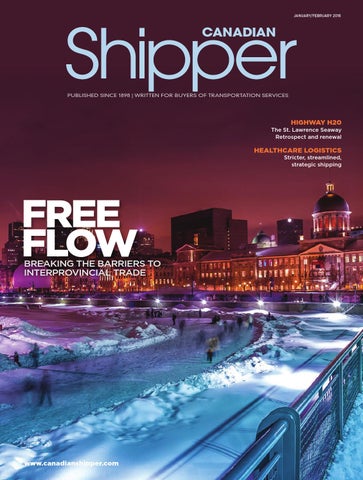
FREE FLOW
BREAKING THE BARRIERS TO INTERPROVINCIAL TRADE
www.canadianshipper.com
p01-02 CdnShipper JanFeb2016-2.indd 1
16-01-15 10:50 AM
When your cargo needs help to keep its cool AC AbsoluteËš and AC Pharmacair, two distinct solutions within our AC Cool Chain family, are designed exclusively for the air transportation of healthcare and pharmaceutical commodities, either in active temperature-controlled containers or passive packaging. With a global network of certified stations and fully trained staff, your shipments travel quickly and safely around the world. To find out more, visit aircanadacargo.com.
AC AbsoluteËš
an AC Cool Chain solution
ACC520_CanShipper_FP_Pharma_ENG_012016.indd 1 p01-02 CdnShipper JanFeb2016-2.indd 2
AC Pharmacair
an AC Cool Chain solution
2015-12-22 4:55 PM 16-01-15 10:50 AM
CONTENTS
JANUARY/FEBRUARY 2016
DEPARTMENTS
12
6 | Editor’s Forward On volatility and challenges for shippers in 2016; introducing our "Retrospective" and "Coaching Corner".
COVER STORY
Interprovincial Trade
8 | In the News
As an export nation Canada strives to create better links abroad, but how do we fare in breaking down the barriers to trading within our own nation?
Supply and demand, railway mergers and corporate sustainability, a new mobile app and congratulations to our publisher!
42 | Inside the Numbers Transportation spend numbers from our Buying Trends research. 44 | The Bigger Picture Freight transportation’s new economic paradigm.
The Fair Rail Freight Service Act Examining the remedies available to shippers for rail service issues.
©Vlad_Pod/iStock/Thinkstock
22 View of an icy skating surface in Montreal, Quebec, host of 2016 Cargo Logistics Canada.
FEATURES A BETTER OUTCOME | 18 SCI Logistics and 3SO’s collaboration in streamlining shared services.
UNIQUE AND SECURE | 20 How an anti-counterfeiting tool can help the pharma industry.
TRANS PACIFIC TRADE PACT | 26 Modernizing logistics practices to benefit from this new trade pact will be key.
continued
www.canadianshipper.com January/February 2016 3
p03-07 CdnShipper JanFeb2016_CONTENTs.indd 3
16-01-15 12:17 PM
Hercules Driver-CSA ad4-8.125x10.875 V7:Layout 1 13-11-01 10:11 AM Page 1
TIRED OF INTERMITTENT CSA SERVICE? Hercules has your Customs Self Assessment solution - guaranteed! We can move CSA and non-CSA freight on the same trailer and all drivers are CSA approved.
1.800.822.4512 Canada 1.800.621.8723 USA herculesfreight.com
p03-07 CdnShipper JanFeb2016_CONTENTs.indd 4
16-01-15 12:17 PM
WHAT’S ONLINE
continued
EMANIFEST | 28 The technology and processes that aim to streamline the crossborder process.
HIGHWAY H2O | 32 Highlights from the St. Lawrence Seaway annual conference.
SUPPLY CHAIN VISIBILITY | 35 End-to-end visibility in the supply chain-feasible and possible?
SUSTAINABILITY REPORTS | 37 What are they, how and why do we generate them?
A FIRST OR LAST FRONTIER? | 39 Optimizing packaging for better supply chain management comes down to “simple” math.
CASE STUDY | 40
WEB TV Transportation Matters
Looking at the food safety audit preparatory process.
SUPPLYING STANDARDS
RETROSPECTIVE | 41
15 occupational standards now linked to supply chain.
Canadian Transportation magazine 1967: the Seaway in perspective.
SELLING TRANSPORTATION How changing technologies could affect transportation patterns.
32
BLOG BITS Search our blog archives at ctl.ca
Carolina Billings Goodbye “E-commerce”, Hello “M-commerce”! Faster, sharper and always at your fingertips. If electronic-commerce “E-commerce” revolutionized the way we shopped, mobile-commerce “M-commerce” is taking things up a notch. Make it a HUGE notch !
Dan Goodwill
40
Some KPIs to Monitor the Transportation Industry in 2016 There are a host of economic indicators that provide economists, academics and transportation professionals with insights into how the general economy is performing.
Find us on Twitter at: @CanadianShipper
|
@LouSmyrlis
|
@JuliaKuzeljevic
|
@JamesMenzies
|
@FleetExecutive
www.canadianshipper.com January/February 2016 5
p03-07 CdnShipper JanFeb2016_CONTENTs.indd 5
16-01-15 12:17 PM
EDITOR'S FORWARD Julia Kuzeljevich
One road, one bridge, one big country…
T
raditionally, January is the month people start afresh, and try to initiate change for the better. I’m not recommending adopting binge-purge juice diets or aiming for unrealistic expectations of self-betterment. Having said that, everyone could use a little life coaching from time to time, and so I look forward to the life and job coaching editorial that our new columnist and current blogger Carolina Billings is offering in her Coaching Corner. On a heavier note, 2016 is likely to be a cautionary tale for trade. According to economic predictions at press time, the world economy is running low and slow. As we were going to press, the Canadian dollar reached a 12-year low as crude oil prices continued falling, and stocks were plunging following China’s devaluation of its currency and an early closing of its stock market to stem the market’s sell-off. The low Canadian dollar vs. a strong U.S. currency and the general fallout from exchange rates will have many implications for trade. We will certainly focus on this as the year rolls out. Volatility remains the name of the game for shippers and the transportation community. Social volatility, in the geopolitical realm, with mass migration and acts of terrorism, will in certain ways also impact trade and the costs of transportation from a risk perspective. Many of the challenges are not new. Everything is cyclical, and adaptation is key. As always, the leading players in our industry will no doubt meet the challenges head on. One of those challenges is planning around the unexpected. Our cover feature this month looks at interprovincial trade and the builtin barriers between provinces on issues such as labour mobility, carrier regulations and trade protectionism. But one of the top barriers to interprovincial trade lies in Canada’s geography, climate and apparent lack of good infrastructure. Mid-January, the newly-built Nipigon River Bridge located in Northern Ontario split because of the cold, severing the only transportation link between Eastern and Western Canada – the TransCanada Highway. The bridge opened to one lane a day after a piece of its decking lifted more than 60 centimetres. The Trans-Canada running through Nipigon is the only major highway in the area, and the Nipigon River Bridge is in the midst of a twinning project – a $106-million rebuilding that will see the old structure replaced with two identical, two-lane expanses. The city’s Mayor Richard Harvey said at the time of the clo-
sure the only option for motorists crossing northern Ontario was to detour through the U.S. “It’s not just us. It’s all of Canada that has a problem right now,” he told reporters. “This is the one place in Canada where there is only one road, one bridge across the country.” Ontario’s Minister of Transportation Steven Del Duca, meanwhile, stated “I take the safety of our roads and bridges very seriously. Understanding the major impact this closure has on traffic and local communities along the Trans-Canada Highway, I have spoken with Minister Michael Gravelle (Minister of Northern Development and Mines) and Mayor Richard Harvey and assured them that MTO will do everything they can do to restore the bridge quickly, while also making sure that the safety of the travelling public remains of paramount importance.” The Ontario Trucking Association advised that trucks operating above Highway Traffic Act (HTA) limits for weight were temporarily not being permitted to cross the bridge. Authorities did not have a definite timeline when the bridge will reopen fully, and carriers were being told they should expect lengthy delays in the meantime. OTA said that Canadian carriers “are legally able to move Canadian goods in transit through the US provided the carrier is able to supply an eManifest to USCBP, including the value for all shipments on board – something, admittedly, that to date has been the biggest obstacle for Canadian carriers wishing to move in-transit.” The association contacted USCBP and the Government of Canada to “consider temporarily allowing paper in transits without value for the purposes of an emergency contingency. OTA and CTA will apprise members on its discussions with both US, Canadian and provincial authorities on contingency options going forward,” the association said. Canadian Shipper will endeavour to keep an eye on infrastructure issues new and old as Canada’s new federal government unveils any plans for stimulus in this realm. In addition to our coaching column from time to time we will be offering you a retrospective page which will look back at the top issues of the day in our publication’s past, and how those issues have evolved. What issues still remain challenges for shippers, and what approaches will they take to resolve them in the current context? This month we take a look at the St. Lawrence Seaway in retrospect, and this complements our main feature on the Seaway following H2O’s annual conference late in the fall. As the year goes forward, we would like to invite our readers to weigh in on the issues that most concern them, or to offer commentary or suggestions regarding the editorial. CS
Write to us at Canadian Shipper, 80 Valleybrook Drive, Toronto, Ontario, M3B 2S9, or e-mail the Editor at : Julia@newcom.ca 6 January/February 2016 www.canadianshipper.com
p03-07 CdnShipper JanFeb2016_CONTENTs.indd 6
©OnstOn/iStock/Thinkstock
16-01-15 12:18 PM
Melissa Farley
Analyst, Service Recovery MOL (America) Inc.
ASSIGNED SERVICE ESCALATION:
TICKET ASSIGNMENT SPEED*
N OV E M B E R 2 0 1 5 TARGET: 90%
What’s behind a number? People. People like Melissa Farley. Professionals committed to the highest level of service. Whether it’s service escalation, quick booking turn times, prompt responses, or fast rate quotes, a top-notch team is in place in our Shipment Management Center. Review all of our fresh KPI results at CountOnMOL.com.
* Defined as the percentage of tickets assigned to a service recovery team analyst in less than four hours.
p03-07 CdnShipper JanFeb2016_CONTENTs.indd 7
16-01-15 12:18 PM
IN THE NEWS
SUPPLY EXCEEDS DEMAND IN GLOBAL ECONOMY: ECONOMIST The aftermath of the Great Recession in the advanced economies has led to a difficult post-catastrophe financial landscape, said Aron Gampel, VP, Deputy Chief Economist with Scotiabank, and a speaker at the Highway H2O conference this November in Toronto. “The global economy is still in tough shape. Growth has continued to decelerate-it remains far less than the average of 4% that we traditionally had. We are barely scraping the barrel, running around 3% growth rate.There is too much supply, not enough demand around the world,” he said. Gampel said that there is a climate of financial market volatility and risk aversion. Geopolitical risks are on the increase, and a period of low inflation, in many countries actual deflation, doesn’t help purchasing power. The downside of downturn has been a “confidence effect”. Citing the November terrorist attacks in Paris, France, Gampel said they are not “one solitary issue” but they are another factor adding to the dampening of confidence worldwide. Not only advanced countries, but emerging markets are underperforming, he noted. In India domestic growth is performing well but the country is not the biggest trading nation. Three of the largest economies in South America are in recession, while in China there is overcapacity in many of their export-oriented industries. “Domestic spending is still strong. But commodity markets are in colossal shakeup, as they were already weakening,” he said. In oil markets, the Saudis’ increase of production, to defend their market, caused massive problems in commodities-sensitive markets World trade is still “low and slow”. The ratification of trade agreements should benefit countries like Canada, Gampel noted. The St. Lawrence Seaway’s declining traffic reflects a global problem, Gampel said. “We are awaiting more global orders. U.S. orders are still relatively soft. Industrial activity is still volatile.At the end of last year and beginning this year, the U.S. was going through a tremendous amount of temporary impacts: port slowdowns, bad weather, and an oil collapse. Order
numbers have slid in the U.S.-we are relying on them to pull us along. It is starting to turn around but there hasn’t been a big upturn.The pump is being primed for stronger global growth. “You couldn’t ask for better conditions now: low oil prices, low interest rates, currency realignments, improving U.S. growth, incremental fiscal stimulus, trade agreements. More and more countries will be asked to step up to the plate,” he said. The U.S. economy is coming back-unemployment is back to around 5%. There is also a lot of underemployment in the U.S. “The economy is trying to get through some of the structural adjustments. The inflation rate is low but could gradually creep up and begin the process of creating some inflation spiral,” Gampel said. The U.S. Federal Reserve raised its rates for the first time in nearly a decade in December. “The U.S. has to walk a fine line on higher
BY JULIA KUZELJEVICH
interest rates raising the dollar’s worth.The loonie has lost considerable altitude. The world is in a state of flux with currency.Americans have paid down debt and are in a much better position to buy, and they are buying right now. But they still have debt fatigue.” “The resource sector in Canada remains an underperformer-non resource products are beginning to move, but are growing very slowly at 1-1.5%,” Gampel said. Leading sectors are exchange rate sensitive: aircraft and parts, industrial machinery, electronics, and consumer goods. Canadian business investment is still very weak-businesses are still very cautious. Infrastructure stimulus is the talk of the day, he noted. “Everyone is going to be investing in infrastructure. That will be a positive factor-the question is how much is going to be put into the pie? Trade agreements such as CETA and the TPP should have a positive impact on Canada’s gateways. “We should see more shipments as demand picks up. The TPP allows us to move and to have many more common denominators than we’ve had in the past,” Gampel said. CS
NORFOLK SOUTHERN REJECTS CP OFFER FOR TRANSCONTINENTAL RAILROAD At press time, Norfolk Southern Corp. (NS) had rejected CP’s enhanced offer of December 16 to create what CP called “a truly transcontinental railroad to better serve customers and the economy.” CP expressed its disappointment with the Norfolk Southern response and said it would review strategic alternatives. The railway said it still believes a CP-NS combination would secure regulatory approval “as a seamless coast-to-coast singlehaul service benefits shippers, the industry and the public, and would generate tremendous shareholder value.” Toward the end of 2014, Canadian Pacific had sent an offer letter to Norfolk Southern
Corp. (NS) proposing a business combination that would create a transcontinental railroad “with the scale and reach to deliver improved levels of service to customers and communities while enhancing competition and creating significant shareholder value.” The combined railroad “would offer unparalleled customer service and competitive rates that will support the success of the shippers and industries it serves, and satisfy the U.S. Surface Transportation Board and Canadian regulators.” Among the combined company’s key innovations would be a new approach to terminal access that would change the status quo in U.S. rail transportation: in the event
8 January/February 2016 www.canadianshipper.com
p08-11 CdnShipper JanFeb2016_News.indd 8
16-01-15 12:41 PM
IN THE NEWS
the new company failed to provide adequate service or competitive rates, it would allow another carrier to operate from a point of connection over the combined company’s tracks and into its terminals, CP said. The new company would also give shippers the choice of where they could connect with another railroad along the network, bringing an end to the practice of “bottleneck pricing” to a large number of shippers in the U.S. The combination would aim to alleviate the long-standing issue of congestion in Chicago, which seized into gridlock in the winter of 2014 and hobbled economic growth. By channeling rail traffic away from Chicago, CP would create fluid routes through under-utilized hubs and free up much-needed capacity for other railroads that pass through the city. “We have a responsibility to our customers not to forget that gridlock in Chicago crippled the industry in the winter of 2014 and threatened to cripple the economy,” said Keith Creel, CP President and Chief Operating Officer. “We need to work together as an industry to keep Chicago fluid and the economy growing, and innovation is the key.” A combined CP/NS would create capacity for all shippers without creating the need for more infrastructure, CP said at the outset of the offer. Norfolk Southern released a white paper December 7, 2015, authored by Chip Nottingham and Frank Mulvey, two former Surface Transportation Board (“STB”) members retained by NS. In the white paper, Mulvey and Nottingham explained why they thought a CP+NS merger and related voting trust would have difficulty gaining regulatory approval. (Neither Mulvey nor Nottingham participated in the review of a “major” merger transaction while at the STB and did not consult with CP to ascertain the details of what CP was proposing or might propose before publishing their white paper.) Their white paper was published before CP had delivered its presentation describing the key features of the proposed merger and related voting trust. CS
CANADA’S RAILWAYS “WELL POSITIONED” TO MEET GHG REDUCTION TARGETS
Canada’s railways are well positioned to meet their greenhouse gas (GHG) reduction targets, according to the latest Locomotive Emissions Monitoring (LEM) Program report released by the Railway Association of Canada (RAC).The report documents emissions of GHGs and criteria air contaminants (CAC) from locomotives operating in Canada between 2012 and 2013. “Investments in more efficient locomotives, among other fuel-management technologies and policies, have allowed Canada’s railways to make substantial emissions reductions,” said RAC President and CEO Michael Bourque. Since 1990, RAC said Canada’s freight and passenger railways have reduced their GHG emissions intensity by more than a third, despite increasing freight and passenger rail traffic. According to the LEM Report, in 2013, GHG emissions from all railway operations in Canada declined by 1.6 per cent from 2012. The railway industry’s achievements complement Canada’s goal to reduce overall emissions by 30 per cent below 2005 levels by 2030. This is the third report released under
the Memorandum of Understanding(MOU) between RAC and Transport Canada. The MOU – which encourages RAC’s Class 1 freight, shortline and intercity passenger railway members to voluntarily cut their emissions intensity – and the Action Plan for Reducing GHG Emissions have been extended to the end of 2016. In another report, Canadian Crude Oil Transportation: Comparing the Safety of Pipelines and Railways , commissioned by the Railway Association of Canada (RAC), and published by consultant group Oliver Wyman, railways and pipelines were found to be equally safe means of transporting crude oil. The report found that between 2012 and 2014, Canadian pipelines and Class I railways together transported 252.7 billion gallons of crude oil, and 99.9997 per cent of that was delivered safely without spillage. It also assessed the movement of dangerous goods by rail from 2004 to 2014, and concluded that railways and pipelines have equally strong safety records. “As Canada’s crude oil production grows, railways will continue to be a safe, complementary option to pipelines,” said RAC President and CEO, Michael Bourque. “Our goal is obviously not to replace pipelines as a way to move energy products, but rather, to work collaboratively and be a complement to move these essential goods without incident.” CS
Canadian Shipper wishes to congratulate publisher Nick Krukowski (left, pictured with Canadian Shipper Editor Julia Kuzeljevich), on winning Newcom Business Media’s Jim Glionna award for Top Salesman of the Year (2015).
www.canadianshipper.com January/February 2016 9
p08-11 CdnShipper JanFeb2016_News.indd 9
16-01-15 12:41 PM
IN THE NEWS
NEW MOBILE APP OFFERS CUSTOMER OVERVIEW OF TEMPERATURE SENSITIVE SHIPMENTS Just before Canadian Shipper was going to press in early January, DHL Global Forwarding released the LifeTrack mobile app for customers. The free application, available for iOS and Android, grants users on-the-go access to DHL’s proprietary online cold chain tracking and management platform through its Thermonet network of Certified Life Sciences Stations, the company said. The app also complements the DHL ActiveTracing solution to track and trace groupage shipments, and the Cargo Mobile Tracking app to trace sea and air freight shipments. LifeTrack allows customers to access an overview of their shipments, alerts about any in-transit issues such as temperature excursions, and instant support through roundthe-clock access to cold chain experts. “Customers want peace of mind on the go.With time critical shipments if anything is not going according to plan they want to communicate with the global team,” said David Bang, Global Head of DHL Temperature Management Solutions/CEO LifeConEx, DHL Global Forwarding. The company offers two distinct product lines: ThermoNet, and LifeConEx, and any customers currently using either or a combo of both have automatic access to the app. Over 100 companies are currently using the LifeTrack system. “We’re encouraging them to use the mobile app for information on the go. We believe this will pick up fairly quickly and be a seamless transition from website to mobile app,” Bang said. Customers are under pressure on regulatory compliance. How do they optimize? “There are three fundamentals: there has to be a very clearly documented process between the players. Sometimes this process can be quite complicated. When it comes to compliance, this process has to be matched with every single shipment. It’s not just about tracking and tracing, there are all kinds of other processes that need to be integrated. Continuous improvement is part of the process. We believe that the technology is an enabler. Mobile apps will break the communication barriers, espe-
cially in the emerging markets.When those shipments are going into those countries, they might not have PCs or laptops available to them. But all of them have a mobile phone. We believe that this technology can link everybody. We are looking into extending this mobile phone app also to nonDHL employees, i.e. brokers,” Bang said. With regard to harnessing Big Data, LifeTrack and the mobile app may be able to help turn that data around, mitigate temperature risks and move temperature sensitive cargo better, Bang said. “We hear this from customers and we plan to work on this in 2016,” he added. Healthcare logistics is a major growth industry and from DHL Global Forwarding’s perspective, the number one challenge is complying with GDP (Good Distribution Practice) regulations. GDP doesn’t give the customer any specifics about the transport or temperature controlled packagingjust guidelines around reporting etc to regulatory authorities. It is still very much a variable market in terms of solution. “As much as it gives the guidelines it doesn’t lock you into a specific solution or market-that is stll a bit of a challenge. We work with all the pharma companies out
there and the different solutions they have,” said GaryVince, Head of Air Freight , Canada, with DHL Global Forwarding (Canada) Inc. “The pharmaceutical industry is working hard to try and become as compliant as possible. That includes temperature control. When moving goods from airfreight perspective you need to have assurance,” he said. Sign-off procedures are built around each customer, depending upon the actual supply chain origin/destination. Each transfer point and handoff is monitored. Outside of that companies use their customer-specific monitors put inside the package. “What I’m seeing is that there is a significant change going on in the passive temperature control world: products that are in the 15-25 degree temperature range. That’s still pretty broad-you can move them into a passive solution that doesn’t require batteries. There are also passive packout solutions being brought into the market: here the concern lies with when the carrier is handling the shipment and it’s exposed. GDP has pushed the customer to look at the risk of those. It comes back to the value of the product,”Vince said. CS
10 January/February 2016 www.canadianshipper.com
p08-11 CdnShipper JanFeb2016_News.indd 10
16-03-02 1:45 PM
p08-11 CdnShipper JanFeb2016_News.indd 11
16-01-15 12:41 PM
INTERPROVINCIAL TRADE
A RENEWED AGREEMENT ON INTERNAL TRADE COULD BREAK INTERPROVINCIAL BARRIERS BY CAROLYN GRUSKE
uskoka Brewery had been doing what all businesses were supposed to do: growing and expanding. The craft beer company, which was founded in Bracebridge, Ont. in 1996, had matured from a small, local start-up into a venture that supplied suds to thirsty beer drinkers in most parts of Canada. The company even launched an American pilot program in and around Buffalo, New York, in order to figure out the best logistics and business models to use outside of the familiar Canadian environment. But in October 2015, government actions forced Muskoka Brewery to alter its domestic distribution model.
In its budget, the province of Alberta raised the taxes on alcohol, including beer by five percent. But more importantly, the government also changed the way it calculated graduated tax rate for small producers headquartered outside of Alberta, British Columbia or Saskatchewan—the three provinces that signed the New West Partnership Trade Agreement. According to Muskoka Brewery president Gary McMullen, that alteration meant the Ontario company couldn’t compete on a level playing field with local Western producers as the cost of a six-pack was set to rise approximately $2, from roughly $16 to $18 (or $20 for some of the company’s premium offerings).
“We couldn’t absorb that increase and we didn’t think it was palatable to pass onto our consumers,” said McMullen, so that only left one course of action: pulling out of the Alberta market entirely. Reaching that conclusion, however, meant making decisions about other aspects of the company’s western business. “To make the West make sense, we need to combine shipping and logistics. Without Alberta in the center, it doesn’t work,” he said, explaining why the Muskoka Brewery was also abandoning the markets in B.C. and Saskatchewan. McMullen said beer destined for Western Canada was shipped from the Brace-
12 January/February 2016 www.canadianshipper.com
p12-17 CdnShipper JanFeb2016 Interprovincial.indd 12
16-01-15 12:48 PM
INTERPROVINCIAL TRADE
bridge warehouse by truck or, during the off-season, by temperature-controlled rail cars. (A second warehouse in Toronto only supplies Ontario restaurants.) Admittedly, Ontario and Quebec accounted for 60 percent of the brewery’s business, but the Western operations were growing, and the decision by the province wasn’t one McMullen was expecting. “We knew the Alberta government was updating the tax structure, but we had no forewarning they were making this major move.” Although McMullen, like anybody who is engaged in the production or distribution of alcoholic beverages in Canada, understands each province has its own taxes, regulations and administration and that navigating those is just “part of the game to be in the market,” he also feels dealing with the various jurisdictions has become a “barrier to business as it’s harder to navigate these waters.” “What we need from government is stable policy.” In contrast, Muskoka Brewery’s experience in the US has left him with the impression that American governments make it easier for business to compete. “They believe the role is to set policy and get out of the way.” Still, he understands governments have the impetus to protect local businesses and local jobs, and to grow the provincial economies, but he thinks “there has to be a better way to do this that doesn’t believe protectionism is the solution.” Balancing the desire for open interprovincial trade and the need to protect local provincial businesses and economies is a juggling act that has been going on longer than Canada has been a country. Section 121 of Canada’s Constitution Act of 1867, for example, states that trade should flow freely between the provinces, without hindrance: “All Articles of the Growth, Produce, or Manufacture of any one of the Provinces shall, from and after the Union, be admitted free into each of the other Provinces.” In practice, however, provinces exercised their powers of taxation and regulations (granted to them in the same Act) and courts interpreted clause 121 as narrowly as
possible, resulting in a country that, to this day, is beset with interprovincial trade barriers, confusing and competing regulations, and a business environment that poses challenges for those who want to access markets across the country. Today, trade barriers come in a number of different forms.The Canadian Federation of Independent Business identifies four types in a research paper entitled “Building a New East Partnership.” Along with natural barriers (physical or geographic obstructions or limitations), it names prohibitive laws (such as those banning the sale of alcohol to customers in other provinces), technical barriers (like industry specific regulations including vehicle weight and dimension standards), and regulatory and administrative ones that require businesses to qualify for permits, get licensed, and fill out paperwork. According to the CFIB, it is this last category especially that tends to cause the most daily hassles for small businesses. “A lot of those challenges seem silly, with different provinces setting up just slightly differently regulations, but it’s fixable,” said Erin McGrath-Gaudet, CFIB’s director for PEI and intergovernmental policy. One way that can be done is for provinces to come to agreements based on mutual recognition. Instead of trying to get different jurisdictions to agree to make every regulation the same and harmonizing all their rules, they need to respect the differences and take the approach that “if it’s good enough for one province, it’s good enough for us,” she said. Of course, there are times harmonization makes the most sense, and according to the president of the Freight Management Association, Robert Ballantyne, work is being done to make it easier to truck goods across the country. “There is reasonable goodwill to try for some further harmonization on truck size and weight limits,” he said noting that every November ministers and officials from provincial transportation departments meet with the goal of creating consistent and simplified rules, all while recognizing the roads were constructed to different standards in different provinces. Still, he is able
to point to some successes particularly in the use of LCVs in all jurisdictions with divided four-lane highways. “Clearly, shippers would like to see as much harmonization as possible. It makes a lot more sense.” Failure to have freer, more open trade barriers is something that businesses see as an impediment to not just national trade but international as well, said John Treleaven, director of the Forum for International Trade Training (FITT) and president of The Treleaven Consulting Group Inc. “How do you construct a globally competitive economy when Canadian companies are restricted from trade in all parts of the country?” he asks. “When the longer we wait, the more it costs us all?” For example, he cites the case of costs passed through to customers as rail companies are forced to pay a range of taxes on diesel fuel used by locomotives. “Companies never pay a tax, their customers pay it. The government of Saskatchewan is imposing an extra cost on farmers and producers in the guise of good politics,” said Treleaven, noting the tax is higher in Saskatchewan than in some neighbouring provinces, in part driving rail companies to either route trains south of the border or to pass along charges to farmers and others who move goods through the province. Even when intentions by the provinces are designed to support the overall national good, such as developing their individual strategies for tackling climate change and reducing greenhouse gases, businesses are likely to have to pay extra when faced with the smorgasbord of regulatory approaches. “If it impacts the access to one provincial market, it affects everybody from one supplier to another,” said Treleaven. Although he has seen some changes implemented to make it easier for workers to apply their trades outside of their home province, the managing director of the Macdonald-Laurier Institute, Brian Lee Crowley, said the labour force isn’t exempt from encountering interprovincial barriers either. “Labour has it better than it was,” he said, “Canadians are able to move out of declining industries, but there are still too continued
p12-17 CdnShipper JanFeb2016 Interprovincial.indd 13
www.canadianshipper.com January/February 2016 13
16-01-15 12:48 PM
INTERPROVINCIAL TRADE
continued from p. 13
many barriers. It’s still too hard to do for individuals with specific skills and trades. For unskilled labourers there are no barriers. For skilled labour, there are higher levels of certification required. That’s the reverse of what we want for the country.”
While it has seemed to some that improving interprovincial trade was an idea that had stagnated, recent efforts seemed to have breathed a new spark of life into the concept. As mentioned earlier,
CAPACITY
Where you need it. When you need it. Endless possibilities.
Logistics
Special Services
Intermodal
Truckload
Capacity isn’t easy to come by these days. At Bison, our suite of transportation services is expandable and adaptable to provide a capacity solution that is exactly WHAT you are looking for. Call us today for details!
1.800.GO.BISON marketing@bisontransport.com bisontransport.com
14 January/February 2016 www.canadianshipper.com
p12-17 CdnShipper JanFeb2016 Interprovincial.indd 14
three wester n provinces have already agreed to the New West Partnership Trade Agreement, and this spring promises the emergence of two new deals: the Agreement on Internal Trade (AIT), which was initially created in 1995 to establish trading rules amongst all Canadian provinces, is expected to be revamped and reintroduced in March, while the Maritime provinces of Nova Scotia, New Brunswick and Prince Edward Island are also working to the spring launch of a partnership deal similar to that of the New West Partnership. “Within the region we definitely see interest within Nova Scotia, New Brunswick and PEI. They have ambition around increasing trade and recognizing that can lead to economic growth. Making it easier for businesses to do business helps everyone. It’s the rising tide that lifts all boats. If we can make it easier to trade within our jurisdictions it will help us. It will help companies,” said Paul Gillis, executive director for the Nova Scotia department of Intergovernmental Affairs. “I think the commitment by the Nova Scotia government is we recognize trade is vital to our growth. In Nova Scotia, the economic development platform of the government is to double our exports in 20 years. We know we can’t do that without making it easier for companies to export. We feel that facilitating and making it easier to do business between provinces is necessary to reach this target of growing our exports,” he said. According to Gillis, at this stage the government is currently asking businesses to offer their input about which regulations in particular are challenging to negotiate across provincial barriers. As for the AIT, Nova Scotia, like all of the provinces, is working equally hard to see it is signed. “We are entering that with the same ambition we are taking with the work we are doing in the Maritime provinces. We know that interprovincial trade is good for economic growth, so we are in those discussions with an ambitious perspective versus a protectionist perspective. “Let’s just say there is a lot of effort going into this and everybody is focused on getting an agreement that makes it easier to do business in Canada. The premiers gave direction to their offices in Charlottetown in 2014 that they want an ambitious agenda that makes it
A M Tr A M Je C C M E S S S M B C P A Ta W Jo W C M M A K P S
continued
16-01-15 12:48 PM
CTCS/C
CTCS
Certified Trade Compliance Specialist
THE MARK OF TRADE EXPERTISE The CTCS (Certified Trade Compliance Specialist) designation > recognizes the experience and expertise of international trade compliance professionals, > sets a standard for ongoing professional development in a field where change is constant, > supports a network for information sharing and collaboration.
The Canadian Society of Customs Brokers is proud to present the CTCS (Certified Trade Compliance Specialist) Designates of 2016 Alberta Merima Alicajic Trevor Bye Allan Corbett Maria Eugenia D’Aloia Jeffrey Fraser Colleen Jennings Cathryn Kirby Adshade Marcia Kobe Elaine Lamb Susan McDonald Steve Spoljarevic Sandra Teed Michael Theodore British Columbia Carol Brown Paul Courtney Allison Douglas Taryn Hannah Wyatt Holyk Jolanta Krasucka William Lee Chun Hui Eric Ma Maria Mate Marc McLean Amanda Miles Ken Nord Patricia O’Malley Stacy Physick
Calie Schumacher Cherie Storms Margaret Tam Gloria Terhaar Gail Wright Melissa Wright Michael Fraser Wright Manitoba Wade Barr Bruno Biondi Darcy Calder Alan Dewar Donna Fetterly Nyree Menzies Valerie Michaud Barb Miller Kim Ross Hayley Dawn Shirtliffe Corey Tkach New Brunswick Shelley Gares Janice Percy Alex Piedrahita Newfoundland & Labrador Kelly Blenkinsopp Brian Collins Ronald Malone Michael Murphy
Ontario Danielle Adair Jamal Ahmed Mehmood Ali Gillian Allan Fahmida Arab Deborah Axford Kathy Barzal Jennifer Beamish Sarah Berlato John Brooks Steve Bunda Kim Campbell Ganase Carlton Marcos Cervantes Laflamme Hannah Cheng Joseph Ciulla Angela Collins Sue Compisano Hernan Cordoba Linda Cybulski Qi Deng Satnam Dhami Grace Di Marca Kathrina Dibueno Tanya Dietrich Karen Dingle Brianne Earish Matthew Earish Charmaine Easton
Cynthia L. Elliott Sean Everden Peter Xi Fang Emil Fiorantis Wa (Grace) Gao Pamela Garrett Adriana Geleriu Negedeyesus Gessese John Giroux Lynne Glass Martha Goncalves Lisa Gouthro Sherry Graham Warren Green Ann Gruszecki Mary-Anne Hardy Kyle Hartwick M Dianne Hill Vicky Nhon Huynh John G. Jakubowski Branislav Kecman Mary Kennette Rufat Khanaliyev Tomoko O. Kitai Lisa Knight Harmeet Kohli Carol Shu-Qin Kwok Christine Leavoy Jennifer Livick Iris (Wen) Long
Elizabeth Lorincz John Lowe Yen Ly-Yong Christine Macri Rajesh Mamtora Philip W. Mason Raad Mathyos Lorella Mazzotta Vickie McInnis Heather Missouri Usha Mistry Jennifer L. Mitchell John Moccia Penny Moulton Karin Muller Tammy Nanticoke Desiree Norwood Sandra Odorico Adefoluke Odunlami Sherry Parker Laurie Pasher Rakesh Patel Alice Peres da Silva Virginia Petrenciu Katie Petteplace Vassili Popov Antonella Proietto John Quirke Kristin Renaud Joseph Rose
Brian Rowe Amanda Salmond Naeem Sardar Tariq Shaikh Tammy Shaw Candace Sider Catherine Slater Jerry C. Spooner Brian Staples Debbie Stevens David Stockwell Michelle Stokes (Bunbury) Susan Subryan Laura Swanson Simona Talasman Michelle Tamburro Raymond Tang Demi Todorov Jonathan Torres Karen Vallee Kimberly Van Runt Terri Walsh Ruth Webb Meredyth Welsman Ping Ping Wen Jeff Willson David Winkler Dian Wollison Ivy Woo June Zheng
Quebec Melanie Bedard Karen Blouin Jean-Philippe Carfagnini Carmen Dumitrache François Dupuis Marc Filion Robert Gaboriault Natasha Harper Claire Howarth Paul Hughes Pierre - Yves Lafrance Nadine Lépine Lorin Levine April Martinez Margaret Emma Million Kevin Mooney Suzanne Perkins Ronald Racine Ginette Ste-Croix Sandra Walker David Wallace John Weight Lynn Wilding A.J. (Tony) Yakubosky Monika Zanacan Michael Zobin Saskatchewan Barry Frain
For information about the CTCS Program, visit cscb.ca/ctcs or call 1-613-562-3543 CTCS/CTL AD.inddJanFeb2016 1 p12-17 CdnShipper Interprovincial.indd 15
16-01-11 12:48 4:35 PM PM 16-01-15
INTERPROVINCIAL TRADE
continued from p. 14
easier for us to do trade in Canada.That is the basis everybody is at the table working on.” Deron Bilous, Alberta’s minister of economic development and trade, agrees that the provinces are dedicated to producing a comprehensive and thorough blueprint for future interprovincial trade. “The meetings are at a fairly high level. The provinces are putting forth their exemptions. This trade deal is operating the way a lot of them are, which is everything is on the table and then it’s carving things out as opposed to trying to put things in it. The discussions have been going on and the premiers are getting updates on the progress of the negotiations. “As for us, Alberta is an exporting province, so we are looking for opportunities for increasing our access to markets within Canada. We also want to make sure we protect our social services, we protect our economic development and how we want to work with First Nations, those are some of the potential carve-outs, but I think it’s really important to
increase our trade with other provinces and also to remove as many barriers as possible.” In particular the province wants to tap markets in Ontario and Quebec. Bilous believes that it’s not just the provincial governments that are feeling energized by the trade talks, but Canadian companies as well. “I think businesses and industries have a feeling of optimism that this issue which has been traditionally ignored, quite frankly, now has the attention of governments.” In particular, he noted the Alberta government is looking to cut red tape and ease the burden of over-regulation for both the traditional oil and gas energy sector but also for the other diverse sectors within the province. “Alberta has been a success for many, many years, but much of the success has been because of high oil prices, and other sectors had to build their success with very little support from previous governments. “Federally, I think, the new government is
willing to work with their counterparts. I can tell you that personally I am very optimistic that our new federal government will have new ways of looking at things.” Like his provincial governmental colleagues, Brad Duguid, Ontario’s minister of economic development, employment and infrastructure, is focused on the potential of the AIT. “A renewed Agreement on Internal Trade is expected to be more ambitious and comprehensive than the current agreement in terms of scope and coverage. In addition, in contrast to the existing agreement, it will also apply to the broader economy as opposed to only specific sectors.” And as with everybody asked, Duguid believes the deal will go through. “While specific details of the discussions are confidential and nothing is agreed on until a final deal is reached, significant progress is being made. I expect to sign a new Agreement on Internal Trade in 2016,” he said. CS
16 January/February 2016 www.canadianshipper.com
p12-17 CdnShipper JanFeb2016 Interprovincial.indd 16
16-01-15 12:48 PM
p12-17 CdnShipper JanFeb2016 Interprovincial.indd 17
16-01-15 12:48 PM
HEALTHCARE LOGISTICS
A BETTER OUTCOME Solid partnerships the key to efficiency in healthcare logistics BY JULIA KUZELJEVICH
I
n the world of healthcare logistics, collaboration is on the increase as diagnostic companies and pharma are creating partnerships, health systems are sharing information, and payors and manufacturers aim to create solutions around cost and outcome management. With the pace of innovation being on the rise, medical research, product R&D, health information systems, personalized medicine and technology in healthcare are also contributing to health advances, efficiencies and rising costs, even as new entrants disrupt the healthcare industry and pressures increase throughout the system. Increasing regulatory complexity is a top concern among supply chain professionals. Concerns about product safety and tampering have increased. New GDP (Good Distribution Practices) regulations for supply chain have been introduced in Europe, China, and Canada. Median age is on the rise around the world and an aging population is a global phenomenon. The increase in the number of people requiring healthcare services puts pressure on cost. A shift from acute to chronic diseases increases ambulatory care vs. hospital care. Channel strategy emerges as a new requirement for delivering ambulatory service. On the manufacturing side, manufacturers are changing portfolios with some pharma brand companies creating generic businesses 18 January/February 2016 www.canadianshipper.com
p18-21 CdnShipper janFeb2016_Pharma.indd 18
and vice versa. While some look to manage product life cycle from brand to consumer, others are choosing to specialize in specific therapy areas. As a result, M&A activity focused on specialization has ramped up, with 2013 - 2014 activity being the highest in 30 years. Medical device companies have concentrated their product lines around therapy areas. Payors, grappling with increased demand, innovation, and limited budgets, are adopting strategies such as limiting access, higher consumer involvement in decisions, consolidation of payor organizations, shift of healthcare from institutions to the community and home, formation of health networks, and increasing competition. The top trends affecting healthcare shippers in Canada are cost, counterfeiting, handoffs SOPs, sourcing, longer supply chains, and cold chain transportation. “Everyone is looking for a way to reduce costs,” said SCI Logistics’ healthcare logistics expert Brent Hodgson. “The provinces are looking at the consolidation of infrastructure and the initial wave of procurement changes has hit the upper level. What’s next? On the one hand you have hospitals saying, we can’t spend any more so you need to give me a price decrease. The manufacturers are saying, we have to be healthy as well, have to invest in R&D and manufacturing. You’re getting into discussions between
©Fuse/Thinkstock
16-01-15 11:22 AM
HEALTHCARE LOGISTICS
trading partners on both sides.They are starting to say why don’t we collaborate to look at more effective ways to deliver sustainable shipping, reduced costs to the provider side.There’s a lot more activity happening with that.The other trend across healthcare is the ever changing regulatory and quality environments. There is pressure from Health Canada and the FDA around how the product is being protected,” he said. That is challenging in a country like Canada with multiple climate zones, and a limited network of capacity in the transportation environment. A shift to care in the home or “ambulatory care” complicates this further. To achieve success, manufacturers and suppliers are building networks of collaboration, creating nimbleness in the supply chain. The following case study between SCI Logistics and 3SO demonstrates a supply chain solution that represents a slight departure from other models in the third party healthcare logistics market. 3SO, a not for profit organization providing shared services to member hospitals, and supply chain partner SCI Logistics were nominated as one of six finalists for the Supply Chain Innovation Award, which was established in 2005 by CSCMP’s Research Strategies Committee and SupplyChainBrain to highlight and recognize the top players in the supply chain industry when it comes to innovative programs, projects, and collaboration. 3SO was formed in 2008 and struck a relationship with SCI in 2009. 3SO is a shared services organization for a group of member hospitals in southeast Ontario. They were set up to help hospitals in areas where they didn’t feel they had core competency, allowing the hospital to focus on patient outcomes. “They were taking a look at better, more effective distribution of services to hospitals. Hospitals have somewhat of a fixed footprint, and they are always looking at newer, better ways of providing services. SCI came in with 3SO to design a hub and spoke distribution system for the region, with SCI providing order fulfilment and distribution capabilities, i.e. the execution of distribution, transportation, inventory supply and demand planning. The partnership enables 3SO to decrease operating costs and free up resources for the member hospitals. 3SO manages the procurement of the surgical and medical products and SCI takes ownership of the majority of the stock inventory and manages all fulfillment activities to and from the central regional warehouse to each of the member hospitals. This gives 3SO flexibility regarding the range of products they wish to order and full visibility on their component costs while, at the same time, leveraging the consolidated demand from the hospitals for improved regional pricing for members' products. During the design process, there were some challenges recognized around the ability to share and problem solve with regard to the data. For example, there was a lot of inventory in various categories. The aim was to see some improvement in the use of assets such as inventory, and improvement in order fulfilment, specifically improving the availability of primary products for nurses and doctors. They also wanted to improve hospital services considering the levels of risk associated with service outcomes, Hodgson noted. A lot of analytics were gathered around spend, and IT data.
It was a couple of years before all the member hospitals were incorporated into the 3SO distribution model. It’s been fully operational for 3SO and the member hospitals for four years now. “Now that we’ve gone beyond implementation, we are looking to improve the use of working capital. Looking at continuous cost improvements, we’ve been able to look at supply chain execution models that reduce cost. 3SO can now leverage some of what they’ve done to improve the supply chain model. “It’s been a little bit of preventive maintenance on continuous improvement toward the reduction of cost, and towards improved service goals,” Hodgson said. In terms of strategies going forward, he said that as the relationship with 3SO continues to progress, “we’re continuing to challenge one another in a formalized continuous improvement structure. We take a look at interaction from an execution model not only with their products but the inbound side of medical products,” he said. “Through the collaborative improvement efforts the team has put forward, you’re looking at the supply chain in its entirety. The team has really taken a view where they’re looking at supply chain working in harmony from a procurement and execution standpoint. There’s been a shift in the management paradigm: procurement, logistics, and distribution collaborate to produce a better outcome. When we started to get a view of the data, with product moving into our facility, it was evident that hospitals were overserved by the manufacturer, with product delivered whether they needed it or not. Right sizing the inbound supply chain was a priority right away.” On the IT side it improved visibility of how many SKUs were being delivered. “Once they started to implement their data streams with SAP, they quickly realized they had similar products from multiple manufacturers. A lot of these things are not unique but they take a significant amount of improvement to be done,” Hodgson said. In the drug environment, there is a lot of focus on stability testing of the upper and lower limits on their drugs, and on extreme heat and cold. Scientifically can they prove that the molecules are safe at other temperatures for a period of so many days? If they have the ability to go back to Health Canada and restate a label condition this could change the shipping requirement, Hodgson noted. “When a company needs to interline, and pass off to other carriers, ensuring integrity of the service model is easier said than done. Because of the population density, in some cases you have one truck going into a community whether it meets the conditions or not. It’s a risk evaluation-will you continue to do business with them? Typically the outsourced service provider is qualified and service contracts are longer term in healthcare. It’s certainly a longer term agreement in the outsourced management world. It takes a significant effort to establish you as a service provider. The last thing anyone wants to do in this world is harm their brand, where the supply chain was not under control,” Hodgson said. CS Editor Julia Kuzeljevich has been writing about transportation issues for 15 years. Her articles have garnered several transportation and Canadian Business Press writing awards.
www.canadianshipper.com January/February 2016 19
p18-21 CdnShipper janFeb2016_Pharma.indd 19
16-01-15 11:22 AM
HEALTHCARE LOGISTICS
UNIQUE AND SECURE ANTI-COUNTERFEITING TOOL HAS APPLICATION IN PHARMA In September 2015, Systech International launched UniSecure, a universal brand and product protection solution that the company said can uniquely identify and register any single manufactured product. That individual product can then be tracked throughout the supply chain and authenticated at any point via mobile app, anywhere in the world. According to Systech, UniSecure capitalizes on unique characteristics that occur with all printers. A “unique” identification signature is generated from an existing print mark or data carrier, such as a barcode.That unique signature is then stored in the cloud for future authentication using a mobile app. No two printed labels or printed data carriers are identical, because printing is dynamic and affected by numerous environmental and other factors that combine to produce small-scale variations or “noise” in printed marks. Systech started out on the authentication side to validate manufacturers and is now working with pharma and the serialization world, said Darryl Brown,VP, Global Strategic Marketing. Internationalization, outsourcing, e-tailing and the expansion of international trade zones have created enormous complexities throughout the supply chain and product life cycle.This has resulted in a rapid escalation of global counterfeiting issues. “We’ve seen a number of situations happening,” said Lou Arace, Systech’s Chief Operating Officer. “Pharma has a unique number on every product to track it through the supply chain. They are already putting a serialized number on the product.Where we come into play is in layering technology,” he said. Said Brown,“Whenever a product moves through a supply chain there’s a ‘here’s what I’m sending and here’s what you’re receiving’ track and trace. It’s relatively easy to reproduce a label. Increasingly it’s more difficult to track between point A and B.” “What’s unique about our product is that even if all the numbers are all the same, the print is going to be a tiny bit different. At the point of manufacturing when the print is made, we’re taking a picture to make sure the label has the right number on it. There are slight variations in the capture.
It tends to be less disruptive to the supply chain and difficult to reverse engineer.” Counterfeiting is actually enabled by legitimate supply chains, through legitimate credit cards, companies, shippers, and couriers. The 2010 counterfeit market was $75 billion in the US alone, Brown said. “If the firms suspect something is a counterfeit, it could take them weeks, months, to verify it. With our product, we give them the visibility through simple phone apps. That product is valid or it’s not. You can scan it anywhere in the supply chain. We are developing more tools around diversion control as well-many manufacturers feel they lose control once the product goes through distributor channels. There are more opportunities for track and trace to see that the product is where it’s supposed to be, i.e. in the distributor channel,” Arace said. “Our app in its rawest form will allow an inspector, receiving person, etc. to scan a box of goods by barcode. The app tells whether it’s a correct or incorrect code to be validated by the database. It makes it very easy without them having to buy expensive scanners, readers, etc.” “Our intense focus right now is on helping pharma to secure their supply chain with proactive, real time information to see if the product is real.We are working to develop track and trace and diversion control. In the distribution and logistics network they want to be able to track and control that the product is where it has to be. I think at the macro trend level you will see more and more pressure of this as more emarketplace trends happen and more brands and manufacturers are going to want to gain control in securing their product. Some customers want to take it to the next level and engage the consumer,” Arace said. Systech has developed solutions for both serialized and non-serialized UniSecure. Serialized solutions are for large and mid-market pharma as they go through their transition. Serialization in and of itself does not se-
20 January/February 2016 www.canadianshipper.com
p18-21 CdnShipper janFeb2016_Pharma.indd 20
By Julia Kuzeljevich
cure a product, while authentification does. “We see continued growth and development for layering on this technology. We’ve also launched it outside of pharma. One of the main pressing points you hear with large global brands is that it’s not a problem with large, luxury goods but with dollar products, $5 products, etc.” said Arace. “We are trying to focus on both sides, i.e. in a manufacturing environment that doesn’t require them to come up with holograms or RFID that can be reverse engineered. Many technologies are non-additive.We have talked to some manufacturers with up to five different markings on their product. We use a standard UPC barcode. We’re not adding something else to change the product. We are capturing the image, and verifying it later.We’ve seen that, especially in CPG, because they don’t want to add any more complexity to their supply chain,” he said. “Authentication and validation are great. As you look at securing the supply chain, today you have inspectors, tomorrow, your consumers could be validating that product for you,” said Brown. This could have a tremendous impact on consumer recall. The consumer could immediately scan from their home and find out if the product is part of a recall, get a substitute, or find out how to return it. “Pharmaceutical companies are being held accountable for how effective their drugs are. Now, if I could basically say Mary took her meds this morning and when she takes it she scans the bottle, I can give her a warning about interactions. There’s more back and forth with the consumer,” Brown said. CS ©Fuse/Thinkstock
16-01-15 11:22 AM
ATS Healthcare Visit ats.ca
Call 1.877.694.4454
We deliver healthcare in Canada. Innovative solutions for PHARMACEUTICALS NUTRACEUTICALS MEDICAL DEVICES COSMETICS & BEAUTY CARE VETERINARY SERVICES OPTICAL DENTAL
ATS Healthcare developed coast to coast temperature management services with mission critical pharmaceutical shipments in mind. Today, our search for improved technologies has resulted in a full suite of complementary transportation opportunities. We extend and expand upon the careful manufacturing processes employed by our customers - throughout Canada’s health conscious industries. Call ATS Healthcare to discover what we can accomplish for you.
p18-21 CdnShipper janFeb2016_Pharma.indd 21
16-01-15 11:22 AM
SHIPPING BY RAIL
THE FAIR RAIL FREIGHT SERVICE ACT BY JULIA KUZELJEVICH
2 YEARS LATER A t a recent seminar for shippers held by the Freight Management Association of Canada, Forrest Hume, partner with DLA Piper (Canada) LLP, talked about remedies designed to level the playing field for shippers using rail service in Canada. DLA Piper Canada’s transportation group also works with their colleagues in the US to provide information about rail remedies to US shippers and to promote the introduction of similar remedies in the US. Hume said, “It’s fair to say that US shippers envy the type of remedies we have here in Canada.” Over the years, railways have “unbundled” their services, and have issued tariffs applying to features of their operations. The price shippers pay for these “unbundled” services is subject to frequent increases. “In Canada, the trend now is toward greater regulation of the railways,” says Hume. The pendulum is swinging back in favour of shippers, in an attempt to level the playing field with the railways. The most recent legislation to level the playing field related to service is the Fair Rail Freight Service Act. In September 2009, Transport Canada assembled a panel to review of Canada’s rail-based logistics system, focusing on rail service provided to Canadian shippers and customers. In the spring of 2012, following a sixmonth facilitation process, the government tabled the Fair Rail Freight Service Act, which passed in 2013. Shippers can now require railways to enter into a service level agreement (“SLA”). About SLA and SLA Arbitration “The tariff-making power of the railways gives them incredible power if you don’t have an SLA with them.The incidental services tariffs they issue are basically everything that was unbundled from the rate. If a shipper isn’t getting proper service, it can force the railway into arbitration by requesting an SLA. SLA arbitration is not used nearly enough,” says Hume, who notes the railways fight hard and have deep pockets. The SLA that is established through arbitration becomes a confidential
22 January/February 2016 www.canadianshipper.com
p22-25 CdnShipper JanFeb FairRail_1.indd 22
16-01-15 12:30 PM
SHIPPING BY RAIL
contract between the railway and the shipper. Arbitration can cover a broad range of service issues, but not rates or charges. Hume adds, “final offer arbitration is the most effective mechanism for obtaining redress from excessive freight rates”. “Before requesting SLA arbitration, the shipper must make a bona fide effort to negotiate with the railway. Using this process, a number of agreements with the railways have been achieved by shippers without having to proceed to arbitration. If the railway declines to provide the shipper with an offer, or if the railway’s offer is not acceptable, the shipper can provide notice to the railway that it will submit the matter to the Canadian Transportation Agency for SLA arbitration,” Hume says. The Canadian Transportation Agency, one of Canada’s oldest federal administrative tribunals, handles market entry and exit of rail carriers and renders decisions on rail disputes related to certain rates, charges, and levels of service. Under the Canada Transportation Act, the Agency provides facilitation and mediation of disputes, and refers matters to arbitrators for final offer and service level agreement arbitration. “It’s as mature and fair a tribunal as you’re going to find,” says Hume. The Agency is a quasi-judicial body. It has similar powers to those of a superior court, and its decisions follow precedent. In SLA arbitration, an arbitrator must make his or her decision within 65 days from the day the Agency refers the matter for arbitration. An SLA established by the arbitrator is effective for 12 months from the date of the arbitrator’s decision. “It is possible for the parties to agree that the service level agreement determined by the arbitrator will have effect for more than one year, but it bears the risk that you may not be happy with the results. It is up to the shipper to make the case that the service it is requesting is required,” Hume says.The agreement is “final and
binding”, although it is possible for a party to seek judicial review of an arbitrator’s decision. The Canada Transportation Act sets out matters that are excluded from arbitration, which include the existence of an agreement already in place between the shipper and the railway, or the existence of a final offer arbitration or competitive line rate decision that is in effect. Issues that shippers can bring to the table in an SLA arbitration are operating terms, and include such things as the number of cars to be provided, the number of days per week of service, the number of times per day, the number of switches, communication protocols, performance standards, and cycle times, for example. Railways can apply to the Agency within 10 days after the shipper has requested an SLA arbitration to object to the shipper’s request. If the objection is granted, the shipper’s submission for arbitration is dismissed. Railway objections can include a claim that the shipper did not make a bona fide effort to resolve the issues before seeking arbitration, or that an agreement is in place already, or that the issues submitted for arbitration concern a rate or a charge and therefore SLA arbitration does not apply. The arbitration rules are governed by federal regulation, Rules of Procedure for Rail Level of Service Arbitration. Per the Rules, the arbitrator that is selected calls a pre-arbitration meeting between the parties. A second pre-arbitration meeting may be called if needed. Hume notes that, as a shipper, you don’t want to enter an SLA arbitration without at least one rail operations expert to provide a report. At the hearing, each party presents its case and has the opportunity to crossexamine witnesses from the other side. Following the evidence, each party can present its final oral arguments and a decision is made within seven days of the conclusion of the hearing. continued on p. 24
©TomasSereda/iStock/Thinkstock
p22-25 CdnShipper JanFeb FairRail_1.indd 23
www.canadianshipper.com January/February 2016 23
16-01-15 12:30 PM
SHIPPING BY RAIL
continued from p. 23
When it comes to enforcement, if one or more conditions ordered by the arbitrator are not being met, the shipper must file a request to enforce the service level agreement with the Agency . The Agency has significant powers to impose administrative monetary penalties for breach of service level agreements, including administrative monetary penalties of up to $100,000 per day for failing to comply with the arbitrator’s decision. The amount of the fine will depend on the severity of the impact on the shipper, distinguishing serious violations from minor errors. Preparing for SLA Arbitration The best advice for shippers is to make a proposal for SLA Arbitration clear, concise and easy to understand, and to ensure the proposal is reasonable. Important considerations to keep in mind in developing the proposal from the shipper’s perspective are: • the traffic to which the service obligations relate; • the service that the shipper requires with respect to that traffic; • information concerning the shipper’s requirements to service the shipper’s customers; and • description of the level of service that the shipper has been receiving or experienced prior to the railway’s reduction of service, or failure of service (which may be cited as a benchmark for what service is reasonable and achievable, and what the service ought to be going forward). Important considerations to keep in mind from the railway’s perspective include: • the railway’s level of service obligations to the shipper; • the impact of what the shipper is proposing on the railway’s ability to satisfy its obligations to other shippers, which may involve consideration of greater and more complex questions, such as the size of the railway’s fleet of available cars and whether this fleet is adequate to service the industry; • whether the railway is discriminating in favour of other traffic where the railway makes more profit; and • whether the railway has put in place adequate crews and power to provide service to the industry.
Issues that the railway could raise during an Arbitration on Level of Service include the following: • the railway may not want to provide what it considers “premium” service on a low density branch line, claiming that the cost of doing so does not justify the level of service; • the railway may allege that the shipper’s siding or facility is inadequate; • the railway may allege that the shipper does not work 24/7 at its facility and that the shipper will have to begin doing so in order to complement the railway’s 24/7 operation; • the railway may allege that it has congestion and capacity problems on the corridor(s) over which the shipper’s traffic moves; • the railway may allege that its service failures are caused by others in the traffic logistics chain, or weather conditions; and • the railway may claim the shipper should be taking a different remedy. Preparation for the arbitration starts well before the submission is made. Hume advises that shippers should treat this process like litigation. All evidence should be gathered together before the submission is made. Once the submission is filed, the process is expedited. It is therefore important to identify witnesses early on, as witnesses should be involved in evidence gathering and preparing the proposal. The shipper should ensure that evidence is prepared in a manner that makes it easy for the arbitrator to select key elements of its proposal.The proposal should be thorough, concise and compelling. Some other matters for the shippers to consider that are involved in participating in the arbitration itself include: • conducting due diligence on the arbitrator that is selected; • retaining independent expert witnesses; • reviewing in detail the proposal (and all other evidence filed) with the witnesses; • reviewing the railway’s proposal and evidence with the witnesses; • thoroughly preparing witnesses for cross examination; • concentrating on the principles used to establish this remedy; and • considering preparing a written argument for the arbitrator. The legislation requires the shipper’s submis-
sion to include the following information: • A description of the traffic to which service obligations apply; • An undertaking with respect to the traffic by the shipper to the railway to ship the goods to which the service obligations relate in accordance with the arbitrator’s decision; and • An undertaking by the shipper to the Agency to pay the fee costs of the arbitration, if any, for which the shipper is liable as a party to the arbitration. Other points stressed by Hume in his presentation include the following: • the shipper must serve the railway with its intention to make a submission for an SLA at least 15 days before making it or the Agency will dismiss the application; • the Agency will also dismiss the application if the shipper doesn’t demonstrate that an attempt has been made to resolve the matter; • the shipper and the railway must each submit a proposal to the Agency within 10 days of the application for arbitration; • the proposal may include any of the operational terms listed in s. 169.31 of the Canada Transportation Act. These operational terms are more particularly defined in a regulation of the Agency, i.e. Regulations on Operational Terms for Rail Level of Services Arbitration (SOR/2014-192); and • either the shipper or the railway can advise the Agency and the arbitrator that they wish to keep information confidential. According to Hume, shippers should document their good faith attempts to resolve the matters in dispute, and ensure that exclusions from arbitration do not apply. Keep in mind that this remedy applies to federally regulated railways, including those US railways that operate in Canada. Hume notes that shippers should also “keep in mind the potential reaction of the railway - history tells us the railways may vigorously oppose an SLA arbitration application. The SLA Arbitration process can run between $75,000-100,000 in legal costs alone, but given the cost-benefit of taking this remedy, those costs are worth the expense. Hume notes that many of the SLA arbitrations initiated by his firm on behalf of clients lead to a negotiated settlement. “The service level agreement process is the ‘best kept secret’ in the industry” says Hume. CS
24 January/February 2016 www.canadianshipper.com
p22-25 CdnShipper JanFeb FairRail_1.indd 24
16-01-15 12:30 PM
p22-25 CdnShipper JanFeb FairRail_1.indd 25
16-01-15 12:30 PM
TRANSPACIFIC TRADE
Links in the chain SIGNATORIES TO THE TRANSPACIFIC TRADE PARTNERSHIP WILL NEED TO MODERNIZE THEIR LOGISTICS PRACTICES BY KEN MARK
C
anada’s recent signing of the Transpacific Trade Partnership (TPP) treaty with 11 other countries is a dramatic step on its own. But when combined with our earlier inking of the Comprehensive Economic Trade Agreement (CETA) involving the 28-member European Union, upon ratification of both agreements, it will create stronger links with markets totaling almost 1.5 billion consumers across two oceans. The 12-nation TTP group includes our NAFTA partners the US and Mexico along with nine other Pacific Rim countries ranging from established economies such as Australia and New Zealand to Japan. More important, it also includes emerging markets in South America - Peru and Chile, as well as several southeast Asian nations, Malaysia,Vietnam, Brunei and Singapore. Many economists forecast that several of these countries will become drivers of future global economic growth. In September, Global Affairs Canada, formerly known as the Department of Foreign Affairs Trade & Development (DFATD), concluded that Canadian agricultural products would gain from tariff elimination and improved market access especially in Japan, Malaysia and Vietnam. Their combined population totals almost 250 million people. Our exports of fish and seafood products currently face tariffs of up to 15 per cent in Japan and Malaysia. In Vietnam, the ceiling is 34 per cent. After TPP ratification, such exports are expected to soar as the middle classes in the latter two markets upgrade their diets.
26 January/February 2016 www.canadianshipper.com
p26-40 CdnShipper JanFeb2016_TransPacific_E-Manifest.indd 26
As for imports, raw milk will not move Gary Horlick, across the border leaving Canada’s dairy in- International Trade Lawyer dustry supply management system intact. The TPP fluid milk import agreement also requires 85 per cent of imports to be processed at facilities in Canada. In the crucial automotive sector, Japanese cars will enter Canada duty free within five years of TPP ratification. As for auto parts, the new standard requires that 45 per cent of their cost must be based in a TPP member. Expanding two-way, trans-Pacific trade will exert greater pressure on Canada’s transportation & logistics processes and infrastructure. At a recent Chartered Institute of Logistics and Transport in North America (CILTNA) conference, Jeff Heynen, director, Trade Policy, Transport Canada concluded that despite TPP’s ambition, in general, it will have less impact on the transport sector relative to CETA. However, he contends that TPP will extend NAFTA’s openness on Specialty Air Services (SAS) to other TPP parties on a reciprocal basis. As well, the agreement recognizes the importance of “demonstration effect” on future FTA rule making, e.g., disciplines on state-owned enterprises, which are major players in many Asian economies. According to CILTNA president Bob Armstrong, “The investments and collaborative efforts of successive federal and Western Canadian provincial governments under the ©erhui1979/iStock/Thinkstock
16-01-15 11:25 AM
TRANSPACIFIC TRADE
Asia Pacific Gateway initiative will help the Canadian transportation industry position itself to take advantage of the TPP. But it will be important to ensure improving efficiency while smoothing out delays at the Canada-US border so we can remain competitive in this broader trade environment.” More specifically, Washington, DCbased international trade lawyer Gary Horlick concludes that all TPP signatory countries will need to build new infrastructure and modernize relevant processes. Here at home, he pointed out that North American railways must add more refrigerated cars to handle increased traffic in fresh and frozen meat and seafood products. As a result of Japan’s decision to reduce tariff on beef imports from 38.5 per cent to 9 per cent over 15 years, Horlick foresees a need for more slaughterhouses in Western Canada, more specialized refrigerated transport and better handling facilities at ports. He also predicts that Vietnam will replace China as the go-to source for everyday consumer goods such as clothing thanks to its lower production costs, especially land and labour. Among other things, the US removal of its existing 32 per cent tariff on Vietnammade apparel will open up opportunities for North American engineering, consulting and construction firms to design and build new road, canal, and airport and harbour projects throughout South-East Asia. Closer to home, Mexico will continue to rival China as a source for large machinery and other manufactured goods thanks to its lower costs and more predictable delivery schedules. The country is already aggressively expanding and modernizing its transportation network. Signing an international trade agreement is merely the first hurdle in opening up markets between countries. Ratifying the deal is often a different and more challenging task. Yet Horlick predicts that the road ahead for TPP ratification may be smoother than the one CETA faces. He says, “For TPP, if after two years not all signatories have ratified the agreement, it can come into force if at least six original signatories whose economies represent 85 per cent of the group’s total GDP say yes. Since the US and Japan alone represent just shy of 80 per cent of the group’s total GDP, if they agree that’s it.” Despite negative headlines to the contrary, Horlick contends the US will ratify. “That’s because they there are more than
700,000 cattle ranches across the 50 states which, thanks to reduced tariffs will sell more beef in Japan. Politicians on both sides cannot ignore such support.” After the TPP agreement is ratified, it will be one international trade treaty down and one more to go. CS
Ken Mark is a veteran technology expert, who has covered supply chain management since it was called distribution and has documented its legitimization as a critical business function. He holds an MBA from York University.
A higher standard A professional result A CIFFA forwarder Whether you require professional guidance with a single air or ocean shipment, need to charter a vessel or an aircraft, or have project work that means moving an entire plant to the other side of the planet, use a CIFFA forwarder... they’ll go farther and reach higher, to serve you better.
1-866-282-4332 CANADIAN INTERNATIONAL FREIGHT FORWARDERS ASSOCIATION
www.canadianshipper.com January/February 2016 27
p26-40 CdnShipper JanFeb2016_TransPacific_E-Manifest.indd 27
16-01-15 11:25 AM
CUSTOMS TECHNOLOGY
WORKING THE SYSTEM FORGING AHEAD ON THE RULES OF EMANIFEST BY KEN MARK
T
he bad news for trucking firms bringing goods into Canada is that after January 11, they may face possible AMPS (Administrative Mon-
etary Penalty System) fines and delays unless they have registered for the Canadian Border Services Agency (CBSA) eManifest program. Under the new rules, they must electronically transmit accurate cargo, equipment and driver data to the CBSA at least one hour before the truck arrives at the border crossing. In other words, the days of drivers handing over paper documents through a booth window to a Customs agent as the truck pulls in are over.
28 January/February 2016 www.canadianshipper.com
p26-40 CdnShipper JanFeb2016_TransPacific_E-Manifest.indd 28
©iStock/Thinkstock
16-01-15 11:25 AM
CUSTOMS TECHNOLOGY
The good news is that the number of potential unregistered carriers is minuscule. Says Jennifer Fox, Toronto-based vice-president Customs, Canadian Trucking Alliance (CTA) and vice-president Customs and Compliance, Ontario Trucking Association (OTA) “We estimate that only about one per cent of Canadian truckers have not signed up.” According to Fox, the CBSA has an estimated 30,000 carrier ID codes while the Canadian Trucking Association (CTA) has about 4,500 members. But not all of these firms handle crossborder shipments. For other modes such as ship, air and rail, the rules are already in place. However, eManifest regulations for freight forwarders will be announced later in 2016. Among over-the-road carriers, the most likely ones caught napping will be smaller players, especially those that only occasionally handle relevant shipments. Says international trade consultant Carol Beaul of Torontobased president Intelli Trade Inc., “The hardest part for these carriers is providing the CBSA with the proper information about miscellaneous shipments-such as last-minute back-haul opportunities that a truckload (TL) carrier may not normally handle. These may include LTL shipments bound for various receivers, personal goods, customs self-assessed (CSA) shipments, empty loads etc. The CBSA has different data requirements for each of these categories.” Beaul and others suggest that carriers’ first priority, even before enrolling in the program, is that they must understand their obligations to the CBSA under eManifest and to update or upgrade their operations to meet the new demands. Still, for the tiny minority of carriers caught short, all is not lost.
“The pain of meeting the new standards may be enough to push smaller firms to abandon paper-based record keeping and embrace the digital world.” The simplest solution is to engage a third-party service provider such as freight forwarders, logistics software developers such as Descartes, major courier companies including FedEx, UPS and Purolator to transmit the data electronically to the CBSA on their behalf. But carriers must first register their firms and drivers with the CBSA. After such filings are checked and verified, firms can then send the required data by phone or fax to the service providers who in turn pass it on to the CBSA within the allotted time frame. For infrequent users that’s all that is necessary. A second option enables carriers to transmit the data on their own directly to the CBSA through its free Web portal. Firms do not need any special software other than an Internet connection and a supported web browser. However, John Moccia, Fort Erie, Ont.-based compliance manager, Livingston International Inc. estimates that most employees may require 40 continued
Continue to Grow Put your Logistics career in motion. Continuing Education
Register now for Winter 2016
centennialcollege.ca/ce www.canadianshipper.com January/February 2016 29
p26-40 CdnShipper JanFeb2016_TransPacific_E-Manifest.indd 29
16-01-15 11:25 AM
CUSTOMS TECHNOLOGY
to 50 hours of training to become comfortable with the system. While the CBSA doesn’t offer any formal training for using the portal, it does offer useful instructional presentations. Under the third option, carriers, typically high-volume players, can establish a direct EDI (electronic data interchange) link between their own internal IT systems with the CBSA’s network. However, setting up such a connection may require up to three months formal testing before it can be approved and implemented. By complying with the eManifest rules, carriers can avoid AMPS-related fines and delays. According to Moccia, there are five different categories of fines.The most severe are the failure to submit pre-load/pre-arrival information for which the penalty rates for first-, second- and third-level infractions are $2,000, $4,000, and $8,000. As well, there are identical fines for failure to comply with a CBSA notification.
In addition, repeat offenders will also attract greater CBSA scrutiny for all their subsequent shipments, which may lead to secondary inspections causing future delays and possible denial of entry at border crossings. The CBSA is not alone in introducing such a system. Most other customs authorities in the world have implemented or plan to implement similar electronic, time-specific reporting systems.The US version, ACE (Automated Commercial Environment), will be launched in 2016. Since the two systems, eManifest and ACE are compatible, Canadian carriers will be ACE-compliant more or less from Day One. The global trend to require reporting of cargo- and carrier-related data electronically helps boost the efficiency and effectiveness of national border security. Such pre-arrival reports enable customs and other government officials to focus their limited resources on assessing higher risk shipments and carriers since staffs have more time to analyze car-
OUR PROMISES GET DELIVERED Terminal Locations | Mississauga, ON Winnipeg, MB Saskatoon, SK Calgary, AB Edmonton, AB Vancouver, BC Fargo, ND
Regina, SK
"Continuing to Deliver Promises between USA and Canada”
Over 350 Power Units and 800 Trailers
Fully EDI capable Up to date Technology Single point of contact 93 years of experience Cross border TL carrier
Operating from seven terminals in Canada and the USA, we offer swift and reliable truckload service to most of North America. That, combined with our no nonsense commitment to customer service has helped Penner become the transportation provider of choice for customers who need to keep their promises, wherever they need to ship in 2015 North America.
www.Penner.ca Toll Free 866.729.7134 30 January/February 2016 www.canadianshipper.com
p26-40 CdnShipper JanFeb2016_TransPacific_E-Manifest.indd 30
rier- and shipment-related data before goods arrive on their doorstep. As a result, they can determine more precisely which shipments require secondary inspections based on incomplete or suspicious information compared against the carriers’ or drivers’ past records or performance. Carriers complying with the new rules come out ahead by earning CBSA “brownie points” that help avoid any delays by establishing a reputation for being good corporate citizens who transmit timely and accurate data. Besides bringing peace of mind to trucking executives by satisfying a federal agency’s compliance mandate, the relevant data also represents a potential treasure trove of business intelligence that after proper analysis can help make operations more productive and profitable. After all, the data relates to the level of service involving shippers and receivers, not to mention the performance of drivers and equipment. The pain of meeting the new standards may be enough to push smaller firms to abandon paper-based record keeping and embrace the digital world. Moccia explains that the eManifest Portal is simply a transmission channel and not a record management service. As a result to comply with the new regulations, relevant carriers and freight forwarders are required to maintain records for three years plus those for the current year. To do so, they must ensure that they print or download all their submitted documents. This requirement may encourage carriers to introduce back-office document handling and storage software tools that simplify and accelerate finding shipment documents and sharing them with colleagues as well with customers and others. As a result, adoptees will no longer need to rifle through filing cabinets and storage boxes to find the required information. Besides satisfying the eManifest requirements, the data delivers other benefits. Companies need such records for various types of financial, accounting and other types of audits. Since back-office process streamlining software enables carriers to store, access, ©aurin/iStock/Thinkstock
16-01-15 11:25 AM
CUSTOMS TECHNOLOGY
share such data electronically, it can eliminate the hassles of dealing with paper files. In fact, Moccia cites the eManifest system’s ability to issue periodic shipment status updates to carriers, customs brokers and others. For example, if a broker submits a release request to CBSA before a carrier files its eManifest, the agency will automatically send the carrier an eManifest notice about the submission. As well, if the CBSA decides to hold a shipment it will issue a notice to both the carrier and broker. By eliminating such a shipment information “black hole”, eManifest makes it easier for all supply chain players to provide more timely and accurate responses to the perennial question “Where’s my stuff?’ Setting up electronic data management systems is just the beginning for carriers. They must also start looking at other software tools to analyze the data to increase efficiencies by identifying underperformers inside and outside the com-
“Equally important, the eManifest demand for timely and accurate shipment data may start “cracking the whip” among transportation and logistics partners.” pany as well as unnecessary and inefficient practices and processes that can be eliminated or improved.. Equally important, the eManifest demand for timely and accurate shipment data may start “cracking the whip” among transportation and logistics partners. Fox sees a growing trend among carriers to ‘delist’ shippers that are not ready when drivers show up in their yards. That list of concerns now includes ensuring that shippers provide the required cargo data accurately and on time. She says, “The carrier’s job is not simply to ‘load and go’. They also need to get the required shipment data as early as possible.” The arrival of the so-called “single
window” approach will be a transcendent moment [aka Holy Grail] for all those involved in moving goods across borders. Beaul defines it as one-stop shopping at the point of entry for satisfying all the regulatory needs of relevant government agencies. So far, eManifest comes up short since it does not deal with customs duties or final release to receivers. To sum up, Moccia concludes, “eManifest is a major initiative, which modernizes and enhances the commercial reporting and arrival processes. While it improves CBSA’s risk assessment and targeting capabilities, it is not the complete solution involving the entire importing process.” CS
www.canadianshipper.com January/February 2016 31
p26-40 CdnShipper JanFeb2016_TransPacific_E-Manifest.indd 31
16-01-15 11:25 AM
HIGHWAY H2O
Simplifying the Seaway ST. LAWRENCE SEAWAY AIMS TO SHOWCASE HOW IT CAN BEAT OBSTACLES AND SAVE SHIPPERS TIME AND MONEY BY JULIA KUZELJEVICH
T
he number of vessels currently in the Great Lakes-Seaway system had exceeded the fiveyear average at the season’s close just before December 30, as ships made a final push to export grain from Thunder Bay and other Ontario ports. The 2015 St. Lawrence Seaway shipping season mirrored North American and global economic trends, said Terence Bowles, President and CEO of The St. Lawrence Seaway Management Corporation. Across the board, total year-to-date (April 2 through November 30) cargo on the Seaway was 31.5 million metric tons, down 10.4 per cent. “Domestic and cross-border transport of cement, stone, gypsum, aluminum and machinery continues full throttle in response to heightened construction activity and a strong automotive sector. While steep declines in global consumption and pricing have largely curtailed coal and iron ore exports, we are encouraged by the recent surge in grain exports, which once again demonstrates the vital role played by the Seaway in supporting global trading activity.” New business has helped to offset shortfalls with figures from
32 January/February 2016 www.canadianshipper.com
p26-40 CdnShipper JanFeb2016_TransPacific_E-Manifest.indd 32
April 2 to November 30 showing that the St. Lawrence Seaway attracted 1.7 million metric tons of cargo either coming from new origins or heading to new destinations, said the Chamber of Marine Commerce. “New terminal announcements in the agri-food sector are helping to reinforce the Port of Hamilton’s role as a grain hub, with increased grain handling capacity,” said Bruce Wood, President and CEO for Hamilton Port Authority. “Construction-related materials like sand and stone have also been very strong this year, owing to continued population and infrastructure growth in Canada’s most populous region. Heading into the last weeks of the season, these commodities are trending 16 per cent higher than the previous year.” After its own major infrastructure renewal program, Eastern Ontario’s Port of Johnstown has had a record performance this season with ships transporting 784,000 metric tons for the season up to November 30. “This has been a stellar year,” says Robert Dalley, General Manager of the Port of Johnstown. “Overall cargo tonnage so far is up 20 per cent. We’ve seen increases in every category from road salt and aggregates to liquid bulk and breakbulk. Grain transported by ship jumped by nearly 50 per cent, due to U.S. corn ©Thinkstock
16-01-15 11:25 AM
HIGHWAY H2O
coming in for local ethanol production. Project cargo, 26 containers of parts for a Napanee generating station, also arrived for the first time on our brand new 19-acre River Front dock. We also completed the $8.9 million restoration of our Harbour Front dock and this extra capacity will hopefully help us with continued growth next season.” Port of Oshawa investment has also attracted new companies and convinced others to grow. A wholesale distributor of structural steel products has opened a new warehousing operation at the port, creating 30 new jobs. Construction was recently completed on a new 45,000-foot transit shed, which is in close proximity to the port’s new $4.1 million rail spur. “We’re very proud of what we’ve been able to accomplish over the past year,” says Donna Taylor, President and CEO of the Oshawa Port Authority. Elsewhere, the Port of Toronto continued to see strong levels of imports including salt, sugar and aggregate. Sarnia Harbour has also performed well this season and is now preparing for winter layup. “Grain volumes at the Cargill dock are between 700,000 – 750,000 metric tons, and we have had two over-sized machinery shipments that illustrate the potential for the Sarnia Harbour to become the terminus of a heavy haul corridor for the region’s manufacturing and petrochemical industries. We have 10 ships booked for winter layup and maintenance and that will help employ up to 300 people over the winter,” said Peter Hungerford, Director of Economic Development & Corp. Planning at the City of Sarnia. “We are also seeing the rewards of new investment in Canadian ports and new vessels,” said Stephen Brooks, President of the Chamber of Marine Commerce. “During the past two weeks, that trend has continued with Algoma Central Corporation ordering two more vessels and Parrish & Heimbecker revealing a $40 million investment in a flour mill at the Port of Hamilton.” Speaking at the H2O conference this November,Terence Bowles noted that shippers want door to door capability. The Seaway is a 3700-km “marine highway” running from the Western tip of the Great Lakes to the Atlantic Ocean, with 41 ports on the system and handling $35 billion in economic activity. Bowles spoke of the “challenging conditions” out there. “We’re working hard to match last year’s performance. We are slightly below the five-year average. Overall grain is down somewhat from last year, still a good year across the average. Steel, iron ore, and coal face difficult times,” Bowles noted. Construction activity is picking up, while liquid bulk is a market that varies but overall has had a pretty good year. Wind energy and specialized cargo projects are up. “It’s important to press on and look at ways of expanding our market, to continue to improve our efficiencies. The only way to compete with other gateways is to have lower costs. I’m pleased with the fleet renewal program; new ships keep coming into our system,” Bowles said. Bruce Hodgson, Director of Market Development, for St. Lawrence Seaway Management Corp., said Highway H20 is now up to 52 members with all segments of industry being represented.
Target audiences include European bulk and container shippers and breakbulk shippers. Highway H2O is present at various trade exhibitions including Breakbulk Antwerp and Breakbulk Americas. A new website will be launched soon, which is three-screen responsive, with refreshed branding, quicker loading, and easier navigation, he said. Betty Sutton, Administrator, Saint Lawrence Seaway Development Corporation, said the Great Lakes “represents the world’s 3rd largest economy, 30% of US-Canada activity.We are here to assist the Great Lakes seaway ports, to be a trusted asset and dependable partner,” she said. The SLSDC launched the Great Lakes opportunity belt initiative aiming to reach out to more and more dynamic audiences about the waterway. “We recently brought the message to Capitol Hill about what we do, as well as to business groups.These outreach efforts have been a critical component of our development initiative.We need to work to take this program to a new level. How do we build on the many positive steps? How does the program add value-what would benefit you more to promote business potential and economic growth?” Sutton said. Mark Parker, Partner, Metal Strategies, commented on the steel market and the resulting effect on Seaway traffic. “A few years ago we had reason to believe that demand would pick up and the sector would return to growth. Now suddenly the outlook is flatter than what we had believed even a couple of years ago. Steel demand indicators are mixed. There is surplus steel capacity worldwide and profitability concerns that will put pressure on commodity prices. There’s been a downsizing in iron ore, and steel demand has fallen to 100 million tonnes per year annual basis. At the moment, 28% of the demand for steel is from the automotive sector. That’s a positive for steel demand moving forward,” Parker said. Construction-related demand for steel is at 38% and Parker said we’re looking at about 3% growth expected over the next 5 years. “Energy and industrial equipment demand, however, is falling and is offsetting the other growth. U.S. manufacturers have too much capacity-they are running at a rate of 77 % and that’s continuing to drop. Investment in equipment is flat. Energy related steel demand will be down 60% this year,” Parker noted. Reasons to be hopeful? U.S. oil production is still double what it was in 2008 because of shale. “They are making investments in the viability of it. Shale oil and gas suppliers are now the ‘swing suppliers’. It’s easy to set up and take down a rig. That ability to shut down capacity so quickly is why we’re seeing steel demand drop so steeply,” Parker noted. Two other factors clobbering the steel industry right now are import competition are excess capacity in steel worldwide. Turkey and Russia are key suppliers whose currency has plummeted. “China, the largest supplier, will be the wildcard that will continue to put pressure on the market. U.S. steel mills are running at only 70% capacity rate. China is operating at half its 1.2 billion cacontinued www.canadianshipper.com January/February 2016 33
p26-40 CdnShipper JanFeb2016_TransPacific_E-Manifest.indd 33
16-01-15 11:25 AM
HIGHWAY H2O
pacity and could in theory supply virtually all demand outside its borders. It has small projects that could be coming on board there and it’s going to export its way out of trouble,” he said. In Canada there will be no meaningful growth in steel demand over the next five years. Iron ore will see some demand over the next year because the scrap supply is tight but after that demand will be flat to low. “With the strong U.S. dollar it would be cheaper to import iron ore. The Canadian dollar is low which should help but the leading suppliers, Australia and Brazil, have faced currency depreciation so as a result, these producers will be more competitive than their North American competitors,” Parker said. “Even though car production will grow 3% you are looking at (increased use of) alternative products, to reduce weight. With high strength low allow steels, a 30-50% drop in steel use in cars is possible in future. The real pressure in capacity reduction has to be outside North America,” he said. Competitive comparisons How does the Seaway stack up against other gateways? Cost is the primary driver of bulk/breakbulk shipper routing decisions. “Seaway routings are very cost advantageous for many trades,” Roy said. He cited as examples iron ore from Labrador to the Great Lakes markets, steel slabs from Europe to the Great Lakes markets, and manufacturing steel from the Great Lakes markets to Europe. “The basic message is Seaway competitiveness is relatively safe, aside from the fact that we are captive to what is happening in global economies. Following up from last year on the potential proposal of moving project cargo, we’ve since had the chance to look at that and found the Seaway more competitive than most think. There is a cost advantage vs. Houston for pipe, nacelles, turbines, and mining trucks from Illinois to Western Europe. In some cases, competitiveness is close to the margin. “The competitive cost advantage for other modes is in some cases very slight so changing the balance could help attract more business. What could change the landscape? Pilotage rates, ballast water requirements, Coast Guard navigation,” Roy said. A 2012 competitiveness study offered some recommendations for the Seaway, Hodgson said. “Some specific commodities were identified as potentials: pet coke, met coke, project cargo. The number one criteria shippers tell us is there is no service-not enough vessels.The Seaway needs to do a better job of establishing mechanisms and relationships to package and sell the entire Seaway routing, to promote and make available information about Seaway routing options and related competitiveness,” he said. The study encouraged rate flexibility among transport chain partners to promote the Seaway routing’s competitiveness, and the facilitation of the consolidation of project cargo to promote the establishment of liner services. “Can we incentivize more carriers to come into the system? Deep dives in the market research team were done on pet coke and its main traffic flows. Research has shown we are competitive and
positioned for opportunities in the long term. With regard to the load centre consolidation initiative, the Seaway is found to be competitive with Houston and other centres, with a minimum of 5% advantage. There is a lot of project cargo from the U.S. Midwest to Houston that is being put on rail. We would have a huge cost advantage putting it on a vessel. The major challenge is a lack of capacity,” Hodgson said. The Seaway has had a business incentive program in place since 2008, offering 20% reduction on tolls for cargo qualified as new business. The program has been gaining in terms of popularity with 1.42 total new tonnes and $2.54 million in total new revenue from 2014 to 2015. It’s about simplifying the system, he noted. “The myth is that the Seaway is a complicated system-we know it’s not but we have to get that message out into the marketplace. We’re putting a concentrated effort on showcasing how the Seaway can save time and money. We have put in one direct number for shipping inquiries.That information is then passed on to stakeholders as required.” The Seaway’s volume rebate incentive program offers a 10% refund on cargo tolls applicable to incremental volumes meeting a set of criteria, while its service incentive offers a reduction of 20% on applicable cargo tolls for carriers that implement a new service. Towards a Mid-America freight coalition Ernie Perry, PhD, with the University of Wisconsin in Madison, runs the Mid-America Freight Coalition. Comprising 10 states, the coalition represents 22% of the U.S. population, 23% of the country’s total truck tonnage, and 63% of its total rail tonnage. “There is a broad range of areas or systems we can work in to increase our competitiveness, such as looking at marine highways as corridors, that they need to be collaboration efforts, they need to be leaders.” The Coalition aims to identify opportunities to collaborate, and to increase awareness of and commitment to freight plan activities across the participating states, and to identify and share best practices across all areas of freight planning and development. “We’re in a situation where we have to use all the systems,” Perry said. Ballast water discharge David Reid, PhD, Consulting Scientist with the Saint Lawrence Seaway Development Corporation, said that 44 countries have signed the IMO convention on ballast water discharge standards, but there is concern over the robustness of G8 testing protocols, and over the reliability of original G8 type approved systems. A report proposed revisions to G8, including wider temperature and salinity ranges, fresh water redefinition, and more. “Evaluating compliance in the field is the preferred method, though you can’t go down to a certain level of examining waste, so you look at ‘gross exceedance’. In the U.S., the legal/policy arena remains unstable. Science based improvements to the testing policy and regulations are being incorporated, and alternative approaches and advancements in technology are being evaluated.” We are closer to harmonizing IMO and U.S.- type approval processes. Practical limits for immediate compliance testing are being recognized and alternative measures are being assessed, he said. CS
34 January/February 2016 www.canadianshipper.com
p26-40 CdnShipper JanFeb2016_TransPacific_E-Manifest.indd 34
16-01-15 11:25 AM
SUPPLY CHAIN VISIBILITY
CREATING VISIBILITY ALL THE WAY THE GO-TO STANDARD BY IAN PUTZGER
U
we Glaser, chief executive officer of Cargomind, a Viennabased logistics provider, figures that forwarders will have to up their game to meet clients’ expectations. “I think end-to-end visibility will become standard,” he declares. Integrated express outfits like FedEx or UPS are able to provide this to their clientele, as they control the process for parcel shipments from the moment they take custody of a shipment until it is handed over to the consignee. In order to compete with them, forwarders need this capability, Glaser thinks. The push is also coming from the other end, as shippers are increasingly employing transportation management systems (TMS), notes Jeff Cullen, chief executive officer of Canadian logistics firm Rodair International. “A couple of our multinational clients have invested in TMS projects
©ksenia_bravo/iStock/Thinkstock
p26-40 CdnShipper JanFeb2016_TransPacific_E-Manifest.indd 35
or products and force their forwarders to take them on,” he says, adding that clients are more bent on accessing shipment information down to the part or SKU level. Brian Pedersen, vice president, airfreight at Kuehne + Nagel Canada, remarks that shippers’ appetite for real-time shipment information is probably most pronounced in the pharmaceuticals and aerospace segments, the former owing to concerns about maintaining temperature levels, the latter more driven by need for speed, especially if a spare part is needed urgently to restore a grounded aircraft back to action. Improved shipment visibility will also give a boost to forwarders’ performance levels, reckons Glaser. “I am convinced that if we make the processes visible, quality will come as a consequence,” he says. Moreover, real-time visibility allows forwarders to take corrective action if any prob-
lems along the way are spotted. Kuehne + Nagel has been using wireless chips to monitor temperature levels on airfreight shipments. Initially brought on for pharmaceuticals shipments, this technology has recently been applied to perishable food traffic as well. “Everybody drives towards being able to measure actual movement as opposed to retroactive measurement,” says Pedersen. Glaser reckons that the industry still has some way to go. While some parts of the supply chain have been mapped out, others remain inadequately defined, and even those with clearer milestones require finer definitions, he thinks. Route maps are critical for the job, he stresses. He says that for airfreight shipments the obvious choice there would be Cargo 2000, an industry initiative launched in the late 1990s to develop comparable performance metrics by defining all pro-
www.canadianshipper.com January/February 2016 35
16-01-15 11:25 AM
SUPPLY CHAIN VISIBILITY
cesses and steps a shipment goes through. “Cargo 2000 is still the foundation for that,” agrees Pedersen. The framework is divided into three levels, of which the most basic one covers the airport-airport section, when the cargo is in the hands of an airline. Stage three extends all the way from doorto-door, at the piece level. Only a few large multinational forwarders have reached that level. Kuehne +Nagel was the first to get there. It helped that the company has a single IT platform, remarks Pedersen. “You need high data quality. There is usually a problem if you do not use a single platform,” he comments. At this point many tracking schemes do not start with truckers if they do not have adequate capabilities. In those cases tracking kicks in at the forwarder’s warehouse for the stretch to the warehouse at the other end and may then skip the trucking part to record the final delivery notice. Some truckers lack that capability, Pedersen says. To cover the last mile for its visibility requirements with large clients who ask for a hook-up to their TMS platform Rodair gives truckers an app for tracking.This is fairly straightforward, according to Cullen.“They just need the technology to download the app,” he says. Linking Rodair’s own IT system to these shippers in order to populate their dashboards with tracking data is a considerably more challenging task. “It’s not plug and play,” Cullen says. “Usually there is a huge amount of integration work with that stuff. The forwarder has full-time resources working on these tasks, but they still take a lot of time to complete. “We are in the process of setting this up with one client. We are 11 months into it and still have two months to complete it,” Cullen says. The reward for such efforts lies in a much closer alignment with the customer, who is less likely to change providers. “If you get it right, it makes the relationship with the client much stickier,” confirms Cullen. “These types of integration truly drive a partnership. You have a more intimate sharing of data than in a traditional vendor-client relationship.” This also raises the barriers for forwarders to win business with shippers who have such requirements. Smaller forwarders especially will find it challenging to compete there. The International Air Transport Association has championed industry initiatives like Cargo 2000 and e-freight and tried to prompt technology providers to develop low-cost solutions that deliver the basic functionality to cargo agents who cannot afford the fullyfledged vehicles. Cullen, who is president of the Canadian International Freight Forwarders Association, questions if the organization should drive cheap IT solutions that would allow smaller players to integrate with shippers for end-to-end visibility. “I’m not sure if CIFFA has a mandate to drive this, to say ‘you guys should use this vendor’, but we will inform members what’s out there. I think it’s part of the competitive landscape to decide whether you play or not,” he reflects. CS
Ian Putzger is an award-winning journalist with more than 20 years experience covering transportation and logistics issues. He is a former writer and editor with the Hong Kong-based Asian Sources Media Group, and Airtrade, a British magazine covering the global air cargo industry. 36 January/February 2016 www.canadianshipper.com
p26-40 CdnShipper JanFeb2016_TransPacific_E-Manifest.indd 36
16-01-15 11:25 AM
SUSTAINABILITY
THE TRIPLE BOTTOM LINE GENERATING A GOOD SUSTAINABILITY REPORT
S
hippers are under increasing pressure to respond to the climate change challenge – they must understand, monitor and report their supply chain carbon footprint in order to meet their reporting and regulatory obligations. These reporting obligations are ever more stringent, reinforcing the need for strategy and insight into sustainability reports. While seven in ten companies have commitments to address deforestation in their supply chains, few are translating these into meaningful actions, says new analysis from CDP, a global non-profit which gathers environmental data on behalf of investors. CDP’s study, “Realizing zerodeforestation: Transforming supply chains for the future”, recently launched at the Global Landscapes Forum in Paris. The findings suggest there is a widespread understanding of the business case for action, with nearly 90% of companies identifying commercial opportunities from addressing deforestation. However, without relevant procurement strategies and policies, commitments are not being implemented fast enough. Half (50%) the companies with commitments to source certified soy are yet to get any into their supply chains. For palm oil this is the case for over a quarter (26%) of companies. And while over three quarters (77%) of manufacturers and retailers have standards for sourcing commodities identified as among the largest drivers of deforestation, just over a quarter (26%) provide suppliers with training or workshops on this issue, the report said. CDP’s global forests report 2015 is produced on behalf of 298 investors with US$19 trillion in assets. It analyzes disclosures from 171 of the world’s largest companies – including Cargill, Mars and Unilever – to establish how they are managing four key commodities linked to deforestation: cattle products, palm oil, timber products and soy. With the vast majority of global deforestation connected to agriculture, these four commodities end up in widely-used products from chocolate to biofuels. Companies are already seeing financial impacts from the production of these commodities, including damage to brand value or higher operating costs from regulatory or reputational risks. As the COP21 climate change talks got underway in Paris this December, the Global Shippers’ Forum (GSF) called on the shipping industry to reach agreement on a market-based measure for carbon reduction or risk having rules enforced. The GSF outlined its view on how the maritime sector should ©anyaberkut/iStock/Thinkstock
p26-40 CdnShipper JanFeb2016_TransPacific_E-Manifest.indd 37
BY JULIA KUZELJEVICH
address the issue. GSF wants to avoid a patchwork approach of national CO2 targets which would be complex to manage and wants the shipping industry to be proactive in agreeing voluntary measures. The EU is already proceeding with its own Monitoring,Verification and Reporting system in absence of an IMO agreement. Shippers are dependent on the shipping industry to provide accurate data on emissions and the GSF believes urgent action is now needed to agree targets. “All stakeholders agree that additional measures are needed to reduce CO2 emissions from the maritime sector. The debate now is how to get this done. We believe the International Maritime Organisation (IMO) should retain responsibility for this issue given its strong track record, but more progress is needed on appropriate Market-Based Measures (MBM),” said Chris Welsh, Secretary-General of the GSF. The Institute for Supply Management defines sustainability as “the ability to meet current needs without hindering the ability to meet the needs of future generations in terms of economic, environmental and social challenges.” Paul D. Larson, CN Professor of Supply Chain Management at the University of Manitoba, spoke about the topic of sustainability reports at CITT’s annual conference in Niagara Falls last October. He was also a guest speaker at the Van Horne Institute’s Sustainable Supply Chain conference in late November. Organizations are encouraged to produce sustainability reports for various reasons, whether to be a good corporate citizen, to track what needs to improve, or to use as a marketing tool. For some, a lack of resources could be a deterrent to producing the reports, Larson said. Perhaps they are not sure what to measure. Maybe the reports are low priority. “Maybe you do but you don’t know it. We produce these reports because of accountability/transparency to stakeholders, to improve public perception and brand image, to improve processes, culture and sustainability technology, and to achieve competitive advantage. There’s also the concept of “little s” and “big s” sustainability, he noted. “If we can conserve fuel, and produce fewer emissions, it’s the right thing to do. But is it the right thing to do if it causes us to take a hit on the bottom line?” Traditional logistics objectives look at minimizing total cost while meeting customer service objectives. www.canadianshipper.com January/February 2016 37
16-01-15 11:25 AM
SUSTAINABILITY
Sustainability is all kinds of stuff-how do we condense that into an index? What is it? What are its elements? And how far into the future do you look? “The key timeframe is a year but we have to look beyond all that. In the logistics world, part of sustainability is keeping a good workforce in place,” Larson said. What is sustainability? For starters, it’s got a triple bottom line, said Larson: environmental, social, economic. According to conference-goers, who contributed thought about what sustainability means to them, it could be the practice of doing something to achieve consistent results, it could be not losing what you’ve already accomplished, it could be being as cost-effective as possible, and it could be ensuring resources are not diminished. Some consider that there is a particular urgency to sustainability because of the issues of malnourishment and social unrest. But there is also incredible waste around
the purpose, and the mandate. It considers all stakeholders. It provides comprehensive coverage of the relevant elements. It’s forward-looking. It offers results on policies, practices and performance. Principles for defining the report’s content include stakeholder involvement and maintaining a balanced approach.The report should reflect positive and negative aspects of the organization’s performance to enable a reasoned assessment of overall performance. It should offer comparability, accuracy, and what Larson calls his 5 C’s: it should be clear, complete, concise, compelling, and creative in its form, content, and ideas. Who generates the report? Some organizations might have a director of sustainability, or a structure around it. In a smaller organization, if it’s a logistics operation, ideally someone with an interest in the operations side could look at something around emissions, Larson said. CS
the world in food distribution, and people eating unhealthier diets. The “little s” aspects of sustainability are the “no-brainers, the low hanging fruit”: packaging reduction, lean logistics, idling reduction, Larson noted. This whole notion of producing products halfway around the world and shipping them-the big question is “why is that even happening? They make a lot of money doing it, but do we really need all that plastic?” Larson asked. This leads to the concept of ‘Doing things right vs. doing right things’: in our sustainability goals, do we just look at lean consumption, or should we look at reduction of consumption? The good report So what does a good sustainability report look like? Pressures of the economic side can often trump those of sustainability. “A good sustainability report lays out
π SHIPPING SUPPLY SPECIALISTS
WAREHOUSE ESSENTIALS ORDER BY 6 PM FOR SAME DAY SHIPPING
COMPLETE CATALOG
1-800-295-5510 uline.ca
TORONTO
60 Hereford Street Brampton, Ontario L6Y 0N3
38 January/February 2016 www.canadianshipper.com
p26-40 CdnShipper JanFeb2016_TransPacific_E-Manifest.indd 38
EDMONTON
11504 – 186 Street NW Edmonton, Alberta T5S 0J1
©2014 Uline
©homeworks255/iStock/Thinkstock
16-01-15 11:25 AM
PACKAGING
A FIRST OR LAST FRONTIER? WEIGHING THE BENEFITS OF PACKAGING OPTIMIZATION
J
ack Ampuja is head of Supply Chain Optimizers, and teaches supply chain management to MBA students at Niagara University, in New York. He has also completed more than 500 packaging-related projects. Speaking at the recent CITT annual conference, Ampuja said that while packaging is emerging as a bigger issue it’s not traditionally been thought of as part of the supply chain. “People don’t think about packaging optimization. The big issue is marketing, purchasing, logistics, manufacturing, and quality control,” Ampuja said. Packaging is more typically seen as a marketing or engineering process. Its impact on the supply chain is <10%, its impact on warehousing <20%, but its freight impact is <60%. The opportunities are big, but there hasn’t been much significant progress in the past 15 years. “Dimensional weight pricing and oversize surcharges have added major complexity and cost to courier shipments. Dim weight pricing is applied to all ground shipments smaller than three cubic feet. Because most small package cartons are smaller than three cu ft. virtually all of them are subject to dimensional weight,” Ampuja said. About a third of all small package shipments will absorb the price increase. “Applications vary by courier but are all getting to around 10 lbs per cu. ft. Air shipments are more expensive at 15 lbs/cu. ft. A 12x12x12 box will be billed at a minimum of 10 times. Large couriers automatically weigh and laser scan the dimensions of each package at their terminal and apply the higher of weight or cube charges,” he said. Why is this happening? Small package shippers used to be large sophisticated companies shipping many packages daily to limited destinations, primarily business to business. But today thousands of new, smaller shippers have emerged who are doing e-commerce transactions on a regular basis.This has changed the cost profile ©Jill Battaglia/iStock/Thinkstock
p26-40 CdnShipper JanFeb2016_TransPacific_E-Manifest.indd 39
of couriers which traditionally managed by weight, which is no longer feasible. “A typical e-commerce shipper achieves 60% cube utilization, shipping 40% filler and air. Many boxes are much worse. Box selection with sophisticated shippers is an automated process. But in a manual process packers typically select the wrong box 25% of the time," he said. (Since they’re paid on productivity, and on getting the stuff out the door, grabbing the bigger box makes more sense.)
“Pick pack is not really a packaging issue-it’s more a freight and mathematical problem. Do you want marketing making decisions affecting your freight budget? Why are people absorbing the higher dim weights? It’s a mystery to me.” Jack Ampuja is head of Supply Chain Optimizers The redesign of shipping cases to be more efficient and less costly is possible but the total improvement opportunity is minimal. A consideration: the typical box supplier or packaging engineer cannot resolve package freight cost issues.They do not understand the freight details of LTL or courier pricing. Commercial packaging software cannot do pick pack operations because of the many different items shipping together. Ampuja worked with a Canadian 3PL that had some four million combinations of weight and cube coming out of their distribution centre. The client wanted someone in to resolve it.
Software analysis can measure boxes against unique shipments to develop various analyses. Shippers can minimize their dim weight by: downsizing packages with excessive space between the package and the product, training for the right box selection, using polybags instead of boxes, cutting down box sizes, bringing in their courier for expertise, and by doing on-site assessments. The pricing methodology behind dim weight, looking at a typical cube utilization of manufacturers/shippers and their boxes, would see things like 10 oz. billed as 1 lb, and 18 oz. billed as 2 lbs. It’s a packaging engineer’s dilemma, designing for a ratio of L2-W1-D2. “But a square box is not good for logistics. The logistics world is rectangular. The reality is in a 12 count box of rectangular units there are 324 possible combinations of case pack arrangements/different shipper sizes.With square boxes there is the flap issue,” Ampuja pointed out. Square and cube boxes are more expensive to construct, require more material, and are more difficult to pick and handle. “Pick pack is not really a packaging issue-it’s more a freight and mathematical problem. Do you want marketing making decisions affecting your freight budget? Why are people absorbing the higher dim weights? It’s a mystery to me,” Ampuja said. People also make the mistake of trying to reduce the number of boxes, saving money on corrugate while freight and warehousing costs are too often ill-considered. “Oversize packages create major inefficiencies. Packages do not fit material systems and must be processed manually. A 2006 Walmart packaging efficiency effort required a reduction of packaging by 5%. It resulted in the company announcing an annual savings of 3.5% to Walmart and $7 billion to suppliers. “Most companies can improve by 10%.There is a big opportunity,” Ampuja said. CS
www.canadianshipper.com January/February 2016 39
16-01-15 11:25 AM
CASE STUDY
FOOD SAFETY AUDITS THE PREPARATORY PROCESS
I
n late 2014, Global Distribution & Warehousing, a Mississauga based contract warehouse, decided to become certified through BRC (British Retail Council) under the GFSI quality umbrella. The move was completely proactive, as no existing customer mandated formal certification. Global’s objectives in the venture were to display its commitment to quality for existing customers, and to attract business under that niche in the storage and distribution market. The following discusses the process and Global’s experiences in attaining the BBRC certification. Paul Kurrat, CCLP, Director of Operations at Global Distribution & Warehousing, Logistics and Supply Chain, details the
tain a brand, firms are moving to achieve formal certification. They are also calling on supply chain partners to maintain suitable standards for their portion of a products movement from producer to consumer. Suitable standards may not always mean a mandate to certification,” he said. Networking our intentions: “I knew some colleagues directly in the food business. They were certified through various bodies for different food grade areas. They passed me to their quality people, who in turn listened to our proposal and gave us great ideas for how we should pursue the designation and what we should expect during the process and the inspections.”
“We had no experience in preparing ourselves for a formal process. We chose to use a consultant to help us. It was one of our best decisions in the process. Make sure that the consultant is fluent in the specific designation that you are pursuing.” Paul Kurrat CCLP, Director of Operations at Global Distribution & Warehousing, Logistics and Supply Chain process of preparing to be audited toward a food grade certification under GFSI, namely the BRC certification. The end result, achieved in August 2015 does allow the facility to store food grade materials (but not food). According to Kurrat, the process was onerous. Group/management buy-in: “The process started with discussions and consensus on why, when and how we would proceed. Without a basic plan and without full management commitment, the project would fail. As consumers we recognize that need and application of quality standards to products. Nowhere is that more important than in the food industry, and by food industry, we mean anything that comes in contact with something that we eat or drink, including packaging and machinery. In order to remain sustainable, and in order to main-
Pre-audit: “In order to benchmark where our existing processes stood, we had the facility pre-audited by an outside firm. It gave us a solid footing on where we had to dedicate more of our resources.” Core competence: “Our only experience in inspections was from customer audits of our facility. We had no experience in preparing ourselves for a formal process. We chose to use a consultant to help us. It was one of our best decisions in the process. Make sure that the consultant is fluent in the specific designation that you are pursuing," said Kurrat. Day 1: Assemble a team. This should include someone from IT, a senior manager in operations and operations supervision. This project cannot be done by one person. First of all, the formal audit will mandate a team; secondly, you don’t have time to pre-
40 January/February 2016 www.canadianshipper.com
p26-40 CdnShipper JanFeb2016_TransPacific_E-Manifest.indd 40
pare for this on your own. Assign key responsibilities to the team members, and set timelines for project work. "From that point, we entered into a process that combined meetings, changing procedures, writing procedures and focusing on the physical conditions on the building and the ability to comply with a higher standard of quality." Processes and progress: “We began with meetings with the quality team to address scope of work. We compared existing Standard Operating Procedures (SOPs) to what was required per the BRC standards for storage and distribution. We held bi-weekly status updates with the team, with our warehouse staff and with the owner. From that we re-assessed our progress and made adjustments to the completion schedule. Once we had a critical mass of newly written SOPs, we began to administer them to the warehouse staff. During that time, we also discussed why we were doing what we were, so that we could get buy in to the new quality standard." The many procedures, standards and reporting measures were collated into a binder. That binder was divided into the sections that corresponded with the BRC audit questions. "We performed a mock audit with our consultant. It gave us a final demonstration of how we stood in preparation for the real audit, and we corrected any shortcomings accordingly.” It’s difficult to describe seven months’ work into a few paragraphs. Achieving BRC certification requires a strong commitment from senior management, both in money and in human resources. It must involve all staff at all levels to garner buy-in, and it must include training everyone involved to the new standards and procedures that will maintain a quality based workplace,"Kurrat noted. Global Distribution and Warehousing was certified as meeting the BRC Global Food Safety Initiative in August of 2015. CS ©MartialRed/iStock/Thinkstock
16-01-15 11:25 AM
RETROSPECTIVE
Seaway Retrospective
Canadian Shipper, under its former title Canadian Transportation, featured, in its March 1967 issue, a six-page special report on the St. Lawrence Seaway. Key concerns? While Canada’s inland shipping industry moved a record 57.4 million tons of cargo over the St. Lawrence-Great Lakes trade route in 1966, it said 1967 could be another record breaker. But a “tug of war” was in progress over proposed increases to tolls and the possibility of substantial lockage charges on the Welland Canal. Both Canada and the U.S. opposed waterway toll increases recommended by the two St. Lawrence Seaway operating entities. The Dominion Marine Association stated that “the present is not a time to saddle Canada’s export and domestic trade with cost increases which cannot be dismissed as other than very substantial, and which can only have the effect of lessening the ability of Canadian commodities to meet the competition of goods from other countries.”
www.canadianshipper.com January/February 2016 41
p41-48 CdnShipper JanFeb2016 CoachingCorner_InsideNumbers_BigPic.indd 41
16-01-15 11:19 AM
INSIDE THE NUMBERS
The Price is Right Two thirds of Canadian shippers spend more than $1 million annually in freight transportation, according to our annual Transportation Buying Trends Research. And they are sensitive to price with four in ten acknowledging that higher rates and/or surcharges have affected their use of the different transportation modes. Rail is frequently the beneficiary when trucking prices get too high with 6 in 10 shippers responding to our national survey noting that at least some of their truck freight could be moved to rail.
Canadian shippers’ annual transportation spend
Yes 42%
58%
Not sure
Well above normal levels
Under $100,000
19% 7%
No
Shipper views on current competitive activity among transportation modes
$100,000$500,000 $500,000$1 million
Higher rates/surcharges have affected use of transportation modes
9%
Below normal levels
18%
of shippers
6%
4%
of shippers
$1-$5 million
22% $20 million or more
24%
Around normal levels
22%
Above normal levels
47% 11%
11% $5-$10 million
$10-$20 million
Percentage of current truck shipments consider rail to be viable alternative More than 40% 0% 43%
of shippers
Main reasons for diverting freight from truck to rail in past year
6%
21-30%
4%
27%
of shippers
Poor truck service or coverage
6%
Responding to customer requests
12% 3%
33%
35%
2% 31-40%
Other
Trying to service new markets
11%
11-20%
42 January/February 2016 www.canadianshipper.com
p41-48 CdnShipper JanFeb2016 CoachingCorner_InsideNumbers_BigPic.indd 42
9% 1-10%
15%
Faster inventory times Decreasing rail prices
Increasing truck prices
©iStock/Thinkstock
16-01-15 11:19 AM
We Deliver. Award-winning media for Canada’s supply chain professionals. Visit us at CanadianShipper.com to subscribe today.
p41-48 CdnShipper JanFeb2016 CoachingCorner_InsideNumbers_BigPic.indd 43
16-01-15 11:19 AM
HUMAN RESOURCES
Welcome to The Coaching Corner Wondering how to ask for a raise? How to move up the corporate ladder? How to manage difficulties or difficult people, provide strong leadership or work effectively under pressure? Perhaps you’re in charge of a team that is not working as well as it should; you want to empower team members but you’re not sure how? Finding answers to such challenging questions will define your supply chain career – if only the answers were easy to find. While some people appear able to soar past such challenges with ease, for most of us such questions pose significant obstacles to our growth and success. But what if you had a secret advantage? What if you had a sounding board for your concerns and access to advice based on the experiences of many who have shared the same challenges you are facing right now. What if you had a coach in your corner? That is exactly what I’m looking to provide with The Coaching Corner. I want to introduce you to the insights gained and the breakthroughs made possible through professional coaching. With each issue, The Coaching Corner will focus on the challenges most relevant to you, answer your questions and guide you towards the breakthroughs you are looking to make in your career. I will be your host at The Coaching Corner. Through an extensive career in business and human resources, I have focused my specialties in the areas of leadership, change management, conflict resolution, business development, human resources, corporate coaching and communications. You may recognize me from my blogs on Canadian Shipper. It is the requests for feedback and follow up questions to my blogs which formed the initial inspiration for this column. After all, knowledge should be shared. Depending on the nature of the questions, I will also be reaching out to a roster of experts ranging from business mentors, lawyers, accountants to mindfulness coaches, human resources professionals, and marketing experts. With each issue of Canadian Shipper I will respond to questions submitted confidentially via email to info@thecoachingcorner.ca giving two professional perspec-
BY CAROLINA BILLINGS, CPCC, CHRL, MA-IS
tives to the same issue.To get things started, let’s touch on what leadership and professional coaching is all about. Here are some of the top questions I often get asked: Q | WHAT IS COACHING AND WHY IS IT RELEVANT IN THE BUSINESS WORLD? C | Business coaching is about employee development and performance. But more specifically, it’s about building a solid relationship and working with an individual to achieve positive results. The coach helps others learn from their experiences and motivates them to maximize their performance. Coaching gives the opportunity for an independent unbiased perspective. A great coach knows how to influence others by providing positive and courageous feedback and guidance.
THE COACHING CORNER.CA
PRESENTED BY NLI LABEL
EMPOWERING YOU ONE ANSWER AT A TIME! Because we believe success is for everyone!
EMAIL US YOUR QUESTIONS TODAY
info@thecoachingcorner.ca *No purchase necessary
SPONSORED BY: Visit www.nlilabel.com for more details
Q | WHO NEEDS COACHING AND HOW DOES IT WORK?
Q | HAVE YOU EVER SEEN COACHING NOT WORK?
C | Nobody needs coaching! However, those who wish to succeed WANT coaching. No different than an athlete, an actor, or a public speaker, anybody who wishes to bring their goals into action and improve their performance seeks out the help from someone with knowledge in training and development.
A | Yes
Q | WHAT DO YOU LIKE BEST ABOUT COACHING? A | I
love to see the transformation and the “aha” moments when a client connects the dots or suddenly finds the missing part. There are three methods to breaking down a business challenge: one is called Fulfillment and it works on goals and aspirations. Another is Balance, and it helps people learn how to view things from different perspectives. The final one is Process, and it’s about reflecting on and understanding what is fact and what is holding us back. It is absolutely amazing to see the three methods employed together and the amazing breakthroughs people can experience.
and no. In my opinion, it always brings about clarity, if nothing else. Coaching is about action, it is about achievement. And, as with any type of growth and development, there is practice, work and accountability. Sometimes clients are not ready to begin to actually do what it takes. In such cases coaching helps bring clarity to them that it is not the right time or perhaps not the right goal for them.
Q | HOW IS COACHING ANY DIFFERENT THAN THERAPY OF COUNSELLING A | Coaching
focuses on the present and the future. It is goal oriented and issue specific. Therapy and counselling go back to the past and examine the origin or roots of the challenge. There is also the possibility of it being a long-term relationship. That is not to say a good coaching relationship is not long term, in fact that is often the case. But it is addressing and achieving one agenda at a time, which is set 100% by the client. CS
For more information, please visit www.nlilabel.com or email directly to info@thecoachingcorner.ca Your questions. Your solutions. Your results. Let transformation & empowerment begin!
44 January/February 2016 www.canadianshipper.com
p41-48 CdnShipper JanFeb2016 CoachingCorner_InsideNumbers_BigPic.indd 44
16-01-15 11:19 AM
GET ON BOARD
with SCMA’s supply chain education and let it take you to future success. You will benefit from SCMA’s supply chain education at every stage of your career. Whether you are looking to update your skills or preparing for the next big step on your career path, SCMA has what you need for success.
Supply Chain Management Professional Designation (SCMP)
Pursue Canada’s most sought-after and widely held designation in supply chain management. This rigorous and internationally accredited program is designed to meet the needs of employers by providing graduates with the highest level of professional competency.
Supply Management Training
Courses and seminars are available for early- to mid-level supply chain practitioners that are designed to update or upgrade your skills and knowledge. You will learn to how to support supply chain functions, and related business skills to help advance your career.
Study Online
The SCMP Designation Program and Supply Management Training courses and seminars are offered online to accommodate even the busiest schedule!
Start on your journey to a successful career in supply chain management—enrol now! SCMAnational.ca
p41-48 CdnShipper JanFeb2016 CoachingCorner_InsideNumbers_BigPic.indd 45
16-01-15 11:19 AM
THE BIGGER PICTURE
“
THE NEW ECONOMIC PARADIGM OF FREIGHT TRANSPORTATION The US Economy and the US Dollar The US economy provided a number of mixed signals in December of 2015. Unemployment is at only five percent. Economic growth, while sluggish, has been able to generate a consistent 200,000 new jobs a month. But some other indices don’t look so good. The Institute for Supply Management (ISM) PMI Index of economic activity in the manufacturing sector contracted in November for the first time in 36 months, since November 2012, while the overall economy grew for the 78th consecutive month. The November PMI registered 48.6 percent, a decrease of 1.5 percentage points from the October reading of 50.1 percent and below the 50 percent mark that signals growth. The New Orders Index registered 48.9 percent, a decrease of 4 percentage points from the reading of 52.9 percent in October.The Production Index registered 49.2 percent, 3.7 percentage points below the October reading of 52.9 percent. Ten out of 18 manufacturing industries reported contraction in November, with lower new orders, production and raw materials inventories accounting for the overall softness in November. The US dollar, despite the pre-election buzz and the recent terrorist activity, continues to soar against other currencies. While good when it comes to the cost of imports, the high greenback slows exports and tourist visits to America. Other countries (e.g. Canada) are not achieving the same level of economic success as the US. In a speech given on Dec. 8, Stephen Poloz, the Governor of the Bank of Canada, mused that
Canada may have to adopt some stimulative measures (e.g. negative interest rates) to spur economic growth. Certainly any combination of US interest rate hikes combined with inaction or opposite action in Canada, can only serve to decrease the value of the Canadian dollar that has been dropping in recent days. Is a $0.65 to $0.70 Canadian dollar on the horizon? These changes have profound effects on freight transportation. As the currency of the United States moves in an opposite direction, the low Canadian dollar (and the currency of other countries), will change the flow of goods between the United States and its second largest trading partner, Canada. There will also be a reduction in exports of US goods to Canada and other markets, thus injuring the American economy. Canadians are already feeling the pinch at the grocery store and in the malls of the large upswing in the American dollar. The rise in the value of the US dollar raises questions about the reshoring movement. How long will the US dollar remain high against other currencies? Will some companies halt or revisit their reshoring initiatives? Will some sectors rethink where they locate their plants to improve the price competitiveness of their products? To balance their lanes and make money, how much will freight carriers adjust their north and southbound rates to compensate for these forces? Stay tuned in 2016.
Climate Change News reports today are indicating that many countries will dedicate themselves to reducing their carbon emissions so as to limit the temperature increase on our planet over the balance of this century.What are the implications for the freight industry? Certainly trucks, one of the biggest emitters of carbon, will have to utilize much more energy efficient engines.This will certainly raise the cost of buying a truck and thereby raise freight rates. Achieving reductions in fossil fuel emissions will also lead to carbon taxes and cap and trade initiatives. These will also increase shipping costs. There will be much more pressure to not just have more energy efficient engines, but to use other types of fuels that are less harmful to the environment. The Cost of Crude Oil The changes outlined above are taking place at a time when the cost of crude oil is below $40 a barrel and drifting downward. While very disadvantageous to North American based producers, these low costs that are partially passed on to consumers at the retail level are great for carriers and shippers. Unless OPEC changes course, we will likely continue to see low prices at the pump. The Trans Pacific Partnership Agreement (TPPA) Following nearly eight years of negotiations, 12 Pacific Rim
countries – Australia, Brunei, Canada, Chile, Japan, Malaysia, Mexico, New Zealand, Peru, Singapore, the United States and Vietnam – have agreed to take part in the Trans-Pacific Partnership Agreement (TPPA), a sweeping trade deal that affects some 40 percent of the global economy. The TPPA is a fundamental aspect of Washington’s pivot-to-Asia policy, involving the large-scale refocusing of American corporate and military muscle within the heart of the ASEAN region. The deal aims at formulating new rules for international trade around core US strategic interests, and in the process overshadowing key functions of the World Trade Organization (WTO), a comparatively more even platform for discussing issue of global trade. Roughly three quarters of Canada’s exports are destined for the US, and the preferential relationship with its largest trading partner that was established by the North American Free Trade Agreement (NAFTA) could be lost. This deal is larger and deeper than NAFTA both in terms of the number of countries involved, as well as the range of tariff and non-tariff barriers addressed. The TPP deal must still be ratified in each member country. In Canada, the Liberal government is generally in favour of free trade but has said they need to review the details before making a decision. CS
T
T su B u
A Dan Goodwill, president of Dan Goodwill and Associates, has more than 20 years of experience in the logistics and transportation industries in both Canada and the US. Goodwill is currently a consultant to manufacturers and distributors, helping them improve their transportation processes and save millions of dollars in freight spend. He has held several executive level positions in the industry. He can be reached at dan@dantranscon.com.
46 January/February 2016 www.canadianshipper.com
p41-48 CdnShipper JanFeb2016 CoachingCorner_InsideNumbers_BigPic.indd 46
©aqabiz/iStock/Thinkstock
16-01-15 11:19 AM
w
“There’s always going to be risk. The issue is how to manage it.” People who know Distribution, know BDO.
The Consumer Business Practice at BDO The logistics business has never been simple. And with recent emphasis on supply chain sustainability, higher safety standards, and an evolving regulatory climate, it’s getting more complex. BDO’s dedicated professionals provide an exceptional array of partner-led services to help you keep up with key issues and maximize profitability, even in challenging times.
Assurance | Accounting | Tax | Advisory www.bdo.ca/consumer-business
p41-48 CdnShipper JanFeb2016 CoachingCorner_InsideNumbers_BigPic.indd 47
16-01-15 11:19 AM
p41-48 CdnShipper JanFeb2016 CoachingCorner_InsideNumbers_BigPic.indd 48
16-01-15 11:19 AM