For professional engineers in private practice
MAY 2016
SPECIAL ISSUE: GREEN BUILDINGS & RENEWABLE ENERGY
www.canad ianco nsu lting eng ineer.c om
SIMPLEX TrueAlert ES speakers: the new sound of safety.
The benefits are loud and clear. SIMPLEX TrueAlert ES speakers are the industry’s first notification appliances with addressable audio. The speakers feature a clean appearance, excellent sound quality and combined fire alarm and PA capability. Plus, you’ll enjoy the same design and wiring flexibility as all our TrueAlert ES addressable solutions. Your clients will benefit from easier testing and maintenance and the ability to program different announcements for different areas of their property. It sounds like the future has arrived.
Contact us today to learn how our entire line of TrueAlert ES addressable appliances is taking notification in a new direction. Or visit www.TycoIFS.ca.
Fire Alarm | Sprinkler | Suppression | Monitoring | Access Control | Video Intrusion | Monitoring | Emergency Communications | Managed & Hosted Services
RBQ 3050-7412-83. Tyco © 2016. ALL RIGHTS RESERVED. Tyco is a trade/service mark of Tyco International Services GmbH and is used under licence. All other marks are the property of their respective owners.
SIMP0296_SG_AE_CanConsultEng_B.indd CCE_SimplexGrinnell_May.indd CCE May16_AMSV3.indd 2 1 1
2016-05-05 2016-05-06 5/4/16 12:52 2:56 1:47PM PM
56 12:52 2:56 PM PM
contents
May 2016 Volume 57, No. 3
features
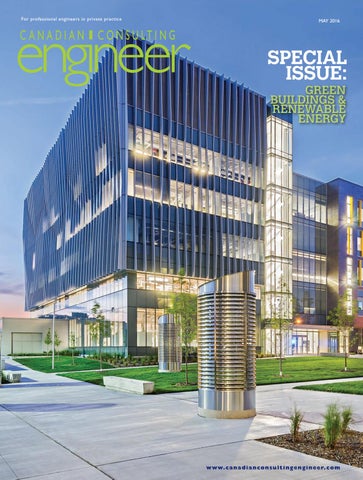
Cover: Environmental Science and Chemistry Building at University of Toronto Scarborough. Photo: Michael Muraz/Diamond and Schmitt. See story p. 16.
See story p. 26.
departments Comment
4
Up Front
6
ACEC Review
16
Race to Reduce. A four year program to encourage energy savings in buildings in the Greater Toronto and Hamilton Area has had phenomenal results. By Sophie Kneisel
21
Seawater Exchange at 351 Water Street. Being near the harbourfront has advantages for a six-storey office building in St. John’s, Newfoundland. By Brad Dawe, P.Eng., Stantec
26
Infrared Thermography. How a powerful tool helps to find leaks in the building envelope. By Gord Rajewski, R.E.T., Williams Engineering Canada
30
Flywheel Energy Storage. The Minto flywheel project built in Ontario is a “mechanical battery” that stores electricity in the form of kinetic energy. By Geoff Osborne, NRStor
33
Biomass Energy Evolves. Across Canada everyone from universities, to utilities, to farmers are finding ways to turn waste organic materials into bioenergy. By Jean Sorensen
35
11
Products 44 Advertiser Index
Earth Benefits. The Environmental Science and Chemistry Building at University of Toronto Scarborough has massive earth tubes and a large geothermal field to help reduce its energy use. By Bronwen Parsons
45
Next issue: Sechelt wastewater treatment plant; Chaudière Falls hydroelectric station; drones; environmental remediation.
on topic FINANCE Minority Shareholders — Moving On. What employees need to know when they own shares in their company and decide to leave. By Paul Mandel, Collins Barrow 39
CONVERSATIONS The Female Advantage. Women should play a much larger role in engineering and the companies that encourage it will reap the benefits. Interview with Marg Latham, P.Eng. 46 May 2016
CCE May16_AMSV3.indd 3
Canadian Consulting Engineer
3
2016-05-06 1:47 PM
engineer FOR PROFESSIONAL ENGINEERS IN PRIVATE PRACTICE
comment
C A N A D I A N C O N S U LT I N G
Editor
Bronwen Parsons (416) 510-5119 bparsons@ccemag.com
We're seeing a groundswell of green action
T
oday the impulse to do what’s right for the planet is becoming entrenched in what we design and build. Big shifts are taking place in the political stratosphere, worldwide and in Canada. In the month of April alone 175 world leaders went to the United Nations in New York to sign the Paris Agreement. Quebec issued its 2030 Energy Policy saying it will increase renewable energy by 25% and biomass by 50%. And Ontario announced it will contract for another 930 MW of renewable energy. But at a more fundamental level we are seeing a groundswell of real projects. For decades government investment on the sustainability front mostly went into roundtables and policy making. Now, good intentions are materializing in actual buildings, programs and technologies that have measurable benefits. Here are a few of the most recent developments. In the buildings sphere the Canada Green Building Council announced in April that it had certified its 1,000th LEED Gold project in Canada. It calculates that between 2005-2015 Canadian LEED certified projects have cumulatively reduced over 1 million tonnes of CO2e. CaGBC has also just produced a guide to help municipalities set up energy benchmarking programs. These could require all building owners to report their energy use, which will be a real incentive for owners to take action on retrofits. ASHRAE, standard bearer for the HVAC industry, has just issued the results of its research to achieve “the maximum technically achievable energy targets for commercial buildings: ultra-low energy use building set.” The researchers measured 400 energy efficiency tools, and of those selected 30 technologies, any of which are “widely available today.” Universities have long led the way in green building in Canada. This issue features two campus buildings, our cover feature at the University of Toronto Scarborough (p. 16), and another at the University of British Columbia (p. 35). But there are also private initiatives. In Montreal, a community group in Rosemont is planning to install a geothermal system in an alley. And five housing developers across Canada are building net-zero subdivision homes. In the renewable energy sector there are exciting developments. We feature a flywheel energy storage plant in southern Ontario that helps stabilize supply to the grid (p. 33). But there are advances in other types of storage, such as fuel cells. Some see them as an almost ideal alternative to diesel generators in remote and First Nations communities. Then there is biomass. Ontario Power Generation converted its Atikokan plant two years ago. Instead of belching black coal, the 227-MW plant now burns waste wood pellets. The forestry industry has many cogeneration plants, thus capitalizing on a perfect synergy of reducing waste and also emissions. And as Jean Sorensen explains (p. 35), municipalities like Surrey are building large plants to convert household waste into energy. Even cattle farmers are getting in on the act. They are marketing the gaseous emissions of manure, in what amounts to the most literally grassroots Bronwen Parsons initiative of all.
4
www.canadianconsultingengineer.com
CCE May16_AMSV3.indd 4
May 2016
Senior Publisher
Maureen Levy (416) 510-5111 mlevy@ccemag.com Art Director
Andrea M. Smith Contributing Editor
Rosalind Cairncross, P.Eng. Advertising Sales Manager
Vince Naccarato (416) 510-5118 vnaccarato@ccemag.com Editorial Advisors
Bruce Bodden, P.Eng., Gerald Epp, P.Eng., Chris Newcomb, P.Eng., Laurier Nichols, ing., Lee Norton, P.Eng., Jonathan Rubes, P.Eng., Paul Ruffell, P.Eng., Andrew Steeves, P.Eng. Circulation
Barbara Adelt (416) 442-5600 x3546 E-mail: badelt@annexbizmedia.com Account Coordinator
Cheryl Fisher (416) 510-5194 cfisher@annexbizmedia.ca Vice President, Annex Business Media East
Tim Dimopoulos (416) 510-5100 tdimopoulos@annexweb.com President & CEO
Mike Fredericks mfredericks@annexweb.com CANADIAN CONSULTING ENGINEER is published by Annex Publishing & Printing Inc.
80 Valleybrook Drive, Toronto, ON Canada M3B 2S9 Tel: (416) 442-5600 Fax: (416) 510-5134 EDITORIAL PURPOSE: Canadian Consulting Engineer magazine covers innovative engineering projects, news and business information for professional engineers engaged in private consulting practice. The editors assume no liability for the accuracy of the text or its fitness for any particular purpose. SUBSCRIPTIONS: Canada, 1 year $62.17. Single copy $8.00 Cdn + taxes. (HST 86717 2652 RT0001). United States U.S. $62.17. Foreign U.S. $62.17. PRINTED IN CANADA. Title registered at Trademarks Office, Ottawa. Copyright 1964. All rights reserved. The contents of this publication may not be reproduced either in part or in full without the consent of the copyright owner(s). ISSN: 0712-4996 (print), ISSN: 1923-3337 (digital) POSTAL INFORMATION: Publications Mail Agreement No. 40065710. Return undeliverable Canadian addresses to Circulation Dept., Canadian Consulting Engineer, 80 Valleybrook Drive, Toronto, ON Canada M3B 2S9. USPS 016-099. US office of publication: 2424 Niagara Falls Blvd., Niagara Falls, NY 14304-5709. Periodicals postage paid at Niagara Falls, NY. US Postmaster: send address changes to Canadian Consulting Engineer, PO Box 1118, Niagara Falls NY 14304. PRIVACY: From time to time we make our subscription list available to select companies and organizations whose product or service may interest you. If you do not wish your contact information to be made available, please contact us. tel: 1-800-668-2374, fax: 416-510-5134, e-mail: vmoore@annexbizmedia.com, mail to: Privacy Officer, 80 Valleybrook Drive, Toronto, ON Canada M3B 2S9. Member of the Audit Bureau of Circulations. Member of the Canadian Business Press
We acknowledge the [financial] support of the Government of Canada.
a
2016-05-06 1:47 PM 1475_Arms CCE_Arm
Announcing the biggest leap forward in the history of room temperature.
Lowest installed cost. Lowest lifetime cost. Highest energy efficiency. Superior design flexibility. More comfortable tenants. Discover why Armstrong Design Envelope technology is the future of HVAC fluid systems: ArmstrongDesignEnvelope.com
a r m s t r o n g f lu i d t e c h n o lo g y established 1934
CCE CCE_Armstrong_May.indd May16_AMSV3.indd 511 1475_Armstrong_DE_Ad.indd
a r m s t r o n g f lu i d t e c h n o l o g y. c o m
ENGINEERED BEYOND THE OBVIOUS
2016-05-06 2016-05-06 1:47 9:47 PM AM4:37 PM 2016-05-05
COWI North America
up front
struction engineers for this dramatic structure near Ground Zero which officially opened in March and replaces a terminal destroyed in the 9/11 terrorist attacks. Designed by Santiago Calatrava and the Downtown Design World Trade Center Transportation Hub, Manhattan, New York. Partnership, the Hub is also known as the Oculus. It AWARDS has two glass and steel bird-like wings. Grandview Heights and Awards of excellence also went to WTC Hub win in B.C. The Association of Consulting Engi- the Sechelt Water Resource Centre by neering Companies-B.C. (ACEC-BC) Urban Systems; to Northwest Hydraugave its 27th annual awards on April 9 lic Consultants for the “River Trainin a gala event at the Fairmont Hotel ing Works in Bangladesh — Protecting the Padma Bridge”; and to Gygax Vancouver. “The Awards for Engineering Ex- Engineering and Northwest Hydraucellence winners represent the best lic for the McLymont Creek Hydroand brightest in our industry, and the power project. Projects by Read Jones Christofferwinning projects are some of the most amazing work that we have seen from sen, Associated Engineering, Hatch, B.C.’s consulting engineers …” said McElhanney, Knight Piesold, Urban Keith Sashaw, president and chief ex- Systems and TetraTech/EBA won Awards of Merit. ecutive officer of the association. Kerry Rudd, head of The Lieutenant Governor’s Award was handed out by the Honourable Associated Engineering, Judith Guichon to structural engi- won the Meritorious neers Fast + Epp for the Grandview Achievement Award. TiHeights Aquatic Centre in Surrey. The jana Smiljanic, P.Eng., of centre is an “ambitious and daring McElhanney won the Professional Kerry Rudd project” with a novel timber catenary Young roof suspended between concrete but- Award. The BC Ministry of Transportation and Infrastructure won the intresses and spanning 55 metres. An Award of Excellence went to the augural Client of the Year Award. ACEC-Manitoba and Consulting World Trade Center Transportation Hub in Manhattan, New York, by Engineers of Ontario also held their COWI North America (formerly Buck- annual awards in April. Watch for covland & Taylor). COWI were the con- erage in the June-July issue. TRANSPORTATION
Fast + Epp
Big plans laid for new LRT network in Montreal area Quebec’s big public pension fund investment company, La Caisse de dépôt et placement du Québec, has unveiledGrandview Heights Aquatic Centre, Surrey, B.C.
6
www.canadianconsultingengineer.com
NUCLEAR
$800 million for Chalk River
The federal government is to spend $800 million to transform the buildings and infrastructure at its Chalk River site near Renfrew, Ontario. Dating from the 1950s when it was a National Research Council project, Chalk River does research into CANDU technology and produces medical isotopes — approximately half of the North American supply. Last year the CNEA consortium, which includes SNC-Lavalin, CH2M and Fluor, was selected to manage the site. COMPANIES
Stantec adds 6,800 U.S. employees
Stantec has acquired MWH Global based in Broomfield, Colorado. Focused on water and natural resources, MWH has 6,800 employees in 187 offices in 26 countries. Its portfolio includes the Panama Canal Third Set of Locks Project. CONTRACTS
Municipal agreement in Ontario
Consulting Engineers of Ontario has a new agreement with the province's Municipal Engineers Association for a “Standard Client/Engineer Agreement for Professional Consulting Services.” The 18-page document covers everything from fees and disbursements to dispute resolution.
continued on page 8
May 2016
32692_M CCE May16_AMSV3.indd 6
2016-05-06 1:47 PM
CCE_Bra
Powerful Heating Technology from LAARS Up to 99% Efficient 1.6, 2, 2.5, 3, 3.5, & 4 million BTU’s Small Footprint Exclusive Vari-Prime Variable Speed Pump Control can reduce pumping costs by 70%! ™
Exclusive LAARS Designed and Built Heat Exchanger
3
INSTALLERS love the MagnaTherm because of its easy to use controls, narrow design, and knockdown ability - perfect for retrofit or new installations.
3
BUILDING OWNERS love the MagnaTherm because of its ultra-high efficiency and up to 70% reduction in pumping costs.
3
ENGINEERS love the MagnaTherm because it’s low NOx, saves energy, installs indoors or outdoors and uses the latest Laars designed and made heat exchanger technology. Scan here for MagnaTherm details
Built to be the Best
™
www.laars.com
©2016, Bradford White Corporation. All rights reserved.
32692_MagnaTherm_8125x1075.indd 1 CCE CCE_BradfordWhite_May.indd May16_AMSV3.indd 7 1
5/4/16 12:22 PM 2016-05-06 2016-05-04 1:47 2:56 PM PM
CDPQ
up front
Concept for a station on Montreal's proposed LRT network.
plans for a large new public transportation system for Montreal area. The organization’s infrastructure investment arm, CDPQ Infra, is planning to construct an automated, 20-hours-per-day LRT network that will stretch across the city and link with the existing metro, rail lines and buses. Covering 67 kilometres, the “Reseau électrique métropolitain (REM)” will link downtown Montreal with the South Shore, the West Island, North Shore and the airport. The REM represents the largest public transportation infrastructure since the Montréal metro was inaugurated in 1966. It will be the third largest automated transportation system in the world after Dubai (80 km) and Vancouver (68 km), and just ahead of Singapore (65 km). The line will have underground, at grade and overhead sections. It will run along dedicated corridors, including the Highway 40 route to the West Island, which means that the trains won’t be slowed down by freight trains.
pamensky Can Civil Engineering janfeb2016.indd 1
8
www.canadianconsultingengineer.com
CCE May16_AMSV3.indd 8
There will be 24 stations, which will be climate controlled and will have protective screen doors between them and the railway track. The $5.5-billion investment is contingent on the federal and provincial governments providing around $2.5 billion, but CDPQ will hold consultations this spring and says it plans to issue requests for proposals by this fall. It will be Quebec’s first publicprivate partnership project. PROJECT MANAGEMENT
Problems with Alberta’s school building program Alberta’s Auditor General, Merwan Saher, has uncovered a litany of problems with the province’s school building program. Reporting in April, the auditor found that the departments of Infrastructure and Education, which are responsible for the school building program, often did not understand the scope of projects. In some instances schools completion dates were announced when it was not even known if the sites were available. The departments would agree on a budget, but there was no agreement on scope, schedule or other milestones. One of the auditor’s recommendations was that the departments should establish a “gated” approvals process, clearly setting out the project deliverables and who is responsible.
May 2016
INDOOR AIR QUALITY
New ASHRAE standard covers e-cigarettes
ASHRAE has issued a new indoor air quality standard, 62.1-2016, Ventilation for Acceptable Indoor Air Quality. The new standard has changes that affect high rise residential spaces, laboratory exhaust and demand control ventilation. In addition, the definition of “environmental tobacco smoke” has been revised to include electronic cigarettes (“vaping”) and cannabis. PEOPLE
Moving on up
Exp has a new chief operating officer. Mark Dvorak took over the position on April 1. He was Mark Dvorak with Teng & Associates, which exp acquired in 2010. At Hatch, Fred Cummings took over the company’s infrastructure division in Western North America in March. He is based in Vancouver.
2015-12-07 2:57 PM
2016-05-06 1:47 PM
1816_Fly CCE_Xyl
W
W
Expand your commercial business with large-dimension Uponor PEX piping and ProPEX® fittings.
3"
2½"
The Milwaukee® M18™ FORCELOGIC™ ProPEX Expansion Tool generates the power you need to create strong, large-dimension connections fast.
2"
EXPAND YOUR BUSINESS uponorpro.com/commercialpiping
ad HPAC_Feb_Uponor.indd CCE right May16_AMSV3.indd size.indd 1 110
2016-01-26 2016-05-06 16-01-26 11:11 11:38 1:47 AM PM AM
6 11:11 11:38 AM AM
ASSOCIATION OF CONSULTING ENGINEERING COMPANIES | REVIEW
CHAIR’S MESSAGE
Leadership and management
“M
anagement is doing things right, leadership is doing the right things.” These words from Peter Drucker and Warren Bennis are as relevant today as they were three decades ago – to both consulting engineers and their clients. Managers create process, but can innovation thrive if there is only process? Will doing the thing right always result in the right thing? If we have a culture of always doing the thing right, will we be able to do the right thing when called upon? The world of engineering as the creator of wealth populates my mind with images of industrialism, modernism, and many other “isms.” But today, the creators of wealth seem like distant aberrations, and now “paper wealth” seems to be the prize and communication technology the new wealth generator. Regardless, I still believe that the consulting engineering sector is well positioned
to provide leadership in emerging areas such as smart, and even intelligent, infrastructure. These solutions are the progress leaders in innovation, they are in the realm of doing the right things, not just doing things right. For example, engineering consultants are at their best when they work in the realm of creativity and innovation. So when we advocate for infrastructure spending, let’s look 50 years ahead and think about what our bridges, schools, hospitals, water treatment plants, highways, and dams can and should look like. The challenge is when clients expect creative, innovative projects when using restrictive procurement practices. To unlock engineering potential, non-restrictive procurement practices such as qualifications-based selection (QBS) are required. When clients don’t use QBS, they may not get what they need. In order for consulting engineers and our clients to be leaders in the development of intelligent infrastructure, we need to both do the right things and do things right. PERRY MITCHELMORE, P.Eng., PMP CHAIR, ACEC BOARD OF DIRECTORS
MESSAGE DU PRÉSIDENT DU CONSEIL
Leadership et gestion
I
l y a une trentaine d’années, Peter Drucker et Warren Bennis affirmaient que « la gestion consiste à bien faire les choses, tandis que le leadership consiste à faire la bonne chose ». Ceci vaut encore aujourd’hui, aussi bien pour les ingénieurs-conseils que pour leurs clients. Les gestionnaires mettent en place des procédures, mais l’innovation est-elle possible avec de simples procédures? Et suffit-il de bien faire les choses pour toujours faire la bonne chose? Si nous sommes programmés pour toujours bien faire les choses, serons-nous en mesure de faire la bonne chose le moment venu? En tant que créateur de richesse, le monde du génie suscite en moi l’idée d’industrialisme, de modernisme, et de bien d’autres mots en « isme ». Mais de nos jours, les créateurs de richesse semblent n’être que de lointaines aberrations, et maintenant la récompense est la « fortune » et la technologie des communications est le nouveau producteur de richesse. Quoiqu’il en soit, je crois encore que le secteur du génie-conseil est bien placé pour faire preuve de leadership dans des secteurs émergents, par exemple dans celui des infrastructures intelligentes. Ces dernières sont à la fine pointe de l’innovation et dépendent d’une volonté de faire
la bonne chose et non seulement de bien faire les choses. Les ingénieurs-conseils sont au sommet de leur art quand ils peuvent exercer leur créativité et leur sens de l’innovation. Donc, quand nous plaidons en faveur d’investissements dans les infrastructures, projetons-nous dans l’avenir, imaginons à quoi pourraient et devraient ressembler nos ponts, nos écoles, nos hôpitaux, nos usines de traitement des eaux usées, nos réseaux routiers et nos barrages dans 50 ans. Mais le problème, c’est quand nos clients s’attendent à des projets créatifs et novateurs alors qu’ils ont recours à des pratiques restrictives en matière d’approvisionnement. Seules des pratiques non restrictives comme la sélection basée sur les compétences (SBC) peuvent débloquer le potentiel du génie. Les clients qui tournent le dos à la SBC pourraient bien ne pas obtenir ce dont ils ont besoin. Pour que les ingénieurs-conseils comme nos clients deviennent des chefs de file en matière d’infrastructures intelligentes, il faut à la fois faire la bonne chose et bien faire les choses. PERRY MITCHELMORE, P.Eng., PMP PRÉSIDENT DU CONSEIL D’ADMINISTRATION DE L’AFIC
May 2016
CCE May16_AMSV3.indd 11
Canadian Consulting Engineer
11
2016-05-06 1:47 PM
ASSOCIATION OF CONSULTING ENGINEERING COMPANIES | REVIEW
The 37th Annual Deltek Clarity Architecture & Engineering Industry Study A valuable resource to benchmark your firm’s performance for success By Megan Miller, Deltek
I
t’s often been said that you can’t manage what you can’t measure. In the architecture and engineering industry, this includes understanding how your firm’s performance stacks up against your peers and competitors. One of the best ways to optimize your firm’s performance for continued growth is through benchmarking. When you have an accurate assessment of where you stand today, you’ll have more insight into what you need to do moving forward. Benchmarking will help you understand how your firm is performing compared to other firms in the industry by size, practice area, project type and market segment. Benchmarking also helps you understand the drivers of great performance and helps identify areas of poor performance. It will help you establish baselines, define best practices to implement within your firm, and identify areas for improvement to help your firm succeed. The Deltek Clarity Architecture & Engineering Industry Study (produced in collaboration with ACECCanada, ACEC, and SMPS) gives leaders critical industry benchmarks to see how their firm measures up and
where there are opportunities for improvement. Now in its 37th year, Clarity is the longest-running and most in-depth benchmarking study in the industry. The Clarity A&E Study collects information from firm participants in four areas: Finance/Operations, Business Development, Project Management and new this year, Talent Management. The final report includes detailed benchmarking metrics in each of these areas to compare your firm to other firms of a similar size, type or market segment. The report also highlights key trends shaping the A&E market and identifies emerging areas of opportunity for 2016 and beyond. As in past Clarity A&E studies, the report breaks out a group of high performers for additional analysis to explore what makes them more successful. What are they doing to more successfully manage their bottom line, retain all-star talent, and execute projects successfully? The study identifies factors that contribute to the success of these high performers. The study also takes a pulse of the industry as it explores the main challenges A&E firms are facing in terms of financial performance, business
development, project management and talent management. It also provides the participants’ outlook for the primary markets for A&E services. So, are you interested in seeing how your firm measures up and whether you’re tracking the right metrics? Do you think you’re on par with the high performing firms or do you have room for improvement? Deltek is looking forward to sharing the results of this year’s study and identifying how you can use the results to shape the future of your firm. Visit http://bit.ly/1TRi9xt to download the full Deltek Clarity report and register for the complimentary five-part Deltek Clarity webinar series. Megan Miller is a senior product marketing specialist for Deltek and a key member of the Deltek Clarity team. She also has 10+ years experience in the A&E industry. Deltek is the leading global provider of enterprise software and information solutions for professional services firms such as architecture and engineering firms and other projectbased businesses. For more information visit www.deltek.com or contact info@ deltek.com
Association of Consulting Engineering Companies – Canada (ACEC-Canada), 420-130 Albert Street, Ottawa, ON, K1P 5G4, tel: (613) 236-0569, fax: (613) 236-6193, info@acec.ca, www.acec.ca. ACEC Member Organizations: Association of Consulting Engineering Companies – British Columbia, Association of Consulting Engineering Companies – Yukon, Consulting Engineers of Alberta, Association of Consulting Engineering Companies – Northwest Territories, Association of Consulting Engineering Companies – Saskatchewan, Association of Consulting Engineering Companies – Manitoba, Consulting Engineers of Ontario, Association of Consulting Engineering Companies - Québec, Association of Consulting Engineering Companies – New Brunswick, Consulting Engineers of Nova Scotia, Association of Consulting Engineering Companies – Prince Edward Island, Consulting Engineers of Newfoundland and Labrador. 12
www.canadianconsultingengineer.com
CCE May16_AMSV3.indd 12
May 2016
2016-05-06 1:47 PM
ASSOCIATION OF CONSULTING ENGINEERING COMPANIES | REVIEW
Post-budget update: impact on consulting engineering firms and key issues to watch for
B
udget 2016 proved to be a positive plan for most of the Canadian consulting engineering sector. Now that the dust has somewhat settled around the recently tabled federal budget, ACEC has a broader understanding of the budget’s impact on the Canadian consulting engineering sector and on what issues it will watch for as the plan unfolds and materializes.
Key issues ACEC will watch for: Timing of the federal government’s plan Phase 1 of the government’s infrastructure plan appears to be designed to address immediate infrastructure needs and to stimulate the economy. It also accelerates some elements of the Building Canada Fund. Providing funding in phases is not necessarily problematic, though it does suggest that much of the money is back-end loaded. ACEC will work with government to ensure they are mindful that next year’s shovel-ready and worthy projects and those of the 10-year commitment require engineering, architecture and design work on the table many months before any construction work is underway. Phase 2 will focus on infrastructure of long-term strategic impor-
tance to the overall Canadian economy. ACEC will stress to government the importance of embarking on Phase 2 of infrastructure spending sooner rather than later and involving the design and construction sector in the program design. Note that unlike the Building Canada Fund, engineering costs will be eligible expenses for municipalities to claim under the new infrastructure funds for transit and green infrastructure. With respect to the Building Canada Fund, ACEC has learned that Ontario is the only province to submit its full list of proposed projects, which has contributed to the delay in investments under this fund. It is also worth noting the PPP screen for projects under the Building Canada Fund has been discontinued. Efficient and science-based environmental assessment process The federal budget also contains significant measures to encourage and support environmental sustainability. While encouraged that the government proposes a rigorous environmental assessment process based on science, ACEC will be seeking assurances that processes will be clear and efficient and won’t encourage frivolous or vexatious delays to infrastructure and resource projects that are important to the economy. Canadian Infrastructure Bank ACEC has confirmed that the promised Canada Infrastructure Bank, which wasn’t mentioned in the 2016 federal budget, is still in development and will likely be introduced as part of Phase 2. It appears that the government has not yet established the mandate or the parameters of the bank.
Resources sector and small business ACEC is disappointed that there was minimal assistance to the resource sector, which has carried Canada’s economy over many decades. This sector has played a vital role in the modernization of our economy in the past and will continue to contribute to Canada’s prosperity if supported. ACEC sees the Canada Infrastructure Bank’s mandate including assistance to help the resource sector access capital. The deferral of tax relief for small businesses is also unfortunate for this important segment of the Canadian economy. Providing value and fiscal responsibility to Canadians While the deficit is of concern, ACEC sees debt management as the real long term issue. Investing in projects with the highest potential return on investment will be of essence. To that end, modern and progressive procurement practices like Qualifications-Based Selection (QBS), especially for design professionals, would also contribute to the success of infrastructure investments by ensuring high quality, high value projects with increased service life and significant life-cycle savings. More information on the budget Upon the release of the budget on March 22, ACEC provided member firms with key numbers for new funding and an at-a-glance analysis of Budget 2016’s impact on the consulting engineering sector. ACEC will continue to reach out to media and continuously work with government towards effective and timely implementation of the budget. To read ACEC’s postbudget analysis please visit the advocacy section of acec.ca. May 2016
CCE May16_AMSV3.indd 13
Canadian Consulting Engineer
13
2016-05-06 1:47 PM
ASSOCIATION OF CONSULTING ENGINEERING COMPANIES | REVIEW
Building stronger alliances amongst industry stakeholders in Alberta
B
ringing together industry stakeholders to share ideas and discuss common issues is an important part of ACEC-Canada’s advocacy work. By forging new relationships and strengthening existing partnerships with like-minded organizations, the consulting engineering sector becomes a stronger, more dynamic industry. ACEC, in collaboration with Consulting Engineers of Alberta (CEA), hosted the “Building Stronger Alliances” reception in Calgary in early April. The event helped forge stronger relationships between the associations and representatives from the Alberta Chamber of Resources (ACR) and the Construction Owners Association of Alberta (COAA). In his welcome address, Master of Ceremony Craig Clifton,
P.Eng., Vice President Alberta at Clifton Associates and Past President of CEA, stressed the importance of collaboration and the value enhanced relationships amongst these stakeholders bring to the sector. As John Gamble, President and CEO of ACEC-Canada stated, “By supporting our resource sector, not only do we create opportunities for the consulting engineering sector, we help create prosperity for all Canadians.” In light of the challenges faced by the resource sector in Alberta, and the long awaited provincial budget days from being tabled, attendees had much to share and discuss over the course of the evening. While Consulting Engineers of Alberta have developed a strong relationship with the Alberta Chamber of Resources, ACEC has recently
participated in a number of national initiatives to educate policy makers on the importance of resource projects and their contributions to our quality of life. These projects include The Measures That Matter: How Canada’s Natural Resource Sector is Working to Protect the Environment in collaboration with the Canadian Chamber of Commerce, and Levelling the Playing Field: Supporting Mineral Exploration and Mining in Remote and Northern Canada with the Mining Association of Canada and the Prospectors and Developers Association of Canada. ACEC wishes to extend a special thank you to Ken Pilip, CEO and Registrar, and Lisa Krewda, Director of Operations, at CEA for making the Building Stronger Alliances event such a success.
C
M
Y
CM
MY
CY
CMY
K
14
www.canadianconsultingengineer.com
CCE May16_AMSV3.indd 14
May 2016
2016-05-06 1:47 PM
ConsultingSpecifingEng-Sustainable-ad-full-pg-rev-C.pdf
1
15-05-27
5:21 PM
The Logical Choice for Green Buildings
solutions for sustainability Approximately one in three LEED Platinum-certified commercial buildings in British Columbia depend on Reliable Controls.
C
M
Y
CM
MY
CY
CMY
K
James Puritch
Vice President, R&D Camosun & UVic Co-op Alumnus
Headquartered in Victoria, British Columbia, in a modern and environmentally constructed LEED Platinum-Certified facility, we design and develop internet-connected building controls for a wide range of green buildings, including schools, hospitals, universities, recreational and commercial facilities. To learn more about our solutions for sustainability, and opportunities in the green buildings industry, please visit our website or sign-up for a facility tour at: www.reliablecontrols.com/corporate/facility/tour.php
CCE May16_AMSV3.indd 15
2016-05-06 1:47 PM
green buildings
At the Environmental Science and Chemistry Building at University of Toronto Scarborough, massive earth tubes that temper incoming air help to reduce the energy use.
EARTH BENEFITS By Bronwen Parsons
Michael Muraz
hen the University of Toronto started to build its satellite campus in Scarborough in the 1960s, the brutalist architecture of its first new building caused a stir around the world. The John Andrews Building, named after its architect, has a pondorous interior of thick concrete walls and winding "streets" with deep balconies. In 1969 David Cronenberg used it to create the foreboding atmosphere of his black and white experimental film Stereo. In the decades since other interesting structures have been added to the campus, which is clustered south of Highway 401 at Morningside Avenue in the eastern suburbs of Toronto.
16
www.canadianconsultingengineer.com
CCE May16_AMSV3.indd 16
Top: energy-hungry laboratories make up 60% of the building area. To compensate, design strategies include low-flow fumehoods and a geoexchange system. Left: building exterior with earth tube intakes in foreground.
May 2016
2016-08-08 1:04 PM
green buildings
Most recently the high-profile Toronto PanAm Sports Centre was built for the 2015 Games on the northern edge of the campus. And just next door to this large aquatic centre, another striking building opened in February. The five-storey, 9,400-m2 Environmental Science and Chemistry building consists of laboratories on one side, academic offices on the other, and an atrium in between. The exterior is distinguished on the laboratory side by a facade of undulating vertical aluminum louvres. These solar shading devices are just one of many features that make the building highly energy efficient. It has been certified LEED Gold, “which for a typical energy-hog laboratory building is no mean feat,” says Paul French of Diamond and Schmitt, the architects. Elaine Guenette (Hopkins), P.Eng., project engineer with Smith and Andersen, who were the mechanical-electrical engineers, explains that they were asked to achieve eight LEED energy points. This score represents a 37% savings over the Model National Energy Code for Buildings. Earth Tubes One of the building's most unusual features is a
May 2016
CCE May16_AMSV3.indd 17
Tom Arban
system of six “earth tubes.” These large 2-metre diameter concrete pipes are buried underground and draw air into the building from vertical aluminum intakes set into the landscaping outside. The earth tubes are sloped towards the building and buried 5 metres deep at their lowest point. The idea is that as outside air passes through the tubes its temperature is moderated before it reaches the air handling unit that serves the office portion of the building. Because the earth tubes vary in length from 20 to 30 metres long they are fitted inside with large semi-circular, fixed metal baffles to equalize the air flow through them. The baffles are also used to create turbulent air for more effective heat transfer. RWDI designed the quantity and location of the baffles with CFD modelling. A heat transfer calculation was also done to see how much difference the tubes would make to the air temperature. “We found that in the winter and summer there are different amounts of heat transfer because the air-to-ground temperature difference varies throughout the year,” says Guenette. “We found that the temperature difference in the air after it has gone through the tubes is 20 degrees F at peak winter, and over the year it averages a Canadian Consulting Engineer
17
2016-08-08 1:04 PM
green buildings
Right: earth tubes under construction; they are buried up to 5 metres deep and fitted with baffles to control the flow of air passing through. Below: Hovan Stepanian of UTSC beside one of the earth tubes inside the building.
Diamond and Schmitt
Smith & Andersen
Right: Pumps and geothermal manifold. The geoexchange system can provide 25% of the building cooling and/or heating load.
University of Toronto Scarborough
difference of 7 degrees F.” The air handling unit can also bypass the tubes if the outdoor air is the right temperature. An ultraviolet system is used to disinfect the incoming air as a safety precaution. Guenette explains: “The UV lights are ceiling mounted in a plenum that collects the air from all the tubes before it is drawn into the air handling unit. There is a safety connection with the door to the plenum such that when the door is opened, all the UV lights shut off.” Earth tubes were installed several years ago in the Earth Rangers Centre near the Kortright Centre, northwest of Toronto, which provided a precedent. “We used a lot of their data to help size these earth tubes,” explains Guenette. The tubes also double as a teaching tool, as the students can monitor their performance, along with the performance of the building’s other systems, as part of their environmental studies. 18
www.canadianconsultingengineer.com
CCE May16_AMSV3.indd 18
Geo-exchange system eases the lab chill Wet and dry research and teaching laboratories occupy 60 per cent of the building, bringing high energy demands. These spaces require up to 10 air changes per hour, for example, which could make conditions very chilly for the occupants. To compensate, the incoming air has to be heated to some degree. The simultaneous heating and cooling of the incoming air into the labs is done efficiently through the geo-exchange (goethermal) system. A collection of 66 boreholes is drilled 600 feet deep below the building and is capable of providing 25% of the building cooling and/or heating load (210 tons of cooling, and 1350 MBH of heating). The heat pump, or geothermal chiller, can operate in heating mode or cooling mode, or in simultaneous heating and cooling mode, Guenette explains. The reheating of the air takes place at each lab and can be specifically controlled. Saving unnecessary air supply Further energy savings in the laboratories areachieved through the use of an air sampling system and low flow fumehoods. The air sampling system tests the air for impu-
May 2016
2016-05-06 1:47 PM
nd Schmitt
green buildings
rities and sends information back to the central building automation system. The BAS then determines how many air changes are required as a minimum in that space. For example if no-one is using the lab, the air sampling system will indicate there are no contaminants and will direct that only, say, four rather than 10 air changes are needed. The amount of air delivered to and exhausted from the space is then ramped down,” Guenette explains. “That’s significant because it’s 100% outdoor air that is being supplied that needs to be cooled, heated and humidified.” The low-flow fumehoods require less air velocity to be flowing across the sash (opening): 60 feet per minute, compared to the more standard 100-120 feet per minute. The units were each individually tested to ensure they are safe to use, employing tests more stringent than the ASHRAE requirements. The energy savings from these low-flow fumehoods are “huge,” says Guenette, reducing the exhaust air from each unit by half. There are over 100 fumehoods on the ground floor alone, and 30 or so on each of levels 4 and 5. “We are also recapturing heat from the fumehood and general exhaust air and using it in a coil in the lab air handling units,” she explains. Cascading ventilation system The building has a cascading ventilation system that takes advantage of the central atrium. The offices are
supplied with 100% fresh air, but this is returned into the atrium and then mixed with the incoming outdoor air for the laboratories. The building automation system controls all the chillers, boilers, air handlers and other building systems. It can be accessed over the internet and will send out alarms when something needs attention. A central condensing steam boiler provides humidification for the HVAC system, domestic hot water heating, and all the lab process requirements. It reuses heat from the condensate to mix with cold incoming water, thus saving energy. As a lab building, it required many special systems, including a nuclear magnetic resonance machine, a high pressure steam system for autoclaves, a chemical resistant drainage and neutralization tank, a central compressed air system, and a reverse osmosis system. Green roof, PV and lighting The building’s other green features include a concrete roof structure that will support a future photovoltaic solar array, a green roof, and a cistern for collecting rainwater for irrigating the landscaping. The lighting is all LED and there are occupancy and daylight sensors, so, for example, lights near the windows are turned off when not needed. The building has a lighting power density of 0.64, “which is 45% better than code, and still gives the light levels needed,” Guenette says proudly. CCE
Environmental Science & Chemistry Building Design Team Owner: University of Toronto Scarborough
Design-Builder: EllisDon
Architect:
Diamond and Schmitt
Mechanical, electrical, Smith and Andersen and Footprint (Elaine Guenette (Hopkins), energy modelling: P.Eng., Kevin Farbridge, P.Eng., Michael Armster, CET, Douglas Gilpin, Lyle Scott, Samuel Mason)
Structural:
Read Jones Christoffersen
Other key players: RWDI (CFD modelling); HGC (acoustics), VR (mechanical contractor); OZZ (electric contractor)
May 2016
Canadian Consulting Engineer
CCE_JanFeb16_Brady_revised_MLD.indd 1
CCE May16_AMSV3.indd 19
19 2016-04-07 10:58 AM
2016-05-06 1:47 PM
VRF will never be the same again.
LG is proud to offer the first 575V Air-Cooled VRF system in Canada. Multi V IV is designed to provide lower operational cost, flexible installation, and best in class heating performance in low ambient temperatures. Enjoy design freedom with a compact HVAC system that requires no additional transformer.
Canada’s First 575V Air-Cooled VRF
Equipped with groundbreaking technologies and superior performance, LG Multi V IV systems have marked their place among the very best VRF systems on the market.
City of Toronto Archives
Visit lgvrf.ca for more information.
©2016 LG Electronics Canada, Inc. All rights reserved. “LG Life’s Good” is a registered trademark of LG Corp. Design, features and specifications are subject to change without notice.
CCE_LG_May.indd CCE May16_AMSV3.indd 1 20
2016-05-05 1:47 2016-05-06 9:20 PM AM
buildings
RACE REDUCE
st
RF
05 9:20 AM
A four year program to encourage energy savings in buildings in the Greater Toronto and Hamilton Area has had phenomenal results, involving about 42% of the region’s office space.
City of Toronto Archives
By Sophie Kneisel
T
hree very different buildings were among the “biggest losers” at the end of CivicAction’s four-year long Race to Reduce energy-saving challenge. At first glance they would seem to have only the appellation “building” in common. The City of Toronto Archives is a 39,950 sq.ft., 20-year-old building with very specific HVAC needs for storing its collections. The Richmond-Adelaide Centre in the financial core is actually several buildings aged 36 to 86 years, totalling 1.6 million square feet, over 40,000 sq. ft. of which is retail space. Caledon’s Town Hall, located in a mostly rural area northwest of Toronto, is a 55,375-sq.ft. municipal office and court facility that was constructed in 1985 and expanded in 2003. The common denominators that put these three in the top four in the Race to Reduce are that they underwent building automation sys-
tem recommissioning or upgrades to ensure their facilities are operating at peak efficiency. They also had lighting retrofits and scheduling changes CivicAction, an organization that has been running programs in the Greater Toronto and Hamilton areas for more than a decade, launched Race to Reduce in 2011. One of the largest regional energy challenges in the world, Race to Reduce invites landlords and tenants in office buildings of all types and ages to work together to reduce energy use by at least 10% over four years. Collectively, the 196 buildings in the Greater Toronto and Hamilton Area that registered — totalling over 69 million square feet, or about 42% of the region’s office space — reduced usage by 12.1%. These savings equate to 193 million equivalent kilowatt hours, 4,200 fewer cars on the road, and $13.7 million in
savings for their owners. Toronto Archives The City of Toronto Archives building took top spot with a 59.9% reduction during the four years of the competition. The Richmond-Adelaide Centre finished in third place, dropping its energy use by 35%, while Caledon Town Hall came in a close fourth, using 34.5 % less energy.* The 20-year-old Toronto Archives located on Spadina Road near Dupont Avenue was in need of upgrades. Its energy consumption was higher than comparable facilities in the city, and staff were having difficulty keeping the temperature and relative humidity at safe levels for the archival material. To provide safe, long-term storage for the collections, it was necessary to install a new HVAC system and energy efficient condensing boilers that were designed and programmed to
Above: City of Toronto Archives building lobby; the building had the greatest energy savings in the Race to Reduce challenge.
May 2016
CCE May16_AMSV3.indd 21
Canadian Consulting Engineer
21
2016-05-06 1:47 PM
Town of Caledon
buildings
meet the building’s needs. As well, the building automation system at the Toronto Archives was only controlling two fan units when the project began. “It was supposed to be controlling boilers and chillers too,” says Prashant Bhalja, P.Eng., project manager in the City of Toronto’s energy and environment division. But the system had been disconnected and overridden as various upgrades and retrofits occurred over the years. If you do a retrofit, you need to provide proper training and support to see savings from the new equipment, Bhalja says. Staff support, maintenance and fine tuning are what make new equipment live up to its potential. “We projected a 25% to 30% reduction [for our Race to Reduce project], but we almost doubled it. I wasn’t expecting that. It was the continuous monitoring, and tweaking the new HVAC system after installation, that made [the reduction] so high. “The big thing is that we’re now also controlling on the distribution side,” he says. The building automation system gets real feedback to tell it what actual conditions are in the building. “We have fully automated it now," he says, right down to heaters that automatically turn off when the garage doors are open. Richmond-Adelaide Centre Oxford Properties, owner and developer of the Richmond-Adelaide Cen22
www.canadianconsultingengineer.com
CCE May16_AMSV3.indd 22
Oxford Properties
Above: Caledon Town Hall. Recommissioning was important in its 35% energy reductions.
the Race to Reduce resulted from a recommissioning exercise. It was undertaken to better understand the building’s use of energy; to improve staff's knowledge and understanding of the building automation system; and ultimately, to realize energy savings. Installed in 2003 when the town hall was expanded to include provincial court facilities, the building automation system did not require upgrading. But the recommissioning exercise indicated that HVAC operations could be scheduled more tightly around the town hall’s hours of operation. As part of the recommissioning, the consulting team tested system components to ensure they were responding to the BAS. Several malfunctioning components were identified and corrected. Since the recommissioning, access to the BAS has been limited to two building operators. “The sustained and continued savings are the result of significant staff education and buy in,” according to a statement from town staff. “Specifically, the facility operations team underwent additional training on building automation systems to build the internal skill set and knowledge to operate Town Hall at optimal efficiency.” Bhalja believes having BAS expertise in-house is vital. “No buildings are static,” he says. “We are telling other people at the City of Toronto to be sure to tie [any] changes into their BAS, and to inform BAS people about CCE operational changes.”
Above: Richmond-Adelaide Centre, a complex of buildings of different ages in Toronto's core.
tre, have taken many measures to reduce its energy consumption over past years. Some of the upgrades were the result of recommendations arising from routine recommissioning, while others were done for the Race to Reduce competition. The BAS was replaced due to its age. Other significant changes leading to the 35% savings in energy use included reviewing and adjusting the HVAC and lighting schedules, replacing various pumps and motors, and adding variable-frequency drives. Inefficient lighting (incandescent, MR30s) along with T8 fluorescents were replaced with LEDs. And the elevator system was upgraded with new controls and a destination dispatch system. Caledon Town Hall At Caledon’s Town Hall, retrofits like installing LED lighting in the parking lot and delamping fixtures in over-lit areas are now being implemented as opportunities arise. Comfort levels in the building are expected to get better still through planned upgrades to the HVAC system. Town staff say the majority of the 34.5% energy reduction identified in
Sophie Kneisel is a freelance writer who lives in Baltimore, Ont. She is a former editor of Canadian Consulting Engineer. * The building that had the second largest energy savings in Race to Reduce was the AeroCentre 1 in Mississauga, Ont.
May 2016
2016-05-06 1:47 PM
CCE_Ru
CCE_Rubbermaid_May.indd CCE May16_AMSV3.indd 23 1
2016-05-06 1:47 2016-05-06 9:53 PM AM
whatif what if
Engineers Canada-sponsored insurance plans co
Bridge Change over within 60 days of your existing group health plan enddate — with no medical questionnaire.
NEW
Professional Retiree Base Guaranteed acceptance — with no medical exam when you apply.
SPECIAL LIMITEDTIME OFFER!
Health & Dental Insurance Plan
Comprehensive Coverage with the highest maximums in many benefit categories.
If you’re retiring or starting your own business, Engineers Canada offers three NEW Professional Retiree Health & Dental coverage options. And right now, you can still apply for our Bridge plan — with no medical exam — even if you don’t have a group plan at work, or even if it ended more than 60 days ago. Apply for Bridge before July 28, 2016 and your acceptance will be guaranteed!
1 877 598-2273
M Un
manulife.com/PE CCE_Manulife_May.indd CCE May16_AMSV3.indd 124
T 2016-05-06 1:47 PM
e plans could give you fewer things to worry about?
Cost of raising children
Term Life
Mortgage debt
Non-mortgage debt
Insurance Plan
University fees
Household expenses
Up to $1.5 million in coverage: The loss of a primary earner can have a major impact on those left behind who may still need to pay for major ongoing expenses. That’s why the Engineers Canada-sponsored Term Life Insurance Plan was created exclusively for engineers and geoscientists to help protect those who count on you in more ways than one.
Manulife and the Block Design are trademarks of The Manufacturers Life Insurance Company and are used by it, and by its affiliates under licence. Š 2016 The Manufacturers Life Insurance Company. All rights reserved. Underwritten by The Manufacturers Life Insurance Company (Manulife), P.O. Box 4213 Stn A, Toronto, Ontario M5W 5M3.
The Manufacturers Life Insurance Company CCE May16_AMSV3.indd 25
2016-04-14 2016-05-06 11:46 1:48 PM AM
Photos: Stantec
green buildings
The office sits above a parkade on a downtown street; the harbour is about 20 metres away, behind the building.
An office building in St. John’s, Newfoundland draws energy for its geo-exchange system from seawater that permeates the ground below the site.
at 351 Water Street By Brad Dawe, P.Eng., Stantec
L
ocated in the downtown core of St. John’s, Newfoundland, 351 Water Street was the first major office building to be constructed in the core in 25 years when it was completed two years ago. It overlooks the historic city’s harbour on one side and takes advantage of the seawater to heat and cool the building. The 15,000-m2 structure consists of a six storey office, set above a six-level parkade and commercial spaces that include a restaurant and coffee shop. Stantec provided architec-
26
www.canadianconsultingengineer.com
CCE May16_AMSV3.indd 26
tural, mechanical, electrical and project management services for the base building and tenant improvements. East Port Properties, the building owner, has a reputation for being a leader in the development of sustainable buildings and saw the advantages of using the renewable energy source at its doorstep. Through a life cycle cost analysis and a hydrogeological research study of the seawater flow characteristics at the site, Stantec was able to recommend the use of an innovative seawater heating and
May 2016
2016-05-06 1:48 PM
Above: building lobby..
cooling system — the first of its kind in Newfoundland and Labrador. The use of water from natural water bodies, such as large lakes, rivers and coastal waters as a source of energy in geoexchange systems to heat and cool buildings is an established engineering practice. However, this building sits approximately 20 metres from the harbour and the land between is crowded with utilities and other infrastructure. In this situation a direct intake of seawater from the harbour was not an option, so-
heating and cooling 351 Water Street using seawater posed a challenge for Stantec and caused us to explore other options. The building sits on low lying, manmade land that was originally where wharfs lined the harbour and now consists of highly permeable geological material and fill. The natural movement of the tides flushes these soils with seawater from the harbour. We decided to see if it were possible to extract or discharge energy from the seawater that permeates the underground soils below the building. May 2016
CCE May16_AMSV3.indd 27
Canadian Consulting Engineer
27
2016-05-06 1:48 PM
green buildings
Stantec
yield of the well. The results of our study confirmed the suitability of the site for use with this unique open loop system concept.
Above: geo-exchange seawater well schematic.
Research and testing We began with research. Our team investigated the published and posted literature, but we could find no similar instance of this type of energy interface having been attempted. If we could demonstrate that the approach was feasible, however, it might open up additional opportunities to cost effectively heat and cool structures located on permeable materials adjacent to tidewaters. We completed hydrogeological testing at the site to confirm whether vertically drilled wells could produce the required volume of water. A test well was drilled in order to carry out aquifer testing, water quality analysis, and to determine the long term sustainable
Geoexchange system design The system installed consists of three engineered wells, any two of which can meet the design requirements and facilitate the absorption or rejection of heat from the harbour waters. We used a net present value analysis to provide the best balance of installed capacity relative to the peak design load. This approach resulted in the system being designed for 40% of the peak load, which will accommodate about 90% of the actual operating load conditions. We drilled the wells straight down in order to access the relatively consistent temperature water from the harbour. The work involved drilling 35 ft. deep, 14 in. diameter holes to bedrock, inserting a smaller pipe with a stainless steel well screen, and then filling the annular space with an engineered pea stone. The outer sleeve was then partially pulled up, which allowed the naturally filtered water to enter the well. The system produces approximately 500 US gpm of flow. Two wide mouth plate and frame exchangers isolate the raw seawater open loop from a closed source water glycol loop (35% propylene glycol) which either rejects or extracts heat from the seawater. Depending on the season, the HVAC system’s heat recovery chiller source water loop either absorbs heat from, or rejects heat to, the harbour through heat exchange with the seawater wells. The system is extremely cost effective when compared to alternate systems based on life cycle cost. It also requires a minor amount of additional infrastructure relative to more conventional systems. The heat recovery
351 Water Street Design Team
Owner-client:
East Port Properties
Architect, mechanical-electrical/ Stantec (Bob MacLeod, P.Geo., Kerry Gosse, Brad Dawe, P.Eng., engineers, project management: Bernie Ropson, P.Eng., Lez Snow, Bob Macleod, P.Geo., Sterling Parsons, P.Eng., Jeff Lutz, Shawna Craig, Melissa Greening)
Civil:
Structural:
Sustainability:
Construction management/ contractor:
28
www.canadianconsultingengineer.com
CCE May16_AMSV3.indd 28
Pinnacle Engineering DBA Consulting Solterre Design Consultants Trendex
May 2016
2016-05-06 1:48 PM
green buildings
chiller produces low temperature hot water at 140 degrees F and chilled water at 44 degrees F. The low temperature hot water is distributed throughout the building to low temperature hydronic baseboards, air handling unit heating coils, terminal reheat coils, and unit heaters as required. Conventional fin tube spans the perimeter of each floor in architectural enclosures. Due to the corrosive properties of raw seawater, material selection was key. High grade stainless steel and plastic pressure piping was used for mechanical equipment and piping in contact with the seawater. Energy recovery systems and ventilation In addition to the seawater heating and cooling system, the building’s HVAC systems recover energy from waste heat sources whenever possible, including from the building general exhaust and tenant server rooms. When supplemental heating is required – generally only on the coldest winter days – two 400 kW electric boilers provide additional heating capacity to the heat pump system. 351 Water Street also has superior indoor environmental quality. Each floor is equipped with two variable air volume (VAV) air handling units; one for perimeter zones and the other for interior zones. Relatively low supply air temperatures from the low temperature hydronic heating system provide increased ventilation effectiveness due to lower air temperature stratification. VAV boxes and modern controls are provided throughout, giving the occupants a high degree of control. In addition, spaces such as meeting rooms and board rooms are provided with demand-controlled ventilation, using CO2 sensors. The energy model prepared for life cycle analysis predicted that the building would use approximately 35% less energy compared to more conventional designs. The Commer-
cial and Institutional Building 2009 Survey from NRCan indicates that a typical large office building in Canada consumes 305 kWh per square metre. The annual energy usage for the first years of operation at 351
Water Street was approximately 200 kWh per square metre. CCE Brad Dawe, P.Eng., is team lead for buildings mechanical engineering with Stantec, based in St. John’s, Newfoundland.
DESIGNED FOR USE ON COMMERCIAL AND INDUSTRIAL STEAM APPLICATIONS
Eliminate the need to weld steam systems •
Available in 2 – 8" | 50 – 200 mm sizes
•
Pressures up to 150 psi | 1034 kPa
For more information visit victaulicsteam.com/cce
9179 REV A 11/2015 © 2015 VICTAULIC COMPANY. ALL RIGHTS RESERVED.
May 2016
CCE May16_AMSV3.indd 29
Canadian Consulting Engineer
29
2016-05-06 1:48 PM
building envelope
INFRARED THERMOGRAPHY Infrared thermography is a powerful tool for discovering where energy is leaking from building roofs and wall assemblies. By Gord Rajewski, R.E.T., Williams Engineering Canada
C
ommercial buildings are complicated things. With advances in materials, systems and the desire to stretch our ability to create functional, sustainable, energy efficient and aesthetically pleasing enclosures, the need to “ join the pieces well” has also intensified. Infrared thermography, when used by those with an understanding of materials, system design and construction, can efficiently identify deficiencies that might otherwise go undetected. What it is Infrared thermography is a method used to detect infrared energy emitted from the surface of objects within a field of view. Thermographic cameras can detect radiation in the long-infrared range of the electromagnetic spectrum (9,000–14,000 nanometers) and convert this data into visible images. Infrared radiation is produced by any object at a temperature above absolute zero. As an object’s surface temperature increases, the amount of infrared radiation also increases. The distribution of surface radiation is displayed as a visible image. These visible images are called thermog rams. Current technology allows for the measurement of small increments in surface temperature. The results can be correlated to the performance of building materials and complex building envelope systems. Evolution since the 1960s The first investigations into the use of infrared thermography as a diLeft: infrared thermography images showing, from top: missing insulation and air leakage within a soffit; air leakage anomolies at cladding joints; three insulated sealed units with “bowing” in the vision lites; major air leakage and heat loss at roof parapets and below strip glazing; uncontrolled air leakage within a stone clad wall assembly.
30
www.canadianconsultingengineer.com
CCE May16_AMSV3.indd 30
May 2016
2016-05-06 1:48 PM
building envelope
On older buildings, infrared thermography is used to reveal symptoms of larger concerns that are hidden from plain sight. As a first diagnostic approach, the use of infrared thermography can provide the investigator with the ability to map trends and more efficiently source the root concern.
moisture. The technology can also be used to determine whether repairs in the envelope have been successful. Examples of anomalies that are commonly detected are shown in the images on page 30.
Up on the roof Infrared thermography has been used extensively across Canada to Dealing with weather identify the presence of enInfrared scans are typically pertrapped moisture within convenformed from the exterior of the tionally designed roofing assembuilding during the hours of darkblies (i.e. waterproofing is located ness. In order to properly test the on the exterior side of the therenvelope’s integrity, the building mal barrier). Infrared thermograenclosure must be positively presphy can be used to survey large surized in advance. It is desirable expansive roof areas in a relatively to achieve a minimum of 15 Passhort amount of time. cals of positive air pressure at the In the colder months, roof ground level. At this minimum membranes that have become pressure, an exterior infrared scan damaged will leak and allow surshould be able to detect small face moisture to enter the thermal voids and gaps that might exist in barrier insulation layer. The therTop: example of entrapped moisture within the roof mal barrier might also be comprothe air barrier system. Additional- insulation at an internal drain. Above: thermal image mised by humidified air leaking ly, a minimum temperature differ- reveals a large area of entrapped moisture within a from the interior. Once the insulaential of 20 degrees Celsius be- conventional built-up roofing assembly. tween the interior side and exterition becomes saturated, it loses its or side of the envelope should be provided. Scans are thermal resistance properties. Infrared thermography can detect where moisture has become entrapped in the roofnormally done during cooler weather, but raising the ining assembly, as these locations will display a greater reladoor temperature enables testing to be undertaken in the tive surface temperature than the areas that are sound early summer months. since heat energy from the interior is able to flow through the damaged insulation. In the warmer months, infrared scans performed on "On older buildings, infrared roofing assemblies are undertaken using the principle of thermography is used to reveal solar gain. On warm sunny days the roof assembly absorbs the radiant energy. At sunset, the roof assembly “gives back” symptoms of larger concerns that the acquired solar gain. Areas that have become comproare hidden from plain sight." mised by moisture or otherwise damaged will tend to hold the solar gain longer than the areas of sound roofing. In sum, infrared thermography, in conjunction with Infrared scans should not be undertaken during conother verification methods, is an efficient means to deterditions of high wind velocity (greater than 15 km/hr) to mine whether a roof can be repaired or is in need of reavoid “scrubbing” of minor air leak signatures. Buildings placement. With drones and other technological advances, with temperature-absorbing claddings should also not the technology will become ever more useful to consulbe scanned immediately following an intensely sunny tants working in the building envelope sector. CCE day, as the infrared will be “blinded” by the effects of solar loading. Gord Rajewski is a registered engineering technologist (ASET) and a certified level I & II thermographer, who has completed assignWhen all the environmental conditions are aligned, ments throughout Canada, parts of the U.S. and in Africa. Based infrared thermography is able to detect the following: unin Edmonton, he is regional director of Williams Engineering controlled air leakage signatures, locations of thermal Canada for the northern region. bridging, insulation faults, and locations of entrapped 32
www.canadianconsultingengineer.com
CCE May16_AMSV3.indd 32
May 2016
2016-05-06 1:48 PM
energy
By Geoff Osborne, NRStor
Flywheel Energy Storage The Minto flywheel project in Ontario is a “mechanical battery” that stores electricity in the form of kinetic energy — one ingenious solution to the search for the “holy grail” of the electricity system.
May 2016
CCE May16_AMSV3.indd 33
Canadian Consulting Engineer
NRStor
E
lectricity systems have undergone a transformation over the last century, from the first basic grids to the highly complex, interconnected and digital power systems of today. Ensuring there is enough electricity to meet demand on a second-to-second basis is an ongoing process. Today, the task is made more difficult because of the growing penetration of intermittent renewable generation, distributed energy resources, and increasingly sensitive energy infrastructure. Innovative energy storage technologies are often referred to as the “holy grail” of the electricity sector. These emerging storage resources are adding much needed flexibility, allowing operators to maximize the use of existing infrastructure. Energy stor- Above: inside the Minto facility; the 10 flywheels are below the concrete vaults at the right. age allows for the withdrawal and reinjection of electricity on demand to better optimize the flow of NRStor, the owner and developer, partnered with Tempoelectricity throughout the power system. Furthermore, these ral Power, Canadian manufacturer of the world's highest technologies are generally fuel-free and can even displace energy flywheels, to deliver the project. the need for greenhouse gas-emitting energy generators. A flywheel is essentially a mechanical battery that stores Large utility-scale and smaller distributed energy storelectricity in the form of kinetic energy. Electricity is used age resources are being deployed at an increasing rate on to operate a motor that accelerates a rotating steel mass to electricity grids around the world. There are a variety of a high speed. Because the flywheel is spinning in a vacuum commercially viable technologies, each with unique operathere is no air drag and the rotational energy can be tional characteristics and niche applications. “stored” for relatively long periods of time with minimal Ontario’s Independent Electricity System Operator parasitic losses. The flywheel’s momentum can then be (IESO) has procured a suite of energy storage technoloharnessed to generate electricity on demand. gies for both short and long duration utility-scale applicaTemporal Power’s flywheel technology provides hightions. The technologies include flywheels, solid-state batperformance energy storage with high power, fast response, and unlimited cycling capacity. Each flywheel teries, flow-batteries, and compressed air energy storage weighs about 12,000 pounds and can spin at speeds in ex(CAES). They can provide a variety of key services to the cess of 11,000 RPM. The basic design allows for up to 15 grid, for example smoothing out intermittent renewable minutes of output at full load, and the units can discharge generation, relieving congestion in transmission and distriand recharge to full capacity at an extremely high rate rebution, storing surplus off-peak energy for use during peak peatedly (see sidebar next page). hours, and providing reliability-based ancillary services. HH Angus (Angus Power) provided project management during development and construction. Angus Flywheel Energy Storage — NRStor Power was asked to review the project’s interconnection Minto Flywheel Project and develop a robust protection and control logic. In 2012, the IESO selected NRStor to develop a 2 MW The Minto project increases the reliability of the system flywheel project through a competitive RFP process. Loby providing regulation service, matching system generacated in Wellington County, southern Ontario, and comtion to total system load, and helping to correct variations missioned in July 2014, the Minto project was the first in power system frequency. In Ontario, this service has grid-connected commercial flywheel facility in Canada. 33
2016-05-06 1:48 PM
renewable energy
Across Canada everyone from universities, to utilities, to farmers are finding diverse ways to turn waste organic materials into bioenergy, and so reducing our carbon footprint.
BIOMASS ENERGY EVOLVES By Jean Sorensen
Don Erhardt, UBC
Bioenergy Research and Demonstration Facility, UBC.
C
reating bioenergy using biomass materials is not new in Canada. Industry, particularly in forestry, led the way. But applications for using waste organic matter, whether plant or animal based, are now reaching deeper into the mainstream of energy production. Biomass operations are even finding their way into
urban areas, as issues such as airborne particulates and odour are resolved. The City of Surrey, for example, is in the process of constructing a $68 million plant that will use a fully integrated closed-loop system to handle 115,000 tonnes of residual kitchen and garden waste and convert it into gas that May 2016
CCE May16_AMSV3.indd 35
Canadian Consulting Engineer
35
2016-05-06 1:48 PM
renewable energy
sion project included plant modifications, and the construction of a fuel storage and handling system to enable the plant to burn biomass pellets and produce 227-MW of power. WorleyParsons, Nordmin, Doosan and Aecon were involved in the conversion. And in April the Government of Quebec announced its new energy strategy, aimed at reducing greenhouse gas emissions. Among its goals for 2030 it plans to increase bioenergy production by 50 per cent. Tree waste to cogeneration at UBC As issues with airborne particulate and odour are resolved, biomass energy operations are even moving into urban areas. One is the University of British Columbia’s Bioenergy Research Demonstration Facility (BRDF), a biomass combined heat and power plant that uses waste wood and tree trimmings. The plant displaces 12 per cent of the campus’s reliance on natural gas. It is situated in the midst of the busy West Point Grey Campus in Vancouver, with residential buildings nearby. “What is unique is the setting. This is a power station for the community and we have sited it in an urban area,” says Paul Holt, C.Eng, director of engineering and utilities for UBC’s Energy and Water Services. The $27.4 million, LEED Gold building, which in 2012 was the first to use Canadian manufactured cross-laminated timber construction, was also the first combined heat and power (CHP) plant in North America to convert biomass into syngas (synthetic gas) that is either burned in its raw form to create steam heating, or cleaned and injected into a combustion engine to create heat Ontario Power Generation
can be used to fuel its fleet of municipal vehicles. The Surrey Organic Biofuel Plant is a public-private partnership being designed, constructed, operated and maintained by the consortium Iris Solutions (which includes Stantec Architecture). It will begin operations in early 2017. In Alberta, WestJet recently announced it was looking to develop a biofuel to reduce greenhouse gas emissions. Fossil fuels today represent one of the airline industry’s largest and most uncontrollable operational costs. WestJet is teaming with the Clean Energy Technology Centre (CETC) to accelerate the development of sustainable aviation biofuel in Western Canada. The CETC itself is located in Drayton Valley, home also to the “Bio Mile,” an integrated bio-industrial park in central Alberta with close proximity to forestry and oil and gas industries whose infrastructure and human resources could eventually support the development of the alternative fuel source. At the Atikokan power plant west of Thunder Bay in northwestern Ontario, Ontario Power Generation completed a $170-milion conversion from coal to biomass in 2014, making it North America’s largest 100 per cent biomass-fuelled power generating plant. The two year conver-
Left: the 227-MW Atikokan Generating Station west of Thunder Bay in northwest Ontario was converted from burning coal to wood pellets in 2014.
36
www.canadianconsultingengineer.com
CCE May16_AMSV3.indd 36
WSP
Right: the forestry industry has been a natural leader in bioenergy production. This Becker Biomass Cogeneration Plant in Homepayne, northern Ontario is adjacent to a lumber manufacturing plant. In addition to producing electricity for the Ontario Power Authority it provides steam to the sawmill for drying lumber and space heating. WSP was contracted to provide design review and construction verification of the $70-million plant, which was completed in early 2014.
May 2016
2016-05-06 1:48 PM
UBC, Don Erhardt
renewable energy
Above: interior of the UBC Bioenergy Research Demonstration Facility at the University of British Columbia’s Point Grey Campus in Vancouver. It produces 2 MW of electricity and 2.4 MW of thermal energy through heat recovery in its cogeneration mode. Advances in the control of odours and particulate emissions are enabling more bioenergy projects to be located in urban areas.
and electricity. In the thermal mode, the facility produces 6 MW of thermal steam energy per hour; in its co-generation mode, it produces 2.4 MW of thermal energy through heat recovery and 2 MW of electricity from an engine. The partnership making the UBC facility possible includes UBC Operations, faculty members, students and researchers, along with BC Hydro and Nexterra Energy, the turnkey supplier of the gasification/syngas technology and also the purification technology to cleanse the syngas. GE Power and Water is the gas engine supplier. The team for the building design included McFarland Marceau (architects), Equilibrium (structural engineers), Stantec (mechanical engineers) and Core Group (civil engineers). Holt says the gasification process, which is common in Europe but has been technologically adapted by Nexterra, reduces the two to three truckloads of residual biomass arriving at the plant daily to a few scoops of ash. “One 20foot truckload of ash goes out a month,” says Holt. He says air-quality monitoring at the surrounding residential buildings has found no particulates escaping or adverse emissions impacting the local community. Approximately 12,000 bone dry tonnes of biomass material annually is sourced from within a 75-km radius by a processing aggregator firm. It chips the material to pieces that measure in thickness between ¼" to 2" and have a
moisture content below 40 per cent (the norm is 25-35 per cent depending on the time of the year). The biomass material is auger fed into the bottom of a chamber that has a fixed bed gasification system. “It is in an environment that is oxygen starved,” says Holt. Hot air is moved into the bottom of the pile of biomass leading to stages of drying, pyrolysis, gasification, and ultimately ash, with the syngas rising to the top where it is captured as it leaves the chamber at a temperature of 500-700 degrees F (260-310 degrees C). It is then burned in an oxidiser to temperatures near 1,700-1,800 degrees F (920-999 degrees C) to produce heat for the boiler, which in turn produces thermal steam heat for the campus. The biomass project is “multi-layered” as the facility is used both for research and demonstration. Holt says the research portion was directed towards determining whether syngas could be used to fire a gas engine, which proved successful: 400 hours of engine grade syngas and 220 MW of electricity was produced. Operational and material challenges stimulated the development of a dual fuel adaptation for the gas engine. The change enables the engine to be operated on either clean syngas or biogas, thus keeping the electricity production green and the greenhouse gas emission targets as planned. Since the conversion the engine has operated at a near 96% uptime. The venture has achieved a number of other goals, May 2016
CCE May16_AMSV3.indd 37
Canadian Consulting Engineer
37
2016-05-06 1:48 PM
renewable energy
required for raw manure. The CHFour Biogas system occupies several buildings and two receiving tanks that are connected to the digester. The anaerobic digester, which is the size of an ice-rink, takes the manure and bedding from the cow barns and mixes it with material from the two other receiving tanks containing bio-waste. A hydrolyzer tank receives organic material from Metro Vancouver households while the liquids tank receives spent restaurant and food cooking oils. These two organic feed streams speed the breakdown of the digester material, by promoting bacteria growth. The bacterial process produces the methane gas. The digester has two rubber domes which inflate as the bio-gas is produced. Brewer says the flexibility of the roof domes
Courtesy of Dual Mechanical
including reducing the university’s reliance on fossil fuels and keeping in stride with its aggressive stance to reduce carbon emissions. In 2007, UBC had already met the Kyoto Protocol for its core academic buildings, then in 2010 the university announced it would commit to reducing its greenhouse gas emissions by an additional 33% from 2007 levels by 2015 — a target it has also achieved — and 67% from 2007 levels by 2020. The goal is 100% reduction by 2050. The Biomass facility has contributed by reducing the campus’s emissions by 5,000 tonnes annually, the equivalent of taking 1,000 cars off the road. The facility has also demonstrated what Holt calls “social license,” as monitoring has shown that power plants using the gasification technology can be situated in residential areas without impacting neighbours.
Above: Seabreeze Farm biogas digester, Delta, B.C. Across North America farmers are financially benefiting by installing biogas collection systems to capture bio-methane from cattle manure. At this Fraser Valley farm the gas is upgraded and then fed into the FortisBC system. The installation was done by Dual Mechanical.
Cattle farms as generators In B.C.’s Fraser Valley, several large scale cattle farms have made strides in the use of biomass as they are converting their animal manure into energy and recycled materials. The latest dairy operation to make the conversion is Delta’s Seabreeze Farm, which is using CHFour Biogas technology to capture bio-methane gases and place it into the FortisBC system. “One of the challenges was the farm’s close proximity to the neighbours,” says John Brewer, C.E.T. of CHFour Biogas. “There was potential for odour complaints.” Located in Ottawa, Brewer is the project leader on the farm’s installation. The digester’s processing of bio-waste takes 24-30 days. While the digester’s bacteria are able to kill pathogens and weed seed, they are unable to break down the hard cellulose, the residual plant fibre found in wood, straw and hay. At the end of the digester’s cycle, a liquid tea is squeezed from the digester’s residuals until only cellulose fibre remains. This cellulose material is cleaned and re-used as barn bedding. The tea is used as fertilizer, going to the field without the prolonged aging that is 38
www.canadianconsultingengineer.com
CCE May16_AMSV3.indd 38
allows the pressure to fluctuate within the digester gas zone while maintaining a continuous rate of feed to the upgrading system. The upgrader removes impurities before the bio-methane goes into the FortisBC system. There is provision at the FortisBC station to reject the gas if it does not meet the standard and recycle it back to the digester. The system also has flares where gas can be burned off in the event of a malfunction in the system and a buildup of the digester’s bio-gas. Brewer says CHFour Biogas has installed 20 units in Canada and the U.S. as farmers learn about the economic benefits that biomass processing can reap. The Seabreeze Farm operation estimates a daily return of $2,000 in gas sales into the FortisBC system. Plus the use of the reclaimed cellulose for bedding on the large dairy operation can translate into annual cost savings of $50,000, while the virtually odourless nutrient tea that remains after the cellulose is removed can be used on the farm’s fields or sold. CCE Jean Sorensen is a freelance writer living in Vancouver.
May 2016
2016-05-06 1:48 PM
finance
By Paul Mandel, Collins Barrow
Minority Shareholders — Moving On When you are a minority shareholder at a private firm and decide to leave and sell your shares, the situation can become complicated and lead to disputes.
A
re you a minority shareholder in a consulting engineering firm? Owning and selling shares can be slightly more complex than you realize. From buying or selling shares and handling disputes with majority shareholders, to understanding the true financial value of your shares (hint: it may not be what you think), as well as the tax implications, here is what you need to know.
Shareholder agreements — a “must have” Minority shareholders at most private companies, including engineering firms, have two kinds of legal protection: securities legislation and shareholder agreements. The latter includes additional rights that extend beyond what’s included in legislation. It is important to remember that a shareholder agreement doesn’t simply fall into your lap. It must be proactively and independently created. In these agreements, the majority shareholder usually gives up rights to the minority. The agreement also provides guidance as to how shareholders are expected to conduct themselves. If you’ve joined an established firm, they likely already have an agreement in place, so you should familiarize yourself with the advantages and limitations of being a minority shareholder. Then if a dispute arises, you know the options available to you. Breaking up is hard Shareholder disputes do not necessarily evolve because people don’t get along. Most disputes occur when one
party wants to retire or get their money out of the private firm. Unlike public companies, where you can sell your shares with the click of a button, the option to sell private firm shares is much more limited. Your motivation may be a timing issue, not necessarily a disagreement with the direction the firm is taking. It doesn’t have to be a clash of egos, but when disagreements arise a dispute resolution forum is necessary. Public courts typically aren’t the best way to resolve shareholder disputes. The proceedings are public and the process slow. For privately owned firms, there are better alternatives: mediation or arbitration. Mediation brings all parties in a dispute together. Usually the mediator hears the evidence and makes a recommendation to resolve the issue, but it’s not binding. Arbitration provides a less openended solution. This process takes place in a private court where the parties have signed a legally binding contract agreeing that the decision of the arbitrator will be enforced. This option is faster and allows for more privacy. However, in my experience, mediation is preferable because you still have some control over the outcome. Before you move on Generally there are up to three options available if you want to sell your shares (likely outlined in your shareholder agreement): (1) Sell your shares back to the company;
(2) Sell your shares to another stakeholder in the firm; (3) Sell your shares to an outside buyer. Option 3 is often not available to you because many shareholder agreements don’t allow the sale of shares outside the firm. They want to keep the wealth and ownership within the company. Option 2 is usually only available if the firm’s board of directors has set up a marketplace and an established price for the sale/purchase of minority shareholdings. Minority discount With all of the options, you may be at the mercy of a concept called “minority discount.” Also referred to as “discount for the absence of control,” it’s exactly what it sounds like. You may not receive full-value payment because you have a “non-controlling interest.” While there is no objective tool or formula to quantify this minority discount, in my experience shareholders could receive as much as 30% less than the allocated-share value (when selling shares as a stand-alone transaction as opposed to being part of the sale of the whole business). But there’s one more thing to consider — do you and your firm actually know the true value of the shares? What’s in a share? When your board of directors sets the value of company shares, it’s often based on their estimation of how well (or not) the firm has done continued on page 44 May 2016
CCE May16_AMSV3.indd 39
Canadian Consulting Engineer
39
2016-05-06 1:48 PM
ADVERTORIAL
manufacturer case study
boilers
VIESSMANN
Viessmann biomass system helps Bluenose Academy attain LEED® Gold
T
he Bluenose Academy in Lunenburg, Nova Scotia is the first government building in the province with a fully-integrated wood pellet-fired biomass heating system. It is also the first building in Canada featuring a biomass heating system to obtain LEED® Gold certification.
Picture courtesy of Architecture49
The Challenge With the Old Town of Lunenburg — a UNESCO World Heritage Site — in close proximity, the Bluenose Academy design team, consisting of Architecture49 and Dumac Energy, was tasked with designing a contemporary school building within a heritage context and achieving LEED® Gold certification. Faced with rising and unpredictable fuel oil costs and with natural gas not available at the site, the team was charged with integrating innovative renewable energy technologies into the building design. The team ultimately settled on using wood pellets as a fuel source as a more economical and price stable option. The design team worked closely with Viessmann to determine system piping layout, integration of a supplementary oil-fired boiler and control technology, as well as determining the appropriate type of fuel delivery method and the sizing of the storage silo. Because a pellet boiler cannot immediately shut down after a heating cycle like traditional oil or gas-fired equipment, closely matching the boiler size to the building’s base load and controlling the boiler to operate as the lead in colder weather, were both important aspects of the design. Solution A Viessmann Pyrot KRT-540 wood-fired boiler (rated at 1843 MBH) was commissioned as the system’s primary source of space and DHW heating. The fully-automatic Pyrot utilizes the industry’s most advanced combustion technology, triple-pass heat exchanger and modulating output control to achieve maximum efficiency, while keeping emissions to a minimum. Its state-of-the-art system monitoring and safety equipment ensure safe and reliable operation. The heating system also includes a Viessmann Vitorond 200, VD2-560 oil-fired boiler (rated at 1941 MBH) to provide backup and additional capacity during peak loads, as well as six Viessmann Vitosol 100-F SV2 flat plate solar thermal collectors. Wood pellets are stored in a 26-ton capacity steel silo and delivered to the boiler by the Pyrot’s feed auger. When fuel gasification and combustion are complete, an automated deashing system extracts ashes from the combustion chamber and transfers them to an ash bin. Performance • The integration of a biomass boiler and solar heating system into the mechanical and electrical system in addition to a good building envelope assisted in optimizing the overall energy performance in the Bluenose Academy. Based on MNECB 1997 designed energy costs we were able to obtain 65% savings of which 46.7% of the buildings energy is provided by on-site renewable energy. • Annual CO2 reductions: 550.5 tons. (Numbers based on MNECB 1997 designed energy costs and Environment Canada’s GHG Inventory 1990-2002.) • The Bluenose Academy was the recipient of the Canadian Solar Thermal Project of the Year by the Canadian Solar Industries Association (CanSIA) in 2012. Viessmann is a leading international manufacturer of heating solutions for all applications and fuel types. As an environmental pioneer, Viessmann has been supplying innovative, clean and efficient heating systems for many decades. Visit us at www.viessmann.ca 40
www.canadianconsultingengineer.com
CCE May16_AMSV3.indd 40
May 2016
2016-05-06 1:48 PM
manufacturer case study
GRUNDFOS
Grundfos Pump Audits Aid in Retrofit of Nearly 100 Toronto Condos, Saving Over One Million Dollars Annually in Hydro Costs
ADVERTORIAL
pumps
F
or the past 25 years DEL Property Management Co. has been actively looking for innovative ways to save their Toronto clients’ money on domestic cold water booster pump systems. “The systems design has not changed in 40 years, and it is very inefficient,” said Bernie Baskovic, DEL Vice President. “The other issue that we were continuously faced with was the under design and over design of systems.” In one particular case, a DEL client operating a 54-storey Toronto high rise was experiencing a number of operational and maintenance issues with its 12 year old booster, and was seeking assessment of the systems’ efficiency. Grundfos Energy Optimization Sales Manager, Feras Marish, was contacted to perform a pump audit that would evaluate the existing system and determine any savings potential with a recommended replacement solution. The pump audit revealed that the existing system was oversized. All three pumps were operating inefficiently, in constant speed mode, and therefore not capable of varying speed with changes in the building’s water demand. Pressure reducing valves were also being used to regulate fluctuations in pressure, significantly wasting energy. Based on analyzed results Grundfos recommended the installation of a Hydro MPC (multi pump controller) BoosterpaQ system, with a projected annual energy consumption of 42,203 kWh, a savings of 85% and over $29,000 annually, with an estimated payback period of 1.2 years. The BoosterpaQ consists of three CR vertical inline multistage pumps, each equipped with a 20HP motor and variable frequency drive (VFD). The BoosterpaQ was chosen for the following reasons: • The booster system is ideal for water supply and pressure boosting in multi-storey buildings. Just two CR’s will meet 100% of the demand while the other remains on standby. • CR pumps are the best foundation for the system. They are extremely reliable and have one of the highest efficiencies in the market. • The MPC alternates between lead and lag pumps, ensuring equal run hours on all of the pumps. With built in pump curves it can identify if it’s more efficient to operate two pumps at slower speed rather than one at full speed. • The VFD located in the MPC adapts to variations in water flow, allowing the CR’s to continuously regulate speed while maintaining pre-set constant pressure. It allows the pumps to run only when demand is detected, extending the life span of the pumps, decreasing energy consumption, and reducing maintenance costs. The upgrade of the new energy-efficient booster system allowed the building operator to receive an incentive rebate of $29,000 from Toronto Hydro. “Grundfos pump audits set a standard for others to emulate,” said Toronto Hydro Senior Project Consultant, Albert Payne. “I truly believe that the Grundfos system is the most efficient and is saving our clients a lot of money,” said DEL VP, Bernie Baskovic. “My search ended when I met Feras.” To date DEL has retrofitted close to 100 buildings, saving clients over one million dollars in both rebates, and annual hydro costs. Article by Melissa Almonte of Grundfos. Grundfos is the world’s largest manufacturer of pumps and pumping systems. Grundfos’ Canadian headquarters is in Oakville, Ont. 1-800-644-9599, www.grundfos.ca May 2016
CCE May16_AMSV3.indd 41
Canadian Consulting Engineer
41
2016-05-06 1:48 PM
Specifier’s Literature New Road Materials Review
Asphalt concrete with recycled rubber tires, concrete with industrial byproducts, and a cement composite are new technologies becoming available for highway engineers.
DESIGN ENVELOPE
Design Envelope technology combines the largest high-efficiency operating range with Sensorless demand-based control for optimal pump performance. Sensorless, demandbased control allows the pump to respond to the fluid flow demands of the HVAC system, moment by moment, providing the exact flow rate required. For more information please visit ArmstrongDesignEnvelope.com SUPPLIER: ARMSTRONG
COMPLETE BUILDING RE-PIPES
Brady & Seidner has been in business for 61 years in the fields of Mechanical Contracting, Service, Maintenance, and Building Re-Pipes. Our scope of work includes plumbing, heating, HVAC, fire protection, controls and refrigeration. www.bradyandseidner.com SUPPLIER: BRADY & SEIDNER
NEW PUMPS CAN CUT ENERGY COSTS BY UP TO 80%
A Grundfos pump system refurbishment can deliver fantastic savings and performance improvements in older buildings — even without changes to the building envelope or piping. Learn more at www.thinkingbuildings.ca/ grundfoscrew SUPPLIER: GRUNDFOS
CCE May16_AMSV3.indd 42
ACO DRAIN – TRENCH DRAINAGE. BUILT TO LAST
ACO Drain is the world’s most used trench drain system. There are good reasons for this. Under this brand there is a variety of drainage systems specialized for many applications. And there are no competitive products that bring together all design features that ACO Drain provides. Call ACO today to learn more! super-strong 1-877-226-4255 www.acocan.ca SUPPLIER: ACO DRAIN
THE MOST EFFICIENT TANK TYPE COMMERCIAL WATER HEATERS ANYWHERE
The eF Series high efficient heater is one of the most exceptional additions to the Bradford White’s commercial line-up. Utilizing exclusive designs and technologies, the new eF series outperforms all competition when it comes to unprecedented installation flexibility, quiet operation and, most importantly, superb thermal efficiencies as high as 99.1%. 866-690-0961 www.bradfordwhite.com SUPPLIER: BRADFORD WHITE CANADA
STOP WATER INFILTRATION IN ONE SIMPLE STEP WITH DENSO
Road erosion, premature concrete failure or water ingress into wastewater systems? Denso’s 12” LT tape has been proven for nearly a century to block water from accessing assets. It won’t harden or crack and is the perfect solution for degrading concrete and persistent water infiltration. Applied in minutes, requiring minimal surface preparation, no product mixing and no curing, it can be buried immediately. Contact Stuart at Denso for more information or demonstration. T: 416-291-3435 F: 416-291-0898 Email: stuart@densona-ca.com Website: www.densona.com SUPPLIER: DENSO NORTH AMERICA INC.
KSB: PUMPS & MIXERS FOR WATER AND WASTEWATER
KSB has an extensive portfolio of pumps, mixers and integrated pump station solutions for water supply and wastewater treatment systems. This equipment is suitable for both municipal and industrial applications and has been specifically designed to take on challenges such as corrosive fluids or the increasing presence of fibrous or abrasive solids in the wastewater stream. A new brochure outlines KSB’s water and wastewater-related products and services. KSB Pumps Inc. 5205 Tomken Road, Mississauga, ON L4W 3N8 Ph. 905-568-9200 E-mail: ksbcanada@ksbcanada.com www.ksb.ca SUPPLIER: KSB CANADA
2016-05-06 1:48 PM
NOT ALL FABRIC STRUCTURES ARE ALIKE.
Let’s start with the strength and agility of fabric and a rigid steel frame. Add the ability to compress a construction schedule plus complete customization and the result maximizes your business investment for years to come. The Legacy Advantage: Full construction, concept to completion project management. Rapid installation up to 3X faster than Asphalt concrete with recycled rubber tires,construct concrete with industrial byproducts, and conventional. Relocatable; as permanent then move if becoming required. Seeing is cement composite are new technologies available for highway engineers. believing! Watch a drone fly-through video today or call for an online demo. Visit www.legacybuildingsolutions.com SUPPLIER: LEGACY BUILDING SOLUTIONS
New Road Materials NEW WEG MOTORS CATALOG
This new WEG Motors Catalog is now available. Containing Purchasing, Electrical and Mechanical data for WEG motors Including General Purpose, Fractional, Pump and Machines, this is our most complete catalog. Visit www.pamensky.com to download. SUPPLIER: V.J. PAMENSKY
UPONOR HYDRONIC DISTRIBUTION PIPING SYSTEMS PRODUCT GUIDE
With more than 40 years of proven performance, Uponor Wirsbo hePEX™ is the durable, cost-effective solution for transporting water to terminal units such as chilled beams and fan coil units. This full-color, 8-page brochure offers a comprehensive overview of product details, codes and standards, system applications and installation methods for hydronic distribution piping systems featuring Wirsbo hePEX pipe. To learn more, visit www.uponorpro.com. SUPPLIER: UPONOR
XYLEM’S FLYGT LOW-SPEED MIXERS
Xylem’s Flygt 4400 low speed mixers are ideal for gentle mixing of large volumes or when horizontal flow is essential. Engineered for providing highly efficient thrust and bulk flow, lowest energy consumption, and positioning flexibility, the 4400 series mixer is the ideal solution for mixer application. For more information call 1-855-XYL-H2O1 (855-9954261) or visit http://www.xylem.com/treatment/us/categories/mixing/low-speed-mixers. SUPPLIER: XYLEM
CCE May16_AMSV3.indd 43
LG MULTI V IV 575V: COMMITTED TO THE CANADIAN MARKET.
a
Once again, LG raises the bar for the HVAC industry with the introduction of Canada’s first 575V Air-Cooled VRF and low ambient solutions. With the elimination of transformers and smaller wiring, stakeholders can expect easier installation and considerable initial and operational cost savings. super-strong For more information, please visit www.LGVRF.ca or call 1-888-824-6211. SUPPLIER: LG ELECTRONICS CANADA
MACH-PROAIR™: ENERGY CONSCIOUS, VERSATILE VAV
Engineered to exceed the specifications for a wide variety of Variable Air Volume (VAV) applications, the Reliable Controls® MACH-ProAir™ is a fully programmable BACnet Building Controller (B-BC) with numerous downloadable standard codes and flexible I/O options, all priced to meet a modest budget, as it continues the Reliable Controls® tradition of intrinsic simplicity, flexibility, and cost-effectiveness. www.reliablecontrols.com/products/ controllers/MPA SUPPLIER: RELIABLE CONTROLS CORPORATION
WORLD’S FIRST GROOVED PIPING SYSTEM FOR SATURATED STEAM
Featuring the Style 870 rigid coupling and a line of fittings, the Victaulic Steam System eliminates the need to weld steam piping with pressures up to 150 psi (1,034 kPa) and temperatures up to 366°F (186°C). Offers quick, simple installation and maintenance while maintaining a safe worksite. To learn more, visit victaulicsteam.com and download submittal 100.02: http://static.victaulic.com/ assets/uploads/literature/100.02.pdf or contact viccanada@victaulic.com with questions. SUPPLIER: VICTAULIC
CANADIAN CONSULTING ENGINEER 2016 MEDIA KIT
Canadian Consulting Engineer magazine provides high quality editorial coverage of the most pertinent and timely issues that affect engineers across Canada. The magazine reaches the consulting engineers who make the critical decisions on building and construction projects. This is exactly the audience you need to reach. Advertise your product or service with us. Be seen and be specified! To order your 2016 media kit, please send along your request to Maureen Levy at (416) 510-5111, email: mlevy@ccemag.com or visit www.canadianconsultingengineer.com
2016-05-06 1:48 PM
finance Minority Shareholders — Moving On continued from page 39
in the past year. Sometimes, they may consult with the company accountants or experts, but even then it may not be a thorough valuation exercise. So the current price of your shares may be under or over-valued in the open marketplace (i.e. if the company were to sell the business as a whole), especially considering the minority discount concept. In order to learn the true value of your company assets, it’s usually necessary to use business valuation techniques or (preferably) hire an expert business valuator. The process considers both the firm’s income and cash flow streams, the assets and liabilities of the company, and transactions in the greater marketplace. This knowledge is not only invaluable when selling shares or handling a dispute, it is also important for personal financial planning — from individual estate and tax planning (for instance, passing on shares in the case of death), to asset measurement
in cases of a matrimonial dispute. The taxman’s share So you’ve dealt with any disputes and found a buyer for your shares. How much are you going to have to pay in tax? If you’re selling to another shareholder or outside buyer, the proceeds will be taxed as a capital gain. Even if you pay the top marginal tax rate for capital gains (26.76% as of 2016), that’s better than if you redeem the shares (sell them back to your firm). In this case the proceeds will be taxed as a dividend income with top rates between 39% and 45%. To add to the reasons why you may prefer to sell to other shareholders or an outside buyer, there’s also a lifetime capital gains exemption that allows you to sell up to $824,176 (2016) worth of qualified shares, tax-free. (Remember this exemption is not available if you own shares in a publically traded engineering firm.) There
products
are tests that determine whether your shares are eligible for this exemption, but the major requirements are: • your company must be a Canadian Controlled Private Corporation (CCPC); • the firm must carry on active business; • a specified portion of the company’s assets must be used for active business purposes. Keep in mind In the end, whether you’re holding your shares, selling them, or addressing a dispute, arm yourself with knowledge. Learn the true value of your company’s shares and understand the implications of your shareholder agreement. CCE Paul Mandel, MBA, CPA, CA. CBV, CFF is a partner at Collins Barrow, Toronto. Valuations, with 20 years of business valuation and litigation support experience. He acts as an expert witness and lectures extensively. Email pmandel@collinsbarrow.com.
professional directory
HVAC
Johnson Controls now has a full line of York chilled beams. The beams deliver comfort while reducing energy use and require 60% less vertical space than conventional all-air systems. www.york.com The Dri-Steem Wetted Media System (left) for evaporative cooling and humidification has multiple, separately controlled stages of media that allow the system to dry out one stage at a time. www.dristeem.com SPX Cooling Technologies’ Marley DT Fluid Cooler is an induced-draft counterflow evaporative fluid cooler. It has higher dry operation capacity in cold weather than fill/ coil hybrid coolers. www.spxcooling.com ELECTRICAL
Rittal has a new addition to its TS8 freestanding enclosure series. The 316 Stainless Steel TS 8 is meant for harsh environments such as oil and gas, pulp and paper, etc. It is a UL Type 4X modular enclosure. www.rittal.com 44
www.canadianconsultingengineer.com
CCE May16_AMSV3.indd 44
Experts in Measurement, Analysis & Control
905-826-4546 answers@hgcengineering.com www.hgcengineering.com
For information on placing an advertisement in the Canadian Consulting Engineer Professional Directory, contact Maureen Levy, Senior Publisher, 416-510-5111, email: mlevy@ccemag.com, or Vince Naccarato, Sales Manager, 416-510-5118, email: vnaccarato@ccemag.com
May 2016
2016-05-06 1:48 PM
ad index
Need more Info? Contact Our Advertisers Listed Below Advertiser
Pg#
May 2016
Telephone
ACO Systems Ltd.
31
info@acocan.ca
Armstrong Fluid Technology
5
info@armstrongfluidtechnology.com
416-755-2291
www.armstrongfluidtechnology.com
Brady & Seidner Associates Ltd.
19
joe@bradyandseidner.com
416-661-1981
www.bradyandseidner.com
Bradford White
7
info@bradfordwhitecanada.com
1-866-690-0961
www.bradfordwhite.com
Legacy Building Solutions
47
legacy@legacybuilding solutions.com
1-877-259-1528
www.legacybuildingsolutions.com
LG Electronics Canada
20
1-888-824-6211
www.LGVRF.ca
am_service@manulife.com
1-877-598-2273
www.manulife.com/CCE
Manulife
24,25
1-877-226-4255
Website www.acocan.ca
Newell Brands
23
Dymo: Canada@newellco.com
1-800-668-4575
newellbrands.com
VJ Pamensky
8
anthonyz@pamensky.com
1-877-726-3675
www.pamensky.com
Reliable Control Corporation
15
info@reliablecontrols.com
1-250-475-2036
www.reliablecontrols.com
SimplexGrinnell
2
CHWoodcock@simplexgrinnell.com
1-978-731-7052
www.simplexgrinnell.com
Tetra Tech
48
charlie.macpherson@tetratech.com
1-626-470-2439
www.tetratech.com
Victaulic Canada
29
viccanada@victaulic.com
1-905-884-7444
www.victaulic.com
Uponor
10
una.getconnected@uponor.com
1-888-994-7726
www.uponorpro.com
Xylem Inc.
9
marc.lauzon@xyleminc.com
1-800-588-7876
xylemwatersolutions.com/ca
Zurn Industries Limited
34
marketing@zurncanada.com
905-405-8272
Manufactuers Case Study
Pg#
Title
Phone
www.zurn.com Website
Grundfos
41
Grundfos Pump Audit’s aid in retrofit of nearly 100 Toronto condos, saving over one million dollars annually in Hydro costs
1-800-644-9599
www.grundfos.ca
Viessmann Manufacturing
40
Viessmann biomass system helps Bluenose Academy attain LEED® Gold
1-800-387-7373
www.viessmann.ca
FREE SUBSCRIPTION *available to qualified readers.
SIGN UP ON-LINE AT www.CanadianConsultingEngineer.com/Subscribe
I wish to receive/continue to receive Canadian Consulting Engineer magazine (7 times a year) Select your format: Digital Print Both Canadian Consulting Engineer Weekly E-Newsletter
OR SIGN, COMPLETE AND SEND THIS FORM By fax to: 416-510-6875 By mail to: C anadian Consulting Engineer, 80 Valleybrook Drive, Toronto, ON, Canada, M3B 2S9
ANSWER THE FOLLOWING QUESTIONS I am engaged in the following Professional Engineer in a consulting engineering practice
Name___________________________________________________________________________________ Title____________________________________________________________________________________ Company________________________________________________________________________________ Address_________________________________________________________________________________ City_________________________________ Province________ Postal Code_______________________ Telephone (
)___________________________ Fax (
)_____________________________
E-Mail___________________________________________________________________________________
S pecification Writer in a consulting engineering or architectural firm, government department or development company Engineering Technologist/Technician in a consulting engineering firm Other (Please specify)_________________________________________ Engineering discipline (Check one box only) Civil Structural Mechanical Electrical Other (Please specify)_________________________________________
Signature_____________________________________ Date_____________________________________ Contact: Barbara Adelt, badelt@annexnewcom.ca, Tel. 416-442-5600 x3546
May 2016
CCE May16_AMSV3.indd 45
Canadian Consulting Engineer
45
2016-05-06 1:48 PM
conversations
INTERVIEW
Marg Latham, P.Eng. believes that the engineering companies who support women have a competitive advantage.
M
arg Latham, P.Eng. is a passionate advocate for increasing women’s role and profile in the science, engineering, trades and technology (SETT) fields. She is also a member of the Board of WinSETT Centre, the Canadian Centre for Women in Science, Engineering, Trades and Technology. She spent many years working in consulting engineering and is now president of Aqua Libra Consulting, a management consulting firm based in Vancouver. Q. Why does gender diversity matter in engineering? Canada’s changing economy and aging labour force have resulted in skills shortages within the SETT sector. While women make up more than half the nation’s population, they are still largely under-represented in these fields. Canada needs a larger, technically skilled workforce. Women are entering post-secondary education programs at a steadily increasing pace, representing the largest percentage of new entrants overall. An employer who supports women in the workplace will have a competitive advantage in attracting and retaining other highly qualified individuals from an increased pool of talent. Furthermore, today’s workplaces are highly integrated with technology and are constantly adopting new ways of thinking and working. Studies show diverse groups are less likely to exhibit “groupthink,” and thus they generate more ideas and creative solu46
www.canadianconsultingengineer.com
CCE May16_AMSV3.indd 46
tions. Researchers have found that including more female employees can enrich an organization's capacity for innovation by bringing different life experiences, perspectives and values, as well as communication, management and leadership styles. When a workforce reflects the diversity of the population it serves, the organization can reach its maximum innovation potential. And when it reflects the diversity of its client base it will be better equipped to understand the needs of their market and identify new opportunities within it. This is true for governance as well. The Conference Board of Canada studied corporations with at least two women on their board for a period of six years. The study concluded that these companies ranked higher in both revenue and profits than those with all male boards. Organizations invest significant resources in the recruitment, training and development of their employees, yet women leave SETT workplaces for other careers in greater numbers than men. Creating workplaces that support, develop and retain female employees provides a return on the organization’s investment in valuable human resources. The business case for gender diversity is clear. However, the path to achieving it is not always so clear. Q. How can Winsett Centre help? Winsett Centre, or the Canadian Centre for Women in Science, Engineering, Trades and Technology, is a notfor-profit organization that works
Photo: K.Tregillas
The Female Advantage
“The business case for gender diversity is clear. However, the path to achieving it is not always so clear.”
through partnerships and collaboration to advance the career success of women at all levels in SETT fields. Its Leadership Program delivers professional development workshops tailored to women in their early or midcareers. The growing list of modules includes: Becoming Leaders: An Introduction to Leadership Skills and Strategies; Effective Communication; Negotiating for Success; Navigating the ‘Politics’ of the Workplace; and Networks, Mentors and Sponsors. More than 75 workshops have been delivered from St. John’s, Newfoundland, to Victoria, B.C. to over 850 women. WinSETT Centre also works with managers and leaders to build a positive workplace culture within their firms, one that enables all employees to contribute their best, through its Respectful and Inclusive Workplace module. CCE For more information on WinSETT visit http://www.winsett.ca/ For information about the Women in SETT Leadership Program, contact Susan Hollett at winsett@ hollettandsons.ca.
May 2016
2016-05-06 1:48 PM
CCE_Le
CCE CCE_Legacy_May.indd May16_AMSV3.indd1 47
2016-05-03 2016-05-06 10:33 1:48 PM AM
Smart Solutions for a Complex World Tetra Tech’s scientists and engineers are developing sustainable solutions for the world’s most complex projects. With more than 3,000 employees in Canada and 16,000 total employees worldwide, we have grown to become one of North America’s largest engineering firms.
tetratech.com |
CCE May16_AMSV3.indd CCE JanFeb 2016 TetraTech_CSA.indd 48 1
/tetratech |
/tetratech
2016-02-01 1:48 2016-05-06 3:42 PM PM