www.claimscanada.ca
October-November 2018
Dangerous curves ahead Official Journal of the Canadian IndeÊpendent Adjusters’ Association
Can au tonom ous veh icle so ver co
road? on the stay and ges llen cha me
PM40063170
TheSPECS SPECSDifference Difference The
assignments@specs.ca assignments@specs.ca 866-333-0803 866-333-0803
Photo: Pat Photo:Patrick Patrick Tho Photo: Patr Photo: Thom Photo: Patrick Thompson
Harmeet Singh Harmeet Singh to providing Harmeet Singh Twitter: @CU_Greg (416)professionals 510-6760 theAquino most timely and Paul and resources to and resources to insurance fromne at nameron, & Associates andrelevant resources Twitter: @CU_Harmeet Twitter: @CU_Harmeet Gary White Twitter: @CU_Harmeet PROFILE Editor Senior P Twitter: @InsuranceCanuk president of hsingh@canadianunderwriter.cahsingh@canadianunderwriter.ca hsingh@canadianunderwriter.ca (416) 510-6796 Online Editor paul@canadianunderwriter.ca Angela Stelmakowich (416) ext. 3652 Steve W industry, pr (416) 442-5600 ext. 3652 the industry, providing marketers with a range (416) 510-6760 (416) 442-5600 ext. 3652the the industry, pr and resources to442-5600 insurance professionals from Subscriptions/Customer National National (416) 510-6788 Editor Senior PSo ne&Consultants Associates Limited, Jason Contant Twitter: @CU_Harmeet Twitter: @CU_Harmeet Twitter: @CU_Harmeet astelmakowich@canadianunderwriter.ca steve@c Twitter: @InsuranceCanuk Angela Stelmakowich Steve W Online Editor gnized by the CIP Gail Page and highly effec and highly effective marketing communications and highly effec jcontant@canadianunderwriter.ca (416) 510-6793 Claims (416) 442-5600 ext. 3652 Contents(Feb14) AS GM.qxp 8/13/14 10:20 AM Page 4 Claims e Consultants Limited, (416) 442-5600 ext.the 3652 Associate Publisher industry, providing marketers rangS@ (416) 442-5600 ext. 3652 with aTwitter: Associate Publisher Subscriptions/Customer Associate Publisher (416) 510-6788 astelmakowich@canadianunderwriter.ca steve@c Account Manager ding by Harmeet Singh gpage@bizinfogroup.ca (416) 51 when heExample (416) 442-5600, Ext. 3652 (416) 510-6793 Paul Aquino Twitter: @ Associate Editor Paul Aquino and highly gnized byreceived the CIPits Gail Page Paul Aquino Manual Manual Michael Wells effective marketing communicatio Associate Publisher Associate Publisher ameron, president of hsingh@canadianunderwriter.ca Associate Publisher (416) 510-5187 ameron, president of (416) 51 hed Leader Award. Greg Meckbach Account Manager Art Direc Associate Publisher ding paul@canadianunderwriter.ca paul@canadianunderwriter.ca gpage@bizinfogroup.ca paul@canadianunderwriter.ca Associate Editor whenby heExample received its InsuranceMarke michael@canadianunderwriter.ca Paul Aquino gmeckbach@canadianunderwriter.ca Paul Aquino Gerald Twitter: @CU_Harmeet Paul Aquino nnameron, & & Associates Associates Paul Aquino Michael Wells Greg Meckbach STELMAKOWICH Art Direc Twitter: @InsuranceCanuk president Twitter: @InsuranceCanuk (416) 510-5187 Twitter: @InsuranceCanuk ameron, president of Circulation Manager hed Leader Award. of Twitter: @CU_Greg (416) 510-5122 paul@canadianunderwriter.ca paul@canadianunderwriter.ca (416) 442-5600 ext. 3652 gmeckbach@canadianunderwriter.ca paul@canadianunderwriter.ca Gerald paul@canadianunderwriter.ca Art Cons e&Consultants Limited, michael@canadianunderwriter.ca Limited, (416) 510-6796 (416) 510-6788 (416) 510-6788 nce Associates (416) 510-6788 Mary Garufi nSTELMAKOWICH &Consultants Associates Twitter: @CU_Greg Sascha INSURANCE Twitter: @InsuranceCanuk (416) 510-6788 Twitter: @InsuranceCanuk O c t oCIP b e r - N o v e m b e r 2 0 1 8 • VTwitter: O L U M E @InsuranceCanuk 12 • NUMBER 4 Circulation ManagerArt Cons (416) 510-5122 gnized by the Account 81, NO. 2, FEBRUARY 2014 ognized by VOL. the CIP (416) 510-6796 Associate Publisher Online EditorManager mgarufi@bizinfogroup.ca e Consultants Limited, ce Consultants Limited, National Sascha (416) 510-6788 Canadian Underwriter’s Insura DIRECTORY adinghe by Cover Example (416) 510-6788 Producti Account Manager (416) 510-6788 Account Manager Mary Garufi Account Manager Account Manager the insurance industry’s soc Feature Harmeet Singh Elliot Ford when received its when he received its Paul Aquino insBlo Claimsthe most (416) 442-5600 ext. 3545 Online EditorManager Gary W gnized by the CIP to providing timely Account ognized by the CIP Michael Wells hsingh@canadianunderwriter.ca Michael Singh Wells Cameron, president ofcurves ahead Michael Wells Producti mgarufi@bizinfogroup.ca Michael Wells PROFILE INSUR eford@canadianunderwriter.ca Harmeet 6 Dangerous Manual (416)pro 51 hed Leader Award. Account Manager paul@canadianunderwriter.ca Account Manager hed Leader Award.its Account Manager and resources to insurance Twitter: @CU_Harmeet Gary W Elliot Ford when he received michael@canadianunderwriter.ca when he Can received its DIRE Insur michael@canadianunderwriter.ca michael@canadianunderwriter.ca hsingh@canadianunderwriter.ca autonomous vehicles overcome challenges and stay on the road? (416) 442-5600 ext. 3545 michael@canadianunderwriter.ca on & Associates Print Production Manager (416) 510-5117 Editor Senior Pu (416) 442-5600 ext. 3652the Michael Wells Twitter: @InsuranceCanuk Editor-in-Chief industry, providing marke Manag (416) 51 Michael Wells STELMAKOWICH Subscrip Michael Wells National STELMAKOWICH BY EMILY ATKINS (416) 510-5122 eford@canadianunderwriter.ca Twitter: @CU_Harmeet hed Leader Award. (416) 510-5122 hed Leader Award. (416) 510-5122 David Gambrill Angela Stelmakowich Insura Steve (416) 510-5122 Wright nce Consultants Limited, Gail PaW ealthy Brokerages Insurance Blogs hosted by Canadian510-6788 Underwriter Phyllis andClaims highly effective insBlo marketing (416) michael@canadianunderwriter.ca michael@canadianunderwriter.ca (416) 442-5600 ext.Print 3652 michael@canadianunderwriter.ca Associate Publisher david@canadianunderwriter.ca Ian Po Subscrip Production Manager astelmakowich@canadianunderwriter.ca (416) 510-5117 steve@c 14the Leading News Features Account Manager Newswire STELMAKOWICH gpage@ STELMAKOWICH Property &INSURANCE Casualty Insurance the insuran ian@c (416) 510-6793 cognized by CIPby Example INSURANCE Paul Aquino Gail Pa@ gOCUS grown up hearing Manual (416) 510-5122 (416) 510-6793 (416) 510-5122 Twitter: Account Manager Property & Casualty (416) 510-5122 Account Manager Phyllis Wright Account Manager Associate Publisher President James Cameron, president of (416) (416) 51 Christine Giovis Account Manager 14 Leading by Example Associate Editor paul@canadianunderwriter.ca 10 Economic losses in fatal accident claims gpage@ In DIRECTORY DIRECTORY (416) 51 y insurance when he Cameron received its Paul Aquino & from Associates Direct Elliot Ford Elliot Ford daily, Greg Meckbach Associate Editor Bruce CreightoninsBlo Elliot Ford christine@canadianunderwriter.ca How they differ non-fatal accident Twitter: @InsuranceCanuk James Cameron, president of calculations insBlogs (416) 51 OCUS Circulati insBl Michael Wells Connect with Canadian Account Manager Account Manager Sandra Account Manager paul@canadianunderwriter.ca gmeckbach@canadianunderwriter.ca PresidentUnderwriter Greg Meckbach Art Direc BYInsurance BRENDAN CAPE shed Leader Award. (416) 510-6788 INSUR ditorial (416) 510-5114 INSURANCE Cameron &Consultants Associates Limited,eford@canadianunderwriter.ca eford@canadianunderwriter.ca Mary G sandra INSUR eford@canadianunderwriter.ca insBlo (416) 510-6796 n Young, president Twitter: @InsuranceCanuk Circulati michael@canadianunderwriter.ca Elliot Ford Elliot Ford gmeckbach@canadianunderwriter.ca Gerald was recognized by the CIP Elliot Ford Bruce Creighton (416) DIRE Vice President DIRECTORY Insurance Blogs hosted DIRE mgarufi@ Insurance Consultants Limited,(416) 510-5117 Connect with Canadian Underwriter Na LA STELMAKOWICH Online Editor (416) 510-5117 (416) 510-6788 Account Manager (416) 510-5117 12 Restoration Myth-Busting Mary G the insu Twitter: @CU_Greg twitter.com/CdnUnderwriter Insurance Brokers Society when he received its (416) 510-5122 Accou eford@canadianunderwriter.ca ditorial eford@canadianunderwriter.ca Jason Contant Cl (416) 44 eford@canadianunderwriter.ca was recognized Art Cons Alex Papanou Three-day drying, Partby 3 the CIP Michael Wells mgarufi@ (416) 510-6796 Michae Insurance hosted by Insurance hosted byUnderwriter Canadian Underwriter Insurance Blogs hosted by Canadian Underwriter jcontant@canadianunderwriter.ca Ma InsuranceBlogs BlogsBlogs hosted byCanadian Canadian Underwriter Established Award. Account Manager Vice President insBlo arketplace insBlogs insBl Sascha KRIS RSEZNOSKI Society whenLeader he received its (416) 510-5117 iation ofBYAlberta, (416) 510-5117 michael@canadianunderwriter.ca mike@ (416) 510-5117 (416) 44 (416) 510-6893 Print Pro twitter.com/CdnUnderwriter Property & Casualty Insurance Newswire Property & Casualty Insurance Newswire Michael Wells Property & Casualty Insurance Newswire Account Manager BY ANGELA STELMAKOWICH OCUS Online Editor (416) FOCUS Papanou Established Leader Award. Property Property Art & Casualty InsuranceAlex Newswire (416) 510-5122 linkd.in/CanadianUnderwriter Property && Casualty Casualty Phyllis Director Productio InsuranceMediaGroup.com tarketplace can become michael@canadianunderwriter.ca Departments Print Pro Harmeet Singh Produ Elliot Ford Gerald Heydens BY ANGELA STELMAKOWICH INSURANCE Gary W (416) 510-5122 oves & Views Account Manager Phyllis Karen Presiden hsingh@canadianunderwriter.ca OCUS That FOCUS Insu Connect with Canadian Underwriter Connect with Canadian Underwriter ned. Circulation Manager Connect with Canadian Underwriter linkd.in/CanadianUnderwriter 4 helps First make Notice DIRECTORY eford@canadianunderwriter.ca (416) 51 Published by (416) Elliot Ford Twitter: @CU_Harmeet Bruce C ditorial14 On the Scene insBlogsinsBlo Mary Garufi www.CanadianUnderwriter.ca Ontario insBlogs.com insBl Account Manager Presiden Print P oves &for Views teering industry INSURANCE eford@canadianunderwriter.ca mary@newcom.ca (416) 510-5117 (416) ext. 3652 Insurance Blogs Insurance Blogs 442-5600 hosted by Canadian Underwriter InsuranceSubscrip Blogshosted hosted Connect with Canadian Underwriter Connecttwitter.com/CdnUnderwriter with Canadian Underwriter Elliot Ford Connect with Canadian Underwriter Bruce C Vice Pres DIRECTORY (416) 614-5831 twitter.com/CdnUnderwriter Phyllis facebook.com/CanadianUnderwriter allery twitter.com/CdnUnderwriter (416) 510-5117 ditorial Gail Pa eford@canadianunderwriter.ca Canadian Underwriter iswww.CanadianUnderwriter.ca published yearly iations, something NEWCOM BUSINESS MEDIA INC. thirteen times Associate Publisher Alex Pa Insurance Blogs hosted by Canadian Underwriter Insurance Blogs hosted by Canadian Underwriter Insurance Blogs hosted by Canadian Underwriter 14 Leading by Example arketplace Vice Pres gpage@ NEWCOM BUSINESS MEDIA INC. insBlogs (416) 510-5117 Paul Aquino twitter.com/CdnUnderwriter Property & Casualty Insurance Newswire Lallery FOCUS the twitter.com/CdnUnderwriter facebook.com/CanadianUnderwriter twitter.com/CdnUnderwriter SPECIAL FOCUS mproves health of president of Alex Pa James Cameron, (416) 51 Canadian Underwriter is at thirteen 80 Valleybrook Drive Canadian Underwriter is located published times yearly paul@canadianunderwriter.ca linkd.in/CanadianUnderwriter linkd.in/CanadianUnderwriter instouch.com/group/CanadianUnderw linkd.in/CanadianUnderwriter InsuranceMediaGroup.com InsuranceMediaGroup.com InsuranceMediaGroup.com arketplace Phone: (416) 442-5600. Cameron & Associates NEWCOM BUSINESS MEDIA INC. SPECIAL FOCUS Twitter: @InsuranceCanuk dustry, so rewarding. Connect with with Canadian Underwriter Circulati W at er w oe Connect Canadian Underwriter ad s ro oves & Views e 6Insurance Editorial All rights reserved. Printed in Canada. contents of th Consultants Limited, Sharing th insBlogs.com Canadian Underwriter is located at 80 The Valleybrook Drive Insu InsuranceMediaGroup.co (416) 510-6788 Ins linkd.in/CanadianUnderwriter Mary Ga linkd.in/CanadianUnderwriter Published instouch.com/group/CanadianUnderw Published by: Editorial linkd.in/CanadianUnderwriter by
i
Photo: Mikaela MacKenzie
insBlogs ContentsOntario instouch.ci
INSURA we have it
6
Photo:Thompson Patrick Thompson Photo: Patrick
Official Journal of the Canadian Indeépendent Adjusters’ Association
Onta
insBlogs insBlogs insBlogs Ontario Ontario
instou
Insurance Blogs hosted by Canadi
Onta 10 insBlogs.com insto Ontario
insBlogs
insBlogs
insBlogs Ontario
Insurance InsuranceBlogs Blogshosted hostedby byCanadi Canad
Photo: Patrick Thompson
Insurance Blogs hosted by Canadian Underwriter
12 insBlogs.cominsBlogs.com insBlogs
InsuranceMediaG
Insurance Blogs hosted by Canadian Underwriter
Insurance Blogs hosted by Canadian Underwriter
Property & Casualty Insurance Newswire
www.claimscanada.ca
August-September
2018
May-June 2018
www.claimscanada.ca
G MECKBACH was recognized by the CIP 6 Editorial
Who is in the
s cars? of autonomou driver’s seat
Published by
The mental side of building flood resilience
insBlogs.com
.ca
in any form, in part or in full, including photocopy Connect witheither Canadian Underwriter Phone: (416) 442-5600. twitter.com/CdnUnderwriter facebook.com/ www.CanadianUnderwriter.ca www.CanadianUnderwriter.ca/MediaGroup www.CanadianUnderwriter.ca mgarufi@ copyright owner. Nor may any part of this publication be Account Manager Insurance Blogs hosted by Canadian Underwriter All rights reserved. Printed in Canada. The contents of th 8Society Marketplace twitter.com/CdnUnderwriter when he received its prior written consent. (416) 44 twitter.com/CdnUnderwriter facebook.com/ in any form, either in part or in full, including photocopy Michael Wells www.CanadianUnderwriter.ca Leader Award. linkd.in/CanadianUnderwriter instouch.com/g N EW W C O M M EEDD Iis AAapublished IAnnual NINC. C .. ofStatistical Canadian Underwriter thirteen times yearly www.CanadianUnderwriter.ca N E C O M MNor Iis IN C Canadian BUSINESS UnderwriterMEDIA iswww.CanadianUnderwriter.ca/MediaGroup published yearly (monthly +may the Issue) by NEWCOM BUSINESS MEDIA Marketplace InsuranceMediaGroup.com NEWCOM INC. thirteen times © Published monthly as source news, technical info Canadian Underwriter published thirteen times yearly NEWCOM BUSINESS MEDIA INC. copyright owner. any part of this publication be 8Established Marketplace
oves & Views allery allery 56 Moves & Views 56 Moves & Views Moves & 58 Views Gallery
AL FOCUS Gallery
Official Journal of
t Adjusters’ Association the Canadian Indeépenden
the Canadian Indeépenden t Adjusters’ Association
Published by
Insurance Blogs hosted by Canadian Underwriter
michael@canadianunderwriter.ca Print Pro NEWCOM BUSINESS MEDIA NEWCOM BUSINESS MEDIA INC. 451 Attwell Dr., ON M9W INC. 5C4 all segments ofToronto, the insurance industry including brokers prior written consent. linkd.in/CanadianUnderwriter instouch.com/g (416) 510-5122 Published by Phyllis (416) 614-2200 • (416) 614-8861 (fax) linkd.in/CanadianUnderwriter adjusters, risk managers and consultants. Canadian Underwriter is at 80 Valleybrook Drive Canadian is located at thirteen 80 Valleybrook Drive, Toronto, Ontario, M3B 2S9 www.CanadianUnderwriter.ca/MediaGroup Canadian is published thirteen times yearly Canadian Underwriter is located at 80 Valleybrook Drive Canadian Underwriter Underwriter published times yearly (monthly + the Annual Issue) by © Published monthly as alocated source ofStatistical news, technical info Canadian Underwriter is published thirteen times yearly KarenisSamuels Sandra Parente President Chairman andUnderwriter Founder Emily Atkins Phone: (416) 442-5600. Phone: (416) 442-5600. NEWCOM BUSINESS MEDIA INC. NEWCOM BUSINESS MEDIA INC. Phone: (416) 442-5600. NEWCOM BUSINESS MEDIA INC. all segments of the insurance industry including brokers Production Manager Director, Business Development Joe Glionna Jim Glionna Editor Account Manager Presiden President Chairman and Founder Canadian BUSINESS Underwriter iswww.CanadianUnderwriter.ca/MediaGroup published thirteen times yearly (monthly + the Annu 510-5190 (416) 510-5114All rights reserved.(416) NEWCOM MEDIA INC. and (416) 614-5801 Privacy Notice adjusters, risk managers All rights reserved. Printed in Canada. The contents of Printed in Canada. contents of this publication may not reproduced or tran Canadian Underwriter is at 80 Valleybrook Drive Canadian Underwriter is located at 80 The Valleybrook Drive, Toronto, Ontario, M3B 2S9 Elliot Ford All rights reserved. Printed inconsultants. Canada. The contents of th Canadian Underwriter is located located atbe 80 Valleybrook Drive Jim Glionna Joe Glionna Bruce Ct NEWCOM BUSINESS MEDIA INC. karens@newcom.ca sandra@newcom.ca Controller Vice President, Operations emily@newcom.ca www.CanadianUnderwriter.ca From time to time we make our subscription list availabl in any form, either in part or in full, including photocopy in any form, either in part or in full, including photocopying and recording, without the written conse Phone: (416) 442-5600. Phone: (416) 442-5600. in any form, either in part or in full, including photocop Phone: (416) 442-5600. Canadian Underwriter is located at 80 Valleybrook Drive, Toronto, Ontario, M eford@canadianunderwriter.ca Peter Fryters Melissa Summerfield Canadian Underwriter is published thirteenyou. times yearly (monthly + the Annu Jonathan Hogg Vice President, Operations Controller product or service may interest you do not wish y copyright owner. Nor any of be Gerald Heydens Ian Portsmouth copyright owner. Nor may any part of this publication be stored in may amay retrieval system of publication any nature wit Phone: (416) 442-5600. copyright owner. Nor any part part ofIfthis this publication be NEWCOM BUSINESS MEDIA INC. Vice Pres Privacy Notice Account Representative All rights reserved. Printed in Canada. The contents of th All rights reserved.ArtPrinted in Canada. The contents of this publication may not be reproduced or tran (416) 510-5117 All rights reserved. Printed in Canada. The contents of t please contact us via one of the following methods: Director Managing Director, Melissa Summerfield Peter Fryters prior written consent. prior written consent. prior written consent. Director ofreserved. Circulation All rights Printedwe in Canada. The contents of this publication may n From time to time make our subscription list availabl (416) 510-5122in any form, either in part or in full, includingin Canadian Underwriter is published thirteen times yearl Alex Pa any form, either in part or in full, including photocopy photocopying and recording, without the conse All rights reserved. Printed inin Canada. The contents of thiswritten publication may n Insurance Media Group in any form, either in part or in full, including photocop in any form, either in part or full, including photocopying and recording, w Pat Glionna Subscription inquiries Director ofeither Circulation Phone: 1-800-668-2374 Fax: 416-442-2191 jonathan@newcom.ca product or service may interest you. Ifnews, you do not wish yw in any form, in may part or in full, including photocopying and NEWCOM BUSINESS MEDIA INC. © Published monthly as aaof source of technical info © Published monthly as a any source technical information and comment, and as aany link between copyright owner. Nor may any of this publication be (416) 510-6800 copyright owner. Nor may partofofnews, this publication be stored in amay retrieval system of stored nature wit © Published monthly as source of technical info copyright owner. Nor any part this part publication be inrecording, a retrieval copyright owner. Nor any part ofnews, this publication be (416) 614-5831 copyright owner. Nor us mayvia any one part of publication be stored in a retrieval E-mail: jhunter@businessinformationgroup.ca Pat Glionna SPECIAL FOCUS please contact ofthis the following methods: prior written consent. ian@newcom.ca all segments of industry including brokers all segments of the insurance industry including brokers, agents, insurance and compani prior written consent. prior written consent. all segments of the the insurance insurance industry including brokers prior written consent. Head Office prior written consent. Canadian Underwriter is located atreinsurance 80Drive, Valleybrook Driv Official Journal of the Canadian Indeépendent Adjusters’ Association Mail to: Privacy Officer, 80 Valleybrook Toronto, O adjusters, risk managers and consultants. © Published monthly as a source of news, technical information and comme adjusters, risk managers and consultants. 5353 Dundas Street West, adjusters, risk managers and consultants. Phone: 1-800-668-2374 Fax: 416-442-2191 Phone: (416) 442-5600. © Published monthly as a source of news, technical information and comme © Published monthly as a source of news, technical info © Published monthly as a source of news, technical information and comment, and as a link between © Published monthly as a source of news, technical info all segments of the insurance industry including brokers, agents, insurance a www.claimscanada.ca Connect with Canadian Underwriter Suite 400, Toronto, Ontario all segments the insurance industry including brokers, agents, insurance a E-mail: jhunter@annexnewcom.ca adjusters, riskofmanagers and consultants. all segments of the insurance industry including brokers all segments of the insurance industry including brokers, agents, insurance and reinsurance compani all segments of the insurance industry including brokers M9B 6H8 GST Regis Subscription Rates: and 2013 Canada All rights reserved. Printed in Canada. The contents of adjusters, risk managers consultants. Produced by the publishers of Canadian Underwriter magazine Mail to: Privacy Officer, 80 Valleybrook Drive, Toronto, O Notice adjusters, risk managers and Privacy Notice (416) 614-2200 adjusters, risk managers and consultants. Privacy Privacy Notice adjusters, riskeither managers and consultants. Second in any form, in part orconsultants. in full, photocop 1 Year $49.95 plus applicable taxes Canadian Underwriter is published twelve times yearlyincluding by NEWCOM MEDIA Cl IN twitter.com/CdnUnderwriter facebook.com/C Privacy Notice fax: (416) 614-8861 time to time we make our subscription list availabl From time to time we make our subscription From list available to select companies and whob From time to time we make ourpart subscription list availab copyright owner. Nor may any ofoforganizations this Publicatio From timereserved. to time we make our subscription list available topublication select companie 2 Years $73.95 plus applicable taxes All rights Printed in Canada. The contents this publication may no GST Regis Subscription Rates: 2015 Canada or service may interest you. you do not wish y product or service may interest you. If you doproduct not wish your contact information made available product or service may interest you. Ifbe you do not wish product orwritten service may interest you. If you do nottoIf wish your contact informati informat prior in any form, either inconsent. part or in full, including photocopying and recording, wity Privacy Notice Privacy Notice Privacy Notice Return und Second Cl please contact us one of the following methods: please usNor via onevia of applicable the following methods: please contact us via one of the following methods: 1 Yearcontact $51.95 plus taxes copyright owner. may any part of this publication be stored in a retrieval sy please contact us via one of the following methods: Single Copies $10 plus applicable taxes linkd.in/CanadianUnderwriter instouch.com/g From time to time we our list availabl A bi-monthly magazine (6x per year), Claims Canada is published From by NEWCOM MediatoInc.time is located claimsour managers, adjusters, insurance prior executives, brokers, restoration professionals, forensic and lawyers, time weat:make subscription list available select companies and organizations who From time toto time we make make our subscription subscription list availab written consent. © Published monthly as a engineers source of news, technical inf Circulation Publicatio Phone: 1-800-668-2374 Fax:applicable 416-442-2191 2 Years $75.95 plus taxes 80 Valleybrook Drive, Toronto, ON, M3B 2S9. among others. Phone: 1-800-668-2374 Fax: 416-442-2191 Phone: 1-800-668-2374 Fax: 416-442-2191 product or service may interest you. you do wish product or service may you. If youmaydo not wish your contact information toIfIf be made available Phone: 1-800-668-2374 416-442-2191 product service may interest you. you do not not wish yy all segments of the industry including broker Claims Canada is the country’s only national publication serving the insurance claims community. Published six interest The contents of this publication notElsewhere be reproduced oror transmitted in any form,insurance either inFax: part or inbeen full, without the E-mail: jhunter@businessinformationgroup.ca Canadian jhunter@annexnewcom.ca © Since 1934, Canadian Underwriter has the voice of Canada’s insuranc times a year, it delivers practical insight that drives the success of claimsE-mail: decision-makers and influencers. Claimsonewritten consentfollowing of the copyright owner. Nor may part ofhighest thisOfficer, publication be stored inmost a retrieval system ofnews any and Return E-mail: jhunter@businessinformationgroup.ca jhunter@businessinformationgroup.ca Mail to:anyPrivacy 80 Valleybrook Drive, Toronto, Ontario, M3B 2S9und please contact us via one of the following methods: providing the quality and relevant insight to insurance please contact us via of the methods: E-mail: jhunter@businessinformationgroup.ca please contact us via one of the following methods: adjusters, risk managers and consultants. Single Copies $10 plus applicable taxes 80 Valleyb Canada is distributed in print and digital editions to a wide range of more than 15,000 industry stakeholders, including nature without prior written consent. 1 Year $73.95 www.CanadianUnderwriter.ca/MediaGroup Canada’s andOfficer, casualty market. The magazine is deliveredO o Circulation to: Privacy 80 Drive, Toronto, Mail to: Privacy Officer, 80 Valleybrook Drive,Mail Toronto, Ontario, M3Binsurance 2S9 Mail to:property Privacy Officer, 80 Valleybrook Valleybrook Drive,insurance Toronto, O M3B nearly 15,000 broker Phone: 1-800-668-2374 Fax: 416-442-2191 GST including Registration number2S9 8909 Subscription Rates:senior 2013 Canada makers Phone: 1-800-668-2374 Fax: 416-442-2191to 2016 decision Phone: 1-800-668-2374 Fax:nationally, 416-442-2191 Elsewhere Canadian Annual Statistical Issue reinsurance company personnel, claims managers and adjusters. beg Second Class MailSince Registration 1Canadian Year $49.95 plus applicable taxes $51.95 Underwriter is published thirteen times yearly (monthly + theitsAnnu E-mail: jhunter@annexnewcom.ca E-mail: jhunter@annexnewcom.ca E-mail: jhunter@annexnewcom.ca Privacy Notice We ackno 80 Valleyb been a link between allapplicable segments of the insurance industry, insuranc 1 Year $71.95 Publications MailGST Agreement # (included with above subscription) Regis Subscription Rates: 2013 Canada www.claimscanada.ca October-November 2018 Claims Canada 3 providing GST Registration number 890939689RT0001 Subscription Rates: 2013 Canada BUSINESS MEDIA INC. 2NEWCOM Years $73.95 plus taxes GST Regi Subscription Rates: 2013 Canada $75.95 Mail to: Privacy Officer, 80 Valleybrook Drive, Toronto, OO Mail to: Privacy Officer, 80 Valleybrook Drive,coverage Toronto, Ontario, M3B 2S9 oftime industry issues, trends, news, personalities and eventsToronto, -of written by C Mail to: Privacy Officer, 80 Valleybrook Drive, From to time weapplicable make ourNumber: subscription list availab the Go M3B 2S9 or separately $38 plus taxes Second Cl Return undeliverable Canadian a Second Class Mail Registration 08840 1 Year $49.95 plus applicable taxes Canadian Underwriter is located at 80 Valleybrook Drive, Toronto, Ontario, M3 Second C 1 Year $49.95 plus applicable taxes 1product Year $49.95 applicable taxes Single Copies $10 plusplus applicable taxes Annual Statistical Issue or service may interest you. If you do not wish the Canad Circulation Dept. Phone: (416) 442-5600. Publicatio Publications Mail Agreement #40069240 Publicatio 2 Years $73.95 plus applicable taxes 2 Years $73.95 plus applicable taxes We ackno 2 Years $73.95 plus applicable taxes Elsewhere Canadian Underwriter (included with above subscription) GST Regis Rates: 2015 Canada Subscription Inquiries/Customer Service GST Registration number 890939689RT0001 Subscription Rates: 2015 Canada please contact us via one ofThethe following methods: Departme GST Regi Subscription Rates: 2015 Canada All rights reserved. Printed in Canada. contents of this publication may n Subscription Rates: 2018 Canada Subscription 80 ValleybrookInquiries/Custome Toronto, 1 Return Year $73.95 of the Go $71.95 Return und undeliverable addresses to: Drive, or separately $39 plusCanadian applicable taxes Second Cl BY ANGELA STELMAKOWICH
58 Gallery
Editorial
6
Editorial
Marketplace 8 Marketplace
56 Moves & Views Moves & Views
Gallery
Official Journal of
58 Gallery
InsuranceMed InsuranceMediaG InsuranceMediaGroup.com PM40063170
NEWCOM BUSINESS MEDIA INC.
PM40063170
InsuranceMediaGroup.c
• first notice FN Flooding costs could spike in Maritimes The financial costs of flooding in Canada’s maritimes could spike by 300 per cent by the end of the century if steps are not taken to address the effects of climate change. A study by researchers at the University of Waterloo looked at the Halifax, Nova Scotia area, a region hard hit by recent riverine flooding. The team, made up economists, geographers and political scientists, merged data on flood probability, climate change and financial payout information from the insurance/re-insurance market and used the information to develop a forecast. “Until recently there hasn’t been a lot of work exploring what increased flooding will cost, and who will get stuck with the bill,” says Andrea Minano, coordinator of the Canadian Coastal Resilience Forum (CCRF) and a researcher at Waterloo’s Faculty of Environment. “The increases in flood losses put into question the long-term insurability in the Halifax area, and highlight a broader problem facing many other areas in Canada
if no actions are taken to mitigate and adapt to climate change.” The research team ran models for two different climate change scenarios and found a significant difference between best and worst-cases. If no action is taken to stall climate change (4°C rise in global temperatures) the Halifax area could incur $67
AI may replace parts of adjusters’ jobs
Claims adjusters could soon have part of their work replaced by software that looks at photos and decides whether property is damaged, but there is still a need for humans in the process, one researcher predicts. When properties are damaged in a major catastrophe by a wind storm or flood, “typically it takes the insurance company a few weeks to send someone out to assess the damage to property,” said Aditya Kaul, lead analyst for research firm Tractica. To expedite the process, some P&C insurers are using drones to survey damage and take pictures. In some cases, they use computer software to automatically assess the damage in the pictures. This is also true for auto damage, Kaul explained. Using artificial intelligence, computer software can flag certain 4
Claims Canada
October-November 2018
million in damages in the event of a severe flood. If the temperature increase could be limited to 2°C, damages would be $10 million for the same event. “The difference in cost between both climate scenarios shows just how exponentially worse things can get without action,” says Minano. “It also shows governments need to plan for rare but high-impact flood events, warn citizens, and not build in high risk areas.” While this study focused on the Maritimes, it warns that nearly all of Canada has vulnerability to hazardous flooding. It calls for discussion about how much flood risk is acceptable to the community; and the need for controls on further exposure in these areas if the risk is deemed unacceptable. The full report, “Application of re/insurance models to estimate increases in flood risk due to climate change” can be found in the journal Geoenvironmental Disasters at http://tinyurl.com/CC-Uwaterloo. ●
By Greg Meckbach
things in images. Based on a photo, the software is designed to decide whether or not a piece of property is damaged. Some claims organizations “automate the process to a considerable degree, so rather than waiting a few weeks, you typically would get the decision on the claim in a few days,” Kaul said. “That would not be possible without artificial intelligence.” But for now, “someone has to sit and tag a lot of these images, train these models and a lot of effort needs to be put in [by humans],” Kaul said. In a few years’ time, AI models will come pre-trained to identify roof damage or flood damage. So it is possible that data service vendors or business software vendors would sell software that is “trained” to decide whether or not a photo shows flood or wind damage. In those cases, carriers and adjusters do not “have to go and train these models,” Kaul said. “These would be pre-trained with existing images.” Kaul does not know of any vendor providing this specific type of service, although he said there are thousands of “one-man garage shops” in the technology industry. “There is a gap in the market,” he said, but does not doubt there will soon be companies providing these pre-trained software algorithms. “I would say over the next three, four or five years, there will definitely be humans checking a lot of those decisions because the trust in AI is not that high…It is a business-critical decision, so it is going to be hard for an insurance company to completely trust AI,” he added. ● www.claimscanada.ca
• first notice FN BC wildfire damage “light” By Jason Contant
Although property damage as a result of the wildfires in British Columbia has been “light” so far this year, the industry must remain vigilant as this could change quickly, said Glenn McGillivray, managing director of the Institute for Catastrophic Loss Reduction (ICLR). Canada’s largest insurer, Intact Insurance, said they have seen “minimal claims activity to date,” related to recent B.C. wildfires. In August a 360-square-kilometre blaze destroyed more than 40 homes and properties in Telegraph Creek. The provincial government declared a state of emergency, as nearly 600 wildfires raged across the province. Smoky skies grounded multiple flights at Kelowna International Airport and air quality advisories were issued for multiple jurisdictions. As of August 19, an estimated 14,000 people have been evacuated from their homes, Canadian Press reported. Kimberley, B.C., which has more than 4,500 residents, was also on evacuation alert. Intact said it is monitoring the B.C. wildfire situation closely and “teams will be able to respond immediately to support customers if the situation worsens.” A spokesperson for Wawanesa Insurance said the company is “monitoring the situation daily and we will respond accordingly, but to date no deployment of our National Catastrophe Team has been necessary.” ●
New Brunswick flooding not a catastrophe By Jason Contant Spring flooding in New Brunswick may have been “historic” and “record-setting,” but it didn’t meet the $25-million threshold of a catastrophe event. Catastrophe Indices and Quantification (CatIQ) said the flooding was a “notable event,” meaning it caused between $10 million and $25 million in property damage. Amanda Dean, vice president of the Atlantic region for Insurance Bureau of Canada (IBC), said the flooding covered “quite an extensive piece of geography,” affecting homes and cottages. But although it was devastating for insureds, it wasn’t a huge claims event. Why not? Partially because New Brunswick is much less densely populated than major cities such as Toronto, which saw between 50 and 75 millimetres of rainfall in two to three hours across parts of the city on Aug. 7. Global News meteorologist Ross Hull said at the time that the normal amount of rainfall for the entire month of August is 78.1 mm. ● www.claimscanada.ca
Hurricane claims processing slow: report A recent report in the National Real Estate Investor says property damage claims following hurricanes Harvey, Irma and Maria last year in the southern U.S. and Puerto Rico are being settled slowly. The sheer volume of claims is partly to blame for the slow pace, but the number of challenging claims, such as business interruption losses, is also high, the report noted. Hurricane Maria, which lashed Puerto Rico in September 2017, caused at least US$33.9 billion in damage, according to the territory’s government. By May this year the U.S. Federal Emergency Management Agency (FEMA) had paid $517 million in funds for structural repairs to homes, along with $402 million for personal property. Another $358 million was paid through homeowners’ insurance, the report said. ●
Storm surge coverage now available By Greg Meckbach
Fifteen years after Nova Scotia was hit by Hurricane Juan, a Canadian home insurer is offering storm surge coverage in all four Atlantic Canada provinces. Storm surge is a rise in sea level resulting from atmospheric pressure changes and wind associated with a storm. Home insurers started offering overland water coverage in 2015, but storm surge was generally excluded until this past May, when The Cooperators Group Ltd. announced it would cover storm surge in Nova Scotia. The Co-operators recently announced that storm surge is now available to its home insurance clients in New Brunswick, Prince Edward Island and Newfoundland and Labrador. “We are not aware of any insurer offering storm surge coverage as part of their package of water coverage for homeowners,” Rob Wesseling, president and CEO of the The Co-operators, said in an interview. A storm does not have to be a hurricane for The Co-operators storm surge coverage to apply. “It simply requires storm surge,” Wesseling said. Storm surges can even happen on inland lakes such as the Great Lakes. ● October-November 2018
Claims Canada
5
Cover Story
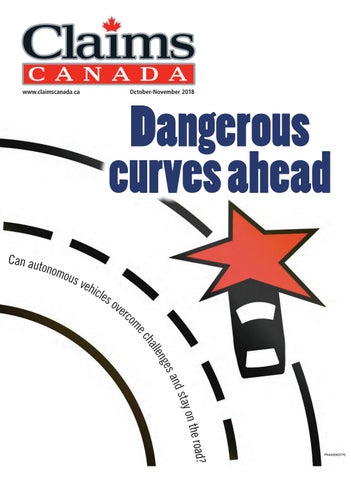
Dangerous curves ahead Can auto nomo us v ehic les ove rco m
Unpredictable technology plus unreliable humans and increasing costs illuminate the deficiencies of self-driving technology
road? on the stay and ges llen ha ec
By Emily Atkins
With names like Autopilot, Pilot Assist and Drive Pilot for various manufacturers’ autonomous driving systems, it’s no wonder the car-buying public might be led to believe these vehicles can drive themselves. But they’d be wrong – and probably sorry – if they were to let these systems ‘pilot’ unsupervised. Car crashes involving autonomous vehicles have gathered headlines lately. From a couple well-publicized Uber crashes to several Tesla collisions, these incidents attract attention. The novelty of ‘self-driving’ cars makes people hyper-aware of their slightest misstep. The attention is warranted. Autonomous vehicle technology, no matter how impressive, it still very much under development, and we are nowhere near being able to rely on cars to drive themselves safely on public roadways. And the humans behind the wheel aren’t much better. The whole reason we need self-driving cars is because we can’t be trusted not to become distracted, drowsy or dumb behind the wheel. Putting people together with semi-autonomous technology can be a recipe for disaster, as these well-publicized crashes have demonstrated. But ADAS (advanced driver assistance systems) have been around since the early 2000s, when adaptive cruise control and lane departure warning technologies were introduced. And since their introduction they have proven to be effective at preventing collisions, saving people from injury and death and reducing the instances of insurance claims. Cars and light trucks cannot get the top safety rating from the Insurance Institute for Highway Safety (IIHS) without forward collision prevention, while the U.S. and European Union are both requiring all vehicles to have autonomous emergency braking and forward collision warning systems by 2020. Their safety benefits are clear. But when the technologies are combined, with adaptive cruise control (ACC) and active lane-keeping, they achieve what’s known as Level 2 automation. The vehicles can perform some aspects of steering and acceleration/braking, but with the full expectation that the human driver remains in control of the rest of the driving tasks. Level 2 systems are getting more sophisticated and are gaining in popularity. But as more cars come equipped with these technologies, risks, challenges and costs are increasing to the point where some say they are increasing risks on the road. 6
Claims Canada
October-November 2018
www.claimscanada.ca
Dangerous curves ahead Recently, the IIHS, the U.S.-based automotive testing outfit funded by insurers, revealed the limitations of several of the more common assistive technologies on the road today. They have shared the results of new ADAS testing they are conducting to find out if the systems perform as advertised. In its research, the IIHS looked at the 2017 BMW 5-series with “Driving Assistant Plus,” the 2017 Mercedes-Benz E-Class with “Drive Pilot,” the 2018 Tesla Model 3 and 2016 Model S with “Autopilot” (software versions 8.1 and 7.1, respectively) and the 2018 Volvo S90 with “Pilot Assist”. The vehicles were chosen because they are some of the few that combine various technologies to create a near-autonomous driving experience. The Institute’s basic question was to discover if these systems behave the way a competent human driver would. Bottom line: they don’t. And the consequences range along a scale from annoying to dangerous, according to the research. IIHS engineers looked at adaptive cruise control (ACC) and active lane-keeping systems in a series of tests completed in their test facility and on the surrounding public roads. The cruise control tests looked at multiple scenarios, both on a track and in the real world. While all the vehicles were able to avoid hitting stationary targets with the ACC turned on, without it, the two Teslas tested did hit the target. All the cars successfully followed a lead vehicle that braked and accelerated, and also were able to brake in time to avoid a stationary target that came into view as a lead vehicle turned off the road. In the real world, however, the cars were less successful. The IIHS engineers found that each of the vehicles, except the Tesla Model 3, failed to react appropriately to a vehicle stopped in front. One of the engineers recounted how the E-Class Mercedes-Benz she was driving, with both ACC and lane-keeping turned on, momentarily detected a stopped pick-up truck in front of her, then lost track of it. The car continued at speed until she hit the brakes.
“These systems…are not capable of driving like a human,” said David Aylor, manager of active safety testing at IIHS, in an interview. “We’re not at the point where these are full autonomous systems – so it’s important that drivers remain engaged, keep their hands on the wheel – because these systems don’t work in all scenarios and they are not a replacement for a human driver.” Aylor said the IIHS research points out failings of the systems in three main areas: curves, hills and stopped vehicles. In tests using the rolling Virginia terrain surrounding the Institute’s facility, researchers found that cars can lose sight of the painted lines that guide the lane-keeping functions on steep hills and curves of certain radii. “These systems are using forward-looking cameras, and as you approach a hill the lines disappear over the crest, and so that can be a challenge for a forward-looking camera. And then curves – some vehicles have more capability to manage tighter curves than others.”
Broken trust This IIHS research was motivated partly because of comments they received from drivers who found that their semiautonomous cars did not behave as expected. “When the system doesn’t operate like the driver is expecting, it really leads to a lack of trust. And so we’re not quite sure of the safety benefit, but if systems are annoying to drivers, if drivers don’t trust systems, they’re going to turn them off,” Aylor said. The problem is that nobody really knows what we should realistically expect from these systems. With semi-autonomous systems in control there’s no baseline data available, said Adam Campbell, a senior associate, human factors, at -30- Forensic Engineering, in an interview. “To determine what a vehicle with autonomous technology should be doing in a certain situation requires an understanding what it does under the most ideal conditions…That sort of baseline data on what it’s expected to do is not really available to us right now.”
How active lane-keeping systems performed in IIHS road tests on 3 curves and 3 hills Number of times vehicles
went over line
BMW 5 series
on curves
on hills
touched line
on curves
on hills
system disengaged
on curves
on hills
stayed within lane
on curves
on hills
3 6 1 1 9 7 3 0
Mercedes-Benz E-Class 2 1 5 1 1 1 9 15 Tesla Model 3
0 0 0 1 0 0 18 17
Tesla Models S
1
Volvo s90
8 2 0 1 0 4 9 9
12
0
1
0
0
17
5
Source: IIHS
www.claimscanada.ca
October-November 2018
Claims Canada
7
Cover Story The human factor
Insurance implications
If the intended behaviour of the ADAS-equipped vehicle remains in a black box, what about the human side of the equation? How humans behave behind the wheel of a conventional car is well documented: “If you had two human drivers operating nonautonomous vehicles that hit each other, the establishment of who could have done what to avoid the collision or could not have done to avoid the collision is premised on human-based research,” Campbell said. “What we know of how drivers respond to certain situations has been very thoroughly documented in research over the last 30 years.” That data is available to objectively say what we expect humans to be able to do in different situations behind the wheel of a car. But when you combine the semi-autonomous systems with human driving, what happens? First, people don’t always use or appreciate the technology. According to recent research by LexisNexus, car buyers mostly stumble across the advanced features in their vehicles. In fact, 85 per cent did not seek out a car with ADAS. And for those who have and use the systems, 40 per cent maintain that they do not fully trust them. Similarly, 36 per cent of ADAS-equipped car owners have disabled or plan to disable some of the autonomous features, while 24 per cent of owners with three or more ADAS features on their cars have disabled some or all of them. Second, some people trust the technology too much and let these Level 2 vehicles drive themselves. This is how several of the well-publicized Tesla crashes have occurred; the driver is watching a movie or sleeping while the car cruises down the highway – it’s all good until something unexpected happens. There are even aftermarket technologies available to disable the reminder buzzers and warnings that are triggered when your hands have been off the wheel too long. “The closer you get to a vehicle that can drive itself, the more dangerous it gets,” said Jamie Catania, president of -30-Forensic Engineering, in an interview. “The vehicle that can almost drive itself is probably the most dangerous, because everybody believes it’s so amazing and can do so much. Yet it’s that one time in maybe 100 trips when it can’t figure out what to do that causes problems.” The third effect of interaction with semi-autonomous cars will be a decline in driver skills. Adam Campbell believes driving ability will be keyed very closely to the technologies on that driver’s particular vehicle. “New drivers aren’t going to be developing that full array of skills needed to safely operate a vehicle that’s not under the control of autonomous technology,” he said. That means when they need to rent a car, or drive a car with unfamiliar technology they’ll be “at a disadvantage and so will everyone else around them on the road.” As well, Campbell said, because there’s no standardization across manufacturers, the operation of each vehicle will require a steep learning curve.
Autonomous vehicles are also contributing to increased costs, both for owners and insurers. While insurers have been offering discounts for cars equipped with collision avoidance systems, “the cost of sensors and monitors have increased to enhance overall safety, but these higher costs have not yet been offset by claims reductions,” said Henry Hamm, personal insurance broker proposition director at RSA Canada. The cost of insuring a Tesla Model 3 in the U.S. is a case in point: AAA predicted a 30 per cent hike in premiums last year. The IIHS’s Russ Rader told TheTruthAboutCars.com: “Teslas get into a lot of crashes and are costly to repair afterward. Consumers will pay for that when they go to insure one.” “A windshield repair on a vehicle with ADAS now requires calibration to ensure the ADAS technology operates to manufacturer specifications, which is associated with more repair time and a higher cost, and in turn impacts premiums,” Hamm said. “Failure to adhere to repair to these standards, opens up potential liability issues for repair firms.” As well, he noted that the cost of automobile repairs is increasing significantly. Some models have seen a 20 per cent increase in the number of parts in a front end in the last two model years, which drives costs up significantly. Cars today boast more safety features, and more expensive parts, proximity sensors, cameras, radar etc. but, “the potential safety benefits are not been reflected in lower crash frequencies. As a result, physical damage coverage is showing an industry-wide deteriorating loss ratio trend,” Hamm added.
8
Claims Canada
October-November 2018
The automakers’ role FFor their part, the car makers are investing heavily in research to figure out how to make the car-human relationship smoother. “Autonomous vehicle manufacturers are funding a lot of research to figure out what people are expected to do on the road given typical roadway conditions – just driving normally and also responding to hazards on the road,” Campbell said. “The reason for that is that they want to build technology that responds at least as well as humans to do to establish trust in the technology.” But automakers are not sharing data. Even the IIHS did not have access to the onboard sensor data in its tests, Aylor said, relying instead on video and external sensors to track the cars’ behaviour. Campbell notes that this is “mostly because the research is proprietary and the claims that are made against autonomous vehicle manufacturers often get settled quite quickly because they know if these things proceed to trial, their golden nugget of technology and the foundational research on it will be exposed to competing companies.” Concrete measures to improve safety include a wide variety of in-car sensors and systems designed to ensure the driver remains alert and in control. “Auto makers are realizing the peril that comes with the false sense of security that ADAS currently provides drivwww.claimscanada.ca
ers,” said Hamm. “For instance, Cadillac has installed sensors that can detect when a driver takes his or her eyes off the road, and will alert the driver to pay attention. There is still the risk of over-reliance on these safety features that may not make the appropriate response in unique circumstances.” And Cadillac’s not alone. MercedesBenz Canada spokeswoman JoAnne Caza emphasizes that the luxury carmaker spends “a lot of time training the sales consultants and delivery specialists so they can explain the technology to their customers. We also have high quality online media content (e.g. YouTube videos), and detailed information in the owner’s manuals.” Likewise, Tesla takes pains to explain to its buyers that they must be aware and in control at all times. Right now, “designers are struggling with trade-offs inherent in automated assistance,” said David Zuby, IIHS chief research officer. “If they limit functionality to keep drivers engaged, they risk a backlash that the systems are too rudimentary. If the systems seem too capable, then drivers may not give them the attention required to use them safely.”
are important for drivers to purchase when they’re buying a new vehicle.” Jamie Catania sees it as a chicken-andegg problem: “These technologies probably make people worse drivers ‘cause they’re less vigilant to the task and they’re less attentive and they’re relying on tech more. But it probably hasn’t come a moment too soon given the way people are prone to drive anyway. It’s probably rescued a lot of 18 year olds from horrible collisions already.”
Fortunately, researchers are making steady progress in teaching ADAS to be smarter and more like a human, and new money is being made available to fund the work. However, for the near term road users, car buyers, insurers and accident investigators will have a lot of complexity to sort through in assessing risk. The process of buying, driving and insuring a car is quickly losing its simplicity and becoming a confusing mess. •
Not all accountants are MDD Forensic Accountants.
The conundrum If ADAS-equipped cars are not smart enough to be trusted, and drivers are not smart enough to know when trust is appropriate, and these vehicles are causing repair and insurance costs to increase, why are we still hurtling down the road to full autonomy? Because the Holy Grail is technology where “every vehicle is communicating with every other vehicle and the roadway and everyone else, so that everyone knows exactly where everyone else is, what they’re going to do,” Campbell said. “Even coming halfway to realizing that reality will hopefully a be a better place than we are right now in terms of overall roadway safety.” IIHS’s Aylor agrees with the prognosis: “I don’t think we’re close, at this point in time. I think the task of driving is much more difficult than most people realize. So, while we’re not at full autonomy, there are a lot of advanced, driver assistance systems that show benefit either in police reported crashes, or insurance related crashes, that www.claimscanada.ca
With over 40 offices on 5 continents, over 30 language fluencies, 18 distinct professional designations and a work history that spans more than 130 countries and 800 industries, we are truly world-class experts with a global reach. To work with a member of our respected team contact any one of our Canadian offices or visit us at mdd.com.
VA N C O U V E R • C A L G A R Y • E D M O N T O N • W I N N I P E G • L O N D O N H A M I LT O N • T O R O N T O • K I N G S T O N • O T T A W A • M O N T R E A L • H A L I F A X
October-November 2018
Claims Canada
9
Economic losses in fatal accident claims BY BRENDAN CAPE
Economic loss calculations in fatal and non-fatal accident claims share certain similarities, but as outlined in this article, there are a number of key differences to consider. In a non-fatal accident claim, economic loss calculations are intended to restore the injured person to the financial position they would have enjoyed had the accident not occurred. In particular, the injured person is normally compensated for both their lost earnings and the additional costs (e.g. medical expenses, housekeeping, caregiving, etc.) they are expected to incur as a result of an accident. In a fatal accident claim, by contrast, economic loss calculations are intended to restore the deceased person’s surviving dependent family members to the financial position they would have otherwise enjoyed had the fatality not occurred. Accordingly, the losses sustained by the surviving family members following a fatal accident are conceptually different from the losses sustained by an injured person after a non-fatal accident. Forensic accountants are often retained in both fatal and non-fatal accident claims to quantify both the past losses and the present value of the future losses based on the available information, which may include opinions provided by medical and/or vocational experts. This article explores four key topics: 1. Loss of Earnings (Non-Fatal Accidents) 2. Dependency on Earnings (Fatal Accidents) 3. Other Economic Losses (Medical costs, household services, etc.) 4. Lump-Sum Awards for Future Losses 1. LOSS OF EARNINGS (Non-Fatal Accidents) In a non-fatal accident claim, an injured person is compensated for their loss of pre-tax earnings capacity, which is a comparison between: (a) The projected future earnings in the absence of the accident; and (b) The projected future earnings as a consequence of the accident. Future losses of earnings are discounted to their mortality-adjusted present value, and may be further discounted to consider other risks such as disability and/or unemployment. For example:
Annual Pre-Tax Projected Earnings Annual (Without Pre-Tax Accident) Earnings (Without Accident) Annual Pre-Tax Projected Earnings Annual (GivenPre-Tax Accident) Earnings (Given Accident) e-Tax Earnings Loss Capacity of Pre-Tax Earnings Capacity Adjusted Present Mortality-Adjusted Value Factor (Age Present 54-65) Value Factor (Age 54-65) oss of Earnings Future Loss of Earnings
10 Claims Canada
October-November 2018
$92,000 27,000 $65,000 10.556 $686,140
2. DEPENDENCY ON EARNINGS (Fatal Accidents) In a fatal accident claim, it is the surviving dependent family members who claim for their losses of dependency on the deceased’s after-tax earnings. The dependents are not compensated for the full value of the deceased’s earnings since a portion those earnings would have been consumed personally by the deceased had the incident not occurred. There are three major components of a dependency loss calculation: ➢ Projected Annual After-Tax Income Unlike a personal injury case, appropriate deductions must be made for the income taxes, CPP contributions and EI premiums which the deceased would have otherwise paid. ➢ Dependency Period In the case of a spouse, the dependency period normally extends to the deceased’s assumed retirement date, while minor children are often considered to be dependent while they are anticipated to live at home or remain in school. ➢ Dependency Rate A dependency rate is a percentage applied to the deceased’s projected after-tax income throughout the dependency period and is intended to reflect each survivor’s level of dependency on the deceased’s after-tax income. As household expenditures are affected in different ways by the loss of a contributing family member, it is theoretically possible to calculate dependency rates specific to each individual situation. However, since many households do not maintain detailed accounting records, dependency rates are often derived from the spending patterns of typical households. Based on statistics for Canadian families with one income-earner, it has been estimated that a surviving spouse has a dependency rate of 72 per cent and that each of the first four dependent children adds approximately four per cent to the dependency rate. In the case of a single-income household with no dependent children, the application of a 72 per cent dependency rate implies that the deceased would have spent 28 per cent of his or her income on himself or herself, and this technique is known as the ‘Sole Dependency Approach’. However, when a second income-earner is introduced to the household, the situation becomes more complex and a lower dependency rate or different methodology may be warranted. The following table compares the Sole-Dependency Approach for a single-earner household to the Cross-Dependency $92,000 Approach that calculates a dependency loss based on the com27,000 bined income of both spouses and then deducts the surviving $65,000 spouse’s income: 10.556 However, when the deceased’s income is significantly low$686,140 er than the surviving spouse’s income, applying the crosswww.claimscanada.ca
Deceased’s Annual After-Tax Income Deceased’s Annual Annual After-Tax After-Tax Income Income Deceased’s Dependency Rate Dependency Rate Rate Dependency Less: Survivor’s Annual After-Tax Income Less: Survivor’s Survivor’s Annual After-Tax Income Income Projected Annual Dependency Loss Less: Annual After-Tax Projected Annual Annual Dependency Dependency Loss Loss Projected
Sole-Dependency Sole-Dependency Approach Sole-Dependency Approach $70,000 Approach $70,000 (N/A) $70,000 (N/A) $70,000 (N/A) $70,000 72 per cent $70,000 72 per per cent $ 50,400 72 cent $ 50,400 N/A) $ 50,400 N/A) $50,400 N/A) $50,400 $50,400
Cross-Dependency Cross-Dependency Approach Cross-Dependency Approach $70,000 Approach $70,000 30,000 $70,000 30,000 $100,000 30,000 $100,000 72 per cent $100,000 per cent cent $7272,400 72 per $ 72,400 (30,000) $ 72,400 (30,000) $42,000 (30,000) $42,000 $42,000
FNOL
AudaTarget
dependency approach can lead to the anomalous conclusion that the surviving spouse has become financially “better off” following the loss of their lower-income spouse: Deceased’s Annual After-Tax Income Deceased’s AnnualAfter-Tax After-TaxIncome Income Survivor’s Annual Deceased’s Annual After-Tax Income Survivor’s Annual After-Tax Income Survivor’s Annual After-Tax Income
Dependency Rate Dependency Rate Rate Dependency Less: Survivor’s Annual After-Tax Income Less: Survivor’s Survivor’s Annual After-Tax Income Income Projected Annual Dependency Loss Less: Annual After-Tax Projected Annual Dependency Loss Projected Annual Dependency Loss
Sole-Dependency Approach Sole-Dependency Sole-Dependency Approach Approach $40,000 $40,000 (N/A) $40,000 (N/A) (N/A) $40,000 $40,000 72 per cent $40,000 72 per per cent $28,800 72 cent $28,800 N/A) $28,800 N/A) $28,800 N/A) $28,800 $28,800
Cross-Dependency Approach Cross-Dependency Cross-Dependency Approach Approach $40,000 $40,000 110,000 $40,000 110,000 110,000 $150,000 $150,000 72 per cent $150,000 72 per per cent cent $108,00 72 $108,00 (110,000) $108,00 (110,000) $(2,000) (110,000) $(2,000) $(2,000)
For this reason, when a household has more than one income earner, the sole-dependency approach is often modified to 50 per cent or 60 per cent to reflect the surviving spouse’s lower of level of dependency on the deceased’s income. This is known as the ‘Modified SoleDependency Approach’ and is often used instead of the Cross-Dependency Approach. Dependency losses are often based on the deceased’s employment and/or self-employment income, without reference to investment income since the underlying investments are often inherited by the surviving dependents. However, there are a number of specific situations which warrant further consideration, such as when the deceased was a member of pension plan or was the owner of a corporation or income-producing property. 3. OTHER ECONOMIC LOSSES (Medical Costs & Household Services) In non-fatal accident cases, injured individuals sometimes sustain economic losses beyond their loss of earnings, such as medical costs and/or the inability to continue providing household services. While fatal accident cases do not normally involve medical costs, the surviving members of a household may still have lost the household services which the deceased had provided prior to the accident. When future medical costs are anticipated, they are often projected by medical experts based on the injured person’s impairment, while household services costs are normally projected based on the cost of replacing those services. 4. LUMP-SUM AWARDS FOR FUTURE LOSSES In both fatal and non-fatal accident claims, once the future loss amounts are determined for both earnings and other losses, the future amounts are then converted to a single lump-sum amount that reflects the discount rates prescribed for future economic losses and the mortality risk of the person who is injured or deceased, and in certain cases may include other risk factors such as disability and/or unemployment. In fatal accident claims, it is also necessary to consider the mortality risk for each surviving dependent family member throughout their periods of dependency. Accordingly, the future loss multiples applicable to dependency losses in fatal accident claims are typically lower than the multiples applied to income losses in non-fatal accident claims.
SUMMARY While economic loss calculations in fatal accident claims are similar in certain respects to non-fatal accident claims, it is important to understand the conceptual differences when assessing an economic loss claim in a fatal accident setting. • Brendan Cape, CPA, CMA, CFF, CBV, is a Senior Manager in the Toronto office of Meaden & Moore International. www.claimscanada.ca
Damage Report Medium Heavy
YEAR: 2013 MODEL: Veloster MAKE: Hyundai VIN #:...XXXXXX
Ron’s Repairs
Otto’s Autos
Manny’s Mechs
NCR 102%
NCR 94%
NCR 115%
What if you had an intelligent system that could tell you which shops were best for specific repair types? That’s exactly what AudaTarget does. Using a vast database of historical records, its algorithms accurately predict which shops will be best suited for the specific conditions of the hit. Instead of basing recommendations off proximity or average repair costs, FNOL agents can make much better decisions.
Pilot studies project 3% to 5% savings on gross appraisal value. Call 1.416.498.3777 or visit audatex.ca/audatarget to learn more.
October-November 2018
Claims Canada 11
Restoration Myth-Busting:
Three-day drying Part 3
BY KRIS RZESNOSKI
If you have followed my last two articles, there was a focus on the science of restoration vs. the believed capability of the industry. If you’re a broker and you’re trying to reduce your loss ratio, there is no better place to start than finding an insurer who knows that reducing dollars on claims starts with effective mitigation. I’m not surprised any more by carriers who focus on shiny objects and miss the opportunity for real savings by passing on partners who can deliver real results. This article will show you a successful mitigation process, the results, and what it means to the customer. More importantly, I’ll outline how it allows the win (customer)-win (insurer)-win (contractor) scenario.
Rebuild Cycle Time: Mitigation Reduces Cycles
Reconstruction should be a last tool in a restorer's toolbox. There’s no doubt that this is the area that contributes the heaviest expense, longest cycle times, and leads to poor customer service experiences. Unlike a renovation, the insured never planned this event and they haven’t prepared to have strangers in their space. General contractors typically have six or more weeks of lead time for scheduling construction work on new jobs. Restorers are expected to provide fast service and close claims quickly, but there is an inherent problem with this model. A four- to seven-day restoration job can turn into a four- to 12-week reconstruction job. It doesn’t take much for emergency mitigation jobs to pile up and create a backlog of rebuild work. When the insured has a water loss and the restorer is aggressive with its mitigation services, there is an immediate savings and wins felt by all. Claims costs in Canada and the U.S. continue to increase even though program rules are being put in place and applied to the contractor. Why is this? The rules that have been adopted are leading to contaminated homes and litigation because they are improperly mitigated.
Tale of Twin Houses: Real World Cost Savings In 2009-2010, while working in Vancouver, British Columbia, I was presented with a challenging vendor manager. Two professionals with a lot of swagger in their step came to my office to do a preferred vendor review. They took the average emergency mitigation costs of our company and compared it to our competitors. I am all for trying to place analytics on claims, but numbers must have context and understanding. I reviewed a graph that illustrated these costs. I still see this practice being used today. The vendor manager paced the boardroom and read me the riot act as our average cost of an emergency was $9,800, while the average cost of our competition was $7,500. “We have a major problem,” she said. “What do you plan to do about getting your costs down?” 12 Claims Canada
October-November 2018
www.claimscanada.ca
The first question I asked was, “How many large losses did we do versus our competitors?” I was told this was irrelevant because it evens out – these are averages. While this is true for larger sample sizes on the insurance side, it is not true for a contractor. The better you are as a contractor, the larger scale work you get – your sample size definitely impacts your average. I next asked, “How did we compare on our rebuild numbers for the same jobs? What was our average rebuild cost versus our competitors?” We were told if the mitigation costs were not reduced we would be losing our place on the program, we should focus on cost savings and we’ll stay in the program. Luckily, we got a case where two eightyear-old row-houses right next to each other flooded. They were identical in every way. Same floors, floor plans, and materials. There was more water in claim #1 compared to claim #2, but not enough to dramatically offset the comparison. On Claim #1 we used an aggressive drying plan that our carrier partner thought was a great idea to reduce overall costs. On Claim #2 we followed the instructions to lower our mitigation costs to get our average costs down.
Claim #1: We extracted
the water, built containment for the cabinets and aggressively dried the structure for seven days. We applied specialty equipment, technology and techniques on this job. We dried the structure for approximately $7,000. The building was restored for a little less than $1,200. The insurance company saved over $9,000 in costs, weeks of ALE, and reduced the amount of time the insured was displaced from their home. It took an additional three days to repair one side of a cabinet and toe kicks, and one day to repair and paint the baseboard. Within two weeks this job was wrapped up and invoiced. The total cost of claim #1 was approximately $8,200.
Claim #2: Completed with the carrier who was managing our www.claimscanada.ca
average mitigation costs; they received a different service. We extracted the water, ripped out the hardwoods, and removed the cabinets, baseboard, and drywall to two feet up. We dried what structure was left for three days, but with less equipment than we did in Claim #1. We did everything possible to reduce our mitigation billings. The invoice for the mitigation was under $3,800. All of the contents also had to be packed, listed, and stored with site protection to reduce the dust in the unaffected part of the house. The cost of repairs and contents were nearly $14,000. We had a delay with the flooring that took an additional 14 days to get figured out. Total cost of Claim #2 was approximately $17,800. Want to know what the profitability to the jobs were? Surprisingly, you would find that the jobs made the contractor about the same amount of money: Claim #1 - $5,300 in 10 days Claim #2 - $5,600 in 49 days
So how does this story end? Claim #1: The insurance company was super happy with the results of our drying methods. The technicians worked hard to mitigate the job properly and the cost savings flowed to the bottom line. Claim #2: The insurance company was also super happy with how we substantially reduced our mitigation bill. Not only did get to remain in the program, they increased our market share.
Conclusion? The compounding effects of bad policies and bad process lead to a negative bottom line and poor claims ratios. Driving efficiency through best practices and adhering to accepted standards of care leads to the project being completed safely and while reducing your claims costs. In my next article I’ll explain the impact of equipment on materials and how materials can react in the drying environment. •
Knowledge And Experience That Has You Covered
Philip Turner TORONTO
Alain Viger MONTREAL
Kevin Copeland CALGARY
Edward Robinson VANCOUVER
FORENSIC ACCOUNTANTS TORONTO | MONTREAL | CALGARY | VANCOUVER AKRON | BEACHWOOD | BOSTON | CHARLOTTE | CHICAGO | CLEVELAND | COLUMBUS LONDON UK | LOS ANGELES | MIAMI | NEW YORK | ORLANDO | PITTSBURGH | WOOSTER
MEADENMOOREINTL.COM 1.855.731.0042
October-November 2018
Claims Canada 13
• on the scene OTS Bryant Vernon joins Aviva Canada as the new chief claims officer. Having recently moved to Canada from the United States, Bryant brings diverse and extensive claims management experience from companies such as Liberty Mutual and Solera. Before joining Aviva Canada in May 2018, Bryant was global head of data science and services at Solera where he helped insurance carriers improve profitability. He is passionate about claims and is committed to transforming the customer journey at Aviva. ●
30 Forensic Engineering has made two senior management appointments. Jamie Catania has been promoted to president and Greg MacLeod has been appointed chief financial officer. With more than 25 years of senior l evel experience in the field of forensic engineering, Jamie will continue to Jamie Catania bring a deep understanding of the industry, a dedication to clients and strong leadership to the firm. During his tenure at 30 Forensic Engineering as vice-president, forensic consulting, he has assembled and managed a large and sophisticated multi-disciplinary team of forensic specialists, while providing regulatory guidance to Greg MacLeod the practice of forensic engineering in the larger community and building a platform for future professionals as an educator at the post-graduate engineering level. Greg joined the 30 Forensic management team in September 2017 to guide the firm through an ownership transition and re-capitalization and he is remaining with the company to oversee strategy and planning. For over 30 years, Greg has held senior leadership positions in many sectors – manufacturing, financial, real estate and business services – and including several years as a Canadian partner with a major global accounting firm, where he led significant business reorganization engagements in Canada and worldwide. ●
Sharon Anderson has been appointed account executive for Cira Health Solutions. She will serve the company’s BC-based clientele from the office in Vancouver. Sharon has 17 years of experience in customer relations and business development. Beginning her career as director of an elite academy, she leverages a background in operations management, marketing, and business development that has taken her from Ontario to Vancouver. Her business development experience includes the hospitality, recreation, and medical industries. A dedication to health management and an extensive background in service and development, complement and enhance her role with Cira Health Solutions. ● 14 Claims Canada
October-November 2018
Terri McColman joins the head office team at DKI Canada as the company’s new commercial accounts manager. Terri brings over 20 years of national and local business development with the past five-plus years in the restoration industry as a commercial development manager with a strong focus on strategic business Terri McColman development and partnerships. In her new role Terri will be responsible for developing the commercial services sector along with supporting the continued growth of the P&C market and broker community. ●
Joelle Reid, B.A., C.Tech has joined Pario Engineering & Environmental Sciences LP. Joelle joins Pario after spending many years in positions in the environmental, health and safety field within the insurance industry. During her career, she has been involved with the investigation of close to 300 claims. Her areas of expertise include: water and mold damage claims; designated substances surveys; abatement protocol preparation; spill remediation and restoration claims; and smoke migration and remediation claims. Joelle is a graduate of York University and holds a specialized Honours Bachelor of Arts (B.A.) degree in Environmental and Health Studies. Following her time at York, she went on to receive a graduate certificate from Seneca College in Urban Land Regeneration, specializing in engineering technology. ●
Jeff Stinson has joined the ClaimsPro team in Peterborough, Ontario, as branch manager. Jeff will succeed Christina Welton, who continues to lead the front desk operations for ClaimsPro’s international London Open Market Direct Priority Service. Jeff brings over 20 years of adjuster experience to his new role. Most recently he was a senior adjuster with a large international independent adjusting firm. Before that, Jeff spent most of his career with a large national insurer based in Guelph, Ontario. He has extensive experience in automotive bodily injury, accident benefits, and property claims. Jeff will report directly to the vice-president for Eastern Ontario, Dan Buch. ● On Side Restoration Services Ltd. has moved in Surrey, British Columbia to a new, larger, and more modern facility located in the Port Kells neighbourhood. Peter Duhault, branch manager for the Surrey and Abbotsford branches said the new locations “will allow us to service a large geographic area encompassing Surrey, Delta, District of Langley, Pit Meadows and Maple Ridge.” The new building has an expanded carpentry/millwork shop, and a comprehensive contents division including fire-line and ozone chamber, as well as an expanded storage area. “We now also have a dust-free paint room making us capable in providing higher quality trim, doors and specialty custom finishings. It’s really a wonderful new space for our management and operations team to convene and reach out to the public as needed,” Duhault added. ● www.claimscanada.ca
Who educates Independent Adjusters to take on critical loss adjusting challenges? WE DO.
Canadian Independent Adjusters’ Association
CLA, FCLA, FCIAA designations are widely recognized as a Canadian benchmark distinguishing proficiency and skills in the loss adjusting profession. CIAA’s blended learning programs equip independent adjusters with the ability to manage all your claim services requirements.
The voice of Independent Insurance Adjusters in Canada
ciaa-adjusters.ca CLA (Chartered Loss Adjuster); FCLA (Fellow Chartered Loss Adjuster); FCIAA (Fellow of the Canadian Independent Adjusters’ Association)