www.claimscanada.ca
December 2018-January 2019
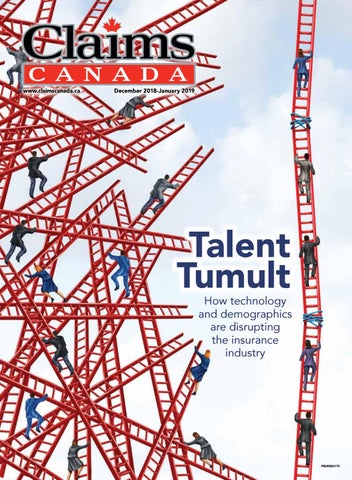
Talent Tumult
Official Journal of the Canadian IndeÊpendent Adjusters’ Association
How technology and demographics are disrupting the insurance industry
PM40063170
Not all accountants are MDD Forensic Accountants.
With over 40 offices on 5 continents, over 30 language fluencies, 18 distinct professional designations and a work history that spans more than 130 countries and 800 industries, we are truly world-class experts with a global reach. To work with a member of our respected team contact any one of our Canadian offices or visit us at mdd.com.
VA N C O U V E R • C A L G A R Y • E D M O N T O N • W I N N I P E G • L O N D O N H A M I LT O N • T O R O N T O • K I N G S T O N • O T T A W A • M O N T R E A L • H A L I F A X
Contents December 2018-January 2019 • VOLUME 12 • NUMBER 5 Official Journal of the Canadian Indeépendent Adjusters’ Association
Cover Feature
6 Talent tumult
6
Technology and demographics are challenging the P&C insurance industry BY EMILY ATKINS
News Features
10
10 Opioid cost recovery
Difficult coverage decisions await BY HEATHER SANDERSON
12 Common insurance coverage issues in Errors & Omissions claims
Cutting through the complexity BY RANDY NOVICK
12
Departments
4 First Notice 14 On the Scene
Published by:
Emily Atkins Editor (416) 614-5801 emily@newcom.ca
Sandra Parente Director, Business Development (416) 510-5114 sandra@newcom.ca
Ian Portsmouth Jonathan Hogg Managing Director, Account Representative Insurance Media Group (416) 510-5122 (416) 510-6800 jonathan@newcom.ca ian@newcom.ca Official Journal of the Canadian Indeépendent Adjusters’ Association
Karen Samuels Production Manager (416) 510-5190 karens@newcom.ca Elaine Borg Art Director Subscription inquiries (416) 614-5831
www.claimscanada.ca
Produced by the publishers of Canadian Underwriter magazine
Claims Canada is the country’s only national publication serving the insurance claims community. Published six times a year, it delivers practical insight that drives the success of claims decision-makers and influencers. Claims Canada is distributed in print and digital editions to a wide range of more than 15,000 industry stakeholders, including claims managers, adjusters, insurance executives, brokers, restoration professionals, forensic engineers and lawyers, among others.
www.claimscanada.ca
Chairman and Founder Jim Glionna
President Joe Glionna
Vice President, Operations Melissa Summerfield
Controller Peter Fryters
Director of Circulation Pat Glionna Head Office 5353 Dundas Street West, Suite 400, Toronto, Ontario M9B 6H8 (416) 614-2200 fax: (416) 614-8861
The contents of this publication may not be reproduced or transmitted in any form, either in part or in full, without the written consent of the copyright owner. Nor may any part of this publication be stored in a retrieval system of any nature without prior written consent.
December 2018-January 2019 | Claims Canada
3
• first notice FN Too small to fail
Community based projects for flood mitigation
A new report from the University of Waterloo stresses the importance of community-based projects to reduce flood risk in Canada. The report examines 11 projects in Vancouver, Calgary, Mississauga, Montreal and Halifax to assess how the restoration and preservation of natural infrastructures — such as ponds, large-scale natural gardens, and restored shorelines — can aid communities in protecting themselves from the impacts of flooding. “In recent years we have seen a dramatic rise in insurable losses related to extreme weather events in Canada. We have also seen insurance payouts average $1.8 billion over the past nine years, up from an average of $400 million just a decade prior,” said Blair Feltmate, head of the Intact Centre on Climate Adaptation at the University of Waterloo. “The increase in cost is due in part to flooding, and this new report identifies some practical mitigation measures municipalities and NGOs can take to limit the impacts of the bigger storms we
expect to see in coming years.” The 11 flood mitigation projects profiled in the report were conducted between 2012 and 2017, with funding from Intact Financial Corporation. The groups supported through this multi-year, multi-dimensional study include (by province): Adaptation to Climate Change Team and Partnership for Water Sustainability (British Columbia); Green Calgary (Alberta); Credit Valley Conservation, Green Communities Canada, and Toronto and Region Conservation Authority (Ontario); Nature Action Quebec (Quebec), and Ecology Action Centre (Nova Scotia). The report highlights two often-overlooked actions as recommendations to maximize the utility of community-level flood mitigation projects in the future. These include the need to engage local stakeholders throughout a project’s life cycle to build ongoing understanding and support for the project, and the need to ensure vigilance in monitoring a project to enable appropriate and timely changes in course correction. ●
Auto insurance rates rise The price of auto insurance has been trending upward in Ontario, Alberta and Atlantic Canada, with increases of 3.57% in Ontario, 0.24% in Alberta and 1.79% in Atlantic Canada in Q3 2018 versus the prior quarter. When compared with this time last year, Ontario saw the steepest rate increase at 10.71% and Alberta saw an annual increase of 6.70%. Annual data for Atlantic Canada is not yet available. The data were collected by LowestRates.ca, an online recommendation site that tracks the average cost of car insurance in Canada on a quarterly basis. ● 4
Claims Canada | December 2018-January 2019
Ontario pot users fall victim to cyber breach Only weeks after marijuana legalization, Canada Post admitted that someone had utilized its tracking tool to uncover personal data of 4,500 users of the Ontario Cannabis Store (OCS). The breach took place some time before November 1, 2018, which was when Canada Post notified the online retailer. “Both organizations have been working closely together since that time to investigate and take immediate action. As a result, important fixes have been put in place by both organizations to prevent any further unauthorized access to customer information,’’ Canada Post said.
OCS said in a statement it “has worked closely with Canada Post to identify the cause of this issue and to prevent any further unauthorized access to customer delivery information.” According to the marijuana retailer, the data breach included postal codes and names of persons signing for deliveries, as well as OCS reference numbers and delivery dates. It also said it had reported the incident to Ontario’s Privacy Commissioner, as well as notifying the 4,500 affected customers. OCS said the delivery data that it received also included information relating to customers of other Canada Post clients. ● www.claimscanada.ca
• first notice FN Growing claims in the marijuana space
Higher BC speed limits result in more claims
By Jason Contant
Claims adjusters handling recreational cannabis claims will need to consider the value of the plant at any given time in the growing process to determine actual loss, says Stephen Agnew, vice-president of the specialty risk division at ClaimsPro. Potential cannabis greenhouse loss is much greater than a standard greenhouse loss. A major fire to one of these cannabis facilities could potentially see a loss in the $100 million range, he said. Following the legalization of recreational marijuana Oct. 17, there has been rapid expansion of very sophisticated cannabis production facilities to grow, harvest and package product. These new developments could potentially involve large commercial exposures, including the following claims: • Course of construction (builder’s risk); • Wrap-up liability (protects contractors and subcontractors working on a large project); • Commercial property; • Complex equipment breakdown insurance; • Business interruption and contingent business interruption. When dealing with a greenhouse loss, you’re dealing with a growing plant, so the value changes as it grows. For example, at the seedling stage, there have been no hydro, watering, fertilizer and manpower costs. “If the product’s going out the door, you’ve incurred all of those expenses,” Agnew said. “Your expenses to the product are much greater at the end of the cycle than they are at the start.” In the medical marijuana space, ClaimsPro has already seen losses primarily between $150,000 and $750,000. These losses, mostly on Vancouver Island, were for fire and water damage, as well as boiler machinery issues, physical damage to buildings and specialized greenhouse equipment. ● www.claimscanada.ca
By Jason Contant
Increased rural highway speed limits in British Columbia had “large and statistically significant” increases in total insurance claims, injury claims and fatal crashes, a recent study has found. Over the course of the study, there were annual averages of 265,187 crashes resulting in an insurance claims (2000-2016). Total auto insurance claims increased 43%, injury claims 30% and fatal crashes 118% on affected road segments. For nearby road segments, the model estimated a 25.7% increase in insurance claims. The study, Road Safety Impact of Increased Rural Highway Speed Limits in British Columbia, Canada was published in the journal Sustainability. Most research shows that raising speed limits results in more injuries, researchers at the University of British Columbia wrote in the study’s abstract. Advocates of higher speed limits argue this conclusion is based on older research – traffic fatalities are decreasing despite higher speed limits and that modern vehicles are able to safely travel at higher speeds, justifying raising rural highway speed limits in B.C. “Based on our findings, we recommend that British Columbia roll back the 2014 speed limit increases,” the researchers suggested. ●
Knowledge And Experience That Has You Covered
Philip Turner TORONTO
Alain Viger MONTREAL
Kevin Copeland CALGARY
Edward Robinson VANCOUVER
FORENSIC ACCOUNTANTS TORONTO | MONTREAL | CALGARY | VANCOUVER AKRON | BEACHWOOD | BOSTON | CHARLOTTE | CHICAGO | CLEVELAND | COLUMBUS LONDON UK | LOS ANGELES | MIAMI | NEW YORK | ORLANDO | PITTSBURGH | WOOSTER
MEADENMOOREINTL.COM 1.855.731.0042 December 2018-January 2019 | Claims Canada
5
6
Claims Canada | December 2018-January 2019
www.claimscanada.ca
Cover Story
Talent Tumult Technology and demographics are fundamentally altering the P&C insurance employment landscape By Emily Atkins
A
storm is brewing for the P&C insurance industry that’s going to mean more intense competition for talented employees. As the industry moves to adopt quickly changing technologies, the need for people with advanced IT skills and experience is expanding. At the same time, the massive demographic shift as Baby Boomers retire and Millennials and later-generation workers move into more senior roles means employers will need to adapt and figure out how to ensure that certain skill sets are not lost, while also working to retain new talent. A recent series of reports by the Insurance Institute of Canada (IIC) on demographic and technological changes has revealed the extent of the changes taking place and sheds light on the challenges these engender for insurance businesses. Demographics of the P&C Insurance Industry in Canada and A Changing Workforce: Implications of Technological Disruption for the Insurance Industry in Canada were recently published as part of the IIC’s ongoing Emerging Issues series, and in collaboration with the Conference Board of Canada.
Evolution of the insurance workforce
The insurance industry is growing. According to the IIC demographic report, 70% of executives see the workforce expanding in the next five years. But there’s a problem here www.claimscanada.ca
because at the same time, workers are retiring in record numbers. More than 25% of current insurance industry workers will leave by 2027, with the bulk of them – 16% – departing in the next five years. At current replacement rates, the research found the industry will likely be able to maintain its workforce, but not grow it. Certain industry segments were found more likely to suffer. In occupational areas these include management and IT workers. Rural areas are projected to see more retirements than urban areas, while Saskatchewan, British Columbia and Quebec will face the largest regional losses. In the context of these trends, the IIC’s research delved more deeply into questions of technology along with the demographic shift in the labour market.
Tech shift
The very technologies that are digitizing our day-to-day lives are also going to have a significant impact on how businesses operate. The Internet of Things, Blockchain, artificial intelligence, autonomous mobility and the growing ability to measure and manage using the vast quantities of data being collected are transforming operations, changing the types of jobs that need to be done and shifting the skill sets that will be required to perform them. The insurance industry will need to adapt to keep up with these changes, as seen in the rise of cyber insurance, and the growing penetration of insurtech applications in the P&C space. Yet at the moment, according to the IIC research, 74% of executives don’t think their organizations can adapt to the pace of technological change. And close to half of HR professionals say technology will impact their company’s recruitment in the next two years. That’s more than double the number who said technology had a profound impact in the previous two years. Their concerns are well founded. Projections show that one third of insurance IT workers are likely to retire in the next nine years. As well, the nature of the IT work is changing, creating new areas where tech skills will come to the fore, while sidelining others. In claims December 2018-January 2019 | Claims Canada
7
Cover Story processing, for example, increasing use of algorithms and AI to analyze claims, along with the implementation of Blockchain to secure the process, may mean a fundamental change in the type of work done by claims professionals. Margaret Parent, director of the professionals’ division at IIC, said in an interview that new technologies will definitely have implications for claims jobs. “If Blockchain can be adopted, it is likely to reduce head count, from a claims perspective. But the amount of people it would take to implement Blockchain would suggest it could probably be similar or more. So, head counts in claims may come down, but head count in the industry, not likely.” Of course, claims is not the only area where the tech shift will affect workers. Tech-savvy firms were reported to be looking for more digital marketers, data analysts, and IT staff relative to those firms that were less concerned about the trend. The IIC demographics report also noted that broker talent and commercial customer service roles were less important to the tech-savvy companies, possibly reflecting “expectations that some of the functions provided by these roles are more likely to be automated in the coming years.”
The tech two-step
So what should P&C insurers be doing about the tech skills challenge? IIC’s research notes that thanks to the widespread adoption of new technologies, the competition for tech workers will be not just within the insurance industry, but also outside of it. IT workers, unlike other insurance employees, are more likely to leave the industry when they change jobs. “We’re going to be competing with a whole bunch of industry sectors,” Parent said. “It’s not going to be easy because insurance may not be seen as the sector of choice for the data and digital candidates.” Insurance HR departments are going to have to figure out how to make insurance industry IT careers more attractive than those in other industries. IIC recommends companies develop a strategy to avoid the extra costs associated with being unable to fill talent gaps. This means developing more targeted recruitment, along with considering ways to use temporary or con8
“Organizations will need to identify the skills they wish to develop and find appropriate educational experiences that can enable employees to acquire these skills.” tract workers to meet demand. Additionally, on the retention side, there will need to be a new focus on providing educational and advancement opportunities that will help satisfy IT workers who might otherwise job-hop. “Organizations will need to identify the skills they wish to develop and find appropriate educational experiences that can enable employees to acquire these skills,” the workforce study notes. These will need to be in step with contemporary learning styles, following trends to shorter attention spans, gamification and real-time feedback.
The demographic double-whammy
The industry is bracing for the retirements of a huge cohort of Baby Boomers who fill the ranks of senior management. With Boomers – who are now aged 51 to 70 according to the IIC’s classification – making up 27% of the insurance workforce, and 35% of management, along with 33% of IT workers, there is potential for a catastrophic skills gap to emerge in the next few years. How to transfer the brain trust from the Boomers to the next generation of workers is a challenge the industry has been grappling with for a while now, but it has become more critical. “Part of the pipeline into management would be some of the 40-somethings moving in,” Parent said. But there aren’t enough 40-year-olds in the pipeline. So the industry needs to turn to alternatives. One is taking advantage of a trend towards later retirements in Boomers – the median retirement for the industry has inched up from 59.5 in 2007 to 61.3 in 2017. The study notes that part of the reason for this is the increasing availability of flexible work arrangements like telecommuting,
Claims Canada | December 2018-January 2019
reduced work weeks or phased retirement. About 86% of employees said they’d be interested in continuing to work past their scheduled retirement date if employers made these options available. The study found that the retirement age rose from 61.1 years to 64.4 years for those with such arrangements. Convincing the brain trust to stick around is just the first step to ensuring continuity, however. Transferring their knowledge to the new generation is the next piece of the puzzle, and it’s one that Crawford & Company Canada has been trying to perfect. “We have a lot of small offices, so we have a lot of places where it’s a casual, one-on-one process,” said Erin Poirier, Crawford’s vice-president of human resources, in an interview. “We also have formal mentoring programs in place, particularly in the GTS space. That is where we’re pairing a newer person to the industry and the company with a longer-tenured and more experienced adjuster, and trying to do that knowledge download.” Poirier said the strategy is definitely working, and the knowledge transfer goes both ways. “Tenured employees are learning a lot about technology from the new hires,” she noted.
The Millennial wave
Millennials (aged 22 to 37, by the IIC’s reckoning) now make up the largest demographic cohort in the P&C insurance industry. They have taken over in a rush; in 2007 they represented only 12% of the workforce, while now they make up 39%. In 2012 they were still the smallest cohort, but in 2017 they edged out both Generation X (38 to 50 years old) at 33% and the Boomers at 27%. What this means is that shortage of 40-year-olds the IIC’s Parent mentioned is going to be met by a group of younger www.claimscanada.ca
individuals. These younger workers, with five to eight years of experience are going to be moving up rapidly. “We need to take some of the millennials, up-skill them quicker, and enable them to gain as much experience as possible in as short a period of time in order to be able to manage what leaders in their 50s are doing right now with 20 years’ experience,” Parent said. Grooming these workers into senior management will require more than just mentoring. Parent said there are important conversations taking place at the IIC about how to deliver the kind of case study-based learning that will develop green talent into experienced senior managers: “How can we train and up-skill quicker? And how do we build more case studies into some of the education so that even if you’re not experiencing firsthand, you can learn about a situation?” are the questions being mulled, she said. Much has been made of the Millennial generation’s work preferences and part of
SURPASSING INDUSTRY STANDARDS
the insurance industry’s push to recruit and retain this cohort will require big shifts in work culture to become more attractive. Having skillsets trump tenure is one of the major changes needed, Parent said, but there are other important parts, like flexibility in work schedules, work-life balance, instant feedback and heavy use of technology. As the report notes, retaining workers will be a key competitive advantage in the coming shortage of skilled employees, and keeping Millennials satisfied at work will be critical to success.
Heads count
The human beings on the customer-facing side of the insurance business play an increasingly important role, even in the face of the industry’s growing reliance on technology. The IIC report notes that “customer service skills are becoming increasingly important to the industry as organizations look to reposition customers at the core of their business models.” Sixty percent of
executives see customer service as a more important skill than others to the future of their organization. Crawford’s Poirier agrees, and identifies another benefit from older staff mentoring the younger ones: “The younger person learns the art of networking faceto-face. They’re used to more social media, texting, online interactions, while our longer-tenured employees are more used to going out to industry functions and really shaking hands and cultivating those relationships.” It will be critical for insurers and claims management firms alike to ensure their recruitment and retention efforts not only account for the evolution of the industry’s people, but also continue to select and groom those who have the human skills to understand what makes a happy customer. No amount of technology, AI or automated claims processing will obviate the need for an understanding human when there’s a catastrophe in a customer’s life. ●
30+ Years Superior Disaster Restoration Services With the strength of our team, leading technology, and an eye to the future, FirstOnSite surpasses restoration industry standards for our insurance partners and commercial and residential property owners. To learn more about how we can help reduce cycle times and enhance customer experience, Call the restoration industry leader, FirstOnSite.
Visit us at firstonsite.ca or call 1.877.778.6731 Follow us:
q030_FOS_Ad_CU_HalfPageHoriz_02.indd 1
www.claimscanada.ca
2017-04-27 10:45 AM
December 2018-January 2019 | Claims Canada
9
OPIOID COST RECOVERY
Difficult coverage decisions await By Heather A. Sanderson
T
he opioid crisis crept into Canada some 21 years ago on the back of assurances from pharmaceutical manufacturers and distributors that drugs like oxycodone (OxyContin) and hydrocodone (Vicodin) were not addictive. Those assurances were false. The opioid epidemic is straining healthcare budgets of Canadian provinces and territories. The rate of hospitalizations due to opioid poisoning has dramatically increased; the treatments addicts need to become clean are very expensive. All of this means that the Canadian provincial and territorial health care providers (public health insurers or PHIs) are looking at cost recovery.
ers, were negligent in supervising their use. Also named are distributors such as ABC, McKesson, Cardinal Health, and public-facing retailers. The allegations against the distributors are that they intentionally or negligently failed to detect, investigate, or report excessive and suspicious orders of prescription opioids and misrepresented their addictive qualities. Most of these lawsuits have been filed in federal court. Most of them have been directed into a multi-district litigation regime directed by a federal court judge in Ohio, who aggressively pursued a global settlement. In March 2018, he ordered the parties to engage in limited and targeted litigation.
American cost recovery
A national class action was launched in 2007 against Purdue Pharma and its affiliates (a company that manufactured OxyContin and OxyNEO), on behalf of 2,000 Canadians in Nova Scotia, Quebec, Ontario and Saskatchewan who became addicted to OxyContin, as well as the PHIs in those provinces for the costs they incurred to treat OxyContin addiction. That lawsuit settled last year on the basis that the defendants would pay $20 million to class members, including $2 million to the PHIs. The settlement had to be approved by each
American health care providers, states, counties, municipalities, hospitals, pension funds, unions and health insurers have filed lawsuits to recoup the cost of providing public services related to opioid addiction (emergency health care, social services and employment-related costs). For the most part, the defendants in these suits are opioid manufacturers (‘big pharma’), doctors and clinics that prescribed the drugs. It is alleged they misrepresented the addictiveness of opioids and, in the case of the prescrib10
Canadian cost recovery actions
Claims Canada | December 2018-January 2019
of the courts in Ontario, Quebec and Nova Scotia and Saskatchewan. Non-approval by one court would nullify the agreement in all other provinces. By the time approval was sought in Saskatchewan, all other court approvals were obtained and through various agreements and orders the settlement was proposed to be binding on all Canadians affected by OxyContin and OxyNEO and on all provincial and territorial PHIs. On March 15, 2018, a judge in Saskatchewan rejected the settlement. He raised two principal issues: Whether the PHIs had properly signed off on the terms of the final settlement; and, whether or not the agreedupon amount of compensation took into account the real costs of treatment, rehabilitation and loss of income for the people who had developed opioid addiction. A notice of appeal of that decision was filed April 2, 2018. There have been few, if any other lawsuits filed in Canada. If the Saskatchewan courts up-end the settlement of the national OxyContin/OxyNeo action, it is possible the PHIs will follow the strategy they used against Big Tobacco and enact legislation to facilitate their ability to sue the manufacturers, prescribers and distributors of opioids.
Coverage for cost recovery
If those lawsuits are filed, then the Canadian P&C industry will be faced with demands to defend, and eventually, demands to indemnify these lawsuits, which raises a myriad of coverage issues under occurrence-based CGL policies. The resolution of those issues will be guided by the American coverage experience with opioid litigation. Is the liability caused by an occurrence? Can it be said that those claiming coverage expected or intended the addiction that resulted in the health care costs? In the context of opioid litigation, is the alleged liability the result of an intentional scheme or is it negligent oversight? In a 2017 U.S. case, the court held that allegations the insured engaged in a deliberate course of conduct designed to increase sales of its opioids by intentionally misleading doctors and the public did not constitute an accident or an occurrence. However, in Canada, conduct that has unintended consequences has been held to be ‘an accident’ or ‘an occurrence’ unless www.claimscanada.ca
there is evidence that the insured courted the risk of the very damage that occurred. Are the potential claims of PHIs for the health care costs of the opioid crisis a claim for damages for bodily injury? Properly characterized, aren’t they claims for compensatory damages for economic costs incurred by the provinces and territories? If so, those claims would fall outside of coverage as they are not claims ‘because of bodily injury’. Two American federal court decisions support that position. However, in another decision, a federal trial court concluded that a duty to defend was triggered. The court reasoned that the “because of bodily injury” language, common in Canadian CGL policies, created wider coverage than the “for bodily injury” wording that is sometimes used. Should these potential claims of the PHIs fall within the coverage of a CGL, the next question will be whether any of the commonly found exclusions apply. The “product itself’ exclusion, that excludes coverage for “bodily
injury” either “arising out of” or “resulting from” products manufactured, sold, handled, or distributed by the insured, has been applied by two American courts to exclude claims for opioid crisis health care costs. I have not found a contrary case in the context of opioid health care costs recovery litigation. However, several, if not most, of the defendants named in any anticipated opioid health care costs recovery litigation will have a variant of product liability coverage that does not include this product exclusion. This coverage is either added by endorsement or is an exception to an exclusion that covers all sums the insured becomes legally obligated to pay as damages because of bodily injury included within the defined term, ‘products completed operations hazard’. Working through typical definitions, those insureds will discover they have coverage for all claims because of bodily injury occurring away from premises owned or rented by the insured that arise out of the insured’s “product” (also
defined). If this type of product liability coverage is in place and no other exclusionary argument applies, then these claims would be covered. Finally, there may be a basis for exclusion on the backs of the unfair competition and criminal acts exclusions. It is possible, but unlikely, that claims bought by the PHIs to recover health care costs would engage the directors’ and officers’ (D&O) and management liability policies of the named defendants. Public assurances by directors that opioids are non-addictive may engage these policies. but to date, there is no reported North American case applying a D&O or management liability policy in the context of opioid litigation. ● Heather Sanderson of Sanderson Law in Calgary, Alberta, is a director of Canadian Defence Lawyers. She thanks Robert Kole, Choate & Hall, Boston, MA, for information on the status of American opioid cost recovery and coverage litigation.
FIRST GENERAL CONTINUES TO EXPAND ACROSS CANADA First General is pleased to announce the opening of new locations in Kamloops and Yorkton First General continues to strengthen their network across Canada with the opening of First General Kamloops. This office will cover Kamloops and surrounding areas, including Merritt, Sun Peaks, Ashcroft, Cache Creek, Clinton, Clearwater & Salmon Arm.
First General continues to strengthen their network across Canada with the opening of First General Yorkton which will service the Greater Yorkton Area, Melfort and Hudson Bay in Saskatchewan and Russell, Roblin, Swan River and Dauphin in Manitoba.
Justin McNaney and Christina McLean McNaney are the owners of the Kamloops office. Justin has been working in the restoration industry for 27 years and is IICRC certified.
“The Yorkton office opening is a compliment to our focus on expanding our national footprint.” said Frank Mirabelli, CEO.
Justin has extensive experience and certifications in water, fire, mould, smoke damage, carpet repair and reinstallation, asbestos, and trauma scene cleanup.Concord FG Kamloops are members of the BBB, Kamloops chamber of Commerce, and Baeumler approved.
Paul Smolinski is the owner of the Yorkton office and is well versed and experienced in servicing the community. His experience includes small to medium sized residential, commercial, institutional and industrial projects. They are equipped to service projects anywhere from $1M to $20M in size and specialities include steel building, concrete work, project management, design build, drafting and engineering services.
Christina also worked in the industry for several years and is a third-generation business owner. Christina acts as the Office Manager for Concord First General Kamloops. Frank Mirabelli, CEO, “both Justin and Christina have extensive experience We are pleased to welcome them to the First General Family. Their experience, customer service and reputation are a great asset to our organization.”
“We are pleased to welcome Paul and the Yorkton team to our First General family! Their proven track record, customer service and reputation, are a great asset to our organization.” Frank Mirabelli, CEO.
HELP HAS ARRIVED.
www.claimscanada.ca
1-877-888-9111 firstgeneral.ca
December 2018-January 2019 | Claims Canada
11
Common Insurance Coverage Issues in E&O Claims By Randy Novick
P
rofessional liability, specifically Errors & Omisions (E&O), continues to be a specialized type of insurance coverage requiring unique expertise to manage associated claims. The complexities and intricacies of this line of insurance can be daunting at times, even to the trained eye. Errors & Omissions is applicable to a wide range of professions, including lawyers, doctors, engineers, insurance professionals, financial advisors, and civil servants. The range of insurance coverage options seems at times as vast as the range of professionals who can be covered. As a seasoned E&O independent adjuster with a legal background, I will be addressing in a series of articles, the most common types of insurance coverage issues that customarily arise in claims, followed by an overview on how to handle situations when such issues arise.
Retroactive Date
Most E&O insurance policies are claimsmade as opposed to occurrence-based and require the alleged wrongful act, resulting in the claim, to have taken place after the retroactive date listed on the declaration page. The retroactive date can be the inception date of the first policy issued by the present insurer to the insured. Alternatively, in the situation of a claimsmade policy where an E&O insurer has provided continuous claims-made coverage for a period of time, the retroactive date may be the first inception date of the first claimsmade policy issued to this insured, even if coverage was with a different insurer for prior policy periods. It is also possible for there to be no applicable retroactive date, with full prior acts coverage being granted. However, this must be specifically addressed and negotiated by the broker at the time in which a change in insurers is taking place. As with any type of insurance coverage, gaps in coverage can pose considerable problems. Consider a situation where an in12
sured has not had claims-made coverage in place continuously for a significant period of time but had historically arranged for E&O insurance coverage to be added via a rider on a previous occurrence based policy. If a claim is made relating to a wrongful act that predates the retroactive date under that insured’s present claims-made E&O liability policy, an analysis would be required in order to determine if coverage could be afforded under the previous occurrence based policy for those professional services rendered prior to the retroactive date reflected in the insured’s present claims-made E&O liability policy. To highlight this, consider a situation where an engineer designed a municipal sewer system in 2012. In 2016, numerous leaks in the systems were discovered and resulted in property damage and environmental damage on municipal and thirdparty privately held land. The initial investigation points to flaws in the engineer’s design of the sewer system. Accordingly, in 2018 a statement of claim is issued by the town against the engineer and other involved parties. At the time the statement of claim was served, the insured engineer had a claims-made E&O policy with a retroactive date of October 1, 2013. This was the date the engineer had changed insurers and the present insurer was only prepared to afford insurance coverage for professional services rendered by the insured commencing on the (i.e.) October 1, 2013. As the design services rendered by the insured engineer in this instance predated the retroactive date, the current E&O insurer may deny insurance coverage. The engineer would then report the matter to his prior claims-made E&O insurer. However, it is customary for a claimsmade E&O liability insurance policy to only provide coverage for claims made and/or reported during or shortly following the conclusion of the policy period for that insurer. Therefore, in this instance the insured engineer may not have insurance coverage for the claim unless he has occur-
Claims Canada | December 2018-January 2019
rence based E&O coverage that would apply to wrongful acts prior to October 1, 2013. Accordingly, insureds and brokers should be extremely mindful when switching insurers to request the new insurer to agree to a retroactive date that starts from the first time the insured party had claimsmade E&O insurance coverage via any insurer. The new insurer may be amenable to providing this coverage as long as there has been no gap or interruption in the coverages of the insured by all of its successive Insurers and for a small additional premium. The broker should also ascertain if the insurer is prepared to afford full prior acts coverage.
Allegations Prior to Inception
Although wording differs from policy to policy, an analysis is required into whether prior allegations are of concern from an insurance coverage perspective if initially raised prior to the present specific policy period, or prior to the first policy period on risk for the present insurer. The definition of “claim” is reviewed to consider whether any prior allegation(s) could essentially constitute a claim and/or notice of circumstances, especially in the event that such prior allegation gives way to a formal claim. In such instances, should it have been disclosed on either the initial insurance application or on any subsequent renewal application? Even if the foregoing conditions are not met, consideration must be given as to whether lack of disclosure of the prior concerns/allegations would have impacted underwriting decisions. Consideration of www.claimscanada.ca
this nature can include what actions the insurer would have taken had the concerns/ allegations been disclosed on the application form. Would the insurer have declined coverage, put an exclusion in place, or accepted coverage but increased the deductible or premium, or would it have no bearing on the underwriting decision reached? The insurer will also assess how it would have proceeded had the claim or notice of circumstance previously been reported to it. Would it have merely taken a wait and see approach or would it have been actively involved in an effort to resolve the matter at that time such that the present formal claim would not proceed? This impacts the analysis as to whether the insurer is negatively impacted by or prejudiced by the failure to disclose prior allegations. By way of example, a software developer rendered software design services for a client. The client expressed dissatisfaction with the services rendered: the software did not function as the client had requested, it
www.claimscanada.ca
cost more than initially quoted, and the implementation was delayed as a result of numerous alleged design errors. These concerns were raised by the client to the insured in writing and the client indicated it may legally pursue the insured if the product was not rectified. This ultimately led to the dissolution of the business relationship between the insured and the client and the client refused to pay outstanding invoices owed to the insured software developer. As nothing further was heard, the software developer assumed the matter was at an end. However, the software developer ultimately decided to pursue the client for the outstanding invoices. The client issued a counterclaim against the software developer alleging negligence in the design and implementation of the software. As the software developer perceived the client would not pursue the allegations, it did not disclose the prior allegations in its application for insurance coverage to a new insurer and/or in any subsequent insurance renewals.
Once the counterclaim was received, the present E&O insurer of the software developer investigated the matter and identified the prior allegations. Depending on the particular circumstances and the particular policy wordings, the present E&O insurer may be in a position to decline insurance coverage to the software developer on the basis of material misrepresentation on the application for insurance coverage. As can be noted from the above, the timing of the alleged wrongful act is extremely relevant for an assessment of the applicability of insurance coverage for an E&O claim. In addition, the timing and extent of the first allegations or expression of concern raised by a client, patient or other individual or entity as against the insured is also relevant for the purposes of assessment of insurance coverage for these types of claims. â—? Randy Novick is executive general adjuster with Crawford & Company Canada.
December 2018-January 2019 | Claims Canada
13
• on the scene OTS consulting firm in Canada to hold this designation. The certificate allows SPECS to fly drones anywhere in the country, enabling short-notice, low-altitude property inspections to meet customer requests. SPECS pilots can now operate drones out of any of the company’s 19 offices across Canada.
Sarah Hirst, FCIP, CRM, (above right) has taken over as the Canadian Independent Adjusters Association’s (CIIA) 34th president. Sarah assumed the role from outgoing president, Monica Kuzyk, during the CIAA Annual General Meeting held August 29, 2018 in Toronto, Ontario. “I would like to take this opportunity to thank the CIAA membership for their confidence and I look forward to continuing to advance the key strategic initiatives necessary for CIAA’s continued relevance and stature in today’s marketplace,” Sarah said. She began her insurance career in 2000 and today is district manager, ClaimsPro, in Edmonton, Alberta.
The CIP Society has presented its National Leadership Awards for 2018. Kyle Case, FCIP, of The Co-operators General Insurance Company in London, Ontario, along with Sara Runnalls, FCIP, of BFL Canada Risk and Insurance Services Inc. in Toronto; and Victoria Stanhope, FCIP, of Stanhope Simpson Insurance Ltd. in Halifax, Nova Scotia, have won in the Emerging Leader Category. In the Established Leader Category the society recognized Paul Féron, FCIP, of ClaimsPro in London, Ont. The National Leadership Awards were created 10 years ago to provide an opportunity to celebrate the outstanding achievements of CIP Society members.
SPECS Limited (Specialized Property Evaluation Control Services Limited) has received its own Nationwide Standing SFOC (Special Flight Operations Certificate) from Transport Canada. SPECS is the first national, post-loss 14
Christine McMillan has joined CRU Claim Services program director. Christine is an all-lines adjuster, licensed across Canada, and a recognized auto AB and liability expert. Her most recent role included more than 10 years with a Canadian company in the claims adjusting sector. She is highly regarded by long-term clients and brings a strong history of building and leading highperformance and loyal teams.
RIMS Ontario Chapter (ORIMS) presented the Donald M. Stuart Award to Michel Rodrigue, director, risk management and insurance for Montreal-based Cirque du Soleil. The award is recognized as Canada’s highest honour within the risk management field. “Michel has successfully created a corporate culture at Cirque du Soleil that realizes risk management’s true value and its ability to support innovation,” said ORIMS president Valerie Fox, corporate EHS manager at NPL Canada. “His career is marked with many outstanding achievements and includes his commitment to giving back to Canada’s risk management community. We proudly present him with this honour and thank him for all that he has done to support RIMS.”
Alan P. Sloman, son of Peter Sloman, shared a tribute to his father who passed away peacefully at his home at the age of 93 on October 1, 2018. Peter had been an independent insurance adjuster for some 50 years, having moved to Vancouver shortly after the Second World War, and opened an office for Kenneth Elms. He
Claims Canada | December 2018-January 2019
had started his career with Mr. Elms in London, England, and, in respect to Mr. Elms had continued to operate as Kenneth Elms & Co. Ltd. Peter was the epitome of a true professional, displaying the utmost honesty and integrity in both his business and personal dealings, and had made numerous friends, and foes, alike. He was a past president of the Insurance Institute of BC, and the then BC Insurance Adjusters Association; served as national president of the Canadian Independent Adjusters Association; a past most loyal gander with the Blue Goose; a member of the Insurance Institute of Canada - Governing Council; and for many years taught the Liability Course for the Insurance Institute.
Blair McGregor has joined CRU Claim Services as associate director of operations, Western Canada for both Maltman International and CRU GROUP. Blair is a multi-line adjuster with a Level Three License in Alberta. He is a recognized expert in liability and property claims and has many years’ experience as a manager and team leader with general insurance companies and independent adjusting organizations. In his most recent role he supervised lawyers’ professional liability claims and as a regional manager with a national adjusting company. Blair is located in the Calgary office.
Canadian company Sinopé Technologies has launched Sedna, a smart water leak protection system that works on its own, without requiring an intermediary or central management, even with a power or Internet failure. It is the first system of its kind designed in Canada. As soon as one of the smart water leak detectors senses water as low as 0.015 inch, the valve shuts off the main water supply and an alert is sent by e-mail or text informing the user of the location of the leak and confirming that everything is under control. ● www.claimscanada.ca
CANADIAN INSURANCE CLAIMS MANAGERS' ASSOCIATION/ CANADIAN INDEPENDENT ADJUSTERS' ASSOCIATION UNITED & COMMITTED LEADERSHIP THROUGH EDUCATION * PROFESSIONALISM * COMMUNICATION
.
THE FACE OF SERVICE… What are we doing to keep customers happy in this 24/7 environment? Hear from Industry Leaders as well as those in the trenches examine: Managing staff burnout Consequences of doing more with less Tips and Tricks to survive in today’s atmosphere Have we successfully adopted a “wellness” environment? ------------------------------------------------------------------------------------------------------------------------------------------- Registration Fee: CIAA/CICMA Members $215.00 Non-Members $245.00 Name:_____________________________________Company:_________________________________ Address: ____________________________________________________________________________ E-Mail:______________________________________________________________________________ Phone:____________________________
Affiliation: CICMA _____CIAA_______Other ________
Register early - Space is limited - Tickets will not be sold at the door. Register Online or return with Cheque payable to “CICMA/CIAA JOINT CONFERENCE” to: Louise Rivett, Integrated Insurance Resources, 5080 Timberlea Blvd., Suite 214, Mississauga, ON L4W 4M2
assignments@specs.ca