Incorporating Canadian Technician and SSGM Magazines
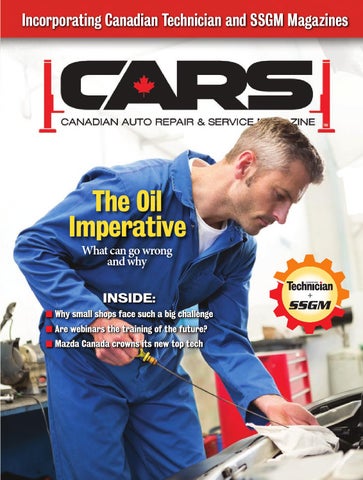
The Oil Imperative What can go wrong and why INSIDE:
+
n Why small shops face such a big challenge n Are webinars the training of the future? n Mazda Canada crowns its new top tech
CARS-April2015.indd 1
2015-04-20 9:26 AM
SO L US EDG E Presenting the all new
Snap-on is a trademark, registered in the United States and other countries, of Snap-on Incorporated. All rights reserved. ©Snap-on Incorporated 2015.
The all-new SOLUS™ Edge is the first diagnostic platform to come fully integrated with SureTrack,® giving you recommendations on parts, solutions to tough diagnoses and expert tips. With lightning-fast boot up, the SOLUS Edge is also the thinnest Snap-on® diagnostic tool ever. Plus, the steady charge lithium-ion battery charges automatically from the vehicle connection, while the embedded SMX operating system gives you fast, reliable operation every time. BECAUSE IF YOU WANT TO BE THE BEST, YOU NEED AN EDGE: SOLUS EDGE. WHAT’S YOUR EDGE? diagnostics.snapon.com/SOLUSedge
CARS-April2015.indd 2
2015-04-20 9:26 AM
APRIL 2015 | VOL. 1 NO. 3
COLUMNS
9
5
Service Notes We’ve revamped our online forum to give shop owners and technicians a place to compare notes and solve problems.
18 Mazda Canada’s Top Tech
Joe DiSabatino of Lallo Mazda in Brantford, Ont. is this year’s winner of Mazda Canada’s Master Technician of the Year competition.
Management Insights Consultant Murray Voth looks at the special challenges that smaller shops face in our increasingly competitive business environment.
38
The Car Side Following proper diagnostic procedure is key… as Beanie finds out when he faces an ailing 2006 Honda Accord.
23
Departments
26
The Future of Training?
The Oil Imperative
With the growing popularity and declining cost of webinars, is online training ready for prime time?
As vehicle technology continues to advance, it’s hard to under-estimate the importance of ample, clean, and properly-spec’d oil.
Letters....................................... 6 Eye Spy..................................... 6 Industry News.......................... 9 By the Numbers..................... 14 It’s Your Turn........................... 17 Baywatch................................ 31 AutoPuzzle............................. 36 Advertiser Index.................... 37
Our new international calling card. by
www.bluestreak.ca
April 2015
3
Canadian Technician_BS Intermotor Contents Page material CARS-April2015.indd 3
2015-04-20 9:26 AM
MAKING THE RIGHT CHOICES REQUIRES THE RIGHT INFORMATION. FIND THE RIGHT INFORMATION ON BMW4IR.CA. Introducing bmw4ir.ca – BMW Group Canada’s portal for independent repair facilities performing quality repairs on BMWs and MINIs. Service your customer’s vehicle with confidence by having all the information you need – right at your fingertips, 24 hours a day, 7 days a week. By signing up for bmw4ir.ca today, you will immediately benefit from: • • • • •
Exclusive special offers/promotions. Quick access to valuable and detailed parts information. Access to catalogues to help increase your sales. Technical information to help answer customer questions accurately. Informative videos to help you increase workshop productivity.
Visit bmw4ir.ca today to setup your account. To learn more, contact your BMW or MINI Retailer.
BMW GROUP ©2015 BMW Canada Inc. “BMW”, the BMW logo, BMW model designations and all other BMW related marks, images and symbols are the exclusive property and/or trademarks of BMW AG, used under licence.
CARS-April2015.indd 4
2015-04-20 9:26 AM
SERVICE NOTES
How’s this for a conversation starter? Our new online forum is finally ready. Check it out at www.carsmagazine.ca/forum. By Allan Janssen I am simultaneously fascinated and horrified at the thought of telepathy – a form of communication that science fiction promises will eventually be a reality. On the one hand, it would be convenient and ever so efficient to be able to communicate instantly without words. On the other hand, there would be no hiding your innermost thoughts. Your true feelings about the people in your life would no longer be walled off behind the mortar of decency. Until we’re able to send our thoughts through the void that separates us, however, I guess we’re stuck with more old-fashioned means of communicating. In your business, effective communication is one of the cornerstones of success. Service advisors learn their customers’ expectations by asking the right questions. And they win trust and confidence by explaining what their customers’ vehicles need. I’ve always been impressed with how quickly a good service advisor can get to the essential concerns that a driver has – whether it’s performance, reliability, safety, or finances. The give and take of conversation eventually makes everything clear. We here at CARS are also invested in the kind of give and take that makes everything clear. The flow of information in magazine articles flows only one way – from writer to reader. But we don’t want to get caught in the trap of transmitting without receiving. That’s why we’ve designed a web site at carsmagazine.ca that allows you to weigh in on the issues of the day. In addition to regular web features like a news feed, a new-product section, an
events listing, archived digital issues, and plenty of feature stories and opinions to keep you busy for hours, we’ve updated our popular online forum to make it easy for you to get involved in a proper conversation. The CARS Forum is a place where you can discuss the automotive repair and service trade with like-minded people, share anecdotes and observations, ask probing questions, and wax eloquent on your favorite subjects. It’s your best opportunity to make your voice heard by your peers across the country. Our previous forum, the Canadian Technician Forum, attracted a very loyal following. Members discussed thousands of fascinating topics and over the years their conversations became the fodder of many magazine articles. It was a resource that offered entertainment, camaraderie, and information all in one place. Our updated forum is even more user friendly and will hopefully make your job a little easier. If you’ve got questions, there are readers out there who have answers. If you have tips, we want to hear them. Got suggestions for the industry, or for this magazine? Great! Or if you’re feeling inspired, you can also consider it a virtual soapbox, allowing you to rant to your heart’s content. We’ll listen and then get right up on our own soapbox to reply when you’re done. When human beings finally acquire the gift of telepathy, a forum like this will be unnecessary. Until then, though, I hope you’ll log on and weigh in!
MANAGING DIRECTOR, AUTOMOTIVE DIVISION | Kathryn Swan (416) 510-5221 kathryn@newcom.ca PUBLISHER | Marc Gadbois (416) 510-6776 marc@carsmagazine.ca EDITOR | Allan Janssen (416) 614-5814 allan@carsmagazine.ca CONTRIBUTING WRITER | Andrew Brooks ART DIRECTOR | Tim Norton (416) 614-5810 tim@newcom.ca CIRCULATION MANAGER | Selina Rahaman (416) 442-5600 ext. 3528 srahaman@annexnewcom.ca SUBSCRIPTION ENQUIRIES | Roshni Thava (416) 442-5600 ext. 3555 PRODUCTION MANAGERS | Steve Hofmann (416) 510-6757 • PRINT: Phyllis Wright CARS magazine is published monthly except for January and July by Newcom Business Media Inc., 80 Valleybrook Drive, Toronto, ON M3B 2S9. The magazine serves the Canadian automotive repair and service industry. Subscriptions are free to those who meet the criteria. For others: single copy price: $7.00 plus tax; one-year subscription in Canada: $53.95 plus applicable tax; 2-year subscription in Canada: $84.95 plus applicable tax; one-year subscription in U.S: US$95.95; single copy price: US$10.00; one-year subscription in all other countries: US$97.95. Copyright 2015. All rights reserved. The contents of this publication may not be reproduced by any means, in whole or in part, without prior written consent of the publisher. The advertiser agrees to protect the publisher against legal action based upon libelous or inaccurate statements, unauthorized use of photographs, or other material in connection with advertisements placed in CARS. The publisher reserves the right to refuse any advertising which in his opinion is misleading, scatological, or in poor taste. Postmaster: send address changes and undeliverable Canadian addresses to Circulation Dept., CARS, 80 Valleybrook Drive, Toronto, ON M3B 2S9.
VP, EDITORIAL | Rolf Lockwood GENERAL MANAGER | Joe Glionna PRESIDENT | Jim Glionna CORPORATE OFFICES HEAD OFFICE 451 Attwell Dr., Toronto ON M9W 5C4 Telephone: 416-614-2200 Facsimile: 416-614-8861 REGIONAL OFFICE 80 Valleybrook Drive, Toronto, ON M3B 2S9 Telephone: 416-442-5600
Facsimile: 416-510-5169
Member of the Audit Bureau of Circulations Publications Mail Agreement #40069240 Print edition ISSN 2368-9129 On-line edition ISSN 2368-9137 We acknowledge the financial support of the Government of Canada through the Canada Periodical Fund of the Department of Canadian Heritage.
You can reach me at 416-614-5814 or allan@carsmagazine.ca
April 2015
CARS-April2015.indd 5
5
2015-04-20 9:26 AM
LETTERS In our business, communication builds relationships Andrew Brooks did a very good job of conveying the importance of communication in the repair and service business (“The Communication Connection ,” Jan-Feb 2015). Communication is one of the most under-utilized tools we have. People need to be informed when making any decision. Explaining why you’re doing something and not just what you’re doing helps people feel more comfortable about paying you to do it. Build a relationship with a person and they will come back. Allan Haberman ACA Training Systems Winnipeg, Man.
It’s good to know what maintenance is… and what it is not Murray Voth’s column (“Why Is Maintenance Undersold?” Jan-Feb 2015) sparked a lively conversation around our shop lunch table. There’s more to preventive maintenance than just changing oil filters so the dealer
will honor the powertrain warranty. The key is scheduling large-ticket items like timing belt and spark plug replacements, around things like routine oil changes. And it’s important to use quality parts. Selling cheap parts with a big mark-up will only increase returns, complaints, and bad word-of-mouth. John Lundrigan Capital Mitsubishi St. John’s, Nfld.
I’ve seen way too many vehicles that are 10 years or older, but have never been properly inspected. Inspections and maintenance go hand-in-hand I really enjoyed Murray Voth’s article on preventive maintenance (“Why Is Maintenance Undersold?” Jan-Feb
EYESPY
All tied up Gary Smith of Bathurst Toyota (formerly Stothart Toyota) in Bathurst, N.B., sent in this photo of a customer’s quick-fix to keep his 2005 Toyota Tacoma 4x4 on the road. With all the leaf springs broken except for the main, the customer used a rope to keep the leaf springs from interfering with the tire. “I’m sure this is not unique,” Smith writes. Maybe not unique, but definitely crazy! Have an interesting picture to share? Send a high-resolution image to allan@ carsmagazine.ca
2015). I’m a licensed automotive tech but I now work in the forklift field. Previous to that, I worked on heavy equipment. In both of those fields, customers truly understand the value of preventive maintenance. They’ve been taught (and it has been proven) that PM decreases unscheduled downtime. Consumers, however, don’t face the same kind of monetary loss when their vehicles are in the shop. To them, it’s merely an inconvenience. It’s unfortunate that they don’t understand the importance of making sure their vehicles are roadworthy. I think the government should insist that every vehicle be subjected to a biannual safety inspection. I’ve seen way too many vehicles that are 10 years or older, but have never been properly inspected. They come in with rotten brake lines, and other safety concerns. In fact, lack of maintenance is high on the list of reasons that I rarely work on automobiles anymore. It’s a matter of pride for me. I enjoy keeping a vehicle in good operating condition. I wish consumers felt the same sense of pride in having a vehicle that runs well and problem free. They would find that purchasing a new vehicle would then be an option, rather than a need. Paul Curtis Frontier Material Handling Toronto, Ont.
I agree that preventive maintenance saves customers money. One of the differences between where you work now and the retail automotive sector is that heavy equipment and forklift operators understand what it costs them if their equipment breaks down. Private car owners have never done the math or been shown the math. When we in the industry get better at that, more consumers will get better at maintenance. —Murray
6 CARS
CARS-April2015.indd 6
2015-04-20 9:26 AM
CARS cover image did not set a good example I enjoyed your first issue, but the cover image made me wince. Put on safety goggles! You would not get a second chance at my shop! Ken Hart Hartech Kaslo, B.C.
We need to embrace a culture of safety I enjoyed reading your magazine, but I was disappointed with the message your cover photo sent to technicians. Having unprotected eyes that close to an impact socket is a recipe for disaster. Our industry has seen numerous changes throughout the years that require continued training. We’re constantly striving to improve our operations by learning and developing new skills that keep us competitive. But what about safety? Are we doing all that we can to ensure that our most valuable assets get to go home safe each night? A safe shop environment requires a commitment to safety, starting from the top down. The manager or owner must truly embrace a culture of safety to make it work. One can never assume that a new hire, or a young technician fully understands what is required to work safely. It’s up to us to teach the importance of using personal protective equipment. And just because an individual has experience in the trade, doesn’t mean he or she has been taught how to work safely. Proper training and
skills demonstrations can make workplace hazards avoidable. One of the best things we ever did was participate in the Certificate of Recognition (COR) program. We took ownership of safety in our company, by developing and implementing a safety management system. Through a process shared between our safety team and outside safety specialists, semi-annual audits are performed. They provide corrective action reports that require prompt follow up. Sound like a lot of work? Not really. It took some getting used to, but once it was well-entrenched, it provided tremendous peace of mind. Getting my technicians to buy into the program was easier than I thought. Turns out most people want to go home safe and free of injury! We make a point of discussing the topic of safety at our monthly staff meetings, and some of our best safety improvements have been introduced by our associates. By giving them a voice in our safety program, they stay engaged and, most importantly, stay safe. Bryce Heron Fountain Tire Okotoks, Alta.
Thank you for your letter. You’re absolutely right that we missed the boat with that cover. We wanted to show a technician’s face without any obstructions, but when an impact tool is being used, proper protective eyewear is a must. We’re determined to set a good example of safety in our new magazine, and I agree that we fell short with that picture. It won’t happen again. —Allan
What’s on your mind? We want to hear from you about anything you read in CARS magazine. Send your email to allan@carsmagazine.ca 970-7720 for details.
MOOG® CONTROL ARMS HAVE YOU COVERED. With over 1800 control arms currently available, the everexpanding range of MOOG® control arms provides the quality and coverage your customers need to service a wider array of Asian, European and domestic nameplates.
EXACT-FIT ENGINEERING QUALITY Built to exacting application-specific requirements
O V E R
1800
PART NUMBERS
moogproblemsolver.com ©2015 Federal-Mogul Motorparts Corporation. NASCAR is a registered trademark of NASCAR, Inc. MOOG and The Problem Solver are trademarks owned by Federal-Mogul Corporation, or one or more of its subsidiaries, in one or more countries. All rights reserved.
April 2015
CARS-April2015.indd 7
7
2015-04-20 9:26 AM
CARS-April2015.indd 8
2015-04-20 9:26 AM
Ford Model T – 1914
N
MADE I First flight across the Pacific – 1931
At the French Grand Prix – 1954
Veedol. The First Choice. Then & Now. Veedol’s journey began over a hundred years ago and has been part of history ever since. Starting in Pennsylvania, our legacy includes being the first oil used in the Ford Model T, flying the first non-stop flight over the Pacific in the Miss Veedol, speeding around racetracks all over the world and giving consumers a quality product that they can rely on throughout. Whether it’s for your business needs or for your personal needs, Veedol will deliver a high quality product every time, all the time.
ELITE®
SYNTRON ®
Virgin base oils are processed to have high thermal and oxidation stability, as well as outstanding protection.
A fully synthetic oil that offers the highest level of engine cleanliness, reduced wear, and fuel efficiency.
Mineral Oil
100% Fully Synthetic
For more information contact:
INNOVATION • TECHNOLOGY • PERFORMANCE
CARS-April2015.indd 10
Automobile Solutions Americas Inc. 800-975-2935 | info@asaveedol.com www.asaveedol.com
THE PROFESSIONAL’S CHOICE
2015-04-20 9:26 AM
We Partner With the Top 25 Vehicle Manufacturers… 360°
FUEL SYSTEMS TECHNICAL TRAINING AIR CONDITIONING
ENGINE MANAGEMENT
TECHNICAL SUPPORT IGNITION
DIAGNOSTICS & TEST EQUIPMENT
DIESEL SYSTEMS
So You Can Benefit From the 360˚ World of Delphi Products and Services. From innovative OE technologies to the leading vehicle manufacturers globally. To a world of diagnostics, training and technical support. Our aftermarket engineers work hand-in-hand with OE, to give you access to the very latest vehicle technologies. We have the aftermarket covered. Discover the full 360˚ value of Delphi quality at delphiautoparts.com. delphiautoparts.com
CARS-April2015.indd 12
2015-04-20 9:26 AM
LIMITED TIME CONSUMER OFFER!
NEWS
NOW THROUGH MAY 31, 2015
INSTALL THE
BEST!
Lee Poetter of Dubois Mazda in Woodstock, Ont. placed third in this year’s competition. “Prepping for this is kind of hard because you don’t know what they’re going to throw at you,” he says.
This competition is open only to the company’s master technicians – those who have been a Mazda technician for at least three years and have passed three new-model courses, four technical courses, six online courses, and a final exam.
‘These guys are the best. They’re really interested in what they do, they have the passion, they learn on their own, and they constantly want to know more.’
— Craig McQueen, technical trainer
In order to get a spot in the annual MasterTech competition, they must do well in a special exam handed out early in the year. Participants get three weeks to research it, fill it in, and return it. Time is a factor, in that if two get the same score, the earliest arrival gets preference. The top three marks get an invite automatically, regardless of what region they come from. Then there are two from Western Canada, two from Ontario, two from Quebec, and one from Atlantic Canada. “I don’t know how they come up with the questions on those entry tests,” says DiSabatino, “but they get you looking
at things that you probably didn’t even know existed before. I feel it is one of the greatest teaching tools they have.” Indeed, training is an ongoing priority at Mazda. Courses are not mandatory but participation is strongly encouraged, and dealers make it an attractive proposition, paying their techs their hourly time to be there, as well as food, travel, and accommodation. “It’s an investment that pays off,” says McQueen. “Their technicians get the job done quicker, there are fewer comebacks, and the customer’s happier.” In places like St. John’s, Nfld., where access to training is not always easy, some dealerships will go so far as to shut down the whole service department and send everybody to class. The competition has long been used to show appreciation to the company’s army of nearly 1000 technicians. Canadian winners would then be invited to compete in the North American finals. The winners of that event would be sent to the world competition in Japan. Unfortunately, DiSabatino won’t be able to test his skills in other markets. Immediately after 2008, when the world economy soured, all Mazda competitions were put on hold. In 2013, Mazda Canada became the first market to resume its Master Tech Competition. There are rumblings that the U.S. and Japan may soon restart their own competitions, but until they do, it’s fair to say that DiSabatino stands alone as the brand’s top competing technician.
GET UP TO
$30
*
CASH BACK! Now through May 31, 2015, when you purchase Wagner ThermoQuiet® brake pads you’ll get the professional’s choice… and save up to $30. ($15 front set and /or $15 rear set)
The Professional’s ChoiCe 4 Time Winner
*After mail-in rebate.
WAGNERTQREBATE.COM FOR COMPLETE PROGRAM DETAILS & TO SUBMIT YOUR REBATE ONLINE.
*VISIT WWW.
Frost & Sullivan Replacement Brake Pads Product Leadership Award Winner ©2015 Federal-Mogul Motorparts Corporation. All rights reserved.
April 2015
13
TQ Rebate Trade Ad_3rdPg_C.A.R.S._032315.indd 13/24/15 9:47 AM
CARS-April2015.indd 13
2015-04-20 9:26 AM
By the NUMBERS Stats that put the Canadian automotive aftermarket into perspective.
$500
MILLION
583
Total auto industry annual investment in R&D in Canada.
300
The number of different engines produced for light vehicles in 2014.
700 pounds
Gallons of gasoline used per U.S. driver in 2013, down 16% from 695 gallons per U.S. driver in 2004 With recent improvements in vehicle fuel economy, the number of gallons of gasoline used is below rates in 1984, when the study was first conducted.
Total weight saved on the new aluminum-bodied Ford F150 pickup – the first high-volume application of light weight vehicle (LWV) technology in the U.S.
The contribution by the motor vehicle aftermarket to the U.S. GDP in 2014. If the aftermarket were a country, it would have the 32nd largest economy in the world, slightly larger than Hong Kong’s.
$212 The average spend per visit among consumers who have their vehicles serviced twice a year. The per-visit spend drops to $208 when consumers take the vehicle in three times a year. Consumers that service their vehicles four times a year spend an average of $200 per visit.
122,325
Number of units sold of Canada’s top-selling light trucks in Canada in 2013, the Ford F-Series. Rounding out the top 3: Ram Pickup (78,793); and GMC Sierra (46,908)
Number of years Honda Civic has held the title of best-selling passenger car in Canada. Through to the end of February 2015, however, the Civic has fallen to third place, behind the Hyundai Elantra and the Toyota Corolla.
11.7 years
Average age of vehicles on Saskatchewan roads in 2012 – the highest in Canada. B.C. was close behind with an average age of 11.2 years, followed by Manitoba at 10.2 years, and Alberta at 10.0 years. Newfoundland had the youngest vehicle fleet in Canada at 8.0 years.
Sources: Auto 21; Wards Automotive engine listing; University of Michigan Transportation Research Institute; DesRosiers Automotive Reports; Northwood University Monthly Economic Outlook; World Bank Group; AIA 2014 Outlook Study; AIA 2013 Automotive Aftermarket Demand Study.
$360billion
14 CARS
6116_An CARS-April2015.indd 14
2015-04-20 9:26 AM
CARS-April2015.indd 15
6116_Ann. F1-CARS_fullPage-V3.indd 1
2015-04-20 9:26 AM
2015-02-13 12:14
Total Canada
The right choice in lubricants
To find Total products in your area, visit total-canada.ca or call 1-800-463-3955
TOTAL ENGINE OIL Powers this engine imagine it in yours!
Sources: Auto 21; Wards Automotive engine listing; University of Michigan Transportation Research Institute; DesRosiers Automotive Reports; Northwood University Monthly Economic Outlook; World Bank Group; AIA 2014 Outlook Study; AIA 2013 Automotive Aftermarket Demand Study.
r - you urch h c r r filte you mes ing a beco creat e s age r g p a a e gar 70 ye book h e r t c e , a v s ine nt o ur F es. isit o ir eng e spe d the why we’v gel. V ip of engin n n a a r s r u h a ’s o s t c y r a r h fo wo cts en!” T their ssion prote bout ue pa® e say,”Am ger and a r t s a ie n r have % lo IX , w ll sto n you hip. At W irt, last 30 omers te t Whe s d s r u o e r c mo of w our place tures 45% to watch p e a d c co that e QR an th or sc
WE E LOV ! INES ENG
wixfilters.com wixfilters.com
CARS-April2015.indd 16
2015-04-20 9:26 AM
m
IT’S YOUR TURN Got an opinion? We’ll happily give you a page to get it off your chest! Send your rant to allan@carsmagazine.ca
Poor quality… poor strategy It seems more and more part makers are turning to China for their manufacturing… with all the quality challenges that come with that. By Murray Knodel The issue with made-in-China parts has captured my attention for the last two or three years. I find it quite alarming that a large number of vehicle part manufacturers – companies that were once known for the quality of their products – have moved more and more of their business to China, with all the fit, form, and function problems that come with that. This goes for some of the best-known names in the automotive aftermarket. Unfortunately, there’s a growing list of products that I will not buy because the quality has greatly suffered over the past few years. One of the main issues with these parts is the lack of precision building. I frequently find that bolt-hole patterns on components are not exactly correct. Recently, a customer ordered a replacement transmission pan for a 2008 BMW X5 from a U.S. company, and provided us with the part to install. About 75% of the bolt holes on the pan did not line up properly. Upon closer inspection, we noticed that there was no brand name inside the pan. The OEM product says “Made In Germany” on the filter area. This had no names anywhere. The part had been made in China, and it was a poor replacement for the original! All too often, the electronic parts that come from China are made with inferior components. Critical parts like switches fail immediately upon installation, or shortly thereafter. Not long ago, we ordered some ignition coils for a BMW. We expected
to get OEM replacement parts, as that is what we asked for. When the replacement coils arrived, however, they did not have the familiar “Made in Germany” stamps on them that we expected to see. The fact that no brand name is visible anywhere on these items has proven to be a sign of offshore manufacturing. I’ve been boycotting companies that fail to disclose the country of origin – or, worse, lie about it. We should have the right to know where the parts we are buying are being made. At my shop, we have found that almost all parts coming from China had some issue with quality – both internally and fitment. The ads for these products often suggest they’re built to OEM specs, but the truth is that what comes out of the box is anything but! Some of my truck driver friends have complained in the last two years that parts are failing quicker and are simply not reliable. They’ve told me their mechanics are having a hard time determining where the part comes
from. Cloned parts rarely have brand names found on them. And they do not last… with dangerous results. This is a bigger problem than consumers are aware of. The automotive repair industry is being flooded by cheap, no-name parts. Big-name brands are offshoring their manufacturing to China, with little or no quality control. They refuse to take responsibility when they fail. As shop owners, we do not want to do jobs more than once. But sometimes we have to, due to poor parts. I’m sick of covering for these greedy companies! The fact we have lost so much good manufacturing to low-cost countries is bad enough. To be flooded with poor quality parts that could cause chaos on our roads is just adding salt to the wound!
Murray Knodel is the owner of Imports Only in Penticton, B.C.
April 2015
CARS-April2015.indd 17
17
2015-04-20 9:26 AM
MANAGEMENT INSIGHTS
Which
shop will
survive? It’s tough and getting tougher for small shops to thrive in today’s economic climate. Here’s why. By Murray Voth In the last year, I’ve come to realize that I am spoiled. Absolutely spoiled rotten! For almost 10 years now, I’ve been providing management training, business consulting, and performance coaching to hundreds of automotive shops. I’ve become accustomed to working with shop owners who are prepared to invest time and money in their businesses. I’ve watched most of these shop owners learn new concepts, work hard to implement them in their businesses, and reap great success for their efforts.
But recently I’ve been exposed to shop owners who don’t take training of any kind. I met one owner who had been in business for five years, yet did not know what an income statement is. Another owner had no proper system for work orders; he simply wrote down the parts and labor on scraps of paper and charged the customer accordingly. Believe it or not, in 2015 there are still shop owners who think the dirty back seat from an old car is suitable for guests in their waiting area. They think it’s perfectly normal to have a shop floor that is covered in grease. Some owners actually believe that charging customers properly for work provided amounts to greed. They think shops that make a profit are acting immorally and unethically, and are getting rich off of their customers’ backs. No wonder I’ve been hearing so much
about shop closings around the country! I know that each closure has its own particular set of circumstances… but there seems to be a common thread. Small shops and those that are poorly run cannot afford the technology and training it takes to stay current in our industry. They’re working on older vehicles, which are usually owned by consumers who have less disposable income. They are not seeing the four- to seven-year-old vehicles – that most profitable of categories. It used to be – up until the early 2000s – that the aftermarket had the lion’s share of those four- to sevenyear-old vehicles. According to the AIA’s 2014 Outlook Study, the aftermarket has dropped to 42% marketshare. Everything I’m seeing leads me to predict that in five years we will see very few viable repair shops that are smaller than four bays and staffed by fewer than three technicians – especially if one of those techs is the owner. How have I come to this dire conclusion? It’s all in the latest statistics about our industry.
18 CARS
CARS-April2015.indd 18
2015-04-20 9:26 AM
I always take a close read of the AIA’s Outlook Study, as I do with any reports from J.D. Power & Associates, or DesRosiers Automotive Consultants. These organizations don’t specifically make the prediction I’m making, but when you combine and overlap the data from the different reports, you can see patterns come into focus. Rather than quote a lot of studies and show a lot of graphs, I’m going to run two business models past you, based on many shops that I see. I think the numbers will tell a very interesting story and prove my theory. I also believe that shop owners might see themselves in the numbers and either take confidence from them or the inspiration to change the way they’re operating. I hope it motivates everyone to face the new realities of our industry, and take the proper training to implement solid business principles. Either that or get out of the industry. On the right you’ll see a table describing two automotive repair shops: Charity Auto, and Performance Auto. They both use the same labor rate of $81.83 per hour… but they have vastly different outcomes!
Charity Auto Ltd.
Performance Auto Ltd.
Door Rate
$81.83/hour
$81.83/hour
Technician productivity
63%
90%
Technician efficiency
85%
111%
Total Annual Labor Sales
$267,250.23 45.0% of total sales
$330,000.00 55% of total sales
Total Annual Parts Sales
$332,749.77 55.0% of total sales
$270,000.00 45% of total sales
Total Annual Sales
$600,000.00 100% of total sales
$600,000.00 100% of total sales
Total Cost of Labor
$133,056.00 50.0% of labour sales
$99,000.00 30% of labour sales
Total Cost of Parts
$226,270.00 68.0% of parts sales
$148,500.00 55% of parts sales
Total Cost of Goods
$359,326.00 59.9% of sales
$247,500.00 41.3% of sales
Gross Profit on Labor
$134,194.23 50.0% of labour sales
$231,000.00 70% of labour sales
Gross Profit on Parts
$106,479.77 32.0% of parts sales
$121,500.00 45% of parts sales
Total Gross Profit
$240,674.00 40.1% of sales $
352,500.00 58.7% of sales
Total Gross Profit
$240,674.00 40.1% of sales
$352,500.00 58.7% of sales
Total Operating Expenses
$170,000.00 28.0% of sales
$240,000.00 40% of sales
Total Net Profit
$70,674.00 11.8% of sales
$112,500.00 18.8% of sales
Management Salary
$0.00
$60,000.00
Service Advisor Salary
$40,000.00
$50,000.00
Rent/Lease/Mortgage
$36,000.00
$36,000.00
Remainder of Operating Expenses
$94,000.00
$94,000.00
Total Operating Expenses
$170,000.00
$240,000.00
Required Retained Earnings
$42,000.00 7% of Sales
$42,000.00 7% of Sales
Required Return on Investment
$83,750.00 16.75% Rate of Return
$83,750.00 $16.75% Rate of Return
Required Net Profit
$125,750.00
$125,750.00
Projected Net Profit
$70,674.00
$112,500.00
Owners Annual Draw
($48,000.00)
$0.00
Potential Retained Earnings
$22,674.00 3.8% of Sales
Required Net Profit
$125,750.00
$125,750.00
Deficit On Return On Investment
($103,076.00)
($13,250.00)
April 2015
CARS-April2015.indd 19
19
2015-04-20 9:26 AM
MANAGEMENT INSIGHTS Looking at Charity Auto’s vital statistics, the first thing to note is that its parts-to-labor ratio is upside down. Rather than being 0.8:1.0, it is 1.0:0.8. Charity Auto’s labor gross profit margin on three technicians is only 50% rather than 70% which is the benchmark for our industry, and their parts gross profit margin is only 32% rather than the benchmark of 45%. I see numbers like this hundreds of times with new clients, whether they have $600,000 a year in sales or $1.5 million. It seems like these are the default settings for our industry. That’s the way we’ve always done it. You will notice that Charity Auto has three technicians. The total labor cost is $133,056 – or $44,352 each. Divide that number by 12 months, and each month by 168 working hours, and you see that they’re getting $22 per hour. Also note that only 54% of hours are booked at the full labor rate, for total labor sales of $267,250.23. The shop shows a net profit of $70,674, which is 11.8% of sales, but note that the owner does not take a management salary out. Instead, he takes a yearly draw of $48,000. That drops the net profit down to 3.8% of sales. So basically we have a technician who thinks he is a business owner. All they’ve really done is bought themselves a job that comes with great liabilities and high financial risk. The Automotive Aftermarket E-Learning Centre has research to prove that it takes up to 7% of sales in net profit kept as retained earnings to keep an automotive shop current in today’s marketplace. Banks, investors, and other lenders say that for the automotive industry the rate of return on investment should be 16.75%. The reason it’s that high is because of the high failure rate of automotive businesses, and high financial risks and other liabilities involved. The benchmark for net profit for an automotive shop is 20% of sales. That means if 7% is required for retained earning, the remaining 13% is required to pay for the return on investment.
You can see that Charity Auto is $103,076 short of the required profit to have the retained earnings and return on investment it needs. Now let’s look at Performance Auto. It also has annual sales of $600,000. The difference is that this shop is operated close to the benchmarks. The parts-to-labor ratio is perfect, margins are right at the benchmark, and the owner is actually taking a management salary of $60,000.
Some small shops will stay open and generate enough of a wage for the owner to survive, but there will be little left for a retirement. You’ll also notice that the shop is producing more labor with one less technician. The labor cost of $99,000 reflects a per-hour wage of $24.55. The two techs manage to bill out 100% of their hours at the full labor rate, for total labour sales of $330,000. Performance Auto is able to get by with one less technician because it is achieving 90% productivity and 111% efficiency, as opposed to Charity Auto’s 63% productivity and 85% efficiency. (By the way, the target for efficiency is 125% so as good as Performance Auto is doing, there’s still a tiny bit of room for improvement.) This comparison gives us an important insight into the future of smaller shops. They have a huge challenge because it’s so difficult to achieve the return on investment they require. You can see that even Performance Auto, which is operating at or near benchmark, still falls short on the net profit required to get a decent ROI. Even with all its skill and progressive policies, it is only managing $112,500 in net profit. Your response might be to question my target ROI of $125,750. You might
think that even a 10 or 12% return on investment would be great. After all, it’s still better than a bank! Well, let’s take a look at some factors that could change. There are very few markets that I work in where you can hire a quality technician for less than $28 to $30 an hour. So if you factor that in, you fall $21,800 further behind. I’ve also made the assumption that these technicians are going to work an average of 168 hours a month. But it reality, you have to take a few days off into consideration: vacations, days off, and sick days. Even if we only lost 5% capacity, we would be short more than $16,000 in labor sales in a single year. And what happens if we don’t own the property and the landlord decides to raise the rent by 10%. That would put this shop another $3,600 behind on profit. The reality is that some small shops will stay open and generate enough of a wage for the owner to survive, but there will be little left for a retirement. In markets where the real estate is less expensive, some of the better small shops will be fine. In other cases, the value of the real estate and the cost of staying in business will not make sense. Many smaller shops will close, either torn down for condos, or the victims of inevitable rent increases when property values make higher rental incomes possible. But most of these shops will close because they are operated the way Charity Auto is, by owners who have simply bought themselves high-risk, low-paying jobs. With high stress and poor returns, this will get old very quickly.
Murray Voth is a consultant and trainer with Total Automotive Consulting & Training Inc. in Edmonton, Alta., which runs the ProShop program across Canada. He can be reached at mvoth@proshopmanager.ca
20 CARS
CARS-April2015.indd 20
2015-04-20 9:26 AM
IT TAKES A DUAL-SHIELD
®
TO DUEL MOTHER NATURE.
As more vehicles come originally equipped with hybrid blades, you want a high-quality solution that provides the application coverage you need and is easy to install. • Dual-Shield® Hybrid Technology: – Pivoting, high-strength polymer shell safeguards the blade from the elements – Spring steel beam structure provides optimal windshield contact and pressure • Side-mount design provides a lower profile for improved windlift
Scan this code with your mobile device for more information.
• SWIFT ® Easy Connection Technology fits 12 leading arm types
tricoproducts.com/sentry
CARS-April2015.indd 21
2015-04-20 9:26 AM
Choose Ford Parts. They fit Ford vehicles better than the others, allowing you and your team to work more efficiently. Plus, we stand behind every single part with a 2-year, unlimited-kilometre warranty* that includes up to $150 in labour. Not only are Ford Parts a great investment for you, your customers will benefit from long-term performance. And that’s what we call a delicious combo.
FORD PARTS
WARRANTY*
DISTANCE INCLUDES LABOUR
PARTS THAT WORK FOR YOU.
FORD.C A
*24-month/unlimited km limited warranty on most Genuine Ford/Motorcraft® Parts and Ford Genuine Accessories (purchased from Ford or Ford Lincoln dealers or Ford dealer wholesale customers) for cars and light trucks that are found to be defective in material or workmanship. Parts, labour, and towing covered for ‘dealer-installed’ parts/accessories; parts only are covered for ‘over-the-counter’ retail parts/accessories; parts and labour (up to a maximum of $150) covered for wholesale and fleet parts/accessories. Part and/or accessory failure due to: abuse, misuse, neglect, alteration, accident, racing; improper lubrication, repair, or installation; use in applications for which they were either not designed, or functionally intended, or not approved by Ford Motor Company of Canada, Limited; cleaning, adjustment or replacement as a part of normal maintenance; or failures caused by non-Ford parts, are not covered under this warranty. Coverage varies between over-the-counter and dealer-installed parts. See your local Ford Store for complete coverage details and limitations. ©2015 Ford Motor Company of Canada, Limited. All rights reserved.
CARS-April2015.indd 22
2015-04-20 9:26 AM
TRAINING
won’t be able to be done anymore.” The solution for them, he believes, is in the Internet. Offering training online is hardly new, but recent technology has made it easier than ever to create multi-media training courses and stream them inexpensively to participants around the world. Students no longer have to plug in expensive peripherals to participate in live discussions. And the software required to take part in webinars is free and easily downloaded. “We’ve had people flying in from remote areas to take our classes and they all say the same thing. They don’t really need the teacher in front of them. If we can put the program onto the web, they would definitely take it,” says Vandenberg. So he’s now offering live webinars that offer essentially the same learning experience as his hands-on training, complete with the videos that are shown live in class. “It’s not always physically possible to have a car in the classroom, especially if you’re meeting at a hotel or something like that,” says Vandenberg. “So we prepare video clips ahead of time, showing hands-on work as we complete a repair. Anyone watching the live webinar would see the same video that’s played in class.” Craig Van Batenburg, founder of the Automotive Career Development Center (ACDC) in Worcester, Mass., has been having similar success with webinars for four years now. “Nothing takes the place of hands-on, but our one-hour live webinars really
Tomorrow’s training With the growing popularity of webinars is online training ready for prime time? By Allan Janssen
Like many automotive trainers, John Vandenberg believes classroom instruction will probably always be the best way to deliver technical training. “I don’t know if it’s because we like to work with our hands or we need to see the actual parts in front of us, but it seems the classroom situation works best,” says the owner of the Manitobabased automotive training company Injectronics. Nevertheless, Vandenberg is concerned about technicians in remote areas who face steep travel costs to keep up with the latest automotive technology. “They need training like the rest of us, but it’s really tough for them,” he says. “As vehicles become more sophisticated, they’re going to find themselves able to do less and less. They’re going to realize that even brake work
April 2015
CARS-April2015.indd 23
23
2015-04-20 9:26 AM
TRAINING work for us,” he says. “We’re going to continue to do them.” The webinars are recorded during an instructor-led class so online viewers can participate in real time and interact with students and teacher alike. The programs are then archived at the company’s website. He’ll be the first to admit, however, that webinars are not a cure-all. “Yes, I believe in books and webinars. But when you’re done with all of that, you want to finish your training with a hands-on class. That’s the ideal formula in my view,” says Van Batenburg. But there are some who believe we’re still a long way away from a truly effective online learning model. Mike Cleary, owner of Automotive Technical Support Services in Fresno, Calif., is a frequent trainer in Canada and across the United States. He covers a lot of miles to offer hands-on,
in-class training. “Guys drive considerable distance to come to my classes,” he says. “I understand it’s inconvenient to travel, and some people prefer webinars. But I’ve gotten a lot of negative feedback about Internet training.”
“Is it possible to learn online? Yes. Can you do it totally online? Absolutely not.” He says webinars are still very limited in what the student sees, and it can be difficult for them to ask questions “That’s the feedback I’m hearing,” he says, “and it’s the reason I don’t do anything but classroom training now.” Mark Lemay, owner of Auto Aide Technical Services in Barrie, Ont., says web training is enhanced when it is
done in conjunction with live instructor-led classes. “Is it possible to learn online? Yes,” he says. “Can you do it totally online? Absolutely not. I think online training can be a great add-on or refresher. But it cannot be the main course. There’s no substitute for having someone there, who can explain something, show it, and answer questions in ways you can understand.” He believes the training of the future will combine live and web components to create a new way of learning and troubleshooting vehicles. “When you have a trainer in one location telling a tech in another location what to do, I think there will be a big market for that,” he says. “I don’t think you can ever get away from the classroom entirely. But I think you’ll see classroom instruction be supplemented with online stuff. That will be powerful.”
24 CARS
CARS-April2015.indd 24
2015-04-20 9:26 AM
The world demands them.
The USA builds them.
As the definitive leader in innovative, best-in-class ceramic disc pad braking solutions, Akebono is proud to manufacture 100 percent of our aftermarket pads right here in the USA. Akebono’s ProACT®, EURO® and Performance® Ultra-Premium ceramic disc brake pads are the best replacement brakes in the world for clean, quiet and smooth braking. OEM’s choose Akebono, you can too!
• Higher customer satisfaction • Fewer comebacks • Increased bay utilization • Greater profitability for technicians
Demand the OEM brand of choice, factory installed on more than 270 models.
Demand Akebono. akebonobrakes.com Find us on Facebook facebook.com/akebonobrakes
CARS-April2015.indd 25
FACTORY INSTALLED
270 + MODELS
OEM BRAND OF CHOICE
2015-04-20 9:26 AM
THE
IMPERATIVE Oil-change intervals may be increasing, but engines have never been more reliant on a steady supply of the correct specification of motor oil to ensure efficient operation and long life. By Jeff Taylor
New vehicles have never been better. They’re more reliable, they get better fuel economy, and they produce far fewer emissions than the vehicles of yesteryear. Manufacturers have been able to make massive improvements in their products, using more efficient manufacturing processes, better materials, and new electronic controls that keep their engines at stoichiometric perfection, even from the coldest start. Being able to achieve this has meant constant transformation under the hood. We’ve moved from carburetors to gasoline direct injection (GDI). EGRs have given way to variable camshafts. And they’ve gone as far as to use electronics to vary the output and pressure of the oil pump. But a high level of vehicle reliability would not have been possible if the oil that lubricates the engine assembly’s moving parts hadn’t kept up with the advancements in technology. Engine oil is still doing the same job it did when the engine was first designed. It lubricates the moving parts, Vehicle reliability reduces friction, removes heat, holds contaminants improvements in suspension, and provides a myriad of other benefits wouldn’t have been that keep a motor running possible if the oil smoothly. Yet, perhaps that lubricates the because it looks the same as it always has, technicians engine assembly’s and vehicle owners alike moving parts seem to take it for granted. They don’t give much hadn’t kept up with thought to the vital role it the advancements plays in vehicle health. They’re likely to overlook it. in technology. I believe we’re all starting to see the results of this attitude at our shops. Over the past three weeks, I’ve seen a number of different vehicles with a variety of issues that can all be traced back to oil.
26 CARS
CARS-April2015.indd 26
2015-04-20 9:26 AM
Issue
The first case involved a 2002 Honda CRV that showed up with a check-engine light on. The customer had owned the vehicle since new and had maintained it with moderate diligence. It had about 117,000 easy kilometers on the odometer. This vehicle had been relegated to “back-up” status. It was a spare family ride that the kids drove when they were home from school. It was equipped with an oil-life monitor system, but that light (which would have indicated a need for immediate maintenance) wasn’t on, so when the son came home for the weekend and started out on a road trip from Hamilton to Montreal, no thought was given to any underhood problems. The CRV started and ran fine; it had heat and a full tank of fuel, so off he went. After a couple of hours on the road, however, the check-engine light flicked on and the usual panic set in. At the next service station, the hood was popped and the driver did the only thing that most customers know how to do: he checked the oil level. It was low, so he topped up the level and resumed his trip. Once back home, he told his folks about the incident and they brought the vehicle in for us to investigate the cause of the light. I installed the scanner, and pulled out the trouble codes, they all pertained to the VTEC system that Honda uses for performance and emission control. This system requires engine oil and because the level was so low, it couldn’t operate properly, which set the code and turned on the check-engine light. The customer had no idea that the engine oil was low and that it hadn’t been changed in over a year because the oil-life monitor light had not been illuminated. Oil-life monitors are not new. They’ve been around for a while, but the Honda system like most manufacturers is counting on the customer to maintain the proper oil level in the engine. It is even stated in the owner’s manual that
1
#
the engine’s oil level should be checked at each fill up and that in Canada the oil should be changed at least twice a year regardless of mileage.
Issue
The second case involved a 2011 Buick Enclave with a 3.6L V6. The customer wanted the spark plugs changed. Well, this involves removal of the upper plenum/intake to gain access. Once we removed the parts, we could see down to the back of the intake valves. They were covered with the hard crusty, impossible-to-remove coating of carbon that the GDI engine is known for. The GDI doesn’t have any fuel spraying on the backs of the valves so the detergents in the fuel have little effect when it comes to keeping the valve clean. Some GDI engines have been notorious for these deposits, especially in early GDI adapters like Hyundai, BMW, VW, and Mini. The issues seem to be compounded by the use of an EGR and the design of the PCV or crankcase ventilation system. Many of these issues have been addressed in newer engine designs but complications still arise. GDI engines need oil that has a low volatility rating to prevent oil vapors from forming and being drawn into the crankcase ventilation system, where they tend to condense and stick to the back of the intake valves (along with
2
#
After performing a service and explaining to the customer how the oil-life monitor works, the vehicle is back on the road, functioning normally. any seepage from the valve stem seals). Engine oils contain an additive package that could make up 20 to 25% of the oil’s actual volume. There are additives to suppress foaming, enhance viscosity, and serve a number of other functions according to the manufacturer’s requirements. One of the most imperative additives keeps volatility
Destroyed turbo on a 2007 Subaru Legacy.
April 2015
CARS-April2015.indd 27
27
2015-04-20 9:26 AM
low. The engineers don’t want the oil to evaporate; they want it to say in the engine doing its job. This property is even more important on a GDI engine. The specification for this additive is known as “the NOACK percentage” and is the results of the NOACK test (ASTM D-5800) that determines the amount of oil that will evaporate under certain test conditions. GDI engines need a low NOACK rating. Dexos, the GM proprietary oil that has been recommended in most GM engines since 2011, has a NOACK of 13%. Standard SN/GF-5 oil has a 15% rating. Some cheaper oils may have a
Issue
The third case involved a 2007 Subaru Legacy, with a complaint of a buck or surge from a stop. First thing I noted was that the check-engine light was on. I did the usual: road-tested the vehicle, verified the complaint, and brought the car into a bay for diagnostics. I did a visual inspection and even checked the oil (it was at the right level and looked fine). I attached a scanner and retrieved the trouble codes, noting that it had camshaft control codes for both the left and right banks. I’ve dealt with the leaking oil pressure switches that some Subarus have but this was the turbo boxer-style engine with a similar but different setup. I don’t have a lot of experience with Subarus, so I did a quick search on the Internet and checked an information service that we subscribe to. I found tons of information on a small filter that was located in an oil-feed line banjo bolt. After some disassembly, I got to the banjo bolt, removed it, and found that, sure enough, the small filter inside was plugged solid. The oil-feed line formed a tee and part of the oil that has passed through the filter went directly to the middle
3
#
higher NOACK rating, allowing the oil to vaporize more quickly. Another problem is driving style. Short trips that never get the engine up to full operating temperature will allow excess fuel to accumulate in the oil, especially when it’s below freezing. This dilution puts stress on the additive package and can accelerate oil vaporization. Not changing the oil frequently enough is also a killer on the additive package. Most manufacturers recommend bi-annual or annual services as a minimum, but this is assuming the oil level is kept at the
of the turbo charger. The other line went to the camshaft actuator. There was no pressurized oil flow going to the cam actuator and this was causing the cam codes and c h e c k- e n g i n e light. Furthermore, in the short time that the turbo charger had been deprived of a steady flow of lubricating oil, it had been completely destroyed. Subaru is aware of this issue, and has even issued a TSB about the problem. Unfortunately, they have not informed their customers that the oil-change interval has been shortened, that only their proprietary Subaru oil filter should be used, and that the small banjo bolt filter should be changed as part of routine service. The average customer gives little thought to their oil and filters. Not only do most modern vehicles have oil-life monitors, but the extended service intervals give a false sense of security. It is true that modern engines don’t burn oil like the engines that our grandfathers’ cars used… but vehicles still have to be properly maintained and the correct oil must be used.
proper level. If the oil level drops, the additive package will have to work harder as there is less of it to do the job… and this can further accelerate the oil’s degradation. In the case of the Enclave, oil changes were not a priority for the owner, and when they were done, it was at quick lube shops and discount stores where the proper oil (with the correct Dexos spec) was not always used. The GDI engine is susceptible to intake valve deposits but with proper service and the correct engine oil this could well have been prevented or at least postponed.
Subaru banjo bolt with built-in filter.
In the aftermarket, we still tend to push the traditional 5,000-kilometer oil change. But as manufacturers improve their engines and alter not only the oil itself, but how the oil does its job, we need to adapt. We also have to educate our customers on how the oil-life monitor system works on modern vehicles, and what requirements have to be met to make their vehicles last as long as possible.
Jeff Taylor is senior tech at Eccles Auto Service in Dundas, Ont. You can reach him at jeff@ecclesautoservice.ca
28 CARS
CARS-April2015.indd 28
2015-04-20 9:26 AM
Are Rusty Calipers Wrecking Your Style?
Get Rolling Again with CARDONE ULTRA™ Calipers • • • • •
Premium Remanufactured Calipers Exclusive Weather-Proof Powder Coating Silver Finish Complements All Wheel Types Banjo Bolts Included Where Applicable Mounting Brackets & Hardware Included/Installed Scan here to learn more about why CARDONE ULTRA™ Calipers go beyond others.
CARS-April2015.indd 29
2015-04-20 9:26 AM
CARS-April2015.indd 30
2015-04-20 9:26 AM
BAYWATCH BA Two-post lift Forward Lift’s new I10 two-post lift comes with Spot-Rite three-stage front arms designed to properly lift a wide range of vehicles. The 10,000 lb.-capacity lift is equally adept at symmetrically holding heavier vehicles and asymmetrically holding lighter ones. Additional features on the I10 two-post lift include a single-point lock release for easy lowering of the vehicle, spring-operated automatic arm restraints that disengage at floor level, a padded overhead shutoff, and adapter height extensions for reaching manufacturer-recommended pick-up points. www.forwardlift.com
Spark plug packaging Robert Bosch has redesigned the packaging for its Double Platinum and Platinum OE Fine Wire Spark Plugs. The design changes include modification of the frontfacing image for increased visual interest. Also included is easy-to-read information on product features and benefits with the text in three languages – English, Spanish and French – for use across North America. www.boschautoparts.com/auto/ spark-plugs
AC service equipment Robinair says its SAE-standard AC1234-6 ACS machine fully meets SAE’s requirement for recovering, recycling and recharging vehicle AC systems that use the new R1234YF refrigerant. It comes with an integrated refrigerant identifier that samples the refrigerant in the vehicle’s AC system prior to recovery. It can service both standard and hybrid vehicle AC systems. With fully automatic operation, you can program it for service, walk away and return when the job is complete. http://www.robinair.com/automotive
TPMS tool OTC says it has released the industry’s first all-in-one tire pressure monitoring system tool with wireless OBDII dongle, activation and relearn capabilities. The OTC 3838 features an exclusive wireless OBD-II module for TPMS registration and includes three years of software updates. It features a 3.5” high-resolution display with easy-to-read icons. A wireless OBD-II module can initiate and perform relearn procedures, and an SD card can store vehicle history. www.otctools.com
April 2015
CARS-April2015.indd 31
31
2015-04-20 9:26 AM
Project1
BAYWATCH BA
Power steering hose CRP Automotive has just launched a new vehicle-specific power steering
hose line for popular European makes, such as Audi, BMW, Mercedes Benz, Mini, Volvo, and VW. The new Rein Automotive Power Steering Hose Program are designed as a direct replacement for the original part. As an option, some come supplied with all required hardware such as metric clamps, O-rings, and washers. www.reinautomotive.com
Strap wrench Gates says its new strap wrench is specifically designed to grip automotive SAE v-ribbed belt driven pulleys. Simple to use, it’s fabricated with a heavy-duty aluminum alloy handle, a highly durable polymer composite locking head, and a specially constructed v-ribbed strap with a high coefficient of friction to remove stubborn pulleys. It was tested and approved by professional technicians www.gates.com
Halogen bulbs
MUCH MORE THAN JUST OEM INFORMATION -REAL FIXES THAT WORK FOR ME ProDemand® delivers not only complete OEM repair information and legendary color wiring diagrams, but also Real Fixes based on millions of actual repair orders. All this and so much more — right at your fingertips, with a single lookup in ProDemand.
For more information: Call us: 800-470-5936 Visit us: www.mitchell1.com © 2015 Mitchell Repair Information Company, LLC. All Rights Reserved. Mitchell 1® is a registered trademark used herein under license.
Hella, Inc. has launched a new line of High Performance 2.0 Bulbs. Re-engineered to deliver up to 100% more light on the road than standard halogen bulbs, they feature an exclusive halogen gas formulation that is said to deliver the look and performance of HID in a halogen bulb. The new bulbs are offered in a kit with everything needed to get the job done, including dielectric grease to ensure a good connection. www.hella.com
Locking flex head ratchet GearWrench has unveiled its new Locking Flex Head Ratchets, built upon the original GearWrench 84-Tooth ratchet design. The new flex head ratchets feature a locking lever mechanism for multiple-angle access, giving technicians nine lockable positions, and allowing a high level of control. The locking mechanism keeps the handle secured in position when the head is angled and a load is applied, so the ratchet does not shift in position during use. www.gearwrench.com
32 CARS
CARS-April2015.indd 32
2015-04-20 9:26 AM
Project1_Layout 1 4/9/2015 3:37 PM Page 1
CARS-April2015.indd 33
2015-04-20 9:26 AM
BAYWATCH BA
Reman parts Cardone has released 13 new A1 Cardone reman numbers and 41 Cardone Select new part numbers. Among them, is the pictured brake caliper for 2010-14 Mercedes Benz C300/ C350/E350. Other parts include: brake calipers for 2012-14 Fiat 500; electronic throttle bodies for 1996-99 Ford Taurus/ Mercury Sable and 2008-11 Ford Ranger V6; wiper motors for 2000-03 Chevy Suburban/Tahoe, GMC Yukon; and window lift motors for 2009-04 Honda Civic/Fit/CR-V www.cardone.com
Synthetic oil Amsoil has expanded its premium Signature Series line with a 5W-50 synthetic motor oil specially formulated for high-horsepower Ford Mustang engines requiring the Ford WSS-M2C931-C performance specification. Amsoil says its Signature Series 5W-50 Synthetic Motor Oil provides outstanding anti-wear protection, fortified with a robust additive package, including detergents and dispersants. www.amsoil.com LIQUI MOLY offers manufacturer approved motor oils for every car. Since 1957, demanding car owners in Germany have used and trusted LIQUI MOLY. Our company offers the highest quality motor oils and additives for gasoline and diesel engines.
Isn‘t it time YOU discover LIQUI MOLY?
Available at:
www.liqui-moly.us
Flexplates and flywheels ATP Automotive says its line of flexplates and flywheels feature precision manufacturing, accurate coverage, and consolidations without compromise. Made of high-quality steel, they feature the correct bolt-hole spacing and ring gear teeth to match the original part. www.atpautomotive.com
Labor search integration AB Magique Shop Management Software now features integrated labor search in its parts catalog. Users can now search and select the labor needed to complete jobs and report it directly, in a click, to the customer’s current evaluation. Check out VL Communication’s demo video on YouTube at tinyurl.com/ abmagiquedemo www.vlcom.com
34 CARS
CARS-April2015.indd 34
2015-04-20 9:26 AM
Fuel modules Delphi Product & Service Solutions has added 12 new fuel modules, two new hanger sender assemblies, and two new universal fuel pumps to its fuel management portfolio, covering more than 1.46 million vehicles built from 1994 to 2013, including Chevrolet, Dodge, and Me rc e d e s - B e n z applications. go.delphi.com
Hand cleaners Deb Group has launched its new line of KrestoGT heavyduty automotive hand cleansers. Engineered exclusively for automotive professionals, KrestoGT products remove heavy grease, grime, oil, adhesives, tar and paint, yet are fine-tuned to be easy on hands. The complete product line includes Orange Boost and Cherry Turbo Heavy-Duty Hand Cleansers; Power Wipes and Cherry Scrubbing Wipes; and Paint Shop Heavy-Duty Hand Cleansers. www.KrestoGT.com
EXPERTS TRAINING EXPERTS One day of fun and training, two dates to pick from!
REGISTER ONLINE Early bird discount valid until April 30, 2015
JUNE 27-28, 2015 JOIN US AT GRAND PRIX KARTWAYS TORONTO (DOWNSVIEW PARK) Rev up your knowledge and push your limits on the race track! Join us for a one-day comprehensive, hands-on technical training event designed for automotive service professionals.
Don’t wait. Space is limited. Registration closes May 31, 2015
www.repxpertlive2015.com
REPXPERT Live is a brand of Schaeffler Group USA Inc.
April 2015
CARS-April2015.indd 35
35
2015-04-20 9:26 AM
AutoPuzzle
#81
• Hardware Included
Positive Mold Ceramic Disc Brake Pads
Solution for AutoPuzzle #79 ACROSS
Positive Mold Metallic Brake Pads
1 3 5 8 9 10 13 14 15 17 19 24 25 26 27 28
Central shaft for a rotating wheel or gear. Unnecessary excess. Source of light. What you try to avoid at work. Kickback. Smallest in amount. Slip ______: the difference between a wheel’s direction of travel and the direction it’s pointed in. Oil commonly used in mobile AC units. Doge’s slithering sports car. Containers designed to hold or protect objects. Indentation or incision on an edge or surface. A measure of productivity. Type of fastening pin. Drag _____. Suspension part that connects the tie rod to the pitman arm. Bread or whiskey. Thin strip used to align parts, make them fit, or reduce wear.
Drum Brake Shoes
DOWN 1 2 3 4 6 7 10 11 12 16 18 20 21 22 23
German auto maker once known as “Auto Union.” The wear surfaces in brake systems. Energy applied to an object. A car typically has five of these. The fifth might be in the trunk. Also known as a universal coupling. Metal fastening pin or bar. What your boss wants you to do when you go to training. Separated. What the instructor is there for when you go to training. Key component in a reciprocating engine. Tattle-tale. One end of the tie rod end. Duty _______. The portion of an on-off period in which an electrical signal is active. Ignition, spark or induction. Type of braking system patented in 1902 by Louis Renault.
Congratulations to Robert Stuckel, winner of a $50 pizza lunch for the crew at Quality Tire Service in Humboldt, Sask. You can be the hero who wins a pizza lunch for your shop. When you’ve finished the crossword, send it, along with your answer to our Question of the Month, to CARS Magazine, 451 Attwell Drive, Toronto, ON M9W 5C4. Or you can put it in an email, along with a picture of the completed puzzle, to allan@newcom.ca.
Question of the Month: How could your jobber serve you better?
Precision Brand Precision Engineering Precision Performance Name: Shop Name: Shop Address: ®
www.autopartsdepot.ca
City: Prov: Phone: Email:
36 CARS
CARS-April2015.indd 36
2015-04-20 9:26 AM
ADVERTISER INDEX
THE
...continued from page 38 Stability Control (ESC). It’s an integration of the Anti-lock braking system (ABS), the Traction Control System (TCS) and side-slip control. Basically, it uses braking and engine performance control to help stabilize the vehicle whenever it looks like you’re losing control on slippery roads.” “Fine!” grumbled Tooner. “But why are the lights on now? All we did was change a brake switch!” We were standing nearby, and Buck was getting worried. “Hey, am I paying for all this chit-chat?” he asked. Basil looked at me in resignation. “We’d better call The Bean.” We’ll never admit it, but Beanie is amazing at finding data and solutions on the repair forums. He claims he can do it blindfolded with a torque wrench in one hand. Sure enough, within 10 minutes, Beanie was doing the victory dance. “You need to perform a VSA sensor neutralization procedure,” he announced, locking his fingers together and cracking his knuckles. There was a long pause from the rest of us. “Okay, I’ll bite,” Tooner sighed. “What’s a sensor neutralization procedure, and how do you do it?” “So glad you asked,” crowed Beanie. “First, with the ignition switch off, you ground out pin #9 on the data link connector – either with the proper scan tool or by jumping pin 9 to pin 4 – and then you turn the key on. The ABS indicator comes on for two seconds and then goes off. When that happens, push the VSA OFF switch once within two seconds.” He looked around at our sullen faces. He was clearly enjoying this. “Okay,” he continued. “When the ABS indicator comes back on again, push the VSA Off switch again within two seconds. After that, some lights will blink as the system pressure sensor neutral position memorization procedure takes place. When all the lights go off, the memorizing is done.” “What’s it memorizin’?” Tooner asked sullenly. Beanie shrugged. “Point zero, or where ‘normal’ is. The system needs to know a good starting point before it can do its job of correcting a skid or a loss of traction situation.” Buck nudged me with his elbow. “Hey, I like this kid. I don’t have a clue what he’s talking about, but pushing buttons and watching pretty lights sounds a whole lot cheaper than changing parts!” Okay, so Beanie was on track. But it’s gonna take a whole box of donuts to put Basil and Tooner back into a good mood. Since Buck had just eaten my stash, I gave Quigley the Timmy’s box and sent him for a refill. I’ll just add it to Buck’s invoice and call it shop supplies. Rick Cogbill is a freelance writer and a former shop owner in Summerland, B.C. You can read more of Slim Shambles’ misadventures in Rick’s book, “A Fine Day For a Drive,” available at www.thecarside.com
Affinia Canada ...........................................16 www.wixfilters.com AIA Canada.................................................33 www.aiacanada.com Akebono Brake Corporation.......................25 www.akebonobrakes.com ATEQ............................................................35 www.tpmstools.ca Automobile Solutions Americas Inc...........10 www.asaveedol.com Blue Streak-Hygrade....................................3 www.bluestreak.ca BMW Group Canada.....................................4 www.bmw4ir.ca Cardone.......................................................29 www.cardoneultra.com Delphi Product & Service Solutions...........12 www.delphiautoparts.com ENI USA R&M Co. Inc.................................31 www.eni.com/na Federal Mogul Corporation..........................7 www.federalmogul.com Federal Mogul Corporation........................13 www.WAGNERQTREBATE.com Ford Motor Company..................................22 www.FORD.CA Liqui Moly USA Inc......................................34 www.liqui-moly.us Mitchell 1....................................................32 www.mitchell1.com NAPA Auto Parts...........................................8 www.NAPACANADA.com ®
Promax Auto Parts Depot Ltd....................36 www.autopartsdepot.ca Schaeffler Group-INA/FAG Bearings..........35 www.repxpertlive2015.com Snap-on Tools of Canada..............................2 www.snapon.com TOTAL CANADA Inc.....................................15 www.total-canada.ca
®
Trico Products.............................................21 www.tricoproducts.com/sentry UCI-FRAM Group.........................................39 www.framgrp.com
VL.COM
VL Com........................................................30 www.vlcom.com WORLDPAC.................................................24 www.worldpac.com/textar100 WORLDPAC.................................................40 www.worldpac.ca/driven1
April 2015
CARS-April2015.indd 37
37
2015-04-20 9:27 AM
THE
Beanie’s on track Most automotive solutions only reveal themselves when the proper procedures have been followed… and this one’s no exception. By Rick Cogbill Buck Pincher was in a bad mood; he’d scarfed down three stale donuts without a single complaint. I took the empty Timmy’s box and dumped out the crumbs. “So what’s on your mind, Buck?” I asked. He waved his cup of coffee towards a 2006 Honda Accord in the parking lot. “It’s that dang import my daughter’s driving,” he muttered. “She claims she can’t shift it out of park, but every time I try it, it works fine. Problem is she won’t stop bending my ear ‘bout it.” I smiled. “Ah, the joys of being a dad. Let’s bring it in and take a look; maybe the guys will have some suggestions.” They certainly did, and Beanie was first to wave his hand in the air. “I know! It’s the TPS switch!” Tooner looked at him sideways. “The throttle position sensor? Explain yerself, kid; that don’t make no sense.” “It makes perfect sense! My buddy at the dealership says he’s run across a few of them. They’re supposed to read 0.49 volts at closed throttle. But if it’s faulty and the PCM sees anything higher than about 0.80 volts, then it won’t let you put the car into gear.” Beanie looked smug. “It’s a safety lock-out. Pretty smart, huh?” Tooner wasn’t convinced. “Whatcha think, Basil? Is the kid on track?” Our veteran diagnostician rubbed his chin thoughtfully. “It is a viable option,” he acknowledged. “But I don’t think it’s the answer.” “Me either.” Tooner connected his scan tool to the data
link connector under the dash. “Now, I’m getting a code 68, which is for a brake switch failure.” He looked pointedly in Beanie’s direction. “Maybe I should start with that.” Basil chuckled. “I would agree. Honda brake switches are a common problem. If they don’t ground properly, they won’t release the shifter interlock.” “Fine,” muttered Beanie, stomping away. “Nobody ever listens to me!” We couldn’t replicate the problem in our shop, but since we did have a brake switch code, we ordered up a new brake light switch and installed it. Buck was thrilled because it wasn’t going to cost him much. However, once the switch was connected, we had a new problem. “What the…?!” Tooner stared at the dashboard. “The shifter’s working fine, but now I got three warning lights!” Basil came over for a look. Sure enough, the Vehicle Stability Assist (VSA) light was on, along with the warning triangle and the VSA Off switch light. Basil frowned. “Do you still have code 68?” “Nope,” replied Tooner. “Now I got code 84 – which according to the manuals is for a pressure sensor logic problem.” He glanced around to make sure Beanie wasn’t within earshot. “Got any ideas, Baz?” he whispered. “I only have a basic knowledge of the system,” admitted Basil. “The VSA system is Honda’s version of Electronic ...continued on page 37
38 CARS
CARS-April2015.indd 38
2015-04-20 9:27 AM
It’s time to change your plugs.
No matter what vehicle is in your shop, Autolite, with over 100 years of world class performance, has the right spark plug for you. Try Autolite spark plugs in any make or model, import or domestic and we guarantee that it will meet or exceed OE quality and performance. Autolite spark plugs create a focused ignition to provide optimum engine performance, horsepower and fuel efficiency.
We guarantee it! See package for warranty details.
FRAM Group Canada Inc., 2430 Meadowpine Blvd.,Unit 107 Mississauga ON L5N 6S2
CARS-April2015.indd 39
CFG2520E
2015-04-20 9:27 AM
CARS-April2015.indd 40
2015-04-20 9:27 AM