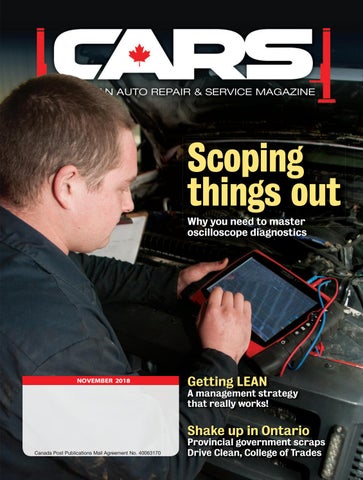
Scoping things out Why you need to master oscilloscope diagnostics
NOVEMBER 2018
Getting LEAN A management strategy that really works!
Shake up in Ontario Canada Post Publications Mail Agreement No. 40063170
Provincial government scraps Drive Clean, College of Trades
Talklkk tot o your y o u r Snap-on Snn a p -onn ® Franch F rann c h isee isee e o r other or othh e r sales sall e s representative r p r es rep esee n t ativ ati v e . Ordd e r onl Order online l i n e att snap ssnapon napp on.com o n .co com om Snap nap-on nap -on is a tra raadema dem rk, regi g ster gi stereed in thee Unit Unit ited States tes es and a otherr count an countr un ies, off unt Snap-on Incorpor Snap rporaated. rpor at All ri right rights ghts hts reserve veedd. ©Snap-on © onn Inco Inc nc rporated ed 201 ed 2 8. 20
Snap-on is a trademark, registered in the United States and other countries, of Snap-on Incorporated. All rights reserved. ©Snap-on Incorporated 2018.
NOVEMBER 2018 | VOL. 4 NO. 9
CANADIAN AUTO REPAIR & SERVICE MAGAZINE
19
23 COLUMNS Service Notes
5
What can you do when the market changes around you? Adapt!
FEATURES
19
Management: Taking a “Lean” approach
Lean principles, long championed by manufacturing companies, have not typically been employed in the auto repair and service world. That might be changing.
23
Technical: Scoping it out
It’s Your Turn
12
Solve your HR problems by hiring for attitude and teaching for skill.
Greenwood’s Garage
13
Shops don’t need more activity. They need effective management.
The Car Side
6 30
Slim Shambles contemplates reinventing his business as a franchise.
www.autoserviceworld.com
If you’re not using an oscilloscope on your toughest diagnostic challenges, you’re missing out on an incredibly powerful tool.
DEPARTMENTS Letters................................................................... 6 Eye Spy ................................................................. 6 In the News ........................................................... 8 By the Numbers ................................................. 11 Baywatch ............................................................ 26 Advertiser Index ................................................ 29
November 2018
3
LG
U
E YO
T AR WHA
R
G FO
HIN REAC
’L ? WE T X E N
.
HERE
UT ET YO
r s te e ver e , n s r l l a s’ c s wi i l te r u s to m e r v e r s . F X c -o WI your — lve, o do o so tion for s a n d n ey drive t g c h in n t e y r t r r u t o r ve et re a te p n o r er, howe you’ lem the ultim n t w i t h riv b d o r y e r p ver fe r uipm teve e of nd e Wha rong. W r o a d e q ehicle a s. om s w ry v offcce ers.c you ixfilt a n d t for eve ad to su w s k duc truc h e ro a pro on t With eep you lk we’l
SERVICE NOTES CANADIAN AUTO REPAIR & SERVICE MAGAZINE
EDITOR | Allan Janssen (416) 578-1586 allan@newcom.ca CONTRIBUTORS | Rick Cogbill, Jeff Colton, Richard Dansereau, John Fraser, Bob Greenwood, Marc Sleaford, Jacob Stoller.
Big changes in Ontario A new government announces the end of two controversial programs, leaving shop owners wondering what that could mean for business. By Allan Janssen
ART DIRECTION | Tim Norton/Janet Popadiuk (416) 614-5810 tim@newcom.ca DIRECTOR OF BUSINESS DEVELOPMENT | Peter Bulmer (416) 605-5346 peterb@newcom.ca QUEBEC & EASTERN CANADA SALES DIRECTOR | Denis Arsenault (514) 947-7228 denis@newcom.ca ADVERTISING PRODUCTION MANAGER, PRINT/DIGITAL | Alicia Lerma 416-510-6845 alicia@newcom.ca CIRCULATION MANAGER | Lilianna Kantor (416) 614-5815 lily@newcom.ca
CARS magazine is published monthly except for January and July by Newcom Media Inc., 5353 Dundas St W. Suite 400, Toronto, ON, M9B 6H8. The magazine serves the Canadian automotive repair and service industry. Subscriptions are free to those who meet the criteria. For others: single copy price: $7.00 plus tax; one-year subscription in Canada: $53.95 plus applicable tax; 2-year subscription in Canada: $84.95 plus applicable tax; one-year subscription in U.S: US$95.95; single copy price: US$10.00; one-year subscription in all other countries: US$97.95. Copyright 2018. All rights reserved. The contents of this publication may not be reproduced by any means, in whole or in part, without prior written consent of the publisher. The advertiser agrees to protect the publisher against legal action based upon libelous or inaccurate statements, unauthorized use of photographs, or other material in connection with advertisements placed in CARS. The publisher reserves the right to refuse any advertising which in his opinion is misleading, scatological, or in poor taste. Postmaster: send address changes and undeliverable Canadian addresses to Circulation Dept., CARS, 5353 Dundas St W. Suite 400, Toronto, ON, M9B 6H8.
MEDIA INC.
VP, PUBLISHING | Melissa Summerfield VP, EDITORIAL | Rolf Lockwood PRESIDENT | Joe Glionna CHAIRMAN | Jim Glionna CORPORATE OFFICES HEAD OFFICE 5353 Dundas Street West, Suite 400, Toronto, ON M9B 6H8 Telephone: 416-614-2200 Facsimile: 416-614-8861 Member of the Audit Bureau of Circulations Newcom Media – Publications at 5353 Dundas Street West, Suite 400 Customer Number: 4006214 Publication Mail Agreement #40063170 Print edition ISSN 2368-9129 On-line edition ISSN 2368-9137
The Ontario College of Trades, which has been both hailed and hated for years, will wind down next year. So, too, will the provincial emissions test program, Drive Clean. With these back-to-back announcements, made over a few short days, automotive professionals in Ontario were reminded how easily governments can alter the operating conditions that govern an entire industry. The question on everyone’s mind, of course, is how the changing political tide will affect business. It’s hard to believe the demise of OCOT will come as anything but good news to the vast majority of technicians who saw their fees jump overnight from $20 a year to $120. The increase was meant to finance a vast army of bureaucrats to manage registrations, and enforcement officers to police work sites. There was also some talk of developing professional standards to improve competence. If the college had been able to make good on its promises – including to rid the province of backyarders who dilute profitability in a super-competitive industry – it might have been heralded as a success. But over nearly 10 years, OCOT scored precious few victories and managed only to alienate its members with poor communication skills and a shocking level of disregard for the industry’s true needs. So no great loss there. The demise of Drive Clean, on the other hand, is more troubling. The program, which was established at the end of the last century to ensure that gross polluting vehicles were either pulled from the road or fixed, has seen a lot of changes in nearly two decades of operation. The test used to require the use of a
dynamometer to allow tailpipe emissions to be accurately read. Thousands of Ontario shops dropped $80,000 on new equipment. In 2014, many those dynamometers became boat anchors when the province switched to using the OBD-II port to analyze vehicle performance. There were continual questions about the accuracy of the tests. And, to keep the fickle electorate happy, the fees were first reduced and then no longer collected at the shop. Instead, they were reimbursed out of government coffers. So, Drive Clean had its share of challenges too. But unlike OCOT, it scored some very important victories. One of them was to bring the owners of older vehicles into an automotive repair and service bay at least once every two years. Technicians were not supposed to go looking for ancillary work to sell, but in many cases even a cursory look revealed the most dangerous vehicle conditions and incidents of neglect. More importantly, it painted our industry in a positive light. We were not only protectors of the environment, but we ensured public safety. We were the good guys. If Drive Clean brought potential customers through the door and revealed the occasional work, well, we’re now going to have to find new ways to do those things. Perhaps one lesson here is that shop owners should not rely too heavily on government programs to help build their businesses. Public initiatives are all too often fleeting and are subject to the whims not only of politicians but bureaucrats and voters too. These are not people you want as silent partners in your business. November 2018
5
LETTERS TPMS are another reason for mandatory inspections In regard to the TPMS issue and provincial safety standards (“Tire dealers seek clarity on TPMS,” October 2018), this argument has been going on for decades. The only right answer is that if the vehicle came from the factory with TPMS, it should work as intended at all times. Enough said. It should be no different than daytime running lights. How many vehicles do we see on the roads without daytime running lights functioning? In Ontario, the new inspection regulations are a vast improvement over what we had. But they still fall short of what is needed. It’s time to implement annual safety inspections when Ontario vehicle owners renew their stickers. We need people in this industry or those representing this industry to have the guts to push forward on these and many more topics. Craig Spicer Orleans Auto Tech Orleans, Ont.
TPMS are a form of protection for today's expensive tires Here’s a different twist. With the price of new tires today, why not promote the sensor as a protection for your investment. The sensor will warn the driver long before a tire is destroyed. Even though in Canada it’s not classed as a safety device, it’s still very important. Bob Ward The Auto Guys St. Thomas, Ont.
Customers usually understand liability concerns At this point, we simply tell the client that we can’t knowingly disable a safety system on a vehicle, for obvious liability reasons. Most people are pretty accepting of this. TPMS has been around long enough that a lot people know what it is. They’re prepared for it when I price winter packages. Peter Foreman Foreman’s Integra Tire Auto Centre Langley, B.C.
All plugged up Air filters don’t get more saturated than this one, discovered on a 2003 Dodge 2500 with a 5.9 diesel by technician Mike Shauf of R.P. Automotive in Weyburn, Sask. The vehicle was in for a pre-winter inspection. Good thing too! Have an interesting picture to share? Send a high-resolution image to allan@newcom.ca
N.S. inspection doesn’t require working TPMS In Nova Scotia, our two-year motor vehicle inspections don’t require the TPMS light be out. The system doesn’t have to work. Same thing with air bag lights. We put stickers on cars if the air bag light is on, but that’s not required. Only the ABS light has to be out and the system working. Brian Nicholson Nova Scotia
Ontario views TPMS and ABS as options Here in Ontario, it’s opposite. We can pass a safety with ABS light on, but air bags must now work. New rules last year. TPMS, like ABS is an “option,” not a mandatory system. Dan Lazin Advanced Auto, Cambridge, Ont.
No mention of TPMS in Quebec regs TPMS is a requirement for vehicles sold in the U.S. but this is a rare case where Transport Canada has not followed suit. While federal authorities specify how vehicles sold in Canada should be built, it is up to the provincial authorities to specify maintenance criteria. So the answer lies with each provincial authority. I just checked the Quebec regulation. There is no mention of TPMS. Yves Boulanger RTL Transit, Longueuil, Que.
Safety systems may not be so safe after all It’s high time to stop the add-ons that are touted as “safety systems.” They make drivers complacent. There’s too much of it. It breaks or gets confused and is not reliable, and thus makes the vehicle more dangerous under many circumstances. Think about lanekeeping systems that steer you right into a pothole which fractures a wheel completely. Gee, I wonder why the TPMS light came on! Jay Douglas Rice Lake Auto Repair Campbellcroft, Ont.
6 CARS
www.autoserviceworld.com
LESS SEEK MORE FIND
Introducing OmnicraftTM parts for all non-Ford makes and models. With this newest addition to our lineup, which includes Ford and an expanded Motorcraft® parts offering for Ford vehicles, we are now a one-stop-shop for quality parts – with a competitive warranty at a great price. So now you can spend less time looking, and more time getting things done. For more information, contact your local Ford Dealer or visit ford.ca/wholesale.
Motorcraft® is a registered trademark of Ford Motor Company. OmnicraftTM is a trademark of Ford Motor Company. ©2018 Ford Motor Company of Canada, Limited. All rights reserved.
NEWS NATA plans strategic realignment, invites input from industry players A spokesman for the National Automotive Trades Association (NATA) says the aftermarket needs to come together if it hopes to preserve access to OE service information, tools, and training. Ronald Tremblay says any
aftermarket group that wants to express opinions about the right-torepair issue will continue to be heard by NATA – the group that serves as an umbrella organization for auto repair associations in Canada.
NATA recently suffered the resignation of two key executives as well as some high-profile association defections, including the Automotive Aftermarket Retailers of Ontario (AARO) and the Automotive Recyclers of Canada. Nevertheless, he said all industry associations, including AARO, are invited to be part of those strategic planning sessions.
Ronald Tremblay
G E T T H E P R O D E M A N D A DVA N TAG E ProDemand® wraps the leading OEM & real-world repair information in a user-friendly interface that works the way you do. You’re always a click away from the information you need for the most efficient diagnosis and repair. Here are just a few ways ProDemand gives you advantages at every step of the repair process: • Start the Job Right - Plate-to-VIN, Latest TSBs • Diagnose the Issue - SureTrack Real Fixes, Top Repairs • Complete the Repair - 1Search™ Plus, Component Tests, ADAS Get started now with a free demo! Call us 800-470-5936 | Visit us: mitchell1.com Or find your local Mitchell 1 sales rep: mitchellrep.com repair information | shop management | shop marketing © 2018 Mitchell Repair Information Company, LLC. All Rights Reserved. Mitchell 1® is a registered trademark used herein under license.
8 CARS
“We’d like to have their input on where NATA goes next. We welcome it. We want to be inclusive,” he said. “We believe NATA can be a driving force, protecting the automotive aftermarket’s interests in Canada.” Tremblay urged AARO not to completely abandon a team approach to solving industry problems. “There needs to be more commitment to come together and a more unified response to the challenges we all face,” he said. “This can’t be about what the different provinces want – what Ontario wants, or what B.C. wants, or what Nova Scotia wants. We’re all in this together. This is an international conversation and we need to bring ourselves together to effect change.” He acknowledged that progress on ensuring ready access to OE tools, training, and service information has been slow and there have been some recent roadblocks. “There’s an awkward transition happening, no doubt about it,” he said. “But it mostly has to do with new technology and a lack of collaboration between all the relevant parties.” Until NATA redefines itself later this year, Tremblay said the association’s presidency will remain vacant. www.autoserviceworld.com
Kitchener shop named top Autopro in Ontario
www.autoserviceworld.com
NAPA congratulates the winners of the Ontario Autopro of the Year. From left: Josh Braithwaite, regional director for western and Pacific regions; Stephen Tavares, business development specialist for Ontario; John O’Dowd, NAPA VP of marketing; Janice and Jerry Zister, owners of Zister’s Autopro in Kitchener, Ont.; Chris Kinghorn, regional vice president for Ontario; Riley Pratt, senior vice president NAPA Canada; Martyn Johns, regional director for Ontario and Atlantic regions, and Andre Latreille, national director for Autopro.
www.redi-sensor.com
REDI when you are. VDO and REDI-Sensor – Trademarks of the Continental Corporation
Jerry Zister’s Autopro in Kitchener has been named the top Ontario shop in NAPA’s banner program. Zister’s earned 199 points out of a possible 200 to win the Ontario Autopro of the Year award. The announcement was made at the banner’s national convention held in Collingwood, Ont. “This is a dream come true,” co-owner Janice Zister enthused before a crowd of fellow Autopro members. “I feel honoured, proud, and excited. All of our hard work has paid off !” She said the shop, which has been an Autopro member for five years, has been working very hard on delivering a consistent level of service. “It’s all about improving the customer experience. That’s all we’ve been working on for the last two years,” she said. “I can’t think of a better way to celebrate our 50 years in business than by being named the Ontario Autopro of the year.” Jerry Zister, her husband and co-owner of the four-bay shop, echoed her comments. “Our team has worked so hard and it is just an amazing thing to be part of the Autopro family and be at this level after five years,” he said. “This is absolutely incredible. It’s such an honour.” Martyn Johns, regional director for NAPA Autopro in the Ontario and Atlantic regions, was instrumental in starting and administering the award. “Over the last three years, I’ve seen some exceptional commitment to achieving this award,” he told the crowd. “I believe there are over a dozen shops in this room that deserve this award. Unfortunately we can only give it to one.” Runners up in the annual award race were M&R Autopro in Trenton, Ont., owned by Frank Meiboom; and Erskine’s Autopro in Orangeville, Ont., owned by Michael Hinbest.
No need to wait for parts delivery when you have VDO REDI-Sensor. Our 5 sensors replace over 270 OE sensors and need no programming, no cloning, and no dedicated programming tools. REDI-Sensor is ready to go, right out of the box.
November 2018
9
NEWS
Study reveals record growth for aftermarket The light vehicle aftermarket reached a record high value of $21.6 billion in 2017 – a 2.86 per cent increase over record-breaking 2015. That’s a key takeaway from the latest Outlook Study, released by the Automotive Industries Association of Canada (AIA) last month. The study forecasts continued growth to $23.8 billion by 2021. The study found that almost 70 per cent of the 26.8 million vehicles registered in Canada – some 18.4 million of them – are at least six years old. Average vehicle age was pegged at 9.71 years. “The aftermarket will see some of its best years in the near future as the market for out-of-warranty repair and maintenance continues to grow,” the report states.
Prime Minister Justin Trudeau was the special guest at a celebration of NTN’s 50 years in Canada and 100th year as a global brand. In a speech to hundreds of guests, Trudeau acknowledged the contributions NTN Corporation has made to its community, and cited the company as an example of global success and international investment in trade. Prior to the gala, he met privately with Japan’s consul-general in Toronto, Takako Ito, NTN Corporation president Hiroshi Ohkubo, and NTN Bearing Corporation of Canada CEO and president Paul Meo. “We’re so proud of this milestone,” said Meo. “NTN has achieved 50 years of steady growth in the Canadian market and 10 decades of global innovation. Our longevity is a credit to our employees, whose dedication and commitment are key to our competitiveness.”
It’s true you’d look good in blue.
Join the 650 independent service centers, all proud to wear the NAPA AUTOPRO colours from coast to coast.
For more information, visit napaautopro.com
10 CARS
www.autoserviceworld.com
By the NUMBERS Stats that put the North American automotive aftermarket into perspective.
62% $9.5 BILLION
The parts component on automotive service and maintenance in Canada in 2017. The labour component was $9.1 billion DesRosier Automotive Consultants, AIA 2018 Outlook Study
18%
Percentage of survey respondents who identified high quality of work as the most important attribute they look for in a repair shop. Quality of work, technical skills, and overall trustworthiness all trumped price and convenience as criteria for finding a shop. Frost & Sullivan, 2015 United States Vehicle Maintenance: Vehicle Owners’ Attitudes and Behaviors, March 2016
$1.864
Total consumer debt in Canada, including mortgages, as of Q2 2018. That number is up from $1.769 trillion a year ago.
TRILLION
Equifax Canada Company 2018 National Consumer Credit Trends Report
$50-$100
Following some high-profile autonomous vehicle crashes over the last two years, that's the drop in the percentage of people who believe roadways would be safer if all vehicles were fully autonomous.
Amount Canadians can expect to save in fuel costs per year by using Low Rolling Resistance Tires which improve fuel economy 2 to 4 per cent.
2018 Cox Automotive Evolution of Mobility Study
Tire and Rubber Association of Canada
6%
Expected global growth in sales of automotive aftermarket parts over the next seven years, as the need for parts worldwide increases. Wards Automotive
154 million Number of vehicles on North American roads by 2023 expected to be equipped with Android Auto – the mobile app developed by Google to mirror features from an Android device to a car’s dash. IHS Markit
43.3%
30%
Percentage of survey respondents in 2018 who expressed an interest in purchasing an electric vehicle, up from 41.3% last year. Interest was highest among those under 35 and those who make more than $75,000 a year.
HALF
Fraction of new car sales in Norway that are electric vehicles. That figure stands at 10% in California and 5% in China.
Average increase in customer spend attributable to positive online reviews.
DesRosiers Light Vehicle Study (LVS)
2 Degrees Institute
Kukui
www.autoserviceworld.com
November 2018
11
IT’S YOUR TURN Got an opinion? We’ll happily give you a page to get it off your chest! Send your rant to allan@newcom.ca
Investing in people Want competent techs who stick around? Hire for attitude, and teach for skill. By Marc Sleaford
Every shop owner wants to know two things. How do you find good technicians? And how do you get them to stay? Like most managers, I’ve always found that good technicians are nearly impossible to find. Anyone who is exceptionally good, has exceptional opportunities. Chances are they’re very well looked after right where they are. So rather than looking for someone else’s superstar, I’ve focused on building new ones in my own shop. Building a star technician is no easy task. You need to have lots of patience and realize that your efforts are really a long-term investment with long-term pay-offs. The key to success, in my view, is to hire for attitude and then teach for skill. It all starts with the interview. Your screening process needs to be thorough. Too many of us look at a resume and decide in a moment if they’re in or out. When you’re hiring for an entry level position, work experience will almost
12 CARS
always be lacking. Don’t let this stop you from meeting the candidate. Rather, give them the benefit of the doubt. Go ahead and schedule that interview. In fact, schedule several of them. You’re looking for someone who takes themselves and their goals seriously, and has a positive attitude to back it up. There are plenty of ways to uncover these traits. My first question has always been, “Is this what you want do for the rest of your career?” I need to understand why they’re pursuing this job, and how hungry they are for success. If you get the sense that they truly love auto repair, you’ve found a perfect candidate to take a chance on – regardless of their experience or lack of it. This is someone worth investing in. Then, on their first day of work, you fit them into your “Pay-It-Forward” strategy, where every person in the shop is responsible for training the next person in line. For example, the senior technician mentors the newly licenced tech, who mentors the apprentice, who
mentors the tire tech who comes in after school. This model allows all the employees to practice leadership skills, build relationships, and focus on how to do a job well. It encourages maturity and professionalism, as well as teamwork. The added bonus is that it creates an efficient, cost-effective way to replace any technician when the time comes, without having to scramble or panic. There is always someone next in line who has been trained to move up the ladder to the now-vacant spot. When you hire a new entry-level employee, you’re just feeding the line. If everything goes well, even the greenest of the green apprentices will mature into competent shop leaders. Their success is your success. If everyone in the aftermarket adopted this model, it would be our trade’s success too. There’s so much more to technician retention than simply offering good wages and benefits. Today’s technician needs to feel that their work is important to the overall success of the business. They need to believe that what they do matters. Giving every technician the opportunity and responsibility to mentor others ticks this box. Not only is it empowering and gratifying, it fills your shop with ambitious and motivated employees – the kind you can build success on.
Marc Sleaford is store manager at Fountain Tire London Westmount in London, Ont. You can reach him at marc.sleaford@fountaintire.com. l f d
www.autoserviceworld.com
GREENWOOD’S GARAGE
their products or “be price competitive” with their programs. They do not grasp the real need for shops to improve productivity and create lasting relationships with clients. They may give lip service to these objectives but they do not back up their words with substantive support. Automotive part manufacturers, warehouse distributors, and jobbers need to sell a sufficient volume of their products in order to survive. This imperative informs everything they do. All of their marketing reveals their true intention, which is to sell parts. The professional service shop, however, is in the knowledge business. The sale of commodities is not its primary objective. Rather, it must sell labour hours, billed at the proper rate, in an efficient environment. Suppliers tend not to talk about the real shop issues, the strategies that achieve the appropriate net income, allowing shops to grow and prosper. Instead, they offer evening presentations and weekend seminars that focus on how to sell more and be busier. These end up being “motivational” talks that really do not teach business acumen or best practices. There’s rarely any discussion of the numbers a shop should be achieving, or the targets that should be in place. There’s little explanation of what the metrics mean or how they should be measured. This is an absolute tragedy within our industry. The fact is shop business management development is a two- to threeyear process, not a one- or two-day experience. There is no silver bullet that provides instant and sustainable solutions. The majority of shop owners finished their formal education when they graduated high school. Many became licensed technicians, with Red Seal
REAL professional development
Time for
Learning shop management skills is an ongoing process. It’s not about taking a weekend seminar or an online sales course. By Bob Greenwood, AMAM We’re experiencing challenges in this industry like never before. They’re the kind of challenges that make many shop owners very nervous about their future. Above everything, they wonder if they’ll actually have a business to sell down the road. Sadly, the company they poured a lot of sweat equity into could be a casualty of societal and technological changes. Even if it’s still standing when they’re ready to retire, it might prove to be nearly worthless to the next generation That’s a very scary thought indeed. A business is worth something only if it is bottom-line profitable, producing a good return-on-investment. It’s considered sustainable if it has business processes in place that can track its financial health and alert management www.autoserviceworld.com
about how and when to adjust its strategies. The automotive repair and maintenance business has changed drastically in recent years… yet you wouldn’t know it by the way the industry seems committed to maintaining the status quo. Changes in technology and society are simply not being acknowledged within the industry. At every level of the industry you can still hear people talking about “increasing car count,” “improving sales” and “staying busy.” These are not the measurements we should be using. The commodity side of the industry is particularly vocal about increasing surface-level activity. It spends tons of money on marketing the notion that you’ll be able to “make more sales” with
CONTINUED
November 2018
13
GREENWOOD’S GARAGE
KEEP YOUR ENGINE YOUNGER FOR LONGER TOTAL Canada produces and commercialize high performance lubricants for the entire automotive sector. TOTAL offers innovative products that meet the requirements of the largest car manufacturers. For more information, consult our website at www.total-canada.ca.
Follow us on
14 CARS
Total Canada
certification. They love motors, and can fix all kinds of vehicles. They may even have shown great commitment to technical training. But when they took over as managers, where were they taught how to read a balance sheet? Where did they learn the difference between markup and gross profit? Where did they study the principles of shop efficiency and its effect on the bottom line? Where were they taught how to manage gross profit? How to measure net profit? How to create a positive shop culture? The cost of extending credit to customers? How to analyze a shop’s progress on a daily, weekly, monthly, quarterly and annual basis? The average independent shop today is missing between $25,000 and $30,000 in net income per bay per year from the current business coming through the doors. This can be directly attributed to a lack of management skill. Shops don’t need more activity. They need effective management. If best practices were employed to measure and manage productivity, suppliers would be getting paid in full each month and at better margins. The shop owner and staff would receive healthy incomes, and there would still be enough cash left in the till to study, measure and move the business forward. Suppliers tell me that shop owners are not interested in management training. But many of these suppliers offer sales pitches, product information, and motivational seminars, describing it as “business management.” These are not what the industry needs in challenging times. They may result in more activity and increased sales, but they will not improve net income. Suppliers have failed their shop customers. What we see now is a lot of shop owners who are nervous about the very concept of management education. They may not say it out loud, but what they’re thinking is: “I was never very good at math and English in school.” “I’m a technician not a pencil pusher.” “I would embarrass myself in a class
full of managers.” “Business management is nothing but numbers and paperwork. That’s why I have a bookkeeper!” Too embarrassed to sign up for management classes, they tell their suppliers that they simply don’t have time for a class. Or the money. Or the interest. Or the need. Here’s what I would say to all the shop owners out there who are clinging to these lame excuses. Wake up! Do the math. You’re deep in debt and under tremendous stress. It’s affecting your relationships with family and friends. Understanding business management principles is easier than you think. The real question is do you want to learn? If you don’t want to learn, then no one can help you and you should just wind down your business, and get out while you can. But if you do want to learn, make a plan right now to enroll in a proper business course. Look for one that is geared to independent automotive repair shops. A generic business course won’t cut it. The issues are just too different. If you find the right one, I’m absolutely confident you’ll enjoy it. Time is of the essence. You cannot ignore this any longer. The independent shop sector of the automotive aftermarket industry is at a critical stage. Without proper business principles, you just won’t produce the kind of net income needed to buy the right equipment, pay for the best training, upgrade your facilities, and attract a great staff. Professional business development will not let you down. B Greenwood is Bob aan Accredited Master Automotive Manager A ((AMAM) who offers personal business p ccoaching and ongoing managementt ttraining for aftermarket shops, focusing on building net income. He can be reached at 1-800-267-5497 or greenwood@aaec.ca.
www.autoserviceworld.com
SHOP MANAGEMENT
Growing your business with
LEAN Shop owners who apply ‘lean’ methods are finding that the key to productivity is eliminating waste. By Jacob Stoller Auto Service Kingston, a nine-bay shop in the west end of Kingston, Ont., may look like any other repair shop to some customers. But those who work in large corporations where “lean” management principles are used may notice some of the hallmarks that are common in their own workplaces. Visual cues such as clear signage, posted work procedures, designated safety zones, and labeled storage areas are everywhere, stark evidence of Auto Service Kingston’s own lean transformation, which began in 2012. “People from large organizations who’ve been exposed to lean are absolutely floored that a little automotive shop has taken this on,” says owner Steve Bernard. “They go back and tell their co-workers, and then we have more customers.” It’s fair to say that most visitors wouldn’t understand how all of those visual aids enable the processes and shop culture that come with lean management, streamlining the work and contributing to a phenomenal improvement to Bernard’s bottom line. “Most independent shops run at a 50% billing rate,” says Bernard, “where they’re buying 8.8 hours from a mechanic, but only billing half of that. We were well below that when we started with lean, but now we’re around 90%.” www.autoserviceworld.com
The VSM team: Staff at Auto Service Kingston created “value stream maps” (seen in the background) to clarify work procedures.
Customer satisfaction has been key. The business has tripled its revenues since Bernard acquired it six years ago. The growth was organic, all of it coming through word of mouth. The lean approach, pioneered by Toyota over 60 years ago, is ideal for independent repair shops because of its emphasis on improving productivity using existing resources. “When Toyota developed lean, the company was under severe financial constraint, so it was all about finding ways to do more with less, and to do it better, faster, and at lower cost,” says Larry Coté, president of Lean Advisors, who worked with Bernard to improve shop processes. For Donny Seyfer, co-owner of Seyfer Automotive in Wheat Ridge, Col., lean is a no-brainer. “You don’t have to spend any money, and you can make more,” he
A visual scheduling system ensures that every job is tracked and that details, such as required maintenance, are noted and communicated to the customer.
says. “Where else can you get that?” “Lean has helped us rethink things, and find better ways to use the resources that we have,” says Sean Payne, owner of Martin’s Bus Service in Napanee, Ont. “I think we all have excess capacity that’s just sitting there, and we need to learn to organize it a little differently.” Through his recently acquired lean eye, Bernard now sees all kinds of opportunity for improvement when he visits other garages. “Immediately you start shifting equipment and stuff in your head,” he says. “Maybe it’s a way to get 33% more work with two days of rearranging. It’s wicked to have that ability to see these things.”
Better value for customers The economic driver behind lean is the identification and removal of waste. That is, eliminating extraneous activity or expenditures that don’t add value for the customer. Replacing an alternator, for example, adds value. Spending 20 minutes looking for a tool does not. “Nobody wants to pay for waste,” says Bernard, “and nobody wants to pay you to walk around looking for your 10mm socket.” Creating an orderly visual environment helps uncover such waste. Lean methods systematically dissect work processes, identifying defects such as unnecessary CONTINUED
November 2018
19
SHOP MANAGEMENT steps taken by a technician, a storage area cluttered with dead inventory, or delays caused by inaccurate information. A pivotal method for Bernard has been “value stream mapping” which creates visual representations of end-to-end work processes, such as a seasonal tire change. It allows employees to identify waste, and sets the stage for designing and implementing improvements. The best results are often achieved when the mapping sessions are led by the employees who work with the processes every day. This requires managers to rethink their role. “It wasn’t easy for me to step back and let somebody else lead like that,” Bernard admits, “but when you see somebody take it over and knock it out of the park like my guys have, it’s one of the most rewarding things. It’s all about pride of ownership.” “We’ve tried to let the people drive the process,” says Payne, “because they’re the ones it’s going to affect the most, in terms of their day-to-day work.” One of the lean tools evident at Auto Repair Kingston is a “water spider.” In lean terminology, that’s a support person who uses “kitting carts” to bring parts, tools, and fluids directly to the technicians so they don’t have to leave their work areas. “The water spider just keeps everything coming to them so they can do what they’ve been trained to do, and not get distracted,” says Coté. “Distractions not only waste time, but
THE RIGHT TOOLS FOR THE JOB
π SHIPPING SUPPLY SPECIALISTS
ORDER BY 6 PM FOR SAME DAY SHIPPING
COMPLETE CATALOG
1-800-295-5510 20 CARS
introduce the possibility of errors and safety problems.” One of lean’s biggest challenges is sustaining the gains. Managers need to recognize that the lean journey never really ends. “It’s always a work in progress,” says Lean is all about using visual aids Payne, “so we have keep to enable efficient processes and our foot on the gas, streamlined workflows. because if we let off, we’re just going to go back to our old ways of doing things.”
Getting started with lean Lean calls for a fundamentally different way of working, and like any major change, it doesn’t occur overnight. “Don’t over-extend yourself,” says Seyfer. “You’ll get nothing done if you take on too much.” With that in mind, here are five tips from the experts for launching your lean program: Get trained. Lean principles are not overly technical, and excellent courses are available online, through community colleges, or in public seminars. Start with small steps. Efforts to “reinvent the wheel” usually fail. It’s much more effective to start with a few quick wins, and build momentum from there. Get employees on side. Lean calls for major change in the workplace. It cannot be achieved without employee buy-in. It’s up to management to prove that lean makes the work easier and less frustrating, as well as adds more value for customers. Avoid the “too busy” trap. If you’re always too busy, chances are you’re wasting too much time on inefficient processes. Some quick wins will help break the vicious circle and create some time so you can implement even more improvements. Get a coach. Working with an experienced lean coach or facilitator brings in an outsider perspective, and helps accelerate the adoption of the lean mindset. Lean has transformed a number of industries, not least of them automobile manufacturing and health services. Its benefits have been clearly shown in improved efficiency, reduced injuries, and healthier profit margins. If you commit to it, it could completely transform the way your shop operates too.
Jacob Stoller is a journalist and facilitator who tackles technical subjects like lean, information technology, and finance.
uline.ca
www.autoserviceworld.com
WE DIDN’T SIMPLY THINK OUTSIDE THE BOX. WE REDESIGNED IT. Valvoline Advanced Bay Box ™
™
Modular Rack for setup customization 7.5 Litre double-handle ergonomic pitcher for precision pouring
Integrated Funnel with each pitcher Drip tray for a safe workplace
Vision Strip
Chamfered Corners
Easy Breakdown
(minimizes waste)
Each Bay Box contains 18.9 Litres, enough for approximately 4 oil changes.
CA-DIG-0123-EN ©2018 Valvoline 8/18 ™Trademark, Valvoline or its subsidiaries, registered in various countries
MOVING IN
TENS OF THOUSANDS OF CARS.
KEEPING
TENS OF MILLIONS OF CARS AND TRUCKS MOVING.
SURPRISED? Continental knows OE because our belts are OE on millions of Chrysler, Dodge, Ford, GM, BMW and Volkswagen vehicles that roll off the assembly line every day. Now with our OE Technology Series (OETS), you can install the aftermarket Multi V_Belt with the OE pedigree. Belts fanatically precision engineered for perfect fit, form and function. Plus, there’s a Continental belt for 98% of the vehicles on the road in the U.S. and Canada. When your reputation is riding on our belts, they must measure up. Get the full story at OETechnologySeries.com.
TALKING TECH
O
Scoping
ld diagnostic techniques are becoming harder to use and are far less effective than they used to be. In a growing number of cases, using a scan tool can only take you so far. These days, if you’re not using an oscilloscope on your toughest diagnostic challenges, you’re missing out on an incredibly powerful tool. The days of swapping ignition coils around to chase a misfire are over. During a misfire event, scan data is only the information the module has been sent (or that it thinks has been sent). Yes, trouble codes can point us in the direction of a concern… but we still need to get our hands dirty and test the vehicle to diagnose the underlying cause. Only an oscilloscope can show what is happening in real time. Trigger and zoom functions can be used to catch glitches and dropout. The quality of information is the key here. Scan tool data gives you processed data. Only scope testing a sensor gives you live data. The oscilloscope is not a new tool
things out The oscilloscope has never been more valuable in the shop. Technicians really need to master it if they want to work on modern vehicles. By Jeffrey Colton
www.autoserviceworld.com
by any means. I can still remember my father using an old big-box analyzer from Sun to diagnose and verify the repair on a poor-running engine. I was just a kid then. Decades later, I’m using the very same process whenever I get a tough diagnostic challenge in the shop (what we tend to call a real “problem child”). Unfortunately, many techs have gotten out of the habit of using scopes. New diagnostic resources like built-in troubleshooters, technical hot lines, and online services like Identifix, have made it easy to skip the step of actually testing the vehicle. All too often, the “confirmed fixes” found in an online database lead technicians in the wrong direction, and parts get replaced because that’s what a scan tool recommended. These resources do not remove the need to perform some simple but important tests. Let’s take a look at a recent problem child that came into our shop: a 2013 GMC Acadia with an intermittent no-crank. Of course, when we ran the vehicle it never missed a beat. It started every time. The customer wanted to know if he needed a new battery. It would have been an easy battery sale… but he didn’t need a new battery. Did he need a new starter motor? Maybe. We could have taken a guess at it, but that wouldn’t have been the right thing to do. We had a problem and we needed to catch it in the act. That was going to be the only effective way to diagnose the cause of the no-crank. We performed a complete module scan and recorded several U codes within modules that were losing communication with each other. From there, we dug into a wiring diagram of the networking of the vehicle. We noticed from the diagram that the modules with U codes were all on the low-speed GMLan network. CONTINUED
November 2018
23
TALKING TECH Service information, description, and operation taught us that in order for this vehicle to crank when the key is inserted, a few things had to be in place. The theft deterrent module had to receive the theft codes, and then pass them on to the BCM using the low-speed GMLan network. The BCM had to decide if the vehicle passed the theft test. If it did, it would send the crank request to the PCM using the high-speed GMLan. So, ultimately, it is the PCM that controls the starter relay to crank the engine. With the information we gathered from the code scan and the service information, we had an idea that something was affecting the low-speed GMLan network. But what? Using a break-out box and a Pico oscilloscope, we plugged into the DLC. Channel A was connected to the pin 6 high-speed GMLan+. Channel B was connected to pin 14 high-speed GMLan-. And Channel C was connected to pin 1 low-speed GMLan. We analyzed the waveform and found no indication of a problem. However the vehicle was not acting up at the time. The trickiest part of the diagnosis was getting the problem to occur when we wanted it to. After many attempts, we finally had the vehicle consistently acting up with our oscilloscope hooked up. When the “no crank“ occurred, the high-speed GMLan+ and high-speed GMLan- both stayed active (1.5 to 2.5 and 2.5 to 3.5 volts respectively). But the low-speed GMLan network crashed to 0 volts. So, we were right. The problem was in the low-speed GMLan. But we still didn’t know what the cause was. Looking back to the networking diagram, we located two circuit bridges. One located just above the DLC [JX205] and the other tucked away behind the interior panel of the left rear quarter panel. We started our testing at the JX205 because of its location. It was much easier to access. We disconnected the JX205 from the circuit. With the bridge discon-
24 CARS
nected, the network was still dead. So we were forced to locate the JX405 in the rear which was not easy. With the network down, the automatic lift gate would not open. Getting back behind the interior panels meant working in pretty tight quarters. When we finally got to the JX405, we disconnected it from the circuit. And the network came live again. That’s when we knew the problem was associated with that section of the network. From there, we built a spider – a connection that we could use to join each module to the circuit one at a time to isolate the cause of the network failure. With the input lead of the spider connected to pin 1 of the JX405 and another connected to pin 3, the network crashed. Pin 3 was the pin that went to the side object-detection module. Then we unhooked pin 3 and added the rest of the modules to the circuit to verity that Pin 3 was the only one causing the network crash. It was. Finally, we went to the side object-detection module and disconnected the connector to rule out a shorted wiring harness. With the module disconnected and the JX405 in place, the network stayed live. This module had an intermittent internal short to ground of the low-speed GMLan network. We replaced and programed the new module and the problem never returned. Looking at the elements of the repair: • A scan tool helped guide us in the
right direction. • Good service information made it possible for us to understand the system and how it worked. • Our training on networking and problem-solving diagnostics gave us the testing techniques to track down the cause of the problem. • And our oscilloscope gave us the real time live data we needed to confirm the cause. I am confident in suggesting that without an oscilloscope, this problem would not have been accurately solved. A lot of shops have an oscilloscope in the facility. The real problem is they don’t have techs who are adequately trained on how to use them. What good is the tool if no one knows how or when to use it? Oscilloscope training is more important now than it has ever been. But be prepared to pay for it. The good classes are not cheap. And the cheap (or free) classes are not always good. Effective training will transform a shop. It will make everyone more confident and effective. And it will turn mechanics into technicians. Jeffrey Colton is the owner of Colton’s Garage in Flesherton, Ont. You can reach him at jeff@coltonsgarage.ca.
www.autoserviceworld.com
NEW
Formulated For Your Vehicle Meets the needs of the growing OE market
BAYWATCH BA Pry bar OTC has announced its new 7177 Extendable Indexing Pry Bar for heavy-duty applications. Designed for prying large heavy objects, repositioning engines or equipment, and general movement of obstructions, it features an extendable reach and pivoting head. A knurled base handle creates a strong, secure grip for maximum leverage. Optimal loading of 1,500-2,200 lb is made possible by its heavy duty 13/16� steel bar and 1-3/8� tubular extension. www.OTCTools.com
Coated pistons A new generation of Mahle piston coatings is being developed to increase efficiency and minimize emissions. The coatings are intended to guide and reduce the heat entering the pistons, reducing the demand for cooling, and allowing a higher quantity of energy to be extracted by waste heat recovery systems. At the same time, the higher exhaust gas temperature permits faster heating of the exhaust gas aftertreatment system following the cold start. www.mahle.com
26 CARS
Diagnostic platform With the introduction of Apollo D8, Snap-on is making its Intelligent Diagnostics solutions more accessible to technicians of all skill levels. Previously available only on the ZEUS platform, it guides users step-by-step directly to the fix, saving them time and making them more efficient and productive. It can scan for vehicle fault codes and diagnostic trouble codes, provide OEM technical service bulletins, and highlight vehicle data that is out of expected range. www.diagnostics.snapon.com
Disc brake pads Centric Parts has introduced a new line of premium performance disc brake pads. Called Posi Quiet PRO (PQ PRO) it addresses key service issues such as brake fade, weak braking response, excessive noise, and time-consuming break-in procedures. In addition to its Mu500 coating, PQ PRO pads are 100% positive-molded, 100% post-cured and 100% scorched for consistently superior long-term stopping power. www.CentricParts.com
www.autoserviceworld.com
Smoke machine adapters Bosch has introduced five new bladder adapters for its HPT 500 heavy-duty smoke machine. The adapters seal off various-sized pipes and hoses when checking for leaks and range in size from 1.5 to 5.9 inches. Each bladder expands to completely seal hoses and pipes in exhaust, intake and turbocharging systems so they can be filled with smoke to check for leaks. The HPT 500 is capable of testing an entire system in 15 minutes. www.BoschDiagnostics.com.
Antifriction for gears Liqui Moly has introduced an additive especially designed for gearbox oil, allowing it to resolve sticking manual gear shifters. New MoS2 Antifriction for Gears reduces wear and makes shifting easier. It includes a solid lubricant that balances out unevenness of the metal surfaces without using corrosive chemical components, which could attack the sensitive non-ferrous metals in the gearbox. www.liqui-moly.com
Quick-Strut assemblies Tenneco has again expanded its aftermarket ride control offering, making Monroe QuickStrut premium replacement strut assemblies available for an additional 4.2 million vehicles registered throughout North America. The Quick-Strut assemblies are designed to help service shops speed up strut replacement times and take advantage of more sales opportunities. The latest range expansion includes coverage for 22 dom e stic and 41 imp or t applications. www.Monroe.com
Boost Your Shop
Profits Your complete Shop Management Software • Create estimates and invoices • Full accounting module with tax remittance • Detailed sales and profit reports • Free updates • Unlimited technical support • An all-inclusive solution
The Only Shop software with Multiple Document Interface • User friendly and inexpensive • Full Customer Retention Module • Complete vehicle repair history • Inventory & tire storage • VIN look up • Up to 20 service bays
True E-Commerce! Shop for parts or tires and order them directly using our innovative integrations with:
Heavy-Duty Two-Post Lift Rotary Lift has launched its highest capacity two-post lifts to date with the introduction of the SPO16 and SPO20 lifts, both featuring Trio arms and Shockwave technology. With lifting capacities of 16,000 and 20,000 lb respectively, these heavy-duty lifts are ideal for servicing most work trucks as well as smaller vehicles like SUVs and cars. Both lifts have been third-party tested and Automotive Lift Institute certified. www.rotarylift.com www.autoserviceworld.com
Online O li catalogue l Mevotech has announced major enhancements to its online catalogue, giving aftermarket customers easy access to information and images for their suspension and chassis parts. The redesigned website features a fresh, new user-friendly layout and vastly improved search capabilities. It also boasts several functionality enhancements to make the identification of parts and fitment more efficient. www.PartsOnline.Mevotech.com
Call us for a free trial version at 1-800-268-4044
www.vlcom.com November 2018
27
$21.6 BILLION STRONG In 2017, the Canadian light vehicle aftermarket was valued at an all-time record of $21.6 billion. Gain a comprehensive understanding of the current aftermarket industry for your own business planning with the 2018 Outlook Study. Complimentary Executive Summary AIA members get your download for FREE Non-member price: $500
Get it now! www.aiacanada.com/publications/outlook-studies
THE CONTINUED FROM PAGE 30
here in Wikipedia.” I got up and leaned against the sink. “Well, since you’re so interested in it, I’ll give you the assignment of researching what’s out there for possibilities. I’m not saying we’ll do it, but we should know our options.” Everyone went back to work while I escaped to my office and dropped into my chair. I began thinking about the changes taking place in my chosen profession. Just the other day I was walking through the mall when I stopped beside a new Infiniti on display. The glossy posters announced the VC Turbo, the first production-ready variable compression motor. The 2.0L 4-cylinder engine can change compression ratios on the go, from 8:1 to 14:1 in as little as 1.2 seconds. The horse power potential from this little four-banger was 268. Where is our industry headed? I wasn’t sure. A few days later Beanie brought me his list of potential franchises and associations that were available to a shop like ours. The price tags weren’t small and my initial response was to put the matter aside. But later that morning Tooner wandered up for a chat. “Got something for ya,” he muttered, handing me a crumpled piece of paper. “Don’t let it get out, but my third cousin Axle is selling a franchise, one he started himself. He calls it Breakdown Bashers, and for a mere 5,000 bucks you get his logo, permission to operate under the name forever, and free warranty repairs for your customer at any of his other franchisees.” I took the paper and studied the logo. It looked like something a 5th grader had drawn. It featured a car with a face on it, cowering below a giant mechanic, grease up to his elbows, brandishing a large sledge hammer. Presumably he was about to fix it by shear force. “Ain’t it great?” enthused Tooner. “His own daughter came up with the design! Real talented kid, eh?” “Uh, how many other franchisees does Axle have?” Tooner thought hard. “I think there’s three, if you count himself, his brother, and a cousin up north near the Yukon border. I’ll admit the warranty coverage is thin now, but it’s a-growin'!” I thanked Tooner for his help and retreated to my office. There were some shop owners I’d met over the years in other parts of the country who were sporting nationally known brands. It was time to call them up and find out how they were liking it. On the other hand, Slim Shambles Auto Repair has a certain ring to it. If Tooner’s cousin can do it, why can’t I? Rick Cogbill is a freelance writer and former repair shop owner, based in Summerland, B.C. You can read more Car Side adventures in his book A Fine Day for a Drive. Go to www.thecarside.com.
www.autoserviceworld.com
ADVERTISER INDEX ACDelco ............................................ 15-18 www.techconnectcanada.com AIA Canada ............................................ 28 www.aiacanada.com/publications/outlook-studies Brake Parts Inc. – Raybestos .................. 31 www.raybestos.com Continental ContiTech ............................ 22 www.OETechnologySeries.com Ford ......................................................... 7 www.ford.ca/wholesale Mann+Hummel – WIX ............................... 4 www.wixfilters.com Mitchell 1 ................................................ 8 www.mitchell1.com NAPA ..................................................... 10 www.napaautopro.com OEM Repair .............................................. 3 www.OEMRepairInfo.ca Prestone ................................................ 25 www.prestone.com REDI-Sensor VDO ...................................... 9 www.redi-sensor.com Snap-on .................................................... 2 www.snapon.com Total ...................................................... 14 www.total-canada.ca Uline ...................................................... 20 www. uline.ca Valvoline ................................................ 21 www.valvoline.com VL Communications ................................ 27 www.vlcom.com Wheel Nut Caddy .................................... 29 www.wheelnutcaddy.com WORLDPAC - Textar ................................ 26 www.textar-worldpac.com WORLDPAC ............................................ 32 www.worldpac.com/quality
Save service bay time! Store wheel nuts with the wheels. Re-useable and safe for all wheels
1-855-584-3463 WWW.WHEELNUTCADDY.COM
Sales@wheelnutcaddy.com
November 2018
29
FICTION
THE
What’s in a name? JOHN FRASER
For the first time in his career, Slim thinks it might be time to expand his business beyond the four walls of his shop. By Rick Cogbill “OK, Sam, I got your latte macchiato, just like you ordered.” Our coffee breaks had stepped up a notch since Samantha joined our team. Thankfully, the regular stuff from Timmy’s was still available to the rest of us who were happy with simpler fare. Sam held up one finger, and turned to show me the phone pressed up against her ear. When she finally ended the call, she sighed loudly and turned to me. “Slim, we’ve got to do something about our warranties. That’s the third call I’ve had about it this week.” I set a box of doughnuts down on the counter. “Somebody had a breakdown after one of our repairs?” “No, no. It’s all these new people moving to town lately. They’re checking us out and the first question they ask is whether we have a national warranty program.” I sighed. Another sign of the times in our industry. All my business life I’d drilled into my staff the importance of quality workmanship in order to garner customer loyalty, but times were changing. Folks wanted to know that they were protected on a long cross-country drive. I couldn’t blame them. When everyone else had arrived for their morning fix of caffeine and sugar, I broached the subject. Tooner was somewhat sympathetic. “I can see their point. You get a water pump replaced here in B.C. and then it malfunctions in Alberta when yer visiting the grandkids. That’s a 10-hour trip through the Rockies to get back here. Ain’t’ no way you’re gonna be towing the car back for repairs.” “I agree,” piped up Beanie. “It’s time we joined an association or a franchise. They give you brand recognition, a warranty
30 CARS
program, training opportunities, and the power of a buying group.” I stared at my coffee and stirred silently while I considered that. “Yeah, but those buy-in fees are plenty steep, depending on who you go with. Plus, what’s wrong with our own brandname recognition?” Sam smiled and patted my arm. “Slim Shambles Auto Repair? Really? No offense, Slim, but it screams ‘small town’ in a very big way.” I looked down the end of the table, to the empty seat where Basil used to sit. He’d been retired for six months now, yet I still found it difficult to be without his sage advice. At that moment our new guy, Gnarly Jacobs, who’d been picking through the doughnut box for a second apple fritter, plunked himself down in Basil’s old chair. It was almost sacrilege. “I’ll tell you, working at the dealer wasn’t always fun,” he said, “But, Dude, having that brand name out front was a big drawing card.” “He’s right,” said Beanie. “It’s called top-of-mind awareness. When people want to buy something, they usually have about three brands in mind. That’s called their consideration set. A brand that enjoys top-of-mind awareness is the most likely purchase option. That’s why one of the most common marketing goals in any communications campaign is to get a particular brand included in peoples’ consideration sets.” Sam stared at him. “Who are you and what have you done with my husband?” Beanie blushed and held up his smart phone. “Uh, it’s all CONTINUED ON PAGE 29
www.autoserviceworld.com
plified. im S e W . d e k s A u o Y
Each Raybestos® line is packaged in distinctly identified boxes for straight-forward inventory and to help your customers quickly select the right brake parts for each job.
The Best in Brakes Made Easy. ©2018 Brake Parts Inc LLC. All rights reserved. RAYBESTOS, THE BEST IN BRAKES, ELEMENT3 and The Raybestos Flying R are among the registered trademarks and trademarks of BPI Holdings International,
www.raybestos.com