April 2017 Vol. 19, No. 1
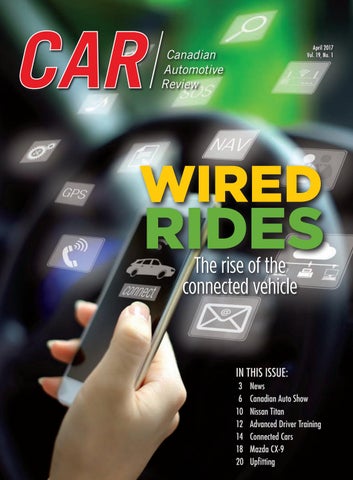
WIRED
RIDES The rise of the connected vehicle
IN THIS ISSUE: 3 News 6 Canadian Auto Show 10 Nissan Titan 12 Advanced Driver Training 14 Connected Cars 18 Mazda CX-9 20 Upfitting
CAR_April 2017_AMS.indd 1
2017-04-19 7:34 AM
CAR_JimPattison_Apr.indd CAR_April 2017_AMS.indd 2 1
2017-04-10 7:34 2017-04-19 2:28 AM PM
10 2:28 PM
Ram Commercial launches virtual upfitting tool
Consumer Reports 2017 Brand Report Card released
Ram Commercial has announced two new programs for commercial upfitters, dealers and customers in viewing, certifying and installing truck-mounted products: Ram Augmented Reality Upfit Configurator and Q Pro. The Ram Augmented Reality Upfit Configurator is a computer-generated visual program for upfitters and dealers to virtually showcase several solutions. Prospective buyers have the opportunity to virtually walk around the vehicle and view inside to assess options via computer simulation. Originally offered on the Ram ProMaster full-size van, the configurator has now expanded to the Ram ProMaster City and the entire Ram Chassis Cab line (3500, 4500 and 5500). Q Pro is a new qualification process for upfitters to certify their product with Ram Engineering. Q Pro allocates Ram Engineering resources to survey, make recommendations and certify upfitter products. Once certified, the upfitter uses Ram’s Q Pro co-brand to help market their product.
Luxury cars from brands like Audi, Porsche, BMW and Lexus are some of the best autos on the road, according to the 2017 Brand Report Card from Consumer Reports. For the second year in a row, Audi (81) earned the highest overall brand score in Consumer Reports’ annual indicator of which brands make the best cars. Porsche (78), BMW (77), Lexus (77), and Subaru (74) rounded out the top five in the rankings. Though the top five brands are unchanged from last year, there was some shuffling in the standings. Porsche and BMW each rose by two spots, while Lexus fell back one spot and Subaru moved down by three. Consumer Reports said its analysis also revealed that consumers don’t have to spend luxury car money to get a quality vehicle. Kia finished just outside the lead pack in sixth place and Mazda came in seventh. CR recommends 100 percent of the Mazda models and 71 percent of the Kia models it has tested. “Our annual analysis reveals that building one or two great vehicles is achievable, but making a whole lineup of excellent ones is much more difficult,” said Jake Fisher, Consumer Reports director of automotive testing. In total, 31 brands were included in the 2017 Brand Report Card. To determine which brands consistently deliver cars that serve consumers well, the company tabulated the overall score, which is a combination of road test score, predicted reliability, owner satisfaction and safety results for each tested model of a brand. Auto experts then averaged those scores at the brand level. Brands with just one tested model were omitted. CR’s rankings are based only on vehicles that are currently for sale on the market and that the organization has tested. Tesla made its debut in CRs rankings in eighth place, though its position is based on just two tested models. Buick’s strong reliability score was enough to balance its middling road test score and secure tenth place, just ahead of Toyota. Lincoln, Chevrolet and Ford finished mid-pack. Chrysler gained seven places and finished just below Cadillac. Honda also finished in the top 10, in the number nine spot. Toyota (11) WIRED fell out of the top 10. CR is currently RIDES Recommending 86 percent of the The rise of the connected vehicle Honda models it has tested, and 78 percent of the Toyotas. Meanwhile, Hyundai landed close behind in the 12th position and Nissan was ranked Cover: iStock 22nd.
80 VALLEYBROOK DR, TORONTO, ONTARIO M3B 2S9 PHONE: 416-442-5600 FAX: 416-510-5140
www.PurchasingB2B.ca
Vol. 19, No. 01
April 2017
EDITOR: Michael Power (416) 442-5600, ext. 3259, mpower@purchasingb2b.ca ART DIRECTOR: Andrea M. Smith PUBLISHER/ADVERTISING SALES: Dorothy Jakovina (416) 510-6899, djakovina@purchasingb2b.ca ACCOUNT COORDINATOR: Tracey Hanson (416) 510-6762, thanson@annexbizmedia.com CIRCULATION MANAGER: Barbara Adelt (416) 442-5600 x 3546, badelt@annexbizmedia.com
ANNEX PUBLISHING & PRINTING INC. VICE-PRESIDENT: Tim Dimopoulos (416) 510-5100, tdimopoulos@annexweb.com COO: Ted Markle, tmarkle@annexweb.com PRESIDENT & CEO: Mike Fredericks CAR, established 1991, is published twice annually (April and October), by Annex Publishing & Printing Inc. © Contents of this publication are protected and may not be reproduced, in whole or in part, without the written consent of the publisher or editor. From time to time we make our subscription list available to select companies and organizations whose product or service may interest you. If you do not wish your contact information to be made available, please contact us via one of the following methods. Phone: 1-800-668-2374, Fax: 416-442-2200, Mail: Privacy Officer, 80 Valleybrook Drive, Toronto, ON M3B 2S9. NOTICE: CAR accepts no responsibility or liability for claims made for any product or service reported or advertised in this issue. CAR receives unsolicited materials including letters to the editor, press releases, promotional items and images from time to time. CAR, its affiliates and assignees may use, reproduce, publish, re-publish, distribute, store and archive such unsolicited submissions in whole or in part in any form or medium whatsoever, without compensation of any sort. Printed in Canada Publications Mail Agreement No. 40065710
April 2017 Vol. 19, No. 1
IN THIS ISSUE: 3 6 10 12 14 18 20
News Canadian Auto Show Nissan Titan Advanced Driver Training Connected Cars Mazda CX9 Up fitting
APRIL 2017 CANADIAN AUTOMOTIVE REVIEW | 3
CAR_April 2017_AMS.indd 3
2017-04-19 11:21 AM
Getty Images
Ontario drivers struggle to identify auto insurance fraud
NAFA announces new board of directors
A survey of Ontario drivers raises concerns about their ability to recognize, reject and report auto insurance fraud, says a recent survey. The survey, done by Ipsos for the Financial Services Commission of Ontario (FSCO), gauged drivers’ knowledge and attitudes toward auto insurance fraud. Among drivers surveyed, 27 percent got a failing grade when confronted with accident scenarios and true or false statements. Baby Boomers (55 and over) were most knowledgeable while Millennials (18-34) were least likely to identify acts of fraud. Other findings include: • T he most popular type of admitted fraud was convincing an auto body repair shop to add unrelated fixes and put the full cost through insurance (five percent); • 35 percent knew how to report auto insurance fraud; • 35 percent did not know that defrauding an insurance company is an offence under the federal Criminal Code; and • 25 percent did not know that auto insurance fraud affects auto insurance premiums. Men and Millennials were more likely to admit to auto insurance fraud than other groups. Five percent of men admitted to claiming false injury from an auto accident compared to one percent of women. Nine percent of Millennials admitted to this compared to one percent of Boomers.
The Board of Directors of NAFA Fleet Management Association (NAFA), operating under new bylaws and election procedures adopted in 2016, recently elected the first slate of officers under its new guidelines. The new rules saw four new directors elected to the board in January, joining nine directors whose terms were continuing. In February, the full board of 13 directors elected from among themselves NAFA’s new president, senior vice-president, vice-president, and secretary/ treasurer. The officers for the 2017-2018 term are: • President—Bryan Flansburg, CAFM • S enior vice-president—Patti Earley, CAFM • V ice-president—Jeff Jeter • S ecretary/treasurer—David Hayward Also on the NAFA board of directors are: • R uth Alfson, CAFM (immediate past president) • Patrick Barrett, CAFM • R ay Brisby, CAFM • M ichael Cole • R obert Martines • D eanne Radke • S teve Saltzgiver, CAFS • G eorge Survant • K athy Wellik, CAFM
Is now the best time for car buying? Those looking to buy a new car may want to do so sooner rather than later, according to Viraf Baliwalla, president of Automall Network, a vehicle buying service. This is the best time of year to buy a new vehicle because there is the best balance between large incentives from manufacturers, availability in the market and dealer willingness to dip into their profit margins to make the sale, says Baliwalla. Manufacturers will soon stop taking orders for current model year vehicles to re-tool their plants for the next model year. Then, availability will dwindle through the summer, the incentives will increase slightly but the tighter availability becomes the less dealers are willing to negotiate.
Getty Images
4 | CANADIAN AUTOMOTIVE REVIEW APRIL 2017
CAR_April 2017_AMS.indd 4
2017-04-19 7:34 AM
PB2B_Fo
EXPERTISE. EXPERIENCE. EASE. THAT’S FORD FLEET. When it comes to building the fleet that your success rides on, trust yours to Ford Fleet. Our experts will be by your side before, during and after sale, offering vehicle advice, customized financing and maintenance solutions, and a nationwide network of Ford-approved up-fitters and modifiers. Our mission is more than just vehicles. We’re driven to make supporting your fleet easier. FLEET.FORD.CA
2017 F-150
2017 FOCUS ELECTRIC
2017 ESCAPE
2017 TRANSIT
Vehicles may be shown with optional features. ©2017 Ford Motor Company of Canada Limited. All rights reserved.
CAR_April PB2B_Ford_Feb.indd 2017_AMS.indd 1 5
2017-04-19 2017-02-03 7:34 9:42 AM
By Lesley Wimbush
DRIVEN COMFORT Executive rides more versatile than ever
Image: Volvo
50 percent of luxury fleet sales, compared to 35 percent in 2009. And of the 15 top selling luxury cars in Canada last year, eight were crossovers. It’s no wonder that Queen Elizabeth chooses to ride in a Range Rover instead of a Rolls, when the SV Autobiography model offers an extra 7.3 inches of legroom, reclining and massaging rear seats, power tables and a cooler for drinks. Not to be left out, Swedish company Volvo has now introduced their most luxurious and expensive model yet; the XC90 Excellence. Based on their award-winning XC90 crossover, the $120,000 CUV has perforated leather captain’s chairs with heating, cooling and massage, two folding tables and cup holders that both heat and cool. Perfect for keeping a drink warm in its Swedish Orrefors crystal cups—included. But you don’t have to shell out five-figure sums to travel in luxury. The Genesis G90; the flagship sedan of Hyundai’s luxury sub-brand, tops out at $87,000 all-in—including delivery, destination and five years (or 100,000km) of free scheduled maintenance. “This car is for a Korean chairman of the board,” says Hyundai interior designer Andrew Moir. Lincoln Continental, the quintessential mainstream limousine, has made a comeback; transformed into an elegant cruiser with suggestions of Jaguar and Bentley in its sheet metal. Its base price of $56,900 is relatively modest; but you’ve got to spring for the $60,400 Reserve trim in order to get the optional $5,0000 rear seat package—which adds reclining seats with heat and ventilation, four-way adjustable lumbar support, a centre console with digital display, sun blinds and extra legroom provided by the sliding front passenger seat. The automotive landscape greatly reflects the changing nature of how we work, as well as how our vehicles fit into our daily commute and the rest of our lives. Even the most traditional sedan buyer may now consider cross-shopping luxury SUVs for their next purchase. A busy executive no longer has to settle for the traditional sober, four-door sedan but has myriad choices available. C.A.R.
T
hink of an executive’s choice of vehicle, and chances are, a sleek, luxury sedan comes to mind. Indeed, premium brands such as Mercedes-Benz, Audi, and BMW have built their reputations on their full-size flagship sedans. It’s not hard to picture the typical Mercedes-Benz S-Class owner in the reclining rear seat, laptop plugged into the charge port and file folders on the handy pull-down table. At his fingertips, there’s access to a large display screen embedded in the seat-back ahead, a built-in cooler that’s just right for sparkling water, and the touch-controls for heat, ventilation, and massage. There’s even a power footrest. While the private jet-like S-Class cabin sets the standard for luxurious back-seat utility, it’s a reflection of our fast-paced world—and lives lived on the move—that a wide range of vehicles now offer similar features for the busy executive. Buyers today demand a lot more versatility, especially at the luxury level, and with the pending arrival of autonomous vehicles, many automakers know there will be more emphasis on passenger comfort. In fact, many of the top selling luxury vehicles today aren’t even sedans at all—they’re crossovers. According to a recent survey by IHS Automotive, luxury SUVs now account for nearly
“With the pending arrival of autonomous vehicles, many automakers know there will be more emphasis on passenger comfort.”
6 | CANADIAN AUTOMOTIVE REVIEW APRIL 2017
CAR_April 2017_AMS.indd 6
2017-04-19 7:34 AM
By Lesley Wimbush
LUXURY CHOICES A wide range of executive rides on display at the Canadian International Auto Show
Image: Cadillac
Cadillac CT6 Plug-In
Cadillac’s CT6 flagship sedan now boasts a hybrid powertrain. The turbo-charged four cylinder is paired with two electric motors with a combined output of 335 hp and 432 lb ft. of torque. Available in one trim, the CT6 hybrid features the same equipment level as the top-spec CT6 Premium Luxury, with a full suite of driver safety aids, 10 speaker Bose sound system, heated front and rear seats, rear seat entertainment system and night vision camera. While pricing starts at $85,995, the CT6 Hybrid is eligible for an $8,000 green vehicle incentive in Quebec, and $3,000 in Ontario.
Image: Alfa Romeo
Alfa Romeo Giulia
Image: Porsche
Porsche Macan Turbo with Performance Package
The small crossover has been an undeniable success for Porsche, who market it as the sportscar of the compact SUV segment. Expanding the model range is this new twin-turbocharged V6 equipped Macan with 440 hp. It also features larger performance brakes, lowered body, controlled sports chassis and sports exhaust. Pricing starts at $97,600.
C
anada’s largest consumer event enjoyed recordbreaking attendance this year with nearly 340,000 people passing through the Metro Toronto Convention Centre. Officials are calling it one of the most successful in the CIAS’s 44-year history, showcasing not only new cars and concepts but also what the future may bring in automotive trends and technology. Certainly those trends are apparent in the executive and luxury vehicle segments. Where traditionally a busy CEO’s choices were limited to large sedans, the market has seen a tremendous uptick in luxurious crossovers. That doesn’t mean that automakers have given up on producing premium sedans—far from it. These flagship four-doors now offer a greater wealth of comfort and technology than ever before. The wider range of choices reflects consumer’s changing needs; from the executive who tows his boat to the cottage on the weekends, then works from the back seat of his versatile crossover, to the big-city investor who enjoys the business class comfort of his Mercedes-Benz S-Class. Or simply the businessman or woman whose reward for their hard work is owning a beautiful ride. There were a variety of vehicles that fit that description on display at CIAS; here are some of our favourites.
This gorgeous Italian-designed sedan has arrived in Canada, and is well-poised to compete with segment leader BMW 3 Series. Available in three trim levels, buyers can choose between the base Giulia, or Ti with 280 hp four-cylinder engine, or the twin-turbo six-cylinder putting out 505 hp and 443 lb. ft. of torque in the range-topping Quadrifoglio. Pricing starts at $48,995, but soars to $87,995 for the Quadrifoglio. Alfa will also be bringing its new Stevio SUV to Canada early next year. Boasting 505hp, and a 0-100 km/hr time of four seconds, the Stevio will have a standard AWD system. Using the same platform as the Giulia, the Stevio promises equal luxury and refinement with a modicum of utility. Its price should be competitive with Audi’s Q5, Jaguar F-Pace, BMW X3 or Porsche Macan—roughly $40,000-$50,000. APRIL 2017 CANADIAN AUTOMOTIVE REVIEW | 7
CAR_April 2017_AMS.indd 7
2017-04-19 7:34 AM
Kia Cadenza
Image: Kia
Making its Canadian debut, the 2018 BMW M760Li XDrive marks the first time there’s been an M model in the flagship 7 Series lineup. The luxurious sedan boasts a 600 hp twin-turbo 12 cylinder engine, and rockets from 0-100 km/hr in only 3.7 seconds. The user interface now offers gesture control to perform such functions as adjusting volume, or accepting an incoming call. For $10,000 you can add a limousine—like rear seat experience with the Executive Lounge package—including a flip down foot rest, heat, ventilation and massage. Pricing is expected to start around $150,000.
You don’t have to spend six figures to have a classy ride. Kia’s 2017 Cadenza features elegant design and a comfortable and luxurious interior and tops out at $45,795 for a fully equipped Limited trim. It owes its crisp clean lines to former Audi designer Peter Schreyer, and the refinement carries over to the interior with quilted leather, wood grain and 14-way adjustable seats with electrically extending seat bottoms. There’s a comprehensive list of technology that includes four driving modes and a full suite of safety systems.
Image: Volvo
Volvo V90 R-Design
Volvo’s stunning V90 R-Design puts paid to the idea of wagons as simple family haulers. Elegant and refined and loaded with interior amenities, the R-Design package ramps it up with 5-spoke rims, and trim-specific grille and body cladding. R-Design V90s feature all-wheel-drive, sportier suspension tuning, a lower ride height, and for now, one engine choice, a 2.0L four-cylinder with 316 hp. Pricing starts at $64,450 Canadian.
Image: Kia
Kia Stinger
This super hot version of Audi’s A3 sedan features the exceptional craftsmanship expected of the German automaker, with outrageous performance. The 2018 Audi RS 3 features, electronically adjustable suspension, Quattro AWD, and 400hp from its 2.5L five cylinder. Yet the inside is as plush as any executive ride with Virtual Cockpit 12.3 inch TFT gauges, and a 705-watt Bang and Olufsen sound system. Pricing starts at $62,900.
Audi RS 3
Image: Audi
Image: BMW
BMW M760Li XDrive
Yet another reveal from this Korean automaker, once known strictly for its budget economy cars. The Stinger, making its Canadian debut, is the first genuine luxury performance car from the Koreans that’s considered capable of competing with the Europeans. In top-spec GT form, the Stinger puts out 365hp and 376lbs-ft. of torque from a 3.3L twin turbo V6. Available as a rear- or all-wheel-drive sedan, the Stinger is equipped with standard 7.0-inch touchscreen and Navigation, and such driver aids as adaptive cruise control, lane keeping assist, collision warning and automated emergency braking. Optional is a 720-watt Hardon Kardon sound system. Pricing will be announced closer to the Stinger’s late 2017 launch date.
8 | CANADIAN AUTOMOTIVE REVIEW APRIL 2017
CAR_April 2017_AMS.indd 8
2017-04-19 7:34 AM
PB2B_AC
AC Delco full page pg #9
PB2B_AC DELCO_Feb17.indd CAR_April 2017_AMS.indd 9 1
2017-02-03 7:34 2017-04-19 1:55 AM PM
By Howard J. Elmer
F
or 2017, Nissan continues the rollout of its revamped Titan by adding another model aimed at the meat of the market—half-tons. This release follows the splash made by the Titan XD last year. That was a completely new truck with a gross weight that put it into the ¾-ton category. It features a Cummins 5.L V8 Turbo Diesel that comfortably tows 12,000lbs. But, that new truck was just the tip of the spear. Now they’ve dropped the Titan, which becomes the little brother to the XD. This Titan is a half-ton and unlike the XD does not try to be anything else. It rides on a different chassis, is about 15-inches shorter than the XD; does not offer diesel and is available in a two-door regular cab. However XD and Titan do share the same crewcabs. This is how Nissan is growing its truck family. While the prospect of a regular cab pickup is probably most attractive to fleet buyers, Titan will most often be purchased as
LARGE &
This Nissan Titan is a half-ton that doesn’t try to be anything else
Images: Nissan
In Charge
a crewcab. With its gas motor it offers 9,300lbs of towing and 1,610lbs of payload capacity in a full-size, four-door pickup that can seat five/six. The base engine in this truck is the 5.6L V8 that makes 390hp and 394lbs-ft of torque pushed through a seven-speed automatic transmission. This engine too has been fully updated. It’s worth noting how this new Titan came to be—as the first one (introduced in 2004) was never a big seller. This time around Nissan followed Detroit’s lead and built a truck that conforms to the expectations of the very unique North American truck culture. The look is large and in-charge, with powerful wheel arches, a muscled hood and aggressive tires. You can see the American in it. It’s no wonder considering that the design came out of California, the engineering from Michigan and the production takes place in Mississippi. Another lesson Nissan has learned from Detroit is that truck buyers like electronic and creature comforts—these days, the more the better it seems. Nissan has obliged, spending considerable effort on these electronics including ones that contribute to safety, and some to making the jobs you’ll do with your truck easier. These driving aids include RearView Monitor and Around View Monitor with Moving Object Detection, including Blind
10 | CANADIAN AUTOMOTIVE REVIEW APRIL 2017
CAR_April 2017_AMS.indd 10
2017-04-19 7:34 AM
Images: Nissan
trucks that do double duty—work as well as carry the family. To that end, Nissan offers interiors that are comparable to any others currently on the market. For instance in the top-of-the line Platinum Reserve you’ll find leather-appointed seats with “Platinum Reserve” branding, heated steering wheel, chrome exhaust tailpipe finishers, 20x7.5-inch dark chrome-like wheels, driver and passenger heated and cooled front seats, heated rear seats, two-tone paint, dark chrome door handle, leather-wrapped steering wheel with a wood insert, wood instrument panel finishers, leather-wrapped shift knob with a dark-painted trim ring, and dark chrome-accented vent knobs and cup holder trim. Beyond the opulent, there are four other trim packages starting with the utilitarian S version. Here you’ll get the cloth front split bench seat Nissan offers interiors that are comparable to any others currently on the market. with a workman-like interior; yet it still offers audio and entertainment via a five-inch colour display. With Spot Warning (BSW), Front and Rear Sonar System and Tire AM/FM/CD/AUX/USB/MP3 player you have all the connecPressure Monitoring System (TPMS). All these are constants for the truck, but when hooking up tions you’d want plus Bluetooth and hands-free text messagtrailers they add another dimension to safety and one-maning. Also available is an SV version and an SL trim package— operation convenience. each adding content. Of particular interest is an available Trailer Light Check The one piece of the pie that is currently missing is a V6 system that allows one person to check the trailer lights—inoffering. Nissan says there will probably be one—they are just a little behind getting it ready for production. So now with cluding turn signals, brake lights and running/clearance lights these Titan ½-ton models added to the Nissan stable it’s while standing at the rear of the trailer. becoming more likely that prospect truck buyers will crossThe Around View Monitor (AVM) is also unique giving a shop these as well when searching for a new ride—and that’s “bird’s eye” view of the surrounding area from front, rear and what Nissan is hoping for. side cameras. The Moving Object Detection (MOD), alerts the Pricing for the 2017 Titan Crew Cab (V8 gas) base model driver to hazards approaching the truck—this includes an starts at $44,650. Trucks are available at dealers now. C.A.R. on-screen notification and warning chime. For the off-roader the Titan is available in a PRO-4X model. This package features Bilstein mono-tube off-road shocks, a rigid rear axle, hefty leaf springs, stabilizer bars and a two-speed 4WD transfer case. A skid plate protects the rad and tranny, and it also comes with front tow hooks and hill descent control. Also available is an electronically locking rear differential. As for towing, like the larger XD, the Titan is well equipped with a Class IV hitch receiver, an integrated trailer brake controller, trailer sway control, tow/haul mode and downhill speed control. The truck is wired to handle both four- and seven-pin trailer connectors. As I mentioned earlier, Nissan gets that The Around View Monitor (AVM) gives a “bird’s eye” view of the surroundings from front, rear and truck guys want their trucks tough—but the side cameras. interiors can be soft. This is the new reality for APRIL 2017 CANADIAN AUTOMOTIVE REVIEW | 11
CAR_April 2017_AMS.indd 11
2017-04-19 7:34 AM
By Emily Atkins
BEYOND the BASICS
Advanced Driver Training teaches skills that make driving more enjoyable —and safer
T
his is not your teenager’s driving class. The day started in a classroom, learning about vision, situational awareness and physics. After a safety briefing, we filed out, met our coaches and jumped into our own cars. Some students rode shotgun while the instructor drove to show them the layout of a racetrack where they would practice new skills. Others went to a slalom course, while a third group headed to a skid pad. After working on these exercises for a while, we returned to the classroom, then everybody switched to the next exercise. While this is not how every advanced driver training (ADT) course works, it is a pretty typical program—one that I enrolled in years ago. It’s driving lessons all right, but a good ADT course teaches skills that go well beyond the basics.
Who it’s for The objective is to create safer drivers with a lower risk of incidents. Thus, ADT can benefit just about anybody who’s been driving for anywhere from a few to many years. Having safer, better drivers on your staff offers numerous benefits for an employer. Whether those people drive their own cars or a company vehicle, offering them ADT is an exercise in risk mitigation. If you reduce the number of motor vehicle related incidents, you will have less lost time, lower costs and declining insurance rates as a result. An ADT program can also be offered as a fun, reward day for staff. Sure, they’ll be learning to be better drivers, but they will also have an enjoyable day out of the office, possibly at a race track. Even the most timid of drivers can be coaxed out of their shells to enjoy the activities. ADT is good for people who commute to work every day or staff who drive to sales appointments, and fleet drivers. Companies use ADT courses for their fleet drivers, as a matter of course. But many more are now recognizing the value of offering advanced training for all staff. “One of the problems with driving, is that everyone does it,” says Rick Morelli, managing director of DriveTeq, a Torontobased provider of advanced driver skills training. “People think because they drive regularly, they’re good at it.” Ben Badenoch, a Southern-Ontario-based professional high-performance driving instructor, concurs: “For someone who has been driving for some time, we try to correct the bad
habits—and we all have them!” Another area ADT can address is remedial skills for specific situations. DriveTeq was recruited to help a company whose delivery van drivers had a tendency to “bang into things” in parking lots, Morelli recounts. “We talked about seating position, mirrors, and looking around,” he says. “We asked them, ‘what’s to stop you from getting out and doing a walk-around to look for hazards?’” In that case, the drivers just needed to be reminded that a few minutes spent planning and observing could save a lot of grief and cost by preventing slow-speed collisions. Other instructors specialize in teaching post-collision return to driving for those who suffer from anxiety getting back behind the wheel. Advanced driver training is a review of the principles of common sense. It teaches you to be aware of the situation around you so you can predict what might happen. The most important skill you’ll learn is vision. Applying good visual techniques “will cure 80 percent of ills in poor driving,” Morelli says. Practically, that means teaching drivers to look up, look around and think about what’s going on. For example, Morelli teaches drivers to look seven to 15 seconds ahead when driving on the highway. That gives you time to plan your maneuvers if something untoward happens in front of you. “In traffic, we usually focus on the bumper of the car ahead, and no further; this can lead to trouble. The further ahead you’re looking, the more time you have to react to any issues that may arise. In any emergency driving maneuver, where your eyes are looking is always one of the most important steps to avoidance or recovery,” Badenoch agrees. Looking further ahead will actually make you a smoother driver, he adds. When your inputs—steering, braking, throttle— are proactive, that not only makes you safer, “but can also make you a more efficient driver, and will also result in less wear and tear on your vehicle.” Even with good vision, you cannot predict everything that might happen. ADT also teaches you skills you’ll need to react when something unpredictable takes place. “We build on top of what you already know, and teach you how to react to emergency driving situations,” Badenoch adds. “When that box falls off the truck in front of you, how should you react? If your car goes into a skid, how should you react?”
12 | CANADIAN AUTOMOTIVE REVIEW APRIL 2017
CAR_April 2017_AMS.indd 12
2017-04-19 7:34 AM
He also notes that many experienced drivers are not necessarily familiar with advances in automotive technology. “Over the last 20 years, there has been a huge leap in driver aids; the biggest being stability control,” he notes. “We can show you how the car has changed, and how it will now react in extreme circumstances.” Familiarity with how your own vehicle reacts is an important piece of the ADT experience. Most schools will advocate using your own car or truck for the course, as each vehicle has its own attributes and dynamics, and you are better off training in the car you drive every day. Some students worry about damaging their daily driver on the practice track or skid pad, but Morelli says such fears are misplaced. With a good instructor, it’s completely possible to drive your car to its limits without fear of damage. The first thing you must do is to figure out what you need. Different outfits offer different specialties. Some are more track and race-focused, while others are set up primarily as risk mitigation courses. There are three places you can look for advanced driver education: Car clubs, private schools and individual coaches. Consider these criteria: Track record, reviews and curriculum.
Ask for references and check them. Advanced driver training is not regulated, and there are no certifications for instructors, but experience is a good indicator of ability. A reputable school will be willing to customize the classes to your business requirements. Also be sure to inquire about insurance. Another way to judge is the quality of the location they offer. A well-run school will usually hold its courses at an established facility like a racetrack. That’s a good sign they are running a safe operation. Both Morelli and Badenoch can recount stories of drivers who thought they were great, only to realize after some sobering lessons during the school that they had a lot to learn. People arrive with a simplistic linear view of how to drive a car: turn the wheel, apply the gas and the brakes. By the end of the day they are “turned on to what the car is doing”, Morelli says. “Now they’ve got the tools to observe, adapt and respond to changing conditions.” Ultimately, advanced training will make drivers more engaged with the task of driving and hopefully, will also instill a sense of enjoyment. As Morelli concludes, if the training can help people enjoy driving, instead of seeing it as a necessary chore, the job is done. C.A.R.
PRICE? CHECK. DURABILITY? CHECK. WARRANTY? CHECKMATE. We don’t provide the best warranty in the game because we have to – we do it because we can. An unmatched combination of quality and durability means you can rest assured that you’re making the best decision when you make it a Mitsubishi.
Visit mitsubishi-motors.ca/fleet for more information on how you can add a Mitsubishi to your fleet.
** Whichever comes first. Regular maintenance not included. See dealer or mitsubishi-motors.ca for warranty terms, restrictions and details. Some conditions apply.
APRIL 2017 CANADIAN AUTOMOTIVE REVIEW 13 2017-04-07 3:09| PM
CAR_Mitsubishi_Apr.indd 1
172 John St., Toronto, ON M5T 1X5 Studio Hotline 416 348 0048 x411 CAR_April 2017_AMS.indd 13
AD CODE: MITBRD17031-Q1-1-2-PG-CdnAutoReview-E
Colour Information Printing Inks: X Colours
Creative (Designer/AD/CD) 2017-04-19 7:34 AM
Vehicles are more connected with the outside world—and each other— than ever before
“T
he world is changing, and we have to be both an automotive and mobility company.” Those were the words of Mark Fields, president and CEO of Ford Motor Company at its 2016 Further with Ford conference in Detroit. To some, that may be surprising. To others, this has been in Ford’s rhetoric, as well as General Motors and others, for quite some time. The statement has just never been so blatant. “We are at an inflection point, and mobility is the natural extension of our business model,” adds Raj Nair, executive vice-president, product development at Ford Motor Company. So how did we get to a point where Ford is labelling itself a mobility company? The root exists in one simple term: connectivity. And that could mean different things to different people, but when talking about connected vehicles, its most simplistic meaning is best described by any vehicle that has connectivity to the outside world. Connectivity is nothing new within our
vehicles—General Motors’ On-Star safety system has been connected to the wireless network for the past 20 years. It exists through infotainment units, connecting our cell phones via Bluetooth, or Wi-Fi and hotspot capabilities. It’s the driving force of change, as society hankers for constant connectivity to the outside world, and the vehicle is turning into an extension of one’s self with daily activities being incorporated.
The growth of the connected vehicle The connected car is a phenomenon that some experts, including Paul Zikopoulos, IBM vice-president, big data & analytics describes, as “the next wearable device.” And automakers are taking this consumer demand to implement seamless connectivity through the development of advanced applications and experiences. It has created a type of arm’s race where millions are being invested into software experts, as well as partnerships with software companies and start-ups, to figure out how to stay connected with work, friends and the Internet world while
Fotolia
By David Miller
behind the wheel. The original forms of connectivity: phone, music, and Wi-Fi are standard equipment and old news on today’s new vehicle. Connectivity is now found in furthering vehicle safety and collision avoidance technologies, customer profiling, cognitive computing, personalized assistance and semi-autonomous vehicle features. And this is just the tip of the iceberg, as Barrie Kirk, executive director, Canadian Automated Vehicles Centre of Excellence estimates that new cars average four-five percent of its value in technology, and that will grow to 40-60 percent by the mid 2020s. The same projections are found on the automaker end when talking to Arwed Niestroj, president and CEO at Mercedes-Benz Research & Development North America. “A couple of years ago, bringing the Internet into the car was a big thing. But now, it’s time to bring the car into the Internet world—part of an intelligent cloud by using vehicle-to-vehicle
14 | CANADIAN AUTOMOTIVE REVIEW APRIL 2017
CAR_April 2017_AMS.indd 14
2017-04-19 7:34 AM
ARI Co
ARI full page pg #15
You can wait for “the future” of fleet technology that others promise. Or get it now, from ARI.
25% of ARI’s operating budget is dedicated to developing technology. The result is using Big Data to solve complex problems so you get out in front of your fleet with confidence – where you belong.
Go to ARIFleetForward.ca Watch our experts explain how ARI innovation can lower your total cost of ownership in this 5-part Technology Video Series.
www.arifleet.ca
ARI Competitive.indd 1 15 CAR_April 2017_AMS.indd
|
1-800-361-5882
2017-02-08 7:34 1:37AM PM 2017-04-19
communication or being a personal assistant which predicts driver wishes.” The team at General Motors takes a similar approach. “Information technology is part of the foundation of General Motors’ development process,” explains Brian Tossan, director, General Motors Canadian Technical Centres. “It’s embedded into our four disruptive forces—electric, connected, shared and autonomous, which are the focus of our technology/ innovation mandate.” We don’t have to look far to believe the projections of Kirk and Zikopoulos. Canadian company Blackberry and its QNX software have budding relationships with most of the major automakers in selling software, operating systems, and human interface systems. Ford’s connection with Blackberry goes even further with a partnership agreement that sees Blackberry software engineers developing customized software for the Blue Oval. At the same time, General Motors has acquired Cruise Automation—a self-driving tech start-up—to further develop personal mobility and accelerate autonomous vehicle technology.
The next big thing Developing from the connected car is the ultimate form of connectivity—autonomous vehicles. It’s the biggest rage, and we already have testing being conducted globally on private grounds. Autonomous vehicles is where the connected car will eventually go, but differing opinions exist to when fully autonomous vehicles become widespread. Dates such as 2020 or 2021 have been announced, leading to another race with more money and R&D thrown into the pot. Developing the technology isn’t so much the problem with plenty of semi-autonomous aids already in existence. The worry is about safety and regulations. It’s not just vehicle-to-vehicle communication that has to exist, but vehicle-to-infrastructure communica-
tion—an area that according to Kirk needs a lot of attention, but is restricted by national and provincial legislation. “Nobody is going to flick a light switch for fully autonomous cars to launch,” adds Kirk. “It will be a gradual roll-out with low-speed electric autonomous taxis coming out first in urban/downtown areas, and by mid-decade we will start to see a business or personal extension to that.”
Drawbacks With the rapid rise in technology, the auto industry hasn’t been immune to drawbacks. Two of the biggest concerns involve distracted driving and security threats. The more technology put in a car, the larger potential for a driver to be distracted. This has forced automakers to take a cautious approach on how they introduce technology within the vehicle. “The average attention span used to be 20 seconds, and that’s now down to eight,” warns Zikopoulos. “This is a social problem beyond driving, but it’s dangerous at speeds around 80-90km/h that can potentially kill people.” Zikopoulos points out that mitigating the problem could come from automakers changing its vehicle add-ons. “In most cases, safety technology is an add-on feature, yet the automakers are stuffing in convenience features for free.” Distracted driving can bring physical harm to you and others, but cyber-security hacking is a whole other ball game. The connected car is a cyber-security nightmare, brought to the surface by two hackers who took control of a Jeep Cherokee. We’re not talking just the infotainment screen, but control of its steering wheel, engine and brakes, leading to a recall by Jeep. Perhaps, this hack was a blessing in disguise for consumers, as automakers have started to place more attention to this serious problem. By simply connecting a phone via Bluetooth, consumers are consenting to their personal data being downloaded, exposing it to hackers. With consumer vulnerability at
high levels, it’s the automakers that could potentially be at fault and responsible for its own added technology. “We need to be able to download the latest operating systems and software into vehicles in a secure fashion, and that starts with firewalls,” says Kirk. “The techniques to do that in a safe and secure way are still being worked out, but I believe the IT systems for the operation and infotainment in a vehicle need to be separate.” The luxury German brand MercedesBenz are securely prepared for the car of the future through its own security mechanisms (public key cryptography, certificates, firewalls, virus scanners, etc.), and three basic principles: transparency, self-determination (customers decide what they want their services to be), and data privacy. “We already bear data protection in mind when designing connected services, and from the very start we have developed our systems and services in consideration of the highest data protection standards,” adds Niestroj.
The times they are a changin’ Connected vehicles started out by assisting the consumer with cellphones or music choices. However, it’s morphed into big business with the influx of software experts that are changing the car into a technology hub that will see connectivity become more safe and personalized. Ford and General Motors have pointed out that the future of the auto industry is in transportation, not just vehicles. That has started to become evident with the advent of car sharing programs and vehicle-to-vehicle communication—already introduced in the 2017 Cadillac CTS sedan. Connectivity in the auto industry is the space to watch in the next five years. There are still several security challenges, and many solutions are still to be tested, but it will be interesting to see what connected vehicles eventually look like, and how automakers attempt to monetize it. C.A.R.
T
16 | CANADIAN AUTOMOTIVE REVIEW APRIL 2017
CAR_April 2017_AMS.indd 16
2017-04-19 7:34 AM
CARSup
When reliability is key, Subaru makes the most sense.
IIHS TOP SAFETY PICK PLUS (WITH OPTIONAL EYESIGHT® & HID HEADLIGHTS) (9th year in a row IIHS TSP winner)
7TH CONSECUTIVE YEAR 2011 – 2017
Think about it. It’s simple. Subaru makes the most sense. With a great model lineup to suit your business needs, it simply makes sense to add the safety, value and reliability of Subaru symmetrical full-time All-Wheel Drive vehicles to your fleet. Thanks to the Subaru symmetrical full-time All-Wheel Drive system, all Subaru vehicles are uniquely equipped to offer unsurpassed control and safety in all types of weather conditions and on all types of road surfaces. Affordable acquisition costs, high residual value and volume fleet incentives make Subaru vehicles an excellent value and a smart investment.
fleet.subaru.ca or call 1-877-293-7272
CARSupp_Subaru_April.indd CAR_April 2017_AMS.indd 171
2017-03-14 7:34 2017-04-19 3:18 AM PM
By David Miller
The Mazda CX-9
Offering up excitement in a three-row package
I
seven-seat CX-9 SUV. Until 2015, the CX-9 hadn’t had a generational change since its inception. IThe vehicle has now transitioned into one of the best looking three-row haulers out there with SkyActiv performance and better fuel efficiency. Initial impressions of the top-tier Signature trim starting at $45,500 (the base GS starts at $35,600) is splendid. It’s the perfect vehicle for the family guy or gal that still wants some spark in their everyday ride. To many families, a depressing
Images: David Miller
ndependence is in Mazda’s DNA. Not only is it a small, yet successful independent automaker, it stands alone in almost everything it does from its rotary engines of the past (soon to be making a comeback) to its “Takumi” craftsmen that bring a never-compromising quality build to its products. Mazda’s innovation and style are best exemplified by its MX-5 roadster, but if you start to look down its roster, that same Kodo “Soul of Motion” design is present all the way up to its three-row,
feeling creeps in from the thought of purchasing a mundane three-row SUV or minivan, and Mazda attempts to solve that problem with the CX-9. The 2017 CX-9 exudes a more elevated and athletic appearance both inside and out. It all starts front and centre with its bold and expanded grille flanked by thinly stretched LED lighting that’s capped off by sleek fenders. From the front, its swept-back roofline gives off the appearance of a smaller vehicle until you walk along its side where it shows off its size. The back side finishes off its chiseled look with a touch of chrome connecting its LED taillights, and a little more for good measure on its bumper above its dual exhaust. As impressive as its exterior is, the CX-9’s interior receives a luxury feel. The biggest impact comes from its trim-exclusive plush Chroma Brown Nappa Leather that sets the tone with all the other accoutrements: shiny chrome, rosewood touches, contrast stitching and soft leather, even on the steering wheel. The upgraded eight-inch infotainment unit (seven-inch for other trims) sits on
AS TESTED: Price: Engine: Power: Transmission: Drivetrain: Rated Fuel Economy (L/100 km): Observed Combined FuelEconomy (L/100 km):
$35,600 – 50,100 2.5-litre turbo SkyActiv four-cylinder 227 hp (250 hp with 93 octane fuel), 310 lb.-ft. of torque six-speed automatic all-wheel-drive (front-wheel-drive in base model offered) City 11.5/ Hwy 8.9 (AWD) 11.6
18 | CANADIAN AUTOMOTIVE REVIEW APRIL 2017
CAR_April 2017_AMS.indd 18
2017-04-19 7:34 AM
the dash. Controlling that unit are push buttons and a rotary dial located behind the gearshift. Its location takes time to get used to, and it’s not the easiest system to use, but even more worrisome is that it lags behind other more technologically advanced infotainment offerings. With most vehicles, there are areas of concern, and with the CX-9 they all centre around space. For the comfort found in the first row, and the ease of entering the back rows with slide and tilt functions, there may be a headroom issue for taller individuals. In addition, the third row is smaller than other segment competitors, and cargo space tends to be on the smaller scale with 2,017 litres of space when both back rows are folded flat (1,082 litres behind the second row and 407 litres behind the third).
Canadian Aboriginal and Minority Supplier Council
Doesn’t feel like a three-row SUV Powering the CX-9 is a new turbocharged, 2.5-litre four-cylinder SkyActiv engine that produces 227 horsepower (250 with 93 octane) and 310lbs-ft. of torque that’s matched to a six-speed automatic transmission. The base version comes standard in front-wheel-drive, but this upscale trim only comes with Mazda’s i-Activ predictive all-wheel-drive. Behind the wheel, a smooth and frisky ride is found, eliminating thoughts of its three rows and its 1,917kg bulk. That’s largely due to its SkyActiv weight savings, making the drive resemble more of a compact crossover feel; only made better by a quiet ride thanks to more sound deadening devices. If there’s need for more power, you can find additional torque instantly and at
Conseil canadien des fournisseurs autochtones et membres de minorités
your disposal. That’s carried over to the handling, where its light frame can pull off sharp turns while staying balanced. All this can be achieved with reasonable fuel economy numbers officially listed at 11.5 L/100km in the city and 8.9 L/100 km on the highway. My numbers seemed to reach higher levels at a combined 11.6 L/100 km under mostly city driving under chilly conditions. The 2017 Mazda CX-9 is unique in every sense. Compared to other three-row offerings like the Honda Pilot and Toyota Highlander that focus on versatility, cargo space and room; the CX-9 still offers ample space and flexibility, but aligns itself more with top-notch styling and turbocharged performance, staying true to its independent ways. C.A.R.
CROSS BORDER
B2B FORUM Windsor
June 6, 2017, Caboto Club 2175 Parent Ave., Windsor, Ontario
Meet with a wide range of manufacturing, logistics, transportation, construction and indirect suppliers serving the automotive sector in both Canada and the USA. 2:00 p.m. Opening & Mingle 2:30 p.m. Marketplace Appointments 4:30 p.m. Networking Reception
Register Now! www.camsc.ca Forum Sponsors:
CAR_CAMSC_April.indd 1
CAR_April 2017_AMS.indd 19
APRIL 2017 CANADIAN AUTOMOTIVE REVIEW 19 2017-04-06 11:03| AM
2017-04-19 7:34 AM
By Howard J Elmer
UPFITTING Your Work Vehicle pallets. Gasoline and diesel engine options are also a feature of these vans—and if 4WD is a concern, Mercedes offers that as well.
What to consider when equipping a van or truck
P
utting together a work or service vehicle starts obviously enough— with a truck. However, deciding which truck and how that truck should be outfitted requires a plan that is a bit more involved. So, while most start out with loose tools in the trunk a well-equipped service vehicle can make the work easier and also more profitable. After all, time is money and a decently upfitted van or truck always saves time. So, if you are considering (or have) a van or truck for business then the following breakout of what to consider in equipping it may help. There are two types for trucks to choose from—not brands, there are several of those. No, what I’m referring to is a factory stock van/truck, versus a chassis cab that is a factory cab and running gear but with clean frame rails
that is ready to accept an aftermarket service body. In large part the decision here has to do with how specialized is your business and how much space do you need. However, where your service vehicle needs to get to is also a concern. For very rough country access, 4WD pickups are still the gold standard; but the new European inspired vans are fast becoming popular. To start with the current crop of vans from Ford, Nissan, Mercedes, Ram and GM cover a lot of interior real estate size-wise. They range from 1500 to 3500 series weight ranges and include dual rear wheels in some cases. In terms of height, most offer as many as three roof heights, the tallest giving ample standing headroom. These vans also offer seating for up to three, wide side and rear doors, most of which are wide enough to accept standard
Once you’ve chosen your truck/van you’ll want to outfit it. Obviously you’re the best judge of what interior racks/shelving or hangers you need—but there is an advantage to talking to a company who supplies this equipment and listening to what they recommend. The fact is they are current on new trends specific to the model of van you’ve bought and with many companies this consultation is just part of its service. Jason Hewitt, of Woodfield Canada Inc, suggests that prospective customers come into Woodfield’s offices to see all the products displayed in its showroom. Then a consultation determines what the customer needs by talking about what tools and supplies they use, how often, the sizes of each and how accessible each needs to be. Over the years, to help in this process, Woodfield has created three standard packages that will suit most buyers and fit all current OEM models, (custom needs not withstanding). These standardized packages are designed for capacity and efficiency— they also offer the best pricing. From there, Hewitt invites customers to inspect vehicles currently under construction in the factory. This is also where buyers can see what the packages that Woodfield sells look like in the vehicles.
Fotolia
Next steps
20 | CANADIAN AUTOMOTIVE REVIEW APRIL 2017
CAR_April 2017_AMS.indd 20
2017-04-19 7:34 AM
CAR_Nis
T:8.125» S:7»
S:10»
ADD A FEW HARD WORKERS TO YOUR CREW. The 2017 Nissan Titan XD with Cummins® Turbo Diesel Engine* offers superior capability and performance. With over 12,000 lbs of towing capacity** and 555 lb.-ft. of torque, you can trust that a fleet of Titans can handle anything your workers throw at it. Or in it.
*Available feature. **When equipped properly. The Nissan names, logos, product names, feature names, and slogans are trademarks owned by or licensed to Nissan Motor Co. Ltd. and/or its North American subsidiaries. Always wear your seat belt, and please don’t drink and drive. ©2017 Nissan Canada Inc. All rights reserved.
CAR_Nissan_April.indd CAR_April 2017_AMS.indd 1 21
2017-04-19 2017-04-07 11:44 1:27 PM AM
S A Installs and equipment are warrentied, can be adjusted as new needs arise, and even be removed and reinstalled in a new vehicle when that day comes. The other type of service vehicle you might be considering is built on what’s known as a chassis cab. These factory built trucks are ready to accept the custom designed and/or standard built box of your choice; generally one that is specifically aimed at a target industry. This type of marriage requires the mating of two industries, the automotive OEM and the body builder. To help these two industries mesh companies like Ram have a dedicated design team that regularly meets with upfitters to coordi-
Its onsite inventory also covers the needs of various trades and these bodies come in several sizes. In fact, for customer convenience and the quickest possible delivery Unicell has a pool of new chassis available at their production locations that a customer can buy or lease and have the appropriate body added—often within a few days. If a customer is in a more remote location Unicell can work through a local dealer or through a third-party leasing company. Probably one of the most cost effective features of a service body is that it can be stripped off a truck that is worn out and transferred to a new chassis cab whereby it continues to offer
“You’re the best judge of what interior racks/shelving or hangers you need—but there is an advantage to talking to a company who supplies this equipment.” nate current and future engineering on its chassis cabs. This kind of cooperation ensures that what the body builders design will fit what comes out of the automotive factories. The obvious starting place is standardizing frame rail spacing, but companies like Ram also provide factory installed electrical connections for easy tie-in to the trucks circuits, left or right-side PTO placement (as needed) and out of the way locations for fuel filler stems including DEF fluid tanks. This type of cooperation between these two businesses simplifies the ordering process and streamlines the costs. Consider a body builder like Unicell Limited. They design one-piece fibreglass service bodies that will fit most every version of chassis-cab offered by most of the manufacturers. These bodies are tougher than aluminum, are smooth and seamless and last for years. Unicell has been building a variety of shapes and sizes since the 1980s.
value to its owner. Companies, such as Unicell, also carry steel service bodies by other manufacturers such as Knapheide, KUV, Reading and Adrian fittings. While they don’t build these—having everything available from one location is a convenience for fleets that have varied needs in vehicles. In general, when looking for an appropriate truck or van for your business most of your attention is taken up with the nuts and bolts of the vehicle and the upfitting. After all it has to do the job it’s intended to do and do it efficiently. But now comes the question of how to pay for it. Do you purchase everything outright? Or do you lease it? This question needs to be answered before you marry the truck and the upfitting. So, while most small businesses own their vehicles, leasing a van/truck from the manufacturer is always an option. The cost of upfitting can also be bought
or leased in some cases. And if you are arranging all this yourself with more than one supplier it can also get complicated. That’s why there comes a point in the growth of many businesses where a one-stop leasing company becomes more attractive as you add to the fleet. Jim Pattison Lease is an example of a company that offers leasing solutions for fleets of vehicles (from five to 500 typically). And while it’s obvious that you’d lease your trucks/vans through Jim Pattision Lease, what is also included is the management of that fleet. That’s a real cost often overlooked by owners. Tom Simmons, vice-president of business development, of Jim Pattison Lease services, describes what they do “as finding the right fit for the customer.” This process starts with meeting the prospective buyer and exploring their needs and also looking at what they currently drive/use. JPL will order the vehicles, have them upfitted appropriately, establish a projected lifecycle based on the customers normal usage and offer a set lease rate that covers all costs for the life of the deal. From a predictable cash flow perspective this is what makes this type of lease attractive. However, the other aspect of JPL’s service is also valuable—management. They can offer fuel accounts, provide maintenance schedules and the contacts with local service providers for things like tires, oil changes and routine maintenance. Keeping track of these records, they can also offer occasional report cards on the real costs being incurred by your fleet. They also know (and share) what the lifecycle costs of new vehicles might be—this is valuable information when choosing your next service vehicle. So, whether you are specking your first service truck or your 100th, rest assured that between the auto OEMs, upfitters and leasing companies there are a variety of products and services available to suit any trade and every budget. C.A.R.
* m th
®
™
a
22 | CANADIAN AUTOMOTIVE REVIEW APRIL 2017
CAR_April 2017_AMS.indd 22
^
2017-04-19 7:34 AM
CAR_Sh
SOME SEE A FLEET
WE SEE A CHANCE TO MAKE YOUR DAY EASIER We look after every detail so you can focus on making your fleet perform better. That’s why we provide comprehensive reporting and control options that are accessible online 24/7. Plus, our universal card is accepted at most fuel sites in the country so your drivers don’t waste time trying to find a place to fuel.
YOUR PARTNER
ON THE ROAD
Receive Discounts* on Select Maintenance Services with
Get AIR MILES®† reward miles
*Certain restrictions apply.10% Discount on the first $100 (before applicable taxes) worth of products and services on every visit at Jiffy Lube locations, including Jiffy Lube Signature Services Oil Changes and other preventative maintenance services. Valid for Jiffy Lube Signature Service® Oil Change services and additional preventative maintenance services which vary by location. Visit www.jiffylube.ca to locate a Jiffy Lube service center near you and view the services offered. Jiffy Lube® and Jiffy Lube Signature Service® are registered trademarks of Jiffy Lube® International, Inc. Jiffy Lube service centres are owned and operated by independent franchisees. ®†™†
Trademarks of AIR MILES International Trading B.V. Used under license by LoyaltyOne, Co.and Shell Canada Products.
Trademark of Shell Brands International AG. Used under license. The Shell Fleet Navigator MasterCard Corporate Fleet Card® is issued by Comerica Bank pursuant to a license by MasterCard International Incorporated. MasterCard and MasterCard Corporate Card are registered trademarks of MasterCard International Incorporated. ™
^
Transactions at non-Shell branded locations can take up to 48 hours to appear on your account.
CAR_Shell_Apr.indd CAR_April 2017_AMS.indd 1 23
2017-04-10 7:34 2017-04-19 1:24 AM PM
CARR_Totota_April.indd CAR_April 2017_AMS.indd1 24
2017-04-05 2017-04-19 10:09 7:34 AM AM