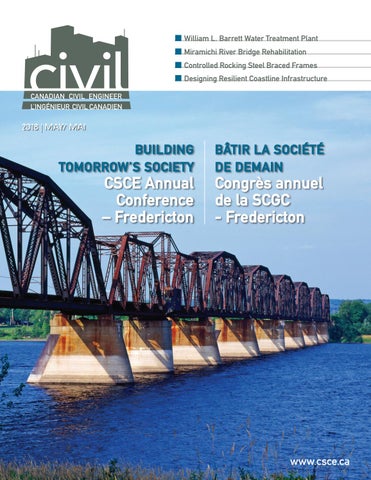
William L. Barrett Water Treatment Plant Miramichi River Bridge Rehabilitation C ontrolled Rocking Steel Braced Frames Designing Resilient Coastline Infrastructure
2018 | MAY/ MAI
BUILDING TOMORROW’S SOCIETY
CSCE Annual Conference – Fredericton
BÂTIR LA SOCIÉTÉ DE DEMAIN
Congrès annuel de la SCGC - Fredericton
www.csce.ca
contents MAY 2018/MAI 2018 | VOLUME 35.2
NEWS, VIEWS & DEPARTMENTS NOUVELLES, POINTS DE VUE ET RUBRIQUES
HISTORIC CIVIL ENGINEERING SITE/LIEU HISTORIQUE DE GÉNIE CIVIL 10 William L. Barrett Water Treatment Plant, Fredericton
CSCE CONFERENCE/CONGRÈS SCGC — FREDERICTON 2018 12 Conference preview
4 President’s perspective/
TECHNICAL: BUILDING FOR TODAY AND TOMORROW/TECHNIQUE: BÂTIR POUR AUJOURD’HUI ET DEMAIN
16 From the Technical Editor 17 History and Refurbishment of 140-year-old Rail Bridge Piers:Southwest Miramichi River Bridge
21 Design and Analysis of Controlled Rocking Steel Braced Frames for Seismic Hazard in Canada
25 Designing Resilient Infrastructure for Coastal Disasters
Perspective présidentielle 6 Young professionals corner/Le coin des jeunes professionnels 7 From the regions: Prairie Region/Région des Prairies 8 Student Voice/ La voix des étudiants 29 In Memoriam/In Memoriam: Kris Bassi 30 CSCE partners and sponsors/ Associés et commanditaires SCGC
13
10
17
On the cover: Fredericton (Image courtesy Getting Images)
Canadian Civil Engineer | May 2018
3
PRESIDENT’S PERSPECTIVE | PERSPECTIVE DE LA PRÉSIDENTE
Susan Tighe, Ph.D., P.Eng. PRESIDENT, CSCE/PRÉSIDENTE SCGC PRESIDENT@CSCE.CA
CSCE/SCGC 521-300, rue St-Sacrement Montreal, Québec H2Y 1X4 Tel.: 514-933-2634, Fax: 514-933-3504 E-mail: mahmoud.lardjane@csce.ca www.csce.ca PRESIDENT/PRÉSIDENTE Susan Tighe, Ph.D., P.Eng.
MANAGING EDITOR/ DIRECTEUR DE LA RÉDACTION Doug Picklyk Tel.: 416-510-5119 dpicklyk@ccemag.com ADVERTISING SALES/ PUBLICITÉ Maureen Levy Tel: 416-510-5111 mlevy@ccemag.com ART DIRECTOR/ COMPOSITION ARTISTIQUE Mark Ryan Tel: 416-442-5600 x3541 Annual Subscription Rates/Abonnement annuel Canada & U.S./E.U. $35.00, Other countries/Autres pays $45.00; Single copy/Un numéro $7.50; Agency discount/Rabais au distributeurs 10% PUBLICATION ISSN 9825-7515 RETURN ADDRESS/ADRESSE DE RETOUR : The Canadian Society for Civil Engineering La Société Canadienne de Génie Civil 521-300, rue St-Sacrement Montreal, Québec H2Y 1X4 Canadian Civil Engineer (CCE) is published five times per year by the Canadian Society for Civil Engineering (CSCE). L’ingénieur Civil Canadien (ICC) est publié cinq fois par année par la Société Canadienne de Génie Civil (SCGC). The opinions expressed in the papers are solely those of the authors and the Canadian Society for Civil Engineering is not responsible for the statements made in this publication. Les opinions exprimées dans les articles sont la seule responsabilité de leurs auteurs et la Société canadienne de génie civil n’engage pas sa responsabilité dans les propos exprimés. CIVIL Magazine is produced by the publishers of Canadian Consulting Engineer Magazine, published by Annex Publishing & Printing Inc. Le magazine Civil est produit par l’editeur de la publication Canadian Consulting Engineer qui est publie par Annex Publishing & Printing Inc.
Annex Publishing & Printing Inc., 80 Valleybrook Drive, Toronto, Ontario M3B 2S9 Tel.: 416-442-5600; Fax: 416-510-5140
Campaigns and Communication: Making Progress
D
uring the course of this past year, we have worked as a team to make CSCE stronger. In addition to carrying out the many day-to-day tasks, we have made great efforts to advance our strategic plan through our alliances with other organizations, and focusing internally on some specific and directed campaigns. We have had an active membership renewal campaign where we prepared videos showcasing the many volunteer leaders across Canada. This has not only been inspirational but also resulted in positive impacts to our membership renewals. During the month of March, we celebrated National Engineering Month in Canada by launching our CSCE PIN CHALLENGE! We have many wonderful ambassadors and we challenged members to recruit new members and be rewarded by doing so. Our Facebook page and the CSCE website feature video challenges recorded by members of our board of directors, and committee and section chairs. We are counting on your continued support and participation to recruit new talent to help our learned Society grow. Be a proud CSCE member! We are looking forward to unveiling the CSCE communication HUB at the 2018 CSCE Annual Conference in Fredericton. As the pace of civil engineering in Canada continues to increase, this innovative and novel networking/communication tool will ensure relevant and topical information is available to our members and provide outstanding networking capability. We are active on social media and will continue to use our new website and various other communication tools to advance our learned society. Thank you for working with me over the past year as your President. To all the hard working volunteers on CSCE Committees, Divisions, Regions and Sections thank you very much for all your hard work! I am looking forward to seeing you at the 2018 Annual Conference in Fredericton. Susan Tighe, Ph.D., P.Eng. is Deputy Provost and Associate Vice-President Integrated Planning and Budgeting and the Norman McLeod Professor in Sustainable Pavement Engineering at the University of Waterloo.
PUBLICATIONS MAIL AGREEMENT/POSTES CANADA ENREGISTREMENT #40065710
4
Mai 2018 | L’Ingénieur civil canadien
PRESIDENT’S PERSPECTIVE | PERSPECTIVE DE LA PRÉSIDENTE
Campagnes et communication: des progrès
A
u cours de l’année écoulée, nous avons travaillé en équipe pour renforcer la SCGC. En plus des nombreuses tâches quotidiennes, nous avons accompli de grands efforts pour faire progresser notre plan stratégique en nous alliant à d’autres organisations, et en nous concentrant à l’interne sur certaines campagnes spécifiques et ciblées. Nous avons mené une campagne de renouvellement des adhésions pour laquelle nous avons réalisé des vidéos montrant les nombreux dirigeants bénévoles de partout au Canada. La campagne fut une source d’inspiration et a eu également des résultats positifs sur le renouvellement des adhésions. Au cours du mois de mars, nous avons célébré le Mois national du génie au Canada en lançant le DÉFI de l’ÉPINGLETTE de la SCGC! Nous avons un grand nombre d’ambassadeurs merveilleux et nous avons mis nos membres au défi de recruter de nouveaux membres contre des récompenses. Notre page Facebook et notre site Web présentent les vidéos des défis lancés par des membres de notre conseil d’administration et des présidents de comités et de sections. Nous comptons sur votre soutien continu et votre participation pour recruter de nouveaux talents qui aideront notre Société savante à grandir. Soyez un fier membre de la SCGC! Nous avons hâte de dévoiler le HUB de communication de la SCGC au congrès annuel 2018 de la SCGC de Fredericton. Alors que le génie civil progresse à un rythme accru, ce nouvel outil de réseautage et de communication innovant permettra à nos membres d’accéder à de l’information pertinente et actualisée et de bénéficier d’une capacité de réseautage exceptionnelle. Nous sommes actifs sur les médias
Canadian Civil Engineer | May 2018
sociaux et continuerons d’utiliser notre nouveau site Web et divers autres outils de communication pour faire progresser notre société. Je vous remercie de m’avoir accompagnée dans mon rôle de présidente au cours de la dernière année . À tous les bénévoles qui oeuvrent si fort au sein des comités, des divisions, des régions et des sections de la SCGC, un grand merci pour tout votre travail! J’espère avoir le plaisir de vous rencontrer à notre congrès annuel à Fredericton.
“ We are looking forward to unveiling the CSCE communication HUB at the 2018 CSCE Annual Conference” “ Nous avons hâte de dévoiler le HUB de communication de la SCGC au congrès annuel 2018 de la SCGC”
Susan Tighe, Ph.D., P.Eng., est vice-rectrice et vice-présidente associée, Planification intégrée et budgétisation et professeure Norman McLeod en ingénierie des chaussées durables à l’Université de Waterloo
See our job openingS at:
rvanderson.com/opportunities
BUILD GREATNESS with
Kim Sayers Principal
CIVIL_Conf_RVAnderson.indd 1
2018-04-13 9:35 AM
5
YOUNG PROFESSIONALS’ CORNER | LE COIN DES JEUNES PROFESSIONNELS
National Conference: YP and Student Events Brandon Searle, E.I.T., M.ENG CANDIDATE CSCE WESTERN NEW BRUNSWICK SECTION CHAIR CSCE 2018 NATIONAL CONFERENCE YP AND STUDENT EVENTS CHAIR
F
or this year, the 2018 CSCE Annual Conference is being held in beautiful Fredericton, New Brunswick from June 13th – 16th. With the theme, “Building Tomorrow’s Society”, Fredericton 2018 promises to be a great conference! The City of Fredericton, the capital of New Brunswick, is a growing community, with two universities in the heart of the City, and is often a great place to visit with various activities and events happening year-round. This year, the CSCE Western NB Section has volunteered to put together all delegate events, including events solely for the YP and Student Delegates. These events vary in terms of being either technical, educational or social, and they offer the YP and Student Delegates an opportunity to network and mingle with leaders in the industry. This year, we have a packed itinerary with an event happening every day: • Kingswood Resort, June 12th (6pm – 9pm ) for YP and Student Delegates
• Mactaquac Dam and Kings Landing Tours, June 13th (1pm – 5pm) for All Delegates • Games Night at Unplugged, June 13th (8pm – 11pm) for YP and Student Delegates • Kitchen Party, June 14th all evening for All Delegates • Craft Brewery Tour, June 15th (6pm – 10pm) for YP and Student Delegates • Wolastoq Boat Tour, June 16th (2:30pm – 4pm) for All Delegates In addition to the events mentioned above, all delegates are invited for a morning bicycle tour from 7am – 8am each day of the conference. This offers an opportunity to experience the downtown waterfront like a local, and partake in some exercise before a busy day! For more information on the National Conference, please visit csce2018.ca or contact me at brandon.searle@opusinternational.ca. Hope to see you there!
Congrès annuel: activités JP et étudiantes Brandon Searle, E.I.T., Candidat M. Eng. PRÉSIDENT, SECTION SCGC DE L’OUEST DU NOUVEAU-BRUNSWICK PRÉSIDENT, ÉVÉNEMENTS JEUNES PROFESSIONNELS ET ÉTUDIANTS, CONGRÈS ANNUEL 2018
C
ette année, le congrès annuel de la SCGC se déroulera à Fredericton, au Nouveau-Brunswick, du 13 au 16 juin. Avec pour thème «Bâtir la société de demain», Fredericton 2018 promet d’être un excellent congrès! Capitale du Nouveau-Brunswick, la ville de Fredericton est une communauté en expansion. Elle compte deux universités au cœur de la ville, et elle est un lieu formidable à visiter offrant divers événements et activités tout au long de l’année. La section de l’Ouest du Nouveau-Brunswick de la SCGC s’est portée volontaire pour organiser tous les événements des délégués, y compris ceux réservés aux jeunes professionnels et aux étudiants. Ces événements ont un contenu technique, éducatif ou social, et donnent aux JP et aux étudiants l’occasion de faire du réseautage et de se mêler aux leaders de l’industrie. Cette année, nous avons mis sur pied un programme chargé comprenant une activité par jour: • Kingswood Resort, 12 juin (18h – 21h) : délégués JP et étudiants
6
• Barrage Mactaquac et Kings Landing Tours, 13 juin (13h – 17h) : tous les délégués • Nuit de jeux à Unplugged, 13 juin (20h – 23h) : délégués JP et étudiants • Kitchen Party, 14 juin, toute la soirée : tous les délégués • Visite Craft Brewery, 15 juin (18h – 22h) : délégués JP et étudiants • Excursion en bateau Wolastoq, 16 juin (14h30 – 16h): tous les délégués En plus de ces activités, tous les délégués sont invités à faire un tour à vélo chaque matin de 7h à 8h. Il leur permettra de découvrir le bord de l’eau du centre-ville et de faire de l’exercice avant d’entamer une journée bien remplie! Pour plus d’informations sur le congrès, visitez le site Web csce2018. ca ou bien communiquez avec moi à brandon.searle@opusinternational.ca. Nous espérons vous y rencontrer!
Mai 2018 | L’Ingénieur civil canadien
FROM THE REGIONS: SECTION NEWS | DE NOS RÉGIONS: NOUVELLES DES SECTIONS
CSCE Saskatoon Makes the Local News Roanne Kelln, AMCSCE CHAIR OF THE SASKATOON SECTION, PRAIRIE REGION
A
civil engineer is probably not who you would expect to see on your local morning newscast. Yet as unlikely as it may sound, that happened for our CSCE Saskatoon Section this past January. On Jan 17th the CSCE’s National Lecture Tour (NLT), Lac-Mégantic’s Human & Environmental Disaster led by Senator Rosa Galvez, Ph.D., stopped in Saskatoon. The Lac-Mégantic tragedy saw the derailment of 74 railway cars carrying light crude, causing the death of 47 residents and the destruction of over 30 buildings. There is certainly no lack of logistical considerations with a tour of this nature and a guest speaker as distinguished and as busy as Senator Galvez. (I would be remiss not to mention our gratitude to CSCE National for organizing this tour.) The CSCE Saskatoon Executive accepted the challenge.
La SCGC de Saskatoon fait les nouvelles locales Roanne Kelln, AMCSCE PRÉSIDENTE DE LA SECTION DE SASKATOON, RÉGION DES PRAIRIES
U
n ingénieur civil n’est probablement pas la personne que vous vous attendez à voir dans votre journal télévisé du matin. Pourtant, aussi improbable que cela puisse paraître, c’est ce qui s’est produit pour notre section de Saskatoon en janvier dernier. Le 17 janvier, la Tournée nationale de conférences de la SCGC, Lac-Mégantic : le désastre humain et environnemental, présentée par la Dre Rosa Galvez, sénatrice professeure, s’est arrêtée à Saskatoon. La tragédie de Lac-Mégantic était le déraillement de 74 wagons de chemin de fer transportant du pétrole brut léger, causant la mort de 47 résidants et la destruction de plus de 30 bâtiments. Un événement de cette nature et présenté par une conférencière aussi distinguée et à l’emploi du temps aussi chargé, requiert une logistique importante. (Je m’en voudrais de ne pas exprimer notre gratitude au Bureau national de la SCGC pour l’organisation de cette tournée). L’exécutif de la SCGC à Saskatoon a accepté de relever le défi.
Canadian Civil Engineer | May 2018
We saw the event as an opportunity – not only to give our members, sponsors, and supporters a chance to hear about an engineering-related event of national significance, but also to let the public know how civil engineers are involved in addressing major disasters such as the Lac-Mégantic case. The NLT stop in Saskatoon happened to occur while three individuals were on trial in Quebec for their roles in the derailment. We were excited to let everyone know that we would be hosting an event where a renowned expert would offer objective and independent observations of what went wrong, what impacts have resulted, and what lessons should be learned from this environmental disaster and human catastrophe. We put the word out to the local press—generating a list of media contacts, writing a press release, and then crossing our fingers. We received a great response! We lined up multiple TV and radio interviews of Dr. Galvez, and we also lined up two local TV interviews for me to talk on air about the Lac-Mégantic disaster, our event and a bit about who CSCE Saskatoon and CSCE is. Overall, we could not have been more pleased with the outcome, both of the event itself and of our efforts to publicize it.
Nous avons vu l’événement comme une opportunité, non seulement de permettre à nos membres, commanditaires et supporteurs d’entendre parler d’un événement d’importance nationale lié à l’ingénierie, mais aussi de faire savoir au public comment les ingénieurs civils sont impliqués dans des catastrophes majeures telles que celle de Lac-Mégantic. La session de Saskatoon a eu lieu alors que trois personnes étaient en procès au Québec pour leur rôle dans le déraillement du train. Nous étions ravis de faire savoir à tout le monde que nous organisions un événement où une experte de renom allait présenter des observations objectives et indépendantes sur ce qui s’est passé, sur les impacts qui en ont résulté et sur les leçons à tirer de cette catastrophe écologique et humaine. Nous avons informé la presse locale en générant une liste de contacts des médias, en rédigeant un communiqué de presse, puis en croisant nos doigts. La réponse fut géniale! Nous avons programmé plusieurs entrevues de la Dre Galvez à la télévision et à la radio et nous avons organisé deux entrevues télévisées au cours desquelles j’ai présenté la catastrophe de Lac-Mégantic, notre événement et la section SCGC de Saskatoon. Dans l’ensemble, nous n’aurions pas pu être plus satisfaits des résultats obtenus tant pour ce qui est de l’événement que des efforts que nous avons déployés pour le publiciser.
7
THE STUDENT VOICE | LA VOIX DES ÉTUDIANTS
Conference Participation is Key to CSCE’s Future Charles-Darwin Annan, Ph.D., P.Eng. CHAIR, CSCE STUDENT AFFAIRS
I
n the past five years the CSCE Student Affairs committee has initiated new programs and strengthened existing ones to increase student participation in the national conference and regional activities. The committee has particularly focused on undergraduate students’ involvement in chapters across the country. The chapters are more involved in regional and local sectional events, and student members are enjoying an early taste of a civil engineering career. The student chapter leaders workshop at the CSCE annual conference has been a great way for student ambassadors to interact with the civil engineering community, and then share their rich experiences with the chapters they lead. CSCE Student Affairs is also proud to support competitions across the country that provide opportunities which suit different interests. As I always say, “It is all about making good civil engineers!” At this year’s conference in Fredericton, Student Affairs is working in collaboration with the Young Professional committee to draw up an enriching program for students, while also having FUN. Here’s a sneak peek into some major student events: • National Student Chapter Leaders Workshop: for incoming leaders to interact and exchange ideas on running a dynamic chapter. • National Civil Engineering Student Design CAPSTONE Competition: the cornerstone of many accredited civil engineering programs in Canada, teams will present their projects in a poster session before a jury. • Student Paper Competitions: an opportunity for students to share the results of their research projects and be recognized. Membership is required, so get your FREE student membership NOW. • Student Awards Luncheon: celebrating the achievements of students from across the country, this event offers an excellent networking opportunity as nearly 400 attendees participate. Awards will be given to winners of CSCE-sponsored national competitions. Let your student membership count! All students are welcome to register and participate in the conference. Charles-darwin.annan@gci.ulaval.ca!
8
La participation au congrès est la clé de l’avenir de la SCGC Charles-Darwin Annan, Ph.D., P.Eng. PRÉSIDENT, COMITÉ DES AFFAIRES ÉTUDIANTES DE LA SCGC
A
u cours des cinq dernières années, le Comité des affaires étudiantes de la SCGC a lancé de nouveaux programmes et renforcé les programmes existants afin d’accroître la participation des étudiants au congrès annuel et aux activités régionales de la SCGC. Le comité s’est concentré en particulier sur la participation des étudiants du premier cycle à travers les chapitres étudiants de la SCGC partout au pays. Les chapitres sont plus impliqués dans les activités régionales et locales, et les étudiants bénéficient d’un avantgoût d’une carrière en génie civil. L’atelier des leaders des chapitres étudiants qui a lieu durant le congrès annuel de la SCGC est un excellent moyen pour ces ambassadeurs étudiants d’interagir avec la communauté du génie civil. Ils peuvent ainsi partager leurs riches expériences avec les chapitres qu’ils dirigent. Les Affaires étudiantes de la SCGC sont également fières de soutenir différents concours partout au pays qui offrent des opportunités correspondant à différents intérêts et ambitions. Comme je le dis toujours, “il s’agit de faire de bons ingénieurs civils!” Pour le congrès de Fredericton, au Nouveau-Brunswick, de cette année, le comité collabore avec le comité des jeunes professionnels (JP) afin d’élaborer un programme enrichissant et stimulant pour les étudiants, qui leur permet aussi de s’amuser. Voici un aperçu des principales activités étudiantes: • Atelier des dirigeants nationaux des chapitres étudiants: les nouveaux dirigeants pourront interagir et échanger des idées sur les éléments clés de la gestion d’un chapitre dynamique. • Concours national étudiant CAPSTONE de conception en génie civil: pierre angulaire de nombreux programmes de génie civil accrédités au Canada. Une équipe de chaque université participera au congrès et présentera devant jury son projet sous forme d’affiche. • Concours de communications étudiantes: une occasion pour les étudiants de partager les résultats de leurs projets de recherche et d’être reconnus. L’adhésion étudiante à la SCGC est exigée pour y participer. Obtenez votre adhésion GRATUITE MAINTENANT. • Dîner des prix étudiants: célébration des réalisations de nos étudiants de partout au pays, cet événement populaire offre une excellente occasion de réseautage. Près de 400 participants au congrès y assistent. Des prix seront décernés aux lauréats des divers concours nationaux parrainés par la SCGC. Faites valoir votre adhésion étudiante! Tous les étudiants sont invités à s’inscrire et à participer au congrès. Charles-darwin.annan@gci.ulaval.ca
Mai 2018 | L’Ingénieur civil canadien
We thank our premium sponsors of this most prestigious international conference. Platinum
Gold
Silver
THE CONFERENCE IS FOCUSING ON THE THEME “BUILD BRIDGES…NOT WALLS” The 10th International Conference on Short and Medium Span Bridges, SMSB – X, will take place in Quebec City, Canada. The SMSB Conference has been organized under the auspices of the Canadian Society for Civil Engineering and is held every four years in one of the Canadian cities. It has traditionally provided a worldwide state-of-the-art forum on all aspects of short and medium span bridges. The conference includes planning, design, construction and management of short and medium span bridges. The SMSB series of conferences is a premier forum to share knowledge and provide guidance for future developments. We hope to see you there! Conference Chairs: Josée Bastien and Adel Zaki For conference and sponsorship information: http://www.smsb-2018.ca/
HISTORIC CIVIL ENGINEERING SITE | LIEU HISTORIQUE DE GÉNIE CIVIL
William L. Barrett Water Treatment Plant The story of the trail blazing facility located in Fredericton, NB By Dale I. Bray, PEng, FCSCE
I
n November 2017, the CSCE Board of Directors approved a recommendation of the CSCE National History Committee that the William L. Barrett Water Treatment Plant be a CSCE National Historic Civil Engineering Site. This article provides a brief account of some of the developments that have occurred at this facility over the years. Until 1883, the City of Fredericton was supplied by individual water wells and onsite privies. The population of Fredericton was about 6,000 in 1883. Up until that time the City was faced with destructive fires and outbreaks of typhoid fever. Early studies for a reliable water supply were based on the concept of piping water under pressure from small storages on nearby streams, but in 1882 the firm of Crafts and Forbes from Boston, MA recommended that the City construct a pumping station with the adjacent Saint John River as a supply. The recommendation was accepted and the majority of the works were completed by 1883
with N. Henry Crafts serving as the attending engineer. The water works included a steam engine with a Gaskill horizontal compound pumping engine. The system was designed to supply residents with 1,800 m3/d of untreated water at a pressure of 240 kPa. The fire flow requirement was a flow of 64 L/s at a pressure of 550 kPa. The water works consisted of 14km of piping and 80 hydrants. The new system provided a reliable supply of water for domestic consumption, gave a very significant improvement in fire protection, but did not greatly reduce the impact of the yearly outbreaks of typhoid fever. In 1904, E. Brydone-Jack, the City Engineer, authorized a study to investigate all aspects of water purity of the water supply for the City. The Water Committee for the City of Fredericton hired Frank A. Barbour, an engineer from Boston, to further investigate the problem. On February 1, 1906, the City accepted the report by Barbour in which he recommended a new technology, a
rapid sand filter. A contract was let in May 1906, and the new facility, including an Allis-Chalmers compound Corliss pumping steam engine, became operational by the end of 1906. For this new system, the water was drawn from the Saint John River by gravity to a pump well adjacent to the 1883 structure. Two centrifugal pumps raised the water to a coagulating basin. The water flowed from the coagulating basin by gravity through three filter beds, each filter having an area of 13.5 m2, to the clear water reservoir situated adjacent to the building housing the rapid sand filters. These new components are shown in the accompanying photograph. A complex array of valves made it possible to clean the beds of the rapid sand filters by reverse flow through the filters as required. The rapid sand filter was designed to supply about 1,890 m3/d of treated water. In a 1907 report to the Fredericton Water Committee, it was stated that “the City has now the most
National Historic Civil Engineering Sites Each year at the CSCE annual conference the Society’s National History Committee selects a site or project from the region in which the conference is being held as a National Historic Civil Engineering Site. Through this program the committee aims to make the general public and engineers themselves more aware of the rich history and heritage of Civil Engineering in Canada.
10
A commemoration ceremony is held during the CSCE conference, and a plaque is placed on the chosen site in a place that is readily visible to the public. Since the program began in 1983, 67 national, international and regional sites have been designated. The National Historic Site to be commemorated at this year’s conference is the William L. Barrett Water Treatment Plant in Fredericton, NB.
Mai 2018 | L’Ingénieur civil canadien
HISTORIC CIVIL ENGINEERING SITE | LIEU HISTORIQUE DE GÉNIE CIVIL
Fredericton Pumping Station and Water Treatment Facility (c 1906). The tall tower houses the constant head tank for backwashing the rapid sand filters located in the lower portion of the building. [Source: Provincial Archives of New Brunswick Image: P657-26]
complete filtration plant for municipal supply in Canada.” There is evidence that the rapid sand filters helped to reduce the number of deaths related to typhoid fever, but further improvement was required. In response to this need a continuous chlorination system was designed and installed in 1912 by J. Feeney, a young engineer who graduated from the University of New Brunswick in 1910. Feeney’s ‘home made’ chlorinating apparatus used calcium hypochlorite to provide an effective sterilization for the City’s water supply. This installation was just three years after Jersey City, NJ became the first city in North America to incorporate large scale chlorination for a municipal water supply. The technology initiated by Feeney remained in place
Canadian Civil Engineer | May 2018
until 1950 when bell-jar chlorinating equipment was introduced. In 1955 the City commenced the development of a wellfield near the water treatment plant. By 1968 the entire water supply was sourced from groundwater. The main issue with the ground water supply was the elevated concentration of manganese. In response to this finding, a new addition was completed in 1984 to house pressurized filtration equipment to deliver water meeting the Canadian Drinking Water Guidelines for manganese. At that time, this was the largest installation of its type for manganese removal from municipal water supply in North America. The original 1883 pumping station, the 1906 rapid sand filter building and the 1984 manganese removal system are integrated into the
current William L. Barrett Water Treatment Plant. In June 2007, the plant was named after William L. Barrett who served as the City Engineer for Fredericton from 1953 to 1973. A plaque will be installed at the site of the water treatment plant on June 14, 2018 during the 2018 CSCE National Conference in Fredericton. The assistance provided by Laurie Corbett, retired engineer with the Water & Sewer Department, City of Fredericton and Neil Thomas, Senior Water & Sewer Engineer, City of Fredericton is acknowledged. Submitted by Dale Bray for the Canadian Civil Engineer at the request of CSCE head office. Phone: 506-455-3784 Email: dalebray@nbnet.nb.ca
11
Building Tomorrow’s Society | Bâtir la société de demain
June 13-16, 2018 | 13-16 juin 2018 | Fredericton, NB Lloyd Waugh, PhD, P.Eng. 2018 CSCE CONFERENCE CHAIR/PRÉSIDENT, CONGRÈS SCGC 2018
Welcome to CSCE 2018 Bienvenue à SCGC Fredericton 2018 Fredericton
W
e are looking forward to seeing you at CSCE’s Annual Conference in New Brunswick’s capital city of Fredericton, on the banks of the beautiful Saint John River, from June 13-16, 2018. Our theme is Building Tomorrow’s Society emphasizing the human connection to, and interaction with, the built environment and the engineer’s role in building communities and improving the lives of all Canadians. Within our conference theme, our goal is to focus on First Nations’ infrastructure and reveal our President’s Task Force on accessible infrastructure. We will also feature specialty conferences on environmental, materials, natural disaster, structural, and transportation themes. One of our technical tours will be to the 653 MW Mactaquac hydroelectric dam, during which attendees will have an opportunity to learn about the issues that have developed since the discovery of alkali-silica reaction and the planned mitigation to ensure the dam reaches its 100-year design life. In addition to technical presentations, you will have an opportunity to renew old, and establish new acquaintances at the
12
N
ous avons hâte de vous rencontrer au congrès annuel de la SCGC. Il se déroulera à Fredericton, capitale du Nouveau-Brunswick, sur les rives de la magnifique rivière Saint-Jean, du 13 au 16 juin 2018. Notre thème est Bâtir la société de demain et met l’accent sur le lien et l’interaction de l’homme avec l’environnement bâti et le rôle de l’ingénieur dans la création de collectivités et l’amélioration de la vie de tous les Canadiens. Dans le cadre de notre thème, notre objectif est de focaliser sur les infrastructures des Premières Nations et de révéler le Groupe de travail de notre présidente sur l’accessibilité aux infrastructures. Nous présenterons également des conférences spécialisées sur l’environnement, les matériaux, les catastrophes naturelles, les structures et les transports. Une de nos visites techniques sera au barrage hydroélectrique de Mactaquac de 653 MW. Les participants auront l’occasion d’en apprendre davantage sur les problèmes qui se sont développés depuis la découverte de la réaction silico-alcaline ainsi que les mesures d’atténuation prévues pour que le barrage atteigne ses 100 années de vie utile. En plus des présentations techniques, vous aurez l’occasion de retrouver de vieilles connaissances et d’en établir de nouvelles à la réception d’ouverture, au salon professionnel, à l’inauguration du site
Mai 2018 | L’Ingénieur civil canadien
CSCE ANNUAL CONFERENCE | CONGRÈS ANNUEL DE LA SCGC
welcome reception, tradeshow, historical dedication and planned social events. Students and Young Professionals will have a dedicated program including a microbrewery tour, games night and ice-breaker events. All conference goers will have an opportunity to enjoy New Brunswick’s lobster, salmon, fiddleheads, a river boat tour, craft beer, and chocolate. Since you’ll be in the neighbourhood, why not bring your family to see the highest tides in the world, the warmest salt water beaches north of Virginia, and the hospitality of a Maritime Kitchen Party. Check us out online: csce2018
historique et durant les activités sociales prévues. Les étudiants et les jeunes professionnels auront un programme spécial incluant une visite d’une microbrasserie, une soirée de jeux et des activités de brise-glace. Tous les participants auront l’occasion d’apprécier les produits du Nouveau-Brunswick, homard, saumon, crosses de fougère, bière artisanale et chocolat, ainsi qu’une excursion en bateau. Puisque vous serez dans les environs, pourquoi ne pas amener votre famille voir les plus hautes marées du monde, les plages d’eau salée les plus chaudes au nord de la Virginie et profiter d’un ‘’party de cuisine maritime’’. Découvrez-nous en ligne: csce2018
Social Event A Maritime Kitchen Party
T
he Thursday evening Kitchen Party is an event you won’t soon forget. From the minute you arrive, you will be greeted with classic Maritime hospitality and charm. From the food, to the decorations, to the entertainment, the Kitchen Party is the event to attend! Throughout the night, this maritime themed party will include music, a variety of beverages to suit all tastes, seafood and a fire station to prepare your own s’mores, all while overlooking over the beautiful Saint John River! Did we mention seafood? What kitchen party is complete without tons of local seafood?! This is the east coast remember, of course there will be lobster. Hope to see you there!
Technical Tour Mactaquac Hydroelectric Dam
T
he Mactaquac Dam is one of the largest hydroelectric generating stations in Atlantic Canada and was constructed between 1964 and 1970. The dam has a generating capacity of 653 MW, which represents approximately 15-20% of New Brunswick’s power demand. Soon after construction, concrete within the structure began to exhibit distress as a result of alkali-silica reaction (a chemical reaction between reactive siliceous aggregates, moisture and alkalis within the concrete pore solution). Since then, the structure has grown almost 230-mm in height and is currently expanding at a rate of 120 microstrain per annum. Attendees will be given an in-depth tour of the dam, observe the six turbines and learn what mitigation techniques are being used to ensure the facility reaches its 100-year design life!
Canadian Civil Engineer | May 2018
Kings Landing Historical Settlement
K
ings Landing Historical Settlement, located 20 minutes outside of Fredericton, is one of Canada’s premiere tourist attractions. The site boasts 300 acres of original museum houses from the period of 1820-1920, over 70,000 artifacts, and more than 40 different exhibits. Kings Landing tells the story that shaped New Brunswick through settlement. The visit will include a tour of the $3.8 million refurbishment of the site’s 19th century dam. The project included a 7-month repair where craftsmen disassembled, restored the 2,000 wooden pieces, and reassembled the wheel. The original wooden dam was replaced with concrete during the refurbishment of the dam.
13
CSCE ANNUAL CONFERENCE | CONGRÈS ANNUEL DE LA SCGC
Conference Schedule Overview Wednesday, June 13, 2018 • Mactaquac Hydroelectric Dam or Kings Landing Tour • Envision Training • Registration Opens • Welcome Cocktail Reception Thursday, June 14, 2018 • Opening Ceremonies and Plenary Speaker • Trade Show Opens • Paper and Case Study Presentations (Morning/Afternoon) • Opening Lunch and Plenary Panel • Historic Site Tour • Maritime Kitchen Party Friday, June 15, 2018 • Breakfast and Keynote • Trade Show • Paper and Case Study Presentations (Morning/Afternoon) • Luncheon and Keynote • Capstone Competition • Annual General Meeting • Reception and Awards Banquet Saturday, June 16, 2018 • Breakfast and Plenary Speaker • Paper and Case Study Presentations (Morning) • Student Awards and Luncheon • Wolastoq Boat Tour
14
ENVISION v3 Sustainability Professional Educational Course
T
his year’s conference will also provide an opportunity for members to participate in the Envision v3 Sustainable Professional Educational program. Envision v3 provides a holistic framework for planning, evaluating and rating the community, environmental, and economic benefits of infrastructure projects. It encourages, evaluates, grades, and gives recognition to infrastructure projects that use transformational, collaborative approaches to assess the sustainability indicators over the course of the project’s life cycle. Today, infrastructure must perform in an increasingly challenging environment, as demands for energy, water resources and ecosystem services climb; access to natural resources of all types are increasingly limited; financial and political constraints mount; environmental, ecological and climate change perils escalate; and global population is surging. Infrastructure owners and professionals who design and build these projects face a tall order of satisfying ever-growing demand, while at the same time responsibly addressing requirements for resiliency and sustainability in ways that simultaneously meet high standards for economic performance. Envision v3 is the product of a joint collaboration between the Zofnass Program for Sustainable Infrastructure at the Harvard University Graduate School of Design and the Institute for Sustainable Infrastructure. With now over 7,000 Envision Professionals in North America, the Envision system has seen increased uptake from public and private agencies across Canada. The Envision v3 Sustainable Professional Educational program is a full-day credentialing program for training participants to use Envision and to incorporate systems-level thinking into their approach to sustainability, considering the broader, often overlooked, impacts of a project. The purpose of this training is to equip participants to use the Envision v3 framework and rating system and to prepare participants to take the examination to become an Envision Sustainability Professional (ENV SP). The course is designed to be engaging, utilizing a highly interactive approach that features group case-study work. The full-day course will be provided at an additional cost on Wednesday, June 13, 2018. To learn more about the course visit www. csce.ca/lifelong-learning/workshops. To learn more about Envision visit www.sustainableinfrastructure.org.
Panel Discussion: “What Lies Ahead?” Within the theme of the 2018 Conference “Building Tomorrow’s Society”, our distinguished panel will present and discuss several serious, urgent and growing issues for the profession, and for society: a) Sustainability and Climate Change; b) Inclusivity and Social Justice; and c) Accessibility and Universal Design. Panelists will be probing, provocative, questioning, and focus on areas where the profession may be “missing the boat” on key issues, and what may lie ahead if not addressed. Following what is hoped to be a spirited and lively session; a draft summary report with observations and recommendations will be circulated to participants for review and eventually submitted to the CSCE Directors. The Panel will be moderated by Alan Perks, a Past President of CSCE, and leader of the CSCE President’s Task force on Accessibility, with 40+ years of Canadian and International experience.
Mai 2018 | L’Ingénieur civil canadien
CSCE ANNUAL CONFERENCE | CONGRÈS ANNUEL DE LA SCGC
Plenary Speaker Don Rusnak
Plenary Speaker Gaëtan Thomas Serving as President & CEO of NB Power since February 2010, Gaëtan Thomas is a committed industry leader and agent of change. His vision for NB Power includes a made-in-New Gaëtan Thomas Brunswick smart grid supported by customer-centric technology and a workforce aimed at creating a greener, more sustainable province. This plan is helping to reduce reliance on fossil fuels, lowering costs and keeping rates low and stable. Gaëtan grew up in a tiny Francophone village in northern New Brunswick before earning a degree in Electrical Engineering from the University of New Brunswick. A lifelong employee of the utility, he has worked in all aspects of the business including as Vice President of both Nuclear and Distribution and Customer Service divisions. In 2015 & 2016, Gaëtan was honoured by Atlantic Business Magazine as one of the Region’s Top 50 CEOs, and was selected as one of the Most Influential Acadians by L’Acadie Nouvelle. He serves as a mentor for the Wallace McCain Institute of Entrepreneurial Leadership and is a board member for the Canadian Electricity Association, an electric vehicle advocacy group Plug ‘n Drive Canada, and The New Brunswick Business Council. He is also the Chairman of the Board of the Atlanta Center World Association of Nuclear Operators. Gaëtan is married to Karen Thomas and together they are proud parents to four grown daughters, with three having completed degrees in science or engineering and the fourth one aspiring to be a lawyer.
Keynote B.F. Spencer, Jr. Nathan M. and Anne M. Newmark Endowed Chair of Civil Engineering, University of Illinois at Urbana-Champaign State-of-the-Art Monitoring of Bridge InfrastrucB.F. Spencer, Jr. ture: Increased awareness of the economic and social effects of aging, deterioration and extreme events on civil infrastructure has been accompanied by recognition of the need for advanced structural health monitoring and damage detection tools. Spencer’s talk will be an overview of current state-of-the-art and practice in the field of structural health monitoring technologies in the U.S., with application to bridge infrastructure. Specifically, Spencer will review various key structural health monitoring technologies, including sensor development, data processing, damage detection algorithms, data analysis and information processing. The ultimate goal of this talk is to stimulate additional discussion regarding the importance of structural health monitoring in managing bridge infrastructure.
Canadian Civil Engineer | May 2018
In 2015, Don Rusnak was elected as the first Indigenous Member of Parliament to represent the riding of Thunder Bay—Rainy River. In this role, he also served as the first chair of Don Rusnak the Liberal Indigenous Caucus. In September of 2017 MP Rusnak was appointed as the Parliamentary Secretary to the Minister of Indigenous Services, a new ministry created to ensure a consistent, high quality, and distinctions-based approach to the delivery of services to Indigenous Peoples. Born and raised in Thunder Bay, Don is the proud son of Anishinaabe and Ukrainian parents. He studied Political Science and Integrated Forest Resource Management at Lakehead University, and continued his education at the University of Manitoba and Osgoode Hall, where he studied Law. Prior to entering politics Don worked at Manitoba Health, helping improve health care delivery for Northern Manitobans. He served as a Crown Prosecutor in Eastern Alberta, where he prosecuted criminal and regulatory offences on behalf of the province, and as the interim Executive Director of Grand Council Treaty 3 in Kenora, where Don worked to improve the finances and function of the organization. Don returned to Thunder Bay in 2010 and opened a legal practice, focusing on the respectful representation of community members across Northwestern Ontario. Along with his roles as a Member of Parliament and Parliamentary Secretary, Don is also the Director-at-Large of the Canada-Ukraine Parliamentary Friendship Association and Vice Chair of the Canada-Nordic-Baltic Friendship Group.
Thank you to our Partners Platinum
Gold
15
FROM THE TECHNICAL EDITOR | MOT DU RÉDACTEUR TECHNIQUE
Building for Today and Tomorrow Jeff Rankin, PhD, P.Eng. 2018 CSCE TECHNICAL CHAIR
T
he technical program for CSCE 2018 will build on our strategic direction of Leadership in Sustainable Infrastructure under the theme “Building Tomorrow’s Society”. We will explore topics in the general conference through technical paper and cases study presentations and the parallel specialty conferences in Transportation, Structural, Materials, Environmental, Disaster Mitigation Specialty. The articles featured in this issue of Canadian Civil Engineer, are a selection of submissions from this year’s conference program. In the first article, Ben McGuigan and his co-authors explore the restoration of a significant piece of infrastructure in the Province of New Bruns-
wick originally designed by Sir Sanford Fleming, an example of one of the case study presentation in the General conference. From McMaster University, Steele and Leydell provide a summary of some of their work in the analyses of novel solutions to address seismic hazards. The detail of this work is expanded upon in a full paper that contributes to the technical content of the 6th International Structural Specialty conference co-chaired by Kaveh Arjomandi and Ashraf El Damatty. In the third article, Stolle, Takabatake, Nistor and Petriu explore the topic of resiliency of infrastructure in the face of coastal disasters, a topic from the 6th International Disaster Mitigation Specialty conference. Each of these articles cover the challenges of building for today and tomorrow, whether dealing with existing infrastructure, exploring novel solutions, or adapting our thinking, as we continue to provide for our society’s needs.
Bâtir pour aujourd’hui et demain Jeff Rankin, PhD, P.Eng. PRÉSIDENT, COMITÉ TECHNIQUE SCGC 2018
L
e programme technique du congrès 2018 de la SCGC s’appuiera sur notre orientation stratégique Leadership en infrastructures durables sous le thème «Bâtir la société de demain». Nous explorerons les sujets abordés lors du congrès général par des présentations techniques et des études de cas, ainsi que des conférences spécialisées parallèles dans les domaines du transport, des structures, des matériaux, de l’environnement et de l’atténuation des catastrophes. Les articles présentés dans ce numéro de l’Ingénieur civil canadien sont une sélection du contenu du programme du congrès. Dans le premier article, Ben McGuigan et ses coauteurs explorent la restauration d’une infrastructure importante dans la province du Nouveau-Brunswick conçue à l’origine par Sir Sanford Fleming. Il s’agit
16
d’un exemple d’études de cas présentées au congrès général. Steele et Leydell, de l’Université McMaster, résument une partie de leur travail dans l’analyse de solutions novatrices destinées à contrer les risques sismiques. Le détail de ce travail est développé dans une communication complète faisant partie du contenu technique de la 6ème Conférence internationale spécialisée sur les structures coprésidée par Kaveh Arjomandi et Ashraf El Damatty. Dans le troisième article, Stolle, Takabatake, Nistor et Petriu explorent le thème de la résilience des infrastructures face aux catastrophes côtières, un sujet abordé lors de la 6ème Conférence internationale spécialisée sur l’atténuation des catastrophes. Chacun de ces articles aborde les défis de la construction d’aujourd’hui et de demain, qu’il s’agisse d’infrastructures existantes, de l’exploration de solutions novatrices ou de l’adaptation de notre pensée, tout en continuant de répondre aux besoins de notre société.
Mai 2018 | L’Ingénieur civil canadien
TECHNICAL: BUILDING FOR TODAY AND TOMORROW | TECHNIQUE: BÂTIR POUR AUJOURD’HUI ET DEMAIN Figure 2: Photo of the bridge looking downstream from the south approach embankment.
History and Refurbishment of 140-year-old Rail Bridge Piers: Southwest Miramichi River Bridge, Miramichi, New Brunswick Benjamin McGuigan1, Daryl DeMerchant, P.Eng.1, Ryan DeMerchant, P.Eng.2, Rocco Cacchiotti3, Eric Fauchon3, Eric Ouellette, P.Eng.4 1
GEMTEC CONSULTING ENGINEERS AND SCIENTISTS LTD., FREDERICTON, NB
2
EASTERN DESIGNERS & COMPANY LTD., FREDERICTON, NB
Figure 1: General arrangement of the CN Rail
3
CN RAIL, MONTREAL, QC
bridge crossing the Southwest Miramichi River
4
CN RAIL, MONCTON, NB
(GEMTEC 2016).
T
he CN Rail Bridge over the Southwest Miramichi River in Miramichi, NB was built between 1871 and 1874 as part of the Intercolonial Railway system, with Sir Sandford Fleming overseeing the design and construction as Chief Engineer. The bridge has been in continuous service since its construction over 140 years ago and is part of CN Rail’s Newcastle Subdivision line, carrying both freight and passenger train traffic. Over the last 100± years various repairs and upgrades have been made to the bridge. CN Rail recently initiated a rehabilitation program to address deterioration of the masonry piers and local scour around the piers. This case study outlines pertinent details of the original design and construction, summarizes various repair works that have been undertaken over the years, and outlines the approach taken with the recent refurbishment.
Canadian Civil Engineer | May 2018
Original construction The bridge was constructed as a six-span through-truss structure approximately 380m long, with an approach embankment approximately 100m long extending out from the south bank of the river. Figures 1 and 2 show the general arrangement and a recent photo of the bridge, respectively. The river has a drainage area of 7,685 km2 upstream of the bridge, and is tidal, with the head of tide located approximately 22.5 km upstream of the bridge. The nominal tidal range is 1.5 m, but extreme tides of 2 to 3 m have been observed. The thalweg in 1870 was located on the north side of the river at elevation -6.0 m (CGVD28). Borings made in 1870 by Fleming (1876) show that the river bed sediment is fine sand underlain by dense gravel (bearing stratum), which is underlain by till and finally, bedrock. Recent grain size analyses show that the bed sedi-
17
TECHNICAL: BUILDING FOR TODAY AND TOMORROW | TECHNIQUE: BÂTIR POUR AUJOURD’HUI ET DEMAIN
Figure 3: Details of the original pier and caisson construction (Fleming 1876).
sons. Local sandstone was used for the majority of the masonry, but imported granite was used to face the upstream ice breakers installed on the piers. Figure 3 shows pier and caisson details of the original construction from Fleming (1876). Additional details of the original design and construction are also provided by Fleming (1876). Figures 4 and 5 show photos of the original construction. Some scour of the river bed material was noted during construction of the caissons, generally in the order of 1.5 m around the upstream ends of some of the caissons. Scour protection in the form of mounded riprap was placed around each pier up to an elevation of -0.8 to -1.5 m, sloping down to the river bed (see Figure 3). Due to the variation in river bed elevation those piers to the north, in deeper water, had much more riprap than those to the south, in shallower water. This scheme would have inadvertently increased the effective width of the piers, resulting in additional local scour.
Modification and repairs, pre-2017 Changes in river bed over time
Figure 4: Timber caisson constructed on land prior to being floated into place and sunk, circa 1872 (Provincial Archives of New Brunswick, P119 Frank Sayer collection, P119-MS2I-109).
Table 1 summarizes observed changes in the river bed at the bridge location over the past 145 years. Data for Table 1 was obtained from Fleming (1876), CN record drawings from the 1900s, and a hydrographic survey in 2015 (GEMTEC 2016). Since the original construction, the thalweg has moved from the north side of the river to the south side, which is likely due to scour at the toe of, and induced by, the southern approach embankment. The cross sectional area of the waterway was initially reduced by 25% due to the bridge and approach embankment construction, but had increased to 4% over the pre-bridge area by 1901. By 2015 the cross sectional area had increased to 10% greater than the pre-bridge area.
Bridge and piers
Figure 5: Construction of bridge, circa 1874 (Provincial Archives of New Brunswick, P119 Frank Sayer collection, P119-MS2I-093).
ment is uniform with a mean grain size of 0.4 mm (GEMTEC 2016). The bridge foundations are wooden caissons, which were sunk down to foundation level by excavating from the inside through the open bottoms, and then were filled with concrete. Foundation elevations vary from elevation -10.2 to -12.5 m, corresponding to 4.2 to 10.5 m below the river bottom. The actual piers, which are about 11 m high, were constructed of stone masonry on top of the concrete-filled cais-
18
In 1901 the original through-trusses were replaced by new steel trusses of the same spans supported on the original piers. Measurements at that time indicated that the riprap mounds around the piers were 2.0 to 3.9 m below the original 1874 levels, likely due to local scour of the fine bed sediment from beneath the toe of the mounded riprap. Underwater surveys of the piers around 1917-1918 indicated considerable degradation of the sandstone masonry, particularly in the vicinity of the low water level, which had worn in by 200 to 225 mm from 0.6 to 1.0 m above the low water level down to the top of the caissons. As a remedial measure, the lower portion of the masonry was encapsulated in 0.6 m of concrete reinforced with wire mesh, up to approximately the low water level. At some point between 1933 and 1956, light steel sheeting was installed along the sides and downstream ends of the piers between the top of the concrete encasement to above high water level, and grout or concrete infill was placed behind the steel sheeting. Pressure grouting of the masonry piers was also carried out, probably at about the same time the steel sheeting was installed.
Mai 2018 | L’Ingénieur civil canadien
TECHNICAL: BUILDING FOR TODAY AND TOMORROW | TECHNIQUE: BÂTIR POUR AUJOURD’HUI ET DEMAIN Table 1: Recorded river bed elevations* over time (note change in thalweg location with time) Year
Mid span Abut.-Pier 5 (m)
Mid span Pier 5-4 (m)
Mid span Pier 4-3 (m)
Mid span Pier 3-2 (m)
Mid span Pier 2-1 (m)
Mid span Pier 1- Abut. (m)
Waterway area at mean sea level (m2)
1870
-4.0
-6.0**
-3.3
-1.7
-2.5
-3.0
1,561 (pre-bridge) 1,172 (post-bridge)
1901
-4.5
-8.8**
-4.0
-4.0
-5.8
-6.5
1,618
1917-1933
-3.8
-7.4**
-4.8
-3.7
-6.7
-6.7
unknown
1962
-3.8
-5.5
-5.0
-5.5
-7.5
-8.2**
1,739
2015
-5.0
-5.4
-4.3
-3.8
-6.0
-6.7**
1,713
* Elevations are referenced to CGVD28 ** Thalweg elevation
Surveys of the river bottom indicated additional riprap was placed around the piers between 1917 and 1933, and again between 1956 and 1962.
Recent inspections In 2011, 2015, and 2016 underwater inspections indicated that a considerable amount of the lower concrete encasement had deteriorated and fallen off along with some of the concrete infill between the steel sheeting and masonry. Mortar joints in the masonry were significantly deteriorated, especially on the upstream noses, and the lower portion of the steel sheeting was extensively perforated by corrosion. Figure 6 shows a high resolution scanning sonar image of one of the piers in 2015 (Amec Foster Wheeler 2015). Remnants of the concrete encapsulation are visible along with the steel sheeting above it. The original concrete caissons appeared to be in good condition, although some of the exterior wood formwork was damaged or missing. Scour holes were noted around the upstream ends of the piers and very little riprap was visible. The 2015 hydrographic survey revealed that the magnitude of local scour varied from 0.5 to 3.8 m around Piers 2, 4 and 5 (see Figure 1 for pier numbering). Probing of the river bottom around the piers indicated that there was riprap buried under the sand bottom. A detailed review of the 2011, 2015, and 2016 inspections, historical records, and the hydrology/hydraulics of the site indicated that there was a total deficiency in scour protection around the piers in the order of 400 to 1500 m3 compared to recommendations set out in the TAC Guide to Bridge Hydraulics (Transportation Association of Canada 2001).
store their original section and to further extend their service life. Repairs to the piers consisted of removing the remaining concrete encasement, steel sheeting, and concrete backing, and constructing a new reinforced concrete encasement 0.6 m thick from the top of the original caisson to above the high water level as shown in Figure 7. During the design phase, due consideration was given to the methodology a contractor could practically employ in undertaking the proposed repairs. The presence of riprap around the caissons, along with the likelihood that the caissons would not be water tight, and limited overhead clearances, made the construction of cofferdams impractical. Thus, the approach was to carry out the work underwater by aid of divers with concrete being placed by tremie methods. Steel nosing was added to the face of the new concrete encasement on the up-
Present refurbishment The Southwest Miramichi River is an internationally recognized major salmon river. The nature and timing of construction activities in the waterway therefore required careful consideration of the potential environmental impacts, as well as approvals from regulatory agencies. The scope of the present refurbishment was limited to the portion of the piers below the high water level, with the intent being to re-
Canadian Civil Engineer | May 2018
Figure 6: High resolution scanning sonar imagery of Pier 4 (Amec Foster Wheeler 2015). Note caisson, remnants of previous concrete encasement, stone masonry, and steel sheeting.
19
TECHNICAL: BUILDING FOR TODAY AND TOMORROW | TECHNIQUE: BÂTIR POUR AUJOURD’HUI ET DEMAIN
Figure 7: General refurbishment scheme.
Floating work platforms were also constructed around the piers to facilitate the work. The contractor installed current deflectors on the upstream ends of the piers to minimize the effects of tidal currents on the divers’ underwater work. The remaining three piers are scheduled for rehabilitation in 2018.
Conclusions This rail bridge was constructed as one of Atlantic Canada’s first major bridges and continues to stand today as a testimony of the critical roles played by civil engineers in the construction and maintenance of sustainable infrastructure. Sir Sandford Fleming faced much opposition from both the Railway Commission and politicians in his day for insisting the bridges on the Intercolonial Line be built of iron with masonry abutments and piers, rather than less expensive and more common wooden structures. With considerable effort he eventually succeeded in convincing his opponents and was authorized to use iron and masonry. This case study is an excellent example of the important role of civil engineers in decision making, design, construction, and maintenance of critical infrastructure. In the present case it has resulted in good performance for over 140 years, and, with the recent refurbishment, the service life is expected to be extended by several more decades. As Canada’s infrastructure continues to age, rehabilitation of old structures will become a more common and important challenge faced by the civil engineering community. There will be a greater need for innovative engineering analyses and designs as well as new construction techniques, both in the construction of new sustainable infrastructure and refurbishment of existing infrastructure.
Acknowledgements The authors acknowledge and appreciate the contributions of CN Rail and VIA Rail to this case study.
References Figure 8: Repair work in 2017..
stream ice breakers. Following the placement of the concrete encasement and steel nosing, the open mortar joints were filled by pumping grout through tubes that had been placed in the joints beforehand. The encasement was dowelled to the existing masonry and high strength pre-stressed anchors were installed through the masonry to further reinforce the piers. Additional riprap was placed around the piers to fill the existing scour holes and to provide adequate scour protection. Repairs to two piers were successfully completed in 2017. Figure 8 shows a photo taken during the 2017 work. The contractor constructed a temporary wharf on the north river bank to facilitate movement of equipment, concrete, formwork, etc. by barge to the piers.
20
Amec Foster Wheeler. 2015. High Resolution Scanning Sonar Survey, Bridges 62.2 and 63, Miramichi, New Brunswick. Amec Foster Wheeler Environment & Infrastructure, Saint John, NB. Fleming, S. 1876. The Intercolonial. A Historical Sketch of the Inception, Location, Construction, and Completion of the Line of Railway Uniting the Inland and Atlantic Provinces of the Dominion. Dawson Brothers, Montreal, Canada. GEMTEC. 2016. Hydrotechnical Assessment for Erosion Protection, CN Rail Bridge Mile 62.2 Newcastle Subdivision, Southwest Miramichi River, Miramichi, NB. GEMTEC Consulting Engineers and Scientists Limited, Fredericton, NB. Transportation Association of Canada. 2001. Guide to Bridge Hydraulics, Second Edition. Transportation Association of Canada, Ottawa, ON.
Mai 2018 | L’Ingénieur civil canadien
TECHNICAL: BUILDING FOR TODAY AND TOMORROW | TECHNIQUE: BÂTIR POUR AUJOURD’HUI ET DEMAIN
Design and analysis of controlled rocking steel braced frames for seismic hazard in Canada Taylor C. Steele and Lydell Wiebe DEPT. OF CIVIL ENGINEERING, MCMASTER UNIVERSITY, HAMILTON, ONT.
T
he Insurance Bureau of Canada released a report in 2013 that evaluated the seismic risk of two major metropolitan areas of Canada, with projected losses of $75B in British Columbia along the Cascadia subduction zone, and $63B in the east through the Ottawa-Montreal-Quebec corridor (IBC 2013). Such reports should prompt researchers and designers alike to rethink the way seismic design is approached in Canada, so as to develop resilient and sustainable cities for the future. To mitigate the economic losses associated with earthquake damage to buildings in seismically active areas, controlled rocking
steel braced frames (CRSBFs) have been developed as a seismically resilient low-damage lateral-force resisting system. CRSBFs mitigate structural damage during earthquakes through a controlled rocking mechanism, where energy dissipation can be provided at the base of the frame, and prestressed tendons pull the frame back to its centred position after rocking. The result is a flag-shaped hysteresis as shown in Figure 1, for which the residual drifts of the system after an earthquake are zero, and the energy dissipation does not result from structural damage. This study presents the design and analysis
base shear
αk
βFy
V
roof drift zero residual drift
energy dissipated Figure 1: Design-level behaviour of controlled rocking steel braced frames
Canadian Civil Engineer | May 2018
of two CRSBFs as the primary lateral force resisting system for steel-framed buildings in Canada. The CRSBFs are designed for six-storey buildings in Vancouver and Montreal with the objective of preventing structural damage and re-centring the building after a design-level event. The frames are modelled and subjected to 30 ground motions selected and scaled to represent the seismic hazard for each site at the first-mode period of the structures. The peak interstorey drifts and residual drifts are evaluated for each design.
Design of example controlled rocking steel braced frames Example prototype structures were designed for Class D sites in Vancouver and Montreal. The floor plan for the example buildings had a 5 bay by 5 bay floor plan, with 9m-wide bays. The first storey height was 4.5m, and the remaining 5 stories were all 3.75m in height. The seismic weight of each floor and the roof were 9110 kN and 6840 kN, respectively. Both buildings were designed with four rocking frames in each direction. The base shear for each frame was calculated in accordance with the National Building Code of Canada (NBCC) (NRC 2015) using Equation [1]: [1] V = S(Ta)MvIEW / RdRo
divided by the number of frames in each
21
TECHNICAL: BUILDING FOR TODAY AND TOMORROW | TECHNIQUE: BÂTIR POUR AUJOURD’HUI ET DEMAIN Table 1: Base rocking joint design parameters Vancouver
Montreal
Design fundamental period, Ta
0.84 s
1.16 s
Modelled first-mode period, T1
0.84 s
1.17 s
Force reduction factor, RdRo
8
8
948 kN
241 kN
15 635 kN-m
4070 kN-m
0.85
0.80
830 kN
200 kN
0.35
0.35
23
7
Design base shear, V
Base overturning moment, Mb Energy dissipation ratio,
β
Energy dissipation activation load, ED Post-tensioning prestress ratio, η
Number of post-tensioning strands, Ns Initial post-tensioning force, PT
2096 kN
638 kN
Equivalent spring stiffness, kPT
39 867 kN/m
12 130 kN/m
5989 kN
1823 kN
31 376 kN-m
9095 kN-m
2.01
2.24
Ultimate post-tensioning force, PTu Max base overturning moment, Mb,max Overstrength factor, Ro
direction, where S(Ta) is the spectral acceleration at the fundamental period of the building, Mv is an adjustment factor for the higher modes, IE is the importance factor for earthquakes, W is the seismic weight of the building, and the product RdRo is the seismic force reduction factor related to ductility and overstrength. The factors IE and Mv were both taken to be 1.0 for both buildings, and RdRo was taken as 8 for both buildings. It is not preferred to specify values of Rd and Ro individually for CRSBFs because both values depend heavily on the base rocking joint design parameters that are selected by the designers, rather than on the material properties of steel. For example, Ro can be calculated as the ratio of the maximum base overturning moment when both the
post-tensioning and energy dissipation develop their ultimate forces to the base overturning moment used to design the energy dissipation and post-tensioning: [2] Ro = Mb,max/Mb
Because Mb,max depends on how the post-tensioning and energy dissipation are proportioned, a single a priori value of Ro cannot be recommended. The ductility factor, Rd, is also not dictated by material properties for CRSBFs, as long as the post-tensioning is designed not to yield at the design level displacements. Table 1 shows the parameters used to design each base rocking joint. The period of each structural model was used to iteratively
2.0
2.0
Sa(T) (g)
3.0
Sa(T) (g)
3.0
NBCC 2015 design spectrum (Vancouver) 1.0
0.0
median of 30 scaled records (west)
0
1 Ta
2
3
period (s)
4
NBCC 2015 design spectrum (Montreal)
1.0
median of 30 scaled records (east)
5
0.0
0
1
Ta
2
3
period (s)
4
Figure 2: Peak interstorey drift ratios for the buildings from nonlinear time history analyses
22
5
design the base rocking joint. However, the codified upper limit for Ta (i.e. 0.05h, where h is in metres) was used if the modelled period exceeded this value. The equivalent lateral forces were distributed along the height of the buildings, and the resulting base overturning moment was computed. The recommendations made by Wiebe and Christopoulos (2014) were used to proportion the energy dissipation and post-tensioning for the given base overturning moment. The energy dissipation ratios, (defined in Figure 1(a) as the ratio of the height of the flag to the linear limit, V), were selected to be 0.85 for Vancouver and 0.80 for Montreal, which resulted in energy dissipation activation loads of 830 kN and 200 kN, respectively. Choosing energy dissipation ratios that are close to but less than 1.0 provides the most possible hysteretic energy dissipation while ensuring that the frame will be fully self-centering. High-strength post-tensioning strands with a cross-sectional area of 140 mm2 were specified, with a yield stress of 1680 MPa, ultimate stress of 1860 MPa, and an elastic modulus of 195 GPa (DSI 2006). The post-tensioning was specified to be anchored at the top of the fourth storey in the middle of each frame. To prevent post-tensioning yielding at interstorey drifts up to the design-level limit of 2.5%, a post-tensioning prestress ratio, η (defined as the ratio of the prestress to the ultimate stress), of 0.35 was selected. This resulted in 23 post-tensioning strands for the frames in Vancouver, and 7 strands for the frames in Montreal. For all cases, the seismic loads governed over wind loads for the design of the base rocking joint. Because the force-limiting mechanism is rocking only at the base, the frame is free to experience the full forces that develop under the higher modes of vibration. This means that for the frame members in CRSBFs to remain elastic, they must be designed to carry the maximum expected forces from both the maximum first-mode response and the higher modes. The dynamic procedure proposed by Steele and Wiebe (2016) was used to de-
Mai 2018 | L’Ingénieur civil canadien
TECHNICAL: BUILDING FOR TODAY AND TOMORROW | TECHNIQUE: BÂTIR POUR AUJOURD’HUI ET DEMAIN sign the frame members to remain elastic under the overstrength lateral forces and the higher-mode response at twice the NBCC elastic design spectrum intensity. The frame members were all designed as axial members in accordance with CSA S1614 (CSA 2014). The members were generally governed by global flexural buckling limit states, but the horizontal members at the third storey act as tension ties to resist the force imposed on them from the post-tensioning and were therefore governed by tensile limit states.
Numerical modelling of example frames A numerical model for the six-storey frames was developed in the earthquake simulation program OpenSees (PEER 2016). Rocking at the base of the frame was modelled using compression-only gap elements in the vertical and horizontal directions at the base of both frame columns. The frame members were all modelled to capture yielding and inelastic buckling when the member capacities were exceeded. The post-tensioning was modelled using a large-displacement truss element with an initial stress and multi-linear material model to capture the prestress and the yield point, and gradual wire fracture of the high-strength steel strands as observed in laboratory tests (Ma et al. 2011). The frictional energy dissipation interfaces were modelled using an elastic-perfectly plastic material model with yield force equal to the specified activation force. Other sources of energy dissipation not explicitly modelled were included using Rayleigh damping assuming a damping ratio of 5%. The seismic weight and P-Delta effects from the gravity system were modelled using a leaning column with an axial stiffness representative of the gravity columns tributary to the frame, and a negligible flexural stiffness.
Ground motion selection and scaling Synthetic ground motions developed by Atkinson (2009) were used for the nonlinear time history analyses. Figure 2 shows the 30
Canadian Civil Engineer | May 2018
6 4
84th percentile median
2 0
0%
1%
2%
3%
4% 0%
interstorey drift ratio
1%
2%
3%
4%
interstorey drift ratio
(Vancouver)
(Montreal)
Figure 3: Peak interstorey drift ratios for the buildings from nonlinear time history analyses
ground motions selected for the building in Vancouver to represent design-level earthquakes in Western Canada at a Class D site. The median spectrum of these ground motions matched the NBCC design spectrum at the first-mode period of 0.84 s with a scaling factor near unity. For the building in Montreal, a different set of 30 ground motions was selected to represent design-level earthquakes in Eastern Canada at a Class D site. These ground motions were collectively scaled by a factor of 1.34 such that the median of the ground motion spectra matched the NBCC design spectrum for the site in Montreal at the firstmode period of 1.16 s. The two frames were both assessed through nonlinear time history analysis based on the peak interstorey drift ratios and the residual drift ratios. Figure 3 shows the peak interstorey drifts for both six-storey structures.
For the Vancouver frame, the peak interstorey drifts were less than 2.5% on average, which was considered acceptable. Even the 84th-percentile interstorey drifts were less than 2.5%, while the peak interstorey drift during any ground motion was 3.3%. The peak interstorey drifts for the Montreal frame were generally less than half of those for the building in Vancouver. All peak interstorey drifts in Montreal were well below the 2.5% limit, and were less than 1% for all but two of the ground motions. This is likely because the spectral accelerations in the long-period range in Montreal are low relative to the spectral acceleration at the first-mode period, which was used to design the base rocking joint. Figure 4 shows the residual drifts after the 30 ground motions for both of the six-storey structures. The residual drifts were generally zero for the frame in Vancouver, with the ex-
6 4 2 0
0%
0.1%
0.2%
0.3%
residual drift ratio (Vancouver)
0.4% 0%
0.1%
0.2%
0.3%
0.4%
residual drift ratio (Montreal)
Figure 4: Residual drift ratios for the buildings from nonlinear time history analyses.
23
TECHNICAL: BUILDING FOR TODAY AND TOMORROW | TECHNIQUE: BÂTIR POUR AUJOURD’HUI ET DEMAIN ception of a single record for which there was a residual drift of up to 0.05% in the top two stories. This residual drift was caused by buckling of the brace in the fifth storey, but the braces did not buckle to below 90% of their initial compressive resistance, and the residual drift was still less than 0.1% for this extreme record. Thus, the structure was still within construction out-of-plumb tolerances according to CSA-S16 (CSA 2014). For the frame in Montreal, the residual drifts were practically zero for all of the records. This demonstrates that the rocking of the frame did not yield the post-tensioning to the extent that the residual post-tensioning force would be unable to re-center the frame. This also indicates that the frame members remained elastic during all of the records, as intended.
Conclusion Past earthquakes and current evaluations of seismic risk have prompted the development of low-damage building systems to promote the sustainability and seismic resilience of our infrastructure. This study presents the design and analysis of controlled rocking steel braced frames (CRSBFs) as seismically resilient lateral-force resisting systems for
buildings in Canada. The CRSBFs designed for buildings in Vancouver and Montreal were able to limit the median peak interstorey drifts to much less than the design limits, and to prevent structural damage during the earthquake records. The residual drifts for both buildings were zero after all but one of the 60 simulated earthquake records. This study suggests that CRSBFs are desirable systems for buildings constructed in two of the most seismically active regions in Canada.
References Atkinson, G.M. 2009. Earthquake time histories compatible with the 2005 National Building Code of Canada uniform hazard spectrum. Canadian Journal of Civil Engineering, 36(6): 991-1000. Canadian Standards Association (CSA). 2014. Design of Steel Structures. CAN/CSA Standard S16-14, Canadian Standards Association. DYWIDAG Systems International (DSI). 2006. DYWIDAG post-tensioning systems. Product Brochure, DYWIDAG Systems International. Insurance Bureau of Canada (IBC). 2013. Study of Impact and the Insurance and Eco-
nomic Cost of a Major Earthquake in British Columbia and Ontario/Québec. AIR Worldwide, Boston, MA. Ma, X., Krawinkler, H., Deierlein, G. 2011. Seismic design and behaviour of self-centering braced frames with controlled rocking and energy dissipating fuses. Report 174, John A. Blume Earthquake Engineering Center, Stanford, CA. National Research Council (NRC). 2015. National Building Code of Canada 2015. National Research Council of Canada, Ottawa, Ontario. Pacific Earthquake Engineering Research Center (PEER). Open System for Earthquake Engineering Simulation v2.5.0 [Computer Software] 2016. Steele, T.C. and Wiebe, L.D.A. 2016. Dynamic and equivalent static procedures for capacity design of controlled rocking steel braced frames. Earthquake Engineering & Structural Dynamics. 45(13): 2349-2369. Wiebe, L., Christopoulos, C. 2014. Performance-based seismic design of controlled rocking steel braced frames. I: Methodological framework and design of base rocking joint. Journal of Structural Engineering, 141(9): 04014226 1–10.
Denso Products - Unmatched Quality and Performance
If it doesn’t say
on the outside, then its not
Denso North America Inc. • www.densona.com
24
on the inside.
Mai 2018 | L’Ingénieur civil canadien
TECHNICAL: BUILDING FOR TODAY AND TOMORROW | TECHNIQUE: BÂTIR POUR AUJOURD’HUI ET DEMAIN
Designing Resilient Infrastructure for Coastal Disasters Jacob Stolle1, Tomoyuki Takabatake2, Ioan Nistor1, and Emil Petriu3 1
DEPARTMENT OF CIVIL ENGINEERING, UNIVERSITY OF OTTAWA, OTTAWA, ON, CANADA
2
DEPARTMENT OF CIVIL AND ENVIRONMENTAL ENGINEERING, WASEDA UNIVERSITY, TOKYO, JAPAN
3
SCHOOL OF ELECTRICAL ENGINEERING AND COMPUTER SCIENCE, UNIVERSITY OF OTTAWA, OTTAWA, ON, CANADA
T
he coastal environment is a significant part of the Canadian landscape as the country is not only bordered by the world’s three main oceans (Atlantic, Arctic, and Pacific) but also encompasses several important internal marine waters, such as the Gulf of St. Lawrence and the Hudson Bay, as well as the long shores of the world’s largest fresh water lakes. The economic and recreational value of these environments is compounded by the fact that 25% of the Canadian population lives within these coastal areas (DFO, 2002). As a result of urban development, this percentage will likely rise as, in Canada, similar to the global trends, population density in coastal areas has continually increased over the past four decades (Manson, 2005). However, these areas pose inherent hazards that can manifest in the form of extreme flooding events caused by storm surges, hurricanes, and tsunamis. The vulnerability of Canadian coastal communities is further accentuated by the ongoing and future climatic changes (Manson, 2005). Already, as a result of flooding, there has been a significant rise (160%) in the average cost of water damage claims over the period of 2000 – 2011 (Friedland et al., 2014). Sea-level rise and coastal erosion will only escalate the susceptibility of coastal areas to extreme flooding events by reducing their natural protection and by extending flood plains (Chouinard et al., 2008; Boon, 2012). Increased intensity, duration, and frequency of storm events will likely exceed the present design conditions and will lead to the futility of many of the current engineered protection measures (IPCC, 2014). The National Research Council of Canada (NRC) has expressed a desire to include the effects of climate change in upcoming versions of the National Building Code of Canada (NBCC). However, changes have not yet been implemented (Barrett and Hannoush, 2016). Tsunamis, while rarer than storm surge and hurricane events, can be significantly more devastating as observed during the 2004 Indian Ocean and the 2011 Tohoku Japan tsunamis. This is of particular concern for the West Coast of Canada, where the nearby Cascadia Subduction Zone (CSZ), that has historically triggered major tsunami events (Priest et al., 2010), could potentially rupture (7-12%
Canadian Civil Engineer | May 2018
certainty) in the next 50 years (Goldfinger et al., 2012). Additionally, tsunamis from far-field sources, such as the case of the 1964 Alaska Earthquake, were shown to have the power to induce significant damage to the Canadian West Coast communities. The East Coast is also not immune to tsunami hazard as it has been hit by the two most damaging tsunamis in Canadian history: the one generated by the 1917 Halifax Port Explosion and the 1929 Grand Banks Earthquake (Clague et al., 2003). In the NBCC, limited prescriptions exist for the design of structures for extreme flooding events (Palermo et al., 2009). As previously mentioned, the standard does not currently address the issue of climate change (Barrett and Hannoush, 2016). In tsunami engineering, a recent paradigm shift due to the devastation of the 2011 Tohoku Tsunami has revised the practice of addressing tsunami design conditions based on conditions from historical events to new design conditions using a probabilistic approach (Chock, 2015). This shift has led to the development of the world’s first design standard (ASCE7), written in mandatory language, specifically for the design of tsunami-resistant infrastructure (ASCE, 2016). The standard relies on a variety of tsunami sources and magnitudes to develop a stochastic catalogue of tsunami scenarios used to asses probabilistically quantifiable hazards. Similar changes may be necessary in the assessment of other coastal flooding mechanisms as the local historical record likely will no longer reflect future design conditions. Additional considerations to be addressed relate to the hard engineered protection measures as economical and social pressures will play an important role in the feasibility and design processes. While the ASCE7 was created for the design of tsunami resistant infrastructure, the costs associated with such designs would be prohibitive for many structures. Therefore, soft measures, such as evacuation plans and procedures, improved building layout, and natural protection, must also be considered in the development of tsunami resilient infrastructure. To illustrate this point, a case study of the Canadian West Coast was performed using a non-linear shallow water equation model to examine the extent of tsunami inundation in the District
25
TECHNICAL: BUILDING FOR TODAY AND TOMORROW | TECHNIQUE: BÂTIR POUR AUJOURD’HUI ET DEMAIN of Tofino. The model had previously been validated and applied for coastal areas in Japan analyzing the 2011 Tohoku Tsunami (Takabatake et al., 2017).
Risk to Canadian Coastlines A numerical tsunami inundation model based on non-linear shallow water equations was developed using bathymetric and topographic data available in the public domain, and was applied for the district of Tofino. A CSZ earthquake was selected as the target earthquake scenario, as it represents the nearest major source in the proximity of Vancouver Island. Such an nearshore event was selected to allow for an analysis of a worst-case scenario. Although plenty of rupture scenarios for CSZ earthquake have been proposed (Wang et al., 2003), in the present study, the rupture scenario, proposed by Wiebe and Cox (2014), was used to model seafloor deformation and generate tsunami waves. That is, the authors assumed a full-length rupture scenario of CSZ with a constant displaced area (100 km width and 1,000 km length) and moment magnitude of Mw 9.3. The result of the simulated offshore tsunami propagation shows that a tsunami wave with over 10m height arrives at Tofino approximately 30 min. after the earthquake ruptured. According to the simulated maximum water surface distribution along the Vancouver Island coastline, it is shown that the regions of its northern and central part (around Tofino, Ucluelet, and Port Alberni) would be affected by higher inundation heights, compared with those from its southern part (e.g., the City of Victoria). Figure 1 shows the predicted maximum values of tsunami wave amplitude/inland inundation depth, flow velocity, flow momentum flux for the district of Tofino. It can be noted that tsunami wave does not reach most of the Tofino’s city center due to its relatively higher
beaches which, during the summer season, are often populated with tourists. The calculated inundation depth and velocity on the beach areas reach more than 8m and 8 m/s, respectively, suggesting that many people would become casualties if they would not be able to evacuate before the tsunami wave arrives. When focusing on the momentum flux, the values on the western part of the peninsula reach values of over 100 kN/m. According to the latest fragility curves, which were proposed based on the observation of 2011 Tohoku Tsunami (Suppasri et al., 2012), when the momentum flux exceeds 50 kN/m, the probability of destruction for wooden structures and steel frame structures increases rapidly. Thus, most of the wooden houses, located along the beaches, would be completely destroyed from the violent tsunami flow.
Resilient Design The ASCE7 focuses on the design of tsunami resistant infrastructure, buildings that would survive the extreme loading in the event of a tsunami. However, the cost of building all structures to these standard prescriptions would not be feasible, particularly in the case of the wooden structures along the West Coast of Vancouver Island. As such, and in compliance with the prescriptions of this standard, tsunami resistant design should primarily focus on critical infrastructure needed to protect the local community (such as vertical evacuation structures) and/or aid in recovery (such as hospitals and bridges). Designing resilient systems could fill the gap between tsunami resistant design and standard design practices. Resilient systems must include mitigation, preparation, response management, and re-assessment considerations (Comfort et al., 2010). The design of these resilient systems spans a wide range of fields and requires coordination across the various levels of stakeholders. From a civil engineering perspective, the focus tends to be on the mitigation (through a variety of protection measures), response management (through evacuation and community layout planning), and re-assessment (field investigations after the events to identify why certain failures occurred). The following sections examine areas of emphasis in resilient design.
Designing with Nature Figure 1. Maximum values of (a) tsunami wave amplitude and inland inundation depth, (b) flow velocity, and (c) momentum flux for the district of Tofino. Black dotted line indicates the coastline. (Source of satellite imagery: ESRI, Digital Globe, GeoEye, Earthstar Geographics, CNES/Airbus DS, USDA, USGS, AeroGRID, IGN, and the GIS User Community)
ground elevation (around 20m above the sea level). In contrast, beach areas facing open ocean, located on the western side of the peninsula, are severely inundated. Tofino is well known for beautiful natural scenery and recreational
26
The high costs of dealing with ever increasing flood risks, as well as the ecological cost of many current coastal engineering practices, have led to a shift towards a “designing with nature” approach (Temmerman et al., 2013). In coastal areas, several natural flood defences do exist. In the case of Tofino, natural topography protects the city center. In Belgium, the restoration of reclaimed wetlands has acted as a water storage area in the event of major floods and storm surges (Sigma, 2014). Sand dunes can provide protection from rising sea levels while also supplying sediment to combat coastal erosion. Natural vegetation and forests can reduce wave loading through attenuation (Tanaka et al., 2014). However, the unencumbered development
Mai 2018 | L’Ingénieur civil canadien
TECHNICAL: BUILDING FOR TODAY AND TOMORROW | TECHNIQUE: BÂTIR POUR AUJOURD’HUI ET DEMAIN of these areas can reduce the effectiveness of these natural protections. Taking advantage, building up, or restoring some of these natural systems has considerable benefits in the design of resilient systems as well as conservation. Natural systems may be a more palatable option to local communities as conventional hard measures, such as dykes and sea walls constructed of concrete disrupt the natural landscape. Conversely, these natural systems require larger coastal areas which may occupy valuable economic land and make their direct implementation in built-up coastal environments challenging. In many cases, natural and hard measures can be integrated to improve aesthetic, ecological, and mitigation performance. The “designing with nature” approach can also be more economical in some cases as the systems have natural methods of restoring themselves with limited intervention. The primary drawback to this approach at the moment is the limited long-term studies of how these systems perform under more intense loading conditions, so maintenance costs are unclear. However, as more of these projects are implemented worldwide, a better understanding of these systems is expected to lead to improved methodology and design in the future. Temmerman et al. (2013) noted that these systems require community buy-in, and therefore, an understanding of why the system is needed. The following section will examine the importance of community engagement in resilient design.
al areas have a positive economic value, they also have increased risk and potentially protective attributes that could be influenced by development. Ensuring open and transparent communication of the flooding threats for coastal areas may improve the acceptance of large-scale protection schemes to maintain natural flood defences.
Community Engagement
Arce, R.S.C., Onuki, M., Esteban, M., Shibayama, T., 2017. Risk awareness and intended tsunami evacuation behaviour of international tourists in Kamakura City, Japan. International Journal of Disaster Risk Reduction 23, 178–192. ASCE, 2016. Minimum design loads for buildings and other structures. American Society of Civil Engineers. Barrett, F., Hannoush, S., 2016. Mitigating the Impacts of Severe Weather. Reports on the Commisoner of the Environment and Sustainable Development Canada. Boon, J.D., 2012. Evidence of sea level acceleration at US and Canadian tide stations, Atlantic Coast, North America. Journal of Coastal Research 28, 1437–1445. CBC, 2018. Tsunami alert tests West Coast readiness, with mixed results. Canadian Broadcast Corporation Article retrieved at: http:// www.cbc.ca/news/canada/british-columbia/tsunami-alert-readiness-west-coast-vancouver-island-1.4500220. Chock, G.Y., 2015. The ASCE 7 Tsunami Loads and Effects Design Standard. Structures Congress 2015 1446–1456. Chouinard, O., Plante, S., Martin, G., 2008. The community engagement process: A governance approach in adaptation to coastal erosion and flooding in Atlantic Canada. Canadian Journal of Regional Science 31, 507–520. Clague, J.J., Munro, A., Murty, T., 2003. Tsunami hazard and risk in Canada. Natural Hazards 28, 435–463. Comfort, L.K., Boin, A., Demchak, C.C., 2010. Designing resil-
One of the key conclusions of several field surveys in the aftermath of the 2004 Indian Ocean, the 2010 Chilean, and the 2011 Tohoku Tsunami was the importance of community awareness regarding the tsunami hazard (Esteban et al., 2015). In the case of the 2010 and 2011 Tsunamis, the cultural awareness, education, and evacuation drills led to relatively successful evacuation procedures during the event. With the relatively rare occurrence of damaging tsunami events, maintaining the awareness of such measures can be challenging as it was observed during the tsunami warning alert on the West Coast of Canada in 2018 (CBC, 2018). In the case of Tofino, this is of particular concern, as this cultural awareness must be also communicated to tourists in the low-lying beach areas (Arce et al., 2017). The inclusion of local authorities and well as of the community at large is critical in many of these flood protection events as these projects are massive in scale and influence areas that are often deemed valuable to the local community (Temmerman et al., 2013). Implementation of both soft and hard measures can be met with societal resistance if the potential threats are not adequately communicated, as was the case with the removal of tsunami warning signs in British Colombia (G&M, 2007). This communication is necessary to improve risk awareness and highlight evacuation procedures in the event of a major flooding event to both the local community as well as tourists. Improved communication highlighting potential flooding threats could also help inform planning and zoning procedures. While coast-
Canadian Civil Engineer | May 2018
Conclusion In the context of extreme events and corroborated with the changes in sea level as well as potential increases in storm intensity, duration, and frequency, Canadian coastal communities have never been more vulnerable to extreme flooding events. At the same time, population has continued to grow in these coastal areas. As the cost of the design of flood resistant communities can be prohibitive, a focus on a resilience-based approach utilizing both hard and soft engineering measures is needed. These resilient systems must carefully weigh protection measures against the social and economic costs of projects. Recently, increased emphasis has geared towards utilizing natural protection systems to reduce economic and ecological costs. Additionally, community engagement has been widely championed as a way to address the needs of stakeholders while emphasizing the necessity for resilience-based design within these vulnerable communities.
References
27
TECHNICAL: BUILDING FOR TODAY AND TOMORROW | TECHNIQUE: BÂTIR POUR AUJOURD’HUI ET DEMAIN ience: Preparing for extreme events. University of Pittsburgh Pre. DFO, 2002. Canada’s Oceans Strategy. Department of Fisheries and Oceans Canada. Esteban, M., Takagi, H., Shibayama, T., 2015. Handbook of Coastal Disaster Mitigation for Engineers and Planners. Friedland, J., Cheng, H., Peleshok, A., 2014. Water damage risk and Canadian property insurance pricing. Canadian Institute of Actuaries, Ottawa. Prepared by KPMG. G&M, 2007. Signs warning of tsunamis seen as blight. Globe and Mail Article retrieved at: https://www.theglobeandmail.com/news/ national/signs-warning-of-tsunamis-seen-as-blight/article683435/. Goldfinger, C., Nelson, C.H., Morey, A.E., Johnson, J.E., Patton, J.R., Karabanov, E., Gutierrez-Pastor, J., Eriksson, A.T., Gracia, E., Dunhill, G., others, 2012. Turbidite event history: Methods and implications for Holocene paleoseismicity of the Cascadia subduction zone. US Geological Survey Professional Paper 1661, 170. IPCC, 2014. Climate Change 2014–Impacts, Adaptation and Vulnerability: Regional Aspects. Cambridge University Press. Manson, G.K., 2005. On the coastal populations of Canada and the world. Canadian Coastal Conference 2005. Palermo, D., Nistor, I., Nouri, Y., Cornett, A., 2009. Tsunami loading of near-shoreline structures: a primer. Canadian Journal of Civil Engineering 36, 1804–1815. Priest, G.R., Goldfinger, C., Wang, K., Witter, R.C., Zhang, Y., Baptista, A.M., 2010. Confidence levels for tsunami-inundation limits in northern Oregon inferred from a 10,000-year history of great
earthquakes at the Cascadia subduction zone. Natural Hazards 54, 27–73. Sigma, P., 2014. An integrated plan incorporating flood protection: the Sigma Plan. Flanders Regional Government. Suppasri, A., Mas, E., Koshimura, S., Imai, K., Harada, K., Imamura, F., 2012. Developing tsunami fragility curves from the surveyed data of the 2011 Great East Japan tsunami in Sendai and Ishinomaki plains. Coastal Engineering Journal 54, 1250008. Takabatake, T., Shibayama, T., Esteban, M., Ishii, H., Hamano, G., 2017. Simulated tsunami evacuation behavior of local residents and visitors in Kamakura, Japan. International Journal of Disaster Risk Reduction 23, 1–14. Tanaka, N., Yasuda, S., Iimura, K., Yagisawa, J., 2014. Combined effects of coastal forest and sea embankment on reducing the washout region of houses in the Great East Japan tsunami. Journal of Hydro-Environment Research 8, 270–280. Temmerman, S., Meire, P., Bouma, T.J., Herman, P.M., Ysebaert, T., De Vriend, H.J., 2013. Ecosystem-based coastal defence in the face of global change. Nature 504, 79. Wang, K., Wells, R., Mazzotti, S., Hyndman, R.D., Sagiya, T., 2003. A revised dislocation model of interseismic deformation of the Cascadia subduction zone. Journal of Geophysical Research: Solid Earth 108. Wiebe, D.M., Cox, D.T., 2014. Application of fragility curves to estimate building damage and economic loss at a community scale: a case study of Seaside, Oregon. Natural hazards 71, 2043–2061.
CSCE SECTIONS SCGC Newfoundland
Sherbrooke
Durham/Northumberland
Calgary
Contact: Jean-Gabriel Lebel, MESCGC T. 514-502-7368 Courriel: jg.lebel@usherbrooke.ca
Contact: Robbie Larocque T. 905-576-8500 Email: robbie.larocque@dgbiddle.com
Contact: Hadi Aghahassani, MCSCE T. 587-475-4872 Email: cscecalgarychapter@gmail.com
Nova Scotia
Québec
London & District
Edmonton
East New Brunswick and P.E.I. (Moncton)
Contact: Kim Lajoie, MSCGC T. 418-650-7193 Courriel: scgc-sectionquebec@outlook.com
Contact: Julian N. Novick, MCSCE T. 519-850-0020 x104 Email: julian@wastell.ca
Contact: Courtney Beamish, MCSCE T. 780-264-1832 Email: chair@csceedmonton.ca
Capital Section (Ottawa-Gatineau)
Manitoba
Vancouver
Contact: Nima Aghniaey, MCSCE T. 613-580-2424 x17691 Email: nima.aghniaey@ottawa.ca
Contact: Tricia Stadnyk, MCSCE T. 204-474-8704 Email: tricia.stadnyk@umanitoba.ca
Contact: Graham Walker, MCSCE T. 780-496-5695 Email: graham.walker2@aecom.com
West New Brunswick
Toronto
South Saskatchewan
Vancouver Island
Contact: Alexander Andrenkov, MCSCE T. 905-320-8912 Email: TorontoCSCE@gmail.com
Contact: Harold Retzlaff, MCSCE T. 306-787-4758 Email: harold.retzlaff@gov.sk.ca
Contact: Jonathan Reiter, MCSCE T. 250-590-4133 Email: jreiter@seng.ca
Montréal
Hamilton/Niagara
Saskatoon
CSCE Hong Kong Branch
Contact: Bing Chen, MCSCE T. 709-864-8958 Email: bchen@mun.ca Contact: Haibo Niu, MCSCE Email: haibo.niu@dal.ca
Contact: Jérémie Aubé, MCSCE T. 506-777-0619 Email: jeremie.aube@wsp.com Contact: Brandon Searle, SMCSCE T. 506-260-3947 Email: Brandon.searle@opusinternational.ca Contact: Sara Rankohi, MSCGC T. 450-641-4000 x 3282 Email: sara.rankohi@groupecanam.com
Contact: Ben Hunter, MCSCE T. 905-335-2353 x 269 Email: ben.hunter@amec.com
Contact: Roanne Kelln, AMCSCE T. 306-665-0252 Email: rkelln@bbk-eng.ca
Contact: Kelvin Cheung, MCSCE T. 011-852-9225-0304 Email: kelvin_cheung@wanchung.com
Northwestern Ontario
Contact: Gerry Buckrell, MCSCE T. 807-625-8705/807-623-3449 Email: gerald.buckrell@hatchmott.com
28
Mai 2018 | L’Ingénieur civil canadien
IN MEMORIAM | IN MEMORIAM
In Memoriam – Kris Bassi, FCSCE
In Memoriam - Kris Bassi, FSCGC
I
C
t was with great sadness that friends of Kris Bassi heard of his death, after a brief illness, on March 13, 2018, at the age of 86. Since 2007 he had lived in Yellowknife, after spending his Canadian working career in Toronto with the Bridge Office of the Ontario Ministry of Transportation where he headed the Design Section for his last 12 years before retiring in 1993. Born in Kenya, Kris received his engineering education at the University of London, with a B.Sc. (1951), an Imperial College Diploma in Concrete Technology (1952), and an M.Sc. (1954). He came to Canada in 1957 and began an outstanding career as a bridge designer where he soon gained international recognition for his expertise in elegant, efficient and visually attractive prestressed concrete structures. I think Kris would have selected the twinning of the Burlington Skyway which opened in 1985 as his choice for his most important bridge design. He was in charge of the innovative design, including that of the 495ft. main span in segmental castin-place prestressed concrete. With the balanced cantilever method of construction no falsework was needed. At the time, this was the Ministry’s largest project. In the mid-1970s, Kris was the leading member of the Bridge Office involved in making a proposal that the Ministry develop its own Bridge Design Code, using the newly evolving limit states method rather than the old working stress method. The resulting Ontario Highway Bridge Design Code (1979) was the first limit states design code, and this method is now used universally. Kris headed the concrete and prestressed concrete chapter committees for this code; subsequent CSA Codes are now used by all provinces. Kris had been an active member of the Society and was named a Fellow in1999. In 1994 he was the recipient of its A.B. Sanderson Award for the development and practice of structural engineering in Canada. He was a valuable member of the Organizing Committee for the CSCE’s first International Conference on Short and Medium Span Bridges held in 1982. This very successful conference continues to be held every four years. At the 1986 conference, Kris Bassi received the outstanding paper award. Over the years, he had contributed many conference papers and received awards such as those from the Prestressed Concrete Institute. After Kris lost his wife, Elizabeth, he decided to move to Yellowknife to be close to his daughter, Sheila. The alternative was to join his son, Kristopher, in Dubai – even further away. On a personal note, I missed our golf games, but we kept in touch through the years by regular exchanges of bridge engineering magazines and messages. Looking back, I realize how fortunate I was in having my friend Kris in charge of the Design Section of the MTO Bridge Office for most of my years as manager. Nobody could have been better. Roger Dorton, FCSCE
Canadian Civil Engineer | May 2018
’est avec une profonde tristesse que des amis de Kris Bassi ont appris son décès le 13 mars 2018, à l’âge de 86 ans après une brève maladie. Depuis 2007, il vivait à Yellowknife, après avoir passé sa carrière professionnelle à Toronto au Bureau des ponts du ministère des Transports de l’Ontario (MTO), où il a dirigé la Section de la conception pendant 12 années avant sa retraite en 1993. Né au Kenya, Kris a obtenu un Baccalauréat d’ingénieur de l’Université de Londres en 1951, un diplôme en technologie du béton et une maîtrise de Imperial College en 1952 et 1954. Arrivé au Canada en 1957, il a mené une carrière de concepteur de ponts exceptionnelle. Il fut rapidement reconnu mondialement pour son expertise dans les structures en béton précontraint efficaces et visuellement attrayantes. Je pense que Kris aurait choisi l’élargissement à quatre voies du Burlington Skyway en 1985 comme le pont le plus important qu’il ait conçu. Il était en charge de la conception innovante, dont celle de la travée principale de 495 pieds en béton précontraint coulé sur place par segments. Avec la méthode de construction en porte-à-faux équilibrée, aucun faux-semblant n’était nécessaire. C’était le projet le plus important du MTO. Au milieu des années 1970, Kris était le principal membre du bureau des ponts qui a proposé que le MTO élabore son propre code de conception des ponts avec la nouvelle méthode des états limites plutôt que l’ancienne méthode de tension. Le Code de conception des ponts routiers de l’Ontario de 1979, qui en a résulté, était le premier code de conception des états limites, méthode maintenant utilisée universellement. Kris a dirigé les comités des sections du béton et du béton précontraint du code. Les normes CSA ultérieures sont utilisées partout au Canada. Membre actif de la SCGC, il a reçu le Prix A.B. Sanderson pour le développement et la pratique du génie des structures au Canada en 1994 et fut nommé Fellow de la Société en 1999. Il fut un membre précieux du comité organisateur de la première conférence internationale de la SCGC sur les ponts de courte et moyenne portée de 1982. Cette conférence a lieu tous les quatre ans et a un grand succès. Lors de celle de 1986, Kris a reçu le prix de la communication exceptionnelle. Il a contribué à de nombreuses communications de conférences et a reçu des prix comme ceux de l’Institut du béton précontraint. Après le décès de son épouse Elizabeth, il a déménagé à Yellowknife pour être proche de sa fille Sheila. L’alternative était de rejoindre son fils, Kristopher, à Dubaï, qui est encore plus loin. Sur le plan personnel, nos matches de golf me manquaient, mais nous avions gardé le contact en échangeant des revues et des messages sur l’ingénierie des ponts. Avec le recul, je me rends compte que j’ai eu beaucoup de chance d’avoir mon ami Kris en charge de la Section de la conception du bureau des ponts du MTO lorsque je le dirigeais. Personne n’aurait pu faire mieux. Roger Dorton, FSCGC
29
CSCE PARTNERS & SPONSORS | ASSOCIÉS ET COMMANDITAIRES DE LA SCGC We invite you to consult our web page (https://csce.ca/members/corporate-membership) to discover all the benefits associated with our Corporate Member Package. MAJOR PARTNERS | PRINCIPAUX PARTENAIRES
PARTNERS | PARTENAIRES
AFFILIATES | AFFILIÉS
30
Mai 2018 | L’Ingénieur civil canadien
Get more out of your membership benefits. Get preferred rates and coverage that fits your needs.
You could save with preferred rates on your home and car insurance.
Get more out of your Canadian Society for Civil Engineering membership. As a member of the Canadian Society for Civil Engineering, you have access to the TD Insurance Meloche Monnex program. This means you can get preferred insurance rates on a wide range of home and car coverage that can be customized for your needs. For over 65 years, TD Insurance has been helping Canadians find quality home and car insurance solutions.
Endorsed by
Feel confident your home and car coverage fits your needs. Get a quote now.
HOME | CAR | TRAVEL
Get a quote and see how much you could save! Call 1-866-269-1371 Or, go to tdinsurance.com/csce The TD Insurance Meloche Monnex program is underwritten by SECURITY NATIONAL INSURANCE COMPANY. It is distributed by Meloche Monnex Insurance and Financial Services, Inc. in Quebec, by Meloche Monnex Financial Services Inc. in Ontario, and by TD Insurance Direct Agency Inc. in the rest of Canada. Our address: 50 Place Cremazie, 12th Floor, Montreal, Quebec H2P 1B6. Due to provincial legislation, our car and recreational insurance program is not offered in British Columbia, Manitoba or Saskatchewan. *Nationally, 90% of all of our clients who belong to a professional or alumni group that has an agreement with us and who insure a home (excluding rentals and condos) and a car on October 31, 2016, saved $625 when compared to the premiums they would have paid without the preferred insurance rate for groups and the multi-product discount. Savings are not guaranteed and may vary based on the client’s profile. Savings vary in each province and may be higher or lower than $625. Wide Horizons Solution® Travel Insurance is underwritten by Royal & Sun Alliance Insurance Company of Canada and distributed in some provinces by RSA Travel Insurance Inc., operating as RSA Travel Insurance Agency in British Columbia. All trade marks are the property of their respective owners. ® The TD logo and other TD trade-marks are the property of The Toronto-Dominion Bank.