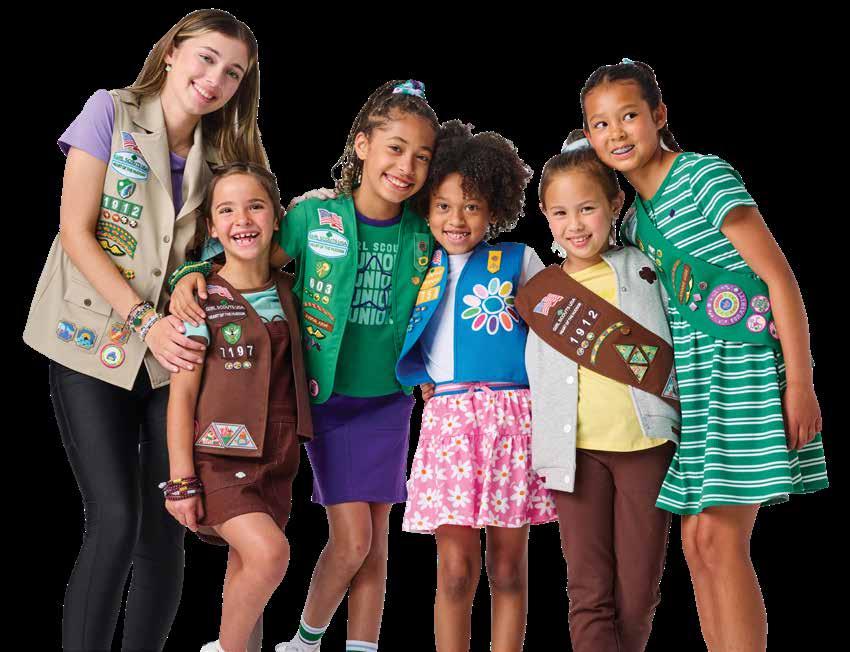
state of the girl

You may not be familiar with all these terms, but it’s likely a 12-year-old girl is.
These specific terms may be outdated in six months, or a year, replaced by words we haven’t heard yet. But the cultural conditions and pressures that they reflect will not be.
Girls today grow up in a fast-paced, age-compressed cultural landscape that consistently frames girlhood as a problem to be diagnosed and managed rather than a stage of becoming. She is cast as the object of someone else’s story, not the subject of her own.
Just look around at the headlines: Girls are anxious. Girls are struggling. Girls are falling behind. And while some of these headlines may be true, it is not the full story.
If you ask a nine-year-old girl what she wants to be when she grows up, she will tell you what she dreams of, specifically, confidently, and without hesitation.
Girlhood has never been just one thing. Her experience shifts depending on where she lives, what opportunities she accesses, what obstacles she faces, and what she may be quietly carrying that no one else can see.
What remains consistent across geographies, age groups, and circumstances is this:
Most young girls have a sense of who they are and who they want to become, but they often face long-held limiting beliefs that there is one particular way to be a girl or experience girlhood.
“I would describe myself as a leader. Very confident, funny, and all around a nice, kind person. The biggest challenge I face as a girl is people underestimating how powerful we are.”
Today’s girls are “yes, and girls.”
she cares about her appearance. Yes, she wants to feel connected. Yes, she wants to know herself on her own terms. Yes,
This is a generation actively navigating and redefining girlhood in real time.
Even inside these conditions, girls are performing, questioning, and stretching themselves to fit into spaces that were not designed for them, and the cost of that work can land squarely on their shoulders.
The pressures girls face are not new. What has changed is the speed and the age at which they begin.
Girls are absorbing messages about perfection, performance, and identity earlier than ever, across home, school, and digital life all at once.
This report will explore the girlhood gap between who she is becoming and the conditions around her.
body image concerns that once emerged in adolescence are showing up as early as age five. And,
loneliness, once associated with the teenage years, is now common well before adolescence. And,
social comparison no longer waits for the school hallway; it arrives through a screen before her school day even begins.
girls say they have not felt confident at school because of how they feel about their appearance. 1 3 in 5
Introduction and Executive Summary: What is the future of girlhood?
Girls are not asking for less challenge, they are asking for more advocates and support. More spaces where they can build confidence, skills, and a sense of belonging. More time to take risks and try new things without the pressure to do it perfectly.
The support systems that once stabilized girls’ lives—afterschool programs, community spaces, informal networks—have thinned or disappeared in many communities.
The girls who need those support systems the most are the ones most likely to lose them. Access to this support truly shapes what is possible for their futures.
Introduction and Executive Summary: What is the future of girlhood?
Why does this matter now?
Today’s girls are being told who to be before they’ve had the chance to decide for themselves. That’s why the space Girl Scouts provides is as important as ever.
For more than a century, generations of girls and young women have turned to Girl Scouts through every version of girlhood.
Girl Scouts’ role has never been to define her own experience for her. We help her define it for herself.
We do that by providing the tools, community, and experiences she needs to recognize and develop the power that has always been within her. That power stays with her well beyond girlhood. Girl Scouts helps her harness it for the rest of her life.
The 2026 State of the Girl report is for everyone who believes girls deserve to be seen clearly and supported well: The parents raising them, the community leaders serving them, the journalists telling their stories, the partners building alongside them, and the funders who know that investing in girls is one of the most powerful investments we can make in our shared future.
This report is also for anyone who understands that the future of girlhood is not some distant idea—it’s a reality that is currently being shaped by millions of girls who are navigating how to become the best versions of themselves in an ever-evolving world.
We invite you to join us in shaping the next generation of girlhood.
Built for her. With her. Always.
“Things have changed since the 1900s; it is not old school anymore. Girls can do anything.”
For too long, the dominant narrative around girlhood has been one of risk and decline. We have studied the absences in girls’ lives: What they are missing, what they are losing, and what is at risk for them.
Let’s meet her before the data frames her.
To know her is to listen to her. And that’s what we’ve done.
We listened to girls and the families raising them, and we looked at the research that has been quietly documenting what they are navigating.
What surfaced shows us that we need to change the narrative around modern girlhood.
Girls are not a problem to solve. They are navigating a world that has not kept pace with who they are becoming. Today’s girls are remarkable. They are ambitious, clear, contributive, and aware of what they need.
Before any data frames her, we start with recognition. With joy. Not as a reward once everything else is fixed, but as a condition that allows her to grow, connect, and figure out who she is.
Girlhood has never been about a single story. It can be messy, contradictory, and expansive, framed by each girl’s unique experience.
“My teachers see one side of me, my friends see one side of me, and my parents see yet another side of me.”
Pippi, 13
Oklahoma
Girls are not a monolith.
Girls’ experiences in the United States vary widely across perspectives and communities. They are shaped by many factors: Their race and culture, their family and household, the language spoken at home, where they live, their physical and mental abilities and how they learn, and the full range of identities they are exploring through girlhood. No single portrait captures all of them.
Compared to past generations, today’s girls are growing up in more racially and culturally diverse communities, 2 in more variable household structures, across regions undergoing rapid population shifts, and with fundamentally different
expectations placed on them by families, schools, and communities.
This report focuses on the dimensions national data brings into view: Specifically racial and cultural diversity, household structure, regional shifts, and economic conditions. Understanding girls fully means continuing to widen the lens through which we view them, which is why creating better data on every dimension of their lives is one of the callouts this report makes.
The girls of Gen Alpha and the teenagers of Gen Z have been in the headlines for years. Our understanding of how the pandemic has shaped the formation of personal and generational identity is still emerging alongside the data.
Today’s girls are coming of age faster than the systems around them can adapt, in households, communities, and economic conditions still reshaping in real time.
No single racial or ethnic group makes up a majority of U.S. children today.
Approximately 8.4% of U.S. children identify as multiracial, reflecting the continued growth of multidimensional cultural identities.3 Over one in five children in the U.S., 22%, speaks a language other than English at home,4 a proportion that has remained steady for over a decade. One in four children lives in an immigrant family.5 Many girls are navigating multiple facets of their own cultural identities while also growing up in communities shaped by a wide range of cultures and perspectives.
8.4%
22% of U.S. children identify as multiracial.
of U.S. children speak a language other than English at home.
1 in 4
children in the U.S. lives in an immigrant family.
“I, especially as a half-Indian and half-white teenage girl, have been told that I’m too dark to be white, but I’m too white to be Indian. And I think that I’m perfect just the way that I am, and that it doesn’t matter what other people think of me.”
Maya
The household has changed.
Today’s household is defined by smaller family sizes and fewer children per household. The average family today has 1.94 children,6 and the average family size is 3.15 people.7
Economic strain and limited caregiver-child time are not new realities for families, but they now collide with higher costs, more demanding work schedules, and fewer buffers against economic pressure.8
What was once less common has become the norm, with both parents in the majority of households now working. As a result, girls often step into caregiving and household responsibilities at younger ages.
Multigenerational households—three or more generations under one roof—are also becoming more common, making up 7.2% of family house holds in the 2020 census, with six million multigenerational households nationwide.9 These structures are more prevalent throughout the South, Puerto Rico, and parts of the West.10
The structure of family life has shifted and girls feel it. Caregivers are balancing higher costs, longer work hours, and fewer buffers. As such, girls are stepping into responsibility earlier, which can build early independence while also raising stress and widening gaps in access to support.11
1.94
A generational low million
6
Families with young children have been steadily moving out of big city cores into suburban, exurban (the outer rings beyond suburban), and rural areas, a pandemic era change that has persisted.12
The data sorts U.S. counties into seven types along an urban-to-rural spectrum, large urban cores at one end (the densest city centers), non-metro rural at the other (the most remote communities). Between them sit suburbs, exurbs, and a range of urban and rural classifications. Since April 2020, large urban counties’ under-five population is down by more than 8%, nearly double the national decline, and exurban counties are the only county type that has added young children. Every other
category has lost them, and large urban areas have lost the most. This is significant because where a girl grows up shapes what she has access to, who she is in community with, and what futures feel imaginable.
8.1%
fewer kids under five live in large urban counties since 2020. The cities are losing their youngest fastest.
Nearly double the national decline.
Source: Economic Innovation Group analysis of U.S. Census Bureau data.13
1 in 3 children grow up “not poor, but not secure.” Their families earn too much to be classified as poor, yet not enough to plan for the future. More than
Economic pressure is constant, even when it’s not visible.
Nationally, 13.3% of children live in poverty under the Supplemental Poverty Measure (SPM).
A broader lens shows how common “not poor, but not secure” can be: 35% of children live below 200% of the poverty line, reflecting a much larger share of families than the SPM figure.14
These burdens are also unevenly distributed. SPM child poverty rates are substantially higher for Black and Hispanic children than for non-Hispanic white children, underscoring how economic risk and its downstream effects concentrate across communities and across generations.15
Six years later, the effects of the pandemic are still shaping daily life. Families prioritize home, stability, and flexibility.16 Time is tighter, and the support systems are thinner. Neighbors, extended family, and after-school anchors are less available/ accessible.
The result is a new kind of household dynamic, one where connection and balance matter more, while stressors compound faster.17 Girls today often navigate these pressures with fewer consistent networks around them than the children of any recent generation.
Girlhood itself has become markedly less typical in any singular sense. Learning environments, social rhythms, and developmental milestones shifted during the pandemic and continue to evolve. The broader landscape of girlhood also reflects
long-running societal evolution: A more diverse nation, a wider range of family arrangements, persistent inequities, and mounting economic pressures. These realities are not sources of instability in themselves. The pandemic is not a closed chapter. It is an ongoing force still reshaping how girls learn, connect, and build confidence and impacting their mental health, their friendships, and the digital relationships that increasingly stand in for the in-person connections that have not fully returned.
Part I: Who is she, really?
Girls are growing up in a moment shaped by speed, expectation, and pressure that shows up earlier and louder than it used to. Building a world for the girls in front of us, rather than for girls of generations past that institutions may remember, is the goal of every funder, partner, and policymaker reading this report. The conditions girls are navigating are not exceptions to plan around. They are the new baseline.
And inside this complexity, something important is happening.
Girls are forming identity, ambition, and purpose with a clarity, and they are doing it earlier than the systems around them are built to support.
• When asked how she would like to be described, she chooses smart (36%), funny (17%), and creative (17%) over pretty.18
• By ninth grade, 70% have already thought seriously about their careers.19
• Interest in STEM has risen from 45% in 2017 to 55% in 2024.20
70% 55% of ninth-grade girls have already thought seriously about their careers. of girls are interested in STEM.
“I made the math team this year, and I couldn’t believe it! I had to take a really hard test, and I had one of the best scores. When my team won the silver medal at the county math tournament, I got to hold the trophy. It was the best!”
Dhanya, 12 Alabama
Friendship is a force multiplier.
More than half of girls say having a friend beside them helps them to try something new, talk to someone new, and do something unfamiliar.21
Girls are arriving at adolescence with more clarity about who they are, what they value, and what they want their lives to look like than the systems around them are designed to receive.
Today’s girls are given culturally prescribed labels: They’re “iPad kids.” They’re “Sephora tweens.” They’re suffering from “brainrot.” But this is not what girls are reporting about themselves.
Any institution serious about supporting girls should invest in the conditions girls are telling us matter: Friends beside her, time and space to be creative, and adults who listen.
1 in2 girls says a friend beside her is what makes her brave enough to try.
“At camporee last month, I figured out how to create bracelets with paracord by using a complex knot. I was happy, excited, and couldn’t wait to show everyone else.”
Maren, 11 California
Girlhood today is multidimensional, shaped by more diversity, variability, and pressure. It’s also shaped by less consistent infrastructure.
The systems around them—schools, programs, and policies—are still calibrated to a version of girlhood that no longer exists.
This is the first gap between girls and the environments meant to support them.
Girls are asking, in their own words and through the data, for more connection.
The physical third spaces that once made building relationships easier have eroded, so she’s left with few choices but to turn to a screen. What she is asking for is not complicated: It’s room to be messy, take risks, and figure out who she is without shrinking to belong.
Nearly 7 in 10 girls ages 5–13 report feeling lonely. These numbers only rise as they grow:
“The world can be really lonely. A lot of people don’t know the real you. You worry that if they did they wouldn’t like you. So sometimes you hold it back because you never know what will be enough or when people will think you are too much. I was really shy for a long time but it was also because I was scared.”
Isabella, 12 Illinois
In Part I, we met her. We listened to who she is, what she wants, and what she’s asking for.
Because girls are not just becoming, they are adapting—and adapting to environments that were not designed for her pace, her complexity, or her full humanity.
Instead of framing girlhood as a problem to be managed, we need to examine the systems she is growing up inside.
Whether it’s the body she is learning to live in, the classroom she is expected to succeed in, or the digital world she is navigating before she fully understands it.
What follows is a closer look at those systems and environments, organized through three questions:
Asks the question: Are the spaces she moves through designed for how girls actually grow?
This covers her physical well-being and body image, her education, and her digital opportunity and access.
is on her side?
Asks the question: Are the adults she depends on showing up consistently?
Is there joy in her journey?
Asks the question:
Are we allowing her room to explore, grow, and enjoy the journey of girlhood?
This covers her physical safety, her mental well-being, and her digital safety and risk.
This covers her connection and sense of belonging, her time beyond the classroom, and her digital connection and creativity.
Girls need environments that let them grow into themselves with confidence, surrounded by adults who focus on who they are becoming, not how they look or how they perform.
Words about girls’ and women’s bodies carry significance.
Girls can absorb pressures and beliefs that the women around them carry.
More than half of girls ages 8–10 (52%) hear the women in their lives speak negatively about their own bodies at least sometimes,23 and the same
is true for 41% of girls ages 11–13.24 The cultural messaging girls metabolize is arriving through the people they love most—their mothers, grandmothers, and aunts—who are repeating what culture has taught them about their own bodies.
The words adults say around her matter. She is hearing how she should look before she has had a chance to know how she feels.
“One of the most external pressures from society that I get a lot of is my body image. Society feels like you have to be a certain way as a woman, you have to be thin and look a certain way. And that’s not me, and I’m not going to change for society. And other girls shouldn’t feel like they have to either.”
Korin, 17 Florida
The shift in emphasis from appearance to ability matters, and it varies with her age.
• At ages 5–7, 50% of girls say they receive more compliments about how they look.25
• By ages 8–10, 66% of girls say people focus more on their abilities than their appearance.26
• 64% of girls ages 11–13 say the same.27
Girls are clear about how they want to be seen. They reach for attributes tied to who they are rather than how they look.
Girls’ physical well-being is shaped by a culture that places constant emphasis on how they look. Body shaming online, whispered comments from friends, or self-deprecating put-downs from parents fortify an internal script about what their bodies are “for” and what girls feel they have to do to manage or perform their beauty.
In order for girls to feel confident in their bodies as they grow, they need adults who model bodyneutral language and environments that shift the focus from appearance to emerging identity.
96% of girls ages 5–13 say they like the way they look. Yet 37% already wish they could change
something about their appearance, and that wish climbs steadily as girls get older, from 21% of 5–7-year-olds to 44% at ages 8–10 and 50% among 11–13-year-olds.28
Girls ages 5–7 receive more comments about how they look than any other age group.29 The scrutiny arrives before girls have language for it, so by the time they’re old enough to push back, appearance is already their lens for understanding their own worth.
Girls are actively negotiating the terms on which they want to be perceived. They are being asked to be confident in who they are while being measured by how they look.
When appearance becomes a central measure of value, it does not just affect her confidence. It influences how she eats, moves, sleeps, and cares for herself. Physical well-being becomes inseparable from the messages girls receive about their bodies. When those messages center on appearance, habits that should build health can quietly become sources of anxiety instead.
Caregivers describe physical well-being as less of a steady baseline and more of a variable condition that is sensitive to small disruptions in environment and routine. Educators describe the same pattern from inside the classroom: More students are arriving without the steady foundation needed for learning and participation. Sufficient sleep, clean clothes, and consistent meals are not a guarantee.31
A child in 2023 was 15–20% more likely to have a chronic condition than a child in 2011.32 Over half of girls ages 12–17 report difficulty getting out of bed and complain about being tired most days.33
Less than 40% wake up well-rested most days.34 12.3% of girls ages 12–17 describe their physical health as “fair” or “poor,”35 and 8% report unmet basic needs, including enough food, access to a doctor, or a safe place to stay.36
12.3% 8% of girls ages 12–17 describe their physical health as “fair” or “poor.” of girls ages 12–17 report unmet basic needs.
• Shift the language adults use about their own bodies and girls' bodies, starting at home.
• Seek out first-person insights from girls about what makes them feel confident and self-conscious, and actually listen to let those insights guide programming and curriculum.
• Design the spaces she moves through— in healthcare, schools, and afterschool programs—to affirm who she is, not how she looks.
The school she enters every day is changing.
Girls remain enrolled in school at rates proportional to the population across K–12. They represent:
• 48.5% of preschool and kindergarten students
• 49% of grades 5 to 8
• 48.4% of high school students37
Beneath those steady enrollment numbers, the system has fragmented.
Public school enrollment is down 2.5% nationwide since 2020, with 1.28 million fewer students.38 Families are turning to private schools (up 15.8%),39 homeschooling, and charter schools, which added over 80,000 students in 2023–2024.40
These shifts are changing how girls socialize, what they are taught, and what extracurriculars they can access. The effects land hardest on girls who are already the most vulnerable. The type of school a girl attends shapes not only her academic outcomes but her sense of belonging and future aspirations.
The pandemic disrupted learning in ways that still linger, leaving gaps in academic progress. For many girls, the classroom experience now includes navigating both academic expectations and the social-emotional fallout of years marked by uncertainty and isolation.
The map below shows how public school enrollment has shifted by state between fall 2020 and fall 2024. Purple marks decline, yellow marks growth. The pattern is uneven. Most states have lost enrollment over the period, with the deepest declines in California, the Northeast, Hawaii, and parts of Appalachia. Only a small group of states, concentrated in the Plains, have gained.
Public School Enrollment Change From 2020 to 2024
Enrollment Change:
She is learning to lead before anyone has made space for her.
Girls excel in self-regulated learning, the suite of skills that includes goal setting, time management, focus, and emotional control.41 These are the skills linked to long-term academic success, and they correlate especially strongly with early success in language arts (reading comprehension, writing, and general communication).
You may have heard that girls outperform boys in reading. And they do.42 Yet the majority of girls remain below proficient in key subject areas. Across all students, proficiency has declined steadily since 2019. The skill foundation is there. The outcomes the system is producing are not.
And because girls are doing relatively better, they are often overlooked when support is distributed.
Percent of Girls Who Are at or Above Proficiency
31%
Compared to 23% of boys
39%
Compared to 41% of boys
32%
Compared to 36% of boys
The decline is even clearer over time. Measured on its underlying scale rather than as a proficiency rate, the average fourth grade reading score climbed for much of the past three decades before peaking in 2019. It has since fallen with every assessment, dropping to 215 in 2024, which is roughly where it stood in 1992. A generation of gains in early reading has been erased in the span of five years.
Decline In Reading Proficiency From 2019 to 2024
*Significantly different from 2024. Source: National Center for Education Statistics, NAEP 2024 Reading Assessment.43
Girls’ proficiency is sliding, too, even as they continue to score stronger than their peers. This is how girls get overlooked when reading support is handed out.
School is also where many girls first learn what it feels like to be unsafe.
School is not just where she learns. It’s where she learns who she is allowed to be, safely.
19% of girls 12–18 report being bullied at school.44
Educators cite afterschool programs as equally vital to academic time for identity exploration, talent discovery, and peer connection. Many are self-staffed clubs that fill gaps left by programs that disappeared during the pandemic and never came back.45
“At the beginning of the school year, I was being pushed around by a classmate. I let it happen and ignored it. Then I learned that I don’t have to be liked or friends with everyone around me. I learned to speak up and put an end to the bullying. It made me feel more confident about myself.”
Julia, 10 California
By ninth grade, 70% of girls have thought “a lot” about their careers.46 Yet 58% of high school girls do not believe they are smart enough for their dream job, and 89% feel pressure to conform to gender stereotypes in their career choices.47
The ambition is intact. What is missing is her trust that the world is ready to let her grow into it.
70% of girls have thought seriously about careers. STEM interest has risen from 45% in 2017 to 55% today.48
• Close the gap between her ambition and her belief in herself. Dismantle career stereotypes, provide mentors who model what is possible, and prepare her for the world she is actually walking into, not just the next grade. She has already imagined her future.
“Through the many provided opportunities involving friendship, learning, skill-building, STEM, and entrepreneurship, Girl Scouts has helped me to become more courageous and confident in all aspects of life.”
Brinley Ohio
• Invest in learning experiences that feel empowering, social, and joyful, where girls build confidence and a sense of belonging alongside their academics.
• Make school a place where she does not have to manage harassment alongside her coursework.
• Protect extracurricular spaces. Afterschool care, clubs, and programs provide opportunities to do the work of identity exploration and peer connection, and they have been hollowed out since the pandemic.
While most girls are using digital tools to create, learn, and connect with others, the cultural conversation tends to be centered on how to keep them safe. 40% of parents with girls ages 2–15 say “too much time on devices” is their greatest concern for their child.49 For parents of girls ages 5–10, that concern rises to 48%.50
of
“too much time on their devices”
their greatest
For parents of girls 5–10, it rises to 48%. Why Girls Spend Time Online: Drivers by Age
Stay connected to friends and family
Learn to do new things or get better at things I enjoy
Ages 5–7
Ages 8–10
Source: Girl Scouts of the USA, “Girls Turn to Screens Out of Boredom.”51
Won’t miss out on what friends are talking about Keeps me from being bored
Ages 11–13
She’s being handed a device before she’s ready to navigate it alone.
A common conversation in parenting circles is when to provide their children with a handheld device. 96% of U.S. households have a smartphone and 75% have a tablet, but dedicated use among children varies significantly by income, family structure, and community resources.52
58% of children ages 5–8 have a tablet of their own. 23% have their own phone by age 8. 19% use a school-issued device at home.53
For some girls, the screen is what is left when everything else is out of reach, and she often navigates the scroll by herself. Children from lower-income households average 3 hours and 4 minutes of daily
screen time. Their higher-income peers average 1 hour and 52 minutes.54 The difference is not a variation in habits.
For children without access to afterschool care in their communities, tablets and phones are vital tools for staying connected with caregivers and for keeping kids occupied while caregivers are working, preparing meals, or caring for other children or elderly relatives.55 Income discrepancy directly impacts a girl’s screen time and what other options families can afford.
58% of children ages 5–8 have a tablet of their own.
23% have their own phone by age 8.
But the digital world also provides opportunities for girls to hone their creativity on their own terms. Girls as young as 7 and 8 are managing their own YouTube channels, building in Roblox, and using digital tools to learn, connect, and create.56 They are teaching themselves by finding tutorials online and building skills the school day does not always make room for.
Girls are developing fluency and confidence in spaces the adults around them are still figuring out. Their potential to shape the digital world is already showing. Technology is not optional—it is part of how they are growing. What they need is support to use it wisely.
• Invest in digital media literacy programs that build critical thinking skills.
• Create opportunities for girls to engage in online spaces that promote creativity, skill-building, and connection.
• Ensure caregiver and educator training keeps pace with girls’ digital lives.
• Treat the income-based discrepancy that impacts screen time as the structural problem it is by investing in affordable, accessible afterschool programs that lets digital balance be a real choice for every family.
There is an unrealistic expectation placed on girls today:
“Figure
it out.
Manage
it.
Handle
it.
Be aware, but not afraid. Be strong, but not too much.”
Most adults would struggle to hold these contradictions, yet girls are expected to navigate them every day.
This section asks a simple question: Who is actually showing up for her and where are the gaps?
Because girls don’t just need opportunity. They need consistent caregivers, role models, and mentors in their life.
The data shares a single argument: Girls thrive when adults choose to stand alongside them. Right now, too many girls are doing the work of self-protection without a consistent adult presence.
“It’s really hard to be a girl in the world, because... you always have to look behind you and make sure no one’s trying to follow you or hurt you. Being a Girl Scout really helps, because I have support from all my sisters and the leaders. They’re really supportive, and they give you a nice, safe feeling. It’s just a feeling of warmth.”
Girls need to feel safe.
Before she can decide who she wants to become, she must feel safe in her environment.
Rates of children ages 5–17 who have been a victim of or witnessed violence in their neighborhood rise with age as autonomy grows and time outside the home increases. Rates are substantially higher among children with disabilities than those without.
7.1%
of children ages 5–17 have been a victim of or witnessed violence in their neighborhood.57
Rates of witnessing or experiencing violence are up overall.
Percentage of children and adolescents aged 5–17 years who had been the victim of violence or witnessed violence in their neighborhood, by disability status and age group:
Data broken down by age band and disability status. Among children with disabilities, the rate is 14%, more than double the 6% rate among children without disabilities. Exposure rises from 5.7% at ages 5–11 to 8.7% at ages 12–17.
Source: National Health Interview Survey, United States, 2022.58
The pandemic also interrupted informal communities that served as a protective layer: Elder caregivers who provided childcare, transportation, and neighborhood trust.59 Those support networks have been slow to rebuild. With the absence of that support, families have become more self-reliant and more cautious about extending trust beyond their closest circles. When the world outside feels uncertain, girls often stay indoors, where screens act as a protective stand-in.60
Caregivers describe a pervasive anxiety that goes beyond neighborhood safety, like abduction. Cyberbullying, school safety threats, and general public unpredictability are now common fears.61 For families raising girls, these concerns often manifest as added anxieties around body shaming, exclusion, and harassment, shaping caregiver decisions about independence, supervision, and where girls are allowed to spend time.
Where her family used to lean on neighbors, they are leaning on programs instead.
Structured programs feel safer to families because the adults, settings, and expectations are more familiar, and therefore more predictable, than the informal networks families once leaned on. They give parents the conditions to feel confident placing their children in new settings. They also give girls access to the kind of safe exploration that indoor, screen-based time cannot replicate.
Girls need consistent, intentional environments where they can take healthy risks. Communities need to rebuild informal trust networks that make safety a shared responsibility rather than an individual burden each family carries alone.
• Design physical spaces and afterschool programs that allow girls to explore, take healthy risks, and feel consistently safe and supported.
• Invest in rebuilding community infrastructure so that safety is not dependent solely on what individual families can provide.
• Provide access to external community programs so her freedom to grow is not dependent on her family’s resources alone.

“I can be really, really shy and that can be lonely. Sometimes I would rather be quiet and not talk rather than think about what people want me to say. But I’m learning that what I have to say is important and people should listen to it. But it seems to me like a lot of adults say they want to do that, but they really don’t.”
13 Illinois
Stress isn’t just a onetime event in her life. It’s become an ongoing atmosphere where anxiety and sadness touch nearly every girl. Stress for girls today rarely comes from one source. Instead, it builds up across multiple areas—school expectations, peer dynamics, family pressures, and a broader cultural atmosphere of uncertainty. When stress becomes a constant backdrop, it narrows a girl’s sense of possibility and inhibits her ability to connect fully to the world around her.62
53%
of girls experienced persistent feelings of sadness or hopelessness in the past year, down slightly from 57% at the height of the pandemic, but still a majority.63
of girls 12–17 show symptoms of anxiety.
29% of girls show symptoms of depression.
25%
Caregivers and educators describe broad anxiety—more specifically, social anxiety in peer settings—and challenges with emotional regulation as common post-pandemic patterns. These behavioral trends are a background state that girls carry into classrooms, friendships, and everyday routines. Percentage of Girls 12–17 with Mental Health Challenges:
of girls seriously considered attempting suicide in the past year, down from 30% at the pandemic peak.
Progress, but not enough.
Source: Centers for Disease Control and Prevention, Youth Risk Behavior Survey Data Summary & Trends Report, 2024.64
Naming what she is feeling is one thing, getting help for it is another.
At times, the mental health support systems in place for girls are uneven at best.
Many girls have some sources of connection, but fewer experience support consistently across the relationships that matter most. Only 51.7% of girls 12–17 “always” or “usually” get the social and emotional support they need, leaving nearly half without reliable support structures.65 55.8% of girls 12–17 say they received parental support “a lot of the time”: This is meaningful, but not universal.66 30.3% of girls 12–17 have unmet mental healthcare needs.67
Access, affordability, stigma, and long wait times all create barriers even when distress is recognized. 15.8% take prescription medication for emotions, concentration, behavior, or mental health.68
When support needs are consistently unmet, emotional distress is normalized as part of what it means to grow up as a girl today.
Only half of girls 12–17 “always” or “usually” get the social and emotional support they need.
Self-esteem is also relational. It rises when girls feel secure with adults who take them seriously. Educators point to focused attention and being listened to, remembered, and responded to as some of the most powerful inputs to a girl’s selfworth.69
• Equip the adults in girls’ lives with the knowledge, training, and tools to recognize distress and warning signs and respond with consistent, compassionate support.
• Normalize having mental health conversations so girls feel safe bringing concerns to trusted adults.
• Ensure schools have the resources and training to identify and respond to signs of distress.
• Show up for her in the everyday moments—not just the crises.
• Take her stress seriously so she doesn’t have to carry it alone.
“Grown-ups don’t quite understand that being a girl in today’s world comes with a lot of pressure from social media, school, and expectations.”
Jillian, 16 California
For previous generations of girls, bullying and social pressures were confined to school hallways. Now, they follow her home on her phone.
46% of teen girls say they are online “almost constantly.”70 50% of 10–12-year-olds say most or all their friends use social media, well before the age 13 minimum.71 The platforms where girls spend the most time are YouTube (90%), TikTok (60%), Instagram (60%), and Snapchat (55%).72 Social media is shaping girls’ self-belief far more intensely than any prior generation.
Girls ages 13–17 are significantly more likely than their boy peers to report that social media negatively impacts their mental health (25% versus 14%), confidence (20% versus 10%), and sleep (50% versus 40%).73
Teens who spend more time on social media are likely to score lower on reading and memory tests, indicating that certain types of screen use may negat ively impact cognitive development and academic performance.74
46% of teen girls say they are online “almost constantly.”
The older she gets, the more cyberbullying she encounters.
Although it’s often experienced in private, cyberbullying can infiltrate so many areas of a girl’s life, causing harm that hides in plain sight.
Some adults don’t know how to intervene because they aren’t aware of what cyberbullying entails. It can range from sending mean or offensive Direct Messages (DMs) and spreading false rumors to sending unsolicited images, physical threats, and explicit photos without consent. High school girls report experiencing the most overall cyberbullying compared to girls of other ages and their boy peers.76 Schools and parents often struggle to identify and mitigate these challenges because cyberbullying is private and yet it infiltrates girls’ most important social networks and relationships. 41% of girls 13–14 experience cyberbullying.77
15–17,
Any cyberbullying
Offensive name-calling
Spreading false rumors about them
Receiving explicit images they didn’t ask for
Constantly being asked where they are, what they’re doing, or who they’re with by someone other than a parent
threats
Any cyberbullying
Any cyberbullying
Offensive name-calling
Offensive name-calling
Spreading false rumors about them
Spreading false rumors about them
Receiving explicit images they didn’t ask for
Receiving explicit images they didn’t ask for
Constantly being asked where they are, what they’re doing, or who they’re with by someone other than a parent
Source: Pew Research Center, “Teens and Cyberbullying 2022.”79
However, girls are clear about what they want the digital world to feel like.
1 in 3 teen girls says it is more important that people are able to speak their
minds freely.
2 in 3 teen girls say it is more important that people feel safe and welcome in online spaces than that people can speak freely.80
Girls need developmentally appropriate online safety training, adults who can guide them through complex digital experiences, and platforms that are actually designed with their safety in mind.

The fear of not being online and missing out on important social relationships is compounding as she ages, not easing.81
The percentage of girls who feel they must be online or they’ll miss out on things their friends are talking about:
Ages 5–7
Ages 8–10
Ages 11–13
21% 31% 51%
• Teach girls the safety skills and privacy practices that let them move through online spaces on their own terms.82
• Ensure caregiver and educator training keeps pace with girls’ digital lives.
• Learn about the social platforms that she frequents so that this part of her digital life is discussed openly and proactively.
• Advocate for platforms and policy where her safety is the design principle.
If everything about girlhood is framed as a risk, when does she actually get to feel the joy of being a girl?
There is a quiet assumption baked into how we talk about girls today:
That they need to be fixed and protected.
However, while girls navigate the modern pressures of girlhood, they are also creating, connecting,
imagining, and discovering the power that is within them. So how do we help them to feel more of the inherent joy of girlhood while understanding that their happiness and well-being is not something that has to be “earned?”
This section asks a different question: Are we giving girls permission to actually experience all aspects of their girlhood without judgement? How do we support them in enjoying the journey of growing up?

Part II: What’s happening around her?
“Hearing that 70% of girls feel loneliness in their lives at some point, honestly that’s not surprising to me, because I’ve felt loneliness myself, and I see it every day at school with my peers. I feel like that number should be a lot lower than it is right now, because there’s a way that we can all make each other not feel as lonely at some point. We’re all here for each other.”
Korin, 17 Florida
Nearly 7 in 10 girls ages 5–13 report feeling lonely.83 But when they are with an ally or friend, things change.
In fact, when peer support is present, it is transformative. More than half of girls say having
a friend beside them encourages them to try new things (52%), talk to a new kid (52%), or join a new group (50%).84 Belonging is built through repeated, concrete experiences of being invited in, being listened to, and knowing there is someone to turn to.
Girls seek new and familiar connections from their extracurricular activities. Top reasons girls choose activities:
Doing something I like Making new friends
Spending time with friends
Source: Known, 2024 National Non-Member Survey.85
It takes one adult to show up and change her life’s path.
78.4% of girls ages 12–17 have at least one adult outside their household who makes a positive difference in their lives.86 Mentors, extended family, educators, coaches, and other community adults remain a meaningful source of steady support.
A single consistent adult can shift a girl’s trajectory— if that relationship is both reliable and accessible.
Her activities after school shape so much of her life. The hours are formative because it’s when she can try new things, fail safely, and discover what she loves.
Girls want creative, collective experiences:
• Art class (42%)
• Music (33%)
• Sports teams (28%)
• Swim lessons (25%)
• Crafting or building clubs (23%)87
Access to these opportunities enhances potential, but right now it’s unequally distributed across girls.
She and her family want the same thing, even when they reach for different words to describe it. Caregivers name confidence as their top hope for what an extracurricular will give a girl, at 46%, followed by personal growth at 39%, and making friends at 34%.88 When asked why they join activities, girls lead with connection: 54% come to do something they love, 51% to make new friends, and 45% to spend time with the friends they already have.89
46% of caregivers name confidence as their top hope for what an extracurricular activity will provide their girls.
“I am super passionate about volleyball. It’s a family sport that gets passed down, and I am very appreciative of my family pushing me to try the sport.”
She finds joy in doing activities with friends.
Girls want to deepen existing friendships and build new ones in the same space. When given the right environment, girls lead, grow, and prioritize relationships with the people around them.
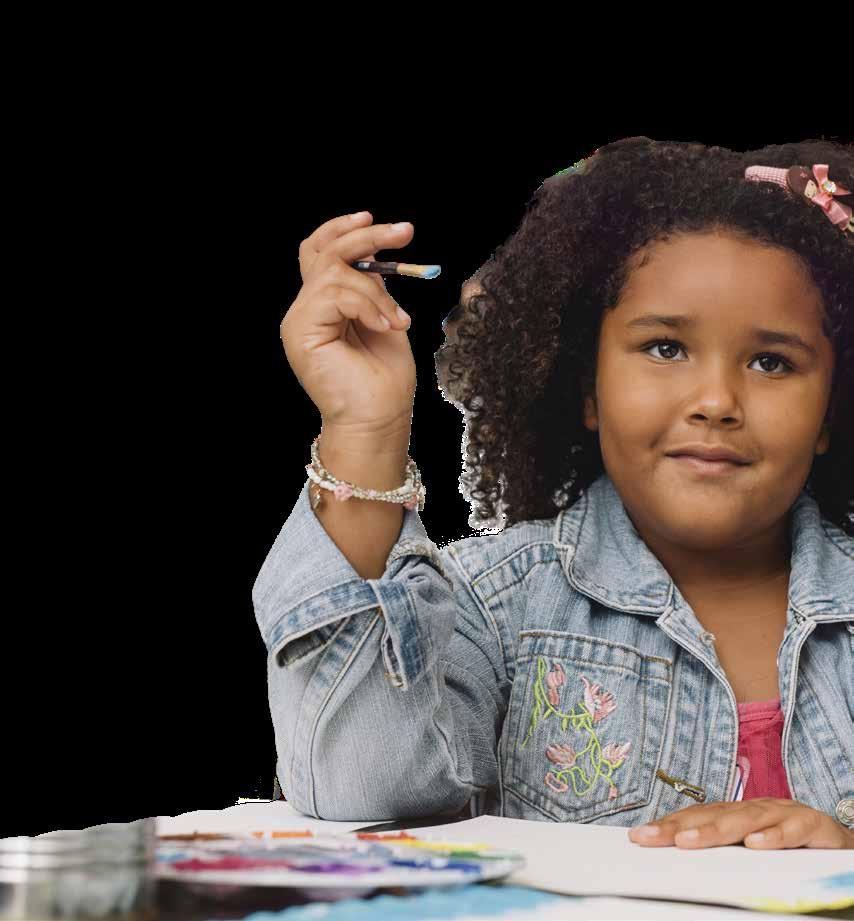
Girls want to express themselves, be part of something larger, and discover a variety of activities.
Access to these extracurriculars are in danger.
Afterschool programs have not returned in many schools and communities post-pandemic.90
Doing something I like
Making new friends
Spending time with friends
U.S. families spend between 8.9% and 16% of their median income on care for one child, with annual costs ranging from $6,552 to $15,600. Even part-day afterschool programs run up to $9,211 per child per year.91
Factors influencing caregiver decision making include affordability (46%) at the top, followed by alignment with the child’s interests (44%), proximity and location (27%), flexible scheduling (26%), and safety (26%).92
Only 36% of parents say their children received regular tutoring or academic support.93 Lowerincome families face compounding barriers of cost, transportation, and program availability.
35% of teen girls feel pressure to be involved in extracurricular activities, and that pressure is not evenly distributed.94
Affordability stands out as the top factor in decision making for caregivers, followed by “aligns with my child’s interests.”
Aligns with my child’s interests
and
Source: Known, 2024 National Non-Member Survey.95
Extracurriculars are doing more than enriching girls’ lives: They also function as childcare and an informal safety infrastructure. For many families, these programs keep girls in known, supervised environments while caregivers are working, preparing meals, or caring for other children or elderly relatives.96
Inherent in extracurriculars is a safety component: School-based programs, community centers, and organized activities provide spaces where girls are known, supported, and protected. Despite the developmental and logistical needs they fulfill, access to these spaces is still out of reach for many families.
Caregivers are most likely to sign up for programs that are:
• Inclusive
• Accessible
• Designed to promote leadership development97
Extracurriculars are often framed as optional when they are actually essential to how girls develop confidence, community, and a sense of who they are.98 Girls need flexible, affordable models that meet families where they are—in schools, neighborhoods, and online—and that go beyond one-size-fits-all programming.
The need for balanced access to meaningful opportunities is clear:
• Enough variety so every girl can explore interests and develop skills.
• Enough downtime for play, family time, and mental health.
• Access that ensures extracurriculars are not a privilege tied to income.
• Invest in removing cost, transportation, and awareness barriers so that girls from all backgrounds can participate fully and consistently. Open extracurricular access to every girl, regardless of what her family can afford.
• Offer a wide range of out-of-school opportunities that allow girls to explore interests, develop new skills, and build the confidence and community that come from trying things together.
• Create accessible spaces and programs where girls can build friendships, share experiences, and feel a sense of belonging rooted in trust and shared understanding.
• Invest in steady adult presence. The research has shown that it changes what becomes possible for her.
• Build belonging into communities so she does not have to build it on her own.
The story that girls are choosing screens over everything else misses the point. They are choosing what is available, not always what they prefer. When girls are asked directly, they say something the dominant narrative tends to drown out: 65% of girls ages 5–13 would rather be creative than engage with screens, 59% would rather go outside and play, and 59% would rather spend time with family 99
Rather than engage with screens, girls ages 5–13 would rather:
The narrative that this generation has been swallowed by technology overlooks what girls themselves are telling us. They are using the digital tools within reach, and they are clear that those tools are not their first choice. The pull toward creativity, the outdoors, and time with family has not gone away, and neither has the value of real connection in offline settings. Girls and caregivers alike are actively seeking experiences that bring their lives back into balance. Be creative 65% Go outside and play 59%
Spend time with family 59%
Digital spaces are also opportunities for connection and creativity, on her terms.
Girls are developing their own lexicon of emojis, internet slang, and inside jokes. Digital spaces have become central to how they communicate and form friendships. Girls are growing into digital builders, not just digital consumers, developing fluency and the capacity to shape the digital world—not just be shaped by it.
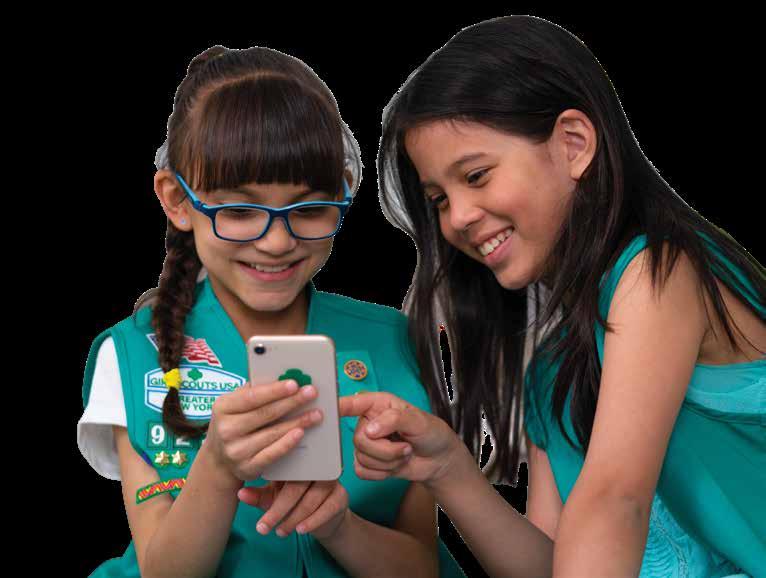
The pull toward screens is a family-wide reality, and her experience of it is shaped by what happens around her as much as by what she does herself. Caregivers and girls alike are seeking experiences that prioritize meaningful, in-person connection while maintaining the ways in which technology genuinely enriches girls’ lives. Sit with what they are reaching for, though, and a quiet contradiction surfaces at the center of how this generation lives with technology.
The irony of this generation is perhaps that, at times, they long for an analog life they never lived.
A moment to slow down. To not have to perform an activity for an online audience. To be silly while no one is watching. To not count the likes and obsess over comments from someone you haven’t met. To own a physical item that’s theirs and not be at the whim of a streaming platform’s rotating selection.
Girls are not asking to completely opt out of their digital life. They are asking the adults and caregivers in their lives to set a healthy example by modeling balanced technology use.
• Create opportunities for girls to form positive peer networks and engage in online spaces that promote creativity, connection, and belonging.
• Invest in balanced programming that honors both girls’ digital fluency and their hunger for in-person community.
• Support whole-family practices that model the balance girls are asking for, because the joy in her journey is not something she can build alone.
52% of girls ages 5–7 say they have trouble getting a parent’s attention because the parent is on their phone.
By ages 8–10, it is 64%.
This report has not just documented a series of separate concerns. It has highlighted a generation reaching adolescence under conditions earlier generations of girls did not face.
• Body image concerns now reach girls as young as five.101
• 7 in 10 girls between 5–13 report feeling lonely.102
• By ninth grade, 70% have already thought seriously about their careers, yet 58% do not believe they are smart enough for their dream job.103
• 46% of teen girls say they are online almost constantly.104
The pressures are compounding and her support systems have not kept pace.
The girls who need help the most are losing support the fastest. The funding needed to close the gap isn’t reaching them. Only 2.18% of philanthropic giving in the U.S. goes to women and girls.105
This is the design challenge of the moment. It is also our greatest opportunity.
Decades of research and 114 years of Girl Scout experience point in the same direction. The conditions that help girls grow are not a mystery. They are knowable, replicable, and visible everywhere a girl has access to them.
What works shares a similar set of design elements:
• Consistent caregiving
• Culturally inclusive spaces
• Intentional family engagement
• Pathways that let girls explore, fail, and try again
• In-person community connection
• Joyful, low-pressure activities designed for experimentation and learning
When these conditions are present, girls lead in their own ways, take creative risks, and form friendships that last. They imagine futures and start moving toward them.
When barriers are lowered and access is widened, the same girls so often labeled “at risk” show up as exactly who they have always been: Ready to connect and be seen. The work of shaping the next generation of girlhood is bigger than any one organization, any one funder, any one moment. It involves building infrastructure that can withstand these changing times.
Girl Scouts has been doing this work alongside girls for 114 years, and we can’t do it alone. The infrastructure girls need is bigger than any single organization can build. Below are six key areas to focus on, each one connected to multiple insights. These areas are even more powerful with combined action.
Collect girl data.
Girls’ needs are unique and often underexamined. The ability to evaluate the status of girls in this report was made possible through proprietary research and through publicly available data with the ability to disaggregate by gender. Beneath the data lie important distinctions to understand and act on. We need more of it.
• Go to the source. Prioritize and expand data collection directly from adolescent girls. Girls understand their experiences best and are best equipped to document and convey their needs.
• Make data accessible. Curators of youth data hold a special responsibility to make data publicly available so that researchers, funders, and practitioners can act on it.
• Build coalitions around researchinformed trends. Institutions and organizations involved in the lives of girls must come together around shared data and analysis to mobilize on their behalf.
Girls’ physical and emotional well-being is shaped by the systems, supports, and opportunities that surround her. Strengthen those systems and you will strengthen her capacity to grow.
• Hear first-person insights from girls about what makes her feel confident, safe, or selfconscious, and let their perspectives lead.
• Shift adult messaging from her appearance to her growth. Model body-neutral language. Emphasize her strengths, her goals, and the identity she is building.
• Design physical and digital spaces that allow her to explore, take healthy risks, and feel consistently safe and supported.
3
Build connected communities.
Girls’ well-being is shaped by the support systems around her: Families, schools, community organizations, and the caring adults who show up for her every day. Investing in these systems helps build the kind of resilience she will carry with her for the rest of her life.
• Equip the adults in her life with the training and tools to recognize gender-specific warning signs and respond with consistent, compassionate support.
• Create accessible spaces and programs where girls can build friendships, share experiences, and feel a sense of belonging.
• Normalize hard conversations on mental health. Make it an open, stigma-free topic by encouraging caregivers and mentors to talk regularly about emotions, coping skills, and the importance of seeking help when needed.
4 Champion and invest in girls.
Girls need adults who help them see what they are capable of, and programs that give them the chance to test it. Invest in the relationships and the experiences that build their confidence in their own future, and their trajectory will shift.
• Provide girls with consistent supportive adults who help her set goals, navigate challenges, and connect what they are learning to who they hope to become.
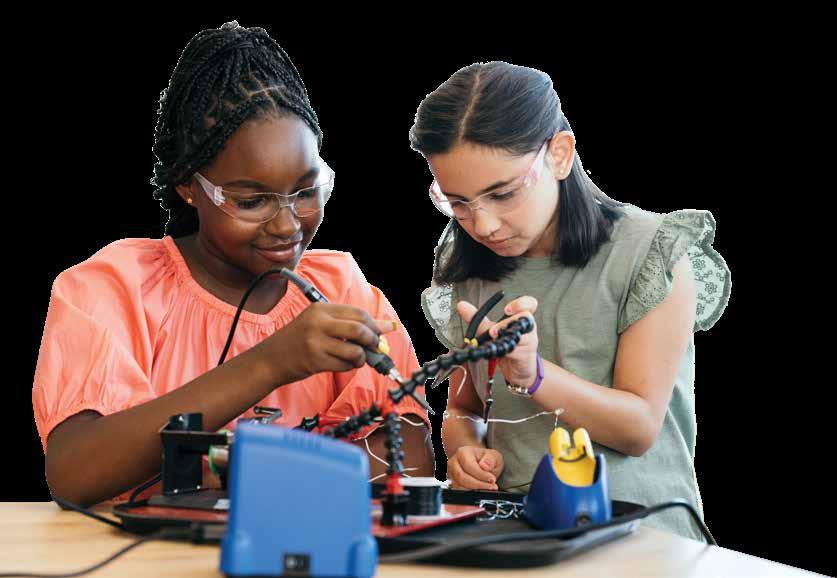
• Build clear, supported pathways for her to explore leadership, STEM, outdoor education, and other future-shaping experiences that strengthen her sense of belonging.
• Invest in programs that close opportunity gaps by offering experiences where learning feels empowering, social, and joyful.
5
The time beyond the school day is where girls develop confidence, community, and a sense of who they are. But whether a girl gets that time, and what she can do with it, depends heavily on her family’s income and where she lives, which makes it one of the most unequally distributed advantages in a girl’s life. Expanding access is one of the highest-leverage investments available.
• Open extracurricular access to every girl, regardless of what her family can afford.
• Offer a wide range of out-of-school opportunities that allow her to explore interests, develop new skills, and build the confidence and community that come from trying things with others.
• Design programming responsive to her unique pressures and priorities, supporting her mental well-being, her identity development, and her hunger for safe, connected spaces.
Girls are growing into digital builders—not just digital consumers—in environments that adults are still figuring out. Resource and develop her digital fluency. Build the protections she needs to live her life online and off.
• Provide online safety readiness training on topics ranging from privacy practices to navigating risky interactions so that she understands how to stay safe.
• Build her critical thinking skills through digital media literacy programs that help her move through digital spaces with confidence and discernment.
• Create opportunities for her to form positive peer networks and engage in online spaces that promote creativity, connection, and belonging.
• Equip caregivers and educators with the resources they need to model healthy digital habits and guide her through complex online experiences without shame or fear.
This is for the people who fund, lead, and advocate for this work.
Fund what works.
2.18% of philanthropic giving in the U.S. goes to women and girls.106 The evidence base for what works has never been stronger. The conditions that help girls grow are knowable, designable, and measurable. Fund the initiatives and programs this report has identified, the organizations doing the work at scale, and the data that lets us measure her future.
the real story.
The dominant cultural narrative around girls is one of risk and decline. The data tells a different story. Girls are clearer about what they want, more ambitious about what they can become, and more articulate about what they need than the cultural conversation has acknowledged. Cover the girls who are already showing us how to meet this moment. Tell their story.
from where you are.
Girl Scout councils are the layer of the Movement closest to where girls actually are, and the closest to the families raising them. This report calls for work that councils have been doing for decades: Providing consistent adult support, creating structured environments, and fostering a strong sense of belonging in communities. Lead with what you already have. Build with what we know works.
Align with what she is asking for. The brands, organizations, and platforms that align with what girls are asking for—that allow her room to grow, take risks, and figure out who she is—are the ones that will be relevant to her as she grows up. Listen first. Build with her in mind. Earn the place she gives you in her life.
Show up while she is becoming. Show up while she is figuring out who she is. Show up consistently. Show up before she has to ask for help. The future of girlhood is shaped through millions of girls receiving exactly this kind of support, from exactly the people in a position to provide it.
That is you.
Girls are growing up in a world changing fast and constantly asking them to produce and perform.
But what if she didn’t have to? What if she learns that the most important thing she will ever build is not an audience but a relationship with herself?
What if we encouraged her to maximize her growing-up years with joy, curiosity, confidence, and courage? Encourage her to question, try new things, and fully discover the power within her?
Girl Scouts understands what it means to grow up as a girl today and is creating experiences that are responsive, relevant, and rooted in the realities of modern girlhood.
This is both a promise and a practice: to evolve with girls, champion their voices, and help them become the leaders they’re meant to be.
We invite you to join us in that promise now.
The study design included qualitative research, quantitative surveys, and secondary data analysis focused on girls in the United States. The first phase of research involved exploratory quantitative and qualitative work conducted by Shine Scout Inc., including moderated discussions and interviews with girls, caregivers, and educators, to surface emerging attitudes, behaviors, and cultural dynamics shaping their experiences. The data from Shine Scout were collected in August–October 2023. Quantitative data consisted of surveys with 800 caregivers with a girl child ages 5–10, balancing for the 4 major geographical regions across the US with an oversample on Black and Hispanic participants. The qualitative data consisted of 14 digital focus groups with 50 total participants, including caregivers of non-member girls ages 5–12, volunteers and organizers of programs/ organizations for girls ages 5–12, and elementary school teachers (grades 1–5). Ethnographic research included nine in-person, in-home groups with 28 non-member girls ages 7–10 across geographic areas (rural, suburban, and urban) with an oversample on Black and Hispanic participants.
The second phase of research consisted of online surveys administered by Known and Wakefield Research with nationally representative samples of girls and caregivers, designed to capture key indicators related to well-being, social connection, identity, and digital engagement, with samples balanced to reflect U.S. population benchmarks on age, race/ethnicity, and socioeconomic background. The data from Known were collected in January 2024, sampling 4,000 households in the United States with a girl or non-binary child ages 2–15. The data collected by Wakefield were collected across 2024 and 2025, surveying 1,000 U.S. girls ages 5 to 13 with an oversample to a total sample size of 500 Black girls ages 5–13 and 500 Hispanic girls ages 5–13.
In addition to the above proprietary sources, the study incorporated secondary data sourced from federal datasets, including the Centers for Disease Control and Prevention (CDC), U.S. Census Bureau, Department of Education, and Bureau of Labor Statistics, as well as leading academic and nonpartisan research institutions. These data were used to provide historical context, identify long-term trends, and contextualize findings within broader youth social and economic conditions. Data included in this report reflect the most recent information available across these sources; secondary data were sourced in 2025 and 2026, with coverage periods varying by data collection cycle.
All research components were integrated to produce an aggregated analysis of girls’ experiences, combining lived perspectives with population-level data. Findings draw on multiple sources, including qualitative research, national surveys, and federal datasets, to identify key themes and patterns shaping girls’ outcomes.
I: Who is she, really?
1. Harriet Smith, Kirsty Garbett, Paul White, Heidi Williamson, and Nadia Craddock, “Evaluating the Effectiveness and Acceptability of Two Positive Body Image Media Micro-Interventions among Children Aged 4–6 Years Old: A Study Protocol,” ResearchGate, 2024, https://www.researchgate.net/publication/387225899.
2. U.S. Census Bureau, “Racial and Ethnic Diversity in the United States: 2010 and 2020 Census,” accessed 2025, https://www. census.gov/library/visualizations/interactive/racial-and-ethnic-diversity-in-the-united-states-2010-and-2020-census.html.
3. KFF, “Children by Race/Ethnicity,” State Health Facts, accessed 2025, https://www.kff.org/state-health-policy-data/stateindicator/children-by-raceethnicity/.
4. Annie E. Casey Foundation, “Children Who Speak a Language Other than English at Home,” KIDS COUNT Data Center, accessed 2025, https://datacenter.aecf.org/data/tables/81-children-who-speak-a-language-other-than-english-at-home.
5. Annie E. Casey Foundation, “Children in Immigrant Families,” KIDS COUNT Data Center, accessed 2025, https://datacenter.aecf. org/data/tables/115-children-in-immigrant-families.
6. U.S. Census Bureau, America’s Families and Living Arrangements: 2022, Current Population Reports P20-587 (Washington, DC: U.S. Census Bureau, 2024), https://www2.census.gov/library/publications/2024/demo/p20-587.pdf.
7. U.S. Census Bureau, “Average Size of a Family in the United States from 1960 to 2024,” December 2025, distributed by Statista, https://www.statista.com/statistics/183657/average-size-of-a-family-in-the-us/.
8. Georgetown Center on Gender Justice and Opportunity, Indispensable But Overlooked: A Research Review of Girls’ Caretaking and Household Responsibilities and Their Effects on Girls’ Lives (Washington, DC: Georgetown Center on Gender Justice and Opportunity, 2022), https://genderjusticeandopportunity.georgetown.edu/wp-content/uploads/2022/07/22_COPI_ INDISPENSABLE_REPORT_FINAL-1.pdf.
9. U.S. Census Bureau, “Several Generations Under One Roof,” America Counts, June 2023, https://www.census.gov/library/ stories/2023/06/several-generations-under-one-roof.html.
10. Ibid.
11. Georgetown Center on Gender Justice and Opportunity, Indispensable But Overlooked.
12. Connor O’Brien, “Young Families Have Continued Leaving Big Cities Post-Pandemic,” Economic Innovation Group, July 10, 2024, https://eig.org/families-exodus/.
13. Ibid.
14. Annie E. Casey Foundation, “Children Below 200% Poverty,” KIDS COUNT Data Center, accessed 2025, https://datacenter.aecf. org/data/tables/47-children-below-200-poverty. Data from Population Reference Bureau analysis of U.S. Census Bureau, Census Supplementary Survey and American Community Survey table B17024.
15. American Academy of Pediatrics, “Child Poverty Rate Remains Steady as Disparities Persist,” AAP News, 2025. https:// publications.aap.org/aapnews/news/33123/Child-poverty-rate-remains-steady-as-disparities.
16. Shine Scout, Inc., Shine Scout Qualitative Research Findings: Non–Girl Scout Caregivers, Volunteers, and Teachers (internal report, Girl Scouts of the USA, 2023). Unpublished.
17. Ibid.
18. Girl Scouts of the USA, “Girl Scouts of the USA and Flamingo Launch Body Appreciation Program as New Research Reveals Body Image Pressures Girls Are Facing at a Young Age,” news release, August 12, 2025, https://www.girlscouts.org/en/footer/ press-room/2025-press-announcements/girl-scouts-flamingo-body-appreciation-partnership.html.
19. Ruling Our Experiences, The 2024 Girls’ Index: Girls & STEM Impact Report (Ruling Our Experiences, 2024), https:// static1.squarespace.com/static/62f55ec3c3784d0f3ec88011/t/67d833c6d7b3e4164fda828d/1742222280132/ The+2024+Girls%27+Index%E2%84%A2+Girls+%26+STEM+Impact+Report.pdf.
20. Ibid.
21. Girl Scouts of the USA, “Girls as Young as Age Five Feel Lonely and It Takes a Toll on Their Confidence, According to New Research from Girl Scouts of the USA,” news release, May 1, 2024, https://www.girlscouts.org/en/footer/press-room/2024press-announcements/mental-health-awareness-month-2024.html.
22. Ibid.
23. Girl Scouts of the USA, “Girl Scouts and Flamingo Launch Body Appreciation Program.”
24. Ibid.
25. Ibid.
26. Ibid.
27. Ibid.
28. Ibid.
29. Ibid.
30. Ibid.
31. Shine Scout, Shine Scout Qualitative Research Findings.
32. Forrest, Christopher B., Lauren J. Koenigsberg, Francis Eddy Harvey, Mitchell G. Maltenfort, and Neal Halfon. “Trends in US Children’s Mortality, Chronic Conditions, Obesity, Functional Status, and Symptoms.” JAMA 334, no. 6 (August 12, 2025): 509. https://doi.org/10.1001/jama.2025.9855.
33. Centers for Disease Control and Prevention, “NHIS Child and Teen Data Query,” National Health Interview Survey, accessed 2025, https://wwwn.cdc.gov/NHISDataQueryTool/NHIS_teen/index.html.
34. Ibid.
35. Ibid.
36. Ibid.
37. Women In Academia Report. “A Snapshot of the School Enrollment of Girls and Women in the United States.” June 28, 2023. https://wiareport.com/2023/06/a-snapshot-of-the-school-enrollment-of-girls-and-women-in-the-united-states/.
38. National Center for Education Statistics. “Public School Enrollment.” Condition of Education. U.S. Department of Education, Institute of Education Sciences, 2024. Accessed June 15, 2026. https://nces.ed.gov/programs/coe/indicator/cga/public-school-enrollment.
39. Shine Scout, Shine Scout Qualitative Research Findings.
40. Drew Jacobs and Debbie Veney, Do You Know Where the Children Are? A Five-Year Analysis of Public School Enrollment 2024 (Washington, DC: National Alliance for Public Charter Schools, 2024), https://info.publiccharters.org/hubfs/2024%20Enrollment%20Report/2024%20Final%20Enrollment%20Report.pdf.
41. A. Moraga-Pumarino, S. Salvo-Garrido, and V. Ortiz-Cea, “Gender, Self-Efficacy, and Academic Performance: Evidence in Business Education Program,” Behavioral Sciences 15, no. 5 (2025): 563, https://doi.org/10.3390/bs15050563.
42. National Center for Education Statistics, “NAEP Reading Assessment, Grades 4 and 8,” The Nation’s Report Card (U.S. Department of Education, 2024), https://www.nationsreportcard.gov/reports/reading/2024/g4_8/?grade=4.
43. Ibid.
44. National Center for Education Statistics, “Fast Facts: Bullying,” accessed 2025, https://nces.ed.gov/fastfacts/display.asp?id=719.
45. Shine Scout, Shine Scout Qualitative Research Findings.
46. Ruling Our Experiences, The 2024 Girls’ Index.
47. Ibid.
48. Ibid.
49. Known, 2024 National Non-Member Survey (internal report, Girl Scouts of the USA, 2024). Unpublished.
50. Shine Scout, Shine Scout Qualitative Research Findings.
51. Girl Scouts of the USA. “New Research from Girl Scouts of the USA Finds Girls Turn to Screens Out of Boredom and Fear of Missing Out.” December 9, 2025. https://www.girlscouts.org/en/footer/press-room/2025-press-announcements/ girl-scout-screentime-research.html.
52. Supreet Mann, Ariana Calvin, Amanda Lenhart, and Michael B. Robb, The Common Sense Census: Media Use by Kids Zero to Eight, 2025 (San Francisco: Common Sense Media, 2025).
53. Ibid.
54. Ibid.
55. Shine Scout, Shine Scout Qualitative Research Findings.
56. Ibid.
57. “QuickStats: Percentage of Children and Adolescents Aged 5–17 Years Who Had Been the Victim of Violence or Witnessed Violence in Their Neighborhood, by Disability Status and Age Group — National Health Interview Survey, United States, 2022.” MMWR. Morbidity and Mortality Weekly Report 73, no. 1 (2024): 25. https://www.cdc.gov/mmwr/volumes/73/wr/mm7301a6. htm?s_cid=mm7301a6_w.
58. Ibid.
59. Shine Scout, Shine Scout Qualitative Research Findings.
60. Ibid.
61. Ibid.
62. McEwen, Bruce S. “Brain on Stress: How the Social Environment Gets under the Skin.” Proceedings of the National Academy of Sciences 109, no. supplement_2 (October 8, 2012): 17180–85. https://doi.org/10.1073/pnas.1121254109.
63. Centers for Disease Control and Prevention, Youth Risk Behavior Survey Data Summary & Trends Report: 2013–2023 (Atlanta: CDC, 2024), https://www.cdc.gov/yrbs/dstr/pdf/YRBS-2023-Data-Summary-Trend-Report.pdf.
64. Centers for Disease Control and Prevention, “NHIS Child and Teen Data Query,” National Health Interview Survey, accessed 2025, https://wwwn.cdc.gov/NHISDataQueryTool/NHIS_teen/index.html.
65. Ibid.
66. Ibid.
67. Ibid.
68. Ibid.
69. Shine Scout, Shine Scout Qualitative Research Findings.
70. Michelle Faverio and Olivia Sidoti, “Teens, Social Media and Technology 2024,” Pew Research Center, December 12, 2024, https://www.pewresearch.org/internet/2024/12/12/teens-social-media-and-technology-2024/.
71. Harris Poll, “What Children Are Saying about Phones, Freedom, and Friendship,” August 14, 2025, https://theharrispoll.com/ briefs/what-children-are-saying-about-phones-freedom-and-friendship/.
72. Faverio and Sidoti, “Teens, Social Media and Technology 2024.”
73. Ibid.
74. Rhitu Chatterjee, “Kids Who Use Social Media Score Lower on Reading and Memory Tests, a Study Shows,” NPR, October 13, 2025, https://www.npr.org/sections/shots-health-news/2025/10/13/nx-s1-5571050/social-media-teens-brains-reading-memory.
75. Faverio, Michelle, Monica Anderson, and Eugenie Park. “Social Media and Teens’ Mental Health: What Teens and Their Parents Say | Pew Research Center.” Pew Research Center, 2025. https://www.pewresearch.org/internet/2025/04/22/teens-socialmedia-and-mental-health/.
76. Emily A. Vogels, “Teens and Cyberbullying 2022,” Pew Research Center, December 15, 2022, https://www.pewresearch.org/ internet/2022/12/15/teens-and-cyberbullying-2022/.
77. Ibid.
78. Ibid.
79. Ibid.
80. Pew Research Center, “More So than Adults, U.S. Teens Value People Feeling Safe Online over Being Able to Speak Freely,” August 30, 2022, https://www.pewresearch.org/short-reads/2022/08/30/more-so-than-adults-u-s-teens-value-people-feeling-safe-online-over-being-able-to-speak-freely/.
81. Girl Scouts of the USA, “New Research from Girl Scouts of the USA Finds Girls Turn to Screens.”
82. Chatterjee, “Kids Who Use Social Media Score Lower.”
Part II: What’s happening around her? Joy in her journey.
83. Girl Scouts of the USA, “Girls as Young as Age Five Feel Lonely.”
84. Ibid.
85. Known, 2024 National Non-Member Survey.
86. Centers for Disease Control and Prevention, “NHIS Child and Teen Data Query.”
87. Known, 2024 National Non-Member Survey.
88. Ibid.
89. Ibid.
90. Shine Scout, Shine Scout Qualitative Research Findings..
91. U.S. Department of Labor, “New Data: Childcare Costs Remain an Almost-Prohibitive Expense,” DOL Blog, November 19, 2024, https://blog.dol.gov/2024/11/19/new-data-childcare-costs-remain-an-almost-prohibitive-expense.
92. Known, 2024 National Non-Member Survey.
93. Pew Research Center, “Children’s Extracurricular Activities,” in Parenting in America (Washington, DC: Pew Research Center, December 17, 2015), https://www.pewresearch.org/social-trends/2015/12/17/5-childrens-extracurricular-activities/.
94. Hurst, Kiley. “Pressures Teens Are Facing.” Pew Research Center, March 13, 2025. https://www.pewresearch.org/social-trends/2025/03/13/pressures-teens-are-facing/.
95. Known, 2024 National Non-Member Survey.
96. Shine Scout, Shine Scout Qualitative Research Findings.
97. Known, 2024 National Non-Member Survey.
98. Shine Scout, Shine Scout Qualitative Research Findings.
99. Girl Scouts of the USA, “Girls as Young as Age Five Feel Lonely.”
100. Girl Scouts of the USA, “New Research from Girl Scouts of the USA Finds Girls Turn to Screens.”
101. Girl Scouts of the USA, “Girl Scouts and Flamingo Launch Body Appreciation Program.”
102. Girl Scouts of the USA, “Girls as Young as Age Five Feel Lonely.”
103. Ruling Our Experiences, The 2024 Girls’ Index.
104. Faverio and Sidoti, “Teens, Social Media and Technology 2024.”
105. Women’s Philanthropy Institute. 2025 Women & Girls Index. Indianapolis: Indiana University Lilly Family School of Philanthropy, 2025. https://equitablegivinglab.org/wgi/.
106. Ibid.
Girl Scouts discover who they are, tap into the power inside them, and build the confidence to let it shine.
Through programs from coast to coast and overseas, girls of all backgrounds and abilities come as they are and create their own paths. Each step becomes a part of the journey, and along the way, they explore their passions, develop handson skills, and discover the tools they need to lead with joy, on their own terms.
Challenges don’t stop Girl Scouts. They discover their strengths in science labs and on hiking trails, at cookie booths and in front of city councils. Backed by volunteers, mentors, and millions of alums, they are part of a lifelong sisterhood of powerful changemakers who are always on their side.
Girl Scouts. Because the world deserves to see their full potential—and they deserve to experience it.