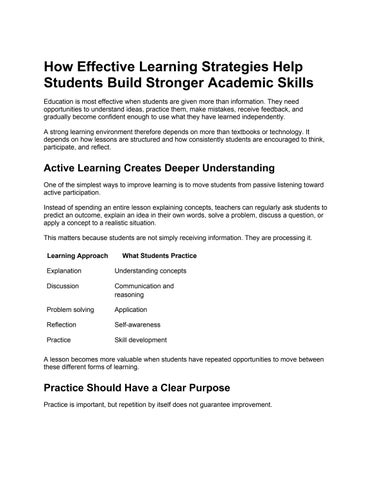
How Effective Learning Strategies Help Students Build Stronger Academic Skills Education is most effective when students are given more than information. They need opportunities to understand ideas, practice them, make mistakes, receive feedback, and gradually become confident enough to use what they have learned independently. A strong learning environment therefore depends on more than textbooks or technology. It depends on how lessons are structured and how consistently students are encouraged to think, participate, and reflect.
Active Learning Creates Deeper Understanding One of the simplest ways to improve learning is to move students from passive listening toward active participation. Instead of spending an entire lesson explaining concepts, teachers can regularly ask students to predict an outcome, explain an idea in their own words, solve a problem, discuss a question, or apply a concept to a realistic situation. This matters because students are not simply receiving information. They are processing it. Learning Approach
What Students Practice
Explanation
Understanding concepts
Discussion
Communication and reasoning
Problem solving
Application
Reflection
Self-awareness
Practice
Skill development
A lesson becomes more valuable when students have repeated opportunities to move between these different forms of learning.
Practice Should Have a Clear Purpose Practice is important, but repetition by itself does not guarantee improvement.