2026
PARAGON
vol. 47
3 | Paragon
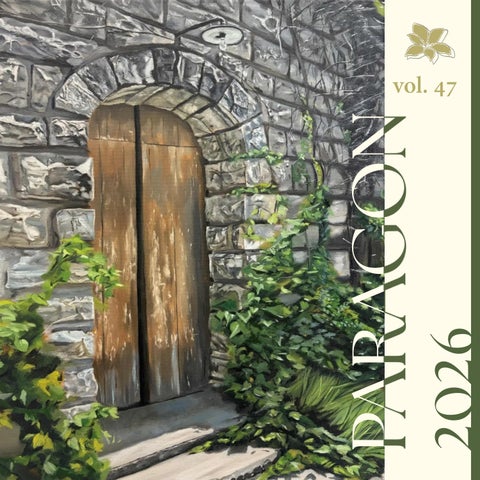
[front cover] Evergreen | Joshua Turner ‘26 | oil on canvas (16x20)
PARAGON vol. 47 | 2026 | Gilman School | Baltimore MD
Editors-in-Chief
Review Board
Matthew Chi Sam Nuermberger
Fela Adeyoju Matthew Chi Cian Connolly Cameron Donohue Liam Digges Christian Flaherty Zimmerman Graham Gill Liam Higgins Joseph Hutzler Sean Jiang Jack Mashaw Emerson Meerdter Luca Mulligan Sam Nuermberger Jay Salovaara Billy Smyth Joshua Turner Sahil Vesely Alex Zhao
Art Editor Joshua Turner
Literary Editor Jay Salovaara
Layout Editors Liam Digges Sean Jiang Luca Mulligan
Faculty Advisors Karl Connolly Johannes Lichtman John Rowell
Plant and Mail
1 Maybe a Good Fishing Spot
16
Falling Sunset
2 Quadrants
17
Marfa Moth Light
3 Savage
18
First Halloween
4 Hairless
19
Study of Horse
5 Soft Fuzz / Ducks and Beer
20
Orlando
6 Controlled Burn
21
Dodgers Game
7 [enter]
22
83 Awesome Food Moments
8 Endless Regurgitation
23
When Life Was Simple
10 Team
25
A Hello From Behind Bars
11 Anchor
26
Kambi Ebo
Sam Nuermberger
CONTENTS
Billy Smyth
Anders Martin
Gray Meerdter
Coco Bose
Nathaniel Krieger
Teo Garza
Cian Connolly
Kambi Ebo
Billy Smyth
Luca Mulligan
Sam Sinofsky
Joe Hutzler
Liam Digges / Suli Leheny
Donovan Herb
Sean Jiang
Leo Eiswert
Tony Romano
Kambi Ebo
UFO: The American Obsession 12 Horizon Blue
27
Distance
13 Smoke Break
30
Sparks
14 Emotions
31
Between the Drops
15 Falling
32
Suli Leheny
Holden Herman
Messiah Jews
LJ Richardson
Alex Zhao
Donovan Herb
Leo Romano
Nikhil Gupta
Coming/Going
33 Pronghorn
49
Between Two Worlds
34 Palm Waters
50
Oafer #13
35 The Cast Over the Magdalena
51
Coward
36 Heartbeat
52
Childhood Cereal
37
Future Promise
38
By Your Side
39
A Glass and a Garden
40
The Colors of Usiacurí
42
Gunpowder
43
Vivarium
44
Over the River
45
The Color of Quiet
46
Pandora
48
Tyler Linkinhoker
Jack Britton
Tony Romano
Rohan Vesely
Suli Leheny & Evan Choi
Liam Digges
Josh Turner
Dylan Moyar
Max Shein
Sam Sinofsky
Matthew Chi
Nikhil Gupta
Rohan Sinha
Josh Turner
Tyler Linkinhoker
Asad Zaheer
Max Shein
Matthew Chi
Bloomed after decades dormant. After dryness and heat. After the rainfall Blurred the atmosphere. The desert a sea of gold and pink and purple. Let sprout. Let butterflies and bees and hummingbirds. Let grow” —Paul Tran
From the Editors To everyone who submitted to Paragon, not just this year but every year I have been part of this club, I thank you so, so much. Art is a lonely and vulnerable thing, and it takes phenomenal courage to send us your work and believe that we will give it the eye it deserves. This issue, like every other, was built upon the courage and vulnerability of many young artists, and I hope you will grow to appreciate that. It has been an absolute privilege to serve as Co-Editor-inChief for my final year with the magazine. With that in mind, the theme of this issue was growth. As our period of whole-board review came to a close, the layout team felt an almost zeitgeist of this year’s Paragon emerging. Or should I say growing? The elegance of Paragon is that students have four years to be contributors. Looking back on previous issues, it is incredibly evident the way the Gilman arts community members have grown in their aesthetic across their time here. I am reminded of not only the creativity and talent the members of the Gilman arts possess, but of how much potential, time, and space for growth remains. I want my last issue of Paragon to embody the wild and unrestrained growth that has colored my time as a writer at Gilman. I remember entering the Upper School as primarily a fiction writer, before transitioning into creative-nonfiction, and now mostly poetry. Both as an artist and an editor, it feels my craft has begun to bloom—and what better way to symbolize that than by the magnolia trees blooming right outside here in Maryland? Huge thank yous to Sean Jiang for hand drawing the branch on the inner cover, and the branch in full bloom on the back, Liam Digges for the green and white magnolia flowers, and Luca Mulligan for help with the cover and overall design of the magazine. As you flip through Paragon volume 47, I hope all the green and flourishing things will help you recognize not just the current brilliance of our contributors, but the amount of growth it took for them to reach this point as artists. Matthew Chi Co-Editor-in-Chief In the foreword to an exhibition catalog of her work, Georgia O’Keeffe reflected, “I found I could say things with color and shapes that I couldn’t say any other way—things I had no words for.” This quote particularly resonates with me in creating this magazine. Every year, I am more and more blown away by the artistic talent and creative capabilities of my peers, and this year has been no different. This issue features a wide range of mediums, styles, and themes that push viewers to fully grasp the meaning of what art is and what it can be. I challenge you all to study each piece, create your own story out of it, discuss with others, and talk with the artist about their work. As an artist myself, it is the best feeling to receive a comment, compliment, or question about a piece I made. I am incredibly grateful to have served as Co-Editor-in-Chief with Matthew this year, and I cannot thank the other editors, Jay and Josh, as well as Mr. Rowell and Mr. Lichtman, enough for their help in creating this wonderful issue. I will always remember afternoons with the review board filled with laughter and thoughtful discussion, as well as editors’ meetings working together efficiently and diligently to make this final product. I am incredibly proud of how it turned out, and I hope it leaves you amazed, intrigued, and inspired. Sam Nuermberger Co-Editor-in-Chief
Plant and Mail | Kambi Ebo ‘26 | oil on canvas (20 x 16)
1 | Paragon
Falling Sunset | Sam Nuermberger ‘26 | marquetry (12 x 9)
2
Marfa Moth Light | Billy Smyth ‘26 | oil on canvas (20 x 20)
3 | Paragon
First Halloween | Anders Martin ‘26 | oil on canvas (14 x 11)
4
Study of Horse | Grey Meerdter | oil on canvas (16 x 20)
5 | Paragon
Orlando Coco Bose ‘26
My feet are permanently creased By the pebbles and stones Of the alley behind my home. A small yard with a white fence, Not picket, but plastic. Crab grass all over. My bike worn From all the rides On Lake Baldwin To my second home at Charlie’s. Lake Highland, The school I was just getting to love. I wish I had the time To love it even more. The catwalk on the second story Where my brothers and I fought, And I seemed to always be at fault. My parents telling me We are leaving Florida Through a game of charades That we won.
6
Dodgers Game | Nate Krieger ‘28 | acrylic on canvas (14 x 11)
7 | Paragon
83 Awesome Food Moments (ranked in order of importance) Teo Garza ‘26 last april, we watched I-83, holding cheesesteaks from Chuck’s. any high-action car chase hidden, by the post-apocalyptic overgrown green of Baltimore when summer gets close. im scared of girls, and I couldn’t enjoy the sandwich. only eight good bites, before the full feeling of waste attached to a $13 Hampden purchase joined the food at the bottom of my stomach. bruh. I hate spending money, and I could never stomach abandoned buildings. I was always afraid of falling through the thin, graffiti-covered plywood. I could see myself falling, cheesesteak in hand, onto the grim and green medley of needles and debris that we saw yesterday, walking in the grass along 83. in the air, falling, i would try to take a huge bite. …
8
after three months, and after two bites of the cheesesteak Diego made, I remembered that day, incredibly isolated from the summer camp simulation I was caught in. I had a lot of beef from (and with) the kitchen that summer. catching Mr. Moses stealing my coffee, every tiny thing there felt too big. my effoc: the pillar of a comfort routine I guarded fiercely, fierce enough, I jokingly told people: “I would fight Mr. Moses” Until Diego pointed out the hidden knife he always kept in his stupid novelty socks. apparently his name wasn’t even Moses… who rebirths themselves Moses when starting their stint as oldhead head-chef? I was not going to miss him. not like I’d miss getting tackled by the Oak kids a cabin too turnt, filled with nine-year-olds needing help with problems I had too by my last day there, I was fed up with it all and through the lingering and gross taste of goodbyes, I was looking forward to another cheesesteak by 83.
9 | Paragon
When Life Was Simple | Cian Connolly ‘27 | oil on canvas (18 x 24)
10
A Hello From Behind Bars | Kambi Ebo ‘26 | oil on canvas (20 x 16)
11 | Paragon
UFO: The American Obsession | Suli Leheny ‘26 | oil on canvas (24 x 30)
12
Distance | Holden Herman ‘27 | oil on canvas (36 x 12)
13 | Paragon
Sparks
Messiah Jews ‘26 “How did I do it?” How did we get so close from so far? Come captivated to what—no, who you are. You’re the kid who doesn’t speak up but still feels the ebbs. You stay to yourself knowing, knowing the best you is away from the light. Those sparks from outside would die to come inside. At your back door with me— but I know—I cannot come in. I know, oh I know. But, these sparks that I carry need you. You’re how the light glistens off these dewy poppies. The best thing to think but the worst to act upon. But for me, this weight is for the things we do for love—for me.
14
Between the Drops | LJ Richardson ‘28 | photography
15 | Paragon
Maybe a Good Fishing Spot | Billy Smyth ‘26 | oil on canvas (20 x 20)
16
Quadrants | Luca Mulligan ‘27 | photography
17 | Paragon
Savage | Sam Sinofsky ‘26 | oil on cavas (20 x 16)
18
Hairless | Joe Hutzler ‘27 | oil on canvas (28 x 22)
19 | Paragon
Soft Fuzz Over the Speakers | Liam Digges ‘27 | oil on canvas (12 x 36)
Ducks and Beer | Suli Leheny ‘26 | oil on canvas (12 x 36)
20
Controlled Burn | Donovan Herb ‘26 | ink on paper (8 x 15)
21 | Paragon
[enter] | Sean Jiang ‘27 | oil on canvas (36 x 36)
22
Endless Regurgitation | Leo Eiswert ‘26 | sculpture (7ft x 5ft x 4ft)
23 | Paragon
Endless Regurgitation Leo Eiswert ‘26
Feeding is circular; the rose – saturated in sludge. Empty red lungs. Must I now covet ambiguity? My vision’s grown grey. The machine churns. It cares not what it consumes. Emulsified colour pours from the mouths of the sated. I, too, cup my hands.
24
Team | Tony Romano ‘26 | oil on canvas (30 x 40)
25 | Paragon
Anchor | Henry Kunisaki ‘27 | sculpture (30 x 15 x 28)
26
Horizon Blue
E
Alex Zhao ‘26 zekiel Smith, 27. An office worker, contracted by the state. Each day he punches in at nine in the morning, and spends eight hours of his life in the office. Typing, stamping, and signing his way through mountains of papers, zoning out in between each click of a pen and mechanical ding of a typewriter. It is an altogether monotonous task, tedious to the very end. Names on papers blending with each other until he barely recognizes the language he’s reading. But it keeps him fed. And each paycheck brings him a step closer to retirement, one padded with state-granted benefits and financial security. He may not be draped in gold, but he isn’t starving either. Yet, to recognize that one is fortunate, one must know two things: That there are those better off, and there are those worse off. For Ezekiel, there is no need for him to strain his eyes in order to find the former - they are present everywhere. Billboards painted with sickening neon and magazines advertising colorfully delightful sins, heralded by picture perfect men and women wealthy enough to outclass the monarchs of old. The latter are harder to know. Not because they are hard to find, no, for one could always see piles of rags at parks and silent statues of still-living flesh shivering in the cruel winter nights. They are simply hard to stomach and thus hard to remember. Ezekiel is glad they are gone. Yet, walking to the station after punching out, he sees a straggler. In the crowd, this tower of filth and stagnation almost glows with failure amongst the ordinary workers. In its hand, a military helmet, filled with an assortment of loose change, half-eaten food, and pity.
27 | Paragon
He stops walking to his train, remembering a verse he once read. “A certain man was going down from Jerusalem to Jericho, and he fell among robbers, who both stripped him and beat him, and departed, leaving him half dead. By chance a certain priest was going down that way. When he saw him, he passed by on the other side. In the same way a Levite also, when he came to the place, and saw him, passed by on the other side. But a certain Samaritan, as he travelled, came where he was. When he saw him, he was moved with compassion, came to him, and bound up his wounds, pouring on oil and wine. He set him on his own animal, and brought him to an inn, and took care of him.” Ah. Yes. To love thy neighbour. Ezekiel, moved to some small kindness, flicks a coin toward the rags. It misses. Ezekiel never had a hand for sports. He leans to retrieve it, but recoils once he realizes what he’s next to. He steps back, and lets the thing grab it on its own. Ezekiel feels a twinge of guilt. Is he a bad person? The train whistle blows. Who cares. He walks away, flinging another wad of pity at the thing before stepping into his carriage. He finds his usual seat, nods to the man sitting across from him, and reaches into his jacket pocket, retrieving a neat brown bible, the leather on its front page emblazoned with golden letters, almost as if to underscore the importance of the contents inside. He begins where he left off, his eyes methodically plodding along each word, soaking in their significance. “There was once a man traveling from Jerusalem to Jericho.”
The train stops. Shouts from the carriage adjacent. A woman screams, her cries intertwining with the brutish yelling of a man. Every fiber in Ezekiel’s body begs for him to stand up, to help in whatever catastrophe is unfolding just several feet away. If it is two men, caught deep within the tender passion of a fist-fight, then he will intervene. If it is a madman, wielding a blade tinted red with crimson lust, then he will lie on the stretcher a hero. If it is a gunman, then the world will be a martyr richer. But he doesn’t. He looks at the man across, and sees the same story. The traveler’s eyes forced down, into a newspaper, rereading the same lines again and again, too scared to turn the page, lest the noise invite in the danger from next door. Better to lie in wait and hope the police intervene. “Everyone! Papers, now!” They all jump in their seats. A young man, dressed in a drab uniform of blue and red marches in. On his head, a field soldier’s cap, dyed a flashy blue instead of the usual grey, making him more visible to those seeking aid, and more importantly, to those seeking refuge from the confines of justice. What sets Ezekiel on edge isn’t any of those. He is used to seeing officers on the streets nowadays. Instead, it is what the man holds in his hand: A pistol. Something has gone wrong. Terribly wrong. The officer begins inspecting the papers of the man across from Ezekiel. Ezekiel looks outside to calm himself. Better there than anywhere within the train car. This time, instead of the mountains or lake that usually capture his attention, it is another stalled train. This time, going in the opposite direction. The cars are much less glamorous than his. Simply wooden planks roughly hammered onto support beams attached to wheels. Outside, multiple armed soldiers walk aimlessly, occasionally glancing into the cracks within.
He returns to his bible. “And he fell among robbers.” A wail snaps him back to reality and to the window. The soldiers have opened the crudely-constructed door to the train car. Except, it is not cattle which exit, but people. People dressed in everything. Rags, suits, pajamas, gowns, skirts, shorts. Everything. It is as if they have been plucked from their lives and dropped into this infernal train. He watches as the soldiers throw the people to the ground, his eyes entranced at the entire affair, moving everywhere as if to understand the reasoning behind it. He locks eyes with one of the people from the car. It is a man, dressed in a fine black suit, not unlike Ezekiel’s own. “Who both stripped him and beat him, and departed, leaving him half dead.” They say a man’s eyes are the doorway to his soul. If that is true, then this man has no soul. Ezekiel’s eyes flick away from the man, desperate to see something else, anything else. “By chance a certain priest was going down that way. When he saw him, he passed by on the other side.” They find their target on the yellow paint of the car. “CJ-87.” He recognizes that notation. He doesn’t even need to search his mind to recall its origin, for it readily presents itself, greedily devouring his attention. On paperwork, his paperwork, marked in a neat black ink. All numbers, letters used for all designations. All for train carts, no matter the model nor make. As long as it moved. This train moves. A gunshot. The man across from Ezekiel clenches the paper. “In the same way a Levite also, when he came to the place, and saw him, passed by on the other side.” 28
Ezekiel had read the reports. Like any good worker. He needed to know where they were going. The purpose. Why the number of carts needed, why the amount of diesel requisitioned, why the blueprints of carts, and the optimal storage volume for each. Except instead of using any standard form of measurement, bodies, deprived of the name human and denoted undesirable, were the metric instead. He had ignored it then. Anyone with half a brain could’ve solved it; yet willful ignorance kept the mind strong, and the heart pure of guilt. Even on the worst of nights, he could promise to himself the same promise his boss had told him, and the same promise the state had told his boss, and so on. That all they worked to accomplish, all they achieved, all they bled, was “for the greater good.” Now, it seems this ironclad promise has burst open, showering him in a rain of lies. His soul tears itself apart, thousands of papers, passports, and orders, consigning infinitely more to their deaths. Signed by the state, no, not by them, by him. His name, stamped in between neat black lines, and certified with his soul, in a blood red wax. A soldier shouts. A child has gone missing from the wretched bunch, letting his legs carry him away from the letters dashed to numbers, the people made soldiers, the train that ferries him to some faraway place, ready to cut away the human and leave behind the undesirable, forgotten bits. “But a certain Samaritan, as he travelled, came where he was.” Ezekiel realizes before anyone else does, where the boy is. “When he saw him, he was moved with compassion.” Bloodied, bruised, and covered in shame, the child hides in an opening between two rocks. When Ezekiel was small, he’d sit in there, waiting for sun to leak through. 29 | Paragon
He is no longer a child, and those rocks don’t fit him. “Came to him” He should report him. “And bound up his wounds” Yet he knows he cannot bring himself to. “Pouring on oil and wine.” The officer inspects Ezekiel’s papers. He watches as the soldiers give up. One less mouth to feed. The cattle train slowly departs, spewing its acridity into the serene summer sky. By this time, no one else notices except for Ezekiel. Their eyes refocused on their newspapers, their minds already forgetful of what occurred moments before. Ezekiel, however, tucks away his bible, his eyes poised outwards. He watches as the clouds pass, their white layers betraying a secret rain, soon to come. He watches the sun move over the horizon, slowly completing its walk around the sky. As he watches, Ezekiel’s mind churns. He will never return to his office, not even to collect his things. He will not explain to his boss nor his colleagues why. He does not need to. He will never spite those who find refuge amongst the shadows again, for he now realizes the price of malice. And perhaps, he will never act as an ordinary citizen again, for he now knows the pitfalls of complacency. He watches as a boy, scared yet tranquil, wriggles out the opening of two rocks, and for a moment, looks back at Ezekiel, and then to the eternal horizon. Breaking his stare, Ezekiel withdraws the bible from his pocket, and finishes the verse. “He set him on his own animal, and brought him to an inn, and took care of him.”
Smoke Break | Donovan Herb ‘26 | ink on paper (13.5 x 18)
30
Emotions | Leo Romano ‘28 | photography
31 | Paragon
Falling Nikhil Gupta ‘26 What if—when you hit the ground Your ego shattered wide Spreading across the floor in shards O-ho! You’ll need a cry Scouring to fit life back right a sharp piece snags your hand and gushing blood comes pouring forth Crimson stains the floor With all the pieces even still Broken as they lay You dare not try to stand again Without a mask to face Needing glue, you ask a friend who stooped down past your pride Piecing back together You Rising now, a man again Seeing through the cracks: A world that never had appeared Looking through that glass
32
Coming\Going | Tyler Linkinhoker ‘28 | photography
33 | Paragon
Between Two Worlds | Jack Britton ‘28 | photography
34
Oafer #13 | Tony Romano ‘26 | oil on canvas (24 x 30)
35 | Paragon
Coward | Rohan Vesely ‘26 | oil on canvas (40 x 30)
36
Childhood Cereal | Suli Lehenyi ‘26 & Evan Choi ‘26 | oil on canvas (23 x 60)
37 | Paragon
Future Promise Liam Digges ‘27 Snippets, I collect them Modgepodge magazine pride Ironed on as if a collage could feel finished– Others write pieces, I have pieces. There are thoughts that roll around my head like streetside crinkle cans, brilliant On TV; these ones drift in puddles, taking on water. Yet late at night, by cliche candlelight The paper is written, cat-whip yarn messily braided Into some snarl of cheap, flashbang meaning. Popup poetry, propagation in pride but you Promised me you will have a scissor sit down To snip out the good parts, even if they are only Coupons for a later date.
38
By Your Side | Josh Turner ‘26 | oil on canvas (30 x 40)
39 | Paragon
A Glass and a Garden
I
Dylan Moyar ‘26 was engaged in my usual activity at parties, looking for a good seat, when I ran into an auburn-haired girl with a glowing red face. She didn’t introduce herself, which I liked. She just grabbed my hand and led me out of the big hall into a smaller living room. At this point, I was wondering if something unexpected was going to happen to me, and whether I should do something about it. But I had overestimated her. We passed through the living room, between a green and an orange sofa, to the kitchen beyond. It was a clean kitchen with lots of glass cups and wine bottles lining the walls on the green marble wraparound counter. The light was soft and quiet. We took seats by the island. The girl, a comfortable distance away from me, let out a sigh that went through her whole body, top to bottom. She seemed to have forgotten me. So I stood, took a glass, and filled it in the refrigerator. “Could I have a glass too, please?” she asked. Her head was now settled in a nest formed by her forearms on the green marble. Though she looked sleepy, her voice was piercing and delicate, like a grown woman’s, like some highborn prodigy educated before the Internet. I gave her the glass I had just filled and sat back down. “Thank you.” A tone of surprise swinging in her voice showed me she believed I had originally risen for her, because I had sat back down. I got up again and filled another, taller one for myself. “Are you alright?” I asked. “Fantastic,” she said. “Just a little woozy, and starting to feel guilty and… What’s the word… apprehensive.”
“Is this your party?” “It’s meant to be. Well, I guess I put it together for all my friends, and their friends, and some people their friends are loosely connected to, so that they could have a good time after the dance and get blackout drunk. Anyway, now it’s their party. And I’ll just clean it up tomorrow.” She stared into her half-drained water glass, lifted it, and splashed the remaining liquid in her face. “I need a breather! Do you want to go outside?” I wasn’t sure if I did, but I felt some compassion for her, so together we went from the kitchen to a cold tiled room with boots and crocs littered around the floor. She slipped on a pair of knee-high black leather boots. I took the camo Crocs, which were big enough that I could kick them off and run if necessary. The garden was moonlit, and the wind was sobering. We sat beside each other on an ancient, mossy stone bench. “Do you feel better now?” I asked her. She turned toward me and smiled. The reflection of the moon in her eyes was brighter than the glint of the sun at noon, and I averted my gaze. “Yes, thank you.” She scooched an inch away from me, appraising me. “How did you end up here?” Did she mean at the party or on the bench? She had landed me on the bench. The former, then. “I like coming to parties.” “No, why really?” “I want to make sure my friends get home safe.” She leaned further away from me. “You know that’s a bad reason?” She said it tauntingly, slyly. 40
My skin prickled out of irritation. “I don’t.” “Everyone will get home safe one way or another. Having a watchful shepherd only encourages them to be even more careless. Even more careless sheep.” “I wouldn’t call my friends sheep.” “That’s right. Sheep aren’t innovative enough to position eight mixers on the blades of a ceiling fan and turn it on when a girl walks below it.” I grimaced, and laughed. She broke out into laughter too. We leaned in toward each other, looking at the lights of the house through the needles and shrubs. Tentatively, I wrapped my right arm around her shoulders. Like a warm rabbit, she nestled into my neck, and the tips of her ears poked my skin. We remained there. When you are that close to another person, you eventually become aware of their breathing, the in-and-out of their rib cage against yours. I noticed that whenever I breathed in, she sighed out. Whenever I exhaled, she inhaled. The wind chased the air into our lungs and moved dynamically between us, from one to the other, two still people warm in the garden at night. A majestic scream ripped through our night. Raucous laughter followed. “Let them be,” the auburn-haired girl, whose red hair was blowing against my face, said. “I’ll fix it tomorrow.” “You don’t know that they broke anything.” Another scream penetrated the night. “Let’s go in,” I said. Feeling authoritative, I stood up. She closed her eyes. I waited. She stood and led the way back to the house. At the back door, fingers on the steel handle, she craned her neck back at me, asking, “What’s your name?” “Aiden,” I said. “What’s your full name?” “Aiden Jackson.” She nodded and raised her eyebrows. “Goodnight, Aiden Jackson.” 41 | Paragon
The Colors of Usiacurí | Max Shein ‘26 | photography
42
Gunpowder | Sam Sinofsky ‘26 | oil on canvas (30 x 40)
43 | Paragon
Vivarium
After Stacie Cassarino
Matthew Chi ‘26 Before the snow fell, my body turned to ash. The smoke thickened and when it cleared, I was still a child. Out of the sky, a voice declared nothing happened and nothing did for years. So I believed it. As a boy, I was told flowers grow back after the snow melts but it’s just not the same. Even still, the rain was just a ghost of what fell the first time: a palimpsest of memories. After dark, fireflies died in the wind. Fireworks vanished beyond the horizon. Somehow, my grandfather could see them. He died too. All the while, I spilled moonlight between my fingers. I pieced grass into spades. I wandered the shore, collecting words. Words cannot be heard at a distance so I ran and ran and ran with a voice as hoarse as a martyr’s and don’t ever hesitate when someone is watching.
44
Over the River | Nikhil Gupta ‘26 | film photography
45 | Paragon
The Color of Quiet
T
Rohan Sinha ‘26 he café thrummed with its usual evening noise, steam hissing from the espresso machine, chairs scraping against tile, voices rising and falling in messy, human rhythm. It wasn’t quiet, but it was familiar. And that counted for a lot. Most days, I can’t help it; voices bombard me with color, regardless of what I want. Laughter curls in warm gold, irritation snaps in sharp, bitter red, and boredom bleeds out in slow, sluggish violet. It doesn’t matter what they say, but everything else. Volume, timbre, the catch in someone’s breath;, all of it folds together, layering like paint on a canvas. It’s taken practice, but I’ve gotten good at it, at seeing the world through my synesthesia. Sometimes it’s subtle, like a faint watercolor with quiet pools of distinct hues; other times, it’s blinding. So I keep my focus narrow—cups, counters, tasks I can control. People don’t notice the quiet barista. That suits me. I’ve misread colors before, stepped in when I shouldn’t have. They pulled back. I learned. I’m nineteen now, technically still tethered to a home I barely visit. My mom texts every Sunday—short check-ins about my hours, my meals, and the weather. We keep things surface-level; anything deeper starts to glow anxious, a sharp orange neither of us wants to touch. I left for school last year, paused after one semester “to save money,” and somehow never unpaused. Out here, nobody expects me to talk if I don’t want to. I can just… be. Blend in. Fade when the colors get loud. On my break, I’ll slip outside with my headphones looped loosely around my neck. No music, just the weight of them, cool against my collarbones, grounding me, a reminder that I can
always tune out if I need to. I’d just stepped back inside, wiping an evening mist from my sleeves, when a sound snagged at the edge of my senses. Not a voice, at first. A distortion. Black static, a low hiss slicing through the ambient warmth of the café. Wrong in a way that hits first and makes sense later. Most sounds carry color; even quiet has a shade. But this… this ate color. Scraped it clean. I turned. She stood at the register, new apron creased like she’d just pulled it from plastic. Shoulders drawn in, posture careful in a way real ease never is. She smiled at a customer, polite, practiced. And the static surged, crackling over the edges of her words as if her voice were being swallowed faster than she could speak. Nobody else noticed. Of course, they didn’t. She wasn’t loud. She kept a conversational volume, but her voice dripped with a suffocating kind of darkness, a darkness that insists. This wasn’t sadness, or fear, or any emotion I knew how to name. It wasn’t a flash of feeling. It was residue. Something that had settled deep and refused to move. I should’ve looked away. Started on the next order, wiped down another mug. But I couldn’t. Because for the first time in a very long while, I saw something that made the monotonous colors inside me shift. A living person wrapped in absence. And whatever that meant, whatever had carved that void into her voice… it wouldn’t stop pulling at me. “Jamie!” My name cracked across the room in a flash of burnt orange—sharp, impatient, too hot at the edges. I blinked, snapped out of the hollow drift of the new girl’s voice, and turned toward the drink station where Marla, our 46
was already jabbing a finger at a crumpled order slip. The hiss of the steam wand curled upward beside her like smoke from a warning flare. “Quad shot oat latte, table six,” she called again, already moving on. I wiped my hands on my apron and stepped back into rhythm. Cups clattered, steam rose in thin spirals, and a grinder buzzed like a distant bee. The place breathed around me, busy, livedin, ordinary. I reached for the next cup on autopilot, letting muscle memory take over. For a moment, everything snapped back into its usual shape. It’s part of why I took this job in the first place. I don’t love coffee—not really. But because places like this have rules: tasks with beginnings and endings, buttons that click the way they should, customers who leave once they’ve gotten what they came for. A life measured in espresso shots and stacked mugs is easier to navigate than one full of unpredictable people. Here, I’m useful. The routine keeps the chaos of other people’s feelings at a comfortable distance, held behind counters and the hum of machines. It provides something small but steady to ground myself with, like a stone in my pocket. And usually, that’s enough. I tell myself that wanting more would only knock things loose. Comfort isn’t the same as connection. But I’d trained myself not to notice the difference. As the café settled back in rhythm, her voice still clung to the edges of my hearing. She was speaking to a customer now, perfectly polite, even warm. It felt wrong to stare. But it felt worse to look away. I told myself it was the static. Her words hit the right notes. But the color—or rather, the absence of it—was chilling. Just a blanket of emptiness, threaded through sound. She handed back change with a gentle smile, gave a soft thanks, then turned away and tucked a strand of hair behind her ear. Nothing strange, not really. And yet the void wouldn’t 47 | Paragon
budge. Emotions shift—frustration spikes, relief softens, even boredom flickers—but it just hovered there, settled like mist that had nowhere else to go. “Who’s the new girl?” I asked quietly when Marla passed by again. She didn’t look up from the register. “That’s Clara. Just started this week. Be nice.” Be nice. Her words grated; I didn’t need the reminder. I wasn’t unkind, just… cautious. But I nodded anyway, mostly to end the conversation. Clara. A soft name. Light gray, with a faint shimmer of green under it, like eucalyptus.
Pandora | Joshua Turner ‘26 | photography
48
Pronghorn | Tyler Linkinhoker ‘28 | photography
49 | Paragon
Palm Waters | Asad Zaheer ‘28 | photography
50
The Cast Over the Magdalena | Max Shein ‘26 | photography
51 | Paragon
Heartbeat After Ocean Vuong
Matthew Chi ‘26 Smokestorm. Horizon. I never see these things. From so far away. It was. Like a monolith. All solid. I almost didn’t believe in movement. I press my forehead. To sand. And it’s all sand. Why am I so surprised. How many people starved. Before they knew. To eat. They said. The shoreline would swallow me up. It did. I was too sandlike. I’m selfish. Like that. I do not want you to pity me. You to leave me here. Listen. I used to. Be a noun. Now I am an ampersand. Et. Two things crushed. Into one. Binding you. & Me. We are brilliant. By definition. I fall short. Of my meaning. I love you. Is just to say. There’s so little time. So stay. Until the daydream. Until the horizon. Right. Now. We are elsewhere. The hole in the Earth. I made it. To hide my flesh. You made it. To find me. When will I grow tired. Of hiding. Of air. Never. Is a promise to be wrong. Please. Let me be wrong. Never. If I swallow. Your face. Will you. Never speak. Instead. Will you stay. Very still. I do not love you. Like that. Pretend I am lying. Say hopscotch. Say marigold. Say copper. Promise you will copper me. With something new. Surprise me. I am already surprised when you appear.
52
[Back cover] Swinging Away | Anderson Isaac | photography 54 | Paragon