North American Sweeper Magazine is published by Phoenix Global Media Inc.
Copyright 2026 by Phoenix Global Media Inc. All rights reserved.
CREATIVE DIRECTOR
Melissa Kennelly EDITORIAL MANAGER
Heidi Karpinich CIRCULATION
Noah Aiden
SUBSCRIPTIONS
$15.00
POSTMASTER:
Please
P.O. Box 235, Stockton New Jersey 08559
THE LEGENDARY POWER BEHIND SWEEPING
• Non-CDL version available
• Mechanical sweeping to handle heavy applications like millings
• Independent broom control for in-the-cut precision
• Single engine for fuel economy and less maintenance
• Simple start-up procedure with easy-to-operate controls
A. Sheerin, Ph.D. Creates System to Measure Local Water Quality Effects from Targeted Sweeping
Today, the street sweeping industry features fullydigital and all-electric sweeper trucks, a variety of off-the-shelf integrated business platforms with full-scope ERPs, including sophisticated CRMs, networked field devices, advanced telecom systems, and more, all adapted to better manage the delivery and performance of street sweeping services. So, the profession is ready for this next-level advancement:
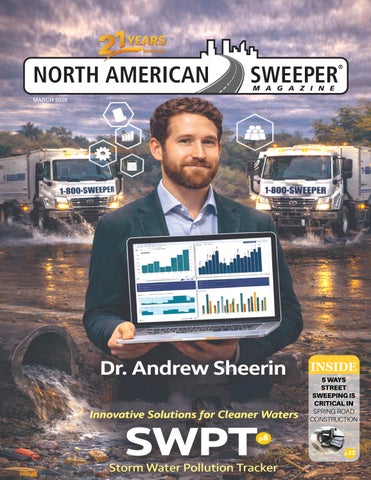
Enter Andrew Sheerin, Ph.D. in Environmental Engineering, with emphasis in data analytics software design. Dr. Sheerin’s dissertation focused on building prescriptive systems for custom street sweeping frequency management to protect local waterbodies through stormwater pollution reduction.
Sheerin’s current study entails the development of a readily replicable platform that integrates sweeping
service tracking data, service route characteristics, and weather prediction data, into a system for flagging key areas for sweeping to complement weather conditions for maximal effectiveness in improving water quality from sweeping based on changing conditions.
ENVIRONMENTAL ENGINEERING – ANALYTICAL SYSTEMS DESIGN
Sheerin started his academic journey in Systems
SPOTLIGHT
Dr. Sheerin’s dissertation focused on building prescriptive systems for custom street sweeping frequency management to protect local waterbodies through stormwater pollution reduction.
Engineering at George Washington University before beginning his graduate studies in Civil and Environmental Engineering at the University of Rhode Island (URI). The graduate program, funded by the Transportation Infrastructure Durability Center, is sponsored by the University of Rhode Island, through a USDOT grant. The Department was looking to bring in a curriculum around enhanced non-structural Best
SPOTLIGHT
Management Practices (BMPs). It was supposed to be a 2-year project, and the plan was for Andrew to complete a Master’s degree in that discipline. However, as he explains, things evolved and grew, and with a little convincing from his advisor, Dr. Vinka Oyanedel-Craver, he decided to go for the full Ph.D.:
“My dissertation started with the evaluation of nonstructural BMPs, the current State approach, and determining how that could be enhanced. Looking through all the available data on street sweeping across the country, there have been many great studies. We chose Warwick, Rhode Island as our research base, to focus on the effects of sweeping in urban areas.
We picked 8 sites, and did street debris collection
and water collection for examination of physical and chemical characteristics. I took more classes and furthered aspects of the study through those. I was fairly proficient with Python. Using Geographic Information Systems (GIS), I recognized the layering potential for geographic data sets and started to figure out methods for correlating GIS data with factors like accumulation rates, pollutant concentrations, and a range of others.
This is not new. People have linked land usage to heavy metals and nutrients in water before, but I wanted to incorporate the specifics of it into the analytical system to generate a clear picture of the compound impacts and the mitigation effects.
I created a map from existing modification solutions,
to defend enhanced street sweeping as a primary cause of reduced pollutants in water. There is a widely used model from the EPA. But it is limited in its ability to reflect sweeping routines, i.e., to program dynamic sweeping schedules based on irregular rainfall events.
INNOVATIVE GEOGRAPHIC INFORMATION SYSTEMS
The message is that urban sweeping shouldn’t be managed with a static approach, such as on a weekly schedule that doesn’t consider when it last rained and doesn’t maximize efforts to remove pollution that will otherwise go into waterways via storm drains. I endeavored to create a model to support my research, which took the form of the Storm Water Pollution Tracker (SWPT) software application.
The SWPT app functions with respect to weather forecasting data and a granular assessment of other environmental factors, such as adopted urban activity data sets. For example, land usage, tree cover, traffic volume, watershed characteristics, road slope, road roughness, curbing, and so on.
Initially, I developed the model based on local field data and did not plan to scale it out to other regions. It’s a big data model, encompassing broad categories of inputs, prioritizing, and optimizing these:
4 Simulation: We conduct simulations of the transporting of pollutants through rain events, and through sweeping, so we can track how much has been remediated by sweeping. The simulation module can produce metrics for summarizing street sweeping effectiveness, including stormwater pollution reductions.
4 Prioritization: The system determines how we prioritize routes based on geographic considerations. The determination can’t be to dispatch sweepers to go out based on rain
The message is that urban sweeping shouldn’t be managed with a static approach, such as on a weekly schedule that doesn’t consider when it last rained and doesn’t maximize efforts to remove pollution...
predictions alone. There must be logic to identify which factors should be included in the real-time decisional analysis, like residential or industrial locations, roadway usage levels at various times, trees, and a range of other inclusions. This way we can target specific areas and pollutants of concern. A priority score is calculated based on combined factors to assess high to low priority roads, depending on particular circumstances, including the kind and characteristics of the predicted weather event.
4 Optimization: The model system optimizes routes to maximize efficiency in collection of dirt and debris, in other words, to pick up as much as possible without wasting resources.
4 Python Programming: Python language enables programming for a vast range of purposes, including aligning timeframes and GIS data to improve analytical and interpretive efficiency.
STREET SWEEPING APP FOR ENVIRONMENTAL PROTECTION
When I wrapped up my dissertation, I started to realize the commercial application potential for this. Every kind of operation in the country with environmental
SPOTLIGHT
policies is always looking for relevant new enhanced BMPs, including state and municipal agencies, sweeping contractors, etc.
The goal of that program is to get ideas out of the lab and into the market. Its Patents2Products is an invaluable
public service and support structure for inventors.
The URI Research Foundation sponsors the URI RISEUP program. The goal of that program is to get ideas out of the lab and into the market. Its Patents2Products
is an invaluable public service and support structure for inventors. I am fortunate to have been a Patents2Products Fellow. They trained me through the entrepreneurial process to understand what it takes to start a business to serve the needs of communities who can benefit from the newly developed SWPT platform.
continued on page 14
SPOTLIGHT
To meet the goal of the CS=CW initiative, the work is being done to prove that street sweeping is a performative best practice street sweeping is a performative best practice and facilitates meeting regulatory requirements.
ENVIRONMENTAL MANAGEMENT PROGRAM DESIGN TEAM
I’ve been fortunate to connect with Seth Brown and Greg McPartlin, colleagues who had been working together on standardizing a nationwide sweeping program. The work is still in the early stages. The initiative is called Clean Streets = Cleaner Water (CS=CW). The goal of the initiative is to provide a regulatory framework for municipal, county, and state use to develop enhanced street sweeping management plans. The objective is to grow a nationwide program that can prove street sweeping is a cost-efficient and effective means of reducing stormwater pollution.
To meet the goal of the CS=CW initiative, the work
is being done to prove that street sweeping is a performative best practice and facilitates meeting regulatory requirements. I’m the Data Engineer of the project. I bring data together, connect the dots, and model the effectiveness of street sweeping in improving water quality. I’m working with organizations in the industry to help them research the exact benefits to water quality in relation to sweeping and frequency.
CS=CW is currently supported by 1-800-SWEEPER, NAPSA, NMSA, Schwarze, Stewart Amos, Elgin, and Tymco. The initiative model is very new.
CS=CW officially launched at the Sweeper Summit on November 5th, in Las Vegas. There are a few different paths we’re taking to get people on board. My part is harnessing and standardizing the sweeping data. All can contribute to that. 1-800-SWEEPER has operating data generated by their contractors, and the manufacturers have efficiency data from their equipment users.
We improve the modeling capabilities by plugging in the various data types with existing peer-reviewed studies and operating data sets. That yields more accurate data analysis for
His passion for
things and solving challenging
led him to the connection between urban street sweeping and water quality.
REGENERATIVE AIR SWEEPING !
Model 600® COMDEX ® Street Sweeper
Model 500x® High Side Dump
Mid-Sized Street Sweeper
Model 210® COMDEX ® Parking Lot Sweeper
SPOTLIGHT
SWPT to develop into more of a decision support package, with front-end tracking operators helping decide where and when to sweep and how to get regulatory credits. The SWPT website explains how the platform brings together weather data, sweeping performance data, and GIS data to trigger sweeping route service orders.
INSPIRED SWEEPING ROUTE TRACKING APP
BY A. SHEERIN, PH.D.
My home state, Rhode Island, is the second-densest state in population that is heavily centered on land-toocean interaction. I was born and raised in Newport, Rhode Island. It’s considered the sailing capital of the US. I’ve spent most of my life on a sailboat. I’ve been pretty intensely into sail boating and racing
since I was 6 years old. I spent most of my childhood in competitive sailing, in grade school, high school, and college. I’ve sailed on many dirty water bodies. So, the issue has always been extremely transparent to me. When I see a body of water impaired and am completely surrounded by it, it’s always there in my head. That experience and my passion for sustainability have inspired me to pursue this path to help improve environmental conditions on the water.
THE FUTURE OF SWPT AND THE POWER
SWEEPING INDUSTRY
From his start in Systems Engineering as a humble undergrad to a doctorate in Environmental Engineering, Andrew’s approach has been utilizing his research to solve problems. His passion for building continued on page 18
SPOTLIGHT
...by virtue of this incoming Ph.D. to the field, it’s fair to say that, technologically, the street sweeping profession has arrived.
things and solving challenging problems led him to the connection between urban street sweeping and water quality. His project progressed naturally to become the SWPT program. He says he’s simply now seeing how far he can go to help improve the industry and make a difference. He is using computers and science to make that difference.
So, by virtue of this incoming Ph.D. to the field, it’s fair to say that, technologically, the street sweeping profession has arrived. Let any who may view the everadvancing power sweeping industry as unevolving or stuck in old patterns take notice. The ambition of the field has been defined by relentless expansion, rapid tech growth, and intense commitment to solutions for improving sweeping performance quality. However, there has been, as Andrew notes, “little scientific methodology” in terms of fine planning for environmentally optimized sweeping schedules. Further, in the street sweeping component of the International Stormwater BMPs Database, a central repository for all BMPs and their impact on water quality, street sweeping is treated as a maintenance activity and not as a potential stormwater pollution
control method. To get it included in that base would be very significant. Dozens of studies over the past 50 years support that inclusion.
Andrew Sheerin emphasizes the objective of standardizing that data to produce a cohesive body of knowledge. He further sums up his environmental work as an effort to help manage water quality through keeping urban roads cleaner by using data and science to tell the story and answer the questions.
For more information about the SWPT program, you can email Andrew at asheerin@ fathomsolutions.dev, or visit the website. For information about CS=CW, you can email Seth Brown at seth.brown@ nationalstormwateralliance.org or Greg McPartlin at greg@urbanquarries.com.
IN THE NEWS
REIMAGINE TOUGH SWEEPING WITH THE ROAD SAVAGE™ GUTTER BROOMS
At Keystone Plastics, we’re always looking for ways to help our customers solve real-world sweeping challenges with solutions that deliver proven performance and reliability. That’s why we’re proud to introduce the Road Savage™ Gutter Broom . These brooms are engineered from the ground up to tackle the toughest sweep jobs with unmatched strength, durability, and efficiency.
...the work is being done to prove that street sweeping is a performative best practice.
Every jobsite throws something different at your sweeper. From heavy road millings and packed debris to overgrown vegetation and extreme curbside conditions, traditional brooms can struggle or require multiple passes which wastes time, increases wear, and drives up costs. Road Savage™ changes that.
BUILT FOR MAXIMUM PERFORMANCE
Unlike standard gutter brooms, Road Savage™ features cable-enforced bristles that bring heavy-duty strength where you need it most. These robust bristles
power through extreme debris in a single pass, saving time on every job and keeping your fleet moving. Whether you’re a municipal operator, contractor, or rental fleet, reliability and productivity matter. Road Savage™ delivers on both, with a broom designed to work as hard as you do.
DURABILITY THAT REDEFINES EXPECTATIONS
One of the hallmarks of Keystone products is durability, and Road Savage™ continues that legacy. Our cable-enforced bristles are built to withstand harsh environments, giving you a broom that lasts significantly longer than standard options. Fewer replacements means less downtime and lower material costs over time.
PRODUCTIVITY YOU CAN COUNT ON
Productivity starts with performance. With Road Savage™ , heavy debris and dense vegetation no longer require multiple passes. That results in faster sweep cycles, less wear on your equipment, and better outcomes for your customers. In environments where time and efficiency matter, Road Savage™ stands out as a reliable choice.
HERE’S WHAT SETS ROAD SAVAGE™ APART
4 Cable-enforced bristles for extreme strength and durability
4 One-pass performance through heavy debris and vegetation
4 Built to reduce downtime and replacement costs
4 Engineered for productivity in demanding environments
If you’re ready to take on the toughest sweep jobs with confidence, the Road Savage™ Gutter Broom is ready to deliver. Talk to your local Keystone distributor today and experience how this heavy-duty solution can elevate your sweeping results.
FOR MORE INFORMATION
Subscribe to North American Sweeper magazine for countless fresh tips on all facets of powersweeping business ownership, including all the specifics of operations, purchasing and maintaining sweeper trucks and parts, employee development, team leadership, administrative management, HR, marketing and branding, business leadership, and much more.
5 Ways Street Sweeping is Critical
in Spring Road Construction
Street sweeping involves more than aesthetics. For contractors, spring is a busy start time for many big projects, but salt, debris, and dust are stirred up from construction work. That makes street sweeping critical for maintaining a safe job site, and it also helps prevent tracking any debris out from work zones.
With an extensive dealer network, Elgin Sweeper
is able to support contractors in keeping jobsites clean and efficient. The team shared five ways street sweeping is vital in spring road construction cleanup. Control dust. Not only is dust from worksites a nuisance, but it also pollutes the air. Dust from construction sites can get stirred during spring showers and have the potential to get into people’s
With
an extensive dealer network,
Elgin
Sweeper is able to support contractors in keeping jobsites clean and efficient.
lungs and harm those with health problems. Street sweeping can help limit that risk using water spraying mechanisms that help minimize the dust.
Clear accumulated debris. By sweeping streets, particularly in the spring, it helps remove any buildup left over like snow melt and sand from the winter. Sometimes, winter presents itself earlier than
predicted, and waste like branches and leaves in addition to road construction debris are left behind. Beyond the seasonal needs, construction sites regularly have debris such as dirt, gravel, rocks, and other building materials. These materials are then tracked or spilled out onto surrounding roadways. This not only hinders daily operations but also poses
If streets aren’t swept during peak rain season, flooding is significantly more likely to occur as sewers and drains clog with debris. This
not only impacts homes and businesses, but construction sites and wildlife.
safety hazards for workers, residents, and commuters. Regular sweeping prevents the accumulation of debris, ensuring a clean and safe working environment. It is critical to do so to stay as clean as possible between construction projects.
Help prevent flooding. If streets aren’t swept during peak rain season, flooding is significantly more likely to occur as sewers and drains clog with debris. This not only impacts homes and businesses, but construction sites and wildlife. Spring is one of the busiest times for road construction, and that mixed with the amount of rain that accumulates, makes sweeping crucial to help prevent flooding.
Comply with regulations. There are both environmental and safety regulations that street sweeping can help accommodate. Sweeping the streets regularly can help prevent pollutants from exiting the construction site and therefore prevent fines from local authorities.
Save costs. Investing in street sweeping may seem like an additional expense, but in the long-term, it helps save money. A regular street sweeping schedule prevents debris and dust buildup in construction sites, which might otherwise cause wear and tear on heavy equipment and machinery at the site leading to costly repairs and replacements.
With an array of sweepers suited for construction sites and industrial applications from the Elgin Waterless Pelican for superior dust suppression to the Elgin Broom Bear with its unparalleled efficiency, Elgin Sweeper supports contractors for the life of the sweeper.
JOB OPPORTUNITY MECHANICAL ENGINEER Kent,
WA.
Design mechanical and structural components for street sweepers. Design hydraulic and electrical systems that integrate with commercial, on-highway vehicles. Design non-metallic parts manufactured in fiberglass, PE, or ABS material. Investigate, refine, and test regenerative air systems for street sweepers. Create detailed component part and assembly drawings. Create Bills of Materials (BOM) for design layout and assembly drawings. Provide technical support to clients regarding products. Coordinate fabrication personnel to produce functional prototypes and fixtures for new designs. Analyze and test prototypes to ensure they meet quality, safety, and performance standards. Create technical documentation for production and customer use. Create Engineering Change Orders (ECO) and perform any related changes to the designs and drawings. Define technical specifications that meet performance, cost, and quality requirements. Program and troubleshoot components using Controller Area Network (CAN) communication protocol. Manage Enterprise Resource Planning (ERP) records including item attributes, Bill of Materials (BOM), and manufacturing routings. Direct fabrication and installation activities to ensure products conform to engineering design specifications. Participate with cross-functional teams, across Alamo Group companies, on large scale projects such as product transfers and electrification initiatives. Provide technical knowledge to purchasing teams to help identify strategic vendors and source materials. Collaborate with vendors to provide drawing clarification, part specifications, and resolve quality issues. Plan, prioritize, and organize work using task management software.. Bachelor of Science degree in Mechanical Engineering required. Ability to communicate effectively with clients, work collaboratively with team members, and draft technical documentation required. Ability to wear protective equipment including steel-toed shoes required. Position requires 24 months’ work experience as a Mechanical Engineer, including minimum 12 months’ experience in each of the following: using SolidWorks software to produce detailed 3D and 2D design drawings; reading hydraulic & electrical schematics to troubleshoot hydraulic & electrical circuits; designing fiberglass, PE or ABS parts; maintaining, testing & analyzing regenerative air systems; using Standardized Manufacturing Process to push new & existing designs through cross-functional workflow that drives downstream customer processes; using Oracle JDE to manage ERP records; facilitating Requests for Quotes and supplier collaboration reviews with vendors; and using Asana task management software to schedule and track work. Occasional weekend or evening hours. Domestic travel to company and client sites throughout the United States required approximately once per six months for several days to provide technical services. Relocation will not be necessary for these trips. Salary $87,110/year. Send resume to tohlgren@nitehawksweepers.com
NAPSA Best Practices: Mastering Tasks with Smart Organizational Tools
The technological evolution of the powersweeping industry over the past decade has been exhilarating to watch. Every modern system has been integrated to increase efficiency and quality. In keeping with those advancements, at the recent 15th International Sweeper Summit & Expo in Las Vegas, the NAPSA Best Practices conference series featured a roundtable entitled Mastering Tasks with Smart Organizational Tools.
The goal of the popular NAPSA roundtable discussion was to help street sweeping contractors build skills in utilizing business technologies and proven management strategies to optimize management practices.
The peer-to-peer group discussion was hosted by Nikki Serafino, Co-Owner, Air Sweep, West Springfield, MA. The participants examined technologies and methods designed to ease the burden and increase the effectiveness of managers who juggle extreme volumes of daily responsibilities.
MASTERING TASKS WITH SMART ORGANIZATIONAL TOOLS
The goal of the popular NAPSA roundtable discussion was to help street sweeping contractors build skills in utilizing business technologies and proven management strategies to optimize management practices. Serafino moderated the group discussion about strategizing to streamline workflows and using advanced tools for increasing efficiency and productivity.
STRATEGIES FOR INCREASING MANAGEMENT EFFICIENCY
The Summit roundtable discussion led by Serafino covered “conceptual tools” as well as physical management tools (such as business software), involving ways to handle large daily workloads more efficiently and minimize friction across processes.
Some key principles discussed included:
4 Categorizing Tasks: Recommendations featured organizing responsibilities into categories. For example, Operations, Sales, Accounting, HR. This approach prevents excessive switching back and forth between task types throughout the day, and that helps reduce the mental fatigue that often results from working that way.
4 Leveraging Time: Recommendations included identifying tasks within the categories that can be delegated, or even automated, to free up leaders to make the best use of their time and their employees’ time too.
4 Streamlining Workflows: Recommendations
Everyone is different and has different operations. But, generally, if you’re looking to utilize upgraded systems and methods... use technology, even if it costs you a little money. That way, you’re not spending 70 hours a week at the office.
featured assessing current processes to identify points of persistent friction and implementing practices to alleviate it for improved efficiency and convenience in day-to-day operations.
NIKKI SERAFINO, INDUSTRY EXPERT, ON USING TECHNOLOGY TO BOOST EFFICIENCY AND PRODUCTIVITY
Nikki offered perspective on the opportunities for greater management success in the industry: “Everyone is different and has different operations. But, generally, if you’re looking to utilize upgraded systems and methods to be more efficient in your daily management across the board with back office
BUSINESS CORNER
Managers should be using technology to leverage their time in the day so they have more time to do what they really need to do, and delegating things that other people can do, and leaving other tasks to automated systems that can do those things.
functions, like human resources, scheduling, etc., use technology, even if it costs you a little money.
That way, you’re not spending 70 hours a week at the office. Just leverage tech to manage your work more conveniently and efficiently, even with phone apps that let you do many functions without having to get anyone else involved.
When asked what takeaway message she would hope that attendees of the roundtable discussion would apply in their businesses, Nikki emphasized, “I would want people to see the benefits of using technology in managing their companies and learn practical ways to use digital and organizational tools to stay on top of their various responsibilities.”
She continued, “In our case, we’ve grown. What worked for the smaller team does not work for the much larger one. You must have systems in place if
you want to grow without pain. We needed to get rid of the paperwork between drivers and the office, for better organizational efficiency and to avoid having a gap or lost job occur because it wasn’t on a scheduling platform. We needed to utilize digital tools for that, and to have everyone speaking together in the same business language, manage the checking of vehicles before and after shifts, manage payroll, scheduling, use forms, sign off on jobs, etc.”
The roundtable focused on essential strategies for operators who must fill multiple roles. Nikki stressed, “Managers should be using technology to leverage their time in the day so they have more time to do what they really need to do, and delegating things that other people can do, and leaving other tasks to automated systems that can do those things.”
PROVEN TOOLS FOR SWEEPING OPERATIONS TASK EFFICIENCY
Additional topics of high interest related to the NAPSA Best Practices learning program and similar industry educational sources include introductions of some proven tools for sweeping business management tasks, such as:
4 Administrative Management Software: Implementing a proven business platform such as Asana, Clickup, Hubspot, Monday.com, enables teams to manage clear roles, manage project tasks efficiently, and track processes and deadlines.
4 Operations Software: Using industry-specific software tools such as ArcGIS Street Sweeping Solutions or SMART System for fleet management and maintenance tracking.
continued on page 32
BUSINESS CORNER
We started going to the Summits in 2015 and have gone every year since then. In addition to the expo and presentations is the education you get from speaking with other company leaders across the country...
4 Advanced Telecom System: Even using the Sweeper Summit App for real-time updates to Expo activities, peer networking events at the venue, etc., is a good intro to relying on technology to make communications much more convenient and efficient.
4 Prioritization Methods: Implementing techniques such as the Eisenhower Matrix to separate the truly urgent tasks from the important ones, and from those that can drop to lower priority status, helps managers quickly determine which chores to do, delegate, drop down the list, or delete.
UNSURPASSED LEARNING OPPORTUNITIES FOR SWEEPING BUSINESS LEADERS AND TEAMS
The extensive NAPSA learning sessions series is a part
of the larger annual 2-day Sweeper Summit, which also features an enormous equipment expo and abundant networking and business socializing events. The next Sweeper Summit will be held in November 2026, in San Antonio, TX. The schedule of learning events will again be focused on helping increase operational and administrative efficiency in the industry.
Nikki encourages all sweeping business owners and managers to attend upcoming Sweeper Summits to benefit their operations, “We started going to the Summits in 2015 and have gone every year since then. In addition to the expo and presentations is the education you get from speaking with other company leaders across the country who are willing to share their experience. That’s a big part of it — to learn
what’s working and not working for people and how to eliminate pain points that all or most of us probably have in common.”
For information about upcoming NAPSA Best Practices learning sessions at the 2026 Sweeper Summit, you can call 419-464-0133, or email info@sweepersummit. com, or visit sweepersummit.com. For information about Air Sweep, you can call 413-739-2605, or visit airsweep.com.