
Associate Broker
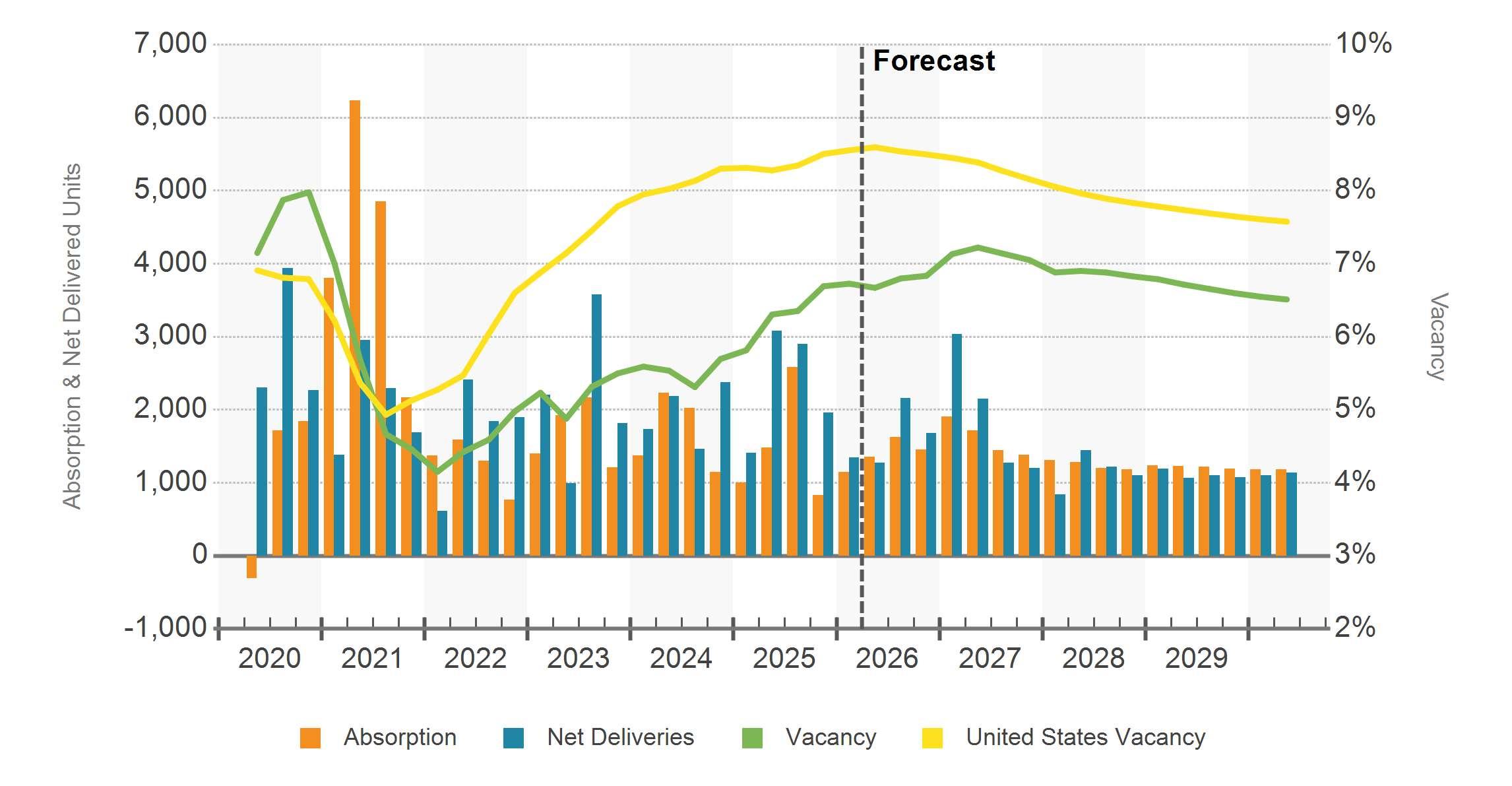
Consistent leasing activity over the past year has been met with periods of increased supply, creating slight upward pressure on the vacancy rate in Boston's multifamily market. This dynamic has moderated rent growth. With the supply side stabilizing, the market is forecasted to maintain healthy fundamentals.
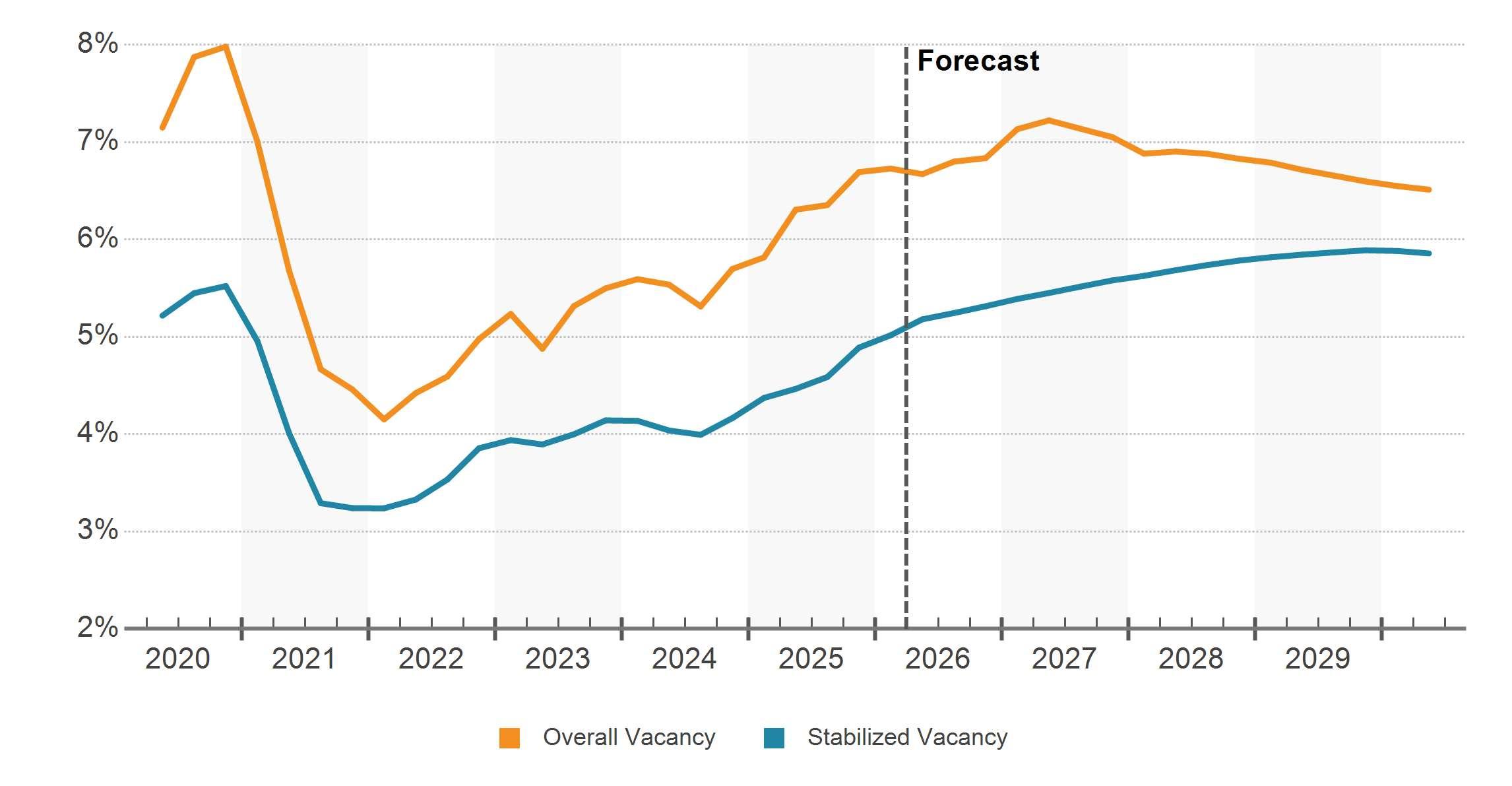
The market's vacancy rate has averaged 5.9% in the past three years, including the current rate of 6.7% during 2026Q2. Over the past year, Boston's vacancy rate has changed by 0.9%, driven by a strong net absorption of more than 6,000 units and 9,200 units of net deliveries.
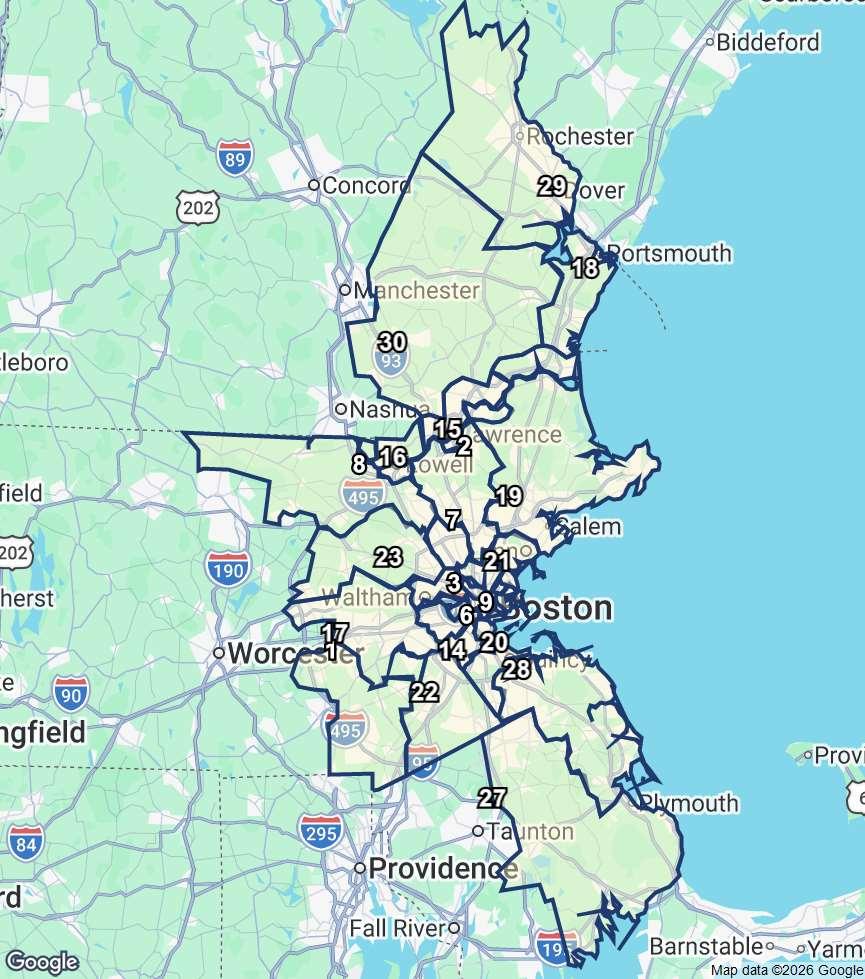
Absorption has been strong in the urban Everett/Malden/Medford/Melrose and suburban Route 1 submarkets with significant new supply additions, resulting in robust leasing activity for newly delivered units. Additionally, demand has held up in several suburban areas south of town, including Roxbury/Dorchester, South Shore, South Plymouth County, and 495 South. Demand has also slowly rebounded in South Boston/Seaport. Other urban neighborhoods, such as Downtown Boston and Harvard/MIT, have seen weaker demand, as have the suburbs of Route 1 South and Lowell/Dracut.
Market performance remains strong in comparison to national trends. Across the United States, vacancy is still up over 300 basis points since 2021Q3, resulting from blistering supply growth in many Sun Belt markets that experienced strong in-migration figures during the peak pandemic months. Boston's vacancy rate has historically averaged around 100 basis points below the national level, but the gap has widened to roughly 200 basis points and is expected to remain wide for some time,
even amidst steady ongoing deliveries.
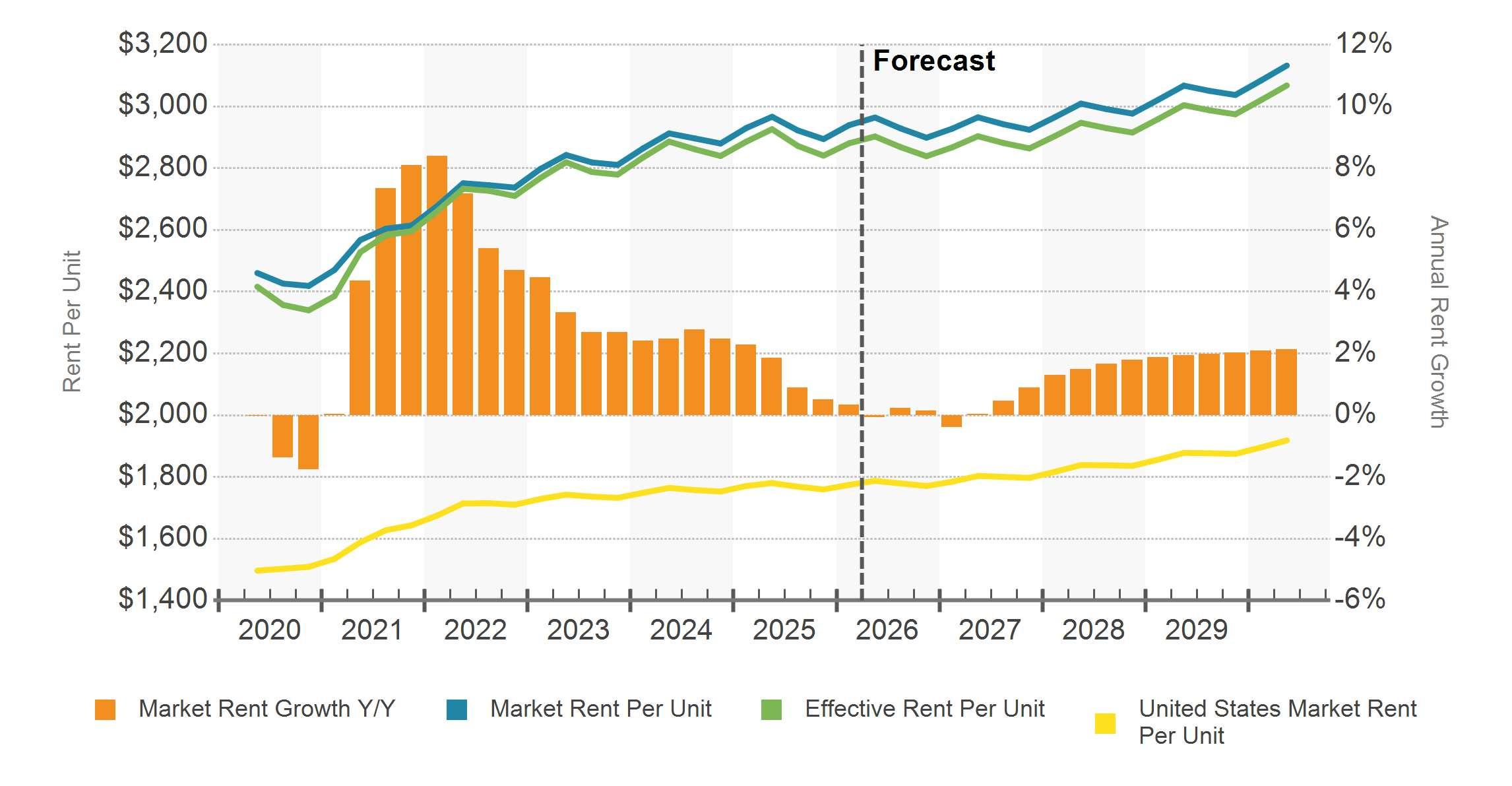
Year-over-year rent growth has receded from a near double-digit rate in early 2022 to 0.4% as of the second quarter. Despite this, growth is expected to gain momentum towards the end of the year and currently on par with the national rent growth of 0.2%.
Overall construction activity continues to slow, now at its lowest point since 2021Q3 and is well below the 10-year average. Between 2023 and 2025, the region added an average of nearly 8,500 units a year and is forecast to decline 6% year-over-year by year-end 2026. Even as the pipeline thins, Boston continues to outpace other markets in the Northeast such as Philadelphia.
Sales activity has remained resilient, posting quarterly gains in the fourth quarter of 2025 and reaching its highest level since 2022Q2. Investors have shifted focus to multifamily assets compared to office and life science properties across Boston in recent years, which accounted for 43.6% of all property sales in 2025.
The base case scenario of the house view forecast calls for the vacancy to climb slightly, with leasing slightly overwhelmed by new supply and subsequent rent growth staying above the 1% mark by the end of the year. The risks to the forecast appear to be evenly balanced. Economic growth projections for this year have moderated due to macroeconomic policy initiatives that could constrain business growth. That said, leasing in Boston is robust, and while a major hiring slowdown could damage this progress, the region remains a tier 1 market that will continue to draw residents and businesses. Vacancies are projected to peak around 7.5% by mid-year.
At 6.7% during the second quarter, the apartment vacancy rate in Boston has changed by 0.9% over the past year, resulting from a small spurt in new supply and steady demand. Although elevated from its trough in 2022Q1, this is not far from its three year average of 5.9%, and is well below the national figure of 8.1%.
Boston's vacancy rate has historically remained below the national average. Notable exceptions over the past decade include the period between 2020Q2 and 2021Q2, marked by pandemic-driven out-migration from cities and increased movement to Sunbelt markets. Since then, Boston has stabilized, with local population growth surpassing the national rate, and 2024 posting the largest population gain since the early 2000s fueled by international immigration and slowing domestic outmigration. By year-end 2025, population growth had slowed by more than half on a year-over-year basis, driven by reduced net migration from international countries and slower natural population growth.
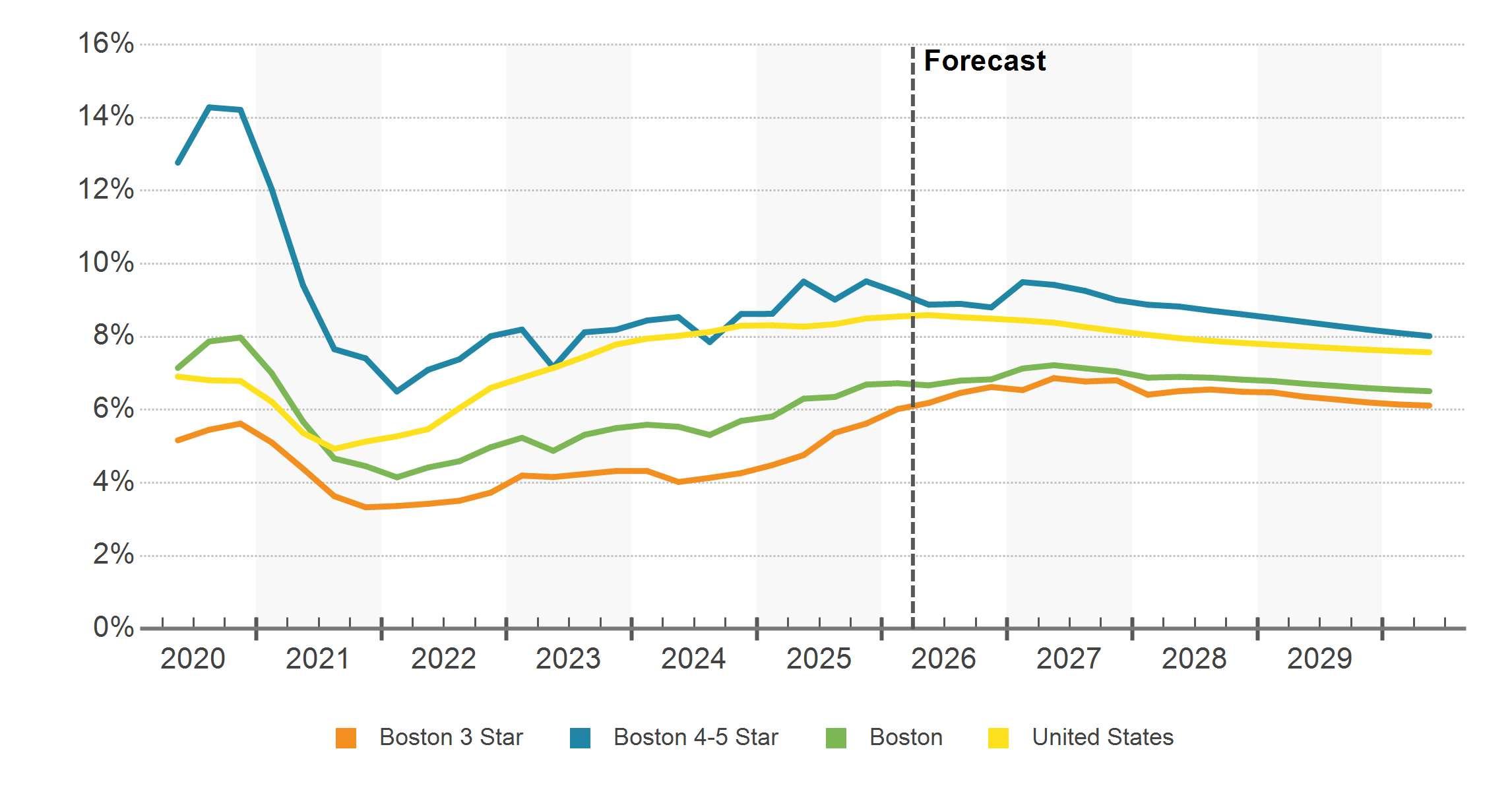
Vacancy differs broadly across building rate market segments, and the effects appear to be occurring at different times. At about 9.2%, vacancy at 4 & 5 Star properties is elevated when compared with the middlemarket units and is above the three year average of 8.8%. It is forecasted to rise above 10% towards midyear as new supply delivers to the market.
Meanwhile, vacancy at 3 Star properties has risen by around 200 basis points since 2024Q2 and now stands at 6.0%, above its three year average of 4.9%.
Vacancies in this building rate will likely continue to rise through the next two years, potentially driven by some trade-outs to higher-end offerings with concessions. While the vacancy gap between 3 Star and 4 & 5 Star properties has typically been about 500 basis points, it is currently over 300 but could narrow over time if trends hold.
Just across Boston Harbor from downtown Boston, the East Boston/Chelsea submarket stands out for its recent strength in demand. Residents have absorbed nearly 6% of its inventory in the past 12 months. Vacancy has also decreased from a three year high despite a large influx of deliveries in 2024, but a recent pickup in construction starts in the fourth quarter of 2025 suggests vacancies will rise in the coming quarters. The adjacent Everett/Malden/Medford/Melrose submarket has also attracted strong demand, with 12-month absoprtion of 5% of the respective inventory amidst a heavy construction pipeline.
Boston's fundamentals remain strong, despite national economic factors that could flow demand as postpandemic supply settles. The region is expected to maintain its traditional position of strength among major markets.
OVERALL & STABILIZED VACANCY
VACANCY RATE
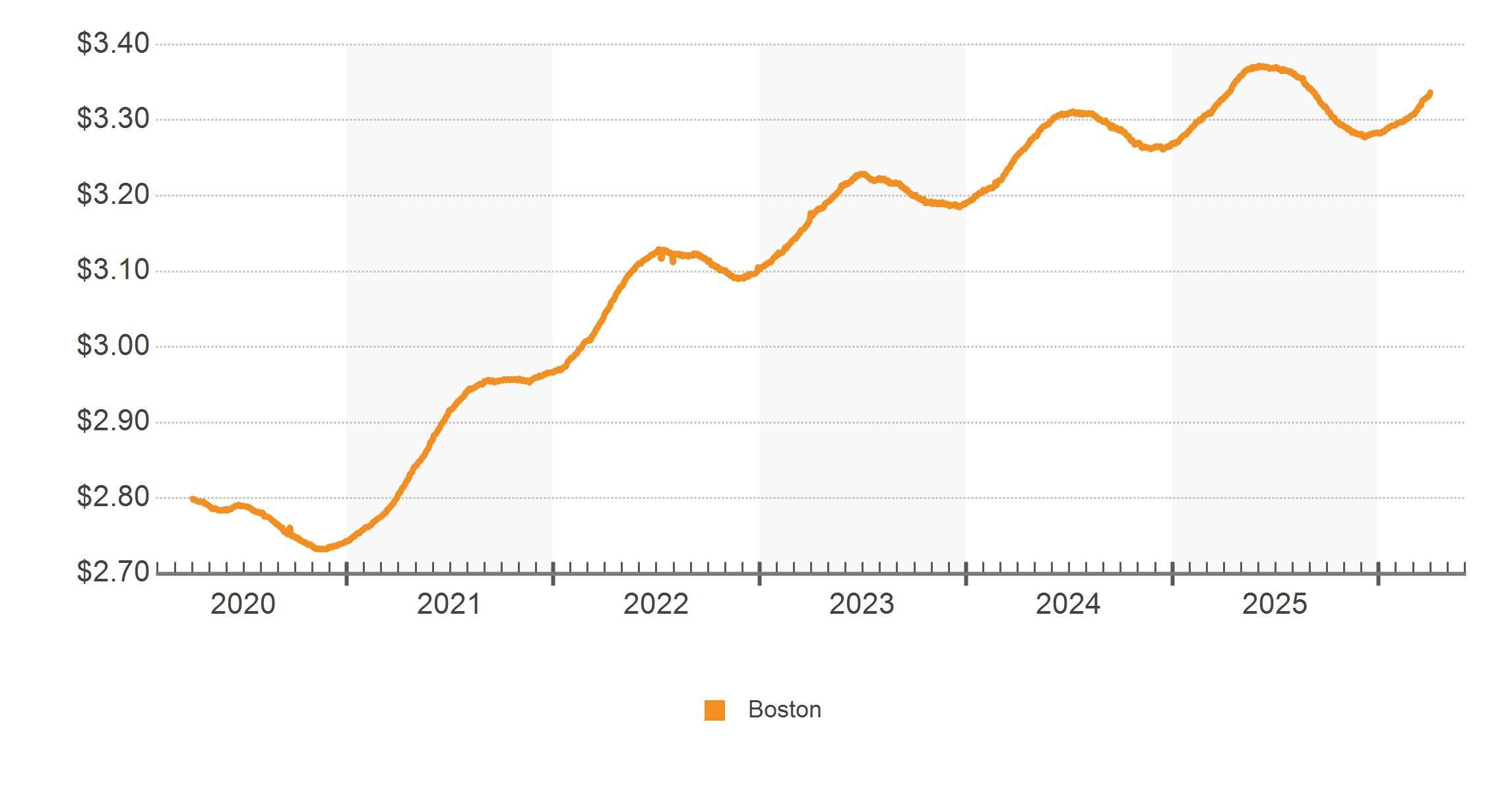
Currently at 0.4%, year-over-year asking rent growth in the second quarter works to regain the three-year average of 2.2% for the Boston metro. This local growth outpaces the national figures three-year average of 1.0%, which is currently a mere 0.2%. It is also good enough to rank in the top half among the country's top 25 multifamily markets by unit count, another sign of Boston's resilience. Local rents are expected to decline slowly the first two quarters of 2026, then pick up more steam towards the end of the year as the supply pipeline exhaustion helps tighten the market.
Market rents in Boston average $2,940/month, ranking among the highest in the nation and trailing only select metro areas in and around New York City and the San Francisco Bay. At this level, consistent annual growth around 3% is attractive to investors, even if the growth rate trails the national average by a minimal 10 basis points. Over the past decade, rents have consistently increased year-over-year, with the exception of the 12month period following the onset of the COVID-19 pandemic, when major cities saw accelerated migration away from urban areas.
Rent growth has slowed more sharply at 4 & 5 Star properties since early 2022, a reflection of supply delivering while demand is still normalizing from its drop in 2020 and rapid snap back in 2021. The effect should continue, with growth at the top end of the market remaining somewhat muted through 2026.
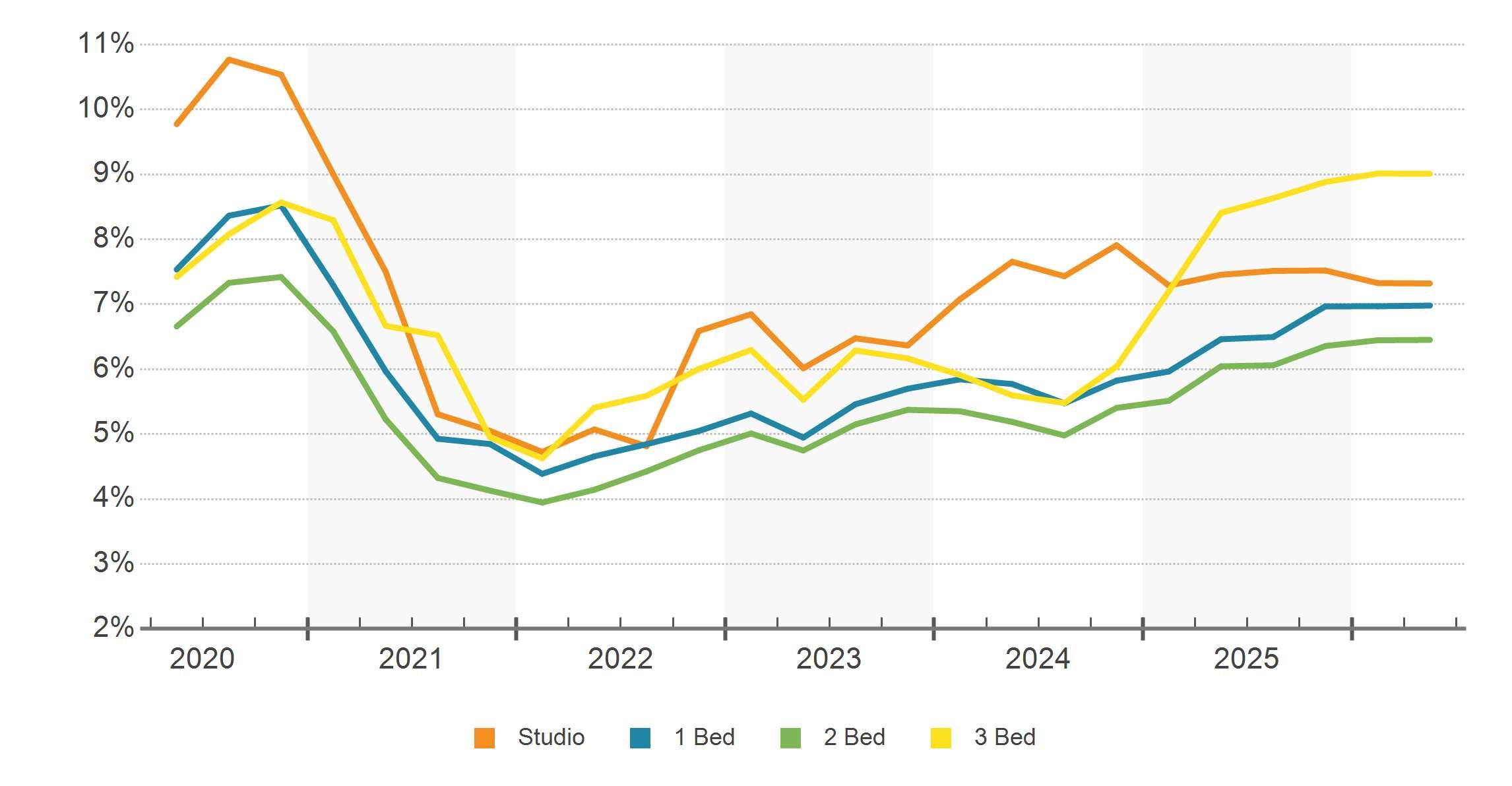
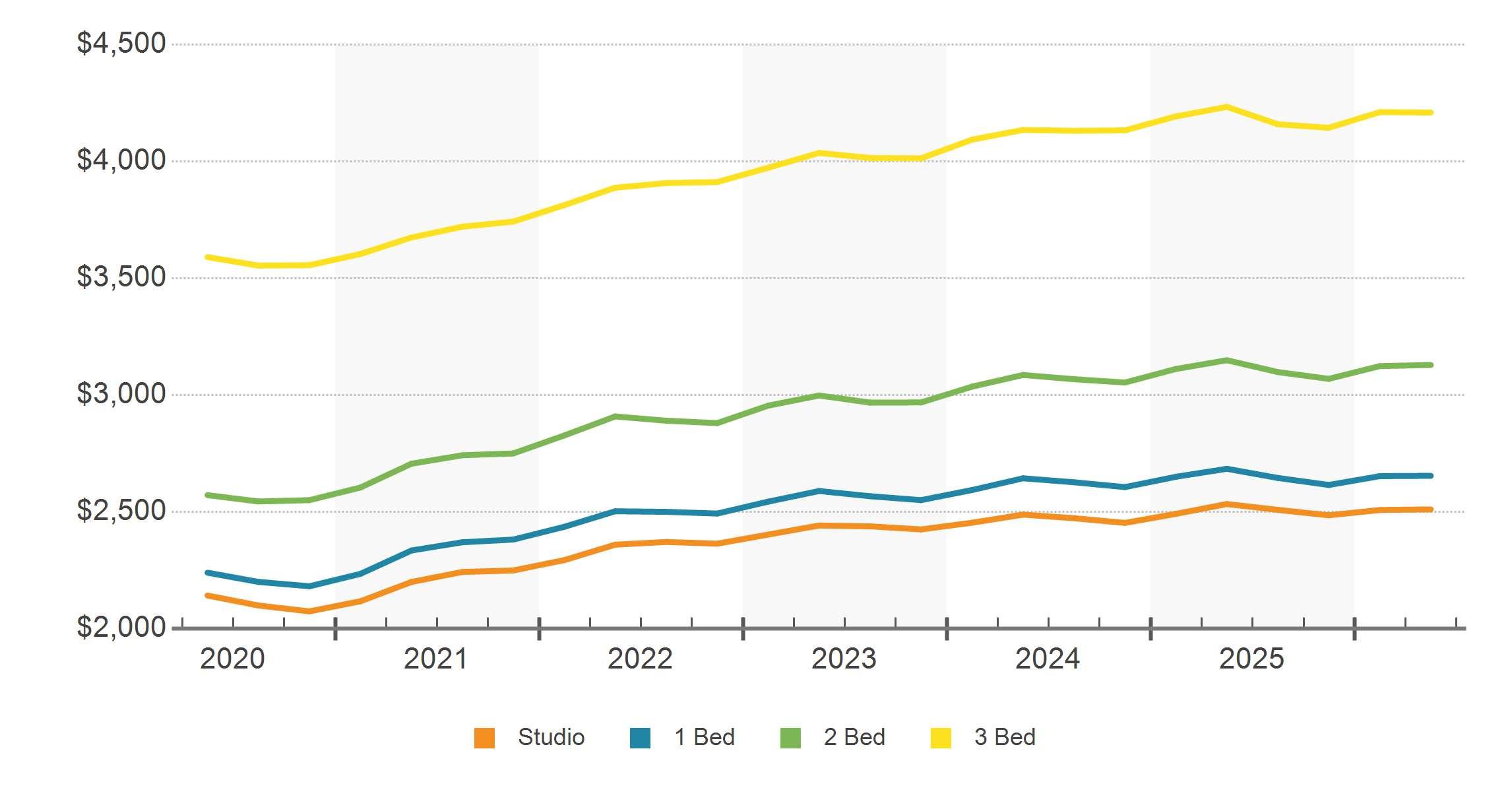
By bedroom size, rent growth moderated across all unit types year-over-year. In 2025, studio rents of $2,490/month, recorded the largest increase at 1.5%, while one, two, and three-bedroom units experienced growth less of 0.5%, reflecting the modest rent gains compared to stronger increases in prior years.
Several submarkets across the size spectrum have performed relatively strongly over the past year. Rents have grown more than 2.5% year-over-year in the northern suburbs submarkets of Lowell/Dracut and New Hampshire Beaches, and between 2.5%-2.0% in the more urban South Boston/Seaport and East Boston/Chelseas submarkets. Meanwhile, rent growth has under performed in submarkets like 93 North and Roxbury/Dorchester by more than -3.5% each.
Overall, Boston appears poised to maintain its place as a steadily performing major market. However, observers are closely watching the ongoing political situations. Following Mayor Michelle Wu's reelection, housing remains a key policy focust, with Wu continuing to advocate for local authority on rent stabilization. State law has prohibited rent control since 1994, and a ballot initiative to put the question directly to voters failed in November of 2023. Market conditions have taken much of the sting out of higher-rent bills since the measure was initially put forward early in 2023. A statewide ballot initiative for November 2026 proposes capping annual rent increases at the lower of CPI or 5%, which could impact Boston's rental market if passed.
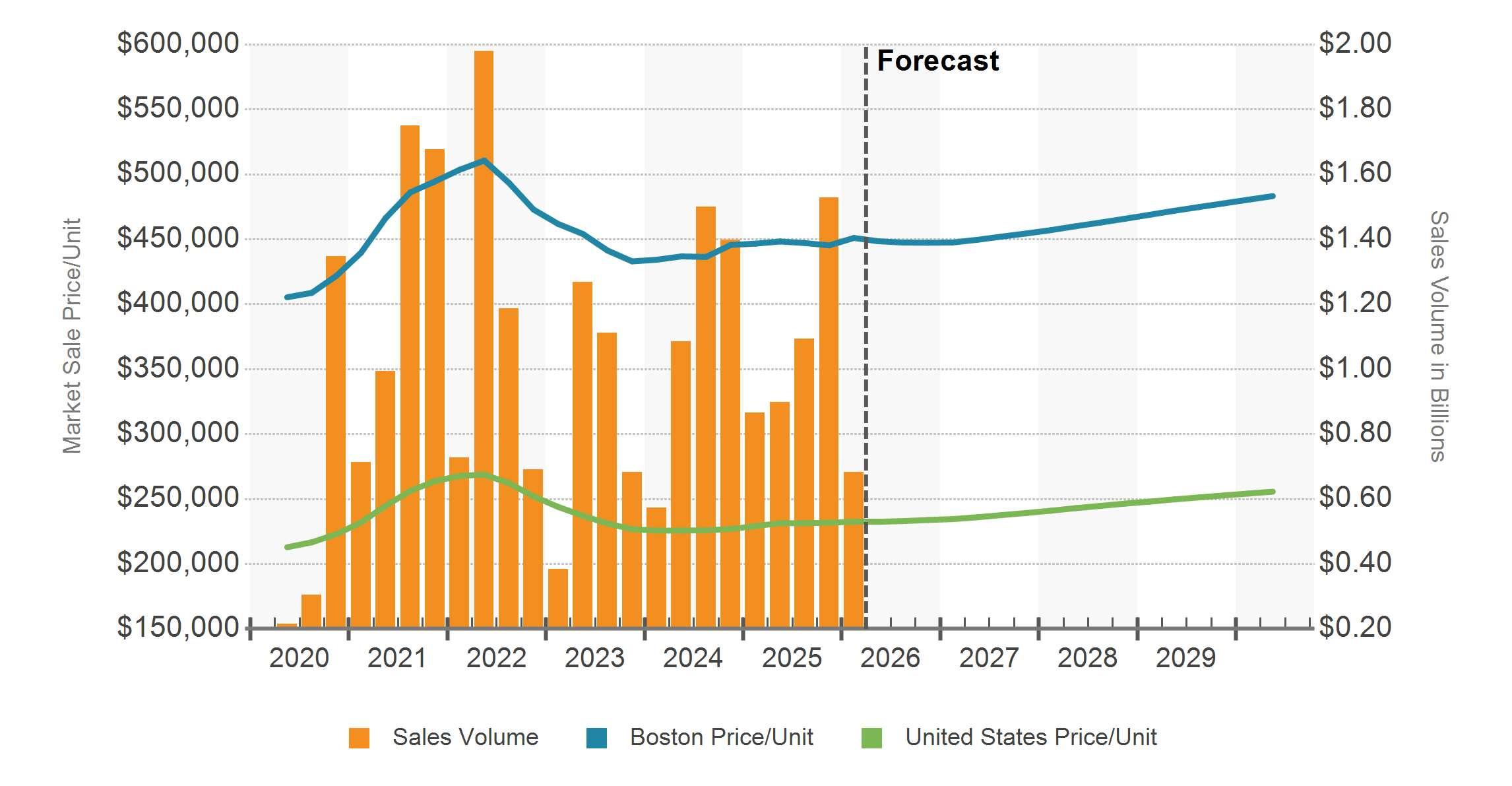
Over the past year, 15,896 units of inventory sold in Boston, accounting for $4.2 billion in sales volume. This compares to the three-year average annual inventory turnover of 12,528 units, and average annual sales volume of $1.1 billion.
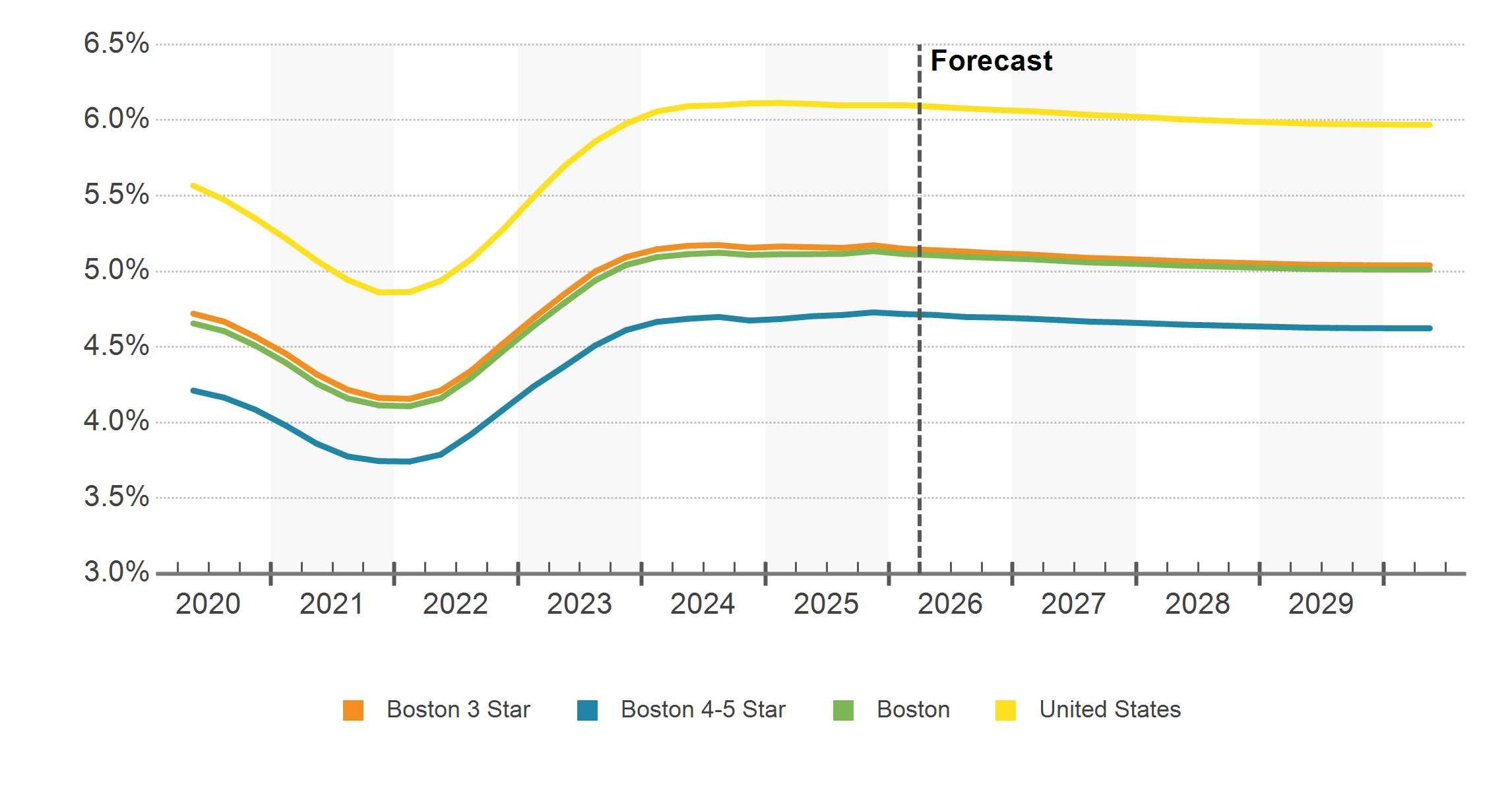
Estimated multifamily market pricing in Boston is $450,000/unit, which is a 93% premium higher than the National average of $230,000/unit. By building rating, pricing is approximately $580,000/unit for 4 & 5 Star properties, $400,000/unit for 3 Star assets, and $310,000/unit for 1 & 2 Star buildings. The estimated market cap rate for Boston multifamily is 5.1% compared to the National average of 6.1%. Cap rates have held flat around the 5.1% mark since the beginning of 2024, reflective of elevated investment demand, stable occupancy, and limited pricing distress.
During the capital markets surge that began in 2021, when interest rates plummeted and investors rushed into apartment deals, Boston's trailing 12-month figure exceeded $6 billion by early 2022. Apartment property sales declined through early 2024, driven by rising interest rates from inflation, increasing vacancy levels, and reduced availability of capital. However, Boston's recent low mark for the trailing 12-month total in 2024Q2 of $3.3 billion didn't drop below the COVID-era low of $2.5 billion. In fact, since the Great Recession of 20072009, each of Boston's low activity marks has increased as capital flows adjust. Trailing 12-month sales volume has since rebounded nearly 32% from the postpandemic low in 2025Q4 and achieved a quarterly high since 2022Q2.
This multifamily sales momentum is impressive, especially considering sales volume for apartments at the national level corrected well below COVID-era lows during 2024Q1. At that point, U.S. trailing 12-month activity sank to $85.5 billion, a 26.3% decline from the $116 billion traded in 2021Q1.
While deal flow in Boston is increasing, there has been more movement in the buyer mix and the type of properties transacting over the past few years.
Public and institutional buyers were involved in sales, accounting for 48% of transacted volume in the past three years. Private capital remains especially active, accounting for nearly half of buy-side volume but only 26% of seller volume over the same period, shifting in favor of institutional and public sellers. The median sale price for the trailing four quarters amounts to $2.3 million, which compares to an average sale price of approximately $13.6 million. This delta speaks to smaller private buyers accounting for more than half of deal volume, but public and institutional players remaining active on a smaller number of large deals.
The 4-star recapitalization of the Altitude Apartments in Malden captured the largest deal in the last 12 months. Acquired by local private investor Rockpoint, the 919unit property traded hands for $268 million (approximately $291,620/unit). Walker & Dunlop, LLC will act as the lender on a $189.1 million loan.
In turn, more recent deals were mostly concentrated in suburban submarkets. Two of the other largest deals in 2025 occurred in the fourth quarter led by Atlantic Management Corporation's purchase of the 588-unit Royal Crest Estates North Andover in North Andover for $254 million (approximately $431,970/unit), and GID Investment Advisor LLC's acquisition of the 352-unit Windsor Marina Bay in Quincy for $205 million (approximately $582,390/unit).
Despite the ongoing headwind sales of local office and life science assets, multifamily transactions will continue to serve as a harbor for capital in 2026. Multifamily sales have accounted for over 40% of total asset sales throughout the Boston region over the past three years.
MARKET CAP RATE
COMPARABLES SUMMARY STATISTICS