

What’s NEXT Pitch
Graphic by Lylah Pouratian
Entrepreneurs Honored
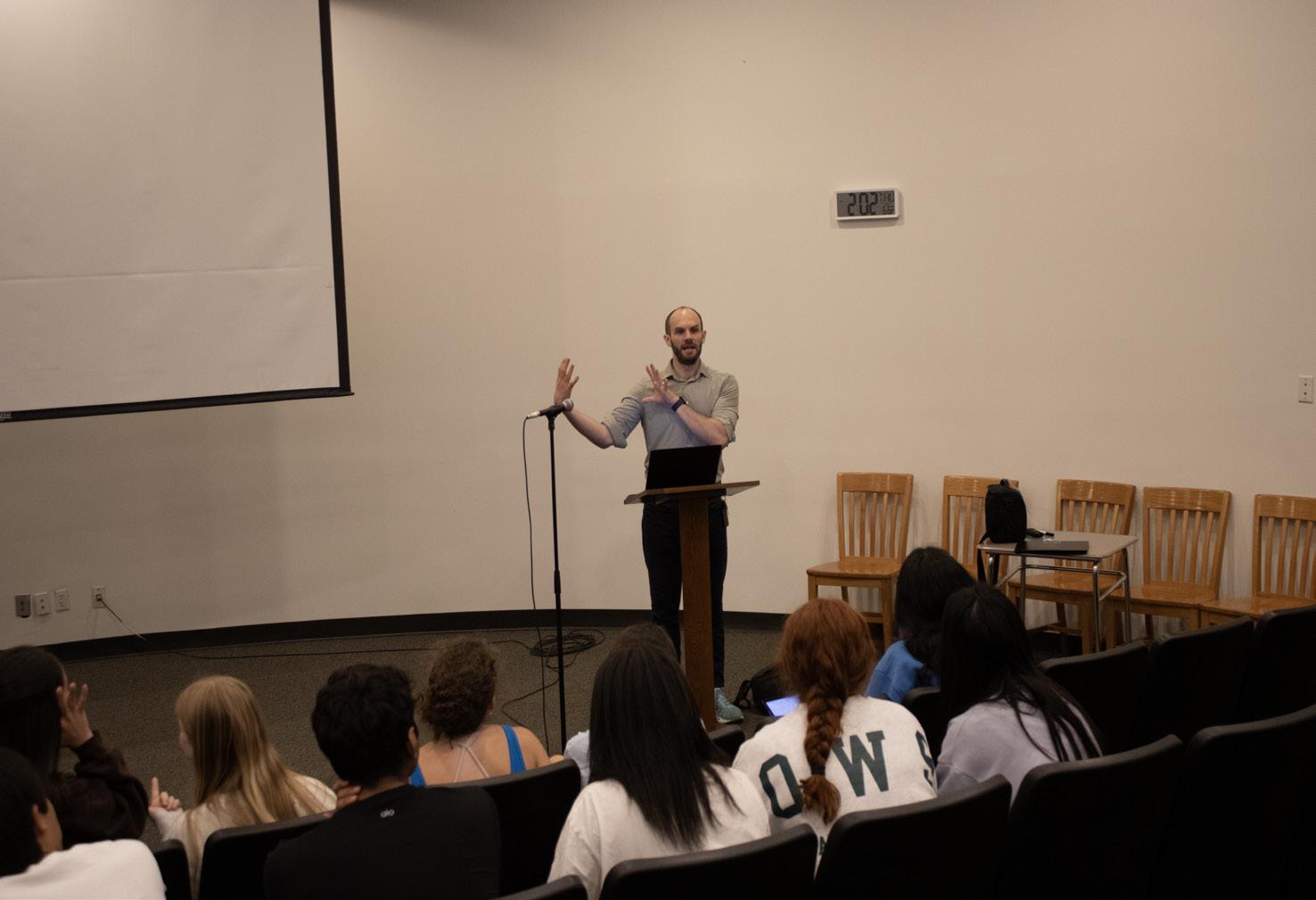
Sophomore Samaira Panjiar’s journey as a rising entrepreneur began unexpectedly at an Upper School assembly in January during a presentation by Director of Design and Innovation Matthew Abbondanzio.
Abbondanzio was inviting students to participate in the What’s NEXT Pitch competition, an event he had launched at Greenhill two years ago. Abbondanzio had first developed the idea while running the design program at La Jolla Country Day School in Southern California, creating a high school version of the popular business reality series “Shark Tank,” in which aspiring entrepreneurs compete for funding by pitching their product or business idea to a panel of judges.
Seated in Rose Hall in the January assembly, Panjiar felt a flash of inspiration as Abbondanzio explained the Greenhill competition that was about to get underway.
“I thought, ‘Oh my God, I’m going to do this,’ because I wanted to become a millionaire,” Panjiar said.
After the assembly, Panjiar emailed Abbondanzio saying she wanted to participate in the pitch and started working on her project outside of school. Her work paid off on April 28, when Panjiar received $1,000 in funding for her project – a more affordable and accurate volleyball line-calling system – and mentorship from the chief marketing officer of Pepsi Co. Foods U.S.
Five other individuals or partners who were finalists along with Panjiar also received funding: junior Ahan Jain, $5,000 for development of an affordable water filter for use in underprivileged areas of India; freshman Anvitha Sagi, $5,000 for development of a new type of shoe that grows with a child to reduce family costs; juniors Ibrahim Abdelfattah and Leo Meyer, $4,000 for development of a more advanced heart monitor; juniors Raghav Metta and Vikram Sampath, $4,000 for development of an inventory management system using AI to enhance the business prospects of online commerce startups; and freshman Austin Yao and seventh grader Rebecca Yao, $3,000 for development of a high-tech lost-and-found system for schools and other institutions using QR codes.
Entrepreneurial Dreams
Abbondanzio’s vision for the pitch competition drew on his own youthful experiences as an aspiring entrepreneur.
“I remember when I was a student, I would have all these ideas and never had any money or mentorship to move them beyond the baseline level,” Abbondanzio said.
When brainstorming her idea, Panjiar looked at the world around her and settled on an issue that she knew firsthand.
“I tailored it to volleyball because I am always frustrated during my own matches and practices when someone calls a ball out when it was clearly in,” Panjiar said. “I know that problem is prevalent in me and my team’s life, so maybe it would be prevalent in others’ [lives].”
Panjiar’s commitment to the project was evident from the beginning, according to sophomore Kellyn Lonergan.
“She was super excited about the idea she came up with and was very committed to getting it done,” Lonergan said.
Once settling on an idea, Panjiar came up with a problem statement: How can we make line calls more accurate during volleyball matches or practice to ensure a fair outcome?
Panjiar then started doing research about what is already in the marketplace and what has been patented. She noticed issues like high prices that put line-calling systems beyond
the means of most club teams and technological weaknesses with sensors unable to tell the difference between a ball or a player’s foot.
“I wanted to look at their issues and solve them with my project design,” Panjiar said.
Panjiar’s idea, “Sidelyne,” uses four sensors that border a volleyball court and another sensor on top of two magnets to determine if a ball lands inside or outside the court. Panjiar also created a prototype of an app that directly transfers data about the line calls to phones and other devices.
Abbondanzio became a source of support for Panjiar, listening to her pitch and providing feedback.
“I think she’s got a really good idea and she’s clearly passionate,” Abbondanzio said. “Our conversation was really around two things: One was the technical challenges and solutions; two was the marketing and sales channel.”
Finalists
At the beginning of this year’s What’s NEXT Pitch competition, individuals and partnerships pitched 19 projects. Those 19 were pared down to six finalists in an initial round of pitches. On April 28, final pitches were made to a panel of local business executives and entrepreneurs.
“Pitch night is very important because in the world of AI you have to know how to generate your own wealth and your own solutions,” Abbondanzio said.
Panjiar said her first-round pitch was nerve wracking, as she wanted to memorize what she said instead of speaking naturally. But after the initial round, she focusing on explaining her ideas more conversationally to stay within the time limit.
“It was a lot easier to just go off of the top of my head and explain what I had learned,” Panjiar said. “After [the initial] pitch off, I learned it was better to just speak about what I knew.”
Panjiar says this experience helped her feel more confident and better prepared her for the final round.
“She was working on her pitch a lot, almost every Hornet Block,” Lonergan said. “She would meet with [Abbondanzio] often and whenever we would FaceTime to do homework she was working on it at home.”
For her final presentation, Panjiar created a presentation on Canva that she projected. This included a background slide explaining club volleyball and the college recruiting process, a problem statement, description of her app, market analysis of her competitors, product impact and a future timeline.
“They are judged purely on the requirements of the pitch [including] did you clarify a problem statement, did you do research to back it up, do you have your solution and financials,” Abbondanzio said.
The finalists were able to request funding and mentorship from the judges, helping them develop their projects. Students could request a specific mentor from the judging panel, while some judges offered to mentor specific teams. The development money provided to the finalists was donated by families and businesses connected to the Greenhill community.
Filled with confidence after her success in the pitch competition, Panjiar plans to use her seed money to build a working prototype of her project.
“I want to keep expanding it to more clubs and eventually reach larger organizations like USA Volleyball,” Panjiar said. “If it gets to that level, it could be used in major tournaments.”


Celebrating Prom
Greenhill Goes Global
The campus hosted its annual Greenhill Goes Global event on May 1, allowing Lower School students and families to celebrate cultures from around the world. Community members volunteered to set up booths representing their culture, heritage and experiences, sharing traditions with peers through this event.
Jazz Night
Greenhill’s annual Jazz Night took place May 8 from 6:30 p.m.-7:30 p.m. The event featured the Upper School Jazz Band performing a selection of pieces for members of the community.
Hornet Hustle
The seventh annual Hornet Hustle brought together current, past and future Greenhill community members for a 2-mile run and walk around campus on May 9. Hosted by the Greenhill Alumni Board, the event continued a tradition centered on school spirit, connection and engagement across generations of the school.
Senior Sunset
Seniors gathered on May 18 on Brinkmann Field for Senior Sunset, an end-of-year tradition that mirrors the Senior Sunrise event that took place on the first day of school. The Sunset event offered the Class of 2026 a chance to reflect and celebrate together as their time at Greenhill comes to an end.
College Application Workshop
Greenhill’s annual college application workshop for juniors will take place on Thursday, May 21 from 9:30 a.m.-12 p.m. The program will include an overview of the Common Application website and time for students to receive advice from college counselors.
Yearbook
The release of this year’s 2026 Cavalcade yearbook will mark the publication’s 75th anniversary. The special edition highlights the history of Greenhill alongside this year’s events and student life. Yearbooks will be distributed on the final day of classes, allowing students to spend time signing each other’s books.
Victoria Gonchar, Natalie Ledyard
SERVING UP SUCCESS: Sophomore Samaira Panjiar, left, was among the students receiving financial support and mentorship for their entrepreneurship projects at the annual What’s NEXT Pitch competition.
Photo courtesy of Greenhill Communications
Heinrichs Returning to Seattle
Kaitlyn Yoo
After two years at Greenhill, Upper School Dean of Students George Heinrichs will be returning to Seattle. The move is the result of Heinrichs’ wife accepting a new job in Seattle, their home before moving to the Dallas area in 2024.
Heinrichs says he is still weighing plans about his new life. In addition to family time, new hobbies and possible writing projects, he intends to take a break from education after 12 years as a teacher and administrator.
His departure was announced March 26 in an email sent by Head of Upper School Trevor Worcester. In it, Worcester recognized the work that Heinrichs has done in his brief time at Greenhill.
“George has positively reshaped the role of the [Upper School] Dean of Students,” Worcester wrote in the email sent to all Upper School students and families. “His commitment to relationship-building allowed him to quickly garner the trust and respect of students, faculty and families.”
Heinrichs first came to Greenhill after Dean of Students Jack Oros announced his retirement. When Oros retired, his job was then split between Heinrichs and Upper School Dean of Student Life Kira Rivera.
In his role Heinrichs has worked to reinforce the norms and values he envisioned for the Upper School, primarily through the Honor Council.
“I had been told that there was a feeling of a lack of consistency when it came to conduct issues,” Heinrichs said. “And I’ve always wanted it to be a system in which we can all agree that the core values matter to us and that when you violate them there’s a consequence.”
As part of the changes he brought, Heinrichs says he prioritized publicizing the values and norms central
to Greenhill. This way, the Honor Council can help students who are struggling, rather than serving merely as a punishment system, according to Heinrichs.
Senior Lily Marshall, one of the council’s student chairs, praises Heinrichs’ success in this goal.
“Honor Council now has a much more formalized and consistent process,” Marshall said. “I think the council has been able to support more students who are struggling academically and create a more honorable and fair environment for all students.”
Because of the steps Heinrichs has taken to bring this environment to life, students like Marshall say they feel discipline is now taken more seriously. Heinrichs adds that he hopes this dynamic continues even after his departure.
“I think that we’ve started to move in a good direction now,” Heinrichs said. “But the change requires the entire community from Lower School to Upper School to align, and that’s going to take a while for students to continue to learn those lessons.”
Still, the two years Heinrichs has spent improving school culture have contributed to a kinder and more honest environment, according to Worcester’s email.
Additionally, Heinrichs has maintained and clarified policies in various aspects of the community. He communicated with grade level deans to enhance advisory time, introduced a new attendance policy and promoted clear guidelines on disciplinary action for students.
“It’s a complex community,” Heinrichs said. “There’s a lot of information that is required to understand this place, and I want to provide as much of that as possible to whoever comes next.”
For Honor Council specifically, Heinrichs has tried to move responsibilities
to future student chairs, among the other members.
“I’m hoping to set the Honor Council to be as self-actualizing as possible,” Heinrichs said. “I would love to see seniors step up and book the spaces, plan the meetings and run the agenda because I think they’re highly capable and have had plenty of experience.”
While Greenhill has yet to announce his replacement, Heinrichs says he’s already planning for his own life changes. As of now, he plans to spend time with his family and pick up new hobbies – making sourdough bread, long-distance running and going fishing with his daughter, among others.
“I’ll probably work on a book project
and study constitutional law, so I can design a class, and it’ll be different,” Heinrichs said. “But I also think it’ll be really good to be present for my daughter and for my wife.”
Regardless of what comes next, Heinrichs says Greenhill has left a lasting impact on him. He says he hopes he has done the same for the community.
“I think that this place has shown me the power of community and how a place can thrive with community,” Heinrichs said. “And I think, hopefully, I’ve helped them learn that while community and relationships are great, sometimes you also need some structure, and you can’t just rely on relationships. You need an appropriate mix of both.”
Debate Finds Success at Nationals
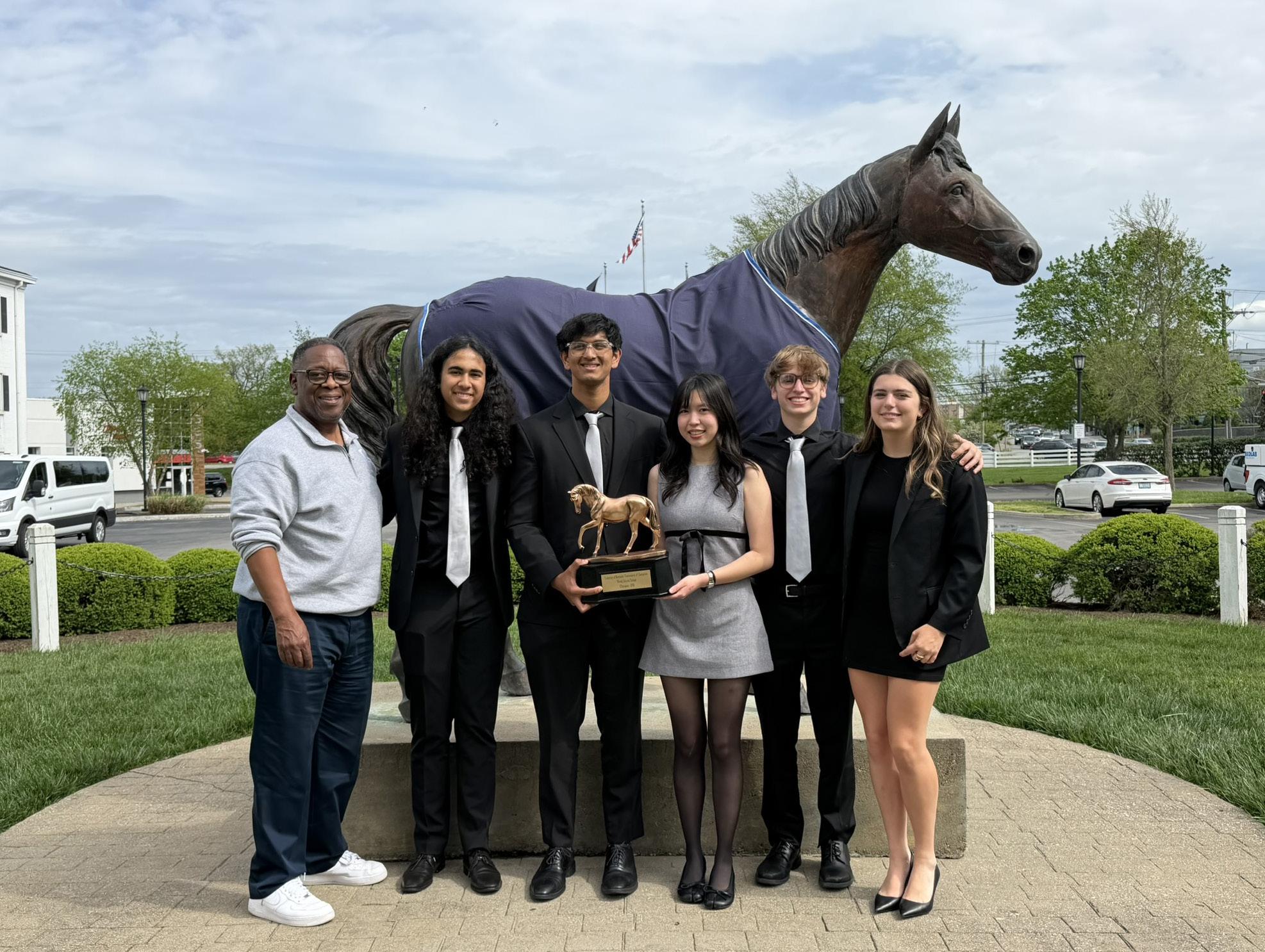
Five Upper School debaters competing as team Platinum in the World Schools format won top honors at the national Tournament of Champions last month.
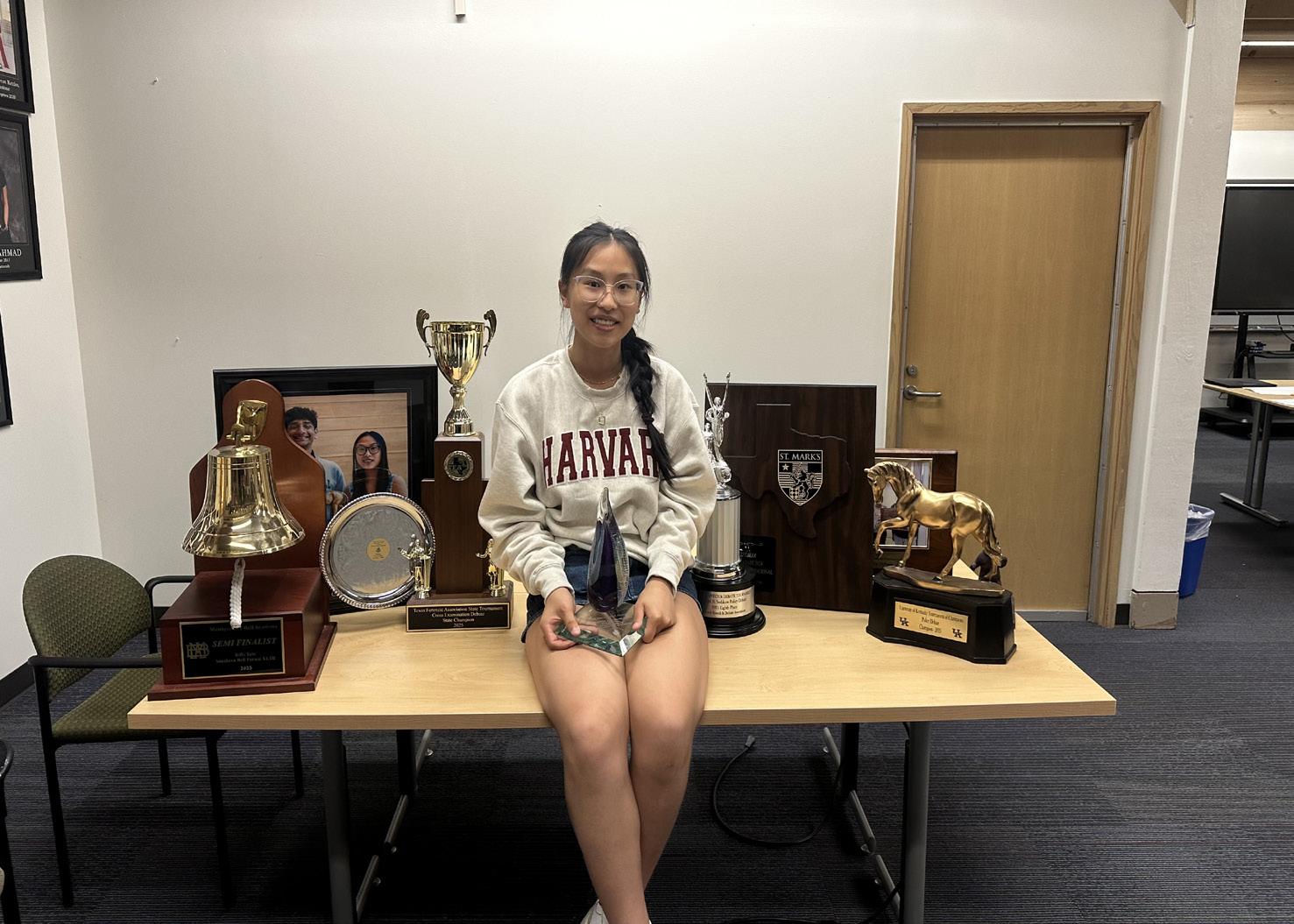
Additionally, senior Rory Liu became the first Greenhill student to receive the prestigious Julia Burke Award. The honor is given to the Policy debater who best exemplifies excellence and passion for
debate as well as a commitment to helping others and sustaining friendships despite the pressure of competition.
The Greenhill debate team sent 22 members to compete in the tournament, the highest number of qualifiers for the event in school history. The tournament took place April 11-13 in Lexington, Ky.
“Once we got there, there was a lot of focus, attention and detail and work that was put into trying to do as well as possible,”
Upper and Middle School Director of Debate Aaron Timmons said.
The first place Platinum team was composed of seniors Benjy Beckman, Vijay Naidu and Josephina Qiu and sophomores Arhaan Iyer and Marleigh Massoud.
The Diamond team, also competing in the World Schools format, finished in third place overall.
Each event had standout performances. In Lincoln-Douglas debate, senior Dylan Millimet and junior Vivek Thankavel ended their tournament in the division’s double octofinals, the final 32 teams. Senior Sarah Koshy reached the quarterfinals and was the ninth Speaker in individual awards.
In the Policy division, senior Iliyan Ali finished as the eighth Speaker and Liu was named the 17th Speaker.
Timmons said that preparation for this tournament looked different from other competitions.
“There’s more of a focus and intentionality and a detail-oriented approach to prep,” Timmons said. “Because for many it’s their final tournament after four years of high school, or some may have competed in middle school as well, so you’re kind of putting it all out there on the table.”
The winning Platinum team previously won the World Schools division in the Texas Forensic Association State Tournament in March. Iyer said that in addition to extensive preparation, his team’s relationship contributed to their wins.
“We learned how each other
works, reads, debates and functions, and we learned our best speaker lineups and combinations,” Iyer said. “I think getting to know each other and becoming close friends definitely helped our performance, because in tournaments, we’re having more fun, less stressed and have better overall cohesion as a team.”
Many seniors say the tournament was a satisfactory end to their careers. Although it was a bittersweet event, senior Dhiya Hemchand said the tournament allowed teammates to spend time together and celebrate their years of dedication to debate.
“It felt really sad,” Hemchand said. “For the past four years, I spent so much time debating, and this was the last tournament that we had, and it just felt like a culmination of everything, and of all the effort I put in.”
Once we got there, there was a lot of focus, attention and detail and work that was put into trying to do as well as possible.”
Aside from where students finished in the tournament, Timmons said he was most proud of the effort and determination that the debaters brought to each round. He said this tournament made him hopeful for the future of the Greenhill debate program.
“If there was one thing [I am the proudest of], it was the level of preparation and the focus they all had, because it’s easy to get distracted,” Timmons said. “It’s easy to just be OK with a certain result or not a maximum effort and they didn’t have that because they wanted to win and it turned out well.”
Aanya Bhoria
BRINGING HOME GOLD: Members of the Upper School debate team hold the Tournament of Champions trophy after winning the World Schools division.
Aaron Timmons
BUILDING ACCOUNTABILITY: Dean of Students George Heinrichs speaks to members of the Honor Council in one of their last meetings before his departure.
Photo courtesy of Rodrigo Paramo
Photo by Jordan Arbuckle
How Greenhill Builds Its Faculty
Aashi Punnam, Vivian White
Every December, before new job listings go live or interviews are scheduled, Greenhill initiates its teacher hiring process with a single form.
The “Letter of Intent” sent to faculty asks employees whether they plan to return the following school year. The responses offer administrators an early indication of potential openings, shaping the months ahead.
“It’s a way to get a sense of what people are thinking,” Head of Upper School Trevor Worcester said. “Some are certain they’re returning; others are considering retirement or changes. It helps us understand where things might shift.”
This year, that understanding was less certain.
Due to multiple teachers across Upper School departments revealing their decision to leave Greenhill, with some departures not confirmed until March, the gradual hiring process became accelerated. Instead of spreading decisions over several months, administrators say they had to move quickly while still finding the right fit.
“There’s a shortage of really good teachers, and the pool for certain disciplines in a given year can be really thin,” Worcester said. “We’re looking for people who are really good relationally, who have good content experience, all of which really add to the stress of trying to find the right person.”
Initial Process
Once open positions are identified, administrators write job descriptions and publicize the opportunity across Greenhill’s website, social media and the websites of the Independent Schools Association of the Southwest and the National Association of Independent Schools. Openings also appear on broader job and professional platforms such as Indeed and LinkedIn.
After applications are submitted, administrators start assessing candidates’ academic backgrounds and teaching experience.
From the initial pool, a smaller group of around three to five candidates is then selected for virtual interviews that span roughly 30 minutes. While the interviews help narrow the field, they serve more as a first impression rather than a final judgment, according to Worcester.
“We’re trying to figure out how someone will be with kids, how they’ll work with adults,” Worcester said. “Those things are harder to measure.”
Alongside Worcester, multiple other administrators are involved throughout the review process, including Director of Academics Jason Yaffe and Director of Equity and Inclusion Monsie Muñoz ’05. Department chairs can also review applications and conduct interviews to provide subject-specific input for administrators.
Candidates say the early stages of the hiring process feel less like a formal screening and more like an introduction to Greenhill’s approach to teaching.
Human Resources Stephanie Campbell.
After each of these meetings, faculty members are sent a feedback form to share their thoughts on the applicant. They also leave ratings on the demonstration and overall interview to provide quantitative data.
It was framed as a conversation. We talked about my background, but also my values and how I think about teaching.”
During their day, candidates are also asked to conduct a guest demonstration lesson for a class of students. The lesson is around 40 minutes and is centered around material the class is currently working on.
“The kids were really eager to talk to me and the conversation just organically flowed,” Fanning said. “I really wasn’t doing a lot, I was writing on the board and directing traffic, because kids were very interactive. In my mind in the moment, I was like, ‘If this is what Greenhill is like, I hope I get the job.’”
“I think that the students should have a big weight because the students are the ones that are going to spend time in the classroom with that teacher,” junior Leo Meyer said.
Final Decision
When the campus visits are completed and the number of candidates is narrowed down to a select few, a final decision is agreed on by Hark, Worcester, Yaffe, Muñoz, Campbell and department chairs.
The goal is to have new faculty hired in the spring before the school year is over, but when the process is delayed due to a late notice of departure from current faculty or a fitting candidate is not found, it continues into the summer. Administrators try to avoid this issue, but with the nature of this year’s hiring cycle, it might be challenging, according to Worcester.

“It was framed as a conversation,” said Upper School English teacher Macklin Fanning, who is in his first year at Greenhill. “We talked about my background, but also my values and how I think about teaching.”
Campus Visit
When the interview stage of the hiring process is completed and administrators settle on a small group of strong applicants, Worcester and department chairs decide whether they want to bring a candidate in for a full day on Greenhill’s campus.
After those applicants are asked to come in for a visit, Upper School Office Coordinator Alma Saldana creates an itinerary full of meetings and a teaching demonstration.
On their visit, the applicants meet with the full department of their respective discipline, counselors, learning specialists and administrators. They also have a meeting with Head of School Lee Hark and Director of
While the demonstration was the most nerveracking part of the day, getting to interact with students and understand the classroom environment was the most rewarding part, according to Fanning.
While the candidate is teaching the class, Worcester, along with Yaffe and a department member, observe the lesson to gauge the candidate’s teaching ability.
“You want to see how they interact,” Worcester said. “I always write down and pay attention to how they introduce themselves in class. Do they give a chance to understand the students and ask names, or do they just go right into it?”
Although students interact with the candidates directly and are asked to participate in the guest lesson, they are not always consulted after the demonstration.
“I would have liked to be asked, because I think there’s a possibility that the evaluators liked things the students didn’t or vice versa,” said junior Charlotte Faems, who had a demonstration lesson in her Biology class.
If a student or class is asked to give feedback on a candidate, they are either sent a feedback form to fill out or communicate their opinions through a conversation with their teacher, according to Worcester.
To make the final decision, the feedback from faculty and students who met with the candidate during their visit, initial interview and the demonstration lesson are considered by administrators. Certain components like specific educational experience and community fit are heavily weighed, according to Worcester.
“Schooling is important, but it’s not necessarily about where you went to school,” Worcester said. “It’s what have you got degrees in, and if you’re up on the content of what you’re going to teach.”
If there is still not a clear choice for the position based on ratings, the administrators meet once more to discuss the options and come to a final decision.
Once that decision is made and finalized, Hark offers the candidate the job. If the candidate accepts the offer, Campbell sends them an employee agreement.
“I think it was only a week or two after my visit when I got a phone call from Lee Hark himself, and I figured, ‘OK, this is probably a good thing,’” Fanning said.
After the employee agreement form is signed and the job is filled, Worcester notifies the other candidates that they did not get the position.
“I make those phone calls,” Worcester said. “It’s tough because oftentimes the most frequent question is ‘Do you have any feedback for me as to why I didn’t get it?’”
New faculty members’ time of employment officially starts on Aug. 1, but the onboarding process starts over the summer to help ease them into the job. Before teachers come back to campus in early August, new faculty from all disciplines have a multiple-day orientation to acquaint them with each other and Greenhill.
“Given that long general orientation, there was only a few days of department orientation,” Fanning said. “And coming in new with no curriculum set there for me, which is cool in a way, makes me think, ‘Well, I wish I had a little more time to get oriented in my department, and figure out what it is that I need to do so that I can deliver the product to the students.’”
Greenhill values and community set the school apart from many others in the area, making accepting an offer to work at the school an easy decision, according to Fanning.
Schooling is important, but it’s not necessarily about where you went to school. It’s what have you got degrees in, and if you’re up on the content of what you’re going to teach.”
Greenhill is not only looking for qualified teachers, but teachers who will go farther to shape their students’ educational experience, according to Worcester.
“For teaching faculty, the top priority is their teaching, how they engage the class and their mastery of content,” Worcester said. “There are other factors that help develop the whole picture of the candidate, but we need expert teachers who will challenge students to think critically and create spaces for students to succeed.”
Trevor Worcester
Middle School
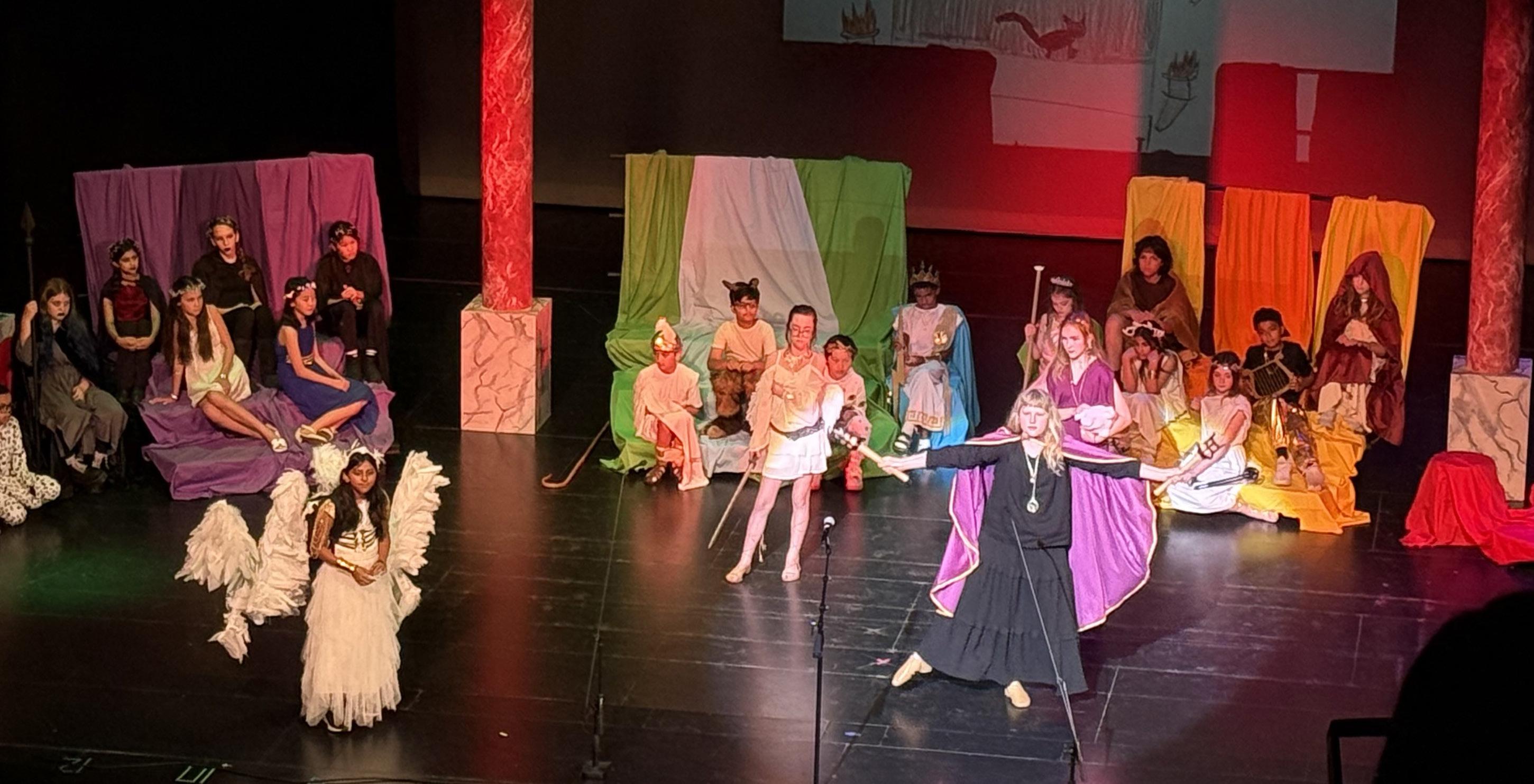
Fifth graders took the stage April 24 for the annual Greek Play, part of a long-standing tradition that combined performance, academics and community participation.
The student-directed production served as a central part of the annual Middle School Greek Day celebrations and culminated weeks of preparation and study of Greek mythology in English classes. Students analyzed myths and characters before transforming them into stage scenes.
“The Greek Play is really a capstone moment for fifth graders,” Middle School history teacher Kathryn Koshkin ’98 said. “It brings together everything they’ve been learning and gives them a chance to perform and take ownership of it.”
In addition to the play, students participated in several Greek-themed activities organized by faculty members.
Reflecting on her own experience participating in the play as a student, Koshkin says that Greek Day brought her entire grade together.
“We had a big feast, we dressed up and everyone was involved,” Koshkin said. “There were Greek Olympics, and
everyone in the whole grade participated.”
Teachers say the play has changed over the years as performances have become more elaborate and collaborative.
It brings together everything they’ve been learning and gives them a chance to perform and take ownership of it.”
“It used to feel more like standing up and delivering a soliloquy,” Koshkin said. “Now it’s much more of a full performance with movement and staging.”
Middle School English teacher Natalie Nihill ’00, who helped organize this year’s production, also participated in the Greek Play as a student at Greenhill. She says it was a special moment.
Now helping lead the production, Nihill says she hopes current students will experience the sense of accomplishment she felt as a student.
“My hope is that they walk away with a really good
Spring Fling Showcases Talent Greek Play Recap
Middle School arts students showcased their year’s work at the annual Spring Fling on May 5.
The event included art displays, a screening of Middle School video production work and performances by Middle School orchestra, band, choir, theater, dance and improv students.
Spring Fling acknowledges and celebrates Middle School art, giving students the opportunity to share their hard work with their parents and peers, according to Head of Arts Terry Martin.
“It’s really, really important for the middle schoolers to feel like they’re being celebrated for all the hard work that they put in all year long in the arts programs,” Martin said.

Previously, Middle School arts students showcased their work in after-school events over weeks. However, this format made it hard for students and parents to support all arts electives.
In response, faculty members created a showcase to take place in a single night, Spring Fling, in 2021.
Spring Fling took inspiration from the Independent Schools Association of the Southwest Arts Festival, an event that allows high school arts students to highlight their talents.
“There wasn’t anything like that for Middle School,” Martin said. “I thought, ‘Wouldn’t it be a great idea if we turned it into more of a celebration, something similar to ISAS?’”
Preparation
classes.
Organizing an event with so many different programs takes careful scheduling and teamwork, according to Martin. One of the biggest challenges was finding a way for families to experience each performance without overcrowding spaces or causing events to overlap.
“I wanted to make it seem like a celebration, allow parents to watch, and for younger kids to get inspired by the older performers,” Martin said.
Since fifth graders have their arts classes at the end of the day, that time was used to help students get ready for their performances. This helped the evening run more smoothly and made the schedule less rushed, according to Martin.
This year, dance was added as a part of Spring Fling and featured 10 performances choreographed by both students and teachers.
“I’m really excited for [the students] to just be seen this year, and for people to be able to see the program that we’re growing and the excitement that they have about dance,” Upper and Middle School dance teacher Gypsy Ingram said.
Reactions
In the days before, Middle School arts students said they were looking forward to the events.
“I’m excited to just be able to be surrounded by all the art and seeing all the cool things that everybody’s created,” eighth grader Alex Gamble said. “I just feel like it’s really fun because people have been working really hard, and when it comes together, it feels really nice.”
Afterward, Middle School students said they were impressed with the variety of Spring Fling performances.
“[Band] did really well,” sixth grader Evelyn Swerdlow said. “It was a really good opportunity to see other people do what they love to do.”
Fifth grader Mila Rosenfeldt said she enjoyed the opportunity to showcase her work.
“A lot of my friends came, and it’s really fun because I get to show them what I’m doing,” Rosenfeldt said.
experience, trying something they’ve never done and feeling special and seen,” Nihill said.
Preparing the production required coordination between teachers, student directors and performers. Teachers organized staging and casting while student directors helped guide rehearsals and performances, according to Nihill.
This year’s performance also introduced a two-act structure to accommodate more student performers.
“We broke it into two acts, and I think it really helped with the rhythm of the play,” Nihill said.
Students described how they enjoyed the experience.

“The Greek play was fun and exciting because there was lots of preparation leading up to it,” fifth grader Arthur Starrs said.
Starrs, who played Kronos, says rehearsals initially made him anxious.
“I was nervous about all the preparation for the actual play, but I ended up feeling relieved by the end,” Starrs said.
Students also contributed behind the scenes through technical theater and stage production.
Fifth grader Spencer Armstrong helped create the atmosphere of the performance.
“I enjoyed working with a group of my friends on making the stage come to life, and I think the play was great and very enjoyable,” Armstrong said.
Armstrong says the experience also introduced him to technical theater and stage lighting.
“My favorite part was getting to learn a lot about tech theater and how lighting works for a play or production,” Armstrong said.
I enjoyed working with a group of my friends on making the stage come to life, and I think the play was great and very enjoyable.”
Ultimately, the tradition continued to bring students together through a shared experience that connected academics with performance.
“It’s a positive tradition with a real purpose,” Nihill said. “It’s a moment where everybody comes together and it’s always a really special experience.”

The art showcased at Spring Fling was the result of months of planning and collaboration by faculty across the Middle School arts
Like other students, Gamble appreciated the opportunity to share her passion with peers and parents.
“I feel like Spring Fling is a place where we can share what we’ve been creating without being judged,” Gamble said.
Nirvan Bhattacharya, Noah Stinchcomb
Willa Oza, Naomi Wien
HIGH DRAMA: Fifth graders perform the annual Greek Play on April 24, the culmination of weeks of hard work and preparations. The play is a highlight of Middle School Greek Day, which also includes Olympic-style games.
ON THE STAGE: Middle School arts students showcase their different creations at the annual Spring Fling.
Photo by Ela Battikhi
Photo by Vivian White
Terry Martin
Kathryn Koshkin
For Rebecca Shuman, Graduation Never Ends
Jordan Arbuckle
By the time each senior walks across the stage at the Morton H. Meyerson Symphony Center on May 26 to receive their diploma, Assistant Head of Upper School Rebecca Shuman will have spent hundreds of hours organizing every detail.
For the past 32 years, Shuman has planned and supervised the Upper School graduation ceremony. Here is a behind-the-scenes look at Shuman’s work to ensure a smooth sendoff for the Class of 2026.
September
Before the 2025-26 school year began, Shuman was already securing a date for graduation. Due to the Meyerson’s venue requirements, Greenhill must submit its preferred week approximately a year and a half in advance. The Meyerson staff then selects a day from Greenhill’s date range, and that allows Shuman to start coordinating an official contract.
Once seniors begin their school year, Shuman compiles a dress catalog with pre-approved options from three local shops to streamline the dress selection process. Girls who choose their own attire must receive Shuman’s approval to ensure it meets the white, floor-length standard.
October
Greenhill requires students to provide their legal name to be printed on their diploma. To start the verification process with the Texas Education Agency, Shuman sends out a form to the graduates that lists each student’s legal name as it appears in school records. Both the student and their guardian must approve the name before graduation.

Shuman also finalizes a date, time and location for the graduation attire event. At this event, students report their status and plan for choosing or renting an outfit for graduation.
Graduates and their families have an opportunity to order formal graduation announcements to share with relatives and friends after Shuman confirms the contract between Greenhill and the Meyerson. She meets with the communications team to prepare for the public release of graduation information on the Greenhill website.

December
Shuman sends out final reminders to families who have not submitted name verification forms. After all forms are collected, Shuman conducts a final review of student names through advisories before sending the information to Greenhill’s diploma supplier for printing. She also checks in with external services and vendors to confirm graduation elements like floral arrangements, photos and seating.
January
To gather and organize information on student attire, Shuman schedules time to review each student’s plan. She does so by recording whether a dress has already been purchased from pre-approved vendors, if a student elects to borrow or make their dress or if a student needs additional help finding a retailer. At the student attire event, seniors gather in the 300 pod of Upper School South to receive a briefing on the next steps they need to complete. Men’s Wearhouse employees are also present to measure students and place tuxedo orders. The process of deciding graduation speakers begins as Shuman sends out the timeline of the application process to seniors. Interested students submit their request to be a speaker.
Diploma covers arrive and are checked for damage before being moved into storage. Shuman then places final orders for the diplomas that will be inside the cover on graduation day. Following this, Shuman examines and continues to approve graduation dresses for students who made their own outfits or who did not order from pre-approved vendors. In addition, Shuman officially orders every tuxedo and coordinates a delivery date to Greenhill’s campus with Men’s Wearhouse.

March
The process for selecting student speakers at graduation continues. Shuman reviews initial applications and meets with senior advisors to determine finalists. Afterward, Shuman and the selection committee review outlines made by each applicant and set up meetings where the students elaborate on their ideas while the committee asks clarifying questions.
The month before commencement is filled with final confirmations and preparations. Shuman reconfirms the date and time with the Meyerson and hires four photographers to capture the event. She also coordinates with Jostens, Greenhill’s ring supplier, to order and deliver the Class of 2026 class rings to students and families. The student speakers for commencement

May
After months of preparation, Shuman’s focus shifts to sharing logistical details with students, faculty, families and external services. Shuman also makes final preparations for graduation day, including a rehearsal with seniors and then the actual execution of the ceremony.
“It’s
a perfect mix of the past, the present and really the future, and I like doing this job because it’s the last thing that some families will do at Greenhill. It’s a huge accomplishment for anyone, no matter how long you have been here, to graduate from Greenhill and a big celebration I think is appropriate and in order. It’s just really an honor for me to put it together.”
–Rebecca Shuman
Longtime Greenhill teachers Jaye Andrews, Susan Bauman ’81 and Barry Ide will be departing after the 2025-26 school year.
Andrews and Bauman are retiring. Ide is moving to Chicago for family reasons. Each of the three teachers has taught on the campus for over 25 years, earning them the designation of “Greenhill Legends.”
Their departures mark a significant moment in Greenhill life, as each has played a major role in teaching, mentoring and shaping hundreds of students.
“I’ve been here since I was a student, and it’ll be hard to leave,” Bauman said.
Bauman added that the recognition of becoming a Legend highlighted the school’s culture and ability to retain experienced teachers.
Andrews voiced similar sentiments.
“It’s an honor to have made it this far,” Andrews said.
Jaye Andrews
Andrews served as a Middle School math teacher for 25 years, teaching Introduction to Algebra, Algebra I and seventh grade math classes.
In his early days at Greenhill, Andrews was challenged by moving to a coeducational school after teaching at an all-boys school.
“I wasn’t totally sure who was going to
be showing up to my classes and what each day would look like,” Andrews said.
Throughout his career, Andrews has seen the structure of Greenhill evolve. He explained that earlier in his career, teachers often worked more closely within gradelevel teams, while today there is more collaboration within subject departments.

He also emphasized how his perspective on students has changed over time. Andrews said that students develop at different rates and that it is important not to judge them too early.
“You can’t judge a student based on who they are in eighth grade,” Andrews said. “Most of them end up in a really good place.”
As he prepares for retirement, Andrews says he plans to spend more time with his family.
“I’m just going to use this time to explore the community and find opportunities,” Andrews said.
Susan Bauman ’81
Bauman has taught at Greenhill for 40 years, building on a connection that began as a student.
She still recalls her early days as a Greenhill student.
“I knew one person,” Bauman said. “I

couldn’t find my science class for the first couple of days.”
Over time, she became more comfortable and eventually built a longterm career at the school. Bauman said her experience at Greenhill has shaped both her personal and professional life.
“I have literally grown up here,” Bauman said.
Bauman has taught a range of classes, including third grade phonics and language arts, sixth grade composition and eighth grade literature. Bauman said that each group of students stands out in different ways.
She recalled a specific classroom experience during a Shakespeare unit, when a student who had not been highly engaged became deeply involved in a performance.
“He came to life,” Bauman said. “It was amazing.”
She said the same student returned a couple of years later to tell her he was still interested in Shakespeare, which she described as a meaningful moment in her career. The student returned to campus recently during Alumni Weekend and reiterated his love for Shakespeare that began in Bauman’s class.
Students say Bauman builds strong connections in the classroom.
“Ms. Bauman makes sure everyone understands the material [and] makes you feel welcome,” eighth grader Nora Pikar said.
As she prepares for retirement, Bauman said she is looking forward to traveling and taking a break from her daily routine.
“I’m ready for what’s next for me and taking a step back,” Bauman said.
Barry Ide
Ide joined the Upper School Science Department after moving from Pennsylvania in 1999. Over the past 27 years, Ide has taught a variety of science courses, including Advanced Placement Biology, Climate Science and Human Reproductive Biology.
He said his approach to teaching has changed over time, shifting from focusing on facts to emphasizing inquiry and curiosity
by having students constantly engaged in wanting to learn more.
“He always has constant enthusiasm for both the concepts he teaches, and also his students and their wellbeing,” junior Benji Lachar said. “Even on rough days, he always seems like he’s happy to teach.”

Ide said he wants to push them past just memorizing information and moving on as soon as units are over.
“Science isn’t just a collection of facts,” Ide said. “It’s about asking questions and trying to understand the world.”
Ide will be moving to Chicago where his wife got a new job. He plans to continue teaching science at another school.
“Greenhill is an amazing place, and it will be hard to leave,” Ide said.
Looking Ahead
Despite the departure of the three campus Legends, students and faculty say their influence will continue to be felt.
“We will miss all of them because we’ve known them for so long,” Lachar said. “They’ve all created connections with their students that make you remember them even after you leave their classes.”
He always has constant enthusiasm for both the concepts he teaches, and also his students and their wellbeing.”
In late April, the three teachers were honored at a Departing Legends ceremony during the Alumni Weekend festivities.
“We want to celebrate them for everything they’ve done for us,” Lachar said. “I only had some of these teachers for a year, but they’ve stuck with me for a lot more than that.”
Even as the Legends prepare to leave, Greenhill students remain in their thoughts.
“I want students to try and be open to new perspectives and always want to continue learning,” Andrews said.
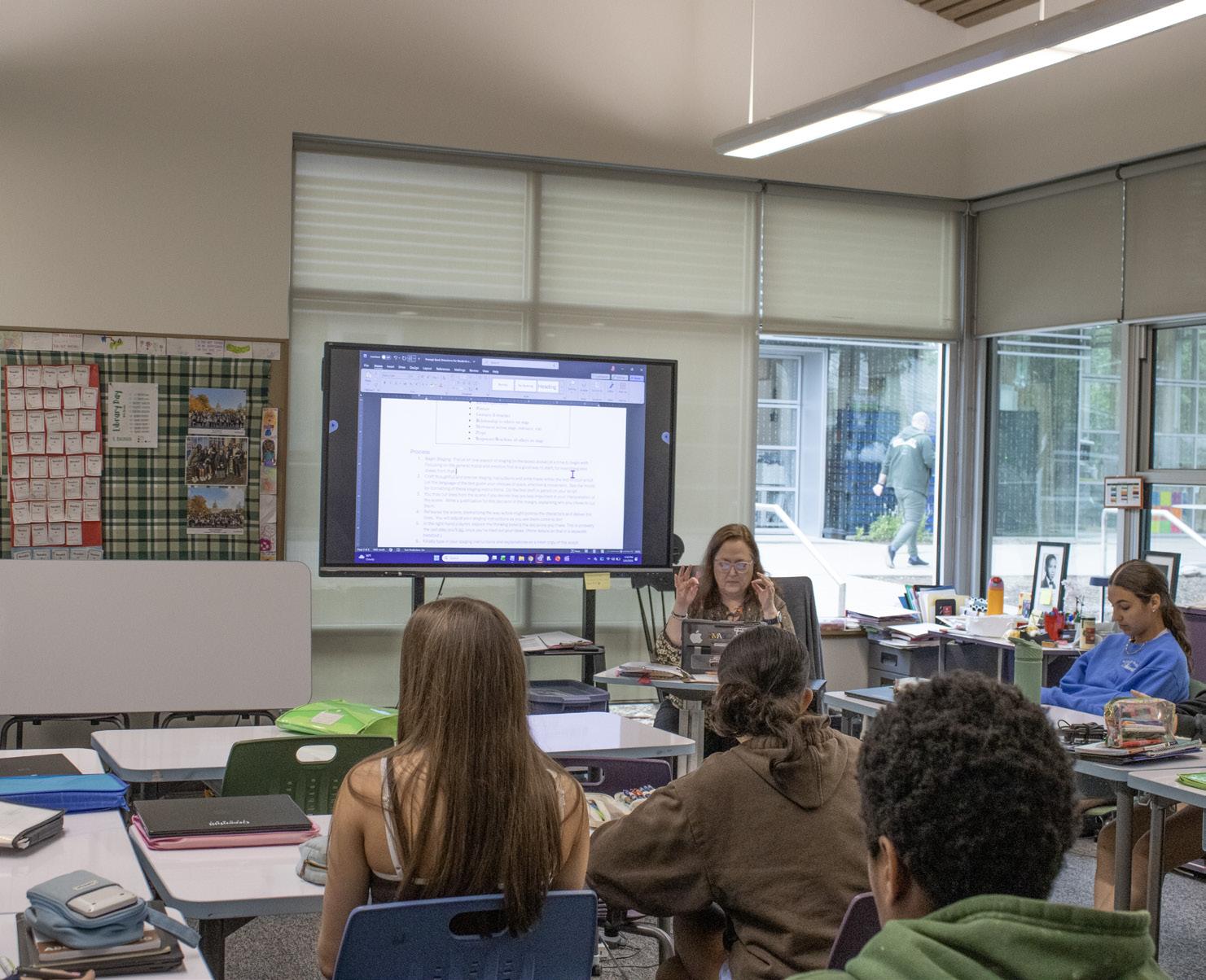
CLASS SUCCESS: Middle School English teacher Susan Bauman ‘81 teaches eighth graders the works of Shakespeare as she nears the end of her Greenhill career.
Photo by Lillian Smith
Marleigh Massoud, Julia Bella Frankfurt
Jaye Andrews
Barry Ide
Susan Bauman
The Graces
Lillian Smith
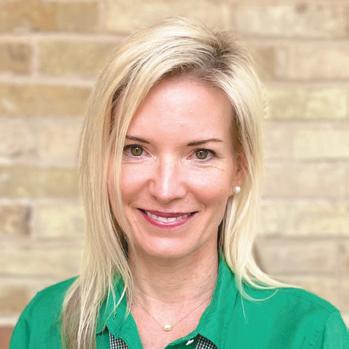
Kendra Grace, Greenhill’s associate head of school/chief financial officer/chief operating officer, and her son, junior Charlie Grace, spend their weekdays immersed in the school community. From director meetings to sports practices, this mother-son duo tackles both the administrative and student-life aspects of Greenhill. Here is a snapshot of a typical day in their lives:


5:00 A.M.
My alarm goes off and my mom wakes me up, but I normally don’t get out of bed until 5:15 a.m.
5:45 A.M.
On the way to the gym, I will take my pre-workout [powder] and listen to my lacrosse pre-game playlist. I go to the gym at the [Aaron Family Jewish Community Center]. I will typically lift dumbbells and barbells, and I’ll hit chest and back.
I’ll get ready for school, and I typically leave my house at 7:30 a.m. On the way to school, I listen to country music, so I can kind of chill out before the school day begins. When I get to school, I complete the homework I still need to do for the day or go to the cafeteria and eat breakfast with [juniors] Eli Yaffe and Miles Martinez.
I have Finance and Accounting with Math Department Chair [Darryn] Sandler ’95. He teaches us about a lot of things like taxes and how to gamble. Everything we learn is very useful for real life. It is definitely my favorite class!
9:50 A.M.
I have Singers, which I also really enjoy. I am a bass, so I sing with the basses, but in choir I normally just mess around with [senior] Quaid Oza. We recently went to the Galleria, which is a field trip we take twice a year. Quaid and I went to North Italia for lunch. We also have our spring concert coming up on, so we’re getting ready for that right now.
11:20 A.M.
I have advisory with Mr. Sandler. We always do trivia, and Mr. Sandler always pairs [juniors] Izzy Shiloh and Aaron Sharma together because they always fight. Mr. Sandler and I have a great relationship. I’ve gotten to take a few of his classes over the years, and he has also been a great advisor. My advisory has also gotten close over the years, even though we suck at Advisory Olympics!
11:50 A.M.
I have Narrative Nonfiction with [Head of School Lee] Hark. A lot of my friends are in the class, but I can’t hang out with them because Mr. Hark is teaching the whole time. Mr. Hark is a great teacher, but he assigns so much work, and the class is pretty challenging.
1:13 P.M.
Kendra Grace
4:45 A.M.
My alarm goes off at 4:45 a.m. because Charlie tells me that he wants to be up by 5 a.m., so I get up to make sure Charlie is up. I work out in the morning, because if I don’t work out in the morning, it’s not going to happen.
8:30 A.M.
I usually get to school between 8 a.m. and 9 a.m. depending on what time my morning meetings are. Typically, the first thing I do though is go to Catalyst and get a coffee.

I normally get let out of Narrative Nonfiction late, but then I go to lunch. I sit at the leftmost picnic table outside the cafeteria. My friends and I have sat there since freshmen year. After lunch, we’ll go to the upperclassmen locker room and hang out there during Hornet Block.
2:35 P.M.
I have Advanced Placement Government and Politics with [Upper School history teacher Bob] Hearne. On my other days, I will have my free period. During my free period, I will meet with tutors or just do my homework.

4:00 P.M.
I will either have football or lacrosse depending on the season. Right now, I don’t have anything though because the Southwest Preparatory Conference Championships for lacrosse have already happened. I’m sad that the season is over, but I don’t mind the extra free time, especially because I have so much school work right now.
6:30 P.M.
I get home, and since my dad works from home, he makes dinner for my mom and me. My favorite meal he makes is spaghetti with a turkey cream sauce.
8:00 P.M.
After dinner, I do homework or study in my room. Or recently I’ve been watching the show, “Suits.” Then, I will go to bed around 9:30 p.m.
9:00 A.M.
In the mornings, depending on the day, I typically have meetings with one of my direct reports. I’m either meeting the director of finance, the director of facilities, the director of operations, or the director of [the Child Development Center]/ Extended Day.
10:00 A.M.
On Wednesdays, we have our construction meetings. [Head of School Lee] Hark and I walk to the construction trailer where we meet with the architects and the general contractor. We go through the status of the new buildings, and we talk through schedule and open items. We then walk to the sites to finalize any other issues that we have.
11:00 A.M.
On Wednesdays, about once a month, I attend an AI taskforce meeting. The group includes other heads of schools and associate heads of schools from around the country, and we talk through ideas about how to use AI to help lead the school.
12:00 P.M.
I usually go to the dining hall for lunch, but I typically eat in my office, where I answer [calls] and catch up on emails.
1:00 P.M.
Meetings start again. I have eight direct reports, so I meet with the other half in the afternoons. On Wednesdays, I also meet with Mr. Hark, and I’ll give him an update of everything that is happening operationally at the school.
6:00 P.M.


I try to go home around 6 p.m. – unless a water main breaks or the construction team hits a transformer and we lose power to the gym or Charlie has a game or a choir concert. My husband will make dinner, and if Charlie is home from practice, we will try to eat dinner together.
7:00 P.M.
I usually spend the rest of the evening catching up on emails and work I didn’t get done during the day. If not, I will watch a show with my husband. Right now, we’re watching the second season of “Your Friends & Neighbors.” In the past we watched “Land Man,” and we really enjoyed that.
9:30 P.M.
I like to read at night before bed, mostly fiction. I try to read for half an hour, but I think I usually fall asleep after about 10 minutes.
Kaitlyn Yoo
A“The Great Divide”
fter chronically listening to the singer-songwriter’s hit album “Stick Season,” it’s safe to say Noah Kahan is not for optimists. If anything, his most recent work, “The Great Divide,” released on April 24, proved to be even more vulnerable and introspective than his previous success.
Rooted in folk-pop and atmospheric guitars, the album is no shift from his previous work, reiterating the same New England bits and self-deprecating criticisms. Still, it manages to pull on listeners’ heartstrings.
Starting with its title track, “The Great Divide” was released Jan. 30, a longanticipated wait for fans who first heard the song last summer during Kahan’s “Stick Season” Tour.
“You know I think about you all the time / and my deep misunderstanding of your life,” Kahan sings.
In many ways, themes in this single become reoccurring throughout the album, making this the gateway into his grief and reflection.
Following the title track, Kahan kept up anticipation for the album through “Porch Light,” released March 13. Here, he highlights sentiments of loss and broken relationships, but instead
of a typical breakup song, Kahan focuses on deeper family struggles.
“I would ask you how you’ve been / it’s all over the internet / But hey I mean you knew that after all,” he starts the song.
Some fans speculate this track is told from the perspective of Kahan’s family, showcasing a self-critical angle of his fame.
Following an often cliché central theme – the unexpected regrets of fame –Kahan manages to twist repetitive feelings into heartbreaking lyrics, varying from sentimental tracks to bouts of depression.

Opening the album, Kahan serenades listeners with “End of August,” an obvious tribute to his hometown of
“Endin’ of August, the bugs are just starting to die,” Kahan sings. Mirroring a previous hit, “The View Between Villages,” he notably uses a theme streamlined through his works. Both tracks feature commentary on bugs, a term he’s used frequently in
While the ballad is unlike many of Kahan’s typical works, he reverts to his folk acoustics in what I think is a standout track: “Doors.” On this, Kahan offers a fresh take on avoidant attachment tendencies.
The same catharsis can be seen in
“Willing and Able,” a piece dedicated to his strained relationship with family, complicated by his constant absence. While it borders on repetitive, Kahan’s talent for imagery and sophisticated lyrics prevent any boredom when listening.
know me / And I wish I could know you much more sometimes,” a devastating line, even for Kahan. Then, he twists the knife even further. “Sit in the yard while the day dies, leave it all on the table / And I’ll say I love you and mean it this time.”
“Headed North” and “Paid Time Off ” bring a new lens to Kahan’s hometown feelings. Yes, he rambles about missing his neighbors, but Kahan’s ability to showcase the dynamics of living in New England offers a new light on his development.

The consistent mirroring of his past works – reminiscent of “Homesick” and “Stick Season” – tells a story of growth.
Another of my favorites is “All Them Horses,” a piece popularized through leaked snippets on TikTok. The faint guitar picking
and gentle drums bring warmth to the song, while his lyrics wreck listeners again.
“You know I wanna beat it, I wanna beat it bad / Oh, everyone looks happy in a photograph,” Kahan rambles.
Ironically, I found my favorite song on the deluxe album. Among the four additional tracks released that same day, “Staying Still” has quickly become my most streamed. In criticizing Logan International Airport and the Harvard track team, this song encapsulates what Kahan’s album centers around. It further jokes about the complexities of New England while commenting on his struggle to grow.
“Never mind, never mind, oh, forget about it / I’ll be good, I’ll be fine, I can laugh about it,” Kahan sings in the gut-
Would it be too much to say the album is better than its predecessor?
To me, Kahan’s introspective nature and personal voice create a beautiful storyline, surpassing his previous work. His ability to blend tragedy, anger and humor with distinct folk sounds allows for a seamless listening experience.
So, even if Kahan feels stuck between worlds, grappling with the pains of fame, it’s safe to say we want him to stay right here, with the last of the bugs.
Arts Students Debut “Big Love” and Beyond
Noa Pouratian
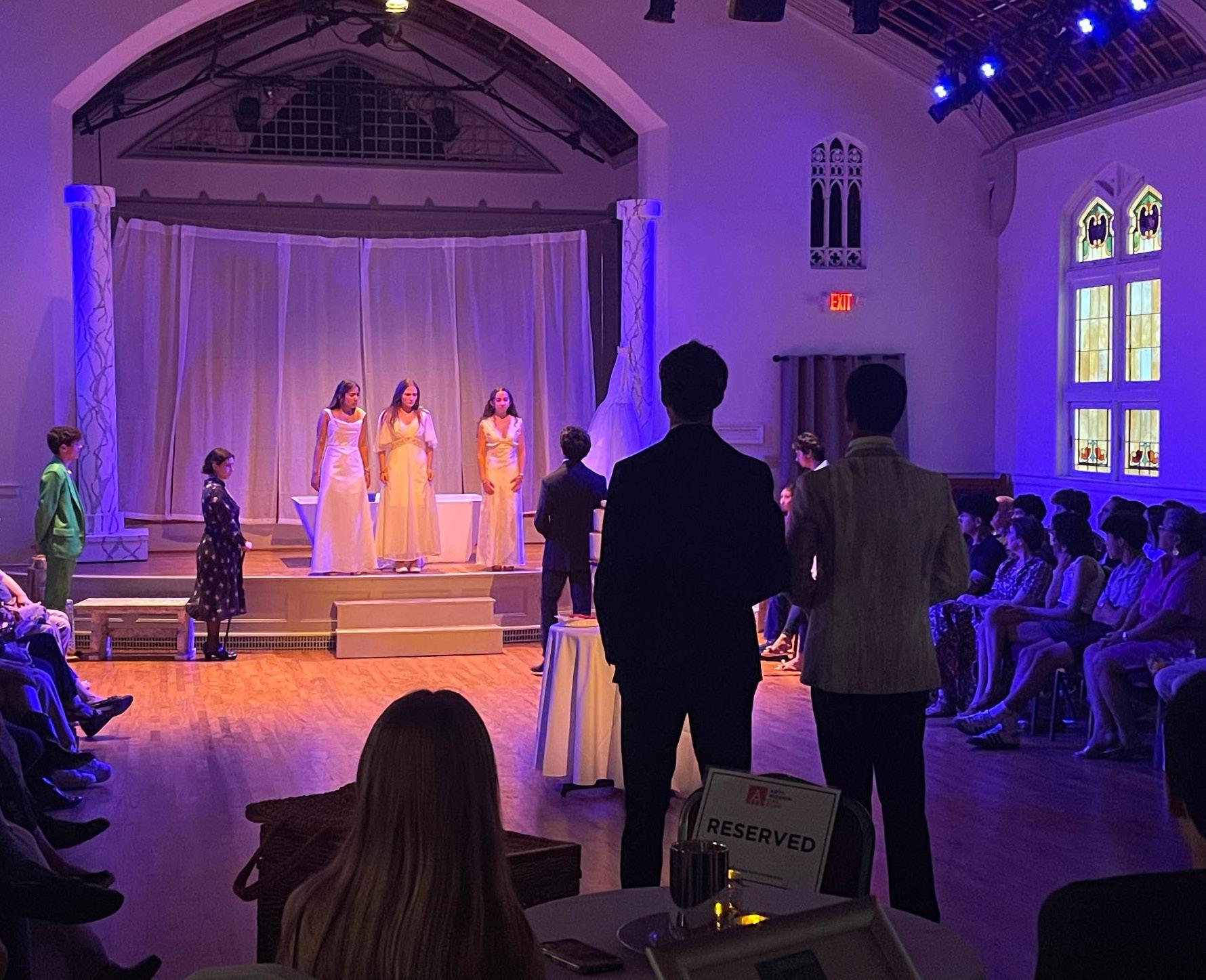
Upper School students from advanced arts electives came together on April 24 to perform a sold-out, off-campus showcase.
The Big Love and Beyond Advanced Visual and Performing Arts Exhibition was designed to present the final projects of students enrolled in the Upper School’s advanced arts courses.
“We had the lucky opportunity to go down to this really cool venue to show a bunch of works,” said senior Charlie Waldman, an Advanced Production student.
At the showcase, the Advanced Production class staged the play “Big Love,” while students in Honors Photography, Honors 2D Art and Design and 3D Art displayed selected works in an on-site exhibition. This allowed audience members to experience both theater and student artwork in the same setting.
“It’s a unique way for all the arts to merge together,” said junior Dani Reiman, an Honors 2D Art student.
The event started solely as a showcase of “Big Love” for the Advanced Production elective, a course designed for experienced upperclassmen experience to take part in a
student-driven show.
Upper School Theater Director Valerie Hauss-Smith says the idea for this class began as a conversation about how to better prepare advanced art students for collegelevel work.

“When you get to being a senior, you start pivoting towards adulthood and also college,” Hauss-Smith said.
The vision for the exhibition later expanded beyond theater. After speaking with photography and visual arts teachers, arts faculty members decided to build a larger event that would showcase advanced work off campus, according to Upper School 2D Art teacher Kendall Davis.
“Psychologically, [doing this event off campus] elevates you,” Davis said. “You feel like a real artist, because you’re showing in [a] real space. You see your work differently than just seeing it in our Greenhill studio on the walls.”
Many students say they hope the new space will enhance students’ hard work.
“I just wanted them to think it’s beautiful and get some emotional response of some sort,” said junior Lydia Kerridge, an Honors 2D Art student.
The exhibition was a step outside of the Greenhill Arts program’s norm in several areas, including it being off campus, according to Upper School photography teacher Frank Lopez.
Moving the showcase off campus gave students the opportunity to explore more complex themes in their art, according to senior Davis Knocke, a student in Advanced Production.
“It shows that Greenhill arts are trying to do something new, trying something different,” Knocke said.
Additionally, many students felt the new environment was inspiring.
“It feels more professional and gives a better idea of what an actual art exhibition or professional theater performance would be like,” Kerridge said.
Both the setting and the content of the art highlighted that, as students presented pieces centered on identity, growth and emotional response. Similarly, the production of “Big Love” explored complex topics such as gender and freedom.
“[Seniors] are about to embark on new adventures where they’re going to be confronted with a world that may not always be respectful,” Hauss-Smith said. “This piece is a great way for them to explore that.”
Students in the showcase say they hope the exhibit helps prepare them for college and allows their work to be recognized at a professional level.
“When you leave this school, whether you want to do theater, film or other arts, you’re going to have [this exhibition] in your back pocket,” Waldman said. “Now, I had the opportunity to do this at this other place, and I learned so much.”
You feel like a real artist, because you’re showing in [a] real space. You see your work differently than just seeing it in our Greenhill studio on the walls.”
Arts faculty have already begun looking into recreating this event annually, according to Lopez.
“I would love this to be a culminating experience for seniors and juniors that are in the honors program going forward,” Lopez said.
Students who took part in this event said there was a clear sense of pioneering a new and valuable opportunity.
“We’re the first ever,” Waldman said. “We’re Season One of this.”
Photo courtesy of Valerie Hauss-Smith
SETTING THE SCENE: The Advanced Production class performs “Big Love” offcampus as other advanced arts classes display selected works in an exhibition.
Valerie Hauss-Smith
Graphics by Lylah Pouratian
Senior Rory Liu was at the breaking point.
After a long day at a debate tournament their junior year, Liu was under physical duress.
“I hadn’t eaten that day,” Liu said. “I was walking out of a tough decision from a judge, and I was about to debate in front of 40 people. I was inconsolable.”
It was at that point that an assistant coach from outside of Greenhill placed a timer on Liu’s desk. The timer was set to expire in two hours, a symbolic reminder to Liu that whatever happened in the next few minutes, their agony would certainly end in 120 minutes.

This moment
– and that timer –became a turning point for Liu in their struggle to manage the stress of being one of the best high school debaters in America. It became a favorite coping strategy for Liu in debate and other aspects of their busy life in the year-plus those that have followed.
“I put a date on my calendar or set a virtual timer after a major milestone to remind myself that I will eventually get through difficult things,” Liu said.
Debate Journey
A highly ranked ping-pong player growing up in China, Liu’s soaring journey to the world of high school debate began in eighth grade, when they started competing in high school Policy debate tournaments.
“It’s very fun in the sense that I love
giving speeches, and I love learning about new things,” Liu said. “And that’s what debate is really good for.”
By their sophomore year, Liu had stepped into higher level competition, debating the best teams nationally. This was also the year Liu says they felt the most motivation to win, prompting them to pour hours into preparation.
I put a date on my calendar or set a virtual timer after a major milestone to remind myself that I will eventually get through difficult things.”
“There was a desire to understand things more deeply and a clear competitiveness,” Director of Debate Aaron Timmons said. “They didn’t want to lose.”
Senior Dhiya Hemchand, Liu’s partner in the Policy debate format, agrees.
“They’re just so hardworking in whatever they do,” Hemchand said. “It’s really admirable because I was motivated to see Rory put in all that extra work.”
There was a desire to understand things more deeply and a clear competitiveness. They didn’t want to lose.”
In April, Liu represented Greenhill Debate in the program’s final appearance at the J.W. Patterson Tournament of Champions in Lexington, Ky.
Battling burnout by the time of the tournament, Liu still finished as the 17th

Rory Liu
Speaker, a high achievement.
being awarded the Julia Burke Award, becoming the first debater in Greenhill history to receive the accolade. The award recognizes not only competitive excellence, but also character and contribution to the community.
who knew Julia Burke, said he nominated Liu because they met the standard of Burke’s character.
[Burke] in the way they thought about competition, other people and the world,” Timmons said.
Timmons adds there is something else that sets Liu apart.
always seemed to care about the people they were debating with and even the people they were debating against,” Timmons said. “It’s not just how they debate – it’s how Rory thinks about other people.”

Liu’s balance of competitiveness and empathy came to define their impact on the Greenhill program, according to Timmons. Even as the activity became physically and emotionally draining, Liu mentored younger debaters and continued to push through challenges they faced.
“What stuck out to me was that despite the hiccups, it’s all handled with maturity and grace, [which] is a testament to their personality,” Timmons said.
Upper School debate coach Rodrigo Paramo says Liu’s levity is a significant reason why they have been able to manage the competitive pressures.
“Even while they are distinguishing themselves as one of the best debaters in the country, they’re doing it 30 seconds after cracking a very dumb joke or making a very silly face,” Paramo said.
Managing Burnout
Liu’s debate success came at a price. At one point in their junior year, the pressure to perform well became overwhelming.
“I cried every day for a week trying to come up with a new [affirmative],” Liu said, referring to creating research-driven arguments. “I was so busy thinking about debate 24/7.”
Despite the heavy workload and
relentless pressures, Liu still cherishes the
“I’d say burnout has played a pretty big role in my junior and senior years of debate, but it’s not like I ever disliked it,” Liu said. “I
In Liu’s senior speech before Upper School students and faculty, they discussed burnout and emphasized the importance of setting boundaries and diversifying Liu also described how they learned to view efforts separate from outcomes. For debate, this meant finding value in the activity distinct from its competitive aspects, Liu said. “If your match the reward, that’s where burnout happens, but if you can find value outside of just winning, it
By their senior year, Liu’s definition of “At the end of the day, one tournament
Community Ties
Ultimately, Liu focused on the opportunity to forge close friendships among teammates and competitors in debate.
“Rory’s career is a testament that competition doesn’t have to come at the expense of relationships, fun and friends,” Paramo said.
Rory’s career is a testament that competition doesn’t have to come at the expense of relationships, fun and friends.”
Liu became well known for their offbeat humor at tournaments.
“Rory could crack a joke or start doing cartwheels and push-ups at any moment,” Hemchand said.
Timmons says Liu’s legacy will endure for years to come, influencing younger debaters to value relationships over awards.
And that is perhaps Liu’s most satisfying achievement from their years in debate.
“If there’s truly one thing I want to leave an impact on, it’s ‘How do I want to be as a person to other people in the community?’” Liu said. “And I just want to be known as a nice person.”
Photo by Noor Zaman
ACHIEVING GREATNESS: Senior Rory Liu poses with several debate tournament awards they have accumulated throughout their successful high school career.
Dhiya Hemchand
Khushi Punnam
Graphic by Anjali Blewett
Evergreen
Greenhill Singers Celebrate 75 Years
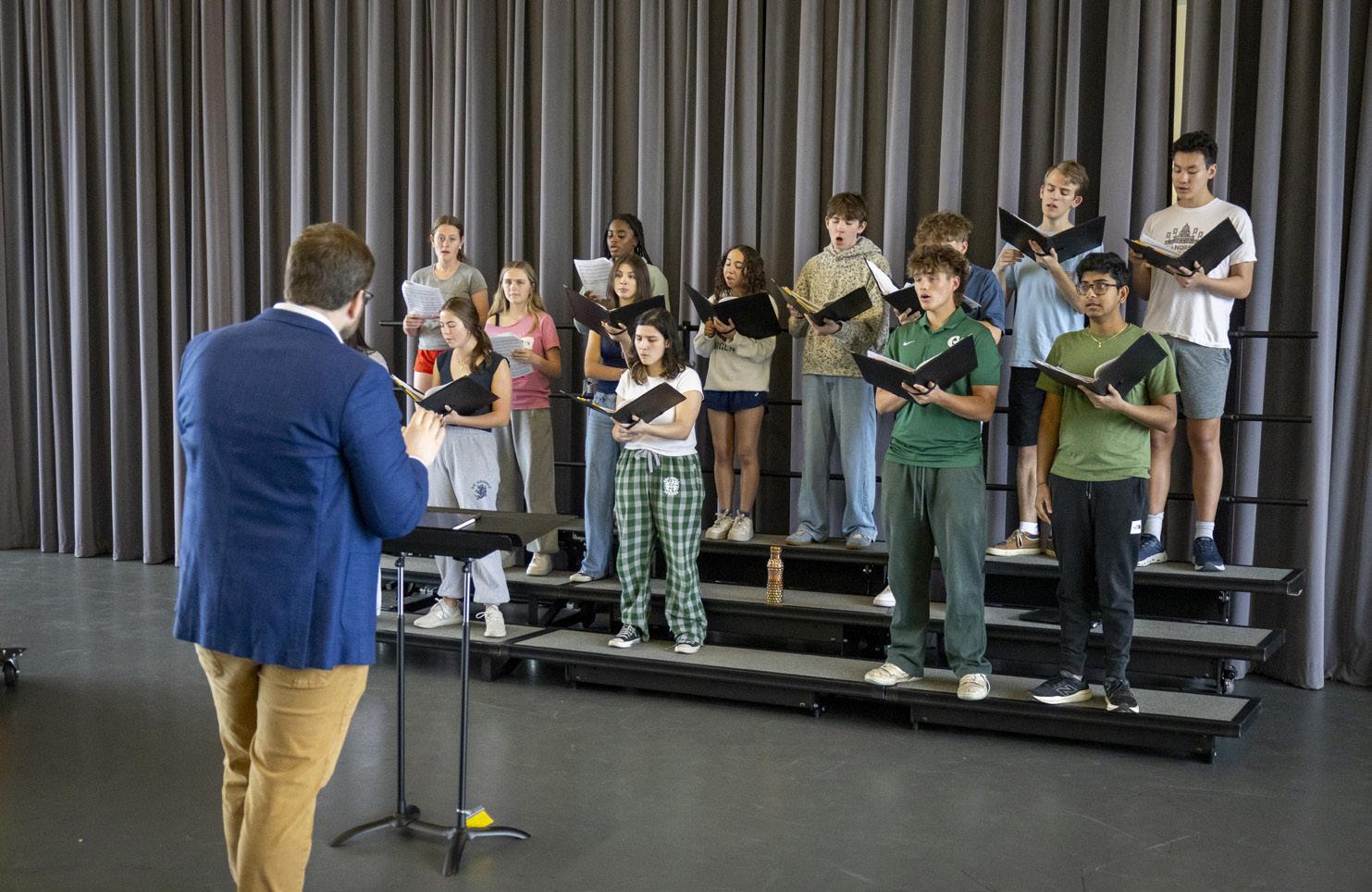
To commemorate the school’s 75th anniversary, the Greenhill Singers have undertaken a project that extends beyond their traditional performances: perfecting and performing a new composition honoring to the school’s history.
Upper and Middle School choir teacher Emmanuel Espiritu commissioned “Along the Journey,” a new choral work composed specifically for performance by the Singers. The Upper School group will perform the piece at the Class of 2026 commencement ceremonies at the Morton H. Meyerson Symphony Center in Dallas on May 26.
“I knew that I wanted to do something special for the 75th and I’d always wanted to get a work commissioned for my choir,” Espiritu said. “It was something kind of new and exciting that I had never done before.”
Created in collaboration with composer Matt Carlson and refined through workshops and rehearsal, the piece reflects both the singers’ voices and the values of Greenhill School.
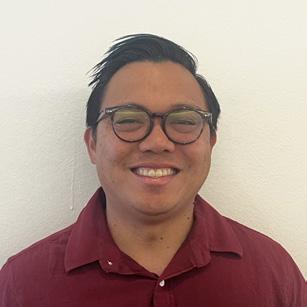
“It focuses on the journey, celebrating our accomplishments and just expanding our horizons and our futures,” junior Max Backover said.
The decision to commission “Along the Journey” was the result of a selection process led by Espiritu. After confirming the idea with Associate Head of School for Mission, Community and Culture Tom Perryman ’81, Espiritu sought a composer and concept to center the anniversary.
Carlson is an undergraduate student in the choral studies program at the University of North Texas and has been recognized for
his compositions nationwide.
“I chose him because he’s kind of an upand-coming composer,” Espiritu said.
Espiritu submitted his proposal for the piece to the Greenhill Cultural Arts Committee, charged with overseeing and planning various school arts events.
“We kind of went back and forth to make sure that the students got the best experience possible in addition to the composition,” Espiritu said.
After getting the committee’s approval, he spoke to Carlson about what he wanted the song to sound like and what he wanted it to represent.
“I wanted it to be very quintessentially Greenhill, while at the same time have it to where other schools could potentially do this song,” Espiritu said. “And then they’d be able to see Greenhill’s name on the top of the score.”
Espiritu says this effort can be seen through the lyrics that mirror Greenhill’s core values of courage, compassion, excellence and integrity. Those lyrics are:, “Courageously, compassionately, / When joy is all around you see/ That we can be a community/ Where everyone is free!”
Once the song was written, the Singers turned their attention to refining “Along the Journey” through many rehearsals and a workshop with the composer. This was done to prepare for the piece’s debut April 9 at the Independent Schools Association of the Southwest Arts Festival.
“Most of the time, songs have some kind of guide or recording that you can listen to in order to reference things,” Espiritu said. “This one was really a blank slate because it was the first time it’s ever been sung.”
Because of this, the workshop with Carlson became extremely important.
Junior Jenna Stenberg says it was helpful for the group to receive critiques from the composer so they could learn to perform it.
“He fixed our vowels,” Stenberg said. “It
was all meticulous details.”
The choral group described how rehearsals and the workshop with the composer helped shape the final version of the piece.
“Working with the [composer] helped unify our sound and helped us become more uniform and benefit the outcome,” Backover said.
I wanted it to be very quintessentially Greenhill, while at the same time have it to where other schools could potentially do this song.”
After the workshop, the Singers moved into the final phase of preparation, focused on bringing “Along the Journey” to the stage.
Senior Avery Montoya says she was
excited to perform this piece for the first time in front of an audience at ISAS.
“It’s this sense of, ‘We get to show these people what we’ve been working on for so long and what we poured our hearts into,” Montoya said.
After ISAS, the singers performed the song at the Galleria on April 21 and sang it again at their Spring Concert on May 7. The final performance will be at graduation on May 26.
As the Greenhill Singers prepare for their commencement performance, “Along the Journey” remains a symbol of Greenhill’s values and a memorable collaboration between students, conductor and composer.
“We are told to be with excellence, courage and compassion, and I think it encapsulates the sense of we are all on a journey together,” Montoya said.
Tyler Childers Concert Review
After touring Europe in March, Tyler Childers’ performance at Dos Equis Pavilion marked the first of his Snipe Hunt Tour. Since Childers is my favorite artist, I was ecstatic to see the tour announced and bought my tickets on presale.
Childers often blends bluegrass, country and folk music to address regional issues such as poverty, addiction and religion.
Following this prioritization, $1 of every ticket from this tour will be donated to the Hickman Holler Appalachian Relief Fund, which Childers created to bring support to philanthropic efforts in a struggling U.S. region.
Dos Equis was packed. With two of my friends, I sat in the 200 Section, on the right side of the stage. The section definitely had an older demographic, as we were surrounded by middle-aged couples, which

was really sweet to see. But behind us, the lawn was packed shoulder to shoulder with teenagers.
Childers came on at around 8:45 p.m. He opened the show with his song “Eating Big Time,” from his newest album, “Snipe Hunter,” which was a great tune to get the crowd excited. He then followed with an older song, “Shake the Frost,” which garnered much louder cheers from the audience. The crowd’s excitement with older songs continued throughout the show.
Childers performed with both an acoustic and electric band, as his newest album uses both. The band delivered the crispest sounds and elaborate jam breaks that had us playing air guitar from our seats.
However, he had a female backup singer that I was not a fan of. She kept singing over Childers, and her microphone was painfully set to a higher volume than his. I do not even recall him having a female backup singer in any of his songs; she took away from his voice and the band behind him.
Although, he is not much of a performer, spending most of his time on stage standing in place, his tangents between songs made up for it. Often, he paced around the stage sipping from his mason jar of water while interacting with the audience.
My favorite tangent was before his Grammy winning song “Bitin’ List.” He challenged the audience to imagine a person we despise for around 10 minutes with different angering descriptions that got us
excited for this rage-filled song. Later, the audience sang the song back to him with passion.
In another tangent, he encouraged us to chat with the other people in our section. The kind lady in front of my friends and I applauded us for our excitement and passionate way of singing along. I reached out to the woman beside me for her curly hair routine. I appreciate how Childers tried to foster connections within the audience.
The 200 Section kept on sitting down and standing up depending on which song was playing. Most people were coupled up and swaying back and forth, and I felt like I may have missed the “200 Section is only for married couples” memo.
Later in the night, Childers introduced his performance of “Jersey Giant,” an unreleased song popularized by his performances alone. He accredited TikTok for its popularity; after the first strum of the guitar, the crowd immediately went wild recognizing the tune.
Throughout the concert, Childers rotated between his old songs and songs from his newest album. The audience had a theme of dying and coming back to life with each rotation, something I wasn’t very fond of. Regardless, I supported it because I feel like other popular artists stick with only their newest music on tours. Altogether, the concert was a wholesome tribute to his past and present career.
Photo courtesy of Greenhill Communications
COMPOSED CELEBRATION: Members of the Greenhill Singers worked with guest composer Matt Carlson to create a song for the school’s 75th anniversary.
Talia Sidikaro
Lylah Pouratian
VIBRANT NIGHT: While Tyler Childers mostly stood in place during his concert, he made up for it through the stunning live stage effects and genre-blending tunes.
Photo by Lylah Pouratian
Emmanuel Espiritu
Centerpiece
Greenhill Navigates
As America has spiraled into a period of intense polarization over the past decade, Greenhill administrators have attempted to emphasize the importance of creating a campus that accommodates beliefs across the left-right spectrum.
More recently, as the Greenhill community has evolved into an ever-morediverse palette of cultures, ethnicities and beliefs, another potential point of conflict has emerged: religion.
While student life has been enriched and enlightened by the diversity of religious identifiers, fault lines have also emerged as groups of students, families and faculty have requested representation and recognition of their holy days and celebrations.
The tension is ongoing, and decisions that are sometimes viewed as mistakes by community members are not infrequent.
This year, for example, the Upper School commencement ceremony on May 26 falls on Eid al-Adha, a Muslim holiday. Only weeks ago, Jewish students and parents expressed concerns over the deadline for summative assignments falling on the first night of Passover.
Going back even further, Hindu students and families at Greenhill for years have criticized the lack of academic accommodations accorded their cherished celebration of Diwali.
Like so many of the calendar decisions that result in criticism and suggestions of insensitivity by affected stakeholders, the commencement date that has offended some Muslim students and families at Greenhill is more complex than publicly revealed.
About 18 months before each graduation, Greenhill submits a preferred week for commencement to the staff of the Morton H. Meyerson Symphony Center.
The Meyerson staff then selects a date from Greenhill’s preferred week. The date for this year’s graduation happened to fall on the Muslim holiday of Eid al-Adha.
In a polarized time when perceptions – even inaccurate ones – eclipse facts, the nuance of how the Greenhill commencement date was selected gets lost. The perception of Greenhill’s indifference by aggrieved individuals or families in these situations only adds to the complexities of the landscape that Greenhill administrators are attempting to navigate.
“Because we invite all this difference into the school, and because we’re so diverse in so many ways it makes it harder for us to feel like we’re one school,” Head of School Lee Hark said.
Holiday Recognition
Founded in 1950, Greenhill has always been a non-sectarian institution. Among the 145 private schools in the Dallas-Fort Worth Metroplex, very few offer an education independent of faith.
Greenhill’s lack of religious affiliation has attracted many Jewish families who don’t view some private schools as welcoming to their religion, according to sophomore Eli Wenzel.
“I know when my mom went here, she said it was very Jewish heavy,” Wenzel said.
Then, Greenhill further diversified.
While traditionally welcoming all religions, diversity at the school has evolved as the Dallas community has become more of a melting pot with varied races and religions, said Head of Middle School Susan Palmer.
Dallas’ population grew 56% between 1960 and 2016 while becoming more diverse
in the process, according to a 2018 report published by the Dallas city government.
While Greenhill saw an increase in religious diversity over time, the school calendar didn’t evolve. The same two holidays remained the only school holidays devoted to religious celebrations: Christian Good Friday and Jewish Yom Kippur.
“We’ve not done other days that I’m aware of at any time,” Head of Upper School Trevor Worcester said.
Hark cites tradition as the reason these have remained the only two school holidays linked to a major religion. But a growing number of students say they don’t believe this is a valid justification.
“If we are a non-religious school, then I think we should stick to that,” junior Lilly Williams said. “While I think it’s amazing to celebrate diverse cultures, when we’re only celebrating a couple of them, it leaves out multiple demographics of people and makes them feel ‘less than.’”
Hark further explains that the process to remove a day of school instruction for another religious celebration would be an extremely difficult decision. Greenhill already offers one less week of instruction than the Dallas Independent School District, so taking away additional days would be detrimental to student learning. Furthermore, with members of the Greenhill community embracing so many religions, it becomes a challenge to pick one holiday over another, Hark said.
“I don’t see a simple solution to this that satisfies everybody and also allows us to make sure we’re coming to school the right number of days,” Hark said.
Calendar Confusion
Although adding a school holiday is not under consideration, Greenhill attempts to honor religious traditions in other ways, such as enforcing no-homework days and putting up decorations on campus.
Director of Equity and Inclusion Monsie Muñoz ’05 says a significant way in which the administration tries to celebrate all religions is by incorporating major holidays into the official school calendar.
As a further acknowledgment of the importance of honoring the religious traditions of community members, Greenhill created a Cultural and Religious Acknowledgments Calendar four years ago and continues to update that calendar based on the requests of community members.
The Calendar Committee, which oversees the general school calendar, is headed by Worcester and includes faculty members from athletics, academics, arts and equity and inclusion.
Worcester says he and Muñoz consult with groups such as the Student Inclusion Council and leaders of affinity groups to make sure all celebrations are noted.
Senior Jin Huang, a member of the Student Inclusion Council, said she had several meetings at the end of last school year to discuss and identify important holidays to avoid future overlap with school events. Despite this, Huang says she believes the efforts of the Student Inclusion Council were not given sufficient weight when creating the school calendar.
“We did send that over to [administrators], but it seems to us that they might have other priorities to consider,” Huang said.
The finalized religious acknowledgements calendar and official school calendar are published on the Greenhill website before the academic year begins. But many students feel there is a
difference between recognizing a holiday in a website calendar and actually celebrating it.
“It seems like we’re acknowledging these holidays, but we’re not really incorporating that into our school schedule because we still have really important [school events] scheduled on religious holidays that are celebrated by a pretty decent sized group of people at Greenhill,” Huang said.
Students who need to attend important religious events during school must request an excused absence and ask teachers for extensions on major assignments.
While some students report receiving an excused absence for religious obligations, others say that some Greenhill teachers have not been as accommodating.
A sophomore girl who asked to remain anonymous says she requested an extension on a formative and summative assignment so she could celebrate the Hindu holiday of Diwali with her family at a Houston temple. She says one teacher allowed her to reschedule her summative assignment, but her English teacher described her absence as a “vacation” and assessed a grade deduction for submitting her formative assignment the morning after it was due.
“I think Greenhill teachers just cherry pick when to accommodate certain religions,” the sophomore said. “I don’t think it’s fair to be punished for being a certain religion while people of other religions get more accommodations.”
Worcester pledged further efforts to emphasize to teachers the importance of accommodating student religious celebrations.
“I think one of the things that I can do as head of Upper School is to say specifically to teachers next year if students request an extension based on one of these [religious] dates on this calendar, it’s not a, ‘Oh no, you’ve got to figure that out,’ it’s a ‘Yeah,’” Worcester said. “If that means for you as a teacher you need to plan differently, then do that.”
Friendship Dynamics
Facilitating discussions on faith in classrooms and on campus has become increasingly difficult, according to students.
Events like the ongoing U.S. and Israeli strikes on Iran, the Oct. 7, 2023 attacks on Israel by the Palestinian group Hamas and the resulting Israeli military campaign against the Hamas-governed Gaza Strip have fueled polarization between religious groups, according to sophomore Stella Pikar.
Often on campus, pressure to lead conversations and teach a deeper understanding of various religions falls on the history and English departments and classes like Literature of World Religions and Modern Middle East.
“It’s unfortunate that the burden gets placed on [these teachers] because it’s their content, as opposed to a math teacher that isn’t going to see that pop up,” Worcester said.
Whether inside or outside the classroom, conflicts stemming from different religious backgrounds, specifically between Jewish and Muslim students, arise often, according to senior Iliyan Ali, vice president of the Muslim Student Association. Ali says the administration punishes students too frequently for sharing their views on campus or on social media.
“I think it’s frustrating because Greenhill advocates for you to stand in your beliefs, and it’s sad to see [students being punished for free speech],” Ali said. “It just shows that Greenhill has failed in a sense.”

Jordan Arbuckle, Vivian White, Kaitlyn Yoo
Religious Diversity
Hark says he hopes Greenhill is a place where students of all kinds of backgrounds can share their ideas respectfully without fear of judgment.
“I want you to be able to put your ideas and your values and your opinions out there, to be comfortable having them challenged in a way that’s appropriate within a community of people who care about each other,” Hark said.
Many students say this aspiration for the school is not the reality as students seek to avoid conflict with one another.
“I think that a lot of times, because religion and politics are so intertwined, we kind of just steer away from it to not cause conflict,” Pikar said. “And I’m not saying that’s a bad thing. I just also think that it shouldn’t be like we’re walking on eggshells around each other.”
While interfaith lunches and history class seminars are good starting points, students still feel they are unable to speak freely on these topics. Some students have also reported fear of freely expressing their religious beliefs due to the possibility of losing friendships.
“Conversations about these contentious topics can honestly destroy friendships and relationships,” Wenzel said. “I think a lot of people come from an ‘us vs. them’ standpoint of ‘If they’re not for me, they’re against me.’”
Pikar says there have been incidents of discrimination in private schools stemming from social media posts or the wearing of religious symbols.
Specifically, Pikar says she fears she would face backlash from peers or punishment from administrators if she wore clothes or accessories in the checkered black-and-white pattern of the keffiyeh, the traditional Arab headdress that has become a symbol of the Palestinian movement for self-determination.
Because of this avoidance, religion is mostly overlooked when it comes to forming friendships, said sophomore Leo Blumenthal.
Muñoz says she agrees with this sentiment.
“I think that Greenhill is a place where students of various religious backgrounds can be and are good friends,” Muñoz said. “Whatever your religious identity or your belief system is, that doesn’t prevent students from being friends with each other.”
Students and faculty alike say it is important to form friendships regardless of differing religious backgrounds. Worcester emphasizes that students should not only tolerate each other’s religions but engage with one another as members of a shared community.
Unifying Religions
Despite the differences and challenges around having a melting pot of religions at Greenhill, there are many ways the school celebrates and welcomes religious affinities.
This celebration looks different at each division level, but the initiatives are entirely driven by students and parents. Greenhill does not directly promote any religion but instead facilitates a space for students and families to celebrate and share their religion on their own terms, according to Hark.
“From my perspective, the most important thing in terms of religious expression in the school is that there are opportunities for students and families to be able to express the importance of faith in their lives. As a non-sectarian school, that should be our goal,” Hark said. “We don’t affiliate with any particular religion; we make space for all of them.”
In the Lower School, the primary form of religious celebration is through hallway displays and parent-led presentations. Space to showcase cultural or religious celebrations is completely open to the whole community, and is constantly booked, according to Head of Preschool and Lower School Michael Simpson.
“I think this exposure is really good for kids to see because religion, no matter where it comes from, brings good values,” Simpson said. “We can reinforce good values to kids and show them they’re all around the world, no matter who you are, if you’ve got this faith, you’ve got this compass, and you’ve got these values.”
The Middle School also engages in cultural and religious displays in the lobby area. Displays often flow from classes and primarily involve student contributions.
Additionally, there has been a movement from students to start Middle School affinity groups, according to Palmer.
These student-driven affinity groups, modeled after the Upper School groups, provide students with a safe space to share their experiences with peers who share their identity. But before these groups can be established in either the Middle or Upper School divisions, interested faculty are trained to be facilitators. This guidance comes from a designated trainer who outlines responsibilities and discusses any ideas with the prospective sponsors.
By just being exposed to cultural and religious demonstrations multiple times a day, students can experience and learn about things most people are never taught,

religiously,” Ali said.
Upper School also provides opportunities for students of different religious orientations to connect with one another through interfaith lunches. During this biannual event, students from all religious affinity groups share pizza while discussing similarities and differences among their religions.
Even with these opportunities for students and affinity groups to display their religion, some students say that all religions are not proportionally represented. For example, while there are displays commemorating holidays like Ramadan and Diwali there aren’t Easter displays, Christian students said.
Hark says this is the result of how some individuals and groups within the Greenhill community prefer to maintain a lower profile in their expressions of faith or cultural identities.
“Outward expression of faith is more part of some religions than others, and so you’ve got some [religions] that are present in the school because they want to do that,”
Hark said. “So then that kind of creates an imbalance. But all religions are invited to participate in the life of the school in this way.”
Through all the conflicts surrounding religion and the challenge of creating a balanced environment at Greenhill, commonalities can be found that unite the differences, according to Simpson.
“We are creating the leaders of the world,” Simpson said. “We want you to go and make this world a good place. And with

Graphic by Lylah Pouratian
Special Report
Students Plan the Rest of Their Lives
Sophomore Chloe Tandon entered this school year with a clear vision of her life in the years following her graduation from Greenhill: attend Columbia University, major in business and economics, then pursue a master’s degree in business or attend law school.
“I plan my schedule and my summers so that my classes are more specific to the major that I want to take, such as AP Statistics, Finance and Accounting, a [Global Online Academy class] and AP Macroeconomics, plus I’m doing two business-related summer programs,” Tandon said.
High school is a time when most Greenhill students develop their identities and explore future possibilities. But some are following a plan that stretches through college and beyond, committing themselves to that blueprint in the courses they take and extracurricular activities they embrace.
Upper School college counselors say most Greenhill students head off to college without a predetermined plan of how they intend to spend the rest of their lives, an approach the counselors see as optimal.
“I think sometimes being so focused so narrowly, so quickly, can inhibit the natural growth that many students will and should experience,” said Director of College Counseling Jenny Fisher.”
Gaining An Edge
At a time of rising anxieties about college admissions across the country, many students and parents are seeking to gain an edge in the competition.
Currently, Greenhill limits Upper School students to seven AP classes spread over three years: one in the sophomore year and three each in the junior and senior years. Juniors and seniors can seek administrative permission to take four AP classes in a year.
People only join because they want leadership, and then at the end of the day when they don’t get leadership, they stop coming.”
“I feel like we’re seeing increasing numbers of people asking for that special permission, and I feel like if the special permission is granted to everyone, then it’s not special,” senior Ruby Garza said.
In the 2026-27 school year, Greenhill will offer three new AP humanities courses, adding to the two currently in the curriculum. Garza predicts that some students will sign up for certain AP classes to enhance their college applications rather than to satisfy their curiosity or desire to learn.
“It sort of hurts my heart a little bit, because I feel like that’s going to end up killing some of my favorite classes at Greenhill,” Garza said. “The younger grades especially are in such a scramble to take as many APs as possible and to get into the top 20 colleges that I feel like they’re going to miss out on a lot of what has made high school so fun for me.”
self-discovery and their mental health, according to Chepur.
Chepur says that he sees many of his peers pick an activity in their freshman year that they are not passionate about but continue doing throughout Upper School. This mentality forces some people to prioritize activities that they don’t especially like and miss out on discovering unexpected passions.
“Everyone just bases their extracurriculars on what they want to do,”
stone,” Fisher said. “And I think it is far more common for a student to say, ‘I’ve liked these certain types of classes, but I don’t know exactly what that means in terms of my next step.”’
Most seniors eventually choose to apply to colleges with a specific major. Of the 103 Greenhill seniors who have committed to college on their class Instagram page, only three were undecided as of May 7.
Sometimes the people who know what they want to do to talk about it, and so everybody’s like, ‘hat’s wrong with me that I don’t know?’”
Specialization in a particular sport at an early age has become an increasingly common phenomenon. So, too, has an academic analog that sees students carving out specialties and planning college majors and graduate studies early in high school or even younger.
College admission is not the only external pressure that prompts some students to commit early to a career path.
Sophomore Abhinav Chepur says he knows many peers and students younger than him who say they already know what career they intend to pursue.
Chepur says choosing college and career paths so young may limit future possibilities and cause regret later in life.
“No matter what, a freshman in high school is not going to know what they want to do for the rest of their life,” Chepur said.
No matter what, a freshman in high school is not going to know what they want to do for the rest of their life.”
Tandon says Upper School clubs have become targets in the college quest. “I think people just do clubs to do them and put them on a resume,” Tandon said.
English teacher Andrew Mercurio says the sort of “resume padding” that Tandon describes has become increasingly common.
“Everybody’s looking for an edge, you know, even if it’s stuff they don’t want to do,” Mercurio said.
Chepur is the co-leader of the Medical Club and says some members of the group are there to check a box rather than out of genuine interest.
“People only join because they want leadership, and then at the end of the day when they don’t get leadership, they stop coming,” Chepur said.
Course load and the pursuit of Advanced Placement classes is another area where some students are seeking an edge.
Tandon says her major motivation to pick a stable career path comes from her family.
“There’s a lot of pressure, obviously, from my parents, to do well and do better than they’ve done in life,” Tandon said. “They’ve given me so much and the opportunity to be at Greenhill, and I want to have a career that will provide for me and make me financially stable.”
Upper School counselor Kathy Roemer says she agrees that familial pressures are often a major contributor to the stress students feel around the college process –whether the pressure is real or perceived.
“I think I do see a lot of times when the pressure comes from parents who tell their child what to do,” Roemer said.
Aside from parents, many students also feel the need to follow advice from accounts on social media to improve their chances of getting into their dream colleges, said Chepur.
Although these accounts appear to share insightful knowledge from previous admissions officers or successful applicants, Chepur feels that they do more harm than good for students’ mental health.
“I feel like now on Instagram, there’s always people fear mongering,” Chepur said. “If you want to do an extracurricular, there will be videos [titled] ‘extracurriculars for business-intended students,’ so everyone’s like, ‘Oh my God, I have to choose what to do now.’”

Potential Harms?
Choosing a specific career path so early can be harmful in many ways to students’
When she begins meeting with sophomores and juniors, they often are undecided in terms of their field of study, Fisher said.
“I find that very few people are set in
you don’t have to have a focus. If you just do well, you’re going to leave your options open and not write anything off.”
Aanya Bhoria, Cate Simpson Graphic by Lylah Pouratian
Jenny Fisher
World Cup Comes to Dallas
unobtainable for the average person who wants to watch the game in person, according to junior Valentina Rojas.
This summer, Canada, Mexico and the United States will host the 2026 FIFA World Cup from June 11-July 19. For many soccer fans, this tournament serves as the most important event for international competition.
Games will be happening here in the Dallas-Fort Worth metroplex.
“I think it’s going to be really cool,” junior Vishaal Gaitonde said. “I know tickets will be hard to get but if I can, I would be excited to go.”
In the United States, the cities hosting matches are Dallas, Houston, San Francisco, Los Angeles, Seattle, Kansas City, Atlanta, Miami, Philadelphia, New York and Boston.
AT&T Stadium, home of the Dallas Cowboys in Arlington, will host five Group Stage matches. With a multitude of games in the metroplex, Dallas residents will have a unique opportunity to watch in person.
“I’m really excited to go because the World Cup [produces] good quality games and you don’t really get to see that all the time,” sophomore Sonam Sehgal said.
Sehgal will be attending the England vs. Croatia match on June 17, a rematch of the 2018 World Cup semi-final match that is one of the most anticipated events of this year’s tournament.
I’m really excited to go because the World Cup [produces] good quality games and you don’t really get to see that all the time.
Many students recall their in-school experiences while watching the 2022 World Cup games during class and advisory.
“It was electric,” junior Alex Meyer said. “It felt like it brought the whole community together even though I’m not the biggest soccer fan.”
Even with so many games, ticket prices are steep. StubHub, a broker website, listed ticket prices ranging from a low of $751 to a high of $57,647 as of May 12.
With prices this high, tickets for matches become
“The addition of dynamic pricing from Ticketmaster and other platforms makes for unbelievably expensive tickets,” Rojas said. “It makes the experience very inaccessible to the majority of fans who have been waiting so long for the opportunity to watch the World Cup in their home country.”
Although ticket prices are expensive, the World Cup is projected to generate significant revenue, specifically for the host cities. The city of Dallas is expected to see a $1.5 billion-$2.1 billion boost in economic activity, according to Dallas Weekly.
Culturally, Dallas will attract fans from all over the country and the world, with soccer as a common denominator.
“We often see with events like these, they create a mosaic of different cultures, but it is taking place in America, which is already a mix of immigrants and backgrounds, will make this world cup particularly special,” Rojas said. “The love for soccer is a universal language that acts a bridge to bring people together.”
to the sport, now that is starting to become more and more prevalent in the U.S. as more European players migrate here,” Collins said.
But this influx of visitors is not without its issues, with concerns including the difficulty of transportation to and

Visitors from over 100 different countries are expected to come to North America to watch soccer. More than 100,000 Argentinian fans are coming to Dallas to watch the Argentina vs. Austria and Argentina vs. Jordan matches, according to Yahoo Sports.
Sophomore Eden Collins says this event can help expand the U.S. soccer culture.
“I also think it will help bring more awareness
“Attending these games is already a huge effort and financial drain,” Rojas said. “They shouldn’t have to worry about transportation on top of what people are already dealing with, and it will create unexpected financial barriers for fans.”
For example, games being held at MetLife Stadium in New Jersey have received unfavorable news coverage because of sharply higher train ticket prices, according to the New York Times.
But while New Jersey Transit has a simple public transport system, Dallas is not as accessible. There isn’t direct train or bus service to AT&T Stadium, and while officials are trying to create a plan to compensate, most fans will have to drive or use ride sharing services, adding another complicated step.
Despite costs and other logistical hardships, fans are excited to have one of the most viewed sporting events in the world come to their hometown.
“I have grown up watching English soccer, so finally getting the chance to see it in person is amazing,” junior Neve Felder said.
Sports Require Leaving School Early
Early dismissals are a recurring issue for Greenhill athletes, and this has been highlighted during the busy spring sports season.
Most of these dismissals occur during the last blocks of the day, since that is often when teams depart for away games.
“The problem with golf this year was that we missed the same day a lot, so we missed the same class a lot,” junior Noora Qureshi said.
For most sports, the head coach sends out the weekly schedule on the Sunday before the school week. This email includes practice and game times, along with any early dismissal times.
The Sunday email can create problems for student-athletes, especially if the dismissal occurs the following day.
“I can’t have prepared and told the teacher early, like I’m supposed to, if I’m receiving the email the day before,” Qureshi said.
Communication is not the only challenge athletes face when they miss class.
Athletes can copy notes from a classmate or go over the lesson with the teacher, but missing class has other impacts, according to junior Anya He, a softball team member.
“I can catch up on material, but it feels like I miss things that the teacher says that are important about the test or something,” He said. “There’s no replacement for missing the actual class.”
This sentiment is echoed by faculty members who teach last-period classes.
The content students miss is not easily replaced, according to Upper School English and Language Arts Department Chair Karin Thomas. Especially in a discussion-based course, the material is hard to recreate outside of class.
work, because even though they might be keeping up with the reading, they’re not getting the benefit of the discussion,” Thomas said. “It’s not something that they can duplicate.”
Beltzman, a baseball team member. “I need extensions for classes I don’t even miss because of how much we miss for baseball.”
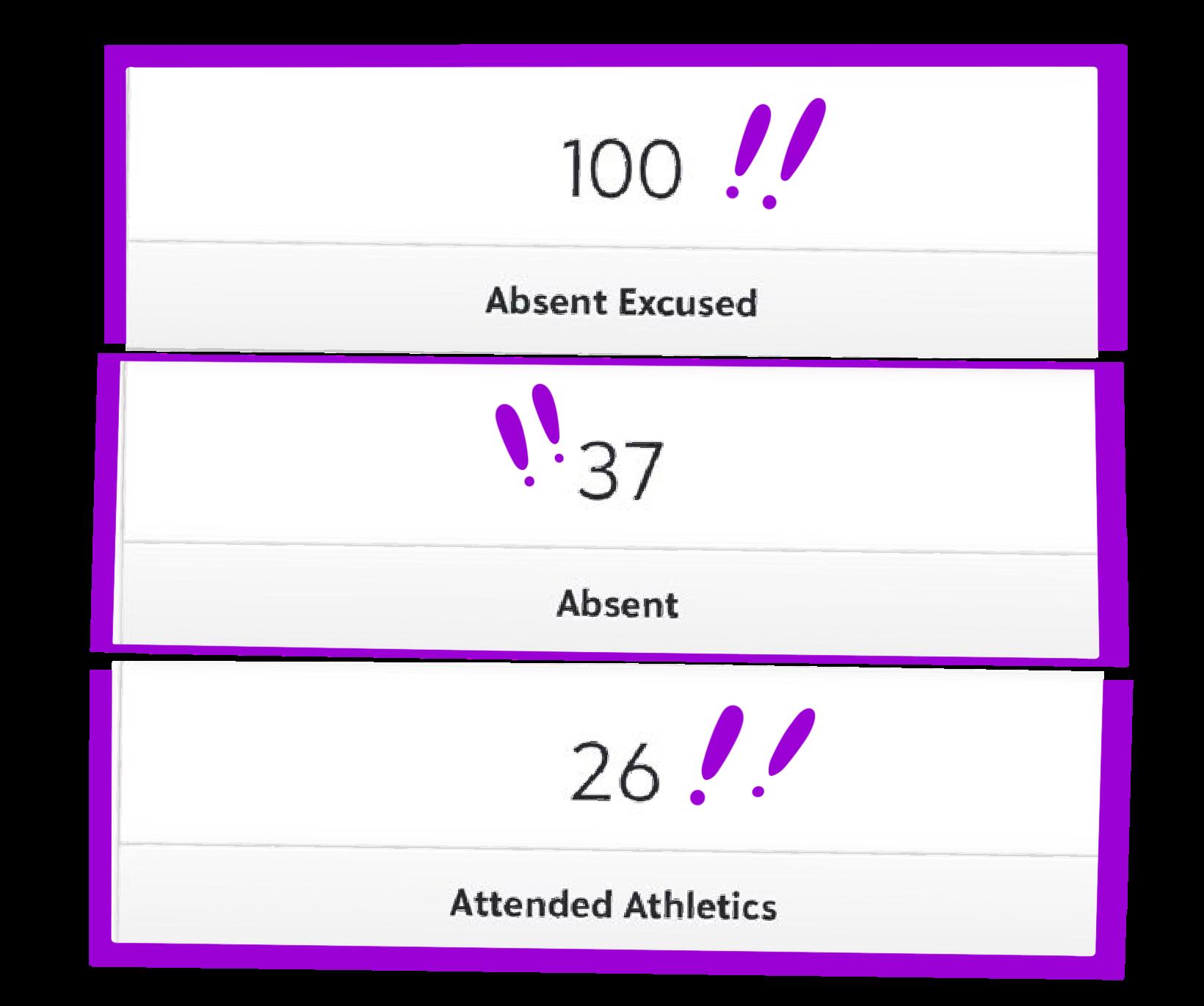
“Usually, [I see] some decline in the quality of their
Due to the time devoted to make-up work, students say the effects extend beyond missed classes.
“It’s trickled down to other classes,” said sophomore Ari
Students handle the challenge in different ways. Some wake up earlier to get work done before school. Others make a point of meeting with their teachers, according to Thomas.
“You have to be really good about getting notes from friends and going to talk to teachers and asking for extra time if you need it,” Qureshi said. “You have to be resourceful.”
While this might work for more driven students, it serves as a larger challenge for others, Qureshi says.
Some teachers say the best strategy is getting ahead of an absence, not just recovering from it.
“You don’t have to wait until after the absence to schedule a one on one. You can always pre-learn it and then be ahead of the game, as opposed to waiting until you’re behind,” Upper School math teacher Hsi Hou Fernandez said. “I feel like the stress once you’ve already fallen behind is higher than if you would meet with your teacher before to get ahead.”
Managing the challenge of missing class comes with broader lessons.
Being a student-athlete imparts a lot of life skills, including time management and self-advocacy, according to students and faculty.
“I think one of the really great parts about being in school and doing a lot of different things is that you get to figure out a lot about yourself,” Thomas said. “[Like] how to work in ways you know that are going to make sure you stay on top of your work.”
Penelope Stone
Cate Simpson
Graphic by Lylah Pouratian
Graphic by Lylah Pouratian
Sophomore Sykes Lamensdorf has earned a spot on the U18 Barebow U.S. Archery Team after ranking fifth nationally. This qualifies him to compete in the Youth Pan American Games in Colombia beginning May 22.
For Lamensdorf, this selection serves as a major achievement he never imagined reaching.

“When I got into the sport, I honestly never envisioned myself being able to do this,” Lamensdorf said. “When I got that email [that] I was going to be able to compete [in Colombia], it was just a culmination of all the hard work I put into this sport.”
Lamensdorf was first introduced to archery by his grandfather, who had practiced the sport for years.
“He didn’t really force it on me,” Lamensdorf said. “I just kind of saw him doing it and asked him about it. So, he gave me a bow and arrow, showed me how to do it, and I got so into it.”
After that, he began practicing in his yard so frequently that it drew the attention of his dad, who encouraged him to compete in tournaments.
But it wasn’t until 2023 that Lamensdorf started entering competitions.
Out of the various local, sectional and national level competitions, Lamensdorf has competed at numerous National Field Archery Association tournaments. He won first place at two separate sectionals.
Sykes Lamensdorf
rankings and Team USA selection. The top five archers earned a spot on the team, and Lamensdorf received the fifth spot. He is currently No. 1 in his division.
Although archery is an individual sport, Lamensdorf trains with Golden Archers Academy, a club of roughly 15 members. In addition to meeting with his coach once or twice a week, he also practices in his backyard.
When I got that email [that] I was going to be able to compete [in Colombia], it was just a culmination of all the hard work I put into this sport.”
Lamensdorf says during normal practice he aims to shoot 600-800 arrows per week, with around 150 at a time. In the week before a tournament, Lamensdorf says he shoots 800 or more arrows. When he gets closer to competition day, he takes a different approach to his practices.

He has also participated in national-level U.S. archery competitions such as the Gator Cup and the Arizona Cup. There are five cup tournaments each year, and placements in those events determine
“I actually taper off as it gets closer to the tournament,” Lamensdorf said. “Archery is more of an endurance sport than anything. It’s about consistency and doing the same thing over and over as many times as you can.”
His coach, Kevin Oblander, credits Lamensdorf’s mindset as central to his success.
“That consistency and work ethic and trying to make that shot perfect, instead of being worried about where it goes and score-wise, says a lot about somebody’s drive,” Oblander
As he prepares for Colombia, Lamensdorf says he’s trying to be consistent with his usual practice routine.
“I’m honestly trying to keep it the same because I’m really trying not to build many nerves for [the competition],” Lamensdorf said.
Lamensdorf says competing in Colombia will be an adjustment because of

the high altitude.
“I have to spend a lot of time practicing before the tournament because the arrow trajectory is different in the altitude,” Lamensdorf said. “I have to get used to the conditions because I’ve never shot in a place like that before.”
Looking ahead, Lamensdorf says he hopes to become the top-ranked archer in the United States in his age group and receive another Team USA selection next year.
Though archery is not an NCAA Division I sport, he says he hopes to continue it in college clubs and throughout his adult life. Oblander also said that Lamensdorf has grown tremendously, not just in his skills but also in maturity.
“I think he’s determined enough,” Oblander said. “No matter what he decides to do in life, I think he’ll go after and get it.”

Penelope Stone, Evan Huang
Sykes Lamensdorf
Photo courtesy of Sykes Lamensdorf
AIMING HIGH: Sophomore Sykes Lamensdorf made the U18 Barebow United States Archery Team, allowing him to compete in the Youth Pan American Games.
Graphic by Lylah Pouratian
Photo illustration by Lylah Pouratian
When Rian Kinsler was old enough to start playing sports, she tried everything: softball, tennis, golf, soccer, basketball and equestrian.
And then she found track.
“I’ve always been told, ‘Rian, you’re so fast. You need to run track,’” Kinsler said. “But unfortunately, I just never had the opportunity. Coming to Greenhill, I decided that I might as well just try.”
Just a few weeks into her first track season in seventh grade, Kinsler was pulled aside by a coach, Candida Francois, better known as Coach Candy.
“She told me she thought I could do really big things and saw so much potential and ‘a lot of upside,’ as she calls it,” Kinsler recalled.
When Francois asked her to join a club team she helped coach, Kinsler said yes.
Next Level Performance
By eighth grade, Kinsler was competing in college-hosted meets at Texas A&M University and University of Houston.
This was also the first year she qualified for the Nike Indoor Nationals, an annual meet at the Armory in New York City. Known for attracting the best track and field athletes in the nation, the Nike meet has been a highlight for Kinsler every year since.
“The environment at NIN is amazing,” Kinsler said. “The music, lights, smoke, the crowd and the athletes always make it a great experience.”
In her freshman year, Kinsler made it to the final round in the freshman division and finished second overall in the 60-meter sprint.
As a sophomore, Kinsler dedicated herself to track.
She advanced to the semifinals of the Nike event’s Emerging Elite Division that year and missed making the finals by 0.001 of a second. She finished ninth overall. She made the finals in the 100 meters of the Clyde Littlefield Texas Relays at the University of Texas at Austin. She also set a new Greenhill record in the 200 meters.
GBut Kinsler was doing a short, explosive sprint workout this past October when she felt something in her hamstring. She says she knew immediately that she suffered a muscle strain. While recovering, she also began experiencing severe headaches.
“I went to get an MRI, and it kind of spiraled from there because they found something weird inside my brain, which they said could be either a birth defect or a brain aneurysm,” Kinsler said.
As a result, Kinsler missed practices and underwent a cerebral angiogram in December. The test confirmed she had a small, stable brain aneurysm – a bulging spot in an artery wall.
The procedure she underwent required additional weeks off for recovery, placing limitations on Kinsler’s agility. Kinsler now requires regular MRI scans to ensure the aneurysm does not progress.
“It was rough, physically, mentally and emotionally,” Kinsler said. “I just felt so behind.”
Kinsler went to physical therapy once a week to recover, and she also used compression sleeves and did Epsom Salt baths.
“Recovery taught me how to actually take care of myself and my body,” Kinsler said. “I definitely learned to trust my process, be patient with myself, and believe that good things would come even when everything felt uncertain.”
Breaking Records
Despite her medical challenges, Kinsler has had a successful spring season. She has set school records in individual sprints and relays, according to track and field Head Coach Stacey Johnson.
Kinsler came back with modest expectations when she opened the outdoor school season at the Greenhill Relays on Feb. 28.
“I wanted to have a clean race and see where my training was after my injuries,” Kinsler said.
Kinsler surpassed these expectations by breaking the school record, running 11.71 seconds in the 100-meter dash.
Later, Kinsler traveled to her favorite
Rian Kinsler

competition, the Texas Relays, held April 1-4 in Austin. Competing against some of the best sprinters in Texas, Kinsler broke her own school 100-meter record in a preliminary round by running an 11.70-second race. She made the finals and finished third overall.
“It honestly felt surreal breaking my own record, because I wasn’t actively chasing it or putting pressure on myself to make it happen,” Kinsler said.
In the 4x100-meter relay, Kinsler helped Greenhill’s team break the school record in the preliminary races, then returned in the finals to earn second place overall.
“For the 4x100-meter relay, she is the anchor leg, so I know that if we get it off within 10 meters, we can almost guarantee Rian will catch anyone and win the race,” senior Nia Harrison said. “There is a huge sense of comfort there.”
More recently, at the Southwest Preparatory Conference Championships meet in Houston, Kinsler ran the 100-meter, 200-meter, 4x100-meter relay and the 4x400-meter relay. Due to bad weather the day before, the schedule was condensed, leaving all four of Kinsler’s events in the same 4-hour window.
“It definitely tested me mentally and physically, because there was not a lot of recovery time between races,” Kinsler said. “But I’m really proud of how I stayed
flexible, focused, and managed the quick turnarounds.”
In Kinsler’s first event, the 100-meter, she won the race and tied her personal best time of 11.70 seconds. She then won the 200-meter with a new personal best time of 24.08 seconds, breaking her 200-meter school record.
In addition to her individual achievements, Kinsler ran the first leg on the winning 4x400-meter relay team and helped the 4x100-meter relay team finish in second place.
While athletes in other sports are able to commit to colleges as juniors under NCAA rules, track recruiting runs on a different schedule. Many sprinters do not sign until their senior year, but Kinsler says she is in the process of talking to schools.
Kinsler says she plans to visit colleges this summer to this have more conversations with coaches about the recruitment process.
“This season has been about resilience and learning how to trust my process even when the path looked nothing like I expected,” Kinsler said. “With injuries and then coming back with breakthroughs, this season has definitely taught me that growth can happen long before the results show it.”
Speed Training Program Begins
reenhill’s High Performance Center introduced a speed training program on April 7 designed to help studentathletes improve one of the most important skills in sports.
Created and led by Sports Performance Specialist Karsen Mayle, this optional program is open to students in grades 7-12. The training aims to develop explosiveness, sprint mechanics and overall performance, according to Greenhill sports performance specialists.
While Greenhill already provides several strength and conditioning programs, such as sport-specific conditioning, lifting, flexibility and mobility work, speed training wasn’t a primary focus of these efforts.
“We can’t always hyper-focus on speed,” Director of Sports Performance Jessen Houston said. “This program allows us to really focus on speed development and see improvement.” Traditional training often prioritizes strength, endurance and injury prevention, leaving limited time for sprint-based work, according to Houston. The new program changes the focus, placing more importance on technique and consistency, he said.
“Speed development requires consistency,” Houston said. “If you’re not doing it regularly, you lose your gains.”
Many students say they share Houston’s goals, hoping the program will strengthen their muscles and reduce their risk of getting hurt.
“I feel that injury prevention is a major priority for us student-athletes, especially those who rely on quick movements and agility,” freshman Olivia Rosenfeldt said. “I believe that speed training helps you work up those muscles or prevent injuries when you’re trying to shift directions and do fast things.”
The program uses a method called “Feed the Cats,” which originated from famous track and field coach Tony Holler. This idea focuses on doing things with precision and intention rather than just doing it more, according to Mayle.
“It’s focused on quality over quantity and helping athletes move as fast as possible with proper mechanics,” Mayle said.
Instead of doing long, strenuous workouts, athletes in this program will perform short, high intensity sprints with full recovery, meaning they rest between reps until their energy is restored.
The benefits extend beyond running faster. The program offers more individualized coaching, something that is often difficult in a larger team setting, according to Houston.
“This program is more one-on-one
focus,” said Houston. “That’s just pretty difficult to do when we have preseason programs and we’re trying to work.”
video analysis, the program gives athletes feedback on their performance, something traditional workouts often lack. By analyzing movement and sprint timings, coaches can identify exactly where athletes need to improve and justify training accordingly, Greenhill sports performance specialists said.
then you don’t have the extrinsic motivation to push yourself,” Mayle said.
“It also lets us know that if you run a super slow time to your average, it may mean you are not recovered.”

and accountability can create a noticeable difference in performance over time, especially as more athletes begin to prioritize speed training.
“You’ll really start to see the divide and the skill gap between athletes who are focusing on sprinting and explosiveness and those who just kind of focus on the weight room,” Mayle said.
In sports, speed can be crucial, according to Mayle. It often determines the outcome of key moments, separating average players from standout athletes.
“There is never a time when you’re watching a game and you say, ‘Wow, that kid’s strong,’” Mayle said. “You always notice who are faster and more than everybody else.” Because of this, speed training can be a key focus for multi-sport athletes.
“I think speed is really important,” said freshman Jada Fleming. “Since I play both basketball and volleyball, you have to be fast on your feet, whether that’s on offense
Fleming added that speed helps athletes move quicker and change direction more By offering a more consistent and focused approach in training programs, Greenhill sports performance specialists say they hope to give student-athletes a competitive advantage.
“We just want to give kids another more consistent opportunity to get faster,” Houston said.
Elena Kramer
TRACK TRIUMPHS: Junior Rian Kinsler maintains focus, speed and drive as she sprints toward the finish line during the 4x100-meter relay in a meet.
Photo courtesy of Rhonda Taormina
Jessen Houston
Ela Battikhi
Graphic by Dani Reiman
Cindy Chou
TGreenhill’s Take on Global News
he U.S.-Iran war has entered its third month. Shots were fired during the White House Correspondents’ Dinner in what the Secret Service has called another attempt to assassinate President Trump. And four astronauts – three American and one Canadian –the moon for the first time in more years.
These current events have stimulated classroom discussions and hallway conversations and debates, according to sophomore Athena Yu.
Greenhill students and teachers who are closely tracking the news hold a wide spectrum of opinions on these notable events.
Conflict in Iran
On Feb. 28, the United States and Israel launched coordinated strikes on Iran, killing Supreme Leader Ali Khamenei and dozens of senior officials. A month later, Iran responded with missile and drone strikes across the region and closed the Strait of Hormuz.
The U.S. has deployed numerous warships, aircrafts and troops to enforce a blockade of Iranian ports, pressuring Iran to reopen the strait. More than 3,000 people have been killed in Iran and over 1,800 in Lebanon, where Hezbollah has exchanged fire with Israeli forces, according to Iran’s forensic chief and Lebanese authorities.
this war has ended up, and the peace terms that we agreed to, really don’t indicate any sort of victory. The only prize was just killing people, and so killing people is then being justified as a necessity.”

“I think wars are easy to start and harder to finish,” said Upper School history teacher Scott Cotton. “America doesn’t have a great track record in the Middle East, so caution is advised.”
By mid-May, a ceasefire between the United States and Iran was in danger of unraveling with negotiations deadlocked.
Congress has voted five times on whether to restrict Trump’s warmaking authority over Iran, but Republicans have defeated each attempt.
Upper School Dean of Students

George Heinrichs says this lack of checks and balances tilts alarming amounts of power into the hands of the president.
“We’ve never had a conflict so driven by one singular individual and their whims,” Heinrichs said.
Many Upper School students say they feel conflicted about whether the U.S. was justified to attack Iran.
“I don’t think for America the war was fought on a basis of necessity,” sophomore Wilson Heeringa said. “The way
With tensions rising in the Strait of Hormuz, students grapple with the economic impact in different ways.
“Every once in a while, I’ll bring up what gas [price] was the last time I got it and ask why it’s changed,” senior Nathan Trimmer said. “Then it gets explained by the most recent event that just occurred in the war.”
Heeringa says the Greenhill community has focused more on the moral aspect of the conflict as opposed to practical gas price increases.
“For the average Greenhill student, paying $2 more for a gallon of gas will not impact them in the same way it impacts the average American,” Heeringa said. “Striking a hospital or a school is going to spur more change in ideas among Greenhill students than having to pay more for gas.”
Assassination Attempt
Trump attended the White House Correspondents’ Dinner held at the Washington Hilton for the first time as a sitting president on April 25. During the dinner, California resident Cole Tomas Allen ran through a security checkpoint holding a gun.
The president, First Lady Melania Trump, Vice President JD Vance and members of the cabinet were evacuated from the ballroom. No attendees were seriously injured.
For Greenhill students, the shooting landed differently, depending on their opinions toward the current administration.
“I was shocked, but it wasn’t as big of a surprise as the first assassination attempt,” senior John Hurley said.
The shooter sent an email to family members minutes before the attack, describing his dissatisfaction with Trump’s immigration detentions, U.S. strikes on alleged drug boats and the bombing of a girls’ school in Iran.
“I think we’re in a very disorganized state as country,” Agastya said. “In a very digital state, we no longer actively engage in civil discourse, which ultimately results in strengthening extremism and increasing political violence.”
Space Exploration
The Artemis II mission sent four astronauts on a 10day mission around the moon. The crew landed off the coast of San Diego on April 10, completing the first crewed lunar mission in more than 50 years.
The mission was met with a range of opinions regarding logistics, ethics and impact among Upper School students.
For sophomore Ayaana Joshi, who is interested in STEM, the mission was inspirational.
“It made me feel really excited about the potential fields I could work in,” Joshi said. “Artemis II showed me the sky is the limit.”
Also watching the liftoff and splashdown, Heeringa said the mission seemed like a publicity stunt for the current administration to advance the space race against China.
“I think the U.S. is scared by the proposition of losing space dominance,” Heeringa said. “Now that China is threatening to make more advancements along with India landing a probe on the moon, it’s scary for the current people in power to not be the best anymore at this one thing.”
Another critique centered around ethics. Joshi says balancing funding in space with funding on earth raises questions about taxes or necessity of space exploration.

Hurley says these incentives don’t justify murder. He also critiques murder in the political landscape, saying it oftentimes invites violence and extremism.
“No matter how much you dislike someone, it’s not going to justify shooting,” Hurley said. “Killing Trump isn’t going to achieve a goal. It’s just going to embolden his idea.”
The rise of political violence in America is rooted in political polarization, according to sophomore Gitanjali Agastya.
OHeinrichs pushes back on this framing.
“People sometimes have this way of assuming a cost is given for one thing that’s normal, but then overestimating the cost if it’s something new,” Heinrichs said. “The war in Iran is a billion dollars a day. We can fund the program to go to Mars for less than fighting
Following Artemis II, NASA is preparing to launch Artemis III in mid2027 to test commercial lunar landers built by SpaceX and Blue Origin in low Earth orbit.
“At a time where people are scared and uncertain, [we need] something to inspire people,” Heinrichs said. “This is a program that asks the best of us to reach out to the stars, asks Americans to invest in the future that’s based on science and innovation, not violence, not division.”
PopUp Bagels Is on a Roll
n April 24, PopUp Bagels officially opened their first Texas location in Inwood Village in Dallas. The Bagel shop that originated in New York City specializes in the “grip, rip and dip” style and sells a variety of bagels, cream cheeses and butters that rotate on a weekly basis.
At PopUp, the bagels are not precut but served fresh out of the oven for customers to tear and dip into a tub of their cream cheeses, or “schmears.” Evergreen juniors Lillian Smith and Victoria Gonchar, both avowed foodies, ventured to the new hot spot to see what all the “steam” is about. Here is what they found:
Lillian:
I first went to PopUp on Saturday, April 25, after my 1 o’clock hair appointment that was next door. Originally, I was intimidated by the line because there seemed to be about 30 people ahead of me. Nevertheless, I decided to stick it out and wait. The line moved very quickly, and I was in the store ordering within 10 minutes. The employees were also very friendly and knew how to run an efficient operation.
Now to the bagels. Let me be the first to say that these bagels are monumental for the Dallas community. I’ve been to New York, and I’ve been to Boston. Still, these bagels are no joke, and they’re quite amazing. I got a sesame bagel, an everything bagel, a salt bagel and a regular cream cheese and salted butter dip. Each bite was delectable.
The bagels are fluffy on the inside and concealed in a
crispy shell. The butter and cream cheese were the perfect temperature to accompany the piping hot bagels. I was so moved by these bagels, I felt compelled to bring them to my New Jerseyan father in the ICU. He was also quite impressed with the bagels and echoes me when I say: Don’t walk, but RUN to PopUp Bagels.
Victoria:
I tried to go to PopUp bagels on April 24, the opening day. I saw the live music, merch and the limited collab with Wingstop all over my social media. However, so did many others. When I went to the store, the line was around the corner. Since it was a Friday, I knew I was going to be late for school if I waited, so I decided to come back another day when the line was shorter.
I finally got to “grip, rip and dip” the bagels on May 8, and the long wait did not disappoint. I ordered the plain bagel with a tub of spinach artichoke cream cheese and Sabatino truffle butter. At first, I was wary of these obscure flavors because I usually like sweet cream cheeses, but I was quickly proven wrong.
These schmears were the perfect flavor. The butter tasted like a truffle oil that complemented the bagel, rather than overpowering it with flavor. The cream cheese was smooth and airy and perfectly captured the artichoke flavor. I was very impressed and will definitely be going back to try the new weekly flavors.
I also got to try PopUp bagels in New York City in March, but I wasn’t as impressed as I was by the Dallas bagels. In
New York, my schmears were frozen hard, making the “grip, rip and dip” process a lot more challenging. Thankfully, the Texas heat must have warmed them up, because the consistency was perfect in Dallas. Dare I say Dallas outdid the New York bagels.
Scott Cotton
Victoria Gonchar, Lillian Smith
Graphic by Victoria Gonchar; photo illustration by Lillian Smith
CHEWY PERFECTION: PopUp Bagels attracts the masses, serving hot bagels, butters and schmears.
Photo by Victoria Gonchar
Evergreen the
Farewell Letter
Dear Evergreen Colleagues (and our Greenhill community): As our time on the Hill comes to an end, we are sad to bid our Evergreen family goodbye. Though our very first issue felt long, these six issues have been filled with so much laughter and joy.
Sometimes, we felt the intense pressure of a looming deadline, yet we always magically turned in all 24 pages proofed and fixed.
We thank all who made graphics, took photos, laid out pages, wrote stories and made edits. To everyone on staff, there is no way we could have successfully completed our run as editors-in-chief without you all.
To our section editors – Jordan, Cindy, Khushi, Talia and Cate; Thank you all for your dedication to learning the new and sometimes frightening skills of Adobe InDesign. This complicated version of PowerPoint may have been difficult at first, but you all persevered through every whitespace issue that came your way –disappearing text and all.
To the juniors and now senior staff: We truly could not have entered layout feeling prepared without you. Thank you for always approaching every task and challenge with a willingness to learn; we know the process can be stressful sometimes, but we are confident that your experiences from this year will carry you far.
Lylah, thank you for the amazing graphics that looked too good to even believe a human drew them. No matter what crazy request we had, you managed to deliver every single time. Your artistic talent is unmatched, and we cannot wait to see where it takes you. Thank you for your uplifting spirit at layout, and the late nights you spent with us just in case we needed an emergency graphic.
Ella, thank you for being such a steady source of positivity and care in the Evergreen Room. Whether we needed a last-minute photo for “Rants & Raves” or a perfect headline, we could always count on you. In your “Day in the Life” articles, you demonstrated a gift for finding the most genuine voices on campus and shaping them into heartfelt stories. It has been a privilege to work with you.
Noor, thank you for always keeping us fed and for making us laugh uncontrollably. Your fangirling over Woodward and Bernstein and bubbly energy kept us awake, no matter how tired we were. You were always the most positive of all the seniors, and without you, the last few days of the April issue was a struggle. Though we were never able to run your alumni profile on Nic Suarez, we hope the paper lived up to everything your third-grade self imagined when you made The Mini Evergreen.

Rory, our cephalopod artist, wannabe Irish dancer and rollerblading master, thank you for everything! We enjoyed hearing about your debate adventures. We loved your doodles on the whiteboard that distracted us from the daunting blank spaces of pages we had yet to proof. Thank you for occasionally hitting the worm in our boomerangs or joining in on our side quests during layout. We hope you never lose this quirky-yetperfect side.
To Justin and Vedant – J.Wu and V.Sub – it felt wrong to separate you both in this letter and while working. You two showed us the magic of InDesign whitespace boxes and whipping the Middle School page into shape (sometimes in league with Rory). You will forever be our InDesign duo and almost basketball professionals. The number of times you saved Sasha from an InDesign crash out is so appreciated. Hopefully, even after we graduate, you two will continue to be the iconic duo you are now.
Mr. Jones, you are the heart and soul of the Evergreen. This paper would be in shambles without your invaluable guidance. We cannot thank you enough for how much you care. Whether it’s Special Report, Centerpiece, staff-ed or cover, you were always pushing us to be better. We loved hearing about the Philippines, your runs,
the songs you’re listening to and the trials and tribulations of being a cat parent to Woodward and Bernstein. Although we’re student-journalists, words cannot describe how lucky we were to have you as our advisor. We will carry the lessons you taught us beyond the Evergreen Room and into our adult lives.
To Jordan, Kaitlyn and Vivian: There will be times when you question why you ever signed up for this job – just like us. But just remember that you have a whole staff backing you. Even when you are on deadline and you are stressed, do not forget to have fun and lean on each other for help.
The funny and happy moments will be the basis of the memories that keep you going for all six issues. We have instilled all our knowledge and every single InDesign trick we have ever learned into you. Best of luck next year; we know you three can do it!
Thank you everyone for the best staff we could ask for and all the memories that we will cherish, even when we get to college. We are forever grateful for everything.
Happy writing!
Nora, Kate and Sasha

the Evergreen Sta�
Noah
ADVISOR
Gregg Jones
Have a response? Opinion? Original Idea?
Email the Editors-in-Chief: arbucklej28@greenhill.org whitev27@greenhill.org yook27@greenhill.org
EDITORIAL POLICY
The Evergreen is an independent, student-run newspaper serving the Greenhill School community. It is printed six times during the school year. Print circulation is 900 copies. Past issues are archived at issuu.com/ghevergreen.
Our staff upholds a code of ethics that values honesty, integrity, accuracy and responsibility. Our mission is to help our community interpret campus, local, state and national events through content written and edited by students.
The Evergreen welcomes letters and emails from readers. We reserve the right to edit submissions for accuracy, grammar and length. The Evergreen will not publish material that we judge to be libelous, or obscene, invades privacy or constitutes hate speech. The staff editorial represents the opinion of The Evergreen staff, not necessarily that of Greenhill School.
ADVERTISEMENTS
The Evergreen welcomes all advertisements, but we reserve the right to refuse an ad. Business inquiries should be directed to Victoria Gonchar: goncharv27@ greenhill.org
CORRECTIONS & CLARIFICATIONS
To request a correction or clarification, please email arbucklej28@greenhill. org, whitev27@greenhill.org or yook27@ greenhill.org
Photo courtesy of Sasha Wai BITTERSWEET GOODBYE: From left, 2025-26 Evergreen editors-in-chief Kate Ponnambalam, Nora Ahearn and Sasha Wai will graduate from Greenhill on May 26.
Comic by Lylah Pouratian
& Rants Raves
A RANT to slow walkers on campus. Their turtle-like pace causes unnecessary hallway traffic, making passing periods even more chaotic, cluttered and frustrating for people in a rush. No one wants to be late to class!
A RAVE to senior speeches. They are always a highlight of assemblies, giving underclassmen motivation and guidance for their upcoming years of high school. We always look forward to what lessons we will learn each time!
A RAVENT to flip flops. While they are comfortable and easy to throw on when the weather gets hot, there are mixed opinions on whether they are too casual or inappropriate for school. I guess you could say opinions really flip-flop on this one.

A RAVE to Catalyst’s new Donut Fridays. It is the perfect sweet treat to end your week, and it makes an already anticipated day even more special! Who doesn’t love donuts and coffee? It is the “hole” point of Friday, really!

A RANT to the depleted Buzz inventory. With the end of the school year, the Buzz temporarily stopped restocking some snacks. Sadly, this meant our favorites nearly disappeared heading into the summer break. Guess the shelves are feeling a little buzz-killed.
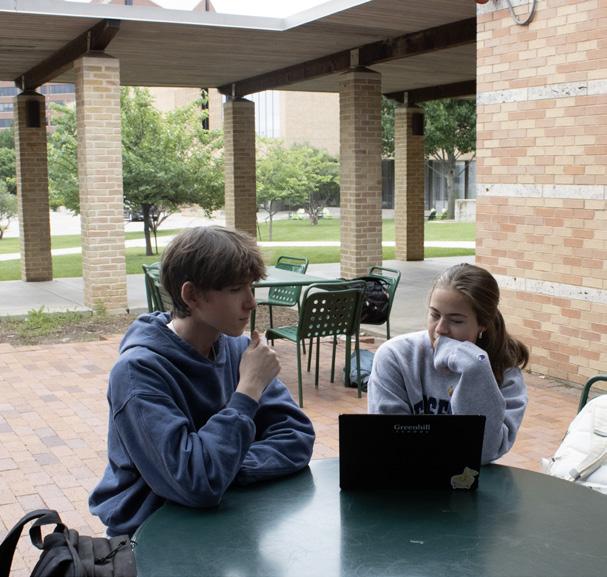
A RAVENT to the end of the year! Summer has arrived, which means a break from the stress of school for three months. Unfortunately, this also has meant cramming in as many summative assignments as possible these past weeks.
The Rise of Stress Toy Trends
Evergreen Staff
In the spring of 2017, fidget spinners took the global toy market – and Greenhill student life – by storm. They were marketed as a low-cost way to manage stress and attention-deficit/hyperactivity disorder, or ADHD. In time, the popularity of fidget spinners and follow-on toys like Pop-Its passed.
But now they’re back. And a central question raised by the resurgence of fidget toys is whether the products are serving student needs or satisfying fashion whims.
The rise and fall of various fidget toys over the past decade suggests something more than a typical consumerism trend. From fidget spinners to PopIts to the more recent rise of stress balls, each wave reflects a broader student culture that quickly adopts and abandons trends.
At Greenhill, these trends have largely gained traction from social media and peer influence. These phenomena, which lie right at student’s fingertips in today’s digital age, have enabled the fidget fad to spread rapidly among students.
Over the past couple of years, TikTok was flooded with clips of Five Below Dumplings and Pop-Its. As these trends faded out, many students stepped away from bringing them to campus, replacing them with “trendier” successors.
The fashion hype of these revered sensory tools undermined their very purpose, making people feel the need to jump on the bandwagon simply because they were viral.
This rising popularity of stress toys is increasing their demand across campus, and everyone has been trying to get their hands on them. Many students have felt the urge to go “NeeDoh hunting” during their free periods just to be a part of the new trend. This takes away the valuable time students are given to meet with their teachers and complete
homework.
When students see their classmates with new, trendy toys that they have seen on their social media pages, they can’t help but notice and ask to borrow them for a class period. Although this sharing seems harmless on the surface, it leads to many students using stress toys for their physical appeal, further increasing their popularity at school. This doesn’t allow students who need them for their true purpose to play with them, leaving these students without an outlet to manage their stress.
For many students, especially those struggling with ADHD, fidget toys can be helpful tools. Rather than resorting to other unhealthy habits like nail biting, fidget toys provide a beneficial way for students to channel excess energy. These stress toys can increase concentration and reduce anxiety, making it easier to stay engaged during long classes, creating a useful coping mechanism.
for this same purpose. If we are feeling anxious during the school day, we are allowed to go into the office and use the toys for their true purpose, without constantly being bothered by our classmates.

Some students dealing with ADHD and anxiety have special accommodations that allow them to use fidget toys at school, specifically during testing. In such a demanding environment, these fidget toys allow students to cope with their nerves in a healthy way, instead of relying on bad habits like skin and hair picking.
The counselor’s office also has a variety of fidget toys


At a school with extreme expectations, it has become more challenging to balance academics and extracurriculars. These are moments where fidget toys might actually benefit students. In addition, the pressure to perform well in both areas often results in minimal time left in the day to take breaks, which makes maintaining focus for extended periods of time even more challenging. Fidget toys support students in managing this stress while continuing to work efficiently.
The problem with the toys is how they’re another example of overconsumption amid consumerist identities. An item gains attention online, becomes popular among students and then inevitably fades as the next trend emerges.
Once these products feed into the trends, some students feel inclined to buy more of the same toy in various colors or textures. Students then bring multiple fidget toys to school to show them off to their peers, making every student that has one seem like a trendfollower.
The result has been a negative connotation with their use, diminishing their real benefits as students even organize fidget toy exchanges. While owning one for focus can be practical, buying several to form a collection can slowly become unnecessary consumption and performative.
The issue regarding fidget toys is not the toys themselves, but how they are used. Students should feel free to use whatever tools to help them succeed. But they should not feel pressured to constantly keep up with shifting trends.
Let’s view these fidget toys as what they are: stressrelieving tools, not fashion accessories.
Graphic by Kaitlyn Yoo

Class of 2026: The

0 students
1 student
2+ students
5+ students
10+ students
20+ students
students studying in California
students staying in Texas 13
American University
Austin College
Boston College (2)
Bradley University
California Polytechnic State University, San Luis Obispo (2)
Centenary College of Louisiana
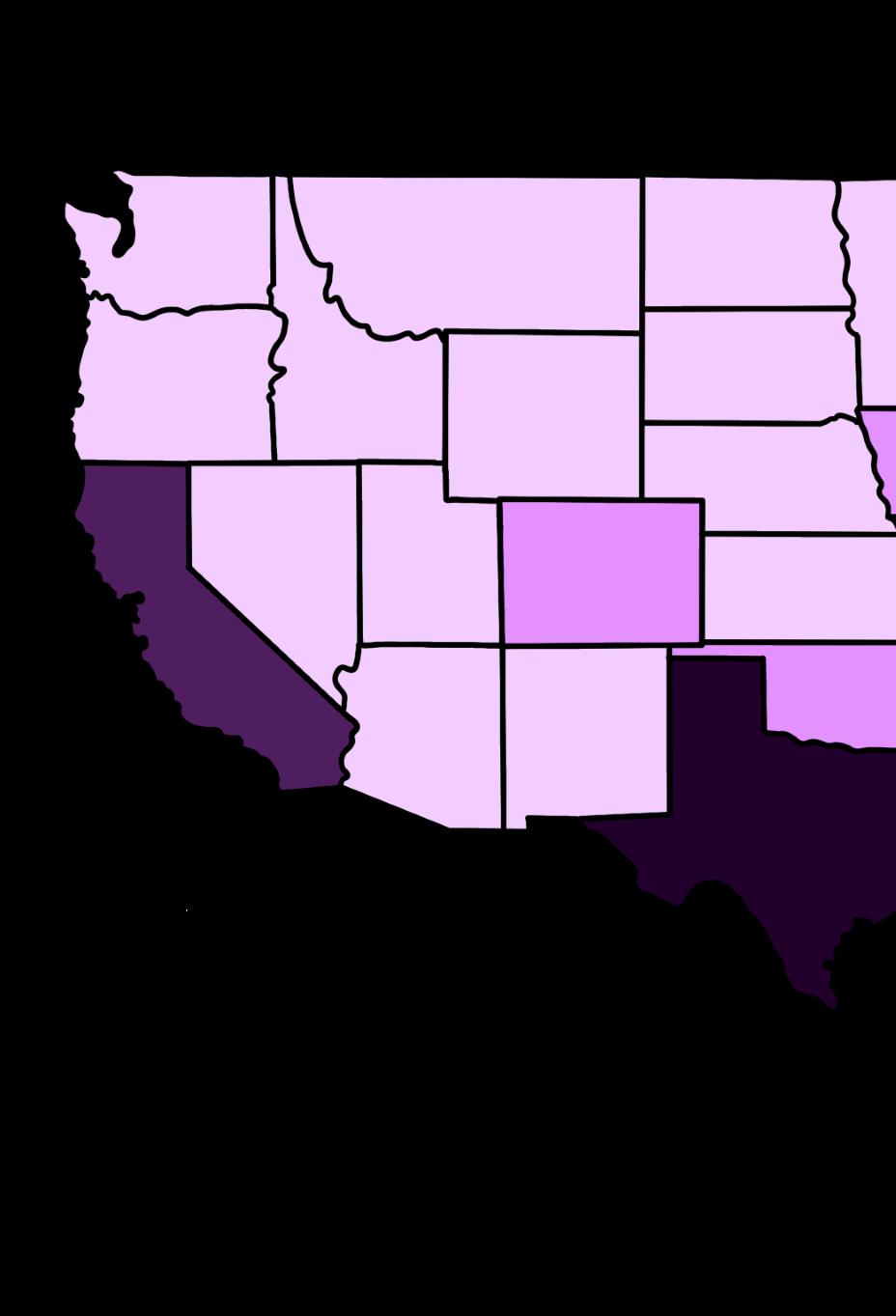
Chapman University
Claremont McKenna College
Colorado State University
Columbia University & Sciences Po (US/France)
Cornell University (3)
Denison University
Duke University
Elon University
Emory University (2)
Furman University
Georgetown University
Southern Methodist University (2) 36
Loyola University Chicago
Mount Holyoke College
New York University (3)
Northwestern University (4)
Princeton University
Purdue University (2)
Rhodes College
Rice University (11)
Rochester Institute of Technology
Schreiner University
Scripps College
The Next Step green
England
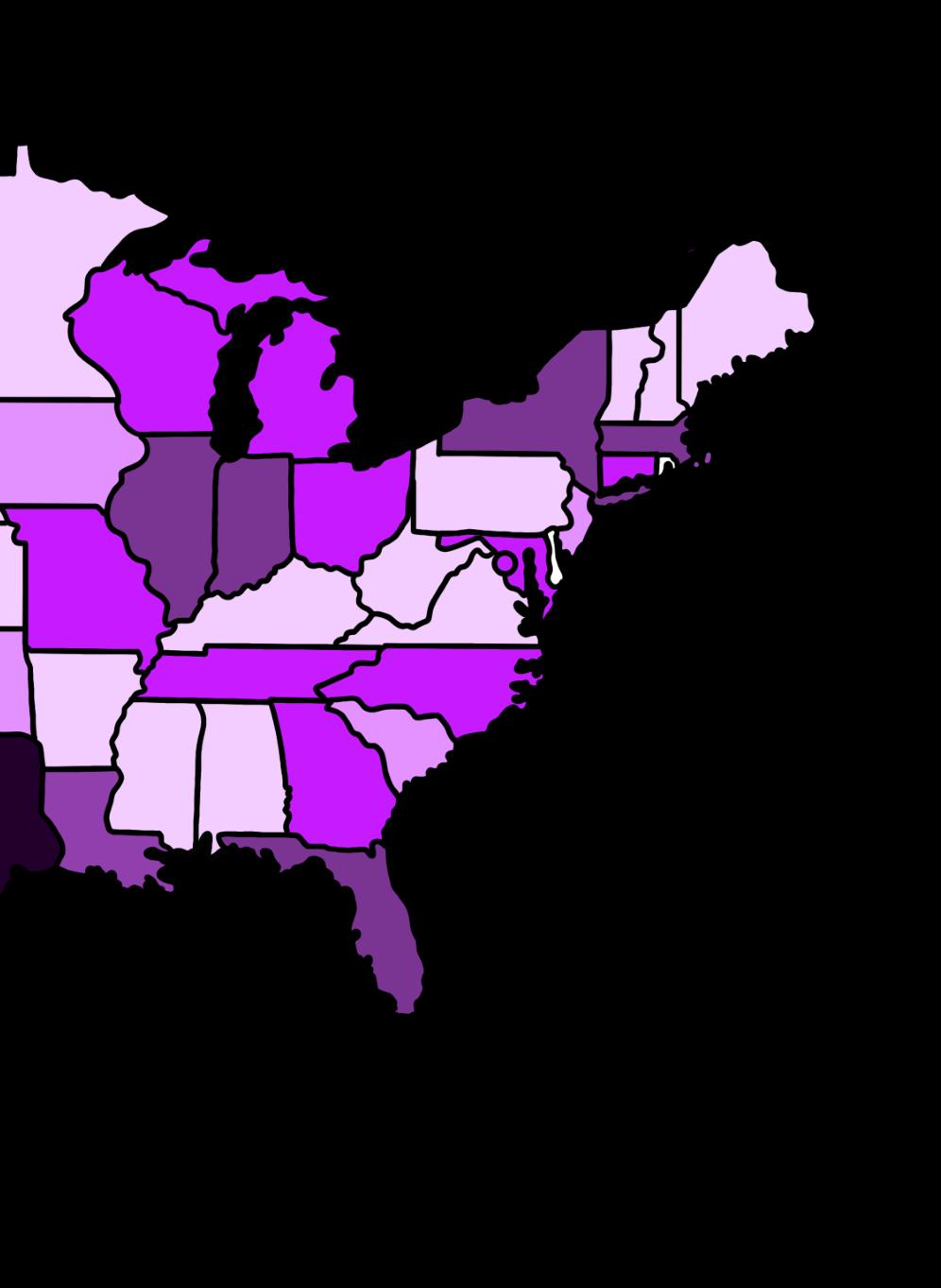
Tulane University (4)
University College London (UK) (3)
University of California, Irvine
University of California, Los Angeles
University of California, Santa Barbara (2)
University of Chicago (2)
University of Cincinnati
University of Florida (2)
University of Georgia (2)
University of Illinois
University of Iowa
University of Maryland, College Park (2)

France
students studying abroad

University of Southern California (3)
University of St. Thomas
University of Texas at Arlington (2)
University of Texas at Austin (15)
University of Wisconsin (2)
Vanderbilt University (2)
Villanova University
Washington University in St. Louis (3)
Wesleyan University
Yale University (2)
Graphics by Lylah Pouratian
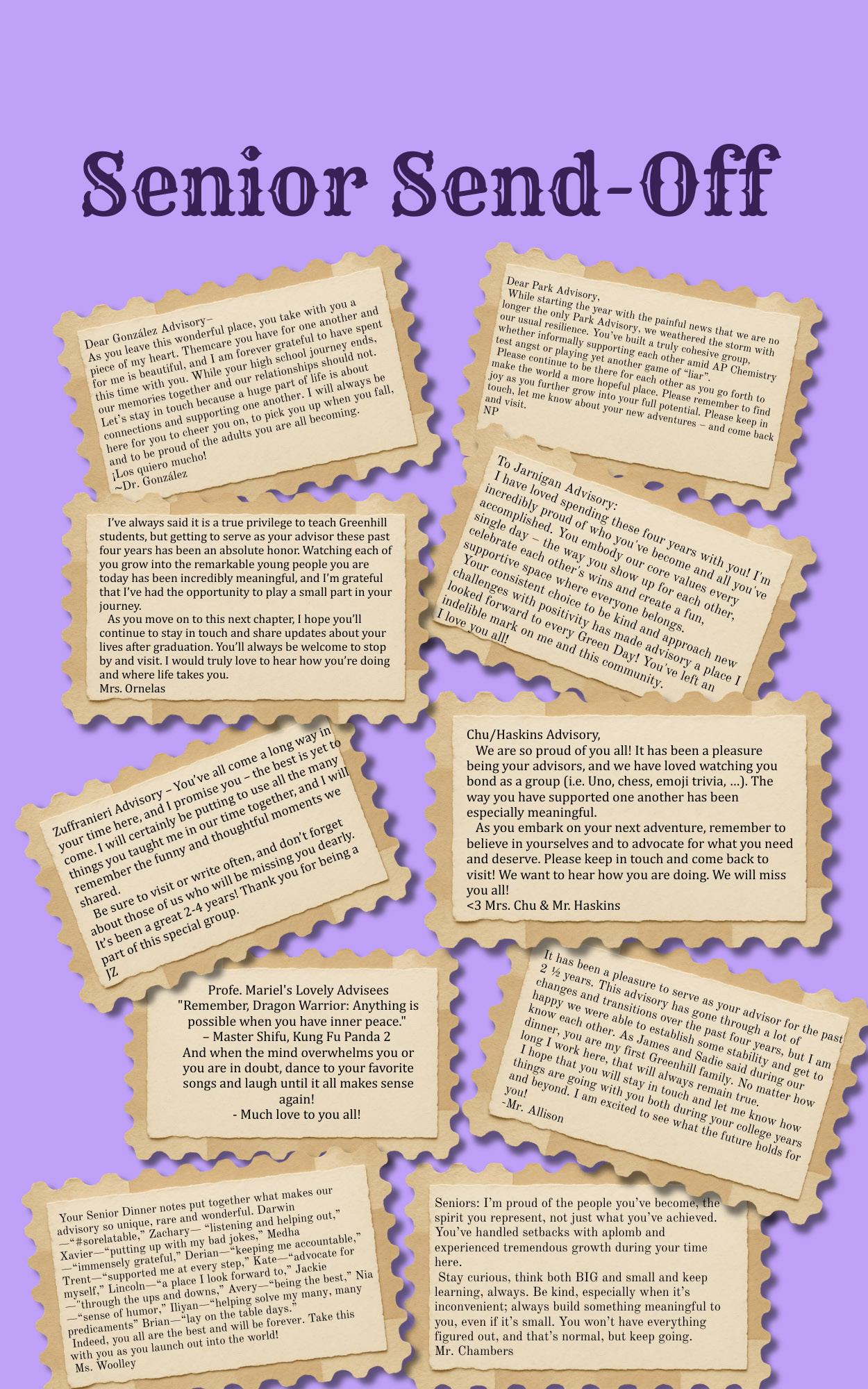
Graphic by Lylah Pouratian