Volume 61, Issue 3
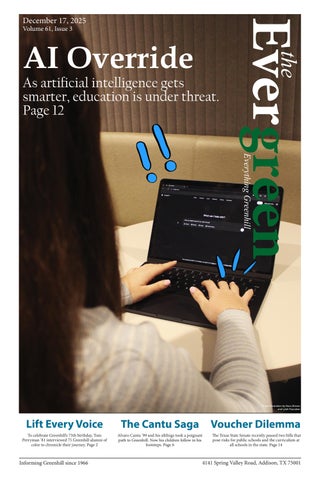
AI Override
the
Evergreen
December 17, 2025
As artificial intelligence gets smarter, education is under threat. Page 12
Everything Greenhill
Photo illustration by Nora Ahearn and Lylah Pouratian
Lift Every Voice
The Cantu Saga
Voucher Dilemma
To celebrate Greenhill’s 75th birthday, Tom Perryman ’81 interviewed 75 Greenhill alumni of color to chronicle their journey. Page 2
Alvaro Cantu ’99 and his siblings took a poignant path to Greenhill. Now his children follow in his footsteps. Page 6
The Texas State Senate recently passed two bills that pose risks for public schools and the curriculum at all schools in the state. Page 14
Informing Greenhill since 1966
4141 Spring Valley Road, Addison, TX 75001
02
News
Jordan Arbuckle
F
austino Torres Sr.’s presence at Greenhill has been characterized by his peers as a relentless pursuit of perfection through an undimmable attitude of empathy, optimism and passion. From painting lines on sports fields to talking with coworkers, people around him said his smile seemed to never fade. Torres served Greenhill with the facilities team for 45 years until he died in 2024. A year later, one of Torres’ grandchildren peered up in awe at his grandpa’s smile, now encapsulated by a portrait hanging upon the Fine Arts Building wall. Alongside the grandchild stood the three sons of the late Greenhill Legend, all struck with varying degrees of emotion and shock. Torres migrated from Mexico at the age of 15 with nothing but a will to build a better life for his future family, according to one of his sons, Faustino Torres Jr. Previously, Torres Jr. was unfamiliar with his dad’s legacy at Greenhill. He discovered it while reading the biography of Torres beneath his father’s museum portrait. “I hope one day I can fill one shoe of what he built,” Torres Jr. said. “It means a lot to know the impact he had here, and I’m forever grateful to the Greenhill family for taking care of him.” Torres’ story is only one of the 75 diverse Greenhill experiences immortalized in the “Lift Every Voice” oral history project for the school’s 75th anniversary. The fiveyear project culminated in an event on Nov. 20, where the surviving members of the 75 pioneering voices showcased in the gallery, along with their family and friends, were invited to experience the exhibit.
opportunity to highlight more diverse voices from the past. He began recording interviews with 75 different people. “It just moved me so deeply to have these 75 people come in and be willing to talk about their experiences, their joys, their proud moments, their highlights, their pains, their struggles and their challenges,” Tom Perryman said. “Greenhill was not always a hospitable place for folks, but to be able to interview them and to have folks be willing to share was just the most humbling thing I’ve ever done.” Along with the interviews, Upper School Photography teacher Frank Lopez and his Upper School Honors Photography students captured black and white portraits of each of the participants. “Through interaction with [real] life people that shared this Greenhill experience, we are able to see wisdom in their faces and read wisdom in the text,” Lopez said. “That’s the power of
culminated with an event celebrating the Greenhill pioneers. In one instance, the experience of Selmore Haines III ’76 at Greenhill wasn’t always positive. Haines tried out for the Upper School musical year after year but never succeeded in landing a prominent role. In the 1975-1976 school year, the musical was “Oklahoma!” and Haines tried out again, with the same disappointing result. Haines’ friends believed he was talented enough. His parents concluded he was passed over because of his African American heritage. “I remember going to [founding Head of School Bernard] Fulton and saying to him ‘do you have a problem with me playing the lead opposite to a white girl?’” Haines was quoted as saying in the
y Photos b
rbuckle Jordan A of
voices lays the p is ent. d g iring ev uildin p B s s in t r d A n a the Fine otional xhibit in ov. 20 in an em e narrative that For Greenhill’s y r e ll nN e ga accompanied his exhibit portrait. 50th anniversary in RIES: Th first unveiled o O T S G s IN ni. It wa photography, In response, Haines created for his 2000, Associate Head SPREAD ill alum h n e e r of being able to give something senior project a one man show titled of School for Mission, 75 G identity.” “Color Me Black,” documenting the history Community and Culture Snippets from the interview were also of African Americans in America. He Tom Perryman ’81 and his brother, David Perryman ’83, created the book “From extracted to showcase the interviewee’s continued to perform “Color Me Black” across the country for 15 years. Humble Beginnings: The First Fifty Years of Greenhill moments, reflections and hopes. The process of extracting approximately Despite this life-defining experience at Greenhill School.” The Perryman brothers brought this 600 words from each interview that speaks Greenhill, Haines still views the school with project to life by interviewing many people to those moments, reflections and hopes a positive, optimistic and thankful attitude. When walking in and seeing the gallery who played a pivotal role in shaping the often seemed impossible, according to Tom for the first time, Haines remarked how school’s history. However, Tom Perryman Perryman. However, Tom Perryman was not much Greenhill had grown and changed felt as though the book did not fully capture alone in completing this project. Executive throughout the years, not just physically but the true Greenhill experience for many. Assistant to the Head of School Kasia Faber ideologically as well. spent countless hours on the project, and “I feel pride and also a reflection of how without her work it would never have come [members of] my peer group were really It means a lot to know the to life, said Tom Perryman. pioneers of integrating culture into the impact he had here, and I’m “I cried listening to some [interviews] Greenhill School, ” Haines said. “We didn’t forever grateful to the Greenhill because of the pain, because of joy, because know that at the time, and to now realize family for taking care of him.” of gratitude that was so apparent in those that and see the long-term effects of having a stories when they think about Greenhill,” positive result is really moving.” Haines was among those who spoke “It occurred to us that it was a very Faber said. “These people’s stories have at the program in the Fine Arts Recital white-dominant narrative, and to a certain shaped the people here today.” Hall during the event, alongside Perryman, extent, the leadership had been very maleLopez, Director of Equity and Inclusion dominant as well,” Tom Perryman said. Monsie Muñoz ’05 and senior Isabel Bhatia, “That narrative we had produced did not one of the project photographers. represent the experiences of everybody at “We know there’s so much to do in our Greenhill.” Many of the surviving 75 interviewees So, when Greenhill’s 75th anniversary saw the oral history project in its entirety for community,” Muñoz said in her speech. loomed, Tom Perryman saw it as an the first time on Nov. 20, when the exhibit “Like any community, we are unfinished, but
Creation
Event
the lessons you’ve offered us, lessons born from perseverance, resilience and love, are what give us the clarity to move forward.”
Community Impact This notion of learning from the oral history project has already started to happen throughout campus, according to Faber. “Every time I walk by the hallway of [the Fine Arts Building], I see kids … reading these words and stopping to look at these faces,” Faber said. “I love observing this because that means that these stories will live on.” Upper School English teacher Joel Garza has designed a way for students to interact with the exhibit in class. He created an assignment where students write about a significant Greenhill moment in their lives. T he n , they connect their feelings and words to one of the 75 interviewees by extracting quotes that resonate with their own personal experience. “I’m not sure what form it will take, student by student, but when I saw those stories, the first thing I thought was there’s some way that we can write with them,” Garza said. “There’s some way that we can write back to them. There’s some way that we can write in honor of these stories.” While capturing portraits, student photographers were also impacted. “It’s so incredibly cool because I was able to photograph people [ranging] from documentary filmmakers to company executives,” senior Sumedha Rapuri said. “It’s really inspiring because it shows you that you can really go into anything, no matter what you’re interested in.” Some of the 75 have also said their legacy has caused Greenhill to change. Hind Jarrah is both an immigrant and a parent to three daughters who attended Greenhill. She said her children brought Islam to the campus in countless ways. “We are immigrants who came to this country,” Jarrah said. “You are just a number when you first come, but when you see something like this [exhibit], you realize that there actually is value to your being.” Tom Perryman Tom Perryman said the event surpassed his expectations in how powerful it would be. “I want folks who have had harder experiences to not give up on us as a school,” Perryman said. “Have faith, we’re not there yet, but we’re working hard to get there.” Perryman also said he believes that this project represents a greater initiative to create a completely inclusive community for all. “I want every kid who comes to this school to feel like they belong, to feel like this is their school, and to feel like they are respected and honored,” he said.
Ever Evergreen
December 17, 2025
the
News
03
Students Attend Local Conference Marleigh Massoud, Vedant Subramanian
I
n partnership with four other schools, Greenhill organized the inaugural DFW Student Belonging Conference in early December, giving students an opportunity to discuss the issues of identity, empathy and community with their peers. The conference took place on Dec. 4-5 at the Marriott Quorum Hotel in Addison. The first day focused on discovering self-identity and featured spoken-word artist André Bradford, whose work centers around empathy. The second day explored community and connection, with Pasos for Oak Cliff founder Alejandra Zendejas speaking to students about her nonprofit’s journey and the impact of service. Eight Greenhill students attended the conference, which was open to students from independent schools in the Dallas-Fort Worth area. “We are creating a space for our students in the DFW area to be able to come together, have some really wonderful conversations around important themes and learn leadership skills,” Director of Equity and Inclusion Monsie Muñoz ’05 said.
Past Conference This year’s local conference aimed to provide DFW students with an experience similar to the national Student Diversity Leadership Conference hosted for years by the National Association of Independent Schools. Last spring, as the Trump administration pressured corporations and universities to abandon diversity, equity and inclusion initiatives, The private schools association announced in April that it was pausing this year’s Student Diversity Leadership Conference and the faculty counterpart, the People of Color Conference, due to “the rapidly evolving political and legal landscape.” The national association’s website said it would “reassess the conferences.” The 2024 Student Diversity Leadership Conference was engulfed in controversy after two adult speakers described Israel’s war in Gaza as a “genocide” and characterized the founding of the state of Israel as a colonialist and racist project, according to New York Times coverage. Jewish students and staff at the conference reported feeling unsafe and hid their Star of David necklaces, according to the Times. The Anti-Defamation League, along with three other Jewish organizations, wrote an open letter to the private schools association condemning “extreme, biased anti-Israel rhetoric” and argued that the conference became a “vehicle” for anti-Jewish and anti-Zionist speech. The private schools association President Debra Wilson apologized in a letter and promised future speakers would be vetted more carefully. The NAIS has not confirmed whether these incidents led to the 2025 pause of the group’s high-profile student and faculty diversity conferences. Despite past controversies, previous attendees say they disagreed with the paused conferences. “I think this is a time where more than ever a space like [the Student Diversity Leadership Conference] is needed for people to be able to have candid conversations, especially within this lens of a school setting about diversity, equity and inclusion, because a lot of that is under attack right now,” said senior Ruby Garza, who attended the diversity conference in 2023.
New Conference To fill the void left by the cancellation of this year’s diversity conference, Muñoz and other Dallas equity and inclusion school leaders decided to create the Student Belonging Conference. “All of the activities that we’re doing are trying to get students to connect with each other and to think about how, in those connections, they can support each other and their communities to make a difference and advocate for change,” Muñoz said in the days prior to the conference. Greenhill co-organized the event with Bishop Lynch High School, the Hockaday School, Parish Episcopal School and Episcopal School of Dallas. The conference hosted between 65 and 70 students in total. Six schools sent students. The Greenhill student attendees were selected through an application process that began in early fall. Decisions were released on Nov. 20. “The application asked us to explore parts of our identity and share that in our responses,” said sophomore Samaira Panjiar. “You were asked to talk about parts of you that the conference would continue to focus on once you go.” Prior to the conference, Panjiar said she was excited to see how the diversity of the community she lives in would affect her experience at the Ruby Garza conference. Sophomore Natalie Davidoff agrees. “I wanted to go so that I can bring back to our school and my community what I experience and got to learn,” Davidoff said before the conference.
Conference Reactions Students who attended the Dallas conference shared a variety of identifiers and backgrounds. “It really surprised me how open it was and judgementfree,” Davidoff said. “Everyone was really inviting. I loved meeting new people because everyone was able to get close with each other really fast.” Panjiar says she enjoyed Bradford’s portion of the conference, which focused on having empathy for others. “You never really understand what other people are going through beyond a surface level and it just takes a second to ask them how they’re doing,” Panjiar said. Sophomore Srinidhi Mettu says her most memorable part of the conference was the discussion on having difficult conversations. “Some people tend to view confrontation as a problem, or as argumentative, versus others find it a way to share your emotions, and it’s just important to know who thinks what about what you’re saying,” Mettu said. Muñoz says the continuation of the Dallas conference is dependent on the status of the national conference. If the “pause” of the Student Diversity Leadership Conference continues, she says she hopes to invite schools from other regions of Texas and maybe Oklahoma to the Student Belonging Conference. “With a little more lead time, we can continue to expand the experience and bring more points of view to the space in an intentional way,” Muñoz said.
December Break The Upper School’s first semester will end with the annual Holiday Singalong on Dec. 19, followed by an early dismissal for students to begin the December Break. The break will include Hannukah, Christmas and Kwanzaa festivities for community members who celebrate the holidays.
“Descendants” Greenhill theater students staged a production of “Disney’s Descendants: The Musical” on Nov. 20-21. The production was “all-school,” bringing together more than 60 cast members from the Lower, Middle, and Upper Schools.
College-Bound Athletes On Nov. 12, the Greenhill Athletics Department recognized three senior student-athletes who have verbally committed to play an NCAA Division I college sport next year. The athletes are: Nia Harrison, who has committed to the track and field program at University of Southern California; Avery Lonergan, who has committed to swim for Colorado State University; and Jaxson Thompson, who has committed to play basketball at Rice University.
Special Day On Campus On Nov. 21, the campus hosted Grandparents’ and Special Friends’ Day for Kindergarten, Lower and Middle School students. The event featured performances, open houses in arts classrooms, campus tours and a photo booth.
Kindness Week All divisions celebrated Kindness Week from Nov. 9- 15. In Upper School advisories, students wrote notes to someone they appreciate and delivered them.
Kindergarten “Nutcracker” The Kindergarten “Nutcracker”, a beloved Greenhill tradition, will take place on Dec. 17. Every December since 1951, Greenhill kindergarteners transform into toy soldiers and dolls and dance to Pyotr Ilyich Tchaikovsky’s holiday classic with the Head of School as the narrator and the Upper School Orchestra providing the music.
Belonging Conference On Dec. 4-5, Greenhill and other local schools hosted the first ever Student Belonging Conference for high school students. Along with two guest speakers, the conference featured sessions and activities led by local educators to help students build new connections and understand various perspectives.
Photo courtesy of Monsie Muñoz
BONDING MOMENT: Seven Greenhill students meet spoken-word artist André Bradford, fourth from left, after learning about discovering self-identity at the 2025 inaugural Student Belonging Conference.
Compiled by Elena Kramer and Meenakshi Mandalapu
04 News
Ever Evergreen the
Members Excel at District Conference Rory Liu
T
wenty-two Upper School students qualified for the high school Youth and Government State Conference that will take place early next year. The students qualified at the Youth and Government district competition in Duncanville on Nov. 15. The state competition will take place Feb. 26-March 1 in the Austin suburb of Round Rock. Hosted by the YMCA of Metropolitan Dallas, the district conference featured events under three categories: mock trial, legislative and media. The competition featured over 1,200 attendees from schools across the Dallas metroplex. “This is probably the most success we’ve had ever for mock trial and was a general positive for the group,” said senior James Gary, the Upper School’s Texas Youth and Government co-judicial chair. “We were really prepared; we got a lot of good feedback and won the rounds that mattered.”
Conference Mock trial students model a court case over the course of several rounds and are evaluated on their prosecution and defense performance. This year’s case revolves around a murder committed by an explosive device. “I wasn’t very happy with how I did in my first round, I felt really nervous,” junior Charlotte Faems said. “When we were given the opportunity to go again, I was really excited and that time we did amazing.” Mock trial participants are scored on the quality of their opening and closing statements, cross-examinations and overall preparedness. Their scores dictate whether they compete in county or district court
at the state conference, with district court designated for the more highly evaluated competitors. Legislative participants debate about a bill they prepare and invent beforehand and attempt to get it passed at the conference. Junior Akash Bose was recognized as a distinguished delegate, having scored high on the quality of his Charlotte Faems written bill, oral delivery and technical understanding of legislative procedures. “It was pretty nice because I thought I did well last year, but I didn’t,” Bose said. In the media division, students report on events that happened during the district conference. Prior to the conference, media delegates completed a Texas Youth and Government promotional video, YG club profile, an op-ed on any current pressing issue, and a research video related to YG or Texas. Only five people in the conference qualify to compete in the state competition. Senior Sumedha Rapuri, as the Media Co-Editor-in-Chief of Texas Youth and Government, oversees selecting those competitors. “I pick them based off of the intensity and passion that I see from them and if they’re putting a visible amount of hard work, actively asking me for help or taking the initiative to find stories,” Rapuri said.
Growing Numbers Interest in Greenhill’s Youth and Government group has skyrocketed this
Photo courtesy of Julia Bella Frankfurt
TRIAL TREASURES: Twenty-two Greenhill students qualified for the Youth and Government Texas State Conference through regional level accomplishments. year, according to Upper School history teacher Ayasha Hensen, who serves as the YG faculty sponsor.
This is probably the most success we’ve had ever for mock trial and was a general positive for the group.”
“I’m really happy that we were able to grow more this year,” senior Ella Costabile said. “We ended up getting a lot of new people who are really excited about the activity and we feel really confident graduating and being able to pass the group on.”
This year, there are 24 members compared to 13 members in 2024. Hensen says that as long as Upper School interest continues, she would like the competitive group to continue growing. “I love government,” Hensen said. “That’s why I have the degree I have and teach the classes I have. I understand that’s not something that whips up passion in everyone so it’s very heartening to see students have passion for something that can have a profound impact on their future and be politically engaged. I like sharing that and helping to facilitate that with younger people.”
Greenhill School Signs Vandalized Talia Sidikaro, Cindy Chou, Khushi Punnam
L
ate at night on Nov. 20, the Greenhill School monument signs at Spring Valley Road and Hornet Road were vandalized with the phrase “FOR GAYS” painted beneath the school’s name. The defacement was spotted early the next morning by the Greenhill security team before visitors and guests arrived for Grandparents’ and Special Friends’ Day, according to Head of School Lee Hark. “Early that morning, we started hearing
about the vandalism from members of the community,” Hark said. “[Associate Head of School/Chief Financial Officer/Chief Operating Officer] Kendra Grace and I alerted out facilities team to make sure we got it covered before our families and visitors arrived.” Instead of scrubbing off the paint, facilities covered the signs with tarps. Grace noted that the school had to preserve the vandalism until the Addison Police Department could investigate the crime. In an email sent the morning of the act, Hark notified Greenhill families
Photo by an Evergreen contributor
HATEFUL VANDALISM: Both of the Greenhill School monument signs on Hornet Road and Spring Valley Road were vandalized on the night of Nov. 20-21.
of the incident. Head of Upper School Trevor Worcester then forwarded the correspondence to Upper School students. “Our facilities team is already addressing the damage, and our security team is reviewing footage and working to identify the person responsible,” Hark wrote in his email. Now, the school intends to fully pursue legal action, according to Hark. “We won’t stand for it,” Hark said. “It’s not who we are.” After reviewing the footage, the Greenhill security staff determined that an adult not associated with the community was responsible for the damage, according to Hark’s email. The vandalism shocked some students and raised critical questions about hatred and inclusion in the world today. Senior Lily Marshall, co-president of the campus LGBTQ+ Affinity Group, said she was initially shocked this could happen at Greenhill. “I was uncomfortable and it felt like someone came into my house and vandalized my home,” Marshall said. While the perpetrator’s motives remain uncertain, Marshall says she wants to highlight the seriousness of the action. Marshall plans to not only address the vandalism at an Upper School assembly but also to discuss the issue with Hark and Worcester along with other leaders in the LGBTQ+ Affinity Group. “They had to walk all the way from the Hornet Road entrance to the Spring Valley entrance to spray both sides, in the middle
of the night in the cold,” Marshall said, “That shows more of the malicious intent for me.” Sophomore Leo Blumenthal, who identifies as gay, says the situation hasn’t had much personal impact for him. “To be honest, I don’t think I’m too affected by it,” Blumenthal said. “Most queer people at Greenhill find it funny.” Junior Geneva Smith-Kuzmich says she felt similarly, at least initially. “I would say initially I laughed upon learning we were vandalized with the words ‘for gays,’” Smith-Kuzmich said. “It seemed ridiculous to me that someone thought that was a good insult. It reminded me of something a middle schooler would say to his friends about someone who was remotely different.” After further reflection, SmithKuzmich says she began to see the intent behind the vandalism as more hurtful than the language itself. “[The vandal] thinking that they could insult us makes me angry for the world, afraid that everyone isn’t accepting,” SmithKuzmich said. “I think going to Greenhill and living in a bubble has made me forget that being ‘for gays’ is seen as a bad thing.” Hark says he received a number of responses to his email from people offering support and words of wisdom. He says he was proud the responses supported both the values of the Greenhill community and the LGBTQ+ community within it. “I hope we can move on constructively and positively, and that people in our community know what the school stands for,” Hark said.
Middle School
05
MS Quiz Bowl Success
Nithya Rao, Adrienne Akintola, Willa Oza
G
reenhill’s Middle School Quiz Bowl program, with a record of success over several years, draws students from a wide range of grade levels and experience. The team is coached by Middle School history teacher James Herman with four other Middle school faculty members: science teachers Tim Lohr, Sangeetha Thangamuthu and Emma DeVine and math teacher Karrie Piper. The A and B teams are composed of the most competitive seventh and eighth graders, while the fifth and sixth graders participate in a lower division. Seventh and eighth graders participate in the Middle School Division while fifth and sixth graders play in the Elementary School Division. “They do that mostly just so that the younger kids have a chance to play against those who are kind of similar in experience,” Herman said. Competing at this lower level gives sixth graders a
developmental pathway and a clear goal to aim for in future years, according to Herman. Quiz Bowl teams spend 45 minutes practicing every Thursday. They learn about subjects such as literature, history and science and participate in practice rounds. Afterward, the coaches assign them practice questions to learn outside of school. Middle School Quiz Bowl has already competed in two of its five regular season tournaments. The Middle School teams will host their final regular season tournament on March 28. Although the team has not won a tournament yet, they have been competitive, making it to the playoffs rounds in two tournaments. “The goal is to make playoffs, and I think both teams are good enough to make playoffs,” Herman said. In addition to the regular season tournaments, the Middle School Quiz Bowl teams will also compete in a nationals prep tournament followed by the national tournament in Chicago in May. Coaches say they are optimistic about their chances of placing and being successful at the national tournament. “Every tournament, we usually have one or two teams make the playoffs and have a chance to win the tournament,” Herman said. Students on the team share similar feelings. “We’ve already qualified, so I think we have good chances to do well,” eighth grader Beck Fuller said.
Choir Concert Nithya Rao, Adrienne Akintola, Willa Oza
O
n Dec. 10, three Middle School choirs performed in their annual combined concert with Upper School students. The concert was held in the Marshall Family Performing Arts Center’s Rose Hall. The Middle School choirs performed 10 songs, including two with the Upper School Singers. The Middle School groups worked hard to execute the performance and explore new, challenging music, according to eighth grader Tallis Fletcher. “Joining different parts of voices together to create something beautiful, to any scale, is such an amazing experience to have,” said Fletcher. “I love how in choir every voice matters and is welcomed in the creation of music, and how it feels to contribute to something bigger than yourself.” Because of the different schedules between Middle and Upper School, the two groups were unable to rehearse together in the lead-up to the concert.
I love how in choir every voice matters and is welcomed in the creation of music, and how it feels to contribute to something bigger than yourself.”
“The challenge will be not knowing exactly what it sounds like until the day of,” Middle School and Upper School choir teacher Emmanuel Espiritu said prior to the concert. “But the kids adapt very well.” Afterward, Middle School choir students expressed their satisfaction with the event. “I think it went well,” said eighth grader Ella Marvin. “All the choirs did amazingly and all the people are so talented.”
Photo by Lillian Smith
BUZZERS UP: Students on the Middle School Quiz Bowl team have competed in two of five regular season competitions. The talented team will compete at the annual national tournament in Chicago in May.
Celeste Dominguez Eliana Beltzman, Mya Brown
M
iddle School science teacher Celeste Dominguez never expected to go into education. Now, she can’t imagine doing anything else. Dominguez attended Baylor University and earned a bachelor’s degree in neuroscience. She continued her studies at the University of North Texas Health Science Center in Fort Worth, earning a master’s degree in neuroscience and pharmacology. While completing her graduate degree, a mentor encouraged her to pursue a teaching career. “My mentor encouraged me to follow an academic path instead of one in animal behavior science, given the emotional attachment I developed toward my non-human s p e c i m e n s ,” Dominguez said. Dominguez says she believes teaching was the right career path. She says she loves to see the impact she makes
on students’ lives while also helping them decide what passion they want to pursue. Dominguez describes her teaching style as calming and helpful for young students. She achieves this by utilizing knowledge she acquired while studying neuroscience. She helps her students stay engaged and have a positive attitude throughout a class, like keeping music on during her advisory to set the mood. Dominguez’s students describe her as a bubbly teacher Celeste Dominguez who always encourages in-depth conversations. “Ms. Dominguez usually does what the kids like, so they fully understand the topic,” seventh grader Hannah Schnitzius said. Susan Eve, Middle School Science Department chair, says Dominguez immediately connected with students and faculty. “Her energy, enthusiasm and vast knowledge of science instantly made a very positive impression on everyone,” Eve said. “Her busy interview day was impressive, exciting and made us know she was going to be a positive contributor to our school.” Graphics by Kate Ponnambalam and Nora Ahearn
Photo courtesy of George Beauchamp
VOICES UNITED: Three Middle School choirs performed in the winter concert on Dec. 10.
Features
06
The Cantu Legacy
Aanya Bhoria, Noa Pouratian
U
pper School English teacher Alvaro Cantu ’99 starts most days by walking his three daughters onto the campus he once attended. He has been a member of the Greenhill community for a large portion of his life, yet the journey has been far from simple. His mother, Juana, left Mexico at the age of 19 to continue her work as the nanny for a family that was moving to the United States. Once in America, Juana began sending money home to her parents in Mexico. Several years later, Juana met and married Eli Cantu. To continue to support her family in Mexico, Juana broke with the homemaker’s role expected of her in the Hispanic tradition, according to Alvaro Cantu. Rather than remain at home, cooking and caring for the three children she gave birth to, Juana Cantu continued to work as a nanny and took on jobs as a housekeeper. One of her clients was Greenhill community member Kate Cecil, a German and Latin teacher. Like Juana Cantu, Cecil was an immigrant. She had served in the Polish resistance during World War II, fled to South America, where she learned Spanish, and later immigrated to the United States. Cecil and Cantu shared their experiences as immigrants, and a bond developed. Alvaro Cantu recalled that as a child, he spent countless afternoons and free hours at the Cecils’ home while his mother was working. “She was just the older woman whose house my mom worked in,” Alvaro Cantu said. “Only later did I understand how remarkable she was.” As time passed, the relationship between Juana Cantu and Cecil deepened into a close friendship. They became so close that Cecil eventually offered to pay off Juana Cantu’s mortgage. Instead, Cantu asked Cecil to help get her eldest son, Eli Cantu Jr. ’90, into her school. And with that, an extraordinary Greenhill family saga began.
Fateful Decision Elisa Cantu-Garcia ’94, the second child born to Juana and Eli Cantu, marvels at her mother’s fateful decision. “Neither one of my parents went to school,” said Cantu-Garcia. “They both came to the United States, met in Dallas, married, had children, but neither one of them are educated. And so, the fact that she has someone offering to pay her mortgage or send her child to school and she picked school is huge.” Eli Jr. had applied to Greenhill previously and did not get admitted. Then, when Juana Cantu expressed her desire to get her first son into Greenhill, Cecil was determined to make it happen. After Eli Jr. was rejected by Greenhill again, Cecil made a call to then-Director of Admissions Steve Blanchard. She advocated for Eli Jr., and he was admitted to Greenhill soon afterward. His younger sister, Elisa, followed. Alvaro Cantu’s later admission to Greenhill had a few more hurdles. “I think Greenhill had a big fear that because we were in a Spanish-speaking home, how this was all going to translate to us going to a school that was all-English,” Cantu-Garcia said. Once Alvaro Cantu was able to demonstrate his proficiency in English, he entered Greenhill in first grade. Although the journey was challenging at times, Alvaro Cantu says he is forever grateful to Cecil and Blanchard for opening the Greenhill door for him and his siblings. At Greenhill’s 75th Founders Day ceremony this year, on September 11, Alvaro Cantu had the chance to catch up with Blanchard, who was one of the honored
guests. “Just to be able to shake the hand of the man that significantly changed your life and thank him was pretty awesome,” Alvaro Cantu said. “Even now, I get emotional about it.”
Greenhill Experience Elisa Cantu-Garcia was admitted to Greenhill in fourth grade but was later moved to third grade as she adjusted to the academic rigor and language barrier. But one of the most striking differences to Cantu-Garcia was the language barrier between her mother and other adults at the school. “I went to a neighborhood school, so all the parents spoke Spanish,” Cantu-Garcia said. “That was the norm, and all of a sudden I was going to a school where we were not the norm.” As a result of the communication difficulties, Cantu-Garcia was often unable to have playdates with school friends and needed to translate for her mother at parentteacher conferences. “As I was translating, and it’s not going the way that I want because I’m kind of struggling, I was lying to my mom saying, ‘oh I’m doing really well,’” Cantu-Garcia said. At one conference, however, Assistant Head for Diversity Programs Joe Gonzales overheard the conversation. He knew that things weren’t going as well as Elisa Cantu was telling her mother, and he shared this information with Juana Cantu. As a result, Greenhill instituted a new rule that a student with Spanish-speaking parents had to have a Spanish-language teacher as their advisor to facilitate communications. Gonzalez was a key support figure for the Cantu children and Juana Cantu at Greenhill, according to Cantu-Garcia. The Cantu family had developed a relationship with Gonzales over the years as he helped Juana Cantu navigate “the Greenhill way,” according to Cantu-Garcia. He often assisted her either directly or by connecting her with a community that could. Despite her early struggles, CantuGarcia persisted and found her way at Greenhill. She graduated in 1994 and now works as admissions associate at Parish Episcopal School in Dallas. Cantu-Garcia
credits her career in education to teachers such as Gonzales. “So many teachers ended up taking us to school and pitching in when they didn’t really have to,” Cantu-Garcia said. “Specifically, Joe Gonzales stands out to me. I want to be able to give that to families. I want to be the Joe Gonzales of Parish.”
Alvaro’s Journey While her journey was unique to her, Cantu-Garcia says her younger brother’s transition to Greenhill was the smoothest of the three children. “He started so much younger,” CantuGarica said. “I think the younger you start, the easier it is to acclimate to the environment.” Alvaro Cantu agrees that coming to Greenhill in first grade eased his transition. He proudly notes his membership in the Greenhill Forever Club – a distinction bestowed on students who spent at least 12 years at the school. “We were all just kids,” Alvaro Cantu said. “I didn’t notice any of the socioeconomic differences. It wasn’t until seventh grade when bar mitzvah season started that I started recognizing like, ‘oh, okay, things are different.’” As the question, “What kind of car did you get?” became the new topic of conversation among his classmates in Upper School, Alvaro Cantu recognized how his family situation was different. But he also saw the magnitude of what his mother accomplished for her children. “The way I see it is that by getting to come to Greenhill, I skipped [forward] a generation,” he said. During his time at Greenhill, Alvaro Cantu made many connections with faculty members that he has maintained to this day. One person who made a significant impact on his Greenhill student life is Assistant Head of Upper School Rebecca Shuman. Shuman remembers Alvaro Cantu as part of a lively group of friends. “They were all athletes,” Shuman said. “They were all loud, but they were all very respectful in a very fun sort of way.” She says she enjoyed forming a bond with Alvaro Cantu and his friends. “Now, many of his friends, their kids, go
here,” Shuman said. “So, Greenhill is kind of that place. Once you develop a relationship with a family or a student, it pretty much lasts forever.” Alvaro Cantu eventually followed his older sister into the education field, but that was not always his plan. Originally, he intended to become a lawyer. He even took the LSAT and worked with a law firm for a year. After examining what he wanted from his job however, he decided to change course. He completed the Dallas Independent School District Alternative Certification Program, which was recommended by his older brother, Eli. “That was 19 years ago, and I haven’t looked back since,” Alvaro Cantu said.
Continuing Legacy Twenty years after his Greenhill graduation, Alvaro Cantu chose to return to campus to teach. He says he had several motivations to return. One was the personal connections he had with faculty. “I get to work with people who were so influential in my life,” he said. Several of Alvaro Cantu’s students say his teaching style and character reflect his life’s journey. “I think because of his background, he really looks into people’s backgrounds and tries to understand where they’re coming from before making assumptions about them,” said freshman Ellen Mapes, who is in Alvaro Cantu’s advisory. While his passion for teaching and his connections to the community were major factors in his return to Greenhill, Alvaro Alvaro Cantu Cantu says the best part of his job is seeing his three daughters – Estella, Remi and Sunny – grow up on the same campus he did. “Estella passed me as a student a long time ago,” Alvaro Cantu said. “To see her shine, to see her love all of the things that I love, it’s a blessing. There’s no amount of money that you can put on it.”
Photo courtesy of Alvaro Cantu
CANTU FAMILY: At a 1985 family gathering in his childhood home, Alvaro Cantu, bottom left, is held by his dad, Eli Cantu Sr., and surrounded by his older brother, Eli Jr., his older sister Elisa, and his mom Juana, top right.
Ever Evergreen the
December 17, 2025
Features
07
Studying During Exam Season
Sadie Werner, Justin Wu
he 2025-2026 school year cumulative midterm exams will take place from Feb. 23-25, testing material from classes up to that point. The exams will be similar to those from last school year, with tests for every year-long class. As anxiety among students rises around the midterm exams, the Evergreen interviewed community members about their thoughts and advice. Here is what they had to say:
“I think it is beneficial for students in an Advanced Placement course to see a much larger synthesis of material than just the sort of discrete units you know as you kind of go along. I remember all our AP scores increased dramatically last year from the previous couple of years.”Trevor Worcester
T
“Last year’s exams fell right in the middle of lacrosse season. But it helped me having practice last year, because I would already be locked in when I got home.” - junior Leo Meyer “It was about what I expected. I was generally pretty used to standardized testing, because I came from public school, so it wasn’t like a surprising thing or anything like that. I think they overall went all right.” - senior Marshall Clarke “There are ways for a student to demonstrate their knowledge and skill set, and I think a sort of traditional test is one of those tools that maybe we had sort of put away for a while. I think it’s good that we brought it back.” - Head of Upper School Trevor Worcester
“Having exams is a really good idea. There’s a pushback by some people, but I think it only makes sense, especially for classes that are going to have an AP exam. I don’t see a reason not to have a midterm so that you have some idea of where you are in the class.” - Marshall Clarke “I think it is going to help when I’m in college since I will have taken and prepared for a cumulative exam before.” - Leo Meyer
“Overall, I feel pretty confident because I’ve understood what we learned earlier in class. Subconsciously, I’m a little nervous about it because big tests have always been a big stress for the me.” - freshman Vihaan Magan “I think I feel much more prepared this year because I have the skills I’ve built since last year, and I also have more experience with exams. I know that instead of preparing the week before, I should probably start preparing the month before.” - junior Kiran Karthik “What I found last year was it tended to be that I felt good across the board about the topics that were on the exam, but there’d be one unit that would hit me hard. So, I think if I’m just more aware about which areas I’m
struggling on that are likely to show up in exams, I can prepare in a wiser manner.” - Marshall Clarke “What I am thinking about is when we get back from break, I start doing preparation. I’ve heard teachers will help us prepare, and I think I’ll do a little bit every night.” - Vihaan Magan “I know there’s some people who haven’t taken many standardized tests, but the key is just to stay calm and be confident in your knowledge and material. I can’t speak for every single teacher here, but I think the vast majority of them are looking to have an exam that if you have been paying a decent amount of attention in class, you’ll do fine.” - Marshall Clarke “Just try and focus on what you know. Don’t stress too much about it. You still have four years left of high school, and the exams aren’t that bad. There’s a lot of fear mongering around them.” - Kiran Karthik “I would say one thing is do not wait until the four-day weekend in February to start gathering your materials. I think a great time to do it is probably when we return from the holiday break in January, starting a new semester, when there’s a little bit of a lull in most classes.” - Trevor Worcester Graphic by Victoria Gonchar
The Evergreen Crossword
Across
3. 75th anniversary oral history project, ____ Every Voice 5. ________ Pilates, a form of exercise popular among Upper School girls 9. Beverage served at the Winter Coffeehouse 11. Position girls soccer Assistant Coach Tina Rincon played 13. Senior Nia Harrison’s home state before Texas 14. Greenhill Singers bonding activity
Down
1. Name the off-campus musical juniors Josh Schnitzer, Natalie Lugo and Sidrah Tarpeh perform in 2. Sophomore Aya Embry’s role in “The Nutcracker” 4. Location of the Youth and Government district competition 6. Band composed of freshmen named ____ of the Desert 7. Number of schools that joined Greenhill in organizing the DFW Student Belonging Conference 8. Venezuela’s President Nicolás ______ 10. Grade in which Alvaro Cantu ‘99 entered Greenhill 12. Type of food made at the school Jenny Bello ‘95 helps run in New York City
Crossword by Nora Ahearn and Lylah Pouratian
08 Features
Evergreen Ever the
Scarlett Song
F
rom influencers posing in mirror selfies at Alo Wellness Club in Beverly Hills to the rise of “Pilates princesses” racking up clicks on social media, Pilates has expanded rapidly in the fitness scene. The trend has created a Pilates craze among Greenhill students and faculty. Pilates is a form of low-impact, controlled movement training. Recently, Reformer Pilates, a specific form characterized by the use of a sliding platform with adjustable resistance springs, has become popularized. The exercise targets core strength, mobility and alignment, which is commonly used in physical therapy for recovery and the prevention of injuries. Greenhill Sports Performance Specialist Katherine Zarembski said she first heard about Pilates long before it became a mainstream trend. “I learned about Pilates from my mom,” Zarembski said. “She used it almost like elevated physical therapy.” Although Pilates has existed since the 1920s, its recent increase in popularity is often linked to social media. More recently, celebrities and influencers have begun posting photos and “day in my life” vlogs from Reformer Pilates studios, often framing the workout as part of a wellnessfocused, minimalistic lifestyle. Pilates has an elitist reputation, even though instructors say the practice is meant to be restorative rather than exclusive, making it especially appealing to higherincome individuals, according to The Washington Post. “Idealistic beauty standards are probably why it got so popular,” Zarembski said. “Many girls are like, ‘that’s what I want to look like,’ but there’s a lot done behind a camera you have no idea about.”
Student Appeal Senior Kacy Johnson, an Upper School athlete who does track and cheer, said she first encountered Pilates through social media when searching for workouts that wouldn’t add much stress to her body. “I first learned about Reformer Pilates through TikTok and Kacy Johnson Instagram,” Johnson said. “It kept showing up on my feed, and then I noticed a lot of my friends were trying
Texas Weather
it too.” Several students said the trend’s presence online made the workout seem appealing. Many trends associate Pilates with a put-together aesthetic, often including slicked-back buns and green smoothies. “I feel like people wear lots of matching sets and cute outfits to my Pilates classes,” senior Sarina Rutner said. “When you look cute, you work out better.” Despite the trend’s glamorization online, there are real health benefits that come from Pilates, especially for strengthening core and stabilizing muscles that support balance, posture and movement control. “You are not going to build excessive amounts of muscle because the springs limit how much weight you can actually apply over time,” Zarembski said. “Pilates focuses on more stabilizer muscles, aiming to improve your balance.” Zarembski recommends Pilates to anyone looking to improve body awareness. She also encourages athletes to use Pilates to improve balance and joint health, though she notes it should not entirely replace traditional strength and conditioning. Johnson has noticed physical changes after staying consistent in class. “I feel more toned overall, especially in my core,” Johnson said. “Pilates focuses on the muscles you don’t think about.” Director of Sports Performance Jessen Houston said Pilates offers many of the same benefits found in other forms of kinetic chain exercise, such as Overhead Farmer Carry and Barbell Clean and Jerk. “Pilates helps with muscle endurance, balance and stability,” Houston said. “It activates the nervous system and helps expend calories.” After years of involvement with exercise science, sports medicine and sports nutrition, Houston says Pilates can be beneficial for many people. “I think it’s less intimidating for young people than traditional weightlifting or running,” Houston said. “I just want people to be active and consistent with whatever works for them.”
Community and Culture Another aspect that often makes Pilates an appealing form of exercise is the community aspect. Working out with a group of people who are all there to improve their wellbeing can be an encouraging and welcoming environment for the recent influx of newcomers, according to Zarembski.
Photo by Scarlett Song
FIT IN OR BE FIT: Reformer Pilates focuses on core strength and balance utilizing a machine with springs. Greenhill students feel pressured to fit the aesthetic. Students echoed that Pilates is an activity you can do with friends. “For most highschoolers, it leans more social,” Johnson said. “People like going together and making it a routine.” Junior Briana Solomon said the environment of each studio can influence the amount of people attending classes. “The style of the studio definitely plays a role,” Solomon said. “When the studio is aesthetic, it gets people to want to come in.”
Accessibility In Dallas, most reformer sessions typically cost between $30 and $50 per class, with higher prices for membership programs. These prices can create an accessibility issue. “The only reason I’m doing Pilates right now is because my studio had a grandopening deal for $15 for a class,” Zarembski said. “Their regular cost is $39. It’s extremely expensive, and it adds up.” Some students said the cost of clothing
to fulfill the social media aesthetic and studio accessories like reformer socks and activewear adds to the financial challenge. “It’s not just paying for a workout class,” Rutner said. “It has an expensive aesthetic that comes with it.” Zarembski notes that many Pilates movements can be replicated without a reformer machine. “You could do it on a foam roller; you just have to be a little creative,” Zarembski said. Solomon says there are many misconceptions on whether there are true benefits from Pilates. “People think Pilates doesn’t actually do anything,” Solomon said. “But it really helps with balance, muscle strength and overall well-being.” Overall, Zarembski views the workout as a useful option for teens looking for low impact exercise routines. “I think any exercise is better than no exercise,” Zarembski said. “If Pilates is a way to get somebody moving, even once a week, I fully support that.”
Evergreen Ever the
December 17, 2025
Features
09
Noor Zaman, Naomi Wien
W
hen Jenni Miller ’95 thought about where life might take her and her Greenhill best friend, Jenny Phillips ’95, New York City was never part of the picture. And the idea of Phillips running a pizza school was even further off. B o r n and raised in Dallas, Phillips – now Jenny Phillips Bello – attended Greenhill from first grade in 1983 through grade 12. She sang in the choir, stu d i e d French for all 12 years and participated in theater, among other creative outlets. “She was very sweet, gentle and quiet but funny,” Miller said. “Just a really kind person and so creative.” As a sixth grader in a Middle School English class taught by Tom Perryman ’81, now associate head of school for mission, community and culture, Phillips Bello was a shy student who was passionate about creative writing. Perryman recalls Phillips Bello as cheerful and always engaged in class, despite her reticence; her personality shone through in her journal entries and narratives. “I feel like I get a special window into a kid during their writing,” Perryman said. “They’ll write things that they wouldn’t necessarily say.” Phillips Bello worked hard to maintain good grades and made time for her extracurriculars while hanging out with friends at the same time. “She probably worked harder than I realized, because it seemed very effortless,” Miller said. “She was effortlessly brilliant. She was very thoughtful and serious, but not in a boring way, just in a very solid way where you’re like, ‘Oh, that person is really learning or really drinking it in.’”
Discovering Teaching Throughout Upper School, Phillips Bello continued to pursue creative writing and French, which she began learning in first grade and remained passionate about. She says that the French program at Greenhill inspired her to earn a bachelor’s and master’s degree in French language and literature. After completing her undergraduate degree at Southern Methodist University in 1999, Phillips Bello says she didn’t have a full career path planned. She worked at a bookstore and a restaurant, but she discovered a love for teaching during her time instructing craft classes, summer camps and substitute teaching. “People may have an exact idea of what [they] want to do, and that’s amazing,” Phillips Bello said. “I was never that person.” After trying different things, Phillips Bello says she began to miss being in school. She enrolled in the French graduate program at the University of Texas at Austin, where
she continued teaching as a part of earning her degree. Phillips Bello went on to earn a master’s and then a doctorate in comparative literature from Texas. During that time, she briefly moved to New York City before
up the Middle Atlantic coast, Phillips and Bello were married at Paulie Gee’s pizzeria in New York City. “Neither of us have culinary backgrounds, neither of us really intended to go into hospitality or the food business,”
returning to Dallas to complete her dissertation. She then began working as a visiting lecturer and taught French grammar and literary analysis/composition at SMU. “Inertia is problematic,” Phillips Bello said. “Sometimes you need to rest and all that, but I just keep doing things.”
Phillips Bello said. “And in fact, pizza school is hospitality. We had an interest in sharing information with people.” Phillips Bello refined the curriculum of the school, shaped lessons and led classes along with her husband. “We’re a great team, and we just made the [business] go,” Phillips Bello said.
Pizza School NYC After teaching at SMU in Dallas for a while, Phillips Bello accepted a job offer in New York City in 2008. Through mutual acquaintances, she met Mark Bello, and that’s when her life took an even more unexpected turn. Bello had started making pizzas as a hobby in the 1990s, and over time friends and family had asked him to teach them his secrets of pizza-making. Around the time he met Jenny Phillips, Mark Bello had decided to transform his hobby into a business. “I just started helping him, and then at a certain point we were just working together,” Phillips Bello said. “It was very organic.” In 2010, the fruits of their labor became Pizza a Casa. The name has since been changed to Pizza School NYC. Phillips Bello says she realized that she enjoyed developing the pizza school, and so she stopped looking for other work. The pizza school became the focal point of her life with Mark Bello. In 2012, as Hurricane Sandy churned
More than Pizza When Pizza School NYC opened in 2010, the couple taught the classes themselves. Now, there are
d e d i c ate d staff members who teach alongside Mark Bello. Phillips Bello works mostly behind the scenes running the
business and booking events. When aspiring pizza artisans enter the school, they are taught how to craft a pie from scratch. Students make their own dough, practice crust-making techniques and learn where to source the best ingredients in a single, fourhour long session. B e l l o entertains his students with an interactive teaching style, incorporating humor, skill and education as instructors demonstrate how to make and shape their own dough and crust from scratch. “ H e’s kind of a p e r f o r m e r, kind of a m a g i c i a n ,” Phillips Bello said. “[He’s] really great at capturing a crowd’s attention, so Pizza School is really dinner and a show.” People from around the world attend classes at Pizza School to enjoy the entertainment and the positive, communityfocused environment, Phillips Bello said. “Pizza is the thing that draws people in, but it’s not the main attraction, as far as I’m concerned,” Phillips Bello said. “For four hours, you’re human. You don’t have a choice, you can’t hide and you’re getting to be creative.” In class, each person can make up to four pizzas with a wide variety of toppings. Phillips Bello says that people usually share their pizzas with others in the class. “We take you on a journey of delicious education,” Phillips Bello said.
Next Chapter Beyond the school, Phillips Bello says she and her husband have also been working on developing a pizza-themed retreat in Upstate New York. The retreat is set to open in 2026 in Pine Bush. People will be able to stay onsite and participate in pizza workshops, other cooking classes and creative educational experiences such as writing and sewing clinics. In a “test weekend,” Phillips Bello and her friends traveled to the house and created quilts together while eating pizzas. “People can come together, and we’ll feed them, and we’ll have guest chefs and writers,” she said. Having followed her Greenhill best friend’s life since they were first graders on the Hill, Jenni Miller marvels at the unpredictable arc of Jenny Phillips Bello’s journey. “I’m just so proud of her,” Miller said. “I’m so glad to be friends with her now, and as an adult it’s such a joy to take part in her life. As a fun, creative, pizza-slinging, French-speaking person, she’s just a fount of joy.” Photo illustration by Noor Zaman
10
Arts
Juniors Take the Stage
Lylah Pouratian
J
uniors Josh Schnitzer, Natalie Lugo and Sidrah Tarpeh will take the stage in the Junior Players’ production of “Hadestown: Teen Edition,” Jan. 8-11 at the Moody Performance Hall. Rehearsals began Nov. 4 and occur Mon d ay - We d n e s d ay every week from 7 p.m.10 p.m. Junior Players is an arts education 501(c)(3) nonprofit which produces a high school winter musical each year. The profits from “Hadestown: Teen Edition” will support arts programming for North Texas youth. Each student participating in the Junior Players musical also performed in the Greenhill production of “Disney’s Descendants: The Musical.” Tarpeh said the transition between both musicals went smoothly. “They’re willing to accommodate you Natalie Lugo and meet you where you are, which I really love about Junior Players,” Tarpeh said. The plot of “Hadestown” intertwines the Greek myth of Orpheus and Eurydice with the story of Hades and Persephone. As she struggles with poverty, Eurydice is lured
into working for Hades’ dark underworld. Orpheus, a poor musician, sets out on a mission to save her. Tarpeh says the plot critiques those in power exploiting the working class. “It’s almost like a direct replica of the world we are in today, with corruption of power, which I think is really fitting for the times we’re in,” Tarpeh said. For the audition, actors had to prepare a song, a monologue, headshots and a resume. “The people who participate in their productions want to be professionals in this field,” Lugo said. “The audition process is very similar to one of a professional setting.” Schnitzer says both talent and flexibility played a component in the audition process. “I think overall I did pretty good in my audition,” Schnitzer said. “About a week later, I got called back and was very excited. One of the reasons that I was cast was because the community that I brought, which is very important.” Schnitzer was cast as Hades. “He’s very feared,” Schnitzer said. “But he also has this softer side to him.” Schnitzer says he mainly credits his low singing voice for why he was given his part.
Photo courtesy of Abby Stigler
SHOWTIME: The Greenhill students participating in the Junior Players’ production of “Hadestown: Teen Edition” prepare for their opening night in early January. “I already have a deep voice every day,” Schnitzer said. “So just seeing how people react to that kind of helped me get into the mindset of Hades.”
They’re willing to accommodate you and meet you where you are, which I really love about Junior Players.”
Both Tarpeh and Lugo earned ensemble
roles. “I get to do a lot of dancing, and we’re the voices behind each of the scenes, kind of like the spirit and the essence of the show,” Tarpeh said. Lugo says she has learned that she is more comfortable in ensemble roles through her experience performing with Junior Players. “The biggest thing I’ve learned about myself as a performer is that I can’t be afraid,” Lugo said. “If I’m afraid, I can’t fully express emotion through my character.” Photo illustration courtesy of Abby Stigler
Choir Program Hits Major Milestones he Greenhill Singers have achieved a record number of regional and state choir qualifications during the fall semester. Under Middle and Upper School Choir Director Emmanuel Espiritu, who took over the program last year, the program is focusing on community building events. Espiritu – Mr. E to his students – says he hopes to achieve three goals this year. “The first thing is to get bigger numbers of students, the second is to sound better overall and the third is to enhance our musical skills,” Espiritu said.
individually to try out because it doesn’t hurt to do it.” In addition to persuading students to audition, Oza says Espiritu was a key factor in helping him practice his audition piece. “I was kind of Emmanuel Espiritu nervous to audition since I felt unprepared for our French piece, ‘Yver, vous n’estes qu’un villain,’” Oza said. “But Mr. E spent close to two hours with me one-on-one after school before I submitted my final audition.”
Accomplishments
Community
This fall, the Greenhill Singers achieved a significant milestone when 10 students were selected for the Texas Private School Music Educators Association All-Region Choir. The students honored are: senior Avery Montoya, alto; senior Ruby Garza, alto; junior Natalie Lugo, alto; junior Jenna Stenberg, soprano; junior Kaitlyn Yoo, soprano; senior Quaid Oza, tenor; junior Max Backover, tenor; senior George Beauchamp, bass; junior Calvin McKee, bass; sophomore Charlie Hamm, bass. Stenberg, Backover and Garza also qualified for All-State Choir, an honor not achieved by a Greenhill choir member since 2020. Espiritu played a role in this year’s TPSMEA success by pushing students to audition, according to Stenberg. “We have a lot of talent in our choir program, and they just needed to be encouraged,” said Espiritu. “I pushed them
Monthly choir games have also helped build connections across grade levels, according to Espiritu. He separates the choir into three teams that compete in games like ultimate frisbee, mini golf and pingpong.
Cindy Chou
T
of community and support within the program, according to Oza. “I love our choir class because everyone is so nice, and it is honestly like a second family to me,” said Oza. “Everyone there is very kind to each other and supportive no matter what’s going on.”
Upcoming Events The Greenhill Singers, as the Upper School choir is formally known, are concluding the semester with several performances. These include the Winter Choir Concert on Dec. 10 and several
community singing events. The Winter Choir Concert showcased a variety of music, including jazz pieces, holiday classics and light, uplifting tunes. For Garza, the Winter Choir Concert will be her last on campus. “It’s definitely a bittersweet feeling,” said Garza. “I’m so incredibly proud of the program that we’ve developed and every single member of the choir.” Beyond the Winter Concert, Greenhill Singers volunteered with the Birthday Party Project on Dec. 11, will perform at the Galleria on Dec. 18 and participate in the annual Greenhill Holiday Singalong on Dec. 19.
The first thing is to get bigger numbers of students, the second is to sound better overall and the third is to enhance our musical skills.”
Espiritu says this strategy builds fellowship between choir students. “We don’t do a whole lot of talking in class, so proximity wise, it’s hard for the sopranos to talk to the basses,” said Espiritu. “When they’re in teams during these games, there’s downtime, so it gives everyone the opportunity to talk to each other.” Several students feel a strong sense
Photo by Vivian White
TEAM BONDING: The Greenhill Singers participate in monthly choir games such as ultimate frisbee and pingpong to build connections and community.
Evergreen Ever the
December 17, 2025
Arts
11
Upper School Students Take on “The Nutcracker” Nora Ahearn, Penelope Stone
W
hether it is Pyotr Ilyich Tchaikovsky’s familiar compositions drifting through shopping centers or homes adorned with dolls resembling toy soldiers, “The Nutcracker” ballet is a defining part of the holiday season for those who celebrate Christmas. But for those in the performance, those same sights and sounds mark something else entirely: months of rehearsals, aching muscles and the challenges of bringing a classic ballet to life. For Upper School students in various showings of the ballet, late nights of repeatedly hearing pieces like the “Dance of the Sugar Plum Fairy” have culminated in performances across the Dallas-Fort Worth Metroplex. Here are a few students who graced the stage in recent “The Nutcracker” performances:
Sloane Edmonds Sophomore Sloane Edmonds took on the role of the Snow Queen while also playing smaller parts in other casts. Edmonds performed with the Dallas Conservatory at the Majestic Theatre in Downtown Dallas on Dec. 6-7. Stepping into a larger role, Edmonds said she faced more pressure. “Everyone’s pretty much watching or getting to look more towards y o u ,” E d m o n d s said. “So, it’s definitely more stressful which is why I always try to rehearse as much as I can so that I feel more comfortable when I’m on stage.” Preparation for the show was time consuming, Edmonds said. She rehearsed six out of seven days of the week. While time consuming, Edmonds spent more time with her castmates that she has grown up with, which is something she says is special about “The Nutcracker.” “We’ve known each other for so long, and that’s what makes every
rehearsal so fun – just the community in general,” Edmonds said.
Aya Embry In her 11th year performing in “The Nutcracker,” sophomore Aya Embry stepped into the lead of Clara for her studio, the Royal Ballet Dance Academy’s, production of the ballet. She performed on Dec. 6-7 at the Charles W. Eismann Center for Performing Arts and Corporate Aya Embry Presentations in Richardson.
It’s really challenging, but I feel like, because it’s challenging, that it’s pushing me so that I can get better.”
Embry’s favorite scene from the show is a pas de deux, French for “step of two,” which is a classical ballet duet with the Nutcracker Prince. “It’s really challenging, but I feel like, because it’s challenging, that it’s pushing me so that I can get better,” Embry said. Lots of time and work went into preparing for this show with Embry’s regular dance classes being replaced with rehearsals. To balance dance and her schoolwork, Embry said she tried to use her time efficiently and create a plan to help set herself up for success. When she was not in the middle of dancing, Embry spent time with her castmates and says she developed new friendships. “We always see each other every single day, then we see each other at our best and worst, so that just creates a stronger connection,” Embry said.
Nina Kaplinsky In her sixth professional production of the show, senior Nina Kaplinsky stepped into the roles of an angel,
Photo courtesy of Will O’Gorman
RATS BE GONE: Senior Will O’Gorman performs as the Nutcracker Prince, fighting off the Rat King. This was one of his many roles in his 10th year of “The Nutcracker.”
Photo courtesy of Nina Kaplinsky
DANCING THROUGH DECEMBER: Nina Kaplinsky poses in tendu derriere as a cook in her sixth production of “The Nutcracker,” organized by the Texas Ballet Theater. a rat and a cook. The company her dance school belongs to, Texas Ballet Theater, put on nine shows at the Winspear Opera House in Downtown Dallas from Nov. 28-Dec. 7. She was on stage for seven of those performances. “It’s really cool to be in the professional environment and be in a rehearsal with the professionals,” Kaplinsky said. Kaplinsky also took part in the Texas Ballet Theater School’s “Nutcracker Excerpts,” snippets of the ballet put on in hotels and malls. She performed in the “Waltz of the Flowers” Will O’Gorman and Arabian Dance. For Kaplinsky, “The Nutcracker” began long before audiences filed into the theater. Students auditioned in early September and by November, the schedule intensified as the student dancers joined the professionals for company rehearsals. She says being in the ballet gets her in the holiday spirit. She even has a collection of the famous wooden soldiers. Kaplinsky says she is applying to college as a dance major and says she would love to keep performing in “The Nutcracker.” “It’s not something that every college puts on, but if the college does put on ‘The Nutcracker,’ I’d love to be part of it,” Kaplinsky said.
Will O’Gorman Senior Will O’Gorman first started ballet 10 years ago when his sister’s dance
studio, the Ballet Academy of Texas, asked his mom if he could join the “Nutcracker” to fill a role for a little boy in the Christmas Eve party scene.
It’s a step up from any other role, especially since the Dew Drop Cavalier is kind of a rite of passage for guys at my studio anyway.”
A decade later, he performed in his last show of “The Nutcracker” in this chapter of his life. On Dec. 6-7, O’Gorman performed in the Irving Arts Center as the Nutcracker Prince. He also danced in the Russian Trepak and “Waltz of the Flowers,” performing as the Dew Drop Cavalier on Dec. 7. O’Gorman said his “Waltz of the Flowers” choreography was his most advanced yet. “It’s a step up from any other role, especially since the Dew Drop Cavalier is kind of a rite of passage for guys at my studio anyway,” O’Gorman said. Auditions and rehearsals for O’Gorman began in early August. Throughout the fall, he trained twice a week on long evenings and weekends. “Anyone who’s a ballet dancer knows just how important ‘The Nutcracker’ is for supporting ballet companies. It’s always the show that brings in the most money,” O’Gorman said. “So, it’s really important for any ballet company or dancer, and ‘The Nutcracker,’ for me, is just a special performance.” Graphic by Lydia Kerridge
12
Centerpiece
Everg Ever the
AI’s Expanding Foo Victoria Gonchar, Sasha Wai, Kaitlyn Yoo
T
hrough years of practice and analysis of short stories, poems and novels, English students around the world have worked to perfect their writing. Shifts in tone, sentence structures and careful word choice allow writers to paint vivid images on the page. And then AI burst onto the scene. These days, Upper School students can be loosely divided into two groups: those who frequently and unapologetically use AI tools in their school-related writing and analytical work; and those who remain committed to intellectual inquiry and the hard work of creating original analysis and writing. The age of AI has given rise to a new culture of scrutiny and cynicism as students face the inevitable suspicions that their intellect and class work might be diminished or dismissed as AI-aided. “It depends on the rules of the assignment,” senior Davis Knocke said. “It is definitely unethical for students to use AI when it’s not allowed. But I would also say students who don’t use AI when it’s allowed are letting themselves go unprepared.” Other students struggle to accept this mentality. “I understand the allure of using AI, but in the long run, it causes you to lose the ability to formulate your own thoughts and opinions,” senior Lily Marshall said. Teachers are noticing a decline in clear communication from students. Even with nuanced and well-crafted ideas, many students fail to put these thoughts on paper, Knocke said – a task that chatbots can proficiently accomplish. Upper School Dean of Students George Heinrichs notes how quickly AI has spread through society and education. “Early on, a lot of people were freaking out because it’s this chatbot that can give terrible dating advice or giving the impression it was falling in love with users,” he said. But in a short period of time, AI has transformed many aspects of society, according to Heinrichs. “[AI] is this element of new technology that makes things far easier to do and accomplish,” Heinrichs said. “But now I’m wondering whether it will truly change human nature.”
Development of AI Though AI has been around way longer than its rise to popularity the past couple of years, these large language models became public domain three years ago, according to Upper School math teacher Melissa Battis. “It has been the fastest growing acceptance of a new technology possibly ever,” said Battis. “The large language models are also becoming better because artificial intelligence is really just advanced machine learning, and machine learning always improves when you continue to use it.” Battis views AI as a possible “thinking partner” that students should utilize rather than rely on. “While the language might seem natural, the level of intellect in it is not necessarily brilliant,” Battis said. “I think that one of the things that we need to talk about as students and teachers is how to not trust it, because it is predictive language.” Early versions of AI chatbots had clear limits to their analytical work, struggling
with basic tasks like providing quotes, citing pages or analyzing text, making it obvious when students were using AI, according to Upper School English teacher Macklin Fanning. But no more. AI has rapidly evolved from an unreliable shortcut into an advanced writing tool that is nearly impossible for teachers to detect, Fanning said. “I imagine there are many times that I read a student’s work, and I don’t know that it’s AI,” Fanning said. “You can make AI do analysis in a way that passes for a student or even better, like professional literary analysis.”
Varying Uses Other students worry that the inability to pinpoint AI usage tips the grading scale to favor those who complete their assignments dishonestly. Those who previously excelled in a subject might feel average among peers who rely heavily on AI, as these bots serve as highly intelligent services, according to junior Izzy Shiloh. “I think AI is the rising tide that lifts all ships, in the sense that it really helps people that aren’t smart be better at certain things,” Shiloh said. “Like if you put hours and time into an assignment, and someone else just generates it, you can’t help but wonder, ‘is my effort worth it?’” These stressors do not exist for students alone; teachers are also affected. As students shift to AI reliance, they put less care into schoolwork, forcing teachers to intervene, according to Upper School history teacher Scott Cotton. He says that when the majority of any class is utilizing AI, it becomes difficult to know when and how to combat usage. “I assume students are using it in all sorts of ways, and I’m fine with some of that,” Cotton said. “But if it becomes a shortcut to a reading, for example, it becomes a shortcut to thinking.” A key giveaway for an AI-generated essay is when assignments go into secondary research and parts of the text that the class did not cover. Often, students do not edit their chatbot’s response, causing red flags to go unchecked before submission. “If the student doesn’t know, and they can’t catch that mistake, they’re not even using AI with any thought and carefulness,” Fanning said. On the flip side, Battis feels that AI has the possibility of being used responsibly among students, given that they know how to thoughtfully prompt the chatbot. “One place where I have used it a lot in math is taking concepts that are incredibly high level and asking it to explain it conceptually [and] connect it to things that make more sense,” Battis said. Heinrichs says he believes many students are overwhelmed and overbooked with advanced classes, sports and extracurriculars, causing them to increasingly rely on AI. He says students can do the work themselves, but sometimes they just don’t have the time. Senior Olivia Wiles also points to the varying academic pressures at school and home; the competitive nature of Greenhill students, and high expectations from many parents, all of which can drive some to turn
to AI for success. “I don’t blame anyone for using it, just because I know for a fact that it’s so hard not to with the amount of homework that we get,” Wiles said. However, Heinrichs says students might be taking the wrong things off their plates, leading to a loss of intellectualism and an overreliance on AI, since students are not actively engaging with their class materials. “I think the next time you encounter something harder, there is a risk of you feeling like you can’t do it now because you are overrelying on a system,” Heinrichs said.
Greenhill Policies Since its popularization in 2023, ChatGPT has grown increasingly relevant in the classrooms. In many ways, students see it as
a helpful study tool. Others are skeptical of its influence on learning. “Honestly, I think that it’s deteriorating people’s cognitive abilities,” Wiles said. “I think it makes people more lazy and less inclined to work.” Wiles’ view, while somewhat unpopular among students, is also why Greenhill has implemented policies to manage AI usage. The Greenhill Handbook states that any use of AI, regardless of the assignment’s weight, is a violation of the Honor Code, and is therefore subject to consequences. Most recently, the school has implemented a 30% grade for Honor Code violations, which include all AI use. Previously, the policy was a “No Evidence” grade of 50%. But the most notorious AI-directed policy, at least from the perspective of students, is the colors assigned to each assignment. Red signifies no permissible use of AI, while orange and yellow allow some use and green is fully open. Students say the policy is inconsistently applied by teachers. Heinrichs also feels the growing impact of chatbots and services limits the ability to regulate usage. “If an assignment is red, but a student Googles something and sees the AI
13
green
otprint on Campus summary, is that cheating?” Heinrichs said. But beyond establishing clear punishments, Heinrichs says AI is undetectable in many situations, complicating the role of the Honor Code even more. While teachers might attempt to use detectors, these sites can also be highly unreliable. “I want to draw lines and have boundaries, and I want students to know what those are too,” Heinrichs said. Heinrichs says he hopes to work alongside the Honor Council to better develop the disciplinary actions taken in response to AI usage. Within the council, a committee will focus on approaching policies for AI tolerance, helping the school manage the increasingly complex programs. “We’re not going to open the door all the way, and we’re not going to shut it,” Heinrichs said. “So, it has to be this messy
middle where we keep trying to respond and react.”
Adaptations in Class In establishing academic and Honor Council policies, it is also important to utilize the positive aspects of AI, according to Heinrichs. To him, students should not be afraid of using platforms like ChatGPT in a responsible manner. Many students and teachers say chatbots can help with efficiency, allowing them to focus more on intellectually challenging work. A key example of this is using ChatGPT to explain challenging concepts as a study tool, making practice questions or review sheets. In doing so, students are able to prepare for major assessments with less effort. “With a little bit of explanation from AI, I think that can be really helpful,” senior Sumedha Rapuri said. “The more creative and analytical perspective on schoolwork will be done by myself, but AI can definitely be helpful as like a jumpstart to that sort of thinking.” Like Rapuri, many students and teachers are already accustomed to chatbot
use in their daily lives, so the pressure to find fair and manageable regulations becomes harder. But instead of targeting it from within the Honor Council, many teachers have taken matters into their own hands. “In the last year or so, I feel like just about everybody realized, ‘yeah, we have to change how we give assessments,’” Cotton said. While the Upper School History Department collectively decided to prioritize in-class, timed writings, eliminating the possibility of AI use, other teachers cannot avoid chatbots as easily. “If I send students home with a writing assignment, this might be cynical, but I think nine out of 10 of them are just going to say, what’s stopping me from using AI too?” Fanning said. Because of this rationale, AI is sometimes used as an escape mechanism for procrastination, according to Wiles. Students can generate summaries of their reading assignments, translations for language worksheets, with only a few words to prompt the chatbot. And this reliance on chatbots can heighten the avoidance of learning, an issue that is prompting educators to take a closer look at what’s most important for students to learn, according to Middle and Upper School Education Technologist Lane Worrall. “You’re in class, you’ve got a crammed schedule, you’re super busy and you will do whatever it takes to get that A,” Worrall said. “From my perspective, AI is shining a spotlight on a bigger need in education: that students would benefit from having more space for productive struggle and a renewed emphasis on the process over the product.” With their busy schedules, some students prioritize heavily weighted assignments, which challenges teachers to emphasize meaning into every task they create. “If a student has put the time and effort into something, then we should be putting the time and effort into giving feedback at the same time,” Battis said. “If a student doesn’t see equal time and effort from the teacher, then they’re going to use what gives them that equal effort.”
Cognitive Impact Perhaps an even more dire consequence of the AI revolution is the degradation of strong foundational skills such as reading, writing, text analyzation and critical thinking, especially in higher levels of education. Wiles says students who use the platforms to create an outline or depend on providing them with ideas for essays are depriving themselves of critical and creative practices. She adds that encouraging students’ use of AI can have effects on their independent intellectual abilities as they grow up. “No matter what, I think that using AI is the easy way out, and I think that people are really starting to depend on it,” Wiles said. “And I think that because of that, we’re going to have less people that think critically and think honestly in a creative way moving forward, especially if we encourage kids
from such a young age to depend on AI.” Fanning echoes this sentiment. “My courses are skills-based courses, and if students are using AI, they’re not working on those foundational writing and critical thinking and reading skills that will carry them into their college studies and their professional lives,” Fanning said.
Path Forward The dangers of overreliance on AI tools was illustrated by a 2025 study conducted by the Massachusetts Institute of Technology’s Media Lab in which 54 people aged 18 to 39 were divided into three groups. Two of these groups utilized chatbots: ChatGPT and Google’s search engine, while the third group relied only on their brains. The results of the study showed that ChatGPT users “had the lowest brain engagement and ‘consistently underperformed at neural, linguistic and behavioral levels.’” Fanning’s views on students’ reliance on chatbots align with the study’s findings. He adds that AI prevents students from engaging with fundamental and essential skills. “If you’re leaning too hard on AI, you’re not learning the foundational skills, and when it comes time to be tested on it, you will not be adequately prepared emotionally and intellectually,” Fanning said. “It’s like you have been using a crutch.” Rapuri says while she recognizes the effects AI has on students’ learning and development, she also highlights the positive opportunities it creates. “I think limits and boundaries definitely need to be exercised, but I think it is such a useful study tool,” Rapuri said. “If I needed to make practice quizzes or tests in all various subjects, AI is honestly the best tool to do so.” Rapuri adds that AI allows her to build comprehension of a subject by supplementing her learning and providing tips for improvement. Some teachers and administrators agree with that notion. “I currently see AI as a solution to some of the work that we have created for ourselves,” Heinrichs said. “It’s really good at writing basic emails. It’s really good at drafting basic documents. Now AI is basically like a really efficient secretary.” To find the right balance with AI, students need to have a deeper understanding of its use, according to Battis. “In order for students to be educated in how they use AI, we need to find spaces and times to educate them, and we need faculty who have experimented and tested the boundaries,” Battis said. “No one faculty member can do it all. There needs to be spaces for converstaion and for education.” Clearly, this new technology has become embedded in education spaces, and this trend will only continue with increasing development. But that leaves students, teachers and administrators with one question: how can the positives of AI be used without sacrificing intellectual inquiry? “AI is not going anywhere; I would encourage everyone to use AI and develop good AI habits,” Fanning said. “There are better and worse ways to use the tool without it usurping agency and intelligence. You are going to have to learn how to use it responsibly and thoughtfully.” Graphic by Lylah Pouratian
14
Special Report
Texas Laws Impact Curriculum and School Choice Kate Ponnambalam, Vivian White
T
wo bills signed into law by Texas Gov. Greg Abbott during the 89th Texas Legislative Session are raising questions and concerns among administrators at Greenhill and other private schools. Senate Bill 2, which became law on May 3 with Abbott’s signature, established a controversial voucher program that will allow families to use public tax dollars to pay for a child to attend a private school. Senate Bill 412, which went into effect on Sept. 1, allows the state to regulate educational material judged to be harmful to children in public and private schools. An increase in state involvement in the operation of private schools – a sector of the education system that had operated largely without state regulation – is a concern for some private school administrators in Texas. “These laws have the potential to impact our independence,” Head of School Lee Hark said. “One of the defining principles of an independent school is the ability to provide the program that we decide we’re going to provide. That’s one of the reasons independent schools exist.”
Voucher Overview Senate Bill 2 presents the potentially larger and more urgent challenge for Greenhill in the near term because school administrators will have to decide whether to opt into the state school voucher program or decline to participate. The Texas program is one of the latest examples of a nationwide push by Republican politicians to dramatically expand the scope of school voucher programs. About a dozen states controlled by majority-Republican legislatures have adopted sweeping school voucher programs. At the national level, President Donald Trump signed into law the first federal voucher program in July. Some of the universal or near-universal
voucher programs launched by Republican state legislatures in the past few years have highlighted unforeseen problems .In Florida, for example, the state education department lost track of 30,000 students who were being supported by $270 million in tax dollars. The Florida voucher program provided about 500,000 students with $4 billion in taxpayer funds last year, according to the Washington Post. The Florida voucher program is the biggest in the country at the mome nt , but Texas is more p opu l ous than Florida, and its voucher program could be even bigger. And that could hold enormous ramifications for public and private schools in the state. In Texas, funding for public schools comes primarily from local property taxes, while private and charter schools operate with fewer regulations and greater curricular freedom. To expand families’ access to private school education, Texas legislators passed Senate Bill 2. “It is something that the governor himself has really advocated for,” Upper School history teacher Ayasha Hensen said.
The Texas voucher program will launch in the 2026-27 school year and will provide around $10,000 per student for private school tuition, with additional funds available for homeschooled students and students with disabilities. If the state’s designated funding runs low, disabled and low-income students will receive priority.
Greenhill’s Decision Greenhill decided not to accept vouchers for the 2026-2027 school year because of a lack of information on the Texas program and other scheduling and
logistical challenges. The Texas Comptroller’s office only released voucher program rules on Dec. 1. “The rules continue to evolve, which makes it challlenging to make a standard plan,” Director of Admission and Enrollment Management Maryanna Phipps said. “So, we don’t feel able to take them at this time.” Even if Greenhill accepts vouchers, the financial benefit to families would be limited. The school has a policy of striving to meet 100% of demonstrated need of its students. Voucher dollars would be treated as an additional resource to pay tuition, reducing the family’s
need-based tuition grant amount, school administrators said. The Texas vouchers were initially called Educational Savings Accounts, but the name eventually was changed to Texas Education Freedom Accounts. Given the potential impact on enrollments and finances, school administrators around the state have been tracking the evolution of the program. “We followed, and are still following, the ESA/TEFA process closely,” Director of Financial Aid Amy deBorst said in an email.
Concerns One area of concern raised by some Greenhill students is how much of privateschool costs will be covered by a Texas Education Freedom Account. “Very low-income families [applying to private schools] still cannot afford what’s left over after the voucher is applied: lunches, supplies, uniforms, transportation,” senior Maya Jagsi said. Jagsi echoes a common criticism that the voucher system doesn’t offer adequate financial support to under-resourced families and thus fails to make private schools more accessible. Another concern is the potential damage to public school systems caused by the departure of students to private schools. Greenhill has decided against accepting state vouchers for the 2026-27 school year, but the school plans to reassess the decision as more data becomes available. The impact of universal or nearuniversal vouchers on Texas public schools is a decisive factor being weighed by Greenhill administrators. “I have several concerns about accepting vouchers. One is that over time, vouchers have the potential to defund public education,” Hark said. “Weakening public schools isn’t something I can support.” Graphic by Lylah Pouratian
Texas Law Aims to Ban “Harmful” Material in Schools
A
s the debate over Texas education vouchers plays out, another piece of legislation poses a different sort of threat to private schools. Senate Bill 412 takes aim at what critics cite as educational material deemed “harmful to minors.” The legislation, signed into law by Gov. Greg Abbott on May 19, removes an affirmative defense for educators who present material later deemed “harmful to minors” and expands potential criminal liability. That could make it easier to bring criminal charges against teachers, librarians or other adults who were previously protected, according to the Texas Tribune. “Harmful material” is content judged to be sexually prurient for minors, patently offensive according to reasonable adult standards and lacking any meaningful educational or social value. The enforcement of this law resides in the hands of the local state district attorney. “Our employees are in danger of being prosecuted if they introduce material that is deemed by others to be harmful to a minor,” Head of School Lee Hark said. “But this law also represents a threat to our ability to design and execute the program we determine is best for our students.” The larger concern is whether Texas Senate Bill 2 and Senate Bill 412 reflect a national trend of increased state government intervention in educational choice and curriculum, especially in states with Republican-dominated legislatures.
“Things can change every legislative session,” Associate Head of School and Chief Financial Officer/Chief Operating Officer Kendra Grace said. “If you take public monies, suddenly the state can potentially start telling you what programs you can or can’t run.”
Potential Impact Because the new Texas law provides little clarity about what counts as harmful, many teachers worry about how ordinary academic materials, especially literature or historical documents referencing sexuality, might be interpreted. SB 412 also has implications for science courses that require instruction on reproductive systems or human anatomy. Upper School science teacher Barry Ide, who designed and teaches the Upper School Human Reproductive Biology course, said he has not changed what he teaches but now documents his choices more carefully. “It hasn’t caused me to second guess, but it has caused me to take additional time to document the social value of what we do in case it ever receives extra scrutiny,” Ide said. Ide also says he worries the law’s ambiguity may encourage self-censorship across the state, even if it does not explicitly ban topics. “The more comprehensive and inclusive sex and sexuality education
students receive, the later they initiate sexual activity and they lower their risk of [sexually transmitted infections] and teen pregnancy,” Ide said. “Not teaching these things has the potential to decrease the quality of people’s lives.” The law’s scope extends to library materials as well, expanding criminal liability specifically for individual librarians rather than their districts or schools. Head Librarian Abby Harrison said this structure also encourages self-censorship in choosing books that address sexuality, LGBTQ+ identities and other potentially controversial topics.
It hasn’t caused me to second guess, but it has caused me to take additional time to document the social value of what we do in case it ever receives extra scrutiny.”
“That’s probably part of the reason they did this, because it now becomes personal to you,” Harrison said. “And that’s a shame, because it means you might be taking things out of the collection, or not putting things in, that need to be there for students.” Despite the heightened pressure, Harrison said her approach at Greenhill remains grounded in professional guidelines that shape how the library selects and evaluates books.
Harrison also emphasized the importance of students understanding legislation and advocating for their own educational beliefs. “Adults can speak up, but people really listen when young people stand up and make a thoughtful, calm argument,” Harrison said. “You all have a voice – and when you use it, change happens.” Across Texas, courses involving identity are drawing intense political Lee Hark attention from the right. That raises questions about how legislation like SB 412 – or even regulations tied to voucher programs – could impose limitations on the curriculum and policies at private schools. “As a teacher of women’s history, I would be absolutely terrified to have any sort of government oversight into my curriculum,” said Upper School History Department Chair Amy Bresie. Greenhill aims to counter any trend toward self-censorship by helping teachers and librarians justify academically relevant materials, Grace said. “Hopefully we can provide the support systems and structure to help them put something in place so that we can defend it,” Grace said. “So that they don’t feel like they have to just avoid content because it’s safer.”
Evergreen Ever the
December 17, 2025
Arts
15
Freshmen Meld Music and Vision Khushi Punnam, Ela Battikhi
F
reshmen Garrett Clark, Harper Spellicy, Joshua Chan and Robert Booth stood in the spotlight, their voices, guitar riffs and drum licks echoing across the crowd. About three-quarters through One Republic’s “I Lived,” the song took a dramatic turn. The guitar fell silent, giving way to singing accompanied only by Chan’s drumming. The crowd broke into a rhythmic clap. “That was wow – really cool,” said Clark. “It was such a cool feeling to have everyone so engaged in our performance and is something I don’t think I’ll ever forget.” The four freshmen are members of a band called Edge of the Desert. Spellicy is the group’s lead vocalist; Clark plays guitar, Booth plays bass guitar and Chan handles the drums. Edge of the Desert has continued to grow its local profile, performing at school events, fundraisers and charity galas.
Journey The band first came together during Greenhill’s fifth-grade Greek play talent show. It has undergone a few changes in personnel over the years. Booth is the newest member. They perform both covers and original songs, according to Chan. Every Saturday at 10 a.m., the four freshmen meet at Chan’s house, where they write songs, plan their next gig or practice
music. Being a member of the band requires commitment, according to Spellicy.
I like how they’re using their talent for greater good and how they’re not afraid to show what they can do.”
“It’s all about consistency, especially keeping in mind that when we play as many gigs as we do, we must stay consistent,” Spellicy said. “We must be able to continue playing the songs so they don’t get rusty.” One of the band’s first gigs outside of Greenhill was at Clark’s bar mitzvah, where many of the band members’ friends and classmates saw them perform live for the first time. “When we got on stage and I started playing, everyone came over,” Clark said. “It was really cool.” Freshman Olivia Rosenfeldt says she appreciated seeing the unity and purpose behind the band’s work at the bar Joshua Chan mitzvah. “What made it even more special is that they all came together to make this a special moment for Garrett on his special day,” Rosenfeldt said. “I like how they’re using their talent for greater good and how they’re not afraid to show what they can do.”
Photo courtesy of Harper Spellicy
ROCK ON: From left, freshmen Harper Spellicy, Garrett Clark, Joshua Chan and Robert Booth perform as Edge of the Desert to raise money for service causes.
Bigger Gigs As Edge of the Desert has grown, their performances have gone from smaller gigs to formal galas. Last year, the DFW Angels, an organization that provides resources for foster families to take in and raise children, invited the band to perform at its annual fundraising gala. They also performed at this year’s event on Nov. 16. The band has also partnered with organizations such as the National Association for the Education of Homeless Children and Youth, which invited them to perform for teachers during its Day of Youth breakfast as part of a national conference. Clark says that performing for these causes has opened his eyes to a disparity of privilege and lifestyle he wasn’t quite familiar with. “It’s really important to us because we all have amazing opportunities,” said Clark. This October, the band played at the Launch Music Conference and Festival in Dallas. Freshman Noah Jones attended the event and was impressed by Edge of the Desert. “My favorite part was probably their performance in general,” Jones wrote in an email. “Even though I’m not much of a rock person, the songs they played and how you could tell
they enjoyed it really made the experience much more entertaining.” They also played on Dec. 13 at the Gre e n h i l l Pre-Gala Holiday Social. Creating and performing music has allowed the band to stay in tune with their emotions, serving as a catharsis where emotion meets sound, according to Clark. “In a certain way, you can get every emotion out at once just by playing music,” Clark said. “If you’re playing something fast, you can get through anger and excitement. You get energized playing it. It basically clears your mind.”
Future Goals These days, the band members are in the process of planning future gigs. One upcoming event is the Battle of the Bands competition next month, featuring young musicians from private schools across Dallas. As Edge of the Desert continues to grow, band members say their work together remains grounded in their devotion to service, creativity and shared purpose. “Being able to do something we love and have a ton of fun to help something that really matters,” said Clark. “It’s the best thing you can do.” Graphic by Lylah Pouratian
16 Arts
Ever Evergreen Shining the Spotlight at the Coffeehouse the
Sasha Wai, Jin Huang, Evan Huang
T
he Greenhill Upper School Arts Board hosted a Winter Coffeehouse on Dec. 12 during Hornet Block. It took place in front of the fireplace in the Montgomery Library, and the Arts Board served hot cocoa throughout the performances. Many students who showcased their talents at the
Winter Coffeehouse felt that it was an exciting event. “I think it went very well,” said junior Max Backover, who sang and acted in an original musical written and composed by senior Owen Hanson. “All of the performers did a great job performing, and the audience was receptive and engaged. I think overall it was a very positive and optimal experience.” For Hanson, the Coffeehouse marked the debut performance of his original musical, “Humaning.”
“I don’t really perform that much in front of people and it was a really big crowd to perform to,” said Hanson. The coffeehouse was not just limited to students participating in a Fine Arts elective. It welcomed all forms of performing arts, including singing, spoken word and instrumental performances. “Anyone is welcome to perform or even just enjoy the performances,” junior Elise Nelson, Arts Board CoHead of Events Committee, said. Head of Arts Terry Martin Terry Martin described the coffeehouse concept as “sort of a metaphor of a group of students coming together and performing for each other.”
All of the performers did a great job performing, and the audience was receptive and engaged. I think overall it was a very positive and optimal experience.”
Photo by Ella Sadka
PERFORMANCE SHOWCASE: Upper School students performed for their classmates during Hornet Block at the Winter Coffeehouse. Audience members watched while enjoying sweet treats such as hot cocoa and brownies.
Martin says the main purpose of the Winter Coffeehouse was to provide talented students with a stage to exhibit skills that their fellow students may not know otherwise. “For Jazz Combo, we would only have one chance, which is Jazz Night in the second semester, to perform for the student body if there are no coffeehouses like this,” senior Darwin George said. This year, the Arts Board established three committees to plan schoolwide events. The committees are focused on planning events, marketing and publicity, and technical support. Other than the coffeehouse, Martin said that the Arts Board is planning to increase their outreach and engagement through announcements and events.
A Not-Quite-Wonderful Return to Oz Kaitlyn Yoo
A
fter seeing “Wicked: For Good,” I have definitely been changed for good. And the movie’s just that: good, not great. Roughly a year after the release of “Wicked,” this second act came at a significant point in time for many viewers, whether because of the contemporary political climate or merely the memes circulating the internet. Released in theaters on Nov. 21, the much-anticipated film focuses on the anti-fascist undertones of the hit Broadway musical and dark backstory of the 1939 movie, “The Wizard of Oz.” And if that was what director Jon M. Chu intended to do, he did his job. From astonishing visuals of the magical landscape to the heartbreaking performances of Cynthia Erivo, who plays Elphaba, and Ariana Grande, who plays Glinda, I was crying the entire two hours and 17 minutes. But that’s the problem right there. A movie retelling an hour-long musical act should not be doubled in length, even with additional scenes. As part of its extended runtime, Chu introduced two original songs, each sung by one of the leading ladies. Erivo’s “No Place Like Home” has become a staple for many. Its empowering yet solemn lyrics capture sentiments of many Americans today. The polarizing divide between political parties has led to distrust and hopelessness, feelings intensified by such depressing events as the delayed release of the Epstein Files, continued acts of gun violence, such as the killing of a 20-year-old West Virginia National Guard member in Washington, D.C. and the critical wounding of another Guard member, and the Trump administration’s harassment of higher education. “If we just keep fighting for it / We will win back and
restore it,” Erivo belts in the powerful ballad. Erivo’s line is one of many parallels between the song and recent events perpetrated by the Trump administration; the many Immigration and Customs Enforcement raids and deportations of “illegal aliens,” as the administration says, follow the scapegoating tactics the Wizard and Madame Morrible use throughout Act Two. In response, the lyrics emphasize a sense of belonging for all animals in the land. “Whether you like it better or you don’t like it as well, there’s no denying that our country is changing around us,” composer Stephen Schwartz said in an interview with ELLE. “The question is, if it’s not the direction you want your country to go in, what do you do?”
The second original song unfortunately lacks the impactful subtext of the first one, rather being filled with superficial and awkward lyrics. Grande, unsurprisingly, sounds stunning to any audience member, given her long-term success as a pop star; I simply wish her ballad’s lyrical strength matched her vocal ability. Grande sings, “For the popular girl / High in the bubble / Isn’t it high time / For her bubble to pop?” After those lyrics, I think she’s better off staying up in her castle. Aside from these songs, the movie takes on many artistic
choices I disagree with. Several numbers lack the intensity of a full orchestra in the Broadway production, namely, “As Long as You’re Mine” and “No Good Deed.” But whatever was lost in sound production was put into visuals. Whether it was Ethan Slater’s transformation into the Tin Man, Glinda’s breathtaking wedding or even the set of the Emerald City, every detail was crafted to perfectly fit the glamorous façade of Oz. Similarly, the dichotomy of the bright, eclectic visuals with looming notes of secrets and scapegoating perfectly represent the story’s metaphors. A fascist society revolving around a lying wizard is hardly what viewers expect from a spin-off of the children’s classic, so the strong visuals aid the audience in recognizing these themes. The foremost aspects of the film come from the stunning duality of Grande and Erivo as Glinda and Elphaba. Their chemistry in songs like “For Good” evokes the strongest sense of friendship, while other scenes highlight the pair’s comedic and passionate rivalry. The duo delivered remarkable performances, whether during shared screentime or individually. Both actresses truly captured the complexity of their characters, equaling – or even surpassing – the first film. Regardless of the exceptional performances of the cast, the movie fell flat in comparison to “Wicked.” By stretching the second act of the musical into a standalone movie, the filmmakers failed to deliver a cohesive storyline. And ultimately the bloated, disjointed story left the audience more confused than moved. It’s not bad; in many aspects I’d say it is even great. But when the first act of a movie franchise is so compelling, it is inevitable for viewers to expect even more out of Act Two. “Wicked: For Good” dragged on, resulting in an average conclusion to a near-perfect predecessor.
Sports
17
Tina Rincon Brings National Impact to Greenhill Jordan Arbuckle, Cate Simpson
F
rom the moment her cleats first touched the field, Tina Rincon knew soccer would be a crucial part of her life. Her passion and work ethic as a goalkeeper led to success. Starting at 8 years old, Rincon played locally at Sting Soccer Club. Her high school career culminated with a state championship, led by a coach who served as an inspiration for her to pursue coaching as well. “I always knew that I wanted to be a coach,” Rincon said. “The question was more ‘so what kind of impact am I going to be able to have?’” Now, Rincon has found that impactful opportunity as an assistant coach for the girls soccer team at Greenhill, specializing in goalkeeping.
Career Rincon played goalkeeper in college at Texas Tech University, an NCAA Division I program, breaking school records for most saves and shutouts.
I always knew that I wanted to be a coach. The question was more ‘so what kind of impact am I going to be able to have?’”
These efforts culminated with Texas Tech qualifying for the Big 12 tournament for the first time in the program’s history. Rincon says she was drawn to Texas Tech by the opportunity to build a competitive program.
“It was a program that I saw an opportunity to build and really be able to put a foundation in,” Rincon said. “If you look at Texas Tech now, they’re consistently ranked at the national level, and I think the foundation that we built years ago really allowed that to happen.” After graduating from college, Rincon still wanted soccer in her life, promp t i n g her to accept an assistant coaching job with the girls soccer team at the University of North Texas. At the same time, Rincon was interested in finance. When she left UNT after a couple of years, she became a certified public accountant. Later, she joined an investment company, yet soccer never left her mind. “I have worked extremely hard in my career to have the [good] fortune to be able to pursue my passion for soccer, while still being able to manage the demands of my profession,” Rincon said. This ability to be successful in multiple fields allowed her to join the U.S. Youth Soccer Board of Directors and Committees. This board is the governing body of the U.S. Youth Soccer Association, which is the largest youth sports organization in America.
Rincon joined the USYS’s board in July 2021 and became the treasurer.
Around the same time, Rincon stumbled on a social media post made by girls soccer Head Coach Laura Flanagan, publicizing an assistant coaching job at Greenhill. “When Tina responded via private messenger, I was secretly over the moon because I knew of Tina,” Flanagan said. “I had watched her play and I just knew that she would be able to bring her skills as a goalkeeper to her coaching, and sure [enough] she did.” Rincon is now a goalkeeper specialized coach for Greenhill’s girls soccer team. As soon as she arrived, Rincon began implementing difficult drills which prepare goalkeepers for making saves and playing under physical demand. “Every practice, the main work that I’ll do won’t be easy,” said freshman Alice Stenberg, the varsity goalkeeper. “It’ll be hard and kind of feel like a workout.”
National Duties In August 2024, Rincon became chair of the U.S. Youth Soccer Board of Directors and Committees. That put Rincon at the forefront of a soccer organization with over 2.5 million players and 54 state associations. In that role, Rincon is making strategic decisions for the sport of youth soccer in America, attending tournaments and working with state associations. As the chair, Rincon also is a part of the general U.S. soccer governing body as the representative of youth soccer. Rincon says one of her favorite parts of serving on the board is being able to watch U.S. professional soccer games. She will have the opportunity to attend the 2026 FIFA World Cup, leading U.S. Youth Soccer’s effort to grow the game in America. “I’m super excited for next year for the World Cup,” Rincon said. “A lot of work is being done to make sure it is an amazing event and I can’t wait to see how it grows the sport.”
Greenhill Impact
Photo by Sadie Werner
PRACTICE TO PERFECTION: Girls soccer Assistant Coach Tina Rincon shares her knowledge and experience about playing goalie to Greenhill players at practice.
Even with her commitments to U.S. Youth Soccer, Rincon is making a difference on Greenhill’s field. Rincon said this is due in part to her supportive and productive relationship with Flanagan. “She is supportive, yet honest, and we both complement one another extremely
well,” Flanagan said. “So, soccer season for me is obviously getting an opportunity to coach our amazing players, but it’s also an opportunity for me to be with someone who I think of as a really good friend.” This bond also serves to benefit the team, as Rincon says her defense-oriented mind works well with Flanagan’s primarily offensive mind to put together the best game plan possible. “It’ll bring us a good balance, because you need both, and you can’t only do one thing during the game,” Stenberg said. In addition to her relationship with Flanagan, Rincon says she has built connections with players over time as she became familiar with their personalities. These connections foster an open and safe environment, according to senior Isa Tanner, girls varsity soccer captain. “She’s been a really great person to go talk to,” Tanner said. Sophomore Ella Tobias, the junior varsity goalkeeper, says Rincon has been instrumental in her improvement. “Without her, I wouldn’t know a lot of the skills I know today,” Tobias said. Junior Penelope Stone says Rincon’s vast knowledge of soccer translates to the team’s fluidity on the field. “She has so much Penelope Stone good knowledge of soccer and she’s super experienced, which adds so much to the team,” Stone said.
Balance With all her soccer and corporate responsibilities, Rincon says she can become overwhelmed at times. But when she recognizes this, she has coping mechanisms in place to help ease the stress. “I think it’s just really important to have that support system so that as things come up, even if they’re last minute, the kids are taken care of, I’m taken care of, and everything like that,” Rincon said. Rincon says this support system not only includes her family and friends. Greenhill has become a stress-free zone where she can focus on sharing what she loves: soccer. Rincon said she hopes soccer serves as a haven for the players as well.
I have worked extremely hard in my career to have the [good] fortune to be able to pursue my passion for soccer, while still being able to manage the demands of my profession.”
“One of the things that we want to do is to make this a fun place to come to and to just try your hardest and do your best while you’re here,” Rincon said. Rincon’s love for soccer has carried her to make a lasting impact not only in Dallas, but across the nation. Yet, her favorite part about coaching at Greenhill is helping players evolve and improve, not only as athletes but as people. “I really look forward to coming out here and seeing the girls grow,” Rincon said. “I love talking to them and getting to know them, because I think that it’s such a genuine and authentic place.” Graphic by Jordan Arbuckle
18 Sports
Evergreen Ever the
Lillian Smith
L
ast season, the girls basketball team had a 25-7 overall record and a 9-1 Southwest Preparatory Conference record, leading to a second-place overall finish in the SPC Championships. This year, the team is using that momentum to push toward success on and off the court. Leading these efforts are Head Coach Darryn Sandler ’95, senior captain Kendall Johnson and junior captains Diya Jain and Ava John. After the loss of four seniors last year, the girls varsity basketball team roster has shrunk from last year’s 14 players to nine this year. This is the smallest varsity roster since 2015. Though the roster size may seem like a disadvantage, the team is viewing it as an advantage, according to Sandler. “We talk a lot about chemistry as a team,” Sandler said. “Having a small team just gives you a better chance of having strong chemistry.” Since five girls are on the court at any given moment, a smaller roster gives each player more playing time but also reduces the number of substitutions during the game. Certain practice drills take more time because the team is no longer big enough to justify using baskets across the court. While this hinders efficiency, it increases training interactions between players. “[The small roster size] has presented some challenges for us, but overall it has been a net positive,” Johnson said. One important way the smaller roster has proven beneficial to the team is the camaraderie between the upperclassmen and the underclassmen, players said. That has improved communication on and off the court, according to Jain. Teamwork is the leading factor in the team winning three out of five games in Westlake’s BeYOUtiful Classic on Nov. 13-15, according to Sandler. The relationships between grade levels, both on and off the court, are crucial to fostering confidence in young players and leadership in older ones, Sandler said. It can also lead to unexpected success. “I think the blend of when your talented players put the team first, and your leaders don't make it about themselves is when you can have really great chemistry throughout the entire team,” Sandler said. “Sometimes you can even beat teams that are better because of the chemistry that you’ve created.” In addition to Sandler’s emphasis on strong team chemistry, the captains are using their role to reinforce his
Photo by Jin Huang
BASKETBALL BUDDIES: Despite having fewer players, the girls basketball team expects a strong season. Players and coaches say a smaller team roster will allow for better communication and performance. philosophy by focusing on the current team’s potential instead of the past. “One thing that's been really good is focusing on the present in this team's future, instead of past season or past players,” Johnson said. “It really helps when everyone feels like they’re a part of the team and the culture.”
Looking Forward Though the team had many wins last year, Sandler and the girls basketball team are choosing to emphasize other things. “Our goal is really just to reach our potential,” Sandler said. “Sometimes that means winning SPC and sometimes
that means just making it to the quarterfinals.” Despite making finals at the SPC tournament last year, the players on the team aren’t overwhelmed with pressure to beat their previous standing. In fact, Sandler and the players say they seldom look at statistics to measure success but instead look for success in whether it was a good overall experience, regardless of wins or losses. “At the end of the day, you're not going to remember how many shots you made or your percentages,” Johnson said. “You're going to remember late night drives and bus rides with all the people that you've met. My expectation is just for the team to stop emphasizing our performances and the wins and losses and focus more on who we’re doing it all with.” Graphic by Victoria Gonchar
Photo illustration by Lylah Pouratian
19 Evergreen Ever Lonergan Sisters the
December 17, 2025
Sports
Ella Sadka
Student-athletes and sisters, senior Avery Lonergan and sophomore Kellyn Lonergan balance club sports with Greenhill academics. Avery, who has committed to swim for the NCAA Division I program at Colorado State University, and Kellyn, who plays middle blocker on her club volleyball team, share a typical sports-filled day in their lives.
Avery Lonergan
Kellyn Lonergan
6:15 A.M. 5:30 A.M. I wake up for High Performance Center training for off-season volleyball training. I have breakfast, which is usually highprotein chocolate milk. I get dressed and pack my backpack and anything that I’ll need for the rest of the day. I leave around 6:30 a.m. and get to Greenhill at 6:40 a.m. because the workout starts at 6:45 a.m.
6:45 A.M. The first thing that we do is we go out to the track and run 200 or 400 meters to warm up, and then we go lift in the HPC room for about an hour until 8 a.m.
8:00 A.M.
I wake up, eat breakfast and then I get ready for practice, because we have Greenhill swim practice from 6:30 a.m.-8:00 a.m. I leave my house at around 6:10 a.m. Practices change day to day, but the morning practices are just for Greenhill swimmers that also swim club, so they’re usually a little harder than the afternoon practices. We do a lot of sprints because that’s what the high school races are mostly focused on. After practicing, I change, shower and get ready for school really fast.
8:30 A.M. Advanced Placement Environmental Science is my first class. Right now, we are doing a lab about ecosystem growth and a project about population.
After HPC, we go to the locker room and get ready for school. I get changed, do a little bit of makeup and do my hair.
9:50 A.M.
8:30 A.M.
I have Advanced Placement European History.
My first class is Honors Spanish 3. We usually work on a project or get some new grammar and vocabulary to work on.
11:50 A.M.
9:50 A.M.
I have Understanding September 11 with [Upper School history teacher Scott] Cotton, which is my favorite class. We have a lot of debates and discussions, and it’s very engaging. I have a lot of fun in that class.
B Block is my free block. I usually do a little bit of homework so that I don’t have to worry about it that night when I have practice. I spend time walking around campus and talking with my friends.
11:50 A.M. I have [United States History]. Right now, we are talking about World War I and World War II, so we are taking a lot of notes during class.
1:10 P.M.
1:10 P.M.
I like to go off campus for lunch whenever I can. My two favorite lunch spots are Flower Child and Cava.
I like to eat lunch outside with my friends.
2:30 P.M.
2:30 P.M. I am really lucky that both of my last periods of the day are free blocks, so I can leave at 2:30 p.m. Once I get home, I usually work on homework, stretch or walk my dog. Sometimes, I’ll sleep, because waking up at 5:30 a.m. is rough.
I have my last class of the day, which is Computer Science. Right now, we’re working on coding an app for a furniture company called American Leather.
4:00 P.M.
4:30 P.M.
Now that it is the winter season and I don’t have school volleyball practice anymore, I can go home at 4. I get home around 4:15 p.m. and eat a snack, and then I try to get all my homework done. I try to be efficient with getting my work done because I have practice later that night. Usually, I’ll call or FaceTime one of my friends so that we can lock in together and get all our work done.
I eat a small snack before my club swim practice. The place I swim at is pretty much down the street from Greenhill. The practices are from 5:00 p.m.-7:30 p.m. and they are really hard. I really like my teammates and my coaches, so that makes it easier.
6:30 P.M. I start getting ready for practice, so I usually eat a small dinner because my practices are usually 8 p.m.-10 p.m. I leave around 7:15 p.m. to get there around 7:45 p.m. to get ready and warm up before practice starts. Usually, we’ll warm up, do dynamics and stuff and then we start with basic drills like “serve and receive.” I’m a middle, so we like to do drills for blocking and hitting, and the team splits so that we can do drills specific to our positions. We practice reading the court and being more explosive and powerful. We usually end practice with scrimmaging.
10:00 P.M. Mad Frog, my club, is around 20 minutes away from my house, so I get home usually around 10:30 p.m. Once I get home, I will make myself a little snack before I get ready for bed and shower and finish any homework I still have to do. If I am efficient with my stuff, I will usually go to bed a little before 11:00 p.m.
5:00 P.M. We start every practice with the weight room. We lift for about 30 to 40 minutes. It is not heavy weights, but we use a circuit structure of exercise. We do a short warm up in the pool because we are usually pretty warmed up from lifting. Today, we did 12 200-meter swims. The odd ones were easy-paced, and the even ones were fast. We recorded our times and tried to keep our times similar throughout the rounds. It was really tiring, but really fun. We were all hyping each other up.
7:30 P.M. After practice, my teammates and I usually sit in someone’s car and chat for a little bit and debrief on our days or how practice went.
8:00 P.M. I eat dinner, shower, finish up any homework and go to bed. I try to go to bed pretty early since I have to wake up early, and I do not study well at night. Graphics by Lylah Pouratian and Kaitlyn Yoo
20 Sports
Evergreen Ever the
Nia Harrison Fights On to Success Nirvan Bhattacharya, Aashi Punnam
T
he wind wasn't the only thing working against Nia Harrison in the high jump event at the 2023 Texas Relays. The weight Harrison felt was crushing: the pressure of expectations, louder crowds and a field filled with experienced upperclassmen. For a sophomore still finding her rhythm, every jump felt steeper than the last, she recalled. "I've learned that pressure is really a privilege," said Harrison, now a senior. "You only feel it because people expect something from you, because you've proven you can go farther." Harrison cleared the winning height that day in the high jump, but the moment meant more than a meet title. It showed her that she belonged at the highest level, Harrison said.
Finding Her Stride Moments like Harrison's victory in the 2023 Texas Relays are milestones in her evolution from a multisport kid, unsure of her path, to an accomplished athlete and NCAA Division I high-jump recruit headed to the University of Southern California. Harrison's path to becoming a nationally recognized high jumper did not begin until later in her life. Growing up, she drifted through various sports, never feeling the need to dedicate herself to one. Harrison first participated in track and field during fourth and fifth grade. The COVID-19 pandemic brought a halt to her progress, and she didn't return to the sport until her seventh-grade year. After moving to Texas from Oregon as an eighth grader, Harrison discovered her passion for the high jump. "I did high jump then, and I was kind of natura l ly good at it," Ha r r i s o n said. "But s oph om ore year was when I really started working hard in it, and that's when I got more recognition." H e a d Track and Field Coach Stacey Johnson fondly remembers her earliest practices. "She was very respectful and very hardworking," Johnson said "You could tell she had potential. The most impressive thing, though, is that she always followed through and did everything it takes to fulfill that potential." During her freshman year, Harison competed in the Texas Relays, a large annual meet in Austin that brings together top high school and collegiate athletes. The moment was intimidating but transformative for her, Harrison recalled. "I was really nervous," Harrison said. "But it went really well. It was such a cool moment to run at the University of Texas with so many amazing teams." From there, Harrison says she developed a consistent routine: weekday practices at Greenhill, weekend sessions with the Major Impact track and field club
team and year-round competitions. "You know, it is showing up here Saturday mornings when everyone else is still sleeping and in bed that makes the real difference," Johnson said. "Nia does that." As Harrison invested more time and dedication to her sport, she learned how to manage pressure and refine her approach to the mental side of the high jump. "I think that it's really important to have goals for myself and just focus on my own goals," Harrison said. "If they align with other people's expectations, that's great. If they don't, that's great, too." Harrison says that philosophy has helped her balance the demands of school, travel, training and leadership roles that can become overwhelming. Stacey Johnson "She stays positive through everything," Johnson said. "She puts in the work and leads in a way that makes people want to follow." Thus far in her career, Harrison has earned a Southwest Preparatory Conference record in the high jump, multiple AllAmerican honors and a podium finish at the U-20 World Championships, an international meet for the best under-20 athletes in the world. "It's the little things that get you to the bigger meets and make the biggest difference," Harrison said. This year, Harrison was named a finalist for the Davey O'Brien High School Scholarship, a selective honor recognizing Noth Texas student athletes for excellence in academics, leadership and character. As a finalist, Harrison received a $2,500 college scholarship. She first learned about the award when a friend, former Greenhill swimming star Josie Arbuckle, won it during Harrison's sophomore year. "Seeing her win it definitely inspired me to apply," Harrison said. A week after being named a finalist, Harrison sat down for an interview with members of the selection committee, including D a v e y O'Brien's son. She said the experience felt encouraging and gave her space to share what motivates her. "I felt like they really wanted to understand who I am," Harrison said. "It made me reflect on what matters to me." The finalists and their guests then gathered for a luncheon celebrating their accomplishments. "We received a little finalist plaque, and it made me so happy," she said.
Off the Track While athletics play a big role in her life, Harrison contributes to the Greenhill community in other ways.
Photo courtesy of Nia Harrison
STAR ATHLETE: After years of dedication to her sport, senior Nia Harrison has committed to the University of Southern California to continue her high jump career. She is a co-chair of the Greenhill Charity Fashion Show, which raises money for mental health awareness. In this role. Harrison oversees fittings, board meetings and sponsorship communications. "It's a lot of organizing and delegating," she said. "It's a lot of work, but it's for a great cause." Co-chair Sophie Carruthers says Harrison's sense of clarity and organizational skills are essential to making the show run smoothly. "She keeps us grounded," Carruthers said. "She's organized, direct and fun to work with, especially when things get chaotic." Harrison is also the co-president of the Black Student Union, where she says she focuses on connecting students across divisions. The annual BSU breakfast, held during Black History Month, is her favorite tradition. "It is a chance for students to see each other across ages," Harrison said. "I hope people walk away with more friendly faces in the hallway." Additionally, she says her work as a Link Crew advisor allows her to support ninth graders as they navigate their first year of high school. "I always looked forward to those meetings when I was a freshman," Harrison said. "I wanted to give advice I wish I'd had." As Harrison's responsibilities extended, her younger sister, Noelle, says her own understanding of hard work has been reshaped. "I see how much she puts into
everything," Noelle said. "She works really hard, but she's also someone I can always talk to." Noelle says the support goes both ways. "[Nia] always finds time to check in on me, even on her busiest days," Noelle said. "She makes you feel like you matter."
Next Chapter When it came time to choose a college, Harrison approached the decision with excitement. USC had long been her dream school, and a visit to the campus during the recruitment process quickly confirmed it. "It was my third visit to a college, so I had things to compare it to," she said. "It had the best of both worlds: a great track program and a great business school." At USC, Harrison says she hopes to win an individual and team NCAA title while tapping into the university's extensive alumni network. Johnson says she is more than ready for the transition. "She has all the tools," Johnson said. "College is a whole new environment, but she's ready. She'll thrive." As she prepares to head to USC, Harrison says she is focused on her goals of continuing to improve, competing at major collegiate meets and eventually contending in the NCAA nationals. "Every finish line is really just the start of a new chapter, and I cannot wait to see where this one will take me," Harrison said.
Views
21
Nora Ahearn, Rory Liu
F
rom accusing people of being affiliated with criminal organizations without offering public evidence, to acting with questionable legal force, President Donald Trump is pulling the United States to the brink of war in South America. Since Sept. 2, his administration has ordered the U.S. military to carry out at least 21 deadly strikes on boats suspected of smuggling fentanyl, killing at least 83 people, according to PBS News. What is disturbing about the Trump administration’s actions to combat transnational crime are its methods. For decades, the U.S. military protocol in encounters with suspected drug boats consisted of interdicting ships, seizing contraband and detaining or prosecuting crew members. That changed early in the Trump administration. In February, then-acting Deputy Attorney General Emil Bove declared at a drug enforcement conference attended by federal prosecuters that the government should “just sink the boats” rather than prosecute drug-runners, according to NPR. This eventually resulted in the current policy of U.S. military personnel bombing ships instead. Because smuggling narcotics is not classified as armed conflict, killing suspected smugglers is not legally justified. Under the International Covenant on Civil and Political Rights, ratified by the U.S. in 1977, law enforcement officials must seek to minimize injury and preserve the right to life. Yet, nonlethal alternatives like interdiction or arrest were never attempted in the Trump campaign. This sets a dangerous precedent for American military operations, provoking gruesome echoes of the war on terror, where, by some estimates, U.S.-led interventions killed over 400,000 civilians in response to Sept. 11. Simply put: Targeting extraterritorial drug boats should never come at the expense of civilian lives. Such unjust intervention could snowball into conflict, as the Trump administration tries to initiate an attempt to overthrow Venezuela’s Chavista government. On Aug. 7, Attorney General Pam Bondi announced a $50 million reward for information leading to the arrest of Venezuelan President Nicolás Maduro. That month, White House Press Secretary Karoline Leavitt said, “The Maduro regime is not the legitimate government of Venezuela.” More recently, Secretary of State Marco Rubio and Homeland Security Adviser Stephen Miller, have called for Maduro’s ousting. The New York Times has reported that the Trump administration is planning to circumvent the longstanding Executive Order 11905 (signed in 1976) that bars the assassination of national leaders while ignoring the need for congressional authorization for use of military force against foreign nations. They have designated Maduro and his security officials as central
figures in the “Cartel de los Soles,” a narcoterrorism group under Trump’s administration, according to the Times. The catch is “Cartel de los Soles” is not an organization, but a Venezuelan figure of speech used to describe military officials corrupted by drug money. Although many Venezuelan military officials benefit from drug trafficking, the Trump administration’s false designation of this “cartel” raises legitimate questions about Trump’s military actions. Increased Washington-Caracas tensions, coupled with a potential attempt to overthrow Maduro, are only going to exacerbate instability in Venezuela. Our president, who has previously made Venezuelan immigration a centerpiece of his deportation campaign, is paradoxically eager to fuel the very volatility that has encouraged people to flee. Maduro, certainly corrupt in his own right, is Trump’s scapegoat. The U.S. administration is using the domestic drug crisis, specifically, the opioid epidemic, as a guise for intervention in South America that is eerily reminiscent of America’s dark past of bloody intervention in Central America and the Caribbean. Washington once pegged Latin American governments as communist threats to justify covert operations, support coups and project military force throughout the region. In reality, these interventions were more about maintaining American geopolitical influence. This time, rhetoric is not centered around communism, but rather narcoterrorism. Venezuela is not the hub of narcotrafficking. The route begins in Colombia and ends at the American border with Mexico, according to CNN. So, Trump’s attacks not only have no legal basis, but they lack factual basis too. Yes, it is imperative to consider the domestic opioid epidemic to be the most significant drug-related issue in the U.S. But Venezuela – as well as Colombia and Mexico – cannot be blamed entirely. American pharmaceutical companies like Purdue Pharma, the developer of the highly addictive OxyContin, initiated the opioid crisis. By scapegoating Venezuela, the Trump administration is evading accountability for America’s homegrown opioid epidemic. Ultimately, cartels would not be at the forefront of American international politics if there were not such high demands for drugs domestically. The Trump administration has acted out of sheer xenophobia and a willingness to escalate violence abroad while neglecting the endemic causes of the crisis it claims to fight. If Donald Trump truly cared for the American people, there would be efforts to expand access to addiction treatment and improve the socioeconomic factors that contribute to addiction instead of redirecting blame outward.
John Hurley
O
ver the past several months, Venezuela has emerged as the largest national security threat in the Western Hemisphere, vaulting from a regional crisis to the center of American foreign policy. What began as Venezuela’s internal collapse has radiated outward, intertwining itself with some of the United States’ most urgent challenges. Venezuela’s economic freefall, criminal fragmentation and political breakdown has intensified migration pressures at the U.S. border, amplified drug-trafficking routes and created conditions for transnational gangs to expand their reach. In this sense, Venezuela’s turmoil has evolved into a force reshaping security dynamics across the hemisphere. In August, the Trump administration initiated a Caribbean buildup of more than a dozen warships and 15,000 U.S. military personnel. This comes after the U.S. formally identified Venezuelan President Nicolás Maduro as the head of the Cartel de los Soles, a narcoterrorism network deemed a foreign terrorist organization in November. What sets the issue apart is not the existence of the network, which has been around since the 1980s, but Washington’s response. For over a decade, the U.S. used “soft pressure” toward Venezuela, employing targeted sanctions, diplomatic isolationism and interdiction to combat threats. But while Washington used incrementalism, Maduro moved to strengthen his regional control. His regime deepened cooperation with the National Liberation Army and Revolutionary Armed Forces of Colombia, nonstate actors who use Venezuelan territory as a safe haven for trafficking arms and narcotics. Furthermore, the U.S. State Department estimated that nearly 90% of Venezuelan cocaine flights headed northward originated from ungoverned zones in Venezuela like Zulia and Apure. Because Venezuela’s collapse has created governance where criminal and state actors overlap, traditional attempts at U.S. rule enforcement are no longer sufficient. Critics, like U.S. Sen. Tim Kaine, the Virginia Democrat, have declared U.S. strikes against small vessels to be at “the level of a war crime.” Yet that criticism often treats Venezuela as a lawenforcement problem rather than the critical emergency it has become. Even worse, Venezuela’s coast guard is effectively defunct. Cartel-linked maritime vessels are routinely armed, and these vessels have opened fire on U.S. and partner ships on multiple occasions. U.N. Human Rights Council Special Procedure experts have argued that U.S. strikes on Venezuelan vessels constitute “extrajudicial executions,” citing international law, ignoring many
significant factors. Yet, by allowing criminal networks and armed groups to flourish, Venezuela is failing to meet its international obligations. In 2020, the U.S. Department of Justice indicted Maduro and other top leaders, alleging that senior Venezuelan officers had conspired with Colombian guerrillas to facilitate cocaine trafficking, using Venezuelan territory as transit and staging zones. Though not as organized as many foreign terrorist organizations designated by the U.S., Cartel de los Soles is still an existing narcoterrorism network that threatens American interests. Opponents also accuse Trump of provoking a Cold War-style intervention. But the ideological differences between the U.S. and Venezuela are irrelevant in this matter. Nearly 8 million Venezuelans have fled since 2015, making this the largest displacement ever in the Western Hemisphere, according to the U.N. Refugee Agency. Nearby nations like Colombia, Peru, Ecuador, Brazil and Chile have also been forced to take in these refugees while struggling with strained healthcare systems, overwhelmed schools and rising gang activity. As for the claim that “fentanyl doesn’t come from Venezuela,” this does not change the need for U.S. intervention. The issue is not the origin of this drug; rather, it’s the infrastructure that Venezuela provides. Whether that be corridors, protections or logistics, organizations use the preestablished drug network to move cocaine and fentanyl precursors through routes in the Caribbean and Central America. The presence of a criminalized state 1,300 miles from Miami magnifies any existing drug pipeline in the hemisphere, strengthening every cartel. Washington has spent two decades using “soft pressure.” But none of these tactics have reversed Venezuela’s collapse. None weakened Tren de Aragua. None reduced the volume of cocaine leaving Venezuelan airstrips. At a certain point, repeating the same failing strategy must be considered negligent. It is time for the United States to act decisively: Maduro and his government must be removed from power. Edmundo González, who is recognized internationally as the president-elect of Venezuela, is prepared to take over after being denied the presidency when Maduro manipulated the 2024 election, according to a report by the Inter-American Commission on Human Rights. By strengthening its recognition of González’s authority, and coordinating with regional countries to isolate Maduro, the Trump administration can disrupt the regime’s networks and cartel infrastructure. This isn’t an invasion, but a necessary campaign to liberate the Venezuelan people. Doing anything less is complicity in Venezuela’s collapse and the destabilization of the hemisphere.
Graphics by Nora Ahearn
22 Views
Evergreen Ever the
Human Trafficking Valentina Casas-Sayek
Valentina Casas-Sayek is a senior who is passionate about social justice and human rights.
I
n 2020, healthcare workers were on the front lines against COVID-19, a global pandemic. Today, they are once again on the front lines of another global epidemic: human trafficking. Texas rates No. 2 in the nation in human trafficking cases, behind only California, according to the Texas Health and Human Services Commission. Two Texas cities, Dallas and Houston, rank among the 10 worst urban areas in the country for human trafficking case. This is based on the cases that have been reported, meaning there may be many more unaccounted cases. The Texas Human Trafficking Resource Center says human trafficking is a “crime that involves exploiting a person for labor, services, or commercial sex.” The victims of human trafficking often share common characteristics and life circumstances that make them more vulnerable targets. Traffickers primarily prey on young women who come from unstable home environments, lack a strong support system or seek emotional connection and belonging. Polaris, an organization that
creates a pathway for human trafficking survivors, reported that 83% of survivors experienced poverty, 96% abuse (physical, sexual or emotional) and 93% substance abuse or mental health challenges. These vulnerabilities have led to common misconceptions regarding human traffickers and their victims, such as traffickers only target victims they do not know or only undocumented immigrants being trafficked in the United States. Although they may use extreme physical force, traffickers often use psychological manipulation and threats as a means of persuasion and control during the recruitment and trafficking process. This psychological manipulation and the instability victims face create a cycle of dependency and submission, which explains why victims remain with their traffickers, according to the Polaris Project. While this may be true in certain cases, survivors are often trafficked by a romantic partner, family member or another trusted person in their life. From January 2020 through August 2022, 44% of victims were trafficked by a family member and 39% by a romantic partner, the Polaris Project has reported. A common marking seen among trafficking victims is a tattoo that indicates control and the trafficker which the victim belongs to. Traffickers tattoo their victims
to dehumanize them and show their “ownership” to other traffickers or gang members. As explained by Think Global Health, the most common tattoo themes are related to currency, romantic sentiment (hearts, teddy bears) and signs of dominance or ownership (crowns, trafficker’s name, nickname or initials). Although these tattoos can be seen in various parts of the body, they are usually placed near the face, upper chest, arms or neck. With 88% of trafficking victims reportedly having passed through the healthcare system unrecognized, there is an urgent need for better training on recognizing the signs of trafficking, particularly the tattoos and the brandings that traffickers use to mark their victims. Not only are survivors’ tattoos a harsh reminder of their trafficker and the time they were trafficked, but they also pose a threat to their well-being. For these reasons, in 2022, the American Society for Laser Medicine and Surgery began offering survivors free laser tattoo removals. A trafficking survivor working with the New Beginnings Laser Tattoo Removal Program explained that “laser tattoo removal of this shameful reminder of being branded that I live with every day has been emancipating.” Healthcare workers, when trained to recognize symbols of human trafficking, can play a critical role in helping make a difference in victims’ lives. A small step forward with many benefits would be implementing mandatory trafficking awareness training in high schools, colleges and, especially, medical schools. Doing this will not only educate people on how to combat human trafficking, but it is also a crucial step toward ending sexual exploitation and restoring dignity to survivors. Every Greenhill student will eventually be in a position to help, whether it be as a future healthcare worker, educator or even just an aware community member. It starts with ensuring trafficking awareness becomes as fundamental to our education as any core subject we study today, providing us with the knowledge to recognize warning signs and the courage to intervene when it matters most. Graphic data compiled by Polaris Project
Hate Has No Place
O
n the morning of Nov. 21, Greenhill students and administrators drove onto campus to see the signs at the two entrances of the school vandalized. Under “Greenhill School,” the words “FOR GAYS” were spray painted. For Lower and Middle School students, it was Grandparents’ and Special Friends’ Day – a day meant to celebrate community. And for Upper School students, it was the last day before departing for Thanksgiving Break. Before most students and visitors even arrived on campus, facilities staff rushed to cover the graffiti and security officers reviewed camera footage. But the damage had already been done. That morning, the sight of those words set a strange tone. For many Greenhill students, insults about the school’s LGBTQ+ demographic were nothing new. The teasing nickname “Gayhill” has floated around in the Dallas private school scene for years. And given
that many students at Greenhill tend to be comfortable in their sexual orientation, the insult “for gays” was sometimes laughed at and treated as juvenile. Still, the actions on the night of Nov. 2021 could be considered a hate crime – and they should be treated as such. The act of defacing the school’s name with identitybased language was plainly harmful. In many cases, Greenhill’s queer students are able to be out and interact openly without fear of ostracization. But what might be considered “normal” here is fragile, and it can be shattered quickly without careful conservation. That is not to say that students should feel scared at Greenhill. It actually means the opposite: this community is known for being openminded and accepting, and we are strong enough to confront intolerance directly. That is why the school’s response left something to be desired – from administrators and students alike. Other than one email, the incident seemed to vanish from community conversation. We slipped into Thanksgiving Break, came back and acted like nothing ever happened. No assembly. Not even
an optional community discussion in the Upper School Lecture Hall. While it may have been tempting, or even easy for some, to move on, silence sends a message. We cannot just forget what happened. In a time of heightened national tension, this should have been a moment for us to come together – not because we are all queer like the line “for gays” suggests, but because ideology should never get in the way of being a respectful human being. This serves as a reminder: Greenhill is home to a wide range of perspectives – political, cultural, religious. That diversity is part of what makes this place unique. But with that comes responsibility. We can each hold our own beliefs without stripping someone else of their sense of belonging. Kindness is not political and respect is nonpartisan. At the end of the day, harmful actions against some of our community members harm all of us. They harm our ability to learn and our ability to see Greenhill as a place where everyone is valued. Moments like this test who we are as a community. Greenhill’s core principles demand more from us. We must have the integrity to name hateful actions plainly, the compassion to understand their impact on those most affected, the courage to confront intolerance rather than quietly move past it, and the excellence to strive to create a community where our responses reflect our ideals. Graphic by Kate Ponnambalam
Evergreen Sta� Ever the
EDITORS-IN-CHIEF Nora Ahearn Kate Ponnambalam Sasha Wai John Hurley
EXECUTIVE EDITORS Rory Liu Lylah Pouratian Ella Sadka Vedant Subramanian Justin Wu
DEPUTY EXECUTIVE EDITOR Noor Zaman
MANAGING EDITORS - PRINT Vivian White Kaitlyn Yoo
MANAGING EDITORS - ONLINE Jin Huang Scarlett Song Penelope Stone
ASST. MANAGING EDITORS Aanya Bhoria Victoria Gonchar Sadie Werner
DIRECTOR OF PHOTOGRAPHY Lillian Smith
NEWS EDITORS
Vivian White and Kaitlyn Yoo
FEATURES EDITORS
Cindy Chou and Khushi Punnam
ARTS EDITORS
Victoria Gonchar and Sadie Werner
SPORTS EDITORS
Jordan Arbuckle and Aanya Bhoria
VIEWS EDITORS
Talia Sidikaro and Cate Simpson
STAFF WRITERS
Adrienne Akintola Ela Battikhi Nirvan Bhattacharya Julia Bella Frankfurt Evan Huang Elena Kramer Natalie Ledyard Meenakshi Mandalapu Marleigh Massoud Willa Oza Noa Pouratian Aashi Punnam Nithya Rao Noah Stinchcomb Naomi Wien
ADVISOR
Gregg Jones
CORRECTION
Because of an editing error, Evergreen staff member Khushi Punnam was not identified as one of the writers of the article “STARS Students Shine” on p. 14 of the Nov. 12, 2025, issue.
EDITORIAL POLICY
The Evergreen is an independent, studentrun newspaper serving the Greenhill School community. It is printed six times during the school year. Print circulation is 900 copies. Past issues are archived at issuu.com/ghevergreen. Our staff upholds a code of ethics that values honesty, integrity, accuracy and responsibility. Our mission is to help our community interpret campus, local, state and national events through content written and edited by students. The Evergreen welcomes letters and emails from readers. We reserve the right to edit submissions for accuracy, grammar and length. The staff editorial represents the opinion of The Evergreen staff, not necessarily that of Greenhill School.
ADVERTISEMENTS
The Evergreen welcomes advertisements, but we reserve the right to refuse an ad. Business inquiries should be directed to Ella Sadka: sadkae26@greenhill.org
CORRECTIONS & CLARIFICATIONS To request a correction or clarification, please email ahearnn26@greenhill.org, ponnambalamk26@ greenhill.org or wais26@greenhill.org
Evergreen Ever the
December 17, 2025
Views
23
Rants & Raves A RAVE to December Break. Soon, we will be able to relax for two weeks with no school. It’s almost time to stay up all night on Dec. 31 and ring in the New Year!
A RANT to missing door handles. We would pause to admire the newlyinstalled sleek black doors in Upper School South, but we’re panicking because, without a door handle, we are trapped in the classroom!
A RAVENT to the holiday drinks at Starbucks. While we love to see the new Peppermint Mochas and Sugar Cookie Lattes in everyone’s hands, we will miss our pumpkin spice and cinnamon beverages!
A RANT to airport travel. With everyone leaving for holiday vacations, bearing the long security lines, full flights and delays are not for the weak.
A RAVE to quarter zips! We cannot complain about the emerging style, and we are not sad to say goodbye to Nike Techs.
A RAVENT to not seeing our classmates and teachers for two weeks. Even though we think they’re great, it is nice to have a refresh. Plus, it makes seeing them again after two weeks more exciting!
The Case for Global Consciousness Beyond Greenhill Kate Ponnambalam
O
n the drive up Midway, sometimes I hear news stories I almost wish I could unhear. Despite the academic stress and intractably long lunch lines, life at Greenhill can feel like children playing under a huge blanket. International headlines about civil war, famine and genocide snatch away a corner of our blanket and the chill of unspeakable horrors rushes in. Most days, I tuck the blanket back in and shift my mind to mundane tasks and worries. Lately, however, I have started to leave the blanket askew and think about how to reconcile the comfort of student life with the heartbreaking recognition that much of the world cannot escape the winter of war and poverty. If anyone could have chosen to lead a quiet life after 27 years of unjust imprisonment in South Africa, it was Nelson Mandela. Instead, he continued his fight to end apartheid, the policy that sanctioned political and economic discrimination against non-Whites in South Africa, and eventually became the first Black president of the nation. Mandela famously explained why he could not abandon the struggle. “As long as poverty, injustice, and gross inequality persist in our world, none of us can truly rest,” he said. Inspired by Mandela and others like him who refused to look away, I started my own journey of restlessness where my heart and intellect awakened to brokenness around the world. I then ask why all this matters and why I should avoid the tempting retreat under the blanket.
During an NPR podcast called State of World last month, I listened as reporters described the escalating civil war in Sudan and interviewed a Sudanese-American poet whose hometown, Al-Fashir, suffered a massacre so severe that satellites detected the blood saturated ground from space. The poet, whose name I later learned is Emi Mahmoud, commented that much of the world dismisses what is happening in Sudan as an internal, ideological conflict where other nations can feel justified in either avoiding involvement or taking sides. Mahmoud argues that the escalating genocide in the Darfur region of more than 400,000 Sudanese people should constitute a moral megaphone to a largely deaf world. She concluded the interview with words that echoed Mandela’s: “For those of us dealing with all of these crises, none of us are free until all of us are free. A step forward for anywhere that is suffering right now is a step forward for all of humanity.” The military and political details from the podcast faded over the course of the school day, but the senseless deaths lingered. Maybe my blanket metaphor was flawed? Maybe some atrocities crawl back under the blanket with you? After school, I dove into Vox and Wikipedia to understand how this conflict started and remembered how genocide had devastated the Darfur region just 20 years ago. A horrific history had repeated itself within a generation. At this point, you may be wondering why our student awareness of tragedies like Darfur matters. I don’t have a dramatic vision for global activism, for now. But I do believe our willingness to listen to the news and learn more about the struggles that countries are facing, near and far, will plant seeds in our hearts – the seeds of perspective, compassion and action. Our student worlds can feel so small. Grades, sports,
friend drama and endless extracurriculars pull our gaze inward and can feel overwhelming. Tragedies like the wars in Ukraine, Gaza and Sudan can stretch the boundaries of our hearts and minds when we imagine the very different concerns of daily life in a war zone. The new seed of perspective sprouts gratitude about the personal and food security most of us enjoy. The second seed of compassion grows a new worldview where our hearts see there are people, far beyond Greenhill and Dallas, whose struggles deserve attention, whose lives deserve protection and whose deaths require mourning and reflection. To take root, the third seed, action, requires the outward gaze and captive heart that flow from perspective and compassion. Action might mean raising money to donate to a relief organization or volunteering for an afternoon or a summer. Or taking time to understand the history and current situation in another part of the world and then sharing that knowledge with others who may give their attention or service. Some may write to political leaders to demand action. Perhaps some of us may even enter careers where we directly or indirectly contribute to diplomatic or humanitarian solutions. For now, we can start by listening to news podcasts, watching TV news channels or even reputable news accounts on TikTok. Then we share the stories with each other and discuss what responsibilities we all have in this messed up world. Finally, we occasionally cast aside the insular comfort of the Greenhill blanket and allow ourselves to contemplate and perhaps even fight against the pain that touches so much of our world. Lots of criticisms about Generations Z and Alpha already float around us like some fatalistic fog of failure. Let Nelson Mandela’s words from a speech 20 years ago inspire us to defy low expectations and turn our attention from the screens to the world: “Sometimes it falls upon a generation to be great. You can be that great generation. Let your greatness blossom.” Graphics by Kate Ponnambalam
24
Evergreen Ever the
The Evergreen surveyed the Upper School to compile the first semester's favorite moments, trends and lunch entrees. Here's the buzz:
Graphics by Lylah Pouratian