A COMPREHENSIVE REPORT ON YOUTH FINANCING IN GHANA
2017 -2022


2017 -2022
This research report presents the findings of a comprehensive analysis of youth financinginGhana,withaparticularemphasisontrackingthedisbursementand utilisationofthe5%DistrictAssemblyCommonFund(DACF)totheNationalYouth Authority(NYA).Despitebeingthecoordinatingbodyforyouth-relatedactivitiesin Ghana,theNYAfacesconstraintsinaccessingthefullfundingrequiredtoimplement comprehensive and sustainable youth initiatives. Several limitations were encounteredinaccessingrelevantinformationanddataforthisstudy.However,a thorough desk review revealed the following key findings; Central Government Interferences and reduction in the Allocation: Despite the DACF's growth by about32%from2018to2021,theNYA's5%shareunderwentaworryingshift.In 2018,theNYAreceived94.6%ofitsallocation,butin2021,itgotonly34%.This changesuggestspossiblegovernmentinfluenceandshiftinprioritiessignallingthe need for a comprehensive analysis of the factors contributing to this change. Discrepancies in resource allocation and Priorities of the Ministry of Youth and Sports: Over the period, sector allocation to the Ministry of sports leaned towardssportsdevelopmentbyextensiontheNationalSportsAuthorityasoverthe National Youth Authority for youth related services. In spite of this trend, and followingtheintroductionofthe5%DACFtoaddressfundingdeficitstotheNYAfor youthrelatedservices,anintriguingrevelationfromthestudy'sevidenceisthatthe NationalYouthAuthoritycontinuestoallocatesubstantialfundsexceedingfour(4) millionGhanacedistowardssportsinfrastructuraldevelopmentduringthestudied periodspanningfrom2018to2021.
This finding underscores a critical challenge where resources intended for youth-focused initiatives are, in part, being directed towards sports-related infrastructure.Thismisallocationoffundsnotonlydivergesfromtheprimary intention of the 5% DACF but also indicates a potential disconnect between fundingobjectives Systemic delays in the release of funds: Thestudydelved intothecontextoftheDACFallocation,examiningthelegislativeframeworkand policyguidelinesgoverningitsdisbursement.Itidentifiedbureaucraticdelaysin the release of the DACF and hence, 5% to the NYA. These delays hinder the timelyexecutionofyouthdevelopmentprojectsandadverselyaffecttheNYA's capacitytofullyimplementveryeffectiveinitiatives.
Thisreportthereforeemphasizestheimportanceofaddressingchallengesof youthfinancingtoensureeffectiveallocationandutilisationofthe5%DACF for youth development
Evidence-based recommendations are provided to support stakeholders and policymakers in making informed decisions to overcometheseconstraints.
NationalYouthAuthority
DistrictAssemblyCommonFund
InternallyGeneratedFunds
MetropolitanMunicipalandDistrictAssemblies
GovernmentofGhana
NationalEntrepreneurshipandInnovation Programme
GhanaSocialOpportunityProjects
InternationalLabourOrganization
CSOs MSMEs
CivilSocietyOrganisations
MicroSmallandMediumEnterprises
MinistryofYouthandSports
RightToInformation
YouthEmpowermentforLife
INTRODUCTION AND BACKGROUND
WHY INVEST IN THE YOUTH?
DACF AND THE 5% ALLOCATION TO THE NYA ( NYA ACT 939)
PURPOSE AND METHODOLOGY OF THE STUDY
KEY FINDINGS
CONCLUSIONS
ADVOCACY RECOMMENDATIONS
ACKNOWLEDGEMENTS
REFERENCES

Thereisnodoubtthatregardlessofsocioeconomic,demographic,orgeographicsituation, youthfacesomedegreeofdifficultyoruncertaintyastheytransitiontoadulthood.However, thesituationyouthsexperienceindevelopingcountriesandmoresoinSub-SaharanAfricais oneofthemostdifficultinmanyrespects(Awad,2020).Thehighrateofunemployment amongyouthscontinuestobeapressingchallengeforgovernmentsandpolicymakersacross theglobe.IntheAfricancontinent,youthslackdecentworkopportunities;amajorityare poverty-stricken;theyarealsoundemocraticandoftenfaceunresponsiveparticipation structures;otherssufferprotractedconflictsandnaturaldisasters;andpooraccessto educationandhealthservices(Tagoe,2015)Glaringinequalitiesinlevelsofyouth developmentpersistwithinandamongcountriesinAfrica,withthelargestgapsintheareas ofeducation,health,digitalproficiency,andfinancialinclusion.

Nearly three-quarters of the world’s youth population is living in countries categorisedashavinglowormediumlevelsofyouthdevelopment.Youthsarepoor and live in rural areas, as well as girls and young women, far worst affected by poverty. For instance, young women are on average twice as likely as their male counterpartstobeneitherinemploymentnorineducationortraining.Theyarealso twiceaslikelytoacquireHIVasyoungmen((UNFPA,2014).
Ghanahasayoungagestructure,withapproximately57%ofthepopulationunderthe ageof25accordingtotheCentralBureauofStatisticsGhana.Thehighestpointof unemploymentstoodat4.80%bytheendof2022,accordingtoTradingEconomics global macro models and analysts published by International Labour Organization (ILO)in2021 Inthelong-term,theGhanaUnemploymentRateisprojectedtotrend around4.80percentin2023and4.70percentin2024,accordingtoILOreport2021. Thehighestproportionoftheunemployedhasremainedbetweenages20and24and 25and29forthelongesttimesince2016.
Recognising the significance of empowering its young citizens, the Ghanaian government has embarked on various initiatives to provide financial support and opportunities to the youth, aiming to foster entrepreneurship, innovation, and economicgrowth.Despitethegovernment'scommitmenttoyouthdevelopmentand thedesignatedallocationofthe5%DistrictAssemblyCommonFundtotheNational YouthAuthority,concernshavebeenraisediftheNYAreceivestheapprovedformula andiffundsareusedfortheexpectedpurpose.Therefore,thisreportseekstoshed lightonthe5%DACFtotheNYAandidentifypotentialbottlenecksandsuggestareas forimprovement

Young people should be at the forefront of global change and innovation Empowered, they can be key agents for development and peace If, however, they are left on society margins, all of us will be impoverish Let us ensure that all young people have every opportunity to participate fully in the lives of their societies (Kofi Annan, Former Secretary General, Unites Nations (UN), Citation2015).
By ratifying the African Youth Charter, Ghana has recognized its commitment to the principlesandobjectivesofthecharter,incorporatingthemintonationalpoliciesand programsthataddresstheneedsandaspirationsoftheyouth.BoththeConstitutionof GhanaandtheAfricanYouthCharterplaycrucialrolesinsafeguardingtherightsand well-beingoftheyouthinGhana.Theselegalframeworkscontributetoensuringthat young people have the necessary support and opportunities for their development, participation,andempowermentinsociety.Inaddition,youngpeoplehavearightto receivesupporttodeveloptheircapabilitiesunderthehumanrights-basedapproach. Theyalsohavecertainintrinsicrightsbyvirtueofthefactthattheyarehumanbeings as well as citizens of a country. These rights are essential to enable them to lead productiveandfulfillinglives.Itisimportanttonotethatthelasttwodecadeshave witnessedyouthpopulationgrowthinGhanaandsub-SaharanAfricaatlarge.Several factors have been attributed to this phenomenon Some of these are improved healthcare systems, education, and general population growth (Ampadu-Ameyaw, 2020). The increasing youth population, though, offers opportunities for economic development by supplying labor for work, it also poses a challenge to the national government as the youth do not have access to employment opportunities to earn a decent living. The rising youth population with its associated unemployment is attributedtothegrowinginstabilityinpartsoftheworld,especiallyintheMiddleEast and North Africa. To avert a similar trajectory in Ghana, the state has been implementing major youth development programs in recent years. A policy paper commissioned in the year 2020 by the Forum for Agricultural Research in Africa (FARA),

examined some of the major interventions implemented by the and/or underemploymentsince2000andopportunitiesforemploymentcreationinrural areas.These include Rural Enterprise Support Programme (REP); National Youth Employment Agency (YEA); (NEIP) (Entrepreneurial development); Nation Builders Corp (NABCO) and National Service; Ghana Social Opportunity Projects (GSOP)-AgriculturalLaborEmploymentServices;PlantingforFoodandJobs(PFJs) (Agricultural Labor Employment Services); COTVET-Training and Skills Development; Youth in Afforestation Programme (YAfP); Youth in Agriculture Programme(YiAP);MicrofinanceandSmallLoansCentre(MASLOC).Toovercome thesechallengesandunlockthefullpotentialofGhana'syouth,amulti-dimensional approach is required. This approach involves coordinated efforts from the government, private sector, civil society, and development partners Prioritizing investments in education and skill development, supporting youth entrepreneurship,andfosteringanenablingenvironmentforinnovationandjob creationareessentialstepstowardempoweringtheyouthandbuildingaresilient andprosperousfutureforGhana.Inconclusion,investingintheyouthofGhanais not only a matter of social responsibility but also a strategic imperative for sustainable development and economic growth. Empowering the youth with education,skills,andopportunitiesnotonlyenhancestheirindividualwell-being butalsocontributestotheoverallprogressofthenation.

The District Assembly Common Fund (DACF) is an important component of the operationalizationofthedecentralizationagendainGhana.TheDACFistherevenue sharingsystembeingimplementedbytheCentralGovernmenttoaddresstheissueof fiscalandresourceimbalanceatthelocallevel.TheFundcreatedunderArticle252of the1992ConstitutionofGhana,isaformula-basedsystemoffinancialtransfersfor local development from the Central Government. The Fund is to promote fiscal decentralization.Also,theFundisexpectedtocomplementtheInternallyGenerated Funds (IGFs) of the assemblies and not to be the main source of revenue for the assemblies(“Thecommonfundnewsletter”,2014).However,overtheyears,thefund has increasingly become the main source of funds for the Metropolitan, Municipal, and District Assemblies (MMDAs). The DACF Act established in 1993(Act 455) defined total revenue as “all revenue collected by or accruing to the central governmentotherthanforeignloans,grants,non-taxrevenueandrevenuesalready collected by or for the District Assemblies under any enactment in force” and the administration,distribution,andmanagementoftheDACFistheresponsibilityofthe CommonFundAdministrators(Sarquah,2008).Outofthis,5%istobedisbursedto NYA.TheNYAwhichisdomiciledintheMinistryofYouthandSportswascreated throughaparliamentaryact939alsoknownasNationalYouthAuthorityAct2016.
Section3.ProvidestheFunctionsoftheNationalYouthAuthority:“Toachievethe object under section 2, the Authority shall (a) formulate policies and implement programs that will promote in the youth (i) a sense of creativity, self-reliance, leadership,loyaltytothecountrydisciplineandcivicresponsibility;and(ii)asenseof friendship and co- operation through exchange of ideas with recognized youth organisationsinothercountriesinAfricaandtheworld;

(b)developthecapacityoftheyouthtoparticipateindecisionmakingatalllevels;
(c)establishandsuperviseyouthleadershipandskillstraininginstitutes;and(d)in collaborationwiththeGhanaYouthFederation,organizeannualyouthconferences atthenational,regionalanddistrictlevels.”Beforethe5%DACF,Until2016when theACT 939waspassedintolawbytheParliamentofGhana,theNYAhadstruggled togetfundingtoexecuteitsmandate.IttooktheintenseadvocacyofCivilSociety Organizations (CSOs) to push for this allocation. A chunk of the budget of the Ministry of Youth and Sports has gone to the NSA, leaving the NYA with almost nothing.Thisallocationhasbeenmadeavailableforthevariouscapacitiesofyoung peopletobebuilt.Section17spellsoutsourcesoffundingfortheNYA.
“ThefundsoftheAuthorityinclude
(a) sumsofmoneyapprovedbyParliament;
(b) five percent of the District Assemblies Common Fund subject to the formula approvedbyParliamentinaccordancewitharticle252oftheConstitution;
(c) returnoninvestmentoffundsbytheAuthority;
(d) donationsandgrants;and
(e) any other sums of money that are approved by the Minister responsible for Finance”.Section18isveryclearontheApplication,offundsoftheAuthority(1)
“ThefundsoftheAuthorityshallbeappliedforthe(a)performanceofthefunctions oftheAuthority;(section3ofACT.939)(b)administrativeexpensesandoversight supervisionbytheMinistrywhichshallinanycasenotexceedfivepercentofthe fundsoftheAuthority.(2)TheBoardshallensurethatthefundsoftheAuthorityare usedsolelyforthepurposeforwhichtheyareapproved”Itisverycriticaltomake referencestotheseaspectsofthelawthatstatethefunctionsoftheNYA,thesource offunding,andtheapplicationofthefundsinordertoputtheanalysisintocontext.
This report represents a response to the urgent necessity to understand youth financing in Ghana spanning 2017 to 2021 tracking the 5% DACF allocation to the NYA and also providing conclusions and actionable recommendations that can enhance the financing of youth development in Ghana.

Athoroughdocumentreviewwas conductedtoenableanunderstanding ofyouthfinancinginGhana.These documentsincludetheappropriation billfrom2017to2022.A comprehensivelistofthedocuments canbefoundonpage34.
The scope of our analysis encompasses an array of dimensions crucial to comprehendingthetrajectoryofyouthfinancing.Itencompassesanappraisalof diverse youth programs executed by the government, extends to the annual budget allocations designated for the Ministry of Youth and Sports, a fundamental repository of resources channeled to catalyze youth-oriented endeavors across the nation. At the core of the analysis lies the 5% DACF, a constitutionally mandated mechanism with the potential to invigorate youth development.Itencompassesboththeanticipated5%allocationearmarkedfor the National Youth Authority (NYA) and the practical realization of this allocation Thedisbursementandutilizationofthesefundsformalinchpinin analyzing the tangible impact of the 5% DACF in fostering youth-centered initiatives. It also includes challenges that underpin youth financing and the utilizationofthe5%DACF.
Youthfinancingencompassesarangeoffinancial mechanismsandsupportprogramsdesignedtoempower youngindividualseconomicallyandfostertheiractive participationintheeconomy.InthecontextofGhana,it playsavitalroleinaddressingtheuniquechallengesfaced bytheyouthpopulation,suchasunemployment,limited accesstocapital,andentrepreneurialendeavors.
Overthefive-yearperiod(2017-2022)underconsideration, thefollowingagencies;GhanaEnterpriseAgency(GEA), NationalEntrepreneurship&InnovationProgramme(NEIP) NationalServiceSecretariat(NSS),IntegratedCommunity CentreforEmployableSkills(ICCES), NationalVocationalTrainingInstitute(NVTI),Opportunities IndustrializationCenters(OIC)GhanaandGhanaRegional AppropriateTechnologyIndustrialService(GRATIS)had manyprogramsoverthelast5years.Theseprogramsare categorizedunderfivemainthemes:namelyskills development(TechnicalandVocational);skillsdevelopment (Apprenticeship);entrepreneurshiptrainingprograms; leadership,governance,anddemocracy(Advocacy);and directentrepreneurshipsupporttoMicro,Small,and MediumEnterprises(MSMEs).

Asitisalreadyobservedabove,thereismultiplicityofinstitutionsbeenactively engaged in diverse youth-oriented programs. The accompanying chart presents meticulously,aggregateddatafromtheseinstitutions,providingtheoverallpicture ontheinvestmentintothevariousyouthdevelopmentthemesfor2017to2022;
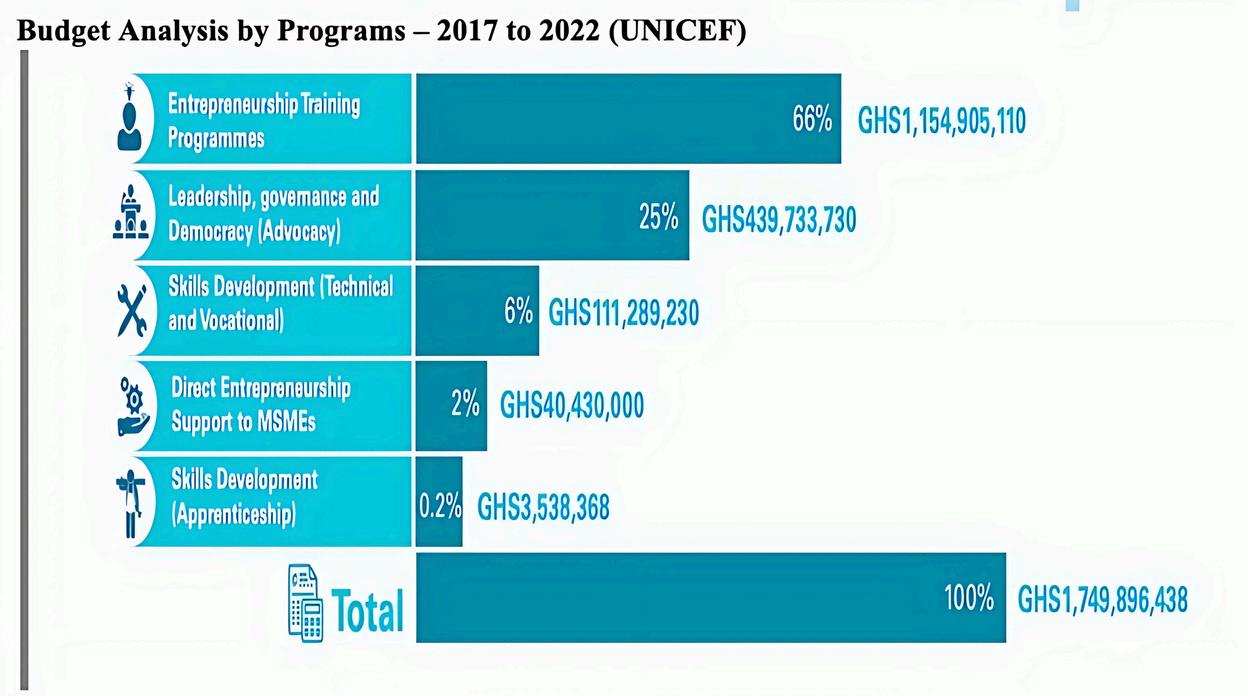
The budget analysis of youth programs in the chart highlights government's commitment to youth development and empowerment. The substantial allocation towards entrepreneurship training (66%) reflects the government's recognition of theroleofyouthentrepreneurshipindrivingeconomicgrowthandjobcreation.This wasfollowedbyprogrammesdedicatedtoadvocacy(i.e.,leadership,governanceand democracy-relatedprogrammes)at25%.
Althoughnoclearpatterncanbeestablishedintheexpenditureallocatedtoyouth intervention programmes over the period, the highest allocation was in 2020 (GHS710,206,334) and the least expenditure was also observed for 2021 (GHS46,431,463),UNICEF2022.WithanoverallexpenditureofGHS1,749,896,438, asseenintheabovechart,46%ofthisfundingwasfromgovernmentsourcesand theremaining54%percentcomingfromvariousdonoragencies.Notably,withinthis donor- driven segment, the MasterCard Foundation has played a prominent role, contributingasignificant71%.
Thisfinanciallandscape,asevidencedbydatafromUNICEFin2022,reflectsa steadfast commitment from donors towards financing youth programs in Ghana over the past five years. Should donors escalate their investment in youth programs beyond governmental contributions, far-reaching implications can emerge. Firstly, heightened donor commitment could potentiallybridgefundinggaps,allowingforbroader,moreimpactfulyouth initiatives to be undertaken. However, a notable shift in reliance on donor funds raises the question of sustainability and self-reliance. While donor contributionscaninvigorateimmediateprojects,arobustnationalframework for financing youth programs remains essential for sustained progress. Striking the right balance between donor-driven support and domestic funding efforts will be pivotal to ensuring a stable foundation for Ghana's youthdevelopmentendeavors.

ThissessionunveilsacriticalfacetofyouthfinancinginGhanabydelvinginto thespecificsoffinancialprovisionsallocatedtotheNYAacrosstheyearsfrom 2018 to 2021, a comprehensive insight into the prioritization and support extendedtoyouth-focusedinitiativesbythegovernment.Thisprovidesalens throughwhichwecanassesstheevolutionoffinancialcommitmentsandthe consequential impact on the NYA's capacity to spearhead impactful youth developmentprogramsduringthispivotalperiod.
The 2018 budget appropriated sheds light on allocation of funds in different areas. An important point is that 23% of the total budget allocated to the MinistryofYouthandSports,whichisGHS7,533,929,wasdirectedto"Youth Services/NYA"asseeninthetablebelow;
However,"SportDevelopment"receivedanallocationofaboutGHS12,578,848,this showsastrongfocusondevelopingsportsascomparedtoyouthservices. Thepercentagesgiven,36%for"CompensationandAdministration"and41%for "SportDevelopment"tellsushowmuchoftheMinistry'sbudgettheseareas received Thesepercentagesshowthebudgetprioritiesandspendingpatterns duringtheyear2018.
Year (2019) GOG

Youth Services /NYA 8,444,417
Management and Administration 8,444,417 8,444,417
Sports Development
Inthecontextofthe2019budgetallocations,comparingwiththepreviousyear 2018,the"MinistryofYouthandSports"receivedahighertotalbudgetofGHS 43,795,046,sourcedfromGovernmentofGhana(GOG),InternallyGeneratedFunds (IGF),andOther/Donorcontributions.Thissignifiesa33%increaseinthebudget allocationfromtheprioryear.Notably,"SportDevelopment"remainedapriority, securinganallocationofGHS16,176,220,comprising37%oftheMinistry'sbudget, withaproportionategrowthof21%fromtheprecedingyear However,the"Youth Services/NYA"categoryreceivedanallocationofGHS8,444,417,equatingto19% ofthetotalbudget.Additionally,the"ManagementandAdministration"category, budgetedatGHS19,174,409,constitutes44%ofthetotalbudget,indicatingan increasecomparedtothepreviousyear2018.
Continuingtheanalysisintothe2020budgetallocations,incomparisonwiththe precedingyears,TheMinistryofYouthandSportsreceivedatotalbudgetofGHS 40,244,155,withtheGovernmentofGhanacontributingGHS39,709,914and InternallyGeneratedFunds(IGF)addingGHS534,241.Thisoverallbudget increasereflectsabout22%growthcomparedtothepreviousyear2018asseen inthetablebelow.
Delvingdeeper,the"CompensationandAdministration"categoryreceived anallocationofGHS16,791,494,solelyfromGOGsources.Thisallocation constitutes 42% of the total budget, revealing a continued emphasis on administrative components. The "Youth Services/NYA" allocation of GHS 7,664,395represents19%ofthetotalbudget,withadecreaseof9%from the previous year 2019. Meanwhile, the "Sport Development" category securedabudgetofGHS15,788,265,reflecting39%ofthetotalbudgetand about2%decreasefrom2019
In 2021, the Ministry of Youth and Sports had a total budget of GHS 34,412,805,whichis14%lessthanlastyear.About41%ofthebudgetGHS 14,219,554, went to "Management and Administration". "Youth Services/NYA" got GHS 7,888,889, making up 23% of the budget, a small increase of 2% from last year. But the budget for "Sport Development" decreasedby22%fromthepreviousyeartoGHS12,304,363.

Inthefinalyearunderstudy,2022,theMinistryofYouthandSportsreceived a total budget of GHS 318,329,000, drawing from Government of Ghana (GOG), Internally Generated Funds (IGF), and Other/Donor sources. This diversesourcingemphasisesamultifacetedapproachtoyouthdevelopment. Year (2022) Ministry of Youthand Sports

Within this allocation, the "Compensation and Administration" category received GHS 285,792,642, supporting administrative functions. The "Youth Services/NYA" allocation of GHS 7,684,364, and the allocation of GHS 24,851,994for"SportDevelopment".Thisfinalyear'sanalysis,whenviewed alongside the previous years, encapsulates the evolving journey of youth financing, highlighting dynamic shifts. The allocation of 90% of the total budget to "Compensation and Administration" in the final year raises important concerns about resource allocation and its potential implications. The influx of donor funds often represents an opportunity to amplify the impact of youth-focused programs, expand initiatives, and invest in developmentalprojectsthatdirectlybenefitthetargetaudience.
However, if a substantial portion of these funds is channeled towards administrationandcompensation,itmayhindertheintendedtransformative effects of donor contributions on the ground Undoubtably, administrative functionsarecrucialforeffectivegovernanceandoperationofanyministry. However,adisproportionatelyhighallocationinthiscategoryraisesconcerns aboutthebalancebetweenadministrativeoverheadanddirectprogrammatic activitiesrelatedtoyouthdevelopment.
TheDistrictAssembliesCommonFund(DACF)allocationanditsdisbursementto the National Youth Authority (NYA) over the specified years offer valuable insights into both the trend of the DACF and its implications for the NYA's funding.ThetablebelowprovidesDACFforeach,theexpected5%oftheDACF andtheactualamountdisbursedtoNYA.

2,312,706,55000
2,402,331,910.00
2,079,426,613.00 3,342,970,84900
Startingfrom2018,theDACFallocatedwasGHS1,812,144,435.00.Theexpected 5% allocation for the NYA amounted to GHS 90,607,221.75. Impressively, the NYA received GHS 85,751,501.26, signifying a commendable disbursement of 94.6%oftheexpectedallocation.Thisindicatesarobustcommitmenttoyouth developmentefforts.
However, the subsequent years saw a fluctuation in the disbursement percentages.In2019,despiteahigherDACFallocationofGHS2,079,426,613.00, the NYA received only GHS 71,218,530.03, corresponding to a disbursement percentageof68.4%oftheexpected5%allocation.Thetrendcontinuedin2020, with the DACF allocation increasing to GHS 2,312,706,550.00, yet the NYA received just GHS 29,218,387.00, representing 25.3% of the expected 5% allocation.Thisdeclineraisesconcernsabouteffectivefunddistribution,andthe government’sprioritiesinthisyear,potentiallyaffectingtheNYA'sfundingfor impactful youth initiatives. 2021 demonstrated improvement, as the NYA received GHS 40,847,248.57, constituting 34% of the expected 5% allocation fromaDACFofGHS2,402,331,910.00.Regarding2022,dataonthedisbursement to NYA from the GHS 3,342,970,84900 DACF allocation was not available In summary,analyzingtheDACFtrendalongsideitsdisbursementpercentagesto theNYAemphasizesvariationsinfundallocation.Theimplicationsencompass challenges in maintaining consistent funding for youth programs, potentially affectingstrategicplanning,implementation,andsustainability.Ensuringsteady andproperallocationoftheanticipated5%DACFtotheNYAholdssignificance forfosteringmeaningfulandcontinuousyouthdevelopmentinGhana.
Examining the utilization of the 5% District Assemblies Common Fund (DACF) by the National Youth Authority (NYA) provides valuable insights into its allocation and expenditurefrom2018to2021.
During this period, the NYA received a total amount of GH¢227,035,666.86 from the DACF, with varying allocations in each year. Specifically, GH¢85,751,501.26 was received in 2018, GH¢71,218,530.03 in 2019, GH¢29,218,387.00 in 2020, and GH¢40,847,24857in2021
Outofthetotalfundsreceived,anamountofOneHundredandEighty-FourMillion,One Hundred and Twenty-Eight Thousand, Nine Hundred and Forty- Seven Ghana Cedis, Eighty-Two Ghana Pesewas (GH¢184,128,947.82) representing 81% of the amount received was spent on Youth related Infrastructure developments according to the AuthoritytoYEFLthroughtheRTI1.TheInfrastructurescoveredthefollowing;
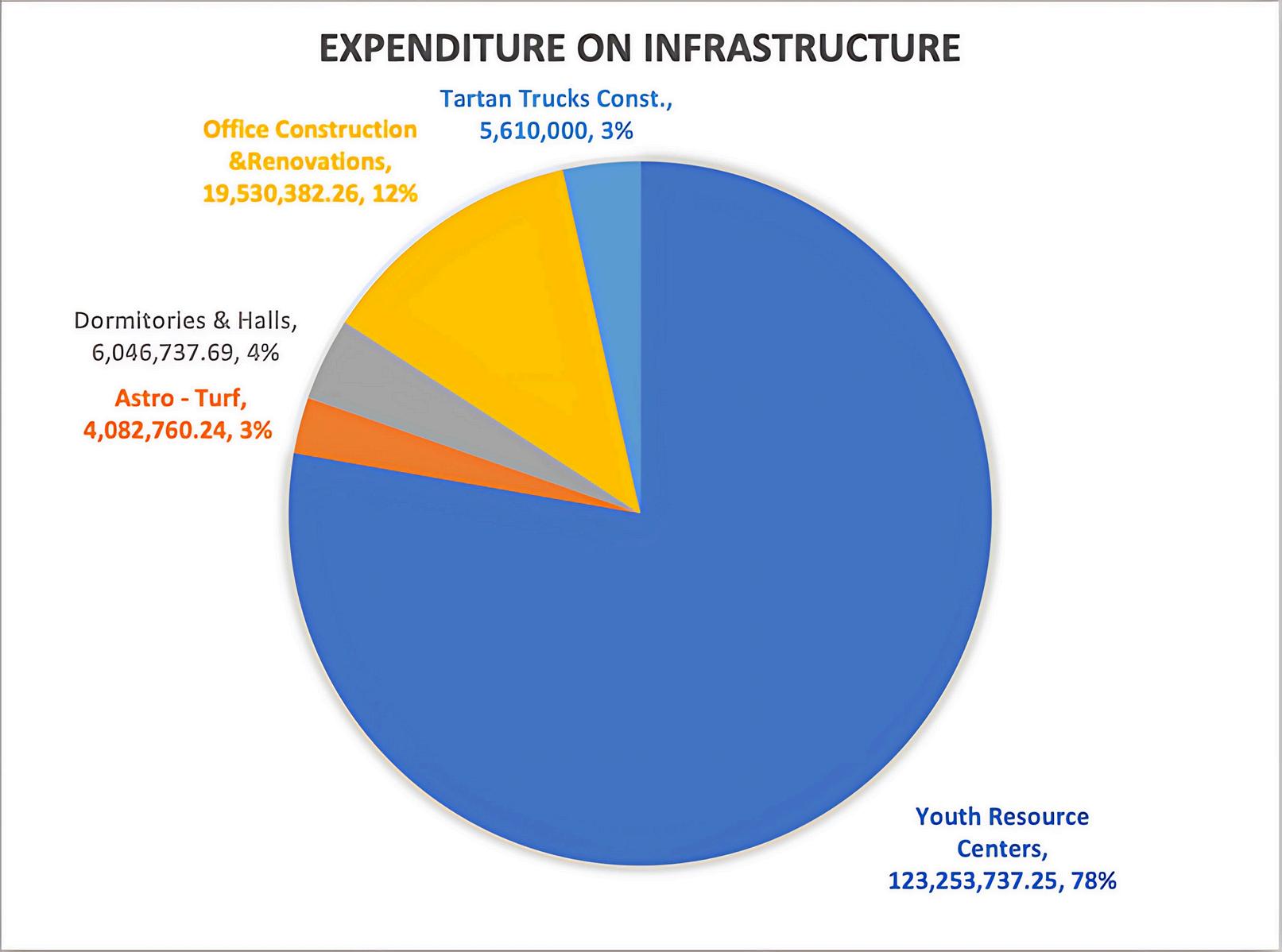
AlsointhechartaboveisadetailedbreakdownofNYA'sexpenditureforthesame periodinfocuswhichwasprovidedtotheNorthernRegionalYouthNetwork;2 YouthResourceCenters- 123,253,737.25 Constructionofdormitories,halls, kitchenforYouthLeadershipSkillsandTrainingInstitutes- 6,046,737.69 AstroTurfFacilities- 4,082,760.24 Constructionandrenovationofoffices; RegionalandDistrictDirectorates NationalOfficeComplex- 19,530,382.26
TartanTrucksConst.- 5,610,000
Theexpenditureonyouth-relatedinfrastructureprojectsisapositiveinitiative,asit aimstocreatephysicalspacesandfacilitiesthatcatertotheneedsofyoungpeople. Infrastructuredevelopmentcanplayacrucialroleinprovidingresources,training, andsupporttoempoweryouthandenhancetheirskillsandcapabilities.Itisworth mentioningthat,though72%oftheexpenditureisonyouthcentres,constructionof thesecentresarestillongoingandrangesfrom60%to95%completionacrossthe country. While this strategic investment in youth-related infrastructure is commendable,it'snoteworthythatthetotalinfrastructureexpendituresreportedto different entities by NYA present inconsistencies. The reported total of GH¢184,128,947.82oninfrastructureprovidedtoYEFLdoesnotalignwiththetotal ofGH¢158,523,617.4providedtotheNorthernRegionalYouthNetwork.Addressing thisdiscrepancyisessentialtoensureaccurateandtransparentreporting,enhance accountability,andmaintaintrustamongstakeholders

Additionally,theresponsibilityforbuildingAstroTurfFacilities(artificialturf sportsfields)inGhanalieswiththeMinistryofYouthandSports(MOYS)and nottheNationalYouthAuthority(NYA).TheNationalYouthAuthority(NYA)is taskedwithimplementingandcoordinatingyouthdevelopmentprogramsand activitiesaimedatempoweringyoungpeopleinGhana.Theirfocusisprimarily oninitiativesrelatedtoskillsdevelopment,capacity-building,entrepreneurship support,andyouthengagement.WhiletheNYAmaybeinvolvedinpromoting sportsandrecreationalactivitiesforyoungpeople,theactualconstructionand management of sports infrastructure like Astro Turf Facilities fall under the purviewoftheMinistryofYouthandSportsandtheNationalSportsAuthority
The Ministry of Youth and Sports (MOYS) is responsible for formulating and implementingpoliciesandprogramsrelatedtosports,youthdevelopment,and recreation. As part of their mandate, they oversee the construction and maintenance of sports facilities, including AstroTurf Facilities, to encourage youth participation in sports and provide them with better opportunities for athletic development and recreation. Based on the NYA's mandate, it is not expected to handle sports infrastructure projects like Astro Turf Facilities directly. If such expenditures are being made, there is a need for further investigationtounderstandtherationalebehindtheseallocationsandtoensure thefundsareappropriatelyutilizedtoachievetheNYA'sprimaryobjectivesof youth development and empowerment. Additionally, coordination with the MinistryofYouthandSports(MOYS)isessentialtoensurethatsports-related infrastructureprojectsarecarriedouteffectivelyandinlinewiththeoverall objectivesofyouthdevelopmentinGhana.
Additionally, GH¢37,888,720.92, amounting to 16.7% of the total funds, was dedicated to Programmes and Operations. This allocation covered various aspects including providing feeding grants to Youth Leadership and Skills Training Institutes, administrative support to Regional and District Youth Directorates, and comprehensive skill development and capacity building initiativesforyouth
AfurtherallocationofGH¢5,017,99812,whichconstituted23%ofthetotal, was directed towards goods and services, as well as general administration overtheperiod.Thisallocationemphasizestheimportanceofsupportingthe administrativeaspectsofyouthdevelopmentprograms.

Financingyouthdevelopmentisavitalinvestmentforgovernmentsseeking toharnessthepotentialoftheiryoungpopulationanddrivesustainable socio-economicgrowth Empoweringyouthwithaccesstoeducation,skills training,employmentopportunities,andsupportforentrepreneurshipnotonly enhancestheirindividualprospectsbutalsocontributestooverallnational development.However,governmentsoftenencountervariousconstraintswhenit comestoallocatingandeffectivelyutilisingresourcesforyouth-focusedinitiatives. Inthiscontext,thispaperexaminestheconstraintsgovernmentsfaceinfinancing youthdevelopmentandexplorestheimplicationsofthesechallenges.Despite recognisingthesignificanceofinvestinginyouth,governmentsencounter numerousobstaclesthatimpedetheireffortstoallocateadequatefundsand implementeffectiveprograms.Theseconstraintsarisefromacombinationof financial,administrative,andinstitutionalfactors,whichcreatecomplexhurdlesto overcome Here,weshedlightonthesechallengesunderthreebroadthemesand theirimpactsontherealisationofcomprehensiveyouthdevelopment.
TherearealotofbureaucraciesinvolvedintheprocessofdisbursingtheDACFwhich delays the receipt of funds by MMDAs. This process starts from the submission of proposed guidelines to Parliament to the receipt of funds by MMDAs. King et al. (2003)addthat,thereleaseofthepercentageofthecountry’stotalannualrevenueto thefundsometimesdelaysformorethanayear.AndsincetheDACFisusuallyused for the implementation of projects, the delay in its release hinders the timely execution of development (World Bank, 2004).Despite references to these issues in paststudies,itisnoteworthythatthesituationremainslargelyunchangeduptothe present day. News portals and agencies, including MPs, MCEs, and platforms like MyJoyOnline,Citynews,continuetoreportonthedelaysinDACFdisbursement.This ongoing reporting indicates that the challenges persist, underscoring the need for ongoingattentiontothisissue.

Moreover,recentobservationsfromthereportoftheCommitteeoftheWhole,in the second session of the eight parliament concerning the proposed DACF distributionformulafor2022,reaffirmthetangibleconsequencesofthesedelays. Thecommittee'sfindingspinpointthetransferandreleaseoffundsasacritical factor contributing to project delays and subsequent hindrances in project completion. As such, the need to address these persistent challenges remains crucial for the effective implementation of development initiatives and the advancement of local communities in Ghana Delays in the disbursement of the DACFcandirectlyimpactthe5%allocationtotheNYA.IftheDACFfundsarenot releasedinatimelymanner,itcanleadtodelaysinpassingontheallocated5%to theNYAforyouthdevelopmentprojects.ThesedelayscanhindertheNYA'sability to execute timely youth-focused initiatives, affecting the effectiveness of their programs.
ThecentralgovernmentfrequentlyissuesdirectivestoMetropolitan, Municipal,andDistrictAssemblies(MMDAs)regardingtheutilizationofthe DistrictAssembliesCommonFund(DACF).ThisoftenlimitstheMMDAs' flexibilitytoprioritizeprojectsaccordingtotheirmosturgentneeds. Additionally,thereareinstanceswheretheallocatedfundsarereduced.
AspecificcaseillustratingthisscenarioispresentedintheCommitteeofthe Whole's2022report:"TheapprovedbudgetofGHS3,342,970,849.00forthe year2022,asstatedintheappropriationAct,waslateramendedbythe MinistryofFinanceinaletterdatedMarch29,2022.

The Ministry instructed the Fund Administrator to base the distribution formula on an amount of GHS 2,387,410,261.00. This reduction, as explained by the Ministry, was a response to fiscal measures endorsed by the cabinet to address the prevailing economic challenges." Thesedirectivesandreductionsimposedbythecentral governmentcansignificantlyconstrainMMDAs'abilitytoaddresstheir immediatedevelopmentneeds,potentiallyhinderingeffectivelocalproject implementation.Also,the5%portiondesignatedforyouthempowermentmight bereallocatedtoaccommodategovernmentpriorities,hinderingtheNYA's receiptofthefullintendedallocation
Overtheperiod,sectorallocationtotheMinistryofsportsleanedtowardssports developmentbyextensiontheNationalSportsAuthorityasovertheNational YouthAuthorityforyouthrelatedservices.Inspiteofthistrend,andfollowingthe introductionofthe5%DACFtoaddressfundingdeficitstotheNYAforyouth relatedservices,theNationalYouthAuthoritycontinuestoallocatesubstantial fundsexceedingfour(4)millionGhanacedistowardssportsinfrastructural developmentduringthestudiedperiodspanningfrom2018to2021.The implicationliesinthepotentialdiversionofalreadyscarceresourcesawayfrom coreyouth-focusedprogramsandinitiatives.Allocatingsignificantfundstosports infrastructurecouldpotentiallycompromisetheNYA'sabilitytoaddresscritical youth-relatedneeds,suchasskillsdevelopment,leadershiptraining,and empowermentprograms.

In conclusion, this research has shed light on the challenges and intricacies of youth financing in Ghana. Despite commendable efforts by the government to implement various youth programs through different agencies, there are persistent challenges that hinder effective youth development and empowerment. The inconsistent budget allocation, delays in fund disbursement,centralgovernmentdirectives,andthenonpredictabilityoffundamountscollectivelyunderminethe capacityoftheNationalYouthAuthority(NYA)toexecute timely and impactful youth-focused initiatives. These challenges highlight the need for comprehensive reforms and strategies to ensure that youth financing in Ghana is efficient, transparent, and aligned with the overarching goalofempoweringthenation'syoungpopulation.
Addressingthechallengesidentifiedinthisresearchrequiresamultifacetedapproach thatinvolvescollaborationbetweenvariousstakeholders,includinggovernment entities,developmentpartners,andyouthorganizations.Thefollowing recommendationsareproposedtoenhancetheeffectivenessofyouthfinancingin Ghana:
Government should ensure transparency in the allocation and disbursement of funds for youth programs. Publish detailed reports on how funds are allocated, utilized, and their impact on youth development. This transparency will build trust and accountability.
Thegovernmentshouldallocateamoresubstantialandconsistentportionofthe budgettowardsyouthdevelopmentprograms Increasingthefinancialresources availableforyouthinitiativeswillenabletheimplementationofawiderrangeof impactfulprojectsandprograms.
Apart from relying on the District Assembly Common Fund (DACF), NYA must explore additional funding sources. This could involve leveraging public-private partnerships,accessinggrantsfrominternationalorganisations,andencouraging corporate social responsibility initiatives by private companies operating in Ghana·Also,CSOs,NGOs,andotherYouthCenteredInstitutionscouldalsomake availablesomepercentageoftheirannualbudgettoaidinthedevelopmentofthe youthandthefundingofyouth-centeredprograms.
Governmentinpartnershipwithitsstakeholdersshouldestablisharobustsystemfor monitoringandevaluatingtheeffectivenessofyouthprograms.Regularassessmentswill helpidentifyareasforimprovementandallowforadjustmentstobemadebasedon actualoutcomes.Thereshouldalsobeacoordinatedfrontforallyouthprogramsand organisationssothatallinterventionscouldbetrackedandcheckedtofulfilitspromise

A C K N O W L E D G E M E N T S
Weextendourheartfeltgratitudetoallindividuals and institutions whose support and contributions made this research on youth financing in Ghana possible. We would like to acknowledge the insights,andexpertiseprovidedbyFINDVIEWand YEFLteam,whosevaluablefeedbackenrichedthe qualityofthisstudy.
We thank you for your continued support in our efforts to contribute to the Youth Development of Ghana
AbbeyCharles,A.V.(2010).TrackingtheGhanadistrictassembliescommonfund. DemandingGovernance,71-100.
Abbey,C.(2010).TrackingtheGhanaDistrictCommonFund.Demanding Governance,,91-100.
Ampadu-Ameyaw,R.J.-A.(2020).Areviewofyouthemploymentinitiativesin Ghana:policyperspective
Awad,A.(2020).Fromschooltoemployment;thedilemmaofyouthin Sub–SaharanAfrica.InternationalJournalofAdolescenceandYouth,pp.945-964. Ayee.(2013).ThedevelopmentalstateexperimentinAfrica.Theexperiencesof GhanaandSouthAfrica.TheRoundTable,259-280.
Tagoe,M.A.-S.(2015).Harnessingthepoweroftheyouththroughnationalyouth policiesinGhana:.Challengestonotionsofempowerment,69-91.UNFPA.(2014).
AnnualReport
https://www.unicef.org/ghana/media/4666/file/2022%20Youth%20%20Budget%20Brief.pdf
https://mofep.gov.gh/sites/default/files/news/2018-Appropriation-Report.pdf https://mofep.gov.gh/sites/default/files/budget-statements/2021Appropriation-Act.pdf.
https://citinewsroomcom/2021/10/government-owes-common-fund-overgh% C2%A22-billion-minority/ https://myjoyonline.com/delayed-release-of-district-assembly-commonfundhampering-programmes-of-local-assemblies-amansie-south-dce/ https://www.ghanaiantimes.com.gh/delay-in-payment-of-common-fundnotjustifiable-mp/
http://ir.parliament.gh/bitstream/handle/123456789/2162/District%20Assem bly%20Common%20Fund%202022pdf?sequence=1&isAllowed=y

