AHEAD IN ANIMAL HEALTH
Validation of an Escherichia coli mastitis model C.G.M. Scherpenzeel1, H.M. Kellij-Klunder1, and A.G.J. Velthuis1 1 Royal GD, Deventer, the Netherlands
WHY? Escherichia coli (E. coli) infection is one of the most frequent causes of severe clinical mastitis in cattle. E. coli mastitis causes acute inflammation and leads to severe loss of animal welfare. Moreover, adequate treatments options are limited. In search for better treatments, for instance with antibiotics, and to acquire more knowledge on this type of mastitis an animal model would be beneficial. GD animal health validated an intramammary challenge model for E. coli mastitis in lactating cattle.
Aim
The aim was to achieve a robust and reproducible E. coli mastitis model with use of a standardized inoculum and a good monitoring of clinical and laboratory parameters.
Materials and Methods The E. coli mastitis model has been described by Sipka et al. (2013, 2014). Four dairy cows were included, all healthy, with low SCC and negative bacteriological results in milk samples from each quarter. Prior to inoculation, a well-known low virulent E. coli strain was standardized in-vitro. From each cow, two quarters were inoculated with 100 colony forming units (cfu) of E. coli: two cows were inoculated in the hind quarters and two cows in the front quarters. After inoculation clinical and laboratory parameters were measured every three hours for day (d) 0 and d 1 post inoculation, every six hours for d 2 and 3 and every twelve hours for d 4, 5 and 6. Cow level parameters include general health and rectal temperature. Quarter level parameters were quarter appearance, appearance of the milk, numbers of live E. coli per ml milk, and the somatic cell count (SCC). In addition, quarter milk production was measured using a sensor in an experimental milking equipment. The milk samples were analyzed in a laboratory which is ISO 17025 accredited. Data collection, processing and analysis was done by trained and competent technicians.
Rectal temp.°C
Number of E. coli after inoculation
4 2 0 0
1
2
3
4
5
Figure 1. Number of E. coli after inoculation
LogSCC/ml
6 4 2
Somatic cell count after inoculation
0 1
Figure 2. Somatic cell count after inoculation
40 38 36 0
1
2
3
4
5
6
Figure 3. Rectal temperature after inoculation
8
0
Rectal temperature after inoculation
42
6
2
3
4
5
6
Kg milk per quarter
CFU/ml (log)
6
Average daily quarter milk production relative to T=0
1,2 0,8 0,4
Control quarters
Inoculated quarters
0,0 0
1
2
3
4
5
6
Figure 4. Average daily quarter milk production relative to T=0
Main results
Take home points:
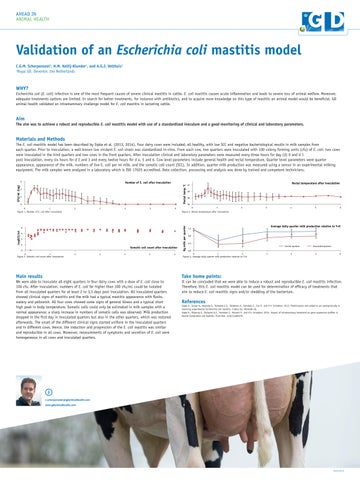
We were able to inoculate all eight quarters in four dairy cows with a dose of E. coli close to 100 cfu. After inoculation, numbers of E. coli far higher than 100 cfu/mL could be isolated from all inoculated quarters for at least 2 to 3,5 days post inoculation. All inoculated quarters showed clinical signs of mastitis and the milk had a typical mastitis appearance with flocks, watery and yellowish. All four cows showed some signs of general illness and a typical short high peak in body temperature. Somatic cells could only be estimated in milk samples with a normal appearance: a sharp increase in numbers of somatic cells was observed. Milk production dropped in the first day in inoculated quarters but also in the other quarters, which was restored afterwards. The onset of the different clinical signs started uniform in the inoculated quarters and in different cows. Hence, the induction and progression of the E. coli mastitis was similar and reproducible in all cows. Moreover, measurements of symptoms and secretion of E. coli were homogeneous in all cows and inoculated quarters.
It can be concluded that we were able to induce a robust and reproducible E. coli mastitis infection. Therefore, this E. coli mastitis model can be used for determination of efficacy of treatments that aim to reduce E. coli mastitis signs and/or shedding of the bacterium.
References
Sipka A., Gurjar A., Klaessig S., Duhamel G.E., Skidmore A., Swinkels J., Cox P., and Y.H. Schukken. 2013. Prednisolone and cefapirin act synergistically in resolving experimental Escherichia coli mastitis. J Dairy Sci. 96:4406-18. Sipka A., Klaessig S., Duhamel G.E., Swinkels J., Rainard P., and Y.H. Schukken. 2014. Impact of intramammary treatment on gene expression profiles in bovine Escherichia coli mastitis. PLoS One. 14;9(1):e85579.
c.scherpenzeel@gdanimalhealth.com www.gdanimalhealth.com
GD3625/08-26