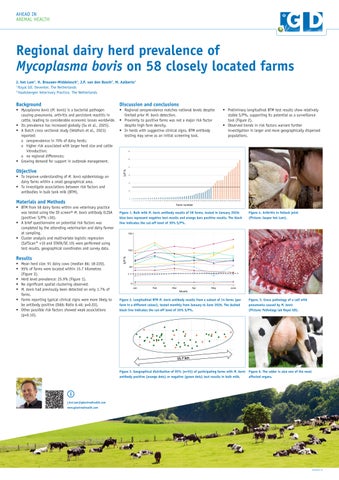
AHEAD IN ANIMAL HEALTH
Regional dairy herd prevalence of Mycoplasma bovis on 58 closely located farms J. het Lam1, H. Brouwer-Middelesch1, J.P. van den Bosch2, M. Aalberts1 1 Royal GD, Deventer, The Netherlands 2 Haaksbergen Veterinary Practice, The Netherlands
• Preliminary longitudinal BTM test results show relatively stable S/P%, supporting its potential as a surveillance tool (Figure 2). • Observed trends in risk factors warrant further investigation in larger and more geographically dispersed populations.
• Regional seroprevalence matches national levels despite limited prior M. bovis detection. • Proximity to positive farms was not a major risk factor despite high farm density. • In herds with suggestive clinical signs, BTM antibody testing may serve as an initial screening tool.
• Mycoplasma bovis (M. bovis) is a bacterial pathogen causing pneumonia, arthritis and persistent mastitis in cattle, leading to considerable economic losses worldwide. • Its prevalence has increased globally (Su et al., 2025). • A Dutch cross sectional study (Veldhuis et al., 2023) reported: o seroprevalence in 70% of dairy herds; o higher risk associated with larger herd size and cattle introduction; o no regional differences; • Growing demand for support in outbreak management.
Discussion and conclusions
Background
Objective
• To improve understanding of M. bovis epidemiology on dairy farms within a small geographical area. • To investigate associations between risk factors and antibodies in bulk tank milk (BTM).
Materials and Methods Figure 1. Bulk milk M. bovis antibody results of 58 farms, tested in January 2026; blue bars represent negative test results and orange bars positive results. The black line indicates the cut-off level of 30% S/P%.
Figure 4. Arthritis in fetlock joint (Picture: Jasper het Lam).
Figure 2. Longitudinal BTM M. bovis antibody results from a subset of 14 farms (per farm in a different colour), tested monthly from January to June 2026. The dashed black line indicates the cut-off level of 30% S/P%.
Figure. 5. Gross pathology of a calf with pneumonia caused by M. bovis (Picture: Pathology lab Royal GD).
• BTM from 58 dairy farms within one veterinary practice was tested using the ID screen® M. bovis antibody ELISA (positive: S/P% ≥30). • A brief questionnaire on potential risk factors was completed by the attending veterinarian and dairy farmer at sampling. • Cluster analysis and multivariate logistic regression (SaTScan™ v10 and STATA/SE 19) were performed using test results, geographical coordinates and survey data.
Results
• Mean herd size: 91 dairy cows (median 86; 18-220). • 95% of farms were located within 15.7 kilometres (Figure 3). • Herd level prevalence: 25.9% (Figure 1). • No significant spatial clustering observed. • M. bovis had previously been detected on only 1.7% of farms. • Farms reporting typical clinical signs were more likely to be antibody positive (Odds Ratio 6.46; p=0.03). • Other possible risk factors showed weak associations (p>0.10).
Figure 3. Geographical distribution of 95% (n=55) of participating farms with M. bovis Figure 6. The udder is also one of the most antibody positive (orange dots) or negative (green dots) test results in bulk milk. affected organs.
j.het.lam@gdanimalhealth.com www.gdanimalhealth.com
GD3608/07-26