AHEAD IN ANIMAL HEALTH
Immunosuppressive effect of a reassorted IBDV strain (Northwestern European A3B1) By assessing Newcastle disease vaccination efficacy and mortality due to secondary Ornithobacterium rhinotracheale infection Willem Dekkers1, Jeanine Wiegel1, Sjaak de Wit1,2 1 Royal GD, Deventer, the Netherlands; 2 Faculty of Veterinary Medicine, Utrecht University, Utrecht, the Netherlands;
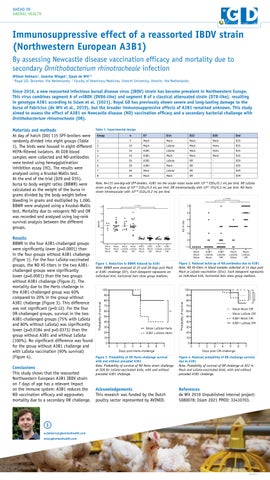
Since 2016, a new reassorted infectious bursal disease virus (IBDV) strain has become prevalent in Northwestern Europe. This virus combines segment A of vvIBDV (DV86-like) and segment B of a classical attenuated strain (D78-like), resulting in genotype A3B1 according to Islam et al. (2021). Royal GD has previously shown severe and long-lasting damage to the bursa of Fabricius (de Wit et al., 2019), but the broader immunosuppressive effects of A3B1 remained unknown. This study aimed to assess the effect of A3B1 on Newcastle disease (ND) vaccination efficacy and a secondary bacterial challenge with Ornithobacterium rhinotracheale (OR). Materials and methods At day of hatch (D0) 115 SPF-broilers were randomly divided into eight groups (Table 1). The birds were housed in eight different HEPA-filtered isolators. At D28 blood samples were collected and ND-antibodies were tested using hemagglutination inhibition assay (HI). The results were analysed using a Kruskal-Wallis test. At the end of the trial (D29 and D35), bursa to body weight ratios (BBWR) were calculated as the weight of the bursa in grams divided by the body weight before bleeding in grams and multiplied by 1,000. BBWR were analysed using a Kruskal-Wallis test. Mortality due to velogenic ND and OR was recorded and analysed using log-rank survival analysis between the different groups.
Table 1. Experimental design Group
n
D7
D14
D22
D28
End
1
5
Mock
Mock
Mock
Mock
D35
2
10
Mock
LaSota
Mock
Herts
D35
3
10
A3B1
LaSota
Mock
Herts
D35
4
10
A3B1
Mock
Mock
Mock
D35
5
20
A3B1
LaSota
OR
-
D29
6
20
A3B1
Mock
OR
-
D29
7
20
Mock
LaSota
OR
-
D29
8
20
Mock
Mock
OR
-
D29
Note. N=115 one-day-old SPF-broilers. A3B1 via the ocular nasal route with 102.79 EID50/0.1 mL per bird. ND LaSota strain orally at a dose of 106.10 EID50/0.5 mL per bird. OR intratracheally with 109.0 CFU/0.5 mL per bird. ND Herts strain intramuscular with 105.09 ELD50/0.2 mL per bird.
Results BBWR in the four A3B1-challenged groups were significantly lower (p=0.0001) than in the four groups without A3B1 challenge (Figure 1). For the four LaSota-vaccinated groups, the ND HI-titers in the two A3B1- Figure 1. Reduction in BBWR induced by A3B1 Note. BBWR were assessed at 22 and 28 days post Mock challenged groups were significantly or A3B1 challenge (D7). Each datapoint represents an individual bird, horizontal bars show group medians. lower (p=0.0001) than the two groups without A3B1 challenge (Figure 2). The mortality due to the Herts challenge in the A3B1-challenged group was 60% compared to 20% in the group without A3B1 challenge (Figure 3). This difference was not significant (p=0.12). For the four OR-challenged groups, survival in the two A3B1-challenged groups (75% with LaSota and 80% without LaSota) was significantly lower (p=0.0184 and p=0.0373) than the group without A3B1 and without LaSota (100%). No significant difference was found for the group without A3B1 challenge and with LaSota vaccination (90% survival) (Figure 4). Figure 3. Probability of ND Herts-challenge survival Conclusions This study shows that the reassorted Northwestern European A3B1 IBDV strain on 7 days of age has a relevant impact on the immune system: A3B1 reduces the ND vaccination efficacy and aggravates mortality due to a secondary OR challenge.
Figure 2. Reduced build-up of ND-antibodies due to A3B1
Note. ND HI-titers in blood samples collected at 14 days post Mock or LaSota vaccination (D14). Each datapoint represents an individual bird, horizontal bars show group medians.
with and without preceded A3B1
Figure 4. Reduced probability of OR-challenge survival due to A3B1
Note. Probability of survival of ND Herts strain challenge at D28 for LaSota-vaccinated birds, with and without preceded A3B1 challenge.
Note. Probability of survival of OR challenge at D22 in Mock and LaSota-vaccinated birds, with and without preceded A3B1 challenge.
Acknowledgements This research was funded by the Dutch poultry sector represented by AVINED.
References de Wit 2019 Unpublished internal project: 5080078; Islam 2021 PMID: 33410703.
w.dekkers@gdanimalhealth.com www.gdanimalhealth.com
GD3428/09-25