


A lack of cobalt in lambs’ diets leads to vitamin B12 deficiency. Ruminants cannot absorb vitamin B12 from feed; instead, it is synthesised in the rumen by microorganisms, for which cobalt is essential. The risk is greatest on soils that are cobalt-deficient, particularly in sandy, low-lying and peatland areas. Problems often arise when lambs start eating more roughage, usually at 6 to 12 weeks of age. The risk may also increase during spring and autumn if the cobalt concentration in grass is relatively low. Feeding low-cobalt roughage in the barn without sufficient mineral supplements can also lead to deficiencies.
The clinical symptoms are often nonspecific to start with. Lambs may show poor growth, reduced feed intake and a generally poor
condition. The fleece may become dull and rough, and some animals may develop diarrhoea, occasionally watery in nature. Despite adequate feed intake, affected animals may lose weight visibly. A characteristic feature is the gradual decline in condition of several lambs within a flock, without obvious acute signs of disease. In more pronounced cases, abnormalities associated with metabolic disturbances may occur, including neurological symptoms or photosensitivity; however, such symptoms have a wide-ranging differential diagnosis.
Diagnosis can be supported by additional blood and/or liver tests to confirm the vitamin B12 status and cobalt deficiency. In lambs with markedly reduced appetite or complete anorexia, administration of vitamin
A small-scale liver fluke risk analysis showed that the dry weather and higher temperatures in 2025 resulted in fewer liver fluke problems across large parts of the Netherlands. However, only a limited number of monitoring areas in the north-west of the country were included. An early outbreak in 2025 could not be ruled out entirely. The risk of infection remains, particularly in areas with higher water levels where livestock have been grazed. The dry weather in August slowed the development of liver flukes and the build-up of infection in the snail population. Thereafter, this process gradually resumed, as expected. This pattern is
consistent with the GD’s findings in the winter of 2025/2026, when liver fluke disease was identified sporadically during pathological examinations. Nevertheless, liver fluke disease should always be an important differential diagnosis in regions where groundwater levels are typically high.
GD recommends that sheep farmers should test faecal samples for liver fluke eggs before turning animals out to pasture after lambing, allowing timely treatment and helping to prevent contamination of pastures for the new grazing season.
B12 by injection can rapidly correct the deficiency. However, treatment is only effective if cobalt intake through the diet is simultaneously improved on a structural basis.
Prevention focuses on identifying high-risk farms at an early stage and making sure there is a sufficient supply of cobalt in the feed. This can be achieved through feed and/ or soil analysis, followed by nutritional assessment to determine if growing lambs are at risk of developing a cobalt deficiency. Depending on the findings, measures may include mineral supplementation, concentrate feeding, pasture management and, where appropriate, fertilisation to ensure sufficient intake during both grazing season and indoor feeding periods.
Until 2020, the Liver Fluke Forecast Working Group issued annual provisional and final forecasts (in mid-September and midNovember respectively), based on factors such as snail counts and studies into the infectious stages of liver fluke in snails. This forecast system ceased in 2020. As a result, livestock farmers no longer have access to an up-to-date national wide forecasting tool, despite timely risk assessment being crucial for targeted prevention and reducing the risk of triclabendazole resistance developing, given that this is the only active substance that is effective against all developmental stages of the liver fluke.
In January, 240 ewes on a sheep farm were treated with mineral boluses. According to the farmer, administration proceeded smoothly and no marked reactions, such as coughing, were observed during administration. However, several days later five ewes unexpectedly found dead, while approximately fifteen others developed acute symptoms, including lethargy, foaming at the mouth, distinct respiratory sounds and, in some animals, melaena. Most clinically affected animals either died or were euthanised for welfare reasons.
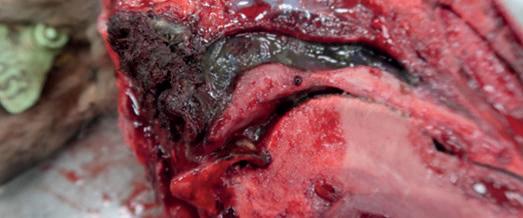
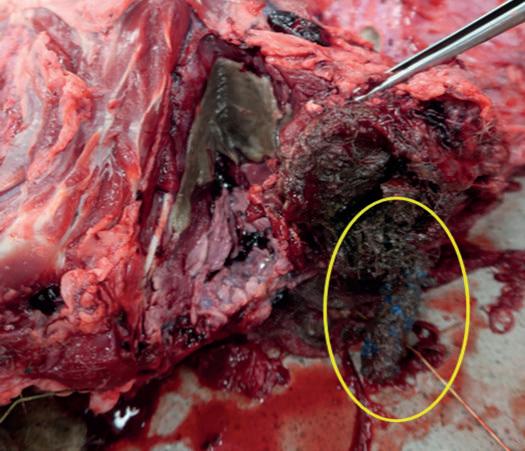
Pathological examination revealed perforation of the oesophageal wall caused by a bolus, accompanied by necrotising inflammation at the site of perforation. In addition, acute myocardial degeneration was
observed, consistent with acute selenium intoxication. Additional analysis liver analysis revealed significantly elevated levels of copper (898 mg/kg dry weight) and selenium (11.4 mg/kg dry weight). Blood tests in three animals also demonstrated elevated copper and selenium levels. These findings suggest a mineral over supplementation, with selenium and copper being the most prominent components involved.
The attending veterinarian contacted the manufacturer, who stated that the problems were probably due to incorrect administration. The combination of a local traumatic injury (oesophageal perforation) and the absence of new cases after administration indicate that the bolus was
In January and February, the Veekijker received several reports of both the neurological and abortive forms of listeriosis in dairy goats. Listeria monocytogenes can cause both clinical forms, whereas Listeria ivanovii is mainly associated with abortion.
The neurological form is more common and generally presents as ataxia, circling, head tilt, behavioural changes and, ultimately, paresis or paralysis. In addition, listeriosis can present as septicaemia, with acute symptoms including lethargy, fever, anorexia and in some cases sudden death. In the abortive form, abortion usually occurs during the final stage of pregnancy, sometimes without the due exhibiting any obvious
clinical signs beforehand. The incubation period varies depending on the form of the disease; in the neurological form, the animal often gets the infection several weeks before clinical symptoms appear. Therefore, the original source may no longer be identifiable or traceable when the first cases are detected, and several animals may become clinically ill over time.
For prevention and control, it is important to be alert to potential sources of contamination in the feed and the surroundings. Contamination with soil when making silage raises the risk of introducing Listeria bacteria. In particular, damp by-products stored under suboptimal
administered incorrectly in some animals. This can lead to local tissue damage, inflammation and accelerated release of the bolus constituents, thereby increasing the risk of acute toxicity.
This incident highlights the importance of careful administration techniques when using boluses, as well as the need for veterinarians to provide farmers with clear guidance regarding administration procedures and disadvantaged of bolus administration should be weighed against alternative approaches such as feed and mineral management. Once administered, boluses are not reversible and may increase the risk of intoxication if administered wrongly or where the mineral status is already high.
hygienic conditions may provide an environment in which Listeria bacteria can persist or multiply. Moreover, contaminated drinking water can exacerbate exposure.
Listeriosis is a zoonosis. Humans can become infected through contact with infected animals or contaminated materials, or by consuming products made from raw milk. This is particularly relevant for farms that process milk themselves and for those that are open to the public. Key measures for minimising the risk to humans are strict hygiene precautions, correct handling of milk and (preferably) pasteurisation of dairy products.
In February, kids were submitted for pathological examination because of increased mortality. Initially, mortality occurred mainly in kids aged around 1 to 2 weeks, with the kids exhibiting respiratory signs. Later, acute mortality was also observed in kids aged 2 to 3 days. Pathological investigations indicated
septicaemia, and a multi resistant strain of Escherichia coli was isolated.
Problems involving resistant or multi resistant E. coli occasionally been observed on goat farms and can lead to substantial losses among goat kids. In this case, assessment a colostrum intake demonstrated
inadequate passive (maternal) transfer of immunity. Insufficient colostrum intake, or poor colostrum, increases the risk of early, rapidly progressing infections and septicaemia during the first days of life. The key preventive measures are optimisation of hygiene management and colostrum management around the birth.
Disease/disorder/ health characteristic
Articles 2.1.a and 2.1.b of the Designation of Animal Diseases in the ‘Rules for Animal Health’/Implementing Regulation (EU) 2018/1882 of the Animal Health Law (EU) 2016/429 (Category A diseases)
*
Infectious pleuropneumonia in goats (CCPP)
(Mycoplasma capricolum subs . capripneumoniae)
Never detected in the Netherlands.
Foot-and-mouth disease (FMD) FMD has not been reported in the Netherlands since 2001.
In early 2025, FMD (serotype O) outbreaks occured in Germany, Hungary and Slovakia. The number of outbreaks remained limited. No new outbreaks have been reportedin Europe since April 2025.
Infection with goat plague (a.k.a. PPR, peste des petits ruminants)
Never detected in the Netherlands. Various outbreaks have occurred in Europe since July 2024. No new outbreaks have recently been reported in Hungary, Bulgaria, Greece or Romania, and the situation appears stable. Several outbreaks were reproted in Albania in June 2025, and a single outbreak was confirmed in Kosovo in July. Outbreaks in Croatia in December.
Infection with Rift Valley Fever virus (RVF)
Never detected in the Netherlands.
Sheep pox and goat pox (SGP) Never detected in the Netherlands. From October 2023 onwards, there were multiple outbreaks in Greece and more recently in Bulgaria, Romania and Greece.
A+D+E *
A+D+E *
Articles 2.1.a and 2.1.b of the Designation of Animal Diseases in the ‘Rules for Animal Health’/Implementing Regulation (EU) 2018/1882 of the Animal Health Law (EU) 2016/429 (Categories B to E)
Infection with Brucella abortus, B. melitensis
The Netherlands retains its disease-free status. The required monitoring samples for 2025 were achieved and all the results were negative.
Infection with the rabies virus Detected very rarely in bats.
B+D+E *
B+D+E *
Disease/disorder/ health characteristic
Infection with the bluetongue virus (serogroups 1-24)
Epididymitis in sheep (Brucella ovis)
Infection with Mycobacterium tuberculosis complex
(M. bovis, M. caprae, M. tuberculosis)
Anthrax (Bacillus anthracis)
Paratuberculosis (Mycobacterium avium subs. paratuberculosis)
Q fever (Coxiella burnetii )
Brief description
Since September 2023, there has been an outbreak of BTV-3 spread across Europe, causing severe problems on sheep farms and (to a lesser extent) on cattle and goat farms.
In 2024, BTV-12 was seen at a limited number of farms in the Netherlands, and later that year in the United Kingdom as well. Outbreaks of BTV-1, 3, 4, 5 and 8 were seen in Europe from July 2025. There were no confirmed clinical cases in the Netherlands in 2025.
Examination of rams for export purposes. Not previously confirmed in the Netherlands.
The Netherlands has been officially free of bovine tuberculosis since 1999.
Last registered outbreak in cattle in 1993. No infections detected since then.
Regular cases, largely in goats (incl. dairy) and occasionally in sheep.
The final dairy goat farm with C. burnetii was certified free from infection in 2016. Q fever was diagnosed in 2024 at a dairy sheep farm in Bakel and in the spring of 2025, C. burnetii was detected in the placenta of an imported sheep at a backyard farm. In 2025, abortion due to Coxiella burnetii was diagnosed in a herd of forest reindeer at a zoo. A notification requirement for camels and deer was subsequently introduced.
Echinococcosis Not detected in the necropsy room since 2023.
Trichinellosis No known cases of trichinellosis in sheep or goats.
Article 2.1.c Designation of animal diseases in the ‘Rules for Animal Health’ of the Dutch Animals Act
Transferable TSEs (scrapie, BSE) No cases among sheep in recent years. In goats, the first case of scrapie was in 2000 and the last in 2001. Classical scrapie was confirmed on a sheep farm in the United Kingdom in 2025. Just a single animal was infected.
Article 3a.1 Notification of zoonoses under the ‘Rules for Animal Husbandry’ of the Dutch Animals Act
Campylobacteriosis (Campylobacter spp.)
Leptospirosis (Leptospira Hardjo)
A few cases per year. Particularly known as a cause of abortion in sheep.
No cases in sheep or goats for several years.
Disease/disorder/ health characteristic
Listeriosis (Listeria spp.)
Salmonellosis (Salmonella spp.)
Yersiniosis (Yersinia spp.)
Toxoplasmosis (Toxoplasma gondii )
Other OIE list diseases
Enzootic abortion (Chlamydia abortus)
Caprine arthritis encephalitis (CAE)
Maedi-visna virus (MVV)
Tularaemia (Francisella tularensis)
Mycoplasma agalactiae
Nairobi sheep disease
Heartwater (Ehrlichia ruminantium)
Brief description
Encephalitis caused by Listeria monocytogenes is regularly found in sheep, and especially in dairy goats. Listeriosis cases are reported every year on dairy goat farms.
Both L. monocytogenes and L. ivanovii can cause abortion in sheep and goats.
Since 2016, there have been recurrent and large-scale losses of kids at dairy goat farms, caused by a multiresistant S. Typhimurium. In 2025, Salmonella Typhimurium was detected in dairy goat kids at two related farms, and Salmonella enterica subspecies enterica Bovismorbificans (type C) in kids at another singledairy goat farm.
A few cases per year. Identified as a cause of diarrhoea, mortality and abortion.
Only a few confirmed cases per year but probably one of the most commonly occurring causes of abortion. High seroprevalence has previously been demonstrated in sheep and goats.
One of the main causes of abortion in goats and sheep for many years. Distribution from farm to farm is through contaminated female breeding stock. Once introduced into a flock, the pathogen is very difficult to control. Enzootic abortion is a zoonosis and is therefore one of the main reasons why pregnant women should avoid contact with small ruminants during the lambing time.
A commonly occurring disease in which the pathogenic virus sometimes behaves differently depending on the size of the farm. Source of introduction not always clear.
A significant infectious disease (or indeed the most significant) at sheep farms, larger ones in particular.
Since 2011, infected hares have regularly been found in the Netherlands, as well as a small number of human tularaemia patients.
Never detected in the Netherlands.
Never detected in the Netherlands.
Never detected in the Netherlands.
*Further investigation into the types found in humans and animals is desirable.
Disease/disorder/ health characteristic
Infections with Schmallenberg virus (SBV)
From monitoring
CCDD in dairy goats
Chlamydia abortus at a dairy sheep farm
Losses of sheep after giving mineral boluses
Listeriosis in dairy goats
T. +31 (0)88 20 25 575
info@gdanimalhealth.com www.gdanimalhealth.com
Brief description
There have been infections with SBV every year since 2011, resulting in congenital abnormalities in lambs. Excluding other possible causes is important for early detection of the introduction of other viruses from the Bunyaviridae group.
Caprine Contagious Digital Dermatitis (CCDD) is an infectious cause of lameness in goats. The aetiology is not entirely clear.
Chlamydia abortus was detected in an aborted foetus from a dairy sheep farm.
Elevated sheep losses following the administration of mineral boluses. The losses are thought to have been caused by incorrect positioning of the bolus gun.
Encephalitis caused by Listeria monocytogenes is regularly diagnosed in dairy goats around the kidding period. Reduced immunity may play a role in the pathogenesis. Listeria monocytogenes is a zoonotic pathogen.
1 Quiet: no action required or action is not expected to result in a clear improvement.
2 Increased attention: alert to an anomaly.
3 Further investigation: further investigation is ongoing or required.



Continuation of


