


High incidence and with slower-growing breeds over-represented
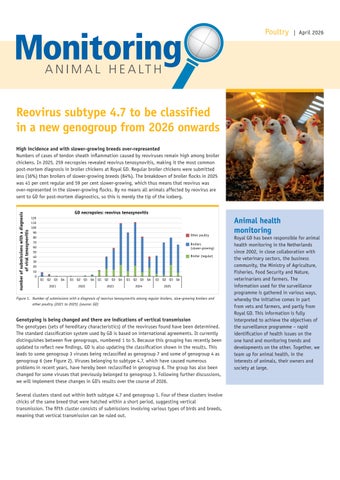
Numbers of cases of tendon sheath inflammation caused by reoviruses remain high among broiler chickens. In 2025, 259 necropsies revealed reovirus tenosynovitis, making it the most common post-mortem diagnosis in broiler chickens at Royal GD. Regular broiler chickens were submitted less (16%) than broilers of slower-growing breeds (84%). The breakdown of broiler flocks in 2025 was 41 per cent regular and 59 per cent slower-growing, which thus means that reovirus was over-represented in the slower-growing flocks. By no means all animals affected by reovirus are sent to GD for post-mortem diagnostics, so this is merely the tip of the iceberg.
number of submissions with a diagnosis of viral tenosynovitis
Genotyping is being changed and there are indications of vertical transmission
The genotypes (sets of hereditary characteristics) of the reoviruses found have been determined. The standard classification system used by GD is based on international agreements. It currently distinguishes between five genogroups, numbered 1 to 5. Because this grouping has recently been updated to reflect new findings, GD is also updating the classification shown in the results. This leads to some genogroup 3 viruses being reclassified as genogroup 7 and some of genogroup 4 as genogroup 6 (see Figure 2). Viruses belonging to subtype 4.7, which have caused numerous problems in recent years, have hereby been reclassified in genogroup 6. The group has also been changed for some viruses that previously belonged to genogroup 3. Following further discussions, we will implement these changes in GD’s results over the course of 2026.
Several clusters stand out within both subtype 4.7 and genogroup 1. Four of these clusters involve chicks of the same breed that were hatched within a short period, suggesting vertical transmission. The fifth cluster consists of submissions involving various types of birds and breeds, meaning that vertical transmission can be ruled out.
Royal GD has been responsible for animal health monitoring in the Netherlands since 2002, in close collaboration with the veterinary sectors, the business community, the Ministry of Agriculture, Fisheries, Food Security and Nature, veterinarians and farmers. The information used for the surveillance programme is gathered in various ways, whereby the initiative comes in part from vets and farmers, and partly from Royal GD. This information is fully interpreted to achieve the objectives of the surveillance programme – rapid identification of health issues on the one hand and monitoring trends and developments on the other. Together, we team up for animal health, in the interests of animals, their owners and society at large.
Reovirus (2023-2025)
Reovirus isolates in cases with tenosynovitis in:
Explanation of the figure: Larger spheres with multiple points: multiple isolates that cannot be distinguished from each other based on the analyzed DNA fragment. The distance between the different spheres (measured along the connecting lines) indicates the degree of similarity. In this case, the shorter the distance, the greater the similarity.
Spheres: number of reovirus isolates
1 isolate 2 isolates* 4 isolates*
>4 isolates* (each point = 1 isolate)
Figuur 2. Phylogenetic tree of reoviruses detected by GD in cases of tenosynovitis over 2023-2025 (new classification including genogroup 6 already shown) (source: GD)
It is unclear whether the bacterium Gallibacterium anatis (GBA) causes illness in poultry. GBA strains have been found in the trachea and organs of poultry showing signs of disease (tissue damage), often in the presence of other pathogens (such as E. coli or enterococci). Genetically different strains are then involved. Difference in pathogenicity of tracheal organ isolates were investigated in a chicken embryo lethality assay. This is a quick way of distinguishing between harmless and pathogenic GBA bacteria without the need for animal experiments.
The assumption was that respiratory isolates are not very pathogenic, if at all, whereas the strains from organs with tissue damage are. This did not turn out to be the case, though: all strains were highly lethal to the embryos. To find out whether certain strains of GBA are pathogenic in chickens, a different kind of study is needed.
In 2025, the strains were studied further to search for unique combinations of genes that may be linked to increased GBA pathogenicity. In the long term, this research could help develop diagnostic tests to identify whether GBA strains are potentially pathogenic or not. In the future, such tests may help target the use of antibiotic treatments in disease processes involving GBA and help incorporate the GBA strain into an autovaccine. The results of this study will be shared as soon as possible.
Infections with E. coli are one of the most diagnosed causes of death in laying hens, with airborne transmission seen as a primary route of infection. Field studies are therefore being carried out to determine the concentrations of E. coli bacteria in the air of the house during an E. coli outbreak. The role of aerial spread of E. coli and the quantities of airborne bacteria present are unknown. A sampling protocol has been developed as part of the project, and it is now being used at various farms during outbreaks. In addition to the measurements, research is also being carried out into the relationship between the airborne bacteria and those in the sick animals, using cluster analysis with Fourier-transform infrared spectroscopy. Because of the currently elevated risk of avian influenza in the Netherlands, no further sampling is taking place at the moment. When circumstances permit, this project will be resumed, including sampling also in the absence of an E. coli outbreak in the house.
Disease/disorder/
Execution decree (EU) 2018/1882 of the Animal Health Law (AHL) (EU) 2016/429 (Category A disease)
Avian influenza (AI) in the Netherlands (H5/H7)
(Source: GD, WBVR, national government)
ND in the Netherlands
(Source: GD, WOAH)
Highly pathogenic AI (H5/H7)*: (first detection in flock)
* In commercial poultry and in backyard situations with >50 birds.
Serological monitoring by GD: (first detection in flock) (antibodies for H5/H7)
Commercial poultry:
Execution decree (EU) 2018/1882 of the Animal Health Law (AHL) (EU) 2016/429 (Categories B through E)
Avian influenza (AI) in the Netherlands (H5/H7)
(Source: GD, WBVR, national government)
Low pathogenic AI (H5/H7): (first detection in flock)
Campylobacteriosis No data available
Avian mycoplasmosis (Source: GD)
Mycoplasma gallisepticumA Serological monitoring by GD: Reproduction sector: Layer pullets (unvaccinated): Layers: - not vaccinated and infected: - vaccinated and infected: Turkeys:
Cases in EWSC based on positive serology and/or voluntary PCR testing: Reproduction sector: Layers: Turkeys: Backyard poultry:
M. meleagridis (Source: GD)
of EWS reports
Disease/disorder/
health characteristic
(numbers at the farm level)
Salmonellosis (non-zoonotic salmonella) (Source: GD)
Salmonella arizonae
Salmonella Gallinarum (SG)
Salmonella Pullorum (SP)
Commercial poultry: Backyard poultry:
poultry:
West Nile fever Not monitored
Article 2.1 Designation of animal diseases in the ‘Rules for Animal Health’ of the Dutch Animal Act Avian chlamydiosis (Source: GD)
Detected by GD:
Commercial poultry: Backyard poultry:
Article 2.2. Designation of zoonoses in the ‘Rules for Animal Health’ of the Dutch Animals Act Salmonellosis (zoonotic salmonella) (at the flock level) (Source: GD)
Salmonella Enteritidis
Salmonella Typhimurium
Other types of Salmonella (S. Hadar, S. Infantis, S. Java, S. Virchow)
Other WOAH-list poultry diseases in the Netherlands subject to compulsory notification Duck viral hepatitis (Source: GD)
Gumboro (IBD) (Source: GD, EWS)
Infectious bronchitis (IB) (Source: GD)
Infectious laryngotracheitis (ILT) (Source: GD, EWS)
Detected by GD:
Reported in EWSC: Broilers:
Types most commonly detected by GD: Broilers:
Reported in EWSC:
Layer reproduction sector (incl. pullets):
Layer pullets:
Layers:
Broiler reproduction sector (incl. pullets): Broilers: Backyard poultry:
of EWS reports
P.O. Box 9, 7400 AA Deventer
Disease/disorder/ health characteristic
T. +31 (0)88 20 25 575
info@gdanimalhealth.com www.gdanimalhealth.com
Brief description (numbers at
Other WOAH-list poultry diseases in the Netherlands subject to compulsory notification (continuation)
Mycoplasma synoviaeB
(Source: GD)
Turkey rhinotracheitis (TRT)
(Source: GD)
Other poultry diseases
Avibacterium paragallinarum
(Source: GD, EWS)
Histomonosis
(Source: GD)
Pasteurella multocida
(Source: GD)
Erysipelas (Erysipelothrix rhusiopathiae)
(Source: GD)
Serological monitoring and/or
dPCR GD:
Broiler pullets:
Broiler rearing:
Broiler breeder pullets:
Broiler breeders:
Layer pullets:
Layer rearing:
Layer breeder pullets
Layer breeders:
Layer pullets:
Detected by GD:
Broiler reproduction sector (incl. pullets):
Layer reproduction sector (incl. pullets):
Broilers:
Layer pullets: Layers:
turkeys:
Reported in EWSC:
Detected by GD:
Reproduction (meat sector):
Reproduction (layer sector):
Layer pullets: Layers:
Detected upon necropsy: Broiler breeders:
Detected by GD: Layers:
Ç Moderate to marked increase
Ç Slight increase - No change
È Slight decrease
È Moderate to marked decrease
A Based on serological monitoring
B Based on serological monitoring and/or differentiating Ms-PCR
C Early warning system



Continuation of table


