Pigs | October 2025
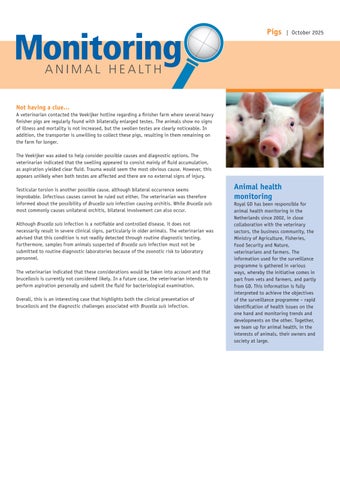
Not having a clue… A veterinarian contacted the Veekijker hotline regarding a finisher farm where several heavy finisher pigs are regularly found with bilaterally enlarged testes. The animals show no signs of illness and mortality is not increased, but the swollen testes are clearly noticeable. In addition, the transporter is unwilling to collect these pigs, resulting in them remaining on the farm for longer. The Veekijker was asked to help consider possible causes and diagnostic options. The veterinarian indicated that the swelling appeared to consist mainly of fluid accumulation, as aspiration yielded clear fluid. Trauma would seem the most obvious cause. However, this appears unlikely when both testes are affected and there are no external signs of injury. Testicular torsion is another possible cause, although bilateral occurrence seems improbable. Infectious causes cannot be ruled out either. The veterinarian was therefore informed about the possibility of Brucella suis infection causing orchitis. While Brucella suis most commonly causes unilateral orchitis, bilateral involvement can also occur. Although Brucella suis infection is a notifiable and controlled disease, it does not necessarily result in severe clinical signs, particularly in older animals. The veterinarian was advised that this condition is not readily detected through routine diagnostic testing. Furthermore, samples from animals suspected of Brucella suis infection must not be submitted to routine diagnostic laboratories because of the zoonotic risk to laboratory personnel. The veterinarian indicated that these considerations would be taken into account and that brucellosis is currently not considered likely. In a future case, the veterinarian intends to perform aspiration personally and submit the fluid for bacteriological examination. Overall, this is an interesting case that highlights both the clinical presentation of brucellosis and the diagnostic challenges associated with Brucella suis infection.
Animal health monitoring Royal GD has been responsible for animal health monitoring in the Netherlands since 2002, in close collaboration with the veterinary sectors, the business community, the Ministry of Agriculture, Fisheries, Food Security and Nature, veterinarians and farmers. The information used for the surveillance programme is gathered in various ways, whereby the initiative comes in part from vets and farmers, and partly from GD. This information is fully interpreted to achieve the objectives of the surveillance programme – rapid identification of health issues on the one hand and monitoring trends and developments on the other. Together, we team up for animal health, in the interests of animals, their owners and society at large.
Specific findings Oesophageal stenosis at the gastric inlet During the third quarter, the Veekijker hotline received a call from a breeding farm reporting that weaned piglets started to deteriorate from approximately five weeks of age onwards. Coughing and sneezing gradually became more prevalent within the group, and some piglets began to lose condition. During previous pathological examinations of piglets that had died on the farm, the veterinary practitioner had repeatedly observed multiple lung abscesses. As part of follow-up diagnostic investigations, the veterinary practitioner and the Veekijker veterinarian decided to select representative animals in the acute stage of disease for necropsy in order to investigate possible underlying causes. Three 7-week-old piglets were submitted for post-mortem examination. Macroscopically, the moderate body condition and ear tip necrosis were immediately noticeable. The piglets showed various inflammatory lesions in the lungs, including abscesses and pleural adhesions. The most remarkable finding was a severe narrowing of the gastric inlet. In these piglets, the transition between the Esophagus and the stomach was reduced to an opening of only 3 to 5 millimeters. This finding may explain the reduced feed intake and could therefore account for the loss of condition observed on the farm. Laboratory examination of the lungs provided evidence for the presence of PRRS virus, App (Actinobacillus pleuropneumoniae), Bordetella bronchiseptica and Pasteurella multocida. These pathogens may explain the lung abscesses observed previously. The severe narrowing of the gastric inlet is considered secondary to a gastric ulcer. Gastric ulceration occurring as a herd problem in piglets of this young age is uncommon. Potential causes of these lesions at such an early age include nutrition, feeding strategy, feed pH, the addition of acids, feed particle size, antioxidant deficiency, mycotoxins, stress-related factors or a possible genetic predisposition. The veterinary practitioner now has several new leads to investigate further during the herd history assessment and farm analysis in order to identify the underlying cause and develop an effective solution to this herd problem.
Royal GD P.O. Box 9, 7400 AA Deventer The Netherlands
T. +31 (0)88 20 25 575 info@gdanimalhealth.com www.gdanimalhealth.com
Pig health in the Netherlands, third quarter of 2025 Disease/disorder/health characteristic
Situation in the Netherlands/Europe
Category A, B, and C diseases (notifiable and controlled) Foot and Mouth Disease (FMD)
The Netherlands has been disease-free since 2001. Outbreaks occurred in Germany, Hungary and Slovakia during the first half of 2025.
Classical swine fever (CSF)
The Netherlands has been disease-free since 1998. No outbreaks have been reported in Europe since 2015.
African swine fever (ASF)
The Netherlands has been disease-free since 1986.
Brucellosis
The Netherlands has been disease-free since 1973.
Aujeszky’s disease (ADV)
The Netherlands has been disease-free since 2007.
Salmonella
Detected 3 times in pathological examinations.
Monitoring: Veekijker Skin disorders
Increased attention for skin disorders in 2025 due to the emergence of a new parvovirus variant.
PRRSv
Most questions submitted to the Veekijker hotline relate to PRRSv.
Monitoring: pathological examinations Streptococcus suis
Meningitis and septicaemia caused by Streptococcus suis are the most frequently diagnosed conditions in weaned piglets.
Gastrointestinal disorders
Approximately one quarter of diagnoses established through pathological examination involve the gastrointestinal tract.
Online Monitoring Streptococci
Streptococci are most frequently reported as the most probable diagnosis, particularly in weaned piglets.
Non-infectious causes
Non-infectious factors, such as nutrition and climate conditions, are frequently reported as the most probable cause of health complaints.
GD3628/08-26