Pigs | January 2026
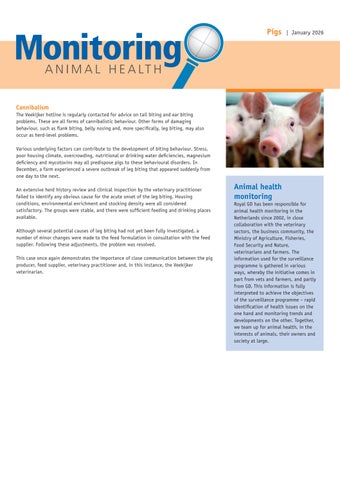
Cannibalism The Veekijker hotline is regularly contacted for advice on tail biting and ear biting problems. These are all forms of cannibalistic behaviour. Other forms of damaging behaviour, such as flank biting, belly nosing and, more specifically, leg biting, may also occur as herd-level problems. Various underlying factors can contribute to the development of biting behaviour. Stress, poor housing climate, overcrowding, nutritional or drinking water deficiencies, magnesium deficiency and mycotoxins may all predispose pigs to these behavioural disorders. In December, a farm experienced a severe outbreak of leg biting that appeared suddenly from one day to the next. An extensive herd history review and clinical inspection by the veterinary practitioner failed to identify any obvious cause for the acute onset of the leg biting. Housing conditions, environmental enrichment and stocking density were all considered satisfactory. The groups were stable, and there were sufficient feeding and drinking places available. Although several potential causes of leg biting had not yet been fully investigated, a number of minor changes were made to the feed formulation in consultation with the feed supplier. Following these adjustments, the problem was resolved. This case once again demonstrates the importance of close communication between the pig producer, feed supplier, veterinary practitioner and, in this instance, the Veekijker veterinarian.
Animal health monitoring Royal GD has been responsible for animal health monitoring in the Netherlands since 2002, in close collaboration with the veterinary sectors, the business community, the Ministry of Agriculture, Fisheries, Food Security and Nature, veterinarians and farmers. The information used for the surveillance programme is gathered in various ways, whereby the initiative comes in part from vets and farmers, and partly from GD. This information is fully interpreted to achieve the objectives of the surveillance programme – rapid identification of health issues on the one hand and monitoring trends and developments on the other. Together, we team up for animal health, in the interests of animals, their owners and society at large.
Specific findings Sloughing of the hoof capsule Towards the end of last year, the Veekijker was consulted regarding an unusual case on a farm that was being repopulated following complete depopulation. Problems were reported in recently introduced replacement gilts. The gilts had been brought onto the farm between two and six months of age. Approximately one quarter of the newly introduced animals showed signs of lameness to varying degrees. The lameness could not be clearly attributed to a single limb; instead, the animals appeared generally stiff or lame on all four limbs. In consultation with the veterinary practitioner, it was decided to submit two animals for pathological examination at GD: one younger gilt that had died naturally and one older animal that was euthanised specifically for diagnostic purposes. In both animals, sloughing of the hoof capsule was observed. This is an unusual finding in pigs. It may occur, among other conditions, in cases of foot-and-mouth disease (FMD) and swine vesicular disease (SVD). However, both diseases could be readily excluded on the basis of the clinical presentation on the farm and the post-mortem findings. The larger animal was also found to have severe necrotising pneumonia caused by Pasteurella multocida. The sloughing of the hoof capsule and the hyperkeratosis of the claws could indicate exposure to a disinfectant used to sanitise the buildings following depopulation. It is possible that the facilities were not adequately rinsed after disinfection. However, no skin lesions were observed elsewhere on the animals. The stiffness and lameness may have had multiple causes. Excessively acidic liquid feed, incorrect vitamin supplementation, an imbalanced calcium-to-phosphorus ratio, excessively rapid growth or exposure to a cold environment may all contribute to vascular damage within the claws or to the development of the osteochondrosis that was confirmed microscopically. Heavy metal analysis of liver samples demonstrated a suboptimal cobalt status. Cobalt is essential for the synthesis of vitamin B12. Following several nutritional adjustments, the clinical signs eventually resolved. The most likely explanation is that a combination of unfavourable factors coincided, resulting in lameness among the introduced gilts. Ultimately, the overall impact on the animals remained limited.
Royal GD P.O. Box 9, 7400 AA Deventer The Netherlands
T. +31 (0)88 20 25 575 info@gdanimalhealth.com www.gdanimalhealth.com
Pig Health in the Netherlands, Fourth Quarter of 2025 Disease/disorder/health characteristic
Situation in the Netherlands/Europe
Category A, B, and C diseases (notifiable and controlled) Foot and Mouth Disease (FMD)
The Netherlands has been disease-free since 2001. Outbreaks occurred in Germany, Hungary and Slovakia during the first half of 2025.
Classical swine fever (CSF)
The Netherlands has been disease-free since 1998. No outbreaks have been reported in Europe since 2015.
African swine fever (ASF)
The Netherlands has been disease-free since 1986.
Brucellosis
The Netherlands has been disease-free since 1973.
Aujeszky’s disease (ADV)
The Netherlands has been disease-free since 2007.
Category C, D, and E diseases (notifiable) Salmonella
Detected 3 times in pathological examinations.
Monitoring: Veekijker Skin disorders
Increased attention for skin disorders in 2025 due to the emergence of a new parvovirus variant.
PRRSv
Most questions submitted to the Veekijker hotline relate to PRRSv.
Monitoring: pathological examinations Streptococcus suis
Meningitis and septicaemia caused by Streptococcus suis are the most frequently diagnosed conditions in weaned piglets.
Gastrointestinal disorders
Approximately one quarter of diagnoses established through pathological examination involve the gastrointestinal tract.
Online Monitoring Streptococci
Streptococci are most frequently reported as the most probable diagnosis, particularly in weaned piglets.
Non-infectious causes
Non-infectious factors, such as nutrition and climate conditions, are frequently reported as the most probable cause of health complaints.
GD3629/08-26