Outbreaks of lumpy skin disease (LSD) in Europe
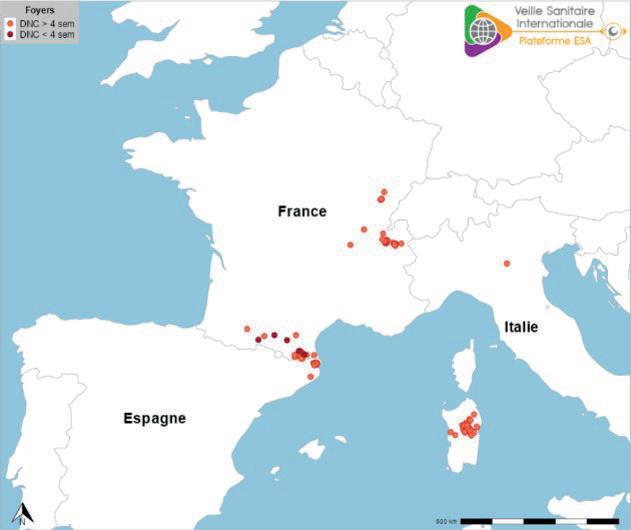
The first case of LSD in Italy was identified on 21 June 2025, followed by the first confirmed case of LSD in France on 29 June. New cases were recorded in both countries in both the third and fourth quarters of 2025. By the end of the fourth quarter, a total of 115 cases had been confirmed across eleven départements in France. A total of eighty cases have been confirmed in Italy, of which only one is on the mainland (in Lombardy). The other outbreaks are on Sardinia.
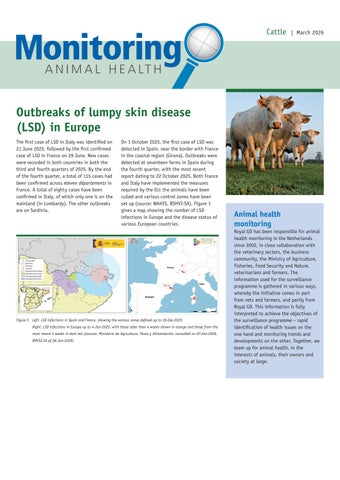
Servicios Veterinarios Oficiales (SVO) de la Generalitat de Catalunya han confirmado nuevo foco de la Dermatosis Nodular Contagiosa (DNC) en la provincia de Gerona, en proximidades de la frontera con Francia. Con éste, son 18 el total de focos notificados hasta el momento, el último de los cuales se había comunicado el pasado 24 de octubre. nuevo foco no supone un aumento de la zona de restricción establecida desde los primeros focos notificados en Gerona.
foco se localiza en una explotación en régimen extensivo, con pastos de uso individual y censo de 106 bovinos en la comarca Alt Empordà, en la provincia de Gerona. La vacunación de la granja tuvo lugar el pasado mes de octubre, si bien, debido a la dificultad manejo de este tipo de animales no se consiguió vacunar a la totalidad del censo, resultando 4 de los animales no vacunados positivos a la cepa de campo del virus de la mediante PCR realizado en el Laboratorio Nacional de Referencia en Algete.
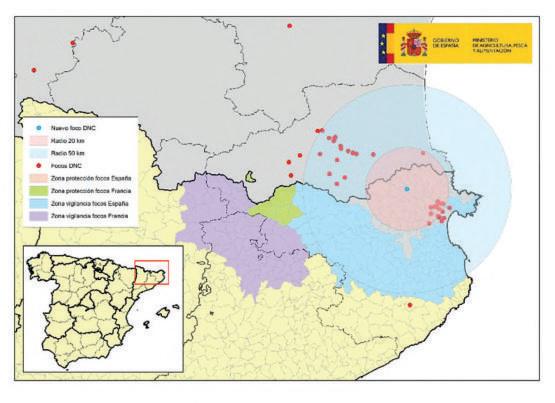
On 1 October 2025, the first case of LSD was detected in Spain, near the border with France in the coastal region (Girona). Outbreaks were detected at seventeen farms in Spain during the fourth quarter, with the most recent report dating to 22 October 2025. Both France and Italy have implemented the measures required by the EU: the animals have been culled and various control zones have been set up (source: WAHIS, BSHVI-SA). Figure 1 gives a map showing the number of LSD infections in Europe and the disease status of various European countries.
Animal health monitoring
de los 18 focos de DNC en Cataluña a fecha 07/01/2025 y ZR que se adoptará en España a partir del 09/01/2025
Figure 1. Left: LSD infections in Spain and France, showing the various zones defined up to 30-Dec-2025.
Right: LSD infections in Europe up to 4-Jan-2025, with those older than 4 weeks shown in orange and those from the most recent 4 weeks in dark red (sources: Ministerio de Agricultura, Pesca y Alimentación, consulted on 07-Jan-2026, BHVSI-SA of 06-Jan-2026)
C/ Almagro 33 28010 MADRID TEL: 913478295 FAX: 913478299
Royal GD has been responsible for animal health monitoring in the Netherlands since 2002, in close collaboration with the veterinary sectors, the business community, the Ministry of Agriculture, Fisheries, Food Security and Nature, veterinarians and farmers. The information used for the surveillance programme is gathered in various ways, whereby the initiative comes in part from vets and farmers, and partly from Royal GD. This information is fully interpreted to achieve the objectives of the surveillance programme – rapid identification of health issues on the one hand and monitoring trends and developments on the other. Together, we team up for animal health, in the interests of animals, their owners and society at large.
Mapa 1. Localización
Acorn intoxication
In October 2025, the Veekijker received several calls about acorn intoxication or cases of clinical signs that led to suspicions of acorn poisoning. This often involved older young cattle that had grazed in nature reserves or on plots of land with oak trees. The affected heifers were listless, kept themselves isolated and had insufficient rumen content. Other signs observed included nasal discharge (sometimes a little bloodied), colic, diarrhoea (sometimes containing blood), tachypnoea, oedema and hypothermia. In some cases, the animals were found dead without having shown prior signs of illness.
Since the end of August, six animals submitted for pathological examination have been diagnosed with ‘suspected acorn intoxication’. Note, however, that there is some overlap
Lice in dairy cattle
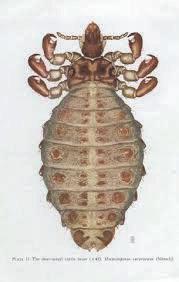
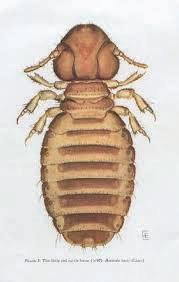
In November, the Veekijker received a report about a dairy farm that had been experiencing problems with lice among its dairy cows for years. The problem recurred every year after the livestock were brought indoors for the winter. Almost all the animals in the herd had lice and some were very severely infested. This led to restlessness and milk production drops. Individual treatments had so far not produced satisfactory results. Lice are small, speciesspecific ectoparasites that live on the surface of the skin. They tend to be found at the warmest parts of the body, such as (for cattle) at the bases of the ears and between the scapulae. There are both biting and blood-
between the Veekijker case reports on possible acorn intoxication and the case studies of poisoning caused by other, unspecified plants (see below). The diagnosis is based on finding acorns in the gastrointestinal tract, in conjunction with tubulonephrosis and haemorrhage and/or ulcers in the digestive tract. These signs are caused by tannin, a substance found in green acorns in particular and to a lesser extent in brown acorns and brown oak leaves. Tannins are substances that can irritate the gastrointestinal tract when ingested, resulting in damage to the mucous membrane of the digestive system. The kidney damage is caused by toxins binding to proteins, which then precipitate out and ‘clog up’ the kidneys. This damage is largely permanent and there is no specific treatment available. Autumn 2025 was a ‘mast year’ for
oak trees, meaning one that is characterised by specific weather conditions under which oak trees produce large amounts of acorns and drop them early. Stormy weather can also make unripe green acorns and leaves fall, which can then get eaten.
The Veekijker has advised supportive treatment for sick animals (including intravenous fluid therapy) and ensuring that remaining animals are kept indoors so they cannot access the acorns, as well as ensuring they have access to good and palatable roughage. In addition, the Veekijker has issued a call – through channels such as the WhatsApp group for vets and across various sectors – for increased vigilance for signs of intoxication due to acorns or oak leaves.
sucking variants (see Figure 2). The first category feeds inter alia on skin flakes, whereas the second feeds on blood. Louse infestations are common, particularly in young animals and those with weakened immune systems. In general, mild louse infestations do not cause many problems and rarely cause problems in adult dairy cattle herds, which makes this case unusual.
The Veekijker has recommended carrying out further diagnostic tests first to determine whether the animals have biting or bloodsucking lice. Depending on which category it is, a herd-wide treatment can then
be carried out using an appropriate method. It is also recommended that the dairy herd’s immune systems should be monitored and optimised. The brushes that are present should be replaced. Animals that are brought in must first be placed in quarantine and treated before being introduced into the herd. As lice can only survive in the environment for a short time, treatment of the stable environment is unnecessary. The vet carried out a herd-wide treatment that was repeated after fourteen days. This had a positive effect and the issue now seems to be under control.
Figure 2. Microscope images of a biting louse (left) and a stinging louse (right) in cattle (source: https://phthiraptera.myspecies.info/).
Health of cattle in the Netherlands, fourth quarter of 2025
VETERINARY DISEASES SITUATION IN THE NETHERLANDS
Category (AHR)
Monitoring results, fourth quarter of 2025
Implementing Regulation (EU) 2018/1882 of Animal Health Regulation (AHR) 2016/429 (category A disease)
Lumpy Skin Disease (LSD) Viral infection.
The Netherlands is officially disease-free.
Foot and Mouth Disease (FMD)
Viral infection.
The Netherlands has been officially diseasefree since 2001.
A, D, E Infections never detected in the Netherlands. Outbreaks in Italy, France and Spain.
A, D, E No infections detected in the Netherlands or in Europe.
Implementing Regulation (EU) 2018/1882 of Animal Health Regulation (AHR) 2016/429 (categories B to E)
Bluetongue (BT)
Bovine genital campylobacteriosis
Bluetongue serotype 3 outbreak in the Netherlands since September 2023. Also a few cases of BTV-12.
Bacterium.
The Netherlands has been disease-free since 2009. Monitoring of AI and embryo stations and of animals for export.
Bovine Viral Diarrhoea (BVD) Viral infection.
Control measures required by the dairy industry are compulsory for dairy farms but voluntary on beef cattle farms.
C, D, E No new infections detected in the Netherlands.
D, E Campylobacter fetus spp. veneralis not detected.
C, D, E The status* of 91.7 per cent of dairy farms is ‘BVD-free’ or ‘BVD not suspected’.
The status of 21.3 per cent of all non-dairy farms is favourable (BVD-free or BVD not suspected).
* The BVD status as determined according to the GD programme.
Brucellosis (zoonosis, infection through animal contact or inadequately prepared food)
Bacterium. Zoonosis.
The Netherlands has been officially diseasefree since 1999. Monitoring via antibody testing of blood samples from aborting cows.
Enzootic bovine leukosis Viral infection.
The Netherlands has been officially diseasefree since 1999. Monitoring via antibody testing of blood samples from slaughtered cattle and bulk milk.
Epizootic Haemorrhagic Disease (EHD) Viral infection.
Detected since 2022 in cattle in Europe (Spain, Italy, Portugal and France).
Infectious Bovine Rhinotracheitis (IBR) Viral infection.
Control measures required by the dairy industry are compulsory for dairy farms but voluntary on beef cattle farms.
B, D, E No infections detected.
C, D, E No infections detected.
D, E No infections detected in the Netherlands. Few infections reported in the rest of Europe.
C, D, E The status of 84.6 per cent of dairy farms is ‘IBR-free’ or ‘IBR not suspected’.
The status of 22.3 per cent of all non-dairy farms was favourable (IBR-free or IBR not suspected).
* The IBR status as determined using the GD programme Anthrax (zoonosis, infection through contact with animals)
Bacterium. Zoonosis. Not detected in the Netherlands since 1994. Monitoring through blood smears from cattle that died suddenly.
D, E No infections detected.
>>
VETERINARY DISEASES SITUATION IN THE
Table continuation
Monitoring results, fourth quarter of 2025
Implementing Regulation (EU) 2018/1882 of Animal Health Regulation (AHR) 2016/429 (categories B to E)
Paratuberculosis Bacterium.
Control measures required by the dairy industry are compulsory in the Netherlands for dairy farms but voluntary on beef cattle farms.
Rabies Viral infection. Zoonosis.
The Netherlands has been officially diseasefree since 2012.
Bovine tuberculosis (TB) Bacterium. Zoonosis.
The Netherlands has been officially diseasefree since 1999. Monitoring of slaughtered cattle.
Trichomonas Bacterium.
The Netherlands has been disease-free since 2009. Monitoring of AI and embryo stations and of animals for export.
Q fever Bacterium. Zoonosis.
In the Netherlands, this is a different strain to the one found on goat farms with no established relationship to human illness. From the first quarter of 2023 onwards, this is once again part of the standard aborter pathology protocol.
E The status of 83.8 per cent of dairy farms is A (‘not suspected’) in the PPN
(Paratuberculosis Programme Netherlands) or 6 in the IPP (Intensive Paratuberculosis Programme)*.
The status of 13.6 per cent of all non-dairy farms is A in the PPN or 6 in the IPP.
* The paratuberculosis status as determined according to the GD programme
B, D, E No infections detected in the Netherlands.
B, D, E No infections detected in the Netherlands. One infection in Belgium.
C, D, E Tritrichomonas foetus not detected.
E One infection detected in the aborted foetuses submitted for necropsy.
Article 3a.1 Notification of zoonoses and disease symptoms, ‘Rules for Animal Husbandry’ from the Dutch Animals Act Leptospirosis Bacterium. Zoonosis.
Control measures required by the dairy industry are compulsory for dairy farms but voluntary on beef cattle farms.
Listeriosis Bacterium. Zoonosis.
Infections have occasionally been detected in cattle.
- The status of 98.3 per cent of dairy farms is ‘leptospirosis-free’.*
The status of 29.7 per cent of all non-dairy farms is ‘leptospirosis-free’.
Two new infections at dairy farms.
* The leptospirosis status as determined using the GD programme
- Four infections detected in cattle or aborted foetuses presented for necropsy.
VETERINARY DISEASES
T. +31 (0)88 20 25 575
info@gdanimalhealth.com www.gdanimalhealth.com
Table continuation
fourth quarter of 2025
Article 3a.1 Notification of zoonoses and disease symptoms, ‘Rules for Animal Husbandry’ from the Dutch Animals Act Salmonellosis Bacterium. Zoonosis. Control measures required by the dairy industry are compulsory for dairy farms but voluntary on beef cattle farms.
Yersiniosis Bacterium. Zoonosis.
Regulation (EC) no. 999/2001
Bovine Spongiform Encephalopathy (BSE)
Infections detected occasionally in cattle.
Prion infection. The QAOH status for the Netherlands is ‘negligible risk’. Monitoring has not revealed any further cases of classical BSE since 2010 (88 cases overall from 1997 to 2009).
Other infectious diseases in cattle
Malignant Catarrhal Fever (MCF)
Viral infection. There are occasional cases in the Netherlands.
Liver fluke Parasite. Liver flukes are endemic in the Netherlands, particularly in wetland areas.
Neosporosis Parasite. In the Netherlands, this is an important infectious cause of abortion in cows.
Tick-borne diseases: Anaplasma phagocytophilum
Ticks infected with Babesia divergens, Anaplasma phagocytophilum and Mycoplasma wenyonii can be found in the Netherlands. A PCR test is only available for Anaplasma phagocytophilum.
- The bulk milk results of 94.8 per cent of dairy farms are favourable (the nationwide Qlip programme).
- No infections detected.
- No infections detected.
- Two infections confirmed upon necropsy.
- Infections were detected at 35 farms and in two animals presented for necropsy.
- Two infections detected in aborted foetuses submitted for necropsy.
- Four infections with Anaplasma phagocytophilum detected.