AHEAD IN ANIMAL HEALTH
Health of veal calves in the Netherlands: associations with transport age Anouk Veldhuis1, Inge Santman-Berends1, Liza le Feber-Dekker1, Myrna Bunte1, Paul Wever1, Linda van Duijn1, Gerdien van Schaik2 1 Royal GD, Deventer, the Netherlands 2 Utrecht University, Utrecht, the Netherlands
Introduction • Long-distance transport of unweaned calves has gained considerable attention due to animal welfare concerns. • Under the EU Transport Regulation, a calf may be transported from the age of 14 days, yet this is likely to be increased in the future according to the latest developments in scientific and technical knowledge in this field. • Germany already banned transport of calves under 4 weeks, as of January 2023. This provides an opportunity to assess the impact of increased transport age on the health of veal calves in the Netherlands, as ~33% of veal calves in the Netherlands originate from Germany. Methods
Kaplan−Meier survival estimate by age, d28 to slaughter 2020−2021−2022
1.00
survival estimate
• Performance of veal calves that arrived at the veal farm at a young age (<28 days at arrival) was compared to those that arrived at a later age (≥28 days at arrival). • Data on health parameters (2020-2024): - Mortality: census data on country of origin, age at arrival in the veal calf herd, and age at slaughter or death, from 8.8 million veal calves that arrived at a Dutch veal farm during the study period. - Records on antimicrobial use (AMU) were available for 5,289 ‘all-in all-out’ production cycles of 800 farms producing white veal. • Analysis: multivariable logistic regression models and survival models to quantify association between health parameters and transport age (young vs. old)
Results
0.99 0.98 0.97 0.96 0.95 0.94
Take home message
• In this study, health parameters of veal calves that arrive in the Netherlands ≥28 days of age were used as a proxy for future performance of veal calves born in the Netherlands when minimal transport age will be raised. • It is assumed that increasing the minimum age at transport will improve health and welfare of unweaned veal calves. Yet this study showed that calves that were transported to veal farms after 28 days of age did not perform unequivocally better. • It is likely that performance of veal calves is highly dependent on country-of-origin related factors (such as differences in breed and calving patterns).
25
50
75
100
125
150
175
200
225
250
age (days) NL origin, <28d at arrival
Other origin, >28d at arrival
DE origin, <28d at arrival
Kaplan−Meier survival estimate by age, d28 to slaughter 2023−2024
1.00
survival estimate
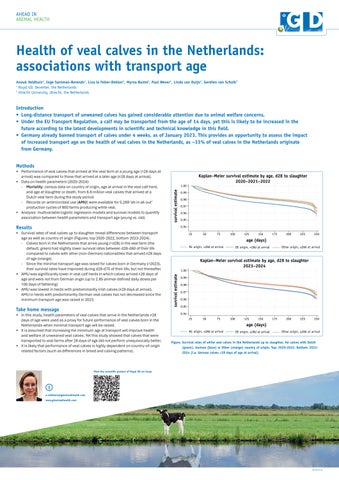
• Survival rates of veal calves up to slaughter reveal differences between transport age as well as country of origin (Figures; top 2020-2022, bottom 2023-2024). - Calves born in the Netherlands that arrive young (<d28) in the veal farm (the default; green) had slightly lower survival rates between d28-d60 of their life compared to calves with other (non-German) nationalities that arrived ≥28 days of age (orange). - Since the minimal transport age was raised for calves born in Germany (>2023), their survival rates have improved during d28-d75 of their life, but not thereafter. • AMU was significantly lower in veal calf herds in which calves arrived ≥28 days of age and were not from German origin (up to 2.85 animal-defined daily doses per 100 days of fattening) • AMU was lowest in herds with predominantly Irish calves (≥28 days at arrival). AMU in herds with predominantly German veal calves has not decreased since the minimum transport age was raised in 2023.
0.99 0.98 0.97 0.96 0.95 0.94 25
50
75
100
125
150
175
200
225
250
age (days) NL origin, <28d at arrival
DE origin, >28d at arrival
Other origin, >28d at arrival
Figure. Survival rates of white veal calves in the Netherlands up to slaughter, for calves with Dutch (green), German (blue) or Other (orange) country of origin. Top: 2020-2022. Bottom: 20232024 (i.e. German calves ≥28 days of age at arrival)
View the scientific posters of Royal GD on Issuu
a.veldhuis@gdanimalhealth.com www.gdanimalhealth.com
GD3534/03-26