AHEAD IN ANIMAL HEALTH
Findings from BTV-related field pilot studies in the Netherlands L. van Duijn1*; E. E. C. Strous1; J. de Jong1; R. Tiessen-Thomas1; M.J.M Bunte1; K.M.J.A. van den Brink1 Royal GD, Arnsbergstraat 7, 7418 EZ Deventer, The Netherlands * Presenting author
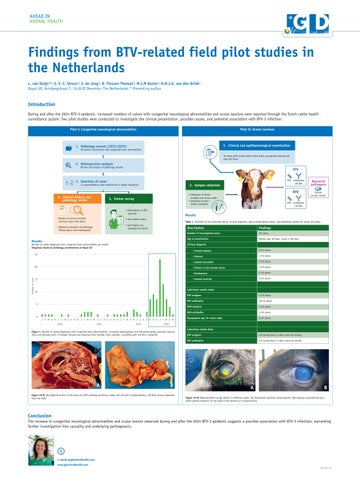
Introduction During and after the 2024 BTV-3 epidemic, increased numbers of calves with congenital neurological abnormalities and ocular laesions were reported through the Dutch cattle health surveillance system. Two pilot studies were conducted to investigate the clinical presentation, possible causes, and potential association with BTV-3 infection. Pilot I: Congenital neurological abnormalities
Pilot II: Ocular laesions
1. Pathology records (2022-2025)
1. Clinical and ophthalmological examination
All bovine submissions with congenital brain abnormalities 10 calves with ocular lesions from dairy, youngstock-rearing and veal calf farms
2. Retrospective analysis
Review and analysis of pathology records
BTV
3. Selection of cases
2. Sample collection
21 representative cases selected for in-depth evaluation
4. Clinical history and pathology review
• Collection of blood samples and ocular swabs • Sampling of dams (when available)
5. Farmer survey • Information on BTV exposure
• Review of clinical histories (clinical signs, herd data)
• Calf health and reproductive events
Culture (ocular swabs)
PCR Antibodies (ELISA)
Description
Findings
Number of investigated calves
10 calves
Age at examination
Median age: 69 days; range 4-106 days
Clinical diagnosis
Number of cattle diagnosed with congenital brain abnormalities per month Diagnoses based on pathology examinations at Royal GD
25
20
Number of cases
BVD
Table 1. Overview of the examined calves: clinical diagnosis, age at examination (days), and laboratory results for calves and dams.
Results
15
- Corneal oedema
9/10 calves
- Cataract
1/10 calves
- Corneal ulceration
7/10 calves
- Chronic or old corneal ulcers
2/10 calves
- Keratoconus
4/10 calves
- Corneal scarring
1/10 calves
Laboratory results calves
10
5
0
Bacterial pathogens
Results
• Vaccination status
• Detailed evaluation of pathology fidings (gross and histological)
PCR Antibodies (ELISA)
J F M A M J J A S O N D J F M A M J J A S O N D J F M A M J J A S O N D J F M A M 2022
2023
2024
BTV antigens
9/10 calves
BTV antibodies
10/10 calves
BVD antigens
1/10 calves
BVD antibodies
1/10 calves
Mycoplasma spp. In ocular swab
0/10 calves
2025
Figure 1. Number of cattle diagnosed with congenital brain abnormalities, including hydrocephalus and hydranencephaly, between January 2022 and February 2025. A marked increase was observed from October 2024 onwards, coinciding with the BTV-3 epidemic.
Figure 2A-B. (A) Sagittal section of the head of a BTV antibody-positive 6 weeks old calf with a hydrocephalus. (B) Brain tissue separated from the skull.
Laboratory results dams BTV antigens
6/6 tested dams; 4 dams were not tested.
BTV antibodies
6/6 tested dams; 4 dams were not tested.
Figure 3A–B. Representative ocular lesions in affected calves. (A) Fluorescein-positive corneal lesions. (B) Cataract characterized by a white opacity posterior to the pupil in the absence of corneal lesions.
Conclusion The increase in congenital neurological abnormalities and ocular lesions observed during and after the 2024 BTV-3 epidemic suggests a possible association with BTV-3 infection, warranting further investigation into causality and underlying pathogenesis.
l.v.duijn@gdanimalhealth.com. www.gdanimalhealth.com GD3619/07-26