

Marian Aalberts1, Jasper het Lam2, Anouk Veldhuis1
1Department of Research and Development; 2Department of Ruminant Health, Royal GD, Arnsbergstraat 7, 7418 EZ, Deventer, The Netherlands
Background
In the Netherlands, Mycoplasmopsis bovis (M. bovis) outbreaks in dairy herds typically present with multiple cows affected by severe arthritis or mastitis and less frequently by pneumonia. A crosssectional prevalence study has shown that infections have occurred in most Dutch dairy cattle herds. To screen for M. bovis seroprevalence at herd level, antibodies can be detected in serum, individual milk and bulk milk samples, using an M. bovis antibody ELISA, resulting in S/P%.
Aim
• to evaluate a semi-quantitative interpretation of bulk milk test results to monitor changes in within-herd prevalences.
• to compare test results of pairs of individual milk and serum samples.
Material and methods
• Bulk milk samples from ten dairy herds and sera from all their lactating cows (N=638) were tested, using the IDscreen® M. bovis antibody ELISA (Innovative Diagnostics). A subset of paired individual milk and serum samples were tested (N=73).
• Samples tested positive if S/P%≥30% (milk) or ≥60% (serum). If bulk milk is positive, mean within-herd seroprevalence is >15% (internal validation).
• Linear regression was used to compare 1) S/P% in bulk milk samples to within-herd seroprevalences and median S/P% of cow sera per herd and 2) S/P% of pairs of individual milk and serum samples.
Results
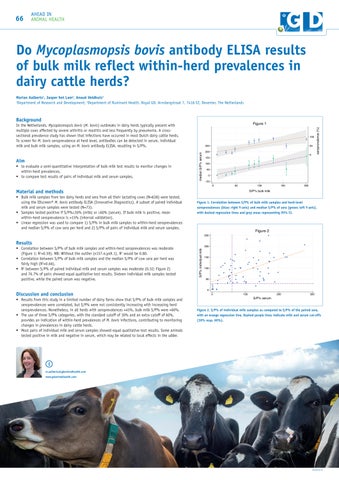
• Correlation between S/P% of bulk milk samples and within-herd seroprevalences was moderate (Figure 1; R2=0.59). NB: Without the outlier (x157.4;y49.1), R2 would be 0.80.
• Correlation between S/P% of bulk milk samples and the median S/P% of cow sera per herd was fairly high (R2=0.66).
• R2 between S/P% of paired individual milk and serum samples was moderate (0.32; Figure 2) and 76.7% of pairs showed equal qualitative test results. Sixteen individual milk samples tested positive, while the paired serum was negative.
Discussion and conclusion
• Results from this study in a limited number of dairy farms show that S/P% of bulk milk samples and seroprevalences were correlated, but S/P% were not consistently increasing with increasing herd seroprevalences. Nonetheless, in all herds with seroprevalences >45%, bulk milk S/P% were >60%.
• The use of three S/P% categories, with the standard cutoff of 30% and an extra cutoff of 60%, provides an indication of within-herd prevalences of M. bovis infections, contributing to monitoring changes in prevalences in dairy cattle herds.
• Most pairs of individual milk and serum samples showed equal qualitative test results. Some animals tested positive in milk and negative in serum, which may be related to local effects in the udder.
Figure 1
Figure 1. Correlation between S/P% of bulk milk samples and herd-level seroprevalences (blue; right Y-axis) and median S/P% of sera (green; left Y-axis), with dashed regression lines and grey areas representing 95% CI.
Figure 2
Figure 2. S/P% of individual milk samples as compared to S/P% of the paired sera, with an orange regression line. Dashed purple lines indicate milk and serum cut-offs (30% resp. 60%).