AHEAD IN ANIMAL HEALTH
Cow Effects on Brix Levels and Colostrum Quantity A.G.J. Velthuis1,2,*, K. Maarleveld2, I. Lammersen2, M. van Asselt2 1 Royal GD, Deventer, The Netherlands, 2 Aeres University of Applied Sciences, Dronten, the Netherlands, * Presenting author
Background and Objective The quality and quantity of colostrum are critical for the passive immunity transfer in dairy calves. This study investigates the associations between various cow and calf factors with Brix levels and colostrum quantity at a commercial farm in the Netherlands.
Materials and Methods
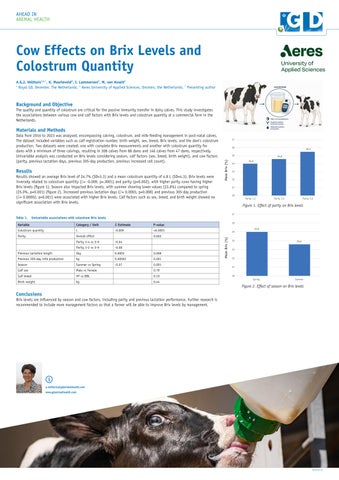
Results Results showed an average Brix level of 24.7% (SD=3.3) and a mean colostrum quantity of 4.8 L (SD=4.3). Brix levels were inversely related to colostrum quantity (β= -0.009, p<.0001) and parity (p=0.002), with higher parity cows having higher Brix levels (figure 1). Season also impacted Brix levels, with summer showing lower values (23.6%) compared to spring (25.0%, p=0.001) (figure 2). Increased previous lactation days (β= 0.0003, p=0.008) and previous 305-day production (β= 0.00002, p=0.001) were associated with higher Brix levels. Calf factors such as sex, breed, and birth weight showed no significant association with Brix levels.
26
25,5
25 24
24,6 24,0
23 22 21 20 Parity 1-2
Parity 3-4
Parity 5-9
Figure 1. Effect of parity on Brix levels 27
Univariable associations with colostrum Brix levels
Variable
Category / Unit
β Estimate
P-value
Colostrum quantity
L
-0.009
<0.0001
Parity
Overall effect
0.002
Parity 3-4 vs 5-9
-0.04
Parity 1-2 vs 5-9
-0.08
Previous lactation length
Day
0.0003
0.008
Previous 305-day milk production
kg
0.00002
0.001
Season
Summer vs Spring
-0.07
0.001
Calf sex
Male vs Female
0.79
Calf breed
HF vs BBL
0.10
Birth weight
kg
0.44
26 25
Mean Brix (%)
Table 1.
27
Mean Brix (%)
Data from 2016 to 2023 was analysed, encompassing calving, colostrum, and milk-feeding management in post-natal calves. The dataset included variables such as calf registration number, birth weight, sex, breed, Brix levels, and the dam’s colostrum production. Two datasets were created: one with complete Brix measurements and another with colostrum quantity for dams with a minimum of three calvings, resulting in 308 calves from 88 dams and 146 calves from 47 dams, respectively. Univariable analysis was conducted on Brix levels considering season, calf factors (sex, breed, birth weight), and cow factors (parity, previous lactation days, previous 305-day production, previous increased cell count).
25,0
24
23,6
23 22 21 20 Spring
Summer
Figure 2. Effect of season on Brix levels
Conclusions Brix levels are influenced by season and cow factors, including parity and previous lactation performance. Further research is recommended to include more management factors so that a farmer will be able to improve Brix levels by management.
a.velthuis@gdanimalhealth.com www.gdanimalhealth.com
GD3618/07-26