AHEAD IN ANIMAL HEALTH
Calves infected with Cryptosporidium parvum and their Calprotectin concentrations A. Velthuis1*, R. Aarts1, E. van Engelen1, S. van der Drift1, C. van Weeghel1 1 Royal GD, Arnsbergstraat 7, 7418 EZ Deventer, The Netherlands * Presenting author
Background and Objective
Number of Oocysts
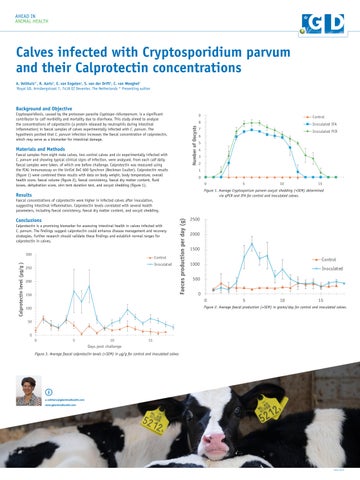
Cryptosporidiosis, caused by the protozoan parasite Cryptospo ridiumparvum, is a significant contributor to calf morbidity and mortality due to diarrhoea. This study aimed to analyse the concentrations of calprotectin (a protein released by neutrophils during intestinal inflammation) in faecal samples of calves experimentally infected with C. parvum. The hypothesis posited that C. parvum infection increases the faecal concentration of calprotectin, which may serve as a biomarker for intestinal damage.
Materials and Methods Faecal samples from eight male calves, two control calves and six experimentally infected with C. parvum and showing typical clinical signs of infection, were analysed. From each calf daily faecal samples were taken, of which one before challenge. Calprotectin was measured using the fCAL immunoassay on the UniCel DxC 600 Synchron (Beckman Coulter). Calprotectin results (figure 1) were combined these results with data on body weight, body temperature, overall health score, faecal volume (figure 2), faecal consistency, faecal dry matter content, fluid losses, dehydration score, skin tent duration test, and oocyst shedding (figure 1).
9
Control
8
Inoculated IFA
7
Inoculated PCR
6 5 4 3 2 1 0 0
5
10
15
Figure 1. Average CryptosporiumDays parvem shedding (+SEM) determined postoocyst challenge via qPCR and IFA for control and inoculated calves.
Results
Conclusions Calprotectin is a promising biomarker for assessing intestinal health in calves infected with C. parvum. The findings suggest calprotectin could enhance disease management and recovery strategies. Further research should validate these findings and establish normal ranges for calprotectin in calves.
Calprotectin level (µg/g )
300
Control Inoculated
250 200 150
Faeces production per day (g)
Faecal concentrations of calprotectin were higher in infected calves after inoculation, suggesting intestinal inflammation. Calprotectin levels correlated with several health parameters, including faecal consistency, faecal dry matter content, and oocyst shedding.
2500 2000 1500 Control
1000
Inoculated
500 0 0
5
10
15
Figure 2. Average faecal production (+SEM) in grams/day for control and inoculated calves.
100
Days post challenge
50 0 0
5
10
15
Days post challenge Figure 3. Average faecal calprotectin levels (+SEM) in µg/g for control and inoculated calves
a.velthuis@gdanimalhealth.com www.gdanimalhealth.com
GD3621/08-26