VOLUME I | 2026
GFS BULLETIN Solving Problems...
...Building Worlds
Congratulations to the Class of 2026 THERE ARE 108 NEW GFS ALUMNI OUT IN THE WORLD! We can’t wait to
see what this driven, inspiring, brilliant group will accomplish in the years to come. In the fall, these new grads will continue their learning at 62 different colleges in 21 states, D.C., Canada, Ireland, and Germany. Learn more about the Class of 2026:
235
Colleges and universities applied to across the country, as well as Canada and Europe
TOP
Matriculating colleges and universities (3+ students): Penn, Swarthmore, Temple, Haverford, Tufts, USC, and Wesleyan
12
College athletics signings
23
“Most selective” institutions (overall acceptance rate ≤10%) where students were accepted, including 7 Ivies: Amherst, Brown, Caltech, Colby, Columbia, Cornell, Duke, Harvard, Johns Hopkins, NYU, Northeastern, Northwestern, Pomona, Princeton, Rice, Swarthmore, U.S. Naval Academy, UCLA, UNC-Chapel Hill, Penn, USC, Williams, and Yale
6
Students attending an HBCU (Hampton University, Howard University, and Morehouse College)
$20MM
In merit scholarships collectively awarded to the class
IN THIS ISSUE 16
A Vision Actualized GFS’ historic Picture This: A Campaign for Learning in Community concluded on June 30, 2026. Hear from four School Committee members about the impact and importance of this remarkable collective effort.
22
For the Love of Math Throughout Lower and Middle School, math teachers lay an intentional, joyful foundation for young learners. Tapping into each student’s unique math aptitude early ensures that everyone can be a math person.
32
World Builders Meet three GFS alumni—writer and illustrator Sarah Jacoby ’01, architect Noah Yaffe ’90, and app developer Steven Songqi Pu ’20—whose work speaks to the theme of this issue in very distinct ways.
FRONT 1 2 3 10 16 22 32
In This Issue From the Head of School News & Noteworthy Tiger Beat Supporting GFS Faculty Focus Features
B AC K 45 52
Class Notes Q&A
This magazine is printed on recycled paper.
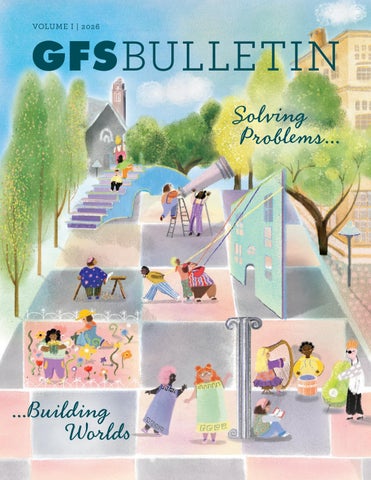
O N T H E COV E R Writer and illustrator Sarah Jacoby ’01 (see page 32) created a custom illustration based on this issue’s theme: “Solving Problems, Building Worlds.” The scene depicts an imaginary version of the center of campus, an outdoor space used every day by teachers and students for learning, work, and play. Volume I 2026 |
1
EDITOR
Emily Kovach D I R E C T O R O F C O M M U N I C AT I O N S
Eryn Jelesiewicz
CON TR IBU TOR S
Barbara Barnett, design Lilly Dupuis ’17, photography Fernando Gaxiola, photography/writing Susannah Hunter ’94 Sarah Jacoby ’01, illustration Eryn Jelesiewicz Emily Kovach Siegfried Liu ’27, photography Hayley Romansky, design Lauren Scharf Duane Michelle Sims Rachael Weissman, design Timothy Wood, GFS Archivist Tommy Talty HEAD OF SCHOOL
Dear Friends, Spring at GFS is a terrifically lively season, marked by two of my favorite annual traditions: Upper School Science Night and the All-School Art Show.
Dana Weeks
C H I E F A DVA N C E M E N T O F F I C E R
As a former biology teacher, I have a special place in my heart for Science S C H O O L C O M M I T T E E (2 0 2 5 – 2 6) Night. This year, students’ innovative Jeri Adams Maureen Carr, Religious Life hypotheses led to data-driven projects Committee Clerk on everything from autonomous Hardin L.K. Coleman ’71 vehicle prototypes to color-changing Joan Cannady Countryman ’58 lip gloss. Alice Chen-Plotkin Ben Cushman ’72, Assistant Clerk During the All-School Art Show, and Nominating and Governance our buildings were overflowing Committee Co-Clerk with artwork of all sorts—tender Marc DiNardo ’80, Recording Clerk self-portraits, abstract sculptures, and Campus Development and Facilities Committee Clerk conceptual senior studio projects, David Feldman ’76, Clerk and much more. In addition to the Carmen E. Guerra technical skill on display, the students' Alex Gurvich, Investment approaches to each assignment Committee Clerk Mary Louise Hill represented an impressive range. David Loder ’72 * These two events are brilliant Takashi Moriuchi, Treasurer manifestations of the theme of this and Finance Committee Clerk Zoë Samuel Rankin ’06 issue of the GFS Bulletin: solving John P. Relman ’75 problems, building worlds. I am drawn Jack Rhoads ’56 to the idea that the mental discipline Anne B.K. Stassen required for solid scientific research Anthony Stover Elizabeth A.W. Williams, and experimentation, combined with Assistant Clerk and Nominating the power of imagination, can lead and Governance Committee Co-Clerk students to conceive of something TRUSTEES EMER ITI entirely new—in any discipline. Pat Macpherson The stories on the pages ahead Christopher Nicholson * illustrate how our campus and Samuel V. Rhoads ’82 Pat Rose alumni communities use their talents, F. Parvin Sharpless energy, and curiosity to address David A. West ’49 * challenges big and small, stretching *deceased to envision—and create—a more just, The GFS Bulletin is published for the equitable world. We look at how alumni, parents, faculty, and friends of our Lower and Middle School math Germantown Friends School. We welcome Hannah Henderson ’91
2
your comments to the editor at: ekovach@germantownfriends.org.
curricula teach young learners to prioritize reasoning and flexibility over shortcuts and quick answers (p. 22). We step into our 2D/3D design labs, where making teaches creative problem-solving as a daily practice (p. 36). And we celebrate Night of Noise (p. 42), GFS’ annual LGBTQ+ pride party, abundant in music, community, and joy. As our alumni well know, learning at GFS means grappling with assumptions and exploring essential questions. Our inquirybased approach, combined with the practice of listening for a greater truth, is foundational to Quaker education. Rooted in the idea that queries are meant to be generative—to open minds and hearts—our particular flavor of Quaker education has persisted for 180 years. And the culminating work of our students this spring provided ample evidence of its impact. I hope you'll return to campus to see all of this firsthand. Our doors are always open. Warmly,
Dana Weeks Head of School
NEWS & NOTEWORTHY
WHAT’S HAPPENING AT 31 W. COULTER STREET—AND BEYOND
Graduates Affirm GFS’ Lasting Impact in 2025 Alumni Survey GFS GRADUATES MADE THEIR VOICES HEARD IN THE 2025 ALUMNI SURVEY, YIELDING RESULTS THAT WILL INFORM AND INSPIRE FUTURE ALUMNI AND STUDENT EXPERIENCES. The survey, conducted between Febru-
ary and June 2025, garnered over 800 responses. Top findings and recommendations centered on the correlation between these indicators: satisfaction with the student experience, satisfaction with the alumni experience, and likelihood to engage with and support the school. GFS worked with an experienced partner who has conducted similar surveys for independent schools for 30 years, giving us valuable and comparative insights. Some highlights from the survey include: GRADUATION YEARS REPRESENTED 11% 2014–present
14% up to 1964
14% 2004–2013
93%
90%
CHARACTER & VALUES
FACULTY IMPACT
Agreed GFS developed their character and values
Say a staff member was strongly beneficial to their experience
ALUMNI PRIDE
FUTURE GIVING
91%
83%
Rated GFS satisfaction as HIGH or VERY HIGH (higher than average)
90%
Say they are proud to have attended GFS
14% 1995–2003 34% 1965–1984 13% 1985–1994 The survey reached a broad cross-section of the alumni community, with responses coming from every graduation year since 1949 and reflecting high engagement across the decades.
RETURN ON INVESTMENT
OVERALL STUDENT SATISFACTION
Agreed GFS was “worth it”
97%
Report they are likely to make a future gift
EXCELLENCE
86%
Believe GFS today is an excellent educational institution
Volume I 2026 |
3
NEWS & NO TEWORTHY
ALUMNI REFLECTIONS
“It was not until later in my adulthood that I realized the full value of the education I was fortunate enough to experience. I often tell people that I would enroll my two kids at GFS if we lived closer.” “I feel very proud and fortunate to have attended GFS. It was a transformative part of my upbringing and education.” “My 14 years at GFS, along with my parents, made me what I have been for 87 years!”
“Even today, GFS remains the place where I made the most lasting friendships of my life.”
STUDENT EXPERIENCE AND MISSION Asked about the success of GFS in fulfilling each component of its mission, respondents indicated a high measure of resonance. In particular, feeling respected and valued, a sense of belonging, and comfort with being oneself were strongly affirmed. Extracurricular activities, with Athletics most highly rated, are critical for a good student experience and 96% were enthusiastically involved. Chorus, travel, theatre, and clubs also ranked highly. 97% of respondents (well above the average) reported being strongly influenced by a teacher, coach, or staff member at GFS.
4
KEY INSIGHTS AND RECOMMENDATIONS Several important insights and recommendations emerged from the survey data, including: Connecting with Mentors: A key recommendation is for GFS to connect alumni with their former teachers and mentors. Prioritizing Diversity: Alumni assigned high priority to continuing to build a “more socio-economically diverse student body.” Relationship Building: GFS would benefit from encouraging present-day students to think about alumni engagement before they graduate; the data shows that a positive student experience informs strong alumni engagement. Feeling Good: The majority of respondents feel a strong connection to GFS, are in regular contact with GFS friends, and feel well informed about GFS activities. Alumni value interacting with fellow alumni most, followed by teachers, coaches, and school leaders. Getting Involved: Of the 15% of alumni who have volunteered in the past five years (thank you!), 80% expressed high or very high satisfaction with their experience. Keeping in Touch: Nearly 70% of respondents would welcome a new, password-protected alumni directory to facilitate professional and personal connections (we are working on this!).
Thank you to all of the GFS alumni who took the time to complete this survey and share their thoughts and opinions. If you have any questions, or would like any further information, please reach out to Heeseung Lee ’91, Director of Alumni Relations, at alumni@germantownfriends.org.
Kicking it Old School at Alumni Weekend
DURING THIS YEAR’S ALUMNI WEEKEND —WHICH TOOK PL ACE FROM M AY 14-17, 2026—WE WELCOMED BACK GRADUATES FROM THE CLASSES OF 1956 TO 2025, WITH PROGRAMMING THAT COVERED THE ARTS, ATHLETICS, SUSTAINABILITY, AND QUAKERISM . These pages recap
just some of the highlights! The Class of 1976 celebrated their 50th reunion with a pickleball meet-up on Friday, followed by the Alumni Weekend Welcome Reception and Arts Exhibition on campus that night. On Saturday morning, they met for breakfast in the front hall of the Main Building, went on a special tour of campus, and reconvened in the evening at a bash hosted by Nina McNeely Diefenbach ’76. The group reported that the weekend proved to be a treasure trove of fond memories and connection. They also collectively showed their support of the school with a generous reunion gift, spearheaded by the
reunion organizers. Cumulatively, the class supported a range of the school's priorities, and their gift will be acknowledged through the naming of an arts studio in the new All School Commons. Informed by their commitment to social justice and dedicated to living their values, this class recognized that this new hub on campus supports current students and the many ways that GFS engages with the Germantown community. In a letter to the class, Tom Loder ’76, one of the reunion organizers, noted: “In coming together for our class gift, we were guided by our common values and dreams of a just future from the years during which we came of age. We are pleased to support a classroom in this new vibrant center of campus, thoughtfully designed to support learning in community with students and neighbors alike.”
Volume I 2026 |
5
NEWS & NO TEWORTHY
Alumni of Color and Retired Faculty and Staff of Color Gathering ON THURSDAY EVENING, ALUMNI OF COLOR, AS WELL AS CURRENT AND RETIRED FACULTY AND STAFF OF COLOR, MET FOR FELLOWSHIP AT THE LANDING KITCHEN IN BALA CYNWYD.
Attendees spanned the classes of 1958-2025, as well as a number of current and former faculty. Guests were welcomed by Head of School Dana Weeks, followed by Director of Diversity, Equity, and Inclusion Charla Okewole. Okewole spoke about joy as an act of resistance and shared highlights of the work that has been happening on campus.
Abigail R. Cohen ’91 Art Lecture Featuring Paul Farber ’01 and Carmen Winant ’01 ON FRIDAY MORNING, CURATOR AND FOUNDER OF MONUMENT LAB PAUL FARBER ’01 AND ARTIST CARMEN WINANT ’01 PRESENTED TO UPPER SCHOOLERS AS THE FEATURED SPEAKERS OF THE ABIGAIL R . COHEN ’91 ART LECTURE.
Their joint talk titled "Art, Justice, and Kinship" covered their 30 years of friendship and the trajectories of their careers. The lecture centered on their deep connection—from pushing each other on the cross-country course at GFS, to celebrating their successes, to navigating life's curveballs. As articulated by Farber, “To have people in your corner who want to see you shine, we do that for each other.” “That's something that GFS fosters,” Winant added. “It's not an accident that our friendship was founded in these halls.” Afterward, they met with the Senior Studio art class for critiques of student work. They urged the students to look for mentors, commit to their own definitions of success, and stay open to the idea that their journeys as artists may zig and zag. By sharing their stories and advice, Winant and Farber passed a torch to the GFS Upper Schoolers. The artists reminded them that finding your people and continually showing up for one another are the greatest success stories of all. Farber (left) and Winant (right)
6
Gallery Spaces FRIDAY EVENING BROUGHT THE COMMUNITY TOGETHER TO ENJOY TIME SURROUNDED BY ART IN MANY MEDIUMS AT THE ALUMNI WEEKEND WELCOME RECEPTION AND ART EXHIBITION. In addition to the All-School Art Show, two special
galleries were on display: “Lasting Legacies,” featuring works by former art faculty, and “One Cycle of My Journey,” a selection of photographs by the late Abigail R. Cohen ’91.
The "Lasting Legacies" gallery (above, right), featured works by Judy Belasco, Jill Bonovitz, Debra Hoffman, Susan Lowry, Nancy Schmidt, Elissa Sunshine, Will Terry, David Welch, and Michael Williamson.
L to R: Henry Steinberg ’93, Aisha Franke Bryant ’00, Jesse Biddle ’10, Lizzie Becker ’16, Chris Hamilton ’01, Rachel Allison ’14, and Job Kunkel ’72 on behalf of his brother Nate Kunkel ’79.
Jersey Retirement Ceremony ON SATURDAY MORNING AT GRATWICK FIELD, DURING A BREAK IN THE ANNUAL ALUMNI BASEBALL GAME, THE ATHLETICS DEPARTMENT HONORED A SPECIAL GROUP OF BASEBALL AND SOFTBALL ATHLETES. GFS retired the jerseys of
Nate Kunkel ’79, Henry Steinberg ’93, Aisha Franke Bryant ’00, Chris Hamilton ’01, Jesse Biddle ’10, Rachel Allison ’14, and Lizzie Becker ’16—now known as the “Super Seven.”
The athletes, their families, and friends in attendance listened closely while the accomplishments of the honorees were heralded. Every speech pointed back to the community that GFS Athletics has built and continues to strive for—one where student-athletes are challenged to grow, inspired to achieve greatness, and most importantly, supported by teammates, teachers, and coaches whose impact lasts far beyond graduation. Volume I 2026 |
7
NEWS & NO TEWORTHY
2026 West Alumni Awardees: Bob Wilcox ’66 and Linda E. Johnson ’76 In the decades since graduating from GFS, Wilcox and Johnson have remained active in the alumni community as class ambassadors, reunion organizers, and supporters of the Picture This campaign. The awards ceremony took place in the Meetinghouse on Saturday morning of Alumni Weekend, with introductory words from Head of School Dana Weeks, Clerk of the School Committee David Feldman ’76, and Sally West Williams ’72. In their speeches, both Wilcox and Johnson spoke highly of how their time at GFS shaped and influenced them. “Whether you ‘marinate in the juice’ here for thirteen Bob Wilcox ’66 (left) and Linda E. Johnson ’76 (right). years like I did, or are only here for one year, GFS affects THE WEST ALUMNI AWARD RECOGNIZES GFS ALUMNI WHO your life,” Wilcox said. HAVE DEMONSTRATED EXTRAORDINARY DEDICATION AND Johnson added, “You meet somebody who went to SERVICE TO THE SCHOOL. It was established in 1999 by the a Quaker school, regardless of where, and you feel like children of David and Susan West (both Class of 1949), you have something in common. It's an extraordinary to honor them and their 50th reunion. thing, this community that Germantown Friends builds The 2026 West Alumni Awardees were Bob locally, and beyond.” —E. K. Wilcox ’66, a retired business owner and town judge, and Linda E. Johnson ’76, President and CEO of Brooklyn Public Library.
GFS Releases Five-Year Sustainability Plan IN MAY, GERMANTOWN FRIENDS SCHOOL RELEASED ITS FIVEYEAR SUSTAINABILITY PLAN, WHICH OUTLINES THE PROPOSED STRATEGIES NEEDED TO ACHIEVE MEASURABLE GOALS ACROSS THREE FOCUS AREAS: OPERATIONS & INFRASTRUCTURE, EDUCATION & HEALTH, AND ENVIRONMENT & CLIMATE. The plan
8
was spearheaded by Francine Locke, Director of Sustainability, in collaboration with the Stewardship Committee, leadership team, and members of the Environmental Action Club. The holistic plan codifies the school’s longstanding commitment to sustainability and was structured in accordance with the GFS Strategic Vision and Sustainable Campus Plan. “The ultimate goal is to elevate our school's existing sustainability work and reduce our contribution to the climate crisis,” said Locke. Locke gathered data and conferred with various constituents on the priorities for the plan. She researched the school’s historical archives and generated a State of Sustainability Report, outlining GFS’ commitment to resource
conservation, green infrastructure, and sustainability-infused academic programs. With input from across the community, Locke also established a definition for sustainability at GFS: Sustainability is our commitment to actively create a thriving world for current and future generations through responsible practices, planning, and stewardship. Guided by our Quaker values, we achieve this by educating and empowering our community to make responsible decisions, taking into consideration the conservation of economic and environmental resources, minimizing waste, transitioning to renewable energy, and fostering a healthy, ethical relationship with ecosystems, both within and beyond our campus. All members of the GFS community are encouraged to read the Five-Year Sustainability Plan, which is available to view at germantownfriends.org/about-us/ sustainability. —E.K.
A New Study Hub Opens on Campus Students give the Upper School Learning Center a thumbs-up. IMAGINE A SPACE ON CAMPUS THAT HAS THE COZY FEEL OF A LIVING ROOM BUT IS STOCKED WITH ALL THE ACADEMIC RESOURCES AND SUPPORT YOU NEED AS YOU NAVIGATE THE DEMANDS OF UPPER SCHOOL . Since opening
its doors in Fall 2025, this is exactly what the Learning Center has become at GFS. Located in a sunny first-floor space in the Alumni Building, the center serves as a hub for learning support. It offers everything from test preparation to writing help. It also doubles as a dedicated testing center for make-up or extended-time tests, provides a quiet, comfortable environment for independent study or collaborative work, and offers a central space to meet with peer tutors and teachers. “I think it’s one of the more welcoming, homey spaces on campus,” said Dan Taboada, Upper School Learning Specialist and Director of the Learning Center. “It’s a place where students can relax and recharge, while also getting help if they need it.” Beyond academic support, the center focuses on longterm planning—working with students on skills, such as goal-setting and prioritizing. The staff is also trained in techniques to develop executive functioning and emotional regulation to help manage stress. Learning specialists often use a “chunking” method to help students plan out projects. They also coach students through the entire writing process, from ideation and outlining to draft revisions and the final product. Teachers in all subject areas hold regular office hours and offer help at other times, but the Learning Center is open and staffed throughout the school day, and students can drop in during their free time as frequently as they want or need. “Opening [the Learning Center] to all Upper Schoolers moves away from the idea that you are either someone who needs support or someone who doesn't; the reality is that everyone needs support at some point,” explained Taboada. “Seeing students from all different classes utilize the space has been really helpful in destigmatizing academic support.” Response to the center has been overwhelmingly positive. Taboada estimates that roughly 180 students
have used the space in some form this year, excluding those there for testing. Khloé Chapman Polite ’28 has used the Learning Center this year for test-taking, studying, and to get assistance with schoolwork for various classes. “The Learning Center has been amazing for me—it has made a big difference to be able to go there any time and get help from whoever is available,” she shared. “Everyone there is welcoming, friendly, and willing to help with anything I might need.” Looking ahead, Taboada aims to expand the center’s reach. Plans are in motion to develop a multi-session seminar for ninth graders to support their transition into Upper School. More than just a new study spot, the Learning Center is reinforcing a culture where students at all levels are comfortable seeking help, asking questions, and developing strategies that help them thrive in high school and beyond. —Lauren Scharf Volume I 2026 |
9
TIGER BEAT
More Than Metrics Thoughtful uses of technology support student-athlete growth. Members of the Girls Varsity Soccer team use the TeamBuildr app to train.
By Tommy Talty AT GERMANTOWN FRIENDS SCHOOL, TECHNOLOGY IS ABOUT ENHANCING— NOT REPLACING—THE HUMAN SIDE OF COACHING, TEACHING, AND COMPETITION. The tools implemented in
Physical Education (P.E.) and Athletics are selected with a clear purpose: to help students better understand their bodies, train more effectively, stay healthier, and develop lifelong wellness habits. Mirroring the school’s broader educational philosophy, GFS’s Athletics and P.E. programs approach tech with great intentionality, carefully considering when—and when not—to use tech. It should not interfere with social interaction among students or impede the sense of joy and pride in cohesive teamwork. In 2019, GFS teachers began using Polar GoFit heart rate monitors (HRMs) in Lower and Middle School P.E. Rather than focusing on competition or comparison, teachers found that HRMs could be used as a tool to help students visualize how their bodies respond to movement. Through simple color-coded systems and real-time feedback, stu-
10
By tracking their progress on the app, student-athletes can efficiently and safely challenge themselves.
dents began to recognize the difference between light activity, moderate exertion, and high-intensity effort. “For younger students especially, seeing their effort reflected in real time turns fitness into something tangible,” said Anya Erz, Head of Physical Education. “These tools encourage students to build awareness and confidence around physical activity and build good habits that they can take into Middle and Upper School.” P.E. teachers found that they could also create more individualized experiences, helping students learn how to challenge themselves safely without overexertion. The HRMs also served as a tool to accurately assess fitness during class. For instance, it might appear that a student isn’t working very hard, yet looking at the live data from the HRM and seeing them at 90% of their max heart rate helps teachers accurately evaluate the true level of the student’s cardiovascular fitness. In Upper School, technology has become increasingly integrated into performance training and long-term athletic development. This year, GFS
implemented TeamBuildr into its strength and conditioning program. This strength training software provides student-athletes with customized workout plans, progress tracking, and direct communication with coaches. For Head Strength and Conditioning Coach Matt Sheehan, the value of the platform goes beyond convenience. “So far, this app has been a game changer for coaches and student-athletes,” Sheehan said. “Our strength and conditioning coaches can program more purposefully across teams and seasons, and students can take more ownership and accountability over their workouts and progress.” In TeamBuildr, students can review workouts in advance, log training results, complete readiness questionnaires, and track performance trends over months and years. Parents can also access the app, creating transparency and shared understanding between coaches, families, and students. Students are not simply being told what to do in the weight room; they are
Lower School P.E. classes use heart rate monitors to track activities like running games.
learning how training works through workload management, recovery, progression, and consistency. Sophomore student-athlete Charles Koehler noted that the platform has helped him track his improvement, learn new exercises, and build routines he can carry into settings beyond GFS athletics. It’s the growth tracking that he loves the most, though. “I can look back at which weights I used for each exercise every single time,” he said. “It's awesome to see how I’ve improved!” Technology also plays an important role in athlete health and safety. Through Healthy Roster, a digital sports medicine platform, GFS athletic trainers can document injuries, monitor rehabilitation, and maintain accurate medical records in real time. Coaches are better informed about player availability and return-to-play status, while parents can stay connected throughout the rehabilitation process. The result is a more coordinated support system surrounding student-athletes. Video technology has also transformed the way athletes learn and develop at GFS. While the Athletics Department has utilized Hudl (a leading sports video software platform) since 2020, recent investments in infrastructure have significantly expanded its impact across the program. With the installation of a dedicated Wi-Fi network and five permanent Hudl cameras at the GFS Fields complex, coaches and athletes now have greater access to game film, performance analysis, and livestream capabilities than ever before. The upgraded system allows GFS to livestream home contests in girls and boys soccer, girls and boys tennis, lacrosse, and baseball while also giving teams the ability to review practices and games, scout opponents, and create recruiting highlight reels. Interim Director of Athletics and Varsity Girls Basketball Coach Mike Lintulahti described the use of video as “one of the most effective teaching tools available in athletics.” It allows coaches to slow the game down and create moments for reflection and growth that are not always possible in real time. Athletes can independently review their performances, identify strengths and areas for growth, and better understand team systems and strategy. Hudl has also become an important part of the college
recruiting process for many GFS student-athletes. Varsity Assistant Boys Basketball Coach and Athletic Recruiting Liaison Rob Fusaro says access to game film and highlight tools give students a real advantage as they begin communicating with college programs. “It’s an essential resource for me and our studentathletes who are looking to play at the next level,” Fusaro noted. With so much recruiting now happening through video, college coaches often form their first impression by watching an athlete’s film. Hudl allows GFS students to showcase their skills, athleticism, and understanding of the game while taking an active role in their own recruiting journey. Looking ahead, GFS is preparing to implement Titan AE wearable trackers, adding another layer to athlete monitoring and development. These GPS-based devices track workload, speed, movement patterns, and intensity during practices and games. The data can help coaches identify fatigue, reduce injury risk, and ensure athletes are training at appropriate levels throughout a season. The technologies GFS P.E. and Athletics have chosen complement one another, allowing coaches and studentathletes to piece together a holistic picture of their experience and performance. Heart rate monitors measure exertion. TeamBuildr tracks strength and readiness. Healthy Roster supports injury management and communication. Hudl provides visual teaching and performance analysis. Titan AE will add movement and workload data. “The investments we have made in technology are ultimately investments in our student-athletes,” said longtime Athletic Director Katie Bergstrom Mark, who was recently appointed as Director of Enrollment Management. “Whether it's providing more opportunities for feedback, improving and expanding access for families and alumni, or helping athletes better understand their own development, these tools enhance the athletic experience. At the same time, the most meaningful growth still comes from the relationships, challenges, and shared moments that define being part of a team.”
Students can see the output of their HRMs projected on a whiteboard during P.E. class.
Volume I 2026 |
11
TIGER BEAT
Staying in the Game Michael Buckmire’s ’17 burgeoning physical therapy career is keeping him connected to the world of athletics. WHEN MICHAEL BUCKMIRE STEPPED OFF THE BASKETBALL COURT FOR THE LAST TIME AS A SENIOR AT DUKE UNIVERSITY, IT WAS THE CONCLUSION OF A JOURNEY HE’D BEEN ON SINCE MIDDLE SCHOOL.
A gifted athlete, Buckmire was a four-year starter on GFS’ Varsity Boys Basketball team. He’s part of the school’s 1,000+ points club (with 1,144 total career points) and earned third-team all-state and first-team AllFriends Schools League. He turned down multiple Division II and III schools who recruited him in favor of going to Duke University—his father’s alma mater—then earned a walk-on spot on the Blue Devils’ top-ranked men’s basketball team. Initially, Buckmire was interested in the medical field—his original plan at Duke was to go pre-med, but he pivoted away from that once he made the team. “My world changed being part of that team because it was so demanding,” he said. “But that experience also helped me see all the people who were part of the basketball program, like coaches and managers. I ended up working closely with our athletic trainer, physical therapist, and strength and conditioning coach.” Through playing college ball, Buckmire envisioned another career path: physical therapy (PT). He decided to apply to PT school, and, after graduating from Duke in 2021, spent a gap year interning with the men’s basketball physical therapist and medical staff. “The day-to-day interactions with the athletes in the weight room, training room, and on the court confirmed that the field of physical therapy was exactly what I wanted to do,” he said. Buckmire completed Emory University's PT graduate program in 2025.
12
He’s spent the past year in an athletic physical therapy residency at the University of Delaware, working with its women's soccer, men’s basketball, and football teams, as well as treating all university athletes throughout the year. His own experiences as a highperforming athlete, like getting injured during his junior year and facing highpressure situations on the Duke team, helped him build empathy and trust with the student-patients. “Not all trainers have been through what these athletes have gone through, but I have,” Buckmire said. “I can relate to their situations, and that helps me be a better clinician.” He also carries with him a confidence that he will be able to connect with patients from all walks of life. This is something he directly ties to his Quaker education. “Knowing how to talk to people from different backgrounds is something that was fostered for me at GFS,” he said. “There’s so much more to people than their ankle or shoulder, and I want to understand the whole person and their whole situation.” Longtime GFS coach and P.E. teacher Tom Myran coached Buckmire on the eighth-grade basketball team and knew him all through Upper School. He describes Buckmire as a talented, dependable player who always kept his emotions steady on the court. In addition to being a great athlete, Myran remembers Buckmire as an inclusive, personable, hard-working student, traits he believes will carry him far as a physical therapist. “Michael, both as a teammate and as a member of the community here, had empathy for others and was just so approachable, and I think that is going to help him in his career,” Myran said.
Photo courtesy of Michael Buckmire.
“When you're working with athletes, they’ve gotta trust you.” Buckmire played recreational basketball in grad school, returns to the Scattergood gym each November for the Alumni Basketball game, and still shoots hoops occasionally, but he hasn’t been on the court as much as he’d like since college. However, working closely with the student-athletes at Delaware keeps him close to the energy of sports that he loves. “Being out there during practices, going through drills, and helping athletes work out as they get back to their sport has been really rewarding,” he said. After his residency ends in July, Buckmire will sit for an exam to be a sports specialist in physical therapy. Then, he hopes to find a job with one of the professional sports teams or another college or university in the Philadelphia area. No matter where he lands, Buckmire says he will keep striving to learn as he serves his patients—another trait he traces back to GFS. “GFS exposed me to so many different things that helped me find my ambition and become a lifelong learner,” he said. “I’m going to keep learning from the people around me, asking questions, and adding to my toolbox of skills.” —E.K.
Together Through Every Point GFS Girls Squash climbed to a Divison III National Championship. By Tommy Talty
the victory was built through connection. Seniors steadied the group. Freshmen delivered in pressure moments. Teammates leaned against the glass between points, shouting encouragement after every rally, every sliding saved point, and every comeback. The Tigers didn’t simply survive the biggest stage in high school squash; they grew stronger because of it. By played with relentless focus, remarkable composure, and Sunday evening, with a championship banner stretched a foundation of trust in one another that never cracked, across smiling faces and tired shoulders wrapped together, the message was unmistakable: the best teams even when their season hung by a thread. Ultimately, GFS won the Girls’ High School Division win together. III National Championship with power and precision, but BY THE TIME THE FINAL POINT STRUCK THE TIN AT THE ARLEN SPECTER CENTER, LOCATED ON THE CAMPUS OF DREXEL UNIVERSITY, THE CELEBRATION FELT INEVITABLE: NOT BECAUSE THE PATH HAD BEEN EASY, BUT BECAUSE THE GERMANTOWN FRIENDS SCHOOL GIRLS VARSITY SQUASH TEAM HAD SPENT AN ENTIRE WEEKEND PROVING IT COULD HANDLE EVERY DIFFICULT MOMENT IT FACED. Across three days, these Tigers
The weekend began with anticipation and hope as the Tigers arrived at Philadelphia Cricket Club alongside the nation’s top programs. Every team came chasing the championship on Sunday. Senior captain Maggie Ruger (above) set the tone all weekend long with calm, clinical play. Her poise never wavered, whether the Tigers were cruising or holding their breath through pressure-filled moments. Ruger’s strength and skills have earned her a place on Columbia University’s squash team this fall.
One of the defining images of the weekend wasn’t on the scoreboard. It was the constant support behind the glass: teammates tracking every rally, celebrating every point, and refusing to let anyone compete alone. (From left: Coach Lauren West, Addie Krause ’28, Gwen Bishop ’29, and Mira Nirmul ’29) Volume I 2026 |
13
TIGER BEAT
Depth emerged as one of the Tigers’ greatest strengths. From the opening round onward, different players stepped up at key moments, helping GFS establish momentum and confidence early in the tournament. Gwen Bishop earned a key 3-0 victory in the opening round against St. George’s School (Middletown, RI).
Saturday’s quarterfinal against Hopkins School (New Haven, CT) transformed into the emotional turning point of the tournament. With the Tigers trailing and two matches remaining, spectators packed tightly behind the glass, trying to follow every point on both courts at once. Mira Nirmul (pictured with coach Chris Longman) showed remarkable composure under pressure. After building an early lead, watching it disappear, and facing a decisive fifth game, she trusted her training and delivered an 11–7 win that kept GFS alive.
Hours later, there was little time to recover before a semifinal matchup with St. Catherine’s School (Richmond, VA). Sisters Devi Simons ’28 (left) and Rani Simons ’29 (right) provided a surge of momentum for the Tigers, each securing a win when the team needed it most.
Next, all eyes turned to Ellie Gehl ’27.With the season hanging in the balance, Gehl dug deep and delivered a clutch final-game victory to send the Tigers into the semifinals.
14
Championship Sunday brought an entirely different atmosphere. Inside the Arlen Specter Center, the U.S. Squash Headquarters in Philly’s University City neighborhood, every sound echoed louder, every rally carried more weight, and every player understood exactly what was at stake. The final matchup? GFS versus St. Paul’s School (Concord, NH).
GFS attacked the final without hesitation, letting St. Paul’s know that these Tigers were built differently than the rest. Early victories from Devi Simons and Mira Nirmul (pictured) immediately shifted momentum and made it clear GFS was ready for the moment.
Ellie Gehl’s (above) hard-fought win pushed the Tigers within one match of a national title, showcasing the relentless focus and high-level play that defined the entire weekend.
Then came the finish. With a championship on the line, Maggie Ruger (above) closed out her remarkable GFS career in dominant fashion, going undefeated (12-0) on Championship weekend and allowing just six total points across a 3–0 sweep in her final match to secure the Division III National Championship. The celebration belonged to everyone: freshmen and seniors, starters and supporters, players and coaches. Arms wrapped around one another beneath the lights, the Tigers celebrated not only a championship, but the culture of teamwork and trust that carried them there. The Championship Team: Back row, L to R: Coach Lauren West, Rani Simons, Addie Krause, Gwen Bishop, Maggie Ruger; Front row: Devi Simons, Ezra Breslin ’28, Ellie Gehl, Mira Nirmul. Volume I 2026 |
15
SUPPORTING GFS
A Vision Actualized The Picture This campaign makes its mark. ON JUNE 30, 2026, GFS MARKED THE SUCCESSFUL CONCLUSION OF AN HISTORIC, FIVE-YEAR, COMPREHENSIVE CAMPAIGN TO GALVANIZE CRITICAL FINANCIAL SUPPORT FOR FOUR STRATEGIC PRIORITIES—ALL CENTRAL TO THE SCHOOL’S MISSION AND VISION.
Picture This: A Campaign for Learning in Community launched quietly in 2021, with a $40 million goal to fund the first phase of our Sustainable Campus Plan, build endowment for financial aid and community education initiatives (e.g., Breakthrough and Community Basketball and Enrichment programs), and meet the increasing demand for unrestricted annual support through the GFS Annual Fund. At the time of this writing, the GFS community has contributed more than $60 million—demonstrating a collective belief in the school and its vision. For some perspective on this monumental effort, we sat down for a conversation with four School Committee members to reflect on the campaign, the distance traveled, the challenges overcome, and the milestones achieved.
DAVID FELDMAN ’76 P’06 ’10 former SC clerk (now assistant clerk) and retired Senior Vice President of First American Insurance Company
HARDIN L.K. COLEMAN ’71 Dean Emeritus at Boston University’s Wheelock College of Education & Human Development
WHAT WAS YOUR FIRST IMPRESSION OF PICTURE THIS? WHY DID YOU THINK IT WAS THE RIGHT PATH FOR GFS TO CHART?
DAVID FELDMAN: We knew this would be an ambi-
tious campaign. A larger student body and faculty, plus aging facilities, required that we reimagine our campus. The campus planning process was revolutionary—it allowed us the chance to advance our programming while staying rooted in the history of this place. This is the first phase of a four-phase Sustainable Campus Plan. The hope is that future phases of the plan will be realized, but the look and feel of the campus that everyone loves will remain unchanged. HARDIN COLEMAN: The clarity of the school’s
JOHN P. RELMAN ’75 Civil Rights Attorney and Founding Partner, Relman Colfax PLLC
DR. CARMEN E. GUERRA P’19 ’21 ’26 Internist and Professor of Medicine at the University of Pennsylvania Perelman School of Medicine
16
vision was remarkably compelling and well-developed. It provided a clear view of what the school could be, not just redoing or remedying past decisions, but preparing for the next generation. To me, that reflected the thoughtful nurturance and care that the school leadership is giving to the education they curate. JOHN P. RELMAN: As a newer member of the
School Committee, I’m coming to this quite late. But my commitment to the school has always been unshakeable because GFS is the reason I do what I do as a civil rights attorney.
PICTURE THIS:
A QUICK REFRESHER BACKGROUND: The campaign began with a community-centered process we called Strategy through Inquiry, a Campus Plan, and a feasibility study.
This is the place where my eyes were opened to social justice and what it meant to live an ethical life—how to put principles into practice and how to adjust when those principles seem ineffective. It was immediately clear to me that the campaign had to be bold enough to support the school’s mission and values, while still sensitive to GFS’ unique history and sense of place, and that great care and effort had been taken to accomplish both objectives. OF THE FOUR CAMPAIGN PILLARS (SEE SIDEBAR), ONE OF THE MOST VISIBLE IS THE NEW ALL SCHOOL COMMONS. HOW HAS THIS NEW SPACE CHANGED THINGS ON CAMPUS, AND WHAT’S YOUR IMPRESSION OF IT?
D.F.: The Dining Hall offers enough
space for whole divisions to eat lunch together and creates huge opportunities for so many things on campus, like community events and full faculty meetings. The arts wing of the building also brings together different disciplines in a way we’ve never had
under one roof before; there have been art installations involving music and video, photography pinned up all over the walls, and I have watched as audiences spill out of the Loeb Performing Arts Center after plays to mingle with the actors in the new lobby. It’s all very exciting. J.R.: The genius of the new building is that the Meetinghouse remains at the center of campus, but the All School Commons provides connective tissue that integrates the school with the community through the new Greene Street entrance. The architecture preserves the
20132014
Facilities Audit
20162017
Strategy Through Inquiry
20182019
Sustainable Campus Plan
20202021
Campaign Feasibility Study & Planning
2021
Campaign Approved by School Committee
2023
Public Launch of Campaign
2024
New Dining Hall Opens
2025
All School Commons Opens
2026
Campaign closed June 30
THE 4 CAMPAIGN PILLARS: GFS Annual Fund, Financial Aid Endowment, Community Education Programs Endowment, All School Commons ACCOMPLISHMENTS: Surpassed $40MM (at the time of this writing, we had just crossed the $60MM mark); completed new All School Commons (dining, arts, engineering, and community space) on time and on budget; hit historic highs for GFS Annual Fund each year of the campaign; grew endowment to ~$56MM; established first endowed fund for Community Education.
Volume I 2026 |
17
SUPPORTING GFS
J.R.: The school is a “force multiplier.”
If you see through storytelling what these dollars are producing in terms of lives lived and change being made, it gives people hope. It helps people decide that GFS is a priority for their giving. H.C.: The culture of giving has shifted—
historically, giving wasn't a major part of many Quaker organizations. Now, alumni understand that you can’t just raise tuition to pay for these opportunities. People are hearing from their peers that they are “in,” and this demonstration of generosity is contagious. D.F.: We have not strayed an inch from
The GFS Dining Hall is now a community hub on campus.
past, like the iconic Boys' Gym [now the Dining Hall], while serving the future as a place where students can gather. Even the construction reflects our Quaker values: humility, frugality, and simplicity. CARMEN GUERRA: I knew the building
D.F.: As members of the School Com-
mittee, we’re fiduciaries and aim to ensure this school is here for another 180 years. Looking to the future, the biggest priority is growing financial aid funding. This is just the start, and it will always be a priority. To truly meet the needs of our community and continue to attract students, we need our endowment to double—at minimum.
would be functional, but I didn't expect how beautifully it would turn out. I also love how many sustainability features it has, like the green roofs! I have even gotten to use the space for events and C.G.: Growing the endowment is really School Committee meetings, and it’s important to me personally because I just been a joy to be in that building. grew up in a family that didn’t have the means to send me to college. I have WHY ARE THE OTHER CAMPAIGN GOALS, gotten to be a physician and cancer researcher primarily thanks to beneINCLUDING GROWING THE ANNUAL factors who set up funds to give kids FUND AND THE ENDOWMENT, ESSENlike me support. I can’t wait to see that TIAL TO THE FUTURE OF GFS? investment in similar students at GFS. H.C.: To me, GFS is the phrase: "Behold, Those individuals are often so driven, I have set before thee an open door." and that will take them so far in life. Growing our scholarship funding at All we have to do is give them access. GFS is important because I believe the kids here will eventually be running HOW DOES THE COLLECTIVE PROCESS the organizations that make big OF REACHING THESE GOALS REFLECT changes in the world. THE COMMUNITY’S COMMITMENT TO J.R.: In a community like GFS, it’s im-
portant that every contribution—of any size—matters. The fact that the Annual Fund is growing as part of the campaign is a huge statement. It shows buy-in and trust in the school across our entire community, including current families, alumni, faculty, and staff.
18
our mission. For those of us who benefited from this education, if we can recreate that for a new generation, it's foundational. We’ve seen many new donors stepping up to provide leadership and meaningful support, which has been quite inspiring. THINKING AHEAD, 50 YEARS FROM NOW, WHERE DO YOU THINK THIS CAMPAIGN WILL RANK IN THE SCHOOL’S TRAJECTORY?
J.R.: I think there will be a “before” and
an “after” with this campaign. These efforts have strengthened the school in ways that I don’t think anyone here could have imagined. C.G.: We changed the school’s trajec-
tory forever with this campaign. I’m so grateful as a parent, and as a member of the School Committee, that so many students will be able to benefit from this now, and well into the future. D.F.: The success of this campaign is
amazing given the state of the world. The gift we can give to future generations is that we’ve enhanced the QUAKER VALUES? school significantly and left it in a C.G.: One of the things that I remember position that those who come next about the process from the very start can build on. —E.K. was that it involved every person in our community. We held several community meetings to unveil the campaign—that part to me felt very much in line with the values of Quakerism.
Gifts that Echo On Honoring Planned Gifts from Christine Hopkins ’73 and Joan Cannady Countryman ’58 THIS YEAR, TWO WOMEN MADE POWERFUL STATEMENTS OF SUPPORT FOR GFS AND THE PARTICULAR KIND OF QUAKER EDUCATION IT PROVIDES THROUGH BEQUESTS TO THE SCHOOL.
They are Joan Cannady Countryman ’58 and the late Christine Hopkins ’73, and we honor their generosity and dedication to GFS.
Joan Countryman with her book, Writing to Learn Mathematics, first published in 1992.
MARCHING TO THE BEAT OF HER OWN DRUM Christine Hopkins passed away on October 1, 2024, after a short but devastating illness. Her brother, Tom Hopkins ’81, is the executor of her estate; the two siblings remained close all their lives, and he faithfully sat by her bedside in her final months. During those last conversations, they spoke fondly of GFS and the values the school instilled in them. “The deep Quaker heritage—the ethic and the idea of trying to live a life of meaning, fighting for peace and justice, sitting quietly in Meeting for Worship—all of that was deeply embedded in Christine and me,” Tom said. Christine was a consistent and committed donor to GFS over the years, and Tom knew that she planned to leave a generous gift to the school after her death, along with a number of other organizations. “She wanted to give to organizations that she thought were important for the planet and would continue to do good into the future, and to honor places that had contributed to her life,” he said. “She included social justice organizations, like the National Association for the Advancement of Colored People and the United Negro College Fund,
Tom Hopkins ’81 in front of a plaque in the All School Commons dedicated to his sister Christine Hopkins ’73.
Christine Hopkins’ senior photo from the 1973 yearbook.
because the longstanding Quaker fight for Black people on this continent got deep in our bones at GFS.” In a 2005 letter to a classmate, Christine elucidated the many reasons why she considered GFS “one of the most important charitable gifts that I make each and every year.” “Schools like GFS are extremely rare and so crucial to sustaining democracy in our society … every GFS student goes on to create ripples of impact, influence, and resource, whether subtle or private in their families or in more publicly seen ways,” she wrote. Tom feels strongly that his sister’s gift to GFS will help maintain the legacy of the school as both a high-level academic institution and a place that helps children cultivate empathy and compassion. “These students will one day be powerful people in the world, and we need powerful people to have the best—not the worst—ethics,” he said. After graduating from GFS, Christine attended Harvard University for two years, and then completed her bachelor's and master’s degrees in dance therapy at Sarah Lawrence College. She pursued a career in dance therapy, often working with elderly populations, and also became a skilled West African drummer. “The three words I use for Christine are: ‘drummer, dancer, dynamo’—she lived so intensely,” said Tom. “She was also a deep feminist, and someone who always embodied the Quaker value of ‘bearing witness.’ She always called it like she saw it, for better or worse.” Tom recalls how they connected over a love of music. In the ’80s, she would take him to see bands in Greenwich Village, and his love of the keyboard, an instrument he still plays today, began with noodling around on her electric piano. Even as Christine moved around the country and Tom settled into his career as a university professor, they Volume I 2026 |
19
SUPPORTING GFS
always kept in touch, hiking and sailing together in Maine and catching up via monthly phone calls. They also both attended GFS reunions and kept in contact with classmates and teachers. Maintaining their connection to GFS remained important to them, even as the decades passed. For Tom and Christine, the school was like family. “I wrote a little song for GFS a few years ago called ‘GFS: The Trunk of My Tree,’” Tom said. “And I would say that was true for both Christine and me. It’s a place where we have very deep roots.” AN INTREPID TRAILBLAZER Joan Cannady Countryman ’58 P’81 ’82 has been part of GFS’ story for nearly 80 years. She currently serves on GFS' School Committee, and recently, she decided to make provisions in her will for GFS, which will continue her already impactful legacy. Countryman’s journey at GFS began in 1948, when her parents enrolled her as a third grader. She was one of the school’s first Black students, and one of its first Black graduates. “When I got to GFS, there was an explosion of wonderful things for me,” Countryman said, noting a special fondness for the Friends Free Library as a young reader with an endless appetite for books. “I can still remember the wonderful librarians, the questions they asked and things they showed me.” After graduating from GFS, Countryman received her B.A. in mathematics from Sarah Lawrence College in 1962, followed by a Master of Urban Studies degree from Yale University in 1966. She attended the London School of Economics at the University of London as a Fulbright scholar the following year. Back in the States, she organized with the Northern Student Movement and worked for the School
A portrait of Countryman was commissioned by the school in 2021; it hangs in the front hall of the Main Building.
20
District of Philadelphia and the University of Pennsylvania. In 1970, she returned to GFS; over the course of 23 years, she served as a math teacher, department head, Assistant Head for Academic Planning, and Director of Studies. Her children, Matthew J. Countryman ’81 and Rachel Countryman ’82, were both lifers at GFS. During her tenure at GFS, Countryman influenced the lives of many students, some of whom still reach out to her to say how her teaching helped them discover a love of—or at least a decent proficiency in—math. “As a teacher at GFS, I saw myself as part of a good group of people who I admired a great deal,” she said. “We all worked together and looked for ways to do the best we could for the students.” Countryman advanced her career in school administration, including holding the position of Head of Lincoln School in Providence, Rhode Island, until her retirement in 2005. Her retirement plans were derailed when she was invited by Oprah Winfrey to work as a consultant and Interim Head of the Oprah Winfrey Leadership Academy for Girls in South Africa. “When you get a phone call from Oprah, that changes things,” Countryman said, laughing. Countryman has served two times on the GFS School Committee, first from 2009 through 2018, and again from 2020 through the present. She has dedicated her time and energy to numerous other boards and projects, a life centered on education, advocacy, and social justice. These days, Countryman and her husband, Ed Jakmauh, live in Philadelphia, enjoying retirement; both are working on their memoirs. As conversations arose about their estate planning, she knew GFS would be part of their allocations. “There was no question that GFS would be included,” she said. “I’m pleased to be able to make a lasting statement of how central GFS is to who I am.” The school’s commitment to Germantown, the neighborhood where she was born and raised, and the engagement with the broader community, resonated with Countryman. “One of the reasons I'm pleased to be able to help in this campaign is that, when I look at what the school has done with the campus, it’s like a magical transformation of what it used to be,” she said, noting the many trees, outdoor play spaces, and the new dining hall in the former Boys’ Gym. Although Countryman is not in Germantown as frequently as she once was, her emotional connection to the school remains strong. “GFS is always in my heart.” —E.K. One of the most profound ways that our community supports GFS is by making a planned gift and joining the Open Door Society. Including the school in one's estate plans is like shining a light down the path toward a thriving future. For more information about planned giving, please email Hannah Henderson ’91, Chief Advancement Officer, at hhenderson@ germantownfriends.org, or call us at 215-951-2340.
Non-Tuition Financial Aid: Eliminating Barriers and Expanding Horizons AT GERMANTOWN FRIENDS SCHOOL, LEARNING REACHES FAR BEYOND THE CLASSROOM. Students are artists, athletes,
scientists, musicians, writers, and so much more. Through performances, study abroad, internships, summer programs, and everyday moments on campus, they begin to understand themselves more fully and see how they fit within their community and the wider world. While financial aid covers core academic expenses, some students and families need additional support to fully participate in the other school-related activities offered by GFS. Non-Tuition Financial Aid (NTFA) helps make that possible. It bridges the gap, covering essential aspects of school life for students in grades K-12, including meals, transportation, technology, wellness counseling, and athletics equipment, as well as after-school care and activities. It can also support the purchase of a prom outfit or tickets to a school event. By supporting co-curricular needs, NTFA helps ensure that every student can take part in the full GFS experience.
Non-Tuition Financial Aid creates opportunities for students outside of the classroom such as language/cultural immersion travel and private music lessons.
NTFA also enables students to pursue opportunities that deepen learning in meaningful ways. NTFA recipients have taken music lessons, received academic support, prepared for standardized tests, and participated in athletics and enrichment programs that nurture their talents and interests. Many also engage in experiences beyond campus, from leadership conferences like Model United Nations to study abroad programs and immersive travel, including trips to Costa Rica and China, and partnerships like the On the Road to Freedom Civil Rights trip to Alabama, designed in collaboration with other Friends schools. Summer courses at regional universities and independent pursuits further allow students to explore new ideas and passions. For Community Scholars and other students receiving scholarship support, this funding can be transformative. It allows them to participate without placing additional financial strain on their families. With this support, students can step onto a stage, attend prom alongside their peers,
travel with classmates, or try something new with confidence. What begins as an opportunity often becomes a profound and lasting part of a GFS student’s academic journey. Some of the most impactful experiences supported by NTFA happen beyond campus. Global travel provides students with the opportunity to deepen their understanding of language, encounter new environments, learn about different cultures and perspectives, and form lasting friendships. One GFS student who participated in the Costa Rica trip through an NTFA grant shared, “I learned how to build relationships with people from totally different backgrounds—scientists, students, everyone.” Another student reflected on their experience in Spain, sharing, “Being away from home for the first time, I learned how to take care of myself and value my thoughts and emotions rather than hide them.” In 2025–2026, thanks to donor support, GFS awarded approximately $407,300 in Non-Tuition Financial Aid, an increase of over $75,000 from the previous year. This growing investment reflects GFS’ commitment to ensuring that every student can fully engage in an education that nurtures mind, body, and spirit. At its heart, NTFA is about opening doors. It allows students to explore their interests, pursue their passions, and say “yes” to opportunities that will shape their future. Whether in a classroom or across the world, these experiences help students find their own voice and deepen their sense of purpose. Donors and friends of GFS often reflect on how experiences like these shaped their own lives. A first performance on stage, a meaningful trip, or a summer opportunity can leave a lasting impression long after graduation. Through their support of Non-Tuition Financial Aid, donors help ensure that every student can fully participate in the richness of a Scan to view the endowed funds GFS education and established by the moments that generous donors to make it so meansupport co-curricular ingful. —Susannah opportunities at Hunter ’94 Germantown Friends School.
Volume I 2026 |
21
FAC U LT Y F O C U S
First-grade teacher Danita Knight-Paulis demonstrates how to measure picture frames for student artwork.
For the Love of Math At GFS, everyone can be a “math person.” MANY PEOPLE CAN REMEMBER A TIME WHEN THEY WERE TOLD, OR THEY DECIDED ON THEIR OWN, THAT THEY WEREN’T A “MATH PERSON,” OR THEY WEREN’T GOOD WITH DIRECTIONS, OR THEY COULDN’T DRAW. Such thinking
can stifle an as-yet-undiscovered skill or talent. The beauty of the human brain is its ability to continuously change and adapt. Perhaps more than any other school subject, math seems to engender such misconceptions and beliefs. The subject often triggers self-doubt because learning it requires problemsolving, which inherently involves making and sorting out mistakes. There are also cultural myths to contend with that tie math ability to innate talent, speed, and even family history. In school, math insecurity can flare at any age, especially if a student is struggling with a particular unit or does poorly on a test. At GFS, math teachers and learning specialists see all of this—anxiety, misgivings, apprehension—as normal parts of a student’s math journey. Strategies for coping with and overcoming
22
these obstacles are exactly what they set out to construct for students in the critical formative years of Lower School. This math journey, with its ups and downs, and joys and struggles, through numbers, patterns, risk-taking, and reasoning, sets the stage for success as students progress to the more complex thinking needed for Middle School math. “We look at the progression of learning math across a landscape,” said Katie Aument, Lower School Math Coordinator. “It's not a linear progression or a set of skills to check off of a list; it's really looking at how kids move from concrete to abstract thinking and from least efficient to the most efficient strategies. There is a path for everyone.” MATH PATHS A community of young mathematicians: that’s how the Lower School envisions the hands-on exploration
of math that characterizes the K-5 years. This collective identity leaves less room for fear or negative thinking about math abilities and helps students forge their own unique places as math practitioners. “Children’s brains are constantly rewiring and developing, and we explain this to them,” said Lower School Learning Coach Diana Gomez. “We believe everyone is a ‘math person.’” Sometimes students doubt themselves when they observe a classmate who seems faster at math or appears to know more. Gomez explains that
MATH TERMINOLOGY PRIMER ALGEBRA: A way to represent problems mathematically. ALGEBRAIC REASONING: Understanding patterns, mathematical structures, equivalence, and generalization. ALGORITHM: A systematic procedure to solve a computational problem. ATOMIZING: Breaking problems down into their smallest parts. Students work in teams to determine how best to measure frames for the Art Show.
such speed or agility is usually due to more experience and exposure, which can be remedied through practice and atomizing. Math calls for all kinds of talents and skills: reasoning, creativity, flexibility, organization, and imagination. There are many ways to be a good mathematician, which is why many Lower School teachers ask students at the start of the school year: What kind of mathematician are you? CHARTING THE COURSE Lower School teachers and learning specialists collaborate to tap into each student’s unique math aptitude early on to get them on the right track. They start by interviewing students each year. Instead of looking at how they perform on a math test or assessment, they dig into students’ understanding of concepts and what strategies they’re using. An inaccurate answer to a math problem might still illustrate understanding of the root concept. Some students, for example, are able to reason abstractly at a very young age, while others need time and support to build meaning through visual models, contexts, and hands-on experiences. In these cases, teachers provide opportunities to work with
manipulatives, drawings, representations, and meaningful mathematical situations that help students make sense of ideas. Their role is to carefully observe students' thinking, pose questions that deepen understanding, and support students in developing increasingly efficient and flexible strategies over time. To accommodate all kinds of math learners, teachers employ several techniques and tools, including rich tasks, mental math practice, math congresses, and gallery walks (see sidebar). HOW IT WORKS In Danita Knight-Paulis’ classroom, first graders measured picture frames to create a blueprint that would help organizers of the upcoming All-School Art Show set up the exhibits. While the measurements weren’t actually needed, this real-world scenario, known as a rich task, gave students purpose. Rich tasks, which can also come from a book or story, also make math more accessible and pave the way for all kinds of learners, from those just beginning to build their math affinity to those who are ready to take on more advanced challenges. To prime them for their Art Show calculations, Knight-Paulis warmed up the class with problem string exer-
EQUIVALENCE: Numbers or objects that are different but have the same value, e.g. 1/2 is equal to 50%. GALLERY WALKS: A routine where students display their work and move around to view, compare, and discuss different solutions and strategies.
MATH CONGRESS: A gathering of students to discuss mathematical work, concepts, and strategies. PLACE VALUE: The value of a digit according to its position. PROBLEM STRINGS: A series of related math problems that the teacher sketches out as students share their strategies RICH TASKS: An open-ended, real-world math problem. Rich tasks can be utilized in any school subject.
cises. And instead of the answer, she wanted to hear the students’ thought processes, which she then mapped out along a horizontal open number line on the whiteboard. “What is 42 plus 30?” she asked. “Thumbs up when you know the answer. Make sure you’re doing some thinking.” Speed was not the goal as the students settled into mentally working out their equations. “Think time” is Volume I 2026 |
23
FAC U LT Y F O C U S “Bravery Stars” give Lower School students a way to celebrate math accomplishments both big and small.
provided strategically to allow students to work at different paces. In addition to embedding silence into their work, the Lower School math program integrates other Quaker practices. “There's value in every voice, in every strategy. All the responses are valid, and we are really careful to recognize the rationale behind students’ calculations,” said Aument. “There’s also a lot of social discourse and collaboration.” After using different colored blocks to measure out the frames, the students reconvened to report their findings and strategies in what is called a math congress. Doing things the “right way” or finding the correct answer were not the primary aims. If there were discrepancies in frame measurements, Knight-Paulis asked the students to share how they arrived at their answer. Like math congresses, gallery walks help students value everyone’s contributions and graciously accept feedback. Students create a poster about a math task they’ve grappled with and their strategy or big idea. Other students then walk around with sticky notes with drawn-on question marks, exclamation points, or checks. Translation: This is confusing to me, or This is what I agree with, or This is a really interesting idea. The gallery walk then concludes with a discussion. “By fifth grade, they're writing really thoughtful wonderings, and offering specific suggestions,” Aument noted.
24
“Students then make refinements based on the notes and share their thoughts with one another.” CURRICULUM COORDINATION GFS’ math curriculum is carefully formulated with a student’s entire educational journey in mind. Aument and Math Department Head Anne Ross partner together regularly to ensure the coherence of the curricular and philosophical approach in math instruction from Early Childhood all the way up through twelfth grade. In Lower School, teachers consider what's developmentally appropriate at each grade level when evaluating and evolving the math curriculum. For the K-5 math learning progression, the consensus is that it’s most important for students to be able to communicate their math thinking, read and decipher someone else's thinking, reason abstractly, and try out more nuanced thinking. Ultimately, teachers want students to develop a deep sense of numbers by understanding the relationships— through factors, multiples, and parts— which in turn helps to reveal patterns. At this age, they are eager to interpret and explain the world around them. Math gives them a framework. A major milestone in Lower School is developing a strong understanding of the place-value system, the foundation of algebraic reasoning, which will lay the groundwork for algebra and algorithms that students tackle in Middle School.
“Algebraic thinking shows up in Lower School because we don't show problems in a static way,” said Aument. “Students regularly work with missing values—whether that’s a start, change, or result—and they build understanding of equivalence and the magnitude of numbers.” Beginning in Kindergarten and first grade, kids count and organize objects, group them into tens and hundreds, and then look for patterns. In a second-grade pre-algebra unit, students are given equivalencies to determine the value of foreign coins. By beginning to look at equivalents, substituting, and canceling out, they are practicing algebraic strategies. In third and fourth grade, students progressively strengthen their placevalue understanding so that when algorithms are presented to them, they can skillfully explain how the numbers are operating. In fifth grade, the story of a frog-jumping contest is part of the algebra unit. Students come armed with some knowledge: how far the frogs jumped and how many jumps, but not the size of their jumps. To solve the problem, they need to conceptualize the unknown. MATH MOVES Middle School math teacher Matt Greenawalt ’02 starts the year with his eighth-grade class by giving them a math conundrum with a pattern, but not enough information for a solution. Students spend the entire period working on the problem. They
can talk to their neighbors and learn from them. As the period passes, students make interesting observations and organize their information in various ways. “Especially with math, there's often a belief that there's one correct answer and one way to go about finding it,” said Greenawalt. “But at GFS, there is an understanding that math is about the pathway and the problem-solving that comes along the way. I don't care if you get the right answer as much as how you're thinking about it, organizing your understanding, and processing.” In Middle School, students delve into more advanced mathematical concepts, such as algebra, geometry, and statistics. This level-up is fortified by the number sense, adaptability, and problem-solving stamina they developed in Lower School. In Upper School there are multiple paths laid out for math learners; calculus and statistics tracks can be taken on their own or mixed; some students take both. Most GFS students go on to take advanced math by senior year which is uncommon in many high schools. Ross attributes this to the school’s belief that math is for everyone. “Because we design a curriculum that’s highly engaging for every single student and create all different kinds of math experiences, the practice becomes both fulfilling and fun, which has really stirred interest in math across the grades,” she said.
Charlotte Schumacher ’31 reports steadily improving at math as she’s gotten older. She now puts more work into it by completing all the homework, asking questions if she needs help, and preparing for quizzes. As a result, this year’s math class has been the most fun yet. “I like that as you get older, you get taught new things and new ways to find answers, and you can build on your skills based on previous skills you've learned,” she said. What kind of mathematician is Charlotte? “One that doesn’t give up and always keeps trying.” —Eryn Jelesiewicz Volume I 2026 |
25
FAC U LT Y F O C U S
Coding Chaucer How a GFS student and a Johns Hopkins professor teamed up to tackle a centuries-old literary mystery. GEOFFREY CHAUCER, THE 14TH-CENTURY WRITER AND POET, IS OFTEN CALLED THE “FATHER” OF ENGLISH LITERATURE. Schol-
ars have pored over every line of his influential works for centuries, and it would be a fair assumption that these 600-year-old Middle English texts are well understood. However, the reality is that there are still plenty of mysteries surrounding Chaucer and his work. For instance, why did he use so many words only once in all his poetry? And
more fundamentally: did he write his poetry with a regular meter, and it was corrupted by scribes who didn’t understand what he was doing, or was he happy enough to write some irregular lines? The latter question is much closer to a resolution thanks to a unique Digital Humanities collaboration between Linus Chen-Plotkin ’26 and an eminent Chaucer scholar and Johns Hopkins University professor, Christopher Cannon.
Through creative coding and problem-solving, Chen-Plotkin helped Professor Cannon complete a massive project: mapping a dataset from The Riverside Chaucer to the new version he coedited, The Oxford Chaucer.
26
Chen-Plotkin and Cannon first met in 2024, in a Chaucer-themed Directed Independent Study (DIS) taught by English teacher Alex Guevarez. In preparing for the DIS, Guevarez reached out to Cannon, whom he’d met as a graduate student at Hopkins, to guestteach a few of the classes. Cannon, coeditor of The Oxford Chaucer (Oxford University Press, 2024), was impressed to hear that such a rigorous class was being offered at GFS. “I was struck by his ambition; it’s extraordinary to teach Chaucer in Middle English at the high school level,” Cannon said. “Not all teachers want to
teach university-level material, but he seemed to want to do that very much.” During this DIS, Chen-Plotkin first experimented with coding to investigate a question he’d been mulling over: were there patterns in why and when Chaucer employed feminine rhymes (multi-syllabic rhymes where the final syllable is unstressed, e.g., billow/pillow)? He knew that these feminine rhymes were often used by other English poets, such as Alexander Pope and William Shakespeare, as “poetry jokes” or references to feminine characters. “I saw feminine rhymes a lot in Chaucer and wondered if there was a connection,” Chen-Plotkin said. He was intrigued to learn from Cannon that this was an open scholarly question. To get to the bottom of it, Chen-Plotkin coded a computer program to analyze the rhyme schemes and syllable counts of every line in The Canterbury Tales, and then mapped the frequency of these rhymes to specific characters. “I expected Chaucer’s female characters to use the multi-syllabic rhymes, but the data actually showed that this rhyme structure had religious connotations, and was employed when religious authority figures spoke, or other characters talked about religious topics,” Chen-Plotkin said. A self-described “STEM kid,” Chen-Plotkin credits Guevarez with helping him discover an affinity for poetry and literature. Guevarez has taught Chen-Plotkin for four years and wasn’t surprised that Linus would leverage his knowledge of data science for literary analysis. “Linus has a ‘puzzling’ sensibility,” Guevarez said. “He’s motivated by solving things that are open to endless debate.” Chen-Plotkin’s data-driven approach impressed Cannon so much that he invited the high schooler to collaborate on a massive computational project that had been at an academic standstill for a decade. Professor Cannon had a digital dataset of The Riverside Chaucer
A screenshot of the text comparison graphical user interface tool ChenPlotkin designed to aid in transferring grammatical tagging information from the Riverside edition to the Oxford edition.
assembled in the 1990s, in which every single word was grammatically tagged. He needed that data mapped onto his new Oxford Chaucer text to solve a major problem: the older edition had ignored metric regularity, whereas Cannon’s new edition prioritizes a strict, musical meter. By lining up the old grammatical tags with the new, regular rhythm, they could see whether historical grammar rules fit Chaucer's verse. “The test is if you take the regular rhythm and line it up with all the grammar, which parts of the grammar are right,” Cannon explained. “If we adjust the grammatical rules, how do we need to adjust them to make Chaucer’s meter regular?” University computer scientists and AI algorithms had failed to bridge the two distinct databases. Chen-Plotkin was the missing link. “Linus has this coding gift and is separately interested in these problems of Middle English, and he’s really, really open to all kinds of ideas and ways of understanding the world,” Cannon said. “He figured out how to line up the databases with one hand tied behind his back.”
Chen-Plotkin wrote a program to auto-tag the text, built a custom graphical user interface to display the lines side-by-side, and wrote computer-aided rules to clean up the thousands of complex anomalies. The work culminated with a project he completed during this year's GFS January Term, when he spent a month at Hopkins writing programs to test historical grammar against this newly minted database. Working side-by-side with Cannon felt like a true collaboration for Chen-Plotkin. “Chris has the knowledge of Latin, Greek, and Middle English, and I have the ability to program whatever he needs to test—he couldn't write the program, and I couldn't do the linguistic analysis without him,” he said. It also allowed the student to connect with the past on a deep level. “I liked seeing the version history of our rules and getting closer to the truth,” Chen-Plotkin said. “And in my research on the centuries of existing Chaucer scholarship, reading through accounts of 19th-century scholars, I felt like I was in a direct conversation with them across time.” Volume I 2026 |
27
FAC U LT Y F O C U S L to R: GFS Upper School English teacher Alex Guevarez, Linus Chen-Plotkin ’26, and Johns Hopkins professor Christopher Cannon.
Their initial round of work yielded two major, big-picture discoveries. First, when they compared Chaucer to one of his contemporaries, John Gower, they found that Gower violated grammatical rules at a much lower rate than Chaucer. They theorized that the surviving Chaucer manuscripts are riddled with more scribal errors, or that, perhaps, there was a more interesting explanation. “It’s possible that Chaucer was simply a more inventive poet who was willing to break grammatical rules for poetic effect,” Chen-Plotkin said. “I think it’s a bit of both.” They also found that no matter how many tweaks they made to their code, there were always grammatical exceptions in Chaucer. “This tells us that Chaucer didn't write under a rigid, perfect set of grammatical rules,” Chen-Plotkin continued. “He wrote during a period of rapid linguistic evolution.” In the spring, Chen-Plotkin continued the work through another DIS
28
with Guevarez, and he and Cannon hope to publish a co-authored paper on their findings. After graduation, Chen-Plotkin will spend a few weeks over the summer advancing the project before heading to Princeton University in the fall. For Cannon, the collaboration has prompted him to reconsider the traditional boundaries between high school and higher education. “I’ve learned that high school students can be much more capable of tackling challenging material than I realized, and I want to find more opportunities for this kind of work,” he said. “And this is because of Alex, a teacher who had the boldness and curiosity to reach beyond the walls of the school.” Guevarez is pleased to see how the experience has ramified beyond GFS. “Chris has put Linus in touch with philologists at UCLA and in British Columbia, so he’s now part of a global constellation of academics [who study the oral and written history of language],” he noted.
There is also a serendipitous, personal dimension to this story. Decades ago, when Cannon was a graduate student and teaching assistant at Harvard University, his PhD supervisor was Professor Derek Pearsall, a preeminent English medievalist. It turns out that right around the same time, Chen-Plotkin’s parents also studied Chaucer with Professor Pearsall as Harvard undergrad students. “Linus’s parents were studying Chaucer with Chris’s mentor back then, and now their son is co-authoring research with him!” Guevarez said. In fact, when Linus first sat down in Guevarez's classroom to begin this journey, he was holding the exact copy of The Riverside Chaucer his mother had used in Pearsall's class all those years ago, bringing this tale of literature and language beautifully full circle. —E.K.
Talking About Art with Sarah Zwerling
“Bloom,” four large digital photo collages, 2025, Penn Medicine Clifton Center, Philadelphia.
UPPER SCHOOL ART TEACHER SARAH ZWERLING IS CURRENTLY IN HER TWELFTH YEAR AT GFS, WHERE SHE TEACHES FOUNDATION OF ART, SCULPTURE, AND DIGITAL ART, AND CO-TEACHES THE MACHINE STUDIO COURSE. Originally from Venice
Beach, California, she has called the Philadelphia area home since 1999. Prominent institutions, such as the Comcast Center and the Philadelphia International Airport, have commissioned Zwerling to create immersive, large-scale digital collages. For her latest piece, “Bloom” at Penn Medicine’s Clifton Center for Medical Breakthroughs, she created layered cityscapes with hand-cut pieces of translucent white vellum. Then, she photographed and composed them into largescale digital collages, lending a tactile, human touch that brings a sense of warmth and care to the hospital setting. “For my new work at Penn Medicine, I was struck by the architectural details visible through the windows—the contrast between old buildings and new skyscrapers,” she said. “My work often intertwines nature and architecture, and for this project, I wanted to bring that outside view into the interior.” Zwerling has a unique and specific point of view that she shares in her classroom every day. Here are five nuggets of artistic wisdom she imparts to her students, no matter where they are in their artistic journeys:
point, encouraging repeated engagement and slower looking. Immersion comes from scale, layering, and complexity; when there are multiple points of entry, we can explore an artwork differently with each experience.” INSPIRATION IS EVERYWHERE “Find inspiration by noticing details in your surroundings. Small moments, patterns, and unexpected visual connections often spark ideas.” NO NEED TO RUSH
“Spend some time with the project before jumping to a solution. No matter the size or scale of a piece, the goal is to identify the core problem first and then explore multiple MULTI-DISCIPLINARY DISCOVERIES possibilities—ideally creating five different ideas—before “Working across disciplines allows the process to stay open committing to a direction. Slow down, observe the enviand flexible. I’ve worked with glass-blowing, sculpture, and ronment, and iterate.” installation art. Decisions about material, color, and scale can completely shift the meaning and mood of a piece.” ART WITHOUT BARRIERS “Artworks in public spaces can create moments of pause and reflection within fast-paced environments. Encounter“Immersive art allows you to take your time moving ing artwork out in the world can shift someone’s thinking through a work without being directed to a single focal or emotional state, or even evoke memories.” —L.S. INSIDE THE ART
Volume I 2026 |
29
FAC U LT Y F O C U S
Human Resources The notebooks students create in Caroline Fosnot’s Anatomy and Physiology class are part sketchbooks, part study guides. TAKING NOTES IS SERIOUS BUSINESS IN UPPER SCHOOL SCIENCE TEACHER CAROLINE FOSNOT’S ANATOMY AND PHYSIOLOGY CLASS. Over the course of the year, 11
of the major organ systems in the human body are covered, and there is a lot to learn and absorb. Pens fly across lined and graph paper as students sift through the information-rich textbooks, copying terms and definitions into their personalized notebooks. Fosnot also encourages the students to draw. Some students trace the textbook diagrams and illustrations using clear sticky notes overlaid on the images. Others draw freehand, adding their own style and aesthetic to the material. Learning to keep a detailed notebook is one of the skills Fosnot hopes her students take away from her class. “Good, effective note-taking helps them pause and review the information,” she said. “I want them to feel confident about that as they go into college.” Graciela Preetam’s ’26 green spiralbound notebook contains dozens of pages of neatly handwritten notes and careful drawings. As an elite athlete and aspiring athletic trainer, she is fascinated by how bodies work; this course, which she took during her junior year, captured her attention unlike any science class she had taken before. “I read the anatomy textbook front to back, even units we weren’t going to cover in class, and took notes on all of it,” Preetam said. “That wasn’t an expectation; I just did that on my own, and it definitely helped me understand the body more.” Fosnot was intrigued to see how Preetam was going above and beyond the assigned work, taking extensive notes, completing extra reading, and staying after class to ask questions. In Preetam’s senior year, she took a Directed Independent Study with Fosnot, exploring the relationship between anatomy and physiology and athletic training. The pages of her notebook continued to fill with words and
30
Sketches by Charley Levin ’26
Sketches by Graciela Preetam ’26
anatomical drawings as she prepared to major in Exercise Science at the George Washington University this fall. “Graciela has this intrinsic motivation and is so engaged with the information, synthesizing complex material independently,” Fosnot said. “Her notebook embodies passionate learning—you can see that she found something that sparked.” Charley Levin ’26 is an artist; she’s been doodling, drawing, and illustrating ever since she can remember. After taking a figure drawing class at a summer arts program, she signed up for Anatomy and Physiology in her senior year. “I’m really interested in looking at figures and skeletal structures through an art lens,” Levin noted. She was pleasantly surprised to discover how much drawing was required in Fosnot’s class. Page after page of Levin’s notebook is inked with expressive and finely detailed illustrations. “I don’t usually get to draw so much with other notetaking, but this is such a visual course,” she said. “This is the science class where I felt I thrived the most, because my artistic background made it easier for me to follow along with the material.” Some of Levin’s favorite units in the class were the
heart, the brain, and the respiratory system, although it was the skeletal and muscular systems that helped her the most with her drawing practice. “After drawing people for so long, it was fascinating to learn the functions of all the systems inside us,” she said. “And it’s helped me improve my drawing because now I better understand the human figure and how it’s arranged.” Fosnot says that her goal is for all of her students to see themselves as scientists, even if they don’t plan to pursue a science-related career. “Anatomy and Physiology is relatable because we all have a human body, and students can draw from their lived experiences,” she said. “I like teaching young adults about how miraculous the human body is, and to have gratitude for their own bodies and all they can do.” Whether the students pack their anatomy notebooks away or bring them along to college, the process of creating them, line by line, is a crucial part of fully immersing themselves in the course. “At the end of the year, the students have this beautiful, personalized compilation of the material we covered,” Fosnot said. “And it’s a reminder for them that art and science aren’t two separate things.” —E.K. Volume I 2026 |
31
WORLD BUILDERS Three GFS alumni crafting stories, experiences, and spaces that shape and mold reality. By Emily Kovach WHAT DOES IT MEAN TO “BUILD A WORLD”?
The term is often used by science fiction and fantasy writers to describe their process of imagining and creating environments, landscapes, and characteristics beyond the scope of referenceable reality. This practice of radical imagination can extend to all corners of life, from the make-believe games that children play, to the reforesting of once-wild places, to painting a mural, transforming the side of a building with pigment and shape. Many GFS alumni are working hard to not only change our world, but to craft new ones inside of it, pockets of hope, resistance, and joy that cast circles of light. Inside these worlds are specific logic, language, characters, and poetics. SARAH JACOBY ’01: WATERCOLOR WORLDS The worlds in Sarah Jacoby’s (right) artwork (below) are soft and welcoming, gentle landscapes populated by charming creatures, abstracted plants, cheerful buildings, and colorful people. “I like to create scenes that come from my heart,” Jacoby said. “They aren’t 100% based in reality, and there's always whimsy and humor.” Jacoby has worked for over a decade as a commercial illustrator, with work featured in publications such as The New York Times, American Illustration, and Pitchfork Media’s website.
32
She is the author-illustrator of three children’s books, all of which are tender stories about kindness and selfacceptance. Forever or a Day is a quiet meditation on the nature of time; Can I Sit With You? explores the power of friendship and loyalty; and Doris tells the story of a free-spirited horse. She has also illustrated a number of other children’s books, including Rabbit and the Motorbike, So Much Snow, and The Coziest Place on the Moon, among others.
With such a vibrant career, it’s hard to believe that throughout her education at GFS and in college, she didn’t really consider herself an artist. “I loved my art classes at GFS, especially painting with Denny Heck [the late GFS teacher and alumna from the Class of 1963], but I was never the best artist,” said Jacoby with a laugh. “I didn't want to do ‘art with a capital A,’ which I thought meant being a sculptor or painter with solo shows in New York.” Instead, Jacoby traveled down a liberal arts path, studying English at Haverford College and cinema studies at Bryn Mawr College as an undergraduate. Later, she did marketing work for the Philadelphia Fringe Festival, played in bands, and taught students digital media skills at the University of Pennsylvania Library. It wasn’t until a co-worker showed her work from their illustration program at the Maryland Institute College of Art (MICA) that Jacoby considered commercial art as a viable career path. Suddenly, the doodles and drawings she captured in stacks of sketchbooks took on a sense of possibility. “I liked the idea that in commercial art, you're not the hero of your work,” she said. “It’s storytelling in service of something else.” After traveling around the country in a van with her husband and a stint living in Los Angeles, Jacoby applied to graduate school in 2013. She decided to attend MICA to pursue a two-year MFA program with a concentration in illustration. She found that she thrived in the art school environment, although it was quite different from the liberal arts schools she’d previously attended. “At art school you have to put your work up on a wall and everyone judges it—I responded well to that,” she said. “It makes you tougher, and you build some muscle around being a thoughtful critic.” After MICA, Jacoby moved to Brooklyn to work for an educational app, TinyBop. During that time, Jacoby connected with a children’s book agency, Writer’s House, whose roster included authors and illustrators she admired. After seeing her senior thesis project, an agent, Steven Malk, asked if she’d consider creating a children’s book and helped her develop her portfolio. A year later, she won a prestigious award from the Society of Children's Book Writers and Illustrators, which gave her the courage to quit her day job and focus on becoming a full-time illustrator. She sold her first book, Forever or a Day, to Chronicle Books; it was released in 2018. From there, her list of freelance clients and book bylines grew. Her perception of herself has shifted as she’s found her footing in the industry, and her art has changed some, too. “When I first started out, my people and creatures were so small,” she remembered. “As I get older and more confident, my work is bigger, more fantastical, and more abstract than what I'd been doing in the past.”
Even with her evolution as an artist, her style remains instantly recognizable. Each one of her pieces, from standalone prints to her books, contains little dreamy, watercolor worlds, inspired by nature yet following her own visual language. None of this is possible, she asserts, without finely-honed technical skills and a deeper grasp of art theory. “You need to employ rules to create a world, and then use line, color, and composition to reinforce those rules,” she said. “I really started learning all of that at GFS.” Jacoby and her family have put roots down in Philadelphia’s Kensington neighborhood, where she works out of their rowhome. In addition to ideating future books and collaborations, she’s started experimenting in ceramics and more personal painting. No matter what mediums Jacoby works with, the essence of her aesthetic—and the optimism behind it—will no doubt be on full display.
NOAH YAFFE ’90: KNOWLEDGE IN THE HANDS Noah Yaffe’s love of architecture started, so to speak, on the ground floor. In 1989, he spent his GFS Junior Project in Martha’s Vineyard, swinging a hammer for a workerowned and -operated design-build firm, South Mountain Company. He was intrigued to learn the rhythms of the island in the offseason, and exhilarated to watch the components of a building slowly coalesce. The experience opened his eyes to both the power of non-traditional learning environments and the profound joys of working with one’s hands. “The people at South Mountain were very passionate about their work and had this deep knowledge of craft, design, and construction,” Yaffe remembered. “Most of Volume I 2026 |
33
The Lewis Arts Complex at Princeton University. Photo credit: Paul Warchol for Steven Holl Architects.
An aerial view of the HEART Herning Museum of Contemporary Art in Herning, Denmark. Photo credit: Iwan Baan for Steven Holl Architects.
them were highly educated, but had chosen this other path, and that helped break down a perceived boundary for me between knowledge in the hands and knowledge in the brain.” After GFS, Yaffe attended Colorado College, and then dabbled in furniture making and design-build work in Martha’s Vineyard and Montana. In 2002, he attended a career discovery program at Harvard University, which drew his attention to architecture. He enrolled in Harvard Graduate School of Design and graduated in 2004. Soon after, he took an entry-level position at Steven Holl Architects, a New York-based firm of international renown. Right away, Yaffe felt at home in the light-filled studio space; it reminded him of the third floor of the Main Building, where he’d spent many hours at GFS in art classes with formative teachers including David Welch, Denny Heck, and Elissa (Factor) Sunshine. “The Steven Holl studio is filled with models and objects that connect materiality with making and learning through intuition, all of which made this place really appealing to me,” he said. Yaffe has remained with Steven Holl Architects for the last 22 years; he’s now a partner, and a partner-in-charge for a number of landmark projects. One of the first major projects that Yaffe oversaw was the HEART Herning Museum of Contemporary Art in Herning, Denmark. This museum originally opened in 1976 in the Angli shirt factory; Steven Holl Architects won a competition for a new building on the museum's campus in 2005, and the space opened in 2009. The new museum building connects to the site's textile history and the Arte Povera work the museum is famous for: the roof's curving geometry resembles overlapping shirt sleeves; the gaps between the “sleeves” are windows at the tops of the gallery spaces. The concrete walls were lined with fabric prior to casting to mimic the texture of wrinkled fabric, an original technique developed specifically for this project.
34
Each detail, from the moveable gallery walls, to the community-oriented spaces, to the numerous sustainability features, evinces Yaffe’s and the firm’s ethos that each site and its circumstances are unique and deserve a unique response. “Our work merges art, architecture, and the environment, shaping the landscape and geometry into its own world,” he said. “A design language can emerge from a place.” One of Yaffe’s more recent projects is the Lewis Arts Complex at Princeton University, a performing arts center that opened in 2017. Though the sharp, clean lines and dramatic proportions of this structure may seem in contrast to the centuries-old buildings surrounding it, great care was given to echo the existing architecture. For instance, the Lewis Arts Complex is a three-sided space, as are many of the historic buildings on the University’s campus. “It’s deeply rooted in the design language of Princeton’s campus,” Yaffe noted. “We used Fibonacci proportions and the golden ratio—we’re secret classicists.” Currently, Yaffe is helping lead the design of the new Student Performing Arts Center at the University of Pennsylvania, which is set to open in 2027. It will feature multiple performance and rehearsal spaces housed in a terracotta-hued building shaped like three suspended trapezoids. The terracotta connects to other notable buildings on campus, including the Fisher Fine Arts Library, designed by Philadelphia architect Frank Furness. It is through this kind of design imagination, one that seeks a core idea rooted in a specific place, that Yaffe and his team endeavor not only to solve material problems, but to build worlds. “We are looking for concepts and ideals that meet the aspirations of a project,” he said. “There’s an inherent optimism with architecture, and we aim to create miniutopias that reach the highest ideals of ourselves, our clients, and the communities they serve.”
STEVEN SONGQI PU ’20: THINKING IN FOUR DIMENSIONS Steven Songqi Pu is a true interdisciplinarian: in the six years since graduating from GFS, he has built apps, sold a company, made a viral horror film, and studied Michelin-starred hospitality. The worlds he’s built live in the invisible architecture of code, pixels onscreen, and choreographies on the dining floor. And, although on the surface, coding, filmmaking, and hospitality might seem quite different, to Pu, they are all connected. “Filmmaking is 2D art, restaurants are 3D art, and computing is 4D art,” Pu said. “They require the same craft, intention, intensity, and ambition—except in computing, the ingredients you are working with are infinitely more complex and unpredictable.” Pu attended Stanford University from 2020 through 2025. There, he earned a bachelor’s degree in Symbolic Systems, an interdisciplinary major that blends cognitive science, linguistics, philosophy, and computer science, followed by a master’s degree in computer science and artificial intelligence. Throughout these years, he wrote a lot of code. His coding approach was anchored by a computer programming model known as object-oriented programming. He compares the process of creating separate structural pieces that function together to cellular biology or LEGO bricks, interlocking to create a coherent ecosystem. “You’re writing programs the way you build a world,” Pu explained. “The program is like a castle you’ve been building up, but all the pipes and pieces inside need to make sense, and some need to be optimized.” At Stanford, Pu’s inherent curiosity also drew him back to filmmaking, a medium he first explored at GFS as an organizer of the Philadelphia Youth Film Festival (PHYFF). While living in a windowless, labyrinthine campus dormitory known familiarly as EVGR, he couldn’t shake the feeling that it would make the perfect setting for a horror film. On a whim, Pu wrote, directed, and shot a three-minute short with the building's eerie, isolating architecture and a mysterious painting as its central characters. The film became a viral sensation on campus. Recognizing it as a successful prototype, Pu scaled up the world for a longer sequel, Second Nature, in the summer of 2024.
He pitched the concept to the broader collegiate film community and assembled talent and a crew from Stanford, Brown, and NYU. He even consulted legendary feature film sound designer Tom Myers ’76, who worked on blockbusters such as Toy Story and Wall-E. The resulting 13-minute film exploded across social media, amassing over 25 million views. This fascination with how environments can shape human emotions also led Pu into an independent study of world-class hospitality. Pu observed closely at two Bay Area Michelin-starred restaurants, Sons & Daughters and Kiln, to study their behind-the-scenes operations. What he discovered was that high-end service requires a similar orchestration to directing a film crew or running a start-up company. “I’ve always been fascinated with hospitality and service, and how when I walk into an IKEA, an Apple store—and certainly when I’m at GFS—I feel so taken care of,” he said. “Working in restaurants reinforced for me that some of the world’s biggest, best companies are hospitality at their core.” Following graduate school, Pu launched his first startup, Lyla. Originally designed as an AI mascot for live streaming, he pivoted the product to solve communicative friction between e-commerce vendors and customers. Lyla caught the attention of a major client and resulted in a successful corporate acquisition. Today, Pu is busy building his second company, focusing on what he considers the ultimate frontier of human perception: time. By building intuitive user interfaces, he is designing tools that he believes will allow everyday people to leverage custom, automated AI workflows that run continuously overnight. “Time is our most precious frontier,” Pu said. “Because of AI, a parallel timeline is being constructed where work happens 24/7 while we sleep—we can actually reclaim control over a massive part of our lives.” For Pu, the confidence to experiment across different dimensions traces directly back to his formative years at GFS. He is grateful to PHYFF faculty advisors André Robert Lee ’89, Sarah Kappel, and Kate Garrity for helping him discover his entrepreneurial side by organizing the festival. “Opportunities like PHYFF really exposed me to what it feels like to put things together, to share things you’ve worked on, and to connect with people on similar journeys,” Pu said. “I appreciate people who support endeavors like that.” Pu also credits a number of his Upper School teachers with introducing “design thinking” frameworks that felt instantly familiar when he began studying at Standford d.school [another GFS connection: the school’s Executive Director is Sarah Stein Greenberg ’96!]. They were the very same principles of empathy, iteration, and structural imagination he had already practiced as a high schooler at GFS. Volume I 2026 |
35
A look inside five makerspaces on the GFS campus. By Emily Kovach
36
Woodshop teacher Stephanie Petro-McClellan (center) works with fourth graders on their Trojan animal projects. GFS IS AN INTELLECTUAL PLACE, WHERE IDEAS, WORDS, AND TEXTS ARE VORACIOUSLY CONSUMED, CREATED, AND DISSECTED.
But it’s also a place of tactile, hands-on making and doing. A place of building and shaping things from wood, metal, fabric, and high-tech materials. When the Fabrication Lab opened on the second floor of the All School Commons last January, it was the newest makerspace in a long tradition of workshops, labs, and studios on campus where students can turn their ideas into tangible creations. The practice of making things by hand at GFS dates back to the late 1800s, when the school founded its woodshop program. At the time, woodshop was called Sloyd, after a system of handicraft-based education developed by Swedish educator Otto Salomon that asserted that working with one’s hands was an important part of brain development for children. This ethos is alive and well at GFS, with more spaces than ever for students to develop practical skills, learn to work with tools, and make things from scratch. LOWER SCHOOL WOODSHOP Descending the concrete steps to the woodshop in the basement of the Main Building has been a rite of passage for generations of GFS lower schoolers. The oldest makerspace on campus, this subterranean workshop teaches the fundamentals of woodworking starting in second grade. How does it work, teaching seven-year-olds to use tools that are pointy, heavy, and sharp? There is a baseline of trust established between Lower School woodshop teacher Stephanie Petro-McClellan and her students: if they listen, and follow her instructions and safety protocols, they gain access to all manner of tools—even some power tools.
Colorful signage reminds students of the non-negotiable rules around safety and stewardship. And, throughout the class time, Petro-McClellan gently reminds her students to put on their safety goggles, slow down, and move intentionally with the tools. “They usually do listen and follow the rules because then they get to have agency, and they love that,” she said. “As a young child, you don’t often have a lot of say in what you do in your life, but in the woodshop, you do.” Each grade works on a few warm-up builds at the beginning of the year, like little wooden robots and whistles. Then, they tackle their bigger projects. Second grade students learn to use the vise, sandpaper, rasp, file, and coping saw to make climbing critters. The third grade is introduced to the block plane, surform, and spokeshave to make themed boats, while fourth grade learns their way around power drills, hammers, and nails to create Trojan animals (to align with their ancient cultures social studies unit). By fifth grade, the students have familiarity with the tools; their final project, small replicas of the Meetinghouse benches, reinforces following a multi-step process and builds skills around measuring, marking, pre-drilling, and drilling. Petro-McClellan, who began working at GFS in 2024, inherited these projects and doesn’t plan to change them. She likes the continuity and the sense of tradition that they create. “Children with older siblings will look at a project, like the bench, and say, ‘My brother made one of those!’” she noted. “I’ve even had alumni send me photos of their Trojan animals from decades ago.” As the Lower Schoolers navigate the step-by-step processes of their projects, the potential for setbacks Volume I 2026 |
37
and frustrations is high. While Petro-McClellan will step in to offer guidance or suggest a different tool for the task, she doesn’t swoop in to save the day. “I’m not going to do the whole thing for them, and they have to get used to that,” she said. “But they also help each other. Sometimes, I'll pause the class and say, ‘This person has a great curve on her boat; let’s stop and look at her strategy.’” Petro-McClellan also sets high expectations that the students will be caretakers and stewards of the woodshop. Everyone takes turns doing various jobs at the end of each class: sweeping, making sure the vises are cleared of sawdust, and putting the tools and materials away. “Everything here has a place, which is a Quaker concept,” said Petro-McClellan. “This is their space, and they work together to take care of it.” The combination of rule-following, experimentation, and self-determination makes the Lower School Woodshop one of students’ most beloved places on campus. Earlier this year, a fifth-grader gave Petro-McClellan a handmade sign they’d made, which she proudly laminated and hung by the door. The sign reads: Hello and welcome to Woodshop! The most amazing place ever!!! MIDDLE AND UPPER SCHOOL WOODSHOP In the Morris Gym, also known as the Middle and Upper School Woodshop, there are traces of projects-inprogress—and projects of the past—everywhere. The floor is coated in a fine layer of sawdust; the communal whiteboard is scrawled with measurements and instructions; tools and materials line every nook and cranny. The rumble of a sander or shriek of a table saw punctuates the quiet as students focus on their work. Lathes spin and drills whir. Before starting at GFS in 2016, woodshop teacher Rachel Fuld (above, right) was a furniture maker. Working with power tools is second nature to her, but she understands that it can be daunting for students, with ample opportunities for mistakes and setbacks. She demystifies tools with simple instructions on how to handle them. “I find an equivalent the student might have in music or sports, like holding a bat or a violin bow—you have to grip it enough so your fingers can move, but not too aggressively,” she said. “It’s about finessing and learning to tread lightly.” Each Middle School grade is assigned woodshop projects that introduce them to the various tools around the shop. Sixth grade uses the lathes to make wooden bowls; seventh operates the band saw and orbital sanders to sculpt wooden lamps; and eighth makes flat-pack beach chairs with the table saw, the drill press, and cordless drills.
38
“These projects involve a lot of precise measuring, tracing, and making templates—it’s the next step up from Lower School,” Fuld said. “As students gain experience and maturity, the full scope of the woodshop resources becomes available to them.” In the Upper School, January Term courses and theatre set-building crews make frequent use of the tools, as do the woodshop-related electives, such as Furniture Making and two levels of Musical Instrument Building. Music faculty Andrew Westerhaus teaches the instrument building classes, which craft analog instruments like drums and whistles, as well as electronic instruments that require wiring and soldering. No matter what kind of project students are tasked with, there are two important principles he sees constantly play out in the woodshop: working through a step-by-step process and problem-solving. “The woodshop is a playground for experiential learning,” Westerhaus said. “Students run into mistakes constantly here—the tool isn’t working right, or the measurements are off. They have to come up with creative ways to solve these problems.” Fuld notes that the students who thrive in woodshop are those who can adapt, pivot, and persevere when the inevitable hiccups arise. The woodshop provides a safe arena for students—especially those who excel academically, but struggle with tactile tasks—to encounter challenges and develop fine motor skills.
At the end of each semester, the students have physical proof of their ability to commit to a process and tackle problems. The practical and beautiful objects they’ve created—a delicate walnut bowl, a cat-shaped lamp, a museum-worthy end table—are imbued with labor, care, and determination. “It is so powerful for students to envision something three-dimensional and then produce it with their hands,” Fuld noted. “It gives them ownership of the process.” SEWING STUDIO A meditative energy hums through the Sewing Studio during the Upper School Costume & Fashion: Designing & Making class. In the sunlight-filled room on the second floor of Loeb, a student irons out strips of fabric in the corner, while another sits at the serger (a sewing machine with four threads), attaching sleeves to a dress shirt. Two more hunch over whirring sewing machines, carefully guiding fabric between the needle plate and presser foot. Beth Quinn, GFS’ Costume Designer/Design teacher, helps a sophomore pin pieces of a pattern onto a light green piece of silk. Now and then, the quiet is broken by a student asking Quinn for help: the machine jammed, or the fabric isn’t lying quite right, or part of a garment got sewn to itself. Constructing garments is all about trial and error, Quinn is quick to remind them. “At this point in the year, the students know not to panic when something goes wrong,” she said. “They’ve learned through our process that with clothing and costumes, things can always be tweaked, readjusted, and fixed.” Quinn has a background in both fashion and costume design. After
years in the fashion industry, working with community theatre groups, and teaching in college and university programs, she was hired by GFS in 2025. In addition to helming costume design and production for the entire Theatre Department, her arrival has led to the creation of electives for Upper and Middle School. While GFS has offered sewing-related January Term courses and Mini Courses, these dedicated fashion design classes are a first for the school. The Upper School elective meets all year. The enrolled students spent the fall focused on technical skills, and supported the fall musical, The Wonderful Wizard of Oz, with costume work. Most of the students already had basic sewing skills, so Quinn was able to dedicate many of the classes to garment construction. “I had the students dissect things to look at all the functional and technical pieces of clothing, like the placement of seams, darts, zippers, and buttons,” she said. “I wasn’t sure they would want to nerd out on that stuff as much as me, but they loved it.” The second half of the year was spent making personal-
Lachlan Peterson ’27 works on a sewing project.
Volume I 2026 |
39
L to R: Max Poziumschi '28, Naomi Allon '27, and Peter Fisher '27 build robotics projects in the Fab Lab.
ized runway and costume projects. After researching color, texture, and style, the measuring, cutting, and sewing begin. Half-scale dress forms allowed for prototyping and multiple iterations without the waste of full-scale yardage. Once all of the details were dialed in, the students started on the full-scale versions of their garments. In Quinn’s eighth-grade Fashion Design elective, students start the year by making garments entirely out of white paper. Without color or fabric type, the students were able to focus on the fundamental elements of design: shape, line, volume, and texture. “Some of the eighth graders came into the class saying, ‘I know my style, and I want to make a pretty dress,’” she noted. “The paper exercise showed them that fashion isn't just draping fabric; it’s planning, inspiration, and creative problem-solving.” The students’ garments, draped elegantly on dress forms, made their debut at Poleyfest, the annual film, theatre, dance, and design showcase. At the end of the year, they’ll take them home—school projects that are now part of their personal wardrobes. THE FAB LAB All School Commons Room 203, also known as the Fab Lab, looks similar to the other art classrooms in the building, save for a few special features. Lining the righthand wall are deep, adjustable floor-to-ceiling shelves packed with projects-in-progress and bins of materials. Each section of shelving is labeled with the class name or club, a safe place for creations to wait until the next time their makers come to work on them. A tech rack pushed against the wall stores iPads loaded with design and animation software. In the corner of the space is a doorway leading into the equipment room, which houses a 3D printer, vinyl cutter, soldering irons, and loads of materials, such as wires, circuit boards, wood boards, and plastic pieces.
40
In the back of the room is a large laser cutter, a userfriendly model that students can learn to operate in just a few minutes, and is capable of cutting through curved, irregular, and oversized surfaces. Despite the impressive array of tools, one of the room’s notable attributes is the solid door which separates it from the classroom. “These machines can be pretty loud, so having them behind a closed door is awesome,” noted John Henderson, Director of IT and Interim Head of Science. “This room also provides ventilation for soldering and an exhaust system for the laser cutter, which are safe, sustainable ways to keep the air clear.” Clubs, like Women in Engineering and the Graphic Design Club, regularly meet in the Fab Lab, along with elective classes, including the popular Machine Studio (an interdisciplinary class fusing art, design, and engineering), Instrument Building, and Robotics I and Robotics II. Jillian Ma teaches the robotics courses at GFS; the intro classes cover foundational skills in engineering, building, coding, and designing robots, while the advanced classes build functioning electronic devices. All the resources in the Fab Lab align in these projects: components are made with the laser cutter and 3D printer; circuit boards are soldered; and analog tools, like pliers and screwdrivers, are used to assemble the builds. Prior to the Fab Lab, robotics classes used to meet in the Wade Building in a shared space with engineering and physics courses. Materials and time were stretched thin; this new home in the All School Commons allows the Robotics program to evolve. “Having our own room—especially located near other Computer Science classes—has been huge for us in terms of collaboration,” Ma said. “And, the tools are new, nice, and streamlined. We can easily keep track of how they’re being used, who has been trained on what, and provide more individual attention to each student.”
One of the most exciting facets of the Fab Lab is the student culture it has begun to cultivate. The open layout and dedicated storage racks allow the creative “mess” of unfinished designs to spark curiosity and peer-to-peer learning as students from different grades can view and admire each other's work. “I see the students walking around, looking at things, and saying, ‘Oh, whose project is that? What are they doing?’” said Ma. “It’s wonderful having more room for our projects to live and be on display, even if they are a work-in-progress.” Inside the Fab Lab, expert teachers and accessible, easy-to-learn machinery lowers the barrier to technical entry for Upper Schoolers. Whether a student is deep in a year-long robotics build or just dropping in on the Women in Engineering Club’s Introduction to Soldering workshop, this classroom has become a hub of hands-on STEM learning and exploration. ENGINEERING & PHYSICS LAB Part of Bob Wein’s room in the Wade Science Center looks like a regular science classroom: his wide desk sits next to a large quadrant of whiteboards, scrawled with equations and diagrams. Matte black lab tables are tidily arranged in the center of the room. But along the countertops bordering the perimeter of the room is a robust engineering workshop. Power tools, 3D printers, an industrial laser cutter, and a ventilated booth for spray paint and epoxy empower students to tackle the open-ended design challenges Wein assigns throughout the year. In the cabinets below the counters are ample supplies for all kinds of builds; there’s even equipment to mix and pour concrete. Beyond skill building and design thinking, Wein’s curriculum urges students to push past “how to build” to “why we build,” weaving threads of teamwork, empathy, and community into the lessons.
“Sociology and engineering are linked,” Wein said. “Where you locate a building affects how people congregate. Build a levee in the wrong place and you divide a community; build it right and it becomes a park. That connection keeps coming up through the course.” This mindset has become innate for students; recently, on a community engagement outing to a neighborhood garden in Germantown, students learned that the volunteers were having issues with the water supply. “One of my advisees had an idea to make a 3Dprinted cover for the pump,” Wein said. “He made measurements with a piece of string, and printed a security cover so only volunteers can turn the water on.” Wein emphasizes foundational skills, such as hand-drawing designs, despite the availability of Computer-Aided Design 3D rendering software, arguing that being able to sketch an idea on paper is a vital cognitive skill. “It doesn’t have to be artistically beautiful, but getting your idea onto a sheet of paper in a way that someone else can understand is a skill worth having,” he said. The level of student growth and progress that Wein sees in the Engineering Lab throughout the year is remarkable. Although students sometimes lament the last few features they weren’t able to add to their builds, Wein encourages them to take stock and appreciate what they’ve accomplished, like designing heat-seeking cars or vehicles that can avoid obstacles. The outcome, he insists, is not as important as the process. “When almost all of my engineering and advanced physics students come back to visit, they talk about the impact that this class had on them,” he noted. “No matter what major or career they end up pursuing, they say that GFS gave them a chance to think about big-picture problems and actually try to solve them.”
Volume I 2026 |
41
GFS’ Day of (No) Silence and Night of Noise centers the power of protest and queer joy. By Fernando Gaxiola USUALLY, WHEN THE MAIN BUILDING’S HISTORIC FAÇADE IS BATHED IN THE WARM GLOW OF THE SETTING SUN, IT SIGNALS THAT ANOTHER BUSTLING SCHOOL DAY IS COMING TO A QUIET CLOSE. However, on April 10, this was re-
versed—it was the school day that was uncharacteristically muted, and the nighttime that echoed with music and laughter. This spring day was the annual Day of (No) Silence and Night of Noise at GFS, two related, yet contrasting, events that celebrate and support the LGBTQ+ community. Day of (No) Silence, now a national demonstration, was founded at the University of Virginia in 1996 to protest the harassment against and erasure of LGBTQ+ people in schools. On this day each year, participants take a vow of silence; by removing their voices from work, school, and life, they represent the silencing of queer voices. GFS has been participating in Day of (No) Silence for nearly 30 years.
42
Night of Noise is an annual GFS tradition that started in 2021, when students in SAGA (Sexuality and Gender Alliance) decided there should be a loud and joyful counterpart to the Day of (No) Silence. The Office of Diversity, Equity, and Inclusion teamed up with the school’s Lesbian Gay Bisexual Transgender Queer Parents and Friends Alliance, Middle and Upper School SAGA groups, and LGBTQ+ faculty and staff to plan what’s now a beloved campus event. When the 2026 Night of Noise kicked off in the early evening, students, faculty, and staff marched across the Common, making lots of sound as a symbolic breaking of the silence. Some pounded out beats on drums, others hummed on kazoos and cheered, and others waved pride flags and banners of all colors: transgender, genderfluid, the Progress flag, and more. In the center of it all, on a platform stage backed by a huge pride flag, glittering drag queens, awash in colorful lights, emceed the gathering. Guests of all ages played raucous rounds of bingo, enjoyed arts and crafts, and got up to move and dance. Cheers and music echoed through the space as the drag queens and students performed songs and choreographed dances.
Event photos by Sigfried Liu ’27. This row, L to R: Rinn Patterson-Jordan ’28; the dance troupe that brought the house down; SAGA in 1994; a number by the local drag performer, DAN!
Kate Garrity, Director of Library Services, gave out kid-friendly queer books by the dozens, all of which were donated by faculty, staff, and parents. The carefully chosen titles give students a window into queer narratives and experiences, and help expand the scope of whose stories get to be told. The books are just one component of the giveaways, gifts, and prizes that make Night of Noise feel like an “embarrassment of riches” as Rachel Reynolds, Middle School teacher and SAGA Faculty Advisor, described the event. Night of Noise is one of Reynolds’ favorite days of the year at GFS. They love seeing the students dressed to the nines, experimenting with showing the truest versions of themselves in a safe space. It’s crucially important to them that the students who attend Night of Noise witness all of the adults at GFS who support them. “Kids at the event take note of all these students and grownups who also show up,” Reynolds said. “There are a bunch of us here and we come in many flavors—there are so many ways that queerness exists. It shows them that this is a community that has room for them.” A highlight of this year’s Night of Noise for Reynolds was the moment when the audience honored long-time GFS teacher, coach, and former SAGA advisor Cheryl Bruttomesso, who was set to retire at the end of the 2025-26 school year following nearly four decades of service to the school. Onstage, SAGA leader Tessa Brockman ’26 presented a flower bouquet to Bruttomesso to a welling of cheers and applause.
“That felt sacred,” said Reynolds. “It was such a shared sense of feeling how we stand on the shoulders of the people who came before, and feeling incredibly grateful for how brave Cheryl has been to be her whole self.” FORMING THE FOUNDATIONS Bruttomesso started at GFS in 1990. She stepped enthusiastically into the SAGA faculty advisor role; the affinity group had been founded by faculty member Larry Simmons, who, save for a brief period in the early ’70s, taught at GFS from 1969 until his retirement in 2004. Thinking back to that era, Bruttomesso reflected on how different the culture was at the time. “Queerness wasn’t as culturally mainstream then,” said Bruttomesso. “Gay-Straight Alliances were starting around this time, but not everywhere. We were one of the first K-12 schools to do Day of Silence.” The ’90s were a turbulent time for the LGBTQ+ community—systemic discrimination was codified into law, exemplified by The Defense of Marriage Act which defined marriage strictly as the union between one man and one woman. It was passed with overwhelming bipartisan support and was signed into law by President Bill Clinton. Such measures were a sobering reflection of public opinion. When Gallup first polled Americans on the issue in 1996, 68% of respondents nationwide opposed same-sex marriage. The impact on the queer community was staggering, with historical data suggesting “gay and lesbian youths [were] two to three times more likely to attempt suicide and that they [accounted] for up to 30% of the total adolescent suicide rate.” Bruttomesso’s answer to that was to offer judgment-free safe spaces to every student at GFS, whether they were queer, straight, or questioning; closeted or out-and-proud. “The queer kids on campus know I have their backs, no matter when or where,” said Bruttomesso. “Queer faculty on this campus can be role models for our kids.” Her courage in sharing her own identity, as well as defending that of others, was the inspiration for Big Bass, a memoir-documentary by alumna Drew Dickler ’08 about
Above, L to R: Night of Noise on the GFS Common; Ellis Cline ’31 and Maron Roosevelt ’30; Philly-based LGBTQ+ activist and drag queen Brittany Lynn; Samantha Felder ’29 and Bell Hennessey ’31.
Volume I 2026 |
43
her queer identity and Bruttomesso’s unwavering support while she was a student at GFS. “Now, even though there are characters on TV and Olympic athletes who are out and celebrated by the media, if you ask those athletes, it’s still hard to be gay,” noted Bruttomesso. “Our society is still heteronormative— the assumption is that everyone is straight, and that can make it hard.” Data from The Trevor Project shows that suicidal ideation among queer youth remains alarmingly high, and 90% have reported that recent anti-LGBTQ+ laws, policies, and debates have caused them stress or anxiety. It also shows that for LGBTQ+ youth who report living in “very accepting” communities, these numbers drop dramatically. Current SAGA faculty advisor AJ Tvarok affirms that even as things have changed in mainstream society in regard to LGBTQ+ rights, affinity groups like SAGA are just as important as ever. “Kids need to see who their people are, and deserve a place to feel safe where their voices are heard,” they said. “Every time I think the world’s in a better place, I am reminded that the need is still there.” THE EVOLVING SAGA LEGACY Since its founding, SAGA’s activities on GFS’ campus have varied in purpose—in the ’90s, it operated as an advocacy and action group, fighting for unisex bathrooms, reforming the curriculum, and directly petitioning teachers, parents, and administrators. These days, SAGA is more focused on educating one another and the community, planning events, developing queries for Meeting for Worship, and creating safe spaces for its members to share what’s on their minds. Day of (No) Silence revives SAGA’s protest spirit each year. Despite how different the world they’re growing up in is from the 1990s, the day still carries the same weight for current students. “I could feel where my voice was missing from discussions and it felt like I was separated from my community because of it,” remarked Amelia Swedloff ’26 on her experience during the Day of (No) Silence this spring. “Being silent is hard and definitely doesn't feel great, but I think it's something important for everyone to grapple with.” “During my first year in Upper School, I felt like Day of Silence was a fun thing to do and a lot of the people
44
who participated were my friends,” mentioned Siegfried Liu ’27. “My sophomore year, while I was not yet out, it felt like a protest, and I took it more seriously. This year was more about my emotions around it. This is my first year publicly out, so who knows what next year will be.” BREAKING THE SILENCE Every year, the Day of (No) Silence ends with a collective breaking of the silence; this year, Upper School gathered for a special Meeting for Worship, as well. After the school day wraps up, SAGA students and parent and faculty volunteers meet back up to transform the Common into a party-ready venue. As the evening unfolds, students and adults light up the space with their creative outfits, fabulous accessories, irrepressible smiles, and the exuberance that comes from the freedom to be yourself. GFS parent Beth Byrne said it was affirming when they and their family first came to GFS in 2015 and learned about the existence of the Lesbian Gay Bisexual Transgender Queer Parents and Friends Alliance (LGBTQIA PFA), a GFS Parents Association affinity group, which they now co-lead. “Seeking community and safety in a new place is essential when you're in an underrepresented group,” Byrne said. Byrne, like many other adults who have come to support the student-driven efforts of Day of (No) Silence and Night of Noise, recognizes how the experiences of students at GFS are so different compared to their own upbringings—and, in some cases, what some youth continue to face in other communities around the country. “Everything about Night of Noise is affirming, joyful, and life-giving, and that is healing for many of us parents who never had these sorts of opportunities in our youth,” Byrne said. “The love and belonging is palpable and expansive—it's hard to have adequate words to describe it.” The same data that illuminates the challenges of the queer community today underscores that being in an accepting community is invaluable, with mental health improving by orders of magnitude. That is the paradox that lives at the heart of Day of (No) Silence and Night of Noise—a collective effort to recognize bravery and struggle broken by an unbridled joy and pride in one's own identity and community.
Above, L to R: SAGA leaders Amelia Swedloff ’26 and Tessa Brockman ’26 with member Zoe Fairweather ’27; Cheryl Bruttomesso was honored for her many years of service to the LGBTQ+ community at GFS; Pride flags unfurled; SAGA in 1998.
IN M E MO R I AM
CLASS NO TES
CLASS NOTES What have you been up to? Please visit germantownfriends.org/alumni/submit-a-class-note to share life updates, career news, or anything else you want the community to know! JOIN THE GFS COMMUNITY ON SOCIAL MEDIA!
1949
JOAN KENNEDY-BERKEY writes, “Ted and I are still enjoying our quiet life on the downeast coast of Maine. Summers are beautiful, winters a little chilly!”
1950
GEORGE SPAETH reflects, “I am increasingly grateful for having gone to Thursday Meeting for Worship for many years at GFS, a scheduled time for listening and pondering deeply. A huge gift. Thank you, GFS.”
1951
KATHRYN PLUMMER GRECIA writes, “I now live in Kentucky, so my presence at Alumni Weekend was not possible this year. As our class is marking 75 years since graduation, I just want to record my amazement that so many years have passed so quickly, and thank God that I’m still here! My days at GFS started in 1938 when I was in that cute little Kindergarten building, and they ended as I walked out of the Meetinghouse after my graduation in 1951. GFS has always been integral to my life: my mother graduated from there in 1927, and happily my daughter did the same with the Class of 1979. As the one in the middle, I was forever set on a course of academic curiosity and excellence, and had an ever-expanding desire to help others in every situation. GFS fostered these qualities that live in me today. Musings here
include thoughts of English, history, foreign language, math, and science classes; and sports, music, drama, and art brought to life for us by so many extraordinary teachers, too numerous to list. But I must single out one, DAVID MALLERY ’41, for honorable mention! He was our forever champion, both in and out of the classroom. We learned about life from him. Thank you, GFS.”
1952
SUSAN RAPPAPORT reports that she is now a great-grandma, and her daughter, NINA RAPPAPORT HALL ’76, is a grandmother!
1953
ROBERT ISRAEL turned 90 last November and is still working fulltime in the OB/GYN department at Keck School of Medicine at USC.
1956
ELLEN SEIBERT says, “Still in Seattle, still playing the viola da gamba, and still singing in the Medieval Women’s Choir along with my daughter Molly who just conducted our concert in St. James Cathedral.”
1958
SARAH ISMAIL writes, “Muddling along in the Kendal community. After 45 years in Concord, Mass., Western Massachusetts is a pleasant change.”
1947 NANCY HARTUNG HOUGH January 17, 2026
1951 CLAIRE HINSEY WARREN April 20, 2026
1952 PHILIP O. RITTER December 31, 2025
1953 KATHERINE CORSON KRAUSE April 22, 2026
1954 ANTHONY C. POTTS April 28, 2025 RIDGWAY SATTERTHWAITE May 17, 2026
1958 MICHAEL G. HOFKIN April 28, 2026
1959 ALEXANDER ARMENTROUT March 17, 2026 MARGARET JONES WALTERS September 19, 2025
1961 RICHARD H. STREAMER December 2, 2025
1962 CHRISTINA BRISTOL January 10, 2026
1964 SUSAN GEROULD June 30, 2025
IN M EMO R I AM
CLASS NO TES
1968
ELIZABETH KUCH moved back to Clearwater, Florida. “It was time. The kids are here and the ‘grandies’ are here. Some new, some familiar. It was a good decision.”
1965 DAVID A. THANHAUSER May 10, 2026
1972 MARY CUNNINGHAM CORRAN October 11, 2025
1979 ALFRED L. JOHNSON, JR.* April 2, 2026
1983 MARK RAINES November 23, 2025
1999 REBECCA BIXBY* March 27, 2026
2002 JENNA BALABAN December 13, 2025
FO RM ER & RET IRED FACU LTY A ND STA F F JULIE CURRIE December 1, 2025 KENNETH FORD December 5, 2025 JUDITH W. HUGHES March 29, 2026 ANN JONES March 9, 2026 CATHERINE SCHRADER January 7, 2026 LARRY SIMMONS February 5, 2026 *also a current or former faculty/staff member
1969
THOMAS HARRIS says, “An exciting year ahead as our family celebrates the 80th season of Blue Bell Camp. I am also looking forward to the GFS Reunion when I JIM WALKER ’59 (above, left) met up for dinner with four GFSers will see Michael Heidingsfield with in Naples, Florida, in early February! whom I have just reconnected and have not seen since he left our class From L to R: CHARLIE DRUM, after sixth grade in 1963!” CLAY VON SELDENECK ’60, HARRY STREAMER, and JOHN FOSTER.
1959
1960
1971
HENRY ROOT writes, “I am the proud grandfather of Veronica BARBARA PARRY reports after last ‘Ronnie’ Foster Root, daughter of our older son, Chris, an ER doctor in year’s Alumni Weekend, “It was a Albuquerque, New Mexico, and his pleasure to see the changes to the campus after an absence of 10 years! wife, Ginny. I merged my firm with Counsel, LLP in San Francisco and And fun to have our 65th reunion when not traveling, am primarily dinner in the library.” focused on music publishing catalog sales and acquisitions.”
1961
FRANCIS HAINES says, “Always grateful for my GFS experience. There is a Quaker Meetinghouse in Concord, New Hampshire, which I attend.”
1964
AMY COHN enjoys chatting with classmates a few times a year. “A few of us are still working!”
1966
JOAN FOREST reports, “I live on beautiful Whidbey Island, Washington, on my farmlet with horses, dogs, cats, a little mule, and a bunny. I still work as a psychotherapist because I love my job, and to keep the animals in the manner to which they are accustomed. I am fortunate to still be healthy and active.”
1972
JANE LEA (below, left) says, “I have lived on Cape Cod since my early 30s. I live with my wife of 34 years. We are both happily rooted in our community and active on many civic committees and boards. I serve as a mediator in the district court. My time with GFS taught me to fight for justice.”
1973
N. BRUCE YAGER is “a chicken farmer, still practicing a bit of medicine on the side, and loving my family and dog, Cooper. Life is good.”
1976
ANN OSBORN says, “It was great to see all those who made it to our 50th reunion! I’m in my 26th year of natural medicine practice, with no plans to retire, as I love helping people to heal. I am planning to travel more in the next few years. Come visit in sunny Northern California!”
1977
E. GRAHAM ROBB retired from practicing law eight years ago and now works part-time officiating high school soccer, basketball, and fastpitch softball games. “I stay busy working in my garden, improving my golf game, and rehabbing the parts of the body that are wearing out faster than I would like. I also volunteer with our community garden, help transport rescue dogs and cats for a shelter, and give bike tours for Fairmount Park Conservancy. I am looking forward to getting back to leading teams of volunteers on international builds for Habitat for Humanity in 2027, which had been on pause since COVID. My wife Betsy and I enjoy visiting our boys in Washington, D.C., and Portland, Oregon. We have been able to travel a bit more including Italy, multiple national parks, and Phillies spring training games in Clearwater, Florida.”
1979
KATHLEEN PAULMIER writes, “I’m back and forth between Philly, the Pine Barrens in New Jersey, and Maine. We are a household of five in Germantown: CHRIS PAULMIER ’79, CARTER PAULMIER ’11, MALIA PAULMIER ’13, a friend of Malia’s from Earlham, myself, and many pets! I love gardening, exploring places in Philly, hiking bits of the Batona Trail, and volunteering with the Friends of Wister Woods. I seem to gravitate back to Germantown Monthly Meeting out of habit and to occasionally join in the collective process. Seeing GFS classmates from near and far is a comfort at age 65!”
1987
FREDERIC BARTLETT is still enjoying life in Schmallenberg, a small town in Germany, and is happy to still have so much contact with his old GFS classmates.
1984
MIMI SHELLER is in her fifth year as Dean of The Global School at Worcester Polytechnic Institute. “I oversee our incredible Global Projects Program, with more than 1,200 students participating in offcampus research projects around the world!”
NATALIE R. NIXON reports, “My very first solely authored book, The Creativity Leap, came out as a second edition on June 30, 2026. It features a new chapter exploring what creativity looks like in a time of AI (spoiler alert: I’m a REBECCA ROSHON says, “I pragmatic optimist), a foreword by moved to Cape Cod in August 2025 Keith Yamashita, and an awesome to be near my brothers and father. endorsement from Daniel Pink! I’m I am in a 55+ community and I am still having fun delivering keynotes very much enjoying living in this based on my second book, Move. beautiful place near my family!” Think. Rest. And I occasionally get together with AMANDA KAISERMAN, LOUISA SANDERS, ATSUKO (ARAI) BOYD, and LISA (SHERMAN) BURNETT. JESSICA TAYLOR writes, “My I’m also dancing a lot with weekly husband and I moved to Chestnut Hill (after nine years in Elkins Park), hip-hop and ballroom classes—and an amateur competition now and and are happy we can now walk and don’t have to drive all the time. then—doing one open water swim trip a year in warm tropical waters, In 2025, BERNARD UNTI received I enjoyed celebrating my class’s and praying for peace in our world.” Humane World for Animals’ highest 40th reunion this spring! I’ve been employee honor, the Fred Myers unemployed for most of the last Award, for high impact over years two years, so if anyone wants to of service. leverage that GFS connection and hire me (writing/editorial/project management), please be in touch!”
1985
1986
1978
Volume I 2026 |
47
CLASS NO TES
1988
1997
DAVID FELSEN says, “I’m in my tenth year teaching History at Avenues in NYC.”
1993
JOHANNA GREESON (above) shares that in May 2026, she received the Distinguished Alumni Award from the University of North Carolina at Chapel Hill School of Social Work. “This recognition is especially meaningful to me, as UNC helped shape my path as a social work scholar, educator, and advocate. My work has focused on improving the lives of young people with foster care experience, especially those transitioning to adulthood, and on advancing research, practice, and policy that center relationships, resilience, and opportunity. I’m deeply grateful to the mentors, colleagues, students, community partners, and young people whose wisdom and courage continue to inspire this work. It is a true privilege to be recognized by my PhD alma mater in this way!” AARON JAVSICAS and his family (below) currently live in Jenkintown, Pennsylvania. This is his 26th year as a book editor, and he has been working at Temple University Press since moving back to the Philadelphia area in 2013.
48
ELIZABETH POND is married with two boys, ages 12 and 15, and two dogs. She says, “My career has been in climate tech and I currently work as the head of brand and communications at a lithium extraction technology company called Lilac Solutions. We need a whole lot of lithium for electrification, and better tech to produce it with minimal environmental impact.”
1994
CHRIS ELKINTON (above) reports, “Life is good here in beautiful Portland, Oregon. I continue to work as a technical consultant in wind energy helping onshore and offshore wind projects secure financing. When I’m not thinking about wind energy, or encouraging our kids’ athletic and musical interests, I’m often hiking outside somewhere with a camera in hand, trying to capture compelling photos of the beautiful landscapes near where I live. This hobby I first picked up during high school at GFS continues to be a source of creativity, exercise, and joy these many years later.”
TASHA RICHARDS says, “I am celebrating the high school graduation of my eldest son, Aidan, who is heading to Bucknell University. I have three younger kids also. A few years ago, I took on the role of Chief Enrollment and Financial Aid Officer at Poly Prep Country Day School in Brooklyn, New York, after a successful career in finance.”
1995
ALEXANDER FRENKEL urges, “Come visit the lowcountry!”
1996
ALEXANDER AURITT is currently living in Seattle with his wife Laura and their two kids, Will (8) and Vivian (5). “I’ve been working as a software engineer in public-interest research (polling) for the past eight years—thanks to classmate MIKE GREENFIELD for getting me started in the field,” he says. “We recently got back from a family trip to Alaska visiting BRENDAN JONES and his family.”
1998
SAMUEL SLAUGHTER (above, right) writes, “I live in Brooklyn with my wife Jess (a writer for New York Magazine) and our one-year-old daughter, Cass (whose professional vocation is pulling books off of shelves). I’m the founder of a small agency called Lighthouse Creative, and I still listen to exactly the same J-Love mixtapes I did while I was in high school. Oh, and I drive around in a 2002 Tacoma with a CAR JAWN vanity plate so all these New Yorkers know where I come from.”
Philadelphia area, our family still cheers on the Eagles, Phillies, and Sixers from afar and comes back to visit periodically!”
travels, I am never too far from home. Go Birds.”
2001
EMILY STIEBEL celebrated her daughter Alana’s Bat Mitzvah this May alongside EMILY BROTMAN GASTHALTER and her brother, JAMIE GEWIRTZ ’00, together with their families. “Emily and I wanted to recreate a photo from my own Bat Mitzvah over 30 years ago!” (above)
2003
CAROLYN BRAFF recently took a new role as the VP of Sports & Entertainment for PepsiCo, leading all of its sports and entertainment partnerships across food and beverage. She says, “The work is challenging and rewarding as we dive deep into what makes consumers truly love brands, and build partnerships that put our brands at the center of the cultural conversation. At home, I have been married to my amazing husband Andrew for 12 years, and our kids are now 10 (Graham, fourth grade) and 7 (Emily, first grade). We live in Chicago’s North Center neighborhood, about a mile from Wrigley Field.”
2004
SARAH KOLKER (above, center), and Lisa Kolker recently had an adult B’not Mitzvah, joined by fellow GFS alumni: KEN ELDER (back row, left), ALI (VIDELOCK) BARSTOW ’03 (back row, second from left), JOHN BARSTOW ’05 (not pictured), NINA KOCH (back row, third from right), PABLO MCCONNIE-SAAD (back row, second from right), and MIKE BOLDS (not pictured).
2011
IBRAHIM KAMARA says, “I am nearing the completion of nine years in Austin and at Google (four as a software engineer). This year I have had the distinct pleasure of reconnecting with GFS friends, from San Diego (MICHAEL PINOVER (above, right) to Brazil (MBIZO MZAMANE ’06) to upstate New York (BEN YORK, BEN ROGERS, JIMMY HALL, and TYLER CLAUSON-WOLF). Despite my current residence and
JULYA LODER got married in September in the Adirondack Mountains. “We were lucky to have a large group of GFS alumni in attendance (below). I’m incredibly grateful for this community, and especially honored that my classmate and best friend, ZOE FEINGOLD, served as my maid of honor, 24 years after we first met in third grade at GFS. Other GFSers who joined us: (back row, L to R): TOM LODER ’76, JON LONG ’91, AARON LODER ’18, ERIK FEDERMAN ’09, REISS CLAUSON-WOLF ’09, BEN YORK ’11, SAMUEL YORK ’13, JIM HALL ’11, MAREK LODER ’07, DAVID GOULD ’07, MAXWELL HAWES ’07, and MARK LODER ’70; (middle row, L to R): DANIEL FEINGOLD ’09, KAT WALDEN ’13, IBRAHIM KAMARA ’11, TYLER CLAUSON-WOLF ’11, JULYA LODER, SAM ROGERS ’13, NADYA SHMAVONIAN ’77, and KYLE LODER ’09; (front row, L to R): KARL SHMAVONIAN ’81, DANNY LODER ’20, ZOE FEINGOLD ’11, and BENJAMIN ROGERS ’11.
DAVID GUTTMANN reports, “I am currently living in Larchmont, New York, with my wife Katy and two sons, Alex and Charlie (ages 11 and 8). I am a Radiation Oncologist at Memorial Sloan Kettering Cancer Center where I treat people with prostate, breast, lung, and gastrointestinal cancers, primarily based in the Westchester County campus. Despite having left the Volume I 2026 |
49
CLASS NO TES
2017
Child and Adolescent Psychiatry and Behavioral Sciences at the Children’s Hospital of Philadelphia. JOSEPH BLOCK (below) released She serves as the lead coordinator his first solo piano album, Solo Piano, Vol. 1, on February 5, 2026. He for the Children of Philadelphia Emotion (COPE) Study under says, “I have been working on it for over a year now, and I am delighted Dr. Lauren K. White in the KiND Lab. The COPE Study examines to share it with the world.” how emotions develop over time and across generations. She says, “I value the opportunity to work with Philadelphia families while supporting children’s mental health and development. I hope to pursue a Ph.D. in Clinical Psychology and eventually open my own clinical practice so I can continue to treat families.”
2020
SAMANTHA DEUTSCH reports that she, MARIBEL CARPENTER, and ANU MCCULLOCH all started graduate school in Boston this year and are thrilled to finally live in the same city after five years apart! Anu is finishing the first year of her MS in Bioengineering at Tufts University, Maribel just finished the first year of her PhD program in environmental health at Boston University, and Samantha is finishing the first year of her JD at Harvard Law School. MADELEINE GOLDSBOROUGH graduated with a PerformerComposer BFA from California Institute of the Arts. JULIA KATOWITZ graduated from Haverford College in 2024 and is now a Clinical Research Coordinator in the Department of
50
ELIJAH LACHMAN (above) has been staying busy working full-time as a medical assistant and researcher while continuing coursework and preparing medical school applications. He says, “Working in the emergency room and clinical setting has been an important part of my journey which first started at GFS, and it has continued to strengthen my interest in patient care and pursuing a career in medicine. I’ve also been involved in research and am a co-author on a publication in Neurosurgical Review, with additional projects currently in progress in biopharmaceuticals. Outside of work and academics, I have been playing in the Philadelphia Amateur Baseball league in addition to enjoying
hiking, golfing, and traveling whenever I can.” SARAH MILLER moved to Brooklyn last year to pursue her writing. She has been working as an executive assistant to a restaurateur and revising her novel.
2021
JASMINE GAILLIARD graduated with a degree in Public Policy from the University of North Carolina at Chapel Hill. She currently serves as a campaign manager in the NC Senate Democratic Caucus. MILES PRIDE reports, “I composed and produced a soundtrack for an indie video game by my good friend and GFS alum BERNIE MATTSON ’22. I also recently finished a seasonal internship with Volpe Koenig, an IP law firm in Philadelphia. I was able to assist their shareholders, senior attorneys, marketing department, and accounting department with a number of special projects before the summer. This fall, I will attend the Benjamin Cardozo School of Law in NYC! I’m chasing a career in the niche intersection of law and the arts, specifically law and music.” SEQUOYAH SUDLER writes, “A couple of years ago, I read a memoir by Jane Ferguson, a war reporter in the Middle East, and realized that I wanted to do the same thing for a living. So I packed up my stuff, moved to Jordan, studied Arabic, and worked as a freelance journalist for eight months. It was one of the most powerful experiences of my life: I interviewed refugees from Syria and Sudan, documented the oppression that Palestinians experience living in the West Bank, and learned about traditional Arab art forms like tatriz (intricate multicolored embroidery) and dabke (a folk dance). I made friends with some of the most incredible people I’ve ever met, and I’m excited to go back to the Middle East this year to continue reporting.”
2023
2022
After graduating from GFS, STELLA GJESDAL HAMMER (above) spent a gap year in Lofoten, Norway, skiing and surfing. She says, “I then studied for a year at Temple University’s Rome Campus before beginning a five-year law degree at the University of Oslo. I always enjoy returning to GFS whenever I’m back in Philadelphia!” AMELIA OTTO (below) graduated from Lehigh University with a B.S. in Mechanical Engineering. This year, she served as President of Lehigh’s Society of Women Engineers chapter and completed her final season on the Lehigh Dance Team, performing at basketball games and campus events. This summer, she will move to York, PA, to begin a career as a Supply Chain Associate at PepsiCo.
MAXIMILIAN FULMOR reports, “I just finished my third year at The University of Texas at Austin, and I was recently elected to UT’s chapter of the Phi Beta Kappa Honor Society! Outside of academics, I have been traveling as much as possible. In 2025 alone, I traveled to at least four new spots. That being said, one of the most exciting things I have done recently was fulfilling a lifelong goal of skydiving with my brother!” EMIL NIKO is currently finishing up a semester abroad at Sciences Po Paris. “I’ve had the chance to refine my French skills in an often humbling fashion and enjoy some travel despite egregious airfare. Aside from that, I look forward to starting my senior year at UPenn in the fall, where I study philosophy, politics, economics, and French.” AMIR STATEN says, “I was elected as the second ‘Mister Morehouse College.’ My role is centered around building intentional brotherhood, being an ambassador for the school, and uplifting the school. I also just recently landed a pretty cool internship in Washington, D.C., where I will be engaging in research on policy and public safety.”
2024
DEAN YAO (below, left) is wrapping up his second year at Caltech as a computer science major and member of the men’s soccer team. “Some highlights through my first two years have been playing two seasons of college soccer, going to Barcelona this past spring break with my best friends from Caltech, and taking some machine learning courses from legendary Caltech professors, such as Professor Yaser Abu-Mostafa. This summer I have the privilege of being a software engineer for TikTok on the recommendation architecture team, where I will be working on the algorithm behind the ‘For You’ page. So if your FYP isn’t giving you the videos you want this summer, let me know and I can see what I can do. My friend and I are also working on a startup that we hope to get some backing for soon. Overall, a very eventful two years so far and I am excited for the future!”
Volume I 2026 |
51
Q&A
Kate Dempsey ’84 Kate Dempsey has served as State Director of The Nature Conservancy (TNC) in Maine since 2016, following over a decade in federal policy. She leads initiatives to combat climate change by integrating conservation science with community knowledge and partnerships with Wabanaki neighbors, an alliance of five federally recognized tribes in Maine. Under her leadership, TNC Maine recently fundraised over $250 million, facilitating the conservation of 200,000 forest acres, restoring 1,800 miles of rivers, and advancing a number of other impactful conservation measures. She’s also a member of Governor Janet Mills’ Climate Council.
My Quaker roots remind me that we can do more by finding what we have in common than by focusing on what divides us. There isn’t a day I don’t want to go to work because our problemsolving mindset brings those divides closer and makes life safer. The people Appalachian ecosystem, for example, I talk to are hungry for action. Working and identify where species need to together on a challenge is simply more move north to escape a warming fun than staying divided. climate. Once we have the data, we use a variety of available tools—financial, LOOKING BACK TO YOUR EDUCApolicy, and market-solutions—to take TION AT GFS, WAS THERE A CLASS action. I’m a big believer in “durable” OR PROJECT THAT HINTED AT THE change. In a world where politics can COURSE YOUR CAREER WOULD TAKE? change in a heartbeat, the physical act My Junior Project was transformative. of protecting a forest or reconnecting It was the 1980s, during the Reagan a river lasts forever. And, as a person era and deinstitutionalization, and who began my career in policy, I still people were beginning to live on see [policy] as essential to creating the streets of Philadelphia. I worked system change and providing the with Sister Mary Scullion at one of the city’s first women’s shelters doing framework within which we act. homelessness outreach. It was the first time I realized I was a different WHAT IS A PROJECT THAT BEST kind of smart than book-smart, and REFLECTS TNC MAINE’S CURRENT that I could actually do things out EVOLUTION? there in the world to help people. That I am deeply proud of our commit- experience was the root of my comment to being in right relations with mitment to social justice and urban our Wabanaki neighbors. For the last policy work. 10 years, our team has invested in learning about the colonial history of Maine and the impact of land dispos- WHAT’S A PLACE IN MAINE THAT YOU session. This has led to land returns WISH MORE PEOPLE KNEW ABOUT? and changing our protocols to support The Debsconeag Lakes Wilderness Indigenous Rights, such as harvest- Area. This is the area Thoreau wrote ing sweetgrass or birch bark on TNC about in The Maine Woods, where he lands. It’s a shift from wanting to was guided by the Penobscot people “protect” nature from people to rec- who have been on these lands for milognizing that people have always lennia. It’s 40,000 acres of lands with the coldest, deepest, cleanest lakes been part of the ecosystem. you can imagine. —E.K.
We spoke with Dempsey about the intersection of social justice and environmentalism in her career, how she tackles problem-solving around issues as complex as climate change, and the Junior Project that changed everything.
YOU BEGAN YOUR CAREER IN SOCIAL JUSTICE AND URBAN POLICY. HOW DID YOU RECONCILE THAT BACKGROUND WITH THE ENVIRONMENTAL MOVEMENT?
When I was younger, I was skeptical of environmentalism because it often felt like “nature vs. people.” My focus then was on social justice and labor; I didn’t see where those interests intertwined with traditional conservation. It wasn’t until I started working for a member of Congress in Lowell, Massachusetts—an old industrial city—that I realized a healthy environment isn’t just about national parks; it’s about where people live, work, and breathe. Today, my work is about repair. The best conservation outcomes happen when you integrate community knowledge with science. Whether it’s working with fishermen to ground truth data or partnering with Wabanaki neighbors, we treat the people closest to the resource as experts. WHAT IS YOUR APPROACH TO PROBLEMSOLVING WHEN FACING A CHALLENGE AS MONUMENTAL AS CLIMATE CHANGE?
We follow the DNA of TNC’s founder, and one of the mothers of the modern environmental movement, Rachel Carson. She insisted on grounding both ecological observations and human stories in data. We look at the
52
HOW DO YOU STAY HOPEFUL AND COMMITTED OVER THE DECADES TO THIS WORK?
Photo by Tristan Spinski for The Nature Conservancy.
THANK YOU! Our historic five-year campaign, Picture This: A Campaign for Learning in Community, concluded on June 30. The GFS community—alumni and parents of alumni, current families, faculty, staff, and friends—has united as never before to help realize a vision for the future of the School. Because of your remarkable collective efforts, we were able to build and open the All School Commons and Abigail R. Cohen Center for the Arts; grow endowment giving by 121%; expand the teacher pipeline and offer meaningful academic enrichment opportunities for students in the greater Philadelphia community; and grow the Annual Fund by 40%, which furthers the extraordinary teaching and learning that GFS is known for. All of these efforts uplift our current and future students, and their unique and powerful educational experiences at GFS.
“In my mind, the All School Commons project is the capstone of 60-70 years of evolution that makes GFS so special. The arts, academics, and athletics, and a supporting infrastructure, will now exist in balanced harmony. While we may never live to see the ending of the story, I am very confident that GFS is on a good track that will surely produce generations of students who will brighten our future.” BOB WILCOX ‘66, 2026 WEST ALUMNI AWARDEE AND CAMPAIGN SUPPORTER
We could not have done this without each and every one of you—we are so grateful.
© 2025 Halkin Mason Photography LLC
GFS
G E R MA N TOW N FRIENDS SCHOOL
31 West Coulter Street Philadelphia, PA 19144 215.951.2300 www.germantownfriends.org
40 AÑOS DE CONEXIÓN On Sunday, April 12, GFS celebrated the 40th anniversary of the Current and former faculty and staff were also present, including school’s exchange program with Escuela Secundaria Técnica Número retired teachers Marnie Kerr and Bob Rhoades, who were honored Uno in Tlaxcala, Mexico, with a festive, community-wide gathering. for founding and stewarding the program over many years. In attendance were numerous alumni who had participated in the program throughout the decades, as well as current Upper School students who had gone on the exchange this January, and host students and their families with visiting students from Tlaxcala. Partners from the Técnica were able to join virtually!
Reflecting on the event, Kerr was deeply moved to see so many faces from the past and present underscoring the lasting value of the exchange program. “The fact that the program is still going demonstrates that it’s lifechanging for children year after year after year,” she said.
Piñatas provided lots of fun for younger guests.
Current students who attended the Tlaxcala Mexico Exchange as ninth graders, L to R: Fern Jensen ’26, Josiah Yeomans ’26, Zoe Levenstien ’26.
A number of attendees brought along mementos from their exchanges, like photo albums, postcards, and letters.
L to R: Program co-founders and former GFS faculty Marnie Kerr and Bob Rhoades, and GFS Chief Advancement Officer Hannah Henderson ’91, who went on the Exchange in 1988.