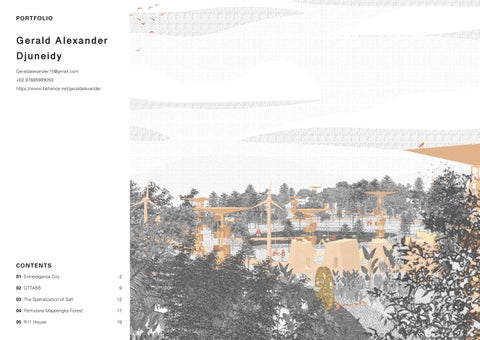
Gerald Alexander Djuneidy Portfolio

Page 1


Geraldalexander15@gmail.com

+62 87885989050

https://www.behance.net/geraldalexander

01 Extravaganza City

Dutch East Indies & Monumental Herritage

Date: January - June 2022

Location: Gambir, Central Jakarta

Project type: Academic (Invidual)

Level: Year 4 (2nd Semester) Final Project - Studio VIII

Typology: Mixed-use & Railway Development

Award: Top 25 Thesis Projects - Public Expose 8.33

Supervisor:

Ir. Agustinus Sutanto, M. Arch., M. Sc., Ph. D. agustinuss@ft.untar.ac.id

HOTEL INDONESIA

Connecting the Dots

Linearity has the power to guide users from one point to another, creating a continuous link between the Juanda and Medan Merdeka attractors. In camouflage theory, connectivity means that a place has the power to orient, identify, and move the body—mind and feelings of its user (camoufleur). This frames the connection of “the self” with “the place” as an art form that creates the spirit of a place, or ’genius loci’. The site plays an important role in creating this connectivity on both a macro and micro scale, linking city landmarks, green open spaces, canals, people, activities and different architectural styles.

From the drawings we can see the site is 300 meters long of green space under a railway, adjacent to an old canal, situated between two distinct architectural typologies. To the east of the site is the Istiqlal Mosque, which is very large in scale with sterile, symmetrical spaces that create a monumental effect. In contrast, to the west, Jl. Citadelweg is filled with degraded Dutch colonial buildings that have been repurposed for trade and services. This street is more vibrant, with many activities happening simultaneously. This project is meant to blur these two differences while also supporting each other, much like a chameleon camouflages with its surroundings.

City Town Hall & National Monument
National Gallery
Pasar Baru
(Preserved Market)
Lapangan
Noordwijk & Rijswijk

Camouflage begins by solving the internal challenges of a site and its surroundings. The program development starts by highlighting interesting street elements like smoke, music, shapes, trains, and the various programs within each building. Then, was to determine what programs could strengthen these elements, creating a horizontal connection across the urban landscapes. The result is a unified and attractive street of Citadelweg, supporting major landmarks like the Istiqlal Mosque, the National Monument, and Lapangan Banteng.

4. Co-working Space
15. Cafe & Bar
14. Elevated Park
5. Elevated Park
10. Amphitheatre
7. Rooftop Garden
6. Community Hall
2. Art Gallery
9. Children’s Playground
8. Courtyard and Retention Pond
11. Skyview & Immersive Experience
13. Indonesian Herritage Trust Extension Lab & Office
3. NGO’s Office 12. Micro Library & Archive Room
16. Vanue & Gallery

Reimagining the Linearity

The form development was conducted by exploring the site’s history and re-imagining it in the present context. The process involved looking at the “architectural spectacle” of Koningsplein (Medan Merdeka), the arches of the Dutch colonial buildings in Noordwijk-Rijswijk, and the expansive biodiverse parks of Wilhelmina Park (now the Istiqlal Mosque). These historical forms were then combined with the designed programs through collage.

RIVER BRANCH PLAZA PLAZA PLAZA PLAZA

Climate Challenges on Linearity

Walking 300 meters in the tropical heat can be challenging. This project addresses this with two strategies. The first is inspired by the greenery of Wilhelmina Park, providing shades from both vegetation and monumental buildings like the Istiqlal Mosque. The second strategy draws inspiration from the local street food, ‘satai’, which produces a lot of ‘fog’ when cooked. By utilizing water from the adjacent canal to create large-scale fog, aims to help the street’s temperature, microclimate and landscape irrigation. Makes the forms blurry, camouflage-like effect.

DIAGRAM

“the fog creating misty scenery & control the street temperature”

Section and Exploded Structure

The Community Hall provides a large shaded area for the streets and public parks, with retention ponds on the ground level. A combination of interlocking engineered wood glued laminated timber and steel joinery was used to create a warm, woody space. Giving a comfortable space for community groups and NGOs to hold meetings that require a large number of people.

GROUND FLOOR

The plans show how the project connects to both the Istiqlal Mosque and Citadelweg. It provides three large green spaces for people to relax during lunch or after work, and these landscapes also link the circulation flow for the multiple masses. Despite the narrow site, the interior is designed to be spacious enough to host numerous galleries and exhibitions.

FIRST FLOOR

Site Sections and Connections

The sections show how each space connects along the 300-meter length. The design incorporates man-made contours, which break up the monotonous of linearity and improve connectivity between the different levels. Features like amphitheaters, balconies, and voids are used to create views and appreciate the surroundings, such as the canal and the trains.

Video Illustration

The link QR code directs to a short rendering video for this project. The video is produced with rendering software, lumion and compiled with adobe premiere pro

02 GTTABB

Reflecting Floating Communities of Kampung Apung

Date: August 2019 - July 2021

Location: Kampung Apung, Jakarta

Project type: Independent Research (built)under student association of IMARTA-SKETSA

Typology: Floating Playground

Role

1st year - Project Director: in charge of program development, all communication with Kampung Apung resident’s, supervision, lead author, legal documents and graphics for publications

2nd year - Lead Division: managing the program, human resources, collaboration & sponsorship, project timeline, finances, author, and arranging the publications

Team: Ayu B, A Cynthia, Cornelius J, Dominikus G W, M

Dzamarsyach D, Olivia N, Sutiana, Venny F, and 27 participants of the program

Research Publication Books (click to open):

1. Kompendium Kampung Apung

978-602-50838-8-4 (ISBN)

2. Kompendium Kampung Apung Jilid II

978-623-97703-2-7 (ISBN)

Supervisor: Dr. Ir. Fermanto Lianto, M.T. fermantol@ft.untar.ac.id

Collaborator: IMARTA-SKETSA, Faculty of Architecture

Tarumanagara University, Kamil Muhammad, Andesh Tomo, and Kampung Apung resident’s all photography and post-production by the author

Site Study

Kampung Apung is Advance Jakarta?

During the first year we did a lot of research and studying how Kampung Apung survive the most difficult environment. We found a beauty, a new character of living, a unique village in dense urban fabrics. Therefore, we try to capture and write all of them in our report, so cities can learn from their localities.

Urban Fabrics in high density urban settlements, water area can be seen as an opportunity for public courtyard, producing fresh air & source of light

Land Subsidence

facing future challenges (water rises) spaces need to be stilts or floating. Kampung Apung already did that, we just try to embrace it

Local Creativity

the floating community playground was inspired by craftsmanships of how the locals survive on water environment

Modular

Strategy

Based on the locality, location, and natural phenomenon, we proposed a modular design to residents using a material they are familiar with: bamboo. This approach aims to simplify construction, foster a sense of ownership, and ensure the design can be easily replicated or even adapted for other locations.

80% of all dwellings in Indonesia are self built Kampung Apung is one of them. Unlocking the opportunity to collaborate with the residents

Flood & Seasonal Change

flood and seasonal changes effecting on water level, this situation can be countered by a space that floats

Street vs Playground

Kampung Apung has vibrant with a lot of activities happend simultaneously. Children needs a safe space where they can be themselves

PLAYGROUND

Design Workshops

Mockups & Sketches x Local Craftsmanships

The design process started by collaborating with lecturers to determine the number of barrels for a 3 x 6 m platform and to confirm if a temporary structure was allowed. This led to a design parameters, requiring 15 barrels that had to be dismantlable and can be moved. The best components from three design groups were synthesized based on budget and time. We learned about bamboo joints from residents, tested knots on a model, and then tested the model’s buoyancy with added loads. Construction drawings were made using sketches to make them easier for the residents to understand. Due to the pandemic, supervision was done through rotating shifts to minimize the number of people onsite. The residents provided daily progress reports through

Model for buoyancy test
Documentation
Supervision
Barrel & Knot Simulations
Actual Knot Craftsmanships Bamboo

03 the Spatialization of Salt

This project investigates the Muaragembong estuary altered landscape, seeking to mediate the complex relationships between the state, community, and the fragile, interconnected ecological systems they inhabit. The project’s central goal is to make the invisible salt issue visible. Working with scientists, the intervention proposes using architecture not just to solve the freshwater crisis but to create a physical object of study to understand the salt’s role in the environment. Through this project, we ask the following critical questions:

1. How to deal with salinization productively that may be beneficial both to human and non human inhabitants?

2. What kind of system that can be replicated throughout the location and in similar locations?

Utilizing a novel solar still design, the project serves a dual function: it provides a new source of fresh water for the local ecosystem, thereby aiding the endemic primate population and facilitating strategic mangrove replanting. Furthermore, the solar still’s distillation process is re-purposed to harvest salt, a significant Total Dissolved Solids (TDS) residue. This harvested salt, crystallized through capillary action on hanging ropes, becomes a new object of study, allowing us to understand and speculate on its role in the estuary’s ever-evolving landscape.

Date: October 2023 - October 2024

Location: Muara Gembong, Bekasi, Indonesia

Project type: Professional & Research

Typology: Water Distilation & Ecological Rehabilitation

Award: 3rd Place in Future Arc Prize 2024: Architecture for Life After

Role: Architectural Designer & Assistant Researcher - in charge of the solar still & salt crystalization experiment, assisting multispecies & antrophocene research, field study & workshops, multidisciplinary discussion with collaborators, design schematic, design development, master planning & illustration

Team: Raushan Fikri

Supervisor: Kamil Muhammad kamil@pppooolll.org

Collaborator: Labtek Apung & Rakarsa

Funding: The University of Basel - South Designs & Goethe-Institut Indonesia

Background & Challenges of Muaragembong

The estuary faces a “slow disaster” defined by nearly 50 years of human-caused changes and rising sea levels, leading to massive seawater intrusion. This has resulted in severe salinization, leaving local groundwater salty or brackish. Low-income residents must import water from Jakarta, and endemic primates are forced into conflict with humans while searching for water. The core issue is that this pervasive saltiness (asin) impacts every aspect of life—from food to water—but remains materially invisible.

Muaragembong estuary (2023)
Location of Muaragembong Estuary The scale of landscape degradation
JAVA SEA
Freshwater Scarcity

Solar Still Experiment 0.0

Understanding Solar Still

Solar still, simply, is a passive apparatus to produce distilled water from evaporating dilluted water. In an experiment conducted at the studio to design DIY solar stills, we’ve identified several key variables that affect the device’s efficiency in producing fresh water. These variables are grouped into three main categories: heat intensity, the quality of the solar still’s cover surface, and the exposed water body. All these variables are organized into a table to determine the optimal design parameters for our field tests.

UMBRELLA SLOPE for rain & evaporated water flow to the chamber

WATER CHAMBER the hole inside function to drip rain water, while the outside wall is for distilled water

Solar Still 1.0

Solar Still Fresh Water Production - Prototyping

Water source (rain)

MIDDLE HOLE for putting the chamber and prevent the salt water overflow, there is 3 mm gap for distilled water to flow

These solar still is the first test field model, made out of acrylic and stainless steel, each generating roughly 20ml/day from 800ml source. We found that acrylic works more optimally during field tests. First, the direct sunlight brings more heat to the brackish water than indirect heat from the stainless steel material. Second, because the stainless steel material gets very hot in the sun, it deters primates from touching it. In contrast, the clear acrylic serves as a strong visual cue for primates, signaling that there is water inside. This prompted them to open the devices, which was enjoyable to observe due to the demonstration of their intellect. The acrylic solar still was purchased by Humboldt University for an exhibition and for student experiments.

AFTER FIVE DAYS

SALT CRYSTALS & WATER DROPLETS on the robe & water container

Solar Still 2.0

The more we test on solar still 1.0, the more we learn. In its process, it leaves residue from TDS (total dissolved solids) that, in this case, is salt. We are now working to maximize this finding to create a new model that can also harvest salt. We immerse hanging ropes in saltwater, utilizing time and capillary action to draw the brine up the ropes, where it crystallizes. This method creates salt crystals in various shapes, which can then be harvested and studied further.

Church of Salt - Model Making

Turbine Propeler

Plastic turbine propeler can be made out of recycled board material. The purpose is to hydraulogically pump up brackish water from the aquafarm.

UPVC Transparent Plastic Sheet

Sheets are stitched together to create air tight room like a green house to increase heat radiation.

Rope

Rope made out the fibre from of mangrove Avicennia Germinans (bakau api-api) that can be fastened to roof framing.

The evaporation of salt water leaves crystallized salt. It evaporates due to the increased radiant heat generated from direct exposure to UV radiation in relatively air tight room.

Salt Crystallization

Salt water is pumped up and let it wet the ropes that are heated by the UV radiation from the sun

Fresh Water Production

Evaporated gas is trapped on the roof that will then condensate and is collected along the gutter. This is called the solar still model.

March - August - Water Workers

Seasons come into play in the operation of this project. Indonesia, being a tropical country, has two seasons: Dry and Wet. During the dry season when the sun is in abundance and freshwater is scarce, the salt chamber collects salt and create fresh water. During the rainy

Social, Economic, and Ecological Impact

Ecological Impact

The primary impact to the building of this structure has been primarily ecological towards the strengthening of the environment, the maintenance of primate habitat, and the production of fresh water.

Social Impact

The platform may become a place for the community to gather, particularly the women when they harvest mangrove fruits (pidada).

season when the temperature tends to be low (thus lowering the chance for evaporative distillation), rain water is collected through the perimeter gutter and salt gets harvested.

Mitigation to Disaster by Strengthening Biodiversity

The replanting of mangrove will not only help in disaster mitigation, but also in expanding primate habitat and strengthening biodiversity. The expansion of mangrove forest acts as both an invitation and a lure for primates to come to the new source of fresh water.

to the pier at the river

Economic Impact

The production of salt can be harvested and sold, becoming a new commodity for the farmers.

Speculative

(Limited) Tourism

In addition, there may be potential for limited, environmental tourism. For the residents, this can be a great place to promote local, mangrovebased culinary products. platform for salt harvest

new mangrove (primate habitat)
mangrove
harvest
also for sighting of primates in their habitat
bucket for primate

04 Perhutana Majalengka Forest

In Wilderness Abundance

Date: October - December 2022

Location: Jatiwangi, Majalengka, West Java, Indonesia

Project type: Professional - Competition (under construction)

Typology: Forest & Water Infrastructure

Award: First Winner of Perhutana Forest International Design Competition

Role: Architectural Designer - in charge of masterplan, site analysis, designing infrastructure model, collaboration model, and researching planting strategy

Team: Editha Santika, Haidar El Haq, Raushan Fikri

Supervisor: Kamil Muhammad kamil@pppooolll.org

Majalengka’s story is anchored around its relation to the land: from the historical abundance of maja fruit to the production of terracotta tiles. But the story could also be seen through the lens of loss: of maja fruit—that which became its namesake, and in Tari Wuwung Kawangi in lamenting the increasing loss of terracotta production.

The advent of Rebana presents suburban expansion that may threaten the livelihood of Majalengka residents.

It is the triumph of Cartesian logic as lands are cut to grids where concrete blocks house lives stuck in a rigid motion of capital production.

Planting Strategy

Against the grid, we must remain rooted in the contour of the land and form a model of technology around the notion of care—of enhancing relations. The production of energy must stem from the understanding of the sun, the wind, and the stream of the river. Materiality is bio-based and is explored through their mode of natural growth. Think fungi, bamboo, stones, and earth. What is their social and economic value? What kind of social assemblage is required to create a productive model of society?

This resource-sensitive model serves as an antithesis to capital intensive, speedy development. Through patience it blossoms. Majalengka seeks a different outcome to loss. This time it remains abundant. To always be abundant.

The planting strategy revolves around allocating for conservation and productive plants. Each square represents 8x8 m2
with recommendation adjecency

05 R11 House

Date: February - November 2023

Location: Bintaro, Indonesia

Project type: Professional (built)

Typology: Growing House

Team: Individual

Supervisor: Kamil Muhammad kamil@pppooolll.org

PHASE I (1 STORIES)

A one-story house, the mass was divided into three sections for circulation: air, sunlight, people, plumbing, and electrical lines. The building’s structure is prepared to support two stories.

Between Masses

PHASE II (PARTIAL EXTENSION)

A portion of the mass is allocated for a carport and courtyard. A partial extension on the second floor is being added in preparation because the family is having a baby during the design process.

PHASE III (2 STORIES)

The building mass will be fully constructed to two stories, with the void from the initial mass cutting retained up to the second floor. The result of the mass cutting in phase one is that every room gets at least two openings for cross-ventilation.

The section shows that the gap between the building masses is the heart of the house, serving as a core for the circulation of air, light, plumbing, wiring, and the family. Several openings were also designed as bay windows to create interesting interactions between these glass boxes. While crossing the bridge, the father can look his daughter sitting on the bay window and his wife cooking downstairs at the same time.

The two additional masses have very different functions and appearances but are similar in form. The form fuctioned as a slope high ceilling that keeps hot air from the activities in the room. One mass does not serve as a facade; instead, it is the master bedroom with large openings facing the lake. The other mass, however, acts as the home’s facade even though its interior function is a service room. Therefore, using translucent material we create a “glowing box” effect to emphasize a newness on the facade while covering all stuff inside.

Turn static files into dynamic content formats.

Create a flipbook
Gerald Alexander Djuneidy Portfolio by Gerald Alexander - Issuu