issue#1550

Page 1


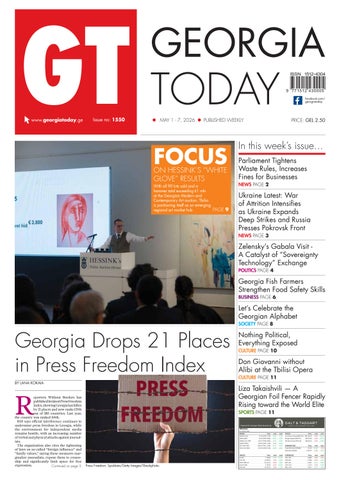
FOCUS

With all 90 lots sold and a hammer total exceeding €1 mln at the Georgian Modern and Contemporary Art auction, Tbilisi is positioning itself as an emerging regional art market hub PAGE 9

Georgia Drops 21 Places in Press Freedom Index

Rthis week’s

Parliament Tightens Waste Rules, Increases Fines for Businesses

Ukraine Latest: War of Attrition Intensifies as Ukraine Expands Deep Strikes and Russia Presses Pokrovsk Front

NEWS PAGE 3

Zelensky’s Gabala VisitA Catalyst of “Sovereignty Technology” Exchange

NEWS PAGE 2 POLITICS PAGE 4

Georgia Fish Farmers Strengthen Food Safety Skills

BUSINESS PAGE 6

Let’s Celebrate the Georgian Alphabet

SOCIETY PAGE 8

CULTURE PAGE 10

Don Giovanni without Alibi at the Tbilisi Opera Nothing Political, Everything Exposed

CULTURE PAGE 11

Liza Takaishvili — A Georgian Foil Fencer Rapidly Rising toward the World Elite

PAGE 11

Georgia Expands State-Funded Healthcare for Rare Diseases and Cancer Screening

Georgia is expanding access to public healthcare through new and updated programs targeting both rare diseases and cancer prevention.

The Ministry of Health is continuing work to broaden state-funded medical services for patients with rare neuromuscular conditions, with plans to extend coverage currently available to children to adult beneficiaries. The initiative forms part of a wider update to the national rare diseases program, expanding access to diagnostic, inpatient and outpatient care for conditions such as spinal muscular atrophy, Duchenne muscular dystrophy and Becker muscular dystrophy.

Health Minister Mikheil Sarjveladze, accompanied by Deputy Minister Tea Giorgadze, met with clinic representatives and hospital managers interested in joining the program. Discussions focused on the scope of services and the expected impact on patient care. Sarjveladze highlighted the importance of continuous monitoring in managing neuromuscular diseases, noting that expanded access to systematic care is expected to improve patient outcomes. Under the updated program, patients will have access to multidisciplinary

care, including consultations with neurologists, cardiologists, pulmonologists, endocrinologists, gastroenterologists or nutritionists, and orthopaedists. A broad range of clinical, laboratory and instrumental examinations will also be covered, supporting early detection, monitoring and long-term disease management. The Ministry says the changes aim to improve quality of life while ensuring adult patients are fully integrated into the state-funded system alongside children.

At the municipal level, Kakha Kaladze announced that Tbilisi will launch a publicly funded lung cancer screening program starting May 1. The initiative, financed by City Hall through its health and social services agency, will offer free screenings to residents aged 45 to 75 who are active smokers or who have quit within the past 15 years.

The program is designed to improve early detection of lung cancer, the leading cause of cancer-related deaths worldwide. Officials say early screening among high-risk groups can significantly increase survival rates. Screenings will be conducted using low-dose CT scans, with each scan reviewed independently by two radiologists and, where necessary, a third specialist to ensure accuracy. Program criteria were developed in consultation with experts in oncology, radiology and pulmonology, and sixteen medical institutions across the city have been selected to participate based on their expertise and technical capacity.

Georgian-French Co-production ‘Children of Popodia’ Premieres Internationally in France

The Georgian-French coproduction film ‘Children of Popodia’ has had its international premiere in France.

The film tells the story of Queen Tamar High School and its students, portraying the everyday life of Christian and Muslim youth living along the Georgia–Turkey border and their relationships.

The film is directed by Sopho Babluani and produced by Gela Babluani.

The production is a joint project between Georgia and France, created

Georgia, Armenia to Host FIFA U-20 World Cup 2029

Georgia and Armenia will co-host the 2029 FIFA U-20 World Cup, bringing one of the world’s leading youth football tournaments to the South Caucasus.

“Confirmed! A historic moment,” a joint statement shared by the Georgian Football Federation and the Football Federation of Armenia reads.

The joint bid by Georgia and Armenia to host the tournament was submitted in June 2024. The competition has been held biennially under the auspices of FIFA since 1977, with 24 teams participating in the final tournament.

The FIFA U-20 World Cup features some of the best young players globally and is often seen as a platform for future stars of the senior game.

Further details regarding host cities, stadiums, and scheduling are expected to be announced at a later stage.

Parliament Tightens Waste Rules, Increases Fines for Businesses

with Extended Producer Obligation (EPR) requirements.

The Georgian Parliament has adopted amendments to the Waste Management Code, introducing stricter regulations and higher fines for businesses.

The changes, prepared by the Ministry of Environmental Protection and Agriculture, aim to strengthen environmental supervision and improve compliance

The amendments introduce clearer and tougher sanctions for companies operating under EPR rules.

Operating without registration will now result in fines of GEL 1,500 for placing up to 10 tons of non-hazardous waste on the market, and GEL 5,000 for failing to register in the EPR system.

Violations of reporting requirements, including submitting incomplete or incorrect information, will carry a GEL 2,000 fine.

Failure to submit an agreed action plan within the legally defined timeframe will result in a GEL 10,000 penalty.

Distributors who violate technical regulations will also face fines of GEL 2,000.

The law aims to ensure that producers and distributors fulfill their obligations more effectively. It also introduces regulations for the temporary storage of specific types of waste, including catalysts, asbestos, ash, and slag.

Particular attention is given to vehicle catalysts. With a ban on their export in force until May 1, 2026, the amendments remove previous restrictions related to their temporary storage.

The law also introduces an incentive mechanism: fines paid within 10 days will be reduced by 20%, in line with existing provisions under the Code of Administrative Offenses.

The Department of Environmental Supervision will be responsible for enforcing the new regulations.

The law will enter into force upon publication.

Georgia Plans Major Tourism Development in Anaklia–Ganmukhuri Area

The Ministry of Infrastructure of Georgia reported that the country is preparing a large-scale project to transform the Anaklia–Ganmukhuri coastal zone into a major tourism destination, while also addressing urgent coastal erosion challenges.

Infrastructure Minister Revaz Sokhadze

said the Black Sea coastline in this area holds significant potential for tourism development and regional economic growth. The project will include full rehabilitation of the coastal zone and the construction of modern tourism infrastructure. A construction tender is expected to be announced following completion of the planning phase.

At the same time, authorities have begun emergency works to mitigate coastal erosion, particularly in Ganmukhuri, where the shoreline has report-

edly advanced inland by up to 100 meters in certain areas, causing land loss. The Roads Department of Georgia is currently working to restore damaged segments

The ministry has also initiated a broader research of erosion-prone areas along Georgia’s Black Sea coast, involving international experts. The study develops long-term strategies to protect the shoreline while supporting sustainable tourism and infrastructure development.

with the support of the Paris Regional Foundation. It received an award in the “Spirit of Faith” category at the Religion Today Film Festival.

The premiere was attended by the Minister of Culture of Georgia, Tinatin Rukhadze.

“This is a film about kindness, humanity, and love. The young people shown in this film remain faithful to the most important value: love. The pastor and Popodia are role models for them. The idea of love and tolerance is the main axis of this film. I thank Sopho Babluani and the creative team for the unforgettable emotions,” Rukhadze said. Georgian audiences will be able to see ‘Children of Popodia’ in the coming weeks.

'Children of Popodia' premieres internationally in France.
Source: Ministry of Culture of Georgia.
Anaklia landmark sight. Source: Georgia Travel
Plastic waste on Rioni river bank. Source: euneighbours.eu
BY LANA KOKAIA
FIFA U-20 World Cup 2029. Source: FIFA
CT Screen. Source: phelpshealth

Ukraine Latest: War of Attrition Intensifies as Ukraine Expands Deep Strikes and Russia Presses Pokrovsk Front

Russia’s war against Ukraine entered another week of heavy attrition, with the most intense fighting again concentrated in eastern Ukraine, while both sides expanded long-range strikes against infrastructure far from the front. The battlefield picture remained defined less by major territorial breakthroughs than by constant assaults, drone saturation, guided bomb attacks and efforts to exhaust the opponent’s air defense, logistics and manpower.

Ukraine’s General Staff reported that 137 combat engagements were recorded on April 29 alone, with the Pokrovsk sector remaining the hottest part of the front. Russian forces launched 31 attacks there, attempting to advance near Pokrovsk, Rodynske, Udachne, Kotlyne and surrounding settlements. Ukrainian forces also reported heavy fighting in the Kostiantynivka, Huliaipole, Lyman and Sloviansk directions, while no major changes were reported in other sectors. Russia used missiles, guided aerial bombs, thousands of kamikaze drones and artillery strikes throughout the day, underlining the continued intensity of its spring-summer offensive effort.

Independent battlefield assessments suggested that Russian forces have not achieved a decisive breakthrough, despite continued pressure. The Institute for the Study of War assessed that Ukraine has largely blunted Russia’s current offensive so far, although Russian troops continue probing across several axes. ISW also reported Ukrainian advances in the Kostyantynivka-Druzhkivka tactical area, western Zaporizhzhia, Pokrovsk, Oleksandrivka and Huliaipole directions,

while noting that Russia continues to rely on mass assaults and drone-heavy attacks.

The air war remained especially intense. Russia launched a large drone attack against Ukraine overnight, with Ukrainian air defenses reporting that 154 of 171 drones were intercepted. Odesa was among the main targets. Strikes damaged residential buildings, port and infrastructure facilities, a kindergarten, commercial sites and vehicles, while 16 people were injured, including a 17-year-old.

Earlier attacks in southern Odesa also damaged a hospital and port infrastructure, while in Sumy region, Russian drone and missile strikes killed one person and injured two others.

Energy and transport infrastructure were again targeted. In Mykolaiv region, Russian Shahed-type drone attacks damaged energy and transport facilities, causing power outages in several settlements. Five people were injured, regional authorities announced. The attack continued a pattern seen throughout the war: Russia striking civilian and dual-use infrastructure to disrupt electricity, transport and regional resilience far behind the front line.

Ukraine, meanwhile, continued to expand its campaign against Russian oil and military infrastructure. Kyiv said it struck a Transneft oil pumping station near Perm, around 1,500 kilometers from Ukrainian territory. President Volodymyr Zelensky said Ukraine would keep extending the range of such strikes in order to weaken Russia’s war infrastructure. The strike formed part of a broader campaign against Russian refineries, depots, oil terminals and logistics nodes, although trade data cited by Reuters suggested Russia’s April crude loadings from Baltic and Black Sea ports remained broadly stable.

The impact of Ukraine’s deep-strike

campaign was also visible politically. Russia announced that its May 9 Victory Day parade would be held without military hardware for the first time in nearly two decades, with officials citing the “current operational situation.” Analysts linked the move to fears of Ukrainian drone attacks and the need to protect military assets. The decision was symbolically important: the parade has long been used by the Kremlin to project military power, but this year’s scaled-down format reflected the pressure Russia faces both on the battlefield and at home.

Diplomatically, the week was dominated by a phone call between US President Donald Trump and Russian Pres-

ident Vladimir Putin, during which a possible temporary ceasefire around Victory Day was discussed. The Kremlin presented the idea as a holiday truce, while Trump described the call positively. Kyiv, however, remained cautious, as Russia has previously announced limited ceasefires that Ukraine says were violated or used for tactical advantage. The main political gap remains unchanged: Moscow continues to demand Ukrainian territorial concessions, while Ukraine rejects surrendering occupied territory as the price of talks.

International support for Ukraine also advanced. On April 23, the Council of the European Union finalized a €90 bil-

lion loan to Ukraine, intended to support urgent budgetary and defense needs in 2026 and 2027. Council says the loan is expected to allow disbursements from the second quarter of 2026, with an indicative €60 billion directed toward strengthening Ukraine’s defense industry and procurement capacity.

NATO and the EU also held a joint meeting in Brussels, calling for predictable, coordinated and sustained support to Ukraine. NATO noted that allies and EU member states account for most military, financial and humanitarian assistance to Kyiv, while the EU Military Assistance Mission has trained 90,000 Ukrainian soldiers. The message from Brussels was that Ukraine’s immediate defense and long-term deterrence remain central to European security.

A separate and important development came from Norway. Ukraine and Norway signed an agreement to jointly produce Ukrainian-designed mid-strike drones on Norwegian territory, with several thousand systems planned for Ukraine’s Defense Forces. The project will be financed by Norway from funds in addition to its already allocated $7 billion in defense support for Ukraine in 2026, and the first deliveries are expected as early as this summer.

Overall, the week showed a war still moving through exhaustion rather than resolution. Russia continued to press hardest around Pokrovsk and other eastern sectors, paying a high price for limited gains, while Ukraine increasingly relied on drones, mobile defense, longrange strikes and international industrial partnerships to offset Russia’s numerical advantages. The front line remained unstable but not broken; the diplomatic track remained active but far from agreement; and the infrastructure war continued to reach deeper into both countries.

Firefighters work at a site of a Russian drone strike in Odesa region on April 29. Source: REUTERS

Zelensky’s Gabala Visit - A Catalyst of “Sovereignty Technology” Exchange

The air over Gabala carried a weight far heavier than the spring mist as Volodymyr Zelensky touched down in Azerbaijan on 25 April. This was not merely a diplomatic courtesy call; it was a defiant signal of a changing tectonic plate in global geopolitics. For decades, the South Caucasus was viewed through the lens of a Kremlin-centric “near abroad,” a collection of states whose destinies were tethered to Moscow’s whims. But as Zelensky walked the tarmac, he was stepping into a region that is increasingly rewriting its own script, one where the Russian shadow is both lengthening and thinning.

The visit served as a masterclass in strategic pivot. The agreements signed during the visit were not the vague platitudes of old-world diplomacy: they were hard-edged pacts centered on defenseindustrial cooperation and the sharing of battlefield intelligence. By exporting its hard-won expertise in counter-drone warfare and air defense to Azerbaijan, Ukraine is effectively helping Baku build a security architecture that does not rely on Russian hardware or personnel. This exchange of "sovereignty technology" underscores a broader realization among the Caucasian states: Russia’s brand of partnership has long been an asymmetrical one, characterized by "hard security" pressure rather than mutual prosperity.

The drift away from Moscow across

the South Caucasus is now fueled by a potent cocktail of distrust and the visible erosion of Russian military prestige. In Armenia, the disillusionment is total. For years, Yerevan viewed Russia as its ultimate security guarantor, only to find the CSTO’s promises hollow during the lightning escalations of recent years. Armenia’s decision to freeze its participation in Russian-led security blocs and its open courtship of Western defense partners is perhaps the most

stinging rebuke to Moscow’s regional hegemony. It represents a fundamental break in the "honest partnership" facade that the Kremlin spent decades cultivating. Even in Georgia, where the political landscape remains a volatile tug-of-war between the streets and the statehouse, the undercurrent of resistance is undeniable. Despite the current government’s tactical maneuvers, the societal DNA of the country remains fiercely

oriented toward the West. The 20% of Georgian territory still held under Russian occupation serves as a daily, visceral reminder that Moscow’s influence is maintained through the barrel of a gun rather than the benefits of a bond.

Meanwhile, Azerbaijan has leveraged its energy wealth and its ironclad alliance with Turkey to transition from a satellite to a regional power player, one that can openly support Ukraine’s territorial integrity while simultaneously

offering to host peace summits. Ukraine has become the inadvertent catalyst for this Caucasian awakening. By tying down the bulk of Russia’s military assets and exposing the limits of its "aggressive military pressure," Kyiv has provided the South Caucasus with the breathing room necessary to imagine a future without a Russian veto. The weakening of Russian influence in the Black Sea has opened the door for a trilateral unification that was once thought impossible. This is not a unification based on forced ideology, but on the cold, hard logic of shared interests, specifically the creation of trade and energy corridors that link the Caspian to the Mediterranean without passing through a Russian filter.

This movement toward a "Caucasian Trio" unity appears increasingly inevitable. It is a slow-motion convergence, a "long thought through" repositioning of three nations that have finally realized they have more to gain from each other than from a neighbor that uses instability as a tool of control. As Azerbaijan, Armenia, and Georgia begin to align their security and economic goals, they are creating a regional front that is becoming resistant to the old tactics of divide and rule. Russia may still possess the capacity for disruption, but it is losing the ability to overcome a regional unity that can finally be rooted in its own sovereign soil.

Author’s bio: George Katcharava is the founder of eurasiaanalyst.com, a geopolitical risk and advisory firm.

Trump Warns Iran to ‘Get Smart Soon’ as Talks Stall and Oil Prices Surge

Tensions surrounding the Iran war escalated further this week as diplomatic efforts stalled, military threats intensified and global oil markets reacted sharply to the prospect of a prolonged confrontation.

US President Donald Trump said negotiations with Iran have “come a long way,” but acknowledged that progress has slowed, with talks now taking place by phone rather than through in-person meetings. He noted that US negotiators are no longer making long trips to Pakistan for face-to-face discussions, describing the previous format as inefficient. At the same time, Trump struck a more forceful tone, warning Tehran to “get smart soon” and reiterating that any agreement would depend on Iran abandoning its nuclear ambitions.

The diplomatic deadlock comes alongside rising military tensions in the Persian Gulf. Iran’s Navy Commander, Shahram Irani, warned that Tehran would take “swift action” if US forces move towards the Strait of Hormuz, a critical global shipping route. Iranian officials said the country has already taken steps to restrict access from the Arabian Sea side and cautioned that continued US pressure could trigger a significantly stronger response.

At the same time, the United States is maintaining a naval blockade on Iranian ports, a measure Washington argues is proving effective. US Central Command said dozens of commercial vessels have been redirected, preventing tens of millions of barrels of Iranian oil from reach-

ing global markets. Iranian officials, however, dismissed the strategy, saying it has failed to disrupt production and instead contributed to rising global prices.

The economic impact is already visible.

Oil prices surged to their highest level in more than four years, with Brent crude jumping to around $120 per barrel. The spike reflects growing concerns that the conflict could drag on and further disrupt supply, particularly if access to the Strait of Hormuz remains restricted. Trump has indicated that the blockade could last for months if necessary, arguing that it is a more effective tool than direct military strikes and can be managed in a way that limits the impact on American consumers.

The war is also becoming increasingly costly for Washington. A Pentagon official told US Congress that the conflict has already cost approximately $25 billion, with most of the spending directed towards munitions. The figure comes as lawmakers approach a potential deadline to approve continued military engagement, raising questions about the sustainability and political support for the operation.

US Defense Secretary Pete Hegseth addressed Congress this week, acknowledging that one of the most controversial incidents of the war remains under investigation. He referred to a strike early in the conflict that hit an Iranian girls’ school, killing around 170 people, most of them children. Hegseth described the incident as “unfortunate” and said a full inquiry is ongoing, underscoring the broader concerns over civilian casualties and the humanitarian cost of the war.

Beyond Iran, the conflict continues to spill across the wider region. Israeli strikes in southern Lebanon killed more

Trump warned "No more Mr Nice Guy" in a Truth Social post this week

than a dozen people this week, including three women in an attack on the town of Tayr Debba. The escalation highlights the fragile and interconnected nature of regional tensions, with multiple fronts at risk of intensifying simultaneously. In another development, the Global Sumud Flotilla reported losing communication with 11 aid boats heading towards Gaza after they were surrounded by Israeli military vessels in international waters. The group accused Israeli forces of threatening to intercept the ships,

raising concerns about the safety of the crews and the potential for further escalation at sea. Despite the mounting tensions, diplomatic channels remain open, albeit in a limited form. Trump confirmed that he recently spoke by phone with Russian President Vladimir Putin, who warned of “damaging consequences” if the United States and Israel resume or expand their military campaign against Iran. The call reflects continued international concern over the risk of the conflict widening

further and destabilizing global energy markets.

The situation remains highly volatile. While both Washington and Tehran signal a willingness to continue talks, neither side appears ready to make the concessions necessary for a breakthrough. Meanwhile, military posturing, economic pressure and regional spillover are driving the conflict into a more dangerous phase, with the potential for prolonged disruption not only in the Middle East but across global markets.

Zelensky meets with Aliyev in Gabala. Source: FB

Georgia and the Battle for Eurasian Connectivity: Why the South Caucasus Is Becoming the Next Arena of Great-Power Competition

Tbilisi means “warm place,” a reference to the sulfur springs that gave the Georgian capital its name. Yet the geopolitics surrounding the city are anything but warm. Nestled between snow-capped mountains and divided by the slow flow of the Kura River, Tbilisi sits at the center of a region where political climates shift as quickly as mountain weather. Inside the city, warmth defines its history and identity, artfully blending tradition with modernity; its multifaith and multiethnic character is among the most vibrant in this part of the world. Outside it, the South Caucasus remains one of the coldest arenas of geopolitical competition, unpredictable and volatile. Today, as great powers compete for control over Eurasian corridors, energy routes, and strategic infrastructure, Georgia’s capital

once again finds itself balancing between warmth at home and the icy calculations of international politics, as it has done in the past, though new realities demand greater weight.

In the emerging geopolitical competition over Eurasian trade routes, small states located along logistical corridors are gaining outsized strategic importance. Few countries illustrate this reality more clearly than Georgia. Long viewed as a peripheral post-Soviet state, Georgia has increasingly become a central node in the contest among the United States, Russia, and China for influence over the infrastructure, energy flows, and transport networks connecting Europe and Asia.

Georgia’s geography explains much of the growing international attention it receives. Located at the intersection of Europe, the Middle East, and Central Asia, Georgia serves as a key transit state in the South Caucasus. As a littoral state on the Black Sea, the country possesses approximately 310 kilometers of coast-

line, stretching from the Turkish border in the south to the Russian-controlled region of Abkhazia in the north. This coastline hosts several strategically important ports, including Poti, Batumi, and the planned deep-sea port of Anaklia, which together form Georgia’s maritime gateway to Europe and global markets.

Georgia also occupies a central position in regional land connectivity. The country shares a 273-kilometer border with Turkey, its most important western neighbor and a NATO member. This border functions as a major logistical bridge linking the Black Sea basin to Mediterranean and European markets through Turkish infrastructure. Georgia’s borders extend further to Azerbaijan (approximately 480 km) in the east, Armenia (about 219 km) in the south, and Russia (around 894 km) to the north, placing the country at the crossroads of major trade routes connecting the Caspian Sea basin to Europe.

Because of this geography, Georgia has

become a critical component of the socalled Middle Corridor, the east–west trade route linking China and Central Asia to Europe through Kazakhstan, the Caspian Sea, Azerbaijan, Georgia, and Turkey. The corridor provides a strategic alternative to both the northern route through Russia and the southern route through Iran. In practical terms, cargo originating in western China or Central Asia crosses the Caspian Sea, enters the South Caucasus through Azerbaijan, traverses Georgian rail and road infrastructure, and reaches Black Sea ports or continues westward through Turkey to European markets.

Several major infrastructure projects reinforce Georgia’s role in this corridor.

The Baku–Tbilisi–Kars railway, opened in 2017, directly connects Azerbaijan, Georgia, and Turkey, enabling freight transport from the Caspian region to European rail networks without passing through Russia. Meanwhile, energy pipelines such as the Baku–Tbilisi–Ceyhan oil pipeline and the South Caucasus gas pipeline transport Caspian energy resources through Georgian territory to Turkey and onward to global markets.

Taken together, Georgia’s Black Sea coastline, its borders with both NATO member Turkey and Caspian energy producers, and its expanding transportation infrastructure position the country as one of the most important logistical hubs in the broader Eurasian connectivity landscape. In an era of growing competition over trade routes and supply chains, Georgia’s geographic position has transformed it from a small post-Soviet state into a pivotal transit node linking Europe, the Black Sea, the Caspian basin, and Central Asia.

This strategic role has become even more important following Russia’s invasion of Ukraine in 2022. The war disrupted the northern Eurasian transport corridor passing through Russian territory and accelerated interest in alternative routes. As a result, Western policymakers, investors, and logistics companies have increasingly turned their attention toward the Middle Corridor and, by extension, to Georgia.

At the same time, China has expanded its economic engagement in the region as part of its broader Belt and Road strategy. Chinese firms have shown interest in infrastructure projects across the South Caucasus, including potential participation in the development of Georgia’s Anaklia deep-sea port. Beijing’s growing presence reflects a broader effort to secure influence over transport corridors linking East Asia with European markets.

Russia, meanwhile, retains significant military leverage in the region. Since the 2008 Russo-Georgian war, Moscow has maintained military forces in the separatist territories of Abkhazia and South

Ossetia. In recent years, Russia has also expanded its naval presence along the eastern Black Sea coast, including plans to develop a naval facility in Abkhazia’s Ochamchire port, just a short distance from Georgia’s planned Anaklia port. These developments place Georgia at the intersection of competing strategic interests. On one side stand Western efforts to strengthen transport and energy corridors bypassing Russia. On another is China’s expanding economic footprint across Eurasian infrastructure networks. On a third front, Russia seeks to maintain its military and political influence across the post-Soviet space.

Faced with these pressures, Georgia has adopted a pragmatic strategy of strategic balancing. Although the country remains constitutionally committed to integration with NATO and the European Union, successive governments have also sought to avoid direct confrontation with Russia while preserving economic ties where possible. Critics sometimes interpret this approach as geopolitical drift. In reality, it reflects the difficult choices confronting small states located between rival powers.

For the United States, Georgia’s evolving role in Eurasian connectivity presents both opportunities and risks. If Washington disengages from the region’s infrastructure development, China is likely to expand its presence through investments tied to the Belt and Road Initiative. At the same time, Russia’s military foothold in Abkhazia underscores the continuing security vulnerabilities facing Georgia.

A more proactive US strategy in the South Caucasus should therefore focus on three priorities. First, Washington should support infrastructure projects that strengthen the Middle Corridor, including port development, rail modernization, and digital connectivity across the region. Second, the United States should deepen security cooperation with Georgia in order to deter further Russian military pressure along the Black Sea coast. Third, American policymakers should encourage economic integration between the South Caucasus and European markets, ensuring that regional connectivity projects remain aligned with Western standards and investment frameworks.

Georgia may be a small country, but its geography places it at the heart of a rapidly evolving geopolitical landscape. As global competition increasingly revolves around control over trade routes, logistics networks, and energy corridors, the strategic significance of the South Caucasus, and of Georgia in particular, will only continue to grow.

For Washington, recognizing this reality is the first step toward crafting a more coherent, consistent, and rational strategy for the region.

Georgia Drops 21 Places in Press Freedom Index

Continued from page 1

POLITICAL CONTEXT

RSF says Georgia’s media landscape is diverse but highly polarized, with widespread manipulation, hate speech and disinformation, particularly on television, which remains the main source of information.

The report notes that media ownership often translates into editorial control, citing Rustavi 2 as an example where editorial policy changed after a change in ownership. It also points to concerns over government influence in the Georgian Public Broadcaster (GPB).

RSF states that expanded regulatory

powers increase the risk of censorship.

It also highlights political instability following the contested October 2024 parliamentary elections, adding that this environment has enabled greater political pressure on media.

LEGAL FRAMEWORK

RSF says Georgia has not yet implemented European Union recommendations on press freedom, a key requirement for opening accession talks.

The report criticizes the adoption of a “foreign agents” law, saying it introduces criminal liability for media directors and board members, and includes potential prison sentences for noncompliance.

It also highlights amendments to the Law on Broadcasting, which ban foreign funding for broadcasters and expand the powers of the regulator overseeing media content. RSF raises concerns over the independence of this body.

Revisions to the Law on Freedom of Speech and Expression are also described as weakening protections for journalistic sources.

ECONOMIC CONTEXT

The report says Georgia’s advertising market remains underdeveloped and is shrinking, particularly in print and online media, which rely heavily on donor funding. RSF warns that restrictions on foreign

funding have worsened the financial sustainability of independent outlets. Combined with regulatory pressure and advantages for state-funded media, these changes are seen as distorting competition and threatening independent media survival.

SOCIOCULTURAL AND SAFETY CONTEXT

RSF says social tensions around religion, LGBTQ+ rights and Russian influence continue to affect journalism. Reporters covering sensitive issues face harassment and pressure, while surveillance and legal restrictions undermine source protection and investigative reporting. The organization also reports increas-

ing verbal abuse, physical assaults and intimidation against journalists, often linked to political tensions and protests. It says investigations into such cases remain ineffective, contributing to a climate of impunity and growing selfcensorship.

GLOBAL RANKING CONTEXT

In the global index, Norway ranks first for media freedom, followed by the Netherlands, Estonia, Denmark, Sweden, Finland, Ireland, Switzerland, Luxembourg and Portugal. Among regional countries, Moldova ranks 31st, Armenia 50th, and Ukraine 55th. The United States is placed 64th, while Russia ranks 172nd.

Caucasus mountains. Photo by Tony Hanmer

Georgia Fish Farmers Strengthen Food Safety Skills

SOURCE: FAO

Fish farmers in Georgia have enhanced their knowledge and practical skills in food safety and aquatic animal health management through a fiveday training. The educational opportunity was organized and delivered by the Food and Agriculture Organization of the United Nations (FAO) under the ENPARD IV program with the support of the European Union and Sweden.

The training brought together more than 40 aquaculture producers, Food Business Operators and sector stakeholders. It aimed at adopting good aquaculture practices aligned with international standards.

As the aquaculture sector in Georgia develops, strengthening food safety and disease prevention is essential for protecting public health and improving market access. The training combined practical and field-based learning to build farmers’ capacity in biosecurity, hazard management, and outbreak response, while introducing FAO-supported digital tools, such as the National Animal Identification and Traceability System (NAITS) and Farm Management Systems (FMS), to enhance traceability and decision-making.

A dedicated field day allowed participants to integrate food safety and aquatic animal health practices through handson farm-based exercises, focusing on the practical application of biosecurity measures, hazard management and realtime decision-making in aquaculture production.

“The aquaculture sector is the world’s fastest-growing food sector, representing 51% of the total aquatic animal pro-

duction already in 2022,” said Haydar Fersoy, FAO Senior Fishery and Aquaculture Officer, and Lead Technical Officer from FAO’s Regional Office for Europe and Central Asia. “Aquatic animal health management and aquaculture biosecurity are therefore of outmost importance, representing key areas to ensure quality and safe products for end consumers.”

“Supporting aquaculture farmers in a practical manner to meet international food safety and biosecurity standards will ensure the establishment of a resilient and competitive sector,” said Guido Agostinucci, FAO ENPARD IV Program Manager. “By strengthening capacities across the entire value chain, we help producers reduce risks, improve product quality and access new market opportunities.”

“Meeting EU food safety standards particularly in eliminating banned substances which have no place in Georgian

Tbilisi, Kutaisi Airports Grow, Batumi Down in Q1 Passenger Traffic

Georgia’s Civil Aviation Agency says passenger traffic showed mixed dynamics across the country’s main airports in the first quarter of 2026, with growth in Tbilisi and Kutaisi, and a sharp decline in Batumi. Georgian airports served 1,605,500 passengers on regular and non-regular flights in January–March, a 4.28% increase compared to the same period last year, despite disruptions linked to the Middle East and Gulf region.

• Tbilisi International Airport handled 1,099,204 passengers, up 8% year-onyear;

• Kutaisi International Airport served 386,238 passengers, a 7% increase;

• Batumi International Airport recorded 115,785 passengers, down 25.6% compared to the first quarter of 2025.

A total of 7,799 flights were operated in the first three months of 2026, includ-

ing 5,669 regular and 2,130 charter flights, marking a 9% increase year-on-year.

The use of Georgian airspace, including take-offs, landings, and overflights, rose by 14%, reaching 72,546 movements.

Cargo traffic also increased, with 10,177 tons transported by air in January–March, up 32% compared to the same period last year.

In terms of passenger numbers, Wizz Air remained the leading airline in Georgia, holding a 20% market share and transporting 326,670 passengers.

The top five airlines by passenger share were:

• Wizz Air: 20% (326,670 passengers)

• Georgian Airways: 9% (148,955 passengers)

• Pegasus Airlines: 8% (133,520 passengers)

• Turkish Airlines: 8% (119,899 passengers)

• Azerbaijan Airlines: 6% (91,657 passengers)

The agency says the figures reflect continued recovery and growth in Georgia’s aviation sector despite external challenges.

aquaculture is key to the future of the sector,” said Denis Reiss, Program Officer for Sustainable Food Systems at the Delegation of the European Union to Georgia. “Georgian responsible and knowledgeable producers, backed by FAO training, are at the heart of this transformation.”

FAO, with the support of the European Union and Sweden, continues to assist Georgia’s aquaculture sector through a combination of technical training modules and targeted support mechanisms. These interventions build on previous activities, including the training opportunities on food safety in aquaculture, good aquaculture practices (GAqP), aquatic animal health, biosecurity systems, and HACCP-based inspection approaches, contributing to strengthened compliance with international standards, improved production practices, and the long-term sustainability and competitiveness of the sector.

Government Creates Investment and Export Agency, Abolishes PPP Agency

The Government of Georgia is creating a new Investment and Export Agency under the Ministry of Economy, replacing the existing Public-Private Partnership (PPP) Agency.

The PPP Agency is being abolished in its current form and transferred from the government administration to the Ministry of Economy. It will operate as a Legal Entity of Public Law (LEPL) under the name ‘Investment and Export Agency.’

The changes are part of broader reforms that also involve restructuring ‘Enterprise in Georgia’ and establishing a new entity, the ‘Georgian Development Corporation.’

At a meeting of the Parliament’s Economic Policy Committee, MP Irakli Mezurnishvili presented amendments to the Law on Public-Private Partnership and called for the draft law to be fasttracked.

Mezurnishvili says the new agency will

focus on supporting Georgia’s investment and export potential. He notes that the Investment Support Department of ‘Enterprise in Georgia’ will be transferred to the newly formed agency.

He adds that funding allocated in Georgia’s 2026 state budget for investment and export support will also be redirected to the new agency.

The Government says the reform marks the return of an investment-focused agency after a nine-year gap.

“Functions related to attracting investments and promoting exports will be moved to the Investment and Export Agency, while the remaining functions of ‘Enterprise in Georgia’ will be transferred to the Joint Stock Company Economic Development Corporation,” Mezurnishvili said.

Georgia Extends Deadline for Tbilisi

Bypass Highway Tender to June

The Ministry of Infrastructure of Georgia reported that the Georgian government has extended the deadline for a major infrastructure tender covering the Avchala–Airport section of the Tbilisi bypass highway.

The tender, valued at approximately GEL 932 million, will now close on June

1, following earlier postponements from April 15 and May 8. Officials said the extensions were granted at the request of participating companies seeking additional time to prepare detailed proposals.

The project includes construction of a 22.5-kilometer, four-lane highway designed to ease traffic congestion in the capital. It will be implemented in two main segments: a 5.8-kilometer Avchala–Gldani section and a 16.7-kilometer Gldani–Airport section. The route will begin near the Avchala railway bridge and extend to

the vicinity of the Lilo market area. Planned infrastructure includes 16 bridges, four parallel tunnels, and four transport interchanges, reflecting the project’s technical complexity. In parallel, the tender process for another segment of the bypass, the 7.3-kilometer Tsitsamuri–Avchala section, has been completed. A total of ten companies submitted bids; however, none came below the official estimated cost of GEL 490 million. Proposals ranged from GEL 520 million to GEL 952 million.

A Georgian fish farm. Source: FAO Georgia
Fish at a Georgian fish farm. Source: FAQ Georgia
Trainees with FAO experts. Source: FAO Georgia
Kutaisi Airport. Source: KutaisiAirport
Irakli Kobakhidze and Mariam Kvrivishvili. Photo: Government of Georgia

Greennovation BOOST Supports Green and Digital Innovation in Western Georgia

SOURCE: UNDP

Greennovation BOOST is currently underway in Georgia, supporting micro, small, and medium-sized enterprises (MSMEs) in Poti and Khobi as they develop green and digital transformation projects.

The 16-week acceleration program and innovation challenge is supported by the United Nations Development Program and the Government of Denmark under the Greening the Future initiative, and implemented by the PMC Research Centre. The initiative helps businesses turn innovative ideas into practical solutions through a combination of funding, mentorship, and structured training.

Following an open call launched in November 2025, 53 proposals were submitted and evaluated by independent experts. Twenty companies were selected

for the acceleration phase, which runs from March to June 2026. The selection reflects a competitive process aimed at identifying scalable, impact-oriented

solutions across priority sectors. The participating enterprises are grouped into seven areas of innovation: agri-tech and precision agriculture,

cleantech and circular economy, digital platforms and services, logistics and transport, e-commerce, entrepreneurship education, and mobility. Projects include AI-based crop forecasting, IoT biogas systems converting farm waste into energy, smart recycling and e-waste collection systems, digital platforms connecting workers with employers, AIpowered logistics and freight optimization tools, and ride-sharing solutions designed to expand electric vehicle use.

The program combines expert-led training, mentorship, and Business Talks to support participants in refining and scaling their business models. A dedicated field and practical learning component is also included to help entrepreneurs apply tools and methods in real operational settings.

The Business Talks series includes three thematic sessions. The first, held on April 15, 2026, brought together experienced Georgian startup founders in partnership with Axel to discuss entre-

preneurial journeys, challenges, funding, and growth strategies. The second will focus on financial sector engagement, with banks and microfinance institutions presenting funding instruments available to SMEs. The third will explore global scaling opportunities, featuring international accelerators such as Plug and Play and 500 Global.

The program will conclude with a Pitch Day, where up to ten enterprises will receive innovation challenge awards ranging from 10,000 to 25,000 US dollars. Winning companies will continue to receive mentoring and monitoring from PMC Research Centre throughout the implementation cycle of their projects.

Organizers say Greennovation BOOST is designed to strengthen regional entrepreneurship in Poti and Khobi by accelerating green innovation, improving business competitiveness, and supporting long-term sustainable economic development.

Georgia Signs $460K Deal to Boost Tourism Promotion in India

Georgia is intensifying its efforts to attract Indian travelers through a new international marketing agreement, as the Georgian National Tourism Administration has signed a $460,200 contract with ‘THINK

LUXURY TRAVEL

The one-year agreement is a wide promotional campaign to position Georgia as a tourism destination in India. Planned activities include digital advertising across platforms such as Instagram and YouTube, alongside placements in traditional media. The campaign will also feature roadshows in major Indian cities, including Bengaluru and Chennai, to directly engage travel industry stakeholders and consumers.

India has been identified as a priority growth market for Georgia’s tourism

sector, with authorities pursuing a targeted strategy to increase visitor flows from the country. As part of this approach, the administration has also invested in promoting niche segments such as wedding tourism.

Earlier in 2026, GNTA signed two separate contracts with ‘VIVAAH WEDDING PARTIES ORGANIZING’, valued at $286,691 and $592,613, respectively. Both agreements focus on positioning Georgia as an international wedding destination.

What We’ll Carry Home

Each of our lives hold quiet things that remind us of home. Maybe you keep one close; maybe it gives you hope on hard days. Is it a cup for your tea? A child’s drawing? A gift from a grandmother? These things are simple, but they point beyond what is seen, bearing witness to the deeper realities they represent. Surely, home is more than just a place: a memory, a relationship, a concept. This Spring, I [Scott Noble, guest writer] partnered with the Iranian community to capture these quiet, hopeful, home-ful things. What We’ll Carry Home

takes a closer look.

When her family visits, they bring gifts from Iran, and you can bet she’ll find enclosed a handmade craft from her niece. “Band-aid in the Sky” (a photo featured in the project) depicts the innocent artwork from a 5-year-old girl being held close by a proud and pleased auntie. The drawing is as you’d expect: green grass at the bottom of the page with the clouds and sun lining the top. In the middle of the drawing, seemingly floating in the sky, is a band-aid, complete with, you guessed it, a smiley face (I suppose that’s one way to fix this broken world). But these are just the playful scribbles from a childlike mind, right? Are they not simply paper and marker? Why would someone hold them so close?

It’s obvious: they are a reminder of home. She is filled with joy for the relationships and memories they represent: the fleeting moments of a beloved niece’s creative expeditions. Look even closer and you’ll see these drawings represent the next generation of Iranians who are growing up in a quickly changing country. A situation riddled with great uncertainty can only be met with great hope. A saying goes, “When the perishable has been clothed with the imperishable, and the mortal with immortality, then the saying that is written will come true: ‘Death has been swallowed up in victory.’” I believe there is something in all of us that reaches toward eternity, for goodness and peace.

This project opened at Corner House Coffee in Marjanishvili on Friday, 10 April, featured with the greater exhibition Into the Known by the resident artists of Caucasus Culture Exchange (Instagram: @caucasuscultureexchange).

From what we hold in our hands to the hope that stretches toward eternity, What We’ll Carry Home is an invitation to pause, breathe, and pray for our Iranian brothers and sisters. See more at whatwellcarryhome.myportfolio.com.

What We’ll Carry Home is a digital photography project shot on a full-frame Canon with a 45mm f1.2 prime lens. I chose black and white in a simple studio style to enhance shapes, textures, and light composition. I was mindful to not

show faces, and, throughout the project, allowed the objects of hope to be the main subjects of the photos.

I am an American photographer passionate about God, culture, and people. My compassion fuels my art. My love of photography is vast, from landscape, street and macro to social and sporting events, and most recently this controlled studio style. This love of the craft was born in the great plains of Montana, as I watched my grandfather photograph wildlife, weather, and all the fascinating frames his trained eye viewed. Surely wonder and curiosity are a few of the greatest gifts you can give. Continue to follow my photography on Instagram at @scottnoblephotography.

GUEST BLOG BY SCOTT NOBLE
Photographer Scott Noble
Mother’s Tea: A Distant Aroma

Let’s Celebrate the Georgian Alphabet

It was, in fact, a small-scale event under open skies, with about three hundred people gathered in one of the Tbilisi mini-gardens at the back of the Georgian Theatrical Society edifice in downtown Tbilisi. Yet nothing more important and meaningful could have taken place in this country on that warm Sunday of April 26.

The admirers of the Georgian (Kartuli) alphabet were celebrating 150 years of Deda Ena (verbatim, mother tongue) by Jakob Gogebashvili, a Georgian educator, children’s writer, and journalist, known as the founder of scientific pedagogy in Sakartvelo. Deda Ena is the first textbook of the Georgian language that we all grew up with. Not only did we grow up with it, but through it we learned how to love our motherland and how to use our native tongue correctly, singularly unique in its own special way.

The Georgian language happens to be one of the fourteen functioning alphabets in the world today, with its thirtythree curly, beautiful characters reflecting the existing thirty-three sounds with amazing phonetic precision and originality. One of the scientific presumptions suggests that Georgia's linguistic story spans thousands of years, miraculously enduring the cruel vagaries of time and safely bringing our complex and absolutely independent linguistic essence into the mid-twenties of the 21st century. How divinely lucky we are!

The event was organized and brought to fruition by Mariam Lomtatidze, the

founder and director of a nongovernmental body called International Culture Space, operating as an active promoter of Georgia’s recognizability in the international arena, as well as fostering friendship and cooperation between Sakartvelo and the rest of the world. A truly elevated mission and an honorable endeavor.

Mariam is indeed a dedicated fighter for popularizing Georgian culture around the globe. Suffice it to say that it was her idea to create the electronic version of Gogebashvili’s Deda Ena, which is now being successfully used by Georgian children living abroad who wish to maintain their mother tongue, as well as by interested foreigners who regard knowledge of the Georgian language as a valuable intellectual asset.

As Marina Shengelia, Mariam’s associate and supporter, notes, “Yes, she is a genuinely energetic and astute workaholic, whose ways and means of realizing various projects in favor of our indigenous culture amaze all of us.” Notably, this highly appreciative evaluation comes from a high-class specialist in the field, a graduate of the famous Moscow Institute of Culture.

Indeed, most of the projects implemented by Mariam Lomtatidze deserve the attention of society. Among them are Kvevri Wine Symphony, Georgian Alphabet Anthem, Shota Rustaveli Museum, Wheat & Wine Museum, Georgian Silk, Bio Farmers and Products, Corner of Georgian Calligraphy, and last, but definitely not least, the idea and creation of her wonderful Georgian Alphabet Garden.

I have not, in a long time, seen a public event that has attracted this much enthusiasm and interest. That miniature gar-

Study Identifies Georgia as Independent Origin Center of Bread Wheat

The Ministry of Culture of Georgia a new international study published in the journal Proceedings of the National Academy of Sciences identifies Georgia as an independent and one of the oldest documented centers of origin for bread wheat (Triticum aestivum).

The research is based on multidisciplinary work led by academician David Lordkipanidze and draws on archaeological findings from the Neolithic sites of Gadachrili Gora and Shulaveris Gora. These sites have yielded material dating back approximately 8,000 years.

Radiocarbon dating conducted at the Weizmann Institute of Science confirmed that the discovered remains represent the earliest known physical evidence of bread wheat identified to date. The study also incorporates exten-

sive research by paleoethnobotanist Nana Rusishvili.

The findings suggest that the South Caucasus, and Georgia in particular, played a significant role in the domestication and early expansion of wheat, contributing to a broader understanding of agricultural origins.

The research was conducted through international collaboration involving Georgian and foreign scientists, including Mindia Jalabadze, Inga Martkoplishvili, Marine Mosulishvili, Nana Meladze, Davit Maghradze, Elisabetta Boaretto and Stephen Batiuk.

The ministry stated that the project was carried out with support from the National Wine Agency of Georgia, the University of Toronto, the Weizmann Institute, and the Society Iveria, a broader initiative focused on research and promotion of Georgian viticulture and agriculture.

A public presentation of the study’s findings will be held on May 1 at the Georgian National Museum.

den, which will henceforth bear the name of the Georgian Alphabet, was filled with people of different generations, socializing with warmth and mutual consideration.

The event was initiated by Giorgi

Gegechkori, the president of the Georgian Theatrical Society, a well-known Georgian artist himself and the progeny of Gogi Gegechkori, one of the most beloved actors of the Georgian people. Mariam led the show attentively and

elegantly, as she always does.

When the children of Tbilisi Kindergarten No. 150, led by their tutor and director Mzia Metreveli, appeared on the tiny makeshift stage of the garden, the excited spectators fell silent. They watched the little Georgian performers with emotion, realizing that the entire event was dedicated to nurturing a future generation capable of carrying the motherland forward with dignity in the very near future. That is exactly what Mariam Lomtatidze is doing for Georgia. She truly deserves our full-time kudos. Delightedly, the grownups did not lag behind, presenting a charming humorous theatrical piece, directed and produced by Nino Lezhava, the widely known Georgian actress.

The event contained many other attractive elements worth mentioning, but alas, not all good things can be reflected in this brief report.

In conclusion, it must once again be emphasized that for Georgians, speaking Kartuli is profoundly important, not merely as a means of communication, but as a pillar of identity, continuity, and cultural survival. Our alphabet truly distinguishes us among the nations of the planet, representing a rare fusion of language, culture, spirituality, and historical resilience.

So let us not be overly surprised that our little Sakartvelo occupies a unique niche in world heritage. And if all this is true, then the new and lovely Georgian Alphabet Garden, created by Mariam Lomtatidze, will be nurtured and preserved by generations to come, ensuring that Georgia’s intellectual, cultural, and spiritual uniqueness and loftiness endure for as long as humankind exists.

Chargli Street. Source: Youtube

Tbilisi Development Fund Announces GEL 24 mln Housing Redevelopment Tenders

Tbilisi City Hall reported that Tbilisi Development Fund has announced two public tenders for the urgent demolition of buildings and construction of new residential complexes, with a combined value exceeding GEL 24 million.

The larger project, valued at GEL 15,101,134, involves the dismantling of five dilapidated structures, one two-story and four single-story buildings, located on a 2,072 square meter plot at 50a Chargli Street. The project provides the construction of a new 12-story multi-apartment residential building on the site, along with associated renovation and infrastructure works.

A second tender, estimated at GEL 9,154,824, covers the construction and renovation of an 11-story residential building at 38a Shuamta Street. Both procurements were announced on April 29, with bid submissions scheduled to take place between May 11 and May 13.

Vineyard Permits to Affect up to 100 Producers

The National Wine Agency says new regulations on vineyard cultivation will affect up to 100 potential producers, based on recent trends.

The agency states that vineyard expansion has slowed in recent years. “Up to 500 hectares of new vineyards are being built annually,” the National Wine Agency notes. “Based on this data, the approval for vineyard cultivation will affect approximately 100 people.”

Only individuals planning to engage in

commercial activity will be required to obtain a permit.

The Deputy Chairman of the National Wine Agency, Zurab Vacharadze, says the reform is part of broader efforts to strengthen the sector. “The wine quality reform is aimed at strengthening the Georgian wine industry, supporting both wine companies and small wineries,” he said. “The goal is to produce quality Georgian wine from quality grapes.”

Amendments to the ‘Law on Vine and Wine’ will enter into force on May 1, 2026, requiring prior consent from the National Wine Agency for the cultivation of commercial vineyards.

The agency emphasizes that the regu-

lation applies only to entrepreneurial activity and does not affect individuals growing vineyards for personal use. Permits will be issued free of charge. The new rules define conditions for planting and renewing commercial vineyards, including planning, selection of varieties and rootstocks, soil preparation, and other agrotechnical measures. Vacharadze also pointed to global trends, citing data from the International Organization of Vine and Wine. “Wine consumption worldwide is at its lowest level since 1961,” he said. “Amid fierce competition and overproduction, greater emphasis must be placed on the quality of raw materials and the final product.”

Children of Tbilisi Kindergarten 150 on Deda Ena Day.
Source: International Culture Space
Bread and wheat. Photo: iStock.

Hessink’s Breakthrough Auction: Is Tbilisi

Becoming a New Regional Art Hub?

A CATALOGUE ACROSS

In a packed hall, emotional tension reaches its peak. The low hum of phones, restless movement and tightly held expressions

fill the room. “One, two, three, sold!” announces Bradley Hessink, sharply bringing the gavel down on the table. Alexander (Shura) Bandzeladze’s monumental abstract canvas Dream of Noah (1989) is acquired by an anonymous buyer for €250,000, a price 25 per cent above estimate and unprecedented for Georgian contemporary art.

A record has been set. Never before has such a sum been paid for a work by a modern Georgian artist. Until now, the highest price achieved for a Georgian artist at auction, peaking at around €2.5 million at Sotheby’s, has been associated with Niko Pirosmani, one of the country’s most internationally recognised artists.

A 100% SALE IN AN UNFAMILIAR MARKET

The result was not only a record but a clean sweep: all 90 lots sold. In auction terminology, this is known as a “white glove” sale, a rare outcome in which every work finds a buyer. The term is more often associated with leading houses such as Sotheby’s or Christie’s and signals both accurate pricing and depth of demand.

For Tbilisi, however, such an outcome is almost without precedent. International auctions remain a relatively recent phenomenon in the city, and this was the first fully realised global sale dedicated exclusively to Georgian modern and contemporary art held on Georgian soil. Even so, market participants describe it as a turning point in the country’s cultural and financial positioning.

The auction was organised by the Dutch house Hessink's Fine Art Auctioneers, known for early sales of works by Banksy and for its expanding presence in emerging art regions. Founded in Maastricht in 1997, the company has operated in Tbilisi since 2007 and has built a reputation as one of Europe’s fast-growing specialist auction houses. Last year, it also sold a rare Gibeon meteorite for €2 million.

second work by the artist sold for €150,000, confirming sustained demand for his large scale abstractions. Often described as a foundational figure in Georgian abstract expressionism, Bandzeladze is also credited with mentoring an entire generation of abstract artists during the Soviet period.

Another major result came from The Tiger by Mamuka Tsetskhladze, which achieved €120,000. The painting had recently been returned to Georgia from France, where it had remained in a private collection for nearly three decades.

Among mid tier highlights, Iliko Zautashvili’s untitled abstraction sold for €65,000, within its estimate range, while Vera Pagava’s Woman reached €35,000.

Non painting works also performed strongly. Lia Bagrationi’s installation 13 Aquarium and a Fish achieved €30,000. One of the most competitive moments of the evening came with Guela Tsuladze’s Armchair, estimated at €3,000 to €5,000. A bidding duel between a Swiss collector and a Georgian buyer pushed the final price to €13,000.

A GLOBAL ROOM IN TBILISI

The sale took place at the Museum of Modern Art Tbilisi, where more than 300 guests filled the room. Behind the scenes, the atmosphere was equally intense: Hessink’s team worked continuously on phones as bidding unfolded simultaneously across platforms.

something fresh.”

He argues that auctions, unlike galleries with fixed prices, introduce a mechanism of competition. “When several people want the same work, they have to fight for it. That drives prices.” In his view, global promotion across Europe, the United States, Asia and beyond does not merely reflect demand but actively generates it, establishing price benchmarks that feed back into the broader market ecosystem.

RECLAIMING GEORGIAN

ART HISTORY

A CENTURY

The sale, titled Georgian Modern and Contemporary Art, brought together around 90 works spanning nearly a century of artistic production, from early modernist experiments to contemporary practices shaped by post Soviet transformation.

Among the historical anchors was Vera Pagava, whose Paris based modernism was shaped by the European avant garde.

Alongside her stood Alexander Bandzeladze and Avto Mosiashvili, pioneers of Georgian abstraction who developed a unique visual language under the constraints of Soviet ideological pressure.

Contemporary positions included Iliko Zautashvili, Lia Bagrationi and Mamuka Tsetskhladze, alongside younger emerging artists. Rather than presenting a linear narrative, the catalogue created a compressed field in which different generations and political realities were placed in direct proximity.

RECORD PRICES ACROSS GENERATIONS

The strongest result of the evening came from Bandzeladze’s Dream of Noah. A

The auction was streamed globally via Hessink’s own platform, as well as through Drouot and Invaluable, with several thousand viewers following online. Bidders were predominantly from the United States, the Netherlands, Belgium, Australia, Spain and Switzerland.

Despite the international reach, the highest in room result remained relatively modest compared with telephone and online bidding, underlining the globalisation of demand even for locally staged sales. The top in room price was achieved by Merab Kopaleishvili’s Deer, which sold for €10,000.

“THE MARKET IS ALWAYS SEARCHING FOR SOMETHING NEW”

For Bradley Hessink, the Georgian auction is both strategic and personal. “How do you fall in love with something?” he says. “All of a sudden it strikes you, you are blown away.”

He describes a gradual attachment to Georgia built over years of engagement, strengthened through local partnerships and a shared commitment to Georgian culture. “The market is constantly searching for something new,” he adds. “There is an abundance of artworks, but collectors have seen everything. They are experienced and always looking for

The auction functioned as a condensed survey of Georgian art history. Works drawn from private collections, galleries and foundations including the Art Foundation Anagi collection, Vere Gallery, Gallery 4710, Chardin Gallery, Photoatelier, Dédicace Gallery and The Why Not Gallery were brought together in a single curated environment. Rather than separating periods, the sale collapsed them. Modernism, Soviet era abstraction and contemporary practice appeared side by side, creating what might be described less as chronology than simultaneity. As Thea GoguadzeApfel, who curated and selected all 90 lots, notes: “This is not about rewriting history, but about allowing fragmented visibility to enter a shared field.”

For her, the project addresses a long standing structural absence. “For decades, Georgian art was grouped under ‘Russian’ or ‘Eastern European’ categories,” she says. “Only recently has it begun to be seen as a category in its own right.”

She adds that geopolitical rupture has paradoxically accelerated recognition. In 2025, Bonhams presented Georgian Art Now in London, achieving around €240,000 in sales with 64 per cent sold, an early signal of category formation.

She was also among the key figures behind Bonhams’ first dedicated Georgian auction following an earlier Georgian-Armenian sale in 2023 initiated with Baia Gallery.

“Georgian artists were invisible for too long,” she adds. “Now Tbilisi is becom-

ing an important centre in its own right. We are asserting a degree of cultural sovereignty and placing Georgian art more firmly on the international map. This is only the beginning.”

FINANCE, CULTURE AND THE MAKING OF A NEW ART MARKET IN TBILISI

The auction also reflected growing institutional alignment between the art market and the financial sector in Georgia. It was supported by leading local financial institutions, including wealth management services and insurance providers, signalling increased confidence in art as an asset class. Such partnerships are increasingly significant in emerging markets, where cultural infrastructure and financial systems often evolve in parallel rather than sequentially. In this context, visibility is not only cultural but economic.

The Tbilisi auction signals a broader reconfiguration. For decades, Georgian art circulated internationally in fragments through exhibitions, private collections or secondary markets abroad. By staging a full scale international auction within the city itself, that structure was partially inverted. The mechanisms of valuation and comparison were temporarily relocated to Georgia rather than imposed externally. What emerges is not simply a national milestone, but a regional repositioning.

Hessink's Auction House’s calendar already includes a further sale scheduled for autumn. Whether this momentum can be sustained will depend on continued demand, repeat transactions and the stability of price levels established in this inaugural sale.

For now, the figures stand clearly: 90 lots, 100 per cent sold, a hammer total of €1,019,070, and aggregate sales exceeding €1.3 million.

In a city where international auctions were once absent, the hammer has fallen. For the first time, it does not simply conclude a sale.

It marks the beginning of a market trying to define its place on the global map.

Mamuka Tsetskhaldze, The Tiger, Oil on canvas, 1988. 200x450cm. Sold
Alexander (Shura) Bandzeladze, Dream of Noah, 1989, oil on canvas, 236×197cm. Sold for €250,000
Aleksandre (Avto) Mosiashvili, Composition, 2014, acrylic on canvas, 110x120 cm. Sold for €4,000
Iliko Zautashvili, Untitled, 1989, oil on canvas, 198×207.5cm. Sold for €65,000

The Violin as a Weather System: Andrés Gabetta Brings Vivaldi to Tbilisi

ABaroque evening in Tbilisi often arrives wrapped in expectation: balance, polish, a shared understanding of proportion. At the Griboedov Theater, Andrés Gabetta enters this field with Antonio Vivaldi as both material and method, shaping a program that treats familiarity as a site of pressure rather than reassurance.

From the first phrases of The Four

Seasons, Gabetta establishes a tightly regulated sound world. Bow distribution becomes the central organizing principle: strokes remain economical, placed close to the string, with articulation carrying structural weight. In Spring, the opening ritornello unfolds with a neargeometric clarity. Phrasing aligns with harmonic rhythm, cadential points articulated through subtle agogic inflection rather than overt emphasis. The pastoral topic recedes, allowing the internal architecture of sequence and repetition to come forward. Summer deepens this approach through

compression. The first movement sustains a controlled density, where repeatednote figures accumulate tension through micro-variations in bow speed and contact point. The storm in the final movement grows from within the texture: rapid figurations maintain rhythmic discipline, while dynamic range remains contained, creating the sensation of pressure building inside a closed system. The result redirects attention from pictorial effect toward structural process. Gabetta leads from the violin with a continuous exchange between solo line and ensemble. The orchestral fabric

responds through finely calibrated entries, particularly in the lower strings, where harmonic grounding acquires a kinetic role. In the Concerto in B minor, RV 387, associated with the Ospedale della Pietà and the violinist Anna Maria, ornamentation functions as a generative layer. Embellishments extend beyond surface decoration; they participate in motivic development, often anticipating harmonic shifts or prolonging dissonances before resolution. Cadenzas emerge as localized expansions of the form, maintaining continuity with the surrounding material.

In Grosso Mogul, tempo becomes a flexible parameter. Gabetta introduces slight accelerations within sequential passages, creating a sense of forward propulsion that interacts with harmonic rhythm. Double-stops and bariolage passages receive a sharply profiled articulation, each string crossing clearly defined. The effect brings contrapuntal strands into sharper relief, revealing an internal dialogue within the solo part itself.

The inclusion of Henry Purcell’s Curtain Music frames the program through the lens of theatricality. Rhythmic gestures in Purcell carry a sense of address, a directed energy that moves outward. This quality extends into the Vivaldi performances, where phrase endings often retain a slight suspension, as if holding space for response. The rhetoric of Baroque music, its gestures, figures, and cadences, appears here as an active communicative system.

Throughout the evening, tuning and temperament play a subtle yet decisive role. Chordal sonorities reveal carefully balanced intervals, with thirds shaped to enhance resonance within the ensemble. Vibrato remains selective, applied as an expressive device at points of harmonic tension or melodic arrival. This restraint sharpens the profile of dissonance, allowing suspensions and appoggiaturas to register with greater clarity.

Gabetta offers a reading in which Vivaldi’s language operates through precision and internal energy, drawing focus toward the mechanics of its construction. The repertoire retains its recognizability while revealing a denser network of relationships within its surface.

Nothing Political, Everything Exposed

There is a particular kind of honesty that emerges when a performance refuses to decorate its own conditions. At Open Space, a venue whose name reads as a declaration of vulnerability, NOTHING POLITICAL unfolds with the quiet confidence of something that already anticipates misunderstanding.

The title does its work early. It disarms, irritates, provokes a mild suspicion. In a city still vibrating from the aftershocks of the 2024–25 protests, to call anything “nothing political” feels either naïve or strategic. This piece, shaped collectively by Nikusha Bakradze, Magda Lebanidze, Tamri Okhikian, Davit Khorbaladze, Sandro Samkharadze, and Sopho Zeragia, moves elsewhere. It occupies a register where language withdraws at the very moment reality becomes too charged to hold directly.

What unfolds resists conventional narrative expectations. There is no arc, no central protagonist stabilizing attention. The performance assembles a field of fragments—recordings, images, half-erased recollections, composed through a shared authorship that includes performers, a director, a composer, a playwright, and a visual artist working without rigid hierarchy. The result feels like memory under pressure. Authority disperses across the stage. No single voice claims interpretive dominance; no gesture settles the others. A dense polyphony takes shape, each participant carrying a portion of the whole, while the whole remains perpetually incomplete.

The Open Space platform intensifies this condition. The scenography

remains stripped, the environment exposed. Performers stand in direct proximity to the audience, their presence unbuffered. Within this framework, the work of composer and visual collaborators becomes sharply legible: sound destabilizes action; images fracture memory. The visual language extends into structure itself. Memory appears as contested terrain. Fragments circulate in damaged, displaced, sometimes incompatible forms. The audience encounters erosion as an active process.

This approach resonates with a broader post-Soviet anxiety around disappearance: whose stories remain, whose vanish, and under what conditions. Emotion circulates through this unstable system with quiet intensity. Love and hatred occupy adjacent states, sliding into one another without warning. The performers inhabit these tensions from within. The effect accumulates through proximity. A glance, a

pause, a repeated phrase: each element gathers weight.

Production becomes part of the narrative architecture. Under producer Ana Gurgenidze, with international support from Nutsa Burjanadze and Tamar Laliashvili, the piece carries the marks of a project that operates across multiple contexts. It speaks locally while maintaining an awareness of its transnational visibility.

What stands out most clearly is the work’s resistance to explanation. In a cultural environment saturated with instant interpretation, NOTHING POLITICAL withholds clarity. It offers material and leaves meaning in suspension. This demand can feel exacting. Some viewers will continue searching for a clearer statement, a more legible position. Others will recognize in this withholding a form of precision. The

piece preserves the contradictions from which it emerges.

Open Space proves to be the right environment for such a gesture. Its lack of theatrical insulation produces direct contact with the material. There is nowhere to hide: from the performers, from the fragments they carry, from the uneasy recognition they produce. In the end, NOTHING POLITICAL reveals itself as deeply, insistently political through its structure: through the distribution of authorship, through its treatment of memory, through its refusal of resolution.

Crucially, all of this remains anchored in specific people: Bakradze, Lebanidze, Okhikian, Khorbaladze, Samkharadze, Zeragia, whose presence keeps the work grounded. The evening concludes without closure. The world remains open.

Photo by the author
Photo by the author
REVIEW BY IVAN NECHAEV
Photo by the author

Don Giovanni without Alibi at the Tbilisi Opera

At the Tbilisi Opera and Ballet Theater, Don Giovanni unfolds with a curious steadiness, as if the work had entered a phase of self-observation. The familiar machinery remains intact: recitative, aria, ensemble, but the evening places unusual emphasis on how these parts recur, align, and accumulate. The opera begins to read less as a sequence of dramatic peaks and more as a patterned circulation of gestures.

Wolfgang Amadeus Mozart’s score, often treated as a vehicle for theatrical momentum, here reveals a quieter rigor. Rhythmic profiles settle into consistent proportions. Cadences arrive with punctual clarity. The transitions between speech and song carry a sense of administrative order, as if each musical unit were filing into place. Listening shifts toward duration and spacing: how long a phrase holds, how quickly a response follows, how repetition builds its own logic.

In this environment, the title figure, sung by Giorgi Lomiseli, moves through the opera with an almost procedural calm. The vocal line stays centered, dynamics measured, articulation clean. Encounters unfold as a series of operations: approach, exchange, continuation. The effect accumulates across the evening. Each scene adds another instance to a growing archive of similar actions, and the character begins to take shape through recurrence rather than transformation.

SPORTS

The surrounding roles register this pattern in different ways. Anna Kharaidze’s Donna Anna sustains a narrow dynamic field, her phrases carrying a continuous thread of tension that resists dispersion. Irina Taboridze’s Donna Elvira maintains a steady presence across appearances, her vocal color anchoring a line of persistence that threads through the opera’s shifting situations. Ramaz Chikviladze’s Leporello approaches the Catalogue Aria with an almost clerical

clarity: the list unfolds item by item, each entry placed with careful timing, the accumulation itself becoming the point. Matteo Macchioni’s Don Ottavio extends his lines with controlled breath, shaping phrases that hover within the orchestral texture. Under Alvise Casellati, the orchestra maintains a lucid surface. String articulation remains crisp, allowing internal voices to emerge. Wind lines trace harmonic turns with understated precision. The overall sound holds together through

balance and proportion, drawing attention to alignment. What gradually comes into focus is a particular image of desire: one governed by iteration. Scenes echo earlier scenes. Gestures return with slight adjustments. The opera’s social field takes shape through these repetitions, each character negotiating position within a structure that continues to reproduce itself. The drama resides in the persistence of the pattern as much as in any single event.

The final sequence gathers these elements into a concentrated frame. Harmonic tension thickens, sustained through measured crescendos and extended chords. The arrival of judgment follows the established trajectory, closing the system with a sense of formal completion. By the end, Don Giovanni lingers as a study in continuity: a work that organizes itself through repetition, where each return carries the weight of everything that came before.

Liza Takaishvili — A Georgian Foil Fencer

Rapidly Rising toward the World Elite

Among Georgian athletes, a new generation is increasingly emerging: one that proudly represents the country on the international stage. They continue to prove that success is not only tied to experience; it also requires determination, hard work, and the right opportunities. Liza Takaishvili is a clear example of this: a young Georgian foil fencer who is steadily making her mark on the international fencing map and confidently advancing toward the world elite.

Lisa competes in women's foil Fencer and has achieved a number of notable results. She is the captain of the Georgian national team and a multiple-time champion in her age category.

At the 2025-2026 Junior and Cadet World Championship (foil), she reached the top 20 and will enter the new season ranked No. 15 in the world. In addition, during the 2025–2026 season, she broke into the top 10 of Italy’s national rankings, securing the No. 8 position. Considering Italy’s exceptional strength in

this discipline, Liza’s results are regarded as a remarkable achievement for her age, reflecting not only her consistency at a high competitive level but also her strong potential as one of the leading young athletes both in Georgia and on the international stage.

“Before moving to Italy, my ranking was 219th. Over two years, through hard work, continuous progress, and gaining significant experience, I managed to achieve these results. However, I’m not fully satisfied yet and will continue fighting for first place.”

In 2025, at the Junior World Cup “Golden Hope Cup” held in Slovakia, Liza placed 8th among 217 participants, becoming the first Georgian female foil fencer to reach the top eight at a tournament of this scale.

“This result was very important to me, not only as a personal achievement, but also as confirmation that I am on the right path. My family puts in tremendous effort every day to give me better opportunities for development and success.

Their support often requires significant sacrifices and hard work, which I deeply value. It is exactly this dedication and care that motivates me to work harder, grow, and ultimately achieve my goals,”

COMMERCIAL DEPARTMENT

Commercial Director: Iva Merabishvili

Marketing Manager: Natalia Chikvaidze

EDITORIAL DEPARTMENT:

Editor-In-Chief: Katie Ruth Davies

says Liza Takaishvili.

According to her, every tournament is a valuable experience that strengthens her, helps her grow, and brings her closer to her goal.

Liza began fencing at the age of 10 at school. Within a year, she became a

Journalists: Ana Dumbadze

Vazha Tavberidze

Tony Hanmer

Nugzar B. Ruhadze

Ivan Nechaev

Mariam Razmadze

Lana Kokaia

Layout: Misha Mchedlishvili

Photographer: Aleksei Serov

school champion and soon advanced successfully in both national and international competitions. The 2023 World Championships in Bulgaria became a turning point in her career, where she was noticed by Italian national team coach Giuseppe Pierucci. In September

International Relations & Communications

Sofia Bochoidze E: sbochoidze@georgiatoday.ge

Website Editor: Katie Ruth Davies

Webmaster: Sergey Gevenov

Circulation Managers: David Kerdikashvili

David Djandjgava

ADDRESS

22 Janashia Str. Tbilisi, 0179, Georgia

of the same year, Liza was invited to Italy, where she now trains full-time in Livorno while continuing to compete internationally under the Georgian flag.

“That was the moment that changed my life. Moving to Italy was a major challenge, but also a huge opportunity that I had to make the most of,” Liza recalls.

Today, Liza trains full-time in Livorno and continues to represent Georgia on the international stage. Her results are already shaping her future, including prospects for continuing her education at leading international universities. Her main goal is clear and straightforward: “I want to become the number one foil fencer in the world. I know it’s not easy, but I work toward this goal every day.”

Today, Liza Takaishvili is not only a promising athlete but also a representative of a new wave that is leading Georgian sport toward international success. Her story once again proves that talent, hard work, and support together create victory. Liza is not only fighting for medals: she is writing a new chapter in the history of Georgian women’s foil fencing.

Tel.: +995 32 229 59 19 E: info@georgiatoday.ge F: GeorgiaToday

ADVERTISING & SUBSCRIPTION

+995 577 72 52 61

E-mail: marketing@georgiatoday.ge

Reproducing material, photos and advertisements without prior editorial permission is strictly forbidden. The author is responsible for all material. Rights of authors are preserved. The newspaper is registered in Mtatsminda district court.

Reg. # 06/4-309

Photo by the author

Turn static files into dynamic content formats.

Create a flipbook
issue#1550 by Georgia Today - Issuu