issue#1549

Page 1


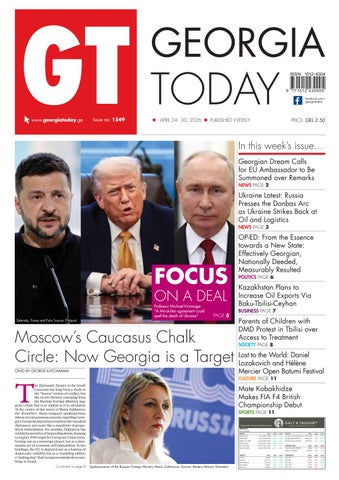
Moscow’s Caucasus Chalk

Circle: Now Georgia is a Target FOCUS

Tthis week’s

Georgian Dream Calls for EU Ambassador to Be Summoned over Remarks

2

Ukraine Latest: Russia Presses the Donbas Arc as Ukraine Strikes Back at Oil and Logistics

NEWS PAGE 3

OP-ED: From the Essence towards a New State: Effectively Georgian, Nationally Deeded, Measurably Resulted

Kazakhstan Plans to Increase Oil Exports Via Baku-Tbilisi-Ceyhan

Parents of Children with DMD Protest in Tbilisi over Access to Treatment

Lost to the World: Daniel Lozakovich and Hélène Mercier Open Batumi Festival

PAGE 11

Mate Kobakhidze Makes FIA F4 British Championship Debut

Spokeswoman of the Russian Foreign Ministry Maria Zakharova. Source: Reuters/Maxim Shemetov
OP-ED BY GEORGE KATCHARAVA
Trump
Putin Source: Firstpost

Strait of Hormuz Tensions Push Fuel Markets Higher as Aviation Industry Faces Growing Pressure

Tensions around the Strait of Hormuz are continuing to ripple through global energy markets this week, as maritime enforcement linked to the United States and Iran disrupts shipping routes and keeps fuel supply worries in focus.

According to Reuters, US naval forces have intercepted and redirected several Iranian-flagged oil tankers operating in Asian waters near India, Malaysia, and Sri Lanka. US Central Command (CENTCOM) also said that 29 vessels have been ordered to return to port as part of broader enforcement actions tied to Iranian maritime activity.

The Strait of Hormuz is at the heart of it all. A narrow but critical waterway, about a fifth of the world’s oil normally passes through it: even small disruptions can quickly be felt in global markets. Traders and analysts say that is exactly what we are seeing now, with prices remaining volatile as uncertainty continues.

Recent reporting suggests that flows of crude and refined fuel from the Gulf have tightened, especially for products like diesel and jet fuel. This feeds directly

into transport and aviation costs, and the effects are already starting to show.

At the same time, the wider conflict remains stuck in uneasy diplomacy. Talks between Washington and Tehran are still technically ongoing, but are fragile and indirect. Neither side appears close to a breakthrough, and recent developments at sea have only added more doubt about whether negotiations can really hold.

For airlines, the pressure is becoming harder to ignore. This week, Lufthansa announced it will cut 20,000 short-haul flights through October 2026, pointing to higher jet fuel costs linked to instability in Middle Eastern oil supply routes. The airline said the cuts will mostly affect lower-demand European routes as it tries to control rising operating expenses.

Industry analysts say aviation is particularly exposed in moments like this because fuel is one of its biggest costs. With Europe relying heavily on imported refined fuel, even small shifts in global supply can force airlines to rethink schedules, reduce capacity, and consolidate routes.

For now, the aviation impact is still secondary to the broader energy concerns. But with tensions around the Strait of Hormuz still unresolved, the sense in markets is that the pressure has not peaked yet.

Georgia’s Population Hits 3.9 mln

Georgia’s population stands at 3,929,581, based on updated 2024 census data published by Geostat.

The agency states that 257,000 people, or 6.6% of the population, are foreign citizens permanently residing in the country. The remaining 3,672, 581 are Georgian citizens.

Geostat explains that the census counts both Georgian citizens and foreign nationals who permanently live in the country, in line with international methodology. The reference moment for the census was midnight on November 13–14, 2024.

The updated figure is 0.4% higher than the preliminary data released in June 2025, which estimated the population at 3,914,000.

Women make up 52% of the population (2,048,577 people), while men account

Georgian Dream Calls for EU Ambassador to Be Summoned over Remarks

Of

ficials from the ruling Georgian Dream party have called for the EU Ambassador to Georgia, Pavel Herczynski, to be summoned to the Ministry of Foreign Affairs following his recent remarks made in Brussels.

Prime Minister Irakli Kobakhidze claimed that Herczynski’s statement was “manipulative” and accused the ambassador of threatening the Georgian public with civil unrest. Kobakhidze added that the diplomat’s comments about possible future developments in Georgia implied a scenario of civil war and economic decline.

“He said that in the near future it will be decided how events in the country

will unfold: either in one direction or another. According to his interpretation, the second direction is civil war and the impoverishment of the population.

When the EU ambassador speaks in such a way, it is truly tragic. This is a direct threat, and summoning the ambassador is therefore appropriate,” Kobakhidze said.

Tbilisi Mayor Kakha Kaladze echoed the criticism, also accusing Herczynski of making alarming statements about potential civil confrontation. Kaladze described the remarks as “deeply concerning” and stressed the need for the ambassador to provide clarification.

“It was a very worrying statement: there was talk of war and civil confrontation. Hearing this is extremely serious. Where there were indirect calls to get involved in war, now there is direct talk of internal conflict. This is very troubling. First and foremost, he must be sum-

moned and asked specific questions that require answers,” Kaladze stated.

The controversy follows comments made by Herczynski on April 22 in Brussels during the opening of a documentary photo exhibition titled “Georgia in Focus” at the European External Action Service. In his speech, the EU ambassador said that Georgia is at a crossroads.

“The future of Georgia is not yet written, but what will be decided in the coming weeks and months will determine whether Georgia belongs to the European family of nations, built on democracy, the rule of law, and human rights, or whether it will unfortunately return to its darker past,” Herczynski said.

The remarks have further strained the already tense rhetoric between Georgian authorities and European representatives, with debates ongoing over the country’s democratic trajectory and its path toward European integration.

Georgia to Build UEFA Category III Stadium in Bolnisi

for 48% (1,881,004). The share of women is higher in Tbilisi and Kutaisi, where it reaches 54%.

62% of the population (2,442,231 people) live in urban areas, while 38% (1,487,350) reside in rural settlements, Geostat says.

Population distribution by region is as follows:

• Tbilisi — 1,331,485

• Imereti — 510,741

• Kvemo Kartli — 441,630

• Adjara — 402,929

• Samegrelo-Zemo Svaneti — 305,597

• Kakheti — 303,833

• Shida Kartli — 251,736

• Samtskhe-Javakheti — 155,282

• Guria — 102,408

• Mtskheta-Mtianeti — 94,039

• Racha-Lechkhumi and Lower Svaneti — 29,901

The 2024 Population and Agricultural Census was conducted from November 14 to December 31, 2024, covering the entire territory of the country, excluding the occupied territories.

UEFA-standard stadium. Source: SPORTARAN

The Ministry of Infrastructure of Georgia announced that Georgia is moving forward with plans to develop a new international-standard stadium in Bolnisi, with the Municipal Development Fund of Georgia signing a contract with the selected company to begin the design phase.

The project envisions a 4,500-seat stadium built in compliance with UEFA Category III requirements, allowing it to host official international matches. Designed with a natural grass pitch, the venue will be suitable for both football and rugby competitions. Project details reveal that the design process is expected to take approximately eight months. Once completed, the stadium will include a full range of supporting infrastructure aligned with modern international standards.

These plans cover team and referee locker rooms, shower facilities, medical and conference rooms, as well as a dedicated media center and commercial spaces.

Accessibility and technical infrastructure are also central to the project. The stadium will feature parking adapted for people with disabilities, alongside modern irrigation systems, security infrastructure, stadium lighting and audiovisual broadcasting capabilities.

Georgia’s population, Census 2024. Source: Geostat.
EU Ambassador to Georgia, Pavel Herczynski. Source: FB

Ukraine Latest: Russia Presses the Donbas Arc as Ukraine Strikes Back at Oil and Logistics

Russia kept up steady pressure along the eastern front over the past week, trying to turn small gains into something more meaningful. Ukraine, in turn, continued striking deep into Russian energy and transport infrastructure while holding its defensive lines in the Donbas. The war remains a slow grind, but its reach is widening, and the consequences are building.

Recent battlefield assessments from Ukrainian and Western sources indicate continued fighting across a long stretch of the front, running from the northeast down toward central Donetsk. Clashes have been reported near Kupiansk and southeast of Slovyansk, particularly along the Kostyantynivka-Druzhkivka line.

Russia’s Defense Ministry says its forces have captured significant territory since the start of 2026, though such claims are difficult to verify independently and are often disputed.

Ukraine continues to rely on a network of fortified towns and cities in Donbas, sometimes described as a layered defensive belt. These positions remain central to slowing or blocking further Russian advances.

There has been no confirmed breakthrough or sudden collapse in Ukrainian defenses this week. Still, the pressure is constant. Russian tactics, as described by military analysts, center on small infantry assaults backed by heavy artillery and guided aerial bombs. The goal appears to be gradual exhaustion of Ukrainian forces rather than a rapid push forward. For Ukraine, the challenge is holding the line while preserving reserves and protecting key infrastructure from ongoing air attacks.

Civilians continue to pay the price. Ukrainian officials reported that missile and drone strikes during the week killed several people and injured many others

in cities including Kyiv, Odesa, and Dnipro. Exact numbers differ between reports and may change, but the pattern is clear. These attacks do not shift the front line directly, but they place pressure on daily life, infrastructure, and public morale.

Ukraine’s southern regions and export routes also came under repeated attack. Authorities reported damage following drone strikes on port facilities in the Danube region, including Izmail, which has become a key export hub as Black Sea routes remain under threat. In the Odesa region, separate strikes damaged port and railway infrastructure. These incidents fit a consistent pattern of attempts to disrupt Ukraine’s logistics and economic lifelines.

Ukraine has responded by continuing its long-range drone campaign inside Russia. Officials and open-source reports indicate strikes on oil refineries, storage depots, and export terminals in several regions, in some cases more than 1,000 kilometers from the border. The aim is to complicate fuel supply chains and increase the economic cost of the war for Moscow.

One reported strike hit the Tuapse oil refinery on Russia’s Black Sea coast. Local authorities confirmed a fire at the site, though the scale of the damage and its impact on operations remain unclear. Taken together, repeated strikes on energy infrastructure are likely adding strain, even if they have not stopped exports. There has been some movement on the diplomatic front, though little sign of a breakthrough. Ukraine has again expressed willingness to hold high-level talks. Foreign Minister Andrii Sybiha said Kyiv has asked Turkey to consider hosting a meeting between President Volodymyr Zelensky and President Vladimir Putin. Turkish officials have indicated they are open to facilitating such talks. The Kremlin, however, has suggested that any meeting would require prior agreement on key terms, pointing to ongoing disagreements over territory and security guarantees.

The wider international situation may also be shaping the pace of diplomacy. Analysts note that U.S. attention is divided across several global issues, which could reduce immediate pressure for negotiations. For now, developments on the battlefield continue to define each side’s leverage.

Ukraine is still securing support from its partners. Germany has announced expanded defense cooperation, including joint drone production and additional air defense systems such as Patriot and IRIS-T. These are expected to strengthen Ukraine’s ability to defend against aerial attacks.

Bolnisi Sioni Rehabilitation Underway, 1970s Floor Removed during Works

Rehabilitation works are being carried out at Bolnisi Sioni by order of the National Agency for the Protection of Cultural Heritage of Georgia.

The Agency says the ongoing works include the removal of a basalt floor installed inside the temple in the 1970s, which was laid on a concrete base.

Archaeological research conducted as part of the project has revealed an earlier floor beneath the structure. Sections were identified near the pilaster of the southern wall and in the western part of the southern section of the church, as was a full pilaster base.

The Agency states that the project envisages dismantling the later floor under archaeological supervision and installing a new, light-colored stone floor using a traditional Georgian layout.

It adds that the floor level will be low-

ered by several centimeters to improve the look and original architectural proportions of the columns and pilasters.

The Agency says that, in some areas, mechanical drilling and milling equipment was used to remove later concrete and basalt layers, noting this is standard practice and does not damage the structure or affect the monument’s stability. Works are being carried out under the supervision of archaeologists and field specialists, with all stages of the process documented and monitored.

The United Kingdom has also outlined further assistance, including large-scale drone deliveries and continued supplies of artillery ammunition and air defense missiles. While exact figures and timelines vary, Western officials increasingly point to drones as a central element of the war on both sides.

Financial support remains just as important. The European Union is moving ahead with a large, multi-year financial package designed to help Ukraine cover both military and government expenses. Funds are expected to be released in stages, helping sustain essential services while the war continues.

Taken together, the past week reflects

the core pattern of this phase of the war. Russia is applying steady pressure along the front and continuing long-range strikes, while Ukraine focuses on holding its defenses, striking back where it can, and relying on outside support. There are no sudden shifts, but that does not mean little is happening. This is a slow, wearing conflict where outcomes are shaped over time through persistence, resources, and resilience. The key question remains unchanged. Can Russia turn its gradual gains into something more decisive, or will Ukraine’s defenses, combined with sustained support and growing strike reach, be enough to hold the line and extend the stalemate?

Georgian Wildlife Photographer Named among Europe’s Top 10 in FEP Awards

Georgian wildlife photographer Irakli Shavgulidze has been named among the top 10 finalists in the wildlife category of the 2026 FEP Awards, organized by the Federation of European Photographers.

Shavgulidze’s shortlisted image, titled “White Wagtail,” was taken near the ancient rock-hewn town of Uplistsikhe in Eastern Georgia.

The photograph secured a place among the final selections in one of Europe’s leading professional photography competitions.

The FEP Awards are organized annually by the Federation of European Photographers, a pan-European body rep-

resenting national professional photography associations. The competition brings together professional photographers from across Europe, with winners selected by an international jury across multiple categories, including wildlife, portrait, landscape, and commercial photography.

This is not Shavgulidze’s first recognition in the competition. In 2017, he reached the Top 5 in the wildlife photography category, marking an earlier international achievement in his career.

Shavgulidze has been active in photography since 2012, and has focused on wildlife photography since 2015. Photography is his second profession and longterm hobby.

The final results and award ceremony will take place in Iceland on April 25, where category winners and overall awards will be announced.

A satellite image shows smoke following drone attacks on a Russian oil facility in the Black Sea port of Tuapse, Russia, on April 16.
Source: Vantor/Reuters
White Wagtails at Uplistsikhe, Georgia. Photo by Irakli Shavgulidze

Open Government Partnership Suspends Georgia’s Membership

The Open Government Partnership (OGP) has suspended Georgia’s membership, citing a failure to implement steps outlined after an earlier suspension in 2024.

The OGP says the decision follows a review process and reflects concerns that the conditions for participation are not currently being met in Georgia.

“The Open Government Partnership is rooted in the principle that governments and civil society must be able to work together in an environment that protects fundamental freedoms. After a comprehensive and fair review process, the conclusion was that these conditions are not currently met in Georgia,” said Aidan Eyakuze, CEO of the OGP.

A group of Georgian non-governmental organizations, including Transparency International–Georgia, the Institute

for the Development of Freedom of Information, Green Alternative, the Georgian Young Lawyers Association, and the Civil Society Institute, said the decision confirms that Georgia has departed from democratic standards.

The OGP said a country excluded from the partnership may rejoin in the future if it meets compliance criteria, including commitments to the Open Government Declaration and verification of required values.

Georgia was first informed of its suspension on October 16, 2024, with the OGP citing the “Agents Law,” which remains in force and applies to grantfunded NGOs and media organizations, as discriminatory.

The OGP was founded in 2011 by the presidents of the United States and Brazil to promote government transparency and public participation. Georgia joined the initiative in 2011.

In 2018, Georgia hosted the OGP Global Summit in Tbilisi, and in 2019 it was re-elected to the OGP Steering Committee for a three-year term until 2022.

Rumen Radev’s Party Wins Bulgarian Election, Secures Parliamentary Majority

Rumen Radev’s newly formed political movement, Progressive Bulgaria, won Sunday’s parliamentary election, marking a decisive shift in the country’s political landscape after years of instability, the BBC reports.

With 87% of the vote counted, Progressive Bulgaria (PB) secured a commanding majority of at least 135 seats in the 240seat parliament, based on official results. The party outperformed its main rivals, the liberal “We Continue the Change –Democratic Bulgaria” (PP-DB) coalition, which received around 15% of the vote, and former prime minister Boiko Borisov’s GERB party trailing with 13%.

The vote was Bulgaria’s eighth general election in five years, coming after prolonged political fragmentation and repeated government collapses. The latest election was triggered after the previous administration attempted to pass a controversial budget in December, leading to mass protests that Radev openly supported in his capacity as president.

In his victory speech, Radev thanked voters for rejecting what he described as “the self-satisfaction and arrogance of old parties” and pledged to build “a strong Bulgaria in a strong Europe.”

“What Europe needs right now is critical thinking, pragmatic actions and tangible results, particularly in shaping a new security architecture and restoring industrial competitiveness,” he said.

Radev, 62, stepped down from the presidency in January after nine years in office to launch his political movement. A former MiG-29 fighter pilot and commander-in-chief of the Bulgarian Air Force, his transition into party politics and subsequent electoral victory mark a significant development in Bulgarian politics.

He campaigned primarily on domestic issues, promising to tackle corruption and restore stable governance following years of fragile coalition governments.

Despite securing a parliamentary majority, Progressive Bulgaria is expected to seek cooperation with other parties to pass key legislation, particularly judicial reforms, which require a two-thirds majority. Radev confirmed he is open to coalition talks.

On foreign policy, Radev is widely viewed as a pragmatic leader with a more cautious stance toward Russia. He has previously criticized EU sanctions on Moscow and called for dialogue with the Kremlin. He also opposes direct Bulgarian military support for Ukraine, arguing that continued arms supplies risk prolonging the war.

However, analysts in Sofia suggest his government is unlikely to obstruct EU-

wide support for Kyiv. Instead, Bulgaria is expected to maintain indirect involvement, including arms exports through third countries: a practice that has made it a significant supplier of ammunition and explosives to Ukraine since 2022. The war has revitalized Bulgaria’s defense industry, with major investments underway. In October 2025, German defense company Rheinmetall announced a €1 billion joint venture with Bulgaria’s VMZ plant in Sopot to produce up to 100,000 NATO-standard 155mm artillery shells annually. A separate gunpowder facility is also planned, as part of broader European efforts to scale up military production.

While opposing direct military aid, Radev has supported strengthening Bulgaria’s role within the European defense sector. “Bulgaria is becoming part of the European defense ecosystem,” he said during a visit to Rheinmetall’s headquarters in Germany in 2025.

Observers note that his likely approach may resemble that of Slovakia’s Prime Minister Robert Fico: critical of certain EU policies, but not actively blocking defense production or broader European initiatives related to Ukraine.

The election result gives Radev a strong mandate to govern, but his ability to balance domestic reform priorities with complex geopolitical dynamics will shape Bulgaria’s role within both the European Union and the wider region.

Moscow’s Caucasus Chalk Circle: Now Georgia is a Target

Continued from page 1

By suggesting that the bloc may not even exist by the end of the decade, Zakharova is attempting to plant seeds of existential doubt in a nation that has, for decades, looked Westward for its North Star.

This aggressive posturing is particularly striking when viewed against the backdrop of Tbilisi’s own “easy-on-Russia” policy. Since 2012, the Georgian government has walked a precarious tightrope, maintaining a strategy of strategic restraint intended to signal goodwill to Moscow. This was meant to be a pragmatic olive branch; a way to de-escalate tensions and provide a pathway toward resolving the agonizing stalemate over the occupied territories of Abkhazia and the Tskhinvali region. Yet, for over a decade, this goodwill has been met with a cold, unilateral silence. Moscow has not offered a single substantive concession; instead, it has continued the physical "borderization" of Georgian soil, moving fences under the cover of night and entrenching its military footprint and the further integration of Abkhazia and the Tskhinvali region into Russian structures.

Zakharova’s habit of dusting off the old

Kremlin playbook, threatening wine embargoes, energy cuts, introducing a visa regime, and the dreaded "unfriendly country" designation, reveals a superpower that is increasingly out of touch with the reality on the ground. The Rus-

sia of 2026 is dealing with a Georgia that is no longer the fragile state of the early 2000s. The resilience of Georgian society has hardened through years of hybrid warfare and economic volatility. While a Russian trade embargo would undoubt-

edly sting the agricultural sector, it would no longer be the death blow it once was. Instead, such a move would likely serve as the final nudge Georgia and its public opinion needs to permanently decouple its economy from the North and fully integrate into the European Single Market.

The stakes are higher now because this is no longer just about Tbilisi. Russia is watching with growing alarm as the entire South Caucasus begins to drift from its orbit. In Armenia, the Kremlin has moved from passive-aggressive to overtly hostile, presenting Prime Minister Nikol Pashinyan with a stark binary: stay within the Russian-led security fold or face the consequences of Western flirtation. Meanwhile, Azerbaijan is leveraging its energy wealth to carve out a role as Europe’s indispensable partner, effectively bypassing Russian influence. Zakharova’s threats toward Georgia are, in effect, a signal to the mountainous trio of the region that any attempt to seek a future independent of Moscow’s mediation will be met with systemic retaliation.

Yet, if Moscow chooses to pull the trigger on its economic threats, it may find that Georgia holds a surprisingly potent deck of cards. Should Tbilisi decide that

the era of "goodwill" has reached its end, it could inflict significant pain on Russian logistics. By joining the full-scale international sanctions regime, closing its airspace, and shutting down the Upper Larsi border crossing, Georgia could effectively sever Russia’s most vital land link to Turkey, Armenia, the Middle East and beyond. At a time when Russia’s northern supply chains are choked by the war in Ukraine, the loss of the Georgian transit corridor would be a logistical catastrophe for the Kremlin. Ultimately, Zakharova’s performance is a window into a Russia that is finding it harder to lead through attraction and is resorting entirely to coercion. By ignoring years of Georgian restraint and failing to offer even a modicum of diplomatic flexibility on the occupied territories, Moscow is rapidly exhausting its levers of soft power. As Georgia continues its steady, if perilous, march toward Brussels, the Kremlin’s old tactics of intimidation are meeting a new Georgian reality: a nation that has learned that the cost of freedom is high, but the cost of returning to the "old playbook" is higher.

Author’s bio: George Katcharava is the founder of eurasiaanalyst.com, a geopolitical risk and advisory firm.

The Upper Lars border crossing. Source: russiable
Rumen Radev. Source: BBC
“Another version of

Minsk for Ukraine could

be fatal”

– Prof. Michael Kimmage on the Ukraine War

In his interview with Radio Free Europe/Radio Liberty’s Georgian Service, Professor Michael Kimmage, founding director of the Kennan Institute and a former US State Department official who worked on Russia and Ukraine policy, takes a frank look at where the war in Ukraine stands four years in. He reflects on what both Russia and Ukraine have actually gained from the fighting, and what they haven’t, making the point that neither side is truly winning.

Kimmage also talks through the murky state of peace efforts, noting a growing sense of fatigue in both Kyiv and Moscow, while warning against any quick or poorly thought-out deal. A settlement along the lines of the Minsk agreements, he suggests, could end up doing serious harm to Ukraine, rather than bringing any real stability.

LET'S LOOK AT THE WAR IN UKRAINE FOUR YEARS ON. WHAT HAVE THE RUSSIANS ACHIEVED? AND THE UKRAINIANS?

You have to ask: have the sacrifices that Russia has made over the last four years been worth it? What have they delivered to Russia? Isolation from the West, a small amount of territory in Ukraine, generations of anger among Ukrainians toward what Russia is and represents, and a closer relationship with China, but to a degree on Chinese terms. It's very hard for me to say that there has been a big, strong strategic leap forward on Russia's part.

On the Ukrainian side, you certainly can't argue that Ukraine is winning, because it is very far from expelling Russian soldiers from Crimea and eastern Ukraine. Ukraine is also struggling with air defenses, as drones and missiles are penetrating them and hitting targets in Ukrainian cities. In addition to manpower problems, Ukraine has financial and demographic challenges. So neither Russia nor Ukraine is winning.

WHAT SHOULD WE EXPECT FROM THE PEACE TALKS? ARE WE DEALING WITH GENUINE NEGOTIATIONS, SOMETHING “PERFORMATIVE,” AS THE ESTONIAN FOREIGN INTELLIGENCE REPORT SUGGESTED, OR AN EXERCISE IN WHAT THE RUSSIANS CALL “MANAGED UNCERTAINTY,” PLAYED BY ALL THREE SIDES?

I think it might have the potential to be all three. Managed uncertainty is attractive on the Russian side, because what Russia would at least like to accomplish is to sow division between the United States and Europe. Even if Russia achieved nothing at the negotiating table, but Brussels and Washington, or Berlin and Washington, seem far apart, that's a modest Russian win. Managed uncertainty is generally how Russia operates. All diplomacy is theater; that's not unique to these negotiations. It would be wrong to say that it's only theater. But on the Trump side, you have a president who enjoys the spectacle of highstakes diplomacy, so it is theater up to a point. The third point, in addition to managed uncertainty and theater, is that something real is happening. There is genuine exhaustion on the Ukrainian side, and also on the Russian side when they are sober and in private. Policymakers in Kyiv and Moscow know they are not

going to get everything they want from this war, and they know the war is costing them. It is very possible that both countries will simply lose from this awful, terrible, criminal, senseless conflict caused by Russia.

Another factor is the upcoming US midterm elections. President Trump is likely the easiest American president for the Russians to work with. From the Russian perspective, there is a window of opportunity in the next few months. If they are going to make a deal, this is the time to do it. Two years from now, there will be a presidential election in the United States, and the world could look very different. Ukraine might innovate or achieve technological breakthroughs that change the war. This could be a moment for Russia to try to wrap it up.

So my sense is that the diplomacy is going to fail, but I would want to maintain some managed uncertainty about that.

IS THERE AN ACCEPTABLE COMPROMISE FOR ALL THREE SIDES TO BE FOUND? AND WHAT WOULD THAT LOOK LIKE?

That’s where I really struggle: to imagine an acceptable compromise. On the Russian side, this is about much more than territory, certainly more than the Donbas. Russia is pursuing a complicated set of claims about Europe’s security architecture: not just Ukraine’s place in Europe, but what Europe itself looks like. Russia wants a bigger role in determining that architecture. The war complicates this ambition, but I think it’s still there.

A settlement that gives Russia semilegal control over Crimea and most or all of the Donbas seems too little. I also find it hard to imagine that Russia would then stand by and watch the rest of Ukraine integrate into Europe: they would push for more.

On the Ukrainian side, I don’t think Ukraine will ever grant formal control to Russia, though there may be ways to negotiate around that. But Ukraine cannot go much further. If Russia demands special rights for Russian speakers, control over church matters, neutrality, and separation from Europe, Zelensky is likely to argue that Ukrainian sacrifices were made precisely to prevent that kind of Russian control over Ukrainian politics.

Beyond the vanity of leaders, which

always plays a role, the substantive issues are very far apart. I don’t know what kind of genius could configure a deal both sides would accept. It goes beyond genius. For Ukraine, this is existential. The very poor-quality diplomacy put together by the United States and Europe in 2014, the Minsk agreements, may have seemed acceptable in Berlin, Paris, and Washington. Violence decreased, and many thought the problem was solved. But it was not acceptable for Ukraine; it became the first chapter of a story whose second chapter was Russia’s full-scale invasion.

Another version of Minsk for Ukraine could be fatal. If Ukraine makes the wrong deal, if Russian forces are allowed to advance on Ukrainian territory as they did in 2014, that could be the death of Ukraine.

EARLIER, YOU SAID TRUMP WAS EASIEST FOR RUSSIA TO WORK WITH, AND MOSCOW CELEBRATED HIS RETURN. YET HIS MOVES, UNDERMINING ASSAD, MADURO, HAMAS, IRAN, AND EVEN RUSSIA’S ROLE IN ARMENIA–AZERBAIJAN, RAISE A SHARPER QUESTION: WHO’S ACTUALLY OUTPLAYING WHOM?

Great question. It requires a two-layer answer. The first layer is more superficial. It involves Trump’s basic lack of interest in Europe, his dislike of the European Union, his limited commitment to NATO, and his personal dislike, probably, of Volodymyr Zelensky, along with a general lack of enthusiasm for Ukraine and a willingness to compromise in ways that most other American politicians would not. At times, this is just rhetoric, but there is also a willingness to endorse the Russian narrative of the war: that NATO expansion is to blame. If you think about the terms of a potential deal in Ukraine, the terms that Vladimir Putin might have obtained from Joe Biden, Kamala Harris, Marco Rubio, or other conceivable presidents, perhaps with the exception of J.D. Vance, would likely have been much tougher than those offered by President Trump. Trump is willing to entertain options that most other high-level American politicians would not. So, at a superficial level, Trump has created a modest diplomatic opening for Russia when it comes to ending the war in Ukraine.

The second layer is different. I don’t think Trump is playing Putin, nor is that his intention. The reality is simpler: Trump doesn’t care much about Putin. He sees him as the leader of an economy smaller than Italy’s, and as someone whose influence largely depends on coercion and military force in neighboring countries such as Georgia and Ukraine. In that sense, Russia is not an especially important or relevant actor. From that perspective, it’s not that the Trump White House acted in places like Armenia–Azerbaijan to annoy Russia; rather, it largely ignored Russia. It reflected what the president wants, what the United States wants: “America First.”

That approach appears across a range of conflicts. At the same time, this has amounted to a notable series of setbacks for Putin, who has effectively been pushed to a lower diplomatic level. That is a real problem for him.

A second, less Trump-specific point, is that the world is becoming more anarchic and more multipolar: the kind of world Russia seemed to want around 2022. But Russia is struggling in this environment. It doesn’t have the economic and military clout of the United States or China, but it still tries to operate at that level and manage the resulting complexity. It is gradually failing to do so.

LAST YEAR YOU WROTE IN THE NEW YORK TIMES THAT PUTIN HAS “LOST THE WEST FOR GOOD.” HAS HE? IS A MORE POPULIST WEST, ESPECIALLY AFTER ELECTIONS IN FRANCE AND GERMANY, REALLY UNLIKELY TO RESUME TIES WITH RUSSIA?

To me, that scenario is a bit far-fetched. It would require simultaneous right-wing victories: a sweep in Germany, France, and the UK. Even then, these parliamentary systems require coalitions, so no single party gets everything it wants. As a partial example, in Italy, semi-populist right-wing leader Giorgia Meloni said one thing about Russia on the campaign trail and another once she was in power. In that sense, Putin has broken something he didn’t need to break. Before 2022, after the annexation of Crimea and Russian involvement in Donbas, Russia was still selling gas and oil across Europe; people and businesses moved back and forth. It was a largely normal relationship. Putin threw that away.

YOU WRITE THAT THE WAR’S OUTCOME WILL BE THE ULTIMATE REFERENDUM ON PUTIN’S PRESIDENCY, AND THAT HE MAY EVEN CONSIDER ESCALATING BEYOND UKRAINE’S BORDERS. WHEN AND WHERE MIGHT THAT HAPPEN?

Well, Putin has many options, regrettably. One is sabotage, with plausible deniability: an easy option that could be used anywhere in Europe. More dramatic options include striking supply routes into Ukraine; it’s a little surprising that hasn’t happened already, given that they run through Romania, Poland, and elsewhere. There are also the satellites providing targeting and intelligence for Ukraine, often US satellites, which would be a major escalation, but not inconceivable. And then there’s the scenario everyone worries about: a territorial move. In Georgia, that’s already a reality. I don't think a Russian invasion of the Baltic republics is on the horizon. That would be an incredibly high risk move for Russia to make because of Article 5. You're then taking yourself into the terrain of a possible nuclear confrontation. The

escalatory options are there, and the stakes are very high; countries at war can act recklessly, and Putin is capable of that.

IF THIS ANARCHIC WORLD ORDER BECOMES THE NORM, WHAT WOULD IT MEAN FOR SMALLER, MORE VULNERABLE STATES, ESPECIALLY IN RUSSIA’S SO-CALLED NEAR ABROAD, LIKE BELARUS, THE CAUCASUS, AND MOLDOVA?

It’s clearly bad news. Historically, the region’s security was shaped by empires: from medieval times through the Soviet collapse in 1991. The era of small, independent states like Estonia, Latvia, Lithuania, Georgia, Armenia, and Azerbaijan is recent and fragile. Stability requires either benevolent external powers, which Russia has rarely been, or some force to maintain order. For Georgia, this is a painful reality: the damage was done in 2008 and remains unresolved, so it has long lived in this kind of world. Moldova has as well, since the Soviet collapse, never enjoying a stable period of easy independence.

The Baltics are the most fortunate countries in this respect, being EU and NATO members. Their story has been different. But if you look at the Baltic states today, they’re living with the fear that this protection could disappear, and they’re trying to decide whether ties to Germany, the EU, or the US best guarantee their security. Fundamentally, this more anarchic order is bad news. It’s part of why Russia wanted it, believing it could use its relative power to shape outcomes, but it hasn’t been especially skillful at marshalling that power. Russia now stands on the sidelines as Armenia and Azerbaijan come to the table, while Central Asia finds ways to be independent of Russia. It feels like Chinese power is growing: it's an almost contradictory conclusion that you can draw.

This anarchic order favors Russian interference in its near abroad by normalizing it, but the war in Ukraine has imposed limits that make it harder for Russia to capitalize on the moment.

AS LEAST WHILE THE WAR LASTS.

Right. The war in Ukraine is draining Russian resources. Russia is now spending around 40 percent of its budget, about 8 percent of GDP, on defense and security, and that’s unlikely to change. The economy has become dependent on military spending. If the war ends, the question is what that spending will lead to. It’s unlikely to produce peace; as long as Putin is president, it will mean new forms of pressure on neighboring states.

BUT IF UKRAINE IS SO CENTRAL TO PUTIN’S VISION OF A “GREATER RUSSIA,” HOW CAN THAT VISION SURVIVE WITHOUT IT?

Exactly: that’s the dilemma he’s created. Putin was once described as a pragmatist, but this invasion shows little pragmatism. It has brought a bitter harvest for Russia: the loss of young men and a rupture with its natural partner in Europe. This strategic blunder continues to play out. Statesmanship should move a country forward, sometimes through military means, but mostly through others, and I feel that objectively Putin has set Russia back with the war. He increasingly resembles a gambler with a table full of chips, throwing them away rather than building gains. The tragedy of Russian politics is that there is no effective mechanism to restrain him, so he continues to drag the country backward.

Michael Kimmage. Source: wilsoncenter

OP-ED: From the Essence towards a New State: Effectively Georgian, Nationally Deeded, Measurably Resulted

Iconsider the political initiative "Georgia First" to be a healthy union. I equate the word "healthy" with a very specific meaning, especially in our times and circumstances.

In my understanding, this healthiness is linked to: who has united, what united us, and for what purpose we united to have our say through action.

We are people for whom politics is not a necessary or sole means of self-assertion. Behind each member of "Georgia First" lies a very practical professional and life path, public recognition, and social weight.

Consequently, by entering politics, none of them are "starting" a socially useful function, nor will they "end" their service to the country upon leaving politics. Therefore, there is nothing behind them to "lose" and nothing ahead of them to "gain" for personal gain. In other words, long before the emergence of the "Georgia First" political initiative, we introduced ourselves to the audience, said hello, and extended a hand of partnership and sincere participation to improve reality. By launching this initiative, we have declared our assumption of political responsibility, alongside social and civic responsibility, for the practical effectiveness of this partnership. We have done this openly and boldly, without attempting to avoid difficult or uncomfortable questions.

In short, we presented ourselves as we are, with our merits and flaws, without vanity or hypocrisy, evaluating things and issues sensibly and naming them with principle.

WHAT UNITED US

We were united by principles that, at first glance, seem basic to the essence of the process, yet are not fully realized in the Georgian reality. We were united by what seems simple to understand but has proven very difficult to translate into practice. We were united by agreement on things that any sane person should probably agree upon without hesitation, yet which represent an unusual and unproven (I wanted to say unpopular) material for broad social agreement in Georgian politics.

We were united by the firm belief that without turning these specific principles into a tradition, national unity cannot be achieved; and as a result, without this unity, national energy cannot be transformed into the most important thing: a modern civic unity. Without such civic

unity, we cannot talk about a modern Georgian state as a foundation of Georgian civic nationalism within the country, or as its standard-bearer and "armor" outside the country.

Briefly, within the scope of "one word," we were united by the following:

• Remembering that every coin has two sides;

• Refusing to divide politics and national affairs into only "black" and "white";

• Whether we like it or not, knowing that the truth is always somewhere in the middle;

• Though unusual, thinking primarily about reforms while in power, instead of thinking about the next election;

• Not being constrained by the "pleasing the voters" complex: real work is not done this way, and practical results cannot be achieved;

• Regardless of the importance of an issue, being careful that "form" does not overshadow "content," and "paper" does not consume "identity."

WHY WE UNITED: GENERAL FOUNDATIONS

We united to offer the Georgian voter, Georgian society, and the citizen of Georgia something new:

• Liberation from the old;

• Breaking useless clichés;

• Realizing the stereotypes that act as brakes;

• Escaping stagnation or, at best, moving in circles.

The essence of this offer is to create the preconditions for Georgia's leap into the First World, against the backdrop of evaluating the past and present objectively, critically, calmly, and by directing academic thought toward practical results, in partnership with you, the citizens of Georgia. In this process, we, "Georgia First," take responsibility upon ourselves as a political entity.

The goal of this offer is to learn to analyze system-creating events within and outside the country and to transform the conclusions drawn from this analysis into the service of our country’s interests and the factual improvement of its citizens' conditions.

Likewise, the purpose of our offer is to create a solid bridge between Georgia's rich and proud historical past and a competitive and dignified claim on the future by the Georgian state through a new political style and culture. The realization of this claim should mean that the designation "Georgia" equals a country of high attraction for living and working, while the word "Georgian" provides the means for self-development and a highly desirable opportunity to contribute to the country's progress.

(which anti-sovereign actions of recent years have denied), and "The Will of the People" (which is actually hybrid coercion practiced on the psyche and consciousness of its own citizens).

The call of "Georgia First" is to fill "Homeland," "Sovereignty," and "The Will of the People" with real content, which is primarily possible if:

• We turn the homeland into a state, and

• We become a systemic nation.

As a result of this essential transformation, we will obtain a Nation-State. We believe that only a systemic nation-state is what we need most to preserve our Georgian identity, restore sovereignty, ensure nationality, and confront today's and tomorrow's challenges with high efficiency. We will achieve a state where the precious and lofty feelings associated with a transformed homeland become a capable state (at last!), and the Georgian living in their own country, instead of being a guest, becomes the host—the owner. Therefore, the NationState is the call of "Georgia First."

2. A NEW UNDERSTANDING OF "GEORGIAN"

I will say openly that during discussions on these and other issues, the question often arose among the members of "Georgia First" as to which ideology we support or represent. On the surface, a so-called centrist line emerged. However, due to the blurring of the word "centrism" in the modern world, it became clear that we had to reject a "centrism" that tells our fellow citizens nothing. Yet, we could not and would not fully reject "The Middle" (shvashistoba), while right-wing tendencies emerged in certain disciplines. Consequently, it became necessary to tie these two currents into a single "ideological" framework, which gave rise to the name Pragmatic Right. This short insert on ideology is for those who stubbornly try to classify any political initiative by ideological markers. But for those who are free from ideological exercises and measure political activity by concrete results, "Georgia First" calls for reflection, conversation, and formation through action on the following:

1. HOMELAND OR NATION-STATE?

A fundamentally incorrect equation currently linked to the pseudo-national policy of the present government, disguised with national rhetoric. This policy is pseudo because: a) National rhetoric remains merely "nationally sounding" and does not serve the Georgian national state with deeds. Moreover, behind the hypocrisy of "nationality":

• The country is drifting toward mere geography;

• National security is a nominal concept;

• Professional diplomacy gives way to image-damaging "wheeling and dealing";

• Instead of social agreement, preference is given to fragmentation, disunity, and anxiety;

• The economic system, instead of generating national opportunities, is formed as an "economy of elite pockets";

• Ignorance replaces knowledge;

• An environment is encouraged where business is enslaved;

• Justice is trampled upon, and the rule of law is equated with the supremacy of the "written law" alone.

b) Openly declared conspiracy theories outweigh state thinking, the direct result of which is the nullification of the political process within the country and the transformation of the country into an object of others' interests on the international stage.

c) Constant, and most importantly, cheap appeals to "Homeland" (which we have had for many centuries regardless of this government), "Sovereignty"

is for us neither just geography, nor a collection of legal norms, nor simply a strategic partner. For the Georgian nationstate, the Western world is much more: it is Our Civilization. With this assessment, the conversation about the importance of Georgian-Western relations is immediately sealed and declared. Along with other concrete benefits, it is this relationship of the highest rank and content that gives Georgia, as the West's "Five-Crossed" national bastion in the region; a distinguished role as a stable, predictable, and in-demand link between the West and the East. In other words, it helps our country gain and actualize functional utility, which is so critical for establishing one's place in a world of "disordered order" under modern conditions.

WHY WE UNITED: CONCRETE FOUNDATIONS

The modern context requires the substantive clarification and correction of many concepts and categories. This is necessary not only for academic but, primarily, for practical needs. For example, we believe that the existing ethnic understanding of "Georgian" requires expansion and the infusion of political content. Along with the transformation we already mentioned, from homeland to nation-state and from a people to a nation, the collective and all-encompassing understanding of "Georgian" should fully contain the civic status of politicaleconomic-social rights. A Georgian should be the creator of their own destiny, the main employer of the state in creating this destiny, a full participant and the main voice in the country's processes, a co-owner of the Georgian state, and not a passive witness to the property of narrow circles or an involuntary "notary" of the property seized by others.

3.

CIVIC NATIONALISM

The core idea of civic nationalism proposed by "Georgia First" is to multiply the effect of existing cultural-ethnic nationalism and put our proud national ego into the practical service of the Georgian nation-state. Along with other important elements that require the normalization of the country, its institutionalization, and a return to its civilizational roots, the load-bearing walls of civic nationalism are:

• The Georgian state functioning as a Service Provider. The main services for citizens are: (a) Ensuring a safe physical environment and property; (b) Ensuring equal access to opportunities for economic and business activities; (c) Ensuring social justice and necessary basic conditions.

• Building relationships between the state, the citizen, and other relevant entities on solid contractual foundations. Among such "contracts," the Constitution of Georgia (the political "Holy Book") and other legal instruments with constitutional priority (e.g., a constitutional agreement/"Concordat" with business, academia, etc.) are primary.

• A Thinking State, where the political position on key issues represents a synthesis of opinions between state, social, business, and creative institutions—an agreement based on co-ownership of the state.

• Consequently, Georgian Thought must become the primary source of Georgia's national-state development: our own thought about ourselves, about who we are, what we want, and how we intend to achieve it: the "Georgia First" thought.

4. THE WEST AS OUR CIVILIZATION

When talking about diversifying the country's foreign political ties, the West

Agreeing on general conceptual issues requires reflection in specific sectors and directions. "Georgia First" has already published its vision on several directions, and material on several more will be published after final processing. Therefore, detailing specific concrete points in this letter is unnecessary due to the public nature of that material. However, I will try to summarize individual directions with a phrase or two: Defense and Security: Real peace is achieved only through solid national security and close cooperation with strategic partners. Phobia-ridden rhetoric and a submissive, undignified "policy" create a constant sense of being a passive victim, which only fuels the country's vulnerability. Additionally, "Georgia First" considers it necessary to adopt a "Defense Act," which should further strengthen the primary precondition for the country's security between the government, defense forces, and citizens.

Foreign Policy: The main condition for the success of foreign policy is the country's successful domestic policy and health: you cannot sell a bad and perishable "product" with any diplomacy. Also, in a world of "disordered order," the country must learn to talk to all main poles or system-creators, master the craft of multilateral policy, and learn, with Georgia's priority first, to trade its own interests to the maximum extent possible.

Economic Policy: Success in the economy depends not on the volume of resources, but on the wise use of those resources. The foundations of a correct economic model are clear rules, strong institutions, and free entrepreneurship. The corresponding vision is presented as a technocratic, measurable, and resultoriented document. Special attention is paid to aspects of economic security.

Business Environment: We believe that healthy business and a corresponding environment are a national priority, to be strengthened by a high-ranking legislative act. At the same time, business should be seen not only as a business process but as Georgian "soft power" and a promoter of the country's international positions.

Justice: Along with "the making of law," it represents the guarantor of stability and national security in the country. Furthermore, Ilia's [Chavchavadze] assessment of justice as a "daily necessity" further strengthens the "Georgia First" approach toward institutions as service providers. It is essential that the legislative and structural changes presented in the vision aim for Georgian justice to exit the "government service zone" and serve society with real deeds.

Nothing can stand in the way of changes if those changes are natural. In the Georgian reality, changes are also necessary. Consequently, based on their naturalness and necessity, these changes are inevitable. We offer these changes to the citizen of Georgia together with us, through the participation of "Georgia First."

Now it is our turn, it is the turn of Georgian thought, it is Georgia's turn.

Mountainous Georgia. Source: Georgiastartshere OP-ED BY VICTOR KIPIANI

Government Adds State Aviation Jobs to ‘Scarce, High-paid’ List

The Georgian government has added professions in the state aviation sector to the list of “scarce and highly paid” positions, under a decree issued on April 21. The amendment updates a 2018 gov-

ernment resolution regulating scarce professions in the public sector and the rules for their remuneration.

The list already includes sectors such as IT, software development, financial reporting and auditing, civil aviation, and maritime and hydrographic fields.

The new changes expand the list to include specific roles in state aviation, including: • pilot / pilot-navigator;

• engineer / flight engineer;

• flight mechanic-operator;

• technician / flight technician;

• supervisors directly responsible for these specialists.

The decree means employees in these roles will be subject to higher pay rules than those typically applied in the civil service.

The resolution will enter into force upon publication.

Georgian, Chinese Economy Ministers Sign Amendments to Free Trade Deal

Georgia and China have signed a protocol on amendments to their existing free trade agreement, first announced 10 months ago.

The document was signed by Georgia’s Minister of Economy and Sustainable Development, Mariam Kvrivishvili and China’s Minister of Commerce, Wang Wentao.

Kvrivishvili said the updated agreement aims to align the deal with the modern trade environment and create additional opportunities for investment and e-commerce. She added that the amendments are strategically important for deepening economic ties between the two countries, and noted that work is underway to allow Georgian animal products, including poultry and honey, to enter the Chinese market.

Minister of Economy and

“We expect the amendments to contribute to the growth of trade turnover,” Kvrivishvili said. “Economic relations between our countries have gained significant momentum in recent years, driven by high-level political engagement and increased cooperation between business sectors.

“Our goal is to fully utilize the opportunities created by the Free Trade Agreement to increase exports to China and support Georgia’s economic growth,” she added.

Georgia’s free trade agreement with China entered into force on January 1, 2018.

Georgia Tourism Holds Steady Despite

DRegional Declines

ata from the National Bank of Georgia reported that the country’s tourism sector demonstrated relative resilience in the first quarter of 2026, with revenues increasing slightly despite a decline in visitor numbers from main Middle Eastern markets.

Total tourism revenues reached $830

million in Q1, a modest year-on-year increase of 0.5%. Over the same period, the country recorded approximately 1.17 million international visitors, a marginal decline of 0.2% compared to the previous year.

The overall performance was influenced by a sharp drop in arrivals and spending from Israel and Iran, reflecting the early effects of regional geopolitical tensions.

The number of visitors from Iran fell by 49% to 13,757, while arrivals from Israel declined by 17.5% to 66,744. Correspondingly, spending by Israeli visitors

decreased by 13% to $98.9 million, while Iranian tourism revenues dropped significantly by 64% to $10 million. At the same time, growth in other markets helped offset these losses. Visitor numbers from the European Union increased by 30% to 96,226, with associated spending rising by 36% to $140.7 million. Saudi Arabia also recorded notable growth, with arrivals up 36% to 8,862 visitors and tourism revenues increasing by 48% to $12.9 million, although analysts note that future quarters may reflect broader regional impacts.

Household appliances. Source: Stelrad

Georgia Appliance and Furniture Markets Face Growth

Galt & Taggart Georgia reports that household appliance and furniture markets have experienced stagnant revenue growth in recent years, primarily due to declining prices. In 2025, the household appliance sector generated $718 million in revenue. The market remains heavily importdependent, with $696 million coming from imports and only $22 million from local production. Analysts attribute the lack of growth over the past three years to price declines across major product categories, although moderate recovery is expected in 2026.

China continues to dominate as the leading supplier, accounting for 44.3% of appliance imports, followed by Turkey (21.3%), Italy (6.4%), Germany (3.5%) and Ukraine (2.5%). By category, heating and cooling systems represent the largest share of imports at 24.5%, followed by refrigerators (16%), televisions (11.4%), washing machines (8.6%), ovens (8.2%) and other appliances (31.4%).

A similar trend is observed in the furniture and lighting segment. The market generated $519 million in 2025, including $408 million from imports and $111 million from domestic production. Turkey (30.3%) and China (29.5%) remain the primary sources of imported goods in this category.

The report stated that declining prices in furniture and lighting products have also constrained revenue growth.

Kazakhstan Plans to Increase Oil Exports Via Baku-Tbilisi-Ceyhan

Kazakhstan plans to increase oil exports through routes passing through Georgia, including the Baku-TbilisiCeyhan (BTC) pipeline and the Trans-Caspian International Transport Route (TITR).

The Kazakh government expects exports via these routes to reach up to 20 million tons annually.

A study by Policy and Management Consulting Group (PMCG) says Kazakhstan has expanded its westward export options through the BTC pipeline and TITR, which relies on shipments via the

ports of Aktau and Kuryk.

Most of Kazakhstan’s oil exports are currently transported through Russia via the Caspian Pipeline Consortium, which connects the country’s oil fields to the Russian Black Sea port of Port of Novorossiysk.

The CPC pipeline transports up to 67 million tons of oil annually from major fields, including Tengiz oil field and Kashagan oil field.

The report notes that roughly twothirds of Kazakhstan’s oil exports pass through the CPC. It adds that the route has faced repeated disruptions since the start of the Russia-Ukraine war.

The study suggests these disruptions followed Kazakhstan’s neutral stance on the war, with technical issues reported along the pipeline.

Baku-Tbilisi Ceyhan pipeline. Source: JPT-SPE
Aviation engineering students training on an aircraft engine. Source: Georgian Aviation University
Georgia’s
Sustainable Development, Mariam Kvrivishvili and China’s Minister of Commerce, Wang Wentao. Source: MoE

Int’l Animal Protection Organization Raises Concerns Over Stray Animal Management in Georgia

An international animal protection organization, OIPA, has expressed concern over the management of stray animals in Georgia.

In a statement dated April 21, 2026, the organization said it had addressed an official letter to the Georgian authorities and diplomatic missions, calling for greater transparency and clarification regarding current practices related to stray animal management.

OIPA says several key issues have been identified based on reports and documented evidence. These include the failure to return animals to their original

habitats after sterilization, the repeated capture of already sterilized dogs, relocation of animals to unsuitable areas, and a lack of information regarding the whereabouts of many animals.

In its letter, the organization called on the relevant authorities to take concrete steps to address these concerns. Specifically, OIPA urged that animals taken for sterilization be returned to their original environments, that unnecessary and repeated capture of already sterilized animals be avoided, and that information about the location of animals be made publicly available and transparent.

The organization also noted that the issue is attracting increasing international attention, highlighting the need for improved oversight and humane management practices in Georgia.

Parents of Children with DMD Protest in Tbilisi over Access to Treatment

Agroup of parents in Tbilisi has stepped up protests against the Georgian government, demanding access to medicines for children diagnosed with Duchenne muscular dystrophy (DMD), a rare and life-limiting genetic disorder.

The protest, which has been ongoing for more than three months, intensified this week as families and supporters spent the night outside the Government Administration building. Despite cold temperatures, some parents remained in the square on wooden benches after police reportedly did not allow them to bring in seating, while others stayed in a nearby parking area.

The parents are calling on Prime Minister Irakli Kobakhidze to meet with them directly. They say they have submitted multiple requests but have yet to receive a response. Earlier meetings with officials, including Levan Zhorzholiani, head of the prime minister’s administration, and Health Minister Mikheil Sarjveladze, have not led to any concrete changes.

At the center of the dispute is whether Georgia should fund and import drugs that are already approved abroad, including by the US Food and Drug Administration. Parents argue that these medicines can slow the progression of DMD and improve children’s quality of life, even if they are not a cure.

Responding to the protests, Minister Sarjveladze rejected the parents’

demands, saying: “The demand is for drugs whose function is not to save life, not to cure, nor to prolong life.” He added that, “there is no drug in the world today that claims to cure Duchenne muscular dystrophy: there are only medicines that claim to slow down the progression of the disease to the point where the need for using a wheelchair can be postponed for one to three years.” He warned that such treatments may carry health risks.

The Ministry of Health has said that such safety concerns are a key reason for its refusing to import the drugs, noting that some had received expedited approval and lacked long-term study data.

Parents strongly disagree. They say the treatments are already in use in the United States and Europe and question

why Georgian children should be denied access. Many also suspect that the high cost of the drugs, reportedly reaching millions of dollars, is influencing the government’s decision. Duchenne muscular dystrophy causes progressive muscle weakening, often leading to loss of mobility and early death. Advocacy groups estimate that around 100 children in Georgia are currently living with the condition. For the families involved, the protest is about urgency as much as policy. After more than a year of appeals, they say they will continue demonstrating until the government agrees to fund access to the treatments they believe could make a meaningful difference in their children’s lives.

Hey there, my Fledgling Compatriots!

The world is progressively becoming a thornier place to live in and navigate. Young people are often confused and not yet equipped to cope with what contemporary human life demands today. Faced with hardly resolvable everyday problems, especially the egregious unpredictability of the future, our young men and women often find themselves at a loss when it comes to making those win-win decisions in favor of their nation, their families, and themselves.

Now the question is whether an optimal model of conduct can be constructed for modern-day young men and women, one that allows them to survive healthily, feel happy, and achieve success while moving through the sticky, stinking debris of the precarious vicissitudes of life on our sin-ridden Earth. Notwithstanding this ostensibly alarming picture, there is, of course, nothing hugely wrong with the atmosphere we are living in, although it is uncannily multifaceted, appallingly accelerated, and dreadfully uncertain, with uncertainty ceaselessly growing. Hence, rather than letting this prevailing atmosphere become a trap, we must hunt for advantages, not drawbacks and pitfalls. Yes, the surrounding chaos feels suffocating every now and then, but at the same time, there are hundreds of tools, accumulated knowledge, numerous paths, and specific ways to meet both concealed and revealed challenges, instead of trying to mechanically and gullibly simplify a complicated world and only semi-enjoy it.

Down with futile slogans, dry clichés, and worn-out standards! Let us look for applicable structures and workable models to build our lives, this message directed especially to those still in their salad years, filled with wistful expectations and wild dreams about their panoramic future.

So, what should we do, and how should we behave?

How about starting by building our inner fundamentals, based on the decisive rationale that our inner system must

remain unflinchingly stable when the external world tends toward imbalance? If this is true, I would suggest three pillars. Let us take good care of our physical health by eating correctly, exercising methodically, and sleeping well and sufficiently. Let us regulate our emotions so that we are never overwhelmed by circumstances. Let us remain absolutely adamant about the spiritual values we will never give up. If we are unable to do this, we can for-

get about any strategy upon which we want to build our lives.

As a result of the mind-boggling rush we have gone through in the last halfcentury, attitudes have changed drastically. If, in my youth, it was enough to choose a path and stick to it tenaciously to succeed, now things are entirely different. Today, young people must first explore thoroughly, adjust comfortably to outcomes, and make informed guesses about the best paths of development that align with the future demands of the existing political and market structures. Not easy, is it?

Nowadays, learning alone does not suffice. It has become more important, indeed indispensable, to learn how to learn. To learn how to learn!

We must also be very careful about acquiring the right skills, those that can serve as tools to earn a living when needed. It is a significant and unavoidable challenge for young men and women to discern right from wrong in this regard. Wasting time acquiring skills that cannot translate into well-being is simply a waste of time.

While guidance in this area is not always easy, there are certain skills that are increasingly essential for all of us. Communication means clear thinking, writing, and speaking. Digital literacy means the wise use of modern electronic tools. Financial understanding means basic investing and risk awareness. Social intelligence means understanding what people represent and building necessary trust. Information management means filtering what we consume, not using whatever comes our way, but what truly serves our survival, saving time, energy, and nerves.

Let us not strive to master everything,

but rather to master what best serves our potential excellence. No one is capable of keeping up with everything our surroundings present.

Modern life demands that we be good at something real and tangible, that we strictly manage our time, and that we think through our decisions. We should let others know that our efforts matter, but we cannot be entirely certain of eliminating the omnipresent, roaring uncertainty in most of what we attempt to accomplish.

That is why we must find ways to feel secure at all times. Otherwise, we may begin to wobble.

Let us eliminate both overthinking and underthinking, and bring clarity to every endeavor we undertake. At the same time, let us not waste our valuable time building empty relationships. Instead, let us nurture genuine ones, within which strong human connections offer immense advantage.

The direction of our thoughts and actions must be from chaos toward progress. This is not always easy to achieve, but who ever said life was becoming easier?

We would greatly help ourselves by reducing rigidity and increasing adaptability, becoming more responsive than merely deliberate, learning to be less distracted and more focused. Cultivating these traits of character helps us, especially the young, to survive. Remaining confused does not pay. Gaining advantage does.

That is all I wanted to share with our maturing generation, in whose hands Sakartvelo will soon rest. And ruling a nation is no easy task.

You must be ready to take over, mustn’t you?

A kid in a Georgian t-shirt. Source: ebay
Parents of DMD sufferers protest. Source: Netgazeti
Dogs in a cage. Source: FB

Green with Pleasure

How many times have I written about the delights of spring? It’s that season again all over the northern hemisphere of our planet: I call it Resurrection Season, as (nice coincidence or not) Easter, for any calendar, always falls within spring. This half of Earth, along with the Savior of all of it, is returning from the dead. A yearly ritual.

My recent trip to the UK also gave me time to revel in that country’s greenery and blossoms. Everywhere I went, from Dorset to Cambridge to North Wales, had the same good news on display. A Georgian friend working in Ireland now understands why it’s pretty well always verdant there: all that rain!

Now, my wife and I are visiting her mother and sister and others in Kakheti, east of Tbilisi. Same thing here, of course. Everything, from well into leaf (peach trees) to just budding (grapevines); all sorts of flowers out too. Much of this

might quickly brown up over the long hot summer. But for now, after the little death of winter, green of all shades and hues dominates. It’s still cool. Nature is taking its chance to burst outwards and upwards. The nearby mountains of Daghestan, on the Russian North Caucasus border from here, are still snow-bound. Our village friends in Upper Svaneti say the white there might now return at night, but it melts off during the days. So we are still about a whole season ahead of them in time.

Here in Kakheti is where much of the country’s farming is done. I once asked my wife and her family to name everything that has been grown, raised or produced on their own patch of land, in the Lagodekhi region. The eventual list was over 85 items long, including such exotics as cornelian (long) cherries, Guinea fowl, mulberries and silk, and tobacco. Not all 85 items at any one same time, but still. Almost everything on offer anywhere in Georgia’s many climates can grow here, whereas the hot-climate things like almonds and persimmons can’t survive where it’s much cooler. True, hail anywhere can flatten a farm-

er’s or gardener’s hopes in seconds. Sometimes, if it’s been catastrophic, the government will offer compensation. A popular joke in Kakheti a few years ago has a farmer asking a neighbor, “Can you lend me a few thousand lari until the next hailstorm?” We once watched from the nearby school’s 2nd-floor windows as this happened to our own little veggie garden in Svaneti, powerless to save anything. So capricious can be the weather. Its vagaries can mean different things to different life-forms, though. I remember a friend telling me in 2001 that although cows here were dying from the drought, it was proving to be a spectacular year for grapes in the same location.

The flowers will turn to seed-heads, each its own kind, as things progress. Then the fruit will emerge: in addition to the things I’ve already mentioned, so many more, such variety as to dazzle the eye and tongue. Over these more than two decades in Georgia, I have been closer to the land than ever before, and had the privilege of seeing its yearly cycles wax and wane over and over again. My two regular poles are Svaneti (my

choice) and Kakheti (my wife’s family). For me this is a reminder that we are all tied to earth, to dirt, to trees and bushes and flowers, fruit and vegetables. There is plenty to celebrate and be thankful for. I don’t need reminding to do this. The display is loud and forceful, not subtle, which is fine. Such a riot of colors is what we and all of nature have waited for since the much narrower palette of winter. Bring it on, let’s revel!

Tony Hanmer has lived in Georgia since 1999, in Svaneti since 2007, and been a weekly writer and photographer for GT since early 2011. He runs the “Svaneti Renaissance” Facebook group, now with over 2000 members, at www.facebook.com/groups/ SvanetiRenaissance/ He and his wife also run their own guest house in Etseri: www.facebook.com/hanmer.house.svaneti

Samegrelo: A Journey into the Heart of Colchis. Part 3

Medea, daughter of the Colchian King Aeetes, niece of Circe, and granddaughter of the Sun God Helios, is known for dedicating her life to medicine and… love. Consumed by passion for the Greek hero Jason, Medea betrayed her father and set sail for Hellas with her lover. Unfortunately, a series of misfortunes awaited her there. In the Western European tradition, Medea earned a reputation as a mystical murderer. According to the ancient Greeks, her entire story is one of cruelty and profound tragedy. Driven by her love for Jason, she first showed him how to complete her father’s impossible tasks. When Jason failed to receive the Golden Fleece from Aeetes, she stole it and fled with him. On the voyage to Greece, Medea and Jason lured her brother, Absyrtus, who had been sent to capture the Argonauts, onto the ship Argo. They killed him, dismembered his body, and cast the pieces into the sea, a strategic maneuver to force the pursuers to stop and collect the remains. At the site where the Colchian prince was buried, the fortress of Apsaros arose, known today as the Gonio Fortress. According to the Ancient Greek version, these were far from Medea’s only misdeeds. She lived in exile with Jason and their children in Corinth until Jason betrayed her by marrying Princess Glauce, daughter of King Creon. He abandoned Medea, shaming her with his actions. Her unquenchable thirst for revenge led to a treacherous plan: she feigned support for Jason's marriage to gain his trust, then murdered King Creon and his daughter. According to Seneca’s version, Medea also stabbed her own children and threw their bodies from the palace roof before fleeing Corinth in a chariot drawn by dragons.

Following this horrific act, Medea found refuge in Athens under the protection of the aging King Aegeus. She married him and bore a son named Medus. However, Theseus, Aegeus’s legitimate son and the hero who defeated the Minotaur, soon returned to Athens. Fearing Theseus would take the throne instead of her own son, Medea attempted to poison him. Just as Theseus raised the poisoned cup to his lips, Aegeus recognized him by his sword and knocked the cup away. Medea’s plan failed, and she was forced to flee once more, taking Medus with her. Eventually, Medea returned to her homeland in Colchis, where, according to some accounts, she overthrew her own brother, who had usurped the throne, and installed her son Medus as king. It is believed that

the region of Media in Asia was named in his honor.

As we can see, in Greek myths, Medea is not only the prototype of the scorned woman but also the image of a powerful sorceress who will stop at nothing for power and revenge.

But here is the catch: In Georgia, the image of Medea has a completely different connotation!

THE GEORGIAN MEDEA

Medea, or Mediko, is one of the most magical female names in Georgia. It is a mysterious name, full of charm. Those who bear it are typically extraordinary, strong, and beautiful women who move through life with great dignity. In Georgia, the name is highly popular because it is primarily associated with wisdom, medicine, and healing.

Interestingly, ancient Georgian mythology has an equivalent to the Greek myth of Prometheus: the hero Amiran, who, like Prometheus, stole fire from the gods to give to humanity. Their stories are remarkably similar.

However, no matter how closely one studies Georgian mythology, there is no native equivalent to the story of Medea and Jason, nor a myth of the Golden Fleece. Ethnographer Nugzar Antelava suggests that such myths may have existed once but were lost over time. Personally, I am certain they were once known to the people, but the Georgian version of Medea was entirely different: it contained no revenge, no poisonings, and no murders.

I suspect that, starting with Euripides’ tragedy, it became beneficial for the ancient Greeks to vilify the powerful Colchian princess. By turning this woman, who possessed secret knowledge of sorcery and medicine, into a symbol of evil and treachery, they engaged in a classic example of xenophobia combined with "black PR." Even in antiquity, it was convenient to blame one's sins and failures on foreigners. This was especially true for foreign women, who could easily be accused of witchcraft and brought to judgment. But in Georgia, no such tales were told of Medea. This is why the mythical Colchian princess is held in such high esteem here: her name is linked exclusively to positive qualities. To Georgia, Medea is the founder of medicine and a great healer. Notably, the art of folk healing has always been highly developed in Western Georgia. To this day, there are families whose medicinal recipes are incredibly popular, legendary ointments and tinctures whose secrets have been guarded for centuries.

During our journey, we constantly heard stories of healers who could stop a slithering snake with a single incantation or make warts and blemishes vanish forever. These stories demonstrate how strong the faith in ancient wisdom remains in Georgia.

A friend of mine once recalled a conversation with a folk healer he had sought out for help. When he asked how she knew all these ancient secrets, she replied simply: "They say we once had a woman named Medea. That is where it all began."

A MODERN MEDEA

In Zugdidi, we were advised to meet with an herbalist named Mzia Mosia, and we hurried to pay her a visit.

Accompanied by her two amusing pinschers, this beautiful elderly woman was waiting for us in the garden by the gates of her large house. She then led us up the grand staircase directly into a room where a variety of medicinal herbs were laid out on a table, emitting a fragrant aroma. It felt as if we had stepped into an alpine meadow whose scents some invisible magician had amplified a hundredfold.

Mzia Mosia, a music teacher by profession, enthusiastically took us on a tour of her healing kingdom and allowed us a glimpse behind the scenes of her "sorcery."

"Look, this is St. John's wort, and this is self-heal. Aren't the inflorescences beautiful? This herb helps with the heart," Mzia explained. "Here we have yarrow; it has an antibacterial effect and is often drunk together with St. John's wort. From marshmallow flowers, we make tinctures and syrups for bronchitis. Over here is primrose, it has a sedative effect. And this herb is gentian; it helps the stomach and regulates blood sugar. This is endro, or madder, the root we use to dye eggs at Easter, but it also helps to remove kidney

stones. Here is lemon balm, and this is nettle, which is excellent for purifying the blood and increasing hemoglobin."

The study of herbs and their healing properties is a profound science! Mzia Mosia, a fifth-generation herbalist, learned it from her ancestors as well as from books. Before Mzia, her mother handled the medicine; she passed away not long ago at the age of 94. Before her mother, Mzia’s great-grandfather was the herbalist.

Mzia’s mother, Margo, even certified her qualifications with an official diploma from the Tbilisi Association of Folk Medicine, which she received at the age of 65 after passing the relevant exam. Mzia proudly presented her mother’s diploma and books to us: "She gained her knowledge from these textbooks. The professors in Tbilisi were shocked by her expertise!" Margo collected herbs herself until her final days. Mzia showed us a video: moving with difficulty through her garden, Margo used long scissors to cut the necessary ingredients.

"Since childhood, I could never walk past medicinal herbs!" Mzia confessed. "But I never intended to pursue this seriously. However, after Margo died, her patients began coming to me, asking for help. Many people knew my mother; she treated patients who traveled to her from Tbilisi, America, and Moscow!" Thus, her mother’s legacy led Mzia into this vocation.

Now, she gathers the herbs herself, prepares medicinal blends and tinctures, and even makes her own apple cider vinegar,

a universal health remedy. "For this, the apples must be slightly underripe and tart," Mzia explained. "Apple cider vinegar helps with high blood pressure, reduces swelling, cleanses the kidneys, and helps break down fat." Meanwhile, a tincture of dwarf elder, Sambucus ebulus, is her panacea for stomach and intestinal issues.

Georgia is rich in various types of clay, some of which are used in folk medicine. In Samegrelo, white and gray clays are common. These are used for baths and masks for problem skin or as a hair remedy for dandruff. Mzia’s mother even made clay tablets for diabetics to cleanse the body and lower blood sugar levels. Mzia collects her herbs in ecologically clean regions. "In the mountains, the herbs are purer and more potent; they must be gathered in the morning or evening when it is dry," she told us. She has a group of like-minded women who travel with her on pilgrimages to the country's monasteries. Along the way, they stock up on herbs.

Some of her working material grows right in her backyard, alongside cucumbers and tomatoes. The herbalist demonstrated the differences between plants, for example, between common mint and peppermint. The former is used for tea, but only peppermint is suitable for medicine.

"Look, this is celandine. We call it the 'Blood of Christ.' When you break the fresh stem, a liquid as red as blood comes out. See? It helps against papillomas and other skin growths." This, it turns out, is how people escaped such ailments in the past!

Finally, Mzia treated us to a delicious cold melon, incredibly refreshing in the summer heat. We were eager to know if the healer had her own recipe for youth and health. "Unfortunately, our health depends heavily on our genes and heredity," Mzia explained. "Faith in God, a kind heart, and right thoughts, free of hatred and malice, are what help a person live a long and happy life."

And what about Medea? What is the modern Megrelian healer's opinion of her famous Colchian colleague? "All of Georgia respects Medea," Mzia replied without hesitation. "All our knowledge of medicinal herbs comes from her. Our people value her greatly, and even children know how much Medea gave to Georgia. That is why I strive to continue her work."

Tatjana Montik, journalist, author, and passionate admirer of Georgia, has spent the past 15 years living in and reporting on this captivating South Caucasus country. See more of her experiences in her new travel diary and cultural guide, Georgia: A Tapestry of Time and Space.

Grapevines in Kakheti. Photo by the author
Medea by Frederick Sandys (1829-1904)

Kordz x Sakamoto: Memory in Motion

On April 19, inside the cavernous industrial shell of Factory Tbilisi, something happened that will be discussed for years with the peculiar mixture of disbelief and certainty reserved for turning points. The ‘Kordz x Sakamoto: A Ryuichi Sakamoto Tribute Concert’ did not simply honor a composer: it reorganized the grammar of how contemporary music can exist in space, in time, and in the body of an audience.

The event, produced by Stockton Records, sold out in advance. That fact alone says little. What matters is the kind of listening that emerged: concentrated, physical, collective. The audience stood, moved, held their breath, recorded fragments, then forgot their phones. The room recalibrated itself around sound.

At the center stood Kordz: composer, architect of the evening, and one of the few figures in the region working at the intersection of post-classical composition, electronic minimalism, and largescale immersive design. The material: the music of Ryuichi Sakamoto. The method: transformation.

A LINE OF TRANSMISSION: FROM SAKAMOTO TO KORDZ

The importance of this project begins long before Tbilisi. It traces back to a relationship; not personal in the conventional sense, but artistic and acknowledged. During his lifetime, Sakamoto expressed appreciation for Kordz’s engagement with his work, recognizing in it a rare quality: attention without imitation. That distinction defines the entire project.

Sakamoto’s oeuvre resists containment. Composer, pianist, electronic pioneer, film scorer, environmental thinker: his music moves between systems. 1000 Knives (1978) emerges from early electronic experimentation infused with political awareness; Tibetan Dance

unfolds through cyclical rhythmic structures that suggest ritual and movement rather than narrative development. His later works dissolve into fragile textures, where sound itself becomes the subject.

Kordz approaches this body of work as a living system. The project, first realized at the Holland Festival in 2021 in collaboration with Het Muziek (formerly Asko|Schönberg) and Boris Acket, established a model: Sakamoto’s music as material for expansion, layering, and spatial translation. The Tbilisi performance represents the maturation of that model.

LOST IN SOUND: REWRITING THE CONDITIONS OF PERCEPTION

Before the Sakamoto tribute unfolded, Kordz introduced a work that quietly reframed the entire evening: Lost in Sound. Developed together with collaborators Haerius and Dozde, Lost in Sound began as an experimental video game: an environment in which the act of composition is transferred to the listener. The premise is disarmingly simple: music emerges through interaction. One moves through a virtual world, and in doing so, writes sound. Gesture becomes structure; navigation becomes phrasing. This background matters, because it explains the deeper logic of the performance version. The live iteration presented in Tbilisi does not merely translate a digital concept into concert form. It preserves its core idea: music as a space that can be entered, explored, and shaped in real time. The addition of live musicians marks a decisive transformation. The original interactive system, fluid, responsive, open-ended, acquires physical resistance. Sound now carries weight. The electronic layer remains, though it no longer floats freely. It anchors itself to bodies, to gestures, to time unfolding in the room.

In this configuration, Lost in Sound operates on two simultaneous levels. On one level, it retains its identity as a generative system: music as process, as environment, as something that can be

navigated. On another, it becomes performance: a set of decisions made in the presence of an audience, shaped by attention, by acoustics, by the irreversibility of the moment. The effect at Factory Tbilisi proved immediate. The audience encountered a field rather than a sequence. Sound extended across the space in layers, sustained tones, pulses, fragments of melody, each element positioned with care, yet open enough to allow perception to move freely between them.

This opening segment recalibrated listening. It dissolved habitual expectations of form, established a different pace of perception, and prepared the ear for duration and repetition as the primary carriers of meaning. By the time the music of Ryuichi Sakamoto entered, the audience was already inside a different acoustic logic. Lost in Sound did not function as a prelude in the traditional sense. It acted as a threshold: an entry point into a concert where composition, installation, and performance converge into a single, continuous act.

EIGHT

PARTS, ONE ORGANISM

The Sakamoto tribute unfolded in eight parts. To describe them as “pieces” would miss the point. The structure operated as a continuous organism; motifs circulating, transforming, reappearing under altered conditions.

In 1000 Knives, rhythmic cells, originally tied to early electronic sequencing, expanded into layered textures distributed across the ensemble. Pulse became spatial rather than metric. The listener perceived movement through density and distribution. Tibetan Dance introduced cyclical motion. Repetition accumulated energy. Micro-variations, slight shifts in articulation, dynamic inflection, instrumental color, generated large-scale transformation. The music did not progress; it deepened. Kordz’s treatment preserved Sakamoto’s essential characteristics: clarity of gesture, sensitivity to timbre, openness of form, while amplifying their structural implications. The success of such a project depends

on execution at the highest level. The presence of Het Muziek ensured a foundation of technical and interpretive excellence. Their experience in contemporary repertoire, where precision and flexibility coexist, proved essential. Alongside them, Georgian musicians brought a distinct energy and clarity: Tamriko Kordzaia — piano, synthesizer; Elene Gogodze — viola; Konstantine Gotsiridze — violin; Giorgi Nadareishvili — cello; Nino Ochigava — flute. Each performer operated within a tightly controlled sonic architecture. Lines passed between instruments with seamless continuity. Entrances aligned with microscopic precision. Dynamic layers stacked without congestion. Tamriko Kordzaia’s role extended beyond performance. Her dual engagement with acoustic piano and synthesizer created a bridge between material and transformation. She anchored the ensemble while opening it outward into the electronic field.

The visual dimension, conceived by Boris Acket in collaboration with Lumus Instruments, elevated the project into the realm of total artwork. Light functioned as counterpoint. Beams intersected, expanded, dissolved. The industrial volume of Factory Tbilisi became an active participant. At moments, performers appeared as silhouettes within a luminous grid; at others, the space opened into vast planes of shifting intensity.

Crucially, the visual system responded to sound. Changes in texture triggered transformations in light. The audience experienced composition across senses: hearing and seeing fused into a single perceptual field.

A NEW SCALE OF MUSICAL EVENT

The decision to present the concert to a standing audience reshaped the social

dynamics of listening. Proximity increased. Movement entered the field. The boundary between performer and listener softened. Kordz himself has described the rare combination of chamber-level detail with the immediacy of a “pop-sized” crowd. In Tbilisi, this combination achieved a rare equilibrium. The ensemble maintained precision; the audience supplied energy. Feedback circulated. The performers adjusted to the room; the room responded in real time. The concert became a shared act. Every layer of the event contributed to its coherence. Organizer Stockton Records provided a production conceived as composition. Technical elements, lighting, sound design, spatial arrangement, functioned as structural components of the work. The significance of this concert lies in its redefinition of scale. Scale here does not refer to size alone, though the visual and spatial dimensions were considerable. It refers to the integration of elements, music, light, space, audience, into a unified system. Kordz’s project situates itself within a lineage that includes minimalism, electronic music, and installation art, while maintaining a clear compositional identity. It engages Sakamoto’s legacy through transformation, extending it into a new context.

For Tbilisi, the event marks a moment of alignment with international practice at the highest level. The project’s origins at the Holland Festival situate it within a global circuit; its realization here demonstrates the capacity of local infrastructure and audiences to sustain such work. Concerts often produce memory. This one produced a shift in expectation. Sound became architecture. Time became material. The boundary between listening and inhabiting dissolved. And for a few hours in Tbilisi, contemporary music revealed a future already present.

Photo by the author
Photo by the author
Photo by the author
Photo by the author
Photo by the author

Lost to the World: Daniel Lozakovich and Hélène Mercier Open Batumi Festival

The first evening of the International Festival Classical Concerts in Batumi 2026, at the Ilia Chavchavadze State Drama Theater, unfolded as a study in artistic identity. Daniel Lozakovich and Hélène Mercier brought to the stage the world of their album Lost to the World, treating it as a living structure; one that continues to evolve in performance. This was a concert shaped by a clear internal logic: the primacy of line, the control of sound, the refusal of excess. The album provides the blueprint, though its real substance lies in the performers’ shared approach to music-making.

Lozakovich’s playing carries the authority of a fully formed technique, refined through a career that has moved rapidly across major international stages. What distinguishes him is the way he reduces that apparatus to essentials. On the album, in the opening phrases of Vocalise, the sound appears almost weightless, sustained through an even bow and a tightly focused tone. The vibrato remains measured, applied with intention. Each phrase extends through a controlled arc, with no superfluous gesture. In Batumi, this aesthetic became physical. The violin line held a steady center, the bow maintaining a consistent contact point, the phrasing unfolding with a sense of inevitability. Expression emerged through continuity rather than emphasis.

Mercier’s role within the duo defines the structural environment of that line. Her background, spanning the Paris Conservatory and collaborations with leading orchestras, resonates in a playing style that balances clarity with flexibility. On the recording, Debussy’s La fille aux cheveux de lin reveals her approach: chords voiced with internal precision, pedaling calibrated to sustain resonance without blur, timing shaped

to support the unfolding phrase. Every element contributes to a stable harmonic field. The piano establishes depth and proportion, allowing the violin to move freely within it. The sound remains open, with each harmonic transition clearly articulated.

The defining quality of the duo lies in their shared sense of time. Their ensemble operates through a finely tuned awareness of phrasing as a continuous process. In Fauré’s Après un rêve, as heard on the album, the alignment of the final cadence illustrates this unity: the violin releases into silence at the exact point where the piano resolves the harmonic tension. The gesture carries a natural coherence, shaped by mutual timing. On stage, this cohesion deepened. Tempo shifts occurred within phrases, shaped collectively. Dynamics developed as unified curves. The performers moved through the music with a single rhythmic instinct, creating a continuous flow.

Lost to the World gathers a repertoire centered on transcription and lyrical

form. Its structure reflects a sustained interest in melody as the primary carrier of meaning. In Mahler’s Ich bin der Welt abhanden gekommen, the recording presents a line extended across long spans, supported by a piano texture that preserves harmonic depth. The reduction to violin and piano concentrates the expressive material, focusing attention on the continuity of sound.

The album includes works that traditionally foreground virtuosity, including Kreisler’s Prelude and Allegro. Within this duo’s approach, technical elements remain integrated into the larger musical flow. Lozakovich executes rapid passages with precision and control, maintaining clarity of articulation across registers. Mercier sustains balance within complex textures, her touch even and consistent. The technical layer functions as a support for the line. In performance, this integration allowed the music to retain its continuity. Each passage contributed to the overall trajectory without disrupting it.

COMMERCIAL DEPARTMENT

Commercial Director: Iva Merabishvili

Marketing Manager: Natalia Chikvaidze

EDITORIAL DEPARTMENT:

Editor-In-Chief: Katie Ruth Davies

Journalists: Ana Dumbadze

Vazha Tavberidze

Tony Hanmer

Nugzar B. Ruhadze

Ivan Nechaev

Mariam Razmadze

Lana Kokaia

Layout: Misha Mchedlishvili

Photographer: Aleksei Serov

The presence of works associated with Weill and Kosma expands the album’s expressive field. Their melodic language, shaped by song traditions, aligns naturally with the duo’s focus on line. On the recording of Youkali, the phrase unfolds with directness and clarity, shaped through careful dynamic control. In Batumi, this approach carried into the live space, maintaining a consistent tonal language across stylistic boundaries. The program’s coherence emerged from this continuity of approach.

The transition from recording to performance forms a central aspect of the evening. The album provides a fixed reference point; the concert introduces variability and presence. Lozakovich and Mercier extend the recorded material into the acoustic environment of the hall, allowing phrases to adapt in real time.

The sound gains dimension through interaction with space and audience. At the Ilia Chavchavadze State Drama Theatre, this transformation appeared in the shaping of resonance and silence.

The opening of the festival established a focused artistic direction. The duo presented a practice grounded in precision, balance, and continuity of line. The album Lost to the World functioned as both source and framework, guiding the performance while remaining open to variation. The result formed a coherent sonic statement. Two musicians, a shared language, and a repertoire shaped through disciplined attention to sound. The festival began with a clear articulation of musical thought, sustained from the first note to the last.

In an era dominated by spectacle, the choice to open with a program of restraint carries a certain audacity. It suggests that cultural significance does not always require amplification. Sometimes, it emerges through attenuation; through the careful shaping of silence, the refusal of excess. Batumi’s festival begins, then, with a gesture that is both modest and strategic. A violin, a piano, a repertoire of inwardness. A city testing the acoustics of its own ambition.

Mate Kobakhidze Makes FIA F4 British Championship Debut

ifteen-year-old Georgian racer

Mate Kobakhidze entered the 2026 FIA Formula 4 British Championship.

Kobakhidze was the only Georgian participant in the international competition, with the season opener taking place on April 18–19.

Kobakhidze’s motorsport journey began in 2019 at the Rustavi International Autodrome, where he started karting at the age of 9. In 2020, at just 10 years old, he became Georgia’s national champion.

International Relations & Communications

Sofia Bochoidze E: sbochoidze@georgiatoday.ge

Website Editor: Katie Ruth Davies

Webmaster: Sergey Gevenov

Circulation Managers: David Kerdikashvili

David Djandjgava

ADDRESS

22 Janashia Str.

Tbilisi, 0179, Georgia

In the following years, he competed in international tournaments, securing multiple victories, which eventually led to Formula 4 testing opportunities and a professional contract.

The official race debut last weekend marked his first appearance in a Formula 4 competition.

Kobakhidze comes from a motorsport family: his father and grandfather were both racers, shaping his early interest in the sport.

The young driver says he plans to study automotive engineering in the future and dreams of building his own sports car, with the ultimate goal of becoming a Formula 1 world champion.

Tel.: +995 32 229 59 19

E: info@georgiatoday.ge F: GeorgiaToday

ADVERTISING & SUBSCRIPTION

+995 577 72 52 61

E-mail: marketing@georgiatoday.ge

Reproducing material, photos and advertisements without prior editorial permission is strictly forbidden. The author is responsible for all material. Rights of authors are preserved. The newspaper is registered in Mtatsminda district court.

Reg. # 06/4-309

Mate Kobakhidze. Source: F4
Photo by the author
Photo by the author

Turn static files into dynamic content formats.

Create a flipbook