Ukraine Latest: Russia Presses Spring Offensive, Air Attacks Intensify, Ukraine Strikes Back at Energy Targets
EU Faces Crucial Week as Hungary Election Could Reshape Europe
Lelo Calls for Anaklia Port to Be Named after Trump
Georgia Plans to Ease Labor Rules for Short-term Foreign Professionals
Samegrelo: A Journey into the Heart of Colchis. Part 2
Love, Slightly Off-Center: Serial Intimacies at Artizan
Rustaveli Theater’s “The Knight in the Panther’s Skin” Premiere Sparks Debate and Public Criticism
Joseph Epstein on
the
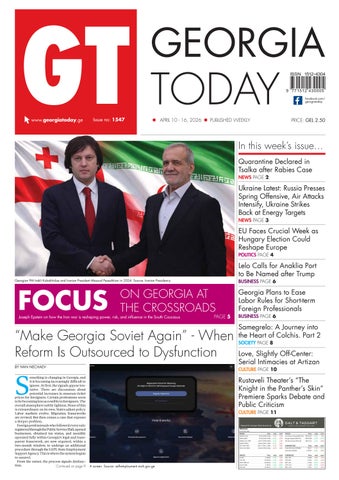
Georgian PM Irakli Kobakhidze and Iranian President Masoud Pezeshkian in 2024. Source: Iranian Presidency
Selected Georgian Heritage Sites to Remain Open during Holidays
BY MARIAM RAZMADZE
The National Agency for Cultural Heritage Preservation of Georgia reported that several major cultural heritage sites in Georgia will remain open to visitors between April 9 and 11 despite official public holidays, while museums nationwide will temporarily close on April 12–13.
The Agency announced that highdemand historical and architectural sites will continue operating under regular schedules from April 9 to April 11. These include:
• Uplistsikhe
• Vardzia • Ujarma
• David Gareja
The decision reflects strong public interest in these cultural heritage sites, particularly during holidays when domestic tourism typically increases.
Conversely, all museums and museumreserves operating under the Agency’s supervision will be closed on April 12 and 13. The temporary suspension applies uniformly across the network of statemanaged cultural institutions.
Authorities encourage visitors to plan their trips accordingly, taking advantage of the extended access to major heritage sites earlier in the week, while noting the full closure over the weekend period.
Georgia Delays Plastic Bottle Ban to 2031 after Business Consultations
BY MARIAM RAZMADZE
The Georgian government has postponed the enforcement of restrictions on plastic beverage bottles by four years, moving the deadline to February 1, 2031, Prime Minister Irakli Kobakhidze announced during a government meeting on April 8. The decision comes after consultations with representatives of the business sector, with authorities mentioning the need to balance environmental goals with economic stability. While reducing plastic consumption remains a priority for public health and environmental protection, the government acknowledged concerns
Quarantine
Gov’t Announces Full Restoration of Borjomi–Bakuriani Railway, Expansion of National Rail Network
BY TEAM GT
The Georgian government has announced plans for the full rehabilitation of the historic Borjomi–Bakuriani railway, widely known as the “Kukushka,” as part of a broader strategy to modernize and expand the country’s rail infrastructure.
Prime Minister Irakli Kobakhidze made the announcement during a cabinet session, confirming that both the rolling stock and railway infrastructure on the scenic narrow-gauge line will undergo comprehensive restoration. Five stations along the route are also set to be renovated.
The Borjomi–Bakuriani railway, a popular tourist attraction and one of Georgia’s most iconic rail routes, has remained
idle since 2020. Based on the government’s plan, the line is expected to resume operations in January next year.
“The government has taken the decision, and it forms part of a wider plan, to carry out the full rehabilitation of the historic Borjomi–Bakuriani railway,” Kobakhidze said, noting that the revival of the line will have “enormous significance” for tourism.
In addition to the Kukushka restoration, the Prime Minister announced the expansion of Georgia’s rail network with the introduction of two new routes: Tbilisi–Kutaisi and Tbilisi–Akhaltsikhe.
The Tbilisi–Kutaisi route will be integrated into the existing network, further improving connectivity between the capital and one of the country’s major regional hubs.
Meanwhile, rehabilitation works on the Tbilisi–Batumi line are expected to
be completed by August, reducing travel time from five and a half hours to four hours. The upgrade is anticipated to significantly improve passenger convenience on one of Georgia’s busiest routes.
Kobakhidze also confirmed that the Tbilisi–Akhaltsikhe line — which has been inactive since 2009 — will be restored by August. Travel time on this route is expected to be cut in half, from six hours to approximately three. The announcements come as part of a broader government effort to modernize transport infrastructure, boost tourism, and enhance regional connectivity. The restoration of the Borjomi–Bakuriani railway, in particular, is seen as both a cultural and economic initiative, aimed at reviving one of Georgia’s historic landmarks while attracting domestic and international visitors.
Georgia Parliament Draft Law – New C5 Visa to Target Wealthy Foreigners
over potential cost increases and operational challenges for companies.
Under the updated timeline, measures that were previously scheduled to take effect earlier will now be delayed until 2031. These include:
A ban on serving beverages in plastic bottles in restaurants and cafés, initially planned for July 1, 2026.
A full prohibition on the production, import and sale of plastic beverage bottles (except for export), originally set for February 1, 2027.
Both steps will now be implemented simultaneously in 2031.
Officials emphasized that the postponement does not signal a shift away from environmental commitments but rather reflects an approach to minimize disruption to businesses and consumers.
Declared in Tsalka after Rabies Case
BY LANA KOKAIA
The State Agricultural Laboratory confirmed a case of rabies in a wild fox in Tsalka municipality on April 6, near Tamar Mepe Street #132.
An investigation by the Kvemo Kartli Department of the National Food Agency found that the infected fox had been bitten by four stray dogs.
To contain the outbreak, the State Governor of Kvemo Kartli declared a quarantine in the affected area. Measures
include disinfecting the infection site, vaccinating domestic and stray animals, monitoring animal movements, and isolating suspected rabid animals for transfer to shelters.
So far in 2026, three rabies cases have been confirmed in Georgia.
The National Food Agency offers annual rabies vaccinations for domestic animals, reportedly covering up to 300,000 dogs and cats each year. Authorities urge pet owners to vaccinate their animals and emphasize that controlling stray dog populations and vaccinating animals are crucial for preventing the spread of rabies.
BY LANA KOKAIA
Adraft package of legislative amendments has been initiated in the Georgian Parliament, introducing a new C5 category visa under the law ‘On the Legal Status of Foreigners and Stateless Persons.’
The authors of the bill say the initiative aims to attract foreign citizens and investors with high purchasing power.
The draft law states that the C5 visa will be multiple-entry, valid for five years, and will allow holders to stay in Georgia for a total of one year. The visa will also cover the holder’s spouse and minor children. Holders will be permitted to engage in remote work for the benefit of non-residents. The fee for issuing a C5 visa, including in electronic form, will range from $20 to $500.
The initiators say the changes are expected to contribute to foreign currency inflows, as well as the development
of the tourism and service sectors. The draft also proposes limiting the right to appeal a refusal to issue a visa and is planned to be considered in Parliament under an accelerated procedure.
“The C5 category is issued to a person coming to Georgia for short-term purposes, who enters the territory of Georgia for tourist purposes and who also has the right to carry out activities only for the benefit of a non-resident person if it is related to activities carried out outside Georgia,” the explanatory note states.
Georgian cultural site. Source: Wander-Lush
Plastic bottles. Source: AZoCleantech
The Kukushka. Source: 1TV
Tbilisi. Source: Georgian Travel Guide
Ukraine Latest: Russia Presses Spring Offensive, Air Attacks Intensify, Ukraine Strikes Back at Energy Targets
COMPILED BY ANA DUMBADZE
The past week in the RussiaUkraine war saw continuing heavy fighting and pressure on both sides. On the ground, Russian forces pushed their spring offensive east of the Dnipro River, especially around Donetsk and the fortified urban belt. Ukrainian commanders said some Russian advances had slowed, and in several areas their troops had pushed the attackers back.
Ukraine’s commander-in-chief, Oleksandr Syrskyi, said Kyiv had regained about 480 square kilometers of territory since late January and retaken eight settlements in Dnipropetrovsk region and four in Zaporizhzhia region. He said, however, that Russian forces were still regrouping and continuing their offensive, while trying to secure more ground and create what he described as a buffer zone near Dnipropetrovsk. Ukrainian counterattacks near Hulyaipole and Oleksandrivka have slowed Russian movements around Pokrovsk, a key logistical hub in eastern Ukraine.
The frontline remains more than 1,200 kilometers long and heavily contested.
Key cities like Kramatorsk, part of Ukraine’s “fortress belt” of defenses, remain major objectives for Moscow’s forces, even as Russia’s overall gains appear limited compared with earlier phases of the war.
This week, air attacks drew particular attention. On April 3, Ukrainian air defense units reported intercepting hundreds of incoming threats, including more than 500 drones and dozens of missiles, though not all were stopped and there were casualties and damage in multiple regions. Ukrainian officials said Russia is increas-
ingly moving from night attacks to daytime strikes, a tactic meant to cause fear and disruption. Kyiv, Zhytomyr, and Kramatorsk were among the areas hit, and Kharkiv faced one of the heaviest bombardments since the war began.
The civilian toll was heavy. In Odesa on April 6, a drone strike killed a woman and her two-year-old daughter along with another woman and wounded more than a dozen people, including a pregnant woman and two small children. Damage to homes, a kindergarten, and power lines left thousands of households without electricity. In southeastern Ukraine on April 7, attacks on a bus in Nikopol and shelling in Kherson killed several civilians, including elderly residents. Officials in Kyiv described this pattern as an escalation during the Easter period rather than a pause. Russian bombardment also cut power
to hundreds of thousands of households in northern Ukraine after damage to distribution infrastructure. Ukrainian leaders say Moscow is trying to wear down defenses and civilian morale by targeting energy systems.
Energy infrastructure was a central focus for Ukraine’s military response. Kyiv has stepped up long-range drone strikes against Russian energy facilities to reduce export revenue and disrupt military logistics. The NORSI refinery, Russia’s fourth-largest, suspended operations after a Ukrainian drone attack on April 5. Ukrainian strikes have also affected other refineries and oil export terminals, including damage at Ust-Luga and Primorsk on the Baltic Sea, and reported fires at facilities in Ufa. Ukrainian forces also struck oil terminals in southern Russia, including at Novorossiysk, causing fires and damage
that affected loading infrastructure. These actions have drawn strong responses from Russian authorities.
Ukraine’s long-range strikes caused disruption and injury inside Russia as well. Officials said a drone attack on Novorossiysk injured at least eight people including children, while air and drone attacks in Belgorod and in occupied parts of Donetsk and Zaporizhzhia caused major power outages and at least one civilian death. Another strike in southern Russia killed one person, injured four others, and set a foreign-flagged vessel on fire. Ukraine’s point is clear: if Russia continues striking Ukrainian cities and infrastructure, its own assets supporting the war are vulnerable. Diplomatic efforts made little headway this week. President Volodymyr Zelensky said Ukraine is ready for a ceasefire if Russia halts strikes, including proposed pauses
on attacks against energy infrastructure. He said a lasting peace would require meaningful security guarantees for Ukraine. Moscow rejected the narrower ceasefire offer while continuing to call for broader peace talks on its own terms. Recent USbrokered talks, which have taken place in Istanbul, Abu Dhabi, and Geneva, remain stalled with disagreements over territory, including Russia’s demand that Ukraine surrender control of parts of Donbas that Kyiv refuses to concede. A potential visit by US envoys was discussed, but no breakthrough emerged.
On the international front, most support for Ukraine this week came in the form of financial and procurement measures rather than major new weapons announcements. On April 3, the European Commission began steps toward a €90 billion support loan for Ukraine for 2026 to 2027, including planned budget support and defense industrial funding. Measures were also approved to speed up procurement of drones and other defense equipment. The EU estimates its total military support for Ukraine at nearly €70 billion and broader assistance at about €195 billion. Ukrainian officials continue to emphasize that air defense systems, especially Patriot-class systems, remain urgently needed.
Taken together, the week did not see dramatic shifts in the frontline or in diplomacy, but it did show how the war is unfolding. Russia continues to press its spring offensive and intensify aerial attacks that hit civilians and infrastructure, while Ukraine responds by reclaiming territory in some areas and targeting the energy and supply networks that underlie Russia’s war effort. The result is a conflict marked by heavy fighting in the east, increasing pressure on infrastructure, and slow or stalled diplomatic negotiations.
Damaged residential building in Zaporizhzhia at the site of a Russian attack. Source: AFP
POLITICS
Long-failing Marriage or Audit of Crumbling Hegemony on April Fools’ Day
OP-ED BY GEORGE KATCHARAVA
The air inside the Kremlin on April 1, 2026, carried the heavy, stale scent of a longfailing marriage. When Vladimir Putin met Nikol Pashinyan, the diplomatic pleasantries could not mask a cold reality: Armenia is attempting a messy divorce from Moscow to elope with Brussels, and Russia is prepared to make the settlement as painful as possible. This was not a meeting of partners, but a high-stakes audit of a crumbling hegemony.
At the heart of the friction is Pashinyan’s aggressive pivot toward European Union integration, a move Putin treated not as a sovereign right, but as a breach of contract. The Russian President was uncharacteristically blunt, framing the Eurasian Economic Union (EAEU) and the EU as mutually exclusive realities.
To Moscow, one cannot enjoy the security of the Russian umbrella and the subsidized warmth of $177.50-per-thousand-cubic-meters gas while courting the very Western institutions currently strangling the Russian economy. It was a textbook display of energy as a leash. Putin’s subtext was clear: Armenia can choose the "European path," but it will pay European market prices to stay warm this winter.
The technical execution of this pressure fell to Deputy Prime Minister Alexei Overchuk, who articulated what is fast becoming known as the "Overchuk Doctrine." By invoking the 1828 Treaty of Turkmenchay, Overchuk wasn't just giving a history lesson; he was asserting a perpetual Russian proprietorship over the South Caucasus. He warned that if
Armenia follows the EU’s path, the "skies will close," effectively cutting off the millions of Armenians living in Russia from enjoying direct flights to their homeland. This historical callback suggests that, in the Kremlin’s view, the borders of the South Caucasus are not defined by modern international law, but by imperial precedents that predated the Soviet Union itself. This "regional ownership" philosophy is undoubtedly the engine behind the
3+3 proposed format, a diplomatic architecture intended to shut the door on the West and leave the South Caucasus nations to be managed as “puppet states” by Russia, Turkey, and Iran. For Georgia, watching from the sidelines, the recent Putin - Pashinyan Moscow summit was a grim preview of its own potential future. The tactics used against Yerevan, economic blackmail, the weaponization of trade routes like the Upper Lars crossing, and the demand for "har-
monized" legislation, are the same tools Moscow has used for years to destabilize Tbilisi.
As Armenia heads toward its June elections, Putin’s demand for "political space" for pro-Russian factions serves as a warning that Moscow intends to be a voting bloc of one. Whether through the control of the railways or the manipulation of the energy sector, Russia is demonstrating that its true attitude toward its neighbors hasn't changed since the
19th century: independence is tolerated only so long as it remains invisible. For the Caucasian mountainous trio, Armenia, Azerbaijan and Georgia, the message from the Kremlin was chillingly synchronized: the price of looking West or elsewhere is losing everything to your North.
Author’s bio: George Katcharava is the founder of eurasiaanalyst.com, a geopolitical risk and advisory firm.
EU Faces Crucial Week as Hungary Election Could Reshape Europe
BY TEAM GT
With Hungary’s parliamentary election just days away, European leaders are nervously watching Budapest as a decision that could change the European Union’s internal dynamics draws near. After 16 years in power, Prime Minister Viktor Orbán is facing the toughest electoral challenge of his career from Péter Magyar, leader of the center right Tisza party, who appears to have the momentum according to recent polling projections.
The outcome in Hungary matters far beyond its borders. Brussels has grown frustrated with Orbán’s repeated use of vetoes within the EU, particularly his decision this year to block a €90 billion aid package for Ukraine, a move that strained relations and contributed to deeper debates in EU capitals about how the bloc makes decisions when countries can halt progress on key issues.
In the final week of the campaign, the United States deepened its involvement in a way that further inflamed tensions.
Visiting Budapest on April 7, US Vice President J.D. Vance threw his weight behind Orbán’s bid for re election, accusing European leaders of improper interference in Hungary’s politics. At a joint appearance with Orbán, Vance described the situation as “one of the worst examples of foreign electoral interference that
I’ve ever seen or even read about,” remarks that were widely reported by Reuters and other outlets.
Vance also praised Orbán as a leader who could model a certain vision for Europe, saying his leadership offered a “role model for the continent,” comments that echoed support from former U.S. President Donald Trump and underscored how much the Trump administration is invested in the election’s outcome.
European Union officials rejected suggestions that Brussels was trying to shape the Hungarian vote. The European Commission emphasized that elections are a matter for Hungarian citizens alone, and Brussels has been careful not to intervene publicly in what it calls a domestic process.
Despite the high profile US involvement, some analysts doubt that foreign backing will decisively shift voter attitudes. Many Hungarians are focused foremost on daily economic pressures, including rising costs of living and stagnant wages. Younger voters, in particular, express deep dissatisfaction with the status quo; in recent polling only about 8 per cent of 18 to 29 year olds said they support Orbán’s party, with some even saying they would consider leaving the country if he wins again.
Péter Magyar has sought to balance his appeal between domestic concerns and Europe wide expectations. He has carefully avoided being portrayed as a “Brussels puppet,” a narrative Orbán often uses to frame his political opponents.
Prime Minister Viktor Orbán. Source EP
Magyar’s campaign emphasizes economic renewal, the promise of unlocking billions in EU funds currently frozen over rule of law disputes, and restoring what he describes as respect for democratic norms.
Opinion polls commissioned by the Median agency show Magyar’s Tisza party could win a two thirds majority in the 199 seat Hungarian parliament. Such a result would give the opposition sufficient votes to amend the constitution and pursue significant reforms, includ-
ing restoring stronger ties with the EU. While Orbán’s Fidesz remains a formidable political force with deep roots in rural areas and older demographics, the pace of change suggested by the latest data marks the most serious threat to his long tenure. Investors and financial markets are already responding to the uncertainty, with Hungarian assets and the currency experiencing increased volatility as the country enters its election week. Whether Hungary votes for continuity
or change on April 12, the result is likely to reverberate across EU capitals. If Orbán retains office, Brussels will again be forced to grapple with a member state that regularly challenges collective decisions on Ukraine, sanctions, and the EU’s future. If Magyar prevails, Hungary may return to closer cooperation with its European partners, unlocking funds and easing some of the bloc’s internal friction. Either outcome will shape the European Union’s capacity to act collectively at a time of deep geopolitical strain.
Nikol Pashinyan and Vladimir Putin. Source: AP
Georgia between Tehran and TrumpJoseph Epstein on Tbilisi's Tough Choices
INTERVIEW BY VAZHA TAVBERIDZE
As the war in Iran spreads beyond the Middle East, it is reshaping the South Caucasus, bringing rising proxy threats, refugee pressures, and shifting alliances to Georgia, Armenia, and Azerbaijan. In an interview with Radio Free Europe/Radio Liberty’s Georgian Service, Joseph Epstein, Director of the Turan Research Center and expert on Eurasia and the Middle East, explains that Azerbaijan faces direct attacks and pipeline threats, Georgia contends with pro-Iranian sentiment and security risks, and Armenia may gain room for Westernoriented initiatives. At the same time, Tehran’s regional aggression and Georgia’s pivot toward Russia, China, and Iran challenge US influence. Yet ongoing American engagement, sanctions, and strategic transit corridors give Washington leverage to shape Tbilisi’s decisions and protect its role in the Middle Corridor.
LET’S START WITH THE REGIONAL PICTURE. WHAT IMPACT IS THE IRAN WAR HAVING ON THE REGION, AND ON GEORGIA IN PARTICULAR? HOW MUCH HINGES ON THIS WAR FOR THE SOUTH CAUCASUS?
Quite a bit. The war is already having pretty big consequences: the region is no longer just a periphery of the conflict, but is actually in the spillover zone. Azerbaijan, I would say, has felt it the most acutely. There was a drone strike on Nakhchivan airport, and there were plots against the Baku-Tbilisi-Ceyhan pipeline and Jewish targets in the country which were foiled. For Georgia specifically, I would say the risks are a bit different, but still serious.
There is the proxy risk. Iran has spent years building networks of influence among the ethnic Azerbaijani Shia in Georgia, particularly in the south of the country. And since the war broke out, we've seen pretty acute displays of proIranian sentiment. We saw the imam in Marneuli come out and call the US a terrorist and display portraits of Khamenei, as well as protests at the Iranian embassy after the elimination of Khamenei, with a group of Georgian citizens saying that they were ready to follow the orders of Iran.
Baku has been warning Tbilisi about this problem for years, and the Georgian government hasn't been taking it seriously. Although, that being said, credit where it's due, very recently security services opened up an investigation into the Georgian branch of Al-Mustafa University. So that's a sign that maybe things are changing.
I think in Georgia, you definitely have the risk of some sort of attack against Jewish and Israeli targets. That has happened in the past during non-war times, and I think the risk is even higher now. But beyond the proxy threat, an unstable Iran could also trigger refugee outflows that affect all three Caucasus states.
WHAT ABOUT ARMENIA, WHICH ALSO SHARES A BORDER WITH IRAN. HOW PROFOUND IS THE IRAN WAR’S IMPACT GOING TO BE, ESPECIALLY WITH THE TRIPP (THE TRUMP ROUTE FOR INTERNATIONAL PEACE AND PROSPERITY) PROJECT IN MIND?
In the past, Iran has been an ally of Armenia. But in a way, a weakened Iran could actually be helpful for Prime Minister Pashinyan's objectives in the region, especially considering that Iran was dead set against TRIPP. We've seen threats. The Supreme Leader specifically said that he didn't want TRIPP. His senior advisor Ali Velayati said that he was
going to turn TRIPP into a graveyard for the mercenaries of Donald Trump. So, in a way, this does possibly give Armenia a little bit more room to move towards the West.
IS THERE A SCENARIO WHERE A WEAKENED IRAN, AFTER THE US LEAVES, TRIES TO REESTABLISH ITS CREDENTIALS, RE-IMPOSE ITSELF ON THE REGION BY LASHING OUT AT WEAKER NEIGHBORS?
Indeed. We've already seen that Iran is perfectly comfortable deploying the wounded animal strategy, where it will just strike out at everyone. We've seen that happen in the Middle East, as well as in the South Caucasus region, with Azerbaijan. So yes, a weakened Iran that isn't quite weakened enough will bring its own dangers.
FOLLOWING US SECRETARY RUBIO’S CALL TO PM KOBAKHIDZE, THE IRANIAN AMBASSADOR’S REMARKS WERE WIDELY SEEN AS THINLY VEILED THREATS, WARNING THAT NO COUNTRY IS IMMUNE TO REGIONAL CRISES AND THAT “THOSE WHO SUPPORTED DONALD TRUMP YESTERDAY NOW PAY THE PRICE.” YOUR THOUGHTS?
Well, Iran is a regional bully. It tries to impose its will on the countries around it through strength. The message is quite clear: don't collaborate with the US or you will become a target for us. What’s surprising about it is that this isn’t usually done through official channels. They typically like to do it through the IRGC or Tasnim, or some other government media outlet, so that they still have the ability to deny it. But the fact that the ambassador said it is a much stronger statement. This shows Iran is a lot more serious.
THE REMARKS WERE DIRECTED AT A GOVERNMENT WITH PRO-IRAN LEANINGS— KOBAKHIDZE WAS ONE OF FEW LEADERS TO VISIT IRAN AFTER RAISI’S DEATH, AND GEORGIAN DREAM HAS FACED CRITICISM FOR COZYING UP TO TEHRAN. WHY WASN’T THIS HANDLED THROUGH BACK CHANNEL DIPLOMACY?
I think it shows the sort of belligerence that you see in the Iranian regime. Iran is kind of similar to Russia in the sense that it doesn't actually have allies, only vassals and proxies. In Iran's case, it only has proxies that it can depend upon. And so, despite the fact that Georgian-Iranian relations have gotten better, despite the fact that we've seen the whole scandal about Iran opening up a bunch of businesses to evade sanctions in one Georgian village, despite Kobakhidze visiting and everyone being buddy-buddy, there isn't trust there.
And so Iran feels that it has to achieve its way through threats of force to put Georgia in its place. It's something of a cautionary slap, so to say, and not even on the wrist.
WHILE IRAN GEORGIA TIES SEEMED TO HAVE WARMED, THE US GEORGIA RELATIONSHIP HAS CLEARLY WORSENED. HOW DEEP AND IRREVERSIBLE IS THAT DECLINE, AND WHAT EFFECTS MIGHT IT HAVE?
It's no secret that Georgia has drifted from both the US and Europe since Georgian Dream came to power. And I would say that their surface logic for this actually does make some sense. They say that they want to practice multivector foreign policy, similar to Azerbaijan and Central Asia. However, multivectorism is all about balancing between power centers, not choosing a side. But what we see in practice is a lot more of
a deliberate turn towards Russia, China, and increasingly Iran.
I think it was a pretty big wake-up call when Vance came to the South Caucasus, and Georgia, once the most pro-US country in the post-Soviet space, was the only country left off his visit.
WHAT WILL THE COSTS BE OF SUCH POLICIES? WHAT WILL GEORGIA AND THE GEORGIAN PEOPLE HAVE TO PAY FOR THAT?
That's a good question. I think we know that European integration, joining NATO, was probably not on the cards anyway. Not necessarily because of the United States, but more because of Germany. That being said, if you look at the allies of Russia, Iran, and China, these are countries that don't necessarily seek to empower their allies. They seek to control them. And so I think, ultimately, the cost here could be sovereignty.
SINCE THE START OF THE IRAN WAR, HOWEVER, WE’VE SEEN SOME NEW RECIPROCITY. FOR EXAMPLE, WE’VE GOT HIGH-RANKING US OFFICIALS VISITING THE ANAKLIA PORT. DOES THAT SIGNAL RENEWED AMERICAN INTEREST?
I think it does signal something real. Georgia remains a key node of the Middle Corridor, especially as long as TRIPP is not yet operational. And so the Vance visit does show that Washington is not yet prepared to cede this strategic transit infrastructure to China. Washington doesn't see it as a done deal that they've lost Georgia. With TRIPP on the cards, this offers an alternative for the Middle Corridor, meaning Georgia does not have a monopoly on it anymore. This could actually then push Georgia towards more cooperation with Washington or risk becoming more irrelevant.
SECRETARY OF STATE RUBIO’S CALL TO KOBAKHIDZE SPARKED DEBATE. SOME SEE IT AS THE US ENGAGING GEORGIA, A WIN FOR GEORGIAN DREAM; OTHERS VIEW IT AS WASHINGTON REACTING TO TBILISI’S TURN TOWARD RUSSIA AND CHINA. WHICH DO YOU THINK IT IS?
I think the truth kind of sits between both interpretations. The Georgian government has clearly stepped up its outreach to Washington, especially after Vance's trip in February, which I think was a wake-up call, because it's not only that Georgia wasn't included: it was barely even mentioned. Kobakhidze has been mentioning this potential reset ever since. And the fact that Rubio took the time, especially during an active war with Iran, does suggest that Washington still sees value in engaging Tbilisi.
IS IT BECAUSE OF THE WAR IN IRAN THAT RUBIO FOUND THE TIME, OR DESPITE IT?
I'm not sure, to be honest. The US readout mentioned security in the Black Sea region, so they might have discussed the war, but it's unclear exactly what role. But what is interesting here is that the US and Georgian readouts told a diverging story. Kobakhidze, of course, declared it as a victory. He said it was productive, that they discussed resetting the partnership, reinforcing Georgia's regional role. But the US readout was a lot more restrained. They talked about areas of mutual interest. And then, crucially, on the same day, President Trump signed an extension of Biden-era Russia waivers that also included the sanctions on Ivanishvili. So it's definitely not a clean reset. I think it's more like a signal of continued engagement, simultaneous with continued pressure.
Trump is taking a Kartlis Deda approach to Georgia: he has a bottle of wine in one hand and a sword in the other
COULD GEORGIA FOLLOW A LUKASHENKO-STYLE MODEL, LIKE THE TRUMP ADMINISTRATION DID WITH BELARUS, WHERE THE US ENGAGES AN UNDEMOCRATIC GOVERNMENT IF IT MAKES CONCESSIONS, SUCH AS RELEASING POLITICAL PRISONERS?
Some sort of arrangement like that is possible. I wouldn't really call it a Lukashenko or Belarus model, because Belarus at this point is essentially a vassal of Russia. Its sovereignty is nominal. And that's not where Georgia is, at least not right now. The Trump administration in general has moved past this postCold War framework where democracy promotion and human rights were central pillars of US engagement with the region. What today’s Washington does care about is Tbilisi's foreign policy and how it engages with the world. So if there are places where Georgian Dream is willing to cooperate on transit, on connectivity, on the Middle Corridor, BTC, I think there's a basis for engagement, even without democratic credentials. But it's also going to be crucial how much Georgian Dream continues to work with and enable America’s adversaries.
SO, IF GEORGIAN DREAM TRIES TO BALANCE ITS FOREIGN POLICY, THE US MIGHT OVERLOOK ITS DOMESTIC MISSTEPS. AM I READING THAT RIGHT?
Yeah, I think so. Because we're seeing them work with these Central Asian governments, with Azerbaijan, even Armenia. I mean, its democracy is really nascent, and that's not an issue there. Some of its closest allies in the Middle East, the UAE and Saudi Arabia, are far from democracies. Democracy is kind of falling off as a criterion for engagement.
IF GEORGIA REFUSES TO ALIGN ON FOREIGN POLICY, HOW MUCH LEVERAGE DOES THE US STILL HAVE? COULD WASHINGTON USE SANCTIONS ON IVANISHVILI, PROLONGED OR LIFTED, AS A TOOL TO INFLUENCE TBILISI TO DO WHAT IT WANTS?
I think it's totally possible. Washington no longer has the leverage of the EuroAtlantic integration path. But there are still meaningful pressure points. The TRIPP corridor, once built, could diminish Georgia’s transit relevance. As for the Biden-era sanctions on Ivanishvili, yes, obviously the picture got more complicated after Trump extended them on the same day as Rubio's call with Kobakhidze. I think essentially Trump is taking a Kartlis Deda approach to Georgia: he has a bottle of wine in one hand and a sword in the other. But the difference, I would say, is that he's holding out both, he's extending both simultaneously, and giving the Georgian government a constant choice.
Joseph Epstein.
Lelo Calls for Anaklia Port to Be Named after Trump
BY TEAM GT
Georgia’s opposition party
Lelo – Strong Georgia has called for the Anaklia deepwater port to be named after US President Donald Trump and positioned as a key hub in a proposed regional transit corridor referred to as the “Trump Route.”
Speaking at a briefing, Irakli Kupradze, the party’s General Secretary, said the Anaklia Port could play a decisive role in strengthening Georgia’s security, economic development, and energy diversification in the Black Sea region.
“We appeal to all involved parties to name the Anaklia Port after President Trump and make it the gateway of the ‘Trump Route’ to the Western world, which will bring us security, Western investments, and economic growth,” Kupradze said.
He claimed that the project carries strategic importance amid ongoing geopolitical instability and conflicts in the wider region. He criticized the ruling Georgian Dream government, accusing it of pursuing what he described as an “isolationist and anti-Western” policy that risks undermining Georgia’s national interests.
Kupradze argued that the Anaklia project — a long-delayed deep-sea port on Georgia’s Black Sea coast — is comparable in significance to major regional infrastructure initiatives such as the Baku-Tbilisi-Ceyhan oil pipeline, and aligns with the strategic priorities of the United States.
He stressed that Anaklia should be granted the status of a strategic object
of national importance and declared the country’s top national priority. The opposition party also called for a leading role in the project to be given to American and transatlantic financial institutions, while excluding entities linked to Russian or Chinese state interests.
The Anaklia port project has been a subject of political and economic debate for years. Initially launched as a flagship infrastructure initiative aimed at transforming Georgia into a regional logistics hub, the project stalled after the government terminated its contract with the Anaklia Development Consortium in 2020, citing unmet obligations. Critics, however, have argued that the decision damaged investor confidence and slowed the country’s strategic development.
Lelo insists that the project must move forward transparently, with all related contracts made public to avoid what Kupradze described as previous “failed investment attempts.”
The party also linked the port’s future to emerging regional dynamics, pointing to a newly discussed transit corridor in the South Caucasus following recent Armenia-Azerbaijan agreements. According to Kupradze, Georgia risks being bypassed unless Anaklia is developed as a central node in this route.
“Anaklia is not just a port; it is Georgia’s national and geopolitical choice,” he said, adding that the project could create tens of thousands of jobs and drive the development of a new urban and economic center, “Anaklia City.”
The opposition party pledged to prioritize the rapid construction of the port both now and upon coming to power, describing it as essential for Georgia’s long-term economic growth and geopolitical positioning.
Georgia Cancels $370m in Fines for 157 Energy Companies
BY LANA KOKAIA
The Georgian government has written off fines totaling about 1 billion lari ($370m) for 157 companies in the country’s energy sector. Authorities say the move is part of a ‘conditional write-off’ scheme. Companies fined for network failures, periodic power outages, budget arrears, or unmet obligations will have their penalties cancelled if they meet future deadlines. Fines
Georgia Plans to Ease Labor Rules for Short-term Foreign Professionals
BY TEAM GT
Georgia’s ruling party has introduced legislative amendments that would allow foreign nationals to carry out certain professional activities in the country without obtaining residence or work permits, provided the work is short-term and project-based.
The initiative, already submitted to Parliament, proposes adding a special article to the Law on “Labor Migration” to address gaps in the current framework, which does not distinguish between temporary and long-term employment.
Under the draft law, foreigners will be permitted to engage in short-term professional activities in Georgia without a work or residence permit if their work is tied to a specific project, event, or service, does not lead to long-term participation in the local labor market, and is carried out as a temporary visit.
The government will determine the list of eligible activities, their duration, and the criteria for defining them as short-term through a separate decree.
Importantly, individuals operating under this framework will not be classified as labor immigrants or selfemployed foreigners in Georgia.
The proposed amendments also expand the list of activities exempt from the law’s requirements. These include individuals holding a special residence permit issued on the initiative of a govern-
ment member, employment in public institutions or state-participated enterprises, and various forms of remote work—such as working for a Georgian employer from abroad or providing services to a non-resident entity outside the country.
Additionally, managerial roles and participation in audit committees in first, second, and third category enterprises, as defined by the Law on “Accounting, Reporting and Auditing,” will also be exempt.
Authors of the initiative claim that the existing legal framework applies uniform immigration procedures to all types of professional activity, regardless of duration or purpose. In practice, this has created challenges in cases where foreign specialists are invited for short-term, one-off assignments, often requiring urgent timelines. They argue that the current system
imposes unnecessary administrative barriers that can delay or disrupt economic and operational processes. The amendments aim to reduce bureaucratic pressure and introduce a more flexible mechanism that recognizes the specific nature of short-term professional visits, allowing them to be carried out legally without undergoing full immigration procedures.
Lawmakers also stress that granting the Government authority to define detailed criteria through secondary legislation will ensure adaptability, enabling regulations to be adjusted in line with evolving labor market needs. The proposed changes are expected to streamline labor migration management while supporting business efficiency and international cooperation, particularly in sectors that rely on short-term foreign expertise.
Land Sales Rise in Georgia, Demand Pushes Prices Up
BY LANA KOKAIA
The land real estate market in Georgia is growing steadily, with annual sales increasing by around 5–6%, according to Irma Elbakidze, founder of brokerage company Binarea.
In the first quarter of 2026, land transactions in Kakheti rose 17% year-on-year, while the Black Sea region saw growth of up to 12%, Elbakidze said in an interview with Sakmis Kursi (Business Course).
“Overall, transactions have increased by 15–20%, with strong interest from Israel, Arab countries, and CIS states. Demand has grown, especially following recent developments in the Middle East,” she added.
will be reinstated for companies that fail to comply.
Prime Minister Irakli Kobakhidze noted that the government made the decision several months ago, and the write-off process has now been finalized. He added that some companies chose not to participate, which will result in the cancellation of projects totaling 535 MW, while projects amounting to 1,500 MW will move forward.
On 30 March 2026, the government announced an increase in electricity tariffs. Household consumers will pay 5 tetri more per kilowatt-hour (about $0.02), while commercial tariffs will rise by 4–6 tetri ($0.01–0.02). Overall, tariffs have increased by 33%, effective 1 April.
The National Energy and Water Supply Regulatory Commission (GNERC) said the rise is due to Georgia’s reliance on electricity imports and higher purchase prices. Planned investments for the new tariff period are also affecting prices.
The commission noted that these investments are intended to gradually upgrade the electricity distribution system and reduce outages, improving reliability for consumers.
Rising demand and limited land supply are pushing prices higher. “Some owners have paused sales, expecting prices to increase further,” Elbakidze said. She cited a Tbilisi suburb where a plot that
sold for $12 two years ago is now listed for $120, attributing the jump to demand. Experts expect the Georgian land market to continue its steady growth throughout 2026.
Georgia to Create Economic Development Corporation and Separate Investment Agency,
BY LANA KOKAIA
eorgian Prime Minister Irakli Kobakhidze announced the establishment of the Economic Development Corporation of Georgia during a government session.
The new institution will be founded on the basis of the Produce in Georgia agency, with several functions, including those of the Development Fund of Georgia, merged into the corporation.
“New instruments will be added to the Produce in Georgia programme, and existing tools will be optimized, enhancing access to finance for the private sector. These new initiatives include initiated loans and measures to develop the capital market. Particular attention will
Irakli Kupradze. Source: IPN
A light bulb. Source: Energy Managers Association
Land for sale in Georgia. Source: Land.gov.ge
Irakli Kobakhidze and Mariam Kvrivishvili. Source: gov.ge
Business people. Source: FB
Economic Growth to Slow in Europe and Central Asia as Risks Rise
BY TEAM GT
Economic growth across developing countries in Europe and Central Asia (ECA) is set to slow markedly this year, as mounting geopolitical tensions, trade fragmentation, and the ongoing conflict in the Middle East weigh on the regional outlook, according to the latest ECA Economic Update released by the World Bank Group.
The report projects regional growth to weaken to 2.1 percent in 2026. In Russia, growth is expected to decelerate to 0.8 percent, while expansion in the rest of the region is forecast to ease to 2.9 percent, as higher energy costs curb consumption and uncertainty dampens investment.
“The region’s resilience continues to be tested, with several countries dependent on imports of natural gas, oil, and fertilizers,” said Antonella Bassani, Vice President for Europe and Central Asia at the World Bank. “Efforts to address the impact of the crisis will be needed in many countries, with a focus on targeted measures to protect the most vulnerable. Pressing ahead with policy reforms for firm growth and job creation will also help to mitigate crisis impacts and strengthen economic resilience and dynamism.”
Subregional trends point to a broadbased slowdown. Growth in Central Asia is expected to average 4.9 percent in 2026 and 2027, reflecting stabilizing oil production in Kazakhstan. In Central Europe, growth is projected at about 2.4 percent this year before moderating slightly to 2.3 percent in 2027, with weaker consumption partly offset by European Union funded public investment. The Western Balkans are expected to see growth aver-
aging 3.1 percent over the next two years, supported by infrastructure investment and strong service exports. Ukraine’s economy is projected to expand by just 1.2 percent this year, constrained by ongoing hostilities, rising energy costs, and mounting fiscal pressures.
The report highlights a prolonged and intensifying conflict in the Middle East as a key downside risk. Such a scenario could significantly disrupt global supplies of energy and fertilizers, driving up energy and food prices and further
dampening growth across the region. Beyond immediate risks, the report underscores a longer-term challenge in the form of slowing productivity growth across many ECA economies over the past decade. In response, some governments have increasingly turned to industrial policies, which are targeted interventions aimed at promoting specific sectors, activities, or firms.
A special analysis in the report suggests that these policies would benefit from clearer targeting and a stronger focus on future competitiveness rather than rein-
Bridging Markets - Georgian Businesses Tap into Estonian Expertise with EU and UNDP Support
BY TEAM GT
Georgian entrepreneurs are getting a boost in their efforts to reach European markets, thanks to a joint initiative backed by the European Union and the United Nations Development Programme, in partnership with the Estonian Centre for International Development.
The program supports small and medium-sized enterprises in building practical skills, gaining new insights, and connecting with mentors as they prepare to expand beyond Georgia’s borders.
In March, Estonia’s Visionest Institute led a series of training sessions focused on service exports, covering areas such as education, training, design, and marketing. The sessions brought together participants including academic and EdTech program managers, digital marketing specialists, CEOs, and business owners. Through tailored programs called “Creative Services Export” and “Education Elevator,” participants learned how
to better understand their business offerings, clearly communicate what makes them unique, and position themselves in competitive European Union markets. They also explored practical ways to attract and retain international clients.
The training included work on digital business-to-business outreach strategies, improving social media presence, and using tools to strengthen operations and expand professional networks.
“The European Union remains committed to supporting Georgia’s private sector,” said Mindy Bojkova, Program Officer for Private Sector Development and Trade Facilitation at the EU Delegation to Georgia. “By investing in skills and innovation, we help small and medium-sized entrepreneurs grow, compete, and connect to European markets.”
Giorgi Tsimintia, Project Manager at the United Nations Development Programme, highlighted the increasing importance of the service sector for Georgia’s future.
“Export readiness is not only about markets. It’s about unlocking potential, creating jobs, and driving inclusive growth. With the European Union’s support, UNDP helps turn expertise into
opportunity, enabling Georgian businesses to grow beyond borders,” he said.
Anu-Mall Naarits, CEO of Visionest Institute, pointed to the value of collaboration across borders.
“The companies we engaged with are innovative, results-driven, and ready to compete globally. Targeted training and international exposure will further strengthen their capacity, resilience, and long-term sustainability. This first experience lays a strong foundation for deeper cooperation between European and Georgian service sectors,” she said.
Around 50 participants took part in the spring 2026 training cycle. Fourteen of the strongest performers, seven from education and training and seven from design and marketing, will continue their development with tailored mentorship support.
Looking ahead, the European Union and the United Nations Development Programme plan to expand training and coaching over the next two years, helping more Georgian businesses unlock export potential and grow sustainably.
The effort is part of the “Inclusive Access to Markets” initiative, a four-year program running from 2023 to 2027.
Funded by the European Union with EUR 5,000,000 and co-funded by UNDP with EUR 162,000, the project aims to strengthen business capabilities, improve value chains, and open doors to European markets.
For more than 30 years, the European Union has worked closely with Georgia, supporting its development through knowledge sharing, expertise, innovation, and financial assistance, grounded in shared values such as peace, freedom, democracy, human rights, and inclusive economic growth.
forcing existing economic weaknesses. Currently, nearly two-thirds of industrial policy measures are concentrated in agriculture and food production, while only 10 percent are directed toward high-tech or capital goods sectors.
“To achieve stronger growth in productivity and jobs, ECA countries could prioritize ambitious policy reforms that modernize the business environment, catalyze entrepreneurship, and improve the quality of education,” said Ivailo Izvorski, Chief Economist for Europe and Central Asia at the World Bank
Group. “Tailored public inputs, such as industrial parks or special economic zones, are the most important type of industrial policies that can help address well-identified market failures. But industrial policies have to be used sparingly and only temporarily.”
The report concludes that where industrial policy is applied, it should support new and dynamic private sector firms and ideas, rather than protect incumbents such as state owned enterprises, and must reinforce rather than undermine market competition.
Georgia’s PM: Anaklia Port Construction to Resume in Coming Days
BY LANA KOKAIA
Georgia’s Prime Minister Irakli Kobakhidze says Anaklia deep-sea port construction will resume in the coming days, with project costs reduced after state expenditure optimization.
“We reviewed the agreement for the deepening of the Anaklia port and the construction of a breakwater, originally costing 203.9 million dollars. We also reviewed the agreement with the supervisory company. As a result, the project cost has been reduced by more than 25% — 52.5 million dollars. Construction in Anaklia will now resume with much reduced costs,” Kobakhidze said. Under the contract signed in August
2024, the Belgian company Jan De Nul is responsible for dredging the seabed and installing the breakwater. The 2026 budget reduces financing for Anaklia port works by 100 million GEL to 50 million GEL. Once the first phase is completed, the port’s annual throughput is expected to reach approximately 600,000 TEU (7.8 million tons of cargo), with the seabed deepened to at least 16 meters.
Although the Chinese state consortium CCCC won the May 2024 competition, the investment agreement has not yet been signed. If finalized, the Chinese side will take a 49% stake, invest millions of dollars, and manage the facility.
On March 26, 2026, Deputy Minister of Economy Tamar Ioseliani briefed Peter Andreoli, a representative of the Bureau of European and Eurasian Affairs of the US Department of State, on the progress of the Anaklia port project.
Anaklia port. Source: anakliadevelopment
Supporting Georgian small and medium-sized enterprises on their journey to European markets. Photo by Nino Zedginidze/UNDP
Samegrelo: A Journey into the Heart of Colchis. Part 2
BLOG BY TATJANA MONTIK
It is said that the fortress-city of Nokalakevi, or Archaeopolis in Greek, may have existed as early as the 13th century BC. In Georgian, "Nokalakevi" translates roughly to "the place where a city once was." If this city is indeed that ancient, it could very well be the Georgian Troy!
The site spans approximately 22 hectares, preserving the ruins of a royal palace and Roman baths from the 5th century AD, along with many other notable structures. Curiously, these include a large private house with a garden where people still live today.
During the Soviet era, before the site was recognized as a cultural monument, seven families resided within the fortress grounds. When archaeological excavations began in the 1970s, six families accepted government compensation and moved. However, one family refused to leave, and according to museum staff, this continues to create significant challenges for archaeological work.
A STRATEGIC STRONGHOLD
If you climb the preserved section of the fortress wall to the left of the entrance, the brilliance of the city’s location becomes clear. Nokalakevi sat on a vital strategic route; the adjacent mountain ridge offers a superb vantage point over the Colchian Lowland and the Tekhura River, which flows into the Rioni and onward to the Black Sea.
Historian Lasha Jikia and many of his colleagues believe that the ancient city of Aia, the destination of the Argonauts, might have been located here. While excavations have so far only reached layers from the Kingdom of Egrisi (4th–8th centuries AD), Archaeopolis is widely considered to have been the capital of the Colchian Kingdom for centuries. This ground has seen countless battles against Persian and Arab invaders.
THE SECRETS OF THE TUNNEL Our guide, Anna Gvasalia, led us through the fortress-city. Its recorded history spans from the 6th century BC until it was finally destroyed in 736 AD by the Arab general Marwan "the Deaf." Until then, no invaders, not even the Persians, who besieged it for twenty years, could breach its complex defensive walls.
After showing us the royal palace, the Fourth Gate, and the Roman baths, Anna took us to one of the settlement's most remarkable features: a 40-meter tunnel of solid Roman arched masonry leading down to the river.
"This tunnel served as a passage to the river gates, connecting the inhabitants to the Black Sea via the river," Anna explained. "In those times, Romans and Byzantines arrived by boat to trade, taking away everything Colchis and Egrisi produced: gold, jewelry, metals, honey, wine, ceramic tiles, shipbuilding timber, and flax for sails and ropes."
Descending the tunnel, we were met with a stunning view: clear emerald water and a quiet backwater that looked incredibly inviting for a swim, framed by massive boulders and lush, green cliffs.
A MUST-VISIT FOR HISTORY LOVERS
Nokalakevi is an essential stop for anyone fascinated by antiquity or Byzantine history. The ruins are impressive when viewed from the highway, but the scale of the fortress is even more striking from within. While the local archaeological museum is currently closed for renovation, excavations were underway again last summer. Who knows what other secrets this ancient stronghold still hides?
This is a wonderful section! It reads like a true culinary adventure. Here is the translation, keeping the mouthwatering descriptions and the warm, hospitable tone.
THE SECRETS OF MEGRELIAN CUISINE
In the world of Georgian gastronomy, Megrelian cuisine holds a place of high honor. It is famous not only for its piquancy but also for its vast variety and the uniqueness of its dishes. Among them are recipes that the rest of the world has never even heard of, dishes so distinct they are difficult to describe. In short: you simply have to taste them!
Why is the food in Samegrelo so spicy?
The reason lies in the climate. Historically, this region was hot and humid, and for centuries, if not millennia, malaria was a rampant threat. To keep the disease at bay, it was necessary not only to drain the swamps but also to use spices as medicine. Carefully selected aromatics acted as natural antiseptics.
"Most of our spices are not indigenous; they were brought here from India, black pepper, red chili, cloves, and fenugreek," Albert Khuntselia explained at the Martvili Museum. "This is a testament to the active trade between Colchis (later the Kingdom of Egrisi) and Asian countries. It is no coincidence that the Great Silk Road passed through our lands."
The most essential seasoning for a Megrelian hostess is adjika. Every cook surely has her own secret recipe for this intensely hot paste. Usually, it is made
from dried red peppers, garlic, and a blend of spices like utskho-suneli (blue fenugreek), Imeretian saffron (marigold), and coriander.
LIVING TRADITIONS
IN SISATURA
Our introduction to the daily life and evolution of Megrelian villages began in the ethno-village of Sisatura, near Zugdidi. This unique museum, founded by Marika and Enri Todua, is a true tribute to their homeland. The couple strives to share this love with every visitor, immersing guests in the Colchis of old. In Sisatura, you don't just observe history, you live the traditions, customs, and lifestyle of the Megrelian people. Marika Todua showed us various types of kitchenware used by Megrelian women for generations. One of the most important tools is the stone mortar for grinding spices, called a khaki. Why use a mortar? Because spices only release their full aromatic potential when they are ground immediately before cooking. Interestingly, for some dishes, hostesses even crush fresh herbs in the mortar to release the juices and amplify the fragrance tenfold.
THE LEGENDARY ELARJI
Before my trip, a friend, and die-hard fan of West Georgian cuisine, told me I absolutely had to visit Aza in the village of Balda. According to him, this woman prepares a legendary elarji.
From Martvili, a scenic road took us across the river to a colorful village called Pervaya Balda (First Balda). Finding Aza there is easy; her hospitable family and cozy guesthouse are known to everyone. We were greeted at the gate by Aza’s husband, Giorgi, who promised an unforgettable masterclass in Megrelian cooking.
First, our host shared the main secret behind his wife's famous dishes: top-tier ingredients, grown and prepared with love. Giorgi grazes his cows on the highaltitude meadows of the Askhi Plateau, 2,200 meters above sea level. They say that on a clear day, you can see the Black Sea from the plateau, and the environment there is pristine. You can imagine the kind of cheese produced from the milk of cows that spend their entire summer blissfully grazing on alpine herbs!
A MASTERCLASS IN "DAIRY TENDERNESS"
In a Megrelian home, the kitchen is usually a separate building. In the culinary kingdom of Aza, Giorgi’s charming and warm-hearted wife, everything is perfectly arranged to feed a large family and guests alike.
Aza leads us into her domain and takes out the star ingredient: a large block of cheese called chkinti.
Note: "Chkinti" means "young cheese." It is a very popular unaged cheese in Georgia (known elsewhere as Imeretian cheese). It is soft, slightly salty, and tender, perfect for eating fresh or using in khachapuri.
First, Aza teaches us to make gebjalia. My mouth is already watering; this is one of my absolute favorite Georgian dishes!
In a large wooden mortar, Aza crushes finely chopped green chilies, a bunch of mint, and salt into a smooth green paste. She then slices the cheese into small pieces, pours boiling water over them, and begins to stir. This is the process of making sulguni (similar in technique to mozzarella). After five minutes of intense stirring, the cheese reaches a dough-like consistency. Aza rolls it out into a sheet, spreads half of the spicy mint filling over it, rolls it up, and rubs the remaining paste on the outside. Finally, she splashes it with a little milk and slices it.
Our gebjalia is ready! We devour it instantly. If I had to name this dish, I would call it "minty-milky tenderness."
No other cuisine in the world knows such a flavor! It is now clear how Megrelians balance their heat: they simply infuse it with a touch of dairy grace.
PULLING THE ELARJI
"And now, we prepare elarji!" Giorgi declares proudly. "Elarji is the calling card of our cuisine," Aza adds. "No feast here is complete without it."
While bread is the staple in Europe and rice in Asia, in Western Georgia, it is the corn-based elarji. It is made from a small amount of white cornmeal cooked like an Italian polenta or Moldovan
mamaliga. But stirring it requires immense strength, because as you stir, you add cheese, a mountain of cheese!
According to Giorgi, the secret is simple: "Don’t be stingy with the cheese! Our elarji is only 20 percent corn, the rest is cheese!"
The mass must be mixed and stretched thoroughly as the cheese begins to boil and melt. Giorgi is a pro; he tames the bubbling mass by lifting a wooden spoon as high as possible. The cheese follows obediently, stretching upward without splashing. Giorgi claims he can stretch elarji up to 4 or 5 meters!
(In that case, he’d have to pull it sideways, or the chef would need a stepladder!)
Aza serves the finished dish on two trays. "We won't let you leave until you finish it!" the couple jokes, and we happily comply. Usually, elarji is served as a side dish for meat, such as kupaty (sausages). But we are so captivated that we eat it plain: the cheesy porridge stretches endlessly, and it is incredibly fun!
We also learned a curious detail: in the past, people in Samegrelo ate elarji for breakfast, cutting it into squares and pouring warm milk over it.
As we savored this delicacy, a question arose: "What did they make this from before corn was brought to Georgia from the New World?" "We used ghomi flour," Giorgi replied. But that didn't mean much to us yet, the visual answer to that question would come later.
Tatjana Montik, journalist, author, and passionate admirer of Georgia, has spent the past 15 years living in and reporting on this captivating South Caucasus country. See more of her experiences in her new travel diary and cultural guide, Georgia: A Tapestry of Time and Space.
Nokalakevi Fortress. Photo by the author
Cooking class in Balda village with Aza Nachkebia. Photo by the author
“Make Georgia Soviet Again” - When Reform Is Outsourced to Dysfunction
Continued from page 1
The agency’s website does not work reliably. Communication channels exist, but responses do not come. Instructions remain unclear, sometimes even to those tasked with implementing them. Yet applicants are required to register anew and pay an additional fee of roughly 200 GEL: a payment made upfront, regardless of whether the service is ultimately delivered.
At the same time, the agency has no access to data already held by the state. Documents previously submitted through the Public Service Hall or tax authorities must be manually downloaded and uploaded again. The applicant becomes the intermediary between government institutions. A system once defined by integration begins to fracture into duplication. This is the moment where the process stops resembling reform and begins to feel distinctly regressive.
Applicants are required to collect documents across institutions and submit them again to a newly created body that lacks access to those same records. There are no clear consultations, no structured guidance, no meaningful support. At the interview stage, the logic becomes almost explicit: “there are many of you, and I am alone.”
Even the basic functionality appears unstable. Systems fail at launch. Requirements change after implementation. Document formats are updated without notification. Applicants submit exactly what is requested, only to be rejected, and only later discover, through independent research, that a new version of the same document has quietly become necessary. The process demands initiative, and offers no clarity in return. Time, too, is treated as expendable. Interviews are not scheduled: they are imposed. Invitations arrive less than 24 hours in advance. There is no possibility to select a time, no option to reschedule, no mechanism to explain conflicts. During the whole month, applicants are expected to remain constantly available, unable to plan travel, work, or even medical procedures. A flight, a surgery, a professional obligation: none of these are accounted for. Failure to appear becomes an automatic ground for refusal. The structure of communication reflects the same disorder. Messages are dense, bilingual, and poorly structured, with critical requirements embedded within polite, non-binding language. “Please
bring your passport and, if possible, your residence permit.” “If possible.”
In practice, there is no flexibility. Without a passport, the interview does not proceed, even if the applicant presents a valid Georgian residence permit. This raises a simple question: if a state-issued residency document cannot verify identity within the state itself, what is its purpose?
Equally striking is the institutional isolation of this procedure. This appears to be the only state service in Georgia that cannot be accessed through the Public Service Hall called House of Justice: the institution that once defined the country’s administrative reforms. The “onewindow” principle, built on clarity and accessibility, is entirely absent here. The
implication is difficult to ignore: a system that exists outside the main architecture of public service begins to operate outside its logic of “Justice.”
The practical effect of the reform reveals a deeper imbalance. It does not regulate the informal labor market. It does not affect those working outside the legal framework. Instead, it imposes additional costs, administrative burdens, and uncertainty on those who have already complied. Those who registered. Those who paid taxes. Those who monthly followed the rules. They are required to repeat procedures, pay additional fees, and navigate a system that offers neither clarity nor guarantees. Compliance becomes a liability.
One possible explanation lies in broader
trends, including a decline in the number of foreign professionals and an attempt to recalibrate or financially structure their presence. There is nothing unusual in a state seeking additional revenue. But if that is the objective, there are simpler and more transparent ways to achieve it.
Charge the fee. And respect people’s time.
Do not construct a system that forces individuals to act as couriers between institutions, to monitor their inboxes constantly, or to reorganize their lives around unpredictable administrative demands. Because what exists now requires both money and time, without guaranteeing either service or outcome.
This is not a failure of policy. It is a failure of delegation. A complex and sensitive function has been entrusted to
the LEPL State Employment Support Agency, a structure that, in its current form, appears unprepared to carry it.
The result is not merely inefficiency. It is a reputational risk.
Because Georgia’s image, built over three decades, rests on a clear promise: that the state is understandable, predictable, and functional. When that promise is undermined, even temporarily, the consequences extend far beyond one agency. They affect trust. They affect investment. They affect the decision to stay.
This situation does not appear inevitable. It appears avoidable. Which makes the final question unavoidable: Why was such responsibility entrusted to a system that was not ready to handle it?
Democracy & Transparency in the Electronic Realm
BY NUGZAR B. RUHADZE
Notwithstanding my rockhardened but still enjoyable age as a midway octogenarian, I’ve got my computer skills and Internet manners at my fingertips. I now reminisce with a smirk how gingerly and fearfully I had stepped into the then hardly developed electronic world to try my intellectual abilities and my readiness to embrace the rapidly advancing new, chilling epoch of the www age. At that uncertain time, I could not see myself, even in my wildest imagination, sitting and tinkering with an unexpected magic like Facebook – the entire world, inside and out, ensconced in my little palm. All of a sudden, everything changed so drastically and vertiginously that a regular mind found it difficult to catch up with the surfeit of electronic novelties. Many of us, the folks of my age, got inflicted with, let’s call it, Internet-and-computer phobia. Not me, though! I valiantly entered the battle and here we go – all the money I currently make is coming from elec-
tronic means and ways, and nothing is going to stop my self-development.
I am operating on the Internet on a 24/7 basis, connecting all I am doing in life with the new mutual domain of our lives, but behold, Facebook has enough power, right, and temerity to voluntarily block features, restrict accounts, and cause service interruptions, based on its claim to protect the integrity of this or that platform under the pretext that it maintains security by means of enforcing the Community Standards. Personally, to me, these kinds of actions seem to be extremely troublesome, but I also understand that they are often designed to restrict bots, abuse, and security threats. This is all good, but when they block me and I am not given a reason for stopping my endeavor to survive, it is not simply irritating, but absolutely frustrating and nerve-wracking.
To calm myself down and to somehow maintain my normal rhythm of life, I went into thorough research of the situation by understanding what I am having to do with in actuality in terms of automated security and anti-spam measures.
As I have learned, Facebook uses algorithms and AI to regulate patterns sooner
than personal actions, when its systems sense risks like sending too many friend requests, liking too many posts, posting in many groups, frequent device switching, posting the same link, sending the same comment an overly numerous number of times, etc. All this may cause this or that system to temporarily block our ability to post. This is just some of the reasons why we get hampered and kept in electronic custody, and why Facebook restricts or blocks users who vio-
late their policies.
And violations include hate speech, harassment, nudity, or misinformation; using fake names; impersonating others; or managing pages with fake profiles, all conducive to causing an account to be disabled and leading to a temporary or permanent ban. There is another streak to the whole thing: sometimes Facebook voluntarily brings down parts of its service to perform upgrades, by telling us ‘Facebook will be back soon,’ which nor-
mally means the company is making improvements to the database where our account is stored. Sometimes, the updates get procrastinated, which might be a reason that some of us have access while others don’t.
To continue, Facebook also has a habit of monitoring threats in real time, which involves augmented security measures limiting functionality in regions facing political unrest or high risks of violence. In the process of my ardent research, I also learned that some of Facebook's mandatory measures may last from one to thirty days, restricting specific actions like posting, messaging, or advertising. And most importantly, it seems like the total loss of access usually occurs in cases of repeated violations.
This is all well understood, but would it not be more civil to use some affordable decorum and tell a poor user that something bad is happening to him or her, to let them have some patience and stay happy until the service is revived? This is a question of a victim, kept in darkness for days, having suffered a huge setback in things he is trying to bring to a successful end, to the benefit of this nation and for some personal advantage too.
Facebook blocked. Source: askleo
BLOG
The Public Service Hall in Tbilisi. Source: ongo
Authorize
BLOG BY TONY HANMER
Corner House Coffee, at 109 Aghmashenebeli Avenue in Tbilisi, recently hosted an evening about self-publishing, which I attended and found especially helpful. Presenting the topic were several successful practitioners of this craft: Max Moyer, Cristi Slate, Craig Phillips, and Sabrina Redman, all American and ranging in age from late teens to late 40s. After the panel, the four of them began together answering general questions from the audience, they each took a session in separate rooms with whoever wanted to join them for their subject. I stayed specifically with the details of self-publishing, run by Cristi Slate.
It is safe to say that publishing today is a far cry from what it used to be even a decade ago. While self-publishing has been around for many times longer than this, until fairly recently it has been much rarer than now. Some famous authors who initially self-published include Andy Weir (The Martian), Beatrix Potter (The Tale of Peter Rabbit), Mark Twain (The Adventures of Huckleberry Finn), Jane Austen (Sense and Sensibility), William Strunk Jr. (The Elements of Style), Margaret Atwood (Up in the Tree), Hugh Howey (Wool), and John Grisham (A Time to Kill).
At the moment it is a very viable alternative to the usual route of getting an
CULTURE
agent’s attention enough to have your book promoted to the big publishing houses. These, in turn, can take years to get your work into the bookshops, and the profit percentage you tend to make is also minuscule compared to what selfpublishing can offer. However…
While you retain so much more creative control when self-publishing (cover design, layout and much more), and can get your book to print much faster, selfpromotion takes up mush more of your time, because it’s all up to you. Advertising? Touring? Putting onto Amazon or other websites? E-books, physical prints, audio versions? You do have to do all this yourself, or pay someone to do it for you.
According to Cristi’s statistics, selfpublishing it 1/3 writing and 2/3 marketing. So, anyone not having the latter gifts or skillset should definitely have someone alongside to help. I would put myself into the group of those needing such assistance.
Cristi added that there are over 4 MILLION book titles self-published each year, across all the genres and sub-genres: how old is “romantasy”? Not very. 90% of these books sell… less than 100 copies each. So, while self-publishing might be relatively simple, doing it profitably is not. Can you go beyond your small or large circle of loyal friends and family members who will buy a copy just because YOU wrote it, and find many times more than this number of committed fan buyers? There’s the rub. This is all of great interest to me, as I
consider my own set of (currently) six short stories set in Svaneti, each with its own group of photos which inspired it and must join it in print. I hope to put them all out in a single volume, with my own photo also on the cover; possibly in separate or parallel English original, Georgian AND Svan translations. Physical printed copies (likely POD, or print on demand, and then mail out, instead of mass printing which needs storage); as well as an ebook version such as pdf
or epub. I now have many more ideas and resources to guide and help me. My printing will not have any color photos, which keeps the cost of including all of those photos to a minimum: all black ink on white paper, including the cover (fullcolor printing is usually CMYK, or cyan, magenta, yellow and black inks.)
I was very glad I had gone to the event, to hear “from the horses’ mouths” the actual experience of self-publishing right now. It helps me plan for a hope-
ful future for my own work.
Tony Hanmer has lived in Georgia since 1999, in Svaneti since 2007, and been a weekly writer and photographer for GT since early 2011. He runs the “Svaneti Renaissance” Facebook group, now with over 2000 members, at www.facebook.com/groups/ SvanetiRenaissance/ He and his wife also run their own guest house in Etseri: www.facebook.com/hanmer.house.svaneti
Love, Slightly Off-Center: Serial Intimacies at Artizan
BY IVAN NECHAEV
There’s a particular kind of exhibition that doesn’t announce itself as an event.
exhibition and more like brushing against one.
The first thing that happens is that you don’t really stop to look. The prints hang against glass walls that open onto the hotel’s courtyard. Outside, people are smoking, talking, scrolling. Inside, someone is waiting for a drink, someone else is pretending not to look at their phone.
The images sit in between: caught in reflections, partially obscured by plants, cut through by the geometry of window frames. You rarely get a clean, frontal view. And after a while you realize: that’s the point. These works aren’t asking for full attention. They live in peripheral vision, like something you half-remember.
“The Lovers,” currently on view at Artizan Design Hotel in collaboration with SLCT Gallery, belongs precisely to that category, and that is its quiet strength.
The premise sounds simple: a series of limited-edition serigraphs installed across the hotel’s interior, running from March 25 to April 22, free to enter. In practice, it feels less like entering an
It sits in the corner of your evening. You notice it between a sip of coffee and a message you probably shouldn’t be checking.
At the center of the show is The Lovers: two figures pressed into each other, though “embrace” feels like too gentle a word. Their bodies are broken into graphic fragments: stripes, marks, patches of color. A dense red shape sits between them; heart, wound, ornament, all at once. It’s a striking image, but also a slippery one. The longer you look, the less stable it becomes. Are they holding each other or collapsing into each other? Is that red shape tenderness or damage?
And then you notice variations across the exhibition, other prints where intimacy tips into something harsher. In one, two figures point guns at each other’s heads in perfect symmetry. It’s almost absurdly simple, almost comic. And then it lingers a bit too long. The show keeps circling the same idea: closeness as something slightly dangerous. Contact as something that leaves a mark.
Artizan is already a very “composed” space: carefully lit, visually controlled, a place where every surface seems aware of itself. Bringing art into it doesn’t disrupt that logic; it extends it. Which raises a quiet question: where does the exhibition end and the interior design begin? The serigraphs are crisp, bold, highly legible. They don’t resist the space: they slide into it. At times, they feel almost too comfortable there, like they’ve always belonged between the velvet seating and the polished glass. But something more interesting happens in that comfort. The
works start to behave differently. They stop being objects you stand in front of and become part of the environment you move through. You don’t contemplate them. You register them.
The insistence on “limited edition serigraphy” hovers in the background. These are artworks, clearly. They are also multiples. They could exist elsewhere, on another wall, in another city, in someone’s apartment. That ambiguity, between artwork and image, between unique and repeatable, fits the exhibition almost too well. Nothing here insists on singularity. Everything feels like it could reappear.
And yet the framing, the lighting, the context restore a kind of value. The hotel does part of the work that a gallery usually does: it tells you that this matters, that this is worth looking at, even if you only glance. You don’t leave “The Lovers” with a clear narrative or a set of conclusions. What you carry instead are fragments. A red shape that won’t quite resolve into a symbol. A striped shoulder caught in reflection. Two figures locked in a gesture that could be affection or impact.
It’s a modest exhibition in scale, but it understands something essential about
how we actually encounter images now. Rarely in silence, rarely with full attention, almost always alongside something else. And within that distracted, layered mode of looking, it finds its tone: intimate, slightly uneasy, and difficult to pin down in a single meaning. Which, for a show about lovers, feels exactly right.
Photo by the author
Photo by the author
Photo by the author
Photo by the author
Tbilisi’s Youth à la Haydn
BY IVAN NECHAEV
There is something almost disarmingly sincere about youth orchestras; an openness of gesture, a lack of defensive irony, that makes them especially revealing in programs built around the idea of inheritance. The recent concert by the Giya Kancheli Tbilisi Youth Orchestra, under the direction of Valentin Uryupin, leaned into that idea with unusual clarity: three works, each orbiting the question of how music remembers, quotes, and reanimates its past.
The program itself looked, at first glance, almost pedagogical. Alfred Schnittke’s Moz-Art à la Haydn, Franz Krommer’s Concerto for Two Clarinets, and Joseph Haydn’s Symphony No. 95 formed a neat historical arc: postmodern fracture, Classical fluency, and then a return to the source. Yet in performance, the evening unfolded less like a survey course and more like a set of overlapping temporalities, where style became something unstable, almost porous. Schnittke came first, and with him the ground already slightly unsteady. MozArt à la Haydn is one of those pieces that can easily slip into cleverness; its collage of Mozartian fragments, its theatrical interruptions, its cultivated absurdity all invite exaggeration. Here, the performance took a more restrained path. The two violin soloists, David Akopian and Teona Kelberashvili, played with a kind of dry wit; never quite leaning into parody, never quite stepping outside the idiom they were distorting.
What emerged was less a joke about Wolfgang Amadeus Mozart than a slightly uneasy conversation with him. Schnittke’s method, quotation as both homage and sabotage, began to feel closer to something like memory itself: discontinuous, recursive, occasionally slipping into
distortion. The orchestra handled the abrupt stylistic pivots with impressive discipline. More importantly, they avoided smoothing them out. The fractures remained audible, which gave the piece its necessary tension. After that came Krommer’s concerto, which landed with a kind of polite brilliance, though now heard differently. Written on the edge of Mozart’s shadow, it demands not so much originality as fluency: an ease with symmetry, with conversational phrasing. Uryupin, who doubled as soloist alongside Marita Pataraia, approached it without fuss.
Their playing favored lightness over projection, which worked in the hall’s acoustic: the lines felt less like declarations and more like exchanges overheard at close range. There was a subtle pleasure in the way the orchestra listened back, especially in the tuttis, where the young players resisted the temptation to inflate the music into something grander than it is. Instead, they let it remain what it wants to be: elegant, slightly mischievous, always in motion. Only then came Haydn’s Symphony No. 95, and it might have seemed like a return to stability, but it didn’t quite land that
way. Instead, it felt subtly altered—as if the listener’s ear, recalibrated by Schnittke’s interruptions, could no longer hear Haydn as entirely “original.” The symphony’s architecture, its balance, its rhetorical clarity, remained intact, yet there was a new awareness of its constructedness. Uryupin’s reading of the symphony was notably unsentimental. Tempi moved forward with quiet insistence; phrases were shaped with attention to line rather than effect. The slow movement, anchored by its famous cello solo, avoided excessive warmth. It unfolded with a kind of inward focus, almost austere, which made
its lyricism feel earned rather than given. In the finale, the orchestra found a sharper edge; articulation tightened, gestures became more pointed, and the music’s underlying humor emerged not as charm, but as precision. What lingered after the concert was not any single performance detail, but a broader impression of listening across time. This is where the youth orchestra format becomes something more than educational: a space where tradition is tested in real time, where even the most familiar forms are heard as if slightly for the first time.
Rustaveli Theater’s “The Knight in the Panther’s Skin” Premiere Sparks Debate and Public Criticism
COMMERCIAL DEPARTMENT
Commercial Director: Iva Merabishvili
Marketing Manager: Natalia Chikvaidze
EDITORIAL DEPARTMENT:
Editor-In-Chief: Katie Ruth Davies
Journalists: Ana Dumbadze
Vazha Tavberidze
Tony Hanmer
Nugzar B. Ruhadze
Ivan Nechaev
Mariam Razmadze
Lana Kokaia
Layout: Misha Mchedlishvili
Photographer: Aleksei Serov
BY TEAM GT
The premiere of a new stage adaptation of The Knight in the Panther’s Skin at the Rustaveli National Theater on April 5 has triggered mixed reactions and widespread public debate in Georgia, with some critics accusing the production of “devaluing national values.”
The performance, directed and staged by renowned Georgian theater director Robert Sturua, offers a reinterpretation of Shota Rustaveli’s 12th-century epic, a cornerstone of Georgian cultural identity and literary heritage.
Speaking about the production, Sturua described the play as a poetic transformation rather than a traditional adaptation.
“Today it is very good; it should be even better. What I had envisioned… I don’t know. What came out is what was meant to come out, guided by the muses. It’s not that everything is pre-planned. I don’t even
International Relations & Communications
Sofia Bochoidze E: sbochoidze@georgiatoday.ge
Website Editor: Katie Ruth Davies
Webmaster: Sergey Gevenov
Circulation Managers: David Kerdikashvili
David Djandjgava
ADDRESS
22 Janashia Str. Tbilisi, 0179, Georgia
fully know what I am doing. This is a poetic translation, so to speak; I have transferred the work of a genius poet into the poetry of theater,” Sturua said in a video shared by journalist Maka Razmadze. Despite the director’s artistic framing, the production has been met with strong criticism from parts of society. Critics argue that the reinterpretation distorts or diminishes the traditional values associated with Rustaveli’s work, which holds a near-sacred place in Georgia’s national consciousness.
The Knight in the Panther’s Skin, written in the 12th century, is widely regarded as a defining piece of Georgian literature, celebrated for its themes of chivalry, friendship, love, and moral philosophy. Its cultural significance has made any reinterpretation particularly sensitive, often sparking intense public discourse. Supporters of the production, however, emphasize the importance of artistic freedom and contemporary reinterpretation of classical works, arguing that theater should evolve and engage modern audiences through new forms and perspectives.
Reproducing material, photos and advertisements without prior editorial permission is strictly forbidden. The author is responsible for all material. Rights of authors are preserved. The newspaper is registered in Mtatsminda district court.