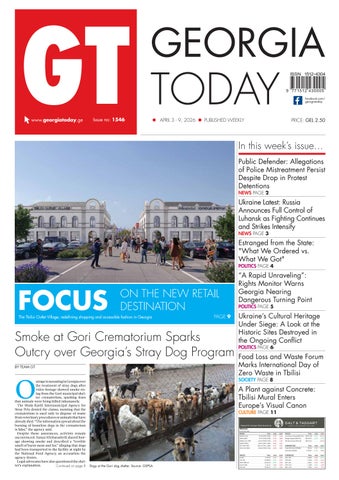

FOCUS
Smoke at Gori Crematorium Sparks Outcry
Outrage is mounting in Georgia over the treatment of stray dogs after video footage showed smoke rising from the Gori municipal shelter crematorium, sparking fears that animals were being killed inhumanely.
The Shida Kartli Intermunicipal Agency for Stray Pets denied the claims, insisting that the crematorium is used only to dispose of waste from veterinary procedures or animals that have already died. “The information spread about the burning of homeless dogs in the crematorium is false,” the agency said.
Despite these assurances, activists remain unconvinced. Tamaz Elizbarashvili shared footage showing smoke and described a “terrible smell of burnt meat and fur,” alleging that dogs had been transported to the facility at night by the National Food Agency, an accusation the agency denies.
Legal advocates have also questioned the shelter’s explanation.

week’s
Public Defender: Allegations of Police Mistreatment Persist Despite Drop in Protest Detentions
PAGE 2
Ukraine Latest: Russia Announces Full Control of Luhansk as Fighting Continues and Strikes Intensify
PAGE 3
Estranged from the State: "What We Ordered vs. What We Got"
PAGE 4
“A Rapid Unraveling”: Rights Monitor Warns Georgia Nearing Dangerous Turning Point
PAGE 5
Ukraine’s Cultural Heritage Under Siege: A Look at the Historic Sites Destroyed in the Ongoing Conflict
PAGE 6
Food Loss and Waste Forum Marks International Day of Zero Waste in Tbilisi
PAGE 8
A Plant against Concrete: Tbilisi Mural Enters Europe’s Visual Canon
11


The Tbilisi Outlet Village, rede

Georgia Bans Sale of Single-use Plastic Cutlery from April 1
BY MARIAM RAZMADZE
Georgia has introduced a nationwide ban on the sale of certain single-use plastic products used for food consumption, as part of broader efforts to reduce environmental pollution and plastic waste.
From April 1, 2026, the sale of plastic cutlery, including forks, knives, spoons, chopsticks, as well as plates, straws and drink stirrers is prohibited. The restriction also extends to food containers, cups and lids made of expanded polystyrene (EPS). The production and import of these items had already been banned earlier, effective January 1, 2026.
The new regulation also applies to public procurement. Government institutions are no longer allowed to purchase plastic cups, food containers or beverages in plastic bottles smaller than three liters. Exceptions are made for military use.
Enforcement will be carried out by the National Food Agency of Georgia, the Environmental Supervision Department
of Georgia, and the Revenue Service of Georgia.
Businesses violating the ban face a fine of GEL 1,000 along with confiscation of the prohibited products. Repeat violations will result in a GEL 2,000 fine and confiscation.
The regulation does not apply to goods produced for export. However, manufacturers are required to notify the Environmental Supervision Department at least one month in advance about production volumes, timelines, and export destinations.
The government has also outlined further steps targeting plastic beverage bottles.
• From July 1, 2026, restaurants and cafés will be prohibited from serving drinks in plastic bottles.
• From February 1, 2027, the production, import, and sale of plastic beverage bottles will be banned, except for containers of three liters or more, or largeformat bottles of 20 liters and above.
These restrictions will apply to both alcoholic and non-alcoholic beverages, with exemptions for military and law enforcement needs.
Tbilisi to Host First Ibero-American Literary Festival May 11–15

BY LANA KOKAIA
Tbilisi will host the first Ibero-American Literary Festival from May 11 to 15.
The festival will bring together prominent contemporary writers, translators and publishers from Spain, Mexico, Venezuela, Cuba and Peru. The organizers say the festival aims to create a space for intercultural literary exchange and build new connections between authors in the region.
“Our goal is to lay the foundation for new literary relations. Within the framework of the festival, various spaces in Tbilisi will become platforms for intercultural meetings,” the organizers add. Key events over the five-day festival will include meetings with Spanish-speaking writers, presentations of new translations, and discussions on the contemporary novel, short story, poetry and challenges of translation. A multidisciplinary program will feature a film screening, a performance by the Spanish National Classical Theater and a memorial evening.
Public Defender: Allegations of Police Mistreatment Persist Despite Drop in Protest Detentions

BY TEAM GT
Georgia’s Public Defender reports that allegations of police mistreatment during protests continued into 2025–2026, even as the overall number of detentions declined.
The Public Defender’s Office of Georgia says between March 1, 2025, and February 20, 2026, a total of 131 individuals detained during protests were monitored in temporary detention facilities and penitentiary institutions. Of these, 35 detainees (26.7%) reported alleged mistreatment by police, while 17 sustained physical injuries.
The report notes that, compared to 2024, both the number of arrests and reported cases of alleged abuse decreased, largely due to smaller-scale demonstrations. However, concerns remain over the nature of police conduct.
Detainees described instances of physical violence, verbal abuse, excessive use of handcuffs, and being restrained with hands behind their backs for extended periods. Some also reported being subjected to humiliating treatment, including being fully stripped during procedures in detention facilities.
In response, 27 detainees requested formal investigation into alleged mistreatment. The Public Defender’s Office referred these cases to investigative authorities, resulting in probes being
launched in 10 cases on charges of abuse of power involving excessive force. In seven cases, investigations were not initiated due to insufficient evidence.
The report highlights that monitoring efforts remained extensive throughout 2025. In total, 573 individuals detained during protests were visited by the Ombudsman’s representatives over the year. Among them, 302 reported alleged mistreatment, and 194 sustained physical injuries, including 49 women and two minors.
While the decline in protest activity has led to fewer detentions, the Public Defender stresses that reports of degrading and disproportionate treatment by law enforcement remain a serious concern.
Government Allocates ₾43mln to Patriarchate Institutions for Education

The Patriarchate. Source: gove.ge
BY LANA KOKAIA
The government has instructed the Ministry of Education to allocate 43,035,000 GEL to 53 institutions established by the Patriarchate.
The decree, signed by Irakli Kobakhidze, specifies that the funds will support Patriarchate universities, schools, colleges, and foundations under the “General Education Schools Financing” program.
The amount will be distributed over three quarters of 2026: 21,517,500 GEL in the first quarter, 12,910,500 GEL in the third, and 8,607,000 GEL in the fourth.
Moldovan Parliament Votes to Leave CIS
BY LANA KOKAIA
The Parliament of Moldova has voted for the country’s withdrawal from the Commonwealth of Independent States (CIS).
Lawmakers approved, in the second reading, the denunciation of the CIS founding agreement, as well as its protocol and statute, completing Moldova’s withdrawal from the organization’s statutory bodies.
The decision follows an initiative by the Foreign Affairs Ministry, which says the CIS’s core principles are no longer respected, particularly regarding territorial integrity and the inviolability of borders.
Authorities also refer to the actions of the Russian Federation, including the war against Ukraine and the continued illegal military presence on Moldova’s territory.
Moldova joined the CIS in 1991, follow-
ing the collapse of the Soviet Union. The organization was formed the same year to maintain cooperation between former Soviet republics in areas such as economic, political, and security affairs.
According to Moldova’s Foreign Ministry, the denunciation of the CIS founding documents is a natural step on the country’s path to EU membership.
Moldova began the process of with-
drawing from the CIS in 2022 and has so far denounced about 70 agreements. Chisinau remains a party to several trade, economic, and social agreements within the framework of the organization. Eight countries remain members of the Commonwealth of Independent States: Russia, Belarus, Azerbaijan, Armenia, Kazakhstan, Kyrgyzstan, Tajikistan, and Uzbekistan.

Plastic cutlery. Source: AHIMSA
Police at a protest. Source: Tabula
Ukraine Latest: Russia Announces Full Control of Luhansk as Fighting Continues and Strikes Intensify
COMPILED BY ANA DUMBADZE
Russia has declared that it now has full control over Ukraine’s eastern Luhansk region, calling it a key milestone in its military campaign. While Moscow presents the claim as a major achievement, the broader battlefield remains largely unchanged, with heavy fighting continuing across multiple fronts and both sides sustaining losses.
The Russian Defense Ministry said its forces had secured the last areas of Luhansk still under Ukrainian control, consolidating authority over territory largely occupied since 2022. Analysts note that more than 99% of the region was already under Russian control, meaning the announcement is more symbolic than militarily decisive. Ukrainian officials have not confirmed the claim and continue to reject Russia’s annexation, insisting that Luhansk, along with Donetsk, Kherson, and Zaporizhzhia regions, remains part of sovereign Ukraine under international law.
The
fiercest fighting persisted in neighboring Donetsk region, particularly around Chasiv Yar, the outskirts of Avdiivka, and west of Bakhmut. Russian forces pressed forward slowly, relying on sustained artillery fire and infantry assaults. Ukrainian troops held their positions and conducted localized counterattacks aimed at slowing Russian advances. Gains were often small, measured in incremental shifts, but the ongoing pressure continues to strain Ukrainian defenses.
In southern Ukraine, Kyiv focused on disrupting Russian logistics rather than mounting large-scale offensives. Ukrainian strikes hit ammunition depots, fuel storage, and transport routes in occupied
Zaporizhzhia and Kherson regions. Longrange drone operations targeted railway hubs essential for Russian military supply chains.
Aerial warfare intensified during the week. Russia launched multiple missile and drone attacks on Ukrainian cities, including key energy infrastructure, causing temporary power outages in several regions. Ukrainian authorities reported that repair efforts were increasingly effective. The strikes appear aimed at undermining morale and disrupting daily life.
Ukraine has also escalated its drone operations, targeting sites inside Russia and occupied territories. Oil depots, refineries, and industrial facilities linked to Russian military operations were among the targets. While these attacks do not immediately change the battlefield, they reflect Kyiv’s strategy of increasing pressure on Moscow’s logistics and economy.
Human Impact of the Conflict
Civilian casualties continued to mount.
Ukrainian officials reported dozens killed or injured in missile and drone strikes on residential areas and infrastructure, while emergency services responded to fires and damaged buildings. Russian border regions and occupied territories also reported civilian casualties from Ukrainian drone strikes, though independent verification is limited.
Beyond immediate casualties, the war has caused widespread displacement.
An estimated 3.8 million people are internally displaced within Ukraine, while over 5.3 million have fled abroad.
More than 12.7 million people inside Ukraine now require urgent humanitarian assistance, including food, shelter, medical care, and other essential services.
The conflict has also severely affected hospitals, clinics, and maternity units.
UN agencies report at least six UN-

supported medical facilities were damaged or disrupted in recent months, putting patients and medical staff at risk and straining emergency response. Repeated attacks on energy infrastructure have caused power outages, heating failures, and water shortages, compounding the hardship for civilians, especially the elderly, children, and those in conflict-affected regions.
Psychological trauma is another profound impact. Constant shelling, drone attacks, and missile strikes on civilian areas, including homes, schools, and public spaces, have created long-term stress for residents. Children face disrupted education and a lack of normal routines, while adults contend with the daily uncertainty of safety and basic needs.
Energy infrastructure remains a central focus of the war. Russia’s attacks on Ukraine’s power grid aim to weaken morale and economic stability, while
Ukrainian strikes on Russian oil and fuel facilities seek to disrupt supplies supporting military operations.
Diplomatic efforts have made little progress. Negotiations remain stalled, with Ukraine demanding full territorial restoration and Russia insisting on its annexation claims. International leaders continue to express concern, but no new mediation efforts have emerged.
Western support for Ukraine continues. Several countries announced additional military aid, including air defense systems, ammunition, and financial assistance. Discussions on longer-term security guarantees for Ukraine also continue, though political disagreements slow decisions.
The European Union will provide an additional €80 million (around $92 million) to Ukraine, funded from profits generated by frozen Russian assets, EU
High Representative Kaja Kallas said on March 31 during a visit to Kyiv. Speaking
alongside Ukrainian Foreign Minister Andrii Sybiha, Kallas emphasized the EU’s ongoing commitment, noting her visit coincided with the anniversary of the Bucha massacre.
“The way to end this war is to confront Moscow, not reward it. Not to loosen sanctions, but to harden them,” Kallas said. She also announced that the EU is preparing its 20th sanctions package against Russia, aiming to “tighten the net even further.”
Russia’s claim over Luhansk has reignited debate over the legitimacy of territorial annexations. Western governments continue to refuse recognition of any land seized by force, reaffirming that Luhansk remains part of Ukraine under international law. For now, Moscow’s announcement carries more symbolic weight than practical impact on the battlefield, while civilians continue to bear the heaviest consequences of the conflict.

Russian soldiers prepare to fire a grenade towards Ukrainian positions. Source: Russian Defense Ministry Press Service via AP
Diplomatic Chess or the Great Game’s Modern Iteration
OP-ED BY GEORGE KATCHARAVA
The cobblestone streets of Tbilisi have long been a stage for the Great Game’s modern iterations, but the events of late March 2026 suggest a shift from diplomatic chess to a desperate, multi-front survival struggle. When U.S. Secretary of State and National Security Advisor to the President of the United States Marco Rubio dialed Prime Minister Irakli Kobakhidze on March 30, the conversation was ostensibly about "security concerns." In reality, it was a flare sent up over a region increasingly squeezed between a Western alliance seeking a reliable corridor and two wounded giants, Russia and Iran, fighting to prevent their own strategic encirclement.
For the Kremlin, the stakes could not be higher. Reeling from a grueling standoff with the West and a Ukrainian campaign that has evolved into a precisionstrike war against Russian oil
infrastructure, Moscow’s traditional hard power is frayed. As refineries smolder and export revenues tighten, Russia has reverted to the weaponization of faith. The Russian intelligence extraordinary public broadside against the Ecumenical Patriarchate is a preemptive strike on the soul of Georgia. By labeling the looming succession of the Georgian Patriarch as a Western intelligence plot, Moscow is attempting to anchor its influence in the one institution Georgians trust more than their government. For a Russia under siege, a pro-Western Patriarch in Tbilisi would represent the near collapse state of its "soft power" southern flank.
Tehran’s entrance into this geopolitical drama is equally frantic. Currently engulfed in a high-intensity war with the United States and Israel, Iran views any American footprint in the South Caucasus as a direct threat to its northern security perimeter. The Iranian Ambassador’s pointed warning that Georgia would pay a "price" for hosting external interventions is the rhetoric of a regime that cannot afford another front. To Iran,

the South Caucasus is no longer just a neighbor, it is a vital escape valve for a country whose maritime routes are and most probably will be under constant threat for some time.
This "hybrid encirclement" places the
Georgian government in a harrowing position. The Rubio call offers a tantalizing lifeline of Western security and investment, particularly as the Black Sea becomes the primary artery for energy bypassing a sanctioned Russia and a
volatile Iran. Yet, the price of that lifeline is becoming clear: Georgia must navigate a minefield of Russian subversion and Iranian intimidation.
On the one hand, we have an opportunity for high-stakes opportunism, while on the other hand, we are facing existential dread. As Georgia prepares to choose a new spiritual leader, it is not just electing a Patriarch, it is deciding whether to remain a bridge for regional revisionists or to solidify its role as the West’s indispensable Black Sea fortress. Expect the coming months to be defined by a surge in “active measures,” designed to fracture Georgian society along religious lines, while Tehran and Moscow might coordinate to ensure that any "reset" with Washington remains a dangerously expensive proposition for Tbilisi. In this New Great Game, the pews of the Sioni Cathedral have become as strategically significant as the pipelines of the Caspian.
Author’s bio: George Katcharava is the founder of eurasiaanalyst.com, a geopolitical risk and advisory firm.
Estranged from the State: "What We Ordered vs. What We Got"
OP-ED BY VICTOR KIPIANI, GEOCASE / GEORGIA FIRST
Modern authoritarianism does not require the use of military force or the suspension of the constitution. In today's world, it manifests in a much more flexible form, revealed largely through legislation and administrative control.
Generalizing the current assessments of the Georgian reality leads us to the concept of the so-called "Dual State." This is a socio-political state of affairs where two systems coexist side-by-side:
1. The Normative State: Characterized by the formal existence of all institutions typical of a state, as well as adherence to all formalistic requirements for the adoption and implementation of laws.
2. The Prerogative State: A system of intra-state relations based on so-called "extraordinary" rights, prerogatives, or privileges. This system has nothing in common with a normal state; here, power is exercised under the aegis of "current needs," "urgent necessities," or "national salvation." Moreover, this "extraordinary" nature is often carried out by observing formalistic requirements at a basic level to mimic the normative state.
This is why the rejection of representative democracy, institutionality, and accountability does not happen all at once, but imperceptibly and undeclared.
The aforementioned dual state is created not suddenly, but through a chain of various actions. While all these actions are logically connected, the chain unfolds in a way that suggests everything is "in place" and "working." However, through the, initially gradual, then accelerating, deterioration of legislation, a legislative authoritarianism clothed in the "sovereign will of the people" takes root.
This is not yet a dictatorship, but it is a unique form of rigid management.
Because it is flexible, being "everywhere and nowhere," its existence is much longer-lasting and immune to change. In such times, there seems to be less ground for formal disputes, were it not

for the essence of the process.
It is the essence of the process that defines the country's vices: when elections are called an unequal and unfair "special electoral operation"; when courts exist in a state of nominal independence but factual subordination; and when "democracy" refers to a phenomenon practically emptied of all democratic markers. Ultimately, we collide with a procedurally and formally impenetrable reality where authoritarianism is carried out in the name of "legality" and through the means of "the law." One manifestation of this is the subordination of the legislature at the expense of increasing executive discretion. Over time, the "extraordinary" nature of rights and prerogatives finally swallows the last facade of the normative state—including the executive branch itself.
SOUNDS FAMILIAR?
The academic study of authoritarianism as a form of government developed relatively late. This necessity arose from the need to label a "middle-ground" form of government that emerged between democracy on one side, and dictatorship/totalitarianism on the other. This form clearly deviated from democracy, though it was not yet a full-scale dicta-
torship. Generally, authoritarianism differs from dictatorship by the absence of power concentration in a single hand (or center), the lack of a universally mandatory ideology, and the absence of means for total mass mobilization. Notably, unlike dictatorship, authoritarianism is characterized by limited, yet still present, pluralism. Unfortunately, discussing these differences in the Georgian reality is not merely a matter of theoretical interest. The deviation from democracy, this "middleground" form, has created a very specific, bitter reality and a specific challenge for Georgian society. It is this unpleasant and dangerous stage of modern Georgian history that forces us to mention the main signs of authoritarian rule and reflect on the environment we inhabit and envision its future trajectory. Specifically: Reliance on the Punitive Apparatus: A key component of authoritarian rule is maximum reliance on the punitive apparatus, the selective use of coercive measures, surveillance, and censorship. To avoid concentrating the repressive "fist" in one hand, these powers are distributed across several agencies. This prevents any single agency from accumulating excess power and becoming a "super-
force." In Georgia today, this trend is increasingly evident: in a country turned into a land of prohibitions, political will is directed toward the apparatus that enforces these prohibitions rather than improving governance. Consequently, financial resources are directed toward maintaining the machinery of coercion instead of creating a modern state system.
Exploitation of the Budget: To secure the loyalty (I intentionally avoid the word "devotion," which carries a different weight) of the coercive apparatus, it is a mandatory practice to "exploit" the expenditure side of the state budget. However, using the budget is not the only way; using any alternative means to "raise" money is also an approved practice. This approach undermines the prestige of the "uniformed" ranks, sabotages state thinking within these structures, and turns them into servants of narrow group interests instead of servants of society. The logical result is the pervasive erosion of the national security system, ending in its total neutralization.
Targeted Propaganda: This involves a peculiar reading and narration of "oneself," the people, and the country's place and role. A story is woven to make people see "national unity" and "national interest" in a new way. Global or regional events are interpreted specifically, mostly subordinated to the context of internal and external "enemies." Furthermore, every process related to the country is linked to a peculiar test of national security, where yesterday's enemy becomes a friend, and a partner or ally is turned into an adversary. To achieve this transformation, negative material, freely available due to the openness of the Western system, is often masterfully exploited. The result of this hybrid information war on one's own population is the cultivation of a managed consciousness: the emergence of a "Post-Homo Sovieticus" with a national brand.
Economic Control (Weaponization of Income): A principal feature of this management style is the tendency to control the economic daily life of citizens. In this, it may seem close to a dictatorship, but two things are missing for a total match: total state control of the economy
and interference in human incomes through "regulation." Authoritarianism is more "delicate." It does not "set," "regulate," or "equalize" incomes, but, by weaponizing income, it can significantly influence the political will of citizens. Practically, this means allowing desirable persons access to financial sources and cutting off undesirable ones. Consequently, the first category is "granted" economic self-sufficiency, while the second is punished for lacking it... or given the opportunity to reconsider their socio-political views to align with the authoritarian's expectations. We clearly saw this in the disproportionate tightening of legislative control over the Georgian civil sector and non-governmental media, and the financial disarmament of entire sectors.
Focus on the International Arena: Authoritarian rulers pay great attention to global processes. Changes in global geopolitics, directly or indirectly, can influence the strengthening or weakening of their rule. To prolong authoritarianism, it is essential to identify situational partners on the foreign stage, bond with them, synchronize propaganda messages, and capitalize politically on the conflicting interests of major geopolitical actors. In this part, too, I believe Georgian domestic or foreign "policy" creates a familiar picture for the reader.
THEREFORE AND BECAUSE OF THIS
Precisely so that the process described above does not finally take root in our country, we need relations based primarily on rules and not on personal, group, or party loyalty.
Precisely so that the temptation to establish such management does not recur in the future, we need real and not falsified politics, effective and not sham economics, true and not hypocritical justice.
Precisely so that Georgians have an effective advocate and protector, we do not simply need a country or a motherland: we need a state.
Precisely so that we can create a solid claim on the future, we need a thinking state.
Rubio and Kobakhidze.
Source: RFE/RL
A politician. Image source: intentionallyvicarious
“A Rapid Unraveling”: Rights Monitor Warns Georgia Nearing Dangerous Turning Point
INTERVIEW BY KATIE RUTH DAVIES
Aweek after Georgia was added to a global human rights watchlist, concerns are intensifying over the country’s political trajectory.
In an interview with GEORGIA TODAY, Tara Petrovic, Europe researcher for the CIVICUS Monitor, describes an unprecedentedly swift decline in civic freedoms, one she says should alarm not only Georgians, but observers across Europe.
WHEN YOU LOOK AT GEORGIA RIGHT NOW, WHAT WORRIES YOU MOST ABOUT THE DIRECTION IT’S HEADING IN?
The most alarming thing to watch unfold is the speed at which the situation is deteriorating. The CIVICUS Monitor has been tracking civic space conditions globally for almost ten years, and annually assesses 198 countries and territories, assigning one of five ratings. Georgia dropped two ratings, from the secondbest, “narrowed,” to the second-worst, “repressed,” in just two years.
We’ve very rarely seen a decline that sharp and that quick anywhere in the world in all the time we’ve been monitoring.
When we talk about civic space, we mean how well fundamental rights to speak out, protest and organize are protected in law and practice. As that space narrows, it becomes more difficult to challenge new restrictions. Once it closes entirely, resistance becomes almost impossible. While protests in Georgia remain persistent, each new law appears designed to weaken people’s resolve.
OF ALL THE NEW LAWS PASSED RECENTLY, WHICH ONE DO YOU THINK WILL HAVE THE BIGGEST REAL-LIFE IMPACT ON PEOPLE, AND HOW?
What makes the legislative changes adopted on March 4 so concerning is how broad their provisions are. Take the amendments expanding the definition
CoE Congress
of foreign grants: while they seem to be aimed at NGOs and media that depend on foreign funding, who are endlessly vilified by the government as destabilizing influences, the wording is so broad that enforcement is only limited by the authorities’ imagination. There is no guarantee anyone who’s politically active or outspoken in their criticism can’t be smeared as having been paid off by foreign powers and prosecuted.
And that vagueness is by design: the uncertainty leaves space for authorities to harass and intimidate whoever they want and impose bureaucratic obligations that are impossible to meet, while operating under the guise of defending the country’s sovereignty. Civil society and media will be most directly affected, as these and previous restrictions are an existential threat to their funding, but the chilling effect will impact many others. At this point, there’s no way of knowing how many people will actually be targeted for prosecution, but anyone who sees the impact will think twice about what they say and do. We’ve seen this play out to devastating effect in Russia.
The amendments threatening prison for “extremism against the constitutional order,” or creating the perception government institutions are illegitimate are dangerous in the same way.
DO YOU THINK THERE’S STILL A REALISTIC CHANCE TO REVERSE THESE CHANGES, OR HAS SOMETHING MORE FUNDAMENTAL SHIFTED?
While Georgia stands out because of how quickly things have unraveled, our research shows freedoms are under attack worldwide. Even in Europe, countries seen as established democracies have seen their ratings slip in recent years. For example, France, Germany and Italy were all downgraded from “narrowed” to “obstructed” in our latest assessment. This shows that keeping civic space open requires constant vigilance, and the freedoms we have can’t be taken for granted.
On the other hand, the shifting nature of the civic space landscape also means

positive change is always possible. Drifting towards repression is always an easier process than the reverse, but we do constantly see examples where people succeed in taking back civic space through grassroots organizing, campaigns and protests.
Trying to suppress dissent through force and intimidation never succeeds in bringing stability: it only deepens resentment and polarization. The Georgian authorities can choose to reverse course at any time, repeal these repressive laws and stop persecuting protesters and critics.
FROM WHAT YOU’VE SEEN, HOW ARE THESE LAWS ACTUALLY PLAYING OUT ON THE GROUND FOR PROTESTERS, ACTIVISTS AND JOURNALISTS?
The endless amendments criminalizing common protest behaviors – face coverings, fireworks, blocking the road and the movement of pedestrians, at first
Adopts Recommendations on Georgia, Urges Political Dialogue and Electoral Reforms
BY TEAM GT
The Congress of Local and Regional Authorities of the Council of Europe has adopted a set of recommendations concerning Georgia, following a vote held during its session. A total of 97 delegates supported the recommendations, while 12 voted against and eight abstained.
The vote followed a debate on the draft text, which addresses concerns over political polarization, electoral standards, and the state of local democracy in the country.
In its recommendations, the Congress calls on the Georgian authorities to
urgently resume political dialogue at all levels of government through an inclusive process involving all stakeholders. The aim, it said, is to reduce polarization and restore the system of checks and balances necessary for a pluralistic democracy.
The body also urged the implementation of its previous recommendations, as well as the opinions of the Venice Commission, to ensure that local governance aligns with the principles of the European Charter of Local Self-Government.
The Congress further called for the repeal of what it described as problematic amendments to Georgia’s Electoral Code and for a comprehensive reform of the electoral framework. According to the recommendations, such reform should be preceded by broad consultations and should ensure the independ-

ence of the Central Election Commission while addressing key shortcomings in the electoral system.
Among other key points, the Congress urged the authorities to halt the criminalization of opposition voices and to repeal legislative changes that could facilitate the banning of opposition parties. It also called for the immediate reintroduction of gender quotas and for strengthening mechanisms to increase women’s participation in local politics.
The recommendations also emphasize the need to repeal amendments that restrict election observation and to return to the practice of systematically inviting the Congress to monitor local elections. The document highlights that genuine political dialogue remains a necessary precondition for meaningful reform.
In addition, the Congress called on the Georgian authorities to repeal legislation that may violate human rights and to refrain from actions that could further hinder the work of civil society and independent media or undermine the foundations of local democracy. It also urged thorough investigations into reports of violence, particularly against detainees and protesters, and called for the release of detained journalists and political leaders.
The adopted recommendations reflect ongoing concerns within the Council of Europe regarding democratic standards and governance in Georgia, and are expected to contribute to continued dialogue between the country and European institutions.
with crippling fines, then administrative detention and imprisonment, are being put into practice relentlessly in a clear attempt to intimidate. A week ago, the media reported a second case of a protester facing imprisonment over repeated administrative offences under the new laws. In February, a dozen people reported having had their bank accounts seized for unpaid protest fines from 2025, despite having appealed the rulings. Independent media and civil society are struggling to survive: since restrictions on foreign funding have been tightened, numerous CSOs and media outlets have reported inspections from anticorruption authorities, frozen bank accounts and criminal investigations.
Two journalists and a photographer are currently on trial and could be punished with administrative detention for reporting from protests, with rulings expected at the end of the month. Among activists, there is a real fear of reprisals for speaking out publicly or engaging
with international organizations, a shocking contrast compared to only a couple of years ago.
IF THINGS CONTINUE ON THIS PATH, WHAT COULD THIS MEAN FOR ORDINARY GEORGIANS, AND FOR THE COUNTRY’S FUTURE IN EUROPE?
The implications could be far-reaching. The European Union has been very vocal in affirming that these laws and repressive practices are incompatible with Georgia’s aspirations for membership. According to the Commission, the country is now a “candidate in name only.”
Despite its current hostile rhetoric, the government maintains that EU integration is a realistic goal it continues to pursue: a goal that Georgians have traditionally overwhelmingly supported. But unless the authorities reverse course and de-escalate their assault on dissent, there is no path forward for Georgia to join the EU.
Papuashvili Accuses Helsinki Commission of
‘Using’
Georgian Opposition for Political Attacks
BY TEAM GT
Georgian Parliament Speaker Shalva Papuashvili last week sharply criticized the US Helsinki Commission, accusing it of exploiting Georgian opposition figures, including Elene Khoshtaria, to undermine the country’s government.
Speaking to journalists, Papuashvili dismissed the Commission’s recent statement, which alleged that the ruling Georgian Dream party is using the judiciary to silence political opponents, and instead claimed that opposition figures are being encouraged to commit offenses for political purposes.
“Khoshtaria and people like her are the Helsinki Commission’s personal prisoners,” Papuashvili said. “They are incited to commit crimes, then imprisoned, and later used to attack the Georgian government.”
Parliament Speaker claimed external actors are deliberately encouraging unlawful actions in order to later issue critical statements, resolutions, and political assessments targeting the Georgian authorities.
“They incite them to commit crimes so they can later organize discussions and adopt statements. They use Georgians, while they themselves do not suf-


fer any consequences,” Papuashvili added, arguing that such actions are part of a broader attempt to politically capitalize on internal developments in Georgia.
The remarks come in response to a statement by the US Helsinki Commission, which expressed concern over the sentencing of Elene Khoshtaria, leader of the opposition party “Droa.” Khoshtaria was sentenced to one year and six months in prison after being found guilty of property damage for writing “Russian Dream” on a campaign banner of Tbilisi Mayor Kakha Kaladze. The Helsinki Commission also warned that Khoshtaria and other opposition leaders could face significantly harsher penalties, ranging from 7 to 15 years in prison, on charges related to alleged “crimes against the state.”
Activists protesting the draft law that would label CSOs and media receiving foreign funding as "foreign agents," March 2023. Photo by Guram Muradovi/Civil.ge
Shalva Papuashvili. Source: FB
Ukraine’s Cultural Heritage Under Siege: A Look at the Historic Sites Destroyed in the Ongoing Conflict
BY KATIE RUTH DAVIES
Since the start of the full-scale invasion of Ukraine, attacks have targeted not only civilians and infrastructure, but also the nation’s cultural heritage. Historic monuments, museums, religious sites, and centuries-old cityscapes have been damaged or destroyed, striking at the identity and memory of the Ukrainian people. And attacks in 2025 and early 2026 have shown that no part of the country’s cultural life is safe.
As of March 11, 2026, UNESCO had independently verified damage to 523 cultural sites. These include religious buildings, museums, monuments, libraries, and archaeological sites across Kyiv, Chernihiv, Kharkiv, Odesa, Mariupol, and Lviv. The figures are likely to rise as assessments continue, though, shining a light on the challenge of protecting cultural property during wartime.
Two years into the full scale invasion, UNESCO estimated that damage to Ukraine’s culture and tourism sectors had reached nearly $3.5 billion, and that close to $9 billion would be needed over the next decade to rebuild and recover.
These estimates covered damage reported through early 2024, and the losses have only grown as the conflict continues.
Let’s look at some of that loss.
In Kyiv, the Saint-Sophia Cathedral, one of the most significant monuments of Eastern Christian architecture, and the Kyiv-Pechersk Lavra, both UNESCO World Heritage sites, were damaged on June 10, 2025.
Odesa’s Spaso-Preobrazhensky Cathe-
dral, located in the city’s historic center, suffered serious damage from a missile strike on July 23, 2023. Emergency stabilization was needed to protect the roof and other structural elements, with UNESCO specialists called in to help prevent further collapse.
In Kharkiv, the Derzhprom State Industry Building, an internationally recognized example of modernist constructivist architecture, was damaged during Russian strikes in 2024, prompting special UNESCO monitoring.
Chernihiv’s historic city center, one of Ukraine’s oldest, and a candidate for the UNESCO Tentative List, was heavily damaged during the first months of the war.
Mariupol has seen some of the most dramatic losses. The Donetsk Academic Regional Drama Theater was destroyed in March 2022, becoming a potent symbol of the humanitarian disaster in the city. The Kuindzhi Art Museum was completely destroyed that same month, leaving the fate of much of its collection uncertain. Residents and cultural officials described the losses as heartbreaking.
The Ivankiv Museum of Local History and Culture was destroyed on February 27, 2022. It had housed more than 400 exhibits, including works by the internationally renowned Ukrainian artist Maria Prymachenko. While some works were saved by local residents, many are still missing.
The Hryhorii Skovoroda Literary Memorial Museum in the Kharkiv region was destroyed on May 6, 2022.
Taras Voznyak, director of the Lviv National Art Gallery, said, “Putin knows that without art, without our history, Ukraine will have a weaker identity.”

By February 2026, Ukrainian authorities reported that at least 700 religious sites had been damaged, around 200 churches and places of worship had been completely destroyed, and more than 70 religious leaders had been killed. Roughly seven million cultural artifacts have been lost, with 1.7 million stuck in the temporarily occupied territories. Thousands of museum exhibits have been stolen or destroyed, and, since 2014, more than five million archival documents from Ukraine’s National Archival Fund have fallen under temporary occupation.
On March 24, 2026, a drone strike hit central Lviv, damaging buildings in the UNESCO World Heritage-listed Historic Center and injuring civilians. Among the landmarks affected were parts of the Bernardine Monastery and the 17thcentury St. Andrew’s Church. Residents described the blast as shocking, leaving debris spread across streets and stainedglass windows shattered. Lviv is home to Ukraine’s first UNESCO Cultural Hub,

From April 1, Abkhazia Fully Relies on Enguri HPP Electricity
BY LANA KOKAIA
Since April 1, Georgia’s breakaway region Abkhazia is being supplied with electricity entirely from the Enguri HPP.
Last year, from August to December 2025, Abkhazia purchased electricity from Russia at night and on holidays to maintain reserve levels. From January to March 2026, Russia supplied the region free of charge. These measures allowed the region to complete the autumn-winter period without outages or serious incidents for the first time in 10 years.
JamNews’ Sukhumi office reports that household electricity tariffs in Abkhazia increased by 15% from April 1. Consumers with single-phase connections will pay 2 rubles (about $0.02) per kWh, while three-phase connections will cost 2.7 rubles (around $0.03) per kWh. Tariffs for businesses remain unchanged.
Abkhazia has not yet fully established a metering system, and control over electricity consumption is limited. Con-
sumption per capita in the region is roughly twice that of residents in territory controlled by Georgia.
The Georgian and Abkhaz sides agreed in the 1990s, without a signed document, that 40% of the electricity generated by the Enguri HPP should go to Abkhazia. However, the region does not always have enough electricity from the HPP, particularly in winter. In recent years, deficits were often covered by scheduled supplies from Russia.
The energy crisis was largely driven by uncontrolled cryptocurrency mining, particularly bitcoin production, which had been ongoing in Abkhazia since 2016.
Georgian energy experts note that without cryptocurrency demand, Abkhazia would have struggled to use even 40% of its allocated electricity 8 to 10 years ago. Cryptocurrency mining is now banned in the region.
Timur Jinjolia, head of the energy company Chernomorenergo, said electricity consumption has dropped by around 500 million kWh compared with the 2023 peak, when demand surged due to illegal mining. The annual electricity deficit has fallen to 600–700 million kWh, down from 1.1–1.2 billion kWh three years ago.
created to protect and support cultural life during the war.
Ukrainian authorities have called on UNESCO and international partners to take stronger action, emphasizing that targeting a city hosting an official Cultural Hub shows blatant disregard for international law and the 1954 Hague Convention for the Protection of Cultural Property.
Lazare Eloundou Assomo, Director of the UNESCO World Heritage Center, said, “Safeguarding World Heritage is a shared responsibility of humanity. Heritage professionals face daily challenges in protecting, maintaining, and restoring sites with severely limited resources.”
Ukrainian leaders and cultural figures have often highlighted the human cost of these attacks. First Lady Olena Zelenska described the destruction of cultural sites as “a war against Ukrainian identity.”
Residents, historians, and museum workers continue documenting damage, protecting surviving artifacts, and call-
ing for accountability from those responsible.
The conflict has also taken the lives of artists and media workers. According to the Ministry of Culture, at least 346 Ukrainian artists and 126 media representatives have died since the full-scale invasion began.
Since the start of the invasion, UNESCO has mobilized more than $75 million from Member States and partners to support Ukraine’s cultural, educational, media, and heritage sectors. Japan has been one of the largest contributors, providing nearly $30 million, and nearly 30 countries from Europe, North America, and Asia pledged coordinated support at a 2024 conference in Vilnius. These funds have helped implement dozens of short- and medium-term projects, including emergency protection of cultural property, risk management, 3D digitization of sites in Kyiv, Lviv, Odesa, and Chernihiv, and measures to prevent looting. UNESCO has carried out consolidation and repair projects in museums across Kyiv and Odesa, installed temporary protection such as the roof for Odesa’s Cathedral of the Transfiguration, trained more than 1,600 cultural professionals in safeguarding collections and historic buildings, and supported nearly 100 artists in exile.
As the war continues, efforts to protect, document, and restore damaged heritage remain a top priority for Ukrainian authorities, UNESCO, and international partners. The scale of destruction shows that this is not only a war over territory, but also a deliberate attempt to erase culture, history, and identity from Ukraine and, by extension, from the shared heritage of humanity.
Refugees Turn Displacement Into Opportunity as 80+ Businesses Launched in Georgia
BY TEAM GT
More than 80 refugee-led businesses have been launched and supported in Georgia under a joint initiative by the United Nations Development Program (UNDP), CARE Caucasus, and the German Government, marking a significant step in helping displaced individuals rebuild their lives through entrepreneurship.
The two-year program, funded by the German Government as part of the UNDP-led project “Improving the Rule of Law and Access to Justice for All,” has primarily supported refugees from Ukraine in transforming business ideas into sustainable sources of income. The initiative officially concluded with a business fair held in Tbilisi on March 26, bringing together refugee entrepreneurs, diplomats, and international organizations.
Based on the program data, 84 businesses received support, of which 73 are currently active and sustainable. These enterprises operate across Tbilisi, Batumi, and other regions, employing a total of 175 people and contributing to local economic activity. On average, participating businesses report profit margins of around 30 percent, while up to 90 percent of entrepreneurs say their family financial situation has improved.
“Targeted support delivers real results,” said Esther Lena Wagner, Deputy Head of Mission at the German Embassy in Georgia. “Out of 84 businesses supported under this project, 73 are active and sustainable. They create jobs and bring new energy to Georgia’s economy. This is resilience in action.”
Douglas Webb, UNDP Resident Representative in Georgia, highlighted the human dimension behind the figures, noting that each business reflects “a story of courage and determination,” and that

access to resources enables displaced people to rebuild their lives and strengthen host communities.
The program’s total grant funding of GEL 1 million generated nearly three times that value in economic return, with a reported return on investment of 2.98.
Beyond financial assistance, the initiative focused heavily on skills development: 198 refugees received specialized business training, over 300 benefited from professional coaching, and 768 accessed legal and financial advisory services to navigate Georgia’s business environment.
“This partnership is about support and sustainability,” said Nino Bolkvadze, CEO of CARE Caucasus. “Refugee families are building stable, independent futures. We are proud to stand with them.”
The initiative comes in a broader regional context shaped by Russia’s ongoing war against Ukraine, which has
forced millions of Ukrainians to flee their homes since 2022. Georgia has hosted thousands of Ukrainian refugees, many of whom have sought not only temporary shelter but also long-term opportunities to integrate economically and socially.
By focusing on entrepreneurship, the program aimed to move beyond humanitarian assistance toward sustainable development, enabling refugees to become active contributors to Georgia’s economy. Organizers say the results demonstrate the potential of targeted international cooperation in turning displacement into opportunity, while also strengthening local communities. The refugee support component formed part of the wider UNDP initiative “Improving the Rule of Law and Access to Justice for All,” funded by the German Government and implemented in partnership with CARE Caucasus.
A UNESCO inspector checking damage in Ukraine. Source: UNESCO
40th Anniversary of the Ecocenter for Environmental Protection, an Organization in the Category of Consultative Status with the Economic and Social Council (ECOSOC) of the UN
BY TEAM GT
In order to advance innovative scientific and engineering disciplines in the fields of water resources management and environmental protection in the South Caucasus region (Georgia, Azerbaijan, and Armenia), and to foster the development and dissemination of environmental education across the former Soviet area, one of the earliest non-governmental organizations – the Hydrotechnician Cooperative – was founded in 1985. The organization was established through the initiative of Academician Tsotne Mirtskhulava and Professors Pridon Shatberashvili and Otar Sichinava.
In Georgia, the organization’s legal status evolved in parallel with legislative reforms. Initially, it was reorganized as a public organization under the name Ecocenter for Environmental Protection from Floods and Inundations. In subsequent years, it was further transformed into a LEPL Eco-Center for Environmental Protection (Ecocenter).
Since 2011, the organization has been led by Academician of the National Academy of Sciences of Georgia, Doctor of Technical Sciences, and Professor Givi Gavardashvili.
In recognition of its implementation of numerous international projects in environmental engineering across the South Caucasus, Kazakhstan (Central Asia), and other regions, as well as its sustained contribution to enhancing environmental education through international conferences, training programs, and seminars, the Eco-Center was granted consultative status with the United Nations Economic and Social Council (ECOSOC) by decision of June 18, 2019. This designation represents a significant institutional milestone for a non-governmental organization.
At present, the Eco-Center operates through an administrative unit and three specialized departments, employs more than 50 scientists and engineers, and maintains active international cooperation with partners in over 20 countries, including major international organizations such as the United Nations, UNESCO, the European Union, NATO, FAO, ICID, and others.
On January 10, 2020, the Eco-Center for Environmental Protection marked its 35th anniversary. In connection with this occasion, Professor Jerzy Jerznach of the Warsaw University of Life Sciences (Poland), a specialist in environmental protection studies, published a detailed overview of the organization’s activities in the GEORGIA TODAY newspaper (January 10–13, 2019 issue).
The following section presents an overview of selected innovative projects and grant-funded initiatives implemented by the Eco-Center for Environmental Protection under the leadership of Academician Givi Gavardashvili over the past five years (2020–2025).
Owing to its geographical position, the Black Sea represents a region of strategic and environmental interest for numerous countries, including Georgia. Within this context, in 2020 the Eco-Center implemented a project entitled “Assessment of Environmental Risks to Beaches Resulting from Storm Events along the Batumi–Sarpi Section of the Black Sea Coastline” (funded by a private individual). It is noteworthy that this coastal area lies along the Georgian-Turkish border, where ensuring coastal environmental safety and assessing storminduced beach erosion risks are of considerable practical importance for both states.
2022 – Following its successful participation in a state tender, the Eco-Center prepared the project “Preparation of Design and Cost Documentation for the Installation of Drainage Systems at the Niko Dadiani Palace in Zugdidi,” funded

by the LEPL “National Agency for Cultural Heritage Preservation Georgia” under the Ministry of Culture and Sports of Georgia. To safeguard the Niko Dadiani Palace foundation from groundwater impacts, the project introduced an innovative three-tier combined drainage system, the originality of which is protected by a Georgian patent (patent holder: G. Gavardashvili).
Within the framework of the project “Preparation of Hydrological Recommendations for the Rehabilitation of the Ivane Javakhishvili Memorial HouseMuseum and Ensuring Flood Safety of the Territory” (funded by Arc-Light LTD, 2023), comprehensive hydrological recommendations were developed to support the subsequent design and implementation of engineering flood-control measures. The project was aimed at the rehabilitation of the Ivane Javakhishvili Memorial House-Museum, a cultural heritage site located in the village of Khovle, Kaspi Municipality, and at ensuring effective flood protection for the surrounding area.
UNESCO Grant Project – conducted within the framework of the Participation Programme for 2022–2023, announced by the Georgian National Commission for UNESCO, entitled “Forecasting Natural Disasters and Innovative Risk Reduction Measures.” The primary objective of the project was to develop and implement a comprehensive national safety strategy and an action plan for risk management, alongside assessing the vulnerability of critical infrastructure to potential natural and anthropogenic hazards.
The project facilitated active collaboration between governmental and nongovernmental organizations in contemporary risk management practices and their operational implementation. This collaboration enabled the establishment of an effective national platform for integrated and systematic risk management, aimed at preventing and mitigating the impact of natural and anthropogenic disasters. During the project period, conferences were organized to enhance environmental awareness among local communities in Tbilisi and the municipalities of Dusheti, Kazbegi, Kvareli, Telavi, and Akhmeta. Additionally, as part of the project, a UNESCO Green Alley was developed in the courtyard of the public school in the village of Ozhio (school director: Zhana Akhalkatsishvili), Akhmeta Municipality, where approximately 100 evergreen plants were planted.
Grant Project of the Shota Rustaveli National Science Foundation of Georgia, Ministry of Education, Science, and Youth – “Elastic Anti-Debris-Flow Barrage”
(AR-18-1244). The leading institution for this innovative project is the Tsotne Mirtskhulava Institute of Water Management at the Georgian Technical University, with the Eco-Center for Environmental Protection serving as the project partner (funded by the Science Foundation).
The Eco-Center for Environmental Protection conducted applied scientific field research, which included the identification of a river in the mountainous regions of Georgia exhibiting active debris-flow processes, suitable for the construction of an innovative debrisflow protection barrier (patent holders: G. Gavardashvili, E. Kukhalashvili, Sh. Kupreishvili, N. Gavardashvili). The project encompassed both the installation of the barrier and its subsequent field testing under natural conditions. For this purpose, Eco-Center specialists selected the catchment basin in the gorge of the Mleta River (Dusheti Municipality), where the innovative flexible debris-flow barrier was successfully constructed. Field studies confirmed the structure’s stability and operational reliability.
With financial support from the World Bank and assistance from the Shota Rustaveli National Science Foundation of Georgia, Eco-Center staff (2021–2022) developed the grant project CARYS_19_305: Innovative Integrated Measures Against Snow Avalanches (patent holder: G. Gavardashvili). As part of the project, a test facility for an innovative avalanche-protection structure was constructed in Gudauri, within the Stepantsminda Municipality, where scientific field experiments continue to be conducted.
International Project NATO SPS G6028 – “Safety Monitoring and Pollution Risk Control Using Digital Models” – funded under the Science for Peace and Security (SPS) Programme of the North Atlantic Treaty Organization (NATO). The NATO Project Director (NPD) is Dr. Charles Hyler, Director of the Center for Irrigation Technology (CIT), California State University (CSU). From Georgia, the NATO Project Co-Director (PPD) is Academician Givi Gavardashvili, Director of the Tsotne Mirtskhulava Institute of Water Management at the Georgian Technical University (GTU). Partner organizations include the Eco-Center for Environmental Protection (Georgia). Key contributors to the project are Professor Kadir Seyhan (Turkey), Doctor of Technical Sciences Mikhail Yatsenyuk (Ukraine), Academic Doctor Dragos Marin (Romania), and Professor Emil Burnavski (Bulgaria).
The primary objective of the project
tific field and laboratory research in the channel of the Duruji River as part of a grant-funded project. Simultaneously, negotiations are ongoing with the Gori Municipality regarding a second project involving scientific fieldwork, laboratory research, design activities, and environmental protection measures in the Tana River catchment basin, with the aim of finalizing a contract for the implementation of an EU-funded project.
is to investigate the environmental parameters of the Black Sea and, within this framework, to establish a Black Sea Scientific Research Observatory in accordance with NATO standards at the Poti Environmental Base of the Tsotne Mirtskhulava Institute of Water Management of Georgian Technical University. Following the Eco-Center’s successful bid in a 2025 state tender, the organization developed the project “Preparation of Design and Cost Documentation for Water Drainage Measures from the Territory of the Niko Nikoladze HouseMuseum and Garden-Park, Located in the Village of Didi Jikhaishi, Samtredia Municipality,” funded by the LEPL National Agency for Cultural Heritage. The project has been completed, successfully passed state examination, and, according to the documentation, is ready for construction commencement.
In the first two months of 2026, the administration of the Eco-Center for Environmental Protection has already signed an agreement with a private individual – master’s degree student Lika Tandilashvili – for the conduct of scien-
The past five years of work(2020-2025) by the Eco-Center for Environmental Protection stand as a compelling testament to its leadership in advancing both scientific innovation and practical solutions in environmental engineering and management. Through impactful research, pioneering engineering designs, and sustained international collaboration, the Center has significantly contributed to addressing complex environmental challenges across Georgia, the South Caucasus, and beyond. On the occasion of its 40th anniversary, I extend my sincere congratulations to my esteemed colleague and friend, Academician Givi Gavardashvili, and his dedicated team. Their vision, commitment, and achievements have elevated the EcoCenter to an internationally recognized institution, including its distinguished consultative status with the United Nations Economic and Social Council (ECOSOC). I wish the Eco-Center continued success in its vital mission of advancing resilience, sustainability, and environmental stewardship both regionally and globally.
PROFESSOR BILAL
M. AYYUB, PHD
Director, Center for Technology and Systems Management, Department of Civil and Environmental Engineering, University of Maryland, College Park, USA.
Academician (Foreign Member), Georgian National Academy of Sciences Honorary Visiting Professor, Imperial College of Science, Technology and Medicine, London, UK.
Senior Economist, US National Institute of Standards and Technology, Department of Commerce, USA (2023-24). CoDirector, International Joint Research Center for Resilient Infrastructure, Tongji University, China. Science Advisory Board (member), National Oceanic and Atmospheric Administration, USA.


Avalanche-protection structure installed on mountain slopes in Gudauri.
Working meeting in University of Maryland (from right to left: Professor Bilal M. Ayyub and Academician G. Gavardashvili, July 14, 2020).
Debris-flow mass retained by the flexible debris-flow barrier in the Mleta River gorge.
Food Loss and Waste Forum Marks International Day of Zero Waste in Tbilisi

BY KATIE RUTH DAVIES
Tbilisi came together on March 30, 2026, to tackle a problem that affects both people and the planet: food loss and waste. Government officials, charity organizations, private sector representatives, and community leaders gathered for a national forum on food donation and waste reduction, marking the International Day of Zero Waste. The event, organized by the Food and Agriculture Organization of the United Nations (FAO) with support from the EU-funded European Neighborhood Program for Agriculture and Rural Development (ENPARD IV), spotlighted Georgia’s increased efforts to turn surplus
food into a lifeline for those in need.
The International Day of Zero Waste is observed each year to raise awareness about reducing waste and promoting sustainable consumption and production. This year, the focus was on food, a resource that too often ends up in the trash while families go hungry. The forum encouraged action from governments, businesses, and households, highlighting how practical solutions and partnerships can make a real difference.
The forum brought together stakeholders from across Georgia’s food system to share experiences, strengthen partnerships, and explore practical solutions for minimizing food loss and waste. Through presentations, panel discussions, and networking sessions, participants looked at ways to make the food value chain more efficient, preserve
surplus food, and ensure that edible food reaches people in need rather than being thrown away.
During the forum, participants signed a joint statement reaffirming their commitment to scaling up efforts to reduce food loss and waste and to promote food donation. This commitment aligns with Georgia’s national priorities and global targets, including the United Nations Sustainable Development Goal 12, which focuses on sustainable consumption and production and aims to halve per-capita global food waste by 2030.
“On the International Day of Zero Waste, we are celebrating Georgia’s substantive progress in transforming the challenge of food loss and waste into an opportunity for improved food security,” said Raimund Jehle, FAO Representative in Georgia. “With the legal framework in place and growing engagement from the private sector, food banks, and charity organizations, the foundations of an effective food donation system are already in place. Strengthening coordination and partnerships will be key to scaling these efforts.”
Ketevan Khutsishvili, Program Manager at the Delegation of the European Union to Georgia, highlighted the EU’s support. “The European Union has supported the introduction of the legal framework in Georgia to address reduction of food loss and food waste, as well as food donation,” she said. “To this end, the EU cooperated with the FAO, Georgian legislative and executive branches, leading to the adoption of the law in 2023. Following this, the European Union further provided assistance to advance the respective system formation. Apart from change of consumer behavior, it is impor-
tant to address the supply chain issues and respective technology and infrastructure management. Ultimately, environmental and economic impact, reaching to the contribution to climate change and resource depletion mitigation, will also reduce the respective economic cost.”
Georgia took a major step in 2023 by adopting the Law on Food Loss and Waste Reduction and Food Donation. This law formalized procedures for food donation, removed tax barriers for surplus food contributions, and established national standards for food safety. It also provided a clear legal framework for accredited food banks to operate, which encouraged broader participation from businesses and public institutions.
Since the law was passed, food banks in Georgia have made significant operational progress. Enkenia, the country’s first accredited food bank, has formalized its operations, set up a warehouse with proper food safety and quality control measures, and expanded its distribution network. Following international food safety standards, Enkenia ensures that donated food is safe for recipients.
The organization now provides thousands of meals and food parcels to families in Tbilisi and surrounding regions, and works with volunteers and partner groups to reach more communities.
Other initiatives, such as the Food Bank of Georgia, provide monthly food aid to low-income families and complement the work of redistribution enabled by the new law. Legal clarity has allowed these organizations to formalize agreements with supermarkets, producers, and distributors, creating a more reliable and scalable system for donating and
distributing food.
Despite this progress, challenges remain. A significant volume of surplus food still goes unused, and expanding infrastructure and distribution beyond Tbilisi to rural areas remains a priority. Strengthening coordination among food banks, logistics providers, and local organizations is essential to ensure that food reaches those in need efficiently and safely.
By linking these national efforts with global initiatives like the UN’s Zero Waste program and Sustainable Development Goal 12.3, the forum highlighted Georgia’s growing commitment to transforming its food system. The country is working to reduce food loss and waste at every stage while ensuring that surplus food reaches people in need and contributes to environmental sustainability.

Smoke at Gori Crematorium Sparks Outcry over Georgia’s Stray Dog Program
Continued from page 1
Temo Jobadze of Lost and Found Animals argued that, if true, burning dog carcasses could constitute a serious legal violation. “Euthanasia is permitted only for animals with incurable disease, severe injury, or extreme aggression, and must be carried out under strict veterinary supervision,” Jobadze wrote. He added that there are no records of controlled medication use or official death certificates, and that burning bodies without refrigeration or documentation may destroy evidence. “The most logical explanation,” he said, “is that the animals were either killed inhumanely or burned, and the oven was used to destroy evidence.”
The controversy is part of a wider debate over the National Food Agency’s stray animal program, launched in 2025 under the Law on Companion Animals and Decree No. 1019. The pilot program aimed to sterilize, vaccinate, and register 9,000 animals in specific municipalities. While the program’s goals are supported

by many animal welfare advocates, a joint statement from over 25,000 citizens and more than 40 organizations warns that its implementation has been deeply flawed.
According to the statement, a significant number of animals were never returned to their original locations, and caretakers were left without information about their whereabouts. Many animals that had already been sterilized and tagged were unnecessarily removed, exposing them to stress, long-distance transport, and the risk of disease in crowded shelter conditions. “Transporting animals over long distances and confining them with large numbers of unfamiliar dogs is an additional source of stress that runs counter to humane population management,” the statement said.
Incidents in western Georgia have brought these concerns to life. Zero Strays Georgia reported that on March 30, approximately 65 stray dogs were removed from Zugdidi to a shelter in Kutaisi. Most of the dogs were already sterilized and vaccinated, but locals were not informed of their location or when they would return. Many were released into an uninhabited area near a hazelnut factory and a highway, creating risks of starvation, disorientation, and accidents. Volunteers observed the animals fighting in cramped transport cages, and many were not given new tags, undermining official assurances about record-keeping.
Zugdidi-based activist Salome Partsvania described rushing to the city center after noticing dogs she had been caring for had disappeared. “I was crying and begging them not to take at least the tagged dogs. I wanted to check if the dogs I had been feeding and caring for were inside the vehicle, but they wouldn’t let me,” she said. Officials told her the animals would undergo veterinary procedures and be returned later.
Zero Strays Georgia added that, “For the second year now, under the guise of a pilot sterilization program, stray dogs

are being taken off the streets and never returned. Among them are dogs that are already sterilized, cared for, vaccinated, and harmless. Staff at the National Food Agency and at shelters privately confirm that the animals are being abandoned in remote, uninhabited areas. This amounts to condemning them to a slow, agonizing death. This practice is categorically unacceptable in any modern, civilized, empathetic society. It is also ineffective: the main driver of stray overpopulation is uncontrolled breeding in households: a problem that has not been addressed. The removed dogs are quickly replaced by new ones. Stop the inhumane culling
of animals immediately. Implement a proper sterilization and neutering program and curb uncontrolled breeding. The stray overpopulation problem can be humanely resolved within a few years.” Government officials have sought to reassure the public. Deputy Minister of Environmental Protection and Agriculture Lasha Avaliani said a law adopted last year governs domestic animals and specifies where they may be kept or returned. “The law states that in a number of places, the keeping of animals is limited, such as kindergartens, schools, and medical institutions,” Avaliani said. He stressed that dogs taken from shelters
will be returned to urban areas, not abandoned locations. “As of today, those animals [from Zugdidi] that have been sterilized and castrated will be returned in 12 of the remaining 29 cases. The remaining 17, after their rehabilitation period, will likely be returned this evening or tomorrow morning,” he said. Despite government reassurances, protests continue in Tbilisi, and a demonstration is planned in Gori on April 4 at 3 pm., as activists demand transparency, legal guarantees that animals will be returned to their original communities, and documented evidence of all procedures.
Dogs rounded up in Zugdidi.
Source: Zero Strays Georgia
A protest in support of humane treatment for Georgia's strays. Source: Zero Strays Georgia
Enkenia leaflets. Source: FAO Georgia
The Zero Waste Forum in Tbilisi. Source: FAO Georgia
The New Retail Destination: Tbilisi Outlet Village Redefines Shopping and Accessible Fashion in Georgia

BY TEAM GT
Georgia’s retail landscape has officially shifted. Tbilisi Outlet Village, the nation’s first true international-scale outlet destination, has opened its doors, bringing a sophisticated European shopping culture
to the heart of the Caucasus. This is not just a mall; it is a thoughtfully designed fashion ecosystem where world-class style meets unprecedented value.
A CURATED PORTFOLIO OF GLOBAL GIANTS
Tbilisi Outlet Village has successfully brought together an impressive lineup of the world’s most recognized labels. From high-performance sportswear to
premium luxury and contemporary streetwear, the village offers a selection for every taste.
Among the many prestigious names now welcoming guests are global powerhouses such as Adidas, Puma, Tommy Hilfiger, Calvin Klein, Gant, Lacoste, and Guess. For those seeking premium footwear and accessories, the presence of brands like Ecco, Geox, and Samsonite ensures that quality is accessible across
all categories.
EXCLUSIVE DESTINATIONS: ONLY AT TBILISI OUTLET VILLAGE
In a move that sets the village apart from any other shopping destination in the country, we are proud to host several iconic international brands that have chosen our location for their exclusive Georgian debut. These labels cannot be found anywhere else in the country:
• Adolfo Dominguez: The pinnacle of Spanish chic, offering sustainable luxury, sophisticated silhouettes, and avant-garde tailoring for the modern wardrobe.
• Bimba Y Lola: The cult-favorite Spanish brand famous for its bold prints, vibrant energy, and high-fashion accessories that have taken the global fashion world by storm.
• Funky Buddha: A dynamic, urbaninspired label that perfectly balances everyday comfort with a rebellious, youthful edge.
THE ART OF THE "SMART BUY"
The core philosophy of Tbilisi Outlet Village is built on the concept of "Smart
Shopping." Unlike traditional boutiques where sales are seasonal, our village offers a premium experience where authentic, high-end products are available at 30% to 70% discounts all year round.
The environment itself is designed to be a getaway. Moving away from the enclosed, artificial lighting of standard malls, the village features an open-air, pedestrian-friendly layout. The architecture, a stunning bridge between Georgian heritage and modern European aesthetics, invites visitors to stroll through elegant promenades, enjoy world-class cafes, and experience shopping as a leisure activity rather than a chore.
A LANDMARK FOR THE REGION
Tbilisi Outlet Village is more than a local success story; it is a regional landmark. By combining these exclusive brand partnerships with a unique architectural setting, the village is positioned to become the premier shopping destination for the entire Caucasus.
As we continue to grow, more international names are set to join our community, further cementing Tbilisi’s status as a rising capital of global fashion.


Birch Search Lurch
BLOG BY TONY HANMER
That was what sent me driving towards Tianeti. I have a painting, one of many such it turns out, of a birch tree forest in winter, by the Georgian painter Oleg Timchenko. The trees in it are so close together that there is nothing visible between their white and black trunks. This is something which I want very much to find in nature, and I have been looking for such a forest here in Georgia.
Friends told me that on the road to Tuaneti, north of Tbilisi, in the mountains, there are stands of birches visible. So I set off to try to find them. On the way, I first stopped at a whole series of Soviet-era ceramic tile murals set onto concrete walls at the roadside. These
are crumbling but still beautiful, in a naive folk-art way, and I carefully photographed each one before they fall to ruin. Then I drove on.
Around one of the high passes of the journey, at maybe 1300m or so of altitude and with plenty of hillside snow not yet melted, I did find what someone else might mistake for birches, in abundance. But these trunks were light gray, with dark green moss growing on them, instead of the paper-white trunks with thin horizontal lines and other growths in black. So, similar at a glance, but not what I was seeking. I know that birches do grow in Svaneti, and have found them outside my village there. They are the only tree usable for the burning torches of the late-winter Lamproba festival. But what I have seen there is not the tight groupings of so many trunks that you can photograph them alone, with nothing between. There they are much
more sparse. Indeed, my Tianeti birch search did leave me in the lurch. I drove on the nicely asphalted road right to that town, through it, and farther north, through villages with names amusing to me. Churchkhelaurebi, for example. You could translate this as the place where people (-eb) who make churchkhela, the Georgian national sweet of walnuts in thickened grape syrup, live (the -ur signifies that they are also Khevsur people). Khevsurtsopeli, similarly, means “Khevsur village.” And many other village names on signs which I have never come across before. Lisho, Bodakheva, with its nice crumbling old bridge which I dared to walk on. Ghulelebi, Devenaantkhevi, Velebi (which means “Valleys”), Aloti, Bokoni, Mamadaanebi, and more.
Finally, the asphalt road gave way to gravel and dirt just after Zemo (Upper)


Artani. I drove on, more carefully, and the snow increased. Eventually, I couldn’t see a place to turn the car around ahead, and decided to head back from there, instead of risking getting stuck in the signal-less middle of nowhere. Past this, Google Maps has the road rising into the mountains (so, even more snow this early in the year) before eventually petering out altogether, and no more villages on it anyway. A fork to the right ends similarly. Enough for this time.
Even if I took a different road north, towards Khevsureti or Tusheti, I would end up snow-blocked. Those main roads in don’t open up for the shepherds and their flocks to go home from the lowlands until sometime in May, usually. Double lives for almost the entire population of those two provinces: summers up north in spectacular peaks, the other seasons down south in slightly more prosaic but motherly, beautiful grazing fields and hills.
West from Tianeti would take you to the large Zhinvali hydroelectric dam and Annuli fortress; but I have seen these several times already, and this isn’t the most picturesque season for serious
landscape photos. The trees up here are still mostly bare of spring buds, so, looking rather dead; there is some snow at the high spots, but it is melting fast all the time now, day and night. I was quite satisfied with my several hours’ jaunt, even though birches failed to appear. I might just track down Timchenko’s contact details and ask him directly whether he painted from a real scene or a fantasy one. And I could also keep looking, Googling, and asking for what I seek. It needn’t even be in Georgia, although that would be simplest for me. Anywhere will do. Eventually, I will find what my mind’s eye has already seen. Until then, the search is also its own reward.
Tony Hanmer has lived in Georgia since 1999, in Svaneti since 2007, and been a weekly writer and photographer for GT since early 2011. He runs the “Svaneti Renaissance” Facebook group, now with over 2000 members, at www.facebook.com/groups/ SvanetiRenaissance/ He and his wife also run their own guest house in Etseri: www.facebook.com/hanmer.house.svaneti
The Georgian-American Educational Parallels
OP-ED BY NUGZAR B. RUHADZE
Writing so profusely about education has a reason: education is a gigantic concern for mankind, the content and specificity of which heavily determine the wellbeing of the generations to come. Meanwhile, if there is anything uncertain, unstable and ridden with doubts around the globe, it is the field of education, never catching up with the concurrent exigencies of real life.
And it is not only in Georgia that educational reform is taking place every now and again, but in almost every country of the world, including the United States. Who would think that in the country of Harvard, Stanford and Yale, the enlightenment of the public might need a reform? Any kind of reform! But as it seems, the land of the best and most famous universities of the Planet also needs renewals and adjustments, periodically refining schools, thus having a significant impact on the lives of educated Americans and the entire American society.
The same is true here, in Sakartvelo, although the history of education of the two nations might suggestively differ. The phenomenon of public enlightenment in America is by far older than the famous Ivy League and the Declaration of Independence itself, whereas the roots of education in Georgia are entangled with its ancient cultural history and medieval monastic academies, focused on national identity and literacy.
The first public school in America was established in 1635, followed by the founding of Harvard College in 1636, the system of education evolving from early colonial days. Comparably, the Georgian educational centers were established out of the country to promote learning, including schools in Antioch in the 4th century, the Monastery of Iviron on Mount Athos in the 10th century, and

A university entranceway. Source: educationgeorgia
monasteries in Constantinople, Jerusalem, and on Mount Sinai, but the first university was founded here as late as 1918.
In America, initially, education was informal and often conducted at home or through small community schools, based on religious instruction, unceasingly adapting to societal changes, technological advancements, and various educational philosophies. The famous Horace Mann, the father of American education, thanks to his belief in education as a tool for social equality, established a structured and accessible education system with an emphasis on reform and professional training for teachers.
Meanwhile, the history of school education in Georgia evolved through 19thcentury educational movements, Soviet-
era centralization, and significant post-2004 reforms, focusing on decentralization, reducing corruption, and increasing school autonomy to create a modern 12-year general education system. The first significant reform of education in the United States took place in the late 19th and early 20th centuries when the Office of Education was created in 1867, which did not directly impact the curriculum in public schools, but became a center for statistical information on the growing number of American educational institutions.
To compare, the first significant education reform in Georgia occurred during the First Democratic Republic between 1918 and 1921, characterized by the nationalization of schools, the introduction of Georgian-language instruction, and the
establishment of Tbilisi State University, followed by purely Soviet reforms, strictly standardizing the system, content and style of education in the entire huge country called the USSR.
Further major modernization reforms took place in 2005 under the Law on General Education to move away from the Soviet system, and finally, there came the current last one, which is reminding us of the American reformers, who championed the idea of experiential learning, emphasizing the importance of teaching students how to think critically and solve problems rather than simply memorizing facts.
In America, this period also saw the introduction of child labor laws and compulsory education, ensuring that children had the opportunity to attend school, but in Sakartvelo, these kinds of
good things had long been taken care of in the Soviet era.
In the 1960s, the civil rights movement went big in the States, and it played a crucial role in education reform as activists fought for desegregation and equal access to education for all races. This kind of reform was absolutely unnecessary in our Georgia as long as the notions of racial discrimination and segregation were utterly alien to our society of that time, although the Soviet regime per se was a hard and cruel thing to endure in terms of other sides of human life.
In the USA, in more recent years, efforts were made, focusing on teaching standards, standardized testing, aiding disadvantaged students and holding schools accountable for their success, which we are gradually adopting in this country and even going further in numerous other respects.
In parallel, the collapse of the Soviet system of education, although it was strong and useful enough in many different ways, was marked by the democratization and humanization of the education process by adopting modern ways of treating both the student audience and the faculty.
The new laws in America provide schools with access to more funding, give disadvantaged schools more resources to help their students and teachers and widen the scope of student success beyond fair test scores. Just as well, the transfer of Georgia to the Bologna Process approximated us to the same means and ways of enlightening our society.
Yes, we differ in myriad ways, but there are certain key components of education reform that unite all of us, be it immense America or tiny Georgia, and these are: curriculum standards, teacher development, school choice opportunity, assessment equity, school accountability, technology integration, preparing students for the future, fostering civic engagement and democracy.
Will education ever be genuinely and entirely reformed? Probably not, and that’s healthy!
Photo by the author
Photo by the author
A Plant against Concrete: Tbilisi Mural Enters Europe’s Visual Canon

BY IVAN NECHAEV
In a city where concrete remembers more than it reveals, where Soviet housing blocks still carry the afterimage of planned lives and deferred futures, the appearance of two girls lifting a plant toward the sky feels less like decoration and more like an intervention. The work, created by the Italian artist Edoardo Ettorre during the Tbilisi Mural Fest, has now been ranked third in the Street Art Cities Expert Choice Awards 2025,
a distinction that places it within a curated European conversation about what public art is allowed to do today: soothe, provoke, or quietly rewire perception.
The facts are straightforward. Twentyfive murals were shortlisted. Experts and artists selected a top five. Spain took first place, France second; Cyprus and Belgium completed the list. Tbilisi, unexpectedly and yet somehow inevitably, landed at number three. But the ranking is the least interesting part of the story.
The mural sits in Vazisubani, specifically, the first microdistrict, building 17, a location that resists easy romanticization. This is not the postcard Tbilisi of
balconies and sulfur baths. It is a livedin, infrastructural Tbilisi: repetitive facades, pragmatic architecture, the quiet choreography of everyday survival. To place a work here is already a statement. Two girls: one standing on a chair, the other steadying her. Between them, a plant—fragile, vertical, almost absurdly hopeful. The gesture is ambiguous: are they placing it on the roof, saving it, elevating it, or simply playing? The ambiguity is the point. The mural resists narrative closure and instead constructs a small ethical field: cooperation, balance, care.
In a city where public space has often
been contested, politically, economically, symbolically, the act of lifting a plant together reads as a minor utopia.
European street art, particularly in its festivalized form, has long been tempted by monumentality: scale as legitimacy, visibility as value. What distinguishes Ettorre’s work is its refusal to equate size with noise.
Yes, the mural is large—it occupies the full vertical plane of a residential block— but its emotional register is deliberately quiet. There is no irony, no overt political slogan, no visual aggression. Instead, the work leans into what might be called domestic transcendence: the idea that care, enacted in small gestures, can acquire architectural significance.
This is where the mural aligns, subtly, with a broader shift in contemporary public art. The most compelling works of the past decade have moved away from declarative messaging toward affective atmospheres: spaces that change how one feels before they change what one thinks.
That this work emerges from the Tbilisi Mural Fest is not incidental. Over the past years, the festival has functioned as a kind of soft urban laboratory, testing how international street art languages can be translated into the specific textures of Georgian life.
The results have been uneven, as such experiments tend to be. Some murals feel imported, aesthetically fluent yet contextually detached. Others, like Ettorre’s, achieve a rare equilibrium: they speak in a global visual idiom while remaining deeply attentive to local spatial psychology.
Vazisubani, with its layered histories and understated resilience, becomes not just a backdrop but a collaborator. The mural does not overwrite the building; it enters into a conversation with it. It would be easy, too easy, to read the mural as a simple ecological allegory: children caring for a plant, a symbol of environmental awareness. And certainly,
that reading is available.
But in the context of contemporary Georgia, where questions of public space, civic responsibility, and collective action remain urgent, the image acquires additional resonance. The plant becomes less a symbol of nature than a proxy for shared responsibility: something precarious that requires cooperation to survive. The girls are not heroic. They are careful. This distinction matters.
In an era saturated with grand narratives and ideological overstatements, the mural proposes a different model of engagement: care as a form of quiet resistance. To lift, to steady, to support: these are minor actions, almost invisible in political discourse. Yet here they are monumentalized, given scale and permanence.
Awards, especially in the ecosystem of global street art, often function as both validation and flattening. They create visibility, but they also risk standardizing what is, by nature, a site-specific and context-dependent practice.
That Tbilisi has entered this ranking signals a shift in how the city is perceived: not merely as a recipient of cultural imports, but as an active participant in shaping contemporary visual culture. And yet, the true success of Ettorre’s mural cannot be measured by its position in a list. It is measured in slower, less quantifiable ways: in how residents pass by it daily, in how children might recognize themselves in it, in how the building, once anonymous, now carries a story.
Ultimately, what remains is the gesture itself. Two figures, a plant, an upward movement. In a city defined by its vertical tensions, between past and future, center and periphery, memory and reinvention, the mural offers a simple proposition: that elevation does not require force. It can be achieved through balance, through cooperation, through the careful distribution of weight. And in the quiet courtyards of Vazisubani, that may be the most radical image of all.
Vere Gallery Unveils Two Newly Discovered Travel Albums on Tbilisi and the Caucasus
BY TEAM GT
Vere Gallery has presented two newly uncovered travel albums, Mon Voyage En Asie and Mon Voyage En Russie, featuring 62 watercolors and graphic sketches created during a scientific expedition to the South Caucasus in the 1830s.
The material had never been published before and remained unknown to the wider scholarly community. Its discovery and introduction into academic circulation mark a significant development for the study of the history of the Caucasus and Tbilisi. Preliminary assessments link the albums to Swiss naturalist and archaeologist Frédéric Dubois de Montpéreux.
The route documented in the albums spans Abkhazia, Samegrelo, Imereti, Kartli, Tbilisi, Armenia, Pasanauri, Kazbegi, and Kabarda.
Particular attention is drawn to the series depicting Tbilisi, which captures the city at a pivotal moment: when its medieval urban fabric was still largely intact, and imperial modernization had only just begun.
Beyond their artistic value, the albums carry significant scientific importance. They offer a rare visual record of the early 19th century and reflect perceptions of the Caucasus and Georgia through an imperial lens, making them a valuable resource for studies of colonialism and spatial memory.
The project is supported by Bank of Georgia Business.
COMMERCIAL DEPARTMENT
Commercial Director: Iva Merabishvili
Marketing Manager: Natalia Chikvaidze
EDITORIAL DEPARTMENT:
Editor-In-Chief: Katie Ruth Davies

Journalists: Ana Dumbadze
Vazha Tavberidze
Tony Hanmer
Nugzar B. Ruhadze
Ivan Nechaev
Mariam Razmadze
Lana Kokaia
Layout: Misha Mchedlishvili
Photographer: Aleksei Serov
International Relations & Communications
Sofia Bochoidze E: sbochoidze@georgiatoday.ge
Website Editor: Katie Ruth Davies
Webmaster: Sergey Gevenov
Circulation Managers: David Kerdikashvili
David Djandjgava
ADDRESS
22 Janashia Str.
Tbilisi, 0179, Georgia
Tel.: +995 32 229 59 19 E: info@georgiatoday.ge F: GeorgiaToday
ADVERTISING & SUBSCRIPTION
+995 577 72 52 61
E-mail: marketing@georgiatoday.ge
Reproducing material, photos and advertisements without prior editorial permission is strictly forbidden. The author is responsible for all material. Rights of authors are preserved. The newspaper is registered in Mtatsminda district court.
Reg. # 06/4-309
Photo source: Street Art Cities Expert Choice Awards 2025
