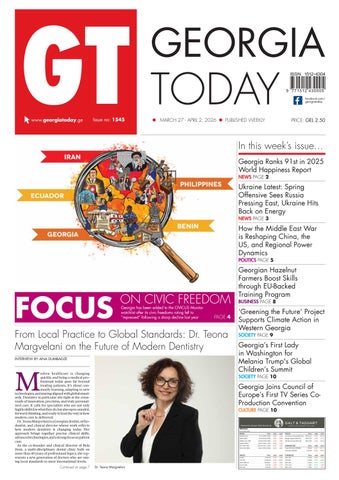
Ukraine Latest: Spring Offensive Sees Russia Pressing East, Ukraine Hits Back on Energy
NEWS PAGE 3
How the Middle East War is Reshaping China, the US, and Regional Power Dynamics
POLITICS PAGE 5
Georgian Hazelnut Farmers Boost Skills through EU-Backed Training Program
BUSINESS PAGE 8
‘Greening the Future’ Project Supports Climate Action in Western Georgia
SOCIETY PAGE 9
BY ANA DUMBADZE
odern healthcare is changing quickly, and being a medical professional today goes far beyond treating patients. It’s about constantly learning, adapting to new technologies, and staying aligned with global standards. Dentistry in particular sits right at the crossroads of innovation, precision, and truly personalized care. It calls for specialists who are not only highly skilled in what they do, but also open-minded, forward-thinking, and ready to lead the way in how modern care is delivered.
Dr. Teona Margvelani is a Georgian dentist, orthodontist, and clinical director whose work reflects how modern dentistry is changing today. Her approach brings together precise clinical skills, advanced technologies, and a strong focus on
Georgia’s First Lady in Washington for Melania Trump's Global Children’s Summit
SOCIETY PAGE 10
Georgia Joins Council of Europe’s First TV Series CoProduction Convention
CULTURE PAGE 10
INTERVIEW
Georgia Ranks 91st in 2025 World Happiness Report
BY MARIAM RAZMADZE
The 2025 edition of the World Happiness Report 2025 has been released, offering a global snapshot of wellbeing based on economic, social and psychological indicators.
Georgia placed 91st in the latest ranking, trailing a number of regional peers and emphasizing ongoing challenges in overall life satisfaction. The index evaluates countries using a broad set of factors, including GDP per capita, social support, life expectancy, personal freedom, generosity, perceived corruption and measures of positive and negative emotions. It also considers behavioral indicators such as charitable giving, vol-
unteerism and helping others.
At the top of the ranking is Finland, which continues to lead globally, followed by other Nordic and high-income countries. While economic prosperity plays a role, the report emphasizes that happiness levels do not strictly correlate with GDP per capita alone.
The results also reveal some unexpected rankings. Russia placed 62nd, while Libya ranked 77th, despite ongoing political and economic challenges in both countries.
Regionally, Georgia lags behind several Central Asian states. Kazakhstan ranked 40th, Uzbekistan 51st, Kyrgyzstan 73rd and Tajikistan 87th.
Among neighboring countries, Armenia ranked 86th, slightly ahead of Georgia, while Turkey came in at 92nd. Azerbaijan (104th) and Ukraine (109th) ranked lower.
Tbilisi Relocates
Cooperative Housing Project on Virsaladze Street
BY MARIAM RAZMADZE
Tbilisi City Hall has approved a new location for a longdelayed cooperative housing project intended for families affected by unfinished construction dating back to the 1990s.
Mayor Kakha Kaladze announced that the project, to be implemented by JaoKeni Building, will now be developed at 12 Spiridon Virsaladze Street, replacing the initially planned site near Makhata Mountain.
City officials said the original location posed technical and infrastructural challenges, leading authorities to identify an
No Bids Submitted for Rustaveli Avenue Rehabilitation Tenders in Tbilisi
BY MARIAM RAZMADZE
The State Procurement Agency reported that all five tenders announced by Tbilisi City Hall for the rehabilitation of Rustaveli Avenue have failed after receiving no bids from contractors.
The tenders, announced on February 20 and valued at a combined GEL 12.3
million, covered multiple sections of the central avenue. Planned works included the replacement of 20 centimeters of asphalt pavement, installation of new curbs and drainage systems, rehabilitation of underground crossings, as well as the addition of railings and fire hydrants.
The project was divided into several segments, stretching from Kakabadze Street to Freedom Square, including main sections near the Merani shopping center and Chavchavadze, Besiki and April 9 streets.
The failed procurement process adds further delays to a project that has already been postponed once. Tbilisi City Hall had initially planned to begin rehabilitation works in 2025 and had signed contracts worth GEL 28 million. However, in March of last year, the municipality suspended the project, declaring the need for additional planning and announcing that tenders would be relaunched in 2026. With no companies expressing interest in the latest round, the timeline of the project is now uncertain.
Eurowings to Launch Direct Tbilisi–Cologne Flights Starting July 2
BY MARIAM RAZMADZE
German airline Eurowings will begin operating direct flights between Tbilisi International Airport and Cologne starting July 2.
The Georgian Airports Association stated that flights on the Cologne–Tbilisi–Cologne route will be operated twice weekly, on Tuesdays and Thursdays. The service will be carried out using Airbus A320 aircraft.
Cologne will become a new destination from Tbilisi, an important addition to the airport’s route network. Officials say the launch is expected to support tourism growth and strengthen business ties between Georgia and Germany.
Eurowings' jet. Source: Eurowings
alternative site that meets all construction requirements. The Virsaladze Street plot is equipped with the necessary infrastructure, allowing the project to proceed within defined timelines. Apartments will be handed over to beneficiaries in several phases.
The development is expected to provide housing for 158 families who purchased apartments decades ago but were left without homes after construction projects stalled. Kaladze addressed the needs of such residents remains a priority for the municipality.
“Providing apartments to residents affected by cooperative construction is a main priority for the city. Since 2017, we have been working to ensure these families finally receive their legally recognized homes,” Kaladze said.
Tbilisi Expands Dilapidated Housing Program to Historic Districts
BY MARIAM RAZMADZE
The Tbilisi City Hall is extending its program for replacing unsafe residential buildings to include Old Tbilisi, introducing a new approach specifically made for the city’s historic areas. Deputy Mayor Giorgi Tkemaladze said the municipality is currently working on dozens of projects in districts where structural conditions require more complex planning due to heritage preserva-
tion rules.
Under the updated framework, the program will operate along two tracks.
In non-historic neighborhoods, structurally unsafe buildings will be demolished and replaced with newly constructed residential blocks. In contrast, in historic areas, where strict architectural and volume regulations apply, the city will adopt a buyout model instead of direct redevelopment.
The buyout mechanism means that the municipality acquires properties at market value, based on owner agreements and independent assessments conducted by the Levan Samkharauli National
Forensics Bureau. Once acquired, the sites will be offered to private investors under the same urban planning parameters currently in force.
City officials say the initiative is designed to improve safety conditions while preserving the architectural integrity of Old Tbilisi. Authorities stress that the program is not profit-driven and the goal is to address long-standing structural risks in residential buildings.
Tkemaladze stated that several cases are already in progress and the municipality expects to present specific project details publicly in the coming months.
Landmark view of Georgia. Source: Atlys
Cooperative housing complex. Source: ArchDaily
Rustaveli Avenue. Source: Georgian Travel Guide
Ukraine Latest: Spring Offensive Sees Russia Pressing East, Ukraine Hits Back on Energy
COMPILED BY ANA DUMBADZE
Over the past week, the war in Ukraine has entered a more dangerous and intense phase. Russian forces have increased pressure along the eastern front, while both sides continue to contest energy infrastructure, and civilian casualties have risen sharply from long-range attacks. Moscow appears to be using the arrival of spring to push a fresh offensive, concentrating on the heavily fortified Donetsk line connecting Sloviansk, Kramatorsk, and Kostiantynivka. Smaller Russian assaults have also targeted Pokrovsk and the Zaporizhzhia region. According to the Institute for the Study of War, Russian troops launched a battalion-sized attack northeast of Sloviansk, along with several smaller attacks, likely preparing for a broader campaign. Ukrainian officials reported more than 600 assaults over four days, with analysts noting that Russia’s renewed use of armored vehicles signals a push to gain ground, even if a decisive breakthrough remains unlikely.
The fighting continues to be a costly war of attrition rather than swift maneuvering. While Russian forces described heavier fighting and pressure in Pokrovsk during winter, Ukrainian commanders said there is no sign of an imminent overwhelming assault. In the southeast, Russian troops have pressed forward in the open terrain of Zaporizhzhia, where defending is especially difficult. Analysts suggest Russia has the manpower to continue advancing, but extensive drone activity is limiting large-scale mechanized gains.
Ukraine’s response has focused on slowing and punishing Russian advances through drones, long-range strikes, and localized counterattacks. Kyiv has expanded its mid-range strike capability, hitting Russian logistics, depots, and supply routes up to 50 kilometers behind the front lines. Long-range strikes have targeted refineries, ports, and other strategic infrastructure, gradually eroding Russia’s ability to replace battlefield losses. The week’s pattern shows Russian incremental pressure on land countered by Ukrainian attacks on the systems sustaining the Russian war effort.
Civilians have again borne a heavy cost.
On March 21, Russian strikes killed four people and disrupted power across northern Ukraine after a drone hit an energy facility in Chernihiv region. Subsequent attacks left more than 200,000 households without electricity. On March 24–25, Russia launched one of its heaviest drone waves in months, killing at least eight people and injuring dozens, and causing damage in western cities that had previously been relatively less exposed. Cultural sites were also damaged, including a UNESCO-listed area in Lviv.
By March 26, Russian attacks killed two more people near Kharkiv, injured nine, and damaged port and energy facilities in Izmail on the Danube: a key logistical hub. Ukrainian officials warned that Russia may be preparing additional long-range drone bases in Belarus and occupied territory, signaling a potential intensification of the air war.
Ukraine, for its part, kept escalating attacks on Russia’s energy network. Reuters reported that Ukrainian strikes in recent weeks hit a growing list of Russian oil targets, including the Saratov refinery, while attacks on Baltic export
infrastructure forced the suspension of crude and oil-product loadings at Primorsk and Ust-Luga, two of Russia’s key export terminals. Reuters calculations published on March 25 said that at least 40% of Russia’s oil export capacity was halted by a combination of Ukrainian drone attacks, pipeline disruption and tanker seizures, making it the most severe oil-export shock in modern Russian history. On March 26, a Russian official said a Ukrainian drone attack damaged an industrial area near Kirishi, home to one of Russia’s biggest refineries. Russia also accused Ukraine last week of intensifying attempts to hit Gazprom compressor stations serving TurkStream and Blue
Stream, though Ukraine did not comment publicly. Together, these attacks show that Kyiv is trying to compensate for Russian pressure at the front by squeezing Russian export revenue and fuel logistics. Diplomatically, the week brought movement but limited tangible progress. Ukrainian and US negotiators met in Florida over the weekend, holding what the White House described as “constructive” talks, with follow-up discussions on Sunday. Russian representatives were notably absent. According to Reuters, the meetings focused on drafting bilateral documents and exploring a potential drone deal, while the broader issue of
security guarantees remains unresolved. President Volodymyr Zelensky emphasized that Kyiv cannot accept proposals linking high-level security assurances to giving up territory in Donbas, which he described as an unacceptable risk to national security.
Meanwhile, international support for Ukraine continued, though with a mix of reassurance and practical limitations. European Council leaders reiterated that the EU fully backs Ukraine in negotiations, firmly insisting that borders cannot be changed by force. They pledged to provide credible security guarantees through initiatives such as the “Coalition of the Willing,” which would allow willing EU members to coordinate defense support even if some countries, like Hungary or Slovakia, veto certain measures at the EU level. European Commission President Ursula von der Leyen confirmed that the EU would still find a way to deliver the previously promised €90 billion support loan to Ukraine despite Hungary’s objections, signaling that Kyiv could receive aid through alternative mechanisms rather than being blocked entirely by a single member state. Germany also simplified armsexport procedures for certain air and naval defense equipment to speed deliveries to Ukraine, and Zelensky confirmed that the United States is continuing Patriot missile supplies, even if they remain below Ukraine’s operational needs. At the same time, the broader international context is becoming more complicated: the war with Iran has diverted US attention and strained airdefense resources, while G7 foreign ministers meeting in France emphasized that Ukraine remains a priority, even as global crises compete for diplomatic focus.
Historic center of Lviv after a daytime attack by Russia. Source: EPA-Yonhap
Amnesty International Urges Release of Elene Khoshtaria, Calls Sentence Politically Motivated
BY TEAM GT
Amnesty International has called on Georgian authorities to immediately release opposition politician Elene Khoshtaria and review her prison sentence, describing the case as politically motivated and disproportionate.
Khoshtaria, the leader of the opposition party Droa, was sentenced by Tbilisi City Court on March 24 to one year and six months in prison. The ruling was based on Article 187(1) of Georgia’s Criminal Code, which concerns property damage resulting in substantial harm.
The charges stem from an incident on September 14, 2025, when Khoshtaria wrote the phrase “Russian Dream” with a marker on election posters of the ruling Georgian Dream party’s Tbilisi mayoral candidate. According to the Prosecutor’s Office, the damage was assessed at 570 GEL (approximately 210 USD).
Reacting to the verdict, Denis Kriv-
osheev, Amnesty International’s Deputy Director for Eastern Europe and Central Asia, said the punishment was excessive for a non-violent act of protest.
“For a symbolic act of protest, writing barely visible graffiti on a street poster,
Archil Gorduladze: Georgia Will Continue to Limit Russia Relations to Territorial Integrity Issues
BY TEAM GT
Archil Gorduladze, a senior figure in Georgia’s ruling party, has reiterated that any engagement with Russia will remain strictly limited to issues of territorial integrity, following renewed rhetoric from Moscow suggesting interest in closer ties.
Speaking as chairman of parliament’s Legal Affairs Committee, Gorduladze said Georgia would only maintain relations with what he described as an “occupying country” in matters concerning “the extension of our country’s full jurisdiction over unrecognized de facto territories.” His comments came in response to recent remarks by Maria Zakharova, who indicated that Tbilisi may be open to more “constructive relations” with Moscow.
Georgia and Russia have not had formal diplomatic relations since the RussoGeorgian War, a brief but consequential conflict that resulted in Russia recognizing the independence of the breakaway regions of Abkhazia and South Ossetia. The international community, including the United Nations and the European Union, continues to regard both territories as part of Georgia.
Tbilisi has since pursued a dual-track approach: refusing diplomatic ties with Moscow while maintaining limited communication channels on security and humanitarian issues, including border incidents and conflict prevention mechanisms.
Gorduladze’s remarks confirm this policy line, emphasizing that any dialogue must center on restoring Georgia’s territorial integrity. “Everyone knows very well that there are no diplomatic relations,” he said, adding that engagement would only occur where it serves national interests tied to sovereignty.
The statement also reflects ongoing domestic political tensions. Gorduladze defended the governing Georgian Dream party against accusations, frequently raised by opposition groups, that it maintains informal ties with the Kremlin.
He argued that if such ties existed, Moscow would not issue statements perceived as favorable toward the Georgian government. Instead, he suggested,
external actors may be attempting to influence Georgia’s internal political landscape.
“Our main interest is the unification of our territories, ensuring peace, and creating guarantees for economic progress,” Gorduladze said, framing the government’s approach as pragmatic and aligned with public priorities.
Zakharova, speaking for Russia’s foreign ministry, said relations between the two countries have a “natural character” and claimed that Georgia appears interested in constructive engagement. She also criticized what she described as “Western practices” in diplomacy, contrasting them with Russia’s approach.
Her comments come as one of numerous periodic signals from Moscow that it is open to restoring broader ties with Tbilisi, including economic and transport links. In recent years, direct flights and trade have partially resumed, despite the absence of formal diplomatic relations.
Analysts note that while economic interactions between the two countries have increased, political normalization remains constrained by the unresolved status of Abkhazia and South Ossetia.
Public opinion in Georgia has consistently favored Euro-Atlantic integration, including closer ties with the European Union and NATO, further complicating any potential rapprochement with Russia.
Elene Khoshtaria will spend a year and a half in prison. This is yet another example of the criminal justice system being instrumentalized to punish dissent,” he said.
Krivosheev stressed that criminal
sanctions for minor, non-violent offences committed while peacefully expressing dissent represent a disproportionate restriction on freedom of expression and should not result in imprisonment.
He further noted that the severity of
the sentence appears linked not to material damage, but to Khoshtaria’s political views and the symbolic nature of her protest against the ruling party.
“The authorities must immediately release her, review her sentence, in particular by quashing the prison term, and end all politically motivated trials without delay,” he added.
Khoshtaria has stated that her action was an expression of solidarity with activist Megi Diasamidze, who had been detained days earlier for a similar protest. Diasamidze has since been released on bail, while her case remains ongoing.
Amnesty International also pointed to a broader context of ongoing protests in Georgia, particularly following the widely disputed parliamentary elections of October 2025. According to the organization, authorities have responded with increasing repression, including arbitrary arrests, criminal prosecutions, and restrictions on freedom of expression, assembly, and association.
The statement adds to growing international scrutiny of Georgia’s political and judicial processes amid continued tensions between the government and opposition groups.
Georgia Added to Global Watchlist as Crackdown on Dissent Intensifies
BY TEAM GT
Georgia has been placed on a global human rights watchlist due to what activists describe as a rapid and sweeping deterioration of civic freedoms, following a wave of restrictive laws and an escalating political crisis.
The move comes from the CIVICUS Monitor, which on 25 March added Georgia to its watchlist of countries experiencing a sharp decline in civic space.
The country now joins others such as Iran, Philippines, Ecuador and Benin.
The decision follows a dramatic downgrade in Georgia’s civic space rating, from “narrowed” to “obstructed” in 2024, and then to “repressed” in December 2025, the second-worst classification used by the monitor. The rating signals severe restrictions on freedoms of expression, peaceful assembly and association.
WAVE OF RESTRICTIVE LAWS
Concerns have intensified following a series of laws passed by parliament in March 2026, which significantly expand state control over civil society and dissent.
Among the most controversial changes are amendments broadening the definition of “foreign grants” to include almost any form of support deemed to influence public policy, even private donations. Violations can carry prison sentences of up to six years.
Lawmakers have also introduced new offences targeting “extremism against the constitutional order,” widely interpreted by critics as a tool against those challenging the legitimacy of the 2024 elections. Additional measures include long-term bans from political party membership for individuals linked to organizations labeled as acting in “foreign interests.”
These developments build on earlier legislation, including the widely criticized “foreign agents” law adopted in
2024, which triggered mass protests and drew comparisons to similar laws in Russia.
WARNINGS OF DEMOCRATIC BACKSLIDING
International observers have also raised the alarm. On 12 March, the Organization for Security and Co-operation in Europe invoked its Moscow Mechanism to investigate the situation in Georgia, concluding that the country is undergoing “marked democratic backsliding.”
At the same time, protest laws have been tightened, criminalizing a growing range of activities such as covering one’s face or blocking traffic. Repeat offences can lead to prison sentences.
“Authorities are introducing sweeping new restrictions at a relentless pace, dismantling civic space piece by piece,” said Tara Petrovic, Europe researcher for the CIVICUS Monitor. “This constant stream of repressive laws must be urgently reversed, and provisions that are incompatible with Georgia’s human rights obligations must be repealed in full.”
PROTESTS AND PRESSURE ON OPPOSITION
The crackdown follows mass demonstrations that erupted in late 2024 after the ruling party, Georgian Dream, announced a pause in European Union accession talks.
Security forces responded with tear gas, water cannons and arrests, while reports emerged of violence by unidentified masked groups. Civil society organizations say hundreds of protesters have since faced detention, fines, and alleged ill-treatment.
Pressure has also mounted on independent media and NGOs, with reports of financial scrutiny, frozen bank accounts and politically motivated investigations. In one case, a broadcaster faced proceedings over a single donation from abroad. Opposition figures have not been spared. Several leaders were jailed or barred from office in 2025, while prosecutors have opened cases against others carrying potential sentences of up to 15 years. A pending case before the Constitutional Court could result in the banning of multiple opposition parties.
“The speed and scale of these repressive measures should alarm anyone concerned about Georgia’s future,” Petrovic said.
Elene Khoshtaria at the moment of protest and after. Source: RFE/RL
Civic repression as per CIVICUS Monitor. Source: Civicus
Archil Gorduladze. Source: IPN
Zineb Riboua on Iran Conflict: How the Middle East War is Reshaping China, the US, and Regional Power Dynamics
INTERVIEW BY VAZHA TAVBERIDZE
In this interview with Radio Free Europe/RL’s Georgian Service, Zineb Riboua, research fellow at the Hudson Institute, offers a fresh perspective on the Iran conflict and its ripple effects across the Middle East. She talks about how China, the United States, Russia, and regional players are navigating the crisis, and what it reveals about shifting alliances, influence, and power.
HOW IS THIS WAR RESHAPING BEIJING’S ROLE IN THE MIDDLE EAST, ITS INTERESTS, ITS LIMITS, AND HOW IT IS PERCEIVED ACROSS THE REGION?
By attacking Iran, the US is also indirectly weakening China's posture in the Middle East. China has a very good relationship with Gulf countries, with trade ties that are mostly transactional, often driven by oil. But for China, it’s beyond just the Belt and Road Initiative and the Digital Silk Road. Why? Because Iran is a very aggressive partner. They terrorize the region and control militias, which are very useful when contesting US power in a strategically vital area with major energy flows. For example, the Houthis in the Red Sea, blockading shipping and attacking commercial vessels, actually challenged US security architecture to the point that the United States could not fully respond and had to negotiate deals. That's very good when you're China. You want Gulf countries to see that the United States is struggling. You want that to happen because it's the only way you can gain a better posture, especially with a Saudi Arabia that needs to have a channel to discuss with Iran and the Houthis. China offered that channel, which is why they brokered the SaudiIran normalization deal in Beijing. Iran also plays a major role in sanctions evasion. China does not want to be a victim of US sanctions or end up in the same position as Putin. Using Iran to bypass sanctions and financial restrictions is crucial for China, especially considering a potential Taiwan crisis.
And Iran’s geography is strategically valuable, as shown in the 25-year cooperation agreement with $400 billion pledged by China. Every move China makes there reverberates beyond the Middle East into Central Asia and beyond. On many levels, it's very noticeable how China also benefited from a very aggressive Iran, to the point where Iran's own military arsenal was basically built by China: the missiles, the components, the chemicals, a lot of it came from China. Also, there's the surveillance part, and Iran's own regime is obviously very repressive; they relied heavily on Chinese technology to identify people.
This shows the depth of China’s involvement in Iran and how it spread throughout the region. Operation Epic Fury is dismantling much of this. Because whatever comes next, they will have to be a non-hostile US actor. Otherwise, the United States will not approve it. With Trump personally involved in choosing which Ayatollah to deal with, China’s lack of access to a cooperative, open regime is a very serious concern.
YOU HAVE WRITTEN THAT “BEIJING HAS INVESTED HEAVILY IN IRAN AS A KEY STRUCTURAL ASSET IN ITS MIDDLE EAST STRATEGY.” WHAT CAN CHINA REALISTICALLY DO TO PREVENT THE LOSS OF THIS HUGELY IMPORTANT ASSET?
I think this is a type of asset that is very
hard to replicate. Right now China is taking a balancing position, condemning Iran’s aggression against Gulf countries, because all these dynamics were actually for China to gain access to US allies, especially Saudi Arabia and the UAE, which are very important.
They will recalibrate, but will need another country to use as a laboratory for sanctions and influence. Few countries will be open to that, as we see with Trump targeting not just Iran but also Venezuela, Ecuador, and Cuba.
The world will think twice about dealing with China precisely because it did not help Iran during the 12-day war and still does not.
SO WHY DID CHINA NOT HELP? HOW LONG CAN IT REMAIN THIS BALANCED ACTOR STANDING ON THE SIDELINES?
They did not and cannot help because they see Iran as a dying regime. Long before the strikes, inflation, youth unemployment, poor water management, and an inability to implement effective monetary policy were all clear to see. People were losing trust in the Rial.
All these indicators show a declining regime, which raises the question of whether China simply chose the rational path: not to prop up a dying state.
WHAT DOES IT DO FOR CHINA'S REPUTATION, CREDIBILITY, AND COMMITMENTS?
China cannot change what is already happening. There is little it can do while a military campaign dismantles every launcher and ballistic missile. The military superiority of Israelis and Americans has been extraordinary, so even leaks suggesting China may be sending targeting intelligence to Iran will not shift the balance of power. China did provide weapons beforehand, but it is not enough. The Islamic Republic’s problem is military: its broken chain of command makes an effective response nearly impossible, even with Chinese aid. Other countries are watching, but they also see that Iran is unpopular.
I mean, one of the things Iran did was target oil infrastructure in Gulf countries, despite the fact that some of those countries, for example Qatar, had played a constructive role for Tehran by relaying messages and facilitating communication. And yet they were still hit. So China finds itself in a somewhat awkward position. It cannot fully distance itself from the Islamic Republic, but nor can it afford to alienate its Gulf partners.
LOOKING AT POSSIBLE END GAMES, IS IT FAIR TO SAY THAT ANY OUTCOME SHORT OF THE MAXIMAL US GOAL OF A COMPLIANT IRAN UNDER US INFLUENCE WOULD STILL BE MANAGEABLE FOR BEIJING?
I think so. If the operation leaves even a spark of hope for the Islamic Republic, China can still capitalize on some gains because the structure is already there. But it will be very hard for China to use Iran as it once did. Gulf countries are already expanding their security partnerships with the US, and the dividends of aligning with Israel are becoming clear; the UAE, for example, sees that. Using Iran to disrupt US security architecture simply will not work anymore. Even if the Islamic Republic survives or shows a glimmer of hope, it will no longer play the same role. China also long counted on US fatigue with foreign interventions, assuming Washington would not act preemptively. This operation breaks that model and shows America is willing to act, changing China’s cal-
culations after its bet on US decline.
HOW DOES THAT CHANGE CHINA'S STRATEGIC THINKING AND DECISION MAKING WHEN IT COMES TO TAIWAN?
The US acting more unpredictably and preemptively is very important because the general consensus was that the US would not intervene in the Middle East. At the same time, the US is trying to bring Iran under a US security architecture.
This changes a lot for Taiwan, because China will lose access to sanctions evasion channels. It will not be able to weaponize or see proxies of Iran as helpful when countering the United States. And more importantly, I think it's also empowering countries like Japan, who also are operating in the Global South, who also are strengthening the alliance system in Asia, especially with countries like Indonesia, the Philippines, and Vietnam.
They’re also watching China’s current unreliability. That's something Japan can capitalize on. So, I think it's changing a lot of parameters.
Obviously, I cannot 100% say what Xi Jinping is thinking, but I can tell you that this is the strategic environment that he's operating in.
IF IT'S INDEED ALL ABOUT CHINA, THEN WOULD IT BE FAIR TO SAY THAT THE DIPLOMATIC CULMINATION OF ALL THIS WOULD BE PRESIDENT TRUMP'S VISIT TO CHINA, WHICH IS REPORTEDLY BEING POSTPONED? HOW BIG OF A CARD WOULD IRAN BE FOR TRUMP TO HOLD WHEN HE GOES TO CHINA?
I think he will want to hold the Iran card, the Cuba card, the Ecuador card, the Venezuela card, the rare earth card.
LET'S LOOK AT THE HORMUZ STRAIT. HOW LONG AND HOW EFFECTIVELY CAN IRAN PLAY THIS CARD?
Not for long. It's a very risky card that can only be played once. It needed to put maximum pressure on the US president to see oil prices increasing and say, “okay, we need to stop.” But Trump refused to change his position. Instead, he doubled down. The Iranians were hoping that it would kick off a huge debate in the United States and trigger
some sort of reaction. It didn't.
DOES THAT ALSO MEAN IT WON'T HAPPEN IF IT DRAGS ON?
I don’t think it can drag on, precisely because it’s harmful for China. This isn’t just about oil. It’s also about fertilizers, and the planting season is coming up very soon. In this operation, Iran is hurting its own partners, and I just don’t think they have the necessary military dominance to sustain it for long. Iran doesn’t have enough weapons or ammunition to maintain it. For that reason, I’m less pessimistic than many other analysts on this one.
ONE OF THE RESPONSES TO THE HORMUZ STRAIT CLOSURE IS THE POTENTIAL SEIZURE OF KHARG ISLAND. HOW DIFFICULT AND COSTLY WOULD IT BE TO HOLD?
I don’t have a precise sense of the cost, but Trump mentioned it back in 1988, so it’s been on his mind for a long time. What matters is that even if Iran ramps up the threats, the United States is doubling down, escalating to establish deterrence. This is the real story that matters: that the Iranians have very few options left. And every day they have fewer. So I think they are being cornered.
HOW MUCH OF A GAME CHANGER WOULD A KHARG ISLAND CAPTURE BE, DO YOU THINK?
It would be a huge game changer, at least for the Gulf countries. It would show that the United States is actually willing to follow through on every single one of its threats.
ON RUSSIA: WITH DEBATE OVER WHETHER MOSCOW IS LOSING A KEY PARTNER OR BENEFITING FROM HIGHER OIL PRICES AND TEMPORARY SANCTIONS RELIEF, IS RUSSIA ULTIMATELY A WINNER OR A LOSER IN THIS CONFLICT?
Russia definitely loses a key partner that helped counter NATO. Most think of NATO’s eastern flank, but the southern flank is crucial too, and Iran played a huge role in weakening it, in Syria, Libya, and elsewhere too. Since NATO explicitly considers Iran a threat, this is overall bad news for Russia.
That said, Russia had partially decou-
pled from Iran after Syria and the fall of Bashar al-Assad. They no longer need Iran in Syria, Armenia, or Azerbaijan, and even transferred drone know-how to Russia in Tatarstan. From a dependency perspective, Russia is not as reliant on Iran as before, but Iran was still a critical partner in pushing back against NATO.
That's, I think, a very big gain when we're thinking about Ukraine. Obviously, people are talking about the sanctions and how they are making some gains. It's true, the numbers speak for themselves. However, we have to also take into consideration the fact that Russia's deficit and economy: no matter how many gains they're making, it will not cover up for their structural economic failures.
They're not in a very good shape. So I think that's also something to take into consideration because it will be important in negotiations with the United States.
AND WILL THERE BE CONSEQUENCES FOR RUSSIA PROVIDING INTELLIGENCE SUPPORT TO IRAN, EVEN AT THE LEVEL OF A SLAP ON THE WRIST?
Yes. I think they are doing payback for the United States providing intelligence to Ukrainians.
But they are also playing with fire, because, for the last two years, they had a Trump that was willing to actually sit down and think about Russian interests. I think they are closing that window. HE'LL BE LESS INCLINED TO DO SO NOW?
I think so. Russia showing once more that it is targeting the United States will change a lot of the administration's calculus.
IN A RECENT PIECE, YOU ARGUE THAT EUROPE HAS PLAYED A POSITIVE BUT LARGELY BEHIND THE SCENES ROLE AND THAT EUROPEAN ALLIES HAVE DECLINED PRESIDENT TRUMP’S CALLS FOR PUBLIC SUPPORT. DO YOU EXPECT REPERCUSSIONS FROM THIS APPARENT RELUCTANCE?
I think it's too soon to see if there will be repercussions. My assessment so far is that there will be. Trump was hoping to show that there is a huge coalition he, the United States, can lead.
IT'S FLASHIER, MORE BOMBASTIC.
Exactly. There’s definitely a dramatic side to it. But when you’re dealing with China, Iran, and Russia, you want to have some kind of counter to that and show that it exists. The thing is, Europe is structurally incapable of doing that, even in the best-case scenario. It puts them in a strange position. Even though they’ve been absolutely crucial with sanctions and extremely helpful in Syria, they can’t publicly acknowledge it because of electoral considerations. I really wish a European leader had explicitly made the case for how Europe is helping and could help. I think it would have changed a lot of the discussions.
AND FINALLY, TURKEY.
I think Turkey is also a winner in this, a big winner. Iran has always been a big problem for them in Syria and Iraq and elsewhere. That problem is vanishing, and it's going to help them in their other projects. But the question for the United States will be how to reconcile Turkey with Israel, especially on Syria. I think that will be the big question of the next few years.
Zineb Riboua. Source: Hudson
Georgia’s Four-Point Drop
BY IVAN NECHAEV
The newest report by Freedom House, ‘Freedom in the World 2026: The Mounting Shadow of Autocracy,’ places Georgia at 51 out of 100, marking a four-point decline over the past year. Within Eurasia, this is the sharpest drop. The country remains classified as “partly free,” though the internal composition of that score now tells a more precise story about where pressure is accumulating.
Freedom House breaks the total into two core components: political rights and civil liberties. Georgia’s political rights score now stands at 10 out of 40, while civil liberties are rated at 32 out of 60. A year earlier, those figures were 21 and 34 respectively. The shift is uneven but analytically clear: the most significant deterioration is concentrated in the domain of political competition and participation. A decline from 21 to 10 in political rights is not incremental.
It indicates structural changes in how political competition functions. According to the report, opponents of the ruling Georgian Dream have faced physical attacks, harassment, and new legal constraints designed to limit their ability to participate in public life.
Within the Freedom House framework, this affects several indicators simultaneously: electoral competitiveness, the openness of political participation, and the degree to which opposition forces can organize without obstruction. The presence of elections alone does not sustain a high score; what matters is whether those elections operate within conditions of relative fairness. The data suggests that this balance has shifted.
The decline in civil liberties—from 34 to 32—is numerically smaller, though it reflects a broader pattern. Freedom House points to continued concerns about free-
dom of assembly, expression, and protection from state overreach, particularly in the context of the protest cycle that began in 2024.
These indicators tend to move more slowly because they are distributed across everyday practices: policing, media conditions, legal protections. A two-point drop signals cumulative pressure rather than a single determinative event. It suggests that while core freedoms remain formally intact, their exercise is becoming more constrained.
One of the more structurally significant developments highlighted in the report is the extension of political control into the education system. Freedom House notes “broad efforts” by the ruling party to consolidate influence in this sector, including reported risks of dismissal for professors critical of the government.
From an analytical standpoint, this marks a shift in the scope of governance. When pressure extends beyond political institutions into universities, it affects not only freedom of expression but also the long-term production of critical discourse. In comparative terms, such moves often accompany a transition from competitive constraint to deeper institutional consolidation.
Georgia’s score of 51 places it alongside Ukraine (51) and below Armenia (54), while remaining significantly above countries such as Azerbaijan (6), Belarus (7), Russia (12), and Turkey (32). These comparisons do not imply convergence but help situate the scale of decline.
The more relevant point is internal trajectory. Georgia’s drop stands out in a region where most changes were marginal. A four-point decline in a single year indicates concentrated developments rather than gradual drift.
Freedom House situates Georgia’s decline within a broader global trend. According to the report, political rights and civil liberties have declined worldwide for the twentieth consecutive year.
In 2025 alone, 54 countries registered
deterioration, compared to 35 that showed improvement. Only 21 percent of the world’s population now lives in countries classified as “free,” down from 46 percent two decades ago. This context matters analytically. Georgia’s trajectory does not unfold in isolation; it aligns with a wider pattern in which democratic systems experience pressure without necessarily undergoing abrupt regime change.
At 51 points, Georgia remains within
the “partly free” category. The institutional framework of democracy - elections, political parties, formal rightsremains in place. What the 2026 report captures is a shift in how these institutions function.
The decline in political rights suggests increasing asymmetry in competition.
The smaller but consistent drop in civil liberties indicates tightening conditions for participation and expression. The expansion of control into sectors such as
education points to a broader reconfiguration of influence. Taken together, these elements describe a system under pressure rather than one in collapse. The four-point drop is not a singular event but the cumulative result of multiple adjustments across the political and civic landscape. The direction of movement is clear; the durability of that trajectory will depend on whether these pressures stabilize, intensify, or reverse in the next reporting cycle.
Fuel Prices in Georgia Rise Again as Global Energy Uncertainty Pushes Costs Higher
BY TEAM GT
Fuel prices across Georgia have climbed again this week, causing concern for drivers, businesses, and consumers already feeling the pinch from rising costs elsewhere. The latest increases come as global energy markets remain volatile amid ongoing conflicts in the Middle East and disruptions to supply routes.
Gasoline in Georgia has gone up by about 2 to 10 tetri per liter, while diesel has seen sharper rises of 7 to 20 tetri per liter, depending on the brand and station. At Gulf stations, a uniform increase of 10 tetri was implemented on March 24, bringing premium gasoline (G Force Super) to GEL 3.83 per liter and Euro Regular to GEL 3.27. Diesel products such as G Force Euro Diesel now cost about GEL 3.67 per liter.
Wissol reported similar trends, with diesel prices rising to around GEL 3.68, while gasoline grades increased more modestly. Socar adjusted prices by between 3 and 15 tetri, with Nano Euro 5 Diesel reaching GEL 3.50 and Nano Super gasoline at GEL 3.67. Other chains such as Lukoil and Rompetrol also raised prices, although real time figures from their websites remain limited.
Georgia is one of the developing member countries of the Asian Development Bank (ADB), which has warned that global supply chain disruptions and higher
energy costs are likely to add inflationary pressure for many economies. The bank has pledged financial support to help countries manage volatility and secure essential imports, including oil. Rising fuel prices do not just affect motorists. Transportation costs feed into the price of many goods and services. In Georgia, recent official figures show that transport prices rose by 1.5 percent in February, contributing to wider inflation trends in the economy, even as some food prices moved in mixed directions. Domestic inflation has been running above 4 percent this year, with food and non alcoholic beverage prices up sharply in earlier months. Higher fuel costs can add to these pressures because goods cost more to move from producers to shops, meaning that families may soon feel the impact not just at the pump but also at the grocery store.
Fuel retailers and transport companies also warn that if diesel remains high, operating costs will continue to rise. That could eventually lead to higher prices for consumer goods that rely on road transport, since almost every product depends on fuel at some point in its journey from factory to shop.
For many Georgians, the continuing price rises are more than a statistic. Drivers are cutting back on non essential trips, and small businesses are carefully watching expenses. With global energy markets still unsettled, there is no immediate sign that fuel prices will fall, leaving many households bracing for more adjustments to their budgets.
Freedom Square, Tbilisi. Source: wikipedia
From Local Practice to Global Standards: Dr. Teona Margvelani on the Future of Modern Dentistry
Continued from page 1
With a background rooted in both tradition and continuous advancement, Dr. Margvelani has played a key role in integrating modern technologies, evidencebased protocols, and multidisciplinary approaches into everyday clinical practice. Her contribution to the field was recognized at the Med Award 2025, where she was named “Leader and Innovator in Orthodontic Practice and Clinical Management,” while Bela Dent received recognition for its outstanding contribution to the development of modern dentistry.
In this interview, Dr. Margvelani reflects on the current state of dentistry, the challenges and opportunities within the field, and her vision for the future of dental care.
HOW WOULD YOU DESCRIBE THE CURRENT STATE OF MODERN DENTISTRY, AND WHAT ARE THE KEY TRENDS SHAPING THE FIELD TODAY?
Modern dentistry is a rapidly evolving field, where technological advancement, clinical expertise, and patient-centered approaches collectively define its future and reinforce its critical role within the global healthcare system.
Key trends include the rise of digital dentistry, 3D diagnostics, CAD/CAM technologies, minimally invasive procedures, and the growing use of artificial intelligence in early diagnosis and treatment planning.
WHERE DOES GEORGIA STAND TODAY IN COMPARISON TO INTERNATIONAL DENTAL STANDARDS?
Dentistry in Georgia is developing at a remarkably fast pace. In recent years, modern technologies and treatment protocols have been actively introduced, bringing local practice significantly closer to global standards.
At the same time, the increasing involvement of Georgian dental professionals in international scientific platforms, professional associations, and research activities is creating a strong foundation for global integration.
My own professional focus is centered on implementing modern standards, improving clinical practice, and adapting international experience within the local system. As a result, Georgia can be viewed today as a rapidly developing dental market with real potential not only to reach but, in certain areas, exceed international standards, particularly with continued systemic development and innovation.
WHAT ARE THE MAIN CHALLENGES CURRENTLY FACING DENTAL PROFESSIONALS?
Today, the field faces several critical challenges, including the rapid pace of technological change, the need for continuous professional education, and maintaining high-quality standards in an increasingly competitive environment.
I see these challenges as opportunities for continuous growth, allowing us to introduce innovative approaches and further optimize the quality of care we provide.
WHAT INSPIRED YOU TO PURSUE A CAREER IN DENTISTRY AND SPECIALIZE IN ORTHODONTICS?
In many ways, I grew up in dentistry. My mother, Bela Margvelani, has over 45 years of clinical experience and founded our family clinic, Bela Dent, which carries her name.
For me, this profession is not simply a career, it is both a legacy and a responsibility to deliver results that remain effective over time.
Orthodontics, in particular, attracted me because it uniquely combines science, aesthetics, and functional rehabilitation. Early in my career, I followed the principle of “one patient — one doctor,” aiming to provide patients with maximum comfort and continuity of care. Expanding into orthodontics allowed me to offer a more comprehensive, multidisciplinary approach within a single clinical setting.
WHAT PRINCIPLES DEFINE YOUR APPROACH TO PATIENT CARE?
My approach is based on three core principles: a deep understanding of each patient’s individual needs, evidencebased treatment, and a strong focus on long-term outcomes.
I believe that high-quality results are achieved not only through technical expertise, but also by ensuring patient trust and comfort. My goal is for every patient to receive care that meets international standards and to be an active participant in the treatment process, rather than a passive recipient.
BELA DENT HAS OVER 40 YEARS OF HISTORY. HOW HAS THE CLINIC EVOLVED, AND WHAT MAKES IT STAND OUT TODAY?
Although Bela Dent was established under its current name 18 years ago, our family’s involvement in dentistry spans decades, over 25 years in my case, and 45 years in my mother’s.
We have successfully combined tradi-
tion with innovation, transforming the clinic from a traditional dental practice into a modern, multidisciplinary center. In recent years, we have actively implemented digital technologies, multidisciplinary treatment approaches, and international clinical protocols. Today, what distinguishes Bela Dent is the consistency of quality, a highly professional team, continuous international education, and extensive experience in managing complex clinical cases; positioning the clinic as a leader in the region.
HOW DO YOU ENSURE THAT YOUR CLINIC MEETS INTERNATIONAL STANDARDS AND DELIVERS HIGH-QUALITY CARE?
Our clinic strictly follows international clinical guidelines and protocols. We continuously invest in staff training, participate in international congresses, and remain actively engaged in professional networks. We use modern technologies and certified materials, while quality control and patient outcome monitoring are integral parts of our daily practice. This allows us to maintain high standards and remain competitive on a global level.
YOU WERE RECOGNIZED AT THE MED AWARD 2025, AND BELA DENT ALSO RECEIVED A MAJOR AWARD. WHAT DO THESE ACHIEVEMENTS REPRESENT FOR YOU AND YOUR TEAM?
I was honored in the category “Leader and Innovator in Orthodontic Practice and Clinical Management,” and Bela Dent received recognition for its contribution to the development of modern dentistry.
The Med Award is an annual national medical recognition involving leading clinics and professionals across the country. For us, these achievements represent not only recognition, but also a significant responsibility and motivation to continue contributing to the advancement of the field.
Such awards strengthen both my professional reputation and that of our clinic within the regional and international dental community.
YOU HAVE PARTICIPATED IN NUMEROUS INTERNATIONAL CONGRESSES AND PROFESSIONAL EVENTS. HOW HAS THIS GLOBAL EXPOSURE INFLUENCED YOUR CLINICAL PRACTICE?
Participation in international congresses and professional events has played a crucial role in my professional development. It allows me to stay continuously updated on the latest advancements in dentistry, exchange knowledge with leading experts, and integrate global best practices into my clinical work.
Over the years, I have attended major international meetings across Europe, Asia, and the United States, including the Greater New York Dental Meeting, where I have participated multiple times. These experiences not only enhance my clinical expertise but also strengthen my ability to implement modern, evidence-based approaches within our local healthcare system. Continuous international engagement is essential for maintaining high standards and ensuring that our patients receive care aligned with global developments.
WHAT ARE YOUR FUTURE GOALS, AND HOW DO YOU SEE THE DEVELOPMENT OF DENTISTRY IN THE COMING YEARS?
My primary goal is to expand the clinic’s international collaborations and to further integrate advanced digital and minimally invasive technologies into our practice. I also plan to become more actively involved in scientific and educational activities.
The future of dentistry is closely linked to personalized medicine, artificial intelligence, and the development of advanced biomaterials. I aim to be part of these processes and to contribute to the global evolution of the field.
Social Market in Ezo Champions Inclusion, Disability Participation, and Local Enterprise
BY TEAM GT
Alively spring social market titled “Connect for Inclusion” brought together local entrepreneurs, family visitors, and community leaders this week to spotlight economic inclusion and social participation for persons with disabilities. The event was convened by the civil society organization Room in Ezo and supported under the “Taking COBERM Further: UK in Support of Sustainable Peace” (UK SSP) initiative, a joint program of the British Embassy Tbilisi and the United Nations Development Program (UNDP) that strengthens inclusive community engagement and peacebuilding in Georgia.
The spring market showcased a variety of locally made products, with a notable
focus on goods created by women entrepreneurs. Far from being only a commercial fair, the event actively centered persons with disabilities as producers, planners, and sellers, integrating them into all stages of preparation and sales, from product design to customer engagement.
Organizers also ran inclusive workshops for children, offering games and creative activities that emphasized cooperation and understanding across abilities. Event attendees described the workshops as both fun and educational, helping to encourage early attitudes of acceptance and diversity among young people.
The UK SSP program, under which this event was supported, aims to deepen inclusive processes that engage youth, women, and other often excluded groups in peacebuilding and societal participation. It focuses on civil society-led initiatives that contribute to community confidence building and inclusive
The Spring Market. Photo by Gela Bedianashvili/UNDP
Dr. Teona Margvelani
Georgian Hazelnut Farmers Boost Skills through EU-Backed Training Program
BY TEAM GT
More than 130 small- and medium-scale hazelnut producers in Georgia have strengthened their farming practices through a targeted training program aimed at improving productivity, sustainability, and food safety in one of the
country’s key agricultural sectors.
A total of 133 farmers took part in the initiative, held in Zugdidi and Telavi, which focused on integrated orchard management. The training sessions were organized under an ongoing partnership between the Food and Agriculture Organization of the United Nations (FAO) and AgriGeorgia, Ferrero’s local hazelnut company, with support from the European Union and Sweden through the ENPARD IV program.
Adjara Launches Major Online Tourism Campaign
Targeting Chinese Market
BY MARIAM RAZMADZE
Adjara Tourism Department has launched a major online marketing campaign in China to promote the Georgian region’s tourist destinations, cultural landmarks, gastronomy and experiences. The initiative’s goal is to increase awareness of both Adjara and Georgia as attractive travel destinations for Chinese travelers. The campaign is being carried out on popular Chinese social media platforms, including Douyin, Red Note, WeChat and Weibo. As part of the campaign, a dedicated promotional page, ‘Visit Batumi’, has been created to showcase Adjara’s mountain, adventure, ecotourism and coastal attractions.
Through the campaign, millions of Chinese internet users will gain insights into Batumi as a year-round destination, emphasizing its scenic landscapes, cultural experiences and recreational opportunities. The online promotion will run until December 15, 2026. The campaign leverages platforms with massive audiences: Red Note reaches up to 300 million monthly users, Douyin has approximately 766 million, WeChat exceeds 1.4 billion and Weibo counts 599 million users. This strategic exposure is expected to significantly help Adjara’s visibility in one of the world’s largest outbound tourism markets.
In addition to the online campaign, Adjara will be represented at the upcoming Shanghai International Tourism Expo. Georgia will participate in ITB China 2026 as a partner country.
sector is essential to ensuring food safety, sustainability, and long-term competitiveness,” said FAO Program Manager Guido Agostinucci. He noted that the initiative equips producers with up-todate, practical knowledge and offers access to financial support, including matching grants for equipment such as hazelnut drying systems.
“With over 65% of Georgian hazelnut exports destined for the EU market, maintaining and expanding this market share is critical,” Reiss said. He added that improved harvesting, storage, and cultivation practices can significantly reduce contamination risks.
The two-day training module, led by experts from Ferrero’s Agri Competence Center in coordination with FAO, covered essential topics including water management, plant nutrition, and integrated pest and disease control. The program is designed to help farmers adopt modern, climate-smart agricultural practices while improving crop quality and production efficiency.
“Supporting the advancement of production standards in Georgia’s hazelnut
AgriGeorgia Outgrowing Manager Marika Kodua highlighted the importance of knowledge sharing for local producers. “These opportunities help farmers adopt modern orchard management practices and improve both the quality and safety of their hazelnut production,” she said.
The program also addresses growing concerns over food safety, particularly the risk of aflatoxin contamination—a key issue affecting exports. According to Denis Reiss, Program Officer for Sustainable Food Systems at the EU Delegation to Georgia, 17 border rejections linked to aflatoxin were recorded in 2025 through the EU’s Rapid Alert System for Food and Feed (RASFF).
Since the launch of the partnership, more than 300 farmers have received training in primary production, postharvest handling, and processing. Participants have also been eligible for financial assistance, with 22 matching grants approved in 2025 to co-finance hazelnut drying equipment—an important step in enhancing food safety across the value chain.
The initiative forms part of the EU’s broader support for rural development in Georgia through the ENPARD program, which has been active since 2013. Aimed at reducing rural poverty and strengthening agricultural capacity, ENPARD has evolved to include a strong focus on food safety, supported by international partners including Sweden, FAO, and the Czech Development Agency.
Poti Port Expands Capacity as Deepwater Terminal Project Remains Delayed
BY MARIAM RAZMADZE
APM Terminals Poti has begun interim expansion measures to handle rising cargo volumes as approval for a long-planned deepwater port project remains pending. The head of the port’s administration, Zviad Chkhartishvili, said the company has launched feasibility studies to dredge the existing port channel, with results expected in the first half of the year. The initiative’s goal is to increase throughout
within the limits of current infrastructure.
“We are in the research phase and cooperating with all relevant agencies. Our goal is to increase throughout within the boundaries of the existing port,” Chkhartishvili said, noting that delays in the new port project have forced the company to pursue short-term solutions.
The expansion steps are described as temporary, driven by the prolonged lack of government approval for the new deep-water terminal, which has been under discussion for more than two years.
“We cannot remain in a constant waiting mode,” Chkhartishvili said. “Even
with incremental upgrades, the current port’s design is outdated: it was built in the early 20th century.”
He emphasized that Georgia requires a modern logistics hub capable of serving both the Caucasus and Central Asia, something the existing port infrastructure cannot fully support.
Despite the interim measures, the company maintains that its long-term priority remains the construction of a new deep-water terminal. The estimated $300 million project has been under negotiation between the operator and the Georgian government since 2018 but no final decision has been made.
Poti Port from above. Source: APM Terminals
Landmark view of Batumi, Adjara. Source: Advantour
Integrated orchard management training for hazelnut farmers. Source: FAO Georgia
Training took place in Zugdidi and Telavi. Source: FAO Georgia
Catharsis
BLOG BY TONY HANMER
Ihad been vacillating on trying to photograph and video the funeral process of Ilia II, CatholicosPatriarch of the Georgian Orthodox Church, on March 22. Crowds outside Sameba cathedral for his wake had swelled after my short, easy trip there on the 19th; waits of longer than 8 hours were being reported, whereas my earlier one had been an hour. It had rained on those later days as well, but people were determined. Transport, free and private, was bringing thousands of people to Tbilisi from across the country to pay their final respects. In the end, I decided to try to join in.
There was no easy information about the coffin’s route from huge Sameba to the smaller, ancient Sioni (Zion) church in the old city, where the Patriarch had stipulated that he was to be buried. Roads were blocked between the cathedral and the church, though. I went to the city
center by metro, and asked about the route at Metekhi church. My assumption had been across the Metekhi bridge, but the Baratashvili bridge was the actual route. So I walked up to Avlabari metro stop to see how things looked there, still a couple of hours early.
Crowds were gathering, as they would be everywhere, at the join of the road coming down from the cathedral and that going downhill to the bridge. Hundreds of uniformed policemen were already standing shoulder to shoulder on both edges of the cathedral road. At the junction, these were replaced by soldiers in uniform, with every 5th one or so holding a Georgian flag on a wooden pole.
I chose a spot which gave me a vantage of both roads, and stood there awhile. But eventually a police SUV came and parked to block these views, and seemed to be intent on staying there. So, with the crowds now having swelled considerably, I had to find another place. My height puts me at a disadvantage in such situations, which once or twice I
have overcome by climbing onto something; but this time there was nothing available. The best I could do was choose a place which gave me a crucial sliver of cathedral road to see, hope not to be jostled away from it, and wait some more. The coffin and procession were scheduled to leave Sameba at 2pm, but it took them well over an hour to travel that short distance to where my crowd and I were. Frequent movements in the throng closer to the cathedral proved to me nothing, until eventually the scene began appearing. Priests, banners, the openbacked hearse with its top entirely covered (as far as ground-eye views could discern) with yellow flowers, but the coffin actually in the midst of these. I did what hundreds of people within sight were also doing, held up my cellphone
‘Greening the Future’ Project Supports Climate Action in Western Georgia
BY MARIAM RAZMADZE
On World Water Day, March 22, attention was turned to the environmental importance of the Kaparchina River in western Georgia, where local and international partners are working to address growing ecological challenges.
Located in the Samegrelo region, the Kaparchina River stretches between the Black Sea and Paliastomi Lake, playing a main role in shaping the ecosystem of Poti and the surrounding environment. However, like many waterways, it faces increasing pressure from climate change and pollution.
Local civil society organizations are stepping up efforts to protect the river, raising awareness, conducting research and mobilizing communities to address environmental risks and ensure long-
term sustainability. These activities are led by the Center for Participation and Collaboration and supported by UNDP Georgia and the Embassy of Denmark in Georgia.
The initiative is part of the regional project ‘Greening the Future, Advancing Rights and Stability: Spurring an Inclusive and Green Transition with Responsive Governance in the Eastern Neighborhood Region’, Region,' funded by the Government of Denmark and implemented by United Nations Development Program.
Launched in 2024 and running through 2027, the $10.8 million program focuses on Georgia and Moldova to strengthen environmental governance and promote climate-sensitive economic development. Of the total budget, approximately $4.29 million is allocated to Georgia, with additional funding dedicated to regional cooperation between the two countries.
In Georgia, the project targets munic-
ipalities such as Poti and Khobi, focusing on reducing regional disparities through inclusive, area-based development and green transition policies. Main priorities include improving energy efficiency, expanding renewable energy use, promoting sustainable mobility and supporting nature-based solutions.
The program also emphasizes community engagement, encouraging citizens, businesses and civil society groups to participate in climate action and local economic development. It seeks to create new opportunities through green jobs, skills development and circular economy initiatives, while ensuring that vulnerable groups benefit from the transition.
By the end of the project, expected outcomes include increased investment in green solutions, stronger local capacities for sustainable development, wider adoption of clean energy and enhanced public participation in environmental decision-making.
to get some video (prompting mutters from behind of us of blocked views and Why didn’t I stay at home to watch it on TV). Alternating between that and DSLR camera was tricky, but at least things were moving slowly enough for me to get some stills too.
I admit to thinking, seeing not only the sea of cellphones but many cameras like mine too: How can my photos stand out?
And decided to adopt one of my favorite techniques, slow shutter speed for motion blur. Not, I add, simply to try to be different for its own sake. Actually, the flags’ motion in the wind, and the procession’s movement contrasted with the stillness of the soldiers, gave me what I wanted to evoke. Then I processed everything in black and white at home.
The crowd remained calm, for which I was very glad. Any panic or anger could
have turned into a stampede, such as one hears on the news, with deaths by trampling. Spontaneous applause, chants of “We love you!” broke out. Once the head of the procession moved past me, I walked downhill in the now moving crowd, and got more photos from the downhill towards Baratashvili bridge, where I remained until it was time to get the metro home. Goodbye, move on.
Tony Hanmer has lived in Georgia since 1999, in Svaneti since 2007, and been a weekly writer and photographer for GT since early 2011. He runs the “Svaneti Renaissance” Facebook group, now with over 2000 members, at www.facebook.com/groups/ SvanetiRenaissance/ He and his wife also run their own guest house in Etseri: www.facebook.com/hanmer.house.svaneti
Georgia to Double State University Admission Quotas for 2028–2029 Academic Year
BY TEAM GT
The Government of Georgia has decided to double student admission quotas at state universities for the 2028–2029 academic year, the Ministry of Education announced, outlining major changes linked to ongoing reforms in the education system.
Ministry says the increase in available places is tied to a structural shift in general education, as students from both the 11th and 12th grades are expected to complete their studies in the same period, significantly expanding the pool of university applicants.
The reform will also affect postgraduate education. The Ministry noted that admission to master’s programs at state universities will likewise increase in 2028–2029, reflecting changes already underway in undergraduate education.
“Most bachelor’s programs have transitioned to a three-year model. By the
2027–2028 academic year, the majority of students enrolled in 2024 and 2025 will have completed their bachelor’s degrees, which will lead to a higher number of candidates seeking admission to master’s programs in 2028–2029,” the statement reads.
As part of the broader reform, the structure of general education is also being revised. The secondary level will now consist of grades 10 and 11, while the 12th grade will become optional. Students wishing to continue into the final year will be able to do so through a prior registration process.
In addition, schools will introduce organized remedial classes for 11th-grade students, aimed at helping them prepare for national exams. The initiative is also expected to benefit current ninth-grade students as they progress through the updated system.
The Ministry says the changes are designed to align the education system with new academic pathways while accommodating a larger number of students entering higher education.
The funeral procession. Photo by the author
The Ministry of Education. Source: FB
Georgia’s First Lady in Washington for Melania Trump's Global Children’s Summit
BY TEAM GT
Georgia’s First Lady, Tamar Bagrationi, arrived in Washington this week to take part in a high level international summit focused on the well-being of children in a fast changing digital world.
The event, called Fostering the Future Together, took place March 24–25 at the initiative of US First Lady Melania Trump and brought together first spouses and delegates from around the world to talk about how education, innovation, and digital tools can be used responsibly to help children learn and thrive. The summit reflects growing concern among governments and experts that children need both opportunity and protection as digital technology becomes increasingly central to everyday life, including education and social interaction.
At the US State Department and White House sessions, participants focused on practical ways countries and tech companies can work together so that children benefit from digital innovation while staying safe online. Trump urged nations to build partnerships, expand research, and improve access to technology that can enhance learning, creativity, and media literacy for young people. She also stressed that global cooperation is essential to make sure children are supported as they navigate a world transformed by artificial intelligence and new digital environments.
In her remarks during Wednesday’s working session, Bagrationi spoke about the shared responsibility of leaders to protect the next generation. “Today, we are united by one shared responsibility,
the well-being and future of our children,” she said. “I am fully committed to this as a First Lady and as a mother who understands the constant responsibility of protecting a child’s well-being.”
Her comments tied Georgia’s cultural heritage to modern efforts to help young people succeed. Bagrationi drew inspiration from Queen Tamar, the medieval Georgian monarch, as an example of leadership built on care and service.
On the sidelines of the summit, a roundtable at the White House brought together spouses of world leaders to talk about shared commitments to children’s education and the challenges of digital life.
Georgia’s delegation also included Deputy Minister of Education, Science and Youth Baia Kvitsiani and Mariam Lashkhi, chair of the Parliament’s committee on education and youth affairs.
In her opening remarks, Trump highlighted the importance of global collaboration to expand access to educational technology and to equip children with the skills they need to succeed in a rapidly changing world. “Beginning today, let’s accelerate our new global alliance to positively impact the progress of our children,” she said.
As first spouses and policymakers considered strategies for online safety and opportunity, the summit brought attention to the broader challenge facing families and educators: making sure innovation supports children’s well-being while guarding against risks such as misinformation, exposure to harmful content, and gaps in access to digital literacy and safe technology. Experts say these issues are now at the center of discussions worldwide as societies seek to balance digital opportunity with protection.
‘I Am Who I Am’
OP-ED BY NUGZAR B. RUHADZE
Could the divine transfiguration of the Patriarch serve as a happy harbinger of national unity in Sakartvelo?
The heartbreaking demise, populous memorial services, and mournful committal of our beloved nonagenarian spiritual father call for earnest and heartfelt reflection. His Holiness and Beatitude, the 141st Catholicos-Patriarch of All Georgia Ilia II, was the longestserving patriarch in the history of the Georgian Orthodox Church, whose passing is not regarded, both nationally and internationally, as a routine religious event. His death is not merely the expiry of another person, but the closing of an entire historical chapter, the end of a father-figure era. Even more, it is rather seen as a unique confluence of faith, national identity, and historical consciousness.
The all-out homage to his memory should probably be understood as an unquestionable sign of eternally cherished national unity, an unbelievably widespread expression of what we believe ourselves to be. Not many religious leaders are favored enough by fortune to command such universal reverence among believers and respect across social and political lines, which is an irrefutable symbol of the Patriarch’s extraordinary moral authority. If the entire nation mourns so naturally and discernibly, then the great man will not be considered merely a church leader, but a moral pillar of the state. Comparably, the funeral of Pope John Paul II attracted global attention as a token of a loud civilizational echo.
For an outsider watching the process, the whole event might seem striking because this sorrowful affair serves as undefeatable evidence of the centrality of faith in Georgia, which is perhaps not just a religious institution but a core mast of our society. There is also a layer of historical interpretation of the event, illuminated by the belief that the church has always been there when Georgia needed to survive empires, occupations, and ideological suppression, such as Soviet dogma. Thus, the Patriarch’s life and work serve as a bridge between past and present, tradition and modern statehood.
And if we truly unite after this, our national cohesion may surprise the entire
world because it will be something very new for contemporary polarized societies. The world was watching us with bated breath, not very clearly understanding what was really going on. This is a fresh cultural image for external spectators: mass mourning, silent crowds, well-behaved children, ancient liturgy, millions of lit candles everywhere—not only in shrines, but also in private homes. The global eye was focused on a deeply spiritual, tradition-rooted nation, evoking dignity and continuity, but also raising questions about the balance between religion and modern governance in Georgia.
The Patriarch’s emotional legitimacy was so enormous that his passing will sooner create a psychological void throughout the nation than leave a simple, though lasting, memory of His Holiness. There is no doubt that Georgian Orthodoxy will remain powerful enough to have the same magnitude of influence over its now-orphaned parish, but my gut feeling is that, without the beloved Patriarch’s charisma, certain currently unknown larger or smaller chasms might emerge within the church itself. A nationwide question might arise: are we the same good people without him, or what will hold us together now—traditional deep faith, a strong state, or some divine power that is still on its way to arrive? Something stabilizing has left us, and the sense of bereavement might linger for a while, if not for good.
Concerning the external gaze, attitudes might differ greatly. Churches like the Russian Orthodox Church and the Ecumenical Patriarchate of Constantinople issued strong, respectful statements, emphasizing the Georgian Patriarch’s
role as a bridge figure and moderating force in current Orthodoxy, although some uncertainty may ensue. Regional neighbors like Armenia and Azerbaijan responded with genuine respect. The Western world reacted diplomatically, highlighting his role in preserving national identity and his influence, but without deep emotional engagement.
Now the most crucial and very uncomfortable question is whether the grief we are experiencing truly harbors the potential to unite the nation, or whether it is only a fleeting illusion that will momentarily disappear after His Beatitude has been entombed. My brief and dry answer (and many might join me in this presumption) is that we might unite briefly, but not perpetually. It feels extremely good that our habitual political divisions are temporarily suspended, politicians and journalists being overly prim and reserved, dressed on air in their smart mourning weeds.
One thing is absolutely certain, though: a message has been sent to the entire world that some latent power is vibrant within the depths of this nation, which might reveal itself at the very moment when our identity is challenged for some reason, the godly words “I am who I am” being very true in our case.
Finally, to put it mildly, I don’t really know if Ilia II united this nation. He more often smoothed and delayed its internal iniquities and contradictions, coping with which seems impossible for anyone with any possible moral, intellectual, or political strength. As it now seems, this nation is verily a hard nut to crack. My modest presumption is that the Patriarch's death will neither unite nor divide the Georgian people. It could reveal some chasms and gaps that had existed before, but were dormant until now. I cannot be sure whether these holes could easily and immediately be patched up or not. Right now, in line for the sacred memorial service, and in the immediate aftermath of our present life, when we are mourning and breathing together in one tormented soul and one saddened voice, when pain is pain and tears are tears, we truly feel like one body. And this is a real test of our endurance and chance to survive. The grateful believers in God and Him walked the holy man’s precious, blessed body all the way from Sameba to Sioni, both sacred and both elevated as never before.
As the unusual moment dictates, let the weeping nation incant together once again—Our Father who art in heaven.
Georgia Joins Council of Europe’s First TV Series Co-Production Convention
BY TEAM GT
Georgia is moving closer to deeper integration with the European audiovisual space by signing the Council of Europe Convention on the co-production of television and streaming series at the Series Mania Forum. The convention, also signed by France, Greece, Italy, Luxembourg, Malta, Montenegro, Poland, and Portugal, is the first international legal framework dedicated specifically to independent TV and streaming series co-productions.
Culture Minister Tinatin Rukhadze emphasized the benefits for Georgian creators, stating that participation in the convention will “facilitate access to international funding mechanisms and strengthen partnerships with European producers,” allowing local companies to co-develop and co-finance projects that would otherwise be beyond their reach. The initiative builds on the long-stand-
structured collaboration and support from initiatives like Eurimages can achieve global acclaim. The new series co-production convention aims to replicate these conditions for television, enabling highquality European series to reach comparable visibility and success.
Council of Europe Secretary General Alain Berset stressed the treaty’s strategic importance, saying: “This treaty will better establish the position of independent producers in a market dominated by non-European players, against a backdrop of economic models dictated by algorithms.” He also highlighted the link to
ing European Convention on Cinematographic Co-Production, which has facilitated cross-border filmmaking across Europe for decades, and which was modernized in 2017 to reflect industry changes. Until now, its primary focus was feature films, but the new treaty specifically targets high-end television and serialized audiovisual content, supporting independent producers and creating clear, shared rules across borders.
international recognition: “This treaty represents a strategic signal for the future resilience of European production and a reminder that Europe is strongest when policymakers, creators, public service media and industry move together.”
Citing past successes under the cinematic co-production framework, Berset pointed to Joachim Trier’s Oscar-winning film Sentimental Value as an example of how
For Georgia, the treaty offers both economic and cultural advantages: co-productions can qualify as “national” productions in multiple countries, opening access to public funding, tax incentives, and distribution quotas. The move also supports cultural diplomacy and international visibility. As the Georgian Ministry of Culture noted, “The convention will help showcase Georgian stories to wider audiences and integrate our creative sector into European networks.” Georgia has already taken steps to attract international productions, including cash rebate programs and hosting foreign shoots, and officials see the convention as a pathway toward long-term industry growth, foreign investment, and alignment with European audiovisual standards.
The Patriarch's funeral.
Photo by Ezz Gaber
Melania Trump at this week's summit. Source: X
At Series Mania. Source: broadcastnow
Dance the Night Away
BLOG BY TONY HANMER
Afriend of Lali’s and mine recently invited me to the 20th anniversary concert of Kartuli Pesvebi (Georgian Roots), a concert of traditional Georgia dance and music. This happened at the Griboedov Theater inside Galeria Mall, just off Liberty Square.
The music, by seven musicians, was live: two drummers and accordionists, a bassist, duduk and stringed instrument players. The dancers were in two groups, children and adults, and all were spectacular: the whole gamut of Georgian regional music, costumes and dances, showing their stuff to a packed audience of parents and fans.
I had an ideal seat, aisle, 4th row, and had come prepared with my DSLR camera and a couple of lenses, of which I only needed the 18-55mm. I managed a few video clips by phone camera too, but have long ago learned that one cannot shoot both media at the same event: it’s just too distracting. So I stayed with the still photos. Other people were shooting too, a few on cameras like mine, some for TV, and plenty of cell phones of course.
A surprise addition to the repertoire was a set of Ukrainian dances after the interval, also in national costume and cheered as wildly as the rest of the show.
We’re rooting for you!
Dance, for me, is all about motion. Nothing new, but capturing that motion is what I try to do in photos. My version of this is a slow shutter speed (1/50 second or so down to as slow as necessary), to blur that motion. The result is something the human eye can never see by itself. But sharply still, frozen frames of dance are, to me, much further from the reality of all that exuberant activity. So, motion blur.
The panning technique, combining that slow shutter with a bit of camera motion in the direction of the subject’s motion, can lead to fascinating results. Usually, when it works well, part of the subject (that in synch with the camera) is recorded as still and everything else (the rest of the subject, and the background) is blurred. I captured this just right in a few shots, but my final processing yielded 77 frames out of 910 that I am really pleased with. I consider this to be a fine ration for such chaotic, fast-moving, unpredictable work. One or two are new masterpieces for me.
I also chose to underexpose all frames by quite a bit, to try to keep the highlights of each scene from blowing out, while letting the blacks from the harsh stage lighting be just that, mostly blacks. And I didn’t adjust colors, letting the existing lights and costumes be themselves.
Sometimes this led to a strong color cast over whole sets of frames, other times to more natural looking lighting. I did adjust perspective so that the horizontal
COMMERCIAL DEPARTMENT
Commercial Director: Iva Merabishvili
Marketing Manager: Natalia Chikvaidze
EDITORIAL DEPARTMENT:
Editor-In-Chief: Katie Ruth Davies
line at the bottom of almost all frames made by the stage would BE horizontal: usually I hadn’t shot it perfectly flat, knowing I could ignore this fussiness in shooting and correct it later. You might think that taking so many photos of a couple of hours’ event would take away from the enjoyment of it for me. I don’t feel this at all. Instead, it helps me fix the glorious spectacle in my memory. And there was plenty to revel in, despite my having seen and heard almost all of this before. It’s just too magnificent to get used to, the very flower and pride of this diverse little country. I will never get tired of experiencing Georgian dance, so full of energy and talent and exuberant joy. It is one of the many reasons why I love this country so deeply and will never get tired of it. If you are here to learn what Georgia is all about, there is no better way than to take in an evening of its traditional culture. You will come away dazzled, awed, and thrilled. Opportunities present themselves; don’t miss out!
Tony Hanmer has lived in Georgia since 1999, in Svaneti since 2007, and been a weekly writer and photographer for GT since early 2011. He runs the “Svaneti Renaissance” Facebook group, now with over 2000 members, at www.facebook.com/groups/ SvanetiRenaissance/ He and his wife also run their own guest house in Etseri: www.facebook.com/hanmer.house.svaneti
Journalists: Ana Dumbadze
Vazha Tavberidze
Tony Hanmer
Nugzar B. Ruhadze
Ivan Nechaev
Mariam Razmadze
Layout: Misha Mchedlishvili
Photographer: Aleksei Serov
International Relations & Communications
Sofia Bochoidze E: sbochoidze@georgiatoday.ge
Website Editor: Katie Ruth Davies
Webmaster: Sergey Gevenov
Circulation Managers: David Kerdikashvili
David Djandjgava
ADDRESS
22 Janashia Str.
Tbilisi, 0179, Georgia
Tel.: +995 32 229 59 19
E: info@georgiatoday.ge F: GeorgiaToday
ADVERTISING & SUBSCRIPTION
+995 577 72 52 61
E-mail: marketing@georgiatoday.ge
Reproducing material, photos and advertisements without prior editorial permission is strictly forbidden. The author is responsible for all material. Rights of authors are preserved. The newspaper is registered in Mtatsminda district court.