issue#1544

Page 1


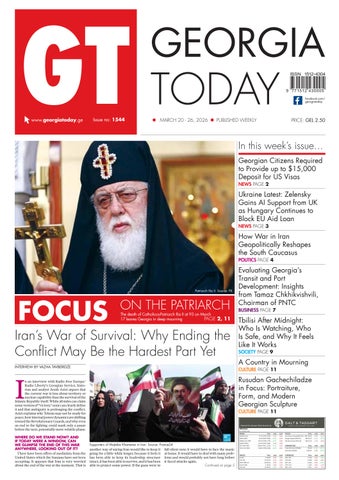
Iran’s War of Survival: Why Ending the

n an interview with Radio

historian and analyst Arash Azizi argues that the current war is less about territory or nuclear capability than the survival of the Islamic Republic itself. While all sides can claim some version of “victory,” none can clearly define it and that ambiguity is prolonging the conflict. Azizi explains why Tehran may not be ready for peace, how internal power dynamics are shifting toward the Revolutionary Guards, and why even an end to the fighting could mark only a pause before the next, potentially more

WHERE DO WE STAND NOW? AND IF TODAY WERE A WINDOW,

In this week’s issue...

Georgian Citizens Required to Provide up to $15,000 Deposit for US Visas

NEWS PAGE 2

Ukraine Latest: Zelensky Gains AI Support from UK as Hungary Continues to Block EU Aid Loan

NEWS PAGE 3

How War in Iran Geopolitically Reshapes the South Caucasus

POLITICS PAGE 4

Evaluating Georgia’s Transit and Port Development: Insights from Tamaz Chkhikvishvili, Chairman of PNTC

BUSINESS PAGE 7

Tbilisi After Midnight: Who Is Watching, Who Is Safe, and Why It Feels Like It Works

SOCIETY PAGE 9

CULTURE PAGE 11

Rusudan Gachechiladze in Focus: Portraiture, Form, and Modern Georgian Sculpture A Country in Mourning

CULTURE PAGE 11

Supporters of Mojtaba Khamenei in Iran. Source: France24
INTERVIEW BY VAZHA TAVBERIDZE
Patriarch Ilia II. Source: FB

Georgia to Launch Nationwide Pet Registration System

The government of Georgia has approved a new regulation introducing a mandatory identification and registration system for pets to improve animal welfare and control.

Adopted on March 12, 2026, the resolution establishes a centralized electronic database for tracking dogs and cats across the country. The system will be administered by the National Food Agency.

Under the new rules, all pet owners and caretakers will be required to ensure their animals are properly identified and registered.

Pets may be identified using microchips and ear tags.

The requirement applies to both owned

and fostered animals, expanding oversight beyond privately owned pets.

The regulation sets clear timelines for registration: Existing pets must be registered by January 1, 2027, newborn animals: within 30–60 days of birth, and newly acquired pets: within 15 days.

Veterinary clinics, shelters and other animal-related institutions will be required to verify whether animals are registered and ensure identification where necessary. This provision is intended to strengthen enforcement.

The government’s unified database will track the number of pets nationwide, link animals to owners or caretakers, help prevent abandonment, and improve the management of stray animals.

Most provisions of the new system will take effect on July 1, 2026. However, some components, such as database access for relevant authorities, have already entered into force.

Georgian Citizens Required to Provide up to $15,000

Deposit for US Visas

Georgian citizens will now be required to provide a financial deposit of up to $15,000 when applying for US business or tourist visas, following a decision by the United States Department of State to expand its visa bond program.

Georgia is among 12 additional countries recently added to the list of nations whose citizens are subject to the requirement. As of April 2, the total number of countries included in the program will reach 50.

The visa bond initiative was introduced last year by the Trump administration as part of efforts to combat visa overstays and curb illegal migration. The program is being implemented as a one-year pilot and has already been extended until August 5, 2026.

Under the scheme, applicants from designated countries may be required to submit a refundable bond ranging from $5,000 to $15,000. The exact amount is determined based on individual circumstances and at the discretion of the consular officer reviewing the application.

Visas issued under this program are limited to single entry and must be used within three months of issuance. US officials say this shortened validity period is intended to increase the likelihood

that travel is completed within a timeframe suitable for collecting data as part of the pilot program.

To secure the return of the deposit, travelers must enter and exit the United States exclusively by air through one of several pre-selected airports designated for the program. The list of participating airports will be published on the official website of the US Department of State 15 days before the program’s implementation and may be subject to periodic changes.

The deposit will be refunded to applicants who comply with all visa conditions and return to their home country within the permitted timeframe, or to those who ultimately choose not to travel to the United States.

The newly added countries include Cambodia, Ethiopia, Georgia, Grenada, Lesotho, Mauritius, Mongolia, Mozambique, Nicaragua, Papua New Guinea, Seychelles, and Tunisia.

They join 38 other countries already participating in the program, including Algeria, Angola, Bangladesh, Bhutan, Botswana, Burundi, Cabo Verde, the Central African Republic, Côte d’Ivoire, Cuba, Djibouti, Dominica, Fiji, Gabon, Gambia, Guinea, Guinea-Bissau, Kyrgyzstan, Malawi, Mauritania, Namibia, Nepal, Nigeria, São Tomé and Príncipe, Senegal, Tajikistan, Tanzania, Togo, Tonga, Turkmenistan, Tuvalu, Uganda, Vanuatu, Venezuela, Zambia, and Zimbabwe.

Georgia Grants Land for Rikoti Wind Power Plant Development

The government of Georgia has allocated 29 land plots in the municipalities of Khashuri and Kharagauli for the construction of the Rikoti Wind Power Plant, another step in the country’s renewable energy expansion.

Under Government Decree No. 538, the land has been transferred to Taba LLC under a 49-year construction rights agreement.

The company will pay GEL 35,480 annually to the state budget for the right to use 60,065 square meters of non-agricultural land.

The decree states that the land must

Georgia Mourns Patriarch Ilia II as Church Names Interim Leader and Sets Funeral

The death of CatholicosPatriarch Ilia II at 93 on March 17 has brought a wave of grief across Georgia, marking the end of a defining chapter in the country’s spiritual and national life.

A period of national mourning has been declared, with flags lowered across the country. The Georgian Orthodox Church confirmed that Ilia II will be laid to rest on March 22, at Sioni Cathedral in Tbilisi, in line with his personal wishes.

In the days following his passing, the Holy Synod met and officially confirmed Metropolitan Shio (Mujiri) as Locum Tenens of the Patriarchal Throne, a role he had already been designated for by the late Patriarch. The decision was announced by Metropolitan Theodore (Chuadze), who also confirmed that a state funeral commission has been established.

Opening the session, Metropolitan Shio expressed condolences to fellow clergy and reflected on the Patriarch’s decades of service. He also raised questions about how the Church will be governed in the period before a new Patriarch is elected.

Senior figures, including Metropolitan Anania Japaridze and Metropolitan Theodore, who also serves as Patriarchal Chorepiscopus, shared their views as the Synod reviewed its statutes before formally approving Shio’s role.

The Synod also issued a public message calling for unity at a difficult moment:

“Today, our love for the Patriarch should be expressed through the fulfillment of his lifelong teachings, first and foremost, through repentance before God and one another, mutual forgiveness, and reconciliation. Through the revival of Christlike love, we will be able to establish peaceful coexistence in our country and strengthen the unity of our society.”

Messages of condolence have come from both within Georgia and abroad.

Prime Minister Irakli Kobakhidze described Ilia II as a unifying figure whose influence shaped both Church and state:

“With his passing, a great era in the history of our Mother Church and the Georgian state came to an end… he constantly remained the spiritual leader of the nation and a symbol of unity.”

The British Embassy in Georgia, through Ambassador Gareth Ward, highlighted his long-lasting impact:

“His unparalleled contribution had an immeasurable impact on the lives of the Georgian people and on the formation

Georgian Patriarch Ilia II. Source: Patriarchal Press Service

of the independent Georgian state… May the Lord grant him eternal rest.”

The United States Embassy also paid tribute: “We are deeply saddened by the passing of His Holiness… His life and extraordinary service will not be forgotten.”

The Metropolitan of Kyiv, Epiphanius, mourned the passing of Georgian Patriarch Ilia II, calling him “a devoted spiritual father” who “dedicated his life to serving God, the Church, and the Georgian people.” He also honored Ilia II’s “exceptional significance not only for Georgia but for the entire Orthodox world” and his steadfast support for Ukraine during difficult times.

Russian Patriarch Kirill said he received the news “with deep sorrow,” calling Ilia II’s nearly 50-year leadership a “landmark era.” He described him as a “spiritual father” to the Georgian people and noted

his role as godfather to thousands of children. Kirill also spoke about their “warm and trusting” relationship and said their cooperation during the Soviet period helped the Church endure difficult times.

Born Irakli Shiolashvili in 1933, Ilia II led the Georgian Orthodox Church from 1977. His tenure saw a revival of religious life, the reopening and construction of churches, and the expansion of theological education. He also played a key role in securing international recognition of the Church’s independence in 1990.

For many Georgians, he was more than a religious leader. Through decades of political and social change, he was widely seen as a steady moral voice and a symbol of unity. On March 22, the country will say its final goodbye as he is laid to rest at Sioni Cathedral.

Glass Bottle Imports to Georgia Rise in Price ahead of Planned Plastic Bottle Ban

be used specifically for the construction and commissioning of the wind power plant, as per an agreement signed on July 17, 2024.

The project is being implemented under a multi-party agreement involving: the Government of Georgia, the Electricity System Commercial Operator, the Georgian State Electrosystem, and Taba LLC.

Founded in 2013, Taba LLC is jointly owned by two Netherlands-registered companies: Rikoti Energy B.V. and Anadolu Kafkasya Enerji Yatırımları A.S. Each holds a 50% stake in the company.

Taba is governed by a seven-member board of directors, composed of six Turkish citizens and one Georgian citizen.

The Rikoti Wind Power Plant project is part of broader efforts to strengthen domestic energy generation and diversify sources through renewables.

New data from Geostat reports that imports of glass bottles and jars into Georgia have become significantly more expensive. In January 2026, the average price of imported glass containers increased by 32% compared with the same month in 2025, even though the overall import volume declined.

Geostat reported that Georgia imported 6,512 tons of glass bottles and jars worth approximately $4 million in January 2026. In comparison, the country imported 7,518 tons valued at $3.5 million in January 2025. The decrease in quantity alongside a higher total value indicates a sharp increase in the price

of glass packaging. A similar trend was recorded over the full year. In 2025, Georgia imported 145,453 tons of glass bottles and jars worth $79.9 million, compared with 155,959 tons valued at $71.7 million in 2024. The figures suggest that the average price of glass packaging rose by roughly 20% year-onyear.

The majority of Georgia’s glass container imports in January 2026 came from neighboring countries.

Top suppliers included:

• Russia– $2.3 million (3,425 tons)

• Armenia– $1 million (2,251 tons)

• Ukraine– $276,500 (375 tons)

• Azerbaijan– $138,200 (273 tons)

• China– $105,000 (102 tons)

The rising demand and prices for glass packaging come as Georgia prepares to introduce strict regulations on plastic beverage containers.

Beginning July 1, 2026, restaurants, cafes and other public catering establishments will be prohibited from serving beverages in plastic bottles.

A broader restriction will follow on February 1, 2027, when the production, import, and sale of beverages in plastic bottles for domestic consumption will largely be banned.

The regulation will include limited exceptions, allowing bottled water in containers larger than 3 liters, and other beverages in containers larger than 20 liters.

Additional exemptions may apply to military and state-use supplies. Analysts say the upcoming restrictions are likely to increase demand for alternative packaging such as glass and aluminum, which could further change pricing trends in Georgia’s beverage and packaging markets.

Ukraine Latest: Zelensky Gains AI Support from UK as Hungary Continues to Block EU Aid Loan

The past week in Russia’s war against Ukraine was marked by intense strikes on both sides, continued grinding battles along the frontline, and high stakes diplomacy in Europe. Russian forces maintained pressure on multiple axes in eastern Ukraine, including around Donetsk, while Kyiv emphasized that attacks, even if persistent, have not produced decisive territorial gains for Moscow.

In the Kyiv region, a major Russian missile and drone assault killed at least four civilians and wounded around 15, according to Ukrainian officials. President Volodymyr Zelensky said Russia had launched roughly 430 drones and 68 missiles in that wave of attacks, telling reporters, “We see a large intensity of strikes against civilians and infrastructure.” He also pointed to the stark cost imbalance in modern air warfare, noting that many of the Iranian designed Shahed type drones used by Russia cost as little as $20,000 to $50,000 each to produce, while the air defense missiles used to intercept them can cost anywhere from $300,000 to over $1 million per shot, depending on the system. “This is a war of resources,” Zelensky said, arguing that Ukraine and its partners must scale up cheaper interception methods and increase production of air defense systems. He warned that relying solely on high cost interceptors against relatively inexpensive drones creates an unsustainable dynamic. Russia’s defense ministry, for its part, attributed the strikes to military targets, claiming its operations were aimed at Ukrainian energy and

logistics infrastructure. Along the frontline itself, both sides reported localized shifts in positions but no major breakthroughs. Russia reiterated claims of advancing near urban areas such as Sloviansk and Kostiantynivka in Donetsk, while Ukraine said it was stabilizing key sectors and repelling assaults near Kupiansk and other contested zones. Independent verification of gains remains difficult in the fog of war, with officials on each side offering differing accounts of tactical developments.

In a demonstration of Ukraine’s growing ability to project force far beyond its front lines, Ukrainian drones struck the 123rd Aircraft Repair Plant in Staraya Russa in Russia’s Novgorod region overnight on 17 March, hitting a facility responsible for servicing Il 76 and Il 78 transport aircraft and other military aviation assets. According to military reporting, the strike came just a day after Ukrainian forces hit the Aviastar aircraft plant in Ulyanovsk, which produces and maintains key Russian transport and aerial refueling planes. Russian aviation monitoring channels reported that two A 50 airborne early warning aircraft, among Moscow’s rare “eyes in the sky,” were at the Staraya Russa facility, though it is not yet independently confirmed whether they were damaged or were even operational at the time of the attack. The plant is located about 650 kilometers from Ukraine’s frontline and roughly 200 kilometers from St. Petersburg and the Estonian border, underscoring how Ukraine’s long range drones are increasingly targeting the logistical and maintenance infrastructure that keeps Russian aircraft flying.

On the diplomatic front, President Zelensky’s visit to the United Kingdom

brought fresh emphasis to Ukraine’s ties with Western allies. Addressing the UK Parliament, he said, “The trust in the United Kingdom is among the highest of all Ukraine’s partners. Ukrainians never forget who stayed,” underlining Ukraine’s reliance on sustained Western military and financial backing. UK Prime Minister Sir Keir Starmer responded by reaffirming Britain’s commitment to Ukraine’s security and warned that tensions in other regions could not become “a windfall for Putin.”

European leaders, meanwhile, are struggling to maintain unified pressure on Russia through both sanctions and financial support for Kyiv, even as divisions within the bloc have complicated progress. At a summit in Brussels this week, much of the focus was on a long planned €90 billion loan for Ukraine to cover its budget needs in 2026 and 2027, a package that leaders had agreed in principle at the end of 2025 but that has been stalled by political disagreements. Hungary’s Prime Minister Viktor Orbán has repeatedly used his veto power to link approval of the loan to energy concerns, insisting that repairs to the Soviet era

Druzhba oil pipeline, damaged in fighting, must be completed before he will support the measure. Other leaders, including European Commission President Ursula von der Leyen, argued that blocking the aid would send the wrong signal to both Kyiv and Moscow, with von der Leyen’s office saying the loan is “a crucial contribution to achieve a just and lasting peace for Ukraine.”

Those same divisions have spilled over into efforts to expand sanctions on Russia. A planned 20th sanctions package designed to tighten restrictions on Russian energy, finance and logistics has been blocked by both Hungary and Slovakia, according to EU diplomats, highlighting how internal disputes can undercut unity on key policy decisions. EU foreign policy chief Kaja Kallas expressed regret at the setback, telling reporters that failing to adopt new measures “is a message we didn’t want to send” on the anniversary of Russia’s full scale invasion.

In parallel with financial and sanctions discussions, EU capitals and London have been intensifying cooperation on defense production, particularly in areas

shaped by lessons from the battlefield.

At Zelensky’s visit to the United Kingdom this week, British and Ukrainian leaders agreed to promote joint drone technology abroad and to deepen collaboration on unmanned systems and artificial intelligence in defense, with British Prime Minister Sir Keir Starmer pledging support that includes funding for a new AI center in Ukraine and cooperation on joint sales to third countries. Starmer emphasized that continued focus on Ukraine was essential, saying the UK and its partners must not take actions that would economically benefit Russia. European Commission proposals and initiatives such as the Readiness 2030 framework also reflect a push to strengthen defense industrial cooperation across the bloc, aimed at increasing strategic autonomy and investment in advanced technologies including drones and counter drone systems. Analysts say this reflects an understanding that future conflicts will be shaped by scalable, technology driven capabilities rather than traditional platforms alone. Diplomatic efforts toward a negotiated settlement remain stalled, with peace talks delayed and global attention increasingly drawn to crises in the Middle East. Ukrainian officials expressed concern that shifts in international focus could affect the consistency of military support, especially for air defense systems they deem essential in protecting both military and civilian targets.

As the conflict settles deeper into its fifth year, the intertwining of heavy bombardments, extended strategic strikes, and complex international diplomacy underscores both how intractable the fighting has become and how central external support remains to Kyiv’s resilience.

Damaged infrastructure. Source: Ukraine News

How War in Iran Geopolitically Reshapes the South Caucasus

The deepening crisis in Iran, with its potential for spillover, might radically reshape the South Caucasus, shifting the region from a peripheral observer to a primary front line. While Armenia, Azerbaijan, and Georgia have decades of experience navigating a delicate relationship with Tehran, the current hostilities threaten to demolish the previously existing balance, replacing it with immediate security threats, economic stagnation, and a disrupted regional status quo.

Developments in the wider region stipulate that the war is no longer a distant concern for the countries of the South Caucasus region. The early March 2026 strike on Azerbaijan’s Nakhchivan exclave signaled that the South Caucasus, not only theoretically but factually, is now, militarily speaking, firmly within kinetic reach. This spillover has triggered a rapid military buildup, with Azerbaijan and Turkey closing borders with Iran as an immediate reaction and bolstering defenses against potential drone and ballistic missile incursions.

Beyond accidental strikes, there is growing concern that vital regional transit and energy infrastructure, specifically the Baku-Tbilisi-Ceyhan pipeline, could be targeted by Iran as leverage against Western-aligned interests. Furthermore,

The

the region grapples with an impending humanitarian crisis. A prolonged military confrontation poses a significant risk of triggering a massive influx of refugees northward, which could potentially destabilize the countries of the region, which are already grappling with internal social challenges, particularly Azerbaijan and Armenia, which share common borders with Iran, with Georgia being second in a row.

The war has effectively severed critical trade and energy corridors globally. Armenia is particularly exposed, as it historically relies on Iranian transit for nearly a third of its external trade. The

Georgian Opposition Seeks French Investigation into Ivanishvili

Georgian opposition parties say they will appeal to French authorities to investigate Georgian Dream founder Bidzina Ivanishvili, citing his reported dual French and Georgian citizenship.

The announcement came from representatives of the newly formed Opposition Alliance, who said they are taking responsibility for advancing key recommendations outlined in a recent OSCE report that criticizes Georgia’s democratic trajectory.

The report, commissioned under the OSCE’s Moscow Mechanism, describes a “marked democratic backsliding” in the country, along with a pattern of violence and abuse against dissenters — in some cases allegedly reaching the threshold of torture — often accompanied by near-total impunity.

Opposition figures said the findings create “a fundamentally new international reality” and require a coordinated response. “The Opposition Alliance has new responsibilities in this context,” said Giga Lemonjava of the Droa party.

Among the report’s recommendations is a call for OSCE member states to pursue legal action against members of the ruling Georgian Dream party, including through international mechanisms such as the International Criminal Court.

The opposition also highlighted the principle of universal jurisdiction, which allows national courts to prosecute serious crimes regardless of where they were committed. In this context, they named France as a key jurisdiction, pointing to Ivanishvili’s alleged French citizenship.

“We are launching active communication with French investigative authorities, including the Prosecutor’s Office, to initiate an investigation into Bidzina Ivanishvili at the national level,” the alli-

Bidzina Ivanishvili. Source: BM.ge ance said, referring to allegations of systemic abuse and the use of prohibited methods against protesters.

The alliance further indicated it would coordinate with international partners to engage the Organisation for the Prohibition of Chemical Weapons (OPCW), following recommendations to clarify claims regarding the possible use of chemical agents.

In parallel, opposition groups said they are working with the Office of the UN High Commissioner for Human Rights to facilitate international monitoring and potentially establish a country presence in Georgia.

They also reiterated support for referring the situation in Georgia to the International Criminal Court, citing allegations of political persecution, torture, and other inhumane acts.

“We will do everything to ensure accountability,” the statement said, adding that those responsible should face justice in international courts.

The Georgian government and ruling party officials have rejected the OSCE report, calling it unfounded and politically motivated.

The developments come amid growing international concern over democratic standards in Georgia and a noticeable deterioration in relations between Tbilisi and its Western partners, including the European Union.

sudden closure of these routes has caused immediate supply chain disruption, prompting a full switch to the only existing logistics alternative, relying on transit through Georgia. Regionally speaking, disruption and uncertainties related to the International North-South Transport Corridor (INSTC) have accelerated a shift toward the "Middle Corridor" via Georgia and Azerbaijan as the safest route that keeps functioning, providing multimodal logistics services for the South Caucasus, Central Asia, and beyond. While this in turn may offer long-term advantages for the transit states, the short-term reality is defined by surging

energy costs, high shipping premiums, and a possible sharp decline in foreign investment and tourism.

Geopolitically speaking, the South Caucasus is undergoing a fundamental restructuring as traditional pillars of the regional security architecture simply disintegrate under the weight of the current global changes we witness. This transformation is defined by the systemic collapse of Russia’s influence and, since the beginning of the strikes, a volatile shift in Iran’s strategic posture, forcing Armenia, Azerbaijan, and Georgia to navigate a high-stakes power vacuum established in the region that somehow

PM Kobakhidze:

tends to be integrated into a broader global standoff. It is clear that the era of Russian influence, as we used to know and experience it for decades, is effectively nearing the end.

Preoccupied by the war in Ukraine, Moscow’s role as the regional arbiter has shifted from dominant power to a sidelined observer, dismantling old deterrents that existed in the region. Simultaneously, the current war in Iran has pushed it toward transitioning its role toward the South Caucasus from a predictable buffer into a transformative wildcard, with a high degree of uncertainty in the near future. Currently operating under a "nothing-to-lose" survival mode, Tehran’s posture has shifted from cautious diplomacy to aggressive military signaling. Georgia finds itself in a precarious position amidst this shifting landscape. Tbilisi, traditionally proWestern, has experienced a shift in its internal political dynamics, leading to new domestic divisions. This shift has resulted in more transactional relationships with foreign powers. As Armenia aligns itself with European security frameworks and Azerbaijan solidifies its Turkish-Israeli alliance, the region has emerged as a primary battleground where Middle Eastern and European interests converge. Thus, any miscalculation on the regional level could potentially trigger international escalation.

*George Katcharava is the founder of Eurasia Analyst, a geopolitical risk, consulting and advisory firm.

No Plans to Review Transparency or Family Values Laws, OSCE Criticism ‘Unsubstantiated’

Georgian Prime Minister

Irakli Kobakhidze this week said that the government does not plan to revise the laws on “transparency” and “family values”, despite criticism presented in a report prepared within the framework of the OSCE Moscow Mechanism.

Speaking at a briefing at the Government Administration, Kobakhidze said the criticism outlined in the report is not supported by evidence, and therefore does not justify revising the legislation.

“We will not review the laws on transparency and family values, as the criticism in the report is unsubstantiated,” the Prime Minister stated.

Kobakhidze acknowledged that certain practical shortcomings identified in the elections should be addressed, noting that preventing misconduct remains an ongoing responsibility.

However, he rejected a number of other claims included in the report as false.

“For example, the report mentions ‘torture,’ even though the author herself acknowledges that no torture was established,” he said.

The Prime Minister also dismissed criticism of the transparency legislation, arguing that it lacks factual basis and ignores broader political realities.

Kobakhidze claimed that the report fails to consider what he described as five attempted coups in Georgia over the past four years, allegedly involving foreignfunded non-governmental organizations.

He stressed that, under universal legal principles, external interference in the

internal political affairs of a sovereign state constitutes a serious violation of sovereignty.

“The purpose of the transparency legislation adopted by the Georgian Parliament is to protect Georgia’s sovereignty and democratic system from such interference,” he said.

Kobakhidze further criticized the report as politically motivated and lacking objectivity, claiming it was prepared to serve “narrow political interests.”

He also alleged that the Polish author of the report failed to disclose a potential conflict of interest related to ties with the Polish government.

Prime Minister claimed that the report does not meet “even minimal standards of objectivity” and lacks depth — a point he noted the author herself acknowledged due to time constraints.

The Organization for Security and Cooperation in Europe Moscow Mechanism is a tool that allows participating states to initiate independent fact-finding missions on issues related to human rights and democratic governance. While such reports are not legally binding, they often carry significant political weight in assessing a country’s democratic environment.

Georgia’s transparency and foreign influence-related legislation has been the subject of ongoing domestic and international debate, with the government arguing it is necessary to safeguard sovereignty, while critics warn it may restrict civil society and democratic freedoms.

Further developments are expected as discussions continue both within Georgia and among international partners.

war and the South Caucasus. Source: 7news
Irakli Kobakhidze. Source: 1TV

Iran’s War of Survival: Why Ending the Conflict May Be the Hardest Part Yet

Continued from page 1

So Iran might not be immediately amenable to ending the war. At the same time, it correctly estimates that President Trump is unhappy with high oil prices, the continued survival of the regime, and the appointment of a leader Trump had said should not be appointed. All of this has affected his morale and has weakened public support in the United States for the war, on which Iran had certainly been counting.

Nevertheless, Iran has been significantly degraded in its military capabilities, but it has been able to survive.

In terms of when the war might end, it is possible that it could finish within the next couple of weeks. Trump would need to be able to declare victory, but at the same time it is becoming harder and harder to define victory in clear terms.

BUT THE IRANIANS WOULD ALSO NEED TO DECLARE VICTORY. LET’S DEFINE VICTORY FOR EACH OF THE THREE SIDES INVOLVED.

The Iranians can easily declare victory now. They can say we survived. They could not force us to change our leader. We fought on. For Iran, victory is survival. This is not a war about Iran’s nuclear program and it is not a war about its military capability. It was a war about the Islamic Republic itself.

The United States and Israel wavered on that question when it became clear they could not get rid of the Islamic Republic as easily as they had claimed. So if Iran says we survived, we put a new leader in place and we are still in power, then the survival of the regime as an intact structure is very much a win for them.

For the US and Israel, the higher grade of victory would have been to remove the Islamic Republic or fundamentally change the tone of its leadership. Trump spoke about a Venezuelan-style transition as his goal, where Khamenei would be dead and someone like Delcy Rodriguez would be running the country, saying things like: “Mr President, we will work with you, we are happy to work with you, we have learned our lesson, we surrender.”

He’s obviously not getting that. Short of that, he can claim the degradation of Iran’s capabilities as a victory. He can say we hit their navy, we destroyed infrastructure, we killed this many people, we demonstrated that we are one click away from shutting down their electricity system. He will try to frame that as victory.

The Israelis care more about achieving their goals. They had a declared goal of bringing the regime down. They appear to have banked on a popular uprising scenario, which seems very short-sighted to me, because most Iran experts believed that was impossible. I do not think it will be easy even after the war. Short of bringing the regime down, Israel can say that the Iran of 2026 is much weaker than the Iran of a few years ago. Netanyahu can justifiably say: think where Iran was on October 7, 2023, and think where it is now.

But the temptation of getting rid of the Islamic Republic will not disappear for the Israelis. They might resort to covert or armed actions inside Iran, trying to create internal strife or civil war-like conditions. So even if the war ends now, it will not be conclusive. It will essentially be a pause before the next round.

I think Trump would be ready to call it quits already. Israel might also be ready to stop. Iran will need to find a point where it can show that it lasted longer than the other two and that it is not weak. The weaker it actually is, the harder it will try to appear strong and show that it is in control. When you are weak, you often need to do more to demonstrate strength.

YOU DEDICATED A PIECE TO MOJTABA IN THE ATLANTIC, DUBBING HIM THE “NEPOTOLLAH.” TO CONTINUE WITH THE METAPHORS, HOW HEAVY IS THE TURBAN THE NEW SUPREME LEADER IS WEARING?

Mojtaba is someone who has almost never been seen in public. In many ways he is a complete closed book. What we know about him mainly concerns his ties to the security forces. Many victims of the regime’s repression have claimed that he played a role behind the scenes.

He also appears to be incapacitated in some way, and we have yet to see a video confirming that he is alive and functioning. His first message to Iranians used very dour language. It offered nothing new, no new vision and no suggestion of a better future. It was the same familiar rhetoric about death to Israel and war with America.

In any case, real power does not rest with him. Real power rests with the Revolutionary Guards. This is not the era of Mojtaba. It is the era of the IRGC in Iranian politics.

POSSIBLE MOTIVES BEHIND HIS APPOINTMENT ARE THREEFOLD: IT SIGNALS CONTINUITY, DEFIES THE UNITED STATES BY SIDELINING TRUMP, AND SUGGESTS HE MAY BE CONTROLLED BY THOSE WHO INSTALLED HIM.

Yes. The third point you make is reinforced by the fact that Mojtaba appears to be incapacitated at the moment. Whether that is temporary or permanent remains to be seen.

The idea that Mojtaba could serve as a stand-in leader for the Revolutionary Guards is not new. On the day President Raisi’s helicopter crashed, I spoke with someone close to Qalibaf who almost hinted at this. He almost sounded pleased that Raisi was gone, suggesting that now Mojtaba could become Supreme Leader. People close to Qalibaf have long promoted Mojtaba as a possible successor.

HISTORY HAS MORE THAN ENOUGH EXAMPLES WHERE A WOULD-BE PUPPET PLACED AT THE TOP REFUSES TO PLAY THE ROLE. COULD THIS HAPPEN HERE AS WELL?

Sure, that can happen too. The puppet can become the puppeteer. But if the puppet is in a coma, it becomes quite a bit harder to do so. Mojtaba has played a role behind the scenes for years, so he is politically savvy enough to have been a major player within the regime. But everything we know about him comes from second- or third-hand sources. Some claim he is more radical than his father, while others try to portray him as a reformer. They say he could be the Mohammed bin Salman of Iran. So we really do not know much about Mojtaba. That is the truth. We do not know what kind of leader he is going to be.

IN HIS FIRST MESSAGE TO THE POPULATION, HE CALLED ON IRAN’S NEIGHBORS TO GET RID OF AMERICAN BASES. WHAT KIND OF NEIGHBORLY RELATIONS IS THE REGIME COUNTING ON ONCE THIS WAR ENDS, HOWEVER IT ENDS?

This is a key question. I think it is one that has divided the internal and factional politics of the regime. The regime invested a great deal in repairing its regional relations. A few years ago Saudi Arabia had cut diplomatic relations with Iran, and several other Arab countries followed suit. Egypt, of course, has had no diplomatic relations since 1979, although there have been limited forms of contact.

So repairing these ties became almost a priority for the regime. It was a priority under Rouhani, it was a priority under

Raisi, and it remained a priority under Pezeshkian. It mattered a great deal. And of course, with China’s mediation in 2023, Iran restored diplomatic relations with Saudi Arabia.

Now there is a debate within Iran. Should the regime continue repairing these ties and preserving them? Or should it say these are illegitimate monarchies anyway and we should pressure them, even intimidate them? Who are they to host American bases?

This thinking goes back to 1979, the idea that these monarchies are illegitimate. Bahrain has a Sunni monarchy ruling over a Shia majority. Saudi Arabia is a monarchy governing Islam’s holy sites and a significant Shia minority. The UAE is another monarchy, now closely aligned with Israel.

We can already see this debate producing factional tensions. Pezeshkian, for example, issued what sounded like an apology to neighboring states. He then had to walk it back because many within the regime reacted very negatively.

So this is one of the central questions facing the regime. How will it structure its relations with its neighbors after the war? But it is also a major question for those neighbors. They increasingly see themselves caught between Israel and Iran, two powerful non-Arab states that attack or pressure them and operate in their neighborhood. They feel stuck between two belligerent powers.

LET’S TALK ABOUT THE STRAIT OF HORMUZ, ONE OF IRAN’S KEY ASYMMETRIC LEVERS. HOW EFFECTIVELY, AND FOR HOW LONG, CAN TEHRAN REALISTICALLY SUSTAIN THAT PRESSURE?

There are limits to it. The real trump card would be if Iran mined the Strait of Hormuz, which would create far greater difficulties for the Americans. But mining the strait would not be easy for Iran, and it would not be easy for the Americans to counter it either. It would be difficult for both sides.

Iran will face limits in how much it can close the strait. But remember that it does not actually need to shut it completely. All it needs to do is make the situation frightening enough that ships are unwilling to pass through. Iran knows the kind of havoc that would cause. It knows the pressure it would place on the United States, on the region, on Europe, and on the global economy. You can already see that the United States has allowed Russia to sell more oil as a result.

they quickly realized that this war was not going to help them. And they still lack inspiring, galvanizing, strategic, inclusive and charismatic leadership capable of organizing a revolutionary movement against it.

WHAT ABOUT THOSE WHO PLACE THEIR HOPES IN THE SHAH?

Reza Pahlavi’s camp appears to want this war to continue much longer. They would like Trump and Israel to prolong it for several more months. They seem to hope that this could eliminate much of the regime’s leadership and produce something closer to total war conditions. In their imagination there is almost a final day, a day of reckoning. Pahlavi keeps saying, wait for my final command. In fact he has asked people not to go out into the streets yet. They seem to believe that a moment will come when the regime is so weakened that they will call for one final uprising.

In that scenario, Iranians would come out, seize weapons and overthrow the regime. It almost has a messianic tone to it. But I don’t see it happening.

So the Iranian regime can probably use this leverage for quite some time. THE US AND ISRAEL APPEAR FOCUSED ON ELIMINATING IRAN’S MISSILE AND DRONE LAUNCH CAPACITY, AND LAUNCH RATES HAVE ALREADY DECLINED SIGNIFICANTLY. WHILE THIS SUGGESTS A WEAKENING ABILITY TO RESPOND, THE QUESTION REMAINS: CAN IRAN BE FULLY NEUTRALIZED?

Iran still retains considerable capabilities. It is conserving its missile arsenal. It still retains significant drone capabilities.

Iran could continue fighting for weeks, possibly even months. At the current pace, if operations continue as they have, it would take months rather than weeks.

Not six months perhaps, but at least another three months. That would be enormously costly for the United States and Israel in every sense.

WHAT MIGHT POST-WAR IRAN LOOK LIKE?

Iran will face major challenges. If the war stops, it will have to manage a devastated economy. It will have to rebuild its military capabilities. It may even struggle to pay civil servants.

Until now the economy, while very weak, has at least managed to provide basic goods. That could become much harder. There may be real logistical problems.

Iran will also face a very different regional environment. Its neighbours will view it as a rogue power under new leadership that appears unpredictable and ready to use force.

So Iran will face many challenges, but at the same time it will also begin to rearm.

COULD IT ALSO FACE MORE CIVIL UNREST FROM THOSE WHO HOPED THIS WAR MIGHT CREATE AN OPPORTUNITY TO CHALLENGE THE REGIME AND FORCE GENUINE CHANGE?

You cannot predict civil disobedience and you cannot predict civil uprisings.

Could there be a massive wave of protests where millions come out and bring the regime down? It is not impossible. But it is not likely.

I think many opponents of the regime will feel demoralized. They will see that there is no easy way to defeat the regime. Part of the Iranian opposition initially welcomed the removal of Khamenei but

ON THE NUCLEAR QUESTION, HOW TEMPTED IS IRAN TO GO ALL THE WAY? ALI LARIJANI ONCE LIKENED GIVING UP ITS PROGRAM TO TRADING “A PEARL FOR A CANDY BAR.” HAS THAT CALCULUS SHIFTED?

It may very well be the case that the current leadership of the Islamic Republic will conclude that they are no longer bound by the so-called nuclear fatwa of Ayatollah Khamenei, and that under new leadership they could develop nuclear weapons. They might well conclude that this is the only way to ensure such attacks will not happen again in the future and therefore decide to pursue it. The problem is that even if they attempt it, I do not think they will be able to do it that easily. Intelligence penetration remains very deep. If they decide tomorrow to build a nuclear weapon and someone discovers it, the next day there will likely be new attacks. Israel and the United States will stop at nothing to prevent that from happening.

AS A HISTORIAN, WHAT PLACE DO YOU THINK THIS WAR WILL OCCUPY IN IRAN’S HISTORY? AND WHAT WILL BE ITS LEGACY?

This is clearly a turning point in Iranian history. The age of Khamenei came to an end not with a whimper but with a blast. He was killed dramatically in this war by the United States and Israel. The transition we had anticipated for many years finally happened. Power has nominally passed to his son, but in reality the Revolutionary Guards now hold power. I also think that Ali Khamenei will not be judged kindly by history. He will likely be seen as someone whose stubbornness, his rigid insistence on certain policies ultimately led Iran into this war and brought the country to the point where there is now, effectively, an ideological civil war within the population. Hopefully it does not become a real civil war, although that possibility still exists.

My own prognosis about the historical moment we are in is that we will first see a period of interregnum. At first it will look as though everything continues as it did during the Khamenei era. It will appear as if nothing has changed. And then the sharper changes will come later.

Now that Khamenei’s ideological revolutionary leadership is gone, the figures who remain do not seem ideological in quite the same way. Because of that, I think Iran could look very different in a few years’ time. Exactly how different, and in what direction, remains to be seen.

Arash Azizi. Source: PBS

Iran Latest: Energy War Widens as Gulf Strikes, Strait Blockade and NATO Rift Deepen Crisis

The war involving Iran escalated sharply this week, with strikes on critical energy infrastructure spilling across borders, a tightening chokehold on the Strait of Hormuz, and a public rift between the United States and its Western allies over how to respond.

A key flashpoint was an Israeli air strike on Iran’s South Pars gas field and nearby facilities, carried out with United States coordination according to officials. South Pars, the world’s largest gas field shared geologically with Qatar’s North Dome, accounts for roughly 70 per cent of Iran’s gas production and fuels much of the country’s electricity generation and industry. The attack damaged pipelines and processing units, prompted Tehran to halt gas exports to Iraq, and contributed to spikes in regional energy prices. Iranian leaders condemned the strike as a dangerous escalation, and Iranian President Masoud Pezeshkian warned it could have “uncontrollable consequences” that might “engulf the entire world.”

The South Pars strike has intensified

BUSINESS

regional tensions. Following Iranian missile fire that caused “extensive damage” to Qatar’s main gas facility at Ras Laffan, Doha ordered Iranian security and military attaches to leave the country: a rare diplomatic rupture between neighbors.

The United Arab Emirates also shut down the Habshan gas facilities in Abu Dhabi after an Iranian attack, and Saudi Arabia said two of its refineries were hit, with Riyadh declaring that “the little trust that remained in Iran has been completely shattered.” Gulf governments temporarily evacuated non essential staff from major oil and gas hubs with fears of further reprisals.

On Thursday morning, Iran attacked an oil refinery in Saudi Arabia, with Reuters reporting that the strikes hit a Saudi Aramco oil rig in the Red Sea port of Yanbu, though the damage was minimal. The United Kingdom's Merchant Marine Operations also reported that an "unknown projectile" hit a tanker off the coast of Qatar. The projectile caused a fire on the tanker, but no one was injured.

Iran this week tightened its control over the Strait of Hormuz, a narrow maritime corridor through which about one fifth of global oil and liquefied natural gas normally passes. Revolutionary Guard officials have issued warnings to

U.S. Investment in Georgia

More than Doubled in 2025

Geostat reported that foreign direct investment from the United States into Georgia surged in 2025, reaching $158.1 million, a 121.7% increase year-on-year. The US ranked as the fourth-largest investor, contributing to Georgia’s total FDI inflows of approximately $1.7 billion.

Detailed data requested by BM.GE shows that real estate remained the leading destination for US investment, nearly doubling compared to 2024. At the same time, investment in the IT sector tripled.

Breakdown by sector:

• Real estate: $80.7 million

• Information technology: $60 million

• Education: $6 million

• Scientific and technical activities: $5.2 million

• Construction: $5.1 million

• Healthcare: $1.7 million

• Administrative services: $1.4 million

• Agriculture and logistics: $1 million

each

• Other services :$840,000

• Hospitality: $401,000

commercial shipping and emphasized that passage cannot be guaranteed, even though some vessels continue to transit the waterway. Insurers have sharply raised premiums for vessels in the strait, effectively constraining traffic.

There have been reports that Tehran may condition safe passage on economic terms, such as by requiring cargoes to be traded in Chinese yuan rather than US dollars. Such a move, if implemented, could have longer-term implications for global energy markets and financial systems, though details remain uncertain. Oil and gas prices have already surged, with Brent crude around US$110 a barrel as markets express concern over further disruption.

US President Donald Trump has called on other nations to help secure the strait and reopen it to commercial shipping, warning that continued disruption could harm global stability. “We need freedom of navigation, and we need it soon,” he said in public remarks this weekend, urging allies to contribute naval assets to a protective mission.

That appeal has met with resistance from Western governments. Major NATO members, including Germany and Italy, have ruled out deploying warships, with Germany’s defense minister saying “this is not our war” and stressing a prefer-

ence for diplomatic solutions. Britain, while expressing concern about energy markets, has also been cautious about committing forces to a broader conflict, highlighting the risks of escalation and the “lessons learned from the Iraq war.”

Other countries, including Japan and Australia, have likewise declined naval participation, though some have offered surveillance or logistical support.

As the conflict has spread beyond military targets, the human toll on civilian life has become increasingly visible.

The World Health Organization reports that more than 1,300 people have been killed in Iran and over 7,000 injured, with confirmed strikes on hospitals, prompting at least six facilities to be evacuated and stretching local health services.

Residential buildings, schools and other non military infrastructure have also been damaged in urban areas, contributing to power and service disruptions that affect everyday life. Civilians in Gulf countries have felt the impact too: Iranian missiles and drones have caused deaths and injuries in the United Arab Emirates, Kuwait and elsewhere, often from shrapnel or debris falling into populated districts, while road networks, ports and electricity grids have been disrupted, limiting transport and access to basic goods.

The cost of the war is also significant.

US defense analysts estimate the conflict cost the United States around $3.7 billion in the first 100 hours of operations, with daily operational costs near $890 million for air and naval sorties, missile use and troop deployments. These figures do not capture the larger economic impacts from disrupted energy supplies, damaged infrastructure and rising regional security spending.

In an unusual twist, the United States and some Gulf states are turning to Ukrainian expertise to cope with a wave of Iranian designed drone attacks. Ukrainian President Volodymyr Zelensky has said that around 200 Ukrainian military experts are in the Gulf region helping allies counter Iranian drone threats, drawing on combat experience from Ukraine’s long war with Russia. For countries in the South Caucasus, the ongoing developments carry clear consequences. Economies remain closely tied to global energy markets and to export routes that could serve as alternatives if Gulf supplies remain constrained. Any prolonged disruption of flows through Hormuz threatens to push prices higher and shift demand toward Caspian exporters such as Azerbaijan, while also increasing pressure on transit nations like Georgia to manage rising traffic and security risks.

International Companies Request Extension for Tbilisi Tram Tender

While real estate and IT dominated, education saw a decline in funding and most other sectors attracted relatively modest investment.

Geostat also identified main US-linked companies operating in Georgia in 2025, though not ranked by investment size. These include:

• Radio Free Europe/Radio Liberty (Georgia Office)

• World Vision International (Georgia Branch)

• Mercy Corps (Georgia Office)

• MagtiCom (with U.S. investment share)

• Technology Management Company Inc. (Georgia Office)

• University of Georgia (LLC)

• Dariali Energy

• FieldCore Service Solutions International (Georgia LLC)

• GE Vernova (Georgia Branch)

• IG Development Georgia Overall, Georgia’s total foreign direct investment reached $1.68 billion in 2025, a 7.6% annual increase.

Geostat stated that the main driver of FDI remains reinvested earnings, which totaled $1.4 billion, accounting for 83% of

International companies participating in a GEL 416 million tram project tender in Tbilisi have asked Tbilisi City Hall to extend the submission deadline, mentioning unresolved technical and financial issues.

The project’s goal is to build a 7.5-kilometer tram line connecting the Didi Digomi district to the Didube metro station, along with the construction of a tram depot. The tender was re-announced in February, setting March 31 as the dead-

line for bid submissions.

The companies involved in the bidding process stated that the design-build model used for the project requires detailed preliminary studies which have not yet been fully provided.

Bidders say the tender documentation lacks essential geological and hydrological data, making it difficult to properly assess engineering risks and prepare accurate proposals.

They also emphasized technical concerns about the planned depot site located in a ravine approximately 10 meters deep, through which a major collector pipe runs. Companies say the engineering

challenges related to this location require further clarification.

Participants have also raised concerns about currency risks in the proposed contract structure. Companies warn that if the contract is signed in foreign currency but payments are made in Georgian lari, fluctuations in exchange rates could create significant financial uncertainty during the project’s implementation.

Bidders say several other aspects of the tender remain unclear, including:

• Responsibility for relocating existing utilities,

• Limited access to the construction site for preliminary research,

• Unspecified technical standards and system integration requirements.

Companies have also recommended introducing international dispute-resolution mechanisms, such as arbitration or a Dispute Avoidance and Adjudication Board (DAAB), to manage potential contractual conflicts.

Given the outstanding questions, participating firms argue that submitting responsible and competitive proposals is not currently possible.

They have therefore urged Tbilisi City Hall to extend the tender deadline by at least two months, allowing additional time for clarifications and technical preparation.

Israel hits world’s largest gas field South Pars in Iran. Source: FB
An elderly woman is helped from the scene of a strike on a residential building in Tehran. Source: USAToday
Tbilisi tram project design. Photo: Georgian Journal.

Evaluating Georgia’s Transit and Port Development: Insights from Tamaz Chkhikvishvili, Chairman of PNTC

Georgia’s strategic location at the crossroads of Europe and Asia has long positioned the country as a key transit hub for regional and international trade. To explore the current challenges and opportunities in Georgia’s transport and logistics sector, we spoke with Tamaz Chkhikvishvili, Chairman of the Supervisory Board of JSC Poti New Terminals Corporation and a key figure with over 30 years of experience in the country’s port and transport industry. In this in-depth discussion, he shares his insights on Georgia’s transit function, port development strategy, infrastructure priorities, investment considerations, and the practical realities of operating and expanding maritime and logistics networks, including the role of existing and planned deep-water ports.

GEORGIA'S TRANSIT FUNCTION AND STRATEGIC IMPORTANCE

When asked about the main challenges facing Georgia's transit function today, Chkhikvishvili emphasizes the historical significance of the country as a crossroads of international trade. "As you know, Georgia has always been an important part of international commerce. Numerous trade routes intersect here, making the country strategically significant. The government has adopted the National Transport and Logistics Strategy for 2023-2030, but the military conflicts in the region over the last two years have further highlighted the importance of Georgia's transit potential," he says.

Chkhikvishvili stresses the need for rapidly implementable, realistic infrastructure projects. He recommends that a public discussion be held with the participation of all companies operating in transport and logistics, and that the resulting recommendations serve as the basis for amendments to the national strategy. "The current government inherited a difficult legacy, and significant effort will be required to implement adequate changes to the national strategy. The decisions made now will define the country's transport potential for decades," he says.

DOES GEORGIA NEED TWO DEEP-WATER PORTS?

On the question of whether Georgia needs two deep-water ports, Chkhikvishvili says he would frame the question differently. "I would ask it this way: at the current stage, is the partial northward expansion of Poti port, financed entirely by a private investor's own funds, a more realistic and economically justified decision than the construction of the Anaklia deep-water port using significant budget funds?"

He notes that the main goal of Georgia's infrastructure development is not simply the ability to construct a deepwater berth. "The decisive factor is whether the regional economy can generate sufficient cargo flows to ensure the regular loading of such infrastructure. Otherwise, any deep-water berth will turn into expensive infrastructure with limited utilization," he explains.

THE STRUCTURE OF BLACK SEA CARGO FLOWS

To put his position in concrete terms, Chkhikvishvili describes the specific characteristics of the Black Sea container and dry bulk segments.

"The Black Sea container segment has one important characteristic: it is mostly

built on the feeder, meaning regional, transport model. Even at today's volumes, the majority of container lines calling at Poti and Batumi use vessels with a capacity of 800 to 2,500 TEU, which connect Georgian ports to major regional hubs such as Constanta, Istanbul, Piraeus, and other Mediterranean ports. The main oceanic container services are concentrated at those hubs, while Georgian ports serve as regional distribution nodes," he explains.

Chkhikvishvili notes that container turnover grew by five percent in 2025 compared to the previous year. However, he argues that growth in container volumes does not by itself indicate the need for a deep-water port capable of receiving large oceanic container vessels of 8,000 TEU capacity and above.

On the technical side, he points out that container vessels in the 3,000 to 4,500 TEU range have a maximum draft of 11 to 12.5 meters requiring berth depths of 13 to 14 meters. This is already the accepted standard for many Black Sea container terminals, and allows for the reception of Panamax feeder class vessels, which form the backbone of the regional feeder fleet. "The development of Poti's container infrastructure within these depth parameters corresponds to the real structure of container shipping in the region," he says.

Turning to dry bulk cargo, he notes that the Black Sea dry bulk market is traditionally oriented toward the transportation of grain, coal, petroleum coke, mineral fertilizers and other bulk goods in batches of 40,000 to 50,000 tons. Handymax and Supramax class vessels, with deadweight tonnages of approximately 40,000 to 60,000 tons, have a draft of roughly 11 to 12 meters, which also requires berth depths in the 13- to 14-meter range.

"The main export batches will remain in the range of approximately 30,000 to 50,000 tons, which is typical of many Caucasus and Central Asian cargoes. In that scenario, the main working vessels will continue to be Handymax and Supramax class ships," he says.

Based on this analysis, Chkhikvishvili concludes that there is no near-term requirement for 16.5-meter-deep berths to accommodate Panamax-class and larger vessels.

A NOTE ON THE STRATEGY DOCUMENT

Chkhikvishvili also draws attention to a passage in the government's own strategy document. Among the listed government measures is an objective described as convincing potential users, including freight forwarders, shipping lines, cargo owners, consignees, and road transport companies, of the commercial and technical utility and cost advantages of the new facility.

"In other words, we decided to build the port first, and now we are trying to convince users that they need it. The causal relationship should be the other way around," he says.

On this basis, he concludes that "at this stage and in the foreseeable future, the need for the Anaklia deep-water port mega-project is not justified."

COMPARING THE TWO PROJECTS: INVESTMENT, TIMELINE, AND RISK

Chkhikvishvili notes that berth depth and cargo growth projections alone are not sufficient to draw a definitive conclusion. Investment structure, project delivery timeline, and commercial risk must all be taken into account.

Investment: The Poti port expansion project will be financed by APM Terminals, representing $250 million in direct private foreign investment with no call on the state budget. The Anaklia port project, by contrast, requires the Georgian state to commit the equivalent amount from public funds in exchange for a 51 percent stake in the project.

Timeline: The northward expansion of Poti port is estimated to take approximately two years. The existing internal port infrastructure and the operational customs processing economic zone allow new berths to be integrated into the functioning port relatively quickly. There are also no privately owned land plots to be expropriated in the case of Poti's expansion.

The future operator of the new berths would be APM Terminals, the current operator of Poti port. APM Terminals would itself help ensure stability of container cargo flows through the involvement of Maersk, a freight forwarding company within the same holding group. Anaklia, by contrast, would be constructed from scratch. Maritime and port

services infrastructure would need to be built from the ground up. Qualified personnel would need to be recruited. To date, no authoritative port operator has been identified for the project. "As construction practice shows, very often in projects of this scale, due to various circumstances, calendar plans are frequently violated and timelines are extended," Chkhikvishvili says. He also notes that it is not yet known what cargo flows are expected at the future Anaklia port, or from which sources.

Commercial Risk: In the case of the Poti expansion, commercial risk is borne by APM Terminals. In the case of Anaklia, commercial risk is borne by the Georgian state.

Taking all of these factors together, Chkhikvishvili states that "the realization of the Poti port expansion project is beyond competition across all parameters.” He adds, however, that the Anaklia question is not closed permanently: "When additional cargo appears and the existing port infrastructure can no longer handle the cargo flows, and when Georgian Railways supports the delivery of tens of millions of tons to the ports, the issue of building Anaklia port will inevitably come onto the agenda."

ON THE ADVANTAGES LISTED IN THE STRATEGY

The national strategy document highlights five advantages for the Anaklia project: strategic location, the capacity to receive large vessels (Panamax class), one-stop-shop service, high throughput capacity, and the possibility of safe navigation year-round. Chkhikvishvili addresses each of these.

On strategic location, he notes that the new port would be situated 5 to 7 kilometers from the border of a conflict zone, and says that whether this constitutes a strategic advantage is a matter for the reader to judge.

On the capacity to receive large vessels, he refers to his earlier technical analysis on vessel classes and required draft depths.

On the remaining three points, he states that these conditions exist equally at existing Black Sea ports in Georgia and cannot be resolved through organizational or administrative measures alone. He concludes that "all these so-called advantages must be weighed against a

high-risk investment of state budget funds."

INFRASTRUCTURE

BEYOND THE PORT: INDUSTRIAL ZONES, TARIFFS, AND GOVERNANCE

When asked what else could be improved to make Georgia's transport corridor more effective, Chkhikvishvili says that the long-term success of port infrastructure is not determined solely by water depth, berth length, and terminal throughput capacity.

"The decisive factor is the formation of an industrial-logistics cluster around the port, which ensures a stable cargo base. Global experience in the development of seaports shows that the most successful port zones develop not as simple warehouse territories, but as fullfledged industrial-logistics ecosystems," he says.

As an illustration, he points to Poti's Free Industrial Zone, which occupies 300 hectares, is directly adjacent to the sea, and has been in operation since 2009. According to Chkhikvishvili, foreign investors and cargo owners have not shown adequate interest in it, and the zone has not been operating at full capacity. "To this day, there is no logical connection between the sea and the land, and nobody has addressed this," he says. He notes that similar trends of declining investment are visible in other territories designated as industrial zones across Georgia.

On the cost side, Chkhikvishvili states that Georgian ports are among the most expensive in the Black Sea and Sea of Marmara basin by vessel servicing costs, also referred to as disbursements. In a number of cases, port service tariffs lack transparency. "The combination of high tariffs, trade imbalance and prolonged waiting time at berths is a factor that hinders the attraction of additional cargo flows to ports," he says. High tariffs on rail and road transport compound the issue further.

He recommends accelerating the adoption of European standards for financial transparency in the port sector. He cites EU Directive 2017/352 as a good example of what he calls light-touch regulation, which, in his view, delivers greater transparency in the port services sector while maintaining a liberal policy environment.

On the question of governance, Chkhikvishvili notes the absence of a dedicated Ministry of Transport and says the government needs to more clearly define the role and responsibilities of those accountable for attracting cargo from different regions. "These functions have been delegated to the railway and the ports, which is genuinely insufficient," he says. He also acknowledges that some challenges are external and not entirely within Georgia's control.

TRANSIT TERRITORY OR TRANSIT ORGANISER

Chkhikvishvili closes by drawing a distinction he says defines Georgia's current position and the choice it faces. "All the surrounding countries are trying to be transit organizers. Georgia, meanwhile, remains a transit territory, and that must be corrected," he says.

In his view, the difference between a transit territory and a transit organizer lies in who controls the logistics agenda, captures the value-added services, and builds the commercial relationships around the movement of goods. Addressing this, he argues, requires the right infrastructure choices, transparent and competitive tariff conditions, functioning industrial-logistics zones, and a clear institutional mandate at the state level to compete for cargo flows from neighboring regions.

Why Georgia Could Become the Next Global Hub for Pilot Training

As the global aviation industry continues to expand, one critical question is becoming increasingly important: where will the next generation of pilots be trained?

Airlines around the world are growing their fleets, reopening international routes, and strengthening global connectivity.

Yet behind this expansion lies one of the most significant structural challenges facing the aviation sector today: the growing shortage of qualified pilots.

According to Boeing’s long-term industry outlook, the global aviation industry will require more than 600,000 new commercial pilots over the next two decades in order to meet the continued growth of air travel. Airbus presents similar projections in its Global Market Forecast, highlighting strong expansion in passenger traffic across Europe, Asia, and the Middle East.

Meeting this demand will require more than simply increasing the number of training programs. It will require the development of new aviation training centers capable of preparing pilots to international standards while operating efficiently within modern aviation infrastructure.

For decades, most professional pilot training has been concentrated in a relatively small number of countries, particularly in the United States and Western Europe. These regions remain central to aviation education, but they are increasingly constrained by rising operational costs, congested airspace, and limited capacity for expansion.

As a result, the aviation industry is gradually looking toward new regions where training capacity can grow more efficiently.

In this evolving global landscape, Georgia has the potential to emerge as an important aviation training hub connecting Europe and Asia.

THE GLOBAL PILOT SHORTAGE

The shortage of aviation professionals is not a temporary challenge. It is a structural issue that affects the entire aviation ecosystem.

Over the next twenty years, airlines will continue expanding their fleets to meet the growing demand for international mobility. Aircraft manufacturers project thousands of new aircraft deliveries during this period, each requiring trained pilots and highly skilled aviation professionals.

Training a professional pilot is a complex and time-intensive process. From

theoretical instruction to flight training and licensing, the process requires years of structured education and operational practice. Aviation academies must invest in aircraft fleets, training infrastructure, instructors, regulatory compliance, and safety systems.

However, many traditional aviation training markets are reaching operational limits. In several European countries, flight training operations must share heavily congested airspace with commercial airline traffic. Weather conditions and regulatory limitations can further slow training progress, increasing both the time and cost required for students to complete their programs.

These limitations are encouraging aviation stakeholders to consider new geographic locations where pilot training can be conducted safely, efficiently, and at scale.

WHY GEOGRAPHY MATTERS IN AVIATION TRAINING

Unlike many other educational sectors, aviation training depends heavily on geographic and operational conditions.

Weather patterns, airspace accessibility, airport infrastructure, and operational costs all play a significant role in determining how efficiently students can complete their flight training.

Countries that offer stable flying conditions, available training airspace, and supportive aviation infrastructure naturally become attractive destinations for aviation education.

Historically, the United States has been one of the world’s largest pilot training centers, largely because of its favorable weather conditions and extensive network of regional airports. Similarly, countries such as Spain and Portugal have developed strong aviation training ecosystems due to their operational environments.

Georgia possesses many of the characteristics that historically support successful aviation training environments.

GEORGIA’S STRATEGIC POSITION

Georgia’s geographic location places it at the crossroads of Europe, Central Asia, and the Middle East. This position alone gives the country strategic importance within the broader aviation network connecting multiple regions.

Accessibility plays a critical role in aviation education. Students seeking professional pilot training frequently travel internationally to obtain aviation licenses recognized by global regulators and airlines. Georgia’s location makes it accessible to students from a wide range of countries seeking an internationallyoriented aviation education.

At the same time, Georgia offers operational conditions that can support efficient training environments.

The country benefits from favorable flying conditions during much of the year, allowing students to complete training flights without excessive weatherrelated delays. In addition, compared with the highly congested airspace of Western Europe, Georgian airspace remains relatively accessible for training operations.

These conditions allow aviation academies to conduct flight training more efficiently while maintaining strict safety standards.

CHANGING AIR TRAFFIC PATTERNS AND THE GROWING ROLE OF THE CAUCASUS

Recent geopolitical developments in parts of the Middle East have also influenced global aviation routes and operational patterns. In recent years, airlines have increasingly needed to adjust traditional flight corridors connecting Europe, Asia, and the Middle East.

As a result, air traffic flows across the wider Eurasian region have gradually shifted, with increasing numbers of aircraft operating through alternative routes that pass over the Caucasus region.

Because of its strategic location between Europe, Central Asia, and the Middle East, Georgia has begun to experience growing levels of transit activity in its airspace. This increased traffic highlights the country’s emerging role within the evolving aviation network connecting major international markets.

While these changes are primarily visible in airline operations today, they also have broader implications for the aviation ecosystem. Rising air traffic often leads to greater attention to regional aviation infrastructure, air navigation services, and aviation-related industries.

For countries such as Georgia, these developments present both challenges and opportunities. On one hand, they require continued development of aviation infrastructure and regulatory capabilities. On the other hand, they reinforce the country’s potential to play a larger role in the global aviation sector.

As aviation corridors continue to evolve, the Caucasus region may increasingly serve as an important bridge between Europe, Asia, and the Middle East, further strengthening the case for developing aviation training centers in this part of the world.

THE GLOBALIZATION OF AVIATION EDUCATION

Pilot training is becoming increasingly international. Today, it is common for students to travel across borders in order to obtain aviation education that meets internationally recognized standards.

Students from Europe, Central Asia, the Middle East, Africa, and Asia frequently seek training programs that combine international regulatory standards with efficient training environments.

Organizations such as the International Civil Aviation Organization (ICAO) emphasize the importance of expanding aviation training capacity worldwide in order to maintain safe and sustainable industry growth.

In this context, aviation training is evolving into a global education sector similar to international higher education.

Countries capable of combining international aviation standards, operational efficiency, and accessible training environments are well positioned to attract international students.

Georgia’s geographic position and operational conditions place it within this emerging global aviation training landscape.

ECONOMIC OPPORTUNITIES FOR GEORGIA

Developing aviation training capacity can bring significant economic benefits. International aviation students contribute to the local economy through housing, transportation, tourism, and other services. Aviation academies also create highly skilled jobs for instructors, engineers, aviation managers, and technical specialists.

In addition, the presence of aviation training institutions can support the development of related sectors such as aircraft maintenance, aviation services, and technical training.

Several countries have already demonstrated how aviation education can become an important contributor to economic development. With the right strategy and long-term planning, Georgia could follow a similar path.

LOOKING AHEAD: A STRATEGIC OPPORTUNITY

The aviation industry is entering a period of long-term transformation. Airlines are expanding global networks, passenger demand continues to grow, and the need for qualified aviation professionals is becoming one of the most critical challenges facing the industry. Addressing this challenge will require not only more pilots, but also new aviation training ecosystems capable of supporting international education and operational efficiency.

Georgia possesses many of the elements needed to participate in this transformation: a strategic geographic location, accessible airspace, favorable operational conditions, and a growing aviation sector.

With thoughtful long-term planning, continued investment in aviation infrastructure, and support for internationally oriented training institutions, Georgia has the potential to become an important center for pilot training serving airlines across Europe, Asia, and the Middle East. As the aviation industry searches for new training capacity in the coming decades, countries that invest in aviation education today may well become the aviation hubs of tomorrow.

Georgia has an opportunity to be one of them.

*Artem Kuzmenko is an aviation entrepreneur and aviation industry expert and the Director of Blue Sky Academy

Planes landing. Source: bluesky_aeroIG
An aviation engineer. Source: bluesky_aeroIG

Is Hi-Tech Bliss or Miss?

In our diabolically interconnected modern world, scientific-technological jumps have an effect of a double-edged sword, equally providing for both, ease and distress, simultaneously granting us a wonderful sense of significant comfort, and serving as a brutal cause of lessened good, rather than an immediate common engine of happiness.

Tech progress guarantees access to unlimited information, connection, and efficiency, while imposing on us social isolation, over-anxiety, and the elimination of genuine, person-to-person interaction. So, why is technological progress good? Nobody suggests whether it is good or bad. This is just what we actually have and are willing to live with because we can’t do otherwise.

Isn’t it astounding that the rapport between lore and bliss happens to be a multifaceted composite with formidable benefits for us as well as a heavy burden, eternally pressing on our fragile mind, often unsettling our essence? Then, why do we take it all for granted? Because scientific and technological progresve has managed to drastically improve countless specific facets of our life, such as: enhanced connectivity, convenience of everyday life, greater efficiency of human behavior, automation of almost everything around, unlimited instant access to information, empowerment of almost every human action, increased life satisfaction, introduction of beneficial activities, augmentation of educational opportunities with enlightenment accessible to billions, easier handling of health problems, growth of life expectancy, reduced poverty and hunger, new tools for connecting the world instantly, sophisticated modern surgery, electricity, antibiotics, clean water systems,

computers, internet, airplanes, expansion of human freedom, improvement of wellbeing, and what not.

OK, granted! But what about regular plain human happiness and humane interaction, which is better, stronger, and more valuable than anything else in life, recognized at every historical stage of development, starting from Neanderthals and ending with scientifically savvy and technologically over-equipped modern humans?

We could easily make the case against technology as a source of unhappiness if it made any sense to do so. Yet, it might be a moderately useful reminder that we should not allow technology to make literal robots out of ourselves, again, if this is possible at all. Well, being a little more pensive about the subject will not hurt. Just think about current mental health issues, meaning over-dependence on digital devices, undue anxiety, depression, and poor sleep quality, gradual erosion of self-esteem, supplanting of actual life, letting the screen time replace activities linked to tangible happiness like face-to-face contact, sleep, and physical exercise, distraction and overload, created by constant notifications and the pressure to be connected around the clock, insurmountable stress, perpetual burnout, and inability to concentrate on meaningful tasks.

Deliberating on those pros and cons, a natural question pops up: Eventually, is scientific and technological progress a source of happiness or rather a reason for human misery and degradation?

Ultimately, true happiness usually comes from human mental connection and physical interaction, which, ideally, should be propped up by technological ways and means rather than substituted by them. Where, if not here, in our moderately developed little Sakartvelo, is this seen, felt, and understood, where, thank God, human emotionalism still counts?

Weirdly enough, technological progress has a proven proclivity to create new forms of misery, which might be more difficult to cope with than learning how to handle the newly created hi-tech tools.

If we listen to geniuses like Jean-Jacques Rousseau and Martin Heidegger, their arguments might seem to be an even harder recognition that technological civilization alienates human beings, pointing to several problems like dire psychological effects.

In modern terms, this might sound like mass manipulation through media, technological unemployment, extreme economic inequality, civilizational dangers like nuclear and biological weapons, the ensuing ecological destruction, surveillance societies, machine guns, concen-

tration camps, propaganda, etc.

Even in literature this kind of thought prevails sometimes. For instance, in The Magic Mountain by Thomas Mann, where scientific rationalism and modern civilization coexist with spiritual illness and moral confusion. On the other hand, there might exist the deeper truth that technology amplifies human nature.

Many modern philosophers would argue a middle position: technology itself is neutral, merely magnifying whatever values humans already have. Another question is if human wisdom and morality are progressing as fast as our technology? One of Albert Einstein’s famous insights might clarify this nebulous theme, summarizing the dilemma beautifully: “It has become appallingly

obvious that our technology has exceeded our humanity.”

That’s exactly why the topic has triggered my journalistic determination at this moment, believing that scientific and technological progress increases the power of humanity, but power does not automatically produce happiness, which mainly depends on ethical wisdom, social justice, cultural meaning, spiritual balance, freedom, mystery, spirituality. Without those, technology can easily turn from liberator into master. Incidentally, philosopher Hannah Arendt once noted that modern society risks producing people who are technically competent but morally thoughtless. Isn’t this awful? But you know, there are so many buts and how-comes to react to!

Tbilisi After Midnight: Who Is Watching, Who Is Safe, and Why It Feels Like It Works

In the global imagination, safety tends to be measured in statistics, plotted in sober graphs, and narrated through the language of risk. Yet, in Tbilisi, safety after dark unfolds less like a dataset and more like a choreography: subtle, social, and deeply embedded in the rhythms of everyday life.

A recent international survey conducted by the research company GORBI places Georgia at the top of a striking list: around 89% of women respondents report feeling safe walking alone at night. The country appears alongside China and Vietnam as one of the three environments where nocturnal mobility does not automatically trigger anxiety. At the opposite end, Chile, Ecuador, and Mexico emerge as spaces where women most frequently report vulnerability after dark. Numbers, however, flatten experience. To understand what “89%” feels like on the ground, one has to walk, preferably without purpose, through the layered geographies of Tbilisi at night: the luminous façades of Rustaveli, the dim stairwells of Sololaki, the semi-private courtyards where conversations hover between balconies like improvised arias. What emerges is a form of safety that is less institutional than relational.

Georgia’s urban fabric produces a particular kind of visibility. In older districts, the architecture itself, shared courtyards, open balconies, porous thresholds between private and public, creates what might be called an ambient watchfulness.

People notice. Not in the disciplinary sense of cameras or patrols, but in the quieter, more persistent way of neighbors who recognize footsteps, silhouettes, deviations.

This produces a paradox: the city feels open precisely because it is observed. Sociologists might describe this as a

dense network of informal social control. Locals would frame it more simply: “everyone knows everyone.” The phrase recurs with such frequency that it risks sounding like folklore, yet it functions as an organizing principle. To move through Tbilisi at night is to move through overlapping circles of recognition: even

when one remains anonymous.

Unlike cities where nightlife fractures into isolated zones, entertainment districts detached from residential life, Tbilisi sustains a more continuous nocturnal ecology. A wine bar spills into a sidewalk that still belongs, unmistakably, to its neighborhood. A techno club pulses beneath a stadium, yet its audience disperses into streets that remain busy, not abandoned. The effect is a night that feels inhabited rather than conquered. This continuity matters. Safety here is not enforced solely through policing, but through presence: through the simple fact that the night is shared. The woman walking home at 2 a.m. is not alone in an emptied landscape; she is part of an ongoing, if quiet, social field.

The survey’s most delicate implication lies in its cultural substratum. Georgia’s social codes, often described as traditional, still carry a strong emphasis on family reputation. Actions rarely remain individual; they ripple outward, attaching themselves to surnames, to kinship networks, to collective identity.

This has contradictory effects. On one hand, it can generate conservative expectations and unwanted attention, particularly toward foreign women, who occasionally encounter persistent, if usually non-threatening, attempts at acquaintance. On the other, it imposes a boundary: behavior that risks public shame is carefully negotiated, often avoided.

In this sense, emotional expressiveness, so characteristic of Georgian masculinity, coexists with a tacit discipline shaped by communal judgment.

It would be easy, and perhaps comforting, to conclude here: to declare Georgia

a rare haven of nocturnal safety. Yet such narratives demand caution.

Firstly, perception is not identical to reality. Surveys measure feelings, which are shaped as much by cultural expectations as by empirical risk. A society accustomed to strong social cohesion may report higher feelings of safety even where structural protections remain uneven.

Secondly, safety is not uniformly distributed. Central Tbilisi differs from peripheral districts; local women may navigate the night differently from migrants or visitors; experiences shift across class, age, and familiarity with the urban environment.

And finally, the very mechanisms that produce safety—tight-knit communities, reputational accountability—can also constrain, surveil, and exclude.

Still, something distinctive persists. Tbilisi at night offers a model that resists easy categorization: neither heavily securitized nor recklessly indifferent, neither anonymous nor oppressively controlled. It is a city that watches itself: through systems and through people.

To walk here after midnight is to enter a space where safety feels less like protection from above and more like a diffuse, collective agreement. An agreement sustained in glances from balconies, in the murmur of late conversations, in the quiet understanding that one’s presence is, in some small way, held by others. The statistic—89%—lingers as a kind of shorthand. Yet the truth of it resides elsewhere: in the lived texture of the Georgian night, where visibility, familiarity, and social memory intertwine to produce a fragile, compelling sense of ease.

Our obsession with tech. Source: fairobserver
A busy Tbilisi street. Source: civitatis.com

Samegrelo: A Journey into the Heart of Colchis. Part 1

Samegrelo is arguably one of the greenest regions in Georgia. Travelers are drawn here not only by its natural riches— magnificent canyons, waterfalls, and unique flora—but also by its profoundly rich historical and cultural heritage. It is impossible to truly know Georgia without visiting this land, where ancient myths of the Golden Fleece, the Argonauts, and Medea come to life at every turn, and where every path preserves the memory of centuries. It is difficult not to fall in love with Samegrelo; it is not just a land of scenic landscapes, but a place where the food is incredibly delicious! In Samegrelo, the birthplace of adjika and elarji, the cuisine is spicy, piquant, and peppery: a unique fusion of passion and tenderness. I will share more about our gastronomic discoveries later.

FIRST IMPRESSIONS: FROM MARTVILI TO TUSCANY

Our acquaintance with the region began in Martvili. Shunning the main highways in favor of backroads, we discovered new charms at every mile. The hilly terrain and certain botanical features often reminded us of the Tuscan countryside. Our car glided smoothly from hill to hill, crossing one river after another, revealing more and more wonders, both natural and man-made. Here and there, the ruins of ancient fortresses and the silhouettes of old churches loomed on the hillsides. Samegrelo is filled with air, vastness, and a sense of freedom!

THE ARCHITECTURE OF HOSPITALITY

The spirit of a place lives in its architecture. In Samegrelo, every house feels

like a distinct personality: large, spacious dwellings where there is always enough room for guests. Typically, Megrelian houses are built on stilts and adorned with intricate grand staircases. This "competition" in elegance and craftsmanship has become one of the region's hallmarks. Some houses are antique timber structures, while others are stone with carved wooden balconies or elaborate mosaics. It felt as if every house was flirting with the traveler, winking warmly from its manicured garden or lawn, inviting us in. Because of this, it was quite hard to restrain ourselves from stopping every few yards to take photos.

A GARDEN OF EDEN

In the early 20th century, Arthur Leist, a German publicist and passionate admirer of the Caucasus, described Samegrelo as the region with the lushest vegetation in Georgia, noting that its lowlands resemble a magnificent garden while the highlands possess the diverse charm of southern mountain landscapes: "Every village is encircled by a wreath of orchards planted with poplars, mimosas, mulberry trees, and acacias. Between them bloom massive rose bushes and wild grapes, while honeysuckle vines entwine the trunks and branches of trees rising above the flowering grass. In the forests stand mighty oaks, elms, boxwoods, beeches, and maples, alongside rhododendrons, azaleas, laurel, noble chestnuts, and ferns as tall as a man."

MARTVILI CANYON: ONE OF GEORGIA’S WONDERS

In Martvili, you will find one of the true marvels of Georgia: the picturesque canyon located in the village of Gachedili. This deep gorge, carved into limestone cliffs by the Abasha River, remains cool even on the hottest days, making it the perfect sanctuary from the summer heat. The canyon is divided into two parts:

the upper and the lower. In the upper section, you can take a boat ride, admiring the sheer cliffs covered in moss and vines, as well as the cascading waterfalls. The total length of the canyon is 2,400 meters, with a 700-meter hiking trail and a 300-meter boat route. The lower part is equipped with walkways, bridges, and observation decks that offer stunning views of pristine nature, lush greenery, and abundant water.

They say that in prehistoric times, the nature here looked exactly as it does in Martvili. And now it’s clear, without any exaggeration: this truly was a promised land! The canyon has yielded dinosaur tracks and the fossilized remains of ancient animals, making it a unique paleontological site as well.

The reserve was officially opened in 2018. Before that, these places were wild and known only to the "initiated." Yet, in the last seven years, over 1.5 million people have visited! The canyon is now one of the top ten most popular tourist destinations in Georgia.

Ani Tsikarishvili, from the information service, told us how life for the locals changed after the canyon became a protected reserve: "Business took off for everyone here! All five hundred people living in the village are involved in tourism. Those who had been working abroad returned home and opened guest houses or restaurants. Usually, entire families work together: the older generation hosts guests and introduces them to our customs, while the younger ones work as guides or run shops right at the entrance to the reserve."

It is clear that the economy in the Martvili district is thriving. But what is happening to the pristine nature? Those who remember these places before their "commercialization" shrug sadly: "The Martvili Canyon has lost its original charm!" It is the eternal dilemma: how to find a compromise between development and the preservation of unique natural treasures.

Fortunately, there are still many other, less explored places around this canyon.

“BIG OAK” MONASTERY

In pre-Christian times, mercy was a foreign concept (though we modern people are gradually returning to that). On Mount Chkhundidi (which means "big oak" in Megrelian), where the Martvili Monastery now stands, there grew a massive tree. Beside it, every mother was obliged to sacrifice her firstborn son, who would be burned next to this oak. There was a belief that if this custom were broken, the oak would die, and the world would come to an end. Naturally, the "bloodthirsty" oak flourished on the ashes of infants. However, the tree was particular about its offerings; it was only considered accepted if the smoke rose in a straight line.

When Andrew the First-Called came to preach in Martvili in the 1st century AD, he showed the people the folly of their superstitions: the oak was cut down, but the end of the world did not come.

"The Christian faith sought, first and foremost, to go where customs and morals were particularly cruel," Albert Khuntselia, from the Martvili Local History Museum, explained to us.

"When Strabo sailed to Colchis, he thought he would encounter savages, but it turned out that they even had currency in circulation!" our guide told us proudly, pointing to a display of numismatic findings from archaeological digs.

"Colchian tetri, silver coins, were in use as early as the 6th century BC! Roman and Greek money were also found here, which speaks to the close trade ties Colchis had at that time."

Khuntselia gave us a tour through the history of his homeland. Having worked here for 35 years, he knows the museum collection, with its extensive ethnographic corner, by heart. On the old geographical maps, we could clearly see how, in prehistoric times, the sea in the South Caucasus gradually receded, freeing up more land where human settlements began to appear much later.

We took a cable car up to the Martvili Monastery, a place of blissful rest for the mind and soul, offering peaceful views of the surroundings. On the mountain where the "bloodthirsty oak" once stood, there is now a beautiful Orthodox church, which serves as the burial vault for the masters of this region, the Dadiani princely family. We were lucky enough to arrive at the monastery in the evening, when there wasn't a single visitor.

An ideal island of silence, peace, and harmony!

THE COLCHIAN LOWLAND VISAVIS COLCHIAN MENTALITY

Enjoying the views of the endless Colchian Lowland, it is easy to transport yourself back to antiquity and imagine this region as the Greek Argonauts might have seen it (in the 13th-12th centuries BC): dense, ancient forests, impassable swamps, and severe, mysterious, and independent people. The Colchians were famous for their timber and flax. They traded with Hellas, supplying ship timber, ropes, canvas, honey, and wax. The Colchians had many unusual traditions. In particular, they buried their dead in leather sacks suspended between trees. Is this why the funeral traditions in Samegrelo are still so different from other places?

The Colchians possessed the Golden Fleece, and perhaps that is why the ancient Hellenes, unlike many other neighbors, did not consider them barbarians. Historian Lasha Jikia from Zugdidi explained to us: "The Golden Fleece is not necessarily gold in the literal sense.

The fleece is more likely the knowledge of how to mine gold and silver, and how to produce metals, bronze, and iron."

In reality, Ancient Colchis was known for its metals, precious, and semi-precious stones. Consequently, the Colchians' jewelry-making was at a high level.

The ancient Hellenes embodied the most striking traits of the ancient Colchians in the figure of King Aeetes:

steadfastness, severity, and impressiveness. It is no coincidence that only his own daughter, Medea, a sorceress and servant of the goddess Hecate who fell hopelessly in love with the leader of the Argonauts, Jason, could defeat him. But more on that later.

Colchians loved to prove their courage to others, for example, by stealing someone else's horse. This was an act of bravado and, simultaneously, a testament to their fearlessness. A horse was a subject of pride and wealth for every family, a symbol of prosperity, and a horse skull was an amulet protecting the house from misfortune and the "evil eye."

Of course, the poor stole horses from the rich, which speaks to a desire for justice that has long been inherent in the people of these parts. It is no coincidence that the Georgian national hero, the abrek Data Tutashkhia, a protector of the weak and an eradicator of evil, hails from these parts.

THE ART OF KIDNAPPING

A BRIDE AND MAKING HER HAPPY

If a young daredevil was lucky enough to steal a horse, he could safely move on to the next stage: getting married. But first, the bride also had to be... kidnapped. To us, coddled representatives of the "enlightened era," it might seem that bride theft is a purely symbolic act, where a guy and a girl simply agree on the upcoming wedding. But in most cases, that is far from the truth.

In a picturesque village near Martvili, we visited a large, friendly family whose head proudly told us that 25 years ago, he had stolen his future wife with his own two hands! "Previously, in seventy percent of cases, weddings were held after the bride was kidnapped," admitted the spirited Goga (name changed). "But, back then, it wasn't considered a crime, and even the police sometimes helped with the affair. My friends helped me."

"And did your beloved not resist at all?" "Oh, she resisted plenty: she cried, screamed, and cursed everything under the sun!" Goga recalled. "But, later, she accepted it, and look how well we live together now!"

We asked Nana (name changed) if her husband was telling the truth. "Yes, at the time of my kidnapping, I didn't know Goga at all, I had only seen him a couple of times from afar. He kidnapped me in front of the cinema, where I’d gone with a friend. I cried, I screamed, and then for a long time I was upset and depressed. The first few years were difficult for me, while I adapted to the new family, the new home, and a strange man, but now, really, look: Goga and I have a large, friendly family, three children and grandchildren, and I am happy. And I am not complaining!"

It seems Nana was exceptionally lucky! I suggest leaving this topic without comment, as everyone can draw their own conclusions. I will note only one thing: times have changed. When we asked his eldest son, Giorgi, if he intended to kidnap a bride for himself, he replied: "No. Actually, I'm waiting for someone to kidnap me!"

Who knows, maybe the tradition of kidnapping everything in sight was brought to Colchis by the ancient Hellenes themselves, who committed the "kidnapping of the millennium" there: stealing away the Colchian princess along with the Golden Fleece!

Tatjana Montik – journalist, author, and passionate admirer of Georgia – has spent the past 15 years living in and reporting on this captivating South Caucasus country. See more of her experiences in her new travel diary and cultural guide, Georgia: A Tapestry of Time and Space.

Martvili Canyon. Photo by the author
A traditional Megrelian house. Photo by the author

CULTURE

A Country in Mourning

The Catholicos-Patriarch of the Georgian Orthodox Church, Ilia II, died on March 17, at 93 years of age. He had held his position for 49 years, thus taking Georgia from the Soviet period to today. He was also the longest-serving Georgian Orthodox Patriarch ever, in over 1500 years of the church’s existence.

Born Irakli Gudushauri-Shiolashvili in Orjonikidze (now Vladikavkaz), in the Russian North Caucasus, he studied at the Moscow Theological Seminary in the late 1950s; was tonsured a monk in 1957, choosing his name from the Old Testament prophet Elijah; then he held bishoprics in Georgia until his election as Patriarch in 1977. In 1990, he succeeded in having Georgia’s Orthodox Church recognized as auto cephalic (self-governing) by the Ecumenical Patriarch of Constantinople. He was consistently chosen as the most trusted person in the country in polls, and did much to unite Georgia as a primarily Orthodox nation. He was present during Georgia’s dark day of murderously quashed anti-Soviet protests, April 9, 1989.

In my 27 years in Georgia, I have seen many new Orthodox churches built in

regions of Tbilisi which were Sovietbuilt, and thus previously churchless. Also, many churches across the country have been rebuilt, restored and returned to the fold after various ignominious atheist uses; and many monasteries and nunneries everywhere have been reopened or newly begun. Even my home village of Etseri, Svaneti, home to about seven ancient churches and chapels, has seen three new ones built in the last few years. Similar things have happened right across Svaneti and elsewhere in Georgia’s furthest regions. Some of my foreign friends, too, formerly Protestants, have converted to Orthodoxy here in Georgia. So, the Orthodox revival is in full swing. I dressed in my best somber gray Harris tweed and dark Svan cap to attend the late Patriarch’s wake in huge Tsminda Sameba (Holy Trinity) Cathedral today. When I was in line about 10m from the entry doors, they were closed: for half an hour, we were told, though this doubled. The line meanwhile swelled to thousands, filling the massive courtyard; and the police presence in and outside the church grounds could also easily be counted at more than a thousand. Then the doors were reopened, and in we went.

I had taken my large DSLR camera as well as my cellphone, but in the end decided to use only the latter for both photos and video, to be less conspicuous

and noisy. At least things moved quite fast, with no checking of bags or restrictions on using cellphone cameras in general. My new GEORGIA TODAY press card was put to use for the first time ever, allowing me to request to spend a few more minutes not moving away but stopping and working as most

people were urged on. Only a very few were allowed inside the roped-off area where Ilia’s body lay in its coffin, with candles, masses of flowers and priests surrounding it. I quickly took my shots and footage and moved out with the slowly exiting crowd.

The mood was solemn, quiet; the cathe-

dral packed with people of all ages coming to pay their respects to the great man. It will stay open 24/7 until his funeral, which will be in a few days. I was glad that crowd control was working well: any chaos could have turned crushingly deadly. But people were calm, everyone expecting to get in. I imagine that a large proportion of the national population will pass through those doors in the next couple of days.

My Georgian friends tell me that the new Patriarch’s election (the first postSoviet one) will begin after the ormotsi (traditional 40-day mourning period), and must be concluded by the 60th day after Ilia’s passing. There may be candidates already years in the waiting, his health having been poor for quite a long time now. The new Patriarch has a vastly different nation to deal with than that of the 1970s, in many ways. The world has changed. I wish him success and blessing.

Tony Hanmer has lived in Georgia since 1999, in Svaneti since 2007, and been a weekly writer and photographer for GT since early 2011. He runs the “Svaneti Renaissance” Facebook group, now with over 2000 members, at www.facebook.com/groups/ SvanetiRenaissance/

He and his wife also run their own guest house in Etseri: www.facebook.com/hanmer.house.svaneti

Rusudan Gachechiladze in Focus: Portraiture,

Form, and Modern

Rusudan Gachechiladze (1937–2025) was one of Georgia’s most original sculptors, whose work quietly transformed the country’s approach to portraiture and modern sculpture. Born in Tbilisi, she studied at the Tbilisi State Academy of Arts under leading artists Nikoloz Kandelaki and Sergo Kobuladze. After graduating in 1963, she devoted her life to sculpture and teaching, guiding generations of young artists at the Acad-

emy’s Drawing Department for over 50 years. From the 1960s onward, Gachechiladze stood out for her refusal to simply reproduce reality. At a time when realism dominated Georgian art, she explored a more expressive and tactile approach, using form, color, and material to convey presence and personality. Her small-scale portrait sculptures reveal a deep psychological insight into her subjects. By emphasizing essential features of the human face and subtly simplifying forms, she created portraits that were both individual and universal. Polychrome plaster gave her works a warmth and texture reminiscent of terracotta, stone,

COMMERCIAL DEPARTMENT

Commercial Director: Iva Merabishvili

Marketing Manager: Natalia Chikvaidze

EDITORIAL DEPARTMENT:

Editor-In-Chief: Katie Ruth Davies

Georgian Sculpture

or bronze, enriching their expressive power.

While she never undertook large public commissions, partly because opportunities for women artists were limited, her work gained recognition across the Soviet Union. She received the Grand Prix at the Transcaucasian Fine Arts Festival, and her sculptures and drawings were featured in prominent art journals. Her quiet influence on Georgian sculpture, however, extended far beyond awards: she reshaped the language of portraiture and inspired a new generation of artists.

Much of Gachechiladze’s artistic legacy survives in plaster casts preserved in museums and private collections, including the Shalva Amiranashvili Art Museum and the ATINATI collection. In her later years, she turned increasingly to drawing, producing a series of sketches inspired by modernist sculpture. These works, depicting athletes, warriors, reclining figures, allegorical characters, and angels, explore rhythm, volume, and movement, revealing her ongoing engagement with the modernist tradition.

Her career was defined by a commitment to exploring the expressive potential of sculpture and drawing, combining technical mastery with a sensitive understanding of human presence. Through her teaching and her art, Rusudan Gachechiladze left a lasting mark on Georgian art, expanding the possibilities of portraiture and modern form.

A dedicated presentation of Rusudan

Journalists: Ana Dumbadze

Vazha Tavberidze

Tony Hanmer

Nugzar B. Ruhadze

Ivan Nechaev

Mariam Razmadze

Layout: Misha Mchedlishvili

Photographer: Aleksei Serov

Gachechiladze’s work is part of the ongoing ATINATI Collection exhibition at ATINATI’s Cultural Center, located at P. Ingorokva 19a in Tbilisi, Georgia. The ATINATI Collection

series showcases works preserved in the foundation’s private holdings, bringing together pieces from across Georgian art history — from modernist pioneers to later generations.

International Relations & Communications

Sofia Bochoidze E: sbochoidze@georgiatoday.ge

Website Editor: Katie Ruth Davies

Webmaster: Sergey Gevenov

Circulation Managers: David Kerdikashvili David Djandjgava

ADDRESS

22 Janashia Str. Tbilisi, 0179, Georgia

Tel.: +995 32 229 59 19 E: info@georgiatoday.ge F: GeorgiaToday

ADVERTISING & SUBSCRIPTION

+995 577 72 52 61

E-mail: marketing@georgiatoday.ge

Reproducing material, photos and advertisements without prior editorial permission is strictly forbidden. The author is responsible for all material. Rights of authors are preserved. The newspaper is registered in Mtatsminda district court. Reg.

Rusudan Gachechiladze’s Shelf Portraits. National parliamentary library of Georgia, 2019. Photo by Tamar Sarajishvili
Rusudan Gachechiladze. Source: art.gov.ge

Turn static files into dynamic content formats.

Create a flipbook
issue#1544 by Georgia Today - Issuu