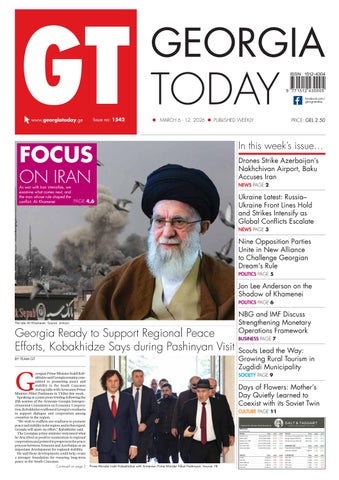
Georgia Ready to Support Regional Peace Efforts, Kobakhidze Says during Pashinyan Visit
eorgian Prime Minister Irakli Kobakhidze said Georgia remains committed to promoting peace and stability in the South Caucasus during talks with Armenian Prime Minister Nikol Pashinyan in Tbilisi this week. Speaking at a joint press briefing following the 15th session of the Armenia–Georgia Intergovernmental Commission on Economic Cooperation, Kobakhidze reaffirmed Georgia’s readiness to support dialogue and cooperation among countries in the region.
“We wish to reaffirm our readiness to promote peace and stability in the region, and in this regard, Georgia will spare no effort,” Kobakhidze said. The Georgian prime minister welcomed what he described as positive momentum in regional cooperation and pointed to progress in the peace process between Armenia and Azerbaijan as an important development for regional stability. He said these developments could help create a stronger foundation for ensuring long-term peace in the South Caucasus.
Drones Strike Azerbaijan’s Nakhchivan Airport, Baku Accuses Iran
NEWS PAGE 2
Ukraine Latest: Russia–Ukraine Front Lines Hold and Strikes Intensify as Global Conflicts Escalate
NEWS PAGE 3
Nine Opposition Parties Unite in New Alliance to Challenge Georgian Dream’s Rule
POLITICS PAGE 5
Jon Lee Anderson on the Shadow of Khamenei
POLITICS PAGE 6
NBG and IMF Discuss Strengthening Monetary Operations Framework
BUSINESS PAGE 7
Scouts Lead the Way: Growing Rural Tourism in Zugdidi Municipality
SOCIETY PAGE 9
Days of Flowers: Mother’s Day Quietly Learned to Coexist with its Soviet Twin
CULTURE PAGE 11
Khamenei
The late Ali Khamenei. Source: stimson
Prime Minister Irakli Kobakhidze with Armenian Prime Minister Nikol Pashinyan. Source: FB
BY TEAM GT
Drones Strike Azerbaijan’s Nakhchivan Airport, Baku
Accuses Iran
BY TEAM GT
Drones launched from the direction of Iran struck Azerbaijan’s Nakhchivan Autonomous Republic on March 5, hitting the area around Nakhchivan International Airport and injuring civilians, Azerbaijani authorities say. The incident marks a significant escalation in regional tensions and raises concerns that the expanding Middle East conflict could spill into the South Caucasus.
Azerbaijan’s Foreign Ministry says at least two drones crossed into Azerbaijani territory and struck areas near the airport in Nakhchivan, an Azerbaijani exclave located roughly 10 kilometers from the Iranian border. One drone reportedly crashed near the airport terminal, while another landed near a village school. Two civilians were injured in the attack. Local media and eyewitness reports said explosions were heard around the airport, with some footage circulating on social media showing damage near airport facilities. Initial reports indicated that the drones may have been Iranianmade “Shahed”-type unmanned aerial vehicles, although independent confirmation of the exact model has not yet been provided.
The Azerbaijani government strongly condemned the incident and summoned Iran’s ambassador in Baku to demand explanations. Officials warned that Azerbaijan reserves the right to take “appropriate measures” in response to attacks on its territory.
The strike appears to be the first time Azerbaijani territory has been directly
targeted since the latest escalation of fighting in the Middle East involving Iran, Israel, and the United States. Analysts say the attack highlights the growing regional spillover of the conflict, with drone and missile strikes increasingly affecting countries beyond the immediate battlefield.
Nakhchivan holds strategic importance for Azerbaijan. The autonomous republic is geographically separated from the rest of Azerbaijan by Armenia and borders both Iran and Türkiye. Its international airport serves as a key transport hub for the enclave.
The incident also comes amid broader geopolitical tensions between Tehran and Baku. Azerbaijan is a major energy supplier to Israel through pipelines running via Türkiye, a factor some analysts say could contribute to heightened friction with Iran during the current regional crisis.
While Iranian authorities have not immediately issued a detailed response to the allegations, reports suggest the incident occurred as Iran launched missile and drone strikes across several locations in the region in retaliation for attacks on its territory.
The situation remains fluid, with Azerbaijani security forces reportedly reinforcing air defenses in the Nakhchivan region as investigations into the strike continue. Regional observers warn that further escalation could destabilize the South Caucasus at a time when the broader Middle East conflict is already expanding beyond its original front lines.
If confirmed as a deliberate cross-border strike, the attack would represent a rare direct military incident between Iran and Azerbaijan and could significantly complicate regional security dynamics.
Georgia Ready to Support Regional Peace Efforts, Kobakhidze Says during Pashinyan Visit
Continued from page 1
Kobakhidze also emphasized the importance of the close partnership between Georgia and Armenia, describing the relationship as an example of strong cooperation and friendship between neighboring states.
“This partnership, this friendship and this cooperation are truly exemplary, and it is our responsibility to do everything possible to deepen them further,” he said.
Pashinyan, who visited Georgia for meetings with government officials and to participate in the intergovernmental commission session, thanked Tbilisi for its role in supporting regional dialogue.
“Today, Armenia and Azerbaijan are building economic relations and connections with the help and facilitation of Georgia. This is truly praiseworthy news, and we thank you for this valuable contribution,” Pashinyan said.
The Armenian prime minister said
11 Countries and EU to Boycott Opening Ceremony of 2026 Paralympics over Russia, Belarus Participation
BY TEAM GT
Eleven countries — Canada, Croatia, Czechia, Estonia, Finland, Germany, Latvia, Lithuania, the Netherlands, Poland, and Ukraine — together with the European Union will officially boycott the Opening Ceremony of the 2026 Paralympic Games, Ukraine’s Ministry of Foreign Affairs announced.
Ministry says the decision comes in response to the International Paralympic Committee’s (IPC) move to allow Russian and Belarusian athletes to compete under their national flags at the Games, with their national anthems played if they win medals.
Kyiv criticized the decision, arguing that permitting athletes from Russia and Belarus to participate with full national symbols undermines international efforts to isolate Moscow over its ongoing war against Ukraine. Belarus has also faced international condemnation for its support of Russia’s military actions. Ukrainian officials said the boycott of the opening ceremony is intended as a political signal of protest rather than a complete withdrawal from the Games themselves.
The group of countries supporting the boycott includes several EU and NATO members, many of which have been among Ukraine’s strongest political and military supporters since Russia launched its fullscale invasion in 2022.
The International Paralympic Commit-
tee has not yet publicly responded to the announcement. The participation of Russian and Belarusian athletes in international sporting events has remained a highly contentious issue since the start of the war in Ukraine, with different sports federations adopting varying approaches. Some international organizations have allowed athletes from the two countries to compete only under neutral status, without national symbols, while others have imposed full bans.
The decision by a group of European countries and Ukraine to boycott the Paralympic Opening Ceremony highlights continuing divisions in the global sports community over how to handle Russian and Belarusian participation in major international competitions during the ongoing conflict.
Georgian Rescue Puppy Hailey Survives 46 days Alone Before Dramatic Discovery Near Dublin Home
BY TEAM GT
AGeorgian rescue dog has been found safe after surviving 46 days alone in freezing winter conditions, discovered just minutes from her home in Dublin, Ireland, reports The Sun.
Hailey’s journey began long before she went missing.
Last June, Klara Poleszuk and her partner, Ciaran, were traveling through Europe when they found four abandoned puppies on the outskirts of Tbilisi, the capital of Georgia. The puppies had been dumped in a ditch near a derelict building and were in severe condition, suffering from dehydration, illness, and malnutrition.
Despite efforts to save them, three of the puppies later died. One survived against the odds. That puppy was Hailey, whom Klara describes as a “miracle.”
Determined to give her a safe and stable life, the couple had Dog Organization Georgia (DOG) and its volunteers organize for Hailey to be brought to them in Dublin. But on January 9, the nine-monthold disappeared from outside their house in Woodbine Park, Raheny, leaving them devastated.
At the time, Klara made an emotional appeal, saying she could not bear the thought of Hailey ending up back on
the streets, the same fate they believed they had rescued her from. The entire purpose of saving her, she said, was to give her a life away from danger and neglect.
For weeks, there was no sign of the young dog. The couple posted flyers throughout the neighborhood, shared appeals online, and asked residents to check their yards and security cameras. Search efforts intensified as they pleaded for any information that could lead to her safe return.
A breakthrough came on February 17, when Hailey was finally spotted.
Klara said the dog had been seen moving through several nearby yards. After comparing reports, they realized Hailey was hiding in a thick, overgrown ditch behind the properties.
“It’s unowned land that nobody really uses, and it gave her shelter,” Klara explained. “She kept incredibly low and hidden, but she was there.”
With the help of two volunteers, Klara began camping near the ditch. They placed hot, strong-smelling food outside, along with Hailey’s toys and clothing carrying their scent. Cameras were set up to monitor her movements.
“Once we got the first confirmed sighting and video footage, the neighbors were unbelievably kind,” Klara said.
“They let us stay near the ditch. We could see her moving around at night, she was close, but still so scared.”
After several tense nights without suc-
cess, everything changed on February 24. Klara and two volunteers were in a neighbor’s yard preparing warm food when nearby dogs suddenly began barking. At first, they assumed the noise was directed at them, but they decided to investigate.
“We were skeptical at first,” Klara said. “But the homeowner showed us a bush… and there she was. Hailey was sitting inside it, frozen with fear.”
It took nearly an hour of gentle coaxing before Hailey finally came out.
Once she was back home, it was as if she had never been gone.
“She recognized everything and everyone straight away,” Klara said. “She went upstairs, found her bed, and started wagging her tail. She ate her dinner, and now she’s snoring beside us, cuddled up with her bear.”
Klara expressed heartfelt gratitude to the neighbors and volunteers who supported the search.
“Thank you to everyone who shared, searched, checked cameras, gave sightings, and supported us in any way,” she said. “We had the most incredible group of volunteers. There’s no way we would have found Hailey without them.”
Despite being just nine months old, Hailey survived 46 days alone in cold and rain.
“She is only nine months old,” Klara added. “She survived in Georgia as a tiny puppy against all odds, and now she’s done it again. She is a fighter.”
Georgian Karatekas Shine in Italy, Securing 7 Medals at International Championship
BY TEAM GT
discussions during the commission meeting focused on expanding bilateral economic cooperation as well as regional and international issues, including areas where the two countries can deepen collaboration.
He also highlighted growing peopleto-people ties between Armenia and Georgia, particularly through tourism.
“The economic relations between Georgia and Armenia are deepening based on a long-standing tradition. For Armenian tourists, Georgia was, is, and will remain the most beloved place for rest and visits,” Pashinyan said, adding that the number of visitors traveling from Georgia to Armenia is also increasing.
Pashinyan thanked Kobakhidze and the Georgian people for supporting efforts aimed at advancing the Armenia–Azerbaijan peace process and said the strengthening political partnership between Armenia and Georgia is increasingly reflected in closer cooperation in culture, sports and economic exchanges.
Georgian karate athletes claimed an impressive haul of seven medals at the IX International Karate Championship “Black Belt Cup 2026,” held on February 21-22 in Lecco, Italy. Organized by the United Federation of Italian Sports Karate (UKS), the tournament brought together approximately 1,000 competitors from around 20 countries.
The Georgian team, representing the Shotokan Karate Do Confederation, dominated the podium with four golds, two silvers, and one bronze medal. Senior competitor Chabuka Makharadze, a four-time world and five-time European champion and black belt V Dan, won gold in both individual kata and the kumite absolute weight category.
Among younger athletes, 13-year-old Andria Saatashvili, a two-time European champion and seasoned international
competitor, took gold in individual
for 13-year-old
kata
boys. He also earned silver in the individual kumite +55 kg category and bronze in the absolute kumite category.
Making her international debut, 11-yearold Barbara Tavadze captured gold in
the girls’ 11-12 years old individual kumite absolute weight division and silver in the +45 kg individual kumite category. The Georgian team’s strong performance highlighted the country’s growing prominence in international karate competitions.
Chabuka Makharadze and the young athletes. Source: FB
Ukraine Latest: Russia–Ukraine Front Lines Hold and Strikes Intensify as Global Conflicts Escalate
COMPILED BY ANA DUMBADZE
While global attention spans flicker between the war in Iran and the enduring struggle in Ukraine, the latter continues to shape itself as a war of attrition. Over the past week, the battlefield in eastern and southern Ukraine remained active, with slow-moving frontlines paired with an intensified campaign of longrange strikes targeting infrastructure and logistics. No major breakthrough occurred, yet missile and drone attacks continued to damage energy networks, transportation hubs, and civilian areas, reinforcing that the war is far from reaching any resolution.
FRONTLINE MOVEMENTS AND TERRITORIAL SHIFTS
Recent battlefield assessments indicate that Russian forces made only limited territorial gains, capturing roughly 25 square miles over the reporting period, reversing a minor loss recorded the previous week. Ukrainian troops maintained a small foothold inside Russian territory near the Kursk and Belgorod border, estimated at about four square miles, with no significant change elsewhere. These figures illustrate a persistent pattern: the war’s fifth year is being defined by continuous offensives and counterattacks, with frontlines moving only incrementally despite heavy fighting. Ukrainian officials reported localized successes in the southeast. Commanderin-Chief Oleksandr Syrskyi said Ukrainian forces retook several settlements in the Zaporizhzhia region since late January, advancing near Oleksandrivka and Huliaipole. Defensive lines were main-
tained in contested areas like Kupiansk in the northeast and the strategic Pokrovsk direction in Donetsk. February also saw a slowdown in Russian territorial gains compared with previous months. Independent military analyses suggest that Ukrainian forces liberated slightly more territory than they lost during the latter half of February, the first net gain since the major 2023 counteroffensive, highlighting Russia’s difficulties in turning sustained attacks into significant breakthroughs.
Despite Ukraine’s localized successes, Russia continued offensive operations across multiple sectors, particularly in Donetsk. Fighting remained heavy around key logistical hubs and defensive positions, including renewed assaults in the Pokrovsk direction and other parts of eastern Donetsk. Analysts note that Russia’s strategy relies on sustaining pressure along a broad front, forcing Ukraine to distribute defensive forces across multiple sectors rather than massing them for a decisive counteroffensive.
LONG-RANGE STRIKES AND INFRASTRUCTURE DAMAGE
Alongside ground combat, Russia intensified its long-range missile and drone campaign. Ukrainian authorities reported attacks on energy and transportation infrastructure: gas facilities in Poltava and electricity substations in Kyiv and Dnipro were hit, injuring at least 20 people. Railways were repeatedly targeted; a drone strike hit an empty passenger train in Mykolaiv, injuring a worker, and a missile damaged a railway station administrative building in Odesa, wounding two children and another railway employee. Multiple rail facilities have been damaged over recent weeks, highlighting Russia’s ongoing aim to disrupt military logistics and civilian transport.
Maritime infrastructure was also affected. A drone strike damaged a foreign cargo vessel near the Black Sea port of Chornomorsk while it carried corn, underscoring the persistent risks to Ukrainian grain exports. The repeated attacks on energy infrastructure are causing broader economic disruptions. ArcelorMittal announced suspension of operations at a Kryvyi Rih steel plant, citing instability in electricity supply. Ukrainian officials warn that repeated strikes on power systems are raising electricity costs and complicating industrial production. Concerns about nuclear safety also emerged: Russian-installed authorities reported a temporary ceasefire near the Zaporizhzhia nuclear plant to repair a damaged external power line, emphasizing the importance of stable electricity for cooling systems.
UKRAINE’S COUNTERSTRIKES
Ukraine continued to target Russian
military and energy infrastructure. The most notable strike hit Novorossiysk, a Black Sea port city, where drones disrupted oil terminal operations and caused fires in fuel storage facilities. Russian officials reported five injuries and damage to residential buildings. Earlier in the week, a Ukrainian drone strike on a chemical plant in western Russia reportedly caused seven deaths and injured at least ten people. While the plant’s exact role in military supply chains is unclear, the strike reflects Ukraine’s focus on industrial and logistical facilities far from the frontlines.
DIPLOMATIC
EFFORTS
Efforts to advance peace and secure a ceasefire have continued, though progress remains stalled. Ukrainian President Volodymyr Zelenskyy said that trilateral peace negotiations involving Ukraine, the United States, and Russia, previously expected to resume in early March, are currently on hold because
of the ongoing conflict involving Iran, which has shifted the priorities of external mediators and disrupted planning for a new round of talks. Kyiv officials said that although dialogue with the US continues almost daily, “the necessary signals for a trilateral meeting haven’t come yet,” and no firm date or venue has been confirmed for the next session. Ukrainian leaders also highlighted ongoing work aimed at securing the release of prisoners of war, signaling that while a comprehensive ceasefire deal remains distant, incremental humanitarian cooperation continues.
Military assistance remains critical. Ukrainian officials highlighted concerns over air defense interceptors, including Patriot missiles used against ballistic threats. Shortages of air-to-air missiles for newly deployed F-16 fighter jets also emerged, reflecting broader strains on global air defense resources due to simultaneous regional conflicts.
A Ukrainian soldier. Source: Getty Images
“Death of a Thousand Cuts… To Weed a Garden”
INTERVIEW BY VAZHA TAVBERIDZE
In this Radio Free Europe/Radio Liberty Georgian Service interview, Dr. Michael Knights, head of research at Horizon Engage, discusses the escalating US-IsraelIran confrontation. An expert in Middle Eastern security with decades-long experience advising Western governments, Knights explains the strategic objectives, what’s realistic on the ground, and the long-term regional stakes, navigating the “fog of war” between survival, regime change, and ongoing conflict.
WHAT’S AT STAKE AND WHAT DOES EACH SIDE WANT? IRAN SEEMS FOCUSED ON SIMPLE SURVIVAL, WHILE US AND ISRAELI GOALS, AT LEAST PUBLICLY, ARE LESS CLEAR. CAN WE STILL DISCERN ANY ENDGAME THROUGH ALL THE STRATEGIC AMBIGUITY?
The minimal US-Israeli objectives are that Iran's offensive military capability to affect environments outside of Iran has to be reduced to an absolutely maximal extent. That means that the missile program is crippled for the long term. There's no aircraft available, as few helicopters as possible, no navy, no major long-range rocket systems, ground force capabilities greatly degraded. That's the minimum. The bonus would be if the regime begins to crumble and there is ideally an inside-out change of government, meaning a change of government starting in Tehran, not a change of government starting in the provinces. And this is why the President of the United States has been essentially begging Iranians to take over institutions and rise up within the cities. But what we're starting to see is the other alternative happening, which is the crumbling of the regime from the outside, from Iranian Kurdistan, from the edges. And that's not as attractive an outcome for anybody because it can start to break the country up and result in significant civil war type conditions.
I don't think the Trump administration is going to back off without achieving its minimum objectives, which is an unprecedented destruction of the Iranian regime's military war machine and repressive institutions.
AND IF THE CHOSEN STRATEGY TO ACHIEVE THOSE OBJECTIVES DOESN'T YIELD THE DESIRED RESULTS, DOES THE US HAVE PLAN B?
Plan B is to do the destruction, then stop and leave the Israelis to go back and ‘weed the garden’ as if Iran were a new Lebanon. After defeating Hezbollah, the Israelis return whenever they want to prevent reconstitution. That is a feasible option here. One end point is the US only achieves its minimum objective, crippling Iranian military capabilities, while Israel conducts an ongoing campaign between the wars, striking targets at will, applying a ‘death of a thousand cuts,’ and fomenting uprisings at the edges of the state. That is not very attractive to the US or the Gulf states, so they wonder if it is worth pushing now to force regime change quickly, done in weeks instead of months or years. Venezuela moved fast, with the Delcy government stepping up after Maduro and showing US subservience. The US sees that is not happening in Iran, so if you can’t overthrow this government, you are stuck with it long term.
BRINGING IN THE GARDENER TO WEED THE GARDEN. IS IT FEASIBLE? BECAUSE LEBANON IS ONE THING AND
IRAN QUITE ANOTHER.
Israel knows Lebanon far better than they know Iran, but, over time, if they wanted to do a slow burn campaign between the wars, they could probably make it almost impossible for hardliners to show their faces at all, in the way it is with Yemen. In Yemen, the senior leadership there has to be extraordinarily careful every single day of their lives. And that's something that the Israelis could certainly do. They could also provide actual, genuine military support to uprisings in individual provinces. They could do that now, but they could also do that in six months or a year.
There's no downside for the Israelis if the regime survives. They're already operating ground forces within Iran.
That's something that will probably increase over years or months. So if you're in anyway, you're going to make sure that this garden never regrows properly in a way you don't want it to. And they've got the capability to do that.
So if it's not stopped now, one way or the other, it's just going to be a campaign between the wars from now on.
IN THIS WAR, IRAN RETALIATED. IT DID NOT FOLD. HOW UNEVEN IS THIS FIGHT? HOW BIG ARE THE ADVANTAGES THAT THE US AND ISRAEL POSSESS?
In conventional military terms, Iran is a house with no roof right now. The Israelis and the US will have full freedom of movement for the foreseeable future, maybe forever at this point. And once it's at this point, the Israelis will never stop going back on a monthly basis until that regime is gone. What's at stake here is the whole future of the region. We're at a dividing line right now, where the post-1979 experience of the region can be fundamentally changed. President Trump is obsessed with the idea that Iran can become a friend. I think the Trump people see Iran as a tragic waste of an amazing market and an amazing potential partner. They want it over because they think that there's a lot to do there.
ISRAEL HAS CAPACITY, BUT DOES IT HAVE RESOURCES? THE US AND ISRAEL ARE GETTING LOW ON INTERCEPTOR MISSILES. IRAN IS FIRING MISSILES INTO NEIGHBORING COUNTRIES, TARGETING US BASES. WHICH SIDE WILL RUN OUT OF CAPABILITIES FIRST?
The Trump people think they are ahead of schedule in degrading Iran’s launch, production, and storage systems. Even though the cost has been high, launches are already slightly down as the system strains. Iran still has large numbers of drones and can largely manufacture replacements internally if it has stocks of engines and key components. But missiles are harder to replace. The cost has favored Iran so far, but they can and will keep firing at the US and the Gulf. On the defense side, resilience matters. The Emirates, for example, haven’t collapsed or emptied out. Dubai and Abu Dhabi remain intact, and life is ongoing. Essentially, any economic system will adapt.
IF IRAN KEEPS FIRING AND ADDS MORE DRONES, THIS COULD BECOME A FULL REGIONAL WAR. WHAT WOULD THAT MEAN FOR THE GULF AND BEYOND?
This is a real scenario. To try to prevent it, two things are happening. The Gulf states are moving from noncombatants to active participants, starting to police the counter-drone line farther out. They are also likely to bring US manned aircraft forward from Jordan, creating a thicker defense screen over the Gulf. There are options we haven’t used yet. Right now, the Gulf states are relying on their most expensive assets to shoot down Iranian missiles, while cheaper options remain unused because they asked US forces to stay based in Jordan, Israel, and Cyprus. That could change. If the worst case happens and Iran keeps firing, they have deeper stockpiles than us and could continue like the Houthis have. Using Hormuz will get very expensive, with the US needing to reflag ships and ensure each cargo, something Trump will not like. The Gulf states also will not welcome weeks of ongoing strikes instead of days. We are essentially in a four- to six-day race.
I think the president's determination might start to flag late this coming weekend. I'm surprised it hasn't already. But that's partly because the Iranian leadership rejected the idea of talks under these conditions. If they had said yes, I think by midweek we would be in talks and we'd have a bombing pause.
So if they change their mind on that, we would probably stop. But as it stands right now, it's going to keep going until next weekend at least. If we get to Saturday and the president is not feeling
the love from the Gulf, the Republican Party and various other partners, and if he's being told that we're getting critically low on interceptors and so are the Gulf states, at that point you're going to hear him pivot. He's going to say job done. A bit like he did with the Houthis. Smashing victory, we're done.
WOULD THAT REALLY BE A WIN FOR HIM?
First of all, he's got a tremendous ability to turn anything into a win, as far as he's concerned. Right now, the Democrats are 100% against this war, but that doesn't make him more inclined to stop the war, that makes him more inclined to keep going. And even when he does choose to pull the plug, he'll be fine with that decision. He never second-guesses himself. He knows when something feels right to do and he knows when it feels right to stop. He's a businessman, he recognizes that some things come out cost-negative and some things come out profitable.
But I don't think the Israelis will stop. They'll continue to treat Iran more generally like Lebanon. If Trump tells the Israelis it's time to stop, the Israelis themselves, if they get low on interceptors, will say, “you're right, okay, we're really upset, but sure, we'll stop.” But the fact is they'll be back within weeks or months.
WILL THEY BE BACK WITH THE US OR WITHOUT?
Without, because next time they wouldn't need the US. Once the minimum objectives of this are done, it will be a much more permissive environment for the foreseeable future for Israel. And so they just expand the campaign between the wars from Lebanon and Yemen and Syria to now include Iran.
IF WE WERE TO ASK WHOSE SIDE TIME IS ON, AND IF IRAN'S CHIEF OBJECTIVE IS TO SURVIVE AT LEAST UNTIL THE NEXT DAY, THEN TIME IS ON IRAN'S SIDE, RIGHT?
Yes, the regime does not appear panicked. It hasn't reached out for some kind of professor to be the new president of the republic and signal to the Americans that a new day is dawning. The appointment of Mojtaba doesn’t change much either. Trump and Israel will see this as an enemy regime till much more serious leadership change comes. I will be surprised if he lasts long, maybe weeks or even days. Tehran is not signaling that there's a new face to this government. They're saying “it's still us.” And they're saying “we don't want to talk to you either.”
They know their only chance of survival is to knuckle down, outlast the US, and maintain internal control. And that's the most likely outcome.
THERE IS THIS PREVAILING VIEW THAT THE ISLAMIC REPUBLIC OF IRAN IS WEAKER THAN AT ANY POINT IN MODERN HISTORY. THIS EXPLAINS THE TIMING OF THE STRIKES. AND YET THE REGIME DID NOT COLLAPSE. WHY?
This is the question Trump will be asking himself. Part of the reason why this happened at this moment is that we had just come off Maduro. We’d seen that if you remove the top guy from a system, the system starts acting completely differently. He was undoubtedly told by the CIA that it's not going to happen here. But the second thing he saw was the protests. And everybody was saying this is the closest Iran has ever come to regime change. You could tell the president got overexcited by that. He got on a roll. And he believed what he was seeing on TV.
So when he does this operation and he says explicitly to the Iranian people that we're going to take away the repression and now you've got to stand up and take back the streets and the institutions, I think the president is genuinely surprised that that's not happening.
WHY HAS IT NOT HAPPENED?
You can see that the Trump administration is slightly confused that it's not happening yet. The Israelis, I don't think they're confused at all. They say there's no way of doing this inside out. It can only be done outside in. We're going to work with Iranian Kurds. We're going to work with anyone else we can [to] get our teeth into at the edges, to bite pieces off this state. So the Israelis have their own track. They're saying that the insideout thing isn't going to work. We would have to kill another two layers of leadership to make that work.
Why don't the streets come up? In January there weren't tons of bombs falling from the air. And the regime had not yet gone brutal and killed thousands of people.
The situation we're in now is probably more unsettling for people to try and come out in protest because they know the regime will be probably doubly brutal than it was before, with zero limitation. And there's a war on. I suspect they're waiting for the strikes to do enough damage. But it's possible that they'll never see the strikes doing enough damage.
I don't think this is going to be a oneand-done. I think this opens the door to repeated regime losses of control.
IF THE REGIME DOES NOT CRUMBLE INTERNALLY, SOME MIGHT BE TEMPTED TO LEND A HAND. WHAT ARE THE CONSTRAINTS HERE? IS REGIME CHANGE FROM THE AIR, WITHOUT BOOTS ON THE GROUND, WHICH SEEMS TO BE THE PREFERRED METHOD OF THE TRUMP ADMINISTRATION, FEASIBLE?
Nobody has really ever done it. Although one might say, in a sense, it was done in Japan in 1945. Now that obviously took atomic bombs.
Trump thinks there are boots on the ground, millions of Iranian boots on the ground. And he's saying that's the bootson-the-ground force. If they don't want to do it, then that's fine. That's up to them.
What I think is going to happen is that after the end of this he will just say to some reporter that it's a real shame they couldn't have finished it off. He can be quite human too. He might say I can imagine that they are scared, they're just people, but it's a real shame that someone from the military couldn't have stood up and led them and we could be having great, beautiful deals right now.
AND FINALLY, RUSSIA AND CHINA. WHAT IS AT STAKE FOR THEM? WHAT DO THEY STAND TO LOSE?
The same as with Venezuela. The problem with Russia and China's great power competition is that they don't have power-projection capabilities. As a result, when something is happening far away, like Venezuela, or even as far away as Iran, they simply have no hard power capability to affect the result. There's still a US hard power advantage at a continental range that the Russians and the Chinese don't have. Their soft power is extraordinary. But in this case, it doesn't help a partner.
And everyone can see that Assad in Syria went down despite Russian support. Iran went down despite Russian and Chinese support. Venezuela, Maduro went down as well. That's the reality.
Dr. Michael Knights. Source: horizonengage
Parliament Approves Legislative Amendments Tightening Rules on Grants and Political Activities
BY TEAM GT
Georgia’s Parliament has approved a package of legislative amendments that further tighten regulations related to receiving grants, political activities, and political engagement.
The amendments were adopted in the third reading, with 78 MPs voting in favor and 9 against.
The legislative package introduces changes to several laws, including the Law on Grants, the Criminal Code, the Administrative Procedure Code, the Code of Administrative Offenses, the Organic Law on Citizens’ Political Associations, and the Law on the State Audit Service. The amendments were prepared by the ruling Georgian Dream faction.
Under the amendments to the Law on Grants, the definition of a grant is expanded.
Based on the new provisions, a grant will include monetary or in-kind funds transferred by certain entities that are intended or may be used to influence Georgian authorities, state institutions, or any part of society. This includes activities aimed at shaping, implement-
ing, or changing Georgia’s domestic or foreign policy, as well as actions connected to the political or public interests of a foreign government or foreign political party.
Foreign-registered legal entities whose activities relate to Georgia will also be considered grant recipients. Such entities will be required to obtain prior consent from the Government of Georgia before receiving a grant.
If a foreign legal entity operating in Georgia through a branch, representative office, or other structure receives a grant without government approval, it will face legal liability.
Individuals or organizations that received grants before the law enters into force will have one month to apply to the government for approval, while the government will have around one month to issue its decision.
The amendments introduce criminal liability for violations of the Law on Grants. Offenses may be punished by a fine, community service of 300–500 hours, or imprisonment of up to six years.
An additional aggravating circumstance has also been added to the money laundering provisions of the Criminal Code.
Money laundering carried out for the purpose of influencing political processes
in Georgia will now be punishable by nine to twelve years in prison.
The legislation also establishes criminal liability for political party leaders who receive foreign funding, with penalties including fines, community service, or imprisonment of up to six years.
The amendments also criminalize foreign lobbying. The direct or indirect transfer of money, securities, property, or other benefits to a foreign citizen or legal entity in exchange for activities related to political issues in Georgia will be punishable by a fine, community service of 300–500 hours, or imprisonment
Europe Press Freedom Report: Situation in Georgia “Deteriorated at an Alarming Rate” in 2025
BY TEAM GT
The situation of press freedom in Georgia sharply worsened in 2025, with the country recording a 78% increase in alerts compared to the previous year, claims the annual Europe Press Freedom Report presented by the Council of Europe’s Safety of Journalists Platform.
A total of 32 alerts concerning Georgia were submitted to the Platform in 2025, reflecting what the report describes as a broader dismantling of press freedom. The document cites institutional repression, politicized law enforcement, the capture of state institutions and public service media, and the erosion of effective checks and balances as key drivers of the decline.
One of the most prominent cases highlighted in the report is that of Mzia Amaglobeli, founder and director of the independent media outlets Batumelebi and Netgazeti. On August 6, 2025, following more than 200 days in pretrial detention and what the report describes as a highly politicized trial, Amaglobeli was sentenced to two years in prison. Since her arrest, both she and her media organizations have reportedly faced smear campaigns, degrading treatment
and economic retaliation.
The report also points to arbitrary arrests of journalists. On November 3, 2025, Mediachecker journalist Ninia Kakabadze was detained on administrative charges of “blocking the road” while covering a rally. In October, Publika journalist Mamuka Mgaloblishvili was briefly detained on similar charges.
Legislative developments in 2025 are described as particularly concerning. On April 1, Parliament adopted a new version of the so-called “foreign agent” law, titled the Foreign Agents Registration Act, introducing obligations punishable by fines of up to GEL 25,000 (€8,250) and prison sentences of up to five years.
On June 12, amendments to the Law on Grants were adopted, requiring foreign donors to obtain prior executive approval before disbursing grants. Amendments to the Law on Broadcasting, which entered into force the same month, expanded the authority of the Georgian National Communications Commission (GNCC) to regulate factual accuracy, fairness and privacy—areas previously governed through self-regulation. The changes allow the GNCC to impose penalties of up to 3% of a broadcaster’s annual revenue or revoke its license. Authorities have already filed complaints against Formula TV and TV Pirveli under the new provisions. Further amendments adopted in June
narrowed protections under the Law on Freedom of Speech and Expression and increased liability for defamation and insult. Draft changes to the Organic Law on Common Courts were also advanced, potentially restricting journalists’ ability to report from court premises by prohibiting photo, video and audio recording in and around courthouses without specific judicial authorization.
The report notes that court orders have frozen the bank accounts of several NGOs, including press freedom groups. Media organizations have also been targeted, including online outlet Project 64, the organization behind Mtis Ambebi, and the Organised Crime Research Media Centre, which runs investigative outlet iFact.
Concerns about the editorial independence of Georgia’s Public Broadcaster (GPB) also persisted. The 2025 EU enlargement policy communication stated that the broadcaster “lacks independence, has a biased editorial policy and has contributed to the promotion of anti-EU rhetoric.” GPB dismissed journalists Vasil Ivanov Chikovani and Nino Zautashvili after they raised concerns about political interference, and Zautashvili’s talk show was cancelled. Additional dismissals followed, reinforcing concerns over political influence on the broadcaster’s governance and funding.
Georgia also continued to deny entry to several foreign journalists, including British freelance reporter Will Neal, French photojournalist Jérôme Chobeaux, Italian journalist Giacomo Ferrara and Swiss photojournalist Gregor Sommer.
The report further documents dozens of physical attacks on journalists by law enforcement officers. Media workers have faced repeated fines, obstruction of their work and confiscation of equipment. Impunity for crimes against journalists remains widespread, with investigations often described as insufficient and perpetrators—particularly those linked to law enforcement—frequently not held accountable.
Despite what the report calls an unprecedented crackdown, independent journalists in Georgia have continued reporting from the ground. However, it warns that without effective checks and balances, legal safeguards and independent institutions, journalism in the country risks becoming unsustainable without immediate international support and pressure.
Such actions will be punishable by a fine, community service of 400–600 hours, or imprisonment for up to three years. Legal entities may face fines or liquidation.
The amendments introduce new rules regarding public political activity by business entities. Companies engaging in political activities unrelated to their core business may face an administrative fine of 20,000 GEL, with repeated violations potentially leading to criminal liability.
The amendments to the Organic Law on Citizens’ Political Associations also introduce new restrictions on party membership.
of up to six years.
A new article has been added to the Criminal Code — Article 316¹, titled “Extremism against the Constitutional Order.”
The provision establishes criminal liability for systematic public calls to violate Georgian legislation, mass disobedience toward state institutions, or attempts to create alternative governing bodies. It also covers actions aimed at portraying Georgia’s constitutional order or state institutions as illegitimate in ways that could harm the country’s interests.
Individuals employed in organizations where more than 20% of annual revenue comes from a foreign power will be prohibited from joining political parties for eight years.
Additionally, the legislation replaces the term “entity with declared electoral goals” with “entity with declared partypolitical goals”, expanding its scope. All restrictions that apply to political parties will also apply to such entities.
The amendments further establish criminal liability for leaders of political parties or political entities that receive foreign funding in violation of the law.
Nine
Opposition Parties Unite in New Alliance to Challenge Georgian Dream’s Rule
BY TEAM GT
Georgia’s opposition landscape remains divided after several parties announced the creation of a new political alliance, while the opposition party Gakharia for Georgia said it would continue operating independently rather than joining the bloc.
Nine opposition groups revealed the new coalition following a meeting in Tbilisi on March 2, presenting it as a coordinated effort to challenge the ruling Georgian Dream party amid an ongoing political crisis. Parties signing the agreement include Ahali, Girchi – More Freedom, Droa, European Georgia, United National Movement, National Democratic Party, Strategy Aghmashenebeli, Freedom Square, and Federalists.
Speaking after the meeting, Ahali leader Nika Gvaramia said the parties had agreed to coordinate their actions while maintaining separate political identities. “We create a unity to win together,” he told journalists, adding that the alliance would focus on common strategy rather than forming a single electoral list.
The parties also released a multi-chapter coordination document outlining their joint political goals and rules for cooperation. The text frames the alliance’s main objective as safeguarding Georgia’s independence and restoring democratic governance.
It calls for the “peaceful dismantling” of what it describes as the “autocratic, criminal regime” of Georgian Dream founder Bidzina Ivanishvili, while emphasizing that opposition unity is necessary to mobilize broader public support for political change.
The document argues that meaningful change will occur only “when a large majority of citizens view regime change as being in their vital interest and believe a credible democratic alternative exists.”
It identifies peaceful protest and civic mobilization as the primary tools for achieving that goal.
The signatories also committed to a code of conduct covering cooperation principles, equal participation among
parties, political responsibility, and fair competition.
Despite the attempt to build unity, several opposition forces remain outside the coalition. Among them is Gakharia for Georgia, founded by former prime minister Giorgi Gakharia after leaving Georgian Dream in 2021.
In a separate statement, the party said it would pursue its own strategy against the government and rejected cooperation with the newly formed alliance.
“We have nothing in common with these parties. We have our own independent path and strategy aimed at weakening the authoritarian rule of Georgian Dream,” the statement said.
The party also criticized previous opposition initiatives, including a parliamentary boycott and the events surrounding October 4, arguing that those actions ultimately benefited the ruling party rather than weakening it.
According to the statement, the developments that followed the boycott campaign were used as political provocations that strengthened the government, while some opposition groups failed to demonstrate sufficient political judgment in their response.
Gakharia for Georgia further said it would avoid political platforms connected to what it described as the “radical political legacy” of the United National Movement and some of its allies.
The alliance comes during continuing political tensions in Georgia, where antigovernment protests have persisted for more than a year following the government’s decision to suspend progress toward European Union integration in late 2024.
Opposition parties have long been divided over strategy, including whether to boycott parliament, participate in elections, or prioritize street protests, contributing to a fragmented political landscape.
While the newly announced coalition aims to coordinate opposition actions, the absence of several significant parties underscores the continuing splits within Georgia’s opposition camp as it seeks to challenge the ruling Georgian Dream government.
Georgian parliament. Source: 1TV
Tbilisi protests in 2024. Source: AFP
Jon Lee Anderson on the Shadow of Khamenei
INTERVIEW BY VAZHA TAVBERIDZE
Acclaimed American journalist and war correspondent for The New Yorker, Jon Lee Anderson has spent decades reporting from some of the world’s most volatile regions, from El Salvador to Lebanon, to Afghanistan, Iraq and Iran. Known for his profiles of Hugo Chávez, Fidel Castro, Che Guevara, and Augusto Pinochet, Anderson turns his penetrating eye to Iran’s Supreme Leader, Ayatollah Ali Khamenei.
For more than 35 years, Khamenei presided over the Islamic Republic not as a charismatic leader or a distinguished theologian, but as a calculating consolidator of power, tightening clerical rule, expanding the reach of the security state, and projecting Iranian influence across the Middle East through an extensive network of proxy militias. Khamenei was austere and opaque; a man whose carefully cultivated image of personal simplicity masked the formidable apparatus of repression and geopolitical ambition he commanded. In his interview with Radio Free Europe/RL's Georgian Service, Anderson suggests that following Khamenei’s death, Iran and the wider Shia Muslim world may yet reveal the full measure of his legacy, one defined as much by fear, coercion, and ideological rigidity as by the aura of spiritual authority that sustained his rule.
ON KHAMENEI: IF ONE WERE TO PAINT HIS PORTRAIT IN WORDS, WHAT WOULD THE MAIN STROKES BE?
This was the man who, following Khomeini’s death, carried the Islamic Republic forward for the next 35-odd years. After Khomeini, who was seen by many almost as God, he proved himself a wily arbiter and manipulator of power, guiding the country from his role as Supreme Leader while maintaining a symbolic connection to the spiritual realm.
He was not a Marjah (Grand Ayatollahs [Marja' al-Taqlid] – VT). He was not a holy man truly versed in Islamic jurisprudence, but he acquired that role in large part thanks to the machinations that followed Khomeini's death and to the idea he helped orchestrate: that Iranians preferred to be ruled by one man, one leader, rather than by a council of men. Essentially, the Islamic Republic that we've come to see in these last few years is Khamenei's Islamic Republic, his handiwork.
Khamenei was not charismatic. He led the Friday prayers, he issued fatwas, he spoke through others in laying down the final word on pretty much everything to do with Iranian life and with its foreign policy, but he was not seen very much. He was a gray-bearded guy with glasses, he wasn't interesting to look at. He wasn't Fidel Castro, he wasn't Saddam Hussein. Even Bashir al-Assad, as weak-chinned as he was, was nonetheless a recognizable face. So was Gaddafi But not Ayatollah Khamenei. He was this cipher, an enigma. But in assessing what his power was, what his true legacy was, it's a combination of insistence on clerical power and the power exercised through the theocracy that he ruled over and consolidated via the instruments of state security. And finally, the extension and fortification of Iranian power in the region through these proxy militias, most of which began their lives during the time of his predecessor, Khomeini, but also through him. That's Hezbollah in Lebanon and Syria, Hamas in the Palestinian territories in Gaza, and the Houthis in Yemen.
So, speaking from a geostrategic point of view, you have to doff your cap to Khamenei. If the point of his life was to make Iran's presence felt and make it a force to be reckoned with in the Middle East and in the Muslim world dominated by Sunni states, then he was very influential. And from the very beginning of the Islamic Revolution, it was Khomeini, assisted by people like him at his side, who so mercilessly crushed all opposi-
tion, first political and then ethnic and every other form of dissidence and protest in Iran, until his dying days. And they faced off against the US, that great hegemonic power of the last century.
DOESN’T THAT KIND OF AUSTERITY COME WITH THE JOB DESCRIPTION? KHOMEINI WAS KNOWN NOT TO SMILE OR LAUGH. YOU NEED TO INSTILL IN PEOPLE A SENSE OF THE DIVINE, NO?
That's right. And especially in Iran, the Ulema (Shiite Islamic scholars educated in madrasas, who hold significant power as interpreters of theology and law – VT) consecrate and exalt the idea of simplicity, humility, and modesty. This was something that we first saw with Ayatollah Khomeini, just this white robe and the beard, a very simple life: austerity. And Khamenei continued to project that as his symbolic connection with the spiritual world.
BUT HE WASN’T ALWAYS LIKE THAT. HOW DOES A MAN FASCINATED BY POETRY, A TRANSLATOR OF KHALIL GIBRAN, END UP AS A THEOLOGICAL TYRANT THE LIKES OF WHICH YOU ARE MORE LIKELY TO FIND IN SOME MEDIEVAL CHRONICLES THAN IN THIS DAY AND AGE?
Good point. How did a psychotherapist like Radovan Karadži become a bloodthirsty monster once Yugoslavia fell apart and he became the architect of ethnic cleansing? Or take Robert Mugabe of Zimbabwe, who had seven university degrees. He was an educated man. And yet he became a corrupt and venal despot. We evolve through life. And Khamenei, in his youth, was even part of a group that looked to a secular Ulema. He was a child of his time, like so many others who came of age in that postwar period, when nationalism was colliding with ideologies like Marxism. And Marxism began to fade. He was part of the revolution that to a large extent replaced Marxism-Leninism as the great expansionist ideology of his day. No movement more than the one that Khomeini and Khamenei headed in Iran has so reshaped the world in the last 45 years.
The idea of political Islam, embodied in Iran’s Wilayat al-Faqih (“Guardianship of the Islamic Jurist”), truly changed the world. They didn’t just overthrow the Shah and upset the Shia-Sunni balance in the Middle East; they immediately tried to export their revolution, some-
times violently, as in Saudi Arabia. In a way reminiscent of Fidel Castro after the Bay of Pigs, they humbled the United States, pushing the Soviet Union out while keeping it close, and confronting the US directly through the hostage crisis. Since then, a frigid peace endured, now disrupted by what appears to be a retributive war under Trump.
HIS DEATH WAS CELEBRATED BY MANY, BUT MANY ALSO MOURNED HIM, NOT ONLY IN IRAN BUT IN THE SHIA MUSLIM WORLD AT LARGE. WHAT DID HE EMBODY TO THOSE WHO MOURNED HIM? WHAT HAS THE ISLAMIC REPUBLIC LOST WITH HIS DEPARTURE?
I think that in death we may learn a lot more about Khamenei than when he was alive, about the way he wielded power, about his personal life, about his personal habits, and perhaps about the way people saw him. When I saw pictures of these people, women weeping disconsolately for him, I don't recall seeing images of women and huge numbers of people marching in the streets and weeping when Saddam Hussein died, or when Gaddafi died, as brutal as his death was. We did see that in the case of Khomeini, and I think that's something that should give us food for thought.
I believe they feel they've lost this father figure with a spiritual dimension, having given him a certain God-like quality because of that spiritual dimension, his role as an Ayatollah, and the Shia beliefs in which they embrace their suffering as a form of popular identity, of communal identity. So every time there is a martyrdom like his, they feel that this strengthens them, that it strengthens their purpose on earth. It sounds paradoxical, perhaps to secular Westerners, but it gives them a greater attachment to their original purpose and identity as Shia Muslims.
YOU MENTIONED GADDAFI AND ASSAD, AND IN BOTH LIBYA AND SYRIA REGIMES THAT BASICALLY CRUMBLED OVERNIGHT ONCE THE TOP FIGURE WAS REMOVED. IN IRAN, THAT DID NOT HAPPEN. WHAT MAKES IRAN STRUCTURALLY DIFFERENT?
Its history, ideology, civilizational identity. I could go on about why the power of men like Muammar Gaddafi or Bashar al-Assad ultimately crumbled. Their systems were highly vertical, largely sustained by terror. Khamenei’s system
of reasons, to the survival of the regime. It may be the only regime they know. It is, after all, their government. And then there are the civilian casualties. I think there's a big risk of this going out of control. We already have the Iranians striking at American or Israeli targets in 14 countries in the region. The US has closed embassies. This war is widening.
The Secretary of War of the United States, as he likes to call himself, Pete Hegseth, says he is not held back by any rules of engagement. This is, as he sees it, a just war, and he can do whatever he wants. And I think we're in uncharted waters here. I personally covered quite a few wars on the ground, including the Iraq invasion and the Afghan war. And I remember how much people like Dick Cheney or, for that matter, Donald Rumsfeld were later accused of being cavalier about the consequences of their invasion of Iraq.
If Donald Rumsfeld was cavalier about the aftermath of Iraq, and we saw what happened there, then how does one describe what Hegseth says?
also relied on repression, but it wasn’t only that. Iran is a very old nation, made up of many ethnicities and nationalities, with a 47-year-old revolutionary regime that is also a security state, but one that functioned. It wasn’t tied solely to the survival of one leader. A system developed in which the clerical state coexisted with a kind of capitalist one: an industrial base, an airline, a nuclear program, an automotive industry, vast cities, and connections with the outside world. It was, and remains, a sophisticated nation that isn’t easily summed up. Khamenei at times erred, and the regime used terror to maintain control, as in the recent killings of protesters. But at other moments, during the years of President Mohammad Khatami in the early 2000s, for example, there was a kind of modus vivendi. The state, growing stronger economically and militarily, had this gray-bearded cleric in the background attending Friday prayers, while a reformist president opened Iran to new relationships and ideas. At times, Khamenei seemed to know when to lift the lid off the pressure cooker; at others, he tightened it again. But this is not a state that is easily summed up, or easily defeated.
THAT’S A SYSTEM HE BUILT OVER THOSE 37 YEARS OF HIS RULE, AND IT SEEMS TO HAVE ENDURED SO FAR. IT ALSO SEEMS TO HAVE COME AS A SURPRISE TO MANY IN THE WEST THAT IT DID ENDURE. That's right. But I also think that the Trump administration committed a strategic error by saying at the outset that this was about regime change. If you tell your enemy, your adversary, at the outset of a battle, that it will be him lying dead at the end of it, he will fight to the end. There are very few people on this earth who will simply give up and die and agree to be killed. And that's the situation that we have at the moment. And it puts us in new territory. Because you already have a moral dilemma that is open and being debated at this moment about the morality or the legality of murdering a foreign leader, any leader, by a foreign power.
However despised Khamenei might have been, this is not something the Iranians have done themselves. It's something the Americans and the Israelis are doing of their own volition. And it may be popular with some Iranians, even a lot of Iranians. But there are also, no doubt, many Iranians, millions perhaps, who feel very aggrieved about this and whose lives are linked, for any number
Look, there's no doubt that the government that Khamenei created, and over which he exercised power, was merciless and deeply cruel to its citizens. Having said that, the idea that the United States and Israel take it upon themselves to be the castigators, the punishers, the executioners of someone like that, and then give different public explanations within a few hours for the reasons they did it, just puts us into a different realm, I think. And the question all that leads us to is this: should the United States continue to bomb and bomb and bomb Tehran? To what aim? Who is expected to emerge in the wake of Ayatollah Khamenei? Donald Trump suggested that he didn't really care, that it might well be a person who was even worse. It seems to me that when you wield war, it is the greatest moral transgression men can wage. Therefore, it has to be the last resort, because innocents will die.
ON WHO IS EXPECTED TO EMERGE, TO SUCCEED HIM, IT APPEARS THAT KHAMENEI’S SON, MOJTABA, IS TO BECOME THE NEW SUPREME LEADER. WE SPOKE ABOUT THE SHADOW OF KHOMEINI LOOMING OVER HIS FATHER. HOW LARGE IS THE SHADOW LOOMING OVER MOJTABA? WHAT SHOULD WE EXPECT FROM HIM?
Well, can you imagine? It's always tough to be a big man's son. And I have no doubt that if he's willing to step into his father's shoes, then he's contemplating the possibility of his own death. What I think, again, non-Iranians or Westerners perhaps don't fully grasp, is the willingness of people like Mojtaba or his father to find martyrdom, the idea that death is simply a continuation of life, and that by dying nobly it will further consecrate and consolidate the revolution that they are living for today.
We don't necessarily know whether Mojtaba is embracing the prospect of death of a martyr, though. We could have surmised that in case of his father, but nothing that we know of Mojtaba so far kind of tells us that he's looking forward to that prospect. In fact, according to the Iranian opposition, his name seems to be connected to quite a few corruption scandals. But if he's voluntarily accepting the role, and he knows that the Israelis will try to kill him, and for that matter, the Americans too, then he's putting himself on a target range. And he has, I would say, a less than 50-50 chance of survival.
AT THIS RATE, HOW CONSIDERABLE IS IT THAT IRAN COULD RUN OUT OF AYATOLLAHS?
How many people there in the country? Many millions. I think that there's an inexhaustible supply of potential Ayatollahs. What we don't know is whether there's an inexhaustible supply of bombs, or interceptors for the bombs and the drones and the cruise missiles that Iran can fire out to America and Israel's proxies.
Jon Lee Anderson. Source: Youtube
NBG and IMF Discuss Strengthening Monetary Operations Framework
BY MARIAM RAZMADZE
Governor of the National Bank of Georgia Natia Turnava met with representatives of a technical assistance mission from the International Monetary Fund to review progress and future steps in enhancing the country’s monetary operations framework.
The National Bank stated that discussions focused on further developing the framework for monetary operations, including improvements to the collateral system used in liquidity management operations and strengthening related risk management mechanisms.
Particular attention was paid to measures on improving liquidity in the lari money market and government securities market, as well as enhancing the effectiveness of the monetary policy transmission mechanism.
Officials emphasized the importance of developing the market as a main instrument for boosting market liquidity and strengthening the central bank’s operational toolkit.
The IMF technical assistance mission has been holding intensive meetings since February 18 with various departments of the National Bank, as well as representatives from the Ministries of Economy and Finance, the Pension Agency and treasury heads of leading commercial banks.
Governor Turnava expressed gratitude to the IMF mission for its technical support, saying that cooperation with the Fund remains crucial for continuously refining the monetary policy implementation framework and reinforcing financial system resilience.
Following the mission’s recommendations, the National Bank said it will coordinate with partner institutions to define priorities and develop a consistent action plan.
The meeting was also attended by First Vice Governor Ekaterine Mikabadze and heads of several departments within the National Bank.
Congressman Wilson Says Georgia’s Infrastructure Has Been Handed to China, Warns of Strategic Risks
BY TEAM GT
US Representative Joe Wilson, co-chair of the US Helsinki Commission, told lawmakers that the ruling Georgian Dream party has effectively handed over Georgia’s infrastructure to the Chinese Communist Party, a move he said threatens Western access to a key East-West trade route.
Wilson made the remarks on March 5, during a Helsinki Commission hearing on “Responding to Chinese Infiltration and Coercion in Europe.” He said that Georgian Dream has essentially sold Georgia’s infrastructure to the Chinese Communist Party and sold the country into debt slavery. “America’s access to the Middle Corridor is essentially controlled by the Chinese Communist Party,” he added.
At the hearing, Wilson described what he called the increasingly similar and sophisticated tactics used by authoritar-
ian governments, which he said are alarmingly facilitated by technology and innovation. He alleged that the government of Bidzina Ivanishvili and its Georgian Dream party had imprisoned opposition leaders, ignored the wishes of the Georgian people for freedom and prosperity, rejected alternatives to what he described as China’s “debt trap diplomacy,” and accepted Chinese support for surveillance technology and propaganda to suppress pro-Western sentiment. He also suggested that Russia, particularly through Ivanishvili’s former business base, has compounded geopolitical concerns.
The Middle Corridor is a trade and transport route that runs from China and Central Asia through the South Caucasus to Europe, bypassing Russia. Wilson said the corridor is critical for securing and diversifying global supply chains and warned that Chinese influence in Georgia could complicate Western access.
Wilson’s remarks were made at a congressional hearing and are supported by reporting on the event. The Helsinki
Commission regularly holds hearings on geopolitical and human rights issues, and this session focused on Chinese influence in Europe. Many of Wilson’s characterizations, such as selling the country into debt slavery or direct Chinese control of infrastructure, are political assertions made during the hearing and are not independently verified as factual findings.
The Government of Georgia has not confirmed the allegations and emphasizes balanced foreign relations with both Western partners and other global powers. Officials reject claims that ties with China undermine sovereignty or commitments to European integration.
The comments come during broader debates in Washington about Georgia’s democratic trajectory, Chinese economic ties, and strategic competition with Beijing and Moscow in the South Caucasus. US lawmakers have previously introduced measures such as the MEGOBARI Act, aimed at strengthening democratic institutions in Georgia and countering influence from authoritarian powers.
Iran Signals Possible Strike on BakuTbilisi-Ceyhan Pipeline Supplying Israel
BY TEAM GT
Iran has signaled that it may target the Baku-Tbilisi-Ceyhan (BTC) oil pipeline, a key energy corridor that supplies nearly 30 percent of Israel’s oil, amid rapidly escalating tensions in the Middle East following recent US and Israeli strikes on Iranian territory.
An adviser to the commander of Iran’s Islamic Revolutionary Guard Corps (IRGC) said on Tuesday that Tehran would not allow oil exports benefiting its adversaries to continue and warned that Iran could strike what he described as the “enemy’s oil supply lines.”
Iranian state-affiliated media reports that the official stated that regional energy infrastructure supporting Israel could become a target if the confrontation with the United States and Israel intensifies.
The remarks were made in the context of the growing military escalation between Iran and Israel, triggered by recent strikes carried out by the United States and Israel against Iranian military and strategic facilities. Tehran has vowed retaliation and warned that it could respond not only directly against Israeli
targets but also against infrastructure linked to Israeli energy supplies.
The Baku-Tbilisi-Ceyhan pipeline, which runs from Azerbaijan’s Caspian Sea oil fields through Georgia to Turkey’s Mediterranean port of Ceyhan, is one of the most important energy corridors connecting the Caspian region with global markets. From Ceyhan, oil shipments are transported by tankers to various destinations, including Israel.
Analysts estimate that Israel receives a significant share of its crude oil through supplies transported via the BTC route and shipped from the Turkish port of Ceyhan to Israeli terminals.
A potential attack on the pipeline would have serious implications not only for Israel’s energy security but also for regional stability and global oil markets.
The pipeline is a critical infrastructure project for Azerbaijan, Georgia and Turkey, and any disruption could affect international energy flows.
Security experts note that the pipeline stretches for more than 1,700 kilometers across three countries and has long been considered strategically sensitive infrastructure. While sections of the route are protected and monitored, its length and geographic exposure make it difficult to fully secure against potential
Georgian Viticulturalists Bring FAO Vineyard Management Training to Universities
BY MARIAM RAZMADZE
Georgian viticulturalists who completed the Food and Agriculture Organization of the United Nations (FAO) Integrated Vineyard Management Training of Trainers program have begun sharing their expertise with university students across the country.
The first educational meetings were held at College Aisi, combining both theoretical instruction and hands-on practice. Sessions focused in particular on grapevine pruning and formation, main components of sustainable and productive vineyard management.
The initiative is part of FAO’s bigger effort to strengthen agricultural educa-
tion and modernize viticulture practices in Georgia. In collaboration with successful alumni of the Training of Trainers program, FAO has also developed a dedicated educational module tailored for university students.
Throughout the year, FAO team members and Training of Trainers graduates will continue conducting educational meetings, ensuring that knowledge gained through the program is transferred directly to the next generation of wine professionals.
The project is implemented under European Neighborhood Program for Agriculture and Rural Development (ENPARD IV) with financial support from the European Union and Sweden. The initiative promotes sustainable vineyard management practices and strengthen the competitiveness of Georgia’s wine sector.
Georgia Allocates €
829,496
for Wine Promotion in Germany
sabotage or missile attacks.
Officials in Azerbaijan, Georgia and Turkey have not yet publicly responded to the Iranian statement. However, any credible threat against the pipeline would likely prompt heightened security measures along the route.
The warning comes as tensions in the Middle East continue to rise following the recent exchange of strikes between Iran, Israel and the United States. Tehran has repeatedly warned that it could expand the scope of its response if attacks on its territory continue.
Energy analysts say that threats against regional oil infrastructure could significantly increase volatility in global energy markets, particularly if key export routes in the Caspian and Middle East regions are affected.
For Georgia, the BTC pipeline is one of the country’s most important strategic infrastructure projects, serving as a major transit corridor that strengthens its geopolitical and economic role between the Caspian region and Europe.
While it remains unclear whether Iran would actually attempt to strike the pipeline, the statement underscores the widening risks to regional energy infrastructure as the confrontation between Iran, Israel and their allies intensifies.
BY MARIAM RAZMADZE
The National Wine Agency of Georgia has signed a new contract worth €829,496 to expand the promotion of Georgian wine in Germany to strengthen its position in one of the country’s main European export markets. The agreement, concluded on February 23 with FF.K. Public Relations GmbH, was awarded through a simplified procurement process. The contract will run through December 2026.
Under the terms of the deal, the German-based agency will carry out a broad range of marketing activities designed to raise awareness and increase sales of Georgian wine across Germany. Planned initiatives include:
• Media campaigns highlighting Georgian wine
• Organization of wine tours to Georgia
for German partners
• Hosting seminars, presentations, masterclasses and tasting events in various German cities
• Cooperation with German influencers, media outlets, wine retailers, and major retail chains
The contractor is also required to prepare an annual performance report evaluating the effectiveness of all implemented activities. The report must detail results achieved throughout the year and be submitted by December 15. Germany remains one of the most important European Union markets for Georgian wine. Data from National Statistics Office of Georgia shows that wine exports to Germany grew by 1% in 2025, reaching USD 6 million.
Among EU member states, only Poland imports more Georgian wine than Germany, emphasizing the strategic importance of maintaining and expanding the country’s presence in the German market.
Georgian viticulturalists sharing their expertise. Source: FAO
Two glasses of wine. Source: Advantour
Natia Turnava met with IMF representatives. Source: 1TV
Climate Adaptation Project Improves Living Conditions in Poti IDP Settlement
BY MARIAM RAZMADZE
Critical drainage and sewage problems in an internally displaced persons (IDP) settlement in Poti are being addressed through a climate adaptation initiative to improve safety, health and long-term resilience.
For years, residential buildings located on Abkhazia and Gagra streets in Poti have faced severe infrastructure challenges. Damaged drainage and sewage systems caused flooding in basements, leading to dampness, mold spread, structural deterioration and increased health risks for residents displaced from Abkhazia.
To resolve the issue, rehabilitation works have been carried out in three residential buildings. The intervention included:
• Detailed assessment of damaged water supply and sewage pipelines
• Replacement and repair of malfunctioning pipes
• Installation of portable pumps to pre-
vent water accumulation
As a result, residents are expected to benefit from dry and stable basements in the near future, contributing to a healthier, safer and more climate-resilient living environment.
In addition to internal infrastructure repairs, work has also begun along the external perimeter of the buildings. The project introduces rain gardens, a naturebased solution designed to absorb and filter rainwater directly into the soil. By retaining stormwater on-site, rain gardens reduce pressure on drainage systems and minimize the risk of flooding in courtyards and basements. The approach supports climate adaptation efforts by addressing the increasing intensity of rainfall linked to climate change.
The initiative, titled “Sustainable Basements for a Green Community – Climate Adaptation in Poti’s IDP Settlement,” is being implemented by CHCA with the support of the United Nations Development Programme (UNDP) and funding from the Government of Denmark. It is part of the broader project “Green Future, Rights and Stability Strengthening.”
Fines for Traffic Violations to Increase as Parliament Backs Amendments
BY TEAM GT
Fines for traffic violations in Georgia are set to increase after the Parliament’s Legal Affairs Committee approved amendments to the Code of Administrative Offenses in the second reading.
The legislative changes, initiated by the Ministry of Internal Affairs and partially revised during article-by-article discussions, envisages tougher penalties and higher fines for a range of road safety violations.
Under the amendments, fines will increase for violations of maneuvering rules — up to 100 GEL, along with a deduction of 20 points from a driver’s license. Speeding fines will also rise to 100 GEL.
Penalties for not wearing a seatbelt and for using a mobile phone while driving will increase to up to 50 GEL, accompanied by a deduction of 10 penalty points.
The fine for violating parking and stopping regulations will increase to 50 GEL not only in Tbilisi but also in other major cities and resort areas.
Our Turtle Guard
During the 15 years I’ve lived in Georgia, my feelings for Turtle Lake (in Georgian: Kus Tba) and its morning inhabitants have undergone a complete evolution. The path from enthusiastic gasps to quiet contemplation was a long one, but it eventually led me to a conscious and profound love.
My first notes on the "Turtle Lake phenomenon" were written in a high tone of admiration: I was charmed by literally everything and everyone I met! Gradually, the daily ascent to those cherished heights became a ritual even more mandatory for me than a morning cup of coffee. And that, you must admit, says a great deal.
The hours immediately following dawn at the height of the swimming season are particularly healing. Every morning on the beach, you encounter the same familiar faces. Mostly, these are people of a
venerable age for whom caring for body and soul became a habit half a century ago. Some perform methodical terrenkurs (health walks) along the trails around the lake; others complement them with a mandatory swim. It is striking to see elderly men plowing through the water using various strokes, even the technically demanding butterfly. They don’t do it for show, but simply because it is part of their morning ritual. In such moments, you feel sincere admiration as you watch these examples of genuine vigor, strength of spirit, and loyalty to oneself.
And not just the men. Some of the women at the lake are striking in their incredible fitness and endurance. Seeing their persistent training in the water, even when the weather turns unkind, is a distinct pleasure. There is such tempering and stature in their movements that it’s impossible not to admire them.
Inspired by the example of these dignified people, I decided to make a change myself. After years of what could be called "lazy resort swimming," I finally bought a pair of fins. From that moment
on, my swims took on a completely different character: they transformed from relaxed splashing near the shore into full-fledged, solid workouts. Many regulars can also be found beyond the beach, walking along the ridge or in the shady woods between the mountains. You can see and hear "our people" from afar. We greet each other with genuine joy, exchanging a few phrases whose meaning always boils down to one thing: how beautiful life is when it can be spent amidst such nature! Having shared and thus multiplied this quiet delight, we each go our separate ways.
If a random passerby happens to cross your path with a sullen look, failing to smile or say hello, it always creates an internal dissonance. It seems almost impossible to walk in such a paradise and not show engagement or, at the very least, basic politeness to a fellow wanderer. After all, up here at this altitude, we are all connected by this silence and this unique morning!
An incredibly tender relationship has formed between us: knowing almost no
Additionally, driving in the opposite direction on a designated “BUS LANE” will result in a 200 GEL fine. Stopping on a sidewalk or pedestrian crossing will carry a 100 GEL fine and vehicle towing. Sanctions are also being tightened for so-called “drifting.” In cases where property or personal injury occurs, offenders will face a 500 GEL fine and suspension of their driving license for six months. Furthermore, fines for damaging roads and infrastructure, as well as violating traffic safety regulations, will increase significantly — ranging from 2,000 to 5,000 GEL.
details about one another, we all share a deep sense of belonging to one large "family." And it couldn't be any other way; after all, we are all serving in the ranks of the Turtle Guard!
In our honest company, there is no division into men's or women's circles.
At Kus Tba, absolute equality reigns, seasoned with light, non-binding flirting. Here, everyone shares the delights of morning Zen as equals: kindly, affably, and almost always with a pinch of subtle humor. My verdict: if you want to meet true gentlemen of the old school, look for them first and foremost at Kus Tba!
There is another unwritten rule: conversation topics must never be burdensome. At the start of the day, when everything exists in its pristine purity, worries and anxieties remain behind the invisible line of this sacred lakeside territory.
We come here for something else: it is customary to fill oneself with light, to reset, and to live exclusively in the current, blissful moment. Even if politics comes up, it’s mentioned in passing, with light irony and without diving into details.
At Kus Tba, hustle and bustle give way to contemplation.
In recent years, as Tbilisi has seen many newcomers, some of whom have also taken a liking to the lake, the "Old Guard" treats them with obvious skepticism and keeps its distance. In this circle, trust must be earned over years.
The most blissful time comes after the swim. You can sit on the shore, squint your eyes, and stretch out under the sun, feeling your body go sweetly numb after a good workout. And suddenly, the silence is broken by a voice: one of the fellow swimmers begins to recite Galaktion Tabidze or Vazha-Pshavela with inspiration, passing the "alaverdi" (the turn to speak/toast) to his comrades. In such minutes, to the sound of great poetry, you clearly realize: happiness exists! And we never tire of sharing this happiness with each other every God-given—or rather, every "turtle"—morning.
Over the years of socializing, I’ve learned that the core of our Guard consists of the old Soviet intelligentsia: doctors, scientists, writers, engineers, teachers, translators... People whose names once shaped the intellectual face of the city.
One of the old-timers once revealed the historical underside of this place to me. It turns out that in Soviet times, Turtle Lake was not just a recreation area, but a kind of informal political club.
In the morning hours, you could find party officials of all ranks here. It was here, away from the offices, that the "right people" were "fished out" for important conversations: whether it was a hiring issue, securing a job, or an offering that opened the necessary doors.
The amendments aim to strengthen road safety enforcement and reduce traffic-related risks across the country.
I readily believe this story. But does it scare me? Does it change my attitude toward the current inhabitants of the shore? To be honest: no.
The thing is, all my companions of these blessed morning hours possess traits that, in my system of values, stand above all else: impeccable dignity, an innate sense of tact, and that deep inner culture that can’t be bought or faked. I would issue such a "diploma" to each of them without hesitation. And now it’s not so important who they were in that distant Soviet past: in the end, time has put everything in its place, leaving behind only the human essence.
Recently, on a forest path above the lake, I met my acquaintance Eteri. She is a small, lean, and incredibly energetic woman who seems to radiate light. Eteri is already over seventy, but every single morning she is at her post walking up the hills. She admits she simply cannot imagine her life without these multikilometer walks.
Sometimes, warming herself on a bench at the very edge of the mountain, Eteri freezes in a sweet slumber. Other days, overflowing with delight, she shouts at the top of her lungs into the abyss—and then, from the depths of the gorge, an echo answers her solemnly and joyfully. In those moments, it seems the mountains themselves reciprocate her feelings.
“Listen, dear,” Eteri said to me. “A couple of days ago I saw you with a woman. She’s been coming here quite often lately. I’ll be honest with you—she’s very much not a good person. You shouldn’t associate with her!”
We started trying to figure out who Eteri meant, and at last I realized.
“Eteri, she’s a perfectly normal, reasonable woman!” I replied. “What makes you think she’s bad?”
“How can a person be good,” Eteri exclaimed sincerely, “if she meets you here on the mountain again and again and hasn’t said hello even once?”
I hurried to apologize on behalf of my acquaintance. I explained that she wasn’t local and didn’t know our customs, and that you can’t label someone “bad” simply for being quiet. Jokingly, I promised to do some “educational work” with her so she would improve.
“That’s right—that’s how it should be, well done!” Eteri encouraged me. “Why do we need ‘bad’ strangers at Kus Tba? We already have enough bad ones of our own!”
Tatjana Montik – journalist, author, and passionate admirer of Georgia – has spent the past 15 years living in and reporting on this captivating South Caucasus country. See more of her experiences in her new travel diary and cultural guide, Georgia: A Tapestry of Time and Space.
Turtle Lake. Photo by the author BLOG BY TATJANA MONTIK
Police on oatrol. Source: TV Pirveli
The Unavoidable: Iran
INTERVIEW BY TONY HANMER
There could only be one subject for me to write about his week: Iran, now entering a week of war.
With things changing by the hour, news reports diverging, and the number of con fl icting opinions set to outstrip the population of that large country, one hardly knows where to start. It hardly seems worth it at all to try to make sense of it. Where I will start is with a couple of friends of mine from Iran who have had refugee status here in Georgia for a little while now. I have known them for over a year. They are husband and wife, Christians, and they have consented to an interview, on condition of anonymity.
HOW LONG HAVE YOU BEEN IN GEORGIA, AND HOW AND WHY DID YOU COME HERE?
We’ve been here for two years; we flew in directly. We came because conditions for Christians in Iran are very repressive. We cannot live our faith there openly at all. So we applied for refugee status here, and so far have been granted it. For this we are glad.
DARE I ASK: HOW ARE YOU FEELING NOW, GIVEN THE CURRENT SITUATION BACK HOME? WHAT HOPES DO YOU HAVE?
Very mixed feelings: joy that things are changing, great sorrow for the death and destruction. Uncertainty about what news to believe. We hope that there will be enough change to let us return to a peaceful, free country where we can be believers in the Messiah openly. HOW HAS YOUR TIME IN GEORGIA BEEN? WHAT IS HARDEST, AND BEST, FOR YOU HERE?
Here, we have freedom to be ourselves. Peace. Security. But home is… there. It always will be. We have family members in Iran who cannot get out because of border issues. Oof course, there are no flights in the whole region. The only open border for foot traffic at the moment is to Armenia, but our people are not registered, they are believers too, so this is unavailable to them at the moment. Contact is sporadic. We can’t call them, and have to wait for them to get in touch with us when they can. It’s very hard not knowing how they are, and what is really going on there.
WHAT DO YOU WISH TO TELL PEOPLE WHO ARE READING
THIS ABOUT IRAN?
“We ask for those who pray to do so, for the things we have mentioned above. And, when peace and freedom return, we will welcome many guests and visitors, even to our own home!” I, too, wish and pray for my friends and their magnificent, ancient country comfort, protection for loved ones, new freedom, and the hope to return to a new beginning. God knows they’ve all had enough fear, repression, disappointment and disaster over many decades. There is no telling, yet, when and how this war will end. There is plenty enough to fear about the many ways in which it could go so badly wrong, and how far it could yet spread.
The photos, by the way, are from my only ever chance to see Iran so far, which was from the air, on the way from Dubai to Kathmandu a few years ago. I, too, hope to be a guest there one day.
Tony Hanmer has lived in Georgia since 1999, in Svaneti since 2007, and been a weekly writer and photographer for GT since early 2011. He runs the “Svaneti Renaissance” Facebook group, now with over 2000 members, at www.facebook.com/groups/ SvanetiRenaissance/ He and his wife also run their own guest house in Etseri: www.facebook.com/hanmer.house.svaneti
Scouts Lead the Way: Growing Rural Tourism in Zugdidi Municipality
BY KATIE RUTH DAVIES
In the heart of Samegrelo, Zugdidi Municipality is emerging as a promising destination for rural and eco-tourism, thanks to an ambitious new initiative led by the International Center of Scouts of Samegrelo. Their program, "Megzuri" (The Guide), is designed to equip locals with the knowledge, tools, and skills to transform villages, farms, and natural landscapes into sustainable tourism opportunities.
This project is implemented in partnership with Action Against Hunger South Caucasus and Zugdidi Local Action Group (LAG), and is supported by the Austrian Development Agency (ADA) through the FORWARD project, which promotes inclusive rural development in Georgia.
Giorgi Tchezhia, Vice President of the Georgian Organization of the Scout Movement and project lead, said, “The Samegrelo Scouts are leading this initiative from start to finish. Five of our leaders are actively working on the project, and the guide itself was authored by Tinatin Mosiashvili and myself. We are proud to show how Scouting can support the development of our local community.”
When asked about his personal motivation, Tchezhia explained, “I am a tourism manager by profession. I felt the need for initiatives like this to support our community, so I decided to create this social project and present it to the Zugdidi Local Development Group. My goal is to develop the local community through the popularization of tourism.”
He added, “I am confident this project will have a lasting impact, strengthen our team’s credibility, and allow us to launch future self-funded initiatives in school tourism, adventure tourism, and cognitive tourism.”
Based on the Scouts’ experience, two strategic priority areas have been identified: rural tourism, which highlights local traditions, farms, crafts, and culinary experiences, and eco-tourism, which promotes nature-based activities, hiking, and environmental education. Tchezhia
said, “We wanted to focus on these areas because they reflect our community’s strengths and the types of tourism that can be sustainable and profitable for local people.”
To stimulate these types of tourism, the team has designed six key activities: creating the guidebook "How to Get Involved in Rural Tourism," workshops with current and potential rural tourism beneficiaries, training sessions for anyone interested in rural tourism, launching the online platform "Megzuri – Zugdidi Municipality Tourist Route," a four-day eco-camp for local youth, and the "Megzuri" Guides Club for ongoing community-led tourism initiatives. Tchezhia emphasized, “Each activity is designed to equip people with practical knowledge and skills, from creating tourism products to managing visitors and promoting their services online.”
Regarding the guide itself, Tchezhia explained, “We designed the guide to be very approachable. It breaks down key concepts so anyone curious about rural tourism can follow along. We will print 100 copies and also make it available online as a PDF.” The guide covers basic tourism concepts, hospitality standards, starting a tourism activity, using social media and digital tools, photography, content creation, and writing a business plan. “Many people don’t realize that they already have everything they need
for tourism: the land, traditions, and culture. The guide helps them turn these assets into real opportunities,” he said. Workshops are open to residents and entrepreneurs in rural areas of Zugdidi Municipality. Tchezhia said, “Our trainers show participants how everyday activities like farming, cooking, or crafts can become tourism products. Many locals don’t realize that tourism is a viable economic activity, so we focus on giving practical skills and confidence to make it happen.” Participants gain competencies in tour operation, guiding, hospitality management, and digital engagement, and they receive certificates to provide credibility as emerging tourism professionals.
The Megzuri online platform serves as a central knowledge hub and promotional space. Tchezhia explained, “Forty participants from rural tourism and forty from eco-tourism contribute content, share experiences, and promote our attractions. We post videos, vlogs, articles, and tourism insights, and in the future, the platform will include digital maps, booking options, and organized routes.” He added, “It’s a way to highlight hidden gems and help local businesses gain visibility.”
A four-day eco-camp will train local youth in camping, hiking, field cooking, first aid, guiding, and tour operation.
“These young people will become eco-
tourism ambassadors,” Tchezhia said. “By involving youth, we are building a foundation for long-term, communityled tourism growth and environmental awareness.”
After the project, Guide Club members will generate business ideas, apply for grants, and collaborate on projects such as marking hiking trails and creating digital content. “The goal is to create a self-sustaining system where knowledge, experience, and opportunities continue beyond the life of the project,” Tchezhia explained.
The Scouts of Samegrelo operate under the Georgian Organization of the Scout Movement, founded in the 1990s after Georgia’s independence. Affiliated with the World Organization of the Scout Movement, Georgian Scouts are coeducational and emphasize leadership, life skills, outdoor education, and community service. In Zugdidi, the Megzuri Guide project merges Scouting principles with
community development and sustainable tourism. “Our work ranges from supporting the Red Cross during COVID19 to promoting outdoor engagement and cultural preservation,” said Tchezhia. Zugdidi Municipality is on the verge of a rural tourism renaissance. “Through workshops, digital platforms, and youth engagement, we are showing locals that tourism is not just a hobby, it is a real, sustainable economic opportunity,” Tchezhia said. “With the right guidance and support, Zugdidi’s villages can become shining examples of rural tourism in Georgia, where culture, tradition, and nature come together to create unforgettable experiences.”
The Scout Movement of Samegrelo is a nonprofit, non-political, educational organization that has been operating in the SamegreloZemo Svaneti region since 2014. You can find out more about the organization on the website scoutsofsamegrelo.com
Zugdidi. Source: georgiantravelguide
Giorgi Tchezia
Iran. Photo by the author
Days of Flowers: Mother’s Day Quietly Learned to Coexist with its Soviet Twin
BY IVAN NECHAEV
In Georgia, spring arrives with a small logistical mystery that sees florists suddenly running out of tulips twice within the same week.
The explanation sits in the calendar. On March 3, the country celebrates Mother’s Day, a national holiday when state offices close and children show up at family tables with flowers. Five days later, the ritual repeats itself for International Women’s Day, the Sovietera celebration that survived the collapse of the Soviet Union with surprising ease.
This double holiday belongs to one of those subtle cultural compromises that Georgia performs particularly well: the art of replacing something without actually getting rid of it.
Mother’s Day appeared in 1991, the year Georgia declared independence. The idea came from Zviad Gamsakhurdia, the country’s first president and a man deeply invested in symbolic gestures of national renewal. The reasoning felt straightforward. March 8 carried the unmistakable smell of Soviet ceremonial life: official speeches, carnations distributed at workplaces, the ritualized praise of the “working woman of socialism.”
The new Georgian state wanted a holiday that sounded less ideological and more domestic. Motherhood seemed like the obvious candidate.
Yet Georgian culture, as it turned out, had no particular interest in eliminating March 8. The holiday had already woven itself into everyday life. Flowers, polite congratulations, a day of mild festive warmth in the gray end of winter—these things rarely disappear because a government decides they should. And so Georgia quietly adopted a second celebration. Mother’s Day arrived on March 3. International Women’s Day remained exactly where it had always been. The
result is a curious five-day corridor of flowers.
In practice, the difference between the two holidays is emotional rather than official. March 3 feels intimate: family, mothers, grandmothers, children arriving with awkward bouquets. March 8 belongs more to the social sphere: colleagues congratulating colleagues, a certain ritual politeness in offices and cafés. Together, they form a small seasonal choreography of appreciation. If one wanted to locate the symbolic heart of this arrangement, the search would probably end on a hill above the Old Town.
There stands Mother of Georgia, the
monumental woman who has been watching over Tbilisi since 1958. Locals know her simply as Kartlis Deda. From the Sololaki ridge, she surveys the city with two objects in her hands: a cup of wine for friends and a sword for enemies: the most concise summary ever attempted of the Georgian national character. The statue was created by the sculptor Elguja Amashukeli for the celebration of Tbilisi’s 1500th anniversary. Its language belonged unmistakably to the visual vocabulary of the late Soviet era: heroic scale, clear symbolism, a monumental female figure representing the nation itself.
When Georgia regained independence,
the monument suddenly found itself in an awkward category. It was Soviet in origin and deeply Georgian in meaning.
Some politicians in the early 1990s suggested replacing it with something more contemporary.
History intervened with a practical problem. The original statue, despite its imposing presence, had been constructed around a wooden internal frame. By the end of the century the structure had begun to deteriorate. The Mother of Georgia was, quite literally, starting to rot from the inside. The authorities turned again to Amashukeli. The sculptor did something quietly brilliant: he created a new version of the
same monument. The updated figure received a metal internal structure. Her clothing shifted slightly; the long medieval sleeves of the earlier design gave way to something a bit more modern. The head covering changed too—less traditional scarf, more stylized form, touched with laurel leaves.
For a short period in the 1990s, Tbilisi briefly had two Mothers of Georgia standing at once: the aging Soviet monument and the newly redesigned one that would replace it. The episode says a great deal about the way the country deals with its past. Georgia rarely erases history outright. It edits it. Adjusts the costume. Reinforces the structure.
The statue still performs its quiet theatrical role above the city. On clear evenings it glows with the golden light that settles over Tbilisi just before sunset, the aluminum surfaces catching the last warmth of the day. From below, the figure appears less ideological than mythological: a guardian watching over the slow swirl of city life.
On March 3, the symbolism becomes unusually literal. Government offices close, including the sleek glass halls of the Public Service Hall, Georgia’s famously efficient bureaucratic machine. Administrative life pauses for a day dedicated to something the state cannot easily regulate: maternal affection. Children deliver flowers. Families gather around tables. Social media fills with photographs of mothers who look slightly embarrassed by the attention. And above the city, the monumental mother keeps holding her two objects—the wine and the sword, hospitality and defense, tenderness and resolve.
In a way, the entire Georgian calendar seems to follow the same logic. One holiday replaces another and somehow both remain. A Soviet monument becomes a national symbol after a change of clothes. Spring arrives twice in a single week. And the florists, every year, prepare for both days.
Grandpa & Grandson Singing Together in Pagliacci
BY NUGZAR B. RUHADZE
The year 1851 is one of the most memorable in the history of Georgian culture. That is the time when the Tbilisi State Opera and Ballet Theater was founded and, as we all know very well, has never stopped being the dominant venue for opera plays and ballet shows in Sakartvelo ever since, including the now-remembered-as-evil Soviet times, when Georgian art, amazingly, flourished and was well supported by the government. The famously conspicuous building on Rustaveli Avenue in Tbilisi, our beloved Opera House was initially built during the Russian Imperial period, reconstructed after a fire in 1896, and given a new name in 1937 after the most prominent Georgian composer Zakaria Paliashvili, the author of the well-known national operatic icons Daisy and Abesalom da Eteri, the long-standing season openers of the House.
On top of the Georgian operas, the Tbilisi Opera House’s repertoire, for tens of years, has included the Western classics, among them Pagliacci, an Italian opera in a prologue and two acts, with music and libretto by Ruggero Leoncavallo, which tells the tale of Canio (tenor), actor and leader of a commedia dell'arte theatrical company, who murders his wife Nedda and her lover Silvio on stage during a performance, and Tonio, the primary antagonist baritone character in the play. Soon, following Leoncavallo’s world premiere in Milan on May 21, 1892,
Pagliacci was brought to Tbilisi, with the first-night performance on October 13, 1893 at the Tiflis Imperial Theater. This fact makes Pagliacci one of the earliest Western operatic works performed on the Georgian stage, which helps strengthen the old theater’s undying standing and gorgeous artistic character, organically connecting the Georgian operatic tradition with the European one, which has always attracted Georgian opera-goers and determined their cultural values.
The contemporary production by the late director Temur Chkheidze, staged at the Tbilisi Opera House, took place in 2006 and has been restaged at various times since. In February of 2020, Pagliacci was again presented with local and international artists by director Chkheidze and conducted by Zaza Azmaiparashvili, corroborating the fact of the opera being a natural part of the theater’s modern playbill. And finally, Pagliacci was performed at the Tbilisi Opera House on the 1st of March, emphasizing its interminable popularity with Georgian opera buffs.
This is exactly where the sensation starts: we saw and heard the famous Georgian tenor Teimuraz Gugushvili as Canio and his grandson Akaki Gugushvili as Tonio, both of them in outstanding shape and voice. The audience could hardly believe that it was the octogenarian Gugushvili in the finale of the first act, culminating the entire event in an amazing performance and vocal might.
The overly surprised and emotionally stricken fans gave him a standing ovation, applauding for several curtain calls. This man is not getting old. Literally! As
a matter of fact, he is becoming younger with every performance that the House gives him a chance to appear in.
In addition to talent’s unbelievable stage life and vibes, he is the chair of the vocal department at the Tbilisi Conservatory, giving the nation newly trained talents and vocal cadres. The tenor’s baritone grandson Akaki is not just his genetic offspring but his eternal student and the probable inheritor of his astonishing grandpa’s most valuable legacy, so well preserved by Teimuraz Gugushvili and prepared for an incipient operatic relay race.
The public loved to death this family interpretation of Pagliacci, so well done and memorably performed. If tradition and continuity make any sense in our digitally defined time, here we are, all is in place for believing that both matter and both have a chance to embellish our telephonically shaped indoor life, and make us feel a little better when voices like the Gugushvilis are heard loudly. Well, let me now do my fair dues by giving to Caesar what is Caesar's and to God what is God's: together with Teimuraz and Akaki, there were in the beautiful show the perfect Georgian soprano Makvala Aspanidze as Nedda, Tamaz Saginadze as Beppe and Lasha Sesitashvili as Silvio, all of them just darlings of our opera stage. Music director of the production Zaza Azmaiparashvili, conductor Levan Jagaev, principal chorus master Avtandil Chkhenkeli and director Federico Grazzini, led by the Theater’s artistic director Badri Maisuradze, in great teamwork made the whole thing as successful as it has turned out to be. Bravo!
The Mother of Georgia sculpture. Source: Georgia travel
Akaki Gugushvili as Tonio. Source: IG
BLOG
Vivaldi, Finally in Tbilisi: A 300-Year-Old Opera Finds an Unexpected Intimacy on the Rustaveli Theater Small Stage
BY IVAN NECHAEV
For most Georgian concertgoers, the name Antonio Vivaldi evokes a familiar image: bright violin concertos, rhythmic sunshine, the endlessly recycled motor of The Four Seasons. The theatrical Vivaldi, the composer who wrote nearly 50 operas for the volatile stages of early eighteenth-century Venice, remains almost invisible in Georgia. Which makes the recent appearance of Ottone in Villa in Tbilisi feel quietly historic. The opera, presented by the Tbilisi State Chamber Orchestra Georgian Sinfonietta on the Small Stage of the Rustaveli National Theater, marks the first attempt in Georgia to stage a Baroque opera in something approaching its original sonic conditions: historical instruments, continuo ensemble, singers trained in the stylistic grammar of early eighteenthcentury vocal rhetoric. In other words, a whole musical ecosystem that Georgian audiences almost never encounter.
The setting could hardly have been more appropriate. The Rustaveli Theater’s small hall, with its compact proportions and shallow stage, resembles the intimate Italian opera houses of the early 1700s far more closely than the grand opera stages Georgians usually associate with the genre. In Vicenza, where the opera premiered in 1713, audiences experienced the work in spaces that functioned almost like salons: rooms where music circulated between performers and listeners with very little distance. Something similar happened here.
THE YOUNG VIVALDI AT WORK
Ottone in Villa belongs to Vivaldi’s earliest operatic experiments. The score still carries the restless curiosity of a composer discovering theater. One hears
flashes of the musical language that would later dominate Venetian opera: sudden rhythmic propulsion, instrumental color used almost pictorially, arias that sculpt emotional states with obsessive clarity.
The plot, imperial intrigue in the Roman world, moves through a familiar Baroque mechanism of disguises, jealousies, and reversals. Yet the real drama unfolds in the music.
Baroque opera treats emotion differently from the nineteenth-century repertoire. Rather than unfolding psychological narratives, the music isolates individual affects and examines them from multiple angles. Each aria becomes a kind of emotional chamber where a single feeling—desire, rage, melancholy— circulates, intensifies, decorates itself with ornament. In performance this structure can feel hypnotic.
The countertenor Maximiliano Danta, singing the title role, brought a vocal color that Georgian audiences rarely encounter in opera houses still dominated by Romantic repertoire. The countertenor voice occupies a curious acoustic territory: light, flexible, slightly metallic at the edges. In Baroque opera, it replaces the heroic castrato voices for which many of these roles were originally written.
Danta approached the role with a rhetorical intelligence that suits the style. His phrasing treated the vocal line less as lyrical expansion and more as speech elevated into music. Cadences arrived like carefully placed commas. Ornamentation functioned as expressive punctuation rather than virtuoso display. Opposite him, Paola Valentina Molinari’s Cleonilla supplied the opera’s emotional volatility. Vivaldi writes her arias with an almost violinistic agility: rapid passagework, quick leaps between registers, rhythmic patterns that resemble instrumental figurations. Molinari
COMMERCIAL DEPARTMENT
Commercial Director: Iva Merabishvili
Marketing Manager: Natalia Chikvaidze
EDITORIAL DEPARTMENT:
Editor-In-Chief: Katie Ruth Davies
handled these passages with an appealing theatrical impatience; the character’s impulsive psychology appeared directly in the music’s quicksilver movement.
The Georgian soprano Tamar Tsirekidze, singing Caio, offered a contrasting presence: a voice centered on clarity of line and controlled phrasing. In Baroque opera, such contrasts become structural elements of the drama. Each character carries a distinctive musical temperament.
THE QUIET ENGINE OF THE ORCHESTRA
The real revelation of the evening, however, came from the pit. Baroque opera depends on the continuo group: a small harmonic engine that supports the sing-
ers and shapes the rhythm of the drama.
In this production, the continuo included theorbo, harpsichord, cello, and bassoon, played by a group of internationally respected specialists: Diego Cantalupi on theorbo, Gabriele Levi at the keyboard, the bassoonist Sergio Azzolini, and the cellist Sophie Lamberbourg.
To listeners accustomed to modern orchestras, this sound world feels almost startling in its transparency. The theorbo—its elongated neck stretching improbably above the ensemble—produces chords that bloom slowly, like soft shadows spreading across the harmony.
The harpsichord adds a brittle brightness, each note articulated with crystalline precision. Bassoon and cello weave a darker harmonic thread beneath the singers. Together they create a texture that breathes with the singers rather than surrounding them.
In Vivaldi’s arias the orchestra often functions like an extension of the vocal line. Strings echo melodic fragments, winds supply brief flashes of color, rhythmic figures pulse beneath the surface.
The Georgian Sinfonietta navigated this texture with admirable stylistic flexibility. Baroque articulation demands a different physical approach from modern symphonic playing—shorter bow strokes, lighter attacks, rhythmic elasticity.
The staging by the Italian director Ilaria Sainato, assisted by Tata Popiashvili, embraced a principle that Baroque theater understood instinctively: drama emerges through spatial relationships. Characters approached, retreated, circled each other with choreographic clarity. Emotional tensions appeared almost diagrammatic. When jealousy entered the scene, the stage geometry shifted. Alliances formed and dissolved through movement across the space.
This visual clarity suits Baroque dramaturgy. The music itself often functions like architecture: balanced, symmetrical, carefully proportioned. The staging sim-
ply translated those musical proportions into physical space.
A LATE ARRIVAL, A NECESSARY ONE
For Georgian musical life, the arrival of a production like this represents something larger than a successful evening at the theater. Georgia’s classical music culture developed primarily through the nineteenth-century repertoire—opera, Romantic symphonies, the monumental piano literature that still dominates conservatory training. These traditions remain powerful and beloved.
The Baroque repertoire belongs to a different musical universe. Its aesthetics emphasize rhetoric, articulation, and stylistic precision rather than sheer vocal amplitude or orchestral mass. Introducing this world into the Georgian context changes the palette available to performers and listeners alike.
Over the past decade, early music has slowly begun to appear across the country’s festivals and concert halls. Small ensembles experiment with historical instruments. Conservatory students encounter new repertoires. International collaborations bring specialists from Europe into dialogue with Georgian musicians. “Ottone in Villa” belongs to this gradual cultural shift.
Opera history has a curious sense of geography. Works that once circulated between Venetian theaters now appear centuries later in cities that their composers could never have imagined visiting. Standing inside the Rustaveli theater’s small hall, listening to Vivaldi’s youthful score unfold with theorbo and harpsichord glimmering beneath the voices, one felt the quiet pleasure of historical coincidence. The music sounded perfectly at home in this intimate space.
Three hundred years is a long delay for a premiere. Yet some works arrive exactly when a city is ready to hear them.
Journalists: Ana Dumbadze
Vazha Tavberidze
Tony Hanmer
Nugzar B. Ruhadze
Ivan Nechaev
Mariam Razmadze
Layout: Misha Mchedlishvili
Photographer: Aleksei Serov
International Relations & Communications
Sofia Bochoidze E: sbochoidze@georgiatoday.ge
Website Editor: Katie Ruth Davies
Webmaster: Sergey Gevenov
Circulation Managers: David Kerdikashvili
David Djandjgava
ADDRESS
22 Janashia Str. Tbilisi, 0179, Georgia
Tel.: +995 32 229 59 19
E: info@georgiatoday.ge F: GeorgiaToday
ADVERTISING & SUBSCRIPTION
+995 577 72 52 61
E-mail: marketing@georgiatoday.ge
Reproducing material, photos and advertisements without prior editorial permission is strictly forbidden. The author is responsible for all material. Rights of authors are preserved. The newspaper is registered in Mtatsminda district court.