Georgian Qvevri Wine Producers Showcase at Slow Wine Fair in Bologna
2
UK Sanctions on Georgian TV Spark Diplomatic Tensions and Shake-Up at Imedi
2
UNDP Launches 2026–2030 Country Program in Georgia to Boost Sustainable Growth and EU Integration
Four Years Since Russia’s FullScale Invasion of Ukraine
4
Shaping a Human-Centric Future for AI – AI Impact Summit 2026
Lifelong Education – A Possible Panacea to Keep the System Up
Still Waters, Moving Fault Lines: Marcel Odenbach in Tbilisi
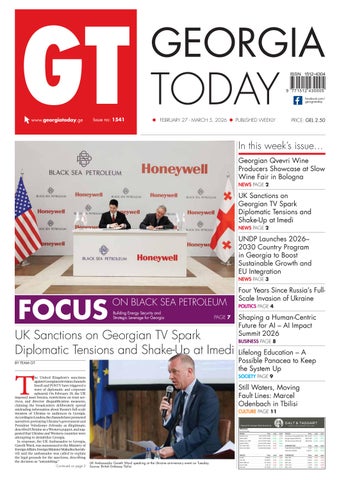
UK Sanctions on Georgian TV Spark Diplomatic Tensions and Shake-Up at Imedi
Continued from page 1
She stressed that sanctions affecting media outlets require a “very solid legal foundation” and criticized what she called the cynical targeting of Georgian television companies to weaken Russia.
Prime Minister Irakli Kobakhidze also weighed in, assuring that media freedom at both Imedi and POSTV would be fully protected. He said no journalist would face restrictions or disadvantages because of the sanctions, describing the measures as a formal violation of media freedom that would have no practical impact.
Drawing parallels to 2007, when Imedi was forcibly shut down under the previous government, Kobakhidze emphasized that the current administration remains committed to protecting fundamental rights and the independence of the press.
The sanctions coincided with a major reshuffle at Imedi. On February 25, businessman Irakli Rukhadze and several supervisory board members submitted their resignations to Georgia’s Public Registry. Those stepping down included Rukhadze, chairman of the board, Giorgi Bakhtadze, Giorgi Kalandarishvili, deputy chairman, and Davit Shonia. Only Director General Maka Lomidze remains on the board. The resignations requested same-day processing, which the registry has not yet confirmed.
The board members cited a change in ownership as the reason for their departure. Rukhadze had announced on February 6 that he would exit ownership of the pro-government outlet, which he had
controlled for years. Reports indicate that Imedi carried around 17 million lari in state debt and was sold for 1,000 lari.
Under the new ownership structure, Prime Media Global will hold 50% of Imedi, while Lomidze and her four deputies hold the remaining 50%. Prime Media Global is fully owned by Ilia Mikelashvili. Rukhadze transferred his intermediary company, Georgian Media Production Group LLC, through which he held full ownership, to the new group. Mikelashvili has held several public and private sector positions and previously sought membership in the Georgian National Communications Commission. Reports suggest that the agreement includes clauses defining editorial policy and restricting criticism of Rukhadze and his affiliates.
Rukhadze said stepping away from Imedi was a difficult but necessary decision, noting that television ownership no longer aligned with his business interests. He expressed confidence in the new management and wished the channel success. Mikelashvili said Prime Media Global intends to maintain Imedi’s editorial direction.
Imedi rejected the UK sanctions as politically motivated and lacking legitimacy. The broadcaster emphasized its 22-year history as a defender of freedom of speech in Georgia and recalled the 2007 storming of its offices, describing that period as a violation of democratic standards and media freedom. The channel reaffirmed its commitment to responsible journalism and serving the public.
EU Fails to Agree on New Russia Sanctions Ahead of War Anniversary
BY TEAM GT
The European Union failed to reach agreement on a new package of sanctions against Russia, just days before the fourth anniversary of Moscow’s full-scale invasion of Ukraine on February 24.
The proposed 20th sanctions package, aimed at tightening economic and financial restrictions on the Kremlin, did not receive unanimous backing from all 27 EU member states — a requirement for adopting new restrictive measures under the bloc’s foreign policy rules.
Diplomats confirmed that Hungary and Slovakia vetoed the package, preventing its adoption at this stage. Both countries have previously expressed reservations about additional sanctions on Russia, particularly measures they argue could negatively affect national energy security and economic stability.
EU officials said discussions are ongoing, but consensus has not yet been
Georgian Qvevri Wine Producers Showcase at Slow Wine Fair in Bologna
BY MARIAM RAZMADZE
Nine Georgian qvevri wine producers presented their products at the international natural wine exhibition Slow Wine Fair, held in Bologna, with financial and organisational support from the National Wine Agency of Georgia. Slow Wine Fair, now held for the fifth time, brought together nearly 1,000 wine companies from around the world, the majority specialising in organic and biodynamic production. The exhibition traditionally attracts up to 20,000 visitors, including representatives of the HoReCa sector, distributors, and
importers — making it a main platform for expanding business partnerships and increasing exports.
Georgian wineries participated in the fair for the second time, presenting traditional qvevri wines to an audience highly engaged with natural and sustainable winemaking practices.
The following producers represented Georgia at the exhibition:
• Andria’s Wine
• Velino
• Chortauli Vineyards
• Gotsa’s Wine
• Badagoni Winery 1933
• Kondoli Winery
• Sherma’s Family Winery
• Niabi Winery
Their presence at the fair strengthened the international positioning of qvevri
wine, a traditional Georgian winemaking method recognised for its historical and cultural significance.
The exhibition was also attended by Natalia Kordzaia, Georgia’s Consul General in Milan, showing the importance of economic diplomacy in supporting Georgian wine exports and international visibility.
Promoting Georgian wine abroad remains one of the National Wine Agency’s core priorities. Through participation in major international exhibitions such as Slow Wine Fair, alongside ongoing advertising and marketing campaigns, the Agency seeks to increase global awareness, build sustainable trade relationships and ensure continued growth in Georgian wine exports.
German, French, UK Ambassadors Reject Claims They Urged Georgia to Open ‘Second front’ Against Russia
BY TEAM GT
The Ambassadors of Germany, France, and the United Kingdom to Georgia have firmly rejected claims that their governments encouraged Georgia to open a “second front” against Russia, calling the allegation false and disinformation.
achieved. Disagreements over specific provisions in the package — including expanded restrictions on technology exports, tougher anti-circumvention measures, and additional listings of individuals and entities linked to the war effort — have stalled progress.
The failure to approve new sanctions comes at a symbolic moment, as European leaders prepare to mark four years since Russia launched its full-scale assault on Ukraine in 2022. Since then, the EU has imposed multiple rounds of sanctions targeting Russia’s banking sector, energy exports, military-industrial complex, and senior officials.
Despite the deadlock, EU officials reiterated their commitment to maintaining pressure on Moscow and continuing support for Ukraine. Negotiations are expected to resume in the coming days in an effort to overcome divisions and reach a compromise.
Russia’s full-scale invasion of Ukraine has now entered its fifth year, with fighting ongoing across eastern and southern Ukraine and continued missile and drone strikes on Ukrainian cities.
The statement was issued jointly by French Ambassador Olivier Courteaud, German Ambassador Peter Fischer, and British Ambassador Gareth Ward on the fourth anniversary of Russia’s full-scale invasion of Ukraine. The declaration was published on the British Embassy’s official Facebook page.
“We fully recognize the profound impact that Russia’s invasion of Ukraine has on the population of Georgia. Georgians know the pain of Russian invasion and the occupation of 20% of their territory,” the ambassadors stated. “The claim that Germany, France, or the United Kingdom urged Georgia to open a second front in this conflict is false and constitutes disinformation.”
The diplomats reaffirmed their firm support for Georgia’s sovereignty and its right to determine its own security and foreign policy choices. They noted that cooperation with Georgia’s Defense Forces continues within the NATO framework, aimed at strengthening defensive capabilities against potential aggression and contributing to broader security in the South Caucasus and Europe.
The ambassadors also highlighted
Georgia’s support for Ukraine, including its participation in the Ukraine Defense Contact Group. They welcomed the Georgian government’s recent decision to provide Ukraine with generators worth 1.5 million GEL, particularly as Russia continues targeting Ukraine’s energy infrastructure during the winter months.
They went on to state that Georgia can play an important role in strengthening European security by maintaining restrictions on access to Russian military armaments, upholding international sanctions, and preventing attempts to circumvent them. The ambassadors also pointed to the need to prevent imports from Russia’s so-called “shadow fleet,” which they described as a threat to maritime security and a tool for evading sanctions.
They further emphasized the importance of restoring and deepening Georgia’s relations with its Euro-Atlantic
partners, as well as reducing dependence on Russian oil and energy resources.
“Russia is not a reliable energy partner,” the statement noted, adding that diversification would help Georgia strengthen its sovereignty and resilience against external pressure while contributing to Europe’s overall energy security.
The ambassadors concluded by underscoring that while the Ukrainian people continue to pay a heavy price in their fight against Russian aggression, Georgia’s own security remains under threat from the same aggressor. They stressed that achieving a just and sustainable peace in Ukraine, and upholding the principles of sovereignty in Europe, are essential for ensuring long-term stability and a peaceful future for Georgia.
The three diplomatic missions expressed readiness to continue close cooperation with Georgia on these critical issues.
Georgian stand at Slow Wine Fair in Bologna. Photo: 1tv.
Image: Firefighters work at the site of a Russian missile strike on a residential area in Kyiv on Sunday. Source: Alessio Mamo/The Guardian
Diplomats Mark 105th Anniversary of Soviet Occupation at Kojori Memorial
Ambassadors paying tribute to the junkers at the Kojori Memorial. Photo: Embassy of Sweden in Tbilisi.
BY MARIAM RAZMADZE
On the 105th anniversary of the Soviet occupation of Georgia, Sweden’s Ambassador to Georgia, Anna Lyberg, joined fellow diplomats at the Kojori Junkers Memorial outside Tbilisi to honor the young military cadets who gave their lives resisting the Red Army in February 1921. The ceremony remembered the Georgian junkers, cadets from the country’s military academy, who fought bravely despite being heavily outnumbered. Their resistance in the hills around Kojori
and Tabakhmela delayed the Red Army’s advance, but ultimately, Tbilisi fell on February 25, 1921, marking the end of Georgia’s brief independence and the start of seven decades of Soviet rule. For Georgians, the day is a solemn reminder of the fragility of freedom and the cost of defending it.
Joining Ambassador Lyberg were other European diplomats, including Marge Mardisalu, Ambassador of Estonia; Edite Medne, Ambassador of Latvia; Darius Vitkauskas, Ambassador of Lithuania; Veselin Valkanov, Ambassador of Bulgaria; Bergliot Hovland, Ambassador of Norway; Artur Hebal, Ambassador of Poland; Petr Kubernat, Ambassador of the Czech Republic; and representatives from the
embassies of Germany and Hungary.
Ambassador Lyberg reaffirmed Sweden’s unwavering support for Georgia’s independence, sovereignty, and territorial integrity, emphasizing the continued importance of international solidarity in defending democratic values. The gathering was both a tribute to those who fought a century ago and a reminder that the principles they defended remain vital today.
The junkers have come to symbolize the courage and determination of a young nation standing up against overwhelming odds. Each year, their memory serves as an inspiration, a call to honor Georgia’s history while continuing to safeguard its freedom.
BY TEAM GT
The United Nations Development program (UNDP) has launched its 2026–2030 Country Program in Georgia, aiming to support longterm development, strengthen governance, and advance the country’s European Union integration goals. The program aligns with national priorities and reflects commitments outlined in the Georgian Constitution and the Sustainable Development Goals (SDGs).
Over the next five years, UNDP will focus on enhancing institutional capacity at both central and local levels, reducing regional disparities, and promoting inclusive economic growth. Key initiatives include supporting small and mediumsized enterprises (SMEs), empowering women entrepreneurs, and advancing digitalization, artificial intelligence, and sustainable technologies. Rural communities will benefit from improved voca-
tional training, market access, and diversified livelihood opportunities.
Environmental protection and climate action are central to the program. UNDP plans to implement climate-smart development, strengthen disaster risk reduction, expand renewable energy use, and improve nationwide air quality and meteorological monitoring. Special attention will ensure that women and marginalized groups benefit from green and sustainable solutions.
The program also aims to strengthen governance and civic engagement. UNDP will support civil society organizations (CSOs), improve public service delivery through digital tools, and enhance evidence-based policymaking. The initiative seeks to empower communities, foster social cohesion, and promote human rights, particularly for vulnerable and conflict-affected populations.
By integrating environmental sustainability, social inclusion, and economic development, the UNDP program aims to foster a more resilient, equitable, and prosperous future for Georgia.
UNDP Launches 2026– 2030 Country Program in Georgia to Boost Sustainable Growth and EU Integration
UNDP program cover. Source: UNDP Georgia
Four Years Since Russia’s FullScale Invasion of Ukraine
BY TEAM GT
At the Tbilisi International Conference, “Four Years Since Russia’s Full-Scale Invasion of Ukraine,” a high-level panel brought together ambassadors and senior representatives from the British Embassy Tbilisi, the Embassy of France in Georgia, the Embassy of Latvia in Georgia, the Royal Norwegian Embassy in Tbilisi, and the German Embassy.
The discussion examined the current battlefield situation, recent diplomatic initiatives, and the broader implications of the war for Ukraine and Euro-Atlantic security.
Anatolii Maliuska, Interim Chargé d’Affaires of the Embassy of Ukraine to Georgia, opened the panel with a powerful address, presenting stark facts about the ongoing war. GEORGIA TODAY shares his remarks below.
“It is a great pleasure and honor for me to be here today and address you on the occasion of the international conference titled ‘Four Years Since Russia’s Full-Scale Invasion of Ukraine.’
“Since February 24, 2022, Russia has continued to terrorize civilians in Ukraine by attacking the critical infrastructure and residential areas of my country. Drones and rockets operated by Russian forces have repeatedly attacked Ukrainian civilians almost constantly. Russians use every single day to strike our energy infrastructure. Since October 2022, Russia has damaged at least 9 GW of Ukraine’s power generation capacity. As of today, our immediate needs in the energy sphere amount to $1 billion, including generation capacity, mobile substations, backup power systems, and other equipment.
Russia continues a massive wave of attacks on Ukraine's railways. Approximately 130,000 railway infrastructure facilities have been damaged or destroyed to date. Ukraine's transportation system has suffered losses of more than $36 billion, and the need for reconstruction already exceeds $77 billion.
“As of December 2025, the estimated damage caused by Russia’s war of aggression against Ukraine amounts to about $800 billion, with the figure growing daily.
“International partners actively assist Ukraine in restoring energy infrastructure, and we count on the continuation
of this support. Ukraine has significant investment potential and is open to international partners to implement projects for the development of the Ukrainian economy.
“We are also counting on the continuation of political support for Ukraine provided by the international community, including Georgia. [On February 23], speaking at the 61st session of the UN Human Rights Council in Geneva, Ms. Maka Botchorishvili, the Minister of Foreign Affairs of Georgia, reaffirmed Georgia’s unwavering support for Ukraine’s sovereignty and territorial integrity, underlined the need to uphold the international order based on the UN Charter, as well as to hold accountable those who violate international law. We hope that Georgia will support the draft UN General Assembly Resolution titled “Support for Lasting Peace in Ukraine.”
“Ukraine has never been, and will never be, an obstacle to peace. We consistently seek a diplomatic solution to restore a comprehensive, just, and lasting peace.
We are ready for an immediate, unconditional, and comprehensive ceasefire. But our red lines remain unchanged, including:
• respect for the territorial integrity
and sovereignty of Ukraine,
• the right to choose alliances, and
• no limitations on defense capabilities.
“Without any doubt, all security-related decisions concerning Ukraine must be made with Ukraine’s full participation.
“Russia’s ongoing aggression constitutes the most significant and direct threat not only to Ukraine, but also to NATO members and European security. Putin’s full-scale invasion of Ukraine has shattered Europe’s security architecture and violated territorial integrity in the most threatening way since the end of World War II. Now entering its fifth year, the war has reached new levels of brutality and violence, with Russia regaining the tactical initiative along parts of the front. Despite huge battlefield losses, sanctions, intensifying Ukrainian strikes on Russian infrastructure, and mounting international pressure to negotiate, the Kremlin has shown no sign of backing down from its maximalist aims. The country remains in full war-economy mode: 40% of Russia’s federal budget last year, almost 8% of its GDP, was devoted to security and defense, sustaining the expansion of defense industrial production. Meanwhile, US military aid to Ukraine has dropped sharply since January 2025, leaving European nations and selected partners to shoulder the bulk of the burden.
“According to Mr. Pete Hegseth, US Secretary of Defense, safeguarding European security must be an imperative for European members of NATO. As part of this, Europe must provide the overwhelming share of future lethal and nonlethal
aid to Ukraine.
“For decades, Europe thrived under an American security umbrella that allowed it to prioritize integration and prosperity over hard power. That era has ended. Moscow’s military and hybrid aggression has shattered illusions of lasting peace, while Washington’s gradual retreat has exposed Europe’s enduring military shortfalls. The second Trump administration has made it clear that defending the continent and supporting Ukraine are primarily Europe’s responsibility.
“Considering the above-mentioned it is clear now how important is it to discuss the issues which are covered by this conference. We have to answer the main questions of today’s global agenda:
- If a ceasefire or peace agreement is not reached and hostilities continue, can Ukraine sustain its defensive line against advancing Russian attacks?
- How is Russia’s ongoing military and hybrid aggression shaping Europe’s security landscape?
- Can European countries sustain Ukraine both militarily and economically during wartime if the US drastically reduces its support?
“I would like to wish a good and fruitful discussion to today’s speakers, other participants, as well as everybody involved.
“And finally, let me to convey my gratitude to organizers of this international conference, particularly to the British Embassy, Embassies of Germany, Norway, France and Latvia in Georgia, and personally to my colleague from the Ukrainian Embassy, Mr. Serhiy Dosenko.”
Ukraine Latest: Four Years In, Ukraine Marks the Anniversary Under Fire as Ceasefire Diplomacy Stalls
COMPILED BY ANA DUMBADZE
Ukraine entered the fifth year of Russia’s full-scale invasion this week the way it has lived through much of the war: honoring loss, keeping the state functioning, and repairing shattered infrastructure while missiles and drones continued to arrive. The fourth anniversary on February 24 became both a memorial and a diplomatic deadline: an attempt by Kyiv and its partners to show that Ukraine’s struggle is not only about lines on a map, but about a democratic society’s right to exist without being broken by terror strikes and coercion.
That message has been increasingly tied to the human cost of Russia’s air campaign, which has again concentrated on energy: turning winter into a weapon.
In the most significant barrage reported this week, Russia launched a large combined attack of drones plus cruise and
ballistic missiles aimed primarily at Ukraine’s power system, with damage reported across multiple regions, including Kyiv and Odesa. Ukrainian officials said at least one person was killed and five injured, alongside damage to residential buildings and rail infrastructure.
President Volodymyr Zelensky framed the pressure in stark civic terms, saying Russia’s week of attacks included more than 1,300 drones, 1,400 guided bombs, and nearly 100 missiles: numbers he used to argue that “normal life” is being deliberately targeted through blackouts and fear.
Kyiv has responded with a mix of air defense, long-range strikes, and an intensified push to keep its institutions and international alliances steady. Ukraine’s air defenses said they intercepted a large share of incoming weapons during the energy-focused onslaught, but the broader pattern remains: even when many threats are shot down, the strikes that get through keep forcing emergency shutdowns, repairs, and rolling disruptions. The point, Ukrainian officials argue, is not
just physical damage: it is psychological exhaustion, the slow grind of making everyday life harder and making the state look incapable.
Ukraine’s own strikes into Russia also carried a “systems” logic this week, aimed less at symbolism and more at degrading the machinery of war. A notable example was an attack deep inside Russia on the Votkinsk Machine Building Plant, an important defense-industrial facility associated with missile production, where Russian officials reported injuries and damage after explosions. Ukraine also reported strikes on energy and industrial sites elsewhere in Russia, part of a campaign intended to complicate Moscow’s logistics and pressure the economy supporting the war. Diplomatically, the anniversary week produced declarations of solidarity, but not a breakthrough. On the eve of the war’s fourth anniversary, the European Union failed to agree on its 20th package of sanctions against Russia because Hungary and Slovakia vetoed the measure, blocking the new sanctions and a €90 bil-
lion EU aid package for Kyiv. The dispute centers on energy transit: both countries have tied their approval to the resumption of Russian oil deliveries through the Druzhba pipeline, which has been halted following damage in January. EU Foreign Policy Chief Kaja Kallas described the impasse as a setback for unity on Ukraine support, while Kyiv condemned the move as political blackmail.
At the United Nations, the anniversary sharpened the argument that any peace formula cannot be built on partition by force. Reuters reported a UN General Assembly move, calling for a truce and peace, alongside visible diplomatic protests during Russian remarks: signaling how central the “rules-based order” frame remains for many states backing Ukraine.
EU leaders also issued an anniversary statement paying tribute to Ukraine’s resistance and reiterating support. Concrete support packages landed alongside the symbolism. The UK announced a new mix of emergency energy funding, humanitarian aid for frontline communities, training support,
and money aimed at justice and accountability for alleged war crimes; an emphasis that mirrors Kyiv’s insistence that a ceasefire cannot mean amnesia. Separately, the UK government said it was rolling out its largest sanctions package in this context and highlighted over £30 million to bolster Ukrainian resilience after winter strikes.
Still, the political realities around Ukraine’s support remain contested. European debates over sanctions and financing, amid concerns about unity, continued to flare, underscoring Kyiv’s worry that battlefield fatigue could eventually become diplomatic fatigue. For Ukrainians, though, the anniversary week was less about speeches than about staying warm, keeping transport moving, and getting through another night of sirens. The ceasefire conversation is alive, but as long as energy stations, homes, and cities remain targets, Kyiv’s core claim stands: the war’s central front is not only the trenches, but the survival of a democratic society under sustained attack.
Tbilisi International Conference, 'Four Years Since Russia’s Full-Scale Invasion of Ukraine'
Anatolii Maliuska, Interim Chargé d’Affaires of the Embassy of Ukraine to Georgia, opened the panel
Mark Brolin on Ukraine, Russia, and the Future of Europe: “Russia is Weaker Than Most Think”
INTERVIEW BY VAZHA TAVBERIDZE
In this exclusive interview with Radio Free Europe/Radio Liberty’s Georgian Service, British-Swedish geostrategist, advisor, and author Mark Brolin discusses the ongoing war in Ukraine, Russia’s strategic failures, and what the West could have done differently. Reflecting on four years of conflict, Brolin offers insights into the long-term consequences for Russia, Europe, and global geopolitics, including the role of technology and the AI revolution.
WHERE DO WE FIND OURSELVES AT THE MOMENT, FOUR YEARS ON AND ENTERING THE FIFTH YEAR IN THE UKRAINIAN WAR?
I would say we have upsides and downsides. The downsides are quite obvious: it has been a human tragedy on an epic scale in actually two countries, affecting lots of Ukrainians and also many Russians who have been led into this war. That's a major tragedy. But we have some upsides as well.
And it is that Russia has been proven to be much weaker than most people thought at the start. I think that is a big win in a way, seeing that Putin is certainly not a strategic genius. He has made mistakes from the start. He has made so many mistakes in this war. I think his original sin was even when he took over from Boris Yeltsin, that he did not choose the path of modernity. He chose the path of backwardness; of clinging to the past. So, in that sense, his failure started before the war, and he had to do something about it. I think that's why he started the war. It is a classic tactic to divert attention from domestic failures. It’s been a massive failure for Russia. It has set Russia back some 150 years.
Of course, his propaganda apparatus portrays things differently, but this has been such a failure. I mean, everyone is losing. In this war, Ukraine has lost in a way, and Russia has lost as well. But I think long-term Russia will have lost much more.
He had so many other options, so many modern routes, and he chose war and destruction. And now Russia is in such major trouble, it will backfire economically in so many ways. And while he is the big culprit, of course, he started the war, he is far from being the only one who made mistakes. If we take Europe, for example, it is the blend of disarmament and making yourself dependent on your arch-enemy for energy consumption. I mean, that is an epic failure, there are no two ways about it. Without that, possibly, there would not have been this war. Ukraine, Poland, and other countries were warning against this and were just ignored. So, that is a big failure on the European part.
And then we have, of course, Washington with the White House president, who is the most Moscow-friendly ever, for reasons nobody really understands. So, in a sense, despite Putin's major blunder, he has been really, really lucky in the White House. And the European response was so meek, at least from the start. It has improved, but it was too meek.
WHAT WOULD HAVE BEEN THE OTHER COURSE OF ACTION ON THE WEST’S PART? WHAT COULD IT HAVE DONE DIFFERENTLY?
In the best-case scenario, which is not going to play out, I think if there was a
It is a tragedy for the Russian people that Putin has set them back almost 150 years
Mark Brolin
will in Europe to do so, Russia could actually fairly easily be pushed back all the way, and even lose Crimea. I think it would be perfectly possible. If you look at the size of the economies, Russia is only number five. Germany, UK, France, Italy, all have larger economies. And at the end of the day, money matters, and military operations cost money. So that is a massive constraint for Russia. If you take the Nordic countries and Poland together, that joint economy is larger than Russia's. So, there is lots of capacity to push Russia back. But in the real world, that's not how things work, because there is not sufficient will.
But I think the will in Europe is actually building. In a sense, Russia has made the same mistake as Japan did when bombing Pearl Harbor. They saw only decadence and lots of talk in the US, and that is what Russia is seeing in Europe as well. But it has been a bit like waking a sleeping giant. Now we have Finland and Sweden joining NATO, and also the rearmament in Europe across the board. Europe cannot afford to make him a big winner, and they should have pushed back from the start. It would have cost much less, both in terms of money, weapons, and lives. But that's too late now.
HOW WELL HAS THE WEST USED THESE FOUR YEARS, ESSENTIALLY BOUGHT BY UKRAINIAN BLOOD?
Poorly. I wouldn't say appallingly, because without the resources from the West, Ukraine wouldn't have survived. But it has still been half-hearted. It should have been much more from the start, because then Russia could have been pushed back.
And I think this goes back to how we have misjudged Putin for actually decades. We have thought that the West has seen him and perceived him as some sort of strategic genius, much stronger than he actually is. So he should have been pushed back much, much, much further long ago. It would have been so much cheaper for Europe and the West in general. It has never been as easy to push Russia back, because with the help of Ukraine and with the help of united Western forces, this could have been over long ago.
And it would have been so much cheaper. Now we have this threat of Russia. I think it's overblown, because Russia doesn't have the capacity to threaten the rest of Europe. It can only threaten the border states, which it has always done anyway. And actually, now there are fewer bordering states that it can feasibly threaten than in the past. So it is weaker than it
has been in several hundred years. ON THAT PARTICULAR SCENARIO WHERE RUSSIA ACTUALLY ATTACKS ONE OF THE BORDER STATES OR TRIES TO CAUSE SOME MISCHIEF, HOW DO YOU SEE THAT PLAYING OUT? WHERE AND WHEN WOULD THAT HAPPEN, AND WHAT WOULD BE THE LIKELY OUTCOME, DO YOU THINK?
Yes, that is the big risk. The reason he's hesitating to conclude peace is that he wouldn’t know what to do with his army if peace were concluded in Ukraine. He would have to return to the domestic situation. There are so many problems. So in a way, it's in his interest to keep up the war machine, even though he can't actually afford it. As to where it would happen, it would not happen in any NATO country. He would never be brave enough to do that. He would be gone in four hours, probably. And he can't do it within the Chinese sphere of influence either.
So that leaves only a few countries. And that's like Moldova and Georgia, and the like. I don't think it is likely he would do it, but there still is a chance. His advisors are all sycophants, so they tell him what he wants to hear, even if it is extremely ill-advised. So it wouldn’t be a rational thing to do, but then again, it wasn't rational of him to invade Ukraine either.
WHEN YOU SAY THAT IF HE WERE TO ATTACK A NATO MEMBER COUNTRY, IT WOULD BE OVER FOR HIM IN FOUR HOURS, WHAT ABOUT SOMETHING MINOR BUT AIMED AT UNDERMINING NATO CREDIBILITY? HOW UNITED DO YOU THINK THE WESTERN RESPONSE WOULD BE?
Yeah, that's a great question. I agree with some of the hesitation in your sentiment here, because I think it might not be totally united. Still, I think it would be much more united than when Ukraine was attacked, because nobody trusts Putin anymore. But if we had Trump still in the White House, there might be some hesitation to push back. One major change on the playing field is that Trump is not as influential in Washington anymore. It has shifted back to a more normal balance of power, with Congress much more influential. And in Congress, there is bipartisan support for Ukraine. Another point is that domestically, I'm not so sure the Russian military would embrace the opportunity, or the “chance,” to take on NATO forces, as they know
the losses would be even more devastating. So he would be gone quite quickly, but not because of total unity in the West, rather because of the combination of a more resolute West and a more split Russia.
FOR ANY OF THAT TO HAPPEN, UKRAINE SHOULD BE DEALT WITH SOMEHOW. CAN YOU SEE PUTIN ACTUALLY COMPROMISING ON ANY OF HIS MAXIMALIST DEMANDS?
I think people are seeing that Russia is in a moment of weakness. People see that it has become a junior partner to China, that Putin draws on resources from there. Otherwise, he wouldn't be able to sustain it. He was even dependent on Iranians making drones for him. Washington is turning a little bit less Moscow-friendly. Europe is catching up. But then again, we have this sycophant thing again. So Putin might not see this, but if he were wise, he would conclude peace right now. I think the forces are gathering slowly, slowly, pushing him more and more back. So I would be surprised if there was a fifth anniversary, but I think chances are better that there is not a fifth anniversary.
CAN PUTIN SURVIVE PEACE, AN AGREEMENT THAT IS COMPROMISE-BASED? HOW DOES HE SOLVE HIS DOMESTIC PROBLEMS? WHAT DOES IT TAKE FOR THE HOUSE OF VLADIMIR TO FALL?
As soon as there is peace, and he's forced into peace, people will ask many of the hard questions. And of course, he has an army protecting himself personally. That is what is holding back someone from toppling him. But in the coming years, I think the focus might turn to keeping Russia together. We've seen all the time that when Russia is strained, the peripheral regions press for more autonomy. And the legitimacy of Putin is already eroding, even despite all the propaganda. When you have had an autocrat ruling for a long time, the country is sort of divided into factions. And I think the Russian regime, even if it manages to cling on a couple of more years, much like in Iran, the magic is gone. People have seen that he is not infallible. That usually means it is only a question of time before the regime falls.
IS HE ALSO AT HIS MOST DANGEROUS AND DESPERATE DUE TO THIS WEAKNESS? AND IF IT WERE TO FALL, WHAT WOULD BE THE RISKS
AND DANGERS, GIVEN WE'RE TALKING ABOUT A NUCLEAR POWER HERE?
Of course, it's an uncomfortable situation that Russia has nuclear weapons. Still, I think anyone trying to press the buttons would face resistance domestically. I'm not sure if Putin today told his military to press this button, these people would know that the bomb would be coming from the West within possibly a minute. So I don't think they would do it. I don't think Russia would. I don't think Putin would do it, however desperate. I don't think he's that kind of person who would be fanatical in that sense. I think he wants to live, very much so, and if you push the button, he will be gone—dead. Team Putin started this war to stay in power. That's the ultimate objective, not to give up and die.
THE FALL OF THE SOVIET UNION WAS LESS TROUBLESOME THAN MANY EXPECTED, BUT IT WAS STILL ACCOMPANIED BY A NUMBER OF REGIONAL WARS. WOULD YOU EXPECT A SIMILAR SCENARIO IF RUSSIA WERE TO COME CRASHING DOWN? Yes, I think that would be more than likely. We would see a new equilibrium. There would be a power vacuum in Central Asia, in the South Caucasus, and especially in the region close to Ukraine. Then we have Dagestan and Chechnya, areas where people would try to become more independent again, and probably succeed. We’d end up with a much diminished Moscow, fighting inwardly to retain these territories, as opposed to bringing war on its neighbors. And I think one other fact that is never discussed, but which I think should be discussed more, is how the AI revolution is changing the geopolitical situation. That is rarely mentioned in this context, but I think it should be, because now when Russia has wasted so many resources, they are so far behind in AI, and so much is changing. Of course, the military has adopted AI, which is quite advanced, both in Ukraine and in Russia. But that’s about it. That has always been the case with Russia: the technology has been advanced within the military, but the rest of society lags so far behind. And that also leaves them going to be even more diminished going forward. It is a tragedy, in a sense, for the Russian people that he has taken them back almost 150 years. I mean, it is the largest country by land area on the planet, they have the ninth-largest population, and they are one of Europe’s poorest countries. And they will be even more diminished because of the AI revolution. It is changing everything, and they will be lagging behind.
Europe cannot afford to make Putin a big winner, and they should have pushed back from the start
Promises of Quality, Instruments of Control: How Centralized Reform Reshapes Georgian Higher Education
ANALYSIS BY SHALVA TABATADZE
In October 2025, the Government of Georgia unveiled its “National Concept for Reforming the Higher Education System,” outlining seven steps to restructure the country’s public university sector. The document portrays Georgian higher education as misaligned with labor market needs, weak in international competitiveness, and burdened by duplicated programs across public institutions. On this basis, the reform introduces stronger state steering: redistributing funded places, financing only public universities, narrowing disciplinary offerings in selected institutions, and consolidating institutional profiles by city.
ACADEMIC FREEDOM AND AUTONOMY: INTERNATIONAL NORMS VS. GEORGIA’S REFORM INSTRUMENTS
In higher education, autonomy is not treated as an ideological luxury; it is an operational condition for quality teaching, credible research, and innovation.
The 1997 UNESCO Recommendation defines academic freedom as the freedom to teach, research, publish, and participate in academic bodies without constraint by prescribed doctrine or institutional censorship. The Bologna Process anchors the European Higher Education Area in institutional autonomy and academic freedom. The European University Association (EUA) measures autonomy across four dimensions: academic, organizational, financial, and staffing. To understand how these international standards compare with the current reform package, below we summarize each EUA dimension alongside the corresponding state steering instruments introduced in Georgia. Taken together, the comparison shows a shift from autonomy preserving governance toward direct structural intervention.
1) Academic Autonomy - this refers to a university’s power to set student numbers, define admission criteria, introduce and terminate study programs, choose the language of instruction, and determine program content and quality mechanisms. Program closures and quotasetting by field; 'one city–one faculty/ department' logic reduces institutional choice and differentiation.
2) Organizational Autonomy – this covers the institution’s ability to decide on internal governance structures, select executive heads, determine the role and selection of external members in governing bodies, and create legal entities, enabling universities to pursue their missions under an enabling regulatory framework. Consolidation logic and externally imposed profiling reshape institutional structures and missions by administrative decision.
3) Staffing Autonomy concerns a university’s capacity to recruit, promote, and dismiss staff; define salaries and employment conditions; and design internal human resources policies free from direct political control. Central steering increases vulnerability to political priorities via funding/quotas; structural uncertainty can trigger staff exits and self-censorship effects. The government has unlimited power in the reorganization process; The new position of leading professor is introduced without the justification of need or proving efficiency of such position internationally or locally.
4) Financial autonomy refers to an institution’s authority to allocate internal budgets, set tuition fees, own and manage buildings and assets, borrow funds, and retain financial surpluses, without disproportionate restrictions or earmarking. Targeted funding and quotas channel resources to selected institutions/ fields, increasing dependency and reducing internal strategic freedom. Restriction to attract international students; Restriction getting funding from families
via tuition fees.
Analytically, the key issue is not whether the state may set priorities. It clearly may. The issue is proportionality and mechanisms. In European systems, governments typically pursue objectives through competitive funding, quality assurance, and performance agreements, while preserving universities’ capacity to maintain plural missions, compete, and self differentiate. The Georgian reform instruments rely more on structural restriction than on quality building incentives. By affecting all four autonomy dimensions simultaneously, mechanisms such as quota allocation and program consolidation weaken the balance between state oversight and institutional independence, creating a clear tension between European governance norms and domestic implementation practices.
QUALITY AND EDUCATIONAL PATHWAYS: COMPRESSED PATHWAYS, REDUCED CHOICE: HOW REFORM RESHAPES QUALITY
One of the most far reaching ideas linked to the reform is compressing the entire education pathway, fewer years of general schooling and shorter bachelor’s and master’s degrees. Even without debating the exact model, the direction matters. International evidence consistently shows that more years of education correlate with better employment outcomes and major non economic benefits, including improved health, stronger civic participation, and lower antisocial behavior. Research exploiting compulsory schooling reforms finds that additional education reduces criminal involvement, while broader OECD reviews link higher educational attainment with social outcomes that support democratic resilience. From a quality standpoint, compression also moves against the dominant European model, where bachelor’s programs last three years and master’s programs mostly two. Shortening the pipeline forces earlier career and discipline choices, often before students have enough exposure to different fields.
Research on early tracking and premature specialization shows that accelerating decisions in this way can widen inequality and lock in disadvantages, contradicting the reform’s stated aim of improving quality and opportunity.
PROGRAM REDUCTIONS & ACCESS: FEWER OPTIONS, NARROWER FUTURES
Program-level changes across highdemand disciplines raise a deeper set of concerns that go beyond quality rhetoric. The current reductions do not simply narrow program portfolios, but they narrow access itself. By concentrating entire disciplines in a single city, the reform effectively limits who can study these fields based on geography, making access contingent on the ability to relocate rather than on academic interest or merit. For students in regional areas, subjects such as political science, business administration, sociology, journalism, computer science, law or international relations may become practically unreachable, even if formally “available” somewhere in the system.
Program level changes in high demand fields add a structural dimension to the quality debate. The reform does not just shorten the pathway: it narrows it. State funded places fall sharply in Law, Business Administration, Psychology, International Relations, Sociology, and Economics, while only Computer Science/ IT expands.
This consolidation also restricts choice across public higher education institutions. Previously, students could select programs based on curriculum focus, institutional culture, research strengths, or pedagogical approaches. Under the ‘one city–one department/faculty’ design, this diversity disappears. Students are left with a single provider per discipline, eliminating the ability to choose between multiple public universities offering distinct profiles within the same field.
The reform additionally abolishes competition among institutions, a key driver of program quality. Strong evidence shows that innovation flourishes in environments where multiple actors operate under quality assured competition: too little competition lowers performance, while moderate competition incentivizes improvement. When only one institution is allowed to offer a discipline, benchmarking, academic mobility, and cross institutional learning collapse, weakening incentives to innovate or invest in program development. Concentrating on a field in one institution does not guarantee its sustainability. In fact, it may produce the opposite effect. Disciplines with small cohorts or uneven labor market trajectories, such as sociology, become highly vulnerable when only one university is allowed to run them. Without the balancing effect of multiple providers, a single downturn in enrollment, staff departures, or even administrative shifts can render the field academically fragile or non viable, putting entire knowledge domains at risk of erosion.
Taken together, these measures reshape disciplinary ecosystems in ways that limit access, restrict choice, eliminate competitive quality pressures, and endanger long term sustainability- consequences that contradict both the stated reform goals and international evidence on how robust academic fields are maintained.
INSTITUTIONAL PROFILES & CAPACITY: RESHAPING UNIVERSITIES: EXPANSION, CONTRACTION, AND STRATEGIC LOSS
The reform aims to redistribute institutional capacity across the public university system. If the reform intends to improve quality, redistribution patterns should reinforce research strength rather than weaken high-performing institutions. Quota data for HEI programs show that the reform is not only about disciplines; it is a redesign of the public university landscape. Some institutions grow, while others face drastic contraction. The scale matters, because it determines whether a university remains multi-profile, research-capable, and regionally relevant.
The reform restructures hierarchy within the public system. The magnitude of reductions at Iliauni, Sokhumi State University and several regional universities indicates systemic restructuring rather than incremental adjustment. Ilia State University is the best research university in Georgia; Sokhumi State University holds a specific symbolic and political meaning in Georgia’s higher education landscape as a displaced institution associated with Abkhazia. Treating it as a generic regional institution through major reductions and a narrowed program mission risks eroding this institutional identity and the social function it plays beyond labor-market preparation.
The government frequently invokes low international rankings to justify sweeping restructuring, presenting
RECONCENTRATION INSTEAD OF RENEWAL: THE REGIONAL IMPACT
upward movement in global league tables as a central policy objective. If this is the standard, then Ilia State University (Iliauni) becomes the clearest test of reform credibility. By every internationally recognized indicator, Iliauni is the most influential and best performing public institution in Georgia. Times Higher Education (THE) assigns Iliauni its highest weight, 30%, to Research Quality, measured through citation impact. In this metric, Iliauni significantly outperforms all other Georgian universities across overall scores and the subject fields in which it appears, including Physical Sciences, Life Sciences, and Social Sciences. Yet, paradoxically, Iliauni is the institution most negatively affected by the reform: its student intake is reduced by 92% through quota allocation. A reform justified by rankings begins by weakening the only institution that already meets the criteria those rankings reward.
The contradiction extends to International Outlook, another major THE component. Internationalization— incoming foreign students, cross border partnerships, and global academic presence—is indispensable for competitiveness. Iliauni scores highest in this dimension as well, consistently outperforming TSU and GTU. However, reform proposals simultaneously introduce a restriction that prohibits public universities from admitting international students, directly undermining the very indicator the government claims to prioritize. Once again, the strongest performer in the field most relevant to rankings becomes the center of policy pressure rather than policy support.
The Times Higher Education component comparison underscores the strategic differentiation among Georgia’s universities: Iliauni leads in Research Quality and International Outlook; TSU shows moderate balance; GTU demonstrates strength in Teaching. Effective policy would recognize and cultivate these complementary profiles. Instead, the reform’s consolidation logic—merging programs and concentrating fields within single public institutions—rests on an assumption that ranking performance is additive. It is not. Citations, the backbone of the Research Quality metric, are average impact indicators: merging high impact clusters with lower impact ones does not raise the average; it risks diluting it. Iliauni’s citation strength cannot be transferred to TSU by administrative decision, nor can GTU’s strong teaching indicators survive being blended into a combined institutional score.
Against this backdrop, cutting Iliauni’s scope and intake while claiming to build global competitiveness becomes the reform’s most visible contradiction. Weakening the only Georgian university positioned to climb global rankings, and restricting the international pathways that underpin those rankings, creates the appearance of a quality reform without substance. The instruments undermine the very goals they are meant to achieve.
The objective to achieve regional deconcentration was presented as an important driver for this higher education reform. The proposed regional enrollment redistribution gives the possibility to evaluate whether reform supports balanced territorial development. There will be significant reductions in enrollment quotas across regional institutions. The magnitude of reduction supports the analytical claim that reconcentration, rather than regional strengthening, is occurring. Regional universities (Zugdidi, Telavi, Akhaltsikhe, Gori) are not only teaching sites: they are anchors for local human capital, public-sector staffing pipelines, and regional innovation ecosystems. OECD work on higher education and regional development highlights that universities can have disproportionate positive effects in less-favored regions, especially where the private sector is weak and R&D capacity is limited. Restricting regional program portfolios into a small set of fields creates two predictable consequences. First, it reduces geographic access to popular fields that students choose, shifting opportunity to large cities. Evidence shows that distance and 'education deserts' affect enrolment choices and amplify socio-economic gaps. Second, it accelerates demographic brain drain: young people leave and do not return, weakening local labor markets and civic life. The policy narrative often uses 'regional development' language while implementing deconcentration. These are opposing logics. Deconcentration requires strengthening regional institutions through quality assurance, partnerships, staff development, and research niches, not stripping them to minimum profiles.
LABOR-MARKET JUSTIFICATION AND THE PUBLIC–PRIVATE ASYMMETRY
The labor-market justification is structurally coherent across the whole higher education system. If oversupply is the concern, policy must address total graduate output rather than only public universities. The reform appeals to labormarket research but primarily constrains public universities, while private universities are not structurally integrated into the quota logic. This creates a basic policy problem: graduates from public and private universities enter the same labor market. If the goal is to reduce oversupply, policy must address total system output.
In law (including international law), intake data show public-sector admissions reduce sharply based on new higher education reform initiatives, but private institutions retain capacity, including previously unused places. The likely result is overall admission remains close to the previous year, while the public share shrinks. This is a redistribution of who delivers degrees and who pays for them, not system-level labor-market alignment.
CONCLUSION
When the reform is read as system design, it prioritizes centralized steering, reconcentration, and institutional hierarchy. Yet the empirical patterns (regional stripping, public–private asymmetry, and the targeting of the strongest research performer) create a strong analytical contradiction: the instruments do not align with the declared goals of quality, competitiveness, deconcentration, matching labor market and optimization of scarce resources. A credible quality reform would look different: strengthen quality assurance, fund research clusters competitively, support regional universities’ capacity and differentiation, align labor-market logic across both public and private sectors, and protect academic freedom as a democratic core value. The contradiction between the declared goals and the instruments presented to achieve these goals clearly indicates the hidden political agenda of the higher education reform.
Ilia State University. Source: yashoverseasedu
Black Sea Petroleum: Building Energy Security and Strategic Leverage for Georgia
SPONSORED CONTENT
In a move set to reshape the energy landscape of the region, Black Sea Petroleum (BSP) has entered into a definitive engineering and licensing agreement with U.S. technology giant Honeywell. The partnership marks a critical milestone for the Kulevi Oil Refinery, the largest private investment project in Georgia’s history. Under the terms of the agreement, Honeywell will provide the core technological licenses, basic engineering, and specialized equipment guides required for the facility’s high-tech processing units. The deal also includes the supply of proprietary catalysts and advanced control systems, ensuring the refinery meets stringent standards for gasoline and diesel quality.
MACROECONOMIC ALIGNMENT AND STRATEGIC LOCATION
The Kulevi Oil Refinery will transition Georgia from a primarily transit-oriented energy state into a producer of highvalue refined commodities. Historically, Georgia has functioned as a vital link in the Southern Gas Corridor and the transport of Caspian crude, but it has remained almost entirely dependent on imported refined fuels. The project is intended to satisfy growing regional demand for refined engine fuels and simultaneously provide domestic price stability in volatile global trends.
The refinery's geographic positioning on the Black Sea coast provides a definitive logistical advantage. Located near the Kulevi Oil Terminal owned by SOCAR, the refinery is situated at the nexus of major energy routes. This proximity allows for the receipt of raw materials and the export of finished products to diverse markets, including the European Union, the Mediterranean, and Central Asia.
DEVELOPMENT ARCHITECTURE
The company has adopted a sophisticated, four-stage implementation strategy designed to manage capital deployment while progressively increasing the depth of refining. This phased approach allows BSP to adapt to regional market dynamics and regulatory shifts while building a robust industrial infrastructure from the ground up.
The first stage, which represented an initial investment of $150 million, focused on the launch of an atmospheric distil-
lation unit with a nominal capacity of 1.2 million tons per annum. This milestone, achieved in late 2025, established the refinery's baseline ability to produce naphtha, high-sulfur diesel, and fuel oil (Mazut). Building upon this foundation, BSP is currently in the final stages of a second expansion phase scheduled for completion early 2027. This stage introduces vacuum distillation and bitumen production units, enabling the facility to manufacture vacuum gas oil (VGO) and industrial-grade bitumen.
The third and fourth stages represent the most technically complex phases of the BSP roadmap. By April 2027, the company plans to launch a second atmospheric-vacuum unit with a nominal capacity of 3.3 million tons per year, which will bring the refinery's total nominal annual capacity to 4.5 million
tons and further expansion of bitumen production capabilities. The final integration stage, projected for July 2028, involves the activation of production units for Euro-5 diesel, Petroleum 92-95, and high-quality aviation fuel Jet A-1. To further optimize productivity, BSP’s long-term master plan includes the future start-up of Hydrocracking and Thermal Cracking units, which will enable fullcycle refining and maximize the yield of high-value distillates from every barrel of crude feedstock.
OPERATIONAL STATUS AND INFRASTRUCTURE
A significant portion of the general infrastructure has been pre-engineered and sized to accommodate future expansion. This foundational readiness ensures that upcoming technological blocks can be
integrated and commissioned with high operational efficiency and significantly compressed timelines. The site is supported by a central rack structure, a central boiler house for steam generation, dedicated water cooling and a water supply system, including advanced water treatment units to maintain strict environmental and ecological safeguards. Power supply is managed through highcapacity transformer substations. Operational management is housed in a stateof-the-art control building and an administrative operations building, supported by an on-site laboratory for realtime quality assurance. A critical logistical link, a pipeline connecting the refinery directly to the SOCAR terminal, was completed in 2025 to enable the efficient transfer of feedstock.
CIRCULAR ECONOMY: BYPRODUCT RECOVERY AND FERTILIZER POTENTIAL
A significant component of the refinery’s long-term economic viability is the planned recovery and utilization of industrial byproducts. This strategic focus aligns with the creation of a "petrochemical cluster" as envisioned by national development funds and corporate leadership. Specifically, the refining and desulfurization processes generate sulfuric acid and ammonia as secondary products. These by-products represent the foundational inputs for the manufacturing of nitrogen-based fertilizers. By integrating byproduct recovery with agricultural supply chains, the project aims to support the domestic agricultural sector through the provision of locally produced nutrients, thereby reducing the need for imported fertilizers. This circular approach is designed to enhance the overall profitability of the refinery while providing broader industrial benefits to the Georgian economy.
INSTITUTIONAL CHALLENGES: WORKFORCE TRAINING AND INDUSTRIAL LOCALIZATION
Despite the technological advancements provided by international partnerships, the refinery faces a critical shortage of qualified personnel within the regional labor market. To mitigate this, Black Sea
Petroleum has initiated comprehensive local content and human capital development programs. These initiatives focus on the vocational education and technical training of the local workforce to ensure that the new industrial ecosystem is operated by highly skilled Georgian professionals.
The development plan includes specialized training for seafarers and onshore technicians, conducted in coordination with recognized maritime and industrial training institutions. These programs emphasize the management of high-tech automated systems, industrial safety standards (ISO 45001), and quality control protocols. This commitment to workforce localization is intended to fulfill the project's corporate social responsibility while ensuring that the long-term operational needs of the facility are met.
GEOPOLITICAL NAVIGATIONS AND CRUDE FEEDSTOCK DIVERSIFICATION
The operational success of the Kulevi refinery is increasingly contingent upon its ability to navigate a complex geopolitical environment. Currently, crude oil is procured directly from shore tanks at the SOCAR Terminal through multiple trading partners. So far BSP has received Azerbaijani and Russian crude Oil, however, the company has successfully navigated a period of intense economic, logistical, and geopolitical challenges to secure a diversified supply chain including Turkmen and Kazakh Crude Oil. This effort is now yielding tangible results, marking a definitive transition toward non-Russian feedstock. The strategic roadmap for the coming months is as follows:
• March–April: Integration of Turkmen crude oil into the supply mix.
• Nearest future: Commencement of Kazakh crude oil shipments.
The refinery gains the flexibility to target high-premium markets. While previous outputs were restricted to the Turkish, African and Asian regions following EU sanctions, after shifting to non-Russian crude the refinery will open the gates of the European market fully. Enhancing both its geopolitical safety as well as commercial benefits.
The Kulevi Oil Refinery. Source: Black Sea Petroleum
Shaping a Human-Centric Future for AI – AI Impact Summit 2026
ARTICLE BY MR NARENDRA MODI, PRIME MINISTER OF INDIA
At a defining moment in human history, the world gathered at the AI Impact Summit 2026 in New Delhi. For us in India, it was a moment of immense pride and joy to welcome Heads of State, Heads of Government, delegates, and innovators from across the world. India brings scale and energy to everything it does, and this Summit was no exception. Representatives from over 100 nations came together. Innovators showcased cutting-edge AI products and services. Thousands of young people
OP-ED
could be seen in the exhibition halls, asking questions and imagining possibilities. Their curiosity made this the largest and most democratized AI summit in the world. I see this as an important moment in India’s development journey, because a mass movement for AI innovation and adoption has truly taken off.
Human history has witnessed many technological shifts that changed the course of civilization. Artificial Intelligence belongs in the same league as fire, writing, electricity and the internet. But with AI, changes that once took decades can unfold within weeks and impact the entire planet.
AI is making machines intelligent, but it is even more a force multiplier for human intent. Making AI human-centric
instead of machine-centric is vital. At this Summit, we placed human wellbeing at the heart of the global AI conversation, with the principle of ‘Sarvajana Hitaya, Sarvajana Sukhaya’ (Welfare for All, Happiness of All).
I have always believed that technology must serve people, not the other way around. Whether it is digital payments through UPI or COVID vaccination, we have ensured that Digital Public Infrastructure reaches everyone, leaving none behind. I could see the same spirit in the Summit, in the work of our innovators in domains like agriculture, security, assistance for Divyangjan and tools for multilingual populations.
There are already examples of the empowering potential of AI in India.
Recently, ‘Sarlaben’, an AI powered dig-
ital assistant launched by Indian dairy cooperative AMUL, is providing realtime guidance to 3.6 million dairy farmers, mostly women, about cattle health and productivity, in their own language. Similarly, an AI-based platform called Bharat VISTAAR gives multilingual inputs to farmers, empowering them with information about everything from weather to market prices.
Humans must never become mere data points or raw material for machines.
Instead, AI must become a tool for global good, opening new doors of progress for the Global South. To translate this vision into action, India presented the MANAV framework for human-centric AI governance.
M
– Moral and Ethical Systems: AI should be based on ethical guidelines.
A
– Accountable Governance: Transparent rules and robust oversight.
N
– National Sovereignty: Respect for national rights over data.
A – Accessible and Inclusive: AI should not be a monopoly.
V
– Valid and Legitimate: AI must adhere to laws and be verifiable.
MANAV, which means ‘human’, offers principles that anchor AI in human values in the 21stcentury.
Trust is the foundation upon which AI’s future rests. As generative systems flood the world with content, democratic societies face risks from deepfakes and disinformation. Just as food carries nutrition labels, digital content must carry authenticity labels. I urge the global community to come together to create shared standards for watermarking and source verification. India has already taken a step in this direction by legally requiring clear labelling of synthetically generated content.
The welfare of our children is a matter close to our hearts. AI systems must be built with safeguards that encourage responsible, family-guided engagement, reflecting the same care we bring to education systems worldwide.
Technology yields its greatest benefit when shared, rather than guarded as a
strategic asset. Open platforms can help millions of youth contribute to making technology safer and more human-centric. This collective intelligence is humanity’s greatest strength. AI must evolve as a global common good.
We are entering an era where humans and intelligent systems will co-create, co-work and co-evolve. Entirely new professions will emerge. When the internet began, no one could imagine the possibilities. It ended up creating a huge number of new opportunities and so will AI.
I am confident that our empowered youth will be the true drivers of the AI age. We are encouraging skilling, reskilling and lifelong learning by running some of the largest and most diverse skilling programs in the world. India is home to one of the world’s largest youth populations and technology talent. With our energy capacity and policy clarity, we are uniquely positioned to harness AI’s full potential. At this Summit, I was proud to see Indian companies launch indigenous AI models and applications, reflecting the technological depth of our young innovation community.
To fuel the growth of our AI ecosystem, we are building a robust infrastructure foundation. Under the India AI Mission, we have deployed thousands of GPUs and are set to deploy more soon. By accessing world-class computing power at highly affordable rates, even the smallest startups can become global players. Further, we have established a national AI Repository, democratizing access to datasets and AI models. From semiconductors and data infrastructure to vibrant startups and applied research, we are focusing on the complete value chain. India’s diversity, democracy and demographic dynamism provide the right atmosphere for inclusive innovation. Solutions that succeed in India can serve humanity everywhere. That is why our invitation to the world is: Design and develop in India. Deliver to the world. Deliver to humanity.
- Beyond 3+1: Why a Two-Speed University Model Is Georgia’s Real Breakthrough
GGraduate students. Source: tbccapital OP-ED BY DR. JOCHEN
eorgia’s higher education system is undergoing its most significant structural shift in decades. The introduction of the 3-year Bachelor’s plus 1-year Master’s model, combined with the “One City – One Faculty” reform, has triggered a polarized debate. One camp frames the reform as overdue modernization aligned with labor market realities; the other sees it as a retreat from European academic standards. Both sides, however, are arguing past the real opportunity. The 3+1 structure is neither a threat nor a downgrade. It can become the foundation of a genuinely differentiated, internationally competitive system if Georgia abandons the assumption that one model must fit all students.
EFFICIENCY WHERE IT MATTERS
The uncomfortable truth is that the previous 12+4 structure often functioned less as academic formation and more as delay. For a large share of students, four undergraduate years meant additional cost without proportional intel-
lectual gain.
In many successful systems—the United Kingdom, Australia, parts of continental Europe—a three-year Bachelor’s degree is entirely standard. What matters is not duration, but density and clarity of design.
A focused, well-structured three-year program can deliver stronger outcomes than a diffuse four-year curriculum padded with marginal additions. For the broad population, 3+1 increases mobility, reduces financial strain, and
accelerates labor market integration. In a country facing demographic and economic constraints, that is not a compromise: it is rational policy.
WHERE SPEED MUST STOP
The real mistake would be to universalize acceleration. No serious country builds its research capacity on compressed mass education alone. The top five to ten percent of students who are destined for international PhDs, scien-
tific leadership, and academic careers, require a different architecture.
Georgia should formally institutionalize an Honors Track: a high-intensity pathway consisting of a 3.5–4 year research-oriented Bachelor’s followed by a rigorous two-year Research Master’s. This would ensure the 300 ECTS threshold expected by leading European doctoral programs and keep the nexus to the Bologna area intact.
Crucially, differentiation is fiscally sustainable. If the majority graduate efficiently, public resources can be concentrated where they generate the highest long-term returns: advanced research training.
Mass access and elite formation are not contradictory goals: they require structural separation.
THE STRATEGIC ROLE OF THE LEAD PROFESSOR
The newly introduced Lead Professor rank is one of the reform’s boldest elements. It signals seriousness about retaining talent and attracting international scholars. But high salaries alone do not create excellence. Their function must be strategic.
A Lead Professor should not primarily administer large, standardized undergraduate programs. The role should
anchor the elite tier: mentoring Honors cohorts, directing Research Master’s programs, integrating Georgian scholars into international research networks. In that configuration, the salary becomes a real investment.
SOVEREIGNTY WITHOUT ISOLATION
Georgia is fully entitled to design a higher education system suited to its scale, resources, and ambitions. Western critics often forget how heavily managed their own systems are.
Yet sovereignty should not mean academic insularity. A two-speed structure reconciles national autonomy with international compatibility; it aligns broad access with global research standards. If implemented coherently, Georgia would not be “downgrading” to 3+1. It would be doing something more sophisticated: separating labor-market education from research formation, instead of pretending they are identical missions. That is the real breakthrough.
The debate should therefore move beyond whether 3+1 is modern or regressive. The decisive question is whether Georgia has the confidence to institutionalize differentiation. Every successful higher education system eventually makes that choice.
Is it Getting Away from Me?
BLOG BY TONY HANMER
Those of you readers who have known me long enough also know that I have written a series of six (so far) fantastical short stories based in Svaneti, and based on photographs of the things I have seen. Dragons made of ice, a phoenix in the clouds, the face of Death himself in a lightly-snowed rock face, and so much more. These stories (in their original form) have been serialized in Georgia Today and can be found there.
I thought I was done. But, oh so true is the maxim that writing is never finished, only abandoned. The writer either decides that it is as good as it’s going to get, or that it is rubbish not worthy of sharing, and then either strives for publication, or sends it, balled up, to the garbage can.
Some sessions with an editor helped me get someone else’s opinion on the writing, to which I had been too close to see some problems and areas which needed improving. The outsider’s view really helped. I began thinking of that longed-for publication, asking a few questions of printer friends inside Georgia. Then another trouble started. The thing is, I may never really be done with the finding and recording photographically more images of Svaneti’s “other” life, and that of other places too. And some of these new images are just as important, beautiful, scary or inclusion-worthy as the original ones which inspired the stories in the first place. What do I do?!
My immediate response has been to decide to add some more text to the original stories, along with the new
images upon which it is based. It might be as small as a sentence fragment, or might mean a whole paragraph. More I’m not sure of: no whole new story has emerged. Yet. You never know, it might. But given that the flow or trickle of new photos might well be lifelong, always offering or threatening to give rise to new writing, how can I ever call this thing finished, this cycle of stories? This is my dilemma. Even leaving my beloved Svaneti will not dam the rush. I can find it anywhere, as recent rust, ice and more images from many other locations demonstrate. Neither is the whole country of Georgia the only place: anywhere at all will do, now that Georgia has provided the initial, original jump into full-fledged pareidolia which has been my main source of pictorial inspiration for some years now (although the stories’ setting is only Svaneti, with the odd mention of other places in Georgia. And I am committed to keeping the locations of images in the real world as their locations in any stories).
I am delighted to no longer be simply recording patterns in clouds, ice, rust, rock, snow and so on. It’s the seeking and finding of forms, and beings, in these media which drives me, and gives me something unique to record. I don’t at all disdain others’ nature photography as pictorial or landscape art: some of what I choose to shoot will always still be this too. The “perfect” version of THAT watchtower and surrounding landscape from THAT upstairs window, which I have shot hundreds of times in all seasons and lightings. Finally, to get one image of that scene which I likely will never surpass. But the creatures beckon and call, not to be ignored. They are too insistent.
Brevity might well be the soul of wit, as the saying goes; and this should prompt
me to cut words, rather than adding them, for maximum impact. But the addition of each new image to the set which are an integral part of the written stories demands that new text accompany them, text which is as long as necessary to explain their inclusion. So this problem is a rare one for me as a writer, I think, among other writers. Not often do images and text play off and feed each other so much, coexisting in a way which maybe shows that each medium needs the part-
nership of the other to work fully. This is the special nature of what I have, I plead. There must come a point, though, at which I say, “I need to get this published. It’s not just enough: it’s as good as I can make it.” And yet, and yet… the images will continue. Perhaps a fixed print version, alongside an online one, the latter only which continues to grow? Maybe this is my answer. In any case, it does seem to me that my labor of love must
enlarge itself while I yet live.
Tony Hanmer has lived in Georgia since 1999, in Svaneti since 2007, and been a weekly writer and photographer for GT since early 2011. He runs the “Svaneti Renaissance” Facebook group, now with over 2000 members, at www.facebook.com/groups/ SvanetiRenaissance/ He and his wife also run their own guest house in Etseri: www.facebook.com/hanmer.house.svaneti
Lifelong Education – A Possible Panacea to Keep the System Up
OP-ED BY NUGZAR B. RUHADZE
As long as educational reform remains the biggest talk of the town, let’s try to theorize a little about the topic. It has long been a piece of conventional wisdom that general public education has no way of catching up with real life, which is progressing at a mind-boggling pace, especially in our vertiginously complicated and technologically driven time. Only occasional brilliant minds serve as the engines of development and the movers of growth. Hence the necessity for human education to be nonstop, interminably providing for progress, which exists in a pure Perpetuum Mobile: a perpetual motion modus vivendi and operandi.
Educators around the world and theoreticians of enlightenment have come to believe that the best tool for maintaining practically usable and aesthetically enjoyable knowledge is the so-called Lifelong Education. What is it? According to one of the many encyclopedic definitions, “It is the voluntary, selfmotivated, and continuous pursuit of knowledge for personal or professional reasons throughout a person's entire life – from birth to retirement.” What does it do? “It spans formal (schools), nonformal (workshops), and informal (selfdirected) learning to adapt to changing environments, boost employability, and foster cognitive health.” Another comprehensive definition would say that “Lifelong Education is a type of personal and professional development, referring
to the process whereby a person is continuously upskilling, reskilling, and uncovering new career and personal growth pathways throughout their lifetime.”
Whatever the definitions, the good news is that Lifelong Education is not restricted by age and is not limited to childhood; it covers the entire span of human existence. That is why it is qualified as “lifelong,” comprising formal, non-formal, and informal types of education, including schools and universities, workshops, seminars, courses, and self-learning methods such as reading, browsing the internet, watching documentaries, and whatnot.
There are many aspects of life that motivate us to be part of Lifelong Education: the necessity to renovate and revitalize ourselves for the sake of advancement on the social ladder or for career progression; the frequent need to enhance our qualifications due to nonstop technological changes; and, last but not least, the inevitable pursuit of personal fulfillment, not to forget professional growth that helps boost our employability, fill skill gaps if there are any, and prepare for new job opportunities. Lifelong Education enhances our cognitive health, bringing the lax mind into an active mode, defying age-related perceptual deterioration. Cultivating
curiosity and boosting self-confidence are just as significant, providing improved social connection based on the chance of acquiring a sense of achievement. Even without being aware that such a notion as Lifelong Education exists, regular folks take one of the myriad online courses to learn new software, attend industry conferences, and even go so far as to learn a new language to make themselves more attractive and useful in a new workplace. Learning gardening, painting, playing musical instruments, reading, and cooking are also part of Lifelong Education, not to mention all kinds of volunteer duties and participation in various social activ-
ities, all of which guarantee self-discovery, renewed motivation, and an expanded personal network.
Lifelong Learning is already regarded as a prerequisite for sustainable development, based on inclusive and equitable quality education, and is critical for adapting to technological advancements and shifting economic scenarios. The world is talking loudly about the modern phenomenon of Lifelong Education, which is gradually becoming truly imperative and almost mandatory if we believe it is better to live in an informed and engaged society than not: a society that demands a positively active, progressfocused mentality and a pragmatic approach.
The time has come when we can no longer steer our lives solely by means of the skills and knowledge given to us by official educational institutions conferring diplomas. Instead, we need to learn throughout the entire span of our lives. Otherwise, we cannot easily cope with acute, even vicious modern challenges. For instance, how can we tackle the advent of the digital revolution unless we are ready for it? That readiness can only come from Lifelong Education with zero age discrimination and without any futile efforts, linking together all levels and types of enlightenment, all educational spheres and spaces, and serving a huge variety of purposes.
And let us say a big thank you to UNESCO for leading and inculcating this great idea of Lifelong Education, which could very well be a panacea for keeping the world system of public enlightenment in usable shape, including our Sakartvelo.
Lifelong learning. Source: online.jwu
Against Failure: Georgian Film Retrospective in Berlin
BY DR. LILY FÜRSTENOW
For this retrospective, we made a selection of feature films by Georgian director Levan Tutberidze, and documentaries representing works by a younger generation of Georgian filmmakers – Tekla Aslanishvili, Andro Dadiani, Saba Dolikashvili, and German cinema-tographer Dominik Gasser. Although different in genre and from different periods, both the feature films and the documentaries explore societies living in the Caucasus after the col-lapse of the Soviet Union. The historical background plays an important role here. The films deal with populations in crisis that have been traumatized by military conflicts in the Karabakh region, by the wars in Abkhazia and Ossetia, which resulted in thousands of in-ternally displaced persons in the territories of Georgia and the Caucasus, with all the resulting economic instability, corrupt governments, waves of nationalism in the former Soviet republics, massive unemployment, and ideologically polarized communities. Both in the feature films as well as in the documentaries, the Caucasus, with its majestic nature and incredible diversity of peoples, is taken under scrutiny.
The united peaceful Caucasus, as it would have been portrayed by the avant-garde filmmakers of the 1920s with their utopian idea of "unity within diversity," turned out to be a failed project, as the still ongoing conflict in the Karabakh region sadly proves, to name but a few examples. The Caucasus itself, with its picturesque seaside views and breathtaking mountains, as in Levan Tutberidze's films Moira and Reise nach Karabakh, is one of the major protagonists in both the feature films and the documentaries. It is all about how geopolitical struggles for spheres of influence and power over this small but crucially important region at the crossroads of the so-called East and West have disfigured human destinies.
The Caucasus emerges in the films as a terrain irrevocably fragmented by fatal contradic-tions between failed attempts to construct futuristic "smart" worlds of prosperity for the privi-leged few, opposed by vast communities living in utter misery in big cities or in sparsely populated countryside. Both Levan Tutberidze’s feature films and the documentaries analyze the pressures of complex, constantly changing political climates, globalization trends, and persistent alienation triggered by market economies, power-
hungry local politicians, warlords, criminals, or ruthless capitalist expansionist policies, each of which brings de-struction in its own way.
The documentaries of Tekla Aslanishvili, for example, investigate how under the guise of "smartness" and false promises of prosperity, new construction projects not only destroy whatever remains of the "good old Soviet infrastructures," such as railways or still intact communication systems, but also serve as sad examples of greenwashing, poisoning local nature, and leaving locals disillusioned with so-called "Western ideals."
In both Tutberidze's Moira and Tekla Aslanishvili's Scenes from Trial and Error, the Black Sea and its majestic coast emerge as visual symbols of connectivity with neighboring countries through centuries-old trade routes that fostered cultural exchange dating back to Greek antiquity.
Nature, on the verge of catastrophic pollution, is represented through strong visual imagery as an obvious obstacle intruding into the ruins left by powerthirsty political regimes and their architectures glorifying the ruling elites.
"If previously, during the totalitarian Soviet rule, films had to be approved by the state committee for film (Goskino) and Soviet film criticism, now it is the film markets and streaming services that decide what has a chance to survive and reach cinema screens and what does not.
In the nineties, Georgian film fell into a deep crisis. It took Georgian filmmakers a long time to recover from the role of eccentric poets who used to tell their sto-ries through their signature language of Aesopian fables" (Giorgi Gvakharia, Zwischen Zwang und Freiheit. Poesie und Realismus im Georgischen Film).
Among the films that inevitably deserve the attention of wide audiences are undoubtedly the works by Levan Tutberidze, characterized by a highly idiosyncratic language and vi-sion. He creates worlds where the tragic and comic aspects of post-Soviet Georgian reality collide. His protagonists are incredibly vivid and vulnerable; their stories are visceral. The filmmaker creates in his works a convincing tableau of contemporary Georgian existence full of antagonisms. Without losing a sense of humor, his films question the basic values of war-traumatized post-Soviet societies. Although ruthless in exposing evils and injustices, the author is never sarcastic about his protagonists, but attempts to create a consistent chain of events and causalities that explain the choices his heroes make and the deci-
Georgian Pavilion Showcased at European Film Market in Germany
BY MARIAM RAZMADZE
The Georgian national pavilion at the European Film Market in Germany received an official visit from Georgia’s Ambassador Extraordinary and Plenipotentiary to Germany, Aleksandre Kartozia, along with Cultural Attaché Dudana Mazmanishvili. During the visit, Levan Dvali, Programs
Director of the Georgian National Film Center, together with Georgian directors and producers participating in the market, presented the ambassador with an overview of Georgia’s activities and results at the industry event.
The Georgian pavilion is organized annually by the National Film Center with the support of the Ministry of Culture of Georgia, providing a platform to promote Georgian cinema, facilitate international partnerships and strengthen the country’s presence in the global film industry.
sions they opt for. Far from falling into moralizing didactics, Tutberidze's works selected for this retrospective are a study of human nature, Georgian character, and the transformations taking place in contemporary societies from historical and mythological perspectives. His camera exposes the inner motives of protagonists with love and care, witty insights, and melancholic camera movements. Meticulous interior settings and minute visual details let us imagine how his protagonists live and what inner motives drive their actions. The subjective camera moves between intimacy and distance, using discreet close-ups and wide shots that reveal the whole picture gradually, focusing on the characters’ innermost and intimate whims, where-as his breathtaking panoramic views of nature are majestic and visually impressive. The Black Sea views from Tutberidze's Moira on the big screen are striking. They appear like scenes out of dreams, reminding us of Hollywood, often referred to as the "Factory of Dreams," a connection that has a deeper historical reference to dreams and their analysis if we consider that the first film screenings and the first psychoanalytic sessions in Vienna took place around the same time in the 1890s, as Georgian filmmaker Giorgi Gvakharia re-peatedly emphasizes.
Last but not least, Georgian film has a very long tradition and glorious past. Its beginnings date back to 1912 when Wasil Amashukeli made his documentary The Voyage of Akaki Tsereteli in Racha Lecxumi, considered the first featurelength documentary produced in Georgia. It is said that the Lumière brothers themselves visited Tbilisi. There also exist parts of The Chronicles of Georgian Independence from 1918–1921 made by Germaine Gogitidze that survived destruction. Apart from the centralized Mosfilm, there were only two successful film companies in the Soviet Union at that time – Gruzia Film and the Ukrainian film industry, dating back to the early 1920s. (Kristian Feigelson, Le cinema georgien: À la croisée des générations) Aleksandre Tsutsunava made the first Georgian feature film, Kristine, in 1916. In 1956, Magdanas Esel, a Georgian short film by Tengiz Abuladze and Revaz Chkheidze, won the Golden Palm for short film at the Cannes Film Festival, marking a significant early success for Georgian filmmaking.
Also in 1956, Mikheil Kalatozishvili's Die Kraniche Ziehen won the Golden Palm at Cannes as Best Film. The success of his film occurred during the era of critique of Stalin’s cult.
An extensive retrospective of Georgian film took place in 1988 at the Paris Centre Pompi-dou, featuring Sergei Parajanov's Ashugh Qarib (Karib der Spielemann) as the first film of the three-month-long retrospective.
In 1987, Tengiz Abuladze's Monanieba (Repentance) was awarded the Grand Prix at the Cannes Film Festival as a film criticizing Stalinist totalitarian rule during perestroika.
This is the third Georgian film retrospective to take place in Germany. The first one was or-ganized by me at the Werkstatt der Kulturen in 2015, followed by a retrospective featuring women in Georgian film, which we produced in Stuttgart in cooperation with Theater am Olgaeck.
As political contexts in the Caucasus worsen and the globalized world rages from one cri-sis to the next, there is plenty for contemporary filmmakers to explore in their cinematog-raphy. For the film industry itself, it could be an opportunity for survival in the worst crisis it has ever experienced. One cannot claim that film will save the world
from war, corrupt poli-ticians, or poverty, but through its visual intensity, moving images can make an emotional impact on audiences, making them more aware of their power, which leaves us all with a chance against failure.
FESTIVAL PROGRAM
26.2.26 – Opening: Scenes from Trial and Error, Tekla Aslanishvili, Documentary, OmU
27.2.26 – The Village, Levan Tutberidze, Feature, OmU
28.2.26 – A State in a State, Tekla Aslanishvili, Documentary, OmU
3.3.26 – The Resting Samurai, Levan Tutberidze, Feature, OmU
4.3.26 – The Mountain Speaks to the Sea, Tekla Aslanishvili, Documentary, OmU
‘Black Country, Black Sea’ Exhibition Explores British Troops in the Caucasus
BY MARIAM RAZMADZE
Anew exhibition by British artist Brendan Jackson opened in Tbilisi on February 24, shedding light on the little-known history of the British military presence in the Caucasus between 1918 and 1920.
Titled ‘Black Country, Black Sea’, the exhibition expands on Jackson’s recently published book and accompanying website. The project traces the journeys of British soldiers, including Indian troops serving under the British Empire, who were stationed in the Caucasus region, including Georgia, during the turbulent years following World War I.
REDISCOVERING A SHARED HISTORY Jackson’s research was sparked by the
discovery that several young soldiers buried in Batumi, Tbilisi and Baku were originally from his native Black Country region of Britain. Many of these soldiers
were only formally commemorated in recent years by the Commonwealth War Graves Commission. Through archival research conducted in both the United Kingdom and Georgia, the artist uncovered previously unseen photographs and historical materials. These findings provide new insight into the brief period of cooperation between the British Empire and the Democratic Republic of Georgia.
EXHIBITION AND BOOK PRESENTATION
The opening included a presentation of Jackson’s book, offering visitors additional context on the historical investigation behind the project.
The exhibition will take place at the Tbilisi Photography & Multimedia Museum, located at 14 M. Kostava Street (Hotel Stamba, D Block, Floor I) and will remain open until March 15. The event is supported by Tbilisi Photo Festival.
Poster of the exhibition. Photo: British Embassy Tbilisi.
Photo: GNFC - Georgian National Film Center.
Still Waters, Moving Fault Lines: Marcel Odenbach in Tbilisi
BY IVAN NECHAEV
On a damp February evening, the lobby of the Tbilisi Photography & Multimedia Museum in Stamba’s concrete shell felt unusually hushed. The city outside, perpetually oscillating between café chatter and political murmurs, seemed to lower its volume for the arrival of a German artist whose work has long insisted that history never does. On February 18, at 7 p.m., Stille Bewegungen. Tranquil Motions opened in Tbilisi: fourteen works spanning four decades by Marcel Odenbach, one of Germany’s most rigorous anatomists of memory.
The exhibition, organized by ifa, the Institut für Auslandsbeziehungen, and presented in cooperation with the Goethe-Institut Georgien, arrives with the quiet authority of an archival dossier. Curated by Matthias Mühling, director of the Lenbachhaus in Munich, the show is less a retrospective than a cartography: a map of recurring obsessions—colonial residue, collective amnesia, the performance of identity, the seductive surface of media images.
Tbilisi has, in recent years, grown accustomed to ambitious international projects. Yet Odenbach’s presence feels different. His is an art that distrusts spectacle. It operates through montage, through interruption, through a steady dismantling of visual comfort. The title Tranquil Motions carries a faint irony. Odenbach’s images often begin in stillness—a shaving ritual in a Turkish barbershop, the languid sway of palm leaves, a rehearsal room where
a piano waits—before revealing the tectonic tensions beneath.
In As If Memories Could Deceive Me (1986), a rehearsal unfolds across a split screen: documentary fragments of Nazi Germany intrude upon the controlled gestures of musical practice. The keyboard becomes a site of contamination. The private act of rehearsal absorbs the public trauma of book burnings and Nuremberg rhetoric. Odenbach’s strategy is surgical. He allows history to seep into the present through formal means: superimposition, abrupt cuts, the refusal of narrative closure.
For a Georgian audience, acutely aware of how recent conflicts are archived, misarchived, or weaponized, such works resonate with disquieting clarity. The culture of remembrance here remains contested terrain. Museums are battlegrounds of narrative. Odenbach does not offer instruction; he stages friction. His installations function as laboratories in which viewers test their own susceptibility to images.
In Tropenkoller (2017), the afterlives of German colonialism in Togo unfold through a layered montage of archival footage and contemporary travel imagery. The “tropics” emerge as projection screen and wound simultaneously. Palm trees, that most European of fantasies, tremble under the weight of exploitation. Odenbach’s editing practice—slow, deliberate, essayistic—reveals colonialism as a visual regime as much as a political one.
Georgia, too, understands the complexities of an empire’s gaze. Russian, Ottoman, Persian, Soviet: each left its sediment in architecture and memory. Watching Odenbach’s colonial excavations inside a Tbilisi institution feels like
a mirror held at an angle: not a direct reflection, yet unmistakably familiar.
Perhaps the most chilling work in the exhibition is In Still Waters Crocodiles Lurk (2004/2003), which circles the aftermath of the Rwandan genocide. The film avoids explicit atrocity. Instead, it lingers on pastoral images—banana plantations, cattle, soft hills—while radio propaganda hums in the background. The horror resides in disjunction. Violence becomes atmospheric, absorbed into landscape. This aesthetic of indirection is Odenbach’s signature. He trusts the viewer’s capacity for inference. In Tbilisi, where public discourse often swings between euphoric self-mythologizing and apocalyptic anxiety, such restraint reads as ethical clarity. The work does not shout;
it unsettles.
Several pieces in Tranquil Motions return to the body as archive. In Male Stories 1, a shaving ritual becomes allegory; tradition etched onto skin. In So Long as the Ball Keeps Rolling, footballers’ legs in motion condense nationalism into muscular choreography. Odenbach isolates gestures and repeats them until they acquire ideological density. There is something almost choreographic in his method. The exhibition unfolds as a score of recurring motifs: lips touching a camera lens in Too Beautiful to Be True, the sea’s surface collaged into a mosaic of longing in A Day at the Sea. Images approach, withdraw, overlay one another. Meaning accumulates through rhythm. The opening was followed the next evening by an artist talk
at the Goethe-Institut, moderated by Ana Gabelaia.
Tbilisi’s cultural scene often oscillates between local urgency and global aspiration. Hosting Odenbach compresses that oscillation into a productive tension. The exhibition situates the city within a broader European discourse on memory politics while simultaneously sharpening local questions: Who controls the archive? How does trauma circulate in images? What does it mean to look?
The collaboration between ifa, the Goethe-Institut, and TPMM underscores a particular model of cultural diplomacy; one that favors complexity over branding. No national pavilion, no celebratory narrative. Instead, a German artist who dissects Germany’s own historical blind spots, presented in a Georgian context equally entangled with history’s debris. In an era when moving images saturate every surface, Odenbach’s practice insists on slowness. His works demand duration. They reward patience. They cultivate doubt. Tranquil Motions is less about tranquility than about the micromovements of conscience—those nearly imperceptible shifts in perception that occur when an image refuses to settle.
As Tbilisi continues to define its cultural self-image—balancing tourism, protest, nostalgia, futurism—this exhibition offers a different tempo. It suggests that the most radical gesture might be sustained attention. To look carefully. To re-edit inherited narratives. To accept that still waters, whether in Rwanda or on the banks of the Mtkvari, always conceal undercurrents.
The show runs through May 3. It leaves behind a quiet provocation: history moves, even when the image seems still.
The "Daughter of Zion" – From Tears to Triumph
COMMERCIAL DEPARTMENT
Commercial Director: Iva Merabishvili
Marketing Manager: Natalia Chikvaidze
EDITORIAL DEPARTMENT:
Editor-In-Chief: Katie Ruth Davies
SPONSORED CONTENT
Based on biblical, prophetic, and poetic interpretations, "In every storm, the Daughter of Zion will stand" represents a 10-step journey from divine warning and desolation to ultimate, promised restoration. The "Daughter of Zion" is a personification of Jerusalem and God's covenant people, often depicted as a beloved daughter, a weeping widow, or a rescued bride.
Here is a 10-step in-depth analysis of this journey:
1. The Chosen Daughter (Status & Privilege): The term signifies a special, intimate relationship between God and His people (2 Kings 19:21). She is considered the apple of His eye, cherished, and protected.
Key Concept: Protection and identity as God's beloved.
2. The Haughty Spirit (Rebellion): Despite her status, the Daughter of Zion often turns from her Father, adopting the practices of surrounding nations (Isaiah 1:21). Her pride and self-reliance lead to a loss of spiritual focus.
Key Concept: Disobedience leading to
Journalists: Ana Dumbadze
Vazha Tavberidze
Tony Hanmer
Nugzar B. Ruhadze
Ivan Nechaev
Mariam Razmadze
Layout: Misha Mchedlishvili
Photographer: Aleksei Serov
spiritual danger.
3. The Approaching Storm (Judgment): The "storms" represent divine judgment and the consequences of sin—usually described as foreign invasion (Assyrians/ Babylonians).
Key Concept: The arrival of consequences/consequences.
4. The Desolate City (Loss of Covering): The "Daughter" is stripped of her covering, reduced to a "shelter in a vineyard" or a "hut in a field of melons" (Isaiah 1:8). This represents extreme vulnerability, shame, and isolation.
Key Concept: Vulnerability and the stripping away of false securities.
5. The Valley of Tears (Repentance & Sorrow): The Daughter of Zion is portrayed as a widow weeping in the night, with tears on her cheeks (Lamentations 1:1–2). This is not just emotional pain, but the realization of her desolation.
Key Concept: Deep sorrow and brokenness.
6. Divine Silence & Searching (Testing): She asks if her suffering is noticed (Lamentations 1:12). During this step, the Daughter of Zion often feels abandoned, testing her faith in God's presence.
Key Concept: Solidarity in suffering— God is not indifferent.
7. Standing in the Storm (Resilience):
International Relations & Communications
Sofia Bochoidze E: sbochoidze@georgiatoday.ge
Website Editor: Katie Ruth Davies
Webmaster: Sergey Gevenov
Circulation Managers: David Kerdikashvili
David Djandjgava
ADDRESS
22 Janashia Str. Tbilisi, 0179, Georgia
Despite the devastation, she does not fully collapse. She is told to "arise" (Isaiah 52:2). This is the pivot point where she begins to rely on God rather than her own strength.
Key Concept: Supernatural resilience.
8. The Promise of Restoration (Hope): Prophets promise that the "captive daughter of Zion" will remove her chains (Isaiah 52:2). God pledges to gather her again, turning her from a, widow back into a "joyful mother of children".
Key Concept: God's faithfulness and promise of renewal.
9. The Coming King (Victory): The ultimate triumph is centered on the arrival of a Deliverer-King (Zechariah 9:9). She is told to shout for joy because her King is coming, righteous and victorious.
Key Concept: Salvation and vindication.
10. The Eternal Dwelling (Restoration): The final state is the New Jerusalem (Revelation 21:4), where all tears are wiped away, and the Daughter of Zion dwells permanently with God. The storm is replaced by eternal peace.
Key Concept: Final, unshakeable victory.
The Persona of the Daughter of Zion. Definition: She represents the inhabitants of Jerusalem.
Reproducing material, photos and advertisements without prior editorial permission is strictly forbidden. The author is responsible for all material. Rights of authors are preserved. The newspaper is registered in Mtatsminda district court.