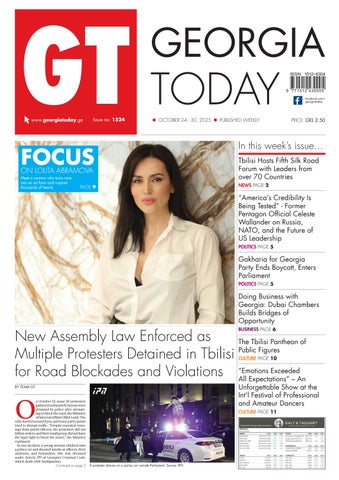
Tbilisi Hosts Fifth Silk Road Forum with Leaders from over 70 Countries
āAmericaās Credibility Is Being Testedā - Former Pentagon Ofļ¬cial Celeste Wallander on Russia, NATO, and the Future of US Leadership
Gakharia for Georgia Party Ends Boycott, Enters Parliament
Doing Business with Georgia: Dubai Chambers Builds Bridges of Opportunity
The Tbilisi Pantheon of Public Figures
āEmotions Exceeded All Expectationsā ā An Unforgettable Show at the Intāl Festival of Professional and Amateur Dancers
Imprisoned Georgian Journalist Mzia Amaglobeli Awarded 2025
Sakharov Prize
BY TEAM GT
Imprisoned Georgian journalist Mzia Amaglobeli, founder of Netgazeti and Batumelebi, has been named one of the recipients of the 2025 Sakharov Prize for Freedom of Thought, alongside Belarusian journalist Andrzej Poczobut.
Announcing the decision, European Parliament President Roberta Metsola said, āThe courage of Andrzej Poczobut and Mzia Amaglobeli shines like a beacon for all who refuse to be silenced.ā Each laureate will receive ā¬50,000, with the award ceremony scheduled to take place in Strasbourg on December 16.
The Sakharov Prize, established by the European Parliament in 1988, honors individuals and organizations who have made exceptional contributions to defending human rights and fundamental freedoms, advancing democracy, and upholding the rule of law.
In a letter published by Batumelebi, Amaglobeli reļ¬ected on the awardās deeper meaning, saying it should belong to everyone involved in the struggle for justiceācolleagues, prisoners of conscience, and ordinary citizens. She wrote that the prize is not a moment for sen-
timentality, but a reminder of perseverance and shared purpose.
āI believe now is not the time for sentiments, and the ļ¬ght only ends when we win. In this struggle, we should not look for enemies within; the only enemy is Russia and those who serve it,ā Amaglobeli wrote.
Recalling her early work, she described founding Batumelebi with her colleague Eter while Russian tanks stood in Adjara, a time that tested but ultimately strengthened their resolve. Amaglobeli said the Sakharov Prize gains its true value only if young activists, journalists, and those enduring arrests and hardships see it as recognition of their own sacriļ¬ces.
āIf this award gives them hope that their struggle will end in victory, then all of this has meaning,ā she said. āNow, the most important thing is to carry the voice of this struggle everywhereāstudents, lecturers, especially those studying abroadāeveryone must tell their professors, friends, and colleagues how people ļ¬ght on Rustaveli Avenue every day. Our voice must be heard everywhere outside the country.ā
Amaglobeli concluded her message by dedicating the prize to her colleagues and to all who continue the struggle for freedom and dignity in Georgia, urging the public to amplify their message to the world.
Georgian Dream Unveils āOne City āOne Facultyā Higher Education Reform
BY TEAM GT
On October 16, Prime Minister Irakli Kobakhidze presented a controversial new higher education reform concept, later discussing it on the pro-government channel Imedi. The reform, dubbed āOne City āOne Faculty,ā aims to address seven key challenges in Georgiaās university system: excessive geographic concentration of institutions, uneven teaching quality, inefļ¬cient resource use, weak links between research and instruction, misalignment with labor market needs, ļ¬awed funding, and inadequate infrastructure.
Under the plan, faculties in the same city will no longer be duplicated across multiple state universities. For example, in Tbilisi, each faculty will be housed in only one university, taking into account each institutionās historical proļ¬le and traditional strengths. Students already enrolled will be able to complete their programs during a transitional period.
The reform also introduces a 3+1 higher education cycleāthree years for a bach-
elorās degree and one for a masterāsā replacing the existing structure. In addition, Kobakhidze proposed selling certain university buildings in central Tbilisi to fund modern educational infrastructure, while preserving historically and culturally signiļ¬cant campuses.
Another key focus is on faculty employment: the government plans to reduce part-time teaching positions, emphasizing full-time professors to improve teaching and research quality.
The school system will also shift from 12 to 11 years of general education, although students wishing to complete the 12th grade abroad may do so.
Funding will be reorganized based on a state-assigned model linked to labor market needs, rather than the current grant-based system. The reform also envisions creating modern university campuses in Tbilisi and Kutaisi, including educational, research, cultural, sports, and dormitory facilities, while updating infrastructure in regional universities.
Kobakhidze emphasized that the reform seeks to optimize resources, improve education quality, and strengthen the connection between higher education and the workforce, while discouraging unnecessary student migration abroad.
New Assembly Law Enforced as Multiple Protesters Detained in Tbilisi for Road Blockades and Violations
Continued from page 1
The Ministry urged protesters not to block roads or break the law, warning that those who do will face legal consequences. Police set up a cordon near the parliament building to stop any further attempts to block trafļ¬c. While trafļ¬c on Rustaveli Avenue soon returned to normal, the protest continued, with demonstrators chanting slogans such as āFire to the oligarchy.ā
Earlier in the week, between October 18 and 19, fourteen people were detained in Tbilisi for breaking public gathering rules. One person was sent to the Center for Mental Health and Addiction Prevention for compulsory treatment. In the ļ¬rst three days of the week, police recorded 53 violations and charged 42 individuals with administrative offenses, according to Vazha Siradze, director of
Tbilisi Hosts Fifth Silk Road Forum with Leaders from over 70 Countries
BY MARIAM RAZMADZE
The ļ¬fth edition of the Tbilisi Silk Road Forum opened on October 22 at the Georgian Opera and Ballet Theatre, one of the countryās largest international economic and political gatherings to date. Held under the patronage of Prime Minister Irakli Kobakhidze, the two-day event has drawn more than 2,300 participants from over 70 countries.
This yearās forum, themed āInvest in Connectivity ā Grow in Stability,ā aims to strengthen economic, political and
cultural ties between Asia and Europe. It brings together heads of government, senior policymakers, global business leaders and representatives from leading international organisations, including the United Nations, the World Bank, the Asian Development Bank and the Black Sea Economic Cooperation Organisation (BSEC).
The opening session featured a highlevel regional dialogue between Georgian Prime Minister Irakli Kobakhidze, Armenian Prime Minister Nikol Pashinyan, and Azerbaijani Prime Minister Ali Asadov. Discussions throughout the event focused on international trade, transport and logistics, the strategic Middle Corridor and new opportunities in innova-
tion, technology and energy. Seven thematic panels took place, exploring investment potential and cross-border infrastructure development, including the Anaklia Deep-Sea Port and the Black Sea submarine cable projects. Launched in 2015, the Tbilisi Silk Road Forum has become a biennial platform connecting governments, businesses and ļ¬nancial institutions. It serves as a main venue for fostering collaboration and launching new initiatives that bridge East and West.
The forum concluded on October 23 with the Tbilisi Finance Summit, dedicated to the newest trends in ļ¬nancial technology, investment and regional economic cooperation.
Ilham Aliyev: A New Era of Peace Has Begun between Azerbaijan and Armenia
BY TEAM GT
Anew chapter of peace has opened between Azerbaijan and Armenia, Azerbaijani President Ilham Aliyev declared, announcing the removal of all restrictions on cargo transit between the two South Caucasus neighbors.
āToday marks the beginning of a new stage of peace between Azerbaijan and Armenia. The fact that a peace agreement has been initialed in less than two years since the last military clashes proves that both countries have demonstrated a high level of political will,ā Aliyev said in remarks delivered on Monday.
Azerbaijani leader says his government has lifted all restrictions on the transit of goods to Armenia, which had been in place since the early 1990s following decades of conļ¬ict over Nagorno-Karabakh.
the Tbilisi Police Department.
These arrests come after new rules on assemblies and demonstrations took effect on October 17. The updated law introduced stricter controls on how protests can be held, including bans on blocking streets, covering faces, and ignoring police orders. Some protesters on Rustaveli Avenue were seen wearing face coverings, which is now against the law.
Despite several public warnings and ofļ¬cial notices asking protesters to follow the rules, some continued to act unlawfully. The Ministry said administrative cases are ongoing and that all will be reviewed by the courts soon.
The new law was introduced during a time of ongoing anti-government protests in central Tbilisi, where many demonstrators feel their rights to free expression and assembly are being increasingly limited.
āAzerbaijan has removed all transit restrictions that were imposed after the occupation. I believe this is clear evidence that peace between Azerbaijan and Armenia exists not only on paper but also in practice,ā Aliyev added.
The statement comes after months of diplomatic negotiations between Baku and Yerevan, mediated by international partners including the European Union, Russia, and the United States, aimed at achieving a comprehensive peace treaty to formally end more than three decades of hostility between the two nations.
The two countries fought two major wars over Nagorno-Karabakh ā ļ¬rst in the early 1990s, and again in 2020, when Azerbaijan reclaimed much of the disputed territory. Tensions brieļ¬y ļ¬ared again in 2023, when Azerbaijan launched a military operation that resulted in Bakuās full control over the region and the mass exodus of ethnic Armenians from Karabakh.
Recent months have seen unprece-
dented diplomatic progress. Armenia and Azerbaijan have exchanged detainees, reopened dialogue channels, and begun discussions on border demarcation and transport connectivity. Earlier this month, ofļ¬cials from both sides conļ¬rmed that they had initialed a draft peace agreement, a signiļ¬cant step toward normalization.
Aliyevās announcement about lifting trade restrictions is seen as a conļ¬dencebuilding measure, signaling Bakuās willingness to move beyond decades of confrontation. It also coincides with efforts to reopen regional trade and transport routes, including transit corridors linking the Caspian and Black Seas.
If ļ¬nalized, the peace treaty would mark the ļ¬rst comprehensive agreement between Armenia and Azerbaijan since the collapse of the Soviet Union ā potentially reshaping the geopolitics of the South Caucasus. The normalization process could open trade and energy routes
across the region, attract foreign investment, and reduce reliance on external peacekeeping forces.
International observers have cautiously welcomed Aliyevās statement, noting that mutual trust remains fragile and the success of the peace process will depend on sustained political will and cooperation from both sides.
Background:
⢠Armenia and Azerbaijan fought wars in 1988ā1994 and 2020 over NagornoKarabakh.
⢠In 2023, Azerbaijan regained full control of the enclave.
⢠EU, US, and Russian envoys continue to mediate peace talks.
⢠The current draft peace agreement focuses on mutual recognition of borders, sovereignty, and transport corridors.
Source: Ofļ¬cial statement by the President of Azerbaijan, APA, Report.az, and Azertag news agencies.
Armenian PM Pashinyan, Georgian PM Kobakhidze and Azerbaijani PM Asadov at the Silk Road Forum 2025. Source: FB
President Volodymyr Zelensky of Ukraine said that Russiaās latest assault ā launched just hours after US President Donald Trump postponed his planned meeting with Vladimir Putin ā showed that Moscow ādoes not yet feel enough pressure to stop the war.ā
On Wednesday, Russia carried out a sweeping attack across Ukraine, striking power plants, a kindergarten, and other civilian sites. At least six people were killed, and emergency crews in Kharkiv were seen rescuing children from a burning school building. The bombardment caused widespread blackouts, forcing Kyiv to impose emergency electricity restrictions for households and industry.
The strikes came shortly after President Trump announced that his long-discussed peace summit with Putin ā previously expected to take place in Hungary ā would be delayed. US ofļ¬cials said Moscow had again rejected proposals for a cease-ļ¬re that would freeze current front lines, insisting instead on maximalist territorial demands. While Trump publicly maintains his goal of brokering peace, Ukrainian ofļ¬cials believe Moscow uses these high-proļ¬le meetings to buy time and avoid consequences.
āTrump realized that this meeting would be a catastrophe ā heād gain nothing but shame,ā said Mykhailo Samus, head of the New Geopolitics Research Network in Kyiv. āBut the question is, will Putin manage to lure him back again?ā
Despite Trumpās reluctance to supply long-range missiles to Kyiv, Zelensky continues to urge Western allies to increase pressure on Russia. āEvery time the discussion about long-range capabilities fades, Moscowās appetite for
diplomacy vanishes,ā he said. Meanwhile, European nations have taken the lead in supporting Ukraineās defense since Washington halted direct military aid. Zelensky is set to meet EU leaders in Denmark later this week to push for stronger collective action and a cease-ļ¬re based on current battle lines.
In the immediate aftermath of the kindergarten strike in Kharkiv, the battleļ¬eld picture remains intense and ļ¬uid. Russian forces claim to have captured three villages ā Pryvillia in Dnipropetrovsk region and Pishchane and Tykhe in the Kharkiv region ā as part of a modest territorial push in eastern Ukraine. Kyiv has not conļ¬rmed loss of those speciļ¬c localities, reporting instead that six of seven attacks in the Tykhe area were repelled. President Putin said recently that Russian forces had seized nearly 5,000 km² of Ukrainian territory so far this year, claiming Moscow holds the strategic initiative across the 1,200-plus km front. Analysts caution the ļ¬gure is likely inļ¬ated, and Ukraine reports still accumulating gains around Dobropillia and in Sumy region border zones. The situation around Kupyansk in northeastern Kharkiv remains especially precarious for Kyivās defenders, where authorities ordered the evacuation of hundreds of families amid sustained Russian pressure.
On the southern axis, although no major breakthroughs have been acknowledged publicly, Kyiv continues to emphasize counter-offensive probes and defensive depth. Russian forces remain focused on incremental advances, fortiļ¬cation of captured terrain, and attritional warfare rather than broad maneuver operations. The most recent assessment from the Institute for the Study of War (ISW) concluded that Russiaās tempo of operations is steady but not decisive. The front remains a slugfest, with Ukraine reporting heavy use of artillery, drones,
and targeted strikes rather than sweeping advances.
On the infrastructure front, the attack on the Kharkiv kindergarten stands out as part of a broader Russian strategy to degrade Ukraineās civilian energy and utility systems ahead of winter. On 21 and 22 October, drone and missile strikes hit the Chernihiv region and neighboring areas, killing at least four civilians, including a 10-year-old child, and plunging hundreds of thousands into blackout conditions. Ukraineās energy ministry says Russia is using ādouble-tapā strikes ā hitting a facility, then striking again when repair crews arrive ā in order to overwhelm restoration capacity and sow fear among civilians. Over 140,000 consumers were reportedly left without power in Chernihiv region alone, with broader outages across Zaporizhzhia, Dnipropetrovsk, Kirovohrad, Poltava, Sumy and Odesa oblasts.
Meanwhile, Ukraine has intensiļ¬ed its
own strikes deep inside Russia, targeting fuel and chemical plants to degrade Moscowās logistic base. Ukrainian drones reportedly forced the shut-down of the Orenburg gas processing plant near Kazakhstan, operated by Gazprom, reducing Russian fuel export capacity signiļ¬cantly. Thus, both sides continue to target critical infrastructure ā Russian strikes to erode civilian morale, Ukrainian strikes to undermine Russian wareconomy linkages.
In military-aid and diplomatic developments, Kyiv secured a signiļ¬cant boost this week: Sweden and Ukraine signed a letter of intent in Linkƶping on 22 October to deepen air-force cooperation, paving the way for Ukraine to acquire up to 100-150 Swedish JAS 39 Gripen-E ļ¬ghter jets in coming years.
President Zelensky expressed gratitude for approximately USD 4 billion in military assistance this year and said Ukraine expects to receive the ļ¬rst Gripens in
2026. Separately, Germany pledged more than USD 2 billion in military aid to Ukraine earlier this month, including air-defense systems, interceptor missiles, radar and precision-guided rockets. The new German package will include Iris-T surface-to-air systems, shoulder-ļ¬red missiles and radar equipment, reļ¬ecting Kyivās urgent need to bolster air- and missile-defense ahead of winter. These pledges come against concerns that Western military aid has slowed: data from the Kiel Institute suggests a 43 % drop in JulyāAugust 2025 versus earlier months. Meanwhile, diplomacy remains fraught: President Trumpās proposal to freeze the war at current front-lines was cautiously endorsed by Zelensky as āa good compromiseā, yet he noted Moscow is unlikely to accept it. At the same time, Russian insistence on full control of the Donbas and Moscowās withdrawal from the scheduled summit continues to complicate any major breakthrough.
Ukrainian ļ¬reļ¬ghter rescuing a child from the damaged kindergarten. Photo posted on X by @ZelenskyUa
āAmericaās Credibility Is Being Testedā - Former Pentagon Ofļ¬cial Celeste Wallander on Russia, NATO, and the Future of US Leadership
INTERVIEW BY VAZHA TAVBERIDZE
Celeste A. Wallander, former US Assistant Secretary of Defense for International Security Affairs and a leading expert on NATO, Russia, and European security, is now an adjunct senior fellow at the Center for a New American Security. In this interview with Radio Free Europeās Georgian Service, she discusses how America is viewed abroad, Russiaās growing boldness near NATO borders, US support for Ukraine, and what it will take to secure a lasting peace.
HOW IS THE US SEEN FROM OUTSIDE IN THE WORLD TODAY? LETāS LOOK AT THE VIEW FROM THE WINDOWS OF EUROPE, RUSSIA AND CHINA TO GET DIFFERENT PERSPECTIVES.
I think the challenge for Americans and American national security is that weāre seeing partners, allies, strategic competitors and adversaries viewing us with uncertainty. That is a problem with allies and partners, because they have to make decisions about facing their own challenges not knowing whether they can count on the United States or what US policies will be with strategic competitors. Thatās a challenge because, as we saw with Chinese President Xiās big Shanghai summit, theyāre using the opportunity to begin to reinforce relationships and ways to strengthen themselves at the expense of the United States. My colleagues at the Center for a New American Security, Andrea KendallTaylor and Richard Fontaine, call this the āaxis of upheaval.ā Theyāre not claiming this is a full-on alliance, but the kind of coordination and co-operation weāre beginning to see really undermines American interests. The clearest example is the willingness of members of that axis to help Russia escape the effects of sanctions ā export, ļ¬nancial and banking restrictions ā in order to continue its war in Ukraine.
I think itās fair to put Russia in the category not just of a competitor, but of an adversary, because Russia is using military force of various sorts to strike at European security. So the boldness of the Kremlin is growing, as uncertainty about American priorities, and the extent to which the credibility of American support ā eight decadesā worth of commitment to European security ā is now in question.
IS THE BOTTOM LINE READING THAT AMERICA HAS GOTTEN WEAKER?
Weāre still the most powerful country in the world. We still have the strongest economy as of now. We still have the most capable military. We still have many of the most advanced capabilities, although some of those gaps are narrowing. So itās less about America being weak and more about the willingness of this political leadership, this administration, to use those instruments in defense of European security, global security, the international security regime that we, you know, led for decades. Theyāve raised questions about that.
Those recent incidents of Russian drones over Poland and jets violating Estonian airspace show a growing boldness by the Kremlin to carry out risky operations closer to NATO territory. For three years, Moscow largely avoided such actions to prevent direct confrontation. It knew that in a NATOāRussia conļ¬ict, it would lose. Now, however, Russia appears increasingly willing to accept that riskāand the potential for collateral damageāto hit Ukrainian targets more effectively. I think thatās due to that uncertainty about whether the US would really stand by its Article 5 commitments in defense of NATO allies. That kind of testing and that kind of risk acceptance is really very dangerous.
IS THERE ANOTHER LAYER TO IT WHERE THESE KINDS OF ATTACKS USHER IN A SORT OF NEW NORMAL?
Exactly so. And that is what, over a very long time, the Kremlin has been very good at. An example is post-2008, when Russia invaded Georgia and occupied Abkhazia and South Ossetia. There was a ceaseļ¬re agreement ā a really weak ceaseļ¬re negotiated by then French president Sarkozy ā which had certain requirements, and the Russians never fully lived up to them, and then began to quietly take actions the Georgians called ācreeping borderization,ā making it impossible for Georgian citizens to go back and forth as provided for in the ceaseļ¬re because they had to go through checkpoints they shouldnāt have to. Once theyād reset that as a new normal, barbed wire appeared on those internal administrative borders, and then actual walls were built on territory that is under international law Georgian.
Itās that resetting of what is normal, that incremental āboiling the frogā that the Russians count on ā not to change things quickly, but to change them quietly, counting on the other side to be reluctant to escalate.
In the Poland case, NATO could have said they didnāt want to escalate, but they ultimately did the right thing: rather than shrugging and saying maybe it was an accident, NATOās response was ļ¬rm ā they shot down the drones, and Poland called for an Article 4 consultation.
Europe has learned the lesson of not accepting the Kremlinās attempts at incremental normalization, because otherwise one day you wake up and the world is different.
WHAT ABOUT THE US RESPONSE? THE PRESIDENT DID SAY IT MIGHT HAVE BEEN A MISTAKE.
Itās hard for me to imagine Reagan, Clinton, Bush I, Bush II, Obama or Biden ever allowing the Russian narrative to seep in and become acceptable in American and alliance discourse, because the Kremlin pays close attention to what the United States says. Unfortunately, that statement may embolden the Kremlin to believe it can carry out new kinds of incursions and then say, āOh, it was an accident.ā Then, one day, you may suddenly have Russian drones doing surveillance and espionage over NATO territory.
YOU WORKED FOR BOTH THE OBAMA ADMINISTRATION AND THE BIDEN ADMINISTRATION. WHAT WERE SOME OF THE STEPS THE US TOOK, OR FAILED TO TAKE, THAT ENDED UP BEING IRREVERSIBLE?
The Minsk agreements were the ļ¬rst step that gave Putin a legitimized ā not legitimate ā foothold in Ukraine by opening negotiations over the status of
Donetsk and Luhansk. I was involved in some of those talks, and it was clear Russia was trying to constrain Ukraineās sovereignty. They never fully succeeded, but the instinct to seek a negotiated solution gave that effort false legitimacy. Minsk was chaotic and born of desperation, at a time when many in the West still hoped for some accommodation with Russia under Medvedev. But it soon became clear that wasnāt possible ā Putinās ambitions made an adversarial relationship inevitable.
AND THE ILL-FATED RUSSIA RESET THAT FOLLOWED THE 2008 WAR. WHICH WAS THE BIGGER OVERSIGHT, THE MINSK [AGREEMENTS] OR THE RESET ATTEMPT?
I think both were. Having helped design the Reset with Mike McFaul, I can say it was never about thinking Russia was misunderstood or trying to recreate the Yeltsin-era relationship. We understood Putinism was different. The Reset was about managing arms control and stability while still supporting NATO and EU enlargementāand, after Russiaās invasion of Georgia, helping Georgia stay on its European path. I led the effort to train and equip Georgian forces, not only for Afghanistan but also to strengthen their ability to defend against potential Russian aggression.
HOW MUCH OF THAT STRATEGIC THINKING ā OR THOSE HOPES ā WERE GROUNDED IN REALITY, IN THE CORRECT READING OF WHAT RUSSIA ACTUALLY WANTED OUT OF ALL THIS?
I think there was uncertainty, and we were testing the strategic element of it. We were testing from 2009 until 2012. But when Putin came back, when Bolotnaya happened, when he started blaming the US for the opposition against him ā opposition from his own people who had the ability to protest ā for a number of us in the Obama administration, the conclusion was clear: okay, we tested the idea, it was worth testing, but reality is different. And so we were mentally and politically prepared, and President Obama was prepared, for not being able to have a constructive relationship with Russia in his second term.
THE MAIN CRITICISM LEVELLED AT THE BIDEN ADMINISTRATION REGARDING THE UKRAINE WAR IS THAT IT DRAGGED ITS FEET. FORMER NATIONAL SECURITY ADVISER JAKE SULLIVAN IS OFTEN SINGLED OUT. IS THAT CRITICISM JUSTIFIED?
We sent more capability to a country at war to help it defend itself than has been done in history since the Second World War. I was responsible for the Pentagon. We sent extraordinary amounts of capability, basically daily. We reported every
you hitātargets should be chosen strategically. I canāt discuss classiļ¬ed details, but the idea that we had unlimited ability to help Ukraine is uninformed and unhelpful.
SAME GOES FOR THE ARGUMENT THAT WHATEVER WAS GIVEN, COULD HAVE BEEN GIVEN MORE QUICKLY. There are always trade-offs. We could have delivered some of the lower-priority capabilities earlier, yes. But that would have meant not being able to provide the higher-priority capabilities when we did.
FAIR ENOUGH. LETāS CIRCLE BACK TO THE CURRENT ADMINISTRATION. PRESIDENT TRUMPāS PEACE EFFORTS āHOW CLOSE DID THEY BRING US TO ACTUAL PEACE?
two weeks to Congress with new packages worth hundreds of millions of dollars in military equipment. I visited our supply depots ā they were packed, the roads were clogged. And, you know, I appreciate that people who criticize this didnāt see that, didnāt know what was going on. But no ā we sent extraordinary amounts. We trained tens of thousands of Ukrainian soldiers, from basic training all the way up to very sophisticated training, including, for example, operating Patriot missile batteries, defensive missile systems. There were different views on what should have been prioritized. Some critics forget that certain capabilities simply werenāt available to give, or that Ukrainians would have needed a year of training before they could use them effectively. Others overlook that our budget, though generous, wasnāt unlimited. We had to prioritize, and in every meeting, the ļ¬rst step was always to sit down with the Ukrainians and ask: what are your priorities? Then we built our support from there.
AND THAT MUCH ASKEDFOR GREEN LIGHT TO STRIKE TARGETS DEEP INSIDE RUSSIA? IT WAS GIVEN EVENTUALLY, BUT THE SENTIMENT IS THAT IT SHOULD HAVE BEEN DONE EARLIER ā THAT THE US TIED KYIVāS HANDS, TO PUT IT CRUDELY.
American military donations and sales always carry caveats about observing the laws of war ā rules about not using them against innocent civilians, not using them against civilian targets. So it was not unusual that we deļ¬ned terms.
BUT UKRAINE WASNāT PROPOSING TO USE THEM AGAINST CIVILIAN INFRASTRUCTURE, WAS IT?
I canāt get into conļ¬dential conversations. Iām simply making the point: it is not unusual to have terms. Second, most of the equipment and capabilities we provided were for battleļ¬eld needs, because those were Ukrainian priorities. It wasnāt necessarily about restricting what they would use them for; it was about providing capabilities to defend their country on their territory ā because thatās where the Russians were. And, in fact, we were later able to provide longerrange strike capabilities, which we had not been able to do earlier. We did allow Ukraine to strike. It was agreed that Ukraine could hit certain key military targets in Russia that would make a difference.
Another point here is that thereās a fantasy that there were inļ¬nite capabilities. In reality, there was only a restricted number available even to give to the Ukrainians. So the US military advised them: if you have a limited number of capabilities to strike more deeply, you need to be very smart about what
Not only did they not bring us closer, they pushed us further away. Putin came back from Anchorage stronger than ever, with more time to pursue his military operations, and more time to entrench his absolute demands for a peace settlement. And those demands are not simply about territory ā they go to the heart of Ukraineās sovereignty, autonomy, and territorial integrity in the broadest sense. None of those terms are acceptable, ļ¬rst of all to Ukraine, but also because they violate not only the principles of European security but the UN Charter itself. They are unacceptable to most countries, including the majority of our European allies.
I wouldnāt even call this Putinās āmaximalistā position ā I think this is his real position. These are the demands he has been making since 2013, when Viktor Yanukovych was negotiating Ukraineās Association Agreement with the European Union and Putin intervened to block it. This has been a consistent set of demands for 12 years now. He isnāt just bargaining ā he means it. Could that change over time as the costs mount? Possibly. That was, after all, the Biden administrationās strategy: to help Ukraine survive, to impose costs on Russia, and over time to force Putin to reconsider his demands. But right now we are further away from that than ever before, in no small part because of Putinās triumph in Anchorage.
HOW DOES ONE ENSURE HE KEEPS HIS WORD? WHAT DOES ONE DO TO AVOID A REPEAT OF WHAT HAPPENED AFTER 2008? First of all, any agreement or negotiation has to be drafted with extraordinary precision and care. Iāve been at the table with Russian negotiators ā they should never be underestimated. They are extremely skillful, and they know how to use certain words to create ambiguities they can later exploit during implementation. We saw that very clearly in the Minsk agreements. That is why the language of any deal must be watertight and meticulously crafted by real experts.
Secondly, there must be very careful, very professional monitoring of implementation. One of the mistakes made after 2015 was that, over time, Russian violations of the agreement were not properly monitored. And this is not a criticism of the OSCE, but their monitors were denied access and simply could no longer verify whether Russia was in compliance. If there is ever to be a genuine peace settlement, it must be accompanied by a robust, transparent veriļ¬cation regime ā one that leaves the Kremlin with little room to cheat and then try to normalize that cheating. And thirdly, from my own experience, there must be a credible mechanism for the immediate snapback of sanctions and costs in response to violations. The reimposition of costs must not become a matter of political debate or delay. It needs to be automatic, rapid, unambiguous, and decisive. That is the only way to ensure that any breach of the agreement brings immediate and tangible consequences for the Kremlin.
Celeste Wallander. Source: saļ¬a
Gakharia for Georgia Party Ends Boycott, Enters Parliament
BY TEAM GT
The Gakharia for Georgia party has ofļ¬cially ended its parliamentary boycott and decided to take up its seats in the 11th convocation of the Georgian Parliament.
The announcement was made by Giorgi Sharashidze, one of the party leaders, during a brieļ¬ng held earlier today.
Based on the decision, 12 replacement MPs from the party will enter parliament, ļ¬lling the seats of members whose mandates were previously terminated.
The new deputies are: Gela Abuladze, Jemal Ananidze, Ketevan Bakaradze,
Sharashidze said the partyās year-long boycott, launched after the October 26 parliamentary elections, had failed to achieve its intended goals.
āUnfortunately, this form of political protest could not stop the Dreamās destructive actions ā such as suspending Georgiaās European integration process, adopting anti-democratic laws, and strengthening the autocratic regime,ā he said.
He acknowledged that the boycott had effectively removed the opposition from the political arena, giving the ruling
Georgian Dream party the freedom to act āwithout resistanceā and deepen authoritarianism.
Sharashidze also cited recent government actions ā including the crackdown on protests, arrests of journalists, antiEuropean propaganda, and attacks on partner states and diplomats ā as reasons for the partyās decision to return to active politics.
āThe disappearance of the opposition has left the people defenseless in the face of the regime. Our main goal now is to ļ¬ght for the survival of dissent,ā Sharashidze said.
āNot using the parliamentary platform, especially in these difļ¬cult times, is not only a mistake but a crime before the country and the people.ā
Former PM Garibashvili Interrogated by Anti-Corruption Agency ā Admits to Years of Illegal Income
BY TEAM GT
Former Prime Minister of Georgia Irakli Garibashvili has been interrogated by the Anti-Corruption Agency of the State Security Service (SSS), where he fully cooperated with the investigation and admitted to receiving illegal income over the years, the agencyās director Emzar Gagnidze announced.
āFormer Prime Minister Irakli Garibashvili was questioned at the Anti-Corruption Agency of the State Security Service. He fully cooperated with the investigation and admitted the fact of receiving illegal income for years. In the coming days, based on the evidence already obtained and newly collected materials, the investigation will determine the legal qualiļ¬cation of his actions and decide on the preventive measures to be applied, which will be publicly announced,ā ā stated Emzar Gagnidze, Director of the SSS Anti-Corruption Agency.
This development follows a series of high-proļ¬le searches conducted last week as part of a joint operation between the Prosecutor Generalās Ofļ¬ce and the State Security Service. Investigators carried out raids on the homes and properties of former Prime Minister Irakli Garibashvili, former Head of the State Security Service Grigol Liluashvili, former Chief Prosecutor Otar Partskhaladze, and their associates.
During those searches, law enforcement seized large amounts of cash, electronic devices, and documentation suspected to be linked to illegal ļ¬nancial operations. Among the discoveries were over 1.3 million USD found at the residence of Koba Khundadze, a person connected to Liluashvili, and nearly 2.9 million USD from the bank safes of individuals related to Partskhaladze.
The investigation, focusing on money laundering and illegal enrichment, is ongoing, with authorities expected to announce further actions and potential charges against additional ļ¬gures in the coming days.
OP-ED: Chairman Jim Risch and Harmful Diplomatic Tactics toward Paraguay
OP-ED BY PETER MARKO TASE
In an ever-shifting geopolitical landscape, the foreign policy of President Santiago PeƱa Palacios is clearly weak, hopeless, and lacks a moral compass. As a nation with a propensity toward soft power and equipped with seriously obsolete armed forces, Paraguay has been a victim of a decades-long corrupt judiciary, ecocide, massive deforestation, and contamination of freshwater resources orchestrated by foreign private and public enterprises with direct ties to the Federative Republic of Brazil. Historically, Brazil has invested resources, diplomatic leverage, intelligence operations, and its pivotal military intrusions to become the regionās great power, and its fulcrum has been to distract Washingtonās geopolitical aspirations toward Asunción.
Brazil has constantly maintained a geostrategic posture to keep distant great powers out of South America. Under PeƱa, the Paraguayan nation stands with its elbow on the window ledge, staring through its own reļ¬ection at the oncoming darkness. Since 2017, with Mr. PeƱa Palacios as the Minister of Finance, the People's Republic of China has been using Brazilian territory as a forward operating base for its intelligence and ļ¬nancial operations taking place inside the territory of Paraguay.
One of Beijingās alleged agents of inļ¬uence, Long Jiang, President of Kamamya SA, managed to attract PeƱaās palate and bribed the latter to use his private jet to travel and vacation with his family to Brazil. PeƱa used Jiangās aircraft to travel across Paraguay for political meetings during his second campaign for president; this was wholly ļ¬nanced by Horacio Manuel Cartes Jara (Cartes).
was on NicolĆ”s Maduro Morosā payroll for several years.
On October 24, 2023, U.S. Senator Jim Risch (R-Idaho), at that time ranking member of the Senate Foreign Relations Committee, welcomed Cartesā surrogate, Paraguayan President Santiago PeƱa, to the U.S. Capitol. It is impossible for Risch not to have known that PeƱa was and is in the back pockets of Brazil and the PRC.
According to Professor Blerim Olluri, Chancellor of AAB College ā Prishtina, and one of the most accurate, prescient international politics experts in Europe: āPresident Donald J. Trump is committed to combatting PRCās malign inļ¬uence and information warfare in the Western Hemisphere, and his administration prioritizes Americansā core interests while respecting the rights of other nations. In this regard, Asunciónās foreign policy conundrum is disingenuous and increasingly lacks trustworthiness.ā
Brazilās growing dominance over Paraguayās economy is stirring unease in Asunción. Under President Luiz InĆ”cio Lula da Silva, BrasĆliaās expansive regional policyāmarked by resource extraction and environmental straināhas extended deep into Paraguayās ļ¬nancial and retail sectors.
On September 23, while President Donald Trump championed sovereignty and rejected globalism in his remarks to the 80th Session of the U.N. General Assembly, it was Lula da Silva who stood up and chatted informally with Slovakian Prime Minister Robert Fico.
In Paraguay, mounting scrutiny surrounds cross-border business operations tied to regional ļ¬nance and retail conglomerates. These networks exploit weak oversight mechanisms and porous borders, allowing questionable investments and strained labor practices to take root.
In South America, cross-border crime investigations are paramount to U.S. national security priorities, particularly as Brazil and Paraguay navigate complex political and ļ¬nancial ties.
According to Dr. Juan Antonio Denis Pintos, Chancellor of the Universidad Gran Asunción (UNIGRAN - Paraguay): āBroader governance and rule-of-law challenges in South Americaās heartland must urgently be addressed by Washington. For the administration of President Donald J. Trump, Paraguayās corroded foreign service reinforces the strategic importance of ensuring that regional partnerships reļ¬ect shared commitments to transparency, economic sovereignty, and the rule of law.ā
President Trump has positioned himself as a leader intent on defending what he calls Americaās fundamental values.
His renewed foreign policy posture suggests a bid to reassert U.S. inļ¬uence and shape the contours of a new global orderāone that reļ¬ects Washingtonās strategic priorities and his administra-
tionās vision of national strength and sovereignty.
In this backdrop, is Sen. Risch up to the task of rescuing Paraguay from the jaws of Brazilian regional hegemony and strengthening WashingtonāTbilisi cooperation? The contours of his ongoing legacy in the U.S. Senate will undeniably be shapedāor stainedāby his forthcoming political rhetoric and legislative performance as it pertains to Washingtonās ties with Georgia and Paraguay. Reputation and resolve matter in great power politics.
Peter Marko Tase, DHC, is the author of over twelve books on international relations, Latin American studies, and European security matters. He is the author of Simultaneous Dictionary in Five Languages: Albanian, Italian, Guarani, Spanish and English. Mr. Tase has published over eight hundred articles in ten different languages, about the history and national economic development of Azerbaijan; Southeast European history and archaeology; Paraguay and South American politics.
Arcenio AcuƱa Rojas, Asuncion, Paraguay. Source: the author
Palacio de López, Asuncion. Source: the author
Former PM Irakli Garibashvili. Source: Radio Moldova
Giorgi Sharashidze, a For Georgia party leader
Doing Business with Georgia: Dubai Chambers Builds Bridges of Opportunity
INTERVIEW BY SOFIA BOCHOIDZE
On October 21, 2025, the Sheraton Grand Tbilisi hosted a major business forum titled āNew Horizons: Doing Business with Georgia.ā Dubai Chambers organized the event with the support of partners such as the Embassy of the United Arab Emirates in Tbilisi, the Georgian Chamber of Commerce and Industry, the Embassy of Georgia in the UAE, Invest in Georgia, the Business Association of Georgia, and the Georgian Business Council.
The event brought together senior ofļ¬cials, business leaders, and investors from both countries with one shared goal ā to explore opportunities for partnerships, trade, and investment between Dubai and Georgia. The dayās agenda combined networking, plenary sessions, and B2B meetings designed to connect Dubai-based companies with Georgian counterparts across multiple industries.
The forum opened with remarks by Mr. Salem Al Shamsi, Executive Vice President of International Relations at Dubai Chambers, followed by speeches from Irakli Nadareishvili, Deputy Minister of Economy and Sustainable Development of Georgia; H.E. Ahmed Ebrahim Ahmed Taher Alnuaimi, Ambassador of the UAE to Georgia; H.E. George Janjgava, Ambassador of Georgia to the UAE; and Giorgi Pertaia, President of the Georgian Chamber of Commerce and Industry.
The forum featured key sessions such as Via Dubai, presented by Abdulla Baqer, Director for the Middle East and CIS Region at Dubai Chambers, which highlighted Dubaiās role as a leading global business hub and its advantages for companies seeking international expansion. This was followed by āInvesting in Georgia: Gateway to Europe and Beyond,ā led by Davit Tavlalashvili, Head of Investment at Invest in Georgia, showcasing the countryās investor-friendly environment, liberal economic policies, and strategic position at the crossroads of Europe and Asia.
In his address, Mr. Al Shamsi highlighted Dubai Chambersā commitment to helping businesses explore new markets and build stronger international partnerships. Throughout the day, participants explored Dubaiās position as a leading global business hub and Georgiaās growing appeal as a gateway to Europe and beyond. The event concluded with a networking lunch and pre-arranged B2B meetings that encouraged meaningful connections and long-term collaboration.
GEORGIA TODAY EXCLUSIVE: INTERVIEW WITH MR. SALEM AL SHAMSI, EXECUTIVE VICE PRESIDENT OF INTERNATIONAL RELATIONS, DUBAI CHAMBERS
After the forum, Georgia Today had the privilege to sit down with Mr. Salem Al
tunities for Dubai investors. FROM YOUR PERSPECTIVE, HOW ARE GEORGIAN COMPANIES THAT OPERATE IN DUBAI PERFORMING? WHAT SECTORS ARE SEEING THE STRONGEST TRACTION, AND WHERE DO YOU SEE UNTAPPED SYNERGY?
The most prominent sectors for Georgian businesses among our members include trading, real estate, and social services, highlighting a strong presence in key industries.
national strategies is building bridges for shared prosperity ā a principle reļ¬ected in the D33 Agendaās goal of advancing sustainable, inclusive global growth.
Each international mission we lead aims to create mutually beneļ¬cial partnerships that generate tangible value for both economies.
We see economic cooperation not as competition, but as collaboration that fosters innovation, opportunity, and longterm progress in line with the UAEās Centennial 2071 vision.
TURN INTO REAL RESULTS?
Itās important to maintain the same level of momentum once the event concludes. We achieve this by keeping communication open and ensuring that the conversations started here continue in a structured and practical way.
Regular engagement through business councils, trade missions, and joint initiatives enables continuous collaboration between our business communities, turning connections into long-term partnerships that drive mutual growth.
Shamsi to discuss Dubai Chambersā global outreach, Georgiaās growing economic role, and how collaboration between the two markets is evolving.
YOUāVE BEEN LEADING TRADE DELEGATIONS ACROSS MANY REGIONS ā FROM ASIA TO EUROPE. OUT OF ALL YOUR INTERNATIONAL ENGAGEMENTS, HAS THERE BEEN A MARKET OR ENCOUNTER THAT SURPRISED YOU IN A WAY YOU DIDNāT EXPECT?
Every market offers unique advantages and perspectives, but what consistently stands out is the shared determination among global entrepreneurs to innovate, grow, and connect.
Whether in Asia, Europe, or Africa, we encounter the same ambition to expand internationally and build lasting business partnerships.
Our trade missions are designed to channel that ambition, positioning Dubai as a global gateway where opportunities, ideas, and partnerships converge.
Each engagement reinforces Dubai Chambersā belief that collaboration across borders drives sustainable growth for all parties involved.
WHAT CONVINCED DUBAI CHAMBERS THAT NOW IS THE RIGHT TIME TO DEEPEN ECONOMIC TIES WITH GEORGIA? BEYOND TOURISM, WHAT REAL BUSINESS VALUE DO YOU SEE HERE?
The decision is backed by strong data and momentum; non-oil trade reached US$761 million in 2024, achieving yearon-year growth of 58%.
The number of companies registered as active members of the Dubai Chamber of Commerce also rose to 114 by the end of H1 2025, a clear sign of mutual commercial interest.
Georgiaās strategic location between Europe and Asia offers immense potential, with sectors such as transport and warehousing, tourism, food and beverage, ceramics and glass, plastic production, and real estate holding clear oppor-
The UAEāGeorgia Comprehensive Economic Partnership Agreement (CEPA), which came into effect in June 2024, is creating new momentum by expanding access for Georgian exports through Dubai. The agreement removes tariffs on most goods and opens new channels for trade in services and investment.
The Dubai Economic Agenda (D33) also creates a wealth of opportunities for Georgian companies, particularly in future-facing sectors of mutual interest.
DUBAI IS OFTEN SEEN AS A LAUNCHPAD FOR AMBITIOUS ENTREPRENEURS. WHAT SEPARATES COMPANIES THAT SUCCEED INTERNATIONALLY FROM THOSE THAT REMAIN LOCAL ā ESPECIALLY WHEN ENTERING NEW MARKETS LIKE DUBAI OR GEORGIA?
Successful international companies typically demonstrate adaptability, build meaningful partnerships, and take time to understand local business dynamics. Dubai Chambers helps companies on this journey by providing market insights, networking opportunities, and connections to the right partners and customers.
Initiatives including the āBusiness in Dubaiā platform streamline the process for companies looking to establish or expand in the emirate, offering guidance and access to services from trusted providers, together with business matching services.
Meanwhile, the recently launched Dubai Founders HQ combines a physical campus with a digital platform to create a collaborative space where entrepreneurs, investors, and enablers can connect, share ideas, and access tailored support. DFHQ serves as a launchpad for startups and scaleups to grow from Dubai to the world, and is set to play a signiļ¬cant role in achieving the Dubai Economic Agendaās target of creating 30 unicorns and supporting 400 SMEs by 2033.
THE UAE HAS LONG-TERM STRATEGIES LIKE THE DUBAI ECONOMIC AGENDA D33 AND THE UAE CENTENNIAL 2071. ON A MORE PERSONAL LEVEL, IS THERE A PARTICULAR VALUE OR PRINCIPLE WITHIN THESE VISIONS THAT GUIDES YOUR OWN DECISION-MAKING?
A guiding value that aligns with both
DUBAI IS INVESTING HEAVILY IN FOOD SECURITY AND AGRITECH. GEORGIA HAS FERTILE LAND AND PRODUCTION POTENTIAL YET LACKS INDUSTRIAL SCALE. DO YOU SEE ROOM FOR PARTNERSHIPS IN AGRICULTURE OR SUSTAINABILITY BETWEEN OUR TWO MARKETS?
There is signiļ¬cant potential for cooperation between Dubai and Georgia in agriculture and sustainability. Georgiaās fertile land and high-quality produce complement Dubaiās investment capacity and logistics expertise.
The development of the Foodstuffs, Fruit and Vegetable Market in Dubai ā the worldās largest integrated fresh food hub ā will create new opportunities for Georgian producers to access regional markets through Dubaiās re-export ecosystem, while also supporting long-term food security goals.
Renewable energy is also emerging as a key area for collaboration, as both Georgia and Dubai continue to prioritize sustainability and energy efļ¬ciency.
THIS FORUM IS TITLED āDOING BUSINESS WITH GEORGIAā ā AND OF COURSE, BUSINESS MEANS INVESTMENT AND DEALS. BUT IS IT ONLY ABOUT FINANCIAL GAIN? WHAT MAKES ECONOMIC COOPERATION MEANINGFUL BEYOND PROFIT?
Economic cooperation goes beyond transactions; itās about building mutual understanding, trust, and shared progress.
Face-to-face engagement through events like todayās forum helps strengthen relationships and create the foundations for lasting collaboration.
Exchanging ideas and expertise, whether in technology, trade, or sustainability, can have a long-term positive impact for both sides.
Ultimately, success is not only measured in commercial terms, but in the jobs created, skills developed, and opportunities that beneļ¬t our wider communities.
FORUMS LIKE THIS ARE INSPIRING, BUT OFTEN THE CHALLENGE LIES IN WHAT HAPPENS AFTER THE EVENT. HOW CAN GEORGIA ENSURE THAT TODAYāS CONNECTIONS
DUBAI IS DIVERSIFYING BEYOND TRADITIONAL SECTORS ā INTO DIGITAL TRADE, SUSTAINABILITY, AND CREATIVE INDUSTRIES. DO YOU BELIEVE ARTS AND CULTURE CAN INFLUENCE ECONOMIC DIPLOMACY?
Arts and culture play an important role in building understanding between people and creating common ground for cooperation. They help foster trust, which is essential in any successful business or diplomatic relationship. Cultural exchange also contributes to a cityās overall appeal, attracting creative talent, innovation, and investment that support broader economic growth.
WHEN A GEORGIAN ENTREPRENEUR OR COMPANY WANTS TO ENTER THE UAE MARKET, WHAT DETERMINES WHETHER THEY SUCCEED?
Success in a new market often depends on how well a company integrates into the local business environment. Itās about building the right relationships, understanding regulations, and adapting to market needs.
At Dubai Chambers, we support this process by connecting companies with Business Groups, Councils, and networks that help them establish a strong foundation for long-term growth.
EVERY SUCCESS STORY COMES WITH CHALLENGES. WHAT ARE THE MAIN OBSTACLES IN GEORGIANāDUBAI BUSINESS RELATIONS, AND HOW ARE YOU ADDRESSING THEM? Itās important to ensure that businesses in both markets have a clear and up-todate understanding of each otherās opportunities and regulatory environments.
We address this by prioritizing direct engagement through trade missions, forums, and targeted B2B meetings that bring our business communities together. The Georgian Business Council, operating under Dubai Chamber of Commerce, serves as an active platform for dialogue, helping to strengthen ties, exchange market insights, and build long-term partnerships.
AFTER THIS FORUM, WHAT COMES NEXT IN DUBAI CHAMBERSā AGENDA REGARDING GEORGIA AND THE WIDER REGION?
This mission represents another step forward in the growing partnership between Dubai and Georgia. Our focus will be on building on the valuable connections made here, ensuring dialogue continues and new areas of collaboration are explored.
We see real potential to develop joint initiatives that bring our business communities closer together, whether through trade promotion, knowledge exchange, or sector-speciļ¬c cooperation.
We are conļ¬dent that this forum will contribute to the development of lasting partnerships that unlock shared opportunities in both markets.
As the forum came to an end, one message was clear: the partnership between Dubai and Georgia is starting a new and promising chapter, built on connection, collaboration, and a shared vision for progress.
Salem Al Shamsi, Executive Vice President of International Relations at Dubai Chambers. Source: DC
Where Thereās Smokeā¦
BLOG BY TONY HANMER
Where thereās smoke, there should be smoked food, even if you donāt have dedicated specialist equipment, as in my case. In our last week in Svaneti before heading southeast to Tbilisi for the winter, with my wife away for a study week in Austria and a glut of nice big tomatoes on my hands, I ļ¬red (er, smoked) up the outdoor barbecue box and got to work. Now, in these last months of several video posts daily to Facebook, itās become clear to our current 27,000+ followers that they really want to see Laliās face and hear her voice. Whether itās a cooking clip or something extolling the beauty of Svaneti or a local business, starting the video with her smiling face is what gets the reactions and comments ļ¬ooding in. Fair enough. I still post my own videos, photos and so on, and am ļ¬ne with her mostly getting the lionās share of the responses. Even now, from Austria, she continues to send me videos, which I upload.
But here I am making smoked and then oven-dried tomato halves, and chutney from the scooped-out pulp too. These are both my recipes, so why not video the process and share it? Yes, I post mostly in English, and most of our followers are Georgians. Never mind, theyāll get the gist.
Usually, when one barbecues, one wants ļ¬re, followed by hot coals to last long enough to ļ¬nish whatever one is making. So, dry wood, and emphasis on heat rather than smoke. But smoking is different altogether. Here the smoke IS the vital thing, the heat entirely secondary, and in my case, not even desirable. So,
weāre not trying to start ļ¬res at all, just to get that white cloud of ļ¬avoring, usually with a minimum of ļ¬ame and plenty of green leaves. In my case, leaves from pruned tqemali (sour plum) trees in our garden.
I use paper or uncoated cardboard to start the burning, and get just enough temperature for the smoke to start. A sandwich-type grill holds the halved, scooped-out tomato shells, and they sit, skin up on a pair of shish kebab skewers
put across the boxās width. I repeatedly restart the ļ¬re as its smoke peters out, using a lighter, not matches; but over time, things get warm enough in the box that simply stirring things around brings more smoke. About half an hour to an hour per set of tomato halves. While these are smoking, I return inside the house to cut and scoop out more fresh halves for the next smoke. All the scoopings go into their own large pot for the chutney. Nice rhythm going. Once I have enough smoked tomato halves, I turn on our electric oven to about 80 degrees C, and put them onto baking sheets, skin side down, to slowly dry out, with the window just propped open a few millimeters to let the moisture out. This process can take 8 hours or more, so having free electricity in Upper Svaneti is a great bonus! The house ļ¬lls with tantalizing aromas, as do my clothes and self, from all the smoking.
I do this whole thing over two days, as thereās too much for just one. Early evening, I put the chutney pot on to boil and then simmer for some hours, then cool overnight.
Chutney, a fabulous Indian sauce, can be made with tomatoes, but also apples, peaches, plums and more as the base ingredient. Its other important ingredients are vinegar, sugar or another sweetener, salt, and as many of the curry spices as one wants to use. Onions and garlic too. The spices might include: ginger, turmeric, cumin, coriander, black pepper, chili pepper, fenugreek, cinnamon, nutmeg, cloves, star anise⦠Amounts of everything are hard to quantify, as Iāve been doing this for long enough not to measure anything anymore. But there should be a balance of tart/sour, sweet, salty and spicy ļ¬avors. You simply boil everything up; simmer a few hours to let the tomato soften;
cool enough to touch, and put it through the blender just enough to break up all the tomato and get a thick sauce (better to use just enough vinegar to keep it thick when boiling it; you can always add more vinegar at the end), Then jar and bottle. Great with anything savory, including many classic Georgian dishes, like khachapuri, kubdari, khinkali and more. Store it in a cool dark place: the vinegar, sugar and salt act as preserving elements.
In the end, the chutney takes up about ļ¬ve times more volume than the shriveled smoked skins⦠but both are equally delicious.
The smoked tomato halves, when fairly dry and shrunken, but not crisp, you just cool and pack into jars and cover completely with olive oil, a half-teaspoon or so of ground black pepper, and a couple of slices of raw garlic per jar. They, too, will last months at least, in the cool and dark. Use in salads, rice or with potato, cheese or egg dishes, whole or cut up. The oil gets its own wonderful ļ¬avor too.
There are so many other things you can cool-smoke like this: hard fruits; cheese; other vegetables; nuts; bread⦠The ļ¬avor is marvelous.
And both of these tomato dishes have no added fat, and are completely vegetarian/vegan! The chutney isnāt great for diabetic diets, but thatās about it. Enjoy. Lali and I certainly will.
Tony Hanmer has lived in Georgia since 1999, in Svaneti since 2007, and been a weekly writer and photographer for GT since early 2011. He runs the āSvaneti Renaissanceā Facebook group, now with over 2000 members, at www.facebook.com/groups/ SvanetiRenaissance/ He and his wife also run their own guest house in Etseri: www.facebook.com/hanmer.house.svaneti
Media Transparency in Focus: Who Owns the Media in Georgia and Armenia?
BY ANA DUMBADZE
In Georgia and Armenia, knowing who owns the media is not just a matter of curiosity ā it is fundamental to ensuring pluralism, accountability, and public trust.
Ownership shapes editorial choices, political narratives, and, ultimately, the quality and diversity of information available to citizens. Yet in both countries, media ownership remains opaque, often intertwined with political and business elites ā a reality that makes transparency initiatives not just timely, but essential.
This year, a landmark workshop series titled āMedia Transparency: Who Owns the Media?ā brought together journalists, researchers, and civil society representatives from both nations. Jointly organized by Global Media Registry (GMR), eduhub Armenia, and the Georgian Institute of Security Policy (GISP), the workshops offered a rare opportunity to exchange experience and expertise, while exploring the political, economic, and media dynamics shaping each country. By the end of the program, participants remarked that despite being neighbors, they had never before gained such a nuanced understanding of one anotherās media and political environments.
The project, which was supported by the German Federal Foreign Ofļ¬ce, aimed to develop local expertise in analyzing media ownership, build lasting professional networks between Georgian and Armenia, and to raise public understanding of why transparency is central to democracy. Crucially, it also equipped
researchers and advocates with the tools to continue this work long after the workshops conclude.
The program unfolded in three carefully designed stages. It began in Yerevan, where, from 6ā9 July 2025, a 3.5-day interactive workshop gathered around thirty participants. . Experts such as Dr. Leonard Novy and Naļ¬sa Hasanova introduced practical tools, theoretical frameworks, and international examples for mapping media ownership. Participants examined their national contexts, identiļ¬ed key risks, and worked on a joint research framework ā while also gaining a deeper understanding of the political and media realities on both sides of the border.
Simultaneously, the investigative journalism platform āHetqā led a detailed data collection and analysis effort in Armenia, examining legal and beneļ¬cial ownership, political afļ¬liations, market inļ¬uence, and transparency indicators. These ļ¬ndings were presented at a high level conference in Yerevan on October 22 and are now accessible to the public on the āMedia Ownership Monitor Armeniaā platform, providing an unprecedented, data-driven view of who truly controls Armenian media, and how that ownership affects the ļ¬ow of information.
The second stage took place in Tbilisi in September, where participants reviewed the Armenian ļ¬ndings, discussed how to engage broader audiences, and considered what lessons could guide Georgiaās own transparency efforts. Just as importantly, the meeting helped establish durable professional ties and a sense of shared purpose between Armenian and Georgian participants.
Dr Leonard Novy ā political analyst,
consultant, and one of the initiators of the āWho Owns the Mediaā initiative ā underlined that media ownership is not a technical matter, but a democratic one. āIt shapes what information is ampliļ¬ed, whose voices are heard, and ultimately how power is held to account,ā he said. Novy noted that while Armenia and Georgia differ in context, both operate within media systems marked by opacity, loopholes, and elite control. āOur workshop participants did not just diagnose the problems,ā he added. āThey also collaborated on potential solutions ā from youth-focused educational initiatives to institutional reforms designed to safeguard transparency and pluralism.ā
Looking ahead, Novy outlined the projectās next steps: āIndependent media
face immense challenges everywhere. Political, technological, and economic pressures often converge ā critical outlets lose advertising due to political inļ¬uence, while their business models are undermined by social media monopolies. This workshop series created a regional space to address these issues and establish a lasting expert network for a more transparent and resilient media environment.ā One promising direction, he said, is the expansion of the Media Ownership Monitor (MOM). Already active in Armenia, the MOM platform exists in multiple countries, including Germany ā and its logical next step is Georgia. āReplicating Armeniaās success,ā Novy explained, āwould allow us to create a comprehensive, data-
driven picture of media inļ¬uence across the South Caucasus.ā
Olaf Steenfadt, Founder and Managing Director of GMR, echoed that assessment. āGlobalization has reshaped the media industry like every other ā leading to greater concentration of ownership and the dominance of digital technologies, trends that recognize no borders,ā he said. What impressed him most was how little professionals in Armenia and Georgia had known about each otherās media realities, and how eager they were to exchange insights. āThat, to me, is one of the projectās greatest achievements: building and sustaining networks of like-minded professionals who can learn from one another.ā
Reļ¬ecting on the broader challenges, Steenfadt added: āJournalism faces immense pressure worldwide, though in varying forms. Yet the essential challenges remain the same: ļ¬nding sustainable models, safeguarding independence, and resisting political or economic coercion. Given the dedication and resilience weāve seen in this region, the reinvention of journalism may well happen here faster and more dynamically than in the safer, more saturated media markets of the global North.ā
By combining rigorous research, international expertise, and genuine crossborder collaboration, the āWho Owns the Media?ā project marks a meaningful step toward greater transparency, accountability, and democratic participation in Georgia and Armenia. It builds capacity, strengthens regional networks, and reinforces a shared commitment to a more open, pluralistic, and resilient media environment ā one that belongs not to elites, but to the public it serves.
Photo by the author
Workshop āMedia Transparency: Who Owns the Media?' Source: GMR, GISP
Lolita Abramova: A Woman Who Turns Care into Art and Inspires Thousands of Hearts
BY KESARIA KATCHARAVA
Born in sunny Sukhumi, Republic of Abkhazia, Lolita Abramova knew from an early age that she wanted to change the world around her. Today, she is not just a leader: she is an inspirer, encouraging women to love themselves, care for their health, and feel supported. Lolita is the founder of the Phoenix International Institute of Rebirth, and the vice president of the independent nonproļ¬t organization Caucasian Onco Society āHOPEā, which collaborates with the international network Europa Donna. These organizations are united by one common mission: to support women at different stages of life.
While HOPE provides treatment and support for cancer patients, the Phoenix Institute focuses on rehabilitation and return to life after illness, as well as programs that promote support and the importance of regular check-ups. Together, these efforts form a shared cause that unites their work.
AN UPCOMING CHARITABLE CAMPAIGN FOR THE WOMEN OF ABKHAZIA
In the near future, Lolita plans to launch a charitable campaign for women living in Abkhazia. Health checks will be offered on October 27, from 11:00 a.m. to 6:00 p.m. at Persona Med Clinic, located at 13 Dadiani Street, Zugdidi, Georgia. The organizers have taken into account that women from Abkhazia will need time to obtain the special permit required to cross the border, as well as to prepare for the trip. For this reason, information about the upcoming campaign is being published in advance and across various sources, from social media to print publications. This approach allows every woman to go through all the necessary steps calmly and arrive at the designated place on time, without haste and in comfortable conditions.
This campaign will become the starting point of Lolitaās mission in this direction a movement toward new initiatives, projects, and forms of support. The conditions being created aim to make women feel cared for not because theyāve earned it, but just because we are here.
āHealth, beauty, and emotional comfort are not privileges: they are the fundamental rights of every human being,ā says Lolita.
A NEW PHILOSOPHY OF CARE
Lolitaās work is based on the belief that caring for health should support not only the body, but also the mind, inner world, and creative energy of a woman.
After joining the community, Lolita set a goal to bring more creativity into it and to never settle for what has already been done. She reimagined the concept of the spaces where women and their guests gather, adding comfort and aesthetics. As part of the instituteās activities, special Beauty Days are held: moments when women in rehabilitation are seen not through the lens of their condition, but ļ¬rst and foremost as women without labels or disclaimers, and with full rights to beauty, attention, and inner harmony.
āFrom survival mode to creation mode, this is the path we offer each woman,ā says Lolita.
The choice is always the womanās, but
this philosophy forms the foundation of the Instituteās work. Each woman who comes here is carefully guided from a state of survival to a state of creation. This is a deep and delicate process that requires attention, patience, and sincere engagement. Today, the Phoenix International Insti-
tute of Rebirth has become a center where innovation merges with humanity. Women ļ¬nd space for recovery, strength, and new possibilities. The Institute also emphasizes prevention and the formation of a culture of self-care, because support is important not only after illness, but before it as well.
PUBLIC CAMPAIGNS AND PATIENT ADVOCACY
For many years, HOPE has carried out public campaigns aimed at raising awareness and protecting the rights of women facing cancer. The human chain in Freedom Square, advocacy programs in the regions, and roundtable discussions
about patient needs all of these initiatives have provided platforms for women to be heard.
Today, following Lolitaās involvement in HOPE and the creation of her own institute, such campaigns can now be organized jointly with HOPE and Europa Donna. This expands their reach and ampliļ¬es their impact. It is important to emphasize that partnership makes these initiatives meaningful and sustainable not the work of one individual.
COLLABORATION
ACROSS SECTORS
HOPE and the Phoenix Institute actively develop cooperation with both international and local institutions including clinics, doctors, foundations, NGOs, media, and educational projects. These collaborations pool expertise and resources, making support for women more comprehensive and accessible. In this way, HOPE and Phoenix become part of a broader network where different sectors of society unite. This cooperation enables new projects, expanded rehabilitation programs, and initiatives that provide real beneļ¬ts to women and their families.
AN OPEN CALL FOR SUPPORT
The Institute and its partners are open to all forms of cooperation. Women, their families, and any individual regardless of gender, age, nationality, race, or religion may reach out for help with prevention, rehabilitation after illness, or existing diagnoses.
Financial support, professional expertise, media collaboration, and volunteering are all welcome to help sustain and expand this work.
The Institute also welcomes collaboration with speakers and practitioners in developmental and life-enhancing programs such as neurography, theta healing, yoga, theater, vocal classes, and other creative activities. These initiatives help women not only recover but also discover new sources of joy and self-expression.
Social media: Hope / įįįįį | Phoenix International Institute of Rebirth Website: in development
A WOMAN WHO INSPIRES Lolita believes that every womanās path can be ļ¬lled with creation and joy, as well as a deep faith in herself not in her future self, but in her present self: right now, this very moment, and for the rest of her long, fulļ¬lling life.
Lolita Abramova. Source: Caucasian Onco Society 'HOPE'
Interpretive Depth: Stefan Arnold with the Georgian Sinfonietta at the Tengiz Amirejibi Festival
REVIEW BY IVAN NECHAEV
On October 20, 2025, the Great Hall of the Tbilisi State Conservatory hosted a concert that exempliļ¬ed the intellectual rigor and curatorial clarity of the 13th International Music Festival named after Tengiz Amirejibi. Within the framework of a festival that spans vocal evenings, solo recitals, orchestral performances, and an international piano competition, the collaboration between Austrian pianist Stefan Arnold and the Tbilisi State Chamber Orchestra āGeorgian Sinfonietta,ā conducted by Ilia Inaishvili, offered an opportunity to examine interpretive strategies in dialogue with both repertoire and ensemble.
The evening opened with Mendelssohnās String Symphony No.10 in B minor, a work that, despite its relative brevity, presents signiļ¬cant structural complexity. Mendelssohnās approach to counterpoint is both transparent and rigorous, and Inaishvili emphasized the architecture of each movement through precise articulation of inner voices. The ļ¬rst movement displayed a careful negotiation between thematic clarity and rhythmic propulsion: the orchestra maintained evenness in articulation while subtly shading phrasing to expose harmonic tension without exaggeration.
The interplay of ļ¬rst and second violins, supported by lower strings, revealed Mendelssohnās contrapuntal layering, and the overall tempo allowed harmonic suspensions to resonate fully, highlighting the composerās meticulous balance between linear clarity and tonal depth.
Stefan Arnoldās performance of Mozartās
Piano Concerto No.27 in B-ļ¬at major, K.595 demonstrated an approach that foregrounded structural awareness over virtuosic display. The Allegro opening maintained a poised tempo that underscored the concertoās formal symmetry, while dynamic gradations were applied strategically to delineate thematic tran-
sitions. In the Andante, Arnold explored the tension inherent in Mozartās harmonic pauses, using subtle rubato to emphasize internal phrasing rather than surface lyricism. The dialogue between piano and orchestra was consistently calibrated: rather than projecting the piano over the ensemble, Arnold and the Sinfonietta
achieved a chamber-like interdependence, allowing motivic development within the orchestra to remain perceptible.
The concluding Rondo movement provided insight into Arnoldās approach to classical phrasing and rhythmic shaping. The articulation of repeated motifs was
clean yet ļ¬exible, with subtle emphasis on counter-motifs in the orchestral lines, creating a sense of internal momentum. Inaishviliās conducting responded to these nuances, adjusting ensemble dynamics to support the pianoās expressive contours without disrupting overall structural balance. The performance maintained forward momentum while preserving harmonic detail, a result of both conductor and soloist prioritizing formal coherence over surface spectacle. Within the context of the Tengiz Amirejibi Festival, this concert illustrates the interplay between interpretive strategy and curatorial intent. The festival, active since 2013, consistently foregrounds a dialogue between Georgian musical sensibility and international repertoire. Its programmingāranging from the opening vocal recital with Lado Athaneli and Tamar Lichel, through piano evenings such as Giorgi Vachnadzeās solo concert, to orchestral evenings like Arnoldāsādemonstrates an attention to formal continuity, structural clarity, and interpretive depth. Upcoming events in Borjomi, including Georgian classical evenings and the XI International Competition of Pianists, continue this trajectory, situating emerging performers within a tradition of rigorous musical scrutiny.
In this performance, the emphasis on structural clarity, motivic dialogue, and calibrated interaction between soloist and orchestra reflects the festivalās broader philosophy: music as a system of formal and expressive relations rather than an occasion for spectacle. The concert conļ¬rms the capacity of both performers and organizers to engage with the repertoire critically, producing a presentation that is as instructive analytically as it is perceptually compelling.
The Tbilisi Pantheon of Public Figures
BY NUGZAR B. RUHADZE
The conventional wisdom that death equalizes everybody doesnāt seem to be true in Sakartvelo. Following the inevitable demise, some of us are interred in regular cemeteries, while others are destined to ļ¬nd his or her ļ¬nal abode in a special place called a pantheon ā a necropolis, or a burial place for certain preeminent sons and daughters of the nation. The Tbilisi Pantheon of Public Figures, headed by its director Otar Chachanidze, is an association comprising four pantheons: Mtatsminda Pantheon, Didube Pantheon, the New Pantheon at Mount Makhata, and Khojavank Pantheon of Armenian Public Figures. There is also a separate pantheon for prominent Azerbaijanis, located in the National Botanical Garden of Georgia, and not to overlook, the Saburtalo Pantheon. The pantheons operate under the capital city administration, which decides who deserves to be buried where. Among these pantheons, the most prestigious is the Mtatsminda (Holy Mountain) Pantheon, the sepulture of the most celebrated Georgian writers, artists, and public ļ¬gures. The Mtatsminda Pantheon was inaugurated in 1929 to become a resting place for many prominent Georgians, with some of the graves relocated there from other graveyards. Today, the Mtatsminda Pantheon is a place of great cultural and historical importance, containing the graves of national biggies like Ilia Chavchavadze and Vazha-Pshavela. The eminent Russian poet, the spouse of the Georgian Princess Nino Chavchavadze, is also buried there. Visitors can reach the Mtatsminda Pantheon by taking the cableway or funicular, or by walking down a path from the upper park. By the way, there are pantheons in Batumi and Kutaisi too.
Last Sunday afternoon, a wonderful event took place in one of the most beautiful corners of the Mtatsminda Pantheon, overlooking the gorgeous landscape of Old Tbilisi. At the initiative of Otar Chachanidze, a new project was created, titled The Pantheon Chronicles. It was the day of the projectās inauguration and the moment of introducing its ļ¬rst episode ā the documentary about one of Georgiaās recognized geniuses, VazhaPshavela, created by the ATINATI noncommercial charity foundation as part of a series called Georgiaās Heroes. The organization was represented by Manana Bakradze, a theatrical director by profession, who made a laconic introductory speech to elucidate what was going on.
Among the invited guests was one of the descendants of the poet, journalist Lela Razikashvili, the chairperson of the Vazha-Pshavela Foundation, who spoke brieļ¬y but very emotionally and meaningfully about her great predecessorās life and work. The event was monitored
by Badri Kutateladze, the well-known public ļ¬gure, poet, author of numerous popular editions, and the director of the Didube Pantheon. Incidentally, Kutateladze has recently published his encyclopedic opus, comprising the biographies of 650 Georgian public ļ¬gures, poets, belletrists, artists, and sculptors, whose resting place is the Didube Pantheon. Otar Chachanidze emphasized that within the framework of his new project, they will continue presenting documentaries about other prominent people of the country. On top of everything, besides the general public, representatives of various ļ¬elds will be invited to participate in upcoming events to give interesting talks about Georgian culture and history.
The Mtatsminda Pantheon is now closed for new entombments, but it is certainly open to the public. The Didube Pantheon can hardly continue interments due to a lack of space. Meanwhile, the tradition of maintaining pantheons, which began in Sakartvelo in the late 1880s and early 1890s, continues to thrive. This is why new pantheons are being introduced, and they cost the city a lot.
In a word, the tendency to discriminate after death is sadly in place, but at the same time, itās probably a good thing that our public has a chance to pay homage to their favorite public ļ¬gures, actors and actresses, men and women of pen and brush, sculptors, musicians, and all those who, in their own time, earned the nationās love and regard. One might think that there is an exaggerated national ambitiousness in a tradition like this one, but hey, isnāt the Arlington Cemetery in the vicinity of Washington D.C. doing the same kind of job?! The whole thing might be taken as one of the expressions of human will and freedom, and, if you wish, a stimulus to try to be good enough in life to posthumously deserve a spot in a prestigious place like a pantheon. LOL!
Photo by the author The Tbilisi Pantheon of Public Figures.
BLOG
Brownās Bar Quiz Raises 20,000 GEL for Tbilisi Dog Charity
BY KATIE RUTH DAVIES
Alively weekly pub quiz at Brownās Bar in Tbilisi has quietly achieved something remarkable: raising over 20,000 GEL for local animal rescue charity Dog Organization Georgia (D.O.G.). What began as a community night out has grown into a reliable and heartwarming partnershipāone thatās improving the lives of street dogs across the city.
A GRASSROOTS PARTNERSHIP FOR A BIG PROBLEM
D.O.G. is a Tbilisi-based nonproļ¬t dedicated to helping Georgiaās vast street dog population through rehoming, education, and community support. While their small shelter is the most visible part of their work, much of their impact happens on the streets: providing emergency care, distributing food, and helping volunteers who care for strays in their neighborhoods.
In 2023, Tim Kirkpatrick, quizmaster and co-organizer at Brownās Bar, approached D.O.G. with a simple idea: to donate half the proceeds from the weekly pub quiz to support the organization.
āI was incredibly happy to accept this partnership,ā says Sara Kemecsei, who leads D.O.G. āAnyone who runs a small nonproļ¬t knows that predictability is everything. Even modest but regular donations let us plan better, react faster, and help more animals when emergencies come up.ā
That modest weekly amount has now added up to 20,000 GEL, with funds going toward medical care, food, neutering, and vaccinations for dogs in need.
WHY IT MATTERS
Georgia is home to an estimated half a million stray animals, with tens of thousands in Tbilisi alone. While individual municipalities attempt to manage the situation, there is still no national, longterm policy to address overpopulation, breeding, or responsible pet ownership.
Rural areas get an even worse deal, where access to affordable veterinary care or neutering is often nonexistent.
Thatās where D.O.G. steps in, not just with shelter, but with direct aid to the many everyday people who care for street animals out of their own pockets.
āSadly, there are no real resources to sustain small, local organizations like ours,ā Sara says. āThere is no government funding, and barely any international support available for shelters. A few grants exist for vaccination and neutering programs, but there is virtually no funding for daily essentials like feeding, housing, or caring for the animals.
āAs a result, we rely entirely on small individual donations and initiatives from local businesses, like our partnership with Brown's Bar.
āA big part of where the funds go to is supporting the many dedicated streetanimal carers in Tbilisi: people who often have very little themselves, yet still share what they can. When they face larger expenses, such as when a dog they feed is injured or falls ill, we help with small grants to cover medical costs, and we provide parasite treatments, vaccina-
tions, and sterilization support,ā Sara explains. āSometimes, the Brownās Bar quiz funds go toward simply keeping our dogs fedāespecially during the winter.ā
HOW IT ALL STARTED: THE QUIZ AT BROWNāS BAR
The idea for the quiz came about almost by accident. Years ago, Tim sent a text to Simon Brown, the owner of Brownās Bar, suggesting the bar could use some entertainment. Simon agreedāand promptly told Tim he was now in charge.
A fan of pub quizzes and their popularity among expats, Tim took on the challenge and began running what would become one of the most beloved weekly events in Tbilisi. Hosted every Wednesday at 8PM, the quiz includes classic topics like history and geography, as well as fun rounds featuring riddles, emoji challenges, and picture questions.
Entry costs 10 GEL per person, with at least 50% going to D.O.G., and the rest awarded to the winning team.
āWeāre really proud of what the quiz has become,ā says Tim. āItās more than just a fun nightāitās created a community. Some quizzers have adopted dogs, some have volunteered as ļ¬ight buddies for dogs traveling abroad, and everyone gets to be part of something that makes a real difference.ā
WHAT THE FUTURE HOLDS
āIn the long run, we dream of a country where animals no longer suffer on every corner ā where, even if not every dog can ļ¬nd a home, there is a smoother, kinder, and healthier coexistence between people and street dogs,ā Sara says.
āWe already see this in small pockets
of Tbilisi and other larger cities. For example, if you walk into Brownās Bar, youāll always ļ¬nd a few friendly street dogs who are practically part of the place: theyāre loved by the visitors, well fed, and safe.
āIf this level of care and respect, supported by reduced numbers through responsible pet ownership and sterilization campaigns, could one day be extended to all street dogs in Georgia, we would already consider that a success.ā
With over 20,000 GEL already raised, both Brownās Bar and D.O.G. are looking ahead to even more ambitious goals. There are plans to continue and expand the partnership, host more adoption events, and encourage more people to get involvedāwhether by donating, adopting, or simply joining the quiz.
āItās amazing to see how much small, regular contributions can add up,ā Sara says. āFor the quizzers, itās encouraging to see that what feels like a fun night out is actually creating real change.ā
Tim agrees: āItās a great feeling to know weāve helped create something lasting. With a little effort, weāve connected our patrons to a local causeāand shown what community support can do.ā
WANT TO JOIN THE FUN?
⢠What: Brownās Bar Weekly Pub Quiz
⢠Where: Brownās Bar, 1 Jerusalem Square, Tbilisi
⢠When: Every Wednesday at 8 PM
⢠Cost: 10 GEL per person
⢠50% of proceeds go directly to Dog Organization Georgia Come for the triviaāstay for the impact!
āEmotions Exceeded All Expectationsā ā An Unforgettable Show at the Intāl Festival of
BY TEAM GT
The world dance legend Victor da Silva crowned the evening with an unforgettable performance ā marking the grand ļ¬nale of the International Festival of Professional and Amateur Dancers in Tbilisi.
With the support of Creative Georgia and Tbilisi City Hall, the Open World Festival of Professional and Amateur Dancers and the international tournament āGeorgian Dance Queen Cupā concluded with a gala evening and awards ceremony at the Sheraton Grand Tbilisi Metechi Palace Hotel on October 19. The event opened with the Georgian national anthem. The festival was attended and judged by: Rostom Aroshvili, Verka Jajanidze, Sopho Petriashvili, Tamaz Todua, Ekaterine Archaia, Ajiderski Clavik ā Israel, Kudinov Oleg ā (neutral), Lokvinenko Pavel ā Israel, Mor Eli ā Israel, Mamyan Mariana ā Armenia, Dzhafarov Eldar āAzerbaijan, Abrate Jerry ā Italy, Abrate Victoria ā Italy, Baistert Dirk ā Germany, Chief Judge: Sporikhyn Mikhail (neutral) ā PRO-AM, Chief Judge: Jano Titirashvili. The highlight of the festival was a dazzling exhibition performance by fourtime world champion Victor da Silva and his partner Katerina Krisanova, winner of the UK OPEN in Blackpool and world champion in Latin-American dance. The evening also featured performances by singer Dodona Namoradze and the ensemble Khalibi, led by Goderdzi Man-
japarishvili. The gala and awards ceremony were hosted by Tea Tsiklauri and Levan Mashava.
The founder and organizer of the festival is Lizi Mor, and the festival director is Ani Laghidze.
The aim of the festival is to attract the attention of the World Dance Council and to support the professional growth and international careers of Georgian dancers ā inspiring the next generation to take their place on the world stage.
Both local and international dance couples took part in the event. Many visitors traveled to Georgia for the ļ¬rst time to experience āDiverse Georgiaā ā exploring the historic city of Mtskheta, the ācity of loveā Sighnaghi in Kakheti, sampling Georgian cuisine, and visiting the Simon Janashia National Museum of Georgia. Such international initiatives play a key role in promoting Georgiaās cultural tourism potential and accelerating the development of the countryās tourism industry.
āTbilisi hosted the International Festival of Professional and Amateur Dancers for the ļ¬rst time,ā said co-founder Lizi Mor. āInternational judges came to Tbilisi especially for this event. The festival united two major tournaments, where ā on this special day ā the best local and international dance couples gathered to compete for the Queen Cup of Georgian Dance.
The festival concluded with an award ceremony. I congratulate all the winners and participants on being part of this important new event and on their outstanding achievements.ā
PUBLISHER & GM
George Sharashidze
COMMERCIAL DEPARTMENT
Commercial Director: Iva Merabishvili
Marketing Manager: Natalia Chikvaidze
EDITORIAL DEPARTMENT:
Editor-In-Chief: Katie Ruth Davies
Professional and Amateur Dancers
āAfter the announcement of the ļ¬nalists, the charismatic dancer Victor da Silva, together with Katerina Krysanova, presented a spectacular show for the audience.ā
Victor da Silva noted how happy he was with the Georgian audience.
āI am delighted with the Georgian audience. Their emotions exceeded all expectations. I am deeply grateful to everyone. I have truly fallen in love with this country and hope to return to Georgia many
Journalists:
Ana Dumbadze
Vazha Tavberidze
Tony Hanmer
Nugzar B. Ruhadze
Ivan Nechaev
Mariam Razmadze
Layout: Misha Mchedlishvili
Photographer: Aleksei Serov
more times.ā
Ekaterine Archaia noted that the festival and competition were held at the highest level.
āThe participants were very well prepared and presented a wonderfully diverse program to both the judges and the audience,ā she said. āThis event is of great importance for promoting our country and supporting the career growth of young dancers within our federation. I wish Ms. Lizi continued success.ā
International Relations & Communications
Soļ¬a Bochoidze E: sbochoidze@georgiatoday.ge
Website Editor: Katie Ruth Davies
Webmaster: Sergey Gevenov
Circulation Managers: David Kerdikashvili
David Djandjgava
Andro Enukidze ā Director of the Event:
āThis festival is a bold step toward promoting Georgian ballroom dance. Georgia is now set to appear on the world ballroom dance map as a country that hosts large-scale, glamorous, and glittering festivals ā as this one truly was.
The evening was crowned by the legendary Victor da Silva, whose exclusive show will forever remain in the audienceās memory.ā
Ani Laghidze ā Festival Director:
āIt was a great honor for the International Festival of Professional and Amateur Dancers, held for the ļ¬rst time in Georgia, to host Victor da Silva ā a champion, mentor, choreographer, actor, and dancer. He gives his all to inspire the new generation who are choosing this beautiful profession for their artistic and professional growth.ā
āVictor da Silva mesmerized the audience with his unforgettable aerial leaps, spins, and storytelling through movement. Itās safe to say that he holds a distinguished place among the greatest dancers of our time. We were thrilled to see his partner, world champion Ekaterina Krysanova, perform alongside him.
My gratitude goes to Ms. Lizi for bringing this joy to Georgia, and to all the wonderful local couples for their dedication and passion for dance. Dancing sets us free ā so letās all dance.ā
The festival was organized by Yama 2025 LLC and led by Lizi Mor, a professional dancer, teacher, international category judge, and Georgiaās delegate to the World Dance Council (WDC) Annual General Meeting.
Reproducing material, photos and advertisements without prior editorial permission is strictly forbidden. The author is responsible for all material. Rights of authors are preserved. The newspaper is registered in Mtatsminda district court.