Issue no: 1571
• SEPTEMBER 25 - OCTOBER 1, 2026 • PUBLISHED WEEKLY
PRICE: GEL 2.50
In this week’s issue... British Ambassador Gareth Ward Visits Batumi as Part of Popup Embassy Initiative NEWS PAGE 2
Ukraine Latest: Russia and Ukraine Step Up Attacks as Winter Looms and Peace Falters NEWS PAGE 3
The War in the Middle East and Iran’s Bird’s-Eye View of the South Caucasus
FOCUS ON RICH HERITAGE AS THE FOUNDATION FOR FUTURE RELATIONS
Ambassador of Israel speaks at the European Days of Jewish Cultural PAGE 8 Heritage in Tbilisi Ambassador Walid Abu Haya and Itsik Moshe
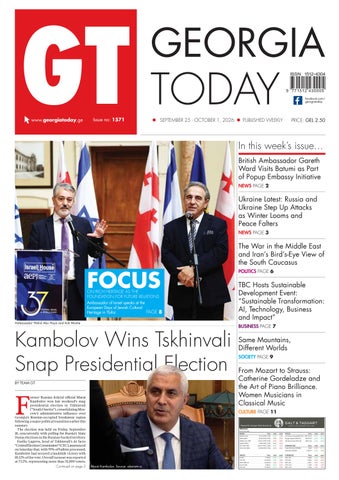
Kambolov Wins Tskhinvali Snap Presidential Election BY TEAM GT
F
ormer Russian federal official Marat Kambolov won last weekend’s snap presidential election in Tskhinvali (“South Ossetia”), consolidating Moscow’s administrative influence over Georgia’s Russian-occupied breakaway region following a major political transition earlier this summer. The election was held on Friday, September 18, concurrently with polling for Russia’s State Duma elections in the Russian-backed territory. Emilia Gagieva, head of Tskhinvali’s de facto “Central Election Commission” (CEC), announced on Saturday that, with 99% of ballots processed, Kambolov had secured a landslide victory with 85.12% of the vote. Overall turnout was reported at 73.2%, representing more than 32,000 voters. Continued on page 2
POLITICS PAGE 6
TBC Hosts Sustainable Development Event: “Sustainable Transformation: AI, Technology, Business and Impact” BUSINESS PAGE 7
Same Mountains, Different Worlds SOCIETY PAGE 9
From Mozart to Strauss: Catherine Gordeladze and the Art of Piano Brilliance. Women Musicians in Classical Music CULTURE PAGE 11 Prepared for Georgia Today Business by
DĂƌŬĞƚƐ Ɛ ŽĨ ϮϮͲ^ĞƉͲϮϬϮϲ
WƌŝĐĞ
ǁͬǁ
ŵͬŵ
^dK <^
WƌŝĐĞ
ǁͬǁ
ŵͬŵ
' KZ' Ϭϭͬϯϭ
ϵϲ͘ϭϵ ;zdD ϲ͘ϭϰйͿ
нϬ͕Ϯй
Ͳϭ͕Ϭй
>ŝŽŶ &ŝŶĂŶĐĞ 'ƌŽƵƉ ; ' K >EͿ ' W ϭϯϵ͘ϱϬ
нϮ͕ϳй
нϲ͕ϲй
'Z /> ϬϲͬϮϴ
KE ^
ϵϲ͘ϰϬ ;zdD ϲ͘ϮϮйͿ
ͲϬ͕Ϭй
ͲϬ͕ϭй
'ĞŽƌŐŝĂ ĂƉŝƚĂů ; ' K >EͿ
' W ϰϱ͘ϯϱ
нϬ͕ϰй
нϯ͕ϱй
ͲϬ͕ϰй
d ĂŶŬ 'ƌŽƵƉ ;d ' >EͿ
' W ϱϮ͘ϯϬ
нϭ͕ϵй
нϵ͕ϲй
WƌŝĐĞ
ǁͬǁ
ŵͬŵ
ϵϵ͕Ϯϱ
Ͳϴ͕ϳй
нϱ͕ϭй
ϰ ϯϲϬ͕ϳϮ
нϭ͕ϲй
Ͳϱ͕ϯй
' '' ϵ ϭͬϮ W ZW
ϭϬϰ͘ϴϭ ;zdD ϵ͘ϱϱйͿ
ͲϬ͕Ϭй
^><Z , ϬϵͬϯϬ
ϵϵ͘ϴϵ ;zdD ϳ͘ϱϯйͿ
ͲϬ͕Ϭй
ͲϬ͕Ϯй
d ϴ͘ϴϵϰ W ZW
ϭϬϬ͘ϱϴ ;zdD ϭϮ͘ϯϬйͿ
нϬ͕Ϭй
ͲϬ͕Ϯй
KDDK /d/ ^
d ϭϬ ϭͬϰ W ZW
ϭϬϳ͘Ϭϴ ;zdD ϵ͘ϳϮйͿ
ͲϬ͕Ϯй
ͲϬ͕ϭй
ƌƵĚĞ Kŝů͕ ƌĞŶƚ ;h^ΨͬďďůͿ 'ŽůĚ ^ƉŽƚ ;h^ΨͬK Ϳ
ǁͬǁ
ŵͬŵ
hZZ E / ^
WƌŝĐĞ
ǁͬǁ
ŵͬŵ
^W ϱϬϬ
ϳ ϳϲϰ͕ϲϰ
нϮ͕ϰй
нϭ͕Ϯй
h^ ͬ ' >
Ϯ͕ϲϬϵϯ
нϬ͕Ϯй
ͲϬ͕Ϭй
&d^ ϮϱϬ
/E / ^
Ϯϰ ϱϮϲ͕ϰϱ
нϯ͕Ϭй
ͲϬ͕ϴй
hZ ͬ ' >
Ϯ͕ϵϴϳϮ
ͲϬ͕ϲй
ͲϮ͕Ϭй
Kt :KE ^ ϯϬ
Marat Kambolov. Source: alaniatv.ru
WƌŝĐĞ
ϱϭ ϴϲϯ͕ϲϵ
ͲϬ͕ϰй
ͲϮ͕ϳй
' W ͬ ' >
ϯ͕ϰϴϭϳ
ͲϬ͕ϵй
ͲϮ͕ϯй
ZƵƐƐĞůů ϮϬϬϬ
Ϯ ϴϴϵ͕ϵϮ
нϬ͕ϳй
Ͳϰ͕Ϯй
hZ ͬ h^
ϭ͕ϭϰϰϵ
ͲϬ͕ϴй
ͲϮ͕Ϭй
&d^ ϭϬϬ
ϭϬ ϳϬϴ͕ϯϯ
нϬ͕ϱй
Ͳϭ͕Ϭй
' W ͬ h^
ϭ͕ϯϯϰϲ
Ͳϭ͕Ϭй
ͲϮ͕Ϯй
2
NEWS
GEORGIA TODAY
SEPTEMBER 25 - OCTOBER 1, 2026
British Ambassador Gareth Ward Visits Batumi as Part of Popup Embassy Initiative Illustrative photo of a kindergarten. Source: shutterstock
NFA: No Violations Found in 81 Samples from Tbilisi Kindergartens BY NANUKA MAGLAKELIDZE
N
o violations were found in 81 samples tested as part of an investigation into cases of norovirusinduced gastroenteritis among children in Tbilisi kindergartens, the National Food Agency said. The agency said laboratory tests for food safety indicators had identified no violations in the 81 samples analyzed so far. The investigation is continuing, with results from the remaining samples to be released in stages. “The National Food Agency is continuing its investigation into cases of norovirus-induced gastroenteritis among children in Tbilisi kindergartens. At this stage, laboratory tests regarding
food safety indicators have confirmed no violations in the 81 samples analyzed. The results of the analysis of the remaining samples will be released in stages,” the agency said. On September 18, children attending public kindergartens were admitted to hospitals with symptoms of suspected intoxication. The National Center for Disease Control and Public Health later said laboratory results indicated that norovirus was highly likely to have caused the vast majority of gastroenteritis cases reported at the kindergartens. The Center said norovirus is the leading cause of viral gastroenteritis worldwide. Georgia’s Investigative Service has also launched an investigation into the suspected intoxication of children at the kindergartens.
Georgian Railway Signs $3.29 Million Contract to Renovate Tbilisi Central Station Platforms BY NANUKA MAGLAKELIDZE
G
eorgian Railway has signed a $3.29 million contract with Maximum LLC for the rehabilitation of passenger platforms No. 2 and No. 3 at Tbilisi Central Station. The contract was signed on September 17, with its total value amounting to $3,292,990, including VAT. BM.GE reported the information. The works are scheduled to be completed within 12 months. The rehabilitation will be carried out in stages, with six months allocated to each platform. The project includes upgrading existing infrastructure, installing new canopies, improving drainage systems, and renovating platform surfaces and lighting. Four new escalators will also be installed, with two on each platform. The project documentation identified several problems with the existing platforms, including issues with surface water drainage systems, reinforced con-
crete structures and drainage channels. It also noted damage to certain sections of the platforms and deviations from the required parallel alignment with the railway tracks. Maximum LLC was registered in the Public Registry on November 8, 2021. The company’s director, Vasil Janghjava, owns a 20% stake, while 80% is held by Erekle Kakabadze. The company’s legal address is in the Bagebi settlement in Tbilisi. Tender documents show that Maximum completed several construction projects in 2023-2025. These include construction works for the Shida Kartli Regional Archive commissioned by the National Archives of Georgia, valued at GEL 3.29 million. The company also carried out construction works for Avaza football school for the Georgian Football Federation, with the main contract valued at $1.72 million. Georgian Railway also planned to rehabilitate the platforms at Tbilisi Central Station in 2024. A tender worth around GEL 4 million was announced at the time, but the procurement process was unsuccessful.
British Ambassador Gareth Ward and local young people in Batumi. Source: FB
BY NANUKA MAGLAKELIDZE
B
ritish Ambassador to Georgia Gareth Ward and the Popup Embassy team visited Batumi as part of the British Embassy’s Popup Embassy initiative, the embassy said. The initiative gives the embassy an opportunity to engage with communi-
ties outside Tbilisi and meet with local partners and young people as part of its outreach activities. During the visit, Ambassador Ward and Head of the NATO Liaison Office Alexander Vinnikov met with young people from Batumi and across the Adjara region. The meeting gave young people an opportunity to learn more about NATOGeorgia relations, as well as the work of the British Embassy and British Council in Georgia. The discussion also provided
an opportunity for participants to engage directly with representatives of the UK and learn more about the institutions’ activities. The British Embassy regularly works with young people in Georgia through educational, cultural and outreach initiatives. “Thank you, Batumi, for the warm welcome!” the British Embassy said. The embassy also published photos from the event.
The British Embassy’s Popup Embassy in Batumi. Source: FB
Kambolov Wins Tskhinvali Snap Presidential Election Continued from page 1 The three remaining candidates trailed in single digits: • Murat Valiev (Patriots of Alania): 3.75% • Kazbek Kodoev (Voter Initiative Group): 2.40% • Zurab Kokoev (Unity Party): 1.35% The 61-year-old Kambolov, a native of North Ossetia within the Russian Federation, spent his career in Russian state institutions. His previous positions included work at the Russian Antimonopoly Committee and the Ministry of Regional Policy, as well as serving as Deputy Minister of Education and Science and director of the National Research Center “Kurchatov Institute.”
Prior to May 2026, Kambolov had no known political or administrative ties to Tskhinvali. His path to the presidency was opened by a bilateral “Treaty on Deepening Allied Interaction” signed between Moscow and Tskhinvali in May 2026. The agreement allowed Russian citizens to hold public office in the territory, removing previous local residency requirements. A month later, de facto President Alan Gagloev unexpectedly resigned on June 23 to take an advisory position under Russian President Vladimir Putin. Kambolov was subsequently appointed Prime Minister and acting President, paving the way for the snap election. Kremlin support for Kambolov was
evident during the short campaign. On July 13, Putin hosted him in Moscow and publicly declared, “We will do everything to support you.” Following the vote, Putin sent Kambolov a formal congratulatory telegram, saying: “Such a convincing electoral victory confirmed the high degree of trust placed in you by South Ossetian citizens. I am confident your work will advance the progressive development of relations between Moscow and Tskhinvali for the benefit of our peoples and in the interests of strengthening regional security.” Georgia does not recognize the election and condemned the polling as part of Russia’s efforts to consolidate control over the occupied territory. Georgia’s Ministry of Foreign Affairs
said: “The holding of any so-called elections in the occupied territories of Georgia under conditions of military occupation and effective control by the Russian Federation - where displaced persons and refugees are denied the opportunity for a safe and dignified return to their homes - is illegal and cannot entail any legal consequences under international law.” The European Union similarly rejected the validity of the process. In a dedicated statement, the EU High Representative said Brussels does not recognize the constitutional or legal framework underlying the vote and described the announced results as “null, void, and without legal effect.” Azerbaijan also said it does not recog-
nize the election or its results. In a statement, Azerbaijan’s Foreign Ministry said: “The Ministry of Foreign Affairs of the Republic of Azerbaijan reaffirms its support for Georgia’s sovereignty and territorial integrity and does not recognize the so-called ‘Presidential elections’ held in the Tskhinvali region of Georgia and their results.” The snap presidential election was held in Georgia’s Russian-occupied Tskhinvali region on September 18, alongside Russia’s State Duma elections. Kambolov’s reported victory marks another step in the territory’s closer institutional alignment with Russia, although Georgia and most of the international community do not recognize the region’s de facto authorities or their electoral processes.
NEWS
GEORGIA TODAY
SEPTEMBER 25 - OCTOBER 1, 2026
3
Ukraine Latest: Russia and Ukraine Step Up Attacks as Winter Looms and Peace Falters COMPILED BY ANA DUMBADZE
T
he Russia-Ukraine war entered another week of heavy attacks and grinding frontline combat, with neither side able to claim a decisive breakthrough. From September 17 to 24, Ukraine stepped up attacks on Russian oil, military and drone infrastructure, including a major assault on Moscow and the surrounding region. Russia continued its own campaign against Ukrainian cities and critical infrastructure, sending waves of drones and missiles against residential areas, factories, railways, fuel facilities and energy networks. At the same time, the diplomatic picture remained unsettled. President Volodymyr Zelensky met US President Donald Trump in New York and pushed for an agreement to halt attacks on energy infrastructure ahead of winter. The Kremlin, however, said there were still no conditions for negotiations to move toward a peaceful settlement. The battlefield itself remained difficult to read. Zelensky said this week that Russian forces had captured about 890 square kilometers of Ukrainian territory since the beginning of 2026, while Ukrainian forces had retaken around 800 square kilometers. He put Russian military losses this year at about 270,000 people. “Vladimir Putin occupied about 890 km this year, and we deoccupied 800 km,” Zelensky said in an interview with The Wall Street Journal. “So that means that in different directions he has 90, okay, let’s say an additional 100 km over the year. It is many times less than it was before, when they were occupying about
3,000-4,000 km a year.” Zelensky’s figures were not independently verified. But they offer his assessment of a battlefield in which Russian forces continue to attack while making relatively slow territorial progress. On the eastern front, Russian forces continued offensive operations along several axes. The Institute for the Study of War (ISW) said Russian authorities were still exaggerating the scale of their advances, including claims that Ukrainian troops around Dobropillya had been encircled. ISW assessed that claim as false and said Ukrainian forces remained active on the northern flank of the Donetsk “fortress belt.” The Lyman sector remained one of the most active areas. Ukrainian forces have been conducting what they call Operation Vivaldi there, seeking to disrupt Russian positions and counter Moscow’s attempts to move toward Lyman and the wider Sloviansk-Kramatorsk defensive area. For Ukraine, the operation has also become a test of whether it can regain some room for maneuver on a battlefield increasingly dominated by drones and dense defensive lines. ISW assessed that the operation demonstrated Ukraine’s ability to restore elements of tactical maneuver after years in which the war had become increasingly positional. Ukraine also continued trying to disrupt the Russian drone network itself. On September 22 and overnight into September 23, Ukrainian forces struck Russian military facilities in the Donetsk and Luhansk regions, according to Ukraine’s General Staff. Among the targets was a drone warehouse belonging to Russia’s Rubicon unmanned systems unit near Volnovakha. Ukrainian forces also struck UAV com-
Presidents Zelensky and Trump in New York this week. Source: meduza
mand posts near Novoselivka Persha and Dachne, a fuel and lubricants depot near Kundryuchyi in Luhansk Oblast, logistics warehouses near Hirnyk and Velyka Shyshovka, and an area where personnel from a Russian UAV unit were concentrated near Krasnohorivka. Further north, fighting continued in Sumy Oblast. Ukrainian military personnel said Russian troops were increasingly relying on small infiltration groups rather than large frontal assaults. A Ukrainian battalion deputy commander cited by ISW said Russian soldiers were repeatedly attempting to infiltrate Ukrainian positions despite heavy losses, while the density of Ukrainian drone operations was making further advances increasingly difficult. For civilians living near the front, however, the distinction between a slow ground offensive and an active war remained largely academic. On September 23, Russian forces
launched several glide-bomb attacks on Sumy, injuring seven people. In Donetsk Oblast, a Russian aerial bomb strike on Oleksandrivka, near the strategically important Kramatorsk area, killed five people and wounded six, according to Ukrainian regional authorities. In the south, the frontline remained comparatively static. Ukrainian forces recently advanced or maintained positions in southern Orikhiv in Zaporizhzhia Oblast, according to geolocated footage assessed by ISW, while Russian troops continued localized infiltration attempts. Ukraine also stepped up attacks on Russian logistics behind the front, striking military trucks along the MariupolBerdyansk highway, around 90–95 kilometers from frontline positions. There was little reported ground activity in the Kherson direction during the latter part of the week. Away from the front, however, the war was becoming increasingly difficult to
contain geographically. On September 17, Ukraine’s Security Service said its long-range drones had struck Rostov-Central military airfield, targeting an An-12 transport aircraft, two An-26 aircraft and three helicopters. The same operation also targeted the Yaroslavl oil refinery, where a fire was reported. The campaign escalated over the weekend. On the night of September 19–20, Ukraine launched what ISW described as its largest combined strike package against strategic targets in Moscow Oblast since the beginning of the full-scale invasion. Russian authorities said three people were killed in the Moscow region. The Moscow oil refinery, a major facility owned by Gazprom Neft, was also hit. Industry sources later told Reuters that crude processing had been halted after fires damaged primary distillation units. The attacks form part of a broader Ukrainian effort to put pressure on Russia’s refining capacity, fuel supplies and wartime revenues, while forcing Moscow to divert air-defense resources to facilities far from the battlefield. Ukraine has also continued striking energy infrastructure in occupied territories. By September 23, the commander of Ukraine’s Unmanned Systems Forces said Ukrainian forces had struck ten gas distribution stations in occupied Crimea since the beginning of the month and 412 power-related nodes across occupied Ukraine and Russia since roughly July. Russia, meanwhile, continued its own aerial campaign. On September 18, missile and drone attacks injured at least 19 people, including children, in Kyiv and surrounding areas, while residential buildings were damaged in Odesa. A civilian vessel in Continued on page 5
4
POLITICS
GEORGIA TODAY
SEPTEMBER 25 - OCTOBER 1, 2026
Publika: Occupied Abkhazia Discusses Military Registration of Students in Russia SOURCE: PUBLIKA
P
eople holding Russian citizenship and citizenship granted by the de facto authorities in occupied Abkhazia who permanently reside in Russia may be registered for military service in order to be drafted into the Russian army. De facto Foreign Minister of occupied Abkhazia Oleg Bartsits said the issue of military registration of Abkhazian students living in Russia was discussed during meetings with Moscow. De facto President of the occupied region Badra Gunba said the de facto Foreign Ministry was working on his instructions to ensure that Abkhazian students in Russia were registered for military service in Abkhazia rather than Russia. He said negotiations on the issue were ongoing. The statements coincide with reports by independent Russian media that Moscow is preparing to launch a new stage of mobilization. On September 23, Bloomberg reported that senior Russian officials were seeking access to foreign bank accounts and moving assets abroad. The outlet said employees of military recruitment offices were taking similar steps. Bloomberg also reported that it had obtained evidence that recruitment office employees were advising relatives and friends to leave Russia. Moscow has repeatedly denied the reports. Under an agreement that entered into force in 2025, people holding Russian citizenship and citizenship recognized
Abkhaz students in uniform. Source: JAMnews
by the de facto authorities in occupied Abkhazia are required to complete compulsory military service in the territory where they permanently reside. On this basis, Abkhazian students living in Russia could be drafted into Russia’s fullscale war against Ukraine. Those who have already completed compulsory military service in occupied Abkhazia are exempt. On December 27, 2025, Russian President Vladimir Putin and de facto President of the occupied Abkhazian region
Badra Gunba signed an agreement providing for support for the implementation of the state program for the socioeconomic development of occupied Abkhazia for 2026-2030. Putin formally approved the agreement on August 5, 2026. Previously, under Russian law, everyone holding a Russian passport was considered exclusively a Russian citizen, regardless of whether they also held an Abkhazian passport. This meant that students at Russian universities were
subject to mandatory military registration. “This fall, my son, who studies at a university in Moscow, told me shocking news that he had received a summons from the military registration and enlistment office,” a resident of Sukhumi told OC Media after the 2025 agreement was signed. “I panicked, I thought that he might be sent to the SVO [the ‘special military operation’, as Russia calls its invasion of Ukraine]. Then, of course, I calmed down
– he is still a student, but what will happen after graduation? He is registered, they can take him into the Russian army and from there send him to war. But now he has the right to choose. And this is a great joy for all Abkhazian mothers,” the woman continued. “Abkhazian passports” are recognized by only four countries: Russia, Nicaragua, Syria and Venezuela. As a result, travelling, studying or working abroad without a Russian passport is practically impossible. However, Russia’s policy of issuing citizenship and passports to residents of the region has previously sparked controversy. In early 2026, Russia began issuing internal Russian passports in Abkhazia, intended for use in Russia for employment and access to various services. At the time, opposition Kan Kvarchiya said the issuance of the passports amounted to an encroachment on Abkhazia’s sovereignty. Although Russia suspended the issuance of the documents a month later and moved the process to Sochi, attention on Kvarchiya increased following the incident. In June, a Russian court sentenced Kvarchiya in absentia to 10 years and six months in a strict-regime penal colony. He was charged with robbery. The case concerns an alleged attack on Russian political consultants involving Kvarchiya during the 2025 local elections of the de facto authorities in occupied Abkhazia. The original article was produced as part of a partnership agreement between Publika and OC Media.
Kobakhidze Meets UN SecretaryGeneral António Guterres
French national Martin Ryan, accused of espionage, attends a court hearing in Baku, Azerbaijan January 6, 2025. Source: Reuters
Aliyev Pardons French National after EU Lifts Sanctions on Russian Oligarchs BY NANUKA MAGLAKELIDZE
A
zerbaijani President Ilham Aliyev has pardoned 20 prisoners, including French citizen Martin Ryan, according to a decree published on the president’s official website on September 23. Most of those pardoned are Azerbaijani citizens. The list also includes citizens of Türkiye and Pakistan, as well as a Russian citizen who also holds Israeli citizenship. Ryan, CEO of Mercorama, was arrested in Azerbaijan in December 2023 on charges of spying for France. He denied the allegations. In March 2026, an Azerbaijani court found Ryan guilty and sentenced him to 10 years in prison. Ryan’s pardon comes after reports that France had sought the removal of EU sanctions against Russian oligarch Alisher
Usmanov, who is close to Russian President Vladimir Putin. Earlier in September, the Financial Times reported, citing sources, that France had been lobbying to have Usmanov delisted from the sanctions list in exchange for Azerbaijan releasing French nationals imprisoned in the country. For their part, Baku denied it had been lobbying France to delist Usmanov. France declined to explain its request to remove sanctions against Usmanov, saying only that it was linked to a “specific national security issue.” On September 22, the European Union lifted sanctions against Usmanov and another Russian oligarch, Mikhail Fridman. Relations between Azerbaijan and France have deteriorated since Paris backed Armenia in the Nagorno-Karabakh conflict. Armenia has begun purchasing armored vehicles from France, while Paris has also confirmed its readiness to provide Armenia with air defense missiles.
Georgian Prime Minister Irakli Kobakhidze and UN Secretary-General António Guterres. Source: X
BY NANUKA MAGLAKELIDZE
G
eorgian Prime Minister Irakli Kobakhidze met with United Nations SecretaryGeneral António Guterres, the Government Adminis-
tration said. The meeting highlighted the longstanding cooperation between Georgia and the United Nations, with discussions focusing on international peace and security and the importance of multilateral partnerships in promoting stability and sustainable development. The officials also discussed the humanitarian situation and security challenges in Georgia’s occupied territories. Kobakhidze thanked Guterres for his support for Georgia’s territorial integrity and sovereignty and highlighted the
importance of a UN General Assembly resolution on the status of internally displaced persons and refugees from Abkhazia and the Tskhinvali region/ South Ossetia. The meeting also addressed peace, security and sustainable development, which are among the central themes of the general debate of the 81st session of the UN General Assembly. Kobakhidze later said on X that the two sides had discussed Georgia-UN cooperation, the UN’s role in the conflict resolution process in Georgia and opportunities to further strengthen the partnership. “I am pleased to have met with UN Secretary-General António Guterres. At the meeting, we discussed cooperation between Georgia and the United Nations, the UN’s role in the conflict resolution process in Georgia, and opportunities to further strengthen our partnership,”
Kobakhidze wrote. The Georgian prime minister also made a commemorative entry in the UN Guest Book of Honor.
KOBAKHIDZE HOLDS BILATERAL MEETINGS DURING UN VISIT As part of his visit to the United Nations, Georgian Prime Minister Irakli Kobakhidze held bilateral meetings with: • Council of Europe Secretary General Alain Berset; • Swiss Vice President, Foreign Minister and OSCE Chair-in-Office Ignazio Cassis; • Turkish President Recep Tayyip Erdogan; • Nauru President David Adeang, during which Georgia and Nauru established diplomatic relations. PM Kobakhidze also addressed the session of the United Nations General Assembly on Thursday.
POLITICS
GEORGIA TODAY
SEPTEMBER 25 - OCTOBER 1, 2026
Kobakhidze: We Discussed Georgia’s Cooperation with OSCE
Ignazio Cassis OSCE Chairperson-in-Office with Georgia's PM Irakli Kobakhidze. Source: X
BY NANUKA MAGLAKELIDZE
G
eorgian Prime Minister Irakli Kobakhidze, who was in New York this week to attend the 81st session of the UN General Assembly, met with OSCE Chairperson-in-Office Ignazio Cassis, who is also Vice President of Switzerland. Kobakhidze wrote on X that during his meeting with Cassis, they discussed bilateral relations between Georgia and Switzerland and opportunities to further deepen cooperation between the two countries. “I met with Ignazio Cassis, Vice President of the Swiss Federal Council, Head of the Federal Department of Foreign Affairs and OSCE Chairpersonin-Office. We discussed Georgia-Switzerland bilat-
eral relations and opportunities to further deepen cooperation between our countries. We also touched upon Georgia’s engagement with the OSCE and our active participation across the Organization’s key areas of work,” Kobakhidze wrote. OSCE Chairperson-in-Office Ignazio Cassis is expected to visit Georgia in October. Before Cassis, the position was held by Finnish Foreign Minister Elina Valtonen, who visited Georgia in October 2025. During her visit, she went to Rustaveli Avenue in central Tbilisi, where she met participants of the pro-European demonstrations that began on November 28, 2024. Following the visit, Georgia’s Foreign Ministry sent a protest note to OSCE participating states. The Interior Ministry also issued Valtonen a GEL 5,000 fine for “blocking the road.” At the time, ten countries expressed their support for the OSCE Chairperson-in-Office.
Ukraine Latest: Russia and Ukraine Step Up Attacks as Winter Looms and Peace Falters Continued from page 3 the Black Sea was also struck, killing its captain. A much larger Russian attack followed on September 22. Ukrainian officials said eight people were killed in strikes across the country, including attacks on industrial and frontline regions. Russia launched ballistic and cruise missiles alongside more than 200 drones, with Dnipro among the principal targets. The attacks were not limited to military targets. Ukrainian authorities reported damage to industrial facilities as Russia continued to hit economic, logistical and transport infrastructure. The following day brought another major wave. According to the Ukrainian Air Force, Russia launched 161 drones and loitering munitions on September 23. Ukrainian defenses reported shooting down 119 drones and three additional loitering munitions, but strikes or falling debris were recorded in numerous locations. Infrastructure in Chernihiv, Kyiv, Poltava, Odesa and Zaporizhzhia regions was affected. Kyiv endured one of the week’s longest attacks, stretching from morning into the evening. The assault included faster, jet-powered drones, creating additional challenges for Ukrainian air defenses. Two people were killed and 45 wounded, Kyiv Mayor Vitali Klitschko said. Railway infrastructure, warehouses, businesses and fuel stations were damaged, while damage to data centers caused internet disruptions affecting approximately 100,000 households. Ukrnafta said one of its petrol stations was destroyed, marking what the company described as the sixth Russian strike against its infrastructure in recent weeks. The attacks came as the question of energy became increasingly tied to diplomacy. With winter approaching, Ukraine is seeking to prevent another campaign against its electricity and heating infrastructure, while Russia has also come under pressure from Ukraine’s attacks on its oil facilities. Zelensky met Trump on the sidelines of the UN General Assembly and discussed a possible bilateral halt to attacks on energy facilities. Zelensky said Ukraine was prepared for “any format” of such an arrangement, provided Russia also stopped striking Ukrainian infrastructure.
He also sought additional Patriot air-defense systems as Ukraine prepares for the colder months. No agreement was reached. US Secretary of State Marco Rubio subsequently met Russian Foreign Minister Sergei Lavrov in New York. Rubio said both sides had expressed interest in a limited arrangement involving energy and grain-related infrastructure, while stressing that such an agreement would not itself end the war. The Kremlin, however, remained publicly skeptical. Dmitry Peskov said the current circumstances did not allow negotiations to move toward a peaceful settlement, while again saying that Zelensky could travel to Moscow for talks. “There are currently no conditions for the negotiations to move towards a peaceful settlement,” Peskov said. “Our position is well-known. Putin said that Zelensky can come to Moscow if he wishes. He will be provided with the necessary security guarantees.” The comments came as Zelensky continued to say he was ready for direct talks with Russian President Vladimir Putin, provided they could produce a concrete result. The two sides remain far apart over the conditions for ending the war. Western support for Kyiv continued alongside the diplomatic efforts. On September 18, the European Commission disbursed another €3.3 billion under the EU’s Ukraine Support Loan, with the money earmarked for critical defense procurement, including missiles and drones. The Commission said nearly €15 billion had been provided to Ukraine during 2026 under the program for defense and budget support. The EU also extended sanctions for another three years against more than 3,000 individuals and entities accused of undermining Ukraine’s territorial integrity, sovereignty and independence. For now, then, the war continues to move in two directions at once. Along the front, Russia is still trying to gain ground, while Ukraine is trying to recover territory and make those advances increasingly costly. Far from the trenches, both sides are striking deeper into each other’s infrastructure, while diplomats continue to search for a way to halt at least part of the violence before winter. Neither track has yet produced a breakthrough.
5
Papuashvili: The CoE Should Explain How Funding a Radical Politician’s Political Project is Compatible with Promoting Civic Dialogue BY NANUKA MAGLAKELIDZE
P
arliament Speaker Shalva Papuashvili has called on the Council of Europe to explain how funding the Tbilisi School of Political Studies is compatible with promoting civic dialogue. “The Council of Europe should explain how funding the political project of a radical politician is compatible with promoting civic dialogue, and what message it sends to society when it funds a politician who rejects election results and describes the government as a Russian regime,” Papuashvili wrote on social media. Papuashvili was commenting on the activities of the Tbilisi School of Political Studies, which operates under the auspices of the Council of Europe in Georgia. He said such support “only strengthens political radicalism and extremism and undermines the impartiality and credibility of the Council of Europe itself.” Papuashvili said the Council of Europe was funding a gathering organized in Bakhmaro by Armaz Akhvlediani and presenting it as a project promoting “civic dialogue.” He described Akhvlediani as a politician who was a member of the Parliament elected in 2020 on the party list of Giga Bokeria’s faction of the United National Movement, while in the 2024 parliamentary elections he ran directly on the party list of “dictator” Mikheil Saakashvili. Papuashvili also referred to statements Akhvlediani made on election night in 2024, when he said that “Ivanishvili’s police regime has been defeated, although it shamelessly refuses to acknowledge it and, through its obedient CEC, declares victory. All four victorious opposition parties are now obliged to prevent Georgian Dream from seizing power.” Papuashvili also said Akhvlediani had previously refused to recognize the 2020 election results. The Tbilisi School of Political Studies was established as a non-governmental organization in 1999. The school operates under the auspices of the
Shalva Papuashvili, Speaker of the Parliament of Georgia.
Council of Europe and is headed by politician Armaz Akhvlediani. A seminar held in Bakhmaro last week became the subject of criticism from government representatives, including Prime Minister Irakli Kobakhidze and Papuashvili. The government said that under the Law on Grants, funding for the Tbilisi School of Political Studies by the Council of Europe required the government’s approval, which had not been obtained. The Financial Transparency Department of the State Audit Office has also launched monitoring of the Tbilisi School of Political Studies. The agency said the monitoring was initiated over the alleged receipt of a grant by the non-entrepreneurial (non-commercial) legal entity “Union Tbilisi School of Political Studies” without the approval of the Georgian government. The State Audit Office also said it would question all individuals who may possess information relevant to the school’s funding.
6
POLITICS
GEORGIA TODAY
SEPTEMBER 25 - OCTOBER 1, 2026
The War in the Middle East and Iran’s Bird’s-Eye View of the South Caucasus
Iran and its neighbors. Source: GGSPN
ANALYSIS BY EMIL AVDALIANI*
T
he war involving Iran is reshaping the strategic situation in the South Caucasus even though Armenia, Azerbaijan, and Georgia have remained outside the direct theater of hostilities. Its effects are nevertheless increasingly visible. The conflict is creating new security concerns, disrupting economic calculations, and accelerating geopolitical shifts that had already begun to transform the region before 2026. The South Caucasus entered the current crisis at a particular moment when Russia’s traditional dominance had already been weakened by the war in Ukraine and by Moscow’s reduced ability to concentrate political, military, and economic resources on the region. Turkey, by contrast, had been steadily expand-
ing its influence, particularly through its strategic relationship with Azerbaijan and its growing role in regional transport and trade. At the same time, East-West connectivity projects were gaining momentum as Europe and Central Asia sought alternatives to routes passing through Russia and Iran. The result is a much more crowded geopolitical environment. The United States and the European Union have become more directly engaged in questions of regional peace, infrastructure, energy, and connectivity. China is seeking a larger economic and logistical role, while Central Asian states increasingly see the South Caucasus as their principal westward gateway. This has created a degree of geopolitical pluralism that is unusual for a region historically dominated by one or two major powers. Iran occupies a distinctive position within this emerging order. Tehran has long regarded the South Caucasus as
part of its immediate strategic neighborhood and as an area where developments can directly affect Iranian national security. It has never, however, been the dominant external power. Imperial Russia and later the Soviet Union shaped the regional order for much of the nineteenth and twentieth centuries, while the Russian Federation retained primacy after 1991. Iran nevertheless played an important balancing role. It maintained close political and economic relations with Armenia, built significant trade ties with Azerbaijan despite recurrent political tensions, and preserved pragmatic relations with Georgia. More broadly, Tehran sought to prevent the South Caucasus from becoming a platform from which rival powers could project influence toward Iran itself. In Iranian strategic thinking, the deeper concern is the regional balance that infrastructure, alliances, and external security partnerships can even-
tually produce. This is particularly evident in Iran’s approach to Armenia’s southern province of Syunik. For Tehran, the ArmenianIranian border is a strategic asset that provides Iran with direct access to Armenia and, through Armenia and Georgia, to the Black Sea and potentially European markets. Any arrangement that could weaken Armenian control over Syunik has therefore been treated by Tehran with considerable suspicion. This explains Iran’s longstanding hostility toward the idea of what Baku calls “Zangezur corridor” and its cautious, and often negative, response to the Trump Route for International Peace and Prosperity, or TRIPP. From Tehran’s perspective such a route becomes problematic if it is accompanied by new security arrangements or a reduction in Armenia’s effective sovereignty over the transit area. The extent to which Iran regards this issue as strategic became visible in early March, when the US-Israeli military campaign began against Islamic Republic, and the latter struck the Nakhchivan exclave, through which the proposed route is expected to pass. The episode underlined an important feature of Iranian policy: connectivity is viewed as part of the regional balance of power. At the same time, the war is weakening Iran’s ability to resist unfavorable regional developments through diplomacy, economic pressure, and political influence. Tehran must now devote greater attention and resources to immediate military and domestic priorities. This creates additional space for other actors to advance connectivity projects that Iran had previously attempted to slow, reshape, or balance. This change coincides with the growth in Western-backed infrastructure initiatives. The United States, the European Union, Armenia, and Azerbaijan are increasingly linking regional normalization with transport development. In July, the European Union announced up to 200 million euros in grants for transport, energy, and digital infrastructure under its “Peace through Connectivity” initiative. Washington has also expanded diplomatic and material support for TRIPP as railway and road projects con-
nected to the broader regional transport network move forward. If these routes become operational, the South Caucasus could become more closely integrated into an East-West transport system connecting Central Asia, the Caspian Sea, Turkey, the Black Sea, and the European market, damaging Iran’s position. Despite these profound changes, Tehran continues to perceive the region as an integrated strategic space linking Iran with Russia, the Black Sea, Europe, and Central Asia. Its objectives are largely defensive. Iran seeks to prevent the emergence of military or political arrangements that could threaten its northern borders. This defensive logic also explains Iran’s prefrence for regional diplomatic mechanisms. Tehran has consistently supported the initiatives that bring together Armenia, Azerbaijan, Iran, Russia, and Turkey, with Georgia refusing to participate thus far. The approach reflects Iran’s broader conviction that the South Caucasus should be managed primarily by the states of the region rather than shaped by Western powers. For Tehran, the format serves several purposes. It limits the legitimacy of external involvement, keeps Iran institutionally involved in regional negotiations, and places it alongside Russia and Turkey despite the differences in their respective capabilities. Transit policy is another important part of this strategy. Iran wants the South Caucasus to remain connected to its own transport system rather than developing exclusively through East-West routes that bypass Iranian territory. Therefore, the current war may therefore weaken Iran’s ability to shape events, but it does not necessarily change what Iran wants. Tehran will continue defending the Armenian-Iranian border, opposing the militarization of new corridors, promoting north-south connectivity, and resisting Western involvement. *Emil Avdaliani is a research fellow at the Turan Research Center and a professor of international relations at the European University in Tbilisi, Georgia. His research focuses on the history of silk roads and the interests of great powers in the Middle East and the Caucasus.
BUSINESS
Wrecked Summit Brings Failure Stories to Tbilisi’s Business Community BY TEAM GT
S
uccess may dominate Tbilisi’s business conversations, but last week’s Wrecked Summit put failure, setbacks and the stories behind them firmly in the spotlight. Held at Terminal on Abashidze Street, the summit was organized by Wrecked co-founders Ketana Sturua and Salome Kutarashvili and brought together professionals from business, technology, advertising, design, product development and entrepreneurship under the theme “Built From Failure.” The event put failed ideas, rejected opportunities, difficult decisions and career setbacks at the center of the conversation, alongside more conventional discussions of professional success. The summit featured 23 speakers across three zones, with 15 partners involved. Organizers said 496 people registered
for the event.
FROM FAILURE STORIES TO PRACTICAL WORK Wrecked’s Main Stage featured speakers from branding, advertising, technology, product development, architecture and design, focusing not only on where they are today but on the setbacks and decisions that shaped their professional paths. The summit also included a Build Zone, where participants worked for 60 minutes on real-world challenges in graphic design, UI/UX design, development and social media, using AI as part of their workflow. Finalists from each discipline then formed a multidisciplinary team for a final challenge and presented their solution on the Main Stage. A separate Networking Zone brought together professionals, startups, educational organizations and businesses. The event was designed to create a space where professional setbacks could be discussed openly alongside achieve-
ment, with a focus on what happens afterward and how failed projects, rejected ideas or unexpected setbacks can shape future work.
WHAT COMES NEXT The response to the first Wrecked Summit exceeded the organizers’ expectations, with registration closing earlier than planned after nearly 500 people signed up. “It’s clear to us that Wrecked made a strong first statement and showed that there is real demand for this kind of honest conversation,” Sturua said. She said the summit gave audiences an opportunity to hear stories and experiences that are rarely discussed publicly, including “not just the polished side of success, but what actually happened along the way.” Sturua added that the event had received positive feedback from both attendees and speakers. Wrecked is scheduled to return in March, with the organizers already working on the next edition.
BUSINESS
GEORGIA TODAY
SEPTEMBER 25 - OCTOBER 1, 2026
7
Trump: "Russia has unfortunately lost control of its Diesel Oil Industry" DJT”, Trump wrote. The President of Ukraine also responded to the US President on social media. According to Ukrainian President Volodymyr Zelensky, “Russia’s war against Ukraine and against common sense must end.” Ukraine has sought peace from the very first moment and has put forward dozens of diplomatic proposals “to end the war with dignity, with guaranteed security and to prevent new Russian invasions.” President Zelensky said that dialogue with President Trump and the United States is still ongoing, and ideas for bringing peace closer are being discussed, including decisive steps toward de-escalation. Ukraine is ready to take corresponding steps toward de-escalation if Russia stops strikes against Ukraine’s energy sector and food export routes.
BY NANUKA MAGLAKELIDZE
U
SPresidentDonaldTrump called the Russia-Ukraine war a “disgrace” in a post published on his Truth Social account on Sep-
tember 21. Trump cited among the consequences of the war that “Russia has unfortunately lost control of its diesel industry.” “Russia has unfortunately lost control of its Diesel Oil Industry due to its War with Ukraine. A large number of their Diesel refineries have been blown up and are, at least temporarily, out of commission. This ridiculous and never ending War with Ukraine must be ended. The whole World suffers as 25,000 people, mostly soldiers, are being killed each month. What a shame! President
Donald Trump, US President, and Vladimir Putin, Russian President. Source: AP
TBC Hosts Sustainable Development Event: “Sustainable Transformation: AI, Technology, Business and Impact” BY TEAM GT
Georgia’s foreign trade in January-August 2026, with Kyrgyzstan ranking as the country’s largest export market and Türkiye as its largest import partner.
Geostat: Kyrgyzstan was Georgia’s Largest Export Market, Türkiye Top Import Partner in January-August 2026 BY NANUKA MAGLAKELIDZE
T
he share of Georgia’s top 10 export partner countries accounted for 68.8% of the country’s total exports in January-August 2026, data from the National Statistics Office of Georgia showed. Kyrgyzstan ranked first among Georgia’s largest export partners with $577.6 million in exports, followed by China with $543.7 million and Russia with $500.7 million. In imports, Georgia’s top 10 import partner countries accounted for 70.2% of total imports during the same period.
Türkiye ranked first with $1.9186 billion in imports, followed by Russia with $1.5318 billion and the United States with $1.5105 billion. Passenger cars were the leading export commodity in January-August, with exports worth $1.3477 billion, accounting for 24.9% of total exports. Petroleum and petroleum products ranked second at $688.9 million, followed by ores and concentrates of precious metals at $403.1 million. Passenger cars also represented Georgia’s largest import commodity group, with imports totaling $2.3643 billion, or 18.9% of total imports. Petroleum and petroleum products ranked second at $1.1647 billion, while medicaments came third at $468.4 million.
A
s a technology company, TBC is committed to combining innovation and development with a responsible approach. This vision was at the heart of TBC’s 2026 Sustainable Development Event, which focused on the role of artificial intelligence (AI) in advancing sustainable development and creating new opportunities for positive impact. Held at the multifunctional TBC Concept space, the event brought together more than 100 guests, including representatives of partner organizations, international institutions, businesses and media, as well as TBC employees and customers. The event was opened by Nino Masurashvili, TBC Deputy CEO and Chief Risk Officer, who spoke about the bank’s technological achievements and the positive impact that innovation is having on businesses, employees and society today. Maka Bochiorishvili, TBC’s ESG Coordinator, presented the company’s work in sustainable development. Her presentation highlighted the importance of TBC’s sustainable portfolio, green financing and renewable energy initiatives, as well as the bank’s support for women’s empowerment, diversity and sustainable education.
A central part of the event was a keynote presentation by Ana Avaliani, Director of Enterprise and Spatial Development at the Royal Academy of Engineering in the UK, who explored the importance of sustainable transformation. She discussed international practices, established perceptions and the real potential for sustainable transformation. The event also featured a panel discussion with TBC technology experts Konstantine Khoperia and Nutsa Abazadze, alongside Shota Elkanishvili of GAIA and Grazia Frontoso of Databricks, represent-
ing TBC’s partner companies. The discussion focused on jointly implemented projects, the relationship between AI and inclusion, and future opportunities that could have a significant impact on people, businesses and society as a whole. The event concluded with a presentation and exhibition tour led by Natela Grigalashvili, who explored the connection between sustainability and art. She introduced the audience to the history of Georgians living in Fereydan and highlighted the role of documentary photography in preserving memory, history and cultural heritage.
Flights by Iranian Airlines Suspended in Georgia BY NANUKA MAGLAKELIDZE
F
lights by Iranian airlines sanctioned by the United States have been suspended in Georgia. The Iranian airlines operated their last flights on September 20. Starting September 21, their operations in the Georgian aviation market will be restricted, RFE/RL reports. On September 8, the United States imposed sanctions on 36 companies and organizations over their support for Iran’s aviation sector. The list included compa-
nies operating flights to Georgia. On September 10, the Civil Aviation Agency said Georgia would act in “full compliance with the international sanctions regime” and take into account sanctions mechanisms imposed by the European Union and the United States. Following the statement, the Embassy of Iran in Georgia published a map of the Black Sea region showing only the western part of Georgia, including occupied Abkhazia, and said: “This is a decision that we should respect as the choice of this country. However, Iranians will travel, see and learn about it… and perhaps new friendships will emerge precisely through this new choice.”
Iranian Ambassador Seyed Ali Mojani also said on September 13 that “in today’s global economy, excluding one … trade route does not always mean creating a new opportunity.” In a comment, he also wrote that Georgia had taken the step of restricting Iranian companies “for America’s greatness.” On September 14, the ambassador added that Tbilisi’s decision “has human and social consequences, along with economic consequences.” He also wrote about “the preservation of language and identity by Fereydanis over 400 years” and listed among the risks of Georgia joining the sanctions “the severing of social and human ties between Georgian society
and Georgians living outside Georgia.” In response to the Iranian ambassador’s statements, Georgian Prime Minister Irakli Kobakhidze said Tbilisi’s policy should be “approached in every sense.” “Generally, making public statements on such issues is incorrect. If we have anything to say to the ambassador, we will speak to the ambassador,” Kobakhidze initially told journalists on September 14 at the government administration. “You know what our approach is: if international sanctions are in effect, we always join such sanctions regimes. We do not allow sanctions evasion,” Kobakhidze said. On September 17, Kobakhidze also said
that Georgia takes into account the sanctions regime against Iran but does not impose bilateral sanctions on the country. “That would be absurd and incorrect. We act in accordance with the established sanctions regime,” Kobakhidze told journalists. Georgia received 29,397 visitors from Iran in the first six months of 2026, down 48.7% compared with the same period in 2025, data from the Georgian National Tourism Administration showed. The decline was caused by the war waged by the United States and Israel against Iran, during which flights from the region, including Iran, were suspended.
8
SOCIETY
GEORGIA TODAY
SEPTEMBER 25 - OCTOBER 1, 2026
Natia Shamatava and Itsik Moshe
Israeli Ambassador: Rich Heritage Is the Foundation for Future Relations BY KESARIA KATCHARAVA
A
s part of the European Days of Jewish Cultural Heritage, an event organized by the Israeli House was held in Tbilisi, at the National Library of Georgia. The event highlighted the importance of Jewish culture and heritage, as well as public diplomacy between Georgia and Israel, and tomorrow’s connections. The event was attended by Israeli Ambassador to Georgia Walid Abu Haya, Head of the Council of Europe Office in Georgia William Massolin, Deputy Minister of Culture Natia Shamatava, Ambassador of India Amit Kumar Mishra, guests from Israel, students, representatives of Georgian society, Head of the Akhmeteli Theater Irakli Gogia, members of an Israeli theater troupe, and Evgeniia Lushnikova, Chief Operating Officer (COO) of the Israeli international company European Village, which is distinguished for its charitable activities. The event was opened by the Israeli Ambassador, who was the main guest of the event. He noted that Georgia is the
best example of how Georgians and Jews have coexisted peacefully and harmoniously for centuries, and how it also serves as an excellent example for other societies. Georgia can be proud of this, he said. “This is history, but for me, as Israel’s Ambassador, it is also a foundation for deepening the friendship between Israel and Georgia. I expect that, on this historical foundation, we will build even better relations between our two countries,” Walid Abu Haya stated, adding that, despite the disinformation being spread around the world against Israel, “the truth will ultimately prevail.” He then thanked the head of the Israeli House, Itsik Moshe, for his work in public diplomacy. Speaking at the event, Deputy Minister of Culture Natia Shamatava noted: “For centuries, Georgia has been and remains a country where different cultures, religions, and traditions coexist harmoniously. Jewish traditions, manuscripts, architecture, music, and the culture of everyday life are our shared heritage, which deserves protection, study, and respect. Protecting cultural heritage is not only about preserving the past, it is also about taking respon-
From left to right: Itsik Moshe, Ambassador Walid Abu Haya, Natia Shamatava, William Massolin, Amit Kumar Mishra
Evgenia Lushnikova and distinguished guests
sibility for the present and the future. That is why the Ministry of Culture of Georgia attaches particular importance to the protection and promotion of the cultural heritage of all ethnic and religious communities.” Itsik Moshe, head of the Israeli House, also addressed the audience. According to him, remembering the past and preserving its heritage is of particular importance. At the same time, it also contrib-
utes, through public diplomacy, to strengthening relations between states and peoples and, above all, to creating and strengthening a foundation for cooperation among future generations. Itsik Moshe emphasized the involvement of young people in strengthening relations between the two countries, and recalled the visit of Georgian students to Israel this summer and their meetings with Israeli young people.
He highlighted global objectives and the growing dynamics of tourism, noting that the “3,000-year Biblical Route,” which is based on cultural heritage, attracts additional tourist flows from Israel and Europe. Through cooperation with Israel, the overall contribution to the tourism sector has already reached approximately $600 million. By strengthening joint work and cooperation, this figure could increase to $1 billion in Georgia’s economy by 2030. It was also highlighted at the event that the Council of Europe promotes intercultural dialogue, mutual understanding, and the protection of Europe’s shared cultural heritage. In this regard, AEPJ, the European Association for the Preservation and Promotion of Jewish Culture and Heritage, plays an important role. This year, the Israeli House built the event’s central message around the theme of LOVE and created the slogan “The love for tomorrow in memory of yesterday.” This message combines historical memory with a future-oriented vision and presents culture and heritage as important instruments of public diplomacy between peoples and countries. The Israeli House, which was selected by the Ministry of Culture in 2017 to represent Georgia’s Jewish cultural heritage in Europe, adapted this year’s program to both the past and tomorrow, in keeping with the spirit of the European Days of Jewish Culture and the vision of the Council of Europe, which considers Jewish culture an integral part of European civilization. Evgenia Lushnikova, Chief Operating Officer (COO) of European Village, also spoke at the event. According to her, the company is a partner of the Israeli House in all its activities and is an active supporter of Georgia-Israel ties in the field of culture. A clip prepared by the Israeli House was shown at the event, titled “The Israeli House’s New Vision: Bilateral public Diplomacy and Dialogue between Cultures.” It emphasizes that antisemitism in the world is a problem for the countries where it is cultivated, since such a country can never become civilized and successful. The discussion also addressed cultural projects that will be jointly implemented in Israel next year. It should be noted that at the beginning of the event, Georgian singer Ia Chantladze performed the Hebrew song “Avinu Malkenu,” while at the conclusion, she performed the national anthems of Israel and Georgia. “We love the future, we remember the past, and we build the future on the foundation of this heritage.”
SOCIETY
GEORGIA TODAY
SEPTEMBER 25 - OCTOBER 1, 2026
9
All Change. Part 2 BLOG BY TONY HANMER
R
enovation continues at Hanmer House in Svaneti, as the two new private bathrooms I mentioned last issue take shape, twins in size and next to each other. Envisioning them was the easy part, measuring their size and determining their position. Easier said than
done, though, are “how water will reach them from the 1000L tank and its pump” and “how all their black water will join the existing underground pipe system and drainage.” We had asked that as much of their piping system inside the house be exposed, not hidden behind walls or under floors if possible, so that in the event of leaks or whatever, the system would be easily accessible for repair or part replacement. Not that you EXPECT such things; but history has
Guesthouse renovations. Photo by the author
taught us some bitter lessons, from which we had better learn! Function over form, in this case, please. It seems miraculous that, 13 years after it was installed, our original covered underground black water drainage pit has not yet needed emptying by vacuum tank truck even once. True, every bathroom has a sign asking for toilet paper to be put into the provided bins instead of into the toilet. This saves a certain volume of waste material building up in the pit. Sooner or later, we know, we’ll have to call Zugdidi for that truck to come all the way up and do the pumping out, at a minimum of 600 GEL (a quote from several years ago). But not yet, despite these years of many hundreds of guests. And anyway, if we divide the cost by the number of years, it’s quite a small expense. Holes have been dug into the cementblock house walls for inflow and outlet pipes, as well as for one window; each bathroom will have its own natural light source. The other window-place required an existing window to be removed as it was much too large; disassembled, as it was also very heavy and just too large to take downstairs, and the unneeded space to be re-blocked up with cement. Things are taking shape nicely. A cement-andrebar floor will underlie everything, already poured and drying as I write this. It’s not that we LIKE renovating all the
Guesthouse renovations. Photo by the author
time, or regularly, but it does improve the quality of the guest house, having more private bathrooms. So we gird ourselves and “suck it up.” And daily the builder is increasing in quality in our opinion, all going smoothly. He knows what he’s doing, exudes confidence, and it shows. We frequently liaise with him to check progress and talk through issues as they arise in a project this complicated. Communication is vital. Soon, it will be time to winterize the house before we leave for Tbilisi at the end of October. I’ve been making the list of what needs doing: putting some outdoor things away; checking fences and locking gates; draining all water from faucets etc. so it can’t freeze and burst them; leaving power only to the camera
system and its modem/hard drive; harvesting all our various fruits and vegetables to take with us; packing our own items to take too. There’s plenty to do, in switching over between our double life of half Svaneti, half Tbilisi. Rinse, repeat. It warrants preparing carefully, so as not to forget anything before our 450-km trip! Tony Hanmer has lived in Georgia since 1999, in Svaneti since 2007, and been a weekly writer and photographer for GT since early 2011. He runs the “Svaneti Renaissance” Facebook group, now with over 2000 members, at www.facebook.com/groups/ SvanetiRenaissance/ He and his wife also run their own guest house in Etseri: www.facebook.com/hanmer.house.svaneti
Same Mountains, Different Worlds BLOG BY NUGZAR B. RUHADZE
I
am just back from Switzerland, and my main impression is nothing near tourism: it is all sociopolitical. Two small countries, two very different lives! What do we humans do with what our past and Mother Nature have given us? This is the question that has been swirling through my mind since I was an adolescent, a disturbingly curious teenager. Just imagine, you are standing somewhere in the Caucasus mountains, and some magic power swishes you off to the Alps. You won’t even know the difference! If you removed the road signs and national symbols, Georgia and Switzerland could almost be mistaken for not very distant cousins. But everyday life in those two equally beautiful lands is strikingly different. Switzerland established itself as a republic as early as the end of the 18th century, having finalized its formation in 1848, whereas the Georgian republic began as late as 1918, having reinvented itself after the Soviet stint in 1991, although statehood in Georgia has a history of more than two millennia. As a result, strong political institutions, well-organized municipalities, law enforcement, public services, quality of education, the highly effective economic machine – all those societal ingredients converting knowledge, capital, skills and stability into high productivity – have historically been more intensive in Switzerland than in Sakartvelo, although Georgia has enormous natural and cultural resources and has also achieved considerable growth. And here comes the killer question: if the mountains are the same, why aren’t the countries? People in the street look as we do – one torso, two legs and two hands; the slopes are as green here as there; brooks and waterfalls burst out of rocks in exactly the same way; rivers similarly cut through deep valleys; forests climb the hillsides; snow sticks firmly to high distant peaks; villages cling to mountainsides with no difference; and the same awe-inspiring feeling overwhelms you that nature has been enormously generous in both lands, competing with each other in the most elegant way. And, all of a sudden, you see that peo-
The author in Switzerland
ple are worse off in our beloved Georgia, roads become less predictable and comfortable, a public space may look neglected, beautiful nature could be soiled with trash, a service that should be habitual can turn into a painful adventure. So, the difference is not in the mountains, but it is in what human beings have built around them. A painful question again: what makes such a big difference? That’s probably the vagaries and variations of history, the strength of national institutions, geographic positioning, convenience of timing, quality of education, effectiveness of economic structure, certainty of political stability and long-accumulated capital. This is where the comparison between Georgia and Switzerland becomes both fascinating and uncomfortable. The two countries are certainly not fully identical: Georgia has the Black Sea, a far more varied climate and its own astonishing geographical and cultural advantages; Switzerland has its Alpine landscape, lakes and densely interconnected European economy. Both are small countries whose identities are inseparable from mountains, valleys, rivers, forests and regional traditions, and yet their citizens live in dramatically different economic and institutional realities. Switzerland, having had generations to accumulate functioning institutions, reliable infrastructure, solid capital, strong technical knowledge and enviable political stability, has reached an extraordinary level of GDP per person at roughly $104,000 in 2024. Georgia, although it has made substantial economic progress since the desperate years following the collapse of the Soviet Union, remains far behind. So, what happened? Are the Swiss simply more disciplined? More industrious? Better educated? More intelligent? Perhaps the real difference is not what is inside people’s heads at birth, but what history has put around them. The question is how a society teaches ordinary people to behave in beneficially practicable ways, and whether another society can learn to do the same. And again, how can two small, mountainous European countries, both blessed with extraordinary landscapes and ancient cultures, end up with such different institutions, incomes, public spaces
and everyday standards of living? There is a genuinely fascinating paradox here: Georgia has enormous cultural and natural assets, while Switzerland has become exceptionally good at converting its assets into institutions, productivity, infrastructure and wealth. Its current prosperity is the result of generations of accumulated versatile assets. Switzerland had a remarkably long period in which it could build institutions without experiencing the kind of twentieth-century catastrophe that Georgia experienced. There certainly are cultural differences between societies too: attitudes toward time, public space, authority, family, work, community, hospitality, rules, privacy and individual responsibility. The Soviet system interrupted Georgia’s independent institutional and economic development for roughly seven decades. It also integrated Georgia into a centrally planned Soviet economic system. Meanwhile, Switzerland’s political system is amazingly decentralized, hence extremely creative. To put all this more extravagantly, a child born in the Swiss countryside and a child born in a Georgian village did not choose their starting assets or liabilities. They just picked up what they found sitting there. To compare once again, Georgian boys and girls inherit a less helpful historical balance sheet. Of course, ideally, nations should not be prisoners of their past, but at the same time, they can’t easily escape it, as in the case of our Sakartvelo. We, like our Swiss fellow earthlings, are entitled to dignity, security, opportunity, respect, good homes, good schools, good public services, decent roads, clean surroundings, happy leisure, a bright future for our children, and a decent standard of living for all of us. Well, neither Switzerland nor Georgia was handed a clear-cut recipe for prosperity, but one of them might have had a chance to enjoy more effective mechanisms for converting its advantages into everyday quality of life. That’s the way it is, but we in Sakartvelo are also not very badly off. There are things we can be proud of for the rest of the world to hear and believe, but you know, we can’t have all that overnight. As the saying has it, patience is bitter, but its fruit is sweet.
10
CULTURE
GEORGIA TODAY
SEPTEMBER 25 - OCTOBER 1, 2026
The Helmet that Traveled through History BY IVAN NECHAEV
A
medieval helmet is an unusually intimate historical object. Unlike a crown, manuscript, monument or ceremonial weapon, it was made to be worn, protecting the head, while shaping the wearer's movement and field of vision. It was an instrument of war, not display, and could travel with its owner across political and cultural borders. That history is now being reconsidered in Tbilisi, where since September 17, the Tbilisi History Museum has displayed a reconstruction of the socalled Wawel helmet, a fourteenth-century object preserved at the Royal Castle in Kraków. The reconstruction was made by Gocha Lagidze, an armorer, conservator and researcher who has worked in The Netherlands for more than three decades, together with Belarusian blacksmith and armorer Mark Izobov. Lagidze donated it to the museum this year. The original remains in Kraków, so the Tbilisi object is not a substitute, but a modern interpretation based on surviving evidence, typological comparison, and practical knowledge of historical metalworking. At the center of the debate over the original is a small but significant detail: a Georgian inscription dating from the seventeenth century. The helmet has traditionally been described in Polish scholarship as Persian or as belonging to the broader tradition of Oriental helmets. Georgian historian Mamuka Tsurtsumia challenged that attribution in research published in Acta Militaria Mediaevalia in 2011 and expanded in 2016, arguing that the helmet belongs to a distinct line in the development of Georgian military headgear. The question goes beyond museum labeling. To identify an object as Persian, Georgian, Ottoman or Byzantine is to place it within a particular network of craftsmen, military practices, trade routes and political cultures. Medieval weapons rarely correspond neatly to modern national borders, and the Caucasus was an active zone of exchange between Georgia, Iran, Byzantium, Anatolia, the Islamic world and the North Caucasus. A helmet could be made in one environment, modified in another, and eventually owned by someone from a third. Its shape alone therefore cannot establish its origin. Tsurtsumia's argument combines physical and visual evidence. He compares the Wawel helmet with other surviving examples, Georgian manuscripts, and representations of warriors. One of the most important comparisons is with a helmet preserved in the Tsageri History Museum, whose form, dimensions and decorative features he considers closely related to the Wawel example, possibly indicating a common workshop
The replica Wawal Helmet. Source: FB
or regional tradition. The visual record provides further parallels. Seventeenth-century Georgian manuscript painting, including illustrations associated with Mamuka Tavakarashvili's copy of The Knight in the Panther's Skin, depicts warriors wearing helmets resembling the Wawel type. The drawings of Don Cristoforo Castelli, an Italian missionary who lived in Georgia during the first half of the seventeenth century, offer another comparison. None of these sources alone proves where the Wawel helmet was manufactured. Together, however, they create a substantial field of evidence: a surviving physical object, a related helmet in Georgia, Georgian manuscript imagery, foreign eyewitness drawings and a Georgian inscription all place the helmet within the history of Georgian military equipment. The inscription is particularly revealing. Tsurtsumia reads it as an invocation involving God, the valiant warrior and St. George, followed by the name of Sazvereli Chijavadze, a member of a powerful Imeretian family. Its seventeenthcentury date is significant because the helmet itself is attributed to the fourteenth century. The inscription therefore records a later chapter in the object's life: by the seventeenth century, a helmet manufactured perhaps three centuries earlier was being used or preserved in a Georgian context strongly enough for a Georgian inscription to be added. For its seventeenth-century wearer, the helmet was not an archaeological object. It was old equipment that could be inherited, acquired, modified or reused. Historical weapons often had several lives before becoming museum objects. The moment when an object becomes heritage is usually much later than the moment
when it becomes old. The original Wawel helmet is incomplete: its nose guard, parts of the brow protection and its mail aventail are missing. Lagidze reconstructed these elements using typological parallels and historical research. This makes the project more than a visual reproduction. Reconstruction requires practical questions that photographs cannot answer: how a missing component was attached, how thick the metal was, how the weight was distributed, how the mail connected to the helmet, and what kind of protection the original construction could provide. In this sense, reconstruction becomes a form of experimental historical research. The aim is not to invent an attractive version of the past, but to test what can plausibly be inferred from surviving evidence. The result should therefore be understood neither as restoration nor as an attempt to imitate the original, but as a clearly identified modern interpretation that makes its probable appearance and function comprehensible. The project also raises a broader question of cultural heritage: what does it mean for an object to "return" to a country when the original remains abroad? The Wawel helmet itself has not returned to Georgia. It remains in Kraków. But its reconstruction is now accessible in Tbilisi, creating a different kind of relationship between the artifact and the culture with which it may have been associated. This is relevant to museums whose historical collections are dispersed across national borders. Cultural restitution is often framed as a choice between retaining an original and returning it, but other forms of connection are possible: longterm loans, joint research, digital replicas, reconstructions, shared exhibitions and collaborative provenance projects. A reconstruction does not resolve questions of ownership or provenance; it makes a historically significant but physically distant object available for study and public interpretation. The helmet's own provenance remains incomplete. It has been documented in the Wawel collection since 1946, while Tsurtsumia has proposed that it remained in Georgia until at least the second half of the seventeenth century before being taken abroad, possibly entering Polish aristocratic collections during a period when objects from the East circulated among European elites. This remains a historical hypothesis rather than a fully documented chain of ownership. That uncertainty is part of what makes the object important. Provenance research asks not only where an artifact is today but where it was at different moments, who possessed it, whether it was inherited or sold, how it traveled, and how its owners understood its identity. For a fourteenth-century helmet that may have remained in use centuries later, reconstructing that chain is inev-
itably difficult. The debate also complicates the familiar image of the medieval Caucasus as a peripheral region between larger civilizations. Georgia's military culture developed through contact with Byzantium, Iran, Anatolia, the Islamic world and the North Caucasus. Such contact did not necessarily mean simple imitation: military equipment was adapted to local fighting styles, materials, cavalry traditions, workshops and aesthetic preferences. A helmet resembling an Iranian type can therefore still belong to a local technological tradition. The inscription adds another dimension by connecting military equipment with religious and personal identity. Its invocation of St. George is particularly significant in Georgia, where the saint has occupied an exceptionally prominent place in religious culture. The addition of Sazvereli Chijavadze's name transforms an otherwise anonymous piece of armor into a more personal historical document, connecting it to a particular social and military environment in seventeenth-century Imereti. The reconstruction is equally significant for the relationship between scholarship and craft. Historical armor cannot be fully understood through photographs and catalog descriptions alone. Knowledge of forging, metal thickness, fastening systems and weight distribution can change how an incomplete object is interpreted. Lagidze's more than three decades of work as an armorer and restorer gives the project this practical dimension, while his collaboration with Izobov brings specialist historical metalworking into the process. Together, the evidence and reconstruction broaden the picture of Georgian history beyond churches, manuscripts and royal architecture. Sophisticated armored cavalry required specialized craftsmen, access to iron and steel, workshops, trade networks and wealthy patrons. Related helmets can therefore provide evidence for a wider material infrastructure of warfare and for Georgia's participation in the technological networks of medieval Eurasia. At the same time, it would be misleading to reduce the helmet to a single national identity. Its possible Georgian origin does not erase its relationship to Persian and other Eastern traditions, just as its Georgian inscription does not erase its later European history. The object may have been produced in the Caucasus, used or preserved in Georgia, marked with a Georgian inscription, transported to Europe, and eventually incorporated into the Wawel collection. Each stage is part of its biography. This is perhaps the most useful way to understand the helmet: not as an object that belongs neatly to one country, but as evidence of a connected world in which technologies and objects moved across borders and acquired new meanings. Its geography is now part of the
story. The original is in Kraków; the reconstruction is in Tbilisi. Between them lie more than six centuries of military history, changing political borders and competing interpretations of cultural identity. The physical reconstruction also restores something that a photograph cannot provide. Armor was designed around the human body. It had weight, affected movement, hearing and vision, and was shaped by the practical demands of combat. Seeing and handling a reconstruction allows visitors to understand the helmet not simply as an art object, but as a piece of technology. The project creates a form of cultural exchange without requiring the original to move. A Polish collection preserves the artifact; Georgian scholarship has challenged its conventional attribution; a Georgian armorer has reconstructed it; a Belarusian craftsman has contributed to the work; and a Tbilisi museum is now making the result accessible to the public. Rather than presenting this as a simple story of an object "coming home," it is more productive to see it as a new scholarly and cultural relationship around an artifact whose biography already crosses several regions. The reconstruction should not be treated as the final answer to the helmet's history. Its value may lie precisely in making further research possible. The Wawel helmet, the Tsageri example, other related helmets and the visual sources identified by Tsurtsumia could be studied together using high-resolution 3D scanning, materials analysis and digital comparison. Such work could distinguish more clearly between established evidence, plausible reconstruction and questions that remain unresolved. The Wawel helmet can therefore be understood almost as a record of technological and cultural movement. Its reconstructed counterpart has now travelled in the opposite direction, bringing the historical argument back to Tbilisi even though the original remains in Kraków. That is what makes the project more significant than a conventional replica. It does not restore the past or resolve every question about the original. Instead, it gives physical form to a historical argument and places a contested artifact back into the cultural conversation of the country with which it may be connected. The inscription gives the helmet a Georgian chapter; the Wawel collection gives it a Polish one; its form connects it to the wider history of Eurasian armor; and its reconstruction gives that history a new physical presence in Tbilisi. The unanswered questions are part of its significance. Objects move, are reused, acquire new meanings and survive far from where they were made. Sometimes the history of an object is revealed most clearly by the places where it is no longer found.
Irish-UK Producer Mike Downey to be Honored at BIAFF in Georgia BY NANUKA MAGLAKELIDZE
I
rish-UK producer and former European Film Academy Chairman Mike Downey will be honoured at the Batumi International Art-House Film Festival (BIAFF) in Georgia on the festival’s closing night this Saturday. The award recognizes his contribution to world cinema as a producer and to European cinema as a former chairman of the European Film Academy and current President of the LUX Prize. Downey has worked with a wide range
of A-list and Academy Award-nominated directors and writers, including Agnieszka Holland, Ryusuke Hamaguchi, Asghar Farhadi, Volker Schlöndorff, Stephen Daldry and Pawel Pawlikowski. Previous recipients of the BIAFF lifetime achievement award include Paul Schrader, Bela Tarr, Agnieszka Holland, Denis Lavant, Mohsen Makhmalbaf, Alexander Mindadze, Abbas Kiarostami, Jos Stelling, Nastassja Kinski and Eldar Shengelaia. Downey has worked in Georgia for many years on a wide range of films and has contributed to the development of the local film industry, particularly through his partnership with Georgian producer Vova Katcharava and 20 Steps Productions.
Together, they worked on Ben Hopkins’ Lost to Karastan, based on a screenplay by Pawel Pawlikowski and starring Matthew Macfadyen and Noah Taylor. The film was the UK’s first official co-production with Georgia and was filmed in Tbilisi. Downey also worked on The President (2014), directed by Iranian filmmaker Mohsen Makhmalbaf and co-produced with Georgia’s 20 Steps Productions; Dede (2017), directed by Georgian filmmaker Mariam Khatchvani and set in the historic region of Svaneti; How to Sell a War (2018), directed by Rudolph Herzog, co-produced with 20 Steps Productions and filmed in Georgia; and Shindisi (2019),
directed by Georgian filmmaker Dito Tsintsadze and based on the true events of the 2008 Russian military intervention in Georgia. “Mike Downey is a great friend of Georgia and Georgian cinema,” Katcharava said. Katcharava said Downey had worked with leading figures in the film industry in Georgia and internationally and contributed to the development of young talent in Georgia. He also highlighted Downey’s work as chairman of the European Film Academy, saying he had supported Georgia “in good times and bad times.” Downey has worked with various insti-
tutions in Georgia to help develop the film industry and, in the early days, helped the international film industry understand that Georgia was a safe place to shoot, with crews and facilities meeting international standards and production teams able to be relied on while keeping costs under control. “Georgia has been like second home to me over the years,” Downey said. “And I am proud and delighted to have played a small part in building this very special and unique industry.” He praised Georgian film crews for their professionalism and work ethic and said he hopes to work more in Georgia in the future.
CULTURE
GEORGIA TODAY
SEPTEMBER 25 - OCTOBER 1, 2026
11
From Mozart to Strauss: Catherine Gordeladze and the Art of Piano Brilliance. Women Musicians in Classical Music BY DR. LILY FÜRSTENOW
C
atherine Gordeladze is a pianist whose artistry combines brilliant technique with musical elegance, expressive color and a strong sense of character. Born in Georgia and based in Germany, she has established an international career as a soloist and chamber musician, performing at major venues and with renowned orchestras. Critics have praised her “sparkling tone,” “profound musicality,” brilliant technique and “great variety of tone colors.” Her six acclaimed solo recordings reflect her particular affinity for virtuoso piano repertoire, dance and musical character. As an official Steinway & Sons artist, she also combines her concert career with teaching and her commitment to bringing classical music to wider audiences. Her program presents a fascinating journey through European music, from the Classical era to the late nineteenthcentury Viennese tradition. Although Mozart, Martines, Czerny, Chopin, Wagner, Liszt and Grünfeld belong to different generations and styles, they are connected by one central idea: the piano as a vehicle for transformation, theatricality and virtuosity. The concert opens with Mozart’s Zehn Variationen über ‘Unser dummer Pöbel
meint,’ K. 455, based on a melody from Gluck’s opera Die Pilger von Mekka. Written in 1784, the work demonstrates Mozart’s extraordinary ability to transform a simple theatrical melody into a succession of contrasting musical characters. Variation becomes a kind of miniature theater, while also showcasing the improvisational and virtuoso traditions of eighteenth-century keyboard playing. The G-major Sonata by Marianna Martines adds an important historical perspective. A highly accomplished composer and keyboard player in eighteenth-century Vienna, Martines belonged to the same musical world as Haydn and Mozart. Her music represents the elegant galant and early Classical style, while her inclusion in the program also brings attention to a remarkable woman composer whose music has only relatively recently begun to receive the recognition it deserves. With Carl Czerny’s Fantasie brillante on themes from Mozart’s Le nozze di Figaro, the program moves decisively into the nineteenth-century world of Romantic virtuosity. Czerny transforms Mozart’s operatic melodies into a brilliant piano spectacle, a tradition that would become central to the Romantic concert repertoire. The emotional center of the program is Wagner’s Tristan und Isolde: Isoldes Liebestod in Franz Liszt’s piano transcription. Here the piano takes on the
Catherine Gordeladze. Source: FB
role of an orchestra, translating Wagner’s intensely dramatic and harmonically adventurous music into the language of the virtuoso pianist. Liszt’s transcription is also a fascinating example of how nineteenth-century composers brought opera from the stage into the concert hall. The two Chopin waltzes reveal another side of Romantic piano culture. In Chopin’s hands, the waltz moves beyond the social ballroom and becomes sophisticated concert music: elegant, lyrical and
technically demanding at the same time. The program concludes with Alfred Grünfeld’s Soirée de Vienne, a brilliant paraphrase on waltz melodies by Johann Strauss Jr. The piece brings the listener into the glittering world of nineteenthcentury Vienna, where salon culture, popular dance and virtuoso piano performance came together. Taken as a whole, the program traces a remarkable musical journey: from Mozart’s Classical variations to Romantic fantasy, from opera to piano transcription, and
from the social dance to the virtuoso concert piece. It is a repertoire in which technical brilliance is never an end in itself, but a means of creating color, character and theatrical imagination: qualities that lie at the heart of Catherine Gordeladze’s artistic profile. Her follow-up concert from the current autumn tour cycle at the Berliner Philharmonie Chamber Music Hall is scheduled on 4.10.2026. It promises to be a true celebration of classic music and excellency of Georgian women performers.
Tbilisi Youth Art Market to Bring Emerging Artists Together under ‘Coexistence’ BY TEAM GT
T
bilisi Youth Art Market (TYAM) will launch its first exhibition project in Tbilisi on September 25-27, bringing together emerging and independent artists, galleries, collectors, cultural institutions and international professionals from the art world. The event will take place at the National Palace of Youth at 6 Rustaveli Avenue, with works by artists working both in Georgia and abroad presented across the historic building over three days. The first edition is being held under the theme “COEXISTENCE,” which focuses on bringing different generations, artistic practices, experiences and perspectives into a shared creative space. The organizers say the theme is not intended as a subject that artists must directly address in their work, but rather as the framework for the project itself, reflecting the coexistence of different artistic languages, generations and creative experiences. TYAM is structured around two groups:
COMMERCIAL DEPARTMENT
Commercial Director: Iva Merabishvili Marketing Manager: Natalia Chikvaidze EDITORIAL DEPARTMENT:
GEORGIA TODAY
Editor-In-Chief: Katie Ruth Davies
TYAM gallery space. Source: TYAM
young artists aged 17-25 who are at the early stages of their careers, and artists aged 25 and over who are working independently without gallery representation. The platform is intended to give artists at these early and transitional stages greater visibility while creating opportunities to meet collectors, gallerists, curators and cultural institutions. The three-day program will include an Art Market section, public talks, panel discussions, meetings with international guests and opportunities for professional networking, alongside a special VIP program. The organizers describe the project as more than an exhibition, with an emphasis on practical knowledge and professional development for artists trying to establish themselves in the art world. The program on September 26 will include an opening talk titled “Starting the Journey: From Young Artist to Professional,” followed by discussions on how artists can attract galleries and build relationships with gallerists, and how to prepare for art markets and fairs both professionally and personally. The day will conclude with an open conversation and Q&A.
The project also has an international advisory circle. Among those associated with TYAM are Paul Dujardin, former director of BOZAR, Center for Fine Arts in Brussels, and Lydia Desloover, a member of the executive committee of the National Opera of Belgium, whose work includes cultural management, inclusion, education and outreach. Elisabeth Vachnadze is listed as a co-curator. According to Vachnadze, the project is intended as “a space for encounters” where history and contemporary art can come together. She said the presence of artists from different generations and backgrounds within the historic setting of the National Palace creates a dialogue between past and present and between experience and new perspectives. TYAM organizers say their longerterm aim is to establish a platform that grows beyond the first edition and contributes to a more connected artistic ecosystem in Georgia. They hope to create opportunities for artists to present their work to new audiences, establish professional relationships and gain access to wider local and international networks.
Journalists: Ana Dumbadze Tony Hanmer Nugzar B. Ruhadze Ivan Nechaev Nanuka Maglakelidze Emil Avdaliani
ADDRESS International Relations & Communications 22 Janashia Str. Sofia Bochoidze Tbilisi, 0179, Georgia E: sbochoidze@georgiatoday.ge Tel.: +995 32 229 59 19 Website Editor: E: info@georgiatoday.ge Katie Ruth Davies F: GeorgiaToday
Layout: Misha Mchedlishvili
Webmaster: Sergey Gevenov
Photographer: Aleksei Serov
Circulation Managers: David Kerdikashvili David Djandjgava
ADVERTISING & SUBSCRIPTION
+995 577 72 52 61 E-mail: marketing@georgiatoday.ge
Reproducing material, photos and advertisements without prior editorial permission is strictly forbidden. The author is responsible for all material. Rights of authors are preserved. The newspaper is registered in Mtatsminda district court. Reg. # 06/4-309