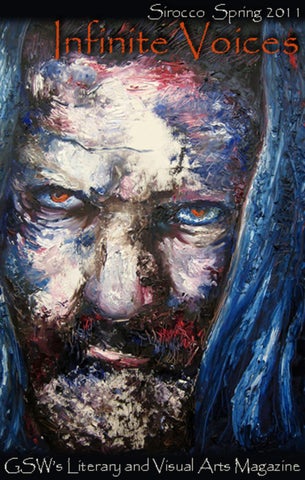
Spring 2011 A magazine of the arts, Sirocco is published in April of each year by students of Georgia Southwestern State University. GSW is a senior unit of the University System of Georgia and an affirmative action/equal opportunity institution. Opinions expressed in the magazine are neither those of the editors nor those of the University. Submissions are welcome anytime, but cannot be read or acted upon except during January and February. Submissions must not have been previously published and must be submitted in electronic format. Authors and artists should have some present or past affiliation with Georgia Southwestern State University. No work will be returned. All correspondence should be addressed to:
Editors: Sirocco Department of English and Modern Languages Georgia Southwestern State University 800 Georgia Southwestern State University Drive Americus, GA 31709 E-mail: gswsirocco@gmail.com We would like to thank the following for financial support:
Student Government Association at GSW The Americus/Sumter County Arts Council Dr. Gabriele Stauf Dr. Jeffrey Waldrop Ms. Tonia Hughes Dr. Mark Laughlin Shiver Lumber Company Scott’s Jewelry Napa Auto Parts Gammage Printing Darius Edwards Pat’s Place Mary Anderson, Lecturer of English and Modern Language, and Ru Story-Huffman, Associate Professor and Reference Librarian, provided invaluable assistance as Copy Editors for the 2011 edition of Sirocco. Their willingness to share their expertise is greatly appreciated. 1
Sirocco
Literary Editors Angel Medina Sunni Zemblowski
Art Editor Sunni Zemblowski
Staff
Tyler Ferguson Brittney Musser Cristian Santillán Bill Schmidt
Faculty Advisor Dr. Genie Bryan
Secretarial Support Sherreyal McCoy
Cover Artwork by Jordan “J.W.” Walker “Iscariot” Oil on Canvas
Cover Design by Sunni Zemblowski
2
Spring 2011
Editor’s Note
We live in a world that is full of voices. In the past, some people’s voices have been censored or silenced. However, as our world has progressed, the magnitude and variety of voices have expanded. Now there exists a world of infinite voices; these voices come from various backgrounds and different ethnicities, from the young and the old, from men and women. One way these voices speak to us is through art--literary, visual, musical, and theatrical. One of the main objectives for this year’s publication was to ensure that as many voices and mediums of communication as possible that exist within our community were represented. Last year, Sirocco began to publish musical works and I felt that it was the task of the magazine to continue this project and to include another art form that has for many years been overlooked – the theatre arts. Another goal was to ensure that each voice was allowed to be recognized without the interference of another. This interference issue affects visual works much more than literary ones; text can shape a viewer’s opinion and lead the viewer to react to a visual work differently than the artist may have intended. Because of this, in the issue, the staff and I made a conscious decision to place visual works on pages facing one another to avoid conflict with text. Sirocco is a chorus of voices, depicting the creative soul of the campus and community. In this issue, we wanted each of the voices to be represented and heard. I hope you will take the time to listen. I would like to acknowledge and thank the following people who helped make this magazine possible. Thanks to Dr. Genie Bryan, our faculty advisor, for your guidance and patience. Dr. Laughlin, thank you for your devotion and hard work to continue the music project that was started last year. Thank you, Ray Mannila and Dr. Stephanie Harvey for your assistance with the new Theatre Arts section. Thanks to Angel Medina, co-Literary editor, and the editorial staff: Tyler Ferguson, Brittney Musser, Cristian Santillán, and Bill Schmidt. Kimberly Norris: thanks for your assistance and knowledge. Also, I extend a great thanks to both our financial sponsors and to all who contributed their works to Sirocco; without you, this magazine and the voices it contains would not be heard. Sunni Zemblowski 3
Sirocco
Authors
Titles
Page
Christin Woods Ling Bai Cristian Santillán Marcus Weathersby Kristin Pair Elizabeth Kuipers Ted Lowell Rebecca Studdard Katie Lea Harvey Penn Mary C. Anderson Jeff Green Paul D. Shapiro Brian U. Adler Joni Woolf Angel Medina Angel Medina Aaron Renfroe
Hecuba, the Last Queen of Troy Goodbye My Lover Guiltiness Is Gone Heaven The Voice of the Fallen Rebirth In Memory of Memories Spark Defying Science Coming From Where I’m From Excerpt from MATTIE MORGAN Periphery Backcounting Academia (Chapter One) The Sand Caves The Last Act The Next Tyler Durden Vampire A Vampire of His Time
6 7 8 12 16 17 20 24 25 28 32 35 38 43 46 47 47 48
Artists
Works
Elisa Boswell Laura Bauer Granberry Sam Hendley Jordan “J.W” Walker
My Grandma’s Kitchen Issac The Two Sides Specimen 3: Young Woman Caught Between the Organic and Mechanical (Betty) What We Perceive Tension Look Up Iphigenia at the Altar Hiding Bullfrog Panthera leo: Domestic Splash Tantalus Canis lupus: Domestic Alan Vital Pillar & Creative Energies
Xavier Sims Mandy Fuller Felicity Leckman Sunni Zemblowski Laura Bauer Granberry Sunni Zemblowski Felicity Leckman Jordan “J.W.” Walker Sunni Zemblowski Skylar Jones Jordan “J.W.” Walker
4
10 11 15 18 19 22 23 26 30 31 36 37 44 45 52
Spring 2011
Theatre Performances
Date
Murder Mystery: The Disquisition of Doom South Pacific As You Like It Faith County Trojan Women Androcles and the Lion
Feb. 26-27, 2010 March 25-28, 2010 April 22-25, 2010 Aug. 26-29, 2010 Dec. 2-5, 2010 Nov. 18-21, 2010
Page 53 54 56 58 60 62
The Sirocco Staff
From left to right: Tyler Ferguson, Brittney Musser, Sunni Zemblowski, Angel Medina, and Bill Schmidt Not pictured: Cristian Santillán
Disclaimer: Grammar and proofreading are the sole responsibilities of the authors. 5
Sirocco
Hecuba, the Last Queen of Troy By Christin Woods
I am queen of wretched wrecks of the remains of a broken world. There is no king. No more princes, husbands, sons, children… No more. We are a lot of broken women waiting for the doom of fate and the impending curse of Duty. So I must be strong. I must lift the heads and hearts of these clipped wings before me. I must teach these caged birds to sing a cheerful tune— Or at least no dirge. I must help them to accept Duty. To laugh in the face of pigs; To accept the lots cast before them; and to bow down to new kings, princes, husbands… I must press on. I must endure. I am queen. It is my Duty.
6
Spring 2011
Goodbye My Lover By Ling Bai
Open the window. The dreary wind hits my face The wind wipes away my tears Our love begins with a simple greeting, Develops with gentle care, Ends with cold saline tears. Goodbye my lover. Close the window. The precious memories surround my mind The memories pierce my heart Our story begins in warm spring, Develops in romantic autumn, Ends with cold winter. Goodbye my lover.
7
Sirocco
Guiltiness Is Gone By Cristian Santillán
Creeping as a hideous snake, she comes, Ducking like a soldier amongst a battle. A glaring galvanized eyeball now moves, Trying to spot the dismay in bosom’s havoc. I try to pluck the door and escape, But I realize a plank is blocking my way, And so I scoot in a vain attempt To avoid the pickaxe hit on my head. But Guiltiness has never failed. A master she is on provoking pain. She crisscrosses with throb my mind, Viciously casting those memories of mine. “See, arsonist of the house of shame, How you’ve ignored what you’ve done to her!” “I couldn’t foresee what she was to do! I would change it all if I just could!” Omitting what I just said, she raises a bloody spade, Quickly commuting within my soul and mind, Condemning my actions with rudeness and hate, She looks for the regrets I’ve stifled and waned. “Quiet yourself, you cold-blooded killer!” Guiltiness warns as she readies to kill me, But something changed while she grasped my fear, For she releases the spade and stares at me. “Tell me the why of your disjointed love, For she killed herself when she had you not.” An afterthought appears in front of my eyes, A realization adjunct to the shed of my sins, And since Guiltiness awaits for my testimony, I shall answer before she decides to end me. 8
“I thought she would not miss my presence! I inferred she had wanted to leave me! Whose fault was discarding love’s essence? After all, she’s the one who betrayed me!” She releases the tight grasp on my being, As though unsure of what her purpose is, And looking sideways realizing her faults, She flees as the memories of my dead love.
9
Spring 2011
Sirocco
My Grandma’s Kitchen Elisa Boswell Intaglio Print 10
Spring 2011
Issac
Laura Bauer Granberry Photograph 11
Sirocco
Heaven
By Marcus Weathersby On October the seventh 1974, Arthur Brandt, aged thirty-seven, had the occasion to step into oncoming traffic and make his way to Heaven. It was not what he had expected. While many things were just as they told him it would be in church – St. Peter at the gate finding his name in the Lamb’s Book of Life, streets of gold, family members long lost there to greet him, and not a single frown or furrowed brow to be found – it struck him as odd when they strapped him to a machine, assuring him it would only be pleasant thoughts from here on out. At first he felt fear, but as soon as that machine was turned on, he would never feel fear again… nor guilt, nor anger, nor sadness, nor surprise, nor disappointment, nor cynicism, nor conceit, nor deception, nor lust, nor selfishness, nor pride. All he could feel now was happiness, absolute happiness and peace. And so it went, and it must have been some time since his death and entry into Heaven (even though time does not exist there). Still, it must have been some time because he could barely remember much of what his life had been, which always seemed to be growing into a shorter period in hindsight. Despite his absolute contentment with everything about him, something just didn’t seem right. Now, it had been a long time since everything didn’t seem perfect in every minute detail, so long, in fact, that he had nearly forgotten what anything other than unadulterated happiness was. It was so small a feeling that had you or I experienced what Arthur Brandt felt at that particular moment we probably wouldn’t have noticed anything at all. He barely noticed it himself. But it was there. He knew it was there buried so deeply underneath the unrelenting happiness, gnawing at a tiny corner of his heart, grinding what small piece of him it held fast to in its jaws. He knew it was there because something was different, a word rarely used and a feeling almost never felt in Heaven. However, he couldn’t dwell on the thought long, for a light was growing inside of him. It was time to be One with God and His light was overtaking Arthur Brandt’s entire soul. It’s difficult to describe or understand the process of being One with God if you yourself are not in Heaven. It’s as if experiencing God Himself as a living entity. It’s his power going through you, consuming you, purging. Words are far too profane to properly portray this experience in all its glory. The closest it can come to being described as is ecstasy, and it shot through Arthur Brandt like a flash filling every part of his being… except for one. It paused at the single spot in his heart he found himself hoping it would not. Before he knew it, God’s Oneness had left him. The happiness was crushing as it always was following being One with God. But, though it had shrunk to its smallest level yet, the different was still there. Arthur decided to clear his mind by taking a walk. As he stepped outside onto the streets of gold, he noticed what a particularly nice day it was, even though 12
Spring 2011
there are no days, because there are no nights, because it is always light in Heaven, even though there is no sun or moon and certainly no stars; however, everything can still be plainly seen, without the slightest hint of a shadow anywhere, as God Himself provides all the light needed, and it covers everything. Arthur walked along the sidewalks of ruby, just as he always did, admired the equally huge mansions of glorious architecture that everyone had, just as he always did, and ran his hand along the walls made of precious stones, just as he always did. It is all residential in Heaven; all other needs are satisfied in the fullest, and thus there is no need for any other types of buildings. Arthur didn’t even have to breathe as he whistled a merry tune along the way. Something was out of place, though. The Archangels were out in force it seemed. They stood at corners, eyeing him as he passed by. And there were far more of them than usual. Normally, you never saw more than two Archangels on any street at any given time. It was almost as if a group of them had begun to follow him. He didn’t know exactly why he wanted to leave their sight, but something drove him on to turn the next corner to escape their burning gaze. He looked ahead to see his Uncle Bradley leaning against a wall, a smile on his face. In life Uncle Bradley and his wife Aunt Bedelia had raised Arthur from the time he was a small child. Uncle Bradley had been a tyrant back then, beating Arthur and his Aunt Bedelia with quite a bit of regularity, however turning to God on his deathbed and thus being allowed into Heaven, where Arthur found he had become as gentle as a lamb. Aunt Bedelia, on the other hand, had been sent to Hell, unable to believe in a God in her heart of hearts, after the way Uncle Bradley had treated her in life. Arthur could see her in Hell sometimes (as the Damned can also see into Heaven), writhing in agony and noiselessly calling out to him, but he couldn’t bring himself to care, because there are no cares in Heaven. At the very most he felt mildly ambivalent about her condition. “Arthur, my boy!” cried Uncle Bradley cheerfully. Arthur smiled and hugged his uncle. He was glad to see him. “How are things?” asked Uncle Bradley. “Perfect,” replied Arthur. “Perfect as always. And you?” “The same, the same. Just as it ought to be.” Uncle Bradley paused, though his smile did not go away (mostly because it couldn’t). However, Arthur could have sworn he saw a slight tremble in it and if this were anywhere other than Heaven he might have said that something looked wrong. “Listen, Arthur, my boy… word’s been going around. People have talking about things, you know.” Another precedent broken. There is no gossip in Heaven, so it was very strange to hear that word was going around about anything other than new arrivals, which people who had been there for more than a few generations generally lost interest in after a while. “Oh?” asked Arthur. “What might they be saying, then? It is nice to talk, after all.” “Yes it is,” agreed Uncle Bradley cordially. “But what they are saying is something that is the not-good.” He struggled to get that last bit out. 13
Sirocco
“The not-good? I had nearly forgotten about it. Something from life, wasn’t it?” “Yes. We had all forgotten about it, it seems. More specifically, dear boy, they had been talking about the not-good in association with you.” He paused. “It seems whenever you are in the vicinity of these people it comes up. And it reminded me of the last time we spoke and you told me about the different you have been feeling. My boy, I’m beginning to think that these two are one and the same. Of course, you know the not-good is forbidden and if this different is, in fact, the not-good, you’re in for quite some trouble, lad. I took the liberty of informing the Archangels for you, so that this may be corrected as soon as possible. We wouldn’t want any embarrassments, now would we?” Two hulking Archangels appeared behind Uncle Bradley. Arthur Brandt turned, but found they were behind him as well. The different was growing in him and he came to realize it was fear that he was feeling. But it was more than just fear. It was anger and shame and pride and doubt and guilt and independence, and for a fleeting glorious moment, Arthur Brandt remembered what it was like to be alive and human again. He felt the need to run, to escape and flee, perhaps even get out of Heaven itself however impossible it might seem. But the Archangels already had him in vice grips around the arms, holding him fast. One of the Archangels read from a scroll and spoke in a booming voice that shook him to his core: “Arthur Brandt, you are hereby charged with feeling unauthorized emotion and are sentenced to immediate judgment before the GodHead.” They were dragging him away before he could think to do another thing else. But Uncle Bradley called out to him as he shrank in the distance, happier than ever: “Chin up, boy! Everything’s fine! They’ll soon have you cured!” Arthur Brandt screamed at the thought, knowing it was true, because there are no lies in Heaven, not even to one’s self. Nothing could change. Nothing could happen. Everything would be perfect in every way, without choice and without question. And it would go on forever and ever and ever and ever.
14
Spring 2011
The Two Sides Sam Hendley
Mixed Media, Ceramics 15
Sirocco
The Voice of the Fallen By Kristin Pair
War torn and battered, traveling home, Threadbare and freezing in six feet of snow. Carrying the injured, glory bound, But what of the fallen? The lost, not found. Left on the battlefield to rot and decay, Their bodies still here, their souls far away. Their hearts beat no longer, their lungs hold no air, Left all alone, far from those that would care. If they could but speak, the stories they’d tell, Of battles, of bravery, of a world gone to hell. But their lips cannot move, their mouths cannot speak, To share with you tales that would make you weep. So as their comrades move on, alive and well, For the dead they must speak, their stories they must tell. Of battles, of bravery, of a world gone to hell. The living must speak, the dead’s stories they must tell.
16
Spring 2011
Rebirth
By Elizabeth Kuipers For hours I pushed, you pulled. Finally you came— Chasing away crash cart and scalpel. The joy of first sight subdued by exhaustion. The miracle of Easter Embodied in you: In the creation of new life Is resurrection of old.
17
Sirocco
Specimen 3: Young Woman Caught Between the Organic and Mechanical (Betty) Jordan “J.W.” Walker Oil on Canvas 18
Spring 2011
What We Perceive Xavier Sims
Oil on Canvas 19
Sirocco
In Memory of Memories By Ted Lowell
The purple bruise on my chest was causing me great pain, but watching a memory walk out on me was heartbreaking. I stood there in the hospital doorway, listening to the automatic doors slide open and back again, for what seemed like forever. I was in shock. I could do no more than stare out at the pale figure walking violently down the sidewalk. The figure was my cousin. Looking at him now I saw not the ignorant and joking person I once knew, but instead a fragment of my very childhood memory torn from my mind only to wander around, lost. When I was thirteen, I finished reading the wonderful book Holes. Not only was I excited about going to see the movie that was being released that year, but also excited about my cousin, Sydney, finishing the book. He never read. But this book was obviously appealing to him because before I knew it, I was being asked to come to his house to dig holes. “Dig holes?” I asked through a very large telephone, “Why would I wanna come and dig holes?” “Cuz it’ll be fun!” he exclaimed in his annoyingly loud voice, “Don’t you wanna see if we can dig a hole as big as they do in Holes?” Sydney had always found a way to get us into something we wished we had never gotten into. Despite the fact that he was a complete opposite from me, I always enjoyed the times I spent with him. He was a smart kid, and he knew it, but he usually preferred not to show it. I, on the other hand, was proud to show how brilliant I was. I went to his house as he had asked, and we grabbed two rusty shovels from his garage. Their house happened to be on a huge piece of land where there were plenty of places to dig holes. So, naturally, we chose the most difficult spot in the middle of the woods where the ground was laced with millions of nearly indestructible roots. We spent eight hours digging those holes. In the book, the holes were the same diameter and depth as the length of the shovel, so that is what we dug. As we walked back to the house, carrying our shovels with blistered hands, we thought about our accomplishments. “I’m glad it’s wrote in that book and bad kids don’t really get sent to a desert to dig holes,” he said looking over at me, “Cuz I’d be there right now.” “Yeah, probably so,” I agreed. Sydney was the kind of person who looked for trouble in order to get attention. But he never actually got into real trouble. People like me and him don’t get into real-life trouble. That memory was the one replaying itself in my mind as I watched the drunk, pale figure on the sidewalk. Where did he go? Where is MY cousin? Where is Sydney? I knew the figure I saw standing outside was my cousin, but it was not the cousin I knew or remembered. It was like a piece of me was walking away. I felt the pain of the bruise again and remembered how it got there. It felt like two hours had gone by in that dimly lit, white waiting room, before we heard any news on my cousin. All we knew was that he had totaled his 20
Spring 2011
truck and that he was possibly drunk when he wrecked. The door I had been staring at while thinking of all the horrible things that could have gone wrong finally opened. Sydney walked out. He was walking; that was good. His parents followed after him, looking relieved. He walked up to my mom and me and we were also relieved to see him talk and function. He had no shirt or shoes on. His chest had bandages here and there and his lip was cut. I wanted to do our secret handshake we used to do to let him know I was there for him. Instead, his parents began to list all the things he had been charged for: DUI, running a stop sign, eluding the police, drugs in system. I was shocked. The Sydney I dug a giant hole with couldn’t have done drugs; he couldn’t have run a stop sign or driven drunk. “You’re going to jail son,” his mom said flatly yet still with anger. Maybe it was out of fear, or because he was still drunk or high, but the next thing he did will stick in my memory just as digging the holes did. He ripped off the bandages and shoved my mom out of the way. He came to me next and delivered a hard punch to my chest. “Get the hell outa my way, man,” he said. Then he walked furiously out onto the sidewalk and walked down the street. I stood there in disbelief. As tears started to fill my eyes, I walked over to the door to gaze upon what had once been a smart, funny, and talented friend. A friend that now resembled a being of whom I had no recollection of ever being with. I have seen death and have been to many funerals, but I do not think anything is worse than having a memory torn from your mind and shredded before your eyes. Someone dying is horrible, but good memories of that person will live on inside you. Watching my cousin walk barefooted, shirtless, and drunk down the hospital sidewalk killed a part of me. I can no longer talk to him and remember how we dug ridiculously huge holes once. That memory, and all other happy memories of him, is shattered by that punch I received.
21
Sirocco
Tension Mandy Fuller Photograph 22
Spring 2011
Look Up
Felicity Leckman Oil on Canvas 23
Sirocco
Spark
By Rebecca Studdard Pain consumed me Like a mighty roaring fire, Even now ice can’t come near To rob me of my desire. I don’t want a cold, hard heart, I’m afraid the bitterness would extinguish my spark. Spark and soul aligned, Walking hand in hand, Paving the way for my destiny. And so I wait. As sand spirals down the hourglasses of life. Ashes to ashes, dust to dust, My spark stays alight, I know this much. Some say life is a cycle Just waiting for a spin. Some say life is just temporary, The end of the end. And others remain quiet about life, Because they don’t know what to say. As for me, I say life is anything, A flower reaching for the sky, A cloud bursting with rain, The sun warming old bones, The storm that has only just begun. Life is a sad song, And a happy one too. Life is joy, And a whole lot of sadness too. But for me life is more like a spark That lights up my days, A pathway to my soul, In the darkest of days.
24
Spring 2011
Defying Science By Katie Lea
(Our blood became thicker than water) A double helix separates us on paper, But the blood that pumps through our veins Bonds us together & identifies us for what we are: Sisters of the heart. Our blood became thicker than water.
25
Sirocco
Iphigenia at the Altar Sunni Zemblowski Oil on Canvas 26
Spring 2011
Artist Statement: Iphigenia at the Altar
Euripides’ Iphigenia at Aulis is a highly emotional play that deals with a wide range of topics. Not only is Euripides commenting on the war occurring during his lifetime, but he also questions the roles of the gods and the nature of man. Iphigenia at Aulis has resonance with so many readers because of the continued relevancy of these human themes, Euripides’ use of unglorified characters and setting, and most of all, the deep-rooted emotional impact of the play. The goal of my painting, Iphigenia at the Altar, was to depict through an academic style the emotional impact – of anxiety and of depression - the play had on the reader while adhering to Euripides’ play as closely as possible. To illustrate a scene that would convey the anxiety and depression felt in the play, I set the painting at Artemis’ altar. I believe this setting, removed from the armies that gathered on the shores of Aulis, would cause the viewer to feel the loneliness and abandonment Iphigenia must have felt. The time of the scene is unclear; the setting could be before or after Iphigenia hears of her father’s decision to sacrifice her to the goddess Artemis. This ambiguity also lends to a feeling of anxiety because the viewer is aware of the sacrifice that will eventually take place, even if Iphigenia is not. In my attempt to paint within the academic style and portray Euripides’ question of the role of deities, I used visual allegories to give clues to the viewer. The most significant of these is the fawn, which is both a symbol of Artemis (notice the crescent moon on its head) and of Iphigenia (they share a similar fate). Other symbols include the contents of the sacrificial basket behind the altar, such as the Apple of Discord, and the flowers that flourish in the meadow. The addition of these symbols is to help with the identification of the figure and events as well as provide academic play between the painting and the viewer.
27
Sirocco
Coming From Where I’m From By Harvey Penn
I wasn’t born in the ghetto But my house was close to the hood I didn’t have a bad life But it damn sure wasn’t good I can sleep through gun shots Simply roll over and continue my slumber But when I wake up in the night and it’s quiet I began to worry and then wonder And the ones they say were bad… Hell, they helped out the most Sayin’ here’s some money lil cousin Just chill and watch this post And the “good guy” who supposed to protect and serve as a duty Harassed us daily and talked to us rudely Besides school only way out was to sell drugs or play ball And unfortunately my jump shot was slightly off So soon me and the fiends became on first name bases And then I became one of those, so familiar faces But mama said, “son, keep your head in them books” So I got out the streets to avoid the life of a crook I remember going to the library asking for a card The old white lady laughed, damn near broke my heart She said, “son, if you get one I don’t think you’ll be a big user” “Besides you don’t need a card to go and play on the computers” ….. I say BITCH!!! I know how to read And how dare your old ass stand here and try to insult me I had so much anger in my voice; I could tell I sounded scary Then she was like “Shhh” we’re in a library So I forget about the book I went out and tried the 9 to 5 But they hardly hire us type of guys Thinking we all lazy and can’t pass the test cuz we get high 28
But they quick to send a nigga to war Man they treat us like some kind of dog We ain’t good enough to live with you But we good enough to die for ya’ll And if you successful then they hate it And they think you’ve been misplaced-ed Like this is a mistake How the hell did he make it They rather see nooses where our ties are And shackles where our watches be They get mad when you ballin’ mane They rather see you ball and chain As unique as I am, they look at us all the same This world is a crazy place, but I try my best to stay sane I can’t really too much complain Because I remember from where I came In a place where gunshot melodies were often sang From a life that wasn’t bad And yet wasn’t good In a small little house, close to the hood
29
Spring 2011
Sirocco
Hiding Bullfrog Laura Bauer Granberry Photograph 30
Spring 2011
Panthera leo: Domestic Sunni Zemblowski Oil on Canvas 31
Sirocco
Excerpt from MATTIE MORGAN By Mary C. Anderson II.
Joe McCrary’s boy had come tearing up to the courthouse on a bicycle one Saturday afternoon hollerin’ that Big Henry Morgan had fallen through the floor of his daddy’s corn crib and couldn’t get out. Lewis had been a deputy trainee then, just one year out of high school. Sheriff Lipscomb had stepped through the courthouse door wiping cracker crumbs off his lips with his sleeve. He pointed to the strongest deputies he had. “Jeffery, you and Punk take Junior and go out there to see what y’all can do. Take the winch and the new rope. I’ll put the hospital on notice.” It was fifteen miles to the Morgan place but it seemed like no time before they got there. Jeff said that it was a chore that lay ahead of them and the trip would’ve pleased him fine if it had taken all day. At the Morgan place, they waded through mud and manure, following a set of tracks that had displaced mire all the way to dry ground. Jeff opened the door of the corn crib, looked in, then shut it and turned the catch. He looked at Earl Morgan. “There’s nothin’ we can do for him now, Earl. Henry’s gone. He’s already turnin’ dark. Earl, can you bring me some coal oil or gasoline? He’s covered up with copperheads. They must be a nest of ‘em under the crib.” Mr. Morgan began plodding out to his tractor shed. “And Earl, we gonna need a heavy sheet of plywood or an old door or somethin’ to pull Henry out of there on. And we’ll need to use your tractor.” “Use that door there, on the crib,” said Mr. Morgan. “It’s about to fall off its hinges anyway. Tractor’s this way.” Punk went with Mr. Morgan to get the tractor. Jeff sent Lewis for the new rope and the canvas tarp that were stashed behind the truck seat. “What we need a tractor for, Jeff?” Lewis asked. Jeff slid the catch on the crib door, opened it and motioned with his head and eyes for Lewis to look inside. There, near the center of the structure were the remains of Henry Morgan, half standing and half slumped, visible only from the knees up as if he were stuck in river mud and looking down at his feet. Huge arms stuck out from his body at right angles similar to those of children pretending to be airplanes. But the color of his flesh was the unmistakable hue of death. The ends of his fingers were purplish black and withering; his face and scalp were a dull, yellow-gray; the back of his neck and what Lewis could see of his upper arms bore the yellow-green stripes of decomposition. Lewis knew that snakebite would swell a man, but, even so, he had never seen a human body that large. He estimated the weight of it at five hundred pounds, and he could do that only by comparing it to the size of the heifer he raised in 4-H. Jeff estimated that Henry had died the night before or early that morning. 32
Spring 2011
“Wonder what he was doin’ in there? There ain’t no corn to get.” Lewis looked at Jeff for an answer, but Jeff just shrugged his dense shoulders. Lewis turned to walk up the hill. “Guess I’ll get that rope now.” Jeff threw gasoline out in front of and along side himself, driving the snakes back under the floor. When he could get to Henry, he emptied the can around the floor break, soaking the dead man’s overalls all around his knees and pouring it as far down into the hole as he could get it. They took off the crib door and laid it so that one end of it just touched the backs of Henry’s bulging knees. Jeff pulled the rope around Henry under his massive arms, then tied the other end to the frame of the tractor. With one slow, easy pull, Henry’s body fell back onto the crib door, his legs came up out of the floor, and he slid out of the crib onto the sticky ground with the rickety door still underneath him. Jeff threw part of a feed sack across one of the tractor’s front tires, and half sat/half leaned against it. “Don’t nobody even think of light’n up a cigarette,” he ordered. “What now, Jeff?” asked Punk. “Cover him with the tarp and tie him to the door. We’ll have to drag him up out of this barn lot to the truck to get him to town. Earl, you go take Miz Mattie to a neighbor’s house while we do this. She don’t need to see it.” “I ain’t even told her he’s dead,” said Earl Morgan letting out a deep sigh. “Oh, Lordy. I ain’t even told her he’s gone.” The lawmen waited in the barn lot while Mr. Morgan trudged up the little incline to his house. In a few minutes, they heard Mrs. Morgan scream and then they heard some things hit the floor and a wall. Then she ran to the back door and hollered out toward the corncrib. “Henry! You get up from there right now, you hear me? It’s time to eat, Henry. Come on in and wash up, son. Get up from there right now. Oh, Henry! Henry!” And she sobbed even as Mr. Morgan coaxed her back into the house and closed the door. After awhile, the Morgan’s truck pulled out from the driveway and turned down the gravel road away from town. Punk drove the tractor with Jeff and Lewis walking along beside the litter, pulling Henry Morgan’s body up into the yard of the home where he’d lived all his life. Jeff cut the hems of the legs of Henry’s overalls and ripped them up past the man’s knees. The man’s legs were as big as trees and the color of blackberry juice. They bore a few bruises and scrapes from the flooring he fell through, but mostly they were bleeding and oozing from snakebites. Jeff counted fourteen on the fronts of his legs, and he guessed there were half a dozen more bites on the man’s calves. But it was the bare, gigantic feet that had received the worst of it; not a square inch of them had escaped the bites; even the calloused leather of his soles had been assaulted, his toes disappearing into pillows of swollen purple flesh from above and below. “Jeff was right. He must’ve fallen right into a nest of those things. And he couldn’t a-done nothin’ after that but just stand there and let’em bite him.” Punk’s 33
Sirocco
eyes were slits as he talked, his mouth screwed up in a grimace. Punk enjoyed talking about the horror of things. “Wonder why he didn’t have any boots on? Good boots would’ve spared him all those bites.” “Henry went barefooted most of the time,” said Jeff. “They don’t make shoes big enough to fit him.” With the winch, a couple of barn timbers, the new rope, and two notches cut into one end of the corn crib door, the lawmen managed to pull Henry up into the bed of the sheriff ’s duty truck and secure the canvas tarp all around him. Even so, people could still see that it was a body being carried back to town, and by the size of it, everybody knew who it was. Henry Morgan had been the largest man alive within four counties. It was a slow, dark ride back to town. Lewis had turned on the radio to hear the last fifteen minutes of the Grand Ole Opry show, and the green glow from the dial was all the light there was to illuminate the faces of his friends, and a corner of the canvas tarp flapping in the wind punctuated the faint music from Nashville. When at last they were only a mile from town, Jeff noticed a glowing orange smudge in the sky through the rear-view mirror. They would learn the next day that Earl Morgan had burned his corn crib to the ground. ©Copyright 2010 by Mary C. Anderson
34
Spring 2011
Periphery By Jeff Green
An old man seen at a glance, his straw hat and bundle, when faced squarely becomes a sign, a shrub, something passed while driving at dusk, tangential from lines of sight, direction. So too, the known dead come from chairs strewn with laundry and are gone with a turn of the head.
35
Sirocco
Splash
Felicity Leckman Oil on Canvas 36
Spring 2011
Tantalus
Jordan “J.W.” Walker Pen and Ink 37
Sirocco
Backcounting Academia (Chapter One) By Paul D. Shapiro
A good friend of mine used to tell me that blackjack was a strange game. “When things go well,” he said, “It seems as if you just can’t lose.” On the other hand, “When things go poorly,” he’d also say,” You can’t imagine how you ever won.” Not surprisingly, I was much more fond of the former, rather than the latter sentiment. It was eight o’clock in the a.m., on a not-so-cheery Monday, at the end of August, and I was suddenly having trouble remembering how I had ever won. I was in the Boulder Station Hotel and Casino in Las Vegas, Nevada, which is located, not coincidently, on Boulder Highway a few miles east of the world famous strip. And allow me to briefly say, thank God for air conditioning. Because it was barely morning outside, and the temperature was already nearly 105 degrees Fahrenheit. At first I thought today’s early foray into the gambling world might be a good one. I had no unrealistic expectations, of course. I understood the odds. I knew the probabilities. For the first thirty minutes or so, as I embraced the natural ebbs and flows of the game, I would typically win three or four small to midsized bets. And then I’d lose one or two. But that pattern was just fine with me. Overall, I was up. At one point, as I started to increase the size of my bets, I won a few large pots in a row. And then, as the profits started to grow, I continued to increase my bets, parlaying the wagers. And that’s when I should have stopped. But I didn’t. Of course I didn’t. Why didn’t I? There’s no law forbidding it. There’s no official rule that says you have to continue playing. You can, absolutely, categorically, stop gambling. In theory, you could walk up to the table, place one bet, win the hand, pick up your chips, and walk 38
Spring 2011
away. But you can’t really do that. Actually, you can. Of course you can. But you won’t.
You could proudly puff up your chest and strut over to the cashier’s windows and leave a winner. But you don’t. Not when you’re there to play. And I was there to play. Since my initial good run, however, when I was up nearly six hundred dollars, the cards had turned bad. Not just bad, but nasty. And it didn’t matter who was dealing them. Since the start of my downfall, three different dealers had rotated their way to my table. And each new dealer now seemed to be in some sort of perverse competition with the previous one to see who could take more of my money. And it wasn’t just that they were winning, which is never fun. It was the way they were winning that was starting to piss me off. On the surface, blackjack appears to be a fairly simple game. You start with two cards. Depending upon how much the numerical value of the cards total, you either ask for more cards, or you don’t. It’s all in an effort to get as close to the numerical value of twenty-one as you can without going over. All face cards are counted as ten. Aces are counted as either one or eleven. Other numerical cards are worth their actual values. The dealer does essentially the same thing. And whoever comes closer to twenty-one wins. The one caveat is that the dealer must keep taking additional cards until he or she reaches a total of 17 or higher, and then they’re required to stop; or if they go over 21, they automatically lose. Players are never required to draw additional cards, which is called hitting. And they can stop taking cards whenever they like. But, in reality, it’s much more complicated than that. There are minor rule variations that exist from casino to casino. There are strategy decisions. There are betting decisions. There are a myriad of subtle changes and factors that take place throughout this process. And all of these are basically designed to give the house a healthy advantage. After all, they don’t build giant casinos in the desert because it’s easy for players to take the house’s money. At most ordinary blackjack tables a knowledgeable player can reduce his or her 39
Sirocco
overall disadvantage to about a one-percent deficit. An uninformed player will lose at a rate closer to three or four percent. And the true idiots, who haven’t a clue, should stay at home and mail the casino a check. They can save all that time and effort they’re going to expend in getting dressed and actually going out to gamble. They’ll need that energy later in life when they’re drinking cheap beer and watching re-runs of Jerry Springer. I place myself into an entirely different category of gambler altogether. But I’ll explain more about that later. Sometimes, when you find yourself on a losing streak, it seems like you just can’t get a good hand. And, of course, every hand the house gets is a winner. Round after goddamn round goes by, with each of the two pair combination of cards you get dealt sucking more than the previous combination of losers. So you simply sit there like a pathetic Melvin. And you look at your two new cards, and you just know that you’re about to lose this hand as well. And it seems like the flood of crap will never end. And it usually doesn’t. That is, until you lose all of the money you’re prepared to lose that day, and you tuck your tail between your legs and you slump home. And, as annoying as that is, and believe me it’s annoying, it’s nothing compared to the shit tsunami I was now having. Because I was still getting good hands. The blackjack deities were giving me the opportunities to do well. And I should have been doing well. I should have been doing really well. But I wasn’t. If I got an eighteen, the dealer got a nineteen. If I got a nineteen, the dealer pulled a twenty. And, if that wasn’t bad enough, since my initial good run of luck ran out, the only blackjacks, two-card combinations totaling exactly twenty-one, which were allowed by the gambling gods, all went to the dealers. So there I sat. Alone at the table. All by myself. Losing hand after hand. Watching my early good fortune turn sour. And I knew I wasn’t going to recoup that money. I was not going to win it back. I might, occasionally, win a rare hand or two. But that streak was short lived as the dealers came slamming back with winner after gut-wrenching winner. I would sit there with what appeared to be a halfway decent hand. A solid total. And I knew the dealer would find a way to win. Notice, I didn’t say I would find a way to lose. Because I’m convinced I didn’t lose 40
Spring 2011
those hands. I didn’t win them, obviously. But I played each hand correctly. I bet exactly what I was supposed to bet. I did exactly what I was supposed to do. It just didn’t work out. The six hundred dollars I had been up was gone. As was another two-hundred and fifty of my initial buy-in stake. I pushed my last two green chips, fifty bucks worth, into the betting circle and waited for the carnage to continue. The pain wouldn’t last much longer. I was nearing the end of the time I had allotted to gambling. And I had to leave shortly. This brings me to another interesting self destructive phenomenon. It’s an odd condition that seems to affect most gamblers. I don’t know the scientific name of the syndrome. But I’m sure it exists. You’re tired. You’re losing. And you’re not having any fun. But you still place that last bet. Even though you’re convinced that you’re going to lose it, you still bet it. When looking at all this rationally, I could use that fifty bucks. I could buy a couple of decent dinners. I could go see five movies and, if they’re matinees, maybe even buy some popcorn. Or, I could just pull the bet back and save it for another gambling excursion when it might be put to better use. But I don’t. Of course I don’t. My two new cards were both paint, which means face cards, and a very strong total of twenty. The dealer also gets her two cards, one of which is dealt face up. She had a four of hearts showing. Now without belaboring tedious charts and mathematical formulae, with a four showing, the dealer should break, go over twenty-one and automatically lose, forty percent of the time. And that’s without me doing a damn thing. In fact, having a two-card combination of twenty, versus a dealer’s up-card of a four, the player should just hold pat, do nothing, and win the hand almost eighty-four percent of the time. But I knew that wasn’t going to happen today. I just knew it. So even when she turned over her hole card, and it was a ten, for a two card total of fourteen, I still knew I was about to lose. It was only a matter of how. If she were merciful she’d pull the next card off the top of the deck and it would be a seven, giving her a nice fast three card total of twenty-one. And then I could go off to work. 41
Sirocco
But, she didn’t. That bitch. It was as if she knew that this was going to be my last hand of the morning and she wanted to show off. Instead of quickly putting me out of my misery, she pulled an ace for a total of fifteen. Then she drew another ace for a total of sixteen. And finally, as if she was on some sick twisted mission from the evil gambling gods, she pulled the five of spades, for a five card total of twenty-one. I saw it coming. She saw it coming. I’m sure her supervisor, the pit boss, saw it coming. The cocktail waitress, who was walking by in her four-inch stiletto heels, saw it coming. I’m sure the surveillance guys who watch everything via closedcircuit cameras in dark back rooms saw it coming. And, like a horrible crash on the highway, we all slowed down to take a look. As I began to push my chair away from the table, the Hellbitch scooped up my losing chips with the cards she so deftly pulled out of her ass, and she smiled a well-practiced insincere smile and said, “Good luck to you sir.” I hate those canned disingenuous statements. She didn’t mean it. She wasn’t being polite. And she knew, that I knew, she didn’t mean it. Regardless, I calmly smiled back and quietly said “Thanks,” all the while hoping she would soon die a painfully horrible death with syphilitic boils and oozing pustules, as locusts picked at her naked rotting corpse that was decomposing somewhere in a New Jersey landfill. If you weren’t sure, I’m not a good loser. I’m not a noble loser. I’m not a happygo-lucky loser. And this morning, I was a loser. I didn’t care that it could have been much worse. And it could have been much, much, worse. If I hadn’t won some of that early money, I would have been down a lot more. Only losing three hundred dollars, when things had gotten as bad as they had been, seemed to be a small consolation. And one that soon passed. Ok. Fuck it. I had to accept reality. My day had started off poorly. And now I had to go to work. It was the first official day of the fall semester. And that’s never good. At least I was capable of making a few other people miserable. After all, I do teach statistics. 42
The Sand Caves
Spring 2011
By Brian U. Adler
for Annette I Time has a way of silently running out on us, up here in the mountains. Hensley’s trail might be worth it if I could look out. We walk for hours up the steep incline. I look around for the same flowers and turtles as last year. But they are not here, gone, dead, eaten, asleep. As we range higher, a certain smell returns, a sweet tug from the past, an invitation by some crazy God who endows us with the memory of things that have come and gone, maybe a thinly veiled curse under a possible blessing. First it’s close to dusk and then it’s night. We run, but the shadows from the ridges move faster. Pitch black before the tent is up, before the fire is made. II I wonder what changes are farther up the trail, although you have been here already, not so long ago. We are hoping to meet what we think is up there, even though sometimes I think what we see is just ourselves. If you are a wasteland, you see waste. A garden brings a garden. A hall full of echoes plays the waltzes from those other times, filling even a green and endless forest like this, if you are that kind of person. III On this dark climb into a future that sighs so longingly with our pasts, time is the third one of us, a fellow traveler I have slighted because of all the damage he has caused me. Up ahead I know are the caves of white sand. Generations of people who have built from that sand, but nothing remains except more sand, and the bones of those people buried deep in its bottom layers. Sinking into those depths, we are all the while creating the future. The old bones are rusting into dreams, speaking a language I have heard before. 43
Sirocco
Canis lupus: Domestic Sunni Zemblowski Oil on Canvas 44
Spring 2011
Alan
Skylar Jones
Mixed Media (Primer, glaze, graphite) 45
Sirocco
The Last Act By Joni Woolf
Perched in the mimosa tree Of her grandmother’s yard She dreamed of being discovered By some movie agent she hoped would be Traveling down the dirt roads Of South Georgia in the summer of forty-four. She did not go to Hollywood But to the nearest town, Lock-stepped in her times She dreamed of marriage and motherhood A life of bliss. The mimosa tree died forty years ago Along with dreams of stardom and safety and fame; Now the sirens of wilderness Call her back to country For the last act. Someone said You’re jumping off the end of the earth So she pondered wisteria, wildness Fields, fences and farmhouse The solitary and the silence And wondered: Is this the end of the earth? How will she live Without the clapping crowd And friends on every side When she returns to the land Of fields, fences and farmhouse Where no one noticed The trembling mimosa limbs That held the girl Who dreamed of being discovered.
46
The Next Tyler Durden By Angel Medina
I’m left to dream in silence as I fulfill all wishes but mine. Others can do as they please, I’m left to dream in silence. I wish I could break my chains but duty always calls. I’m left to dream in silence as I fulfill all wishes but mine.
Vampire
By Angel Medina The smile I keep making Is the face I continue faking. The mirror exposes what I see. A bruised ego and a weak self-esteem But this is not what is seen By the unsuspecting people. Only bright whites and soft lips Is what they see in their blinding bliss, Oblivious to my monster within.
47
Spring 2011
Sirocco
A Vampire of His Time By Aaron Renfroe
He came in to my store late, just before closing, but that didn’t matter. I stood there holding unfolded denim pants and watched as the automatic glass doors slid shut behind him. The GAP sign glowed over his head. It threw illumination that made the moment more perfect, like something out of a movie. He was like something out of a movie. Dressed in tight black jeans and a green turtleneck sweater, his skin was alabaster and utterly flawless. Even from across the store I could see that his eyes were gold ringed in red. I ignored the fact that he was just a shade over five feet. Height didn’t matter to me. He scanned the store once before he saw me watching him. Our eyes met. Worlds felt like they were moving, colliding; I imagined starlit skies and endless nights in his arms, and couldn’t help smiling and waving at him. The pants I’d been holding fell to the ground. It looked like he grimaced, but that was impossible. My immortal prince walked up to me. There was a look of some poignant emotion on his face. The quiver of his lips, the concave of his cheeks, they might have been mistaken for constipation but I knew them for what they were: This was a man whose soul knew pain and torment, a man in search of someone who could accept him for who he was. “Can I help you, sir?” I asked, trying for my most professional voice. “Ah . . . I think . . .ah, I think that you dropped these.” He reached down and picked the pants I’d dropped up and offered them to me. I took them back from him, deliberately brushing his fingers with mine. His hand was stone cold. I’d expected that, so it didn’t bother me one bit. “That’s very nice. Don’t you want to go somewhere to talk? Maybe back to my place?” I looked down into his face and hoped that I didn’t sound too expectant. My vampire took a step back from me. He looked uncertain. “Ah… that would…ah, be…ah…nice. How about coffee, instead? I’d love to…talk.” He shoved the tips of his fingers into his too-tight pants and rounded his shoulders awkwardly. Someone else might have mistaken him as an uncertain teenage boy. I didn’t. “Of course, that sounds perfect! Coffee will help me stay up with you all night!” He was brilliant! Of course he was. No doubt he was very old; he probably had a degree. I finished my shift and closed the store down as quickly as I could. It was hard not to pause every few seconds to look over at him where he stood next to the entrance. Limned by the light of the sign, he might have been mistaken for some sort of vampiric angel. I managed to resist, mostly. We talked all the way to the IHOP. He was a total gentleman. He didn’t 48
Spring 2011
try to manhandle me, and he was a great listener. Better yet, I couldn’t look at his face (which I did often) and tell what he was thinking. The look of discomfort that I was coming to adore was fixed. There was no reaction when I revealed that I’d only dated two boys and had kissed neither. I was, after all, a good Christian girl waiting for my vam … the right man to come along. I didn’t want to tell him that I knew what he was, not yet. He’d show his true self when he was ready. I was certain that it would be soon. An unenthusiastic waitress greeted us at the door with an unlit cigarette in one hand and a cell phone in the other. She scowled, but led us inside and passed us menus. “Seat yourselves, I’ll be back in a minute,” she told us. My vampire failed to take the lead, so I grasped his hand and led him past the first rows of seats and to a private corner near the back. There weren’t many other people there, a few black-clad smokers congregated in the designated enclosure and an older man was slumped in his seat next to the entrance. Still, I wanted absolute privacy. I sat across from him so I could watch his face. His tussled dirty-blond hair just begged to be touched. Somehow, I resisted the impulse. “So, tell me about yourself,” I said. He fidgeted and looked down. “You’re special, right?” “Ah . . . yes.” “You can tell me, I won’t judge. I promise.” I tried to inject every ounce of earnest conviction possible into my voice. “Well . . . I am . . .ah . . .” His hesitation was driving me up the wall. Clearly, he was trying to play coy. Maybe he was testing me. “You’re a vampire, aren’t you?” I said. “Ah . . . yes. Of that, I am certain.” Finally, real communication! “What sort of vampire are you?” I asked. “Do you shimmer and glisten in the sun?” He looked away. “Um. . . . I do, now.” “What do you mean, ‘you do now’?” “Well, a few years ago, I didn’t. Now, I do.” He wouldn’t look at me. I admit it, I was intrigued. “What were you like a few years ago?” Somehow, he blushed. “I . . . ah, I didn’t like the sun. But I really liked . . . ah, feeding from men. I was very tormented; it didn’t seem right, you know?” “What? You were into men?” This was unexpected, to say the least. He shook his head. “Not like you mean. It wasn’t . . . intimate. I don’t think.” “You don’t think? How could you not think? What sort of vampire are you?” I couldn’t help raising my voice. I was a modern girl, but I’d been raised to 49
Sirocco
believe in certain inalienable facts. Like that vampire boys liked girls. Scowling, he shuddered and sat up straight. For a moment, I could see the shadow of someone else overlaying his body; a darker, taller, more devious man. It scared me, that visage. “In the beginning, I was the sort to ruin young ladies like you,” he said. His voice had changed; it had taken on a regal, faintly foreign, tone. “I was in command of the world, then. Nothing could stop me.” The red rims of his eyes filled in as he spoke; the bloody color swallowed the gold in the center until only a pip of the original color remained. Quivering, somewhere between terror and hopeful longing, I asked, “And now?” The shadow that had embraced him vanished as though it had never been. His shoulders curled inward defensively and the grimace returned. “Now, I . . . ah, glisten in the sun.” He looked up at me. The near-solid red of his eyes was the only proof that the shadow I’d seen had been real. “I can go into the sun!” There was terror in his voice. His vulnerability touched me. I reached out and took his hands in mine. “That isn’t so bad, is it? Isn’t the sun nice?” “Not at all,” he replied distastefully. “It’s horrid. I despise the sun. Why become a vampire if you want to be . . . normal but shiny? And these unholy urges . . .” His voice trailed off. “Urges?” I asked, hopeful. “Yes. For the last few years, I’ve been . . . lonely. I never sleep anymore and my heart aches constantly. It’s like I am. . .” “Broken?” I finished for him. He nodded. Despite rising, giddy, hope, I had to know more. “Have you experienced any other changes over the years?” The waitress arrived before he could answer. Blandly, she asked, “What would you like to order?” “Coffee and a veggie omelet, no garlic please,” I said. No garlic, just in case. “Nothing else on the side, no bacon or grits?” she asked. “Oh no. I’m watching what I eat. I don’t want anything else.” I wanted her to go. “Alright. And you, sir?” she turned to face my vampire. If he’d looked uncomfortable before, he did even more so now. “Ah . . . I think no. But, maybe a very raw steak.” He wrapped his arms around his stomach and turned a lovely shade of pink. He closed his eyes and grunted out, “Maybe some tomato juice?” The waitress didn’t seem to notice the change in his demeanor; she just wrote down his order and walked away. As soon as she was gone the color drained from his face and he sat back up. He looked like himself again. 50
Spring 2011
I asked, “Are you okay? What was that about?” “Around some people my stomach . . . gets confused. Damn the Lost Boys,” he said mirthlessly. I didn’t get it. The rest of our evening went by in silence. I wanted to press him, to find out more about the changes that he’d been through, but he wouldn’t look at me anymore. It was the waitress, I decided. We needed real privacy. After our order finally came, I ate quickly and gestured for the waitress to go ahead and bring the check. She returned a few minutes later with a slip of white paper that she left face up on the table. “Pay whenever,” she said. I looked up at my gentleman vampire expectantly. He made a confused face then reached into his pocket. It was a surprising struggle for him to get his hand into his jeans. He withdrew a fat wad of cash and stared at it suspiciously, like it hadn’t been there before. My vampire paid, of course. We exited the IHOP together and made our way back to the GAP parking lot where my car was waiting. The silence between us was electric; I was certain that I could feel a real connection there. We were meant to be together. I rehearsed what I would say to convince him to come home with me the entire way. At the car and I looked down at him expectantly. “Well, this is it. Are you sure that you don’t want to come home with me?” He didn’t answer. He just leaned down and kissed my neck, hard. Then, I felt teeth. Ah yes, I’d forgotten. His eyes were red, not gold.
51
Sirocco
Vital Pillar & Creative Energies Jordan “J.W.” Walker
Pen and Ink and Color Pencil 52
Theatre Arts
Murder Mystery: The Disquisition of Doom GSW Production Feb. 26-27, 2010 53
Sirocco
South Pacific
GSW Production co-produced with Sumter Players, Inc. March 25-28, 2010 54
Theatre Arts
South Pacific
GSW Production co-produced with Sumter Players, Inc. March 25-28, 2010 55
Sirocco
As You Like It GSW Production April 22-25, 2010 56
Theatre Arts
As You Like It GSW Production April 22-25, 2010 57
Sirocco
Faith County GSW Production Aug. 26-29, 2010 58
Theatre Arts
Faith County GSW Production Aug. 26-29, 2010 59
Sirocco
Trojan Women GSW Production Dec. 2-5, 2010 60
Theatre Arts
Trojan Women GSW Production Dec. 2-5, 2010 61
Sirocco
Androcles and the Lion
GSW Production co-produced with Sumter Players, Inc. Nov. 18-21, 2010 62
Spring 2011
Dedication
This year’s edition of Sirocco is dedicated to Dr. Mark Laughlin for his hard work and dedication to Sirocco and the musical project. Although he has not been a member of the GSW family for long, Dr. Laughlin is well known and loved among his students. The 2010 edition of Sirocco was the first to be accompanied by musical submissions. The staff that year decided to expand the magazine to include musical selections. Having little knowledge of how to move forward with the music project, the staff approached Dr. Laughlin; he was more than happy to help the magazine and lead the process. When this year’s staff asked if we could do it again for the 2011 edition, he agreed without hesitation. Through it all, Dr. Laughlin has worked diligently to include the CD in both editions. For his hard work and dedication to Sirocco, we thank him and we are proud to award this year’s dedication to Dr. Mark Laughlin. Dr. Laughlin’s time and talent has helped to make Sirocco a true representation of all the arts at Georgia Southwestern. 63
Sirocco
Literary and Visual Arts Awards The Dolores Capitan Writing Award
Is made possible through the generous support of Dr. And Mrs. William Capitan, and is given yearly to nonfiction writers who are students at Georgia Southwestern State University. The winners are chosen by faculty judges.
2011 Academic Division Winners:
1st place: Jason Millsapp’s “Jason: Both of the Argonauts and of Medea” 2nd place: Jasmine Watkins’ “Sex Addiction” 3rd place: Katie Lea’s “Feminist Issues of Gender in the Penelopiad”
Editor’s Choice
Is awarded to the by Sirocco’s Literary and Art Editors. This year’s winner: Harvey Penn’s “Coming From Where I’m From”
The Sirocco Cover Prize
Is offered each fall by the Sirocco editors, who select a theme and accept submissions for cover art. The winning submission receives a $75 prize.
A Brief History From 1965 – 1983, twelve editions of Sirocco were published as a literary magazine. The founding faculty advisor was Mrs. Iris Argo. In 1984, the magazine’s name was changed to Clay and Pine: A Magazine of Literary and Visual Art and continued under that name until 2004. In 1985, Clay and Pine was the winner of the College Literary Magazine National Competition. In 2004, the editors wanted to return to the original name as it was more in keeping with the themes of Georgia Southwestern’s nickname – the Hurricanes. To augment the name, the subtitle “Catching the Winds of Creativity” was added.
64
Spring 2011
Plantium Sponsors for Sirocco 2011 Thanks for your support!
Sirocco Mission Statement At Sirocco, we strive to provide our community an outlet for the unique voices we encounter everyday and to share our contributor’s personal expressions in order to enrich our environment. Through the years, we have witnessed the rising awareness of creative writing and hope to further that cause. Our goal is to encourage new voices, reinforce the creative process, and create opportunities for the winds of creativity to sweep through our community.
65