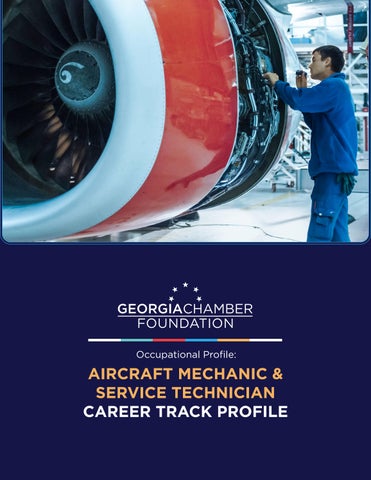
Occupational Profile:
AIRCRAFT MECHANIC & SERVICE TECHNICIAN CAREER TRACK PROFILE GeorgiaLAUNCH
2026
01
Aircraft Mechanic & Service Technician Career Track Profile
01 01
GeorgiaLAUNCH
2026
GeorgiaLAUNCH
2026
Occupation: Aircraft Mechanics and Service Technicians (49-3011)
Description of Job Duties: Diagnose, adjust, repair, or overhaul aircraft engines and assemblies, such as hydraulic and pneumatic systems.
Examples of Education Available: • • • • • • • • • •
Aviation-related CTAE pathways (Aviation Maintenance Flight Operations, Unmanned Aerial Systems) Other CTAE pathways (Automotive, Manufacturing, Energy Cluster) TCSG programs, including Aviation Maintenance Technician programs (e.g., Central Georgia TC Associate in Aviation Maintenance Technology Savannah TC programs in Airframe and Powerplant (A&P Certification) with associate diploma, and certificate options) Aviation Welding Fundamentals TCC at Southern Crescent TC Registered apprenticeships at local aviation companies USG options, including Aviation Maintenance Technology Associate degree and Aircraft Structural Technology certificates at Middle Georgia State University BS in Aerospace Engineering at Georgia Tech Options via military training (e.g., Air Force, Navy, etc. aviation careers) FAA recurrent training
GeorgiaLAUNCH
2026
02
Licensing and Credential Examples: FAA Airframe and Powerplant Certification, OSHA 10/30 Hour.
Why It Matters: The Aircraft Mechanic and Service Technician occupation (SOC 49‑3011) plays a vital role in Georgia’s aviation industry, offering strong demand, competitive wages, and clear advancement opportunities. These professionals maintain and repair aircraft to ensure safety and compliance with federal standards. Entry into this field can begin through aviation support roles such as Aircraft Fueler (SOC 53‑6031) or by completing a technical college program that leads to FAA Airframe & Powerplant certification. With experience and additional training, individuals can progress to specialized positions like Avionics Technician (SOC 49‑2091) or Maintenance Supervisor (SOC 49‑1011). Those who pursue further education, such as a bachelor’s degree, can advance into roles like Aerospace Engineer (SOC 17‑2011). Whether starting after high school or through technical training, this occupation provides multiple pathways and strong career mobility within Georgia’s growing aerospace sector.
03
GeorgiaLAUNCH
2026
GeorgiaLAUNCH
2026
04
Career Mobility Ladder
Career mobility is a powerful concept that illustrates how individuals can climb a structured ladder to transform an entry-level role into a high-paying professional career. This progression begins at the “Start” phase, where workers enter roles requiring minimal prior experience to build a vital technical foundation. Leveraging high skill similarity, individuals then “Advance” into more complex positions that offer significant wage growth and increased technical responsibility. Ultimately, by choosing to “Specialize” through advanced training and experience, workers reach professional-level occupations that maximize their earning potential. This pathway highlights the value of lifelong learning and skill development, allowing workers to expand their opportunities over time without the immediate necessity of a four-year degree at the outset. Career mobility in Georgia’s industrial and aerospace maintenance sectors provides a direct route for mechanical experts to transition from the factory floor to the hangar. This journey begins as an Industrial Machinery Mechanic (49-9041), where workers master the complex systems that power Georgia’s manufacturing plants, earning a median salary of $60,100. As these professionals refine their diagnostic skills and mechanical precision, they can leverage their foundational expertise to advance into the role of Aircraft Mechanic and Service Technician (49-3011). In this advanced role, median earnings in Georgia jump to $77,880, with top-tier technicians earning up to $130,020 as they maintain the fleets of Georgia’s massive aviation hubs. For those who develop an eagle eye for detail and a deep understanding of safety standards, the path leads to specializing as a Transportation Inspector (53-6051). This professional-level role shifts the focus from hands-on repair to critical oversight, ensuring that vehicles and equipment meet the rigorous safety and compliance regulations necessary for public transport and cargo. In Georgia, this specialization commands a median salary of $98,150, with 90th percentile earners reaching $142,060. With over 24,000 combined positions projected in the state by 2032 across these tiers, this ladder demonstrates how mechanical talent can be honed into a lucrative career dedicated to the safety and reliability of our global infrastructure.
05
GeorgiaLAUNCH
2026
Example Pathway:
Specialize: Transportation Inspectors (53-6051) • Medium Skill Similarity • 2024 GA Median Hourly Wage: $47.19 • 2024 GA 90th Percentile Hourly Wage: • 2024 GA Median Annual Earnings:
Aircraft Mechanics and Service Technicians (49-3011)
• 2024 GA 90th Percentile Annual
• 2024 GA Median Hourly Wage: $37.44 • 2024 GA 90th Percentile Hourly Wage: $62.51
Start:
• 2024 GA Median Annual Earnings:
Industrial Machinery Mechanics (49-9041)
• 2024 GA 90th Percentile Annual
• Some Skill Similarity • 2024 GA Median Hourly Wage: $28.89 • 2024 GA 90th Percentile Hourly Wage: $39.34
$68.30
Advance:
$98,150 Earnings: $142,060 • 2032 Projected GA Employment: 1,340 • 2032 Projected US Employment: 26,100
$77,880 Earnings: $130,020 • 2032 Projected GA Employment: 6,930 • 2032 Projected US Employment: 145,000
• 2024 GA Median Annual Earnings: $60,100 • 2024 GA 90th Percentile Annual Earnings: $81,820 • 2032 Projected GA Employment: 16,220 • 2032 Projected US Employment: 510,300
Source: Occupational Mobility Explorer, O*Net/Bureau of Labor Statistics
GeorgiaLAUNCH
2026
06
High Demand Occupations: Skills Overlap
There are numerous opportunities for upward mobility specific to the Aircraft Mechanic and Technician career track. However, insights from GeorgiaLAUNCH research demonstrate that there are numerous transferable skills across other high-demand careers. In terms of knowledge overlap, there is more than 60% overlap with Industrial and Electrical Engineers. Additionally, there is more than 42% overlap with Lineworkers.
Knowledge Overlap Analysis Industrial Engineers Industrial Engineers
Electrical Engineers
Machinists
Aircraft Mechanics
Lineworkers
Electricians
77%
31%
64%
33%
36%
40%
67%
31%
33%
27%
10%
43%
42%
23%
Electrical Engineers
77%
Machinists
31%
40%
Aircraft Mechanics
64%
67%
27%
Lineworkers
33%
31%
10%
42%
Electricians
36%
33%
43%
23%
30% 30%
As it pertains to skills, there is more than 62% overlap in required skills for Lineworkers and Electricians. There is also more than 40% overlap with Machinists, Industrial Engineers, and Electrical Engineers.
Skills Overlap Analysis Industrial Engineers Industrial Engineers
07
Machinists
Aircraft Mechanics
Lineworkers
Electricians
76%
35%
43%
48%
52%
33%
41%
44%
53%
40%
45%
44%
67%
62%
Electrical Engineers
76%
Machinists
35%
33%
Aircraft Mechanics
43%
41%
40%
Lineworkers
48%
44%
45%
67%
Electricians
52%
53%
44%
62%
GeorgiaLAUNCH
2026
Electrical Engineers
72% 72%
Key Takeaway:
Aircraft Mechanic has immediate job openings, projected growth, and numerous transferable skills offering great career advancement and economic mobility.
GeorgiaLAUNCH
2026
08
www.gachamber.com/foundation
01
GeorgiaLAUNCH
2026