
The Georgetown Voice, 4/24/26

Page 1


APRIL 24, 2026

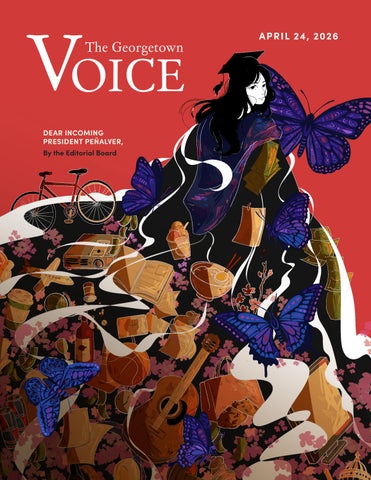
DEAR INCOMING

PRESIDENT PEÑALVER, By the Editorial Board

4

news Georgetown’s freshman classes are becoming more diverse. Students and experts say there’s still room to grow.

SYDNEY CARROLL

6

edito,ials

Dear Incoming President Peñalver,

EDITORIAL BOARD

7

voices I didn’t speak up that night—so now I am

IMANI LIBURD

9

voices

The last dance: Voice Sportz’s seniors reflect

BRADSHAW CATE AND ANDREW SWANK

April 24, 2026

11

voices It’ll be okay, go random

RENEE PUJARA

12

news commenta,y All aboard the AMSTrack!

BRIDGETTE JEONNAIRE AND JACOB GARDNER

14

hal0time leisu,e Syllabi standouts: The best books Voice writers read for class

HALFTIME LEISURE

15

hal0time s2o,ts A look ahead at the

Editor-in-Chief — Eddy Binford-Ross

Managing Editor of Content — Sydney Carroll

Managing Editor of Operations — Imani Liburd

inte,nal ,esou,ces:

Exec. Manager for Sta& — Chih-Rong Kuo

Exec. Editor for Resources, Diversity, and Inclusion — Elaine Clarke

on the cover 4 news

people, and learn from your mistakes; and in a few short years, it'll forget you. But

Asst. Editor for Resources, Diversity, and Inclusion — Renee Pujara

Editor for Sexual Violence Advocacy, Prevention, and Coverage — Olivia Fanders

Social Chairs — Aaron Pollock, Justin Higgins Archivist — Eileen Miller

news:

Executive Editor — Aubrey Butterfield Features Editor — Alexandra Risi News Editor — Sophia Jacome

Asst. News Editors — Justin Higgins, Sehr Khosla, Julia Carvalho, Basia Panko

Asst. Features Editors — Sophie St Amand

o2inion:

Executive Editor — Evalyn Lee

Voices Editor — Phoebe Nash

Asst. Voices Editors — Olivia Pozen, Jacob Gardner, Colby Kelly, Bridgette Jeonarine

Editorial Board Chair — Darin Eberhardt

Editorial Board — Seth Edwards, Imani Liburd

Kamran Darnall-Hirani, Paige Benish, Phoebe Nash, Olivia Pozen

leisu,e:

Executive Editor — Elizabeth Adler

Leisure Editor — Lucy Montalti

Asst. Leisure Editors — Ryan Goodwin, Karcin Hagi

Halftime Editor — Aaron Pollock

Asst. Halftime Editors — Joaquin Martinez, Alex Hwang, Quinn Ross

s2o,ts:

Executive Editor — Anna Cordova

Sports Editor — Julia Maurer

Asst. Sports Editors — Andrew Swank, Stella Linn

Halftime Editor — Eileen Weisner

Asst. Halftime Editors — Vince Gude, Lila Gizzie

desi4n:

Design Editor — Paige Benish

Spread Editors — Maggie Zhang

Cover Editor — Michelle Wang

Asst. Design Editors — Pia Cruz, Sophie St Amand, Shabad Singh

co2y:

Copy Chiefs — Isabella Baldwin, Madison Weis

Asst. Copy Editors — Lila Wesner, Sonia Pensa, Michelle Lee

multimedia:

Multimedia Executive — Olivia Fanders

Podcast Exec. Producer — Katie Reddy

Podcast Editor — Romy Abu-Fadel

Podcast Asst. Editor — Alaena Hunt

Asst. Photo Editors — Yunji Yun, Ella Qu, Ayman Alam

online:

Online Executive — Connor Dwin

Asst. Website Editor — Apara Chandavarkar

Social Media Editor — Maysam Ider

business:

General Manager — Amber Bai

Asst. Manager of Alumni Outreach — Elyse van Houten

Asst. Manager of Accounts & Sales — Ally Rogers

su22o,t:

Contributing Editors — Tina Solki, Sam Monteiro, Emma Cameron, Alex Lalli, Ninabella Arlis, Eileen Miller, Katie Doran

Sta& Contributors — Izzy Wagener, Ali Chaudhry, Rhea Banerjee, Leah Abraham, Olivia Li, Bradshaw Cate, Cassie Delinsky, Annie Egan, Massimo D’Onofrio, Elle Marinello, Elizabeth Foster, Alexandra Hamilton, Katie Han, Rina Khoury, Michelle Lee, Belinda Li, Aidan Munroe, Rory Myers, Christina Pan, Mahika Sharma, Alexis Tamm, Hannah Yu, Minhal Nazeer, Hudson Witte

Georgetown’s freshman classes are becoming more diverse. Students and experts say there’s still room to grow.

Every August for the past two years, Corey Madison (CAS ’27), one of the coordinators for the 2026 New Student Orientation, has been assigned a new group of students to lead for the week before classes begin.

One of the things that has been most exciting to Madison is getting to introduce new students of all different backgrounds to the Hilltop.

“I’ve had international [students], I’ve had kids of every race, multiple different socioeconomic backgrounds,” Madison said.

Every incoming class of freshmen arriving at Georgetown has a new makeup of socioeconomic, racial, ethnic, and cultural backgrounds. The demographics of these students can give insights into the equity of Georgetown’s admissions, recruiting, and enrollment process.

In early April, Georgetown published its 2025-26 Common Data Set (CDS), a standardized dataset published annually by institutions nationwide, providing demographic and institutional data. The

However, Georgetown has proven to be an outlier.

In both years since, Georgetown’s share of white students in the incoming class has decreased, with a nearly nine-point decrease since the Class of 2027. When considering the data in terms of white versus nonwhite students, the student body’s share of students of color has increased, particularly among Asian and Hispanic/Latino students.

While the percentage of non-white students declined from 35.83% to 35.75% immediately following SFFA, that percentage shot up to 39.9% for the Class of 2029.

However, not every historically underrepresented group has seen the same trends: Georgetown’s population of Black or African American students has decreased just over one point from the Class of 2027 to the Class of 2029. In addition, the share of students identifying as two or more races has been cut almost in half.

There are some nuances of the data that are important to understand: international

Class of 2027, zero enrolled in the Class of 2028, marking a 100% decrease in AI/AN freshman enrollment.

Zack Mabel is the Director of Research at Georgetown’s Center on Education and the Workforce (CEW), which studies the connections between education and workforce demands, often focusing on the impacts of racial and economic factors on student outcomes. He explained that the SFFA ruling caused universities across the country to consider new ways to recruit and enroll diverse groups of students without directly considering race.

“I think it was a wake-up call to a lot of universities that they were going to need to be much more proactive and pull many different levers all at once in order to try to counterbalance the challenges that prohibiting the use of race-conscious admission practices set in place,” Mabel said.

In 2024, the year after SFFA, Georgetown began considering students’ eligibility for a federal Pell Grant, a government financial aid award given to students displaying exceptional financial need, in admissions. Consequently, the Class of 2028’s share of Pell-eligible students rose to 15%.

A university spokesperson told the Voice that Georgetown is committed to cultivating a diverse student body.

“We regularly review the university’s application process with the goal of making it as accessible as possible to anyone who may be interested in a Georgetown education,” the spokesperson said.

The CEW’s past research shows that class-conscious admissions practices, like giving a preference to Pell recipients, cannot fully replace race-conscious admissions in cultivating racial and ethnic diversity. However, Mabel said that Georgetown’s efforts may have been more successful because the admissions department has made targeted efforts in outreach to students from racially diverse backgrounds and in low-income communities, beyond just considering Pell eligibility.

“The critical missing piece here is, what have the admission rates looked like for these populations of students, not just what does the diversity of the enrolled class look like?” Mabel said. “More students of color could show up on campus if more students of those backgrounds are simply applying to Georgetown.”

Another key demographic is students whose race or ethnicity is unknown, usually meaning they did not report. This percentage of students almost tripled in the first year following SFFA, with 9.52% of the Class of 2028 unknown compared to just 3.31% of the Class of 2027. For the Class of 2029 this number decreased slightly to 7.87%.

This gap makes it harder to track the diversity of incoming classes, according to Mabel, because distributing this percentage of students among other categories could have dramatic impacts on demographic data. While he said that students not reporting could likely be students of color who are worried they may be disadvantaged in the application process, this remains unclear.

Black students see dips in enrollment

Georgetown’s percentage of Black students in the Class of 2029 fell to 4.41%, just over a one-point decrease over the past two freshman classes. Black people make up 13.7% of the U.S. population, which means Georgetown’s percentage is significantly lower than the national demographics.

While the share of Black students in Georgetown’s freshman classes has decreased, Madison, who is also an advisory board member for Georgetown’s chapter of the National Association for the Advancement of Colored People, said that he has confidence that the admissions office is trying new methods to recruit students from underrepresented backgrounds.

“They’re already doing as much as they can to combat the negative effects of removing affirmative action, and they’re very committed to keeping the school a diverse place,” Madison explained.

Madison said outreach is key to getting students of color to apply and commit to Georgetown. He highlighted Hoya Saxa weekend, hosted by the Center for Multicultural Equity and Access, which provides accepted students from diverse backgrounds with financial assistance to come visit Georgetown.

Asian students see increases, but grapple with complicated labels

More than 22% of the Class of 2029 identifies as Asian, marking an almost five-point increase from last year’s freshman class. Post-SFFA, Asian American enrollment has been a mixed bag at other elite private colleges, according to reporting by NBC News

In admissions data, Asians are considered to be “overrepresented.” While they accounted for under 7% of the U.S. population in 2025, they often comprise between 15% and 40% of students at elite private colleges. This can lead to the assumption that all Asian students are advantaged in the college admissions process.

“Asians and Asian Americans are historically one of the overrepresented groups attending selective universities. But there are many different subpopulations within that group that are, in fact, historically underrepresented,” Mabel said.

The term “Asian American” itself can be too broad for many students filling out demographic information. The United Nations recognizes 48 different countries in Asia, the world’s largest continent.

Saniya Bhagwat (SFS ’28), co-chair of the Politics and Advocacy Committee for Georgetown’s Asian American Student Association, said that she didn’t resonate with the label of “Asian American” for a long time because it seemed too general.

“I specified that I’m South Asian, because I did not have the same cultural experiences and just general experiences as, say, my East Asian friends had,” Bhagwat said. “For example, I dealt with some colorism growing up, and that is definitely part of my South Asian identity.”

In surveys like CDS, it can appear that Asians are generally privileged in the college admissions process. However, Bhagwat cautioned against that assumption. She argued that, like any other racial or ethnic group, Asians are diverse in their privilege and access to education.

“I also think because of the model minority myth and things like that, people tend to associate ‘Asian American’ with wealth and high levels of education,” Bhagwat said, referencing the false, but pervasive, idea that Asian Americans are inherently more intelligent and hardworking than other minority groups. “It’s important to remember that there are low-income Asian Americans.”

Additionally, while the U.S. Census created a new “Middle Eastern or North African” category for its questions on race/ethnicity in 2024, much of educational data, including the CDS, hasn’t caught up. Thus, students from those backgrounds are often forced to choose between identifying themselves as white, African-American, or Asian, which may feel inaccurate to them.

Share of Hispanic/Latino students more than doubles

The category of Hispanic and Latino students has seen the largest growth of any group, starting at 4.5% in the Class of 2027, falling to 3.81% of the Class of 2028, and then increasing almost threefold to populate 9.38% of the Class of 2029. Yet, this still falls short of the 20% of Americans who identify as Hispanic/Latino.

Emilio Cazares Borbon (CAS ’26) is the president of Movimiento Estudiantil Chicanx de Aztlán, a cultural, political, and service group on campus. For Borbon, increased enrollment of Hispanic students is a positive sign.

“Seeing that there still is a strong Hispanic community that is increasing, in some way, makes me happy and excited that we are sticking together,” Borbon said.

Borbon is one of many students who chose not to select a race on his Georgetown portal. He explained that it can be complicated for some Latinos to choose how to identify themselves. The U.S. Census and other surveys consider Latino/Hispanic to be an ethnicity rather than a race, however, the CDS lumps race and ethnicity together.

Borbon said that following the ban on affirmative action, students may opt not to report their race/ethnicity to mitigate any chance of harmful racial bias.

While Borbon said that Georgetown is “doing something right” given the recent jump in Hispanic/Latino student enrollment, he also thinks that more should be done before students reach the college application process to ensure that students feel prepared to apply.

“Georgetown and every university is the finish line, especially for first-generation students [...] the problem is getting there,” Borbon explained. “I think there should be more efforts in elementary school, middle school, and high school to give everyone the fair chance to apply to Georgetown or any other high-achieving school.”

Looking forward

Students say Georgetown’s initial progress on racial and ethnic diversity after SFFA is heartening. However, Mabel and others believe that there are still more ways Georgetown can continue to recruit a diverse student body.

“There’s recruitment, there’s the financial aid packaging, so that university is competitive with other institutions who are probably competing for the same set of academically qualified students,” Mabel said. “Then there’s investing in the on-campus resources and cultural experiences.”

Bhagwat emphasized the importance of resources and identity groups that allow students to see themselves and their culture represented on campus.

“I noticed when I came to Georgetown, ‘Oh my God, there’s so many organizations and opportunities for me to learn about other Asian cultures and engage in my own,’” Bhagwat said.

Mabel said that post-SFFA, Georgetown’s growing diversity could attract even more students from diverse backgrounds.

“When prospective students who are visiting look around and they realize, ‘There are students like me here, and I’m not going to be the outlier,’ it’s going to make it easier for students to choose to apply to Georgetown, and make it easier for students who are admitted to then ultimately enroll,” he said.

Dear Incoming President Peñalver,

At the start of each academic year,

The Georgetown Voice’s Editorial Board writes a letter to incoming students introducing our campus’s history and the role they play in shaping its future. Now, at the end of this year, we write to you, incoming President Eduardo Peñalver, to outline this institution’s current misalignment with its mission, and to ask you to better adhere to its stated values, Ad majorem Dei gloriam (for the greater glory of God).

Over the past several weeks, Pope Leo XIV has provided clear leadership to Catholic institutions on applying Jesus’s principles of solidarity with oppressed peoples. The Pope has repeatedly expressed fundamental ideals of Catholic teachings which oppose “the imperialist occupation of the world,” whose violence “until now has been the law,” clashing with President Donald Trump’s war-waging in the Mideast. As a Catholic university, we should follow the Pope’s lead, adopting tangible policies which display care for our community and the greater world.

First, there is a clear bias towards wealthy applicants at this university, whether with legacy admissions policies or alleged illegal tuition inflation. A 2017 study found 74% of Georgetown students come from the top 20% of America’s wealth bracket, and only 3.1% come from the bottom 20%. Admitted students from non-wealthy backgrounds are immediately faced with inadequate financial aid that prohibits them from ever joining us on the Hilltop. Instead of investing in the foundation of the university—its workers, faculty, and students—our money is wasted on unpopular generative AI, sevenfigure executive salaries, and runaway expansion. While low-income students go unsupported, it seems to be less about what Georgetown can afford but what it chooses to prioritize. President Peñalver, your administration can change this, and we call on you to end legacy admissions, expand efforts to increase the diversity of our campus, and concentrate more funds on the allocation of financial aid.

While administration has faltered, its students, in line with the Jesuit value of “People for Others,” have recognized our university’s exploitation of labor. Over the past year, the Georgetown Coalition for Workers’ Rights mobilized behind our cherished Georgetown University Transportation Shuttle (GUTS) drivers. At the behest of Interim President Robert Groves and the Board of Directors, Chief Operating Officer David Green attempted to outsource long-time GUTS employees to a third-party contractor, which would cause our drivers to lose their benefits, such as free tuition for their children. To demand that the administration protect the drivers, students occupied Healy Hall outside of the President’s office. While the drivers will retain their status as university employees, the university has fallen short of guaranteeing that future GUTS drivers will be employed directly. We call on you, President Peñalver, to provide the GUTS drivers the basic dignity of this guarantee.

This labor fight did not begin last year. In 2005, students went on a hunger strike that resulted in the implementation of the Just Employment Policy, meant to ensure a living wage and worker protections. Still, that policy and the resolutions of the Advisory Committee on Business Practices have been ignored by the administration when convenient. Some of our workers make barely more than D.C.’s minimum wage, far from a living wage. The standards of labor on this campus must be strengthened, in line with the Catholic belief in the dignity of work. Pope Leo emphasized that the priority of work dynamics should “neither be capital, nor the laws of the market, nor profit, but the person, the family, and their well-being.” In this spirit, we call on you, President Peñalver, to ensure a permanent commitment to paying all workers in Georgetown’s community—from custodial staff to adjunct professors and everyone in between—a living wage.

university administrators. As a Cornell student in 1994, following your occupation of a University building to confront the lack of administrative support for Latino students, you stated, “So much shit happens at this University, I think I could have a rally every day until the year 2016.” Thirty-two years later, we find this statement rings true at Georgetown.

But despite your previous sentiments, your decision to lock all Seattle University campus buildings amid a 2024 demonstration in solidarity with Palestine exhibits a mistrust of student activists.

Georgetown, like many universities across the country, was deservedly called out for its complicity in the genocide of Palestinians in Gaza by the apartheid state of Israel. In response to community protests and activism, interim President Groves took just 31 minutes before rejecting a student divestment referendum that received 67.9% support. This was coupled with a new and repressive ‘Speech and Expression policy’ which bans masks and amplified noise at protests. In this light, we call on you, President Peñalver, to agree to students’ demands to divest our money from genocide and implement a speech and expression policy guided by students.

President Peñalver, you have your own history in demanding better from

You recently argued that your current campus of Seattle University should have a philosophy of “institutional modesty.” In your view, this compels a university to take sides only when “necessary to operate in a manner consistent with their institutional values.” Exploitation of workers and students, as well as genocide, is inarguably inconsistent with our stated institutional values. As you rightly identified in a statement to the Seattle University community, fixing these issues demands concrete actions over “performativity.” In claiming to adhere to the Jesuit values of “Faith that Does Justice,” “Care for our Common Home,” and “People for Others,” we take on a commitment to the well-being of all humans. We write this letter to you so you can hear the concerns of students who feel ignored by the present administration. However, beyond simply hearing us, we urge you to utilize your power to deliver. G

The editorial board is the official opinion of The Georgetown Voice. The editorial board operates independently of the Voice’s newsroom and the General Board. The board’s editorials reflect the majority opinion of the editorial board’s members, who are listed on the masthead.
I didn’t speak up that night—so now I am

Content warning: This article discusses rape and suicidal ideation.

The truth is, no one knows how they will react. I thought I would fight for them to get off of me, or scream for help if I experienced something like that.

But when it came time to act, I did nothing.

This February, I was raped. That reality is still difficult to come to terms with. That night constantly replays in my head.

I still struggle to remember everything, but some things are hard to forget. I’ll never forget the darkness, the pain, or the constant struggle as I tried to make him stop, which was ultimately unsuccessful. Eventually, I gave up. I stopped trying to get up only to be pushed back down, and I stopped trying to speak up only for my voice to be ignored. Instead, I remained still, just hoping it would end soon.

After that night, I continued to attend classes like normal, before finally accepting the gravity of what I’d experienced. Ever since that realization, I haven’t been the same. The next week, I shut myself off from everyone and stayed in my room, hoping the trauma would go away in a couple of days. That didn’t happen. My days were spent sleeping, eating microwaveable meals, and reliving every moment of that night.

By locking myself in my dorm, I hoped to avoid questions from those around me. I worried about what I would say if someone asked me what was wrong, and I was nervous about what their reaction would be if I told them the truth. So I held it in, only relaying vague information.

Though I successfully avoided people, I could not protect myself from reliving what happened that night while in my dorm. I can’t help but view my bed, which at one point made me feel safe, as the site in which terrible things were done to me. As hard as I tried, I couldn’t sleep. I was scared, and there was only one way I knew how to make that fear stop—to avoid living in reality.

For several days, I thought about ending my life. I blamed myself for everything that had happened to me. I believed that I had to be an awful person, as if bad things only happen to bad people. While wanting to be dead, I questioned everything about who I was and where I was in life. I lost interest in everything—I wanted

to leave Georgetown, and I no longer wanted to attend law school. Each day, I watched as deadlines for assignments and internships went by, and I completed nothing. I wanted to—but I just couldn’t bring myself to do anything.

Once I realized that things were getting bad, I reached out to my dean, who connected me with the Sexual Assault, Relationship Violence, & Stalking Services team, who are part of the Health Education Services. After talking to on-campus resources, they encouraged me to tell my mom and sisters what had happened, since I had been carrying this alone for over a week.

My mom always taught me to be careful, but I made a mistake when I trusted someone that I shouldn’t have. One evening when I was on a call with my family, I texted them a question: “If something bad happened to your family member but it was because they made a bad choice, would you address the bad choice or just be supportive?” Instead of answering the text, they repeatedly asked me what happened. I turned off my video camera, and with tears in my eyes and a breaking voice, I told them my story. All I could get out was that I had been raped, but that was followed by a long list of questions, which I answered. They weren’t upset with me, and it made me more comfortable telling others, so I did.

Though I was happy that I was finally able to open up to some people, I never wanted to answer any questions about what I planned to do next. All anyone seemed to care about was whether or not I’d be reporting him to the police, which was something I ultimately decided against. People told me that I had a responsibility to protect other people from being victims, and although I understood their point, I believe that it overlooked that I was a victim. I wanted to help others, but I didn’t know how to when I couldn’t even protect myself. I chose to remain silent to focus on my own mental health and getting back to where I was academically and socially, but that hasn’t happened yet.

The trauma I have as a result of that event isn’t something that will ever fully go away. Unfortunately, it has shaped me, and I don’t know how I feel about that yet. People often say things like “You’ll be a better person because of this,” but I don’t

agree. This horrific thing didn’t need to happen to me for me to grow, and I will forever refuse to reframe what happened to me as a positive thing.

Being raped is extremely hard to grapple with. I am better mentally than I was a few weeks ago, but I still have my ups and downs. The hardest part in this healing process has been trusting myself and understanding that what happened doesn’t define me in any way. I will carry this pain with me for the rest of my life, but I am now working to move beyond being a victim, and finally being a survivor.

If you need help, you are not alone. Contact: Georgetown Sexual Assult Response and Prevention Team: sarp@georgetown.edu

D.C. Rape Crisis Center 24/7 hotline: (202)-333-RAPE

Rape, Abuse, and Incest National Network (RAINN) 24/7 hotline: 1-800-656-HOPE

Come as you are, leave changed anyway

Alittle over three years ago, I walked into Leavey 424 for the first time. I remember seeing the champagne-stained walls covered in Sharpie-d quotes, the worn lounge chair, and the ceiling with signed names. But what I remember most were the people sitting around the middle table.

Then, I had no idea that the Voice would make me a radically more resilient, considerate, and empathetic person than the girl from Salem, Oregon, who had just walked into the o!ce for the first time. Or that some of the people sitting around that table would help me see how impactful community journalism can be and solidify my choice to become a local journalist after graduation.

I was just a second-semester freshman, still looking to find exactly where I belonged. As someone who had been the editor of her high school paper and took a gap year to work as a journalist, I thought that student journalism was for me. But, I had spent the fall joining and, quickly, quitting a different student news publication. I was in a mild identity crisis.

So I sent a cold email to then-features editor Franzi Wild (SFS ’25) and received the following reply: “As always, with every Voice section, we have no application and encourage you to come as you are!!” That was how, on a cold day in early March 2023, I found myself stepping into Leavey 424 for the first time. And I am, oh, so glad that the Voice welcomed me as I was.

In my hardest moments at the Voice, I found myself thinking back to those words Franzi wrote. While I might not have done so perfectly, I have made my best effort to channel that welcoming ethos of the Voice as editor. I have tried to uplift reporters during the editing process, telling them when I loved a lede, a quote, or a sentence. When a piece needed extra support, I made a point to sit down with the writer to walk them through the edits. I have also encouraged my writers to step outside their reporting comfort zones (hello, Voice sports interviews!). All while trying to ensure they never felt pressured to become someone they weren’t.

In so many ways, the Voice pushed me. I covered the start of D.C.’s pro-Palestine encampment after one hour of sleep on a couch, rethought how the Voice approached news coverage, had tough conversations with community members, struggled through the interpersonal problems that come from working with close friends, and more. Yet the Voice never asked me to be someone I wasn’t, just pushed me to be a more resourceful and thoughtful version of myself.

The profound lessons I have learned from the Voice are why I find saying goodbye so bittersweet. There is a reason that whenever I can bring up the Voice in conversation, I do; it has become an intrinsic part of who I am. And while there is great joy in seeing something that changed your life continue to flourish as you leave, there’s also a sadness to the fleeting nature of memory.

I’ve been thinking a lot about the quotes scrawled in Sharpie on the o!ce walls— including my own. When I look at them, there’s a mixture of names that I recognize and ones that I don’t, dates from my tenure and some from long before. I am struck by how many people the Voice welcomed as they were, shaped their college experience, and sent on their way.

Yet this is part of the magic of a place like the Voice, and college, as a whole.

It has the power to form who you are as a person, what you value, and who you care about. At the same time, there’s a beautiful impermanence to it all. Georgetown won’t remember you long after you leave the gates (except to ask for alumni donations). And the Voice won’t remember me—it won’t remember the things I’m proud of, but it also won’t remember the mistakes I made.

I’m beginning to think that’s the point of it all. This is a place to grow, meet new people, and learn from your mistakes; and in a few short years, it’ll forget you. But you won’t forget it.

I will long remember laughing until I cried in the early morning hours with managing editor Sydney Carroll (CAS ’27) and design editor Paige Benish (SFS ’28). I’ll keep close the lessons I learned in fighting to keep our printing budget with my predecessor, Connor Martin (CAS ’25). I’ll still write in Comic Sans nine-point font when I’m

struggling with an essay or article (like this one), because former Voice Editorin-Chief Nora Scully (SFS ’24) told me to. And my outlook on how journalism should be in service to our communities is forever shaped by long conversations with Franzi.

It is the people, those around us and ourselves, that make an organization, and then the organization makes us a little too. As I look back on my time in the Voice, I am sad to say goodbye, but so incredibly grateful that when I walked through the doors 37 months ago, it welcomed me as I was and shaped who I became.

I know in a few short years, I’ll be just another name on the o!ce walls. When future Voice editors walk into Leavey 424, they’ll see dozens of tally marks in the corner labelled “Franzi and Eddy, Hours @ GW.” But they won’t know how I slept on the George Washington University sidewalk during our coverage of the pro-Palestine encampment with Franzi and then-Editorin-Chief Graham Krewinghaus (CAS ’25). When they see “Eddy Binford-Ross F’25 and S’26” written on a ceiling tile, they won’t know about the tears and late nights, or the joys and laughter. They’ll just know that for one academic year some student named Eddy was editor of the Voice. Yet as bittersweet as that is, I cannot wait to see what the Voice continues to become and the people that it continues to shape as I fade to just a name, dates, and quotes on a wall.

The last dance: Voice Sportz’s seniors re ect

As I’ve been reflecting on my four years as a Hoya ahead of my imminent graduation, I keep coming back to the 2022 World Cup, for some reason. My fondest memories at Georgetown include running from an exam to watch the penalty shootout ending of the Argentina-Netherlands quarterfinal match through the glass windows of the HFSC, the time I looked over in my Principles of Microeconomics lecture to see three other students also watching a match on their laptops (sorry, Professor Burk), and the spontaneous conversation that I sparked up when I noticed another student wearing competing teams’ jersey.

Those moments exemplify what I truly love about sports and sports writing—the emotions of competition. Every article I’ve written for the Voice has been an opportunity to communicate the joys, sorrows, triumphs, and disappointments of athletics. Perfectly distilling a game, season, or storyline into a few hundred words is an impossible task, yet striving to write an article the right way is a rewarding endeavor.

The struggle to put out my best writing has not been something I have experienced alone. I’ve been fortunate enough to have a wonderful group of editors and co-writers—including this article’s effervescent co-author and my dear friend Bradshaw, who have been with me on this seven-semester journey. They have patiently worked with me to build a writer’s toolkit of grammar, style, conscision, and creativity that I am using even as I write these words now. Outside this not-a-job job, my teammates in the Sportz section have been amazing friends in our community of sportsball nerds.

Together, Voice Sportz has shared in the epic highs and lows of Georgetown athletics fandom, witnessing miraculous tournament runs and heartbreaking late-game collapses. I will cherish both the elation and anguish that we have shared as I transition into an alumnus fan. Coming together in community to experience those emotions is, I think, the reason we love sports. Writing about those emotions is yet another way to share the experiences with a wider audience, to connect with more people who feel a similar way.

So if I may engage in the time-honored tradition of giving unsolicited advice at graduation, I believe that we should all find a group of fans to root with. You don’t have to root for a sports team or an athlete—it could be an artist, a fictional character, or a favorite food, if that’s what moves you. The important thing is to find a community and build bonds over the experiences, both positive and negative, that you share. And if you want to share those experiences in writing, there is no

walk into the Voice o!ce for my final few meetings, I keep noticing a phrase scribbled with marker on the collapsing drywall: Die fort he Voice. The weird space that breaks up “for” and “the” has endured since I read it my freshman fall, written by an anonymous alum who I imagined tried capturing the spirit of this band of lovable, energetic, passionate misfits.

I have known so many people who would die fort he . I joined the club when a wild-eyed junior shoved a copy of the magazine into my hands at freshman CAB Fair. Jo Stephens (CAS ’24) would become my mentor when she welcomed me into the Sportz section and the wider Voice community. Sports became my way of connecting with people, especially when I felt battered by ever-present imposter syndrome.

That community taught me to write and to write well (I hope you’d agree, dear reader). I idolized my seniors who handled sensitive topics with grace. I recommend reading Langston Lee’s (CAS ’24) tribute to the late women’s basketball coach Tasha Butts, Jo Stephen’s “Running as a revolt,” and all of Ben Jakabcsin’s (MSB ’25) and Henry Skarecky’s (SFS ’25) Sickos’ guides to sports. These pieces shaped me as much as any class I took at Georgetown.

The cruelest part of college is that it lasts only four years (on average…). The people I looked up to all sadly had to get “real jobs,” and left Andrew and me to grow into the leadership roles they once occupied. While I do not think I had a perfect tenure, especially when I skipped pitch meetings for Georgetown basketball games, I am glad to have bridged the section to the next generation.

Each section meeting opens with an icebreaker that includes your “Georgetown introduction” and your age. This semester, I have felt ancient declaring that I am 22 while surrounded by so many people born after the release of the Nintendo DS.

Yet, as I accept my eventual fate as an anonymous alumnus whose words are immortalized on the Voice wall, I am proud of what the community has become.

Some traditions remain—meetings start twenty minutes after they should, because the “sportos” are having too much fun chatting. We still have off-the-wall debates about the biggest animals we could fight. Most importantly, I have loved to see the hard-hitting journalism these new faces cover, see Eileen Weisner’s (SFS ’28) Ed Cooley interview and Julia Maurer’s (CAS ’28) transfer athlete exploration, born from the same passion for sports that bonded me to the section my freshman fall.

As I leave the Hilltop this May, I will soon be that anonymous alumnus on the wall. However, I leave comforted knowing that this next generation will die fort he Voice

GRAPHICS BY MASSIMO
LAYOUT BY PAIGE BENISH

Georgetown in talks to offer Metro’s U-Pass, giving students free unlimited rides

At least once a week, Mia Rich (SFS ’28) uses the D.C. metro to explore the city with friends, go on dates with her girlfriend, or attend special occasions with her family in Maryland. Thanks to the Hoya Transit program, her trips have always been on Georgetown’s dime.

However, this semester, she was not selected to receive the same benefits. Now, costs for transportation must be covered out-of-pocket.

“I didn’t realize how much I was really spending but then I started paying for it by myself,” Rich said. “$2.25 seems like a small amount but when you’re hopping from place to place, it definitely adds up.”

Rich is not alone. Each semester, the Hoya Transit program operates on a lottery system, in which only 3,200 students across all campuses (around 20% of the student population) are selected each semester to receive a monthly $50 Metro credit.

In an effort to expand the Hoya Transit program, the university told the Voice that Georgetown is now in negotiations to participate in the Metro U-Pass program, which would offer undergraduate students unlimited rides on the Washington Metropolitan Area Transit Authority (WMATA) system. The program is currently used by other D.C. universities, including George Washington University (GWU) and American University (AU), as well as several other colleges with satellite campuses in the District.

“While we have not made a decision related to U-Pass at this time, we understand the interest from our student body and are currently talking with WMATA to understand their updated program,” the spokesperson wrote to the Voice. “We are also working through internal analysis to explore potential opportunities for the Georgetown student body.”

GUSA President Darius Wagner (CAS ’27) hopes that the university will have a pilot program available to students in the fall of next year.

Negotiations with WMATA began in February after they announced changes to their U-Pass program, shifting from their universal model that requires 100% of the student body to have a U-Pass to a new “opt-

in” model that only requires a minimum student participation level of 33%.

Wagner said that his administration’s early talks with university administrators indicated that WMATA’s original U-Pass enrollment model represented a barrier for Georgetown’s participation in the program.

“It used to be an all-or-nothing approach, and so that would have cost something around $5 million that the university couldn’t afford,” Wagner said.

WMATA currently charges a fee for schools to use U-Pass, which is included in the cost of tuition for students at participating schools, typically equivalent to $1 per day. Students at GWU and AU pay a $115 and $136 semesterly fee, respectively, according to GUSA Chief of Staff Ignacio Loaiza Sandoval (CAS ’28).

Sandoval said that Georgetown told him that they do not want students to cover the fee, meaning that under the “all or nothing” model, the university would have had no choice but to cover passes for nearly 16,000 undergraduate, graduate, and professional students across all campuses, regardless of how often they use the metro.

The idea to expand Hoya Transit has long been supported by the student body, as shown in a 2021 student referendum, which passed with 84% of voters in favor of joining the U-Pass program. According to Sandoval, the university launched the Hoya Transit program in response to the results of the 2021 referendum, providing a less expensive alternative to U-Pass, while collecting ridership data and student feedback.

Sandoval explained that the main goal for GUSA is getting as many Georgetown students on public transit as possible.

“The thing that’s very important to us is financial accessibility,” Sandoval said. “We have seen through American University, which is the first university to enroll in U-Pass, that it launched their ridership once you remove the barriers and the burden of people to be able to access Metro.”

Wagner expressed interest in a “tier system” for the launch of the program to determine which students might be selected. Wagner said the program should prioritize low-income students who need financial support for consistent metro usage, like for internships or exploring the city, so they can take advantage of the benefits to the fullest extent. The current Hoya Transit program does not consider financial need when selecting students through its lottery.

After Rich was denied the Hoya Transit program for the semester, she realized she would have to reevaluate her metro usage. She hopes to have an internship and explained that, while she would prioritize an internship over the financial cost of transportation, the cost would be a factor in planning the rest of her semester if denied the program again.

“I would definitely have to sit down and be like, ‘How much am I spending per trip, per day. Is it worth it?’” Rich said. “I would also budget other parts of my life around remembering that I have to spend $2.25 to get to and from work every day.”

Rich explained that having travel benefits encouraged her to travel into the city more without a significant financial barrier. She said that if Georgetown opts into the U-Pass program, it will extend this opportunity to more of the student body.

“People say we get trapped in the Georgetown bubble, and I think that’s very true,” Rich said. “Part of that is the accessibility. I feel like [U-Pass] gives us a greater chance to get out in the city. I came here not just to come to Georgetown, but just to be in D.C. as well.”

It’ll be okay, go random

My best decision at Georgetown was made before I even arrived on campus. It was also a decision I did not make: picking my roommate. Well, not picking.

I made the rather bold or (arguably) stupid decision to go random for my freshman year roommate. The decision to let go and trust the universe changed more than just where I slept.

Tired of scrolling through the accepted student Instagram page, I decided not to reach out to anyone. Not because I didn’t find anyone interesting, but because I was overwhelmed by the choices. Everyone came from different parts of the world and it showed. There was everything including well-posed solo pictures, group shots near beaches, sports teams, and orthodontist-approved smiles, all accompanied by nondescript bios about how they “love going out, but also staying in.”

I pored over these snapshots, envisioning myself with people, wondering who I could sit with at night, trading stories and kicking our feet in the air.

I envisioned the stereotypical image of two girls in twin XLs with matching sheets and decor, lying on their stomachs, giggling, and eating popcorn. Thanks, mainstream media! In this vision, homework did not exist, neither did club responsibilities, nor the possibility that we wouldn’t get along. And just like with everything, I put too much pressure on it to be perfect.

This desire to be perfect is still something I am unlearning. Yet, freshly graduated Renee, (still) not diagnosed with ADHD, was facing decision fatigue. During a time when my feed on every platform was filled with must-brings for college, decor inspiration, and the best going-out tops for frat parties,

I couldn’t handle the pressure of finding a roommate whose nails I would like to paint.

I had gone through the Campus Housing Roommate Matching System (CHARMS) process when I was admitted the year before, but an unexpected gap year and health complications had left my would’ve-been roommate with an extra bed. Terrified to imagine a future with someone else only for it to not pan out again, I left my fate in the hands of Residential Living. From their office in Harbin, they held my future in their hands, as well as the spare keys I would find myself frequently needing.

When I was assigned my roommate, I did the only thing someone in my position could: I stalked her. Instagram posts, stories, tagged photos, the meaning of the psalm in her bio, and even her high school weightlifting stats, as if those mean anything to someone who has been to Yates less than 10 times. I wanted to know everything about the girl whose bed would touch mine.

I told my parents my findings, and my dad let that slip on movein day when he asked her about weightlifting. My face turned red as I admitted to her I did a deep dive. She was sweet, only to tell me months later that it was weird, but she had seen too much at that point.

We weren’t instant besties, but two people who learned to live with each other. In doing so, we discovered each other’s music tastes, night routines, and sounds of laughter. We didn’t hang out with each other often and had different circles, but coming back to the dorm every night brought a sense of familiarity knowing she would be there, and I hope she felt the same.

I found my people, slowly, tediously, not realizing she was one

of them until the spring.

All the friends I had made were like me in some way, and she was not. I learned a lot from her different interests. She taught me how football works while I filled her in on celebrity gossip, especially Taylor Swift. Then, the “Community in Diversity” slogan, as hung on lampposts in Healy lawn, finally clicked.

So, if I have one suggestion, it is to let go.

We don’t live together anymore, and I don’t know if we ever will again, but letting go of preconceived notions about what Georgetown and friends here should look like allowed me to find one of my best ones.

Unexpected changes in plans led me to find my place at Georgetown. My plan to join The Hoya went out the window when I stepped into the Voice office, saw unhinged quotes on the wall and answered icebreakers about favorite Corp snacks. My plan to be a Government major was also crushed when International Relations put me to sleep. Getting rejected from a dance team helped me find a friend, who also got the same “unfortunately, we have a limited number of spots to….” email (you know the rest.)

Recently, when my aunt called about my cousin who was trying to figure out her roommate, my advice was to go random. The best experiences have come from randomness: the ones I did not plan, the clubs I joined on a whim, the people I unexpectedly sat next to during freshman orientation or met when I was returning chairs I had stolen back to the common room.

Now, as I plan to study abroad next semester, and as a recovering perfectionist, there is more than a huge part of me that wants to plan every single detail. But there is a new part of me that wants to surrender to new experiences to find where life takes me. !

All aboard the AMSTrack!

Anjali Ofori (CAS ’27) came to Georgetown set on studying public policy and living at the Capitol Campus. However, she found herself in a limbo of wanting to explore politics without highly defined course requirements. Her search for a middle ground ended with her firstyear seminar, “Race and Class in D.C.,” an American Studies class taught by professor Sherry Linkon.

“That’s how I got into the AMST pipeline,” Ofori said, using the acronym for American Studies. “I was super interested.”

Many students describe their journey to the American Studies (AMST) program as exactly that: a pipeline. The program recruits through word-of-mouth and shared spaces.

We were not immune to this trend. In August, we both joined the Voice as staff writers for the opinion section. Through conversations with fellow writers—several of whom are AMST majors—we were predisposed to pledge allegiance to the United States of American Studies. As recently accepted students, we decided to investigate what the program has to offer and its potential shortcomings.

Foundations of AMST

The so-called AMST “pipeline” was born from a moment of national urgency.

Founded in 1969, Georgetown’s AMST program emerged amid national upheaval in protest against the Vietnam War. Professor Brian Hochman, AMST program director, said the major was a deliberate effort to diversify the rigid course-bycourse academic experience, and instead imagine a Georgetown curriculum that wasn’t siloed into traditional departments.

“It was an attempt to imagine the Georgetown humanities curriculum in a slightly more open-ended way,” Hochman said in an interview with the Voice. “And that was consistent with the spirit of protest and inquiry that dominated college campuses at the time.”

AMST majors apply during their freshman year. Upon acceptance, they are pre-registered for “Origins and Identities,” a course taken during their sophomore fall and the first of six core classes that focus on understanding historical racial, gendered, and class-based power dynamics in the U.S. The goal is to reshape students’ approach to their studies.

“American Studies is less of a discipline and more of a way to think,” Ofori said. “It really forces students to tackle the bigger picture of what’s really going on in the U.S. in history versus how we remember the things that are happening.”

Between the sophomore entry and senior thesis, AMST offers a level of curricular freedom that often surprises students. By engaging with cross-listed classes, students can carve out their own niches through seemingly disparate electives, from “Constitutional Law” to “Storytelling & Hip-Hop.”

A famous quirk of the program is its cohort model. Because of the major’s small size, students move through their core requirements as a single, tight-knit unit. For sophomores like Ofori, this offered a social lifeline.

“I really value the cohort model,” Ofori said, referring back to her time in an International Baccalaureate program in high school. “It’s just always something that I’ve gravitated towards, having a strong sense of community in my education.”

As students who went to relatively small high schools, having access to a familiar group will allow us to build support systems and form connections that span beyond the classroom.

Hochman noted that the model fosters lasting academic connections.

“The conversation is ongoing rather than restarting every single semester,” Hochman said. “Even if the conversations you’re having are different over the course of the classes, it ensures that there is one very concrete goal in mind. ”

If the cohort is the heart of the major, the senior thesis is its spine. AMST remains one of the few programs at Georgetown that requires every graduate to complete a year-long independent research project.

While the prospect of a 60-80 page paper is daunting, AMST program manager Colva Weissenstein (GRAD ’08) sees it as the moment when students take possession of their education.

“Thesis was how I found my way to American Studies,” Weissenstein said.

Weissenstein originally joined the program as a teaching assistant while completing the Communication, Culture, and Technology graduate program at Georgetown.

“[The thesis] is a small part of my job on paper, but emotionally, it’s like the

very part of it,” Weissenstein said. “I’m in the thesis class with the students. I keep track of their assignments, just sort of keep a sense of it so that if anyone is ever in a place where they’re floundering, as one does when one is doing an enormous project, then I can just be like ‘No, I’m up to speed.’”

As incoming American Studies students, this intellectual flexibility has excited us as we start planning our sophomore year. The ability to take elective courses spanning many fields, such as anthropology, disability studies, and journalism, will allow us to explore new areas of interest while simultaneously fulfilling major requirements.

Finding inspiration abroad

For Regebe Bekele (CAS ’26), the AMST curriculum reimagines American history as a series of interconnected narratives rather than a linear sequence of events.

This contrasts Bekele’s first impression of AMST, where she was originally apprehensive that the program would be a good fit.

“I think I initially had an adjustment period with AMST,” Bekele said. “But I wouldn’t say it’s unique to AMST and more of Georgetown University as an institution. It’s a [predominantly white institution]. Very white, very wealthy, and a little ignorant at times.”

Despite her initial struggles, Bekele felt that she was able to truly embrace the major through her study abroad and her senior thesis.

In her junior spring, Bekele studied in Seoul, South Korea. She took a course titled “How You Wave,” examining how Korean culture was shaped by American Black culture and reinterpreted through a distinctly Korean lens. This class, combined with “Black Fandoms,” a Black Studies course she took with Georgetown professor Brienne Adams, became a launchpad for her senior thesis.

After her time in Seoul, Bekele went to Tokyo, Japan, for a summer program. She immersed herself in Japan’s expansive media culture, visiting sites like the iconic Sega store in Shibuya.

Coincidentally, Sega’s Sonic the Hedgehog 3 (2024) film was in production at the time, sparking online discourse over whether or not Sonic was a Black character. Bekele decided to explore Sonic’s connection to Black culture in her final class paper. She

highlighted how the Black community used transformative fandom—the process of fans actively building on a story’s “canon” or written reality—to reimagine Sonic as a character of color.

When she returned to Georgetown for her senior year, Bekele used the paper as an outline for her senior thesis, titled “‘Make Sonic Black Again, We Not Gon’ Get Mad’: Analyzing Discourse and Identity in Black Digital Fandoms.”

Redefining America

Sophomores Hannah Gilheany (CAS ’28) and Corbin Chance (CAS ’28) first heard of AMST through the Georgetown University College Democrats, where many of the student board members were current majors.

Like many AMST students, Gilheany initially planned to pursue a government major. However, due to the immense size of the program, she felt it lacked a sense of connection between students and professors.

As an AMST and Government double major, she filled this gap with the tight-knit academic network AMST offers.

“When you walk into an AMST classroom, everyone hangs out,” Gilheany said. “I like to get there early so I can talk to people.”

Chance said that the AMST major has helped him “make sense of what America is.” Growing up in a rural small town as a queer person, Chance said he had a closedminded view of society, but that being in D.C. and attending AMST classes allowed him to embrace a new perspective.

see that this is a major for them, and I would love for the major itself to incorporate more voices from people of color.”

Bekele also said that discussions of race in her AMST classes have fallen flat in some areas.

“College is never what I imagined it to be. Urban America is never what I imagined it to be,” Chance said. “Every single time I walk into the classroom for one of my AMST credits, I feel like I’m being open to a new perspective or a new way of looking at America I had not even imagined before, and I think that that’s really, really special.”

Gilheany and Chance also see space for improvement within the program. Both shared concerns that there was not enough diversity in perspectives due to their cohort’s demographics.

Chance explained that his AMST cohort is predominantly white.

“Discussions will automatically be guided by the fact that we are majority white,” Chance said. “The program needs to open up to just more perspective and voices.”

Gilheany said that this lack of diverse perspectives could be traced to the program’s recruitment tactics, usually relying on wordof-mouth.

“It can sometimes fall into the super echo chamber because a lot of students taking [AMST] have similar political beliefs,” Gilheany said. “It can be easy to get comfortable and feel that everyone agrees but the world looks very different than that.”

Specifically, in her second sophomore core course, “Memory, Power and Culture,” she recalled reading Moby Dick, a novel that follows a racially diverse crew in their hunt for a supernatural whale. But rather than discussing the barriers facing fictional characters, Bekele wished that they had analyzed firsthand experiences of people of color in the U.S., to make discussions more relevant and engaging.

Bekele said she believes there needs to be more intentionality in discussing different narratives and historical figures, especially within the sophomore core classes, which are designed to establish context for future courses.

“We’re not just patting ourselves on the back because we have, like, one surface-level discussion on race in America,” Bekele said. “There’s a lot more going on.”

As a first-generation, low-income (FGLI) student, Bekele said that her parents were extremely supportive of her decision to commit to AMST, unlike some of her peers within the Georgetown Scholars Program, a university initiative that provides financial and communal support to lowincome students. However, like some students, Bekele still faced an internal battle to convince herself that she was

‘I am learning critical thinking. I’m learning communication skills. I’m learning writing skills,’ which can take me into literally any path that I want,” Bekele said.

As FGLI students ourselves, this perspective was refreshing: liberal arts can provide students with tools for success in

Syllabi standouts: The best books Voice writers read for class

From comedy classes to ghost stories to Shakespeare, we’re making the most of our $95,000 year of education and sharing the highlights from our assigned course readings with you.

Big Swiss by Jen Beagin

Despite warnings that I wouldn’t feel particularly funny at 8 a.m., I enrolled in “Comedic Fiction and Writing.” While the wake-up is admittedly challenging, Jen Beagin made it worth it, if only for the two weeks we discussed her novel. My professor would like me to highlight Beagin’s metafictional prowess, admire the accurate representations of Hudson, New York, and interrogate the symbolism of a trash can. He’d also advise pacing your reading; I’d argue this book should be devoured. A woman takes a gig as a sex therapist’s transcriber and becomes transfixed by a particular client. What follows is a simultaneously comedic and melancholic tale about love, trust, and what happens when you know too much.

Tales From the Haunted South by Tiya Miles

I read my fair share of classics this year, but only one book precipitated the novelty of a riveting phone call with my mom that revealed information about our family’s lineage of supposedly talented mediums. Historical monographs like Tiya Miles’s Tales From the Haunted South often lend themselves to extremely boring and obtuse readings, whereas this book pithily explains its dense subjects. Miles, an eminent historian, unpacks slave ghost tours, exploring how their untruthfulness and racial politics sustain racist narratives into the present. Even though she by and large condemns the tours, Miles still wants to believe in the impossible: the historical possibilities of the overwhelmingly fraudulent dark tourism industry and ghosts themselves. I, too, want to believe in the impossible: compelling reading assignments, interesting phone calls home, and, of course, ghosts.

As someone who has also read a fair share of classics this semester, this book may not have precipitated a phone call with my mom, but I liked it so much that I certainly thought about it. Edward P. Jones’s Pulitzer Prize-winning novel The Known World offers a poignant gaze into the life of Henry Townsend, a formerly enslaved Black man turned slave owner in antebellumera Virginia. Beyond the focus on how free Black people reached for equality in an unjust world through their ownership of enslaved Black people, Jones weaves a behemoth cast of characters together to create one known world. What particularly piqued my interest as I attempted (but ultimately failed) to finish this book before my two-hour discussion was the way Jones played with time throughout the book. He often broke the flow of the novel to jump around his own timeline, a reminder that, as much as we pretend slavery is a thing of bygone days, the past is not as far as it seems.

These riveting books carry a reassuring weight as literary stalwarts. Finally reading the heavy-hitting literature my grade school teachers alluded to year after year confirmed that I am, in fact, receiving that mystical liberal arts education.

The Jungle, the classic exposé of the meat-packing industry, follows the life of the immigrant Jurgis Rudkus as he and his family move to Chicago, where they succumb to disease, weather, untenable working conditions, and more. While Jurgis’s life seems impossibly miserable, that was life.

Julius Caesar is chock full of more relatable life references. For example, “Et tu, Brute?” reminded me of every time my friends turn down Leo’s dessert after dinner. “The fault, dear Brutus, is not in our stars, but in ourselves” made me tear up as I remembered how much I cried over The Fault in Our Stars. John Green must be a

The Sing Sing Files by Dan Slepian

As much as I hate to admit it, I have never been a nonfiction person. So, when Professor Marc Howard assigned The Sing Sing Files in “Prisons & Punishment,” I was not enthused. However, after reading it, I may have had a change of heart.

The Sing Sing Files explores the career of Dan Slepian, a Dateline (1992-present) producer who, after one particularly unique project, dedicates his career to exonerating wrongfully incarcerated men. Although it was nonfiction, the characters drove the book to its emotional peak and forced readers to confront injustices within our everyday systems. This book is heartbreaking yet hopeful, a look into the deepest flaws in our systems and the very individuals who will repair them.

All Quiet on the Western Front by Erich

“Then what exactly is the war for?” asks one of the German soldiers in this novel, which takes place on the Western Front during World War I. This question echoed in my mind throughout Late European History with Professor Elizabeth Cross. The novel’s young soldiers, called “The Lost Generation,” died in the trenches in the face of technological warfare.

As students who are the same age as these soldiers, witnessing the war in Iran, the genocide in Gaza, and the invasion of Ukraine, this book encourages us to investigate who profits from war and who bears the brunt of its violence. During World War II, Nazi Germany, Italy, and France banned Remarque’s novel, revealing the threat it posed to state-powered war machines. Reading this book today in the United States, another book-banning and war-waging state, hits the core of studying the humanities: to empathize deeply with the reality of human suffering.

The Known World by Edward P. Jones
The Jungle by Upton Sinclair and Julius Caesar by William Shakespeare

A look ahead at the 2026 World Cup

On Dec. 18, 2022, the world sat perched on the edge of their seats, waiting to see if Lionel Messi could lead Argentina to their first World Cup title since 1986—and he did. With greats like Messi, Cristiano Ronaldo, and Luka Modrić inching their way towards retirement, the international football scene is at the dawn of a new era, one to be shaped by the World Cup in June. As an avid fan myself, the following is a brief summary of my field notes and predictions for what’s to come.

Hosted jointly by Mexico, Canada, and the United States, the 2026 World Cup will be the first to include 48 teams. Previously, the tournament had a 32team, eight-group layout, but in 2017, the FIFA Council voted to implement the new format to expand representation— although some speculate the decision also reflected a desire to increase tournament revenue.

This year’s expanded format has created tectonic shifts in the tournament base. First, it has opened space for Curaçao, Jordan, Cape Verde, and Uzbekistan to strengthen their reputations on the international stage during their first-ever World Cup appearances. Other teams such as Qatar, Panama, Bosnia and Herzegovina, the Democratic Republic of the Congo, Iraq, and Haiti are all seeing their second-ever World Cup pitches. Second, and perhaps more dramatically for global fan bases, a 48-team tournament eliminates the so-called “power groups” from previous years. Groups are formed randomly through drawing teams from pots arranged based on their FIFA world rankings. In 2022, Canada found itself in Group F stacked against tournament favorites Belgium, Croatia, and Morocco, with the latter two later reaching the semi-finals. Only the first two teams in each group would reach the Round of 16, meaning that Group F specifically experienced highly competitive matchups from kickoff. I’d argue the closest parallel that we will see this year would be Group C with No. 6 Brazil and No. 8 Morocco, or Group L with No. 3 England and No. 11 Croatia. Still, I don’t believe the excitement within each

group will boil over as much as it did during the age of the “power groups.” Such a large pool of teams to pick from drastically reduces the chance that any three top teams fall into one of the 12 groups of four and simply won’t manufacture the same competitive base as seen within the 32-team format.

When looking at individual success stories, the World Cup always brings a few drastic upsets. The 2022 tournament alone saw multiple headline-worthy outcomes, including Saudi Arabia’s win over Argentina in the group stage and Japan taking down both Spain and Germany. In June, I expect similar showings from Bosnia and Herzegovina and Türkiye.

If Spain’s 2024 Euro win taught us anything, it’s that teams living outside of the limelight are perhaps the best suited to shake up bracket predictions. Until their dramatic win over Italy on penalties in March, Bosnia and Herzegovina hadn’t drawn much attention. Despite its subsequent qualification, the team is still largely building its future in the shadows.

Algorithms predict outcomes using game records—not Bosnia’s strong suit— but they don’t consider work ethic. The team’s qualification run demonstrates their relentless playing style, driven by a disappointing football history and strong national pride. The young blood on the squad—namely, midfielder Esmir Bajraktarević—typically drives the team’s energy. However, their youth could pose a challenge against the long duration of this year’s tournament. Thus, I see them reaching the Round of 16, but not the quarterfinals.

With a far less dramatic entrance into the tournament, Türkiye has a high chance of advancing because of its relatively weak Group D, which consists of the U.S., Paraguay, and Australia. Alexi Lalas, a former U.S. Men’s National Team defender turned soccer analyst for Fox Sports, hailed the group as very favorable to American success. I’d counter that it’s more so for the Türkiye team. With major talent from Inter Milan’s Hakan Çalhanoğlu, Real Madrid’s Arda Güler, and Juventus’s Kenan Yıldız, there is no reason why Türkiye can’t fully dominate its Group D opponents. I am, however, cautious to predict that they will avoid elimination in the Round of 16.

In terms of coming away with the trophy, it’s safe to say that multiple

countries all have a chance to reach the final. A win for Argentina would solidify its reign in football, placing it alongside Italy and Brazil as the only teams to win two consecutive titles. With uncertainty around Messi’s return, it’s still unclear how Coach Lionel Scaloni will pivot the team strategy to compensate.

The Portuguese team faces a similar learning curve with Ronaldo’s diminishing attacking role, but it still possesses depth—think Bruno Fernandes, Vitinha, and João Félix—on its bench capable of compensating for that loss. Their chances of reaching the final will depend on whether they can efficiently capitalize on their opportunities and form stronger build-up sequences—two downfalls that led to their elimination in 2022.

Lastly, Spain’s showing in the 2024 Euros, coupled with strong performances by its players on both the international and club stages over the recent months, gives me hope that they could pull off a victory this summer. One major downfall of the Spanish team, however, is that they often find themselves in a cycle of possession without converting their opportunities. Should their talent—such as Mikel Oyarzabal, Lamine Yamal, and Rodri— withstand the pressure to perform, it’s safe to say they very well have a chance to emerge on top.

The World Cup will open on June 11 at Estadio Azteca in Mexico City between Group A’s Mexico and South Africa, with the final taking place on July 19 at New Jersey’s MetLife Stadium.

Turn static files into dynamic content formats.
Create a flipbook
The Georgetown Voice, 4/24/26 by The Georgetown Voice - Issuu