Asst. Halftime Editors — ;oaquin Martinez, Alex Hwang, Quinn Ross
sports:
Executive Editor — Anna Cordova
Sports Editor — ;ulia Maurer
Asst. Sports Editors — Andrew Swank, Stella Linn
Halftime Editor — Eileen Weisner
Asst. Halftime Editors — Vince Gude, Lila Gizzie
2esign:
Design Editor — Paige Benish
Spread Editors — Maggie Zhang
Cover Editor — Michelle Wang
Asst. Design Editors — Pia Cruz, Sophie St Amand, Shabad Singh
1opy:
Copy Chiefs — Isabella Baldwin, Madison Weis
Asst. Copy Editors — Lila Wesner, Sonia Pensa, Michelle Lee
multime2ia:
Multimedia Executive — Olivia Fanders
Podcast Exec. Producer — Katie Reddy
Podcast Editor — Romy Abu-Fadel
Podcast Asst. Editor — Alaena Hunt
Asst. Photo Editors — Yunji Yun, Ella Qu, Ayman Alam
online:
Online Executive — Connor Dwin
Asst. Website Editor — Apara Chandavarkar
Social Media Editor — Maysam Ider
business:
General Manager — Amber Bai
Asst. Manager of Alumni Outreach — Elyse van Houten
Asst. Manager of Accounts & Sales — Ally Rogers
support:
Contributing Editors — Tina Solki Sam Monteiro, Emma Cameron, Alex Lalli, Ninabella Arlis, Eileen Miller, Katie Doran
Sta& Contributors — Izzy Wagener, Ali Chaudhry, Rhea Banerjee, Leah Abraham, Olivia Li, Bradshaw Cate, Cassie Delinsky, Annie Egan, Massimo D’Onofrio, Elle Marinello, Elizabeth Foster, Alexandra Hamilton, Katie Han, Rina Khoury, Michelle Lee, Belinda Li, Aidan Munroe, Rory Myers, Christina Pan, Mahika Sharma, Alexis Tamm, Hannah Yu, Minhal Nazeer
Dear readers,
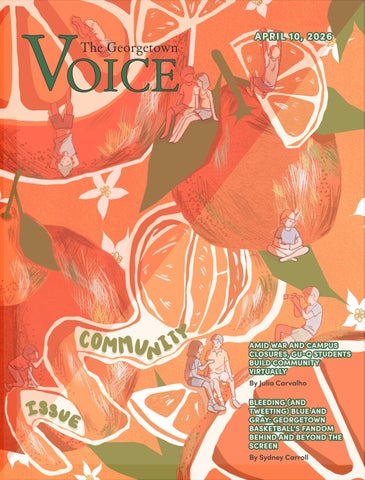
Welcome to the Voice’s Community Issue: a collection of 11 articles about the myriad ways people come together on the Hilltop, in D.C., online, and, even, abroad.
In these pages, you can read about how students on our Qatari campus have fostered community during the war in the Mideast, how transfer athletes navigate coming to Georgetown, and how artists fight gentrification with their work in Anacostia. I hope you find these pieces as interesting and engaging as I did.
In deciding our two themed issues for this semester, I wanted the Voice to engage with different facets of the Georgetown experience, as we navigate life in the District and on the Hilltop. It is in this light that we chose to have this Community Issue accompany our annual D.C. Issue.
Over the four years I have been a part of the Voice, I have had many conversations about what makes our publication special. One of the ideas that has come up over and over again is our commitment to empathetic, considerate communitydriven journalism. (This is a mission that I have perhaps
navigate society, and it forms the foundation of any lasting change. In this spirit, it’s a critical time to dedicate an issue to this type of coverage.
There are many facets of community, belonging, and place that we only grazed the surface of, and even more that didn’t fit within the pages of this magazine. But the Voice is committed to continuing this type of coverage long after this issue is on stands.
And we hope that you, as readers, continue to think about what it means to be part of a community—on the Hilltop, in D.C., in the United States, and the world. As Georgetown encourages us through its Jesuit values to be People for Others and embrace Community in Diversity, we challenge you to support these ideals.
If you have any thoughts at all about this issue, our coverage online, or anything going in our Georgetown community, I’m just an email away: editor@georgetownvoice.com.
However, without further ado, enjoy our second to last issue of the semester!
Amid war and campus closures, GU-Q students build community virtually
BY JULIA CARVALHO | DESIGN BY SHABAD SINGH
Maryam Al-Ansari (SFS ’26), a Qatari student and member of the Georgetown University Qatar (GU-Q) senior class committee, recently started a personal project titled “100 days, 100 people,” to commemorate her final semester.
However, her plan to take a picture every day with various members of the university community was interrupted in April, when the university announced that it would be operating remotely for the remainder of the semester as a result of escalating war in the Mideast region.
After the U.S. and Israel launched a joint attack on Iran on Feb. 28, Iran responded with retaliatory strikes targeting both Israel and U.S. military installations in Bahrain, Kuwait, and Qatar.
As the bombardment persisted, Iran’s Ministry of Science and Technology reported that U.S.-Israeli strikes hit 30 Iranian universities. The Iranian Islamic Revolutionary Guard Corps, a branch of the armed forces responsible for its ballistic missile program, issued a statement to state media on March 29, threatening to target U.S. universities in the region, such as GU-Q, if the U.S. did not condemn these attacks.
After organizing voluntary departures for international students and implementing hybrid instruction for over a month, GU-Q announced on April 1 that classes would be conducted virtually, with a pass/fail option, for the remainder of the semester. In an email to the community, Dean Safwan Masri described the situation in the region as “too fluid to support a return to in-person operations at this time.”
Al-Ansari acknowledged both her personal disappointment and an upheaval of the senior class committee’s broader work to build the campus community.
“A lot of my plans for our senior year are plans for in-person events like a senior dinner, senior sunrise, which have all been canceled or put on hold,” she said. “It’s just difficult seeing my plans, things that I have worked hard on, go to waste.”
Al-Ansari turned her attention to another tradition she referred to as “senior letters.”
Typically, a bulletin board is mounted in the atrium of the GU-Q campus displaying envelopes for every graduating senior, in which community members are invited to leave farewell notes.
Given the campus closure, Al-Ansari created virtual folders for the class of 2026 and sent out instructions to the GU-Q community for sharing their letters.
“I think we deserve to have this tradition, especially during this time where support is definitely needed from our friends, staff, and faculty,” Al-Ansari said.
Gwyneth Estomo (SFS ’27), who was born and raised in Doha, said that it is not her safety that has been most concerning, despite the Qatari Armed Forces’ interception of two Iranian missiles as recently as April 5.
“I don’t necessarily feel unsafe here, I’m with my family,” she said.
Rather, the transition to virtual learning has required the most support.
“What I really miss the most is being at university with my friends and learning in classrooms,” Estomo said. “The sudden shift is very jarring for me, because I didn’t think I’d get to experience online learning again since the pandemic.”
She explained that Dean Masri, along with other professors, have taken to hosting off-campus dinners to celebrate events like Eid al-Fitr, a recent Islamic holiday, and to give students who call Qatar home a new way to connect.
“We hosted one recently at a hotel,” Estomo said. “It was to celebrate Eid. My professors have also been reaching out individually and as a class to just ask how we’re doing, to see if there’s anything they can do to accommodate us.”
For international students, such as Saroosh Zahid (SFS ’27), faculty and staff have conveyed messages of support through virtual community forums. After
returning to his home in Pakistan, Zahid described one meeting in which Dean Masri reaffirmed his commitment to ensuring student well-being.
“He kept saying that he can’t rest until his students are in a better place, they are taken care of, they’re not worrying,” Zahid said. “And when someone asked him, ‘Are you planning to leave Qatar as well?’ he said, ‘Qatari students are here, right? So I’m going to be here with them.’ That’s a very important kind of message from leadership.”
This support came not just from faculty and staff, but also from fellow students.
“In the past one and a half months, I’ve come to feel more a part of the community than ever before,” he said. “Anyone who knew anyone was emailing to check in. Even someone you see in class, but never talk to, would email you and ask, ‘Are you OK? Is everything fine? Where are you located these days?’”
Despite his gratitude for the opportunity to spend the month of Ramadan with his family, Zahid expressed his readiness to return to the life he “built from scratch” at GU-Q.
“I also feel, at many times of the day, that I really want to go back to Doha, despite being with family right now,” Zahid said. “How can I be here when my friends are still there?”
While the campus closure has created uncertainty, Zahid is confident in the GU-Q community’s resiliency.
“We’re optimistic that in the grand scheme of things, everything will work out,” he said. “Maybe it’s going to take a month, maybe two. We’re not sure about anything right now, but everyone is hopeful to the degree they can be. Somehow we all have trust in Qatar that they will work something out, because they always do.”
FBY CHIARA VOLPI
GRAPHICS BY MASHA MILLER; LAYOUT BY LUCY MONTALTI
reshman year, I was constantly told to go on ESCAPE. Despite the neverending advertisements—from tempting me with chocolate (my weakness) to upperclassmen telling me they wish they had taken the opportunity—I remained unconvinced. I felt like the retreat wasn’t ‘for me’—as the child of a Buddhist father and semi-Catholic mother, my relationship with religion was complicated. So why would I want with big energy. One leader brought a banjo, and although he could only play “Rainbow Connection,” we still happily sang along. The sometimes endless drive felt extremely short, filled with the sound of laughter and new friendships forming.
circle for me: he was my Problem of God teacher and encouraged me to apply to be a leader. His talk was based on how Ignatian terminology like consolation, desolation, and discernment guides him through his adult life. These talks are so special—as we grow through this transition period between adolescence and adulthood, hearing the mistakes and subsequent lessons learned from figures we look up to shows us that actually, everything will be okay.
Strong opinions: May we hold them, and
may they
bring us closer
BY PHOEBE NASH
DESIGN BY MAGGIE ZHANG
I’ve spent a considerable portion of this semester in the margins of Google Docs. Suggesting mode has become a way of life. It is in this mode—and in every suggested em dash—that I have further immersed myself in the world of opinion journalism.
While journalism has been increasingly underfunded and undervalued, leaving communities undercovered, it seems opinion journalism has experienced a contradictory resurgence in popular culture. A controversial piece by The New York Times on liberal feminism in the workplace circled social media for weeks; The Washington Post’s lack of endorsement for the Harris campaign led to 200,000 canceled subscriptions; Vogue’s article titled “Is Having a Boyfriend Embarrassing Now?” has left many of my friends asking the same question.
Over the past semester, the Voice’s opinion section—which is cleverly, yet confusingly, named “Voices”—similarly grew. Writers covered many corners of campus and District life: they dove into the Potomac, got comfortable with stupidity, questioned situationship culture, called out university labor practices, bought new jeans, resisted genocide and displacement through cooking, and gave endless advice. Each Tuesday evening, Voice-rs descend upon the office via the trusty Leavey
Beyond being entertaining and occasionally cult-like, the opinion section of student publications, at the Voice and otherwise, serve as a beating heart of campus life.
Forming a particularly alive archive, these stories live on well after authors and editors have graduated. They exist to tell us not just what happened, but how the writers themselves reacted, reflected, and made sense of it.
(SFS ’26)—and pieces develop in spite of my stubbornness. Bylines grow. The envelope full of articles I send home to my parents is reclassified as overweight. Quality increases; quality persists.
Take the Voice’s now graduated editorin-chief, Connor Martin (CAS ’25), whose American Studies thesis on the lawsuits around LGBTQ+ students on Georgetown’s campus was born out of a news commentary he wrote freshman year and opinion pieces from The Hoya, the Voice, and The Indy. These stories live on; the opinions do too.
Opinions, as with most things, flourish in community. In editing chains and weekly meetings, the beliefs I hold so dear (often verging on personality traits) are challenged, reworded, and questioned. Why do I refuse to use generative AI? What is the root of consistent complaints about phone walkers and slow salad bar users? And when, oh when, will I stop talking about those damn elevators?
As I waxed on, I realized many of these opinions were, in earnest, born from my own complaining. My more glass-half-full co-conspirators, thankfully, reshaped my musings into reflections on community, connection, and even joy.
I’ve started, also, to allow these opinions to shake. To let unfinished thoughts be worked out a little in rooms full of other people, and to stay long enough for them to become part of something shared, instead of something I
Guided by the pace of our biweekly print schedule, I’ve often found it hard to let go. I grasp onto my pacing, turn of phrase, theses, and often indefensible takes. Better tendencies persevere— namely late-night voice memos from Opinion Executive Evalyn Lee (CAS ’27) and last-minute passes by Editor-in-Chief Eddy Binford-Ross
Beyond my own 900 to 950-word theses, I’ve learned from others’ pieces too. Evalyn got me hooked on day-old bagel bags. The Editorial Board educated me on pressing issues of university-perpetuated injustice, such as their attempted outsourcing of transportation employees. Hannah Beil (CAS ’28) inspired me to say “I love you” more (and almost buy a $70 sweatshirt). From the confines of our 16-page magazine grow endless possibilities for other connections: what was written in the notes app and early drafts came to inform bagel rankings, understandings of the very university we attend, and how we love and are loved.
As the semester draws to its fateful close, I’m proud to conclude a verbose (and welledited) semester, and I’m excited to watch the linguistic legacy take hold. I’m confident in our work that comes from and speaks to communities we cover, instead of simply being “laid at the feet of the student body.”
May we continue to write. And may you, whoever you are, keep reading—or start, if you haven’t already.
Going somewhere, together
BY JACOB GARDNER
DESIGN BY LUCY MONTALTI
Along the western coast of Florida, the salty air wafts through every opening of my 2011 Ford Escape. In the rearview mirror, my curls bloom outward, doubling in size. I turn the volume up—“Anticipating” by Britney Spears is playing—as the sun begins its descent into crepuscular glow. The beauty of an evening drive used to be my everything.
I once told myself that I loved driving because it provided a moving space of freedom that my teenage years necessitated. The car was an escape, a clean exit from whatever version of myself I didn’t feel like being that day or from any place that made that version necessary.
And while that feeling of escape remains, I’ve discovered the car’s appeal was actually quite the opposite. The car not only allowed me to pick up and go, but rather, just as often, to bring someone with.
My proudly self-bought car certainly did not come with all the bells and whistles. The radio cut out if you hit a pothole too hard, and the passenger window took a full 10 seconds to roll down, as if sentient and considering the request. But none of that mattered once another person joined.
There is a particular intimacy to driving someone somewhere: waiting outside their house, deciding the music, asking where you’re going even if you already know. To drive someone is to take responsibility for them, however briefly. You are the one navigating, the one paying attention, the one making sure they arrive safely. You and your passenger are sitting just inches apart but looking forward, which
makes it easier to say things you might not say face-to-face. The conversation isn’t a performance. It can start, stop, drift. It can disappear entirely without becoming awkward or suffocating.
I didn’t realize I would miss my car until I didn’t have it.
My attachment to driving became apparent immediately upon arriving in D.C. My first week, I faced the oh-socanon conundrum of getting on the right Metro line but in the wrong direction. I sat on the train, staring at the map on the wall like it might rearrange itself out of pity. I rode the red line towards Glenmont five stops too far before I realized, got off, and waited again just to ride it all the way back and then some. It was disorienting; everyone moved with a kind of purpose I couldn’t quite match.
In the brutal heat of July, the Metro didn’t offer that inherent sense of being with someone, of fighting over the AC to combat our collective melting. All I wanted was to be back behind the wheel—alone, or better yet, with a friend.
Transportation creates space for connection, and the public variant is a seemingly unique species. It lacks the enclosed, intentional intimacy of a car, instead possessing something looser, more ambient. You sit across from strangers, share space without introduction, overhear conversations you were never meant to hear. Someone plays Central Cee too loudly. Someone falls asleep and their drool pools on the floor. Someone is clearly having a worse day than you.
What emerges from the shared space of public transport is a different kind of permission than the privacy of my car. On a train, no one is looking at you, but you are not simply alone either. You exist beside people without needing to account for yourself. You can be quiet, unfinished— held in motion, both literally and socially.
Amid the absence of a car, I found that the public nature of the Metro offered me a different kind of escape from Georgetown’s campus. In the Georgetown neighborhood, everything is
proximal. Everyone walks (or scooters?) to their destination. And on campus, there is a constant visibility where your anonymity is vanquished: you will pass the same people on the sidewalks, in cramped classrooms, and during the dinner rush at Leo’s. Without a car, without an immediate way out, there’s less distance and privacy between you and everyone else.
But public transportation changes that. It offers movement without such concentrated exposure; you step on the train and become one of many. On the Metro, it feels more acceptable to be alone since each person’s solitude becomes common among strangers.
The Metro community is not something you opt into. When you step onto a train, you become a part of it—moving alongside strangers, whether you are ready to be seen or not.
Admittedly, I still miss my car. I miss the enclosure, the control, the potential for screaming when the right song comes on. But it wasn’t just the driving I missed. It was the feeling of company without expectation. The sense that being with someone didn’t have to look like small talk about GPAs or the peril of English majors. Connection could happen in the in-between. Between stops, between conversations, even between versions of yourself.
And maybe that is what I’ve been learning here, without a car: that community does not always look like closeness. Maybe it looks like proximity, or a shared direction. Maybe it looks like sitting next to someone, not speaking, as the city moves around you.
Now, when the train pulls into the station with a rush of air, louder than it needs to be, I’ll step inside, take a seat by the window, and let my headphones fill the space the same way they would in my car. Someone across from me will be asleep. Someone else will be watching their reflection in the glass. And, whether I am alone or not, all of us will be going somewhere, together. G
“The
place that built me”: Amid gentrification, Anacostia’s artists embody the art of resistance
BY CHIHRONG KUO | DESIGN BY PAIGE BENISH
As far as Jason Anderson, a multidisciplinary artist from Anacostia who goes by the artist name Jay Sun, can remember, there has always been construction in Washington, D.C. While much of this gentrification has historically plagued downtown and Northwest Washington, Anderson said that Anacostia, a neighborhood in Southeast D.C., is becoming increasingly unrecognizable. New development is threatening to erase the spread of multicolored murals in every alley, local poetry collectives, art exhibitions, museums, and the boom of go-go music as one struts down Martin Luther King Jr. Avenue SE.
Anacostia’s history runs deep. Before D.C.’s inception, it began as a thriving community and trading center in the larger village of Nacotchtank, where Algonquian Indigenous people of the Northeastern Woodlands lived. Following European colonization and the formation of the District, the community evolved into Uniontown, a suburb for the large Navy Yard workforce. It was in Anacostia that Frederick Douglass, the father of the abolition movement, spent the last quarter-century of his life, and where he served as a thespian in a community theater company.
Today, Anacostia’s artistic roots live on. The neighborhood is rife with community artists preserving its historical roots and propelling the next generation of local artists, even as widespread gentrification threatens the community that has long called it home. In Anacostia, art is not just a passion: it’s a vehicle through which residents maintain the area’s roots.
Anacostia is more than 90% Black, but Lamont Mitchell, the chairman and chief operating officer of the Anacostia Coordinating Council, which focuses on community organizing to revitalize the neighborhood, pointed out that newcomers to the area are predominantly
non-Black. Housing prices in D.C. have increased exponentially in the last decade, and Mitchell anticipates further price hikes in Anacostia with the advent of new buildings and the Department of Health moving to the area.
“There’s a lot of pressure on the real estate market in historic Anacostia, and [prices] are moving upward, but east of the [Anacostia] river is where the last only affordable housing will be found in D.C.,” Mitchell said.
While inflationary pressures often price out locals, certain inclusionary zoning policies now require new units to have a percentage of residents with a targeted income, which allows residents to reap the benefits of investment, according to Mitchell. However, even with comparatively affordable housing, housing costs in Anacostia continue to rise, pushing out residents.
Anderson recalled the most recognizable gentrification of Anacostia in the 2000s, when residents began leaving D.C. and selling family homes that had been passed down for generations.
“The community changes—there aren’t as many block parties, there aren’t as many festivals and go-go bands playing randomly, cookouts,” Anderson said. “People like to speak negatively about gentrification, and rightfully so, because of the loss of ownership. But when you remove the indigenous people from the communities, there goes the culture also.”
Similarly, Dwayne Lawson-Brown, or Crochet Kingpin, a crochet artist, playwright, and poet, said that D.C. today feels like a different world from the D.C. they grew up in due to rapid gentrification.
“The hospital I was born in, Columbia Hospital for Women, is now a Trader Joe’s and condos. The middle school where I started writing and sharing my poetry out loud is now a Trader Joe’s and condos,” Lawson-Brown said. “There’s this common thread of D.C. natives—
and particularly Black D.C. natives— [feeling] that our past can be bought.”
Lawson-Brown grew up in a neighborhood between Anacostia and Congress Heights called Douglass, and has returned to live just down the street from their childhood home. They contribute regularly to art shows and exhibitions in the D.C. area. Lawson-Brown also created D.C.’s longest-running open mic “Spit Dat,” has featured as an artist in the Artto-Go-Go Anacostia Cultural District, and hosted a wearable art exhibit at the Smithsonian's Anacostia Community Museum.
“I wanted to move back into my neighborhood and buy in my neighborhood so that I could be a good neighbor,” LawsonBrown said. “While our society has the most access to the power to connect and the most access to information, I sometimes feel that we’re also the least communal that we’ve ever been.”
In resistance to these challenges, local artists have sought to bring community through education and entertainment. Community and solidarity through art Ahmad Woodard, who goes by the stage name Ama’d, is an MC, lyricist, and actor who grew up in Anacostia. He was a self-described “program hopper,” attending various non-profit initiatives catered towards music and music development as a child. One of the most influential programs for him was Project Create, a community-based nonprofit providing accessible multidisciplinary education to young people. Today, he is an artist-in-residence at Project Create.
“Project Create, and a lot of other programs that I’ve been a part of in the past as an artist, those will be my lifelines to the city,” Ama’d said. “I do plan on leaving, but I will always come back, and those will be the resources that I can come back to.”
Ama’d is involved in many other artistic projects in the city that allow him to speak out about the issues
he cares about. Most recently, he collaborated with the Freedom Futures Collective to create the FREE DC Mixtape (2026), using art to discuss political topics like the National Guard’s deployment in D.C. and government repression.
Ama’d co-wrote the lead single, “Free DC,” which he performed at the No Kings Protest in late March.
“Southeast is in my blood. D.C. is in my blood, so everything comes from here,” Ama’d said. “I always write from the perspective of my community and my city, but I also create from a worldly perspective.”
Ama’d’s art centers around what he calls “duality perspectives,” emphasizing being in tune with his community and bringing inspiration and optimism. In particular, he speaks about issues that disproportionately affect
Black people across the U.S.
Ama’d centers on the trauma of gun violence, which killed many of his friends. Gun violence disproportionately impacts Ward 8, of which Anacostia is a part, with the ward experiencing 50 fatal shootings and 154 gun-related injuries compared to one fatal shooting and two gun-related injuries in D.C.’s wealthiest ward, Ward 3, in 2024.
Telling Anacostia’s story
While development of the arts in Anacostia has always been oriented toward the local community, it has also found success beyond the neighborhood.
Kymone Freeman is a playwright, activist, and the co-founder of We Act Radio, an independent media organization in Anacostia that amplifies the voices of underrepresented people and elevates conversations about local and national protest efforts.
Freeman uses interdisciplinary art forms to change dominant
narratives about the neighborhood, including a PBS documentary short “Fresh Prince of Anacostia” and a storytelling public media exhibition “Anacostia Unmapped.”
While he has found success with national media outlets, Freeman emphasized that the success of his radio show stemmed from the relationships he built with local artists who shared his same passions.
“Had I not done something with my artsy friends, creating a festival, I wouldn’t have met my future business partner,” Freeman said. “I wouldn’t have gotten the radio project on my lap, and it wouldn’t have got funding.”
Efforts by Ama’d, Lawson-Brown, Freeman, and Anderson demonstrate the importance of art in community building and resistance in Anacostia. While Anderson did not definitively plan to remain in D.C. for his artistic career, he found success with local film, television, and theater opportunities in the area.
Giving back to the community
However, staying specifically in the neighborhood where he grew up has helped Anderson reach and inspire young people.
“Examples are crucial. It’s good to see people of your community in positions like doctors, lawyers, architects, designers, artists,” Anderson said. “That has been a key element to the disconnect with the youth in these communities and success. You need examples to see, to give you some type of motivation.”
Part of the reason Anderson returned to serve his community was to repay the favor of mentors and opportunities from his own youth. At the same time, he returned to instill an alternative perspective in the youth of Anacostia in the face of growing gentrification and displacement.
“I’m also a student of war. If one entity gets the upper hand, they can kind of dictate how it goes, unless the opposing entity says something, or does something, or doesn’t accept those terms,” Anderson said. “If we can conquer your land, we’re going to do that until we can’t. So at some point there has to be a deterrent for institutions, or developers, or corporations, like, ‘This may be problematic if we try to displace these people.’”
While he calls himself “retired from art,” Anderson still gives back to his community as the dean at a local high school and a youth basketball and football coach.
“The most important role in my activism, or artist activism, is my ability to connect with youth,” Anderson said. “Building those relationships with
the young people and just trying to instill things about their history, their heritage, the politics surrounding their conditions.”
Maintaining Chocolate City
While gentrification most noticeably and disproportionately affects Black residents, ultimately, it impacts all residents who hope to preserve culture and remain in the city, Lawson-Brown said. For example, the number of Chinese residents in D.C.’s Chinatown decreased by more than 90% from 2010 to 2020, and the recognizable signs remaining are corporate insignia with Chinese lettering.
“It is an issue that is bigger than Black folk, though it may appear to only affect Black folk,” Lawson-Brown said.
Lawson-Brown noted that the displacement of Black folks from Ward 8 and the increase in non-Black residents moving in isn’t merely an individual or racial problem, but reflects larger systems of oppression.
“The reality is, we can’t afford to live downtown, white folk can’t afford to live downtown, only the richest of rich can afford to live there,” Lawson-Brown said. “While I am upset about people getting forced out of their homes and being priced out of their homes, but I don’t fault individuals that are like, ‘I’m just looking for a place to live, and the only thing that I can afford is this, like a two-bedroom east of the river.’”
D.C.’s moniker “Chocolate City” originated as a reference to its status as the first majority Black city in the 1950s. However, between 1970 and 2015, the percentage of Black residents fell from 71.1% to 48%. Wards 7 and 8, D.C.’s wards east of the Anacostia River, have remained majority Black, with an estimated 92% of Anacostia residents being Black. In contrast, as of 2025, D.C.’s percentage of Black residents was 43.4%.
Despite the moniker, Lawson-Brown noted that, to them, “Chocolate City” always represented racial diversity beyond the Black community.
“There’s always been people of other races in D.C. What made Chocolate City special is that everybody could thrive together,” Lawson-Brown said.
However, there is hope. For the 11,000 residents who call Anacostia home, the neighborhood is not just a place for artistic appreciation or historic preservation, but a breathing force for the future.
“This is the place that built me,” Ama’d said. “Those will be the resources that I can come back to. I can support these organizations that have supported me and poured into me. That’ll be how I can pay it forward.”
Bleeding (and tweeting) blue and gray: Georgetown ’s fandom behind and beyond the scre
BY SYDNEY CARROLL | DESIGN BY RYAN GOODWIN
million posts in the past 22 years.
“It was an opportunity for fans to comment on the teams and on games in an era before widespread social media,” Reagan wrote to the Voice.
Today, Reagan also runs the account @ hoyatalk on X, formerly known as Twitter, a platform where many fans discuss Hoya basketball.
For every Georgetown men’s basketball game, there are thousands of posts about who missed shots, what Hoya legends were in the stands, and more. Featuring clever usernames and occasional insider knowledge on the team, the accounts and people that make up “Hoya Twitter” have built an online alliance. Beyond being a place to rehash games, Hoya fans have turned this online community into one of genuine care, fostering connections that reach far beyond the screen.
Rasheen Carbin (SFS ’98) shares his thoughts from the moniker of @HoyaOptimist33 to over a thousand followers.
“It’s just an extension of my passion for Georgetown University and for Georgetown basketball,” he explained.
Carbin started co-hosting “spaces,” rooms on X where different accounts can audio chat. As a result, Carbin was invited by the BIG EAST Energy Network, a family of podcasts about men’s basketball teams, to become host of Bleeding Blue and Gray, which debuted in August 2025.
While Carbin may seem like a natural fit to run a podcast about the team, his cohost hasn’t attended Georgetown—because he has yet to graduate high school.
sports management or reporting, so his involvement online served as a perfect pipeline. After launching his podcast, he’s also become an inside source, developing relationships with players, coaches, and their parents.
His favorite players to chat with include former Hoya forward Drew Fielder, current senior guard Jeremiah Williams, and junior guard Caleb Williams—he also chats with Caleb Williams’ father.
“They have given me quotes that helped grow my page way bigger than I ever thought it was going to become,” Rosen explained. “It’s been very fun to talk with them and also their parents, and just get to know the community.”
Colin (CAS ’24), who runs @TidalBlueHoya and requested to only be referred to by his first name to maintain anonymity, became a Hoya basketball fan after he watched Georgetown beat rival Syracuse in 2021.
“It wasn’t until we beat Syracuse that I had that like, ‘Oh my gosh, this is what sports are all about’ out of your body experience,” Colin explained. “You’re with a group of people, [and] that aspect of cura personalis took hold and I [was] like, ‘Okay, this is fun.’”
Colin emphasized the welcoming nature of Hoya spheres online, something others said is pretty rare.
As a young person learning the ropes, Rosen said that the community has been extremely open to helping him out and teaching him along the way.
“There’s a lot of people on Twitter that I can just DM or people I can text and just be like, ‘How do you think I should go about
this?’” he explained.
“It’s been very fun, and it’s also helped me learn a lot about how to navigate the sports world.”
This community also expands into real life. Ryan Yohn runs @_ HoyaParanoia_, but he was also never a Georgetown student. Yohn became a fan through his mom, who was a Georgetown professor for 17 years.
“My childhood was Georgetown basketball games,” he said.
While Yohn no longer lives in the District, he makes a point to meet up with online friends in person at Capital One Arena.
“When I do make it up there, I get a couple DMs to meet up with people, and it’s been great,” he explained. “There’s definitely a community outside of the internet that comes with the territory.”
Reagan has made similar in-person connections, even with people who may have known his work before they knew his name or face.
“Last month, I was sitting with a fan at the Big East tournament who mentioned how he follows hoyasaxa.com on Twitter,” Reagan recalled. “I opened my phone to the site and asked, ‘This one?’”
Carbin meets up with online friends at Clyde’s before the Hoyas play. It’s reminiscent of his time at Georgetown, where going to games with his friends were some of his best memories.
“You’re not going to have very long at Georgetown. You have four years. And part of that is not just being in the classroom or doing an internship. Part of it is sharing a communal experience with your friends,” Carbin said. “You’re going to remember the huge victories, and you’re going to remember the defeats, and you’re going to remember the bus rides you’ve shared to the arena.”
On the field and in the classroom, these volunteers are on
BY EILEEN WEISNER | DESIGN BY KATIE REDDY
Beth Wenger, deputy director of Kids
Explore Exercise Now (KEEN) Greater D.C., has worked at the organization since 2008. Volunteering with KEEN, a national nonprofit that works to bring sports and physical activity to children with disabilities, changed Wenger’s career path, causing her to transition from the publishing industry to becoming KEEN’s program manager.
She felt challenged at first by her work with a six-year-old nonverbal athlete, but the time she spent with him hooked her.
“The people involved were so nice, and the work was so great,” she said. “It just piqued my curiosity. And so I went back again and again and again.”
Every weekend at sites across the District, KEEN and its network of volunteers serve over 500 athletes with free one-on-one programming. These unstructured, flexible programs, ranging from basketball to swimming, are designed to suit individual needs and growth. Now in their 33rd year of operation, this noncompetitive companionship system drives KEEN’s core principle: “accept every child, regardless of the nature or severity of their disability.”
Wenger credits the organization for teaching her tolerance, acceptance, diplomacy, and balance.
“I loved kids, and I loved sports—the fact that they had disabilities didn’t really register for me then,” Wenger said.
In the spring of 2024, KEEN established a partnership with the University of Maryland’s (UMD) Kinesiology Department to offer two service-learning classes: an upper-level kinesiology elective and a onecredit general elective course open to other majors. In both, students volunteer at KEEN sessions every Sunday as a “lab” component of the course. Dakota Goldfarb, KEEN’s UMD site program manager, has a unique vantage point on the benefits KEEN provides college volunteers.
“A lot of [volunteers] have KEEN impact their career field,” Goldfarb said. “I have one student who plans to go into occupational therapy. She has a sibling with autism, she loves working with the kids. It solidified her want to go into KEEN or something similar.”
Emma Powell, the graduate coordinator and lecturer of the two classes, prioritizes getting her kinesiology students out into the community to center it in their work.
“For me, anyone in public health, it’s so important to do community work. That has been a big priority for me in my work,” she explained. She highlighted that the UMD site makes KEEN more accessible to families in Prince George’s County who might otherwise have to travel to the D.C. locations.
Isabella Vidal, a UMD senior in the one-credit service-learning course, majors in kinesiology and plans to work in occupational therapy post-graduation. Like Powell, she sees the practical importance of community volunteering to bolster real-world public health work.
“Learning more helps you to be a better practitioner,” Vidal said. “If I didn’t have any experience at all, I would feel I would be a disservice to my patients or kids I work with.”
In her one-on-one sessions with different athletes, Vidal has already witnessed many developmental milestones that therapists look for, such as grasping and throwing.
Maggie Chen, a junior in the kinesiology program, took the three-credit elective in the fall after hearing about it from a friend. She is currently enrolled in the one-credit course and plans to continue volunteering independently with KEEN in the fall.
“I’ve worked with KEEN for a while, I’m very attached,” said Chen. “One of the parents said that no other place accommodates his child as well as KEEN.”
Her time in the program has strengthened her interest in pediatric physical therapy, and she’s hopeful to see more places that welcome kids with disabilities. By placing the athletes’ needs front and center, KEEN surrounds them with the support and space to grow.
Unfortunately, KEEN faces limitations tied to its nonprofit structure in promoting physical activity and companionship for kids with disabilities. Wenger said, “We always have this long waiting list for kids who want to get into the program,” and that “the need for [KEEN’s] programs is great.”
“80% of our athletes are somewhere on the autism spectrum, and most of them are on the more severe side, because that’s who we’re designed for,” Wenger said. “The results of our activities and our efforts takes longer to see. Sometimes we can only gauge it on the fact they come back session after session after session.”
community
But those results hinge on the volunteers returning time after time. KEEN does not require volunteers to make a specific time commitment to the organization. Instead, it asks them to come when they can. New volunteer training is offered before each athlete session, creating a flexible, lowbarrier-to-entry experience.
“The longer you work with kids with disabilities, or spend time with kids with disabilities, the more open and accepting you become,” said Wenger. “What you can see over time is growth. You can’t necessarily see that if you come and volunteer with us once or twice.”
That growth is a two-way street. Only through dedicated volunteers can KEEN continue to support others.
“KEEN is run by volunteers,” she said. “We’re a community organization. We are as big as we are because of the community. We can serve more kids, we can do more good, with more help from the community. More volunteers, more corporate donors and sponsors, and people in general who are willing to lend a hand in some way.”
As the program continues its third decade, Goldfarb says that these volunteers and donors aren’t just giving to the program— they’re being rewarded by it as well.
“You make an impact on your athletes’
Georgetown transfer athletes nd home on the Hilltop
BY JULIA MAURER
GRAPHICS BY MARIAM OKUNOLA; LAYOUT BY MAGGIE ZHANG
Jack Lindimore, a sophomore defender on Georgetown’s men’s soccer team, found his way to the Hilltop the second semester of his freshman year, after playing his first college season at Indiana University. For Lindimore, the decision was about finding a permanent community for his college experience.
“I really wanted a place I would be at for four years,” he told the Voice Transfer athletes like Lindimore are not new to college sports, though they have garnered more attention following a 2024 change to NCAA transfer eligibility rules. Now, athletes can transfer freely without sitting out a year, regardless of how many times they have transferred previously. This rule has made transferring much more common, providing all student-athletes the opportunity to search for a new community if their current school isn’t a good fit.
Much of the focus on transfer athletes is the impacts that the new rules have had on top-tier basketball and football rosters, but for most athletes, the decision to transfer and the subsequent process is much more personal. Transfer athletes practice, play, and build chemistry with their team while also adjusting to a new campus, city, and academic environment.
Olivia Williams, a sophomore cross country and track and field athlete, transferred this year from the University of Pennsylvania. In an interview with the Voice, Williams said the team has made an effort to help her feel connected to both the team and the larger D.C. community.
“We try to incorporate lots of things into our runs,” Williams said. “At the beginning of the year, we did a run to the monuments because when I came on my visit in May, I really only saw campus and didn’t really see any of the other cool parts of D.C.”
Georgetown baseball head coach Edwin Thompson views the arrival of transfer players and the ensuing transition period as just another part of the college sports season.
“Any time you bring people into an organization,
there is a period of how everything blends in,” he said in an interview with the Voice.
For Thompson’s team, the fall season is a time to get to know each other off the field, welcome new players, and build chemistry beyond baseball.
Thompson likes to “[keep] it very simple, very organic,” as the team gets to know each other. The Hoyas attended a Washington Nationals game together and held a cookout so that coaches and returning players alike could, as Thompson said, “get to know [new transfers], what they like, what they do.”
Not only is welcoming players important, but Liam Connor (CAS ’27), a junior on the men’s lacrosse team who transferred to Georgetown this fall from Colgate University, stressed that recruiting plays a role in creating a community. Coaches focus not only on bringing in players that will fit in athletically, but also will mesh well with the team’s personalities.
“[Coach] tries to recruit very similar people,” Connor said in an interview with the Voice. “The coaches made it really easy for me to come in.”
Thompson also mentioned the challenges of bringing on new players. Sometimes the dynamic works out immediately for the team, and sometimes the chemistry takes the entire year to develop.
“Every year it’s different, every team is different,” he said.
While athletes find friendships within their team, they also find community within athletics and at Georgetown as a whole. Williams noted that Georgetown’s circle of athletes, in general, is very welcoming.
“You walk around with the athlete backpack or parka and just start a conversation,” she said.
Despite the support available, transferring schools has its own challenges—ones that are not necessarily unique to athletes. Lindimore described feeling pressure to get the decision right on his second try as he looked for a community that would be a good fit for the next three and a half years. Coming to Georgetown, Lindimore had many of the same anxieties as any transfer student, focusing on finding a place he would be happy, mesh with the new team, and find a home on campus.
When asked about his biggest challenges when transferring, Lindimore said, “The anticipation of going to a new school, not really knowing anybody, kinda restarting your life in a way.”
So much of the attention on transfer athletes today centers on the star players, often in basketball or football, who stay with a team for just a year before seeking opportunities elsewhere. However, the vast majority of transfer athletes look for the same things as any other transfer student: a community.
While there are certainly challenges for players as they start over in a new city, at a new school, and on a new team, the change often brings a level of contentment to their decision.
“I’m so glad I did transfer. It is one of the best decisions I’ve ever made in my life,” Lindimore said. “Everything kind of really worked out for me.”
Connor echoed Lindimore’s sentiment. “Every time I look back at my decision, I am just so thankful that I was given the opportunity to play here,” he said.
Williams also expressed no regret with her decision, offering advice for other potential transfer athletes.
“If you aren’t having a great experience, college is not long at all, and it’s supposed to be fun,” Williams said. “If transferring is something you’ve thought about more than once, then just do it, and you won’t
Georgetown’s dance community unites in “One Move, One Groove”
BY ALEXANDRA RISI AND AUBREY BUTTERFIELD DESIGN BY PIA CRUZ
On the evening of March 20, students poured into Gaston Hall to see “One Move, One Groove,” a dance showcase hosted by Groove Theory, Georgetown’s hip-hop dance team. By the end of the night, they got a glimpse into the diversity of the Georgetown dance scene and the community that many dancers, amateur and experienced alike, find on the Hilltop.
This year marks the 16th annual performance of “One Move, One Groove.” Featuring guest performances from campus groups GU Jawani, Ritmo y Sabor, Hoya Break Squad, and GU VIBE, the show was an opportunity for Georgetown’s dance community to come together, share their styles, and spotlight the art of dance.
The showcase’s program was organized around three mixes, or dance numbers to mashups, featuring all Groove Theory members. One mix, “The Groove Prix,” had a car theme, featuring a mashup of songs about driving (such as Rihanna’s “Shut Up And Drive” and Tate McRae’s “Sports Car”) and dancers sporting racecar-inspired looks. In between mixes were smaller vignettes, ranging in style and genre, demonstrating the true breadth of ability within the dance group.
Groove Theory began working on their pieces at the start of the semester, according to Groove Theory Community Captain Mia Tyler Rich (SFS ’28). Alongside their new dances, Groove Theory performs a few older numbers typically seen at their basketball game performances.
Rich fondly recalled the process of creating “The Groove Prix,” which started with the idea of choreographing to the song “Tokyo Drift” by Teriyaki Boyz. The group was initially unsure how to pull the concept off, but Rich was ready to try anything to make it happen.
“That process is so fun, talking through that, because we get to come up with really outlandish ideas,” she said.
Early in the semester, Groove Theory members had the opportunity to teach a dance class in the style of their choosing as a bonding activity. In addition to encouraging members to come up with innovative choreography and experiment with new types of dance (bringing about the genius of a brat (2024) tap number), the exercise gave Rich and the ensemble a vast repertoire of numbers to develop into performances for the ensemble.
“[The showcase] kind of formalizes it in a way, [so] you can see your choreo on the stage, and that's just really, really cool,” Rich said.
Each year, Groove Theory looks for ways for new talent to take the lead in performances and choreography.
“A lot of times our mixes will be choreographed by new members,” Rachel Miyamoto (CAS ’26), a junior captain for Groove Theory, said. “It’s a really cool chance to be able to see such a wide variety of experiences [being] expressed by all of our different dancers.”
There often isn’t a unified thread tying the different dances within the showcase together, and that’s intentional.
“It really shows the diversity of dances,” Veronica Arty (CAS ’27), another junior captain for Groove Theory, said. “Even within our mixes, each dance and each mix is very different, and you can see the type of choreographer, their perception of what the dance should look like.”
Scattered throughout the showcase were performances from guest groups.
Ritmo y Sabor, Georgetown’s Latin dance group, performed three numbers taken from their own annual showcase, Tras Los Años (“through the ages”), which occurred the following day. Alejandra Cova (SOH ’26), one of Ritmo’s Co-Directors, said that the showcase celebrated the group’s 20year anniversary, looking at how Latin dance has changed since the group’s founding.
For Groove Theory, Ritmo picked their most modern and energetic numbers to perform. Their set included a merengue to Karol G’s “Si Antes Te Hubiera Conocido,” a reggaeton to “X’clusivo” by Gonzy and Saiko, a bachata to “En Privado” by Xavi and Manuel Turizo, and a merengue to Bad Bunny’s “Despuès de la Playa.”
For Cova, Ritmo has become a place where she can celebrate her culture and meet a diverse array of people from all around campus.
“We have people on the team who are from Hispanic backgrounds and are Latino or Latinx, and we have people who are first generation as well, and then people who have no tie to Latin culture, and they still come every single day with such enthusiasm and such love for our culture,” Cova said.
Similarly, for Vrinda Jhingan (SFS ’28), vice captain of Jawani, Georgetown’s bhangra dance group, the community is the heart of the group, and a lot of time is dedicated to building strong bonds between teammates.
“Obviously, we all love to dance, that’s a big part of why we’re in Jawani, but it’s also become a space to make friends and hang out,” Jhingan said.
Cova sees Ritmo as both an opportunity to perform and to connect with others.
“I really love how Ritmo has brought people together from different parts of Georgetown, all with the sheer desire to dance, to move your hips and enjoy good music,” Cova said.
With an incredible diversity of styles, Groove Theory’s “One Move, One Groove” showcased the variety of talent in the greater Hoya dance community. Rich encouraged those outside of dance—regardless of skill level—to consider getting involved in dance ensembles on campus.
“Let your preconceptions go. We’re all here to have fun,” Rich said. “I promise you’ll walk out laughing, maybe with a couple new skills.”
The couch: Where the real athletes are made
BY BRADSHAW CATE
DESIGN BY SHABAD SINGH
We have entered a dark time of the year. The NFL season is over. College basketball has come to a close. Worst of all, no one will watch baseball with me. While I normally spend my social battery watching sports, the spring sports slumber puts my plans on hold.
Yet, I have one saving grace: the magical power of video games.
I grew up playing EA Sports College Football (1993) with my dad. Almost every day after school, we would boot up the 2009 version on the PlayStation 2, and I would try my hardest to beat him with the Arkansas Razorbacks. He always swore he was not going easy on me, but I have my suspicions looking back now (no six-year-old should win 109–30 in any game). The games helped bridge the gap between my interest in video games and his in sports, and I likely would never have become a sports writer without that initial fusion.
However, to the disappointment of myself, my family, and millions of sports fans around the country, licensing disputes ended the College Football game series in 2013. While I played NBA 2K (2005) with friends in high school and during the pandemic, it was hard to build the sense of community I had felt playing College Football online. It feels different to yell in excitement with the person next to you on the couch, to be able to share your favorite junk food, and politely shake hands behind a false smile after losing.
Then, the announcement came. I texted the news article to everyone I knew like a modern-day Paul Revere. In 2024, EA Sports College Football had finally returned. My friends at Georgetown finally experienced the great chaos and camaraderie of the game, and I could replay the series that my dad and I had constantly competed in.
And, EA Sports College Football 25 (2025) lived up to the hype.
I have made some of my favorite college memories playing the game with my friends. I still think about the time my
friend, who had never played before, scored a 100-yard kickoff return against the clear favorite. Cramming people into my small dorm and trying to share a massive pizza with no plates makes me almost want to live in Southwest Quad again.
The day after I was diagnosed with cancer, fellow Voice -lifer Andrew Swank (SFS ’26) came over and played College Football with me. The gesture may have seemed small to him, but I smiled the whole time, even as he kicked my butt. The community built through these games made one of the hardest times of my life a little easier.
College Football 25 is not the only game to have made an impact. My dad and I are now fond of MLB: The Show 25 (2025) after playing hundreds of hours following chemotherapy appointments. With The Show, we are not just playing with random computer-generated players, but with the real stars of Major League Baseball. The games helped us learn the ever-changing team rosters, connecting us D.C. transplants with the wider Nationals community. Daylen Lile might be my favorite National after I used him to hit five home runs against my dad. I am excited to sing his praises at games this season with other fans, and to feel like I belong in a place a thousand miles from home.
same memories as you, or introduce new favorites to those already around you. For me, that was video games.
Additionally, the games do not need to be strictly sports. I think every Georgetown club has hosted a Mario Kart (1992) night with additional rules to modify the game. Just Dance (2009) is another Wii classic that I find easy to pick up. If you do not mind turning your dorm into a jazzercise studio, and your neighbors do not mind you screaming karaoke at the top of your lungs, give any version of the series a try.
As these last few weeks of school wind down and as my time on the Hilltop comes to an end, I have a call to action. Find someone with a game console. Send a mass calendar invite to your friends, ideally repeating every week. Regardless of whether you are a senior or a freshman, now is the time to have fun with your friends, even if it’s just on your couch.
Thirty years from now, you will not remember the grade you got on your International Relations final. You will not remember how well you did on your Problem of God paper. But you will remember the nights you spent with friends. Your finals and papers will not text you after you have graduated. Focus on building your community first, one
The best part of TV? The space between the episodes
BY LUCY MONTALTI DESIGN BY ELLE MARINELO
TV used to be something more. It was the campfire around which the family would sit each night. It was the centerpiece of national monoculture. When your show aired on TV, you would watch, as would the family in the apartment above you. And next door. And next door to them. The next day, you’d crowd around the o!ce water cooler and discuss every little detail, getting to the bottom of whether Ross and Rachel were really, truly on a break.
Now, of course, none of this was ever my experience. I grew up in the era of DVR and On-Demand. Shows played because I clicked the remote and summoned whichever episode I wanted, whenever I wanted. Plus, I’ve yet to work in an office with a water cooler. Still, my favorite experiences with TV have always been the ones that bring me closest to what TV used to be. That is, TV has connected with me the most when the episodes are released week by week.
I came to this revelation on Dec. 19, after neglecting studying for my finals in favor of watching Episode 5 of Heated Rivalry (2025-present). As I lay in bed— buzzing from the high of an excellent episode, scrolling through reactions on social media, and urgently texting my friends that they had to start watching—I opened my Notes app and wrote, “We are in an AWESOME time for television because it’s not all coming out at once!! We can talk about it as it comes out!!!!” I wasn’t just thinking about Heated Rivalry in that moment, either. This past winter, every Sunday at 10:00 p.m. I faithfully tuned into the newest episode of I Love LA (2025-present), and the subsequent messy, drama-filled debriefs became the highlight of my week.
It’s the experience I wish I could have had with other shows, like Squid Game
show’s final season to join our rotation last summer. We were juggling a couple of other shows too, and with the occasional busy night that forced us to skip our little routine, it took us about a week and a half to get through all six episodes. Unfortunately for me, I had a major character death spoiled just two days after the season came out. I kept quiet and pretended I didn’t know what was coming so my family could still experience the gut punch in real time, even if I didn’t.
It’s memories like these that make me realize that binge-watching is entirely impractical, despite its convenience. Most busy people do not have multiple straight hours available to devote to a TV show. But a one-hour story bite, slotted neatly into your weekly schedule? That’s more doable. It becomes a little ritual, a welcome reprieve from the hustle and bustle of daily life. You have no fear of your TikTok For You page—no spoilers lurking behind each swipe. You don’t have to cover your ears and sing, “LA LA LA” at the dinner table because your friends binged a whole season and are spilling plot points. There’s just nothing that beats watching an episode the night it drops and knowing you’re on the same page as everyone else.
A show that drops all at once creates an in-group, dividing those who have finished and those who haven’t. Those who have seen the show get to make their jokes, share their edits, and theorize about what’s to come. Everyone else is left shielding their eyes from spoilers and excusing themselves from conversations. And once you finally get around to watching, the culture has moved on.
But a show with a spaced-out release schedule invites community. Each new episode builds a growing wave of interested viewers who join in on the conversation because their timeline won’t stop talking about this character or that twist. It’s a snowball that keeps on rolling until the finale, and by then, two months have passed, sometimes even more. That extended period of collective conversation creates a genuine cultural moment. Think about the release of WandaVision (2021), for example. Watching Wanda’s sitcom fantasy slowly unravel, while complex plot theories ran rampant across social media, was such an exciting time to be a Marvel fan. Or, look at Euphoria (2019-present). Four years later, I still remember sitting at the exercise bikes during gym class in sophomore year of high school and forming friendships through discussions about Cassie’s affair with Nate. That sense of togetherness was only possible because these shows unfolded week by week.
TV is a unique storytelling medium precisely because it stretches over time. While movies offer a brief glimpse into a different world, TV shows are epic sagas and longrunning stories that bring people together. It’s about the synchronicity of watching together. Weekly television gives us room to breathe, to talk, and to theorize. It gives showrunners space to build slow momentum, and it gives viewers space to absorb it.
We don’t need shorter content. We don’t need flashier content. We definitely don’t need more content. What we need is time, because time makes room for conversation, and conversation builds community.