Summer 2026
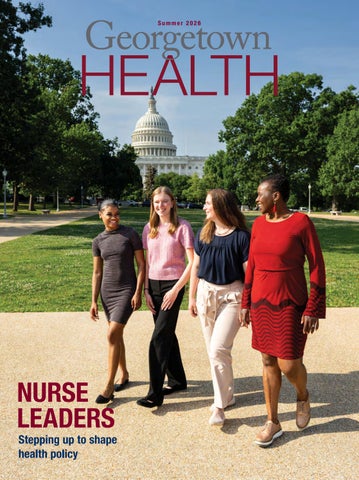
NURSE LEADERS
Stepping up to shape health policy
SUMMER 2026
the conditions 6 Building to thrive
Thrive Center for Children, Families and Communities and its Innovation Hub carry forward 50-year legacy of Georgetown’s holistic work supporting mental health.
the future 12 Reshaping of global health
As the field undergoes major upheaval, a reimagined architecture emerges centering countries’ health sovereignty and communities of practice.
the Hilltop 18 toFrom the Hill
Georgetown’s Berkley School of Nursing leads in policy education and engagement to promote optimal health for all.
6
18
12
2 Editor’s Letter 3 Check Up 26 Inside Look: CONVERGE Center 28 On Campus 36 Alumni Connections 39 Arts and Letters 40 Reflections on Health
Cover Photo: Phil Humnicky; Photo: The Apollonian, 1975 / Georgetown University Archives
News & Research
with Shantel Hébert-Magee (M’05)
From the Archives
The Georgetown Special Master’s Program in Physiology & Biophysics, better known as the SMP, celebrates 50 years since its first graduation. The one-year program, developed by renowned Georgetown faculty Lawrence Lillenfield, M.D., Ph.D., and Estelle Ramey, Ph.D. (pictured in the photo’s foreground), helps college graduates hone their credentials before applying to medical schools. Cohorts work alongside Georgetown medical students, practice their skills in labs and workshops, and volunteer in the local community. Alumni have gone on to study at more than 150 medical schools worldwide.
Editor’s Letter
Office of Advancement
R. Bartley Moore (SFS’87) Vice President for Advancement
On June 30, 2026, we officially concluded Called to Be: The Campaign for Georgetown, exceeding our goal of $3B to help Georgetown meet the world’s most profound needs. I want to express our deep gratitude to everyone who made a gift, no matter the size. Together your contributions help our university grow, improve, and fulfill its mission. To read a few stories highlighting the impact of philanthropy over the last decade, see our campaign recap on pages 34 and 35. We shine a spotlight on research, scholarships, programs, professorships, and more, all made possible by our generous and visionary donors. Our first feature highlights the Thrive Center for Children, Families, and Communities, a multidisciplinary and cross-institutional collaboration prioritizing mental health for the next generation. Its unique “whole family” approach aligns perfectly with Georgetown’s values. The features continue with a story about the changing landscape of global health. Hear from Georgetown’s thought leaders as well as recent graduates who are developing innovative solutions for communities around the world. One theme that emerges is listening. As Siona Sharma (SFS’20, L’26) says, “If I’m serving a community that is not my own, it feels important to be led by those who understand their own needs.” The final feature is all about the Berkley School of Nursing’s leadership role in policy education and engagement. The downtown location of the school’s DNP and Ph.D. programs makes it easy to collaborate with the Law Center and the McCourt School of Public Policy. Beyond the features you can read about a grant supporting GUMC’s brain health research and the winning entry in last year’s DC Public Health Challenge; meet both the head team physician for the Green Bay Packers and Louisiana’s chief medical officer for Medicaid; and learn about the BGE cancer symposium and the Lombardi Gala. I hope you enjoy reading these stories as much as we enjoyed writing them, and, as always, please reach out if you have ideas or anything you’d like to share.
Jackie Wood Vice President of Advancement, GUMC Amy Levin Associate Vice President for Communications Erin Greene Assistant Vice President of Creative
Georgetown Magazine Staff
Camille Scarborough, Editorial Team Lead Jane Varner Malhotra (SCS’21), Features Editor Elisa Morsch (SCS’20), Creative Director
Editorial Team
Gabrielle Barone, Nowshin Chowdhury, Kimberly Clarke (C’07, G’09), Mike DeRario, Emily Hancock (G’27), Michael Miller, Racquel Nassor (G’23), Patti North, Sara Piccini, Natalie Rabner, Karen Teber, Christine Wilson, Lauren Wolkoff (G’13), Kat Zambon
Design Team
Ethan Jeon, Shikha Savdas, Sofia Velasquez
Project Managers
Hilary Koss, Chloë Holman
University Photographer Phil Humnicky
Georgetown Health Magazine 2115 Wisconsin Ave., NW, Suite 400 Washington, DC 20007-1253 Feedback and story ideas: healthmagazine@georgetown.edu Address changes: alumnirecords@georgetown.edu
—Camille Scarborough, Editorial Team Lead
Summer 2026 | Georgetown Health Georgetown Health is distributed free of charge to alumni, parents, faculty, and staff. The diverse views in the magazine do not necessarily reflect the opinions of the editors or official policies of the university.
Scan the QR code to read about the Berkley family's recent $25 million gift to the Berkley School of Nursing.
Photo: Georgetown University
Georgetown University mourns the passing of William R. Berkley (Parent’95, ’96), a former member of the Georgetown University Board of Directors. His and his family’s support of the Berkley School of Nursing; the Berkley Center for Religion, Peace, and World Affairs; the McDonough School of Business; and other initiatives transformed Georgetown and immeasurably expanded opportunities for students and faculty.
Georgetown University provides equal opportunity in employment for all persons, and prohibits unlawful discrimination and harassment in all aspects of employment because of age, color, disability, family responsibilities, gender identity or expression, genetic information, marital status, matriculation, national origin, personal appearance, political affiliation, race, religion, sex, sexual orientation, veteran’s status, or any other factor prohibited by law. Inquiries regarding Georgetown University’s non-discrimination policy may be addressed to Institutional Diversity, Equity & Affirmative Action, 37th and O Sts. NW, Suite M36, Darnall Hall, Georgetown University, Washington, DC 20057. © 2026 Georgetown University This issue includes FSC-certified paper.
2
G e o r g e t o w n H e al th
C HECK UP
Community engagement plans help Georgetown researchers connect with the needs of the people they serve.
Giving voice to the patient perspective
Photos iStock
n n Community engagement is a critical part of the research process, ensuring that a study’s findings meet the needs and improve the lives of the populations being studied. At the Georgetown-Howard Universities Center for Clinical and Translational Science (GHUCCTS), the community engagement team empowers researchers by connecting them with community members or patients who can offer important insights and feedback on their work. “Our goal is to engage and support investigators across the consortium to conduct research that is relevant and wellaligned with the needs of the population we serve,” says Seble Kassaye, associate professor of medicine in the Department of Medicine at Georgetown University School of Medicine and medical director of the GHUCCTS Hub Liaison Team. “We provide consultation services to bridge investigators to the community, so researchers design studies that resonate
with the community,” adds Kassaye. “We want to ensure successful recruitment and retention of participants, allowing researchers to answer the key questions that led to their research study.” Tactics for community engagement exist along a continuum, ranging from simply reaching out to a population to share information about the research, to holding listening sessions, to the establishment of a joint relationship between the researcher and community members. After developing a community engagement plan with the researcher, the engagement team, along with the GHUCCTS recruitment team, can help them by designing informative and eye-catching flyers for events, connecting researchers with relevant community groups, providing letters of support and referrals to other GHUCCTS services, and organizing and facilitating events. n
Georgetown and the Institute for Natural Medicine are developing a MedStar Health-accredited continuing medical education course teaching clinicians how to incorporate evidence-based whole person health strategies into everyday practice.
SUMMER 2026
3
CHECK UP
Postpartum health care, social support n n In the year following childbirth, many new parents experience a sharp
decline in health care access and social support. To combat this critical gap in the U.S. health care system, the National Center for Education in Maternal and Child Health (NCEMCH) at Georgetown University has launched the Postpartum Systems of Care Repository. Led by John Richards, research professor and executive director of NCEMCH, the repository contains over 5,000 curated resources designed to turn research into practical, lifesaving implementation. It is housed within Georgetown’s MCH Library, one of Georgetown University’s six special collections and a primary resource for the maternal and child health workforce. The United States continues to face a maternal mortality crisis, with a significant percentage of pregnancy-related deaths occurring in the postpartum period. Mental health conditions, drug overdoses, and cardiac complications remain leading causes of mortality and morbidity in the months following delivery. “The Postpartum Repository was built to help ensure that no postpartum person falls through the cracks of our health care system,” says Richards. “By organizing thousands of evidence-based tools, we are providing the infrastructure necessary to move from recognizing the problem to implementing sustainable, high-quality care for every family.” n
Cancer symposium highlights emerging technologies Georgetown speakers were joined by peers from the National Cancer Institute, Rutgers University, and the University of Tübingen, Germany, among others. n
and students hosted a symposium focused on challenges and possibilities in cancer treatment. “Cancer Frontiers: Rare Cancer, Emerging Technologies, and Disparities” gave students a chance to learn from respected researchers and to present their own work. Principal organizer Tomoko Steen, director of the Biohazardous Threat Agents & Emerging Infectious Diseases Program, said that the event combined the expertise of Georgetown’s Department of Oncology with its Biomedical Science Policy & Advocacy programs. “The symposium focused on how to reduce disparities by introducing studies on tackling rare cancers, leveraging emerging technologies to detect and treat cancers to address disparities in Students and Professor Tomoko Steen (right) stand around the banner for the Cancer cancer care,” said Steen. Frontiers symposium.
4
G e o r g e t o w n H e al th
Photos: iStock / Courtesy of Biomedical Graduate Education
n n In December, Biomedical Graduate Education faculty
Reversing immune suppression in pancreatic cancer n n In 2025, there were an estimated 67,440 new cases of pancreatic cancer diagnosed in the U.S. and an estimated 51,980 deaths, making it the third leading cause of cancer deaths in the country with a five-year survival rate of 13 percent. However, research at Georgetown’s Lombardi Comprehensive Cancer Center is helping scientists outline how to improve outcomes in pancreatic cancer. Through insight from cell and mouse experiments, researchers have discovered that when pancreatic cancer cells send out tiny particles that are packed with certain microRNA molecules, nearby immune cells
called macrophages are reprogrammed to help the tumor grow instead of engaging in their usual role of fighting the tumor. “Our approach focuses on blocking adverse outcomes of microRNA-based communication between pancreatic cancer cells and immune cells,” says Georgetown professor Amrita Cheema, senior author of the study. “By disrupting these channels of communication, we could reprogram the immune cells and restore their ability to fight cancer.” The study appeared in the January 2026 issue of the Nature journal Signal Transduction and Targeted Therapy. n
Study examines GLP-1 stigma
Photos: iStock
n n In a new study exploring stigma associated with the use of GLP-1 drugs for weight loss,
women who lost weight using GLP-1 medications were judged more harshly than those who lost weight through diet and exercise, with negative reactions driven largely by beliefs that medication-assisted weight loss is a “shortcut.” The study also found higher levels of stigma when the women in sample scenarios were portrayed as white rather than Black. The findings, published this April in the American Psychological Association’s journal Stigma and Health, highlight how social narratives about “acceptable” weight loss strategies can shape attitudes toward women with obesity, even when the weight loss is clinically significant. More than 100 million people in America are clinically eligible to use GLP-1 medications, such as Ozempic, Wegovy, Mounjaro, or Zepbound, for weight loss, and approximately 18 percent of U.S. adults are currently using or have previously used a GLP-1 drug. “GLP-1 medications can offer meaningful health benefits for people with obesity, but many patients report feeling shame and guilt for using them,” said social psychologist Stacy Post, a postdoctoral researcher at Georgetown’s Lombardi Comprehensive Cancer Center. “Our results show that the ‘easy way out’ perception does more than spark casual criticism. It can translate into measurable stigma, including fat phobia and a desire for social distance.” n
SUMMER 2026
5
BUILDING THE CONDITIONS TO THRIVE Accelerating what works in mental health for children, families, and communities BY LAUREN WOLKOFF | DESIGN BY SHIKHA SAVDAS
Photos: Phil Humnicky / Paul Jones
W
hen Mallika Pajjuri cold-messaged Georgetown professor Matthew Biel, director of the Thrive Center for Children, Families, and Communities, on LinkedIn in late 2024, she had no idea the exchange would end up being so consequential for her new company. Pajjuri’s startup, Psyche Care—which she began developing as an undergraduate at MIT— sought to address what she and her co-founder see as a critical yet overlooked aspect of children’s mental health: the parent or caregiver. One parent she interviewed in her research shared that if her child had a diagnosis such as cancer, casseroles would appear on her doorstep. For mental illness, she felt she was scrambling for support. “Parents and caregivers of kids in crisis are largely left on their own, without guidance, support or resources to manage the situation,” says Pajjuri. The timing was fortunate. The Thrive Center was looking for candidates for a new initiative called the Innovation Hub, a Silicon Valley-style accelerator pairing startups and nonprofit organizations with Georgetown researchers. Biel thought Psyche Care would be a perfect fit. The Innovation Hub turned out to be exactly what Psyche Care needed to take its business model to the next level. The three-month experience offered not only community and mentorship, but also a framework for translating research into real-world settings. Through the fellowship, Psyche Care launched a quality improvement study with MedStar Montgomery Medical Center in Olney, Maryland. Working with more than 20 families drawn from the hospital’s emergency department and inpatient unit, Psyche Care tested its caregiver coaching model in real time, connecting parents with peer support and personalized crisis management tools. The initiative achieved a 92 percent reduction in emergency department use among participants and a 100 percent post-enrollment completion rate. Psyche Care has also secured $500,000 in investor funding as a result of the fellowship, building on $100,000 in prior grant funding. “This kind of support can be game-changing for a company. We were clear on our mission and had big ideas of what could potentially work, but didn’t know how to frame the argument and the evidence for it,” says Pajjuri. “We left the fellowship with this new knowledge and new connections. It’s had a snowball effect.” Since its launch in early 2025, the Innovation Hub has supported 19 organizations across three cohorts, collectively reaching more than 2 million kids and families in over 20 states and four continents. The program has facilitated hundreds of connections to state and systems leaders, and has fostered partnerships between fellows and major institutions.
SUMMER 2026
7
port p u s f ing ind o g k n s i a h h T c “ ameg e left b e W . can y pan m o this c h a t i w for wship nd new o l l e f the dge a e l w o n new k ons.” i t c e n con JURI LL —MA
AJ IKA P
Fifty years in the making
While the Innovation Hub focuses on startups, the Thrive Center itself builds on decades of existing research and relationships. Founded in 2024, it grew out of two institutions with deep roots at Georgetown: the Center for Child and Human Development—which Phyllis Magrab led for more than 50 years—and the research and community engagement components of MedStar Health’s Division of Child and Adolescent Psychiatry. That division was founded and is led by Biel, a professor of psychiatry and pediatrics at Georgetown, where he holds the Marriott Endowed Chair of Child, Adolescent, and Family Mental Health. The merger linked Magrab’s expertise in early childhood systems, disabilities, and community-based work with Biel’s clinical and research depth in child, adolescent, and family mental health. Choosing the name Thrive was intentional. Rather than centering the work on illness and its treatment, the name signals the need to build the holistic conditions for children, families, and communities to flourish. As Biel says, the risk of not doing so is clear. “Too often, young children and their families have experiences of adversity that have long-lasting consequences for
8
G e o r g e t o w n H e al th
their health and well-being. We can do better to nurture and protect our young people.” Over the past two decades, research on early development has made an overwhelming case for investing in children at the very beginning of life, and the return on that investment is well documented. Positive early experiences are strongly linked to lifetime gains in learning, health, and economic productivity, while early adversity, such as poverty, trauma, and parental mental illness, carries financial and societal costs. Thrive’s approach is grounded in a concept called early relational health, or the state of emotional well-being that comes from positive connections between a child and parents, caregivers, teachers, doctors, and others in their orbit. It reflects the core belief that you cannot effectively serve a child without understanding the family, community, and systems in which the child grows up. The gap between this understanding and how society actually invests in children is vast. Biel points to the lack of paid parental leave in the U.S. as one example. Research shows that paid leave in the first year of life significantly increases the likelihood that children will form healthy attachments and be protected from early trauma and stress. More broadly, the systems designed to serve children and families, such as health care, education, and social services, are too often siloed and difficult to navigate. Mental health care continues to be reimbursed differently than other medical care, creating persistent gaps in access. And too often, a child’s trajectory is helped or hindered by the zip code where they were born. “There are tremendous barriers to putting in motion the policies and decisions we need to make as a society to show we value young children,” says Biel. To address these challenges, Thrive connects a multidisciplinary array of researchers, clinicians, policy experts, and public health scholars in ways that few centers can. Structured around four pillars—early childhood, disabilities, child and family mental health, and digital health—Thrive also convenes experts from across the university, including the School of Medicine, School of Health, Berkley School of Nursing, McCourt School of Public Policy, College of Arts and Sciences, and Georgetown’s clinical partner, MedStar Health. Faculty maintain deep community relationships across the Washington area, long-standing partnerships in early childhood, mental health, and disability research nationally, and a growing portfolio of international collaborations. “The well-recognized and sustained crisis in youth mental health in this country requires a deep understanding of the factors at play,” says Biel. “We bring broad expertise and community connections to identify where we see the best opportunities for intervention.”
Photo: Courtesy of Thrive Center
Mallika Pajjuri (right), CEO and co-founder of Psyche Care, connecting with psychologist Alison Stoner (left) at the 2025 Solutions Fair, says the Thrive Center’s support is “game-changing” for a startup like hers.
The first thousand days
Photo: Rafael Suanes
David Willis, professor of pediatrics and psychiatry at Georgetown and founder of Nurture Connection, a prevention and community systems-change initiative now headquartered at the Thrive Center, has spent his career making the case for why those early relationships are foundational. “Every year, skills beget skills beget skills—it’s like building the foundation of a house,” he says. “If the foundation is not strong, the house doesn’t weather storms well. And the foundation of human flourishing is laid in the first thousand days.” Though the science is clear, the country has largely failed to act on that understanding, Willis says. Over the past 25 years, billions of dollars have flowed into early learning programs without delivering the outcomes the science would predict, because those programs have too often neglected the relational connections that make learning, social development, and emotional regulation possible. “Early childhood systems and supports in the first thousand days have always and truly faced a scarcity mindset, with programs chronically competing for scarce dollars,” Willis says. “Investing early in the foundations of flourishing in this nation is essential. And we’re not talking about huge dollars. We’re talking about intentional dollars.” The investment gap is compounded by the fact that the informal family and community networks that once supported young children have broken down, Willis says. For example, roughly 40 percent of newborns come home to single parents who are largely on their own. This shift has eroded what Willis calls the “generational social protective environments” that families once relied on. The effects of all this on children and young people are profound. Half of all mental illnesses emerge by age 14; three quarters before age 24. Chronic conditions like depression, post-traumatic stress disorder, and substance use disorders are among the conditions that have the most devastating impact on individuals, families, and communities. The situation is compounded by access to care, which remains deeply unequal, and shaped by race, income, insurance status, and geography. Yet Willis sees reasons for cautious optimism. Communities and states are beginning to shift from a scarcity mindset toward what he calls an abundance mindset, working together towards common goals with “the recognition that human flourishing is built through collective action.” Thrive Center faculty member David Willis, M.D., in conversation with Innovation Hub Fellow Sam Gardner at the 2026 Solutions Fair, argues that the first thousand days of life are where society’s investment gap is most costly and most fixable.
Where families already are
Thrive’s approach to these challenges takes shape across several initiatives, all of which entail deep community-based work. Neal Horen, one of the country’s foremost experts in early childhood mental health systems, leads Georgetown’s Center of Excellence for Infant and Early Childhood Mental Health Consultation. He holds the Phyllis R. Magrab Endowed Chair and serves as associate professor of pediatrics and director of infant, early childhood, and relational health at Thrive. The center’s premise is that adults who work with very young children in early care settings regularly encounter behavior that signals distress, but they often lack the mental health expertise to respond. Over more than two decades of work in infant and early childhood mental health consultation, Georgetown has trained and supported consultants to bridge the gap, serving programs across states, territories, and tribal communities, from which the center has also drawn deep knowledge about community-centered approaches to children’s well-being. The federally funded Center of Excellence has formalized and expanded that reach and has become the national clearinghouse for best practices in the field. Horen says this work demonstrates Georgetown’s commitment to translating research into practical and tangible outcomes.
group interventions, counseling, and home visits. In collaboration with the Thrive Center, ECIN helps administer a training program for peer support specialists and community health workers to build exactly that kind of local capacity and ensure that family is at the center of care. The ECIN model has attracted long-term philanthropic investment—including from the A. James & Alice B. Clark Foundation, the J. Willard and Alice S. Marriott Foundation, the Bainum Family Foundation, and the Howard and Geraldine Polinger Family Foundation, among others. The “whole-family” approach runs through Thrive’s work in developmental disabilities as well. For families raising children with disabilities, the timeline stretches far beyond early childhood, according to Pamala Trivedi, an associate professor of pediatrics who directs Georgetown University Leadership Education in Neurodevelopmental Disabilities (GULEND) training program and serves as associate director of the Georgetown University Center for Excellence in Developmental Disabilities. Both federally funded programs, headquartered at the Thrive Center, are part of extensive national networks supporting disability training, research, and community partnership. “Families raising young people with high support needs aren’t navigating a single crisis or transition. They’re navigating over decades,” says Trivedi. And they’re doing it through school, health care, and social service systems that have been “designed to see only part of them at a time.” GULEND is among the more unusual training models in the country. Rather than training clinicians, family caregivers, and people with disabilities in separate tracks, it brings them together to avoid fragmentation. Classes are taught by disabled people, family caregivers, and community members, alongside credentialed professionals, and trainees complete practicum placements in community settings where people with disabilities and their families are served. A new Thrive initiative called Centering Voices builds on this same commitment to inclusion, by focusing on the role of school-based staff who provide assistance to students with disabilities in DC public and charter schools. These staff members, known as direct and dedicated aides, are often the primary anchor for a student with neurodevelopmental disabilities, yet they receive limited training, inconsistent supervision, and little acknowledgment. “What we have heard from the aides was consistent: the work is deeply relational, they’re doing it largely alone, and what they need isn’t abstract developmental theory—it’s real practice, real words, real support,” says Trivedi. Georgetown LEND graduate Fari Ghamina Tumpe (left) receives recognition for her longtime advocacy for people with disabilities in DC, presented by Pamala Trivedi.
10
G e o r g e t o w n H e al th
Photo: Courtesy of Thrive Center
“The academics and research are really important pieces, but this is a place where we take all that into the community and we base our efforts on what the actual needs are that we are seeing,” he says. Another Thrive initiative, the Early Childhood Innovation Network (ECIN), is a 10-year partnership with Children’s National Hospital focused on DC’s youngest children. Co-directed by J. Corey Williams, associate professor of psychiatry at Georgetown whose career has centered on community-based approaches to mental health, ECIN works in Washington’s most underserved neighborhoods to build the conditions for children and families to be healthier from the start. Through partnerships with Children’s National Hospital and community leaders, ECIN builds child mental health programs that embed support where families already are, such as in pediatric checkups, classrooms, and neighborhood gathering spaces. The community-based approach emphasizes prevention by reaching children and families early, preemptively reducing the demand for emergency intervention rather than simply responding to it. “We need to double down on preventative investments and catch emergent problems before they spiral into crisis—and that support should be community-based, living in people’s neighborhoods and schools and Head Start centers. And it has to be focused on whole-family care,” says Williams. Central to that model is having people with lived experience navigating the mental health system provide screening,
“We bring
th expertise e broad and com m connecti ons to id unity entify where th e best opportun ities for intervent ion are.”
—MAT TH
EW BIE
L
Photo: Rafael Suanes
Thrive Center Director Matthew Biel believes too much of children’s mental health has long been ignored by health care. He says Georgetown is uniquely positioned to change that.
Funded by the Graham Foundation, the Centering Voices pilot is a collaboration between the MedStar Georgetown Center for Well-being in School Environments and the Thrive Center. Trivedi and colleagues have been running listening sessions and pilot trainings with dedicated aides in DC public and charter schools, co-designed with a practicing aide, schoolbased behavioral health clinicians, and family members of students with disabilities served in local, public schools to build more sustainable pathways for inclusion. Trivedi also works with another overlooked constituency: fathers and what she calls “fathering caregivers” (the latter a term she prefers for its breadth, encompassing grandfathers, stepfathers, and others who don’t fit the conventional model). Fathering caregivers have been historically underrepresented in research, clinical practice, and program design, Trivedi says. “What our research has shown is how expansive fathering actually is, fathers centering social-emotional health, disrupting intergenerational cycles, being role models against violence, shattering stereotypes about gender and disability, and creating seats at the table in systems that weren’t designed with them in mind,” she says. Thrive’s disabilities work will soon receive a new boost. In January 2027, Georgetown will launch a joint Executive Master’s in Global Leadership in Disability and Systems Transformation, developed with the University of Thessaly in Greece and housed in Georgetown’s School of Medicine Biomedical Graduate Education program. The course of study, aimed at mid-career leaders across health, policy, law, and technology, is built on the premise that
the knowledge most essential to systems change lives with the people closest to those systems. “Disability doesn’t look the same everywhere. Family systems don’t work the same everywhere,” Trivedi says. “Our job is to train leaders who know how to listen to families, to people with disabilities, and to people with mental health support needs, and who have the skills to build something better.”
‘We live that at Georgetown’
For a center like Thrive, which is fueled by multidisciplinary and cross-institutional collaboration in DC and beyond, Georgetown is a natural home. Further, Georgetown’s Jesuit tradition of cura personalis— care for the whole person—runs through Thrive’s approach. “The mindset of the institution, its Jesuit background, its social justice commitment, its historical view about the dignity of every person—those core values are relational values,” says Willis. “Humans flourish through their physical health, their psychological sense of connectedness with others, and their spiritual lives. We live that at Georgetown.” It is precisely that orientation toward the whole person, the whole family, and the whole system that attracted Pajjuri to the Innovation Hub fellowship program. She had grown up watching friends cycle through diagnoses, inpatient programs, and mental health crises, and what she kept coming back to was the lack of attention to the people surrounding the child—care of the whole family and community. The Thrive Center’s Innovation Hub gave her company the tools to do something about it. “Being able to be in the driver’s seat of building Psyche Care, while having these advisors as champions, was an experience I’ve never had in any other program,” says Pajjuri. n
SUMMER 2026
11
Photo: iStock
12
G e o r g e t o w n H e al th
Countries put the focus on achieving health sovereignty through communities of practice
BY JANE VARNER MALHOTRA | DESIGN BY ETHAN JEON
T
oday we are witnessing vast upheaval in the global health field, particularly in the area of development assistance organizations and structures. Last year’s abrupt dismantling of the U.S. Agency for International Development (USAID) and the U.S. withdrawal from the World Health Organization (WHO) sent shockwaves through the global community dedicated to this life-giving work. “We’re seeing an acceleration of questions that were already emerging about sustainability, country ownership, and the future architecture of global health,” notes Norman J. Beauchamp Jr., executive vice president for health sciences at Georgetown University Medical Center and executive dean of the School of Medicine.
Amid this changing landscape, Georgetown students, staff, faculty, and alumni are helping shape a new vision of health sovereignty, with a grounding in the Jesuit values of cura personalis or care for the whole person, service to others, and expanding the common good. “At Georgetown, global health is not simply work done across borders. It’s a reflection of the university’s commitment to human dignity, partnership, justice, and the common good,” Beauchamp adds. “The university’s role is not to substitute its judgment for that of countries and communities, but to help convene partners, generate evidence, support implementation, and learn from innovations emerging around the world.”
SUMMER 2026
13
Reimagining the global health architecture While the dismantling of long-standing institutions has created uncertainty, it has also prompted a critical opportunity for evaluating whether the old systems were meeting the needs of today. Looking at the past three decades of his work in global health, Ambassador Mark Dybul (C’85, M’92) recognizes the ongoing need for deep systemic change in the field to match the ambitions set out at the turn of the millennium. “To be honest, it hasn’t shifted enough,” says Dybul, professor in the Department of Medicine at Georgetown University School of Medicine and a senior advisor at Georgetown’s Center for Global Health Practice and Impact (CGHPI). “We were stuck in old values and systems that were created 25 years ago and are not built for the current time.” Early in his career, Dybul led the implementation of the President’s Emergency Plan for AIDS Relief (PEPFAR), a global health initiative established in 2003 by President George W. Bush. Dybul later served as executive director of the Global Fund to Fight AIDS, Tuberculosis and Malaria, returning to Georgetown in 2017 to help lead a new global health center. “I helped start and run two massive international health organizations, but we have not kept the promise that we made in 2000 to support countries by building the capacities so that they could fully own and run their own health systems.” He points out that the old model of paternalistic aid delivered from wealthy, powerful countries to high-need countries can create unhealthy relationships and dependencies.
“They still do need financial support, but we need to be supporting them to own and lead the response in their countries, their health systems. And they’ll do it in an extraordinary way that we can then learn from, and use to improve our own health system. It can be a beautiful virtuous circle rather than what it’s been, which is unidirectional: ‘Here’s our money, here’s our expertise, do it this way.’ Often they have better ways and can teach us.” “That idea of bidirectional learning is central to Georgetown’s approach,” says Beauchamp. “The future of global health is not charity moving in one direction. It is partnership, humility, and shared learning across countries, systems, and communities.” In 2019, Dybul co-founded CGHPI with Deus Bazira, associate professor of medicine and leader of Georgetown’s Global Health Institute. Understanding and implementing this kind of major health system overhaul fits into the vision of CGHPI, which works to sustainably improve health outcomes through the generation and translation of scientific evidence into policy and practice. And the conditions today are ideal for change. Although the current U.S. administration’s actions have put a spotlight on reduced financial support for global health, foreign aid funding from developed countries has been in steady decline for the last decade, apart from a short time during the COVID-19 pandemic. “This is not just in the last six months, eight months,” explains Dybul. “Now there’s an acceleration to it, but linked to that acceleration is that vision of country ownership, country sovereignty, treating people as equals. And we have not been doing that enough.”
Dybul meets with Dr. Mechack Shongwe, senior medical officer at Mankayane Government Hospital in Eswathini.
14
G e o r g e t o w n H e al th
Photo: Jilly Motsa-Dlamini
Health sovereignty and the Accra Reset “In the last decades, countries that have historically benefited from the generosity of development aid started thinking long term about how to sustainably fund their own health agendas,” says Bazira. He notes that when COVID hit, economies stagnated and many African countries borrowed heavily, leading to a debt crisis. The setback meant some countries were now paying more in debt servicing than they were spending on education and health combined. In 2023–2024 Bazira and Dybul joined other leaders outside of Georgetown in conversations around supporting new approaches to foreign aid and global health. In 2025, these exploratory conversations became more urgent. “We asked, how can the world respond to protect the gains around global health, but also work with global development institutions and countries to have an orderly transition into a sustainable future, where countries do more for themselves and achieve full health sovereignty? Countries making the decisions, identifying their priorities, driving the health agenda in their countries, and ultimately financing more of their own health care,” explains Bazira. “Traditionally, others were paying for certain things and dictated their agenda, oftentimes bypassing national government systems.”
If global trade policies were more equitable, developing countries would need less financial assistance from others, Bazira says, leading to more just and sustainable systems. “If they got more out of their own resources, if they added more value to their natural wealth, whether it’s minerals or agriculture, and could produce and trade more finished products, they would be getting more money into their economies and wouldn't need assistance.” African leaders including Ghana’s President John Mahama, former Nigerian President Olusegun Obasanjo, and former Liberian President Ellen Johnson Sirleaf Deus Bazira, DrPH, MPH, MBA, is director of Georgetown’s Center for Global Health Practice and Impact. were already thinking along similar lines about the future of health sovereignty in Africa. trying to do,” says Bazira. Some of the supporters were also Their conversations helped shape what became known as the new partners to the university. Accra Reset, an African-led effort to reimagine global health The next step was to put this new model of health sovergovernance through greater country ownership and regional eignty into action. Rather than working with countries one collaboration. by one, Georgetown helped implement the communities To broaden the coalition, the group convened leaders of practice approach, facilitating the creation of a group of during the October 2025 U.N. General Assembly—including countries who work together and form a support network for presidents, prime ministers, and representatives from the idea sharing and solidarity. A dozen African countries were World Health Organization and the World Bank—and preidentified based on factors like similar health systems and sented this concept of the Accra Reset. It was well received, governance structures, as well as historical relationships. and has since expanded through a heads-of-state council In March 2026, teams from eight countries—made up and a high-level panel focused on the future of global health of senior representatives from ministries of health and governance and architecture that includes Dybul among finance—came together in Kampala, Uganda, to explore its members. how health and economic flourishing go hand-in-hand. “They signed onto the idea of re-imagining global devel“Rather than just a social good that you do when money is opment architecture using health as an entry point,” says available, health is also foundational for prosperity and ecoBazira, who notes that health was chosen because “it is nomic development,” Bazira explains, because investment in vulnerable and dependent on a lot of overseas development health creates jobs and helps sustain a productive workforce. assistance, and stands to lose the most with some of these The Kampala group coalesced and Georgetown’s CGHPI sudden changes that are happening.” helped them develop scaffolding for success, with each
Photo: Dazzle Mukisa
Establishing communities of practice
As a trusted academic institution on the global stage, Georgetown University is an important part of the Accra Reset initiative, supporting the countries’ agenda, helping find funding, and partnering to develop a structured approach for the program’s success. Beauchamp notes that “Georgetown brings a distinctive set of assets to this work: deep global health experience, implementation science, policy translation, law, diplomacy, ethics, and a Jesuit commitment to accompanying communities rather than directing them.” “We started shopping this idea around, and several foundations agreed to the vision as it aligns with what they’re
country working on different elements contributing to health sovereignty, staying in touch over the intervals and meeting quarterly to exchange ideas, successes, and challenges. Georgetown is intentional about not leading but rather assisting with convening, coordinating, and connecting the different countries’ health and finance ministries, as well as providing on-demand technical support to individual countries and at the community of practice level to enhance best practices sharing, wider dissemination, and benchmarking efforts. “The goal is to help countries turn good ideas into executable plans, while ensuring that ownership remains where it belongs: with the countries and communities themselves,” explains Beauchamp.
SUMMER 2026
15
The legal side
from local community leaders who know their needs best. "If I'm serving a community that is not my own, it feels important to by led by those who understand their own needs." While there she worked on the continental COVID response, seeing how countries like Rwanda and Morocco successfully addressed the pandemic with far fewer resources than places like the U.S. To learn more about the donor perspective, she moved to Geneva and worked for the Global Fund. “I began to understand what donors ask for and what that machinery looks like when they funnel money to people on the continent,” Sharma explains. She then entered Georgetown Law with the hope of helping individuals in marginalized communities, and in a broader sense, to help reform systems and structures at institutions to support public health as a fundamental human right. She chose to return to Georgetown for its expertise in global health law, and spent her first summer interning in Malawi helping people living with HIV. The experience was profound. “The women I worked with were sex workers, who are legally protected in Malawi, but they were often arbitrarily arrested and harassed by police, who would expose their health status—for example, by requiring them to take their daily antiretroviral medications in front of others. One of the best ways to protect vulnerable groups is to aid them in legal empowerment and organizing. The lead women of such organizations, created to protect sex workers, had been trained by local lawyers to serve as paralegals, advising other workers about their rights while facing the police. It was motivating.” And then she connected the dots. “I realized that one of the groups received funding from the human rights division of the Global Fund where I had
To overhaul a system as massive and complex as global health financing, experts are approaching it from many angles. “That interdisciplinary approach is a natural fit for Georgetown,” says Beauchamp. “Health, law, diplomacy, public policy, ethics, and human rights are brought together in service of durable systems change.” From a legal perspective, for example, Botswana has a new government that set up structures for delivering reforms in five strategic areas including health, and took the plans to parliament to pass a law that institutionalized the new structures, so that they will outlive any specific government. Other countries in the community of practice took note, says Bazira. Siona Sharma (SFS’20, L’26) just co-authored a paper on the legality of the U.S. withdrawal from WHO and believes health is a human right that requires legal protection. Determined to serve others in the field of global health, she graduated from the School of Foreign Service’s Science, Technology, and International Affairs (STIA) program during the pandemic, and joined an organization working mostly with American agencies and foundations. “Graduating into COVID, a lot of people were thinking about global health,” says Sharma. With an interest in East Africa, she moved to Ethiopia to gain an in-country perspective on receiving financial assistance, and Siona Sharma (center) joined colleagues to visit a school in Malindi, Kenya in 2025 to further advocacy importantly, she notes, to learn efforts for health education policy reform.
16
G e o r g e t o w n H e al th
Photo: Courtesy of Siona Sharma
“We’ll work with countries to write policy papers and publish their learnings in peer-reviewed journals, so other countries who are not even part of the community of practice can learn from the progress being made,” says Bazira. “Hopefully, that will lead to more countries joining the community of practice.” As the coalition continues to develop, they hope to learn from countries beyond the African continent, such as South Korea, Indonesia, Singapore, and Brazil, who successfully moved away from dependency on foreign aid and can share lessons from their experiences. “Dr. Bazira and Dr. Dybul are exemplars for GUMC’s pillar, global health, with an emphasis on in-country capacity building,” says Beauchamp. “The future of global health cannot be built on dependency. It must be built on dignity, sovereignty, shared learning, and the humility to recognize that innovation emerges from communities around the world. Georgetown has an important role to play as a trusted convener and implementation partner.”
been working. They are doing work over the years to not only help people win their lawsuits, but also to ensure that people are legally empowered and able to address their health needs. When the legal system was attempting to limit people’s rights, we reached out to the Global Fund to conduct highlevel advocacy on behalf of the vulnerable populations we were working with in Malawi. “I carry that seminal experience with me now. People are going to need lawyers and medical professionals to help them regardless of how the global health structure changes. People are benefiting from our advocacy, and I hope to keep being part of that effort.”
Photo: Courtesy of Anya Hirschfeld
Entering the field today With so much upheaval in the global health field, Dybul believes it’s a good time for the next generation of leaders to introduce new solutions. “When things are changing in a dramatic way, young people have a chance to contribute and to direct, to be involved in the change, to think of the ideas for how that will change. And the access to technology and connectivity with people accelerates that ability.” For Anya Hirschfeld (G’25), earning her master’s in Health and the Public Interest opened the door to her current role in global health for the Council on Foreign Relations, where she did her capstone project. After graduating and before her new position started, she reached out to her mentor John Monahan, senior advisor to Georgetown’s Global Health Institute, who connected her with Georgetown Global Health Nigeria, a program supported by CGHPI. “I wanted to do something that would supplement my policy engagements from Washington, to keep adding that central ingredient of what’s really happening on the ground,” Hirschfeld notes. Within two weeks, she was on her way to Abuja for an experience that would change her approach to her work. There for a month, she traveled to a clinic in the northern state of Kano to observe mothers of children experiencing severe and acute malnutrition. “In the global health policy world, you look at malnutrition rates and trends. But being there and seeing mothers on cots with their babies, and seeing all of these intersecting issues—all of these cultural foundations and religious, gender, economic implications that brought them to this state of complete and total emergency—was really shocking to me.” As she saw mothers and children being readmitted, she began thinking about how they could be supported in a more holistic way. How is their home life and how are they able to care for their families? “There’s a very high birth rate and they come back with other children who are also on the brink of death.” She started a project proposal to interview and screen mothers “for anxiety and depression, and check in on their relationships at home with their husbands. And while they're
Last summer Anya Hirschfeld (center) worked with Georgetown Global Health Nigeria, a program with CGHPI based in Abuja.
admitted for that, on average for a week, see what kinds of interventions might be possible to support them.” The in-person encounter was life-changing for her. Despite all the changes in global health financing, structures, and policies, as someone relatively new to the field, she is hopeful and inspired by the many people she’s already met, particularly those in the countries who are working to achieve full health sovereignty. “I have a lot to learn and a lot to experience. But I’ve met amazing people who are working on the ground in global health, locals working on the implementing partner side. They have expertise about what worked and didn’t work with older systems. If they are properly incorporated into the new system, it will have a huge value add.” With the growing population of young people in low and middle-income countries, Dybul sees their innovation as key going forward. “There’s no reason for there to be any poverty, for people not to have health care anywhere in the world,” says Dybul. ”Now is the time to be bold, to come forward with big ideas. It’s a huge opportunity for young people to have a disproportionate impact that is rare in history.” Along with developing innovative solutions, Bazira underscores the importance of putting the ideas into practice and how Georgetown can help, by collecting and disseminating important lessons and models for how to make it happen. “For most countries, it's not a lack of good ideas, it’s how you translate those ideas into action. The execution, the implementation piece is where the community of practice and Georgetown’s technical role is going to be prominent, translating good plans and policies into action.” n
SUMMER 2026
17
by sara piccini
I
|
design by sofia velasquez
Photo: Joshua Campbell
n the early 2020s, syphilis cases began increasing dramatically in the U.S., particularly among the Native American population. By 2024, the syphilis rate among Indigenous people in the Great Plains surpassed the highest point since 1941, when penicillin was first used to treat the disease. Cases of transmission in pregnant women also skyrocketed, with 3% of Native American babies born in South Dakota in 2023 having congenital syphilis. Working for the Indian Health Service between 2023 and 2025, midwife/nurse practitioner Anna Dykstra (G’21) served on the frontlines in combatting the spread of syphilis on the Pine Ridge Reservation in South Dakota’s Oglala Lakota County. “Our county had one the highest rates of syphilis in the country,” says Dykstra. “We were working as hard as we could with testing, treatment, and public outreach. And we’ve really made great progress. Rates have gone down significantly.” Dykstra decided to translate her clinical experience into advocacy. She was already involved in a project through South Dakota’s Avera Research Institute addressing maternal health outcomes in the state, so she approached the head researcher and another OB/GYN about initiating a study on syphilis.
18
G e o r g e t o w n H e al th
Faculty and students from the Berkley School of Nursing’s Executive Doctor of Nursing Practice program join Georgetown Nurse Executive in Residence Bradley Goettl, chief nursing officer for the American Nurses Enterprise, on Capitol Hill. SUMMER 2026
19
Policy as liberation
Recognizing that policy is foundational to how care is delivered, financed, regulated, and experienced, the Berkley School of Nursing has taken on a leadership role in policy education and engagement.
20
G e o r g e t o w n H e al th
Unprecedented access
Waite points to the work of Associate Professor Stephan Davis (G’09), who joined the school’s faculty in 2024 and served for two years as the inaugural executive director of leadership, policy, and
Photo: Rachel Headley/Background photo: iStock
“Nurses work in all different spheres, helping those who are sick, those who are close to death, those coming into the world, as well as providing preventative health care,” says Dean Roberta Waite. “So they really need to understand how policy impacts people across the lifespan. “The core ethical tenets of nursing focus on social justice and health equity,” continues Waite. “If we say we’re about promoting social justice and supporting health equity, we need to be engaged in policy.” She emphasizes the early leadership of the nurse-midwife program in bringing students to Capitol Hill during their on-campus intensives, a practice that has been adopted by other hybrid master’s programs. Nurse midwife Anna Dykstra (G’21) has been selected as a 2026 participant in South Dakota’s Billie Sutton Leadership Institute. Below: Associate Professor Stephan Davis Faculty need to be versed in policy (center) with students and faculty of the BSON’s Executive and Clinical DNP programs. as well, Waite says. She notes that just this year, four Berkley School of Nursing faculty members have been inducted as fellows of the American Academy of Nursing, a leading policy organization. The academy director, Suzanne “As unfortunate as it was to have this terrible outbreak in our community, it provided an excellent Miyamoto, teaches a course on Health Care Policy opportunity for research on effective treatment and & Advocacy at the school. Because its mission is rooted in cura personalis, prevention,” she says. The institute secured funding, the Berkley School of Nursing is especially well and the project began earlier this year, with Dykstra positioned to “understand the whole person— providing her clinical observations on the specific their physical, emotional, spiritual, and financial challenges involved in treating a rural population needs—because all of those things impact their with high poverty rates and low levels of health ability to thrive, operationalize, and lead fully literacy. Dykstra’s experience highlights the essential voice productive lives,” says Waite. “From my perspective, what good policy allows that nurses bring in advocating for better patient for is the pursuit of liberation, because it ensures outcomes and, ultimately, more effective health that resources are aligned with policies that support care policy. “Nurses are the Swiss Army knives of health care,” optimal health for everyone.” The school has recently introduced a number of says Rebecca Shasanmi Ellis, assistant professor at new initiatives on the undergraduate and graduate Georgetown’s Berkley School of Nursing. “Because level, capitalizing on Georgetown’s DC location. nurses operate in such a wide span of settings and spend the most time with patients and their families, “What has deepened over the last three years is not only didactic education, but engagement on we have a unique lens across the individual to the Capitol Hill as well as with national nursing orgasocietal level. It allows us to amplify the voices of nizations,” she says. our patients and the communities we serve.”
Photo: Phil Humnicky
Doctor of Nursing Practice (DNP) education, and led innovations in the Executive DNP in Health Systems Leadership and Policy degree program. Davis continues to teach in the Executive DNP program, which—along with the Berkley School of Nursing’s other doctoral programs—is located on Georgetown’s Capitol Campus, just blocks from Congress. “It’s an amazing environment,” says Davis. “We have unprecedented access to people involved in the legislative process.” He also remarks that the downtown location of the school’s DNP and Ph.D. programs enhances opportunities for cross-disciplinary collaboration with the other schools and programs, including the Law Center and the McCourt School of Public Policy. Vicki Girard, professor and founding codirector of the Georgetown University Health Justice Alliance, recently presented to students on medical-legal issues, leading to the integration of that work into the their scholarly projects, he says.
In January 2025, Davis launched the Nurse Executives in Residence Program, which gives DNP students the opportunity to learn directly from national nursing leaders through focused mentoring and special lectures. Among the current program participants are Robyn Begley (N’77), CEO emerita of the American Organization for Nursing Leadership (AONL), and Deb Zimmermann, AONL’s immediate past president. In a pilot program facilitated by Begley, Zimmermann, and AONL staff, two Executive DNP students and four DNP program faculty members participated in the AONL Advocacy Academy in Summer 2025. The academy provides education on the legislative process and hones advocacy skills in preparation for meetings with members of Congress. In Summer 2026, all executive DNP students will be able to participate. This June the Berkley School of Nursing co-hosted a reception with AONL for its board and Nurse Leaders in
“Being the most trusted profession, nurses are such an important voice in advocacy...” —Stephan Davis (G’09)
Undergraduates on the Hill
In the Berkley School of Nursing’s undergraduate BSN program, recent innovations include the integration of a policy intensive into the health care systems course, an initiative spearheaded by faculty member Rebecca Ellis, a longtime public health nurse and current chair of the Public Health Nursing Section of the American Public Health Association (APHA). She notes that BSN Program Director Sarah Vittone wanted to connect with the Law Center to
prepare nursing students for advocacy work. Ellis became the first nursing faculty member to teach in the Health Justice Alliance’s program that pairs medical students with law student mentors to prepare for meetings with Congressional members. “With the program’s blessing, I translated materials to be nursing focused and integrated a policy intensive into the Berkley School of Nursing’s existing health care delivery systems course,” explains Ellis. She piloted the course in Spring 2025, which culminated in nursing students’ traveling to Capitol Hill for meetings in the individual offices of their home-district legislators. “They’re paired with faculty mentors who’ve had experience advocating on Capitol Hill or studying health systems to help them prepare.” The feedback from students was overwhelmingly positive, and the course was officially renamed Health Care Delivery Systems and Policy this year. “We cover the legislative process, but we also connect to nursing’s social justice pillar and how advocacy fits into that,” says Ellis. “We ask them to select a health access or equity related policy to advocate for. I also introduce them to nursing education and workforce policies that need more
Former Chief Nursing Officer of the United States Surgeon General’s Office, Dr. Aisha Brooks (left) speaks with Strimling (right) at the annual National Black Nurses Association Hill Day, facilitated by Ellis.
Photos: Rebecca Ellis
Advocacy members on Capitol Campus to kick off the Advocacy Academy. “The fact that we’re able to build these types of programs shows the power of the connections we have,” says Davis. “Being the most trusted profession, nurses are such an important voice in advocacy, especially during this time of unprecedented distrust in government and institutions. “We usually think about advocacy in the context of lawmakers, but I also think it’s important that nurse leaders and clinicians are prepared to engage in discourse that’s meaningful with patients and communities and to be able to have respectful dialogue across differences,” he says. “I believe Georgetown is uniquely positioned for that work.”
Berkley School of Nursing Dean Roberta Waite (center) with Julia Strimling (N’26), founder of the undergraduate Legislative Action Group, and faculty advisor Rebecca Ellis.
sponsorship, so they understand how those policies impact their experience as students.” Students in the course have already witnessed the direct impact of their advocacy. “One of our successes last year was getting a co-sponsorship of the PRECEPT Nurses Act, which provides a tax credit for eligible nursing mentors,” says Ellis. “Another legislator was so impressed with student advocacy for those who are on Medicaid and Medicare that she asked us to collect additional stories to document community needs. “I feel so in awe of our students who get this type of experience and go on to expand the opportunities to other students,” adds Ellis.
Photo: Courtesy of Rebecca Ellis
‘Nursing is political’
In addition to her research and teaching responsibilities, Ellis has also been serving as a faculty advisor for the student-led Legislative Action Group, known by its acronym SNAG-LAG. The group was founded in 2023 by Julia Strimling (N’26) shortly after she transferred to Georgetown from Duquesne University in Pittsburgh.
“At Duquesne, I had been involved in the student nurses association as a legislative co-chair, so I was starting to dip my toe in,” says Strimling. “When I came to Georgetown, I wanted to make sure I took advantage of being in DC, to create a space where students could really get involved.” The group’s first event, a meeting with a Nebraska legislative health staffer arranged by Associate Professor Sarah Vittone, attracted more than a dozen students. “We’ve had a number of Hill days since then and have also gone to hearings. We even attended a Senate mark-up, which was a really interesting experience.” Strimling is especially passionate about mental health policy and ensuring parity of coverage. This spring, her advocacy helped secure the vote of her Congressmember, Rep. Greg Steube (R-Fla.), for legislation that supports grants and activities to improve mental and behavioral health among health care providers. “Nursing in and of itself is very political,” says Strimling, who begins working this summer in the
“Nurses are the ones that people open up to, who have those initial conversations about social factors that are determining health outcomes—food security, housing security, affordable insurance.” —Julia Strimling (N’26)
24
G e o r g e t o w n H e al th
Ellis also arranged for Strimling to meet with the president and members of the Florida Nurses Association. “They were so impressed with Julia,” she says. “She now is equipped with skills that she can bring back to other nurses. There are so many seeds that will come to fruition from these opportunities.”
Nurse-citizens
Waite emphasizes that once nursing students enter the workforce, they carry civic as well as professional responsibilities. “You are a nurse by profession— you have to understand how policies are linked to health—but as a citizen you have a duty as well. It’s not just about writing policy, it’s how to instill it. Social justice is not passive.” Georgetown nursing alumni like Anna Dykstra exemplify the role of nurse-citizen, bringing evidence-based health information to researchers who can use it to advocate for more effective treatment and policy. In her experience on the Pine Ridge Reservation, she and her colleagues identified critical factors that exacerbated the syphilis outbreak.
Photo: Rebecca Ellis
Neurosciences Intensive Care Unit at MedStar Georgetown University Hospital after earning her BSN degree in May, and plans to become active in the hospital’s Health Care Advocacy and Legislative Council. “Nurses are the ones that people open up to, who have those initial conversations about social factors that are determining health outcomes—food security, housing security, affordable insurance. “We also see the impact when people are afraid to get to health care because of previous experiences of discrimination or concerns about immigration status. Every one of those factors is influenced upstream,” she says. In February, Ellis—a member of the Nursing Community Coalition—connected with three national nursing organizations and arranged for SNAG-LAG members and other interested nursing students to attend the National Black Nurses Association Hill Day, the National Association of Hispanic Nurses Health Policy Summit, and the American Association of Colleges of Nursing Student Policy Summit.
A seat at the table
Given the crucial perspective nurses bring to policymaking, there is a need for significantly greater nursing involvement, particularly at the federal level. “One of the Congressional committee meetings I attended was discussing the future of the health care workforce, and there was only one mention of nursing,” notes Strimling. “There are a lot of doctors in Congress, but not as many nurses, and not as many nurses testifying as witnesses. “It was a big surprise to me how underrepresented nurses are.” Ellis recalls similar experiences. “I worked for the World Health Organization, developing resilient systems to support the increase of the nursing and midwifery workforce. In meetings with medical doctors, public health folks and non-clinicians, I would be the only nurse,” she says. “We need to expand our conception of what types of tables nurses need to be at.” “I want to plant seeds so that we can have more nurses in Congress,” Waite adds, citing the example of Congressmember Lauren Underwood (D-Ill.), an R.N. and former Georgetown Berkley School of Nursing faculty member who co-founded and co-chairs the Black Maternal Health Caucus. “For many of the issues legislators are called to address, they have no foundational knowledge on health policy—none. Nurses need to be in those spaces, and they need to be in those seats.” n
Photo: Michelle Janis
“Syphilis is complicated to diagnose and treat. The secondary and tertiary stages require a longer course of oral antibiotics, or three penicillin injections given every week for three weeks,” she says. “Some patients came in for the first treatment but didn’t return because they couldn’t afford gas or they faced extreme weather conditions.” The unit was understaffed, and some of the patients simply lacked health literacy, not knowing what syphilis was or how it was transmitted, she adds. “Education is the most effective way to counteract the disease, but figuring out how to implement the education is challenging,” says Dykstra. “That’s the direction the research project is going.” Dykstra has recently embarked on a new project after being selected as a participant in South Dakota’s Billie Sutton Leadership Institute. “We have huge maternity deserts in our state, where it can take hours to get to a hospital. I will be looking at the possibility of nurse midwives providing prenatal care in rural areas.” She sees the federal Rural Health Transformation Program as a potential source of funding. “During my time as an R.N. and now a nurse midwife, I worked in a lot of different settings—the South Dakota Department of Health, the Monument Health system in the Black Hills, the Indian Health Service. I’m hoping to reach out to the key players in these organizations and bring them together to figure out how we can make this happen.”
Anna Dykstra (G’21) with a former nurse colleague facilitating a mobile unit for STI testing on the Pine Ridge Reservation. Previous (page 24): Berkley School of Nursing undergraduate students attend a Hill Day to meet with Congressional legislators and staff. SUMMER 2026
25
MedStar Health and Georgetown CONVERGE toward innovative care By Racquel Nassor
M
edStar Health and Georgetown University are developing and building the CONVERGE Innovation, Simulation, and Discovery Center—an 18,500-squarefoot facility located in the Reiss Science Building on Georgetown’s Hilltop Campus—that aims to catalyze the future of teaching, learning, and caregiving through interdisciplinary collaboration and industry advancements. “The pace of innovation in health care is rapidly accelerating. CONVERGE will enable our community to be on the leading edge of building, testing, and refining solutions with the world-class entrepreneurs, companies, faculty, and learners it will empower and attract,” says William Sheahan, senior vice president and chief innovation officer at MedStar Health and executive director at MedStar Institute for Innovation. Using cross-sector expertise, CONVERGE aims to reimagine community medicine in a dynamic hub that will
26
G e o r g e t o w n H e al th
host 18,000 learners annually in cutting-edge simulation and specialty spaces using virtual and augmented reality, eye-tracking devices, and massive data displays. “Through realistic, high-fidelity scenarios, teams across roles learn together, building trust, shared decision-making, and professional confidence,” says LynnMarie Verzino, senior vice president and chief nursing officer at MedStar Health. The center’s clinical and innovation spaces will enable big data analysis, computational teamwork, and care model redesign. CONVERGE will also house discovery and simulation spaces for prototyping non-living materials—such as 3D-printed trainers—and exploring the frontiers of living materials—including tissue and organ printing. “CONVERGE presents a strategic opportunity to prepare students, clinicians, and transdisciplinary partners to deliver exceptional, evidence-driven care in environments that mirror
Photos: Courtesy of MedStar Health / Georgetown University
“CONVERGE brings together the combined expertise of MedStar Health and Georgetown University— across medicine, nursing, psychology, education, science, design and engineering, and the humanities— and community partners to redesign how care is taught, delivered, and improved. Rooted in decades of collaboration, it gives physical form to a shared commitment to education, innovation, and service for the future of health,” says Norman J. Beauchamp Jr., executive vice president for health sciences and executive dean of the School of Medicine.
the complexity, uncertainty, and pace of contemporary health systems,” says Roberta Waite, dean and professor at the Berkley School of Nursing. “These experiences translate directly into safer practices, stronger teamwork, improved readiness, and consistently higher-quality patient care in real clinical environments.” Working with faculty from across Georgetown University, the Center for New Designs in Learning and Scholarship, and The Red House, the CONVERGE Center will bring together experts in psychology, material and computer sciences, education, business, and human performance to improve care outcomes. “Today’s health care challenges are too complex for a single discipline to solve alone,” says Rachel Barr, chair and professor of psychology at Georgetown. “The partnership between MedStar Health and Georgetown University creates a powerful foundation for this convergence—turning knowledge into meaningful, measurable change.” n
SUMMER 2026
27
ON CAMPUS
This July, Eduardo M. Peñalver began his term as the 49th president of Georgetown University. Peñalver, pictured here on one of the roof terraces of Georgetown’s Capitol Campus, is deeply committed to Catholic and Jesuit values.
Get to know President Peñalver Interview by Mike DeRario
28
G e o r g e t o w n H e al th
As a leading scholar on property law, Peñalver has published two books; served as a professor of law at Fordham, the University of Chicago, and Cornell; and held visiting professor posts at Harvard and Yale. President Peñalver shared with Georgetown Health magazine some reflections on the role of his Catholic faith in his work and what makes Georgetown special. What drew you to Georgetown? Georgetown’s a unique institution: being an R1 research university but also very much in the Jesuit Catholic tradition. You see this in the mission statement when it describes Georgetown as a student-centered research university— that is unique. I’ve spent most of my career at research universities. The tension between research and teaching has always been one of the challenges that research universities grapple with. So I was really drawn and taken by that aspiration to be a research university but also student-centered and to deliver an amazing student experience rooted in the Jesuit commitment to cura personalis.
Photo: Georgetown University
In October 2025, Georgetown’s Board of Directors unanimously voted to name Eduardo M. Peñalver the 49th president of Georgetown University. He began his new role on July 1, 2026. Peñalver joins Georgetown after serving as the 22nd president of Seattle University, another Catholic, Jesuit institution. He was the first layperson to lead the university since its founding in 1891. Before his appointment as president of Seattle University, Peñalver served as the dean of Cornell Law School, focusing on increasing financial aid and expanding programming. He was raised in a Catholic family in Puyallup, Washington, a small town near Tacoma. His father, a retired pediatrician, immigrated to the U.S. in 1962 from Cuba, and his mother, a retired school nurse, is the daughter of Swiss immigrants who became dairy farmers in Washington. Peñalver earned his bachelor’s degree from Cornell University and law degree from Yale Law School, then studied philosophy and theology at Oxford University as a Rhodes Scholar. He also clerked for former U.S. Supreme Court Justice John Paul Stevens.
ON CAMPUS
How has the intersection between research and teaching played out in your career? When I started my academic career at Fordham, I expected to really enjoy the research part of the work. I love writing; that was the initial draw for me of becoming a legal academic, to have the time and the freedom to write about the things I wanted to write about. And then I quickly learned how much I loved teaching and how much I enjoyed interacting with students. I got some of my best ideas for articles from questions that a student would ask in class. Students are free thinkers when it comes to the subjects that we’re teaching them; they’re approaching the issues with fresh eyes. So I just found a great interaction between my teaching and my research. How does your Catholic faith influence your work? I find that my faith is a source of comfort to me in a pretty challenging job at a challenging time for higher education. There’s a great comfort that comes from the length of that tradition and continuity of that tradition, and knowing all the challenging times that the Catholic Church has seen and lived through. And then there are the truths of the tradition, the truths of our faith—about what it means to be human— that help me think through some of the unusual situations that I have to confront as a university president.
Photo: Yosef Kalinko
What excites you about joining the Georgetown community? These moments of beginning are really exciting. I’m new to this community, and I already am meeting all kinds of new and amazing people who are steeped in the Georgetown tradition. I’m excited to immerse myself in that, learn more, and get to know the community and become a part of that tradition as well. What would you like the community to know about you? I’m someone who is always learning, and I’m always trying to update what I think. My best thinking is going to be informed by the feedback I get. So I want people to know that I’m always open to that feedback. I view the work of leadership is an extended dialogue that needs to be active on both sides. At Jesuit institutions, we talk about being contemplatives in action, and both pieces are important. Because we can get kind of lost in contemplation and never take action, or we can just act without thinking. And we need to be doing both at the same time. I’ve always
found that the Jesuit tradition really speaks to me in its pragmatism, its orientation toward action but also its reflectiveness and the way it brings those two sides together. What’s on your mind as you enter this role? I am spending a lot of time in conversation with members of the Georgetown community and thinking about how we can rise to meet this moment, leading the way with answers that are true to Georgetown’s distinctive history and values. This is a pivotal time both for higher education generally and for Georgetown. Georgetown is uniquely positioned to meet this moment and to offer a distinctive response to the challenges that confront us. The Jesuit model of higher education offers compelling answers to many current critiques of higher education, with its emphasis on intellectual openness and dialogue across our differences and in the way it places students at the center of our educational mission. Additionally, the rise of generative artificial intelligence is forcing universities to re-evaluate how we prepare our students for the world they will enter and lead after graduation. Jesuits have embraced new technologies for centuries even while it yokes them to ethical limits and human values. Armed with these tools, Georgetown is up to the task of helping our students to navigate the new things being ushered in by AI. Finally, taking full advantage of our Capitol Campus will enable us to provide immersive experiential learning opportunities for our students and to engage with the many governmental, nonprofit, and business leaders at work in our nation’s capital. n
Peñalver receives a blessing at a Mass celebrating his inauguration as the president of Seattle University at St. James Cathedral in Seattle, Washington, on Sept. 23, 2021.
SUMMER 2026
29
The stroke recovery team includes: (back row, from left) Ming Tan, professor and chair of biostatistics and bioinformatics; Barbara Bregman, professor and chair of rehabilitation medicine; Anton Wellstein, professor of oncology and pharmacology; Jaeil Ahn, associate professor of biostatistics and bioinformatics; and Matthew Edwardson, associate professor of neurology and rehabilitation medicine. The Parkinson’s project team includes Tan plus: (front row, from left) Rebekah Evans, assistant professor of neuroscience; Kathy Maguire-Zeiss, professor and chair of neuroscience; Patrick Forcelli, professor and chair of pharmacology and physiology; Hong-Yuan Chu, associate professor of pharmacology and physiology.
Grant supports brain health research at GUMC Two multidisciplinary teams focused on Parkinson’s and stroke recovery received the Thomas A. Reynolds III Return to Function Challenge Grant last year. The grants will support each team as they continue their research centered on Georgetown University Medical Center’s “Brain Health” pillar of excellence, which aims to lift the university as a world leader in restoring neurological function through research, education, care, and systems change. The stroke recovery team is analyzing molecular biomarkers in blood samples to detect how tissues and organs are affected in stroke patients. The method was successfully applied in monitoring treatment effects in patients with cancer and in patients receiving liver transplants by studying blood samples collected before and after treatment or transplant. “The brain is one of the most complicated organs and every patient’s childhood, lifestyle, diet, and disease history affects how they react to a stroke and how they recover,” says Anton Wellstein, professor of oncology and pharmacology. “In this project we plan to establish the capability to monitor molecular and cellular changes during stroke recovery at the individual patient level to ultimately guide therapeutic interventions.”
30
G e o r g e t o w n H e al th
The Parkinson’s team is studying senescence cells—aging cells in the brain that stop dividing but do not die—to understand their role in Parkinson’s disease. Using postmortem brain tissue from Parkinson’s disease patients and tissue from people without the disease, they aim to identify the presence and location of these cells. The team will also use advanced in vivo rodent models to recreate key features of Parkinson’s, allowing them to observe how these cells affect brain activity and inflammation. The goal is to uncover how these aging cells interfere with normal brain function. “This is the power of a team,” says Kathleen Maguire-Zeiss, professor and chair of neuroscience. “Together we can tackle how Parkinson’s affects the brain in ways no single lab could. We are very grateful to Mr. Reynolds for making this work possible.” Data generated by the team work under this Return to Function Challenge Grant is crucial for the completion of publications and provides the underpinnings for successful multi-disciplinary federal and other grant applications to further the research. n
Photo: Rafael Suanes
By Nowshin Chowdhury
ON CAMPUS
Preparing nursing students to treat the whole patient
Photo: Georgetown University
By Nowshin Chowdhury and Heather Wilpone-Welborn
Program faculty balance academic roles with clinical pracPrimary and urgent care settings often focus on physical tice to educate students in whole person care through evaluhealth over mental health. To fill the gap, the Berkley School ation of symptoms and behaviors in the context of social and of Nursing launched the Psychiatric-Mental Health Nurse structural life stressors. Practitioner (PMHNP) Post Graduate Certificate program. An applied learning assignment in the spring psycho“Georgetown is about treating the whole patient,” says Hilary Summers-Royce (G’13), a student in the PMHNP cer- pharmacology course involved pairing each student with a volunteer clinical mentor to write a publishable manuscript, tificate program. “Cura personalis is helpful in thinking about with a focus on clinical practice guidelines for treating a diagthe right questions to ask patients—not only about physical nosed mental disorder of interest. The manuscript, written ailments, but also about their mental health.” by PMHNP student Dristi Basnet and co-authored by her Summers-Royce is a family nurse practitioner with 12 years clinical mentor, Management of Comorbid Autism Spectrum of experience. She transitioned from the business world into Disorder, Attention-Deficit/Hyperactivity Disorder, and Anxiety nursing, eventually working in an urgent care setting. “Patients would come in for a sinus infection, but then score in Pediatric PMHNP Practice has been published in the July 2026 issue of the Journal of Psychosocial Nursing and Mental positively on depression screenings,” says Summers-Royce. “I Health Services. felt like I lacked the knowledge to follow through. My goal Graduates of the PMHNP certificate program will be prenow with the PMHNP program is to be able to dig in and provide the additional help and knowledge my patients need.” pared to take the PMHNP certification exams offered by the American Nurses Credentialing Center and the American The program aims to build a sustainable local network for Academy of Nurse Practitioners. n mental health care in Washington, DC, and enrollment is limited to students who live in the Washington Metropolitan Area. The small cohort fosters a personalized learning environment where students rely on one another, and their faculty as they confront difficult topics. The inaugural cohort of post-graduate nurses joined the program last fall and will complete their certifications in December. In a hybrid format, students learn through synchronous online class discussions; two on-campus clinical intensive programs with workshops and simulated, standardized patients; and community-based asynchronous PMHNP leadership meets with cohort-mates Dristi Basnet (front left), Hilary Summers-Royce (G’13) (front center), learning and service. and Tyris Ford (front right).
SUMMER 2026
31
ON CAMPUS
Recent graduates head to New Zealand and India as Fulbright scholars
As Fulbright scholars, Sahana Arumani (H’25, G’26) is tracking bacteria in New Zealand’s rural waterways and Shagun Gandhi (H’25) is focusing on head and neck cancer survivorship in India.
“In the human science major, you’re expected to ask your own questions and figure out how to answer them. That’s exactly what the Fulbright also requires.” —SHAGUN GANDHI (H’25)
32
G e o r g e t o w n H e al th
Earlier this year, Georgetown was named No. 1 producer of Fulbright scholars, including two awardees from the School of Health. Sahana Arumani (H’25, G’26) won the grant and headed to Massey University in Palmerston North, New Zealand, to assist with mapping leptospira strains in waterways after major flooding events by collecting field samples. Leptospirosis is a zoonotic disease, transferred from animals to humans, with flu-like symptoms that disproportionately affects agricultural workers and Indigenous communities in New Zealand. Part of Arumani’s project includes contributing to public health literature reviews and qualitative research on disease awareness campaigns. Arumani began her undergraduate career doing wet-lab research before transitioning to public health-focused projects, including an honors thesis on HPV vaccine uptake. After starting her accelerated master’s program, Arumani became interested in the concept of “One Health,” the idea that human, animal, and environmental health are inextricably linked. Arumani is interested in synthesizing the limited but concerning data on pregnancy complications associated with leptospirosis and understanding how occupational exposure compounds the risk. “That gap in the literature stood out to me,” says Arumani. “It’s a place where epidemiology, occupational health, and women’s health intersect.” Shagun Gandhi (H’25) headed to Tata Memorial Centre’s ACTREC (Advanced Centre for Treatment, Research and Education in Cancer) in Mumbai, India, with her Fulbright grant. Her project focuses on head and neck cancer survivorship. Gandhi’s time at Georgetown’s Lombardi Comprehensive Cancer Center, where she hosted art workshops for patients, taught her that “curing” is only one part of the journey. Gandhi is interviewing head and neck cancer survivors who are one to three years post treatment in order to refine a survivorship questionnaire that accounts for local nuances, such as the role of faith, village priests, and traditional Ayurvedic medicine in a patient’s care journey. As a first-year student at Georgetown, Gandhi conducted independent molecular biology research through the Laidlaw Undergraduate Leadership and Research Scholarship Programme, which supports scholars at 21 universities around the world, including Georgetown. She worked with professor Jan LaRocque to research the molecular mechanisms of DNA double-strand break repair, a pathway that is critical to maintaining genomic stability and preventing cancer. “My wet-lab experience taught me ownership,” says Gandhi. “In the human science major, you’re expected to ask your own questions and figure out how to answer them. That’s exactly what the Fulbright also requires.” n
Photos: Courtesy of Sahana Arumani and Shagun Gandhi
By Heather Wilpone-Welborn
In the 12 years that NAM has conducted the competition, Georgetown teams have won seven prizes, addressing a wide range of public health issues in District of Columbia. The Georgetown Global Health Institute leads the project on campus. (From left) Talia Korobkin (M’28), Harnoor Sachar (SFS’26), Omar Anwar (C’26), and Shivali Vora (SFS’26), winners of the Interprofessional Prize.
Breathe Easy proposal wins award at 2025 DC Public Health Case Challenge
Photo: Risdon Photography
By Christine Wilson
competition and is a great fit for Georgetown. We have a long Talia Korobkin (M’28) is a rising third-year medical student, but she was intrigued when she saw the invitation to compete and storied history of building interdisciplinary programs. This project fits very well into our mission which encourages in the annual DC Public Health Case Challenge sponsored conversations across differences.” by the National Academy of Medicine (NAM). The 2025 Bode describes the rigorous process the team had to follow: case focused on identifying practical, affordable, sustainable approaches to strengthening health resilience for chronic dis- “The team has to agree on a data-based project that has the potential to improve health care in the District, engage the eases in DC residents. community, define their process and outcomes, and submit Korobkin was accepted and placed on a Georgetown team their project using a hypothetical budget that NAM provides. with Harnoor Sachar (SFS’26) and Shivali Vora (SFS’26), If that concept is accepted, they have two weeks to finalize the two seniors from the School of Foreign Service, and Omar proposal before presenting it to the very prestigious academy. Anwar (C’26), a senior biology major from the College of It’s a very short time frame that encourages communication Arts & Sciences. Coming from very different parts of the coordination and teamwork.” university, they brought diverse interests, perspectives, and “That time frame was really challenging,” says Korobkin. backgrounds to the effort. “When you submit your concept, you meet with the NAM They worked together to produce Breathe Easy: Improving judges and you aren’t allowed to tell them what school you Air Quality, Respiratory Health and Environmental Justice in are from. The project has to stand totally on its own. They ask Washington, DC, ultimately winning the Harrison C. Spencer really tough, unpredictable questions. My heart was pounding.” Interprofessional Prize. Breathe Easy has a three-year implementation period, and “One of the coolest things about this project is that you are includes initiatives in 20 elementary schools and 10 senior required to put together a team of three to six students repreliving centers in Wards 7 and 8, as well as support for existing senting at least three disciplines,” says first-time team advisor community programs that promote the creation and preservaLeticia Bode, professor of Communication, Culture & Technology, and inaugural research director of the Knight-George- tion of green space. n town Institute. “This mix of students really sets apart this
SUMMER 2026
33
The O’Neill Family Foundation Clinical Simulation Center is a dynamic learning environment created through the generosity of Georgetown alumni Timothy O’Neill (L’77) and Linda O’Neill (NHS’77).
The community we are Called to Be
Reducing financial strain for medical students, STEM undergraduates
School of Dentistry alumnus Richard Calabrese (D’77) and his wife, Angela, made a transformational bequest to establish two endowed scholarship funds designed to help aspiring scientists and physicians. One fund will support undergraduates in the Regents STEM Scholars Program, which seeks to address the shortage of underserved and first-generation college students in STEM fields. A second fund will help students with demonstrated financial need attending Georgetown’s School of Medicine.
34
G e o r g e t o w n H e al th
Scholarships are vital to ensuring that passion—not debt— shapes medical students’ future career paths. Recalling how meaningful financial assistance was during his education, Richard said he and Angela hope “that we can ease the burden for young people going into a noble profession.”
Increasing cancer prevention close to home
Since opening in April 2023, Georgetown’s Ralph Lauren Center for Cancer Prevention has touched thousands of lives through education, legal services, patient navigation, and opportunities to participate in clinical trials. The Center was made possible by a commitment from the Ralph Lauren Corporate Foundation, a longtime supporter of Georgetown’s Lombardi Comprehensive Cancer Center. Located in an area of Southeast DC with high cancer and mortality rates, the Ralph Lauren Center offers resources for breast, lung, colorectal, and prostate cancers, facilitating screening and follow-up care at MedStar Health facilities and other nearby providers. It also helps patients address health-harming financial and social challenges. Distinguished University Professor Lucile Adams-Campbell, the center’s founding director, said her team works to meet people where they are. “The Ralph Lauren Center has enabled us to be more inclusive, which is central to our mission,” she says. “There are now people from all over Washington, DC, including more people of color, coming to Georgetown for care.”
Photo: Leslie E. Kossoff
On June 30, 2026, Georgetown concluded Called to Be: The Campaign for Georgetown, with gratitude for the many alumni, parents, and friends who helped the university exceed its $3 billion goal. More than 160,000 members of the Georgetown community gave to this historic effort, raising over $447 million for Georgetown University Medical Center and forever elevating our ability to answer our calling. Across the last decade, we have seen the immense impact when our community steps up to support the Georgetown students, scholars, and practitioners working toward greater hope and health for all. Some gifts advanced enduring priorities. Others addressed emerging needs. All played a vital role in Georgetown’s contributions to teaching, care, science, and medicine for the greater good.
ON CAMPUS
The D’Aniellos’ generosity will enhance education, clinical Expanding opportunities at renamed nursing school care, and research for years to come. “Along with its potential In a major milestone for nursing education at Georgetown, to impact and improve the care of patients at the national and the university renamed its nursing school the Georgetown global levels, research is one of the new ‘currencies’ of getting University Berkley School of Nursing in Fall 2025, thanks to a from medical school to residency and residency to fellowship,” transformative $25 million gift commitment from the Berkley Khanna noted. “It’s a process that feeds itself and scales the Family Foundation. The gift supports initiatives to bolster impact our faculty, residents, and students can have on our field.” student success and well-being; endowed faculty positions; technology upgrades; and an Accelerated Bachelor of Science Fueling faculty, student research in human science in Nursing (ABSN) program, whose first cohort began in In 2019, Blythe Shepard, now an associate professor, became August 2025. Through the Berkley Endowed Scholarship Fund, the first holder of the Dekkers Endowed Chair in Human Georgetown is increasing access to the ABSN program—a Science, established with a gift from Marijn Dekkers and vital pathway to addressing nursing vacancies. Andra Dekkers (Parents’19, ’21, ’21). The chair has enabled The Berkley family has longstanding ties to Georgetown and Georgetown’s School of Health to expand research opportua history of generous philanthropy. Their latest gift “honors the nities for faculty and their students. importance of our work in the formation of students, and shapShepard’s five-year term was a period of significant growth ing leaders, in a values-based environment like Georgetown,” for her lab, which focuses on cellular signaling as a means to says Roberta Waite, dean of the Berkley School of Nursing. regulate kidney and liver physiology. “The Dekkers Endowed Chair made it possible for me to make great strides in my Accelerating seizure research, treatments research endeavors while mentoring the future generation of Seeking to support the department that had a significant scholars and scientists,” she says. influence on his life and career as a pharmacologist, Jerome In 2024, Georgetown awarded the Dekkers Endowed Chair Fleisch (G’67) and his wife, Marlene Cohen (also a pharto Associate Professor Jan LaRocque, whose lab focuses on macologist), established the Jerome H. Fleisch and Marlene genome integrity. LaRocque has mentored dozens of underL. Cohen Endowed Professorship of Pharmacology. The graduate students and serves as co-advisor for Georgetown’s position’s inaugural holder is Patrick Forcelli (G’11), chair of Undergraduate Research Conference, where students from Georgetown’s Ph.D. in Pharmacology & Physiology program. healthand science-related majors can share their research, Forcelli’s research seeks to improve the treatment of seizures thanks to generous support from the Wietlisbach family. n and epilepsy, and to explore how complex behavior is con-
trolled by brain circuitry. “This professorship has significantly accelerated my laboratory’s work on new treatments for epilepsy,” says Forcelli. “Knowing that Georgetown Pharmacology profoundly shaped Dr. Fleisch’s career makes this especially meaningful.”
Photo: Ralph Lauren Center
Transforming orthopaedic care, education, and research
Three orthopaedic surgery faculty members at Georgetown University School of Medicine and MedStar Health were named D’Aniello Family Endowed Chairs, thanks to a transformational gift from grateful patient Daniel D’Aniello. Previously, Daniel and Gayle D’Aniello established the D’Aniello Family Endowed Chair and Professor of Orthopaedic Surgery, held by A. Jay Khanna (C’91, M’95), who had performed life-changing spinal surgery on Daniel.
Recognizing that transportation gaps pose a significant barrier to cancer screening, Ralph Lauren Center patient navigators pick up individuals from partnering churches, shelters, and service agencies.
SUMMER 2026
35
ALUMNI CONNE CTIONS
Nursing alumnus navigates federal career By Nowshin Chowdhury
At hospitals throughout his career, Yu has been a staff nurse, providing direct bedside care, and gained experience in medical/surgical nursing, obstetrics, and even working on the Moderna COVID-19 vaccine clinical trial. Yu completed his Master of Science in community and public health nursing at Hunter College–CUNY and is currently obtaining his Doctor in Nursing Practice at the University of Maryland, Baltimore. He works for the Indian Health Service, an agency within the Department of Health and Human Services, as a public health advisor and national HIV/ HCV/STI clinical coordinator. “I found my passion in infectious disease, specifically taking care of people living with HIV and viral hepatitis, as well as STIs—and I transitioned from direct patient care to the public health world,” says Yu. “Although we’ve made advancements for HIV biomedically, there are still so many people left behind due to stigma and the inability to access care. My passion is rooted in advocacy, health equity, and the belief that we can end the HIV epidemic in the U.S. within our generation.” Most of Yu’s clients are located on rural and remote reservations across the U.S., which he visits to provide guidance to clinicians on the latest testing and treatment guidelines. He also awards and oversees grants. “Providing holistic care, a value I learned at Georgetown, truly resonates with my work in public service,” says Yu. “I believe that a disease doesn’t define who someone is. That was instilled in me very early on during my Georgetown education.” He adds, “I always describe my time at Georgetown as being filled with joy but hard work. I was pushed to strive for excellence, which I appreciate more looking back now. Work ethic and leadership are two skills inherent to my Georgetown education and it has paid dividends both academically and Andrew Yu is also certified as an AIDS Care Registered Nurse and an active member of the Association professionally.” n of Nurses in AIDS Care’s rural nursing committee.
36
G e o r g e t o w n H e al th
Photo: Phil Humnicky
Drawn to Georgetown for its stellar nursing school, Andrew Yu (NHS’11) has applied what he learned here to a career that has taken him from bedside care to public health work for the Indian Health Service. Yu navigated the early days of nursing school with help from his mentor, Dina Rosenthal, and came to appreciate the different avenues of nursing. He also found time to perform with Georgetown’s Chamber Music Ensemble in the Department of Performing Arts. “I’ve been playing piano all my life, but I wasn’t sure if I’d have time to perform between my classes and clinical hours at the hospital,” says Yu. “I’m glad I was able to strike a balance. Performing helped my mental health.”
(Top) Carrie Rich (G’09) accepting the 2025 Baratta Center Global Impact Award from the Baratta Center for Global Business Education at Georgetown’s McDonough School of Business; (Bottom) A group of Global Good Fund alumni and staff reunited in South Africa for the second annual “UnSummit” in 2019.
One alumna’s dedication to funding the common good
Photo: Rafael Suanes / Courtesy of Carrie Rich
By Racquel Nassor
Positively impacting the world drives Carrie Rich’s work with entrepreneurs. By co-founding Global Good Fund, she invests in high potential young leaders including 700 entrepreneurs in over 70 countries. Their work has created thousands of jobs impacting 11.6 million lives. “Great ideas are evenly distributed, but access to opportunity—mentoring, coaching, capital, peer networking—is not,” she says. “The Global Good Fund supports entrepreneurs who are underrepresented in financial markets. With phenomenal ideas and incredible resilience, they are building solutions to real-world problems that they experience firsthand.” The seed for the fund started at Georgetown during Rich’s internship with Inova Health System in Virginia. She met her mentor and Global Good Fund co-founder, Knox Singleton, who supported Haitian community development while growing Inova into a multibillion-dollar health system as CEO. “The Global Good Fund came about because I was grateful he invested in my leadership development, which was unexpectedly serendipitous. I had gone to school to learn how to run hospitals—I was not planning on co-founding a nonprofit—but Georgetown opened the door to that opportunity,” she says. Now, Rich is looking to scale the number of entrepreneurs The Global Good Fund supports domestically and around the world to 40,000 in the next four years. She has built an impact ecosystem that includes a venture-backed impact consulting practice based in the Global South and a venture capitalist fund that exclusively invests in impactdriven companies led by underrepresented founders targeting market-rate financial returns.
Ultimately, she believes in the fund because she knows the downstream benefits of being invested in. When Rich was introduced to the then-CEO of Howard University Hospital, Larry Warren, she stayed connected and he later opened the door to Trinity Health where Rich now chairs the Stewardship Committee and serves as the vice chair of the national Board of Directors. “I am so honored to serve on the Trinity Health board where I can make a difference,” she explains. “It’s an opportunity to look out for the common good in underserved communities,” in part, by helping to ensure health access. Rich, who in 2025 won the Baratta Center Global Impact Award at the Georgetown McDonough School of Business, concludes, “Caring about the common good has a ripple effect. You have to stick with it if you want to impact the world.” n
SUMMER 2026
37
ALUMNI CONNE CTIONS 2
3
1 4
5
Tools of the Trade Interview by Nowshin Chowdhury
medicine to be on the sidelines and in training rooms so he can From a young age, Ryan loved science and playing sports. He provide the proper care to help athletes get back on the field. realized early on that he could “marry sports and science” by “Understanding the care of the patient to the nth degree pursuing orthopaedic surgery. transcends specialties,” says Ryan. “As my career evolved, I Originally from Colorado, Ryan attended University of learned to provide function and pain relief to every patient— Notre Dame as an undergraduate and received his medical whether they’re a high-level athlete or someone who wants to degree from Georgetown. He found a supportive community pick up a grandchild painlessly. in Georgetown’s orthopaedics department that taught him to “At the end of the day, my number one goal is to provide care for the whole patient. service to the individual patients so they get what they need— With Georgetown School of Medicine professor John Delahay as his mentor, Ryan matched to an orthopaedics resi- medically and mentally.” Tools of his trade include: dency program in New York City. He went on to Birmingham, Alabama, for a sports medicine fellowship and Bern, Switzer1. Cold brew from his favorite coffee shop: To fuel him for land, for a hip preservation fellowship, ultimately landing in the day Green Bay, Wisconsin, through connections he made along 2. Phone: To communicate with patients, staff, and coaches the way. In addition to being a Packers’ team doctor, he works 3. Laptop/Table: To research and review imaging and mediat Bellin Health in Green Bay. cal history “At each phase of my career, I was willing to go wherever I had the best opportunity to be the best version of the surgeon 4. Medical bag: To contain supplies and medications to that I wanted to be,” says Ryan. address minor injuries on the field He believes it’s important for a surgeon practicing sports 5. MRI: To navigate musculoskeletal injuries n 38
G e o r g e t o w n H e al th
Photos: Courtesy of Michael Ryan, M.D. / iStock
Michael Ryan, M.D. (M’11), is the head team physician for the Green Bay Packers and an orthopaedic surgeon who specializes in sports medicine and hip preservation surgery.
ARTS AND LETTERS
Health alumna offers guidance, resources for caregivers
Photos: Courtesy of Rachael Piltch-Loeb
By Gabrielle Barone
When her father was diagnosed with early-onset Alzheimer’s disease, Rachael Piltch-Loeb (NHS’12) noticed a glaring gap in resources. Support groups and offerings were aimed toward an older audience demographic, not for younger patients and caregivers, or for her generation: internet-savvy millennials. Piltch-Loeb, who studied health care management and policy at Georgetown, realized her experience and unique skillset in health research and communications could help those in similar situations. Georgetown was the beginning of her research and communications career—and introduced her to her husband and best friends. Piltch-Loeb’s first job after graduation was as a full-time research assistant for Michael Stoto, retired professor emeritus in the School of Health’s department of health management and policy. She is now a public health professor, researcher, private consultant, and expert source for publications such as The New York Times, The BBC, and USA Today. Before her father’s experience with early-onset Alzheimer’s, Piltch-Loeb said she would have considered herself educated in navigating the health care system. She became familiar on a different level while navigating the complex structure with limited offerings in available resources and support, for a disease about which little is known for certain. The Millennial Caregiver: Caring for Loved Ones in the Busiest Years of Your Life was inspired by her family’s caregiving experience and covers the journey from creating initial care“It felt like putting pen to paper and taking plans to dealing with grief. “It felt like putting pen to paper and collating the lessons collating the lessons our family and our family and others had learned could be helpful,” says others had learned could be helpful.” Piltch-Loeb. “Even though it was time-consuming, it also felt like an important way to pro—Rachael Piltch-Loeb cess our experiences.” The book format also allowed to capture the dueling challenges of caregiving for both her to highlight the human parents and children. Though the book speaks to a specific component around a sensitive demographic, Piltch-Loeb hopes it can be an easy entry topic “where focusing on just point for a broader audience in search of strategic material, numbers and statistics is never especially the communications strategies, which readers have going to tell the whole story.” especially found useful. As a part of the new “sand“I think that’s the whole reason for writing, whether it wich generation” she also had reaches a few people or thousands” she says. “I want to help a unique, but increasingly others with a resource for navigating this experience.” n common, perspective: trying
SUMMER 2026
39
Reflections on Health with
Shantel Hébert-Magee (M’05),
M.D., MPH, Louisiana Department of Health
I grew up in New Orleans. My family has been here for nine generations. There’s a strong sense of community, ancestral veneration, and Catholicism. This cultural mélange makes Louisiana unique.
There were times in my childhood when we were destabilized and had to live with different family members. My experiences with kinship care and having a lot of people in one house resonated with people struggling during lockdown.
When I was a baby the Creole traiteur (community healer) told my mom that there was a calling on my life and to invest in me. Despite our humble beginnings, my mother, a single parent, made my education her top priority.
I became Louisiana’s chief medical officer for Medicaid, and health care financing was the biggest issue. It’s challenging to provide quality care and access when you have small coffers and a lot of need.
For medical school, I wanted a place that appreciated my Louisiana healing culture that looks at the entire person: environmental stability, spirituality, or imbalance contributing to a physiologic outcome. Cura personalis resonated. When I was a teen, my Aunt Emma (“Tante Lanky”) passed away from a recurrence of breast cancer after her medical concerns were dismissed by clinicians, confirming that we bring societal biases into health facilities, knowingly or unknowingly. I chose pathology because I wanted to understand the why. Joining the faculty at the University of Alabama at Birmingham, I researched cancer health disparities and GI pathology, working with global industry to develop early detection devices for pancreatic and bile duct cancer. In another country someone said, “Your folks must be so proud. You must do this at home.” The realization came upon me: What about my home community? I shifted to public health, earning my MPH at Harvard in 2019. In February 2020 I was building a start-up in West Africa when the pandemic shut everything down and I instead returned home as medical director for the Department of Health, responsible for the greater New Orleans area. We were a viral hotbed because of Mardi Gras. Things were very uncertain, and there was so much mistrust. I was on the news, going to community events and speaking Creole to the elders. Having a face that’s reflective of the community helped. 40
G e o r g e t o w n H e al th
Since returning from my own breast cancer journey in 2025, I serve as regional director for Baton Rouge and six largely rural parishes. Free time? My brother is a lawyer and we started a community-based nonprofit called GOT GOT Studios, named for when people find themselves dealing with a legal issue and say “I got got.” We use art as a funding source to provide pro bono civil legal aid for people being wrongfully evicted, who face wage loss or health-harming legal issues. We were inspired by the struggles my mom had trying to raise us with limited funds. When someone is able to say, “My neighbors helped me out,” it reverberates. Within Louisiana’s healing culture, there’s never a stranger. n —Interview by Jane Varner Malhotra
Photos: Courtesy of Shantel Hébert-Magee / iStock
As a youth, influenced by hip-hop, I begged for a Georgetown jersey. When the store clerk asked why, I said, “I’m going there.” It was my innate response.
GUMC student spaces benefit from recent philanthropy A recent gift from philanthropist Joan Ferrill funded a renovation of the Med-Dent Student Annex. The newly renovated annex provides medical students with dedicated study space and small group study rooms, as well as a comfortable lounge and kitchen area. At a reception this spring, Norman J. Beauchamp Jr., executive vice president for health sciences and School of Medicine executive dean, presented Ferrill with a short white coat like the ones worn by medical students—only hers was embroidered with the special designation of “perpetual student.”
Photo: Lisa Helfert
“It was one of the most amazing days I’ve ever had in my life,” Ferrill said. “I was so honored and pleased to meet the wonderful students. If they are the future of medicine, we’re in good hands.” Ferrill also toured the entry lobby of the Med-Dent Building, as well as the anatomy lab, as both areas will similarly benefit from upgrades and improvements because of her gifts to Georgetown.
NON-PROFIT ORG. US POSTAGE Georgetown University Office of Advancement Communications University Box 571253 Washington, DC 20057-1253 USA
Photo: John McDonnell
The 38th Annual Lombardi Gala took place on March 14, 2026, at the Andrew W. Mellon Auditorium in downtown Washington, DC. This year’s event featured special performers, including Grammy-nominated, multiplatinum singer/ songwriter and actress Jordin Sparks. A surprise initiative to support future cancer researchers was unveiled: the Louis M. Weiner, M.D., Aspiring Oncologist Fund, a tribute to Weiner’s 18 years of leadership.
PAID
PERMIT NO. 3901 WASHINGTON, DC