HYDRO 4-2025

Page 1


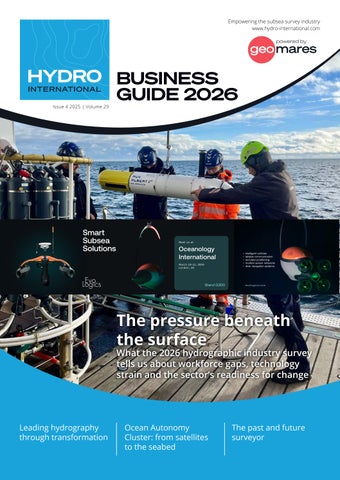
The pressure beneath the surface

What the 2026 hydrographic industry survey tells us about workforce gaps, technology strain and the sector’s readiness for change

Leading hydrography through transformation

Ocean Autonomy

Cluster: from satellites to the seabed

The past and future surveyor

Director Strategy & Business Development

Durk Haarsma

Financial Director Meine van der Bijl

Editorial Board Huibert-Jan Lekkerkerk, Mark Pronk, BSc, Marck Smit, Auke van der Werf

Head of Content Wim van Wegen

Copy Editor Serena Lyon

Marketing Advisors Myrthe van der Schuit, Peter Tapken, Sandro Steunebrink

Traffic Manager Linda van der Lans

Circulation Manager Adrian Holland

Design Persmanager, The Hague

Hydro International is an independent international magazine published by Geomares. The magazine and related e-newsletter inform worldwide professional, industrial and governmental readers of the latest news and developments in the hydrographic, surveying, marine cartographic and geomatics world. Hydro International encompasses all aspects, activities and equipment related to the acquisition, processing, presentation, control and management of hydrographic and surveyingrelated activities.

Subscriptions

Hydro International is available on a subscription basis. You can subscribe at any time via https://www.hydro-international.com/ subscribe. Subscriptions will be automatically renewed upon expiry, unless Geomares receives written notification of cancellation at least 60 days before the expiry date.

Advertisements

Information about advertising and deadlines are available in the Media Planner. For more information please contact our marketing advisor (myrthe.van.der.schuit@geomares.nl) or go to www.geomares-marketing.com.

Editorial Contributions

All material submitted to the publisher (Geomares) and relating to Hydro International will be treated as unconditionally assigned for publication under copyright subject to the Editor’s unrestricted right to edit and offer editorial comment. Geomares assumes no responsibility for unsolicited material or for the accuracy of information thus received. In addition, Geomares assumes no obligation for return postage of material if not explicitly requested. Contributions must be sent to the head of content wim.van.wegen@geomares.nl.

Our latest hydrographic industry survey shows a sector balancing rising data volumes, evolving skills and rapid advances in automation, AI and remote sensing. Organizations work to secure certified personnel, keep pace with modern equipment and deliver high-quality data under mounting pressure.

A research vessel that has been the cornerstone of ocean science in the United States for five decades is preparing to retire.

On 20 September 2025, the RV Endeavor returned to the University of Rhode Island’s (URI) Bay Campus in Narragansett after completing her final mission.

In this interview, IHO secretaryg general Mathias Jonas reflects on technological revolutions, the evolution of digital standards, international cooperation and the strategic processes that have shaped modern hydrography during his tenure.

The Cayman Islands recently became the first nation to map its entire EEZ using autonomous systems, marking a significant moment for modern hydrography. Led by Saildrone in collaboration with the UKHO, the mission charted more than 90,000 square kilometres of seabed.

The profession of the hydrographic surveyor is ever-changing. But how will current technological and societal changes impact hydrographic surveying? Will this be a matter of historical recurrence, or are we on the brink of something completely new? These are the questions Huibert-Jan Lekkerkerk explores in this article.

The industry is moving toward uncrewed and remote surveys, yet ROV pipeline inspections require complex sensors and higher speeds, producing more detailed data and still needing large offshore teams. Existing uncrewed solutions fall short – a gap DeepOcean aims to bridge with its new USV Challenger

With a rapidly growing membership base, the Ocean Autonomy Cluster (OAC), is supporting collaboration and innovation around the world. In this interview, Frode Halvorsen, cluster manager of the OAC, discusses its role in bridging the gap between academic research and the industry.

Hydrographers face a constant flow of data from ENCs, satellites, buoys and modern bathymetric surveys. But does this create a true big-data challenge? Big data depends on five factors – volume, velocity, variety, veracity and value – which determine whether traditional analysis methods can keep pace.

Geomares

P.O. Box 112, 8530 AC Lemmer, The Netherlands

T: +31 (0) 514-56 18 54

F: +31 (0) 514-56 38 98 hydro-international@geomares.nl www.hydro-international.com

No material may be reproduced in whole or in part without written permission of Geomares. Copyright © 2025, Geomares, The Netherlands All rights reserved. ISSN 1566-9076

Cover story

A research team aboard RV Alkor conducted a 14-day expedition in 2025 to study historic munitions on the Baltic seafloor. Autonomous and remotely operated vehicles mapped the seabed, captured high-resolution imagery and collected water samples, which were analysed on board for explosive residues. The mission targeted key regions in German and Polish waters and tested enhanced vehicle autonomy. The findings support projects addressing contaminated ammunition sites and inform future Baltic Sea restoration efforts. (Image courtesy: Gabriel Nolte, GEOMAR)

Transition

The end of the year traditionally involves looking back on the past year and ahead to the new.

Nevertheless, this Business Guide promises to be useful for the whole of 2026.

Over the past six weeks, we have asked hydrographers from all corners of the world – working in the private sector, hydrographic offices, big and small companies, academia and non-profit organizations – about the trends they see, as professionals working in the field every day. Our head of content Wim van Wegen has summarized the outcomes of the questionnaire for you to dive into on page 6 of this Business Guide.

It is striking to see how one pressure on the workforce is here to stay; we have measured this strain consistently in the last few years, but the shortage of qualified personnel, an ageing professional base and difficulties in attracting new talent mean that many companies are having trouble keeping up. Consultants would see an immediate answer in automation and AI, to decrease the pressure of daily tasks, but not hydrographers, it appears from our survey. Most respondents believe that technological progress does not reduce the need for expertise and man hours. The overall opinion is to be cautious to think that these two, AI and automation, can serve as a panacea to staffing shortages. In combination with an increase in demand for hydrographic data for offshore renewables, coastal defence, habitat monitoring, dredging and so on, the overall pressure on the profession is here to stay for the coming years, I dare to predict.

It is good custom to welcome or say goodbye to high-profile hydrographers

in our magazine, and to interview them when assuming or leaving their post. The most prestigious position in hydrography might very well be secretary general of the International Hydrographic Organization, based in Monaco. Of course, we approached departing secretary general Mathias Jonas to give him the floor in this special issue of Hydro International (see page 14). Jonas has headed the organization for nine years, and according to him, hydrographic data is now recognized as essential baseline information for more than just seabed mapping, as the maritime and blue economy, environmental sciences and oceanography all depend on it as well – on top of all the other fields named above. Jonas is known as the ‘one hundred man’ for several reasons, among which the fact that he oversaw the 100th anniversary of the IHO in 2021 and welcomed Kiribati as the 100th Member State in 2024, but also because of the launch of the S-100 data services. Coming back to the survey, this success – achieved during Jonas’ tenure – is seen by the hydrographic community as a major and often underappreciated challenge that takes up a lot of resources – especially in smaller organizations where uncertainties around timelines, tooling and implementation requirements mean that S-100 is more than a technical upgrade, it is a structure transition that will require investment and energy.

There’s lots more in this packed issue, including profiles of all our Premium Members. You will find them on the website of Hydro International as well, and you can read more about them in the Members section. It is good to realize that, through the enduring support of these members, Hydro International is able to produce quality and in-depth information for you, as our valued readers. Our members are empowering the hydrographic community and the profession!

Happy reading!

What the 2026 hydrographic industry survey tells us about workforce gaps, technology strain and the sector’s readiness for change

The pressure beneath the surface

Hydrography is reaching a point at which standing still is no longer an option. The latest industry survey reveals a sector balancing rising data volumes, shifting skill demands and rapid advances in automation, AI and remote sensing. Organizations are working to secure certified personnel, keep pace with modern equipment and deliver high-quality data, despite mounting operational pressure. What emerges is a field that is adapting – but not without friction. Across all responses, one theme resonates: the future is arriving faster than expected. The question is whether the sector will shape that future, or be shaped by it.

Here we explore the forces reshaping hydrography – beginning with automation and AI, followed by workforce dynamics, data management pressures, equipment constraints and the technologies expected to redefine the field. Together, these insights show not only what organizations are doing today, but also what they fear, prioritize and hope for as the next decade takes shape.

A sector defined by cross-cutting structural pressures

Certain themes appear repeatedly across the survey, regardless of whether respondents are discussing AI, equipment procurement, data bottlenecks or long-term readiness. Three forces shape nearly every response: a shortage of skilled personnel, uneven technological adoption creating gaps between well-resourced and resource-limited organizations, and structural constraints –from procurement cycles to training capacity – that move more slowly than innovation. These themes do not represent repetition, but rather deep, interlinked pressures that define the state of hydrography in 2026. They form the backdrop against which every challenge in this article must be understood.

Towards the era of automation and AI

It was inevitable that the first question in this year’s survey would focus on automation and AI. These technologies dominate discussions across most technical disciplines, and the hydrographic community is no exception. The sector is clearly entering a phase in which new tools, autonomous systems

and AI-supported workflows are becoming increasingly visible in day-to-day-operations.

When respondents consider how automation and AI will affect the workforce over the next five years, a broadly consistent picture emerges. The general sentiment is cautiously optimistic: these technologies are expected to support the workforce rather than displace it – though they will sharpen the need for new skills and new forms of operational readiness.

AI and automation as enablers – not replacements

Many respondents emphasize that automation and AI will serve as tools that increase efficiency, improve data quality and reduce repetitive manual tasks. Automated

As an example of satellite-derived bathymetry in action, Victor Vescovo’s marine technology company Caladan Oceanic partnered with TCarta and the Greenwater Foundation to provide Kenya with detailed maps of its coastal seafloor. The use of SDB brings the world a step closer to the goal of a fully mapped ocean floor by 2030. (Image courtesy: TCarta)

cleaning, more intelligent processing workflows and AI-supported interpretation are seen as helpful additions that free specialists to focus on higher level analysis and decision-making. Respondents stress the importance of revising procedures, defining how autonomous systems should operate in practice and ensuring that staff training evolves alongside new tools.

Growth in uncrewed systems – from USVs to remotely operated or partially autonomous platforms – is widely anticipated. Yet few expect these technologies to significantly reduce workforce size. Instead, hydrographers’ roles are expected to progress towards system supervision, remote operations, data integration and quality assurance. In other words: the work will change, but the need for expertise will not disappear. Several respondents caution against assuming that AI or automation provide a simple solution to staffing shortages.

Higher skill levels and broader competence

With more advanced workflows comes more advanced skill requirements.

Survey participants repeatedly note that hydrographers will need a stronger grounding in data science, digital workflows, sensor fusion and high-volume data interpretation. Technological progress does not reduce the need for expertise, and several highlight the risk that new entrants might become over-dependent on automated tools without developing

foundational understanding – a concern that echoes through the entire survey. This is not merely about technical upskilling; it is about ensuring the next generation of professionals understands both the systems they operate and the hydrographic principles those systems rely on. After all, high-quality results still depend on professionals who understand sensor behaviour, environmental influences and data validation.

Uneven

adoption and the need for continuous learning

Respondents expect automation and AI adoption to progress at different speeds across the sector. Offshore and commercial companies will likely take the lead, driven by budgets and innovation incentives. Ports, public authorities and smaller hydrographic offices may move more slowly due to limited resources or training opportunities. Making sure that innovation lifts the whole sector rather than deepening existing disparities is a concern shared by many hydrographic professionals.

Many stress that successful adoption depends on continuous professional development. Updated training programmes, structured knowledge transfer and alignment with evolving standards are seen as essential to ensure that automated tools contribute to – rather than compromise – data quality.

A hybrid future for hydrographic operations

Across the responses, one message stands firm: the future will be hybrid. Autonomous platforms, automated processing and AI-enhanced tools will work alongside, not instead of, skilled professionals. Tasks will shift, roles will evolve and the sector will increasingly rely on a synthesis of technology and expertise. If the survey is any indication, fears that AI will sweep away jobs in the hydrographic sector are largely absent.

Respondents generally welcome the direction that is already set in motion – but they caution that organizations must invest in people as much as in systems. With the right training and support, AI and automation are viewed as developments that can strengthen the sector rather than disrupt it.

Securing certified hydrographic personnel

When respondents reflect on how their organizations expect to secure certified personnel in the coming years, they describe a multilayered challenge that touches on recruitment, training, retention and collaboration. Most foresee a need for a combination of strategies rather than relying on a single approach. The most frequently mentioned theme is the availability and development of skilled professionals. Respondents link this to familiar concerns: an ageing workforce, limited inflow of new hydrographers and steadily rising workloads. Despite automation’s potential to assist with routine tasks, the need for expert interpretation, operational judgement and quality oversight remains unchanged.

Many highlight that skill profiles are evolving rapidly. Modern hydrographers must combine traditional expertise with data analytics, remote operations, multi-sensor integration and digital workflows. This increases the urgency of well-structured training pathways, updated curricula and long-term professional development. Without sustained investment in people, several survey participants warn, organizations may struggle to maintain capacity and data quality in the years ahead.

Internal development the primary strategy

The most frequently mentioned strategy is internal training and upskilling. Many organizations expect to depend heavily on in-house learning, mentorship and structured development programmes to

Survey respondents send a clear signal: strengthening workforce skills and training is the sector’s top priority for staying future-ready.

Rising data volumes and the growing need for efficient data management are among the key challenges facing companies and organizations in the hydrographic industry. (Image courtesy: Shutterstock)

With over 2M nm sailed and 50,000 days at sea, Saildrone brings unparalleled endurance and capability to seafloor mapping for defense and commercial applications.

UNMATCHED AUTONOMY

FROM NEAR SHORE TO THE OPEN OCEAN

Turnkey Ocean Mapping Service

Low Carbon Footprint

No HSE Risk

Up to 90-day Endurance

Mapping depths up to 11,000 m

bring new staff to certified levels. This reflects both a shortage of qualified candidates and an opportunity to shape expertise internally.

Several respondents highlight that certification routes require time, hands-on experience and deliberate guidance – which in turn requires internal career structures and senior staff who can mentor newcomers.

Recruitment remains important – but challenging

Although internal development is increasingly central, many organizations continue to attempt recruitment from the market. Participants in this year’s industry survey consistently describe the talent pool as small and highly competitive, with private companies, government agencies and offshore contractors all seeking similar profiles. However, even teams that succeed in onboarding young professionals often struggle to keep pace with the rising demand for both operational capacity and specialized skills.

Successful recruitment, organizations note, often depends on offering attractive working conditions: professional growth, flexible arrangements, accessible learning opportunities and modern tools. Yet many caution that recruitment alone cannot meet long-term personnel needs. Moreover, relying too heavily on external hiring risks creating instability, especially as experienced candidates become harder to find. Sustainable workforce planning, they argue, will depend on reinforcing internal training and retention strategies.

Retention of experienced staff a strategic priority

Respondents frequently emphasize the importance of retaining senior professionals, as they hold critical operational knowledge and play a vital role in training the next generation. Losing them to retirement or career changes is seen as a major risk to organizational continuity. Retention is understood broadly: competitive salaries matter, but so do career opportunities, recognition, manageable workloads and the opportunity to work with modern technologies.

Several contributors note that the knowledge gap between junior and senior staff is widening. The sector’s technical complexity is growing, which is making it harder for newcomers to develop expertise quickly. This is not just a matter of staffing but one of long-term continuity: without a steady inflow of well-trained hydrographers, organizations are prone to losing critical experience that cannot easily be replaced by automation or procedural guidance.

Growing reliance on external partnerships

Many respondents have high expectations and hope for more room for stronger collaboration with universities, training institutes and professional bodies. Internship programmes, dual-education models and shared training initiatives are seen as ways to strengthen the pipeline of certified hydrographers. A few emphasize the value of internationally aligned certification schemes that allow both organizations and individuals to plan long-term development more effectively.

A widening skills gap on the horizon

Beyond the practical solutions, several respondents voice a deeper concern: the widening gap between rapidly evolving digital workflows and current workforce capabilities. As remote operations, multi-

An example of uncrewed and remote surveying in action: the Blue Eclipse, Fugro’s largest USV as of 2025, completed a 675km² survey in the North Sea, with water depths ranging from 90 to 250 metres. (Image courtesy: Fugro)

sensor fusion and AI-driven processing become everyday realities, hydrographers will need broader and more sophisticated skill sets to keep pace. Some even question whether existing certification frameworks can adequately capture this shift, suggesting they may need to evolve sooner rather than later.

Rising data volumes and the growing need for efficient data management

When asked how well the sector is coping with greater data volumes and the need for more efficient data management and delivery, respondents paint a picture of cautious capability. Most organizations feel they are coping – but with rising effort and increasingly stretched workflows.

Strengthening data quality, standards and consistency

Many respondents emphasize data governance, quality control and standardization. As survey platforms and processing tools multiply, maintaining consistency becomes more challenging. Some note that the diversity of data sources – from multibeam and Lidar to satellite-derived bathymetry (SDB) and USVs – can complicate internal workflows if standards are not updated in parallel. Respondents often mention sensor integration, variable quality between contractors and a growing need for clear guidance on best practices. Several note that future readiness depends not only on adopting new technology, but also on guaranteeing that the resulting data remains interoperable, trustworthy and suitable for long-term use.

Respondents explicitly mention the transition to S-100 as a major pressure point. While many recognize its long-term benefits –improved interoperability, richer data models and alignment with modern digital workflows – they also stress that the shift demands substantial preparation. Smaller organizations in particular highlight uncertainties around timelines, tooling and required training. For many survey participants, S-100 is not simply a technical update but a structural change that will require clearer guidance, coordinated implementation and sustained investment.

Managing, but with increasing pressure

Respondents note that modern software, cloud-enabled processing and automated cleaning tools help keep operations manageable.

kongsberg.com

Rising equipment costs and limited access to modern tools

When asked about the significance of rising equipment costs and limited access to modern survey tools, respondents present a dual picture: yes, financial pressure is real and growing, but not uniformly limiting. While some see it as a structural barrier, others take a more strategic and measured view.

The concerned view: structural barriers for many organizations

Without these advances, the sector would already be overwhelmed. Still, data volumes continue to rise faster than workflows can be optimized. Pressure is being felt across acquisition, storage, processing, quality control and delivery. Many suggest that organizations are operating close to capacity – and could struggle if volumes continue to expand without further investment.

Fragmented systems and workflows

One of the clearest connecting dots is the fragmentation of technical environments. Organizations rely on mixes of legacy systems, proprietary tools and manual handovers between software packages. Respondents describe this fragmentation as inefficient and a frequent source of bottlenecks. “The tools exist, but integration is lacking,” is a sentiment voiced in many responses.

Processing capacity and automation limits

Respondents often identify processing capacity as a limiting factor, as higher-resolution multibeam and Lidar surveys require increasingly powerful hardware. AI-assisted tools help, but automation does not remove the need for expert quality control – which takes time. Public authorities and smaller organizations, in particular, face investment cycles that lag behind technological need.

Storage, archiving and long-term management

A recurring theme is uncertainty about which data should be stored, for how long and in which format. Raw and intermediate datasets are large, costly to keep and challenging to curate. Without consistent organizational policies, duplication and loss of institutional memory become real risks.

Rising delivery expectations

Based on the input to this year’s survey, a growing gap between what clients expect – faster delivery, richer products, more interactive interfaces – and what organizations can deliver efficiently using current tools emerges. This gap seems to be widening, especially where cloud-based delivery platforms or automated reporting tools are not yet available.

Decision makers, clients and non-specialists can assume that modern tools automatically deliver high-precision results. Therefore, clear communication about achievable quality levels, survey conditions and validation requirements remains essential.

Public agencies, smaller hydrographic offices and academic institutions often describe rising equipment costs as a major operational constraint. Tight budgets, rigid procurement cycles and high capital costs make it difficult to acquire or update multibeam systems, Lidar sensors, uncrewed platforms and highperformance processing hardware.

Even when funding is available, procurement delays can push purchase far into the future – sometimes until technologies have advanced even further. Older equipment increases maintenance effort and can hinder modern workflows. The deeper concern is not just affordability, but also the risk of falling out of step with industry standards.

in the Cat S-5B programme gaining the knowledge required on the pathway to individual hydrographic certification. Their training comes at a crucial time, as the hydrographic sector and adjacent fields face an urgent need for new talent to meet growing demands. (Image courtesy: IIC Academy)

The more optimistic view: long-term value through strategic investment

A second group of respondents takes a more pragmatic and positive stance. They acknowledge rising costs but emphasize that well-planned investment strategies, long-term financial cycles and partnerships with manufacturers enable steady progress.

Some describe success with leasing models, shared equipment pools or joint procurement. They view modern tools as enablers that improve data quality, reduce vessel time and enhance operational efficiency – often offsetting the initial cost.

Shared concerns and connecting themes

Across both views, respondents agree that staying technologically

Organizations are preparing for the future by focusing on individual certification pathways and upskilling their current teams.
Students

Equipment costs continue to climb, and for many organizations the impact is now impossible to ignore – most rate it as moderate to very significant.

relevant is essential. Outdated equipment limits capability, slows workflows and risks lowering data quality. Many also express concern that uneven access to modern tools could widen gaps between organizations, threatening interoperability and collective standards.

At the same time, respondents paint an interesting picture of a rise in creative solutions: shared platforms, crossorganizational resource pooling and collaborative acquisition strategies that help stretch budgets while maintaining technological relevance. Respondents call for more predictable, better-planned strategies that allow organizations to modernize equipment, adopt new workflows and sustain survey capacity.

Which emerging technologies could redefine hydrography?

When respondents are asked which emerging technology could be the biggest game changer for hydrography in the coming five years, their answers cluster around a core insight: the future will not be transformed by a single breakthrough, but by the convergence of many. Autonomous systems, AI-driven workflows and remote sensing innovations form a multi-layered picture of technological evolution.

Autonomous and uncrewed systems the strongest theme

The most frequently cited shift is the rise of USVs, AUVs and more autonomous platforms. Respondents expect much broader deployment of autonomous vehicles in both nearshore and offshore environments. These systems offer expanded endurance, safer operations and continuous data acquisition. Several

respondents anticipate a shift towards multi-platform fleet management, where operators supervise autonomous missions remotely while performing real-time data validation. The idea of ‘integrated autonomy’ – autonomous navigation that is coupled with adaptive data-driven decision-making –is highlighted as a major future step.

AI-supported processing and automated workflows

AI and machine-learning tools appear prominently throughout the responses. Many expect significant reductions in manual processing efforts as models become more trustworthy. Feature detection, automated quality control and intelligent cleaning are seen as areas where AI will have the greatest impact. As signalled before, respondents do not expect AI to replace expertise. Instead, they see it shifting hydrographers’ time towards interpretation, quality assurance and integration of multiple datasets.

Satellite-derived bathymetry and topobathy Lidar

Remote sensing is another theme that appears consistently. SDB, once seen as a niche technique, is gaining ground as accuracy improves. Respondents see strong potential for large-area mapping, planning and multisensor workflows. Expectations are clearly rising, coupled with increasing interest and, to a lesser extent, knowledge. When it comes to the latter, there is still much work to be done. Topobathy Lidar is recognized as increasingly central to seamless land-sea modelling, and respondents anticipate gains in coverage, resolution and automated classification.

Integration, cloud workflows and ‘systems of systems’

A notable thread across many comments is that integration – rather than any single technology – could be the true game changer. Respondents mention cloud-based processing, real-time data delivery and fully digital workflows as developments that could fundamentally improve efficiency. For some hydrographic experts, the shift towards more integrated workflows also ties into the ongoing transition to S-100. They see the standard as a foundational enabler for the ‘system of systems’ approach: autonomous platforms feeding into cloud-based processing chains, validated by AI-based QC and enriched with satellite data.

Surprising concepts from the edges of innovation

A small but fascinating subset of respondents points towards technologies that sit well

Key findings from the 2026 industry survey:

• Hybrid workflows – AI and autonomy will accelerate work, but skilled people remain essential.

• Workforce capacity – shortages and evolving skill demands dominate nearly every response theme.

• Uneven technological adoption – innovation outpaces organizational readiness.

• Growing data volumes – processing, QA/QC, storage and delivery are under mounting strain.

• Equipment costs – pressure is significant, especially for smaller and public organizations.

• Emerging technologies – autonomy, AI, SDB and Lidar take the lead, but integration is considered the true game changer.

• Sector sentiment – progressive, pressured and conscious of the urgent need for investment and collaboration.

• Although S-100 is an important sector-wide development, it was rarely mentioned by respondents, suggesting that it is not currently among the most pressing issues they experience.

outside the traditional hydrographic toolbox. Some survey participants mention quantum positioning and navigation as a potential disruptor once it matures – offering navigation capabilities independent of GNSS and therefore more resilient for autonomous operations. Others highlight emerging biological sensing methods, such as environmental DNA (eDNA), which could allow survey platforms to capture ecological information alongside bathymetric data, hinting at a future where hydrography and marine environmental monitoring become increasingly intertwined. Several respondents also point to mass-market technologies – low-cost drones, handheld consumer Lidar, gamer-grade GPUs and even smartphone-based depth tools – as innovations that, while not designed for professional hydrography, could influence workflows indirectly through accessibility, experimentation and training.

Together, these outliers reflect a broader truth: meaningful innovation is no longer confined to specialist manufacturers. The boundaries of what might shape hydrography in the coming years are expanding, and ideas from neighbouring disciplines may prove just as influential as advancements within the field itself. Ignoring such cross-pollination could mean missing the next major leap forward, and the sector’s adaptability will determine how fully it can harness these unexpected opportunities.

Towards a more collaborative and coordinated sector

A final theme relates to collaboration, as the pace connected with technological and methodological change makes isolated approaches increasingly impractical. Many respondents value shared knowledge, accessible training and strong connections between industry, public authorities and research organizations. Closer coordination is seen as a way to reduce fragmentation, support implementation of new standards and strengthen sector-wide resilience.

Final thoughts on the hydrographic industry

The responses to the final question of the 2026 edition of the hydrographic industry survey – “Do you have any additional thoughts you would like to share about the current status of the hydrographic sector?” – reveal a picture of a field that is both progressing and under pressure. While individual comments differ in detail, the shared themes are remarkably consistent. In parallel with workforce and budgetary challenges, participants in the industry survey see a steady increase in the demand for hydrographic data. Offshore renewable energy

About the author

Wim van Wegen is head of content at GIM International and Hydro International. In his role, he is responsible for the print and online publications of two of the world’s leading geomatics and hydrography trade media brands. He is also a contributor of columns and feature articles, and often interviews renowned experts in the geospatial and hydrographic industries. Van Wegen has a bachelor’s degree in European studies from the NHL University of Applied Sciences in Leeuwarden, the Netherlands.

developments, coastal defence, habitat monitoring, port maintenance, dredging operations and national seabed mapping projects all require reliable, high-resolution datasets. Many respondents stress that hydrography plays a crucial role in safe navigation, marine planning and environmental understanding, and so responsibilities continue to expand rather than diminish.

This growing relevance brings opportunities for innovation and sector growth. Yet it also reinforces existing pressure points: more surveys, more analysis, more reporting and more integration with environmental data, all while organizations already operate at the limits of capacity.

Visibility, communication and the need for collaboration

A notable number of respondents comment on the sector’s limited visibility outside specialist circles. Hydrography remains essential to national infrastructure and international maritime operations, yet is often underestimated by policymakers and funding bodies. That lack of visibility can influence budget decisions, public engagement and the attractiveness of the field to young professionals.

A sector with strong potential – and clear points of tension

Despite the concerns raised, the overall tone is one of cautious optimism. The hydrographic sector remains dynamic, technically advanced and integral to a wide range of marine activities. Many respondents appreciate the opportunities for innovation, interdisciplinary work and long-term societal impact.

However, this positive outlook depends on addressing several structural challenges. Workforce development, sustainable procurement strategies and consistent updates to data standards will be crucial. Respondents underline that investment in people is just as important as investment in systems, and that a well-trained, adequately supported workforce is the foundation for delivering reliable hydrographic data in an increasingly complex marine environment.

The survey shows strong expectations that automation and AI will reshape hydrography in the coming years, with autonomous platforms emerging as another key driver.

IHO Secretary General Dr Mathias Jonas to leave office

Leading hydrography through transformation

As Dr Mathias Jonas approaches the end of his second term as secretary general of the International Hydrographic Organization (IHO) in August 2026, Hydro International spoke to him about his nine years at the helm of the organization and his professional journey spanning decades of hydrographic development. Dr Jonas reflects on technological revolutions, the evolution of digital standards, international cooperation and the strategic processes that have shaped modern hydrography during his tenure.

You will be leaving the IHO in August 2026, having stood at the helm as secretary general since 2017. How do you look back on this time?

“I look back with great gratitude that I was able to fulfil this special task over two terms of office. It was the German philosopher Friedrich Hegel who said that events seem accidental when they happen but appear as destiny in retrospect. As a trained seaman and qualified nautical engineer, I was never destined to take on global responsibility for cooperation in international hydrography. The role of secretary general of a specialized intergovernmental organization encompasses a very broad spectrum of technical, organizational, legal and political issues. It is demanding and challenging, but always extremely interesting. After all, we learn to handle challenges by overcoming them. Our times are dynamic in every respect, and being responsible for an effective global organization requires not only keeping pace with constantly changing conditions, but staying strategically ahead – judging circumstances correctly, acting with foresight and shaping developments. I believe I have largely succeeded in this. The IHO is on solid ground in terms of programmes, operations, finances and personnel. I have managed the organization responsibly, developed it significantly and can hand over the keys to my successor with a clear conscience. I have found it particularly enriching to work with colleagues of different ages, qualifications and sociocultural backgrounds. It is impressive to see how they commit

themselves to hydrography as a global endeavour.”

You previously held the position of vice president and head of the Nautical Hydrography Department at the BSH in Germany for a long time. To what extent did your work at the BSH help you in your role at the IHO?

“Firstly, of course, the expertise. I joined the BSH in 1994 as the first person responsible for the technical approval of digital nautical chart systems and, over the years, grew into other areas of nautical hydrography until I was entrusted with heading the department in 2009. This greatly expanded my overall responsibilities. I also oversaw the management of the five BSH ships, hydrographic surveying and wreck search, nautical cartography, nautical information service, and even the in-house print shop with its typesetting unit, offset machines and bookbindery. The range of topics required working on tasks and challenges in parallel, developing a sense of priorities and remaining flexible when events unfolded differently from expected. At the time, Nautical Hydrography was the largest department at the BSH in terms of personnel and finances, and managing more than 200 colleagues was certainly the most challenging aspect. The deliberations on strategic planning and organizational direction, which I helped shape as vice president from 2014 onwards, had a major influence on me. A specialized authority is not merely a recipient of instructions; it is expected to anticipate

future developments based on its expertise and to balance these against available resources. This is challenging in concept and even more so in implementation because it involves people and their work.”

In 2026 you will have been leading the IHO for nearly a decade, but your involvement with IHO issues started much earlier. How do you remember those beginnings, and what has changed since?

“The uptake of computerization across sectors, including shipping, began in the late 1980s – the time I graduated as an engineer. The first PC-based onboard devices were Electronic Chart Systems emerging in the mid-1990s. This was revolutionary and challenged the traditional production and dissemination of paper nautical charts. The IHO was required to transform its core asset –standardization of nautical information – from paper to digital products. Member States had to adapt their processes and product portfolios. Unlike paper charts, the entire chain ‘from ping to chart’ was no longer solely in the hands of hydrographic offices, and collaboration with industry became essential. In 1999 I issued the first type-approval certificate for an ECDIS, although production and distribution capacity for S-57 ENC data was still limited. It took a decade to build this up and until 2018 to make ECDIS mandatory for international shipping. Paper charts did not disappear entirely, but today the ratio of sales is around one to nine in favour of digital products. This creates

a difficult legacy – maintaining two parallel production lines for products similar in content but very different in management. The move towards a data-centric approach, producing both paper and digital formats from a single database, reversed the long-standing paradigm. While it seems obvious today, this took years. The next evolutionary step has been to make ECDIS systems more dynamic by integrating real-time water levels, tidal data, currents and ideally ocean weather. For such integration, dense seabed topography is essential. Software development increasingly drives the technical landscape. The IHO responded by developing the S-100 concept to support efficiency gains in sea transport. It took longer than expected – it was conceptualized in 2005, and now the first S-100-based services are expected in 2026. Meanwhile, hardware innovations such as improved hydroacoustic systems, bathymetry from Lidar and satellites, autonomous platforms and broadband at sea create a quantum leap effect.”

The IHO continues to adapt its standards, including S-44 and S-100 elements addressing subjects such as secure data distribution. But how can the IHO gather expertise across these different technical fields to not only keep pace but set the standards?

“The IHO is composed of its Member States. The Secretariat coordinates around two dozen committees, working groups and project teams, relying on contributions from subject matter experts nominated by hydrographic offices and industry partners. Some tasks require specific technical expertise – particularly in software-

based standards – so outsourcing through contractual arrangements is sometimes used. Still, Member States’ provision of human and material resources remains critical. Standardization depends not only on technical solutions but also on market acceptance. To support the transition from standards to implementation, the IHO and Singapore jointly operate the Innovation and Technology Laboratory, established in 2021.”

What are the most important successes of your term of office?

“I am known as the ‘one hundred man’: overseeing the IHO’s 100th anniversary in 2021, welcoming Kiribati as the 100th Member State in 2024, and seeing S-100 data services launch in 2026. But the IHO is not driven by symbolic milestones alone – it is about shaping processes, many of which began long before my election in 2017. My appointment coincided with a constitutional reorganization. A central change was shifting task planning and budget management to the newly established Council of 30 Member States, which meets annually. Introducing this new governance model has increased flexibility and agility. During my term, what might be called ‘Digital Hydrography 2.0’ emerged. A core IHO task – technical standardization of marine geodata – was not only preserved but expanded to neighbouring domains such as maritime traffic control, marine weather and navigational warning services. Digital navigation systems will soon approach the usability of land-based navigation technology. Another central subject is ocean mapping. When I took office, only 6% of the world’s oceans had been surveyed according to modern standards. By the end of

When Mathias Jonas began his tenure, only 6% of the global ocean had been surveyed to modern standards. Now, thanks to sustained international collaboration, that number is on track to reach 28% by year’s end.

this year, that figure will have risen to 28%, thanks to international efforts. Achieving full coverage remains a long-term goal, but the necessary processes are now in place. One of my strategic aims has been to consolidate the IHO’s role in ocean mapping. This includes resolving the long-standing debate on the recognition of the Southern Ocean. I am pleased that the IHO General Assembly formally recognized it in 2023 after decades of controversy dating back to 1937. Improved communication and alignment of technical standards have strengthened the IHO’s role as a partner to oceanography, the maritime economy and environmental sciences. Hydrographic data is now widely understood as essential baseline information. Membership has grown from 87 to 103 during my tenure – a new record and, in part, the result of long-term efforts by my predecessors. One long-running process completed in 2018 was making ECDIS mandatory for international shipping. A major new development is establishing the first IHO branch office in Busan, Republic of Korea, operational from 2026. Technical experts there will maintain the global digital infrastructure for S-100 standards and data services – an important shift in IHO operations and staffing.”

International conflicts have increased in recent years. What consequences does this have for your work, and how do you deal with these challenges?

“The IHO, founded more than a century ago, is built on the principle

About Dr Mathias Jonas

Dr Mathias Jonas has served as secretary general of the International Hydrographic Organization (IHO) since 2017. Formerly vice president of the Federal Maritime and Hydrographic Agency (BSH) and Germany’s national hydrographer, he began his career as a merchant seaman and has been deeply involved in integrated navigation, marine geoinformation and charting standards since the 1990s. He is the author of numerous publications on technical aspects of the digital provision of marine geoinformation and strategic considerations on the future of hydrography. During his term he managed to widen the scope of the organization to become an essential contributor to the aims expressed under the UN Ocean Decade.

that international cooperation benefits maritime stakeholders regardless of political differences. This principle remains highly relevant today. Intergovernmental organizations often reflect global geopolitical dynamics, functioning most efficiently when political conditions are favourable. While the IHO does not address bilateral disputes directly, it plays an important mediating role within its technical mandate, for instance in clarifying responsibilities for surveying and mapping. My colleagues and I help build consensus among Member States, enabling agreements even when political discord exists. The IHO pursues two primary objectives: safe navigation and protection of the marine environment. I fully support these aims and remain committed to them, irrespective of political circumstances.”

What drove you as IHO secretary general? What were your personal ambitions?

“I am driven by curiosity – about boundaries, about possibilities and about learning. My tenure at the IHO has offered substantial professional fulfilment, aligning my work with my values and ambitions. The Secretariat in Monaco, on the Côte d’Azur, provides a unique environment, enriched by natural beauty and Mediterranean culture. I have valued the opportunity to contribute to the international mission of the organization, addressing strategic global issues with long-lasting impact. As my term draws to a close, I look back with a sense of accomplishment and forward with anticipation. I will miss the role and its surroundings, but I also look forward to returning to Rostock, reconnecting with family and friends and considering new professional opportunities after a period of rest. I will be ‘open to work’ again. One project on my list: updating the ECDIS textbook I co-authored, as the 2021 edition now requires significant revision following the adoption of the S-100 framework.”

From

Complex nearshore conditions demand more than a contractor. NV5 delivers insight. Our sonar-backed fleet and GIS-ready outputs are already supporting ports, pipelines, and renewable builds across the Great Lakes and beyond.

Compass Survey

Compass Survey Limited leads the way in delivering precision-driven, locally developed and tech-enabled survey solutions across Africa. We specialize in combining advanced uncrewed technologies with indigenous innovation to tackle complex offshore and onshore challenges. We eliminate risk, improve efficiency and deliver real-time, accurate and actionable data – critical for our clients’ successful project execution. Our dedicated team is committed to transforming how land, marine and infrastructure surveys are conducted – bringing accuracy, efficiency and reliability to every project.

Esri

Esri, the global market leader in geographic information system (GIS) software, location intelligence and mapping, provides solutions for maritime and hydrographic organizations. Through our integrated platform, organizations can efficiently manage maritime spatial data infrastructure while streamlining hydrographic data processing and enhancing nautical charting operations. Esri software is deployed in more than 350,000 organizations globally and in over 200,000 institutions. Esri has regional offices, international distributors and partners providing local support in over 100 countries on six continents. Trusted worldwide, our proven technology strengthens maritime safety and advances critical blue economy initiatives. Discover how our solutions can transform your maritime operations at go.esri.com/national-maritime.

EvoLogics

EvoLogics, based in Berlin, Germany, with a US office in Yorktown, VA, was founded in 2000 by scientists and R&D experts pioneering maritime innovation. Specializing in underwater smart robotics, acoustic networks and bionic engineering, the company integrates deep research with cutting-edge technology. The cornerstone of EvoLogics’ strategy is the underwater Internet of Things, enabling intelligent cooperation between autonomous vehicles, sensors and humans. This ecosystem relies on field-proven S2C acoustic communication technology, merging acoustic data networks with real-time positioning.

Exail

Key platforms include the Sonobot 5 USV, the biomimetic Quadroin AUV and the Diver Navigation System. Supported by a new 2025 production facility, EvoLogics delivers integrated solutions that enhance safety and efficiency across ocean science, offshore energy and commercial marine operations.

Exail is a leading high-tech industrial company specializing in cutting-edge maritime sensors and autonomous platforms. The company’s expertise includes surface and subsea inertial navigation systems, subsea positioning and imagery solutions, and surface and subsea maritime drones and robots (USVs, AUVs and ROVs). With a strong entrepreneurial culture, Exail’s innovative systems and solutions deliver unrivalled performance, reliability and safety to clients operating in the severe maritime environments of offshore energies and ocean sciences. Employing a workforce of 2,000+ people worldwide, the company benefits from a global footprint and conducts its business in over 80 countries. Exail was formed by ECA Group and iXblue joining forces in 2022. It is a subsidiary of Exail Technologies, a family-owned company specialized in high technology.

HYPACK

HYPACK, a Xylem brand, has been developing HYPACK, HYSWEEP and DREDGEPACK software since 1984. With 40 years of experience, 10,000 users and support for over 400 sensors and devices, HYPACK is a leading provider of hydrographic and dredging software worldwide.

Kongsberg Discovery

Our software provides the tools needed to design surveys, to collect, process, and edit hydrographic survey or environmental data and to generate final products. Our commitment to the industry and partnerships with manufacturers allow us to provide solutions for all your surveying needs and use cases, ranging from simple vessels to large survey ships with networked sensors and systems.

hypack.com sales@hypack.com

NV5

Kongsberg Discovery has a long history of providing products, systems and solutions for commercial and non-commercial customers in the ocean space, encompassing subsea, offshore, merchant, fishery, naval, onshore and space applications. Kongsberg Discovery works alongside industry, authorities, institutes and other stakeholders to understand the evolving nature of their requirements. With decades of in-house competence and experience, it is a trusted technology partner for its customers. A strong technology backbone in hydroacoustics, robotics, inertial navigation, positioning, laser, radar and communication, blended with deep application know-how and software, gives Kongsberg Discovery the insight and drive to develop new products and solutions for its customers to excel for a sustainable tomorrow. Pairing hardware design and sensor knowledge with intelligent software yields unmatched solutions in multiple areas: the joy of creating is in Kongsberg Discovery’s DNA.

Saab UK

NV5 Geospatial has been at the forefront of collecting and processing high-resolution Lidar and ortho imagery for coastal and marine resource programmes for over four decades. We offer experience in acquiring data with close attention to tides, water clarity, airspace restrictions and weather patterns to ensure success. We also provide integrated GIS solutions to harness data into actionable information. Guided by coastal geospatial experts, our data products, analytics and enterprise GIS solutions inform resource management, habitat mapping and coastal resiliency planning for future generations.

At NV5, we understand the scientific, technical and policyrelated issues facing the coastal and marine resource management community. Our client-focused approach starts with understanding your needs, then leveraging state-of-theart technologies to develop a solution that empowers you with high-quality geospatial intelligence.

nv5.com/geospatial/solutions/

Saab UK, part of Saab AB, is a leading provider of advanced defence and security technologies with a strong focus on subsea innovation. With around 600 employees and a presence in the UK for over 30 years, our Fareham site is the centre of excellence for the world-class portfolio of Seaeye underwater robotic systems. These solutions are trusted globally for operations in challenging environments.

Key innovations include the Seaeye SR20, the all-electric workclass vehicle designed for demanding offshore tasks, and the eM1-7 Electric Manipulator, delivering precision and reliability for complex underwater missions. These systems reflect Saab’s commitment to sustainable, electric technologies that keep people and society safe. Saab operates eight major facilities across the UK, including training and simulation in Wiltshire, Seaeye underwater robotics and sensor systems in Fareham, public safety solutions in Hull, the Software Technology Centre in Farnborough and its headquarters in London.

Saildrone

Saildrone is a maritime defence company with a relentless passion for performance. Built to operate in the world’s harshest environments, Saildrone’s autonomous systems deliver payload effects and persistent, wide-area intelligence, enabling informed decisions across the spectrum of defence missions. Harnessing AI, advanced sensor suites and renewable power for unmatched endurance at sea, Saildrone delivers superior multi-domain impact – from power projection to persistent ISR to real-time threat detection and tracking – while reducing cost and risk. With proven operational success across the world’s oceans, Saildrone is advancing the frontier of autonomous maritime operations to give decision makers and warfighters the enduring advantage to outpace adversaries today and build tomorrow’s most decisive capabilities.

Seabed

Seabed’s engineers develop quality equipment for surveying and dredging in the offshore and onshore sectors. With our team of developers, support engineers and sales, we aim for the right balance in these processes and specialize in out of the box solutions. This, together with dealerships of well-known brands offering equipment of a very high standard, makes us a reliable partner for all your needs. Our strength lies in finding the optimum solution for every requirement using existing equipment and tailoring this to our client’s needs. The client is supported in every step of the process, including installation and training. Products include positioning solutions, sonar/bathymetry, mobile mapping, underwater sensors, moving vessel profilers, hydrophones, density probes, bottom sampling, software solutions, telemetric solutions and cables, connectors and housing, all of which are also available for rent. We expand our rental pool continuously to keep up with changes in technology.

Teledyne Marine

Teledyne Marine is a group of leading-edge subsea technology brands under Teledyne Technologies Incorporated. Through strategic acquisitions and collaboration, we have evolved into an industry powerhouse, uniting imaging, instruments, interconnect, seismic and vehicle technologies to deliver complete solutions for hydrography, offshore energy, dredging, defence, marine research and more.

Teledyne Valeport

Teledyne Valeport provides leading-edge marine sensing and monitoring solutions. We design and manufacture instrumentation for the oceanographic, hydrographic and hydrometric communities, with a worldwide customer base.

Our portfolio supports a wide range of applications, including autonomous underwater surveys, hydrographic mapping, pipeline inspection, object detection, marine construction and seismic exploration. Whether you need a single component or a fully integrated system, Teledyne Marine offers standard products and turnkey solutions tailored to your toughest challenges. We are committed to innovation, reliability and global customer support. With one-stop purchasing, worldwide service and unmatched technical expertise, Teledyne Marine continues to shape the future of subsea technology.

Our underwater sensors and profilers are used for environmental monitoring, water survey, energy, dredging, civil engineering and scientific research. Our instrumentation includes bathymetry, CTD & environmental, current, sound velocity profilers and sensors and tide gauges. Teledyne Valeport has supplied the subsea sector with a portfolio of products that delivers innovative solutions for over 50 years. From coastal mapping to inland waterway monitoring, Teledyne Valeport’s Hyperion range delivers precision optical sensors designed for integration with survey platforms, AUVs and ROVs. Supporting accurate water quality measurements for a range of applications, Hyperion ensures reliable data in challenging conditions.

How past and current developments may impact the profession

The past and future surveyor

The world is ever changing. So is the profession of the hydrographic surveyor. But how will current technological and societal changes impact hydrographic surveying? Will this be a matter of historical recurrence or are we on the brink of something completely new? Let us look at some past developments, taking a line from George Santayana (1905): “Those who cannot remember the past are condemned to repeat it.” This article will therefore first consider some historical developments to see what may happen in the future to our profession. Please note that this overview is neither complete nor can developments be pinned to an exact time period.

Before the 18th century, hydrographic surveying was a very imprecise business with data unsystematically gathered from a great number of sources. Bathymetry was mostly absent in early charts and positioning relied on relatively crude latitude measurements and dead reckoning. Charts were either state or company secrets or were created and distributed by commercial printing houses. Very often, information was not only inaccurate but also outdated. New charts often copied old charts with a new look and name on them.

Hydrographic surveyors as we know them today were virtually non-existent, and chart information came from sea captains and explorers who wrote down what they witnessed. They collected their data using whichever sailing ship they happened to be on, were often away for years on end and had to rely on navigators onboard, the education of whom was mostly in the hands of individuals. Knowledge was transferred orally using hands-on experience or a select number of standard works on navigation that often were kept in print for decades.

1720–1920: hydrography becomes scientific

From the 18th century onwards, hydrography for the safety of navigation became more state-institutionalized, starting with the French Depot des Cartes et Plans de la

Marine in 1720. It was not until the second half of the 18th century that systematic chart updates based on proper hydrographic surveys were performed. This was also the start of hydrography as we know it today. First, land survey work was performed to set the geodetic network. The development

of the sextant and chronometer allowed relatively accurate determinations of latitude and longitude, which greatly improved the accuracy of data. The hydrographic data was then systematically collected using resection from two sextant angles combined with depths from the lead and line along survey

Frontispiece of ‘De groote lichtende ofte vyerighe colom’ showing the state of the art of navigator education in the 17th century. (Image courtesy: Allard Pierson Museum)

lines. The charting itself relied, depending on the preference of the hydrographic service, on instruments such as the station pointer or on newly developed formulas. Navigational charts were issued by governments rather than commercial companies.

As exploration became more systematic and institutional, specialized tools and training appeared. Ships for exploration and surveys required their own outlay and specialized crew. Engine power was adopted relatively quickly. Hydrographic training was still ‘on the job’ and most hydrographic surveyors started their career as navigators. Surveyors would be away for long periods but could often rely to some extent on existing infrastructure to support them. As most surveying was government business, hydrographic surveyors became part of navies and were trained at navy institutes. In the field they were supported by a survey crew that was trained on the job by the same surveyors who would oversee their work. Books specifically devoted to hydrographic survey started to appear, such as those of Murdoch Mackenzie and Beautemps-Beaupre.

1920–1970: hydrography goes electronic

The methods described were further refined during this period but essentially remained unchanged. With the development of underwater acoustics, the single-beam echosounder made its introduction into hydrography and was quickly adopted as a standard tool. In the United States, radio acoustic ranging was developed, a system that

Illustration from Beautemps-Beaupre’s ‘Introduction to the practice of nautical surveying’ showing the resulting chart of a ‘modern’ survey. (Image source: archive.org)

19th-century survey sextant. (Image source: collection author)

can be seen as a predecessor to long baseline positioning. During WWII, electronic positioning systems were conceived which, after the war, were transformed into a multitude of high-accuracy hyperbolic and range-range positioning systems.

Photogrammetry for topography became mainstream, which also saw the introduction of aircraft into hydrography. These new technologies were used side by side with the ‘old’ technologies. Chart plotting did not change much and still required manual labour but chart printing was modernized. Near the end of this period, the first of the ‘modern’ survey technologies such as multibeam echosounders, sidescan sonar, underwater acoustic positioning and sub-bottom profilers saw the light of day.

The establishment of the International Hydrographic Bureau (IHB, now IHO) in 1921 can be seen as the formal start of international cooperation which lasts until today. With respect to hydrographic training, not much changed. The publication of the International Hydrographic Review by the IHB and the hydrographic conferences held by the same did much to spread knowledge across the field. Surveyors were now away for periods of a few months to maybe a year or so and could rely on existing infrastructure with relatively quick communications.

1970–1990: hydrography is automated

With the more systematic exploration and production of oil and gas,

Radio acoustic ranging principle. (Image courtesy: NOAA)

Late

hydrographic surveying became a private, commercial, enterprise. Though initially navies supported exploration, it became quickly clear that more capacity was required. What also became clear was that project requirements were different although survey technologies were essentially the same. Hydrographers were quick to adopt computers into the work process, allowing for faster data collection and processing. As computer capacity increased, software became more elaborate and complete.

With the greater need for capacity, the training of surveyors could no longer be handled by just the navies, although many of the early commercial surveyors obtained their knowledge through the respective hydrographic services. Specialized, civil training emerged with the IHO setting the standards for training programmes, which led to the Cat-A and Cat-B recognized courses we still see today. This period also saw the establishment of hydrographic societies and new periodicals and congresses to continuously educate a much wider hydrographic audience and allow them to network and cooperate.

The surveyor from this period had to be skilled in both the ‘old’ manual techniques but also in the ‘new’ digital and electronic technologies. The commercial environment also required faster turnaround times, and the surveyor could no longer afford a few months delay between surveying and delivering the final product. Teams became smaller as automation did not require as many people. The surveyor would generally be away for no longer than a few months and could rely on structured organizations and immediate communications with experts to help solve issues.

1990–2015: data revolution

GNSS and specifically dGPS were quickly embraced by the hydrographic world and almost fully replaced electronic positioning as they were about as accurate but much faster and cheaper to use. At the same time, systems such as the multibeam echosounder and bathymetric Lidar became commercially available. This changed the sparse data from single-beam to full bottom coverage, highdensity datasets.

This period also saw the development of the geographic information system and of modern survey software to support the new data streams. Charting became part of survey software supporting relatively quick turnaround of data to final product. At the same time, the electronic navigational chart and electronic chart display system were defined and developed, allowing safety of navigation data to be distributed in digital form. New platforms became more elaborate, with the ROV becoming the standard offshore tool. The first autonomous underwater vehicles were developed but the main tool remained the survey vessel / launch and

aircraft / helicopter for photogrammetry and airborne Lidar (bathymetry).

New technologies require new standards and commercial and civil institutes started to develop these standards, notably the European Petroleum Surveying Group (EPSG, now IOGP) and the International Marine Contractors Association (IMCA). The new surveyor had to be able to handle the high data volumes and increased accuracy with tools that were still being developed and improved. Survey crews became even smaller, but knowledge was easily disseminated through the internet and digital publications. Hydrographic surveyors would be away for weeks to months now. The hydrographic surveyor was responsible for a wide variety of systems using technology that was still under development. As a result, training also became wider in subjects and more detailed in content with a focus on specific techniques and applications.

2015–today: remote, autonomous and artificial

Most of the technologies we use today are

Remote control centre for USV. (Image courtesy: Exail)
Crew at work on a survey launch in 1969. (Image source: De Hollandse Cirkel)

About the author

Huibert-Jan Lekkerkerk is a contributing editor, freelance hydrographic consultant and author of other publications on GNSS and hydrography and principal lecturer in Hydrography at Skilltrade (Cat B) and the Maritime Institute Willem Barentsz (Cat A).

will keep emerging. Historically, hydrographic surveyors have shown themselves to be technocratic and flexible enough to be the early adopters and absorb new technologies quickly. On the other hand, society has changed. We can see this in the job rotation duration, which has gradually been reduced from years to weeks and for some no longer than a working day.

still the same as in the previous era. Systems have become easier to use if set up correctly. However, clients also keep asking for more and higher quality data while setting stricter tolerances for construction. Further miniaturization of electronics and the improvement of computing power have allowed the development of smaller and faster electronics. Additionally, communications have become significantly faster and less expensive.

This has allowed the development of autonomous, uncrewed and remote systems. The uncrewed aerial vehicle equipped with Lidar and photogrammetric cameras is standard on many construction projects. The next step with remote control and remote processing of survey data with lightly or uncrewed and sometimes autonomous survey vessels is in full swing. This has also changed the work environment; remote working does not require the remote surveyor to be away and, for the first time, some surveyors can work from behind their desk in the office and be home in time for supper.

With the increase in computing power, data processing has also become more automated. Machine learning and artificial intelligence are out of the research phase and are slowly becoming mainstream in data processing. Compiling data in databases and integrating it with other datasets is now standard for many clients for whom bathymetric data is just one aspect of their daily operations.

Towards the future

What will hydrography look like in the next 10 to 20 years? No one can say for sure, but it is clear from history that new technologies

As the industrial revolution changed the way we propelled our survey vessels, the age of automation changes the way we collect our data. Looking towards the future, we can see two types of surveyors emerge. The first is very skilled in the higher theoretical and technological details of mobilization, data acquisition and processing. This type of surveyor will possibly travel from site to site, mobilizing systems and troubleshooting them in the field. Once the system has been set up and running, we will see another type of surveyor, more of an operator, taking over the operation. These operators will most probably work increasingly remotely, and their main function will be overseeing the operation of highly automated systems. When they detect an issue, they will involve a troubleshooting surveyor to analyse and resolve the issue, either through a change in the system or through corrective action with the automation.

Looking at data processing and products, we have seen a gradual change from pure safety of navigation products on paper to electronic products / data for a much wider use with integration into other datasets. At the same time, the processing of data without major issues is becoming increasingly automated. This will possibly create a similar division for data processing / charting as described for data acquisition.

The above translates to a potential paradigm shift in our industry that we have not seen for decades. We will (again) require survey operators who can be trained relatively quickly and without all the theoretical details as well as more technical surveyors who can oversee the operations and can analyse and troubleshoot the system based on in-depth knowledge. At the same time, there are so many systems around that it is impossible to be trained in detail on each system and method. Education will need to give a basic understanding of all technologies and techniques with specialization occurring through additional formal training geared towards the application.

The above may be seen as a bad thing, but considering that it is becoming harder to obtain and retain personnel for many companies, it may also provide a way out. The big challenge will be to sustain training programmes for the specialized surveyors if the volume drops even lower than it is today.

Cat-A students at work with a USV. (Image courtesy: Maritiem Instituut Willem Barentsz / NHL Stenden)

Your Partner in Water Quality

From coastal surveys to inland waterways, the Hyperion range delivers high-performance optical sensors designed for environmental monitoring and water quality research. Designed for seamless integration with autonomous platforms and survey systems and avaliable in the following parameters:

CSIRO uses sonar and Lidar to map Australia’s deepest lake

Australia’s deepest lake has just given up its secrets. A high-tech mapping team from CSIRO, Australia’s national science agency, has unveiled an extraordinary new perspective on Lake St Clair, the glacial jewel of Tasmania’s central highlands and one of the country’s most celebrated natural landmarks. By twinning advanced multibeam sonar with cutting-edge Lidar technology, the team has created the first detailed 3D map of the lakebed and shoreline, revealing a dramatic underwater landscape of sheer cliffs, winding ravines and towering rock formations that have remained hidden since the last ice age.

Carved by ancient glaciers and recognized as part of the UNESCO World Heritage Cradle Mountain - Lake St Clair National Park, the lake has long been admired for its wild beauty. Yet its exact maximum depth has never been definitively confirmed, with previous estimates ranging from 160 to 215 metres. CSIRO’s new mapping now officially confirms its deepest point at 163 metres –far deeper than any other lake in Australia and even deeper than Bass Strait, which reaches approximately 85 metres.

CSIRO hydrographic surveyor Augustin Déplante said the mapping offers a stunning new view of the lake and settles the longstanding question of its true depth: “Our mapping confirms that Lake St Clair is absolutely Australia’s deepest lake, with the next deepest lake being less than 100 metres deep.” He added: “We found Lake St Clair’s deepest point is close to the western shore on the bend in the lake about four kilometres north of the visitor centre, but there are

several areas where the lake depth reaches 150 metres,” he continued. CSIRO will share the 3D dataset to support research into underwater habitats, geological formation processes, safe navigation and the use of the lake for testing autonomous underwater vehicles.

How it was mapped

The team battled wild weather to systematically map the lake over eight days using high-resolution multibeam echosounders – a type of sonar that uses pulses of sound to measure depth. The project combined data collected by the twin-hulled eight-metre research vessel RV South Cape and a two-metre uncrewed, remotely operated vessel called the Otter, whose compact size enabled detailed mapping in shallower areas inaccessible to larger boats. The Otter also used Lidar to map the shoreline, and this information was integrated with the underwater data to form a single, high-resolution 3D dataset.

“The mapping is highly detailed and can identify objects as small as 50 centimetres in some places. Along the shoreline, it shows the trees that have fallen into the lake and, in deeper areas, has revealed several mysterious features on the lakebed, sparking curiosity

RV South Cape and the Otter USV operate together on Lake St

as part of ongoing environmental survey work in Tasmania’s remote highlands.

CSIRO / Andrew Filisetti)

about their origins,” Mr Déplante said. “While the data does not confirm the presence of a Lake St Clair ‘Loch Ness’ monster, it does offer a powerful new tool for exploring the lake’s hidden depths. Importantly, the project provided us with the opportunity for cross-disciplinary training for our team and to integrate the latest technologies into our toolbox to enhance the capabilities we offer the research community.”

The project was led by CSIRO’s Engineering and Technology Program in Hobart, with support from the Autonomous Sensors Future Science Platform, both of which deliver advanced technologies for marine, freshwater and terrestrial research in remote and complex environments. The underwater mapping was delivered using Norbit multibeam systems provided by Seismic Asia Pacific.

High-resolution imagery of Lake St Clair, Tasmania, looking southward and highlighting the lake’s deepest point in purple. (Image courtesy: CSIRO)
CSIRO’s
Clair
(Image courtesy:

How multibeam echosounder platform choice controls mapping resolution

Multibeam echosounders (MBES) have revolutionized how we map the seafloor, enabling high-quality depth measurements over large areas and across a wide range of depths. However, MBES performance depends strongly on the platform carrying the system. The choice between a hull-mounted MBES and an MBES mounted on an autonomous underwater vehicle (AUV) or remotely operated vehicle (ROV) often comes down to one central question: what is the resolution requirement?

This article discusses how MBES resolution scales with depth, why AUV/ROV platforms can achieve far higher detail, the limitations of each platform, and why ‘fit-for-purpose mapping’ remains essential in modern ocean mapping.

MBES resolution and depth

Hull-mounted MBES systems, typically installed on ships and uncrewed surface vehicles (USVs), remain the workhorses of global seafloor mapping. They have enabled most of the 27.3% of the world’s oceans currently mapped to modern standards. Their strength is endurance, coverage and efficiency over large areas. However, the achievable lateral resolution (which is a function of beam width and water depth) decreases with increasing depth, and is given by:

AUV/ROV-mounted MBES: high detail through proximity

AUV- and ROV-mounted MBES systems avoid this deepwater limitation because they operate much closer to the seafloor. By flying tens of metres above the bottom rather than thousands, they can achieve extremely fine footprint sizes even with similar beam widths. Because footprint size is proportional to altitude, an AUV or ROV can map the same deepwater area at 10-20 times higher resolution than a ship or USV. This makes AUVs ideal for specialized high-resolution applications such as hydrothermal vent discovery, detailed benthic habitat mapping, volcanic terrain mapping, fault and fissure delineation, underwater archaeological surveys, and pipeline and infrastructure inspections. In these cases, resolution is not merely

Figure 1: Seabed features mapped using two different MBESs on different platforms (top: Sentry AUV Reson 400kHz MBES, 1m grid; bottom: R/V Falkor EM302 30kHz MBES, 20m grid). Retrieved from [1]

For context: at about 4,000m depth (roughly the average ocean depth), a hull-mounted MBES with a 2° transmitter × 2° receiver beam width can achieve ~140m lateral resolution (footprint) at nadir and ~280m at a 60° swath angle. A narrower 1° × 1° system improves this to ~70m at nadir and ~140m at 60° swath angle, but still cannot achieve the fine-scale detail required for many deepwater applications. This depth-resolution relationship defines the fundamental limitation of hull-mounted systems in deep water.

aesthetic, it directly determines whether key features are detectable.

Limitations of AUV- and ROV-mounted MBES

Despite their clear advantages, AUV- and ROV-mounted MBES systems come with important operational and technical constraints, especially with respect to horizontal positioning accuracy, limited endurance, slower survey speed and reduced mapping coverage. For example, most AUV surveys rely on the mother ship or an

autonomous surface vessel (ASV) for USBL acoustic positioning, or require an LBL array when higher accuracy is needed. This adds significant time, logistical complexity and cost. Additionally, a hull-mounted MBES at ~200m water depth may achieve a swath of ~700m at ±60° swath opening, while an AUV at 20m altitude may achieve only ~70m. Even though the AUV and ROV mapping fidelity is superior, the area coverage per hour is significantly smaller. These trade-offs make AUVs and ROVs valuable, but not always the best choice.

The

resolution

gap between

platforms prompts a simple question: how much do you need?

About the author

Examples of platform differences

Figure 1, courtesy of Schmidt Ocean Institute, provides a clear demonstration. The same deep-sea volcanic terrain was mapped using Sentry AUV with a Reson 400kHz MBES flying ~70m above the seafloor, producing a 1m grid and using R/V Falkor with an EM302 30kHz MBES mapping from the surface, producing a 20m grid. The AUV-generated map achieves roughly 20 times finer resolution, clearly revealing features such as eruptive vents, volcanic craters, lava flows, faults, fissures and landslides – details that cannot be resolved by a hull-mounted system.

A similar contrast is shown in Figure 2, where a landslide at 200m depth was mapped by both a hull-mounted system (flying ~200m above the bottom) and an AUV-mounted system (flying ~20m above).

The AUV’s tenfold improvement in resolution captures the subtle morphological signature of the landslide, which is barely detectable in the ship-based dataset.

These examples highlight why AUVs are essential when highresolution detail is required. The same level of resolution can be achieved using ROV-mounted MBES.

Elias Adediran is a FIG/IHO/ ICA Category-A hydrographer and graduate research assistant at the Center for Coastal and Ocean Mapping/Joint Hydrographic Center, University of New Hampshire. He is pursuing a PhD in Ocean Engineering, focusing on uncertainty characterization in interpolated bathymetry.

Fit-for-purpose mapping: the real key The dramatic resolution differences between platforms lead to the central question: what resolution do you really need?

High-resolution AUV or ROV data can be transformative, but it is not always necessary. For many applications, including safety of navigation, extended continental shelf mapping, cable route planning and habitat classification at broad scales, a hull-mounted or USVmounted MBES provides more than enough detail, while offering unmatched efficiency and coverage.

A practical, cost-effective strategy is to combine both technologies:

1. Use hull-mounted MBES for broad-area mapping and identifying features or targets of interest.

2. Deploy AUV/ROV-mounted MBES for focused, high-resolution mapping of priority sites.

This hybrid approach reduces total mission cost, improves efficiency and ensures that both coverage and detail requirements are met.

In short, the best mapping platform depends on the intended use of the data. Resolution is powerful, but fit-for-purpose survey design is what ultimately determines success.

References

[1] https://schmidtocean.org/cruise-log-post/new-viewsseafloor

[2] Hughes Clarke, J. E. (2018). The Impact of Acoustic Imaging Geometry on the Fidelity of Seabed Bathymetric Models. Geosciences, 8(4), 109. https://doi.org/10.3390/ geosciences8040109

Figure 2: Seabed feature (landslide) mapped from a hull-mounted MBES and AUV-mounted MBES. Retrieved from [2]

Ocean Autonomy Cluster facilitates the transition to safe, sustainable and profitable solutions

Tapping in to oceanspace opportunities: from satellites to the seabed

With a rapidly growing international membership base, the Ocean Autonomy Cluster (OAC) based in Trondheim, Norway, is supporting cross-border collaboration and innovation around the world. In this interview, Frode Halvorsen, cluster manager of the OAC, discusses its role in bridging the gap between academic research and the industry. “Faster and more effective commercialization of autonomous research and the scaling up of high-potential solutions benefits not only individual companies, but also society as a whole.”

Although only a relatively small town in central Norway, Trondheim has a big reputation in the world of maritime technology. The world’s first test site for autonomous vessels was opened in the sheltered waters of the Trondheim Fjord (700m depth) in 2016. Originally comprising 3,000km2, it has since been expanded to 17,000km2. Trondheim is also home to the Norwegian Technical University (NTNU), where around 30,000 of the town’s 200,000-strong population study, while a further 10,000 people are employed there.

“Trondheim is a knowledge-heavy town which is known as the Tech Capital of Norway. It also has a long maritime history. In fact, the first ocean technology lab was opened here almost a hundred years ago,” says Frode Halvorsen, cluster manager of the Ocean Autonomy Cluster in Trondheim. “The combination of the test site – where companies can deploy their latest inventions in relatively safe yet challenging, real-life Atlantic conditions – and the expertise, research and innovation stemming from the university makes Trondheim a natural gravitational point for the ocean technology community.”

Safe, sustainable and profitable autonomous solutions

In view of all these ingredients, Trondheim is the ideal base for the Ocean Autonomy Cluster (OAC), which was set up as part of the government’s Norwegian Innovation Clusters Programme in 2020, run by Siva, Innovation Norway, and the Norwegian Research Council. “The aim of the OAC is to strengthen Norway’s global leadership role in future autonomous solutions. As a cluster, we facilitate the transition from conventional solutions to safer, more sustainable and profitable autonomous ones by bringing together different companies and organizations,” comments Halvorsen.

“This accelerates the development and commercialization of the business opportunities within ocean autonomy –below, on, and above the water’s surface,” he adds.

The cluster officially started on 1 March 2020, but just 12 days later Norway closed down due to COVID-19 restrictions. “This wasn’t the best start for an innovation cluster that was supposed to bring people and companies together for innovation projects,” admits Halvorsen. “On the other hand, COVID-19 not only underlined the need for unmanned and remote operations, but was also a great accelerator for both.”

He recalls one of the OAC’s members –OceanTech Innovation – working on an offshore inspection project at that time which should have been a three-day operation in Aberdeen, Scotland, but turned into a trip lasting almost three weeks. “Nowadays, the same operation could probably be managed remotely from Trondheim or any other place in the world with a good internet connection,” he states.

Rapidly growing membership base

The OAC membership base is growing rapidly, with five new members having joined in the previous week, bringing the total to

Frode Halvorsen, manager of the Ocean Autonomy Cluster. (Image courtesy: Fremtidens Industri)

around 70 organizations. “As the service provider, our team has grown to keep pace with our membership numbers. Whereas I was the only one in 2020, there are now eight of us working full time to serve our members,” adds Halvorsen.

The membership profile is very varied, ranging from startups and small businesses to large companies such as Kongsberg, and even leading ferry operators including Torghatten and Boreal. “Due to increased attention to operating costs, stricter environmental requirements, and a labour shortage putting pressure on service continuity, ferry operators are looking to automate and autonomize wherever they can: not just navigation, but also loading, unloading, ticket handling and engine management,” explains Halvorsen.

“By joining the OAC, they can improve their knowledge and competences, get to know other members who might be able to help them, and be among the first to hear about new technology and research projects.”

Access to research and funding

Halvorsen believes the cluster’s close partnership with the NTNU adds value for the entire ocean technology community. “We bridge the gap between academics and researchers, and the industry and users. By disseminating details of the latest research and technologies to industry players, we functioning as a kind of business developer for ideas and spin-offs from the university. At the same time, we alert existing companies to the latest technological possibilities as the basis for innovation, driving further progress,” he says.

As an example of how this works in practice, he mentions a small event hosted by the OAC together with Maritime Robotics in September. Called ‘AfterSea with TrønderROC’, it showcased concrete plans and projects related to remote operation centres (ROCs). “This technology is expected to play a key role in the future of maritime operations, and we invited all interested actors to contribute to the development of solutions that can make offshore operations more flexible and cost-efficient,” explains Halvorsen. “We also brought in some research from NTNU’s Shore Control Lab – an advanced laboratory within for design prototyping and user research to make maritime technology compatible with human needs. Their mission is to enhance situational awareness, safety and usability using applied research methodologies,” he continues.

For suppliers of autonomous technology, membership of the OAC offers additional benefits. “Besides the networking and knowledgesharing advantages, we provide access to a number of other ‘tools’ and programmes including the Ocean Space Incubator and the European Space Agency’s Business Incubation Centre (ESA BIC).

In fact, our Norwegian members often recoup their membership fee several times over by securing additional funding through such programmes,” says the cluster manager.

“When it comes to our startup members, we often find that they are technologically mature but lack commercial experience. We can help them get their company off the ground by supporting admin, business development, applications for funding, and so on,” he adds. “And of course, one of the major benefits of OAC membership is the

OAC members: Jonas Follesø (chief technology officer at Blueye Robotics), Torbjørn Houge (senior technology director, defence & security at Maritime Robotics) and Andrea Faltynkova (co-founder of F&Z Solutions). (Image courtesy: Lars Bugge Aarset/Ocean Autonomy Cluster)

test site ‘tool’, which helps our members get access to vessels and data to test and validate their solutions in real-world situations.”

For this, the OAC works very closely with Fjordlab. This organization provides national infrastructure for full-scale ocean experiments, and research, development and testing of underwater robotics, underwater installations, autonomous ships and ship operations.

Shift to multi-domain operations

When the cluster started, the primary focus was on supporting surface vessels and some underwater projects. The approach was structured around the various horizontal markets for autonomous technology, e.g. transport, fish farming, offshore energy.

“But the tech community in Trondheim is historically strong on what we call in Norwegian havrom – with hav meaning ‘ocean’ and rom meaning ‘space’. Therefore, we decided to take a vertical ‘ocean space’ approach,” explains Halvorsen. “This is not to be confused with ‘hydrospatial’, which as I understand it refers to different types of water bodies, such as lakes, oceans and rivers. By ocean space, we mean the vertical spatial range covering everything from the seabed to the satellites in orbit.”

“After all, uncrewed vessels – whether underwater or on the surface – need satellite data for navigation and communication purposes. Moreover, many of our members are not just involved in USVs, but also in drones. By focusing less on the specific applications, we’re helping organizations to tap into the possibilities created by autonomous ocean technology when it’s seamlessly combined into multi-domain operations,” he adds.

Whereas ocean space relates to autonomous solutions in the ‘y-axis’, the OAC also covers the ‘x-axis’ by supporting developments in over-the-horizon control. “What we mean here is operating and controlling robotic vessels remotely when they are beyond the line of sight. Improvements in sensor technology are opening up lots of opportunities in this area,” he says.

Pivot towards the dual-use market

Besides the COVID-19 pandemic, another

Petter Sjursen, product engineer at Blueye Robotics. (Image courtesy: Lars Bugge Aarset/Ocean Autonomy Cluster)

accelerator of evelopments in autonomous and uncrewed solutions has been the war in Ukraine, according to the cluster manager. “Autonomous technology is aimed at replacing three types of tasks: dull, dirty and dangerous. In the Ukraine conflict, we’ve seen rapid innovation in the use of drones to reduce human risk in the dangerous war zone, for instance,” states Halvorsen.

“But it’s not just about defence; it’s more about preparedness. In the current times of geopolitical uncertainty, it’s increasingly essential to monitor critical infrastructure. Autonomous technology used in the fish-farming sector to detect natural predators or undesirable water conditions can also be deployed as early-warning systems for underwater threats in harbours or around wind farms or oil & gas platforms. Therefore we are experiencing exponential growth and expect to continue to see an increased need for our services,” he adds.

“Many of our members who had previously only provided technology for civil and commercial uses have noticed increased interest from the defence side in recent years. These companies have of course pivoted more towards the dual-use market – not only from an entrepreneurial perspective, but because they have innovation in their DNA and are keen to tailor existing autonomous solutions to help improve European security,” he explains. “We launched the XLRTR scaleup and acceleration programme to help SMEs take a structured approach to the dual-use industry. Our first group of Norwegian members have now reached the end of that, having gained the expertise and network they need to succeed.”

Strengthening the international community

Despite being part of a Norwegian government programme, the OAC’s membership base extends far beyond the national borders. Several members come from elsewhere in Europe – especially Germany and the UK – and some are even based in the USA. “Most of them actually reached out to us and asked whether they could join. That says it all about Trondheim’s reputation within the international ocean technology community,” comments Halvorsen.

Over the past three years, he has travelled a lot, attending conferences and seminars, meeting prospective members and partners, and building an international network of industry connections, including with similar innovation clusters in other

countries. “I am a firm believer in collaborating when you can, and competing when you have to. By building pan-European and worldwide contacts and leveraging the network, we can provide even more value to our members by facilitating introductions that may lead to tangible, real-world projects,” he says.

Cross-border interaction

There are already multiple examples of cross-border interaction. “Some of our Norwegian members have hosted visits from abroad, including from Denmark, Ukraine and Brazil. One of our new members from the USA wanted to test radar software here in Norway to better understand the thermographic conditions,” comments Halvorsen. “And the connections go both ways, with Norwegian companies having travelled to work on projects in countries including Germany and Croatia. Such partnerships strengthen not only the innovation network throughout Europe, but also the European community, which I think is very important in today’s geopolitical climate.”

In terms of tangible projects, the OAC is breathing new life into the Flexible Autonomous Smart Transport (FAST) R&D project. “In the context of more sustainable logistics, this project was initially launched in 2020 to encourage a shift in cargo transport from road to sea. The question was: Can a modular, autonomous and flexible barge system at sea outperform the truck in the future?” he explains. “Now, against the backdrop of forecasts of 1.5% annual growth in total freight flows in Norway, and with a landslide having blocked part of a key national railway connection, this issue has become even more pressing. A new transport solution based on autonomous/ remote-controlled/low-crewed vessels and smart systems could not only be more cost-effective and environmentally friendly, but would also improve our country’s infrastructural preparedness.”

Future outlook

When asked about the future of ocean autonomy, it is no great surprise that Halvorsen mentions artificial intelligence (AI). “AI is at the core of autonomy; without AI, it’s just automation,” he states. “So it’s great news that NTNU is set to lead the Norwegian Maritime AI Centre, the first of its kind in the world, when it opens in early 2026. As an industry partner, we’re looking forward to sharing the benefits of that research with our members and the wider community.”

Product sketches from Maritime Robotics. (Image courtesy: Lars Bugge Aarset/Ocean Autonomy Cluster)
Anton Ögren and Fredrik August Haslund Wik, Njord – The Autonomous Ship Challenge. (Image courtesy: Lars Bugge Aarset/Ocean Autonomy Cluster)

Another key opportunity according to Halvorsen lies in the shift away from the use of single drones or vessels in favour of deployment in swarms: “People often think of drone swarms in the context of the air only, but when combined across multiple domains – air, surface and subsea – they can add a whole new dimension to operations.” For

OAC members in their own words

Blueye Robotics

Blueye Robotics develops mini-ROVs that provide rapid, reliable and real-time visual inspections below the surface. Its focus is on empowering professionals with intuitive technology that enables remote operations, minimizes risk and supports data-driven decisions. By combining robust hardware and intelligent software, Blueye contributes to the growing ecosystem of autonomous ocean technologies and digitalization in the blue economy.

“We joined the Ocean Autonomy Cluster in 2020 to collaborate with other leading Norwegian companies and research institutions driving innovation in autonomous marine operations,” says Christian Gabrielsen, CEO of Blueye Robotics. “The cluster provides an ideal platform for knowledge exchange, joint development projects and increased visibility in the global ocean technology community.”

Through the OAC, Blueye has participated in industry workshops, innovation forums and collaborative R&D initiatives related to subsea monitoring, data sharing, and autonomy. “OAC membership has strengthened our network across the ocean technology ecosystem, fostering partnerships and collaborations that accelerate product innovation. It has also enhanced our international exposure – including at events and exhibitions – and provided valuable insights into emerging standards and market opportunities within autonomous and remote ocean operations,” he continues.

“As ocean industries move towards greater autonomy and sustainability, we see the OAC as a key platform for joint innovation and global outreach. We expect to increase our activity within the cluster, particularly around interoperability, data management and integration of autonomous systems,” he adds.

example, NTNU researchers from the Centre for Autonomous Marine Operations and Systems (AMOS) have conducted an experiment using a small satellite, an uncrewed aerial vehicle, two uncrewed boats and subsea robots in what’s called an ‘observational pyramid’. “In their project, they used this setup to survey the same area simultaneously and study the effects of temperature and ecosystem changes on marine life. This could potentially be useful for other monitoring applications such as defence and security, for instance,” he comments.

With its funding application for the 2026-2028 having recently been approved, the OAC is looking forward to continuing to add value for the hydrographic sector and adjacent fields over the coming years. “When it comes to taking research findings and turning them into commercial products, Norwegian companies and others elsewhere in Europe are lagging behind other countries. By intensifying our focus on cross-border collaboration, we aim to support the fast and effective commercialization of autonomous research and the scaling up of high-potential solutions. This will benefit not only individual companies, but also society as a whole,” Halvorsen concludes.

“The OAC plays a crucial role in uniting industry, academia, and government to advance ocean autonomy. Blueye Robotics is proud to contribute to this collective effort and looks forward to continued collaboration toward safer, smarter, and more sustainable ocean operations,” concludes Gabrielsen.

Maritime Robotics

Maritime Robotics’ autonomous technology enables safe, efficient and sustainable remote-controlled maritime operations worldwide, significantly reducing human risk, fuel consumption and environmental impact across defence and security, ocean mapping, and offshore energy.

The company has been a member of the OAC since 2020. “The global demand for sustainable, secure, and cost-efficient marine operations is more urgent than ever. Our work within the OAC is a direct response to this need,” states Eirik Hovstein, VP defence at Maritime Robotics. “The cluster enables us to form strategic partnerships companies aimed at developing more efficient and sustainable marine operations with other world-leading technology. One example is our recent partnership with Eelume. By integrating our uncrewed

Simen Helgesen, control system developer at OceanAccess. (Image courtesy: Lars Bugge Aarset/Ocean Autonomy Cluster)
The Navier USN sutonomous surface vehicle (ASV), winner of Njord – The Autonomous Ship Challenge 2025. (Image courtesy: Lars Bugge Aarset/Ocean Autonomy Cluster)

Explore the versatility of our USVs: from modular platforms to fully custom builds up to 24 meters. Our vessels combine rugged hardware with advanced in-house autonomy software, delivering safe, efficient, and low-emission performance in both inland and offshore environments. Whether it’s hydrographic surveying, environmental monitoring, or asset inspections, we provide turnkey USV solutions with full lifecycle support. Our vessels help clients reduce operational costs, improve safety, and achieve sustainability goals, all with precision and control.

Designed and made in The Netherlands

unmanned@demcon.com

surface vehicles (USVs) with their autonomous underwater vehicles (AUVs), we can offer a comprehensive surface-to-subsea solution that dramatically reduces operational costs and emissions.”

A second reason was innovation and development. “The cluster provides a framework for joint projects and research, allowing us to push the boundaries of what’s possible. It helps us stay at the forefront of the industry by working with leading R&D institutions,” comments Hovstein. “And last but not least, as a Norwegian company, we believe in contributing to our nation’s reputation as a leader in autonomous technology. The OAC is a vital hub for this, fostering a collaborative ecosystem that drives commercialization and export.”

“The maritime industry is undergoing a paradigm shift, and no single company can drive it alone,” he continues. “By joining forces, we can collectively tackle the complex challenges of sustainability, efficiency and security in the world’s oceans. The OAC is not just a cluster; it’s a launchpad for the future of maritime technology.”

“We’re not just developing products; we’re creating solutions that will enable a more responsible approach to managing our oceans and a safer working environment for people. The collaboration we’ve achieved with our partners through the OAC is a testament to the power of a shared vision and is a model for success in this rapidly evolving industry,” he adds.

The company anticipates that its involvement with the OAC will further intensify. “The future of maritime autonomy lies in autonomous robotic organizations (AROs): teams of heterogeneous companies working together seamlessly across air, surface and underwater environments,” explains Hovstein. “The OAC will be central to this shift, and we expect to be at the forefront of projects that develop these ‘systems of systems’. This will enable more robust, efficient, and cost-effective operations at a scale previously unimaginable,” he concludes.

F&Z Solutions

Founded in 2023, F&Z Solutions builds uncrewed surface vehicles with the aim of bringing cutting-edge research tools into industry. The company’s vision is to democratize access to high-quality environmental data by making water monitoring accessible, scalable and sustainable based on simplicity, reliability and robustness.

About the author

Lynn Radford is contributing editor and copy-editor at GIM International and Hydro International. After working in international sales and marketing for around 15 years, including at publisher Reed Business, she became a freelance translator, editor and copywriter in 2009. She now writes for print and online media in various sectors, including technology, supply chain, the food industry and horticulture.

“When we joined the OAC in 2024, the main reasons were to gain access to the network, events and funding opportunities,” comments Andrea Faltynkova, CEO of F&Z Solutions. “Besides connecting with similar businesses in Trondheim, we also saw opportunities for internationalization.”

Since becoming a member, the company has leveraged a number of resources through the OAC, including for product development, business development and legal support. “Additionally, we have received beneficial exposure through the OAC’s newsletters and LinkedIn posts,” says Faltynkova.

Looking ahead, she expects that F&Z Solutions will contribute more to the OAC as it grows as a company, such as by suggesting or perhaps even facilitating events. “There is a wealth of knowledge and experience shared in the cluster, and it has been instrumental for us in securing funding for development projects and other activities,” she concludes.

Frode Halvorsen has been cluster manager for the Ocean Autonomy Cluster since March 2020. He has over 20 years’ professional experience related to innovation and entrepreneurship in various fields, and previously worked in education as a teacher of natural science. Halvorsen holds a master’s degree in Strategy and Business Development from the Norwegian Technical University (NTNU).

About Frode Halvorsen
The NTNU Shore Control Lab. (Image courtesy: Lars Bugge Aarset/ Ocean Autonomy Cluster)
Researcher Felix-Marcel Petermann at the NTNU Shore Control Lab. (Image courtesy: Lars Bugge Aarset/Ocean Autonomy Cluster)

AML Oceanographic

AML Oceanographic has 50 years of experience in the design and manufacture of high-performance hydrographic and oceanographic equipment. Our customer base spans all seven continents and our after sales support network is equally extensive. We offer three product lines: hydrographic instrumentation, CTDs and multiparameter sondes, and underway profiling systems. In hydrography, AML invented time-of-flight sound velocity technology, now the market standard for multibeam sonar correction. In CTDs and sondes, we have the market’s most extensive sensor ecosystem, with an array of 20 sensors that can be directly installed on the instrument end cap. AML has delivered more underway profiling systems than any other company in the world, with over 200 MVPs installed on autonomous platforms, small launches and large vessels. Whether you’re worried about deadlines, stakeholders or return on investment – we’ve got you. At AML, we’re all about promises kept.

BeamworX

BeamworX is a specialized software engineering company dedicated to creating user-friendly software for hydrographic surveying and data processing. Founded with a focus on innovation and simplicity, the company develops robust software that streamlines workflows for professionals in the dredging, port management and oceanographic sectors worldwide. Operating on an annual subscription model, BeamworX ensures continuous updates and support, making its solutions accessible to a global clientele without the burdens of outright purchase costs.

Cerulean Sonar

Cerulean Sonar is a Minnesotabased technology company specializing in high-performance, affordable underwater acoustic systems for ROVs, USVs and autonomous platforms. We design and manufacture imaging sonars, multibeam echosounders, Doppler velocity logs and subsea positioning systems. Trusted by OEMs, integrators and researchers worldwide, Cerulean Sonar combines innovative engineering, reliable manufacturing and sensible price solutions.

CHC Navigation

CHC Navigation (CHCNAV) develops advanced mapping, navigation and positioning solutions designed to increase productivity and efficiency. Serving industries such as geospatial, agriculture, construction and autonomy, CHCNAV delivers innovative technologies that empower professionals and drive industry advancement. With a global presence spanning over 140 countries and a team of more than 2,000 professionals, CHCNAV is recognized as a leader in the geospatial industry and beyond.

Our marine surveying USV solutions, featuring highperformance drones and advanced echosounders, are engineered to meet the comprehensive needs of professionals in marine surveying and construction. These solutions deliver unparalleled mapping accuracy essential for hydrographic surveys and bathymetric mapping, ideal for both coastal and inland shallow-water projects. Designed with precision and reliability at its core, our technology ensures accurate data collection for a wide range of marine applications.

DEMCON UNMANNED SYSTEMS

Demcon Unmanned Systems is a full-service partner for high-quality uncrewed surface vessels (USVs) in diverse maritime applications. We offer customizable USV platforms and full custom builds up to 24 metres, plus turnkey solutions, including handling equipment, system integration and lifecycle support. All vessels are fully uncrewed and remotely operated, equipped with advanced autonomous capabilities. We develop all core systems – operating systems, autonomy software, control modules and safety systems – in-house, ensuring robust, efficient and secure operations. Our expertise spans USV naval architecture, systems engineering, automation and simulation tooling. Designed for durability and sustainability, our platforms feature awardwinning designs, recyclable propulsion and patented dynamic positioning. With redundancy in critical systems and industrialgrade components, we deliver reliable performance with minimal maintenance.

DEVELOGIC

Welcome to the world of develogic, where the deep sea becomes an adventure and passion and competence go hand in hand. As the driving force behind numerous deepsea research expeditions, our solutions have enabled industrial customers from diverse branches, leading universities and institutions around the globe to make groundbreaking discoveries and innovations for more than 20 years. The reasons for this are our love of the sea and a deep understanding of our work. In the process, from idea through development to production, every solution is 100% made by develogic. Our extensive know-how and our technological innovations make us a reliable partner for our customers.

Eye4Software

Eye4Software B.V., based in the Netherlands, specializes in the development of GPS and GIS mapping software for Windows. Eye4Software began developing Hydromagic after being asked by clients if it could produce a more cost-effective and user-friendly package for hydrographic surveys. The development of this software started in 2001 and has been used worldwide by all kinds of companies since 2011. Hydromagic currently has over 1,500 unique users, ranging from mining companies to water boards, dredging companies, surveying firms, departments of transportation and much more. The software’s unique selling point is that it has the great advantage that it can be used without intensive training by people with or without a hydrographic background. Eye4Software’s main vision is to keep the software as simple as possible, so that customers can learn the basics in a single working day.

GeoAcoustics

GeoAcoustics Ltd is an established developer and manufacturer of advanced hydroacoustic systems for seafloor mapping, sub-surface imaging and seabed characterization. With 47 years of experience, the company is globally recognized for rugged, dependable systems that combine precision with operational efficiency. All GeoAcoustics systems are designed for easy deployment, low power consumption and compatibility with established and cutting-edge marine data acquisition workflows.

The flagship GeoSwath 4 delivers bathymetric and sidescan data with real-time, AI-powered quality control. GeoScan 2491 and 2361are compact, high-resolution sidescan sonar towfish systems. GeoPulse 2 and GeoPulse Compact provide highresolution sub-surface imaging. These systems operate reliably in varied environments, from Arctic fjords to equatorial deltas, supporting hydrography, marine science, offshore energy, defence and coastal engineering.

Hydro-Tech Marine

Beijing Hydro-Tech Marine Technology Co., Ltd. is a national high-tech enterprise dedicated to underwater exploration territory with leverage of core technology and independent intellectual property, product R&D, manufacturing and sales of sonar equipment.

IIC Academy

The Beijing office is the headquarters and is the R&D centre of hydrographic surveying equipment. The production plant is located in Tianjin and the software R&D department in Tsingdao.

IIC Academy delivers the industry’s most modern and accessible hydrographic and marine geospatial training, offering IHO-recognized Category B programmes in S-5B and S-8B. Trusted by hydrographic offices, offshore energy operators and survey companies worldwide, our flexible blend of online learning, expertled virtual classes and practical fieldwork lets professionals advance their skills without stepping away from their work. Developed in close collaboration with industry partners, our courses prepare learners for the technologies reshaping the sector – autonomous platforms, S-100 production, remote operations and advanced data workflows. IIC Academy enables organizations to build capable, future-ready teams while giving individuals the credentials and confidence to stand out in a competitive global market. When industry leaders need jobready survey talent, they turn to IIC Academy.

Innomar Technologie

For more than 25 years, Innomar has been providing innovative and high-quality equipment and software for the marine and offshore business. The well-known Innomar parametric sub-bottom profilers and associated software are perfectly suited for high-resolution sub-seabed visualization in water depths from less than one metre to full ocean depth. Applications include, but are not limited to, dredging and geophysical surveys, mapping of buried pipelines, cables and UXO or reconnaissance and route surveys at prospective offshore construction sites, such as wind farms. The current product development is focused on solutions for USV and AUV integration.

Leica Geosystems, part of Hexagon

With more than 200 years of history, Leica Geosystems, part of Hexagon, is the trusted provider of premium sensors, software and services. Its state-of-the-art airborne bathymetric solutions portfolio combines bathymetric and topographic Lidar sensors with medium-format cameras to provide seamless data from the seabed (bathymetry) onto land (topography). Our expertise in planning airborne surveys, manufacturing and operating sensors and extracting the maximum value from the data enables our bathymetric portfolio to support a broad range of applications and offer a major productivity gain for even the most complex hydrographic mapping projects.

Leica Geosystems’ bathymetric portfolio includes the Leica CoastalMapper, a next-generation hybrid bathymetric and topographic Lidar system, the Leica Chiroptera-5 for detailed shallow-water mapping and the Leica HawkEye-5, capable of capturing data from shore to deeper waters.

NORBIT Subsea

NORBIT Subsea is part of the NORBIT Oceans segment, delivering tailored technology solutions to the international maritime market. Our diverse customer base includes survey companies, research institutions, military and governmental agencies, dredging operators, rental providers, offshore construction specialists and marine contractors. We design and develop a broad range of sonar technologies – from wideband multibeam and 3D sidescan sonars to sub-bottom profilers and longrange surveillance systems – enabling the exploration and understanding of the ocean environment.

Nortek

Nortek designs, develops and produces instruments that measure movement under water. Our acoustic Doppler current profilers (ADCPs) measure processes such as currents and waves, while our Doppler velocity logs (DVLs) help subsea vehicles navigate. Backed by our global support team, our instruments are trusted worldwide by scientists, researchers and engineers at leading research institutions, government agencies and robotics companies. Our objective is to excite users with useful, innovative technology that is certified by leading quality assurance organizations.

NORBIT Subsea offers a versatile family of cylindrical, lowpower, high-resolution multibeam sonar systems, designed for rapid mobilization and available with integrated GNSS, yaw stabilization, dual-head configurations and more. Our sonar systems support applications including bathymetric surveys in rivers and oceans, cable and pipeline inspections, UUV- and USV-based surveys, and quay wall and structural inspections.

RIEGL

RIEGL is an international leading provider of cutting-edge WaveformLidar technology for applications in surveying. We offer dedicated airborne Lidar bathymetry (ALB) sensors and systems for efficient coastal and shallowwater mapping and river surveying. With the VUX-820-G, RIEGL now provides a compact, fully integrated solution that combines a high-performance Lidar sensor capable of measuring two Secchi depths into the water, the RIEGL RiLOC-F-inside inertial navigation system, an integrated RGB camera and RIEGL’s proprietary software licenses for generating georeferenced and refraction-corrected point clouds. At just 5.7kg/12.5lbs, the system is especially well-suited for UAV-based operations. This all-in-one solution makes bathymetric Lidar more accessible than ever through user-friendly integration and operation.

SatLab Geosolutions

SatLab Geosolutions is a global provider of satellite positioning solutions based in Sweden, with 11 operations centres and over 100 reputable dealerships worldwide. We are committed to delivering timely services around the clock.

Our advanced innovations in GNSS, optical, Lidar and sonar technologies, combined with our expertise in data processing and analysis software development, empower customers across a range of industries, including civil engineering, construction, mining, forestry, agriculture and hydrology.

Through ongoing investment in R&D, SatLab aims to enhance productivity while ensuring user satisfaction. We are dedicated to helping our customers expand horizontally and dig vertically, fostering growth and unlocking mobility.

SBG Systems

SBG Systems provides highprecision inertial navigation and motion sensing solutions tailored for the hydrographic industry. With advanced IMUs and INS such as the Ekinox, Apogee and Navsight series, SBG ensures accurate, stable data for marine mapping, bathymetry and subsea operations. Its systems integrate seamlessly with echosounders and bathymetric Lidars, delivering reliable performance in shallow-water surveys, deep-sea missions and dredging projects. Compact, robust and easy to deploy, SBG solutions also offer exceptional motion compensation and navigation accuracy in demanding environments. Supported by Qinertia postprocessing software, strong technical assistance and a global presence, SBG Systems is a trusted partner for hydrographic professionals seeking efficient and dependable survey solutions.

TCarta

TCarta delivers hydrospatial and geospatial solutions in the coastal domain using proven satellite remote sensing methods and machine learning. We are specialized in satellite-derived bathymetry (SDB), a remotely-derived water depth and seafloor mapping product effective to 20m depth or 30m in ideal conditions. SDB offers a non-intrusive, rapid alternative or complement to traditional survey methods, ideal for coastal modelling, reconnaissance and operational planning. Our products include 10m & <2m resolution SDB, 90m global bathymetry, seafloor classification, mangrove & seagrass monitoring, water quality monitoring, and world & coastal basemaps. We also provide SDB training workshops. Collaborating with global partners, our skilled team provides customized solutions for engineering, navigation, environmental monitoring and geospatial intelligence projects. With global experience, TCarta excels in remote island nations and challenging environments such as the Middle East and Arctic.

Trimble Applanix

Trimble Applanix designs, builds, delivers and supports products and solutions designed specifically for the hydrographic survey industry. Trimble’s Applanix POS MV has become the industry standard in positioning for hydrographic vessels. With over 20 years of established leadership in the marine sector, Trimble Applanix has become synonymous with advanced products and trusted scalable solutions that maximize productivity through mobile mapping and positioning.

Woolpert

Woolpert’s certified hydrographers, land surveyors and GIS professionals develop and integrate topographic, bathymetric and hydrographic technologies to provide data, analyses and modelling to advance critical projects. Our full-service geospatial capabilities complement our expansive maritime services, which include elevation-derived hydrography, dredging and marine construction support, seafloor mapping, emergency response, reservoir capacity, tidal and river current survey, tidal gauge analysis, cable and pipeline alignment, geodetic and geophysical survey, environmental mapping and remediation, marine GIS and object detection. Owning and operating survey vessels and crewed and uncrewed aircraft, we enable immediate and proficient mobilization. Our responsive structure and leadership support the expert collection of highaccuracy topographic and bathymetric Lidar, multibeam and sidescan sonar data and high-resolution imagery, as required by public, private and governmental agencies.

Wuxi HaiyingCal Tec Marine Technology

Haiying-Cal Tec Marine Technology (Haiying Marine), based in Wuxi, China, is a world-leading supplier of underwater acoustic products. Founded in 1994, the company is committed to the R&D, manufacturing and agency of marine electronic instruments, including echosounders, hydrophones, sound velocity profilers, acoustic Doppler current profilers (ADCPs), tide gauges, altimeters and sub-bottom profilers. Leveraging cutting-edge acoustic technology and comprehensive after sales service, we have built close partnerships with global collaborators and earned an outstanding reputation worldwide.

YellowScan

At YellowScan, we design, develop and build Lidar solutions for professionals who require performance, robustness and accuracy. Our hardware and software solutions are easy-to-use data collection tools that come with training and support from our experts. Our products come with embedded laser scanners, INS, GNSS receivers and onboard computing. Each system is designed to meet the highest precision and accuracy needs for 3D mapping.

Founded in 2012 in the south of France, we now have sales, customer training and support representatives around the globe. Our customers use our products worldwide in the surveying, bathymetry, environmental research, archaeology, civil engineering and mining sectors.

LiDAR Topo-Bathymetry

unrivaled detail in coastal mapping and inland water survey

/ 12.5 lbs total system weight scanner, camera, and IMU/GNSS system included

kg / 21.6 lbs scanner weight (optional components not included)

15 kg / 33 lbs scanner weight (optional components not included)

Explore RIEGL’s Topo-Bathymetric Sensors & Systems www.riegl.com

RIEGL VQ-840-GL
RIEGL VQ-860-G
RIEGL

PML and partners complete successful autonomous sampling mission in Plymouth Sound

Plymouth Marine Laboratory (PML) and the National Oceanography Centre (NOC) have completed a successful sampling campaign in Plymouth Sound –the natural harbour located on England’s south-west coast, adjacent to the city of Plymouth – using the uncrewed surface vessel (USV) AutoNaut Pioneer. The mission formed part of the EU-funded MARCO-BOLO (MARine COastal BiOdiversity Long-term Observations) project, which focuses on advancing biodiversity monitoring in coastal and marine environments across Europe.

Once deployed at sea, the AutoNaut was closely monitored by PML and NOC teams aboard the PML “Explorer” RIB and the “Plymouth Quest” research vessel. (Image courtesy: Plymouth Marine Laboratory)

Autonomous systems offer a cost-effective way to observe the marine environment in high detail, while also supporting the transition towards net-zero oceanographic operations. The Pioneer – a five-metre AutoNaut USV propelled by wave motion and powered by 300-watt solar panels – carried the most advanced scientific payload ever deployed on an AutoNaut platform. Equipped with a suite of state-ofthe-art sensors, the vessel collected data independently as it self-navigated the area.

Autonomous sampling breakthrough

Over 26 hours of sampling across four days in Plymouth Sound, the USV gathered plankton imagery using a UVP-6 Plankton Imager, while environmental DNA (eDNA) samples were autonomously triggered by real-time chlorophyll readings via a RoSCI eDNA sampler. This is believed to be one of the first deployments of a RoSCI eDNA sampler on an autonomous surface vessel

in Europe – a significant step that highlights the growing potential of uncrewed systems to perform complex biodiversity monitoring tasks with minimal human intervention.

The mission marks a key achievement for Work Package 4 – Mapping Biodiversity with Autonomous Systems within the MARCOBOLO project. This work package aims to enable next-generation technologies for biodiversity observations in coastal and marine regions.

Professor James Fishwick, project lead at PML, said: “This mission showcases how autonomous technologies can revolutionize the way we study our marine environments –we can only protect what we understand. By integrating real-time sensing with biodiversity sampling, we can capture vital data on ecosystem changes with greater precision and frequency.”

Next-generation observation network

“This latest PML and NOC mission contributes to MARCO-BOLO’s efforts to validate and refine the use of eDNA for biodiversity assessment, developing tools and technologies that will form part of a sustainable, long-term observation network to support the biodiversity of European waters,” Fishwick added.

Dr Julie Robidart, lead for Work Package 4, said: “This demonstration combines non-invasive, multisensor biodiversity observations with the AutoNaut wavepowered vehicle, to provide carbon-neutral, detailed maps of coastal ecosystems. It furthers the state of the art by using networked sensor data streams to decide where and when to sample, without human interaction. Smart technologies like these can decrease power requirements, thus increasing endurance of autonomous systems.”

Funded through the EU Horizon Europe programme, with support from UK Research and Innovation (UKRI), the €7.3 million MARCO-BOLO project brings together 28 organizations from research, industry, government and the non-profit sector.

Led by EMBRC-ERIC (France), the four-year initiative aims to strengthen marine, coastal and freshwater biodiversity observation, enhance decision-making and contribute to restoring ocean health.

PML’s Professor James Fishwick at Turnchapel Wharf, performing the final readiness checks on the Pioneer prior to deployment. (Image courtesy: Plymouth Marine Laboratory)

Reflections on the RV Endeavor’s five decades at sea

Farewell to a workhorse

A research vessel that has been the cornerstone of ocean science in the United States for five decades is preparing to retire. On 20 September 2025, the RV Endeavor returned to the University of Rhode Island’s (URI) Bay Campus in Narragansett after completing her final mission – a study on the long-term impacts of oil and gas extraction along the Atlantic coast. The homecoming marks the end of an illustrious career that began in 1975, when the National Science Foundation (NSF) commissioned three purpose-built intermediate-class research vessels. Endeavor, constructed by Peterson Builders in Sturgeon Bay, Wisconsin, was one of them.

At 185 feet, and officially christened at the Graduate School of Oceanography (GSO) pier on 11 December 1976, the ship was designed from the keel up for oceanographic work. She was built not as a conversion of a naval or commercial vessel, but as a floating laboratory meant to push scientific frontiers. Her first days at sea set the tone for what followed. Only four days after the christening, Endeavor was called to respond to the Argo Merchant disaster off Nantucket, at the time one of the worst shipwreckderived oil spills in US history. For three months, she supported studies that safely can be described as shaping modern oil-spill response.

Since then, the vessel has spent roughly 200 days a year at sea. More than 8,000 scientists, engineers, students and teachers sailed aboard Endeavor across 736 scientific expeditions and more than a million nautical miles. She made port calls in 22 countries, deployed instruments to depths of 8,700 metres, and became home to countless discoveries, time series and training opportunities.

With the vessel now approaching retirement, Hydro International speaks with two people who know her better than almost anyone: Brendan Thornton, port captain of the Endeavor, and Bonny Clarke, marine technician. Together, they reflect on the ship’s legacy, its character and the culture that made it a pillar of ocean science.

Purpose-built platform for discovery

When asked what defines Endeavor’s contribution to ocean science over nearly 50 years, Thornton points to something fundamental. “Endeavor was one of the first purpose-built research vessels for NSF and URI. She was designed from the ground up as an asset to scientific capability,” he says. “A lot of the vessels before her were conversions from Navy or commercial ships. Endeavor was different – a true research platform.” Because she was built as a general-purpose vessel rather than a highly specialized ship, Endeavor supported an enormous range of missions. Thornton describes her as “almost like a Swiss Army knife” of oceanography – equally capable of working on the continental shelf, conducting deepwater operations, deploying moorings or supporting biological, chemical, geological and physical oceanography. The vessel’s flexibility links directly to her enduring value. “She could be adapted very well and carry out most missions from the 1970s until today,” he says. “Those long-term foundational datasets she supported are used worldwide.”

Clarke agrees, emphasizing how early and often the ship became involved in pivotal events. “From the start to the end of her career, Endeavor played a major role in oil-spill response,” she says. From the Argo Merchant spill to the work during and after the 2010 Deepwater Horizon disaster, Endeavor repeatedly provided a platform

for understanding how hydrocarbons move through and affect marine ecosystems.

These missions, Clarke adds, were about more than reacting to crises. They also advanced the science of mapping and sensing. At Deepwater Horizon, for instance, GSO alumnus Chris Reddy and MIT alumnus Richard Camilli brought robotic systems to map subsurface plumes – a technique that changed how responders understood the spill’s physical dynamics.

Over five decades, Endeavor accumulated no fewer than 730 scientific missions, which makes choosing a single defining moment nearly impossible. Still, Thornton finds himself drawn to the continuity rather than the singular successes. “The ones that stick

Brendan Thornton manoeuvring Endeavor during a CTD cast.

out for me are the time-series missions,” he says. “You can compare datasets over many years and really see how the environment is changing.” Retrieving and deploying moorings, gliders or autonomous vehicles also stands out. “Everyone’s out on deck – crew, scientists, engineers – working as a team. It’s high-stakes, fast-paced and very technical. That teamwork captures the spirit of the ship.”

Clarke points to the Long-Term Ecological Research (LTER) missions south of Martha’s Vineyard as emblematic of Endeavor’s culture. Conducted four times a year, these transects rely on every part of the vessel and bring new generations of scientists into the field. “We saw graduate students from their first cruise – wide-eyed and nervous –all the way through to earning their PhDs and becoming confident scientists. Being part of that process, cruise after cruise, is incredibly impactful.”

Contributions to hydrography

Although Endeavor was not built as a dedicated mapping vessel, she has played a significant role in advancing seafloor and water-column investigations. Clarke recalls expeditions with Robert Ballard in the Mediterranean and Black Sea using the ROVs Hercules and Argus for the purposes of studying shipwrecks and volcanic sediments. During one of these missions, researchers discovered an unexpected

hydrothermal vent site – a reminder that discovery often emerges from multidisciplinary work.

The ship also supported deep coring campaigns, which Thornton highlights as an often-underappreciated form of mapping. “We’ve done piston cores thousands of metres deep and pulled up 30 or 40 feet of sediment,” he says. These cores provide geological timelines essential to understanding environmental change. URI still holds a warehouse full of samples dating back to the 1970s.

From the perspective of oil-spill science, Clarke says the Deepwater Horizon work represents “a dynamic and novel mapping technique” –one that helped reveal how hydrocarbons behaved at depth.

From the Arctic to the tropics

One of the hallmarks of Endeavor’s service has been her geographical range. She operated from the subpolar waters near Svalbard to the tropics around Easter Island and the Galapagos – and across the Atlantic to Cape Verde. This required flexibility in both equipment and people. “You have to be prepared for any environment,” Thornton says. “It’s interdisciplinary teamwork – scientists planning experiments, officers managing weather and navigation, deck crews handling the gear. It takes a village.”

Clarke reframes the question from the ship’s perspective. “Because Endeavor can work in so many regions and climates, the science drives where we go. As science changes, we can follow it – from the Black Sea to Hawaii.”

Every new mission also brings new equipment. “Each trip means different gear, different rigging, different sensors,” Thornton says. “Adapting those to a general-purpose vessel requires a lot of planning and flexibility.”

Problem-solving

If Endeavor is known as a reliable workhorse, her crew is known for improvisation and problem-solving. Clarke calls the ship “a floating Home Depot,” stocked with tools and spare parts accumulated over decades. She offers a vivid example: a group of graduate students who arrived with an untested deck incubator system built for a household aquarium, not a seagoing mission. The pumps were not seaworthy, the power requirements did not match, and the equipment needed urgent re-engineering. “We spent the night creating junction boxes, finding a transformer, splicing wires –anything to get it working safely in 20-foot seas,” Clarke says. “You never know what’s going to show up on the dock.”

That creative problem-solving extends across the entire vessel. “Most of the time, there’s a solution,” Thornton says. “But you only get there because of the experience and teamwork.”

Education and public engagement

Throughout her career, Endeavor served not only as a research vessel but also as a bridge between ocean science and the public. Thornton stresses how important this has been for students. “It’s their first real exposure to at-sea research. Instead of learning in a classroom, they’re hands-on – sampling water, handling gear, even coming to the bridge to learn navigation.”

Brendan Thornton standing inside Endeavor’s Kort nozzle during a shipyard period.
©2025 Hexagon AB and/or its subsidiaries and affiliates. Leica Geosystems is part of Hexagon. All rights reserved.
Leica Chiroptera-5 Leica HawkEye-5
Leica CoastalMapper

Clarke explains the Rhode Island Endeavor Program, a statefunded initiative that grants Rhode Islanders access to scientific sea time. It supports graduate students, early-career scientists and schoolteachers, helping them obtain data for publications or curriculum development. The popular Teachers at Sea Program brings K-12 educators aboard for weekend cruises, ensuring that ocean science reaches classrooms across the region.

One of Clarke’s favourite outreach efforts is the MiniBoat Program, run by the non-profit Educational Passages. Middle and high school students build small, GPS-tracked boats that Endeavor deploys near major currents. Clarke personally deployed one called Anita twice – one voyage ending in Massachusetts and the second in Nova Scotia, where it was recovered by a halibut fisherman and returned through local students. “Every deployment turns into a remarkable story,” she says. “It gets students excited about ocean currents, global connectivity and exploration.”

Strengths and limitations of a 50-year-old ship

Thornton underscores the vessel’s build quality above all. “Peterson Builders constructed a very effective platform,” he says. The ship’s deep draft – 19 feet – gave her exceptional sea-keeping ability despite her length. “She rode well in heavy seas. They don’t make them like they used to.” But limitations emerged as technology advanced. Clarke points to seafloor mapping as a clear example. Modern vessels now incorporate large flat hull sections for multibeam sonars and other advanced transducers.

“That’s something you can’t retrofit into a deep-draft vessel from the 1970s,” she says. The lack of dynamic positioning is another constraint. “With a single screw and a bow thruster, we do well, but it’s hard to keep station within a few metres,” Thornton explains. “The new vessels will change that.”

The tools of ocean science have evolved dramatically over 50 years. Thornton cites navigation as one of the biggest operational shifts.

“When Endeavor was built, you took your position with a sextant or used Loran-C. Now we have GPS, satellite phones and near-continuous communication. It changes everything – for the science and for life at sea.”

Clarke highlights the impact of acoustic Doppler current profilers (ADCPs), beginning in the 1980s. These instruments reveal current speed and direction throughout the water column and even help infer biological activity through backscatter

Long-time Endeavor crew members prior to departure. Left to right: Brendan Thornton (mate/port captain), Everett McMunn (retired captain), Dan Alexander (port engineer), Kevin Walsh (AB), Valmont Reichl (mate), Chris Armanetti (captain), Oscar Sisson (bosun).
RV Endeavor berthed in St. George’s, Bermuda, in support of the Bermuda Atlantic Time-Series Study (BATS).

signals. Understanding vertical migration has been essential to studying the ocean’s role as a carbon sink.

Communication technologies have also transformed research workflows. “Internet at sea now looks a lot like internet

ashore,” Clarke says. Low Earth orbit (LEO) constellations such as Starlink and OneWeb allow real-time troubleshooting, remote IT assistance and even video calls. “If something breaks, I can watch a YouTube tutorial. That’s huge.”

The ship has also supported increasing quantities of autonomous equipment. “We see more AUVs, gliders and towed vehicles than when I started,” Thornton says. “They make it easier to capture data over long periods and across large areas.”

A culture worth carrying forward

As Endeavor nears retirement, both interviewees are clear about what they hope continues aboard the next generation of research vessels. “A strong problem-solving mindset,” Thornton says. “Collaboration between scientists and crew. A safetyfocused culture. Mentorship and training. And pride – pride in maintaining the vessel and supporting the mission.”

Clarke expresses a wish that traditional seamanship skills remain valued even as automation increases. The new ships will feature automated launch systems for instruments such as the CTD, but she believes the ability to rig and deploy equipment manually remains essential. “We need techs who can do both – use the automated systems, but also fall back on hands-on skills when things get weird. Because something strange always shows up on the dock.”

Thornton agrees. Learning to operate and maintain a 50-year-old ship prepares crew for any future vessel. “When automated systems fail – and they will – you need to know how to do things manually. Endeavor has been a fantastic training platform for that.”

Sunset over station work on Georges Bank.
Endeavor in shipyard: bow (left) and stern (right).

Endeavor’s successor

The vessel that will succeed Endeavor at the URI Bay Campus is already under construction. The Narragansett Dawn, a US$125 million NSF-owned general-purpose research vessel, is expected to arrive in 2027. At 199 feet, she will offer more space, more power and far more advanced sensor suites.

Clarke details some of the scientific capabilities: multibeam seafloor mapping, high-resolution sub-bottom profiling, jumbo piston coring via the Pachyderm system, fibre-optic and electrically conducting cables for ROVs, enhanced meteorological instrumentation including ceilometers and sea surface skin-temperature sensors, and a wave radar capable of monitoring swells and, in some cases, sea ice.

Thornton points to operational improvements, especially dynamic positioning and diesel-electric propulsion. “DP will support ROVs, AUVs, piston coring and any mission that requires station-keeping. The new power systems will also be more fuel-efficient and environmentally responsible,” he says.

Both emphasize that the new vessel will continue the work that defined Endeavor – broad, multidisciplinary science driven by the needs of the research community.

Final reflection

As the interview draws to a close, Thornton offers a personal reflection on what the vessel means to him – and to the many who served aboard. “The 50-year career reflects the dedication of every crew member who served aboard her,” he says. “I’ve only been part of her history for nine years, but her longevity is a testament to all those who came before me. Their contributions deserve deep recognition.”

What stands out most for him is the community built around the ship. “Everybody stays connected – people come back to visit, to check in. It’s not just a scientific or operational legacy but a personal one. And we hope to continue that with the Narragansett Dawn.”

After five decades, thousands of students, countless discoveries and a global footprint of research, the RV Endeavor will tie up soon at the GSO pier one last time. Her wake, however, will continue far into the future: in the data she helped collect, in the scientists she helped train, and in the culture she forged – a culture that now sets the course for the next generation of oceanographic exploration.

About the galley team

The galley team aboard the RV Endeavor has always been one of the most reliable and steady parts of life on this ship. Anyone who has sailed aboard knows how much their work shapes the day. They keep everyone fed, look out for the crew and science parties, and bring a sense of consistency even when everything else around us is changing. They have supported every long shift, every tough weather day and every late-night watch with meals and a place to reset. Their hard work, pride and genuine care for the people on board have meant a lot to all of us.

About the interviewees

Brendan Thornton began his career on the RV Endeavor as an AB and advanced through the deck ranks to chief mate before becoming port captain. He oversees daily operations and crewing and supports the vessel’s scientific missions. He is a graduate of Massachusetts Maritime Academy.

Bonny Clarke began her technical career aboard tall ships, where she was responsible for managing oceanographic equipment and troubleshooting systems with a primary focus on experiential education, while sailing the Atlantic and Caribbean. Over the years, she transitioned to motorized research vessels such as the RV Endeavor, where she now focuses on maintaining complex sonar systems and hydrographic sampling methods. It has been a rewarding journey for Bonny, evolving from traditional sailing to cutting-edge marine technology.

Bonny Clarke on the RV Endeavor preparing for a weather-balloon deployment.

▶ Unmatched high-resolution sub-seabed data with excellent penetration

▶ Usable from extremely shallow waters to full ocean depth

▶ User-friendly data acquisition and post-processing software

▶ Used worldwide for various applications

www.innomar.com

Historic expedition unveils vast coral reefs thriving off Uruguay

A team of scientists from Uruguay has discovered that deep-sea coral reefs off the nation’s coast are thriving. The reefs are made up largely of a species recently listed as vulnerable to extinction and were documented during a Schmidt Ocean Institute expedition

Shipwreck survey

They were also the first to explore the wreck of the ROU Uruguay, a cannon-class destroyer that initially served as the USS Baron during World War II. The United States transferred it to Uruguay in 1952, who used it for several decades as a patrol and training ship until sinking it as a naval exercise in 1995. The science team spent a full day studying the wreck, which now serves as a reef habitat. They also collected data to better understand how the shipwreck has changed over time and assess the presence of any contaminants.

Formed by Desmophyllum pertusum, a slowgrowing cold-water stony coral, the reefs turned out to be healthier, larger and richer with life than expected. One of the largest reef complexes was found at a depth of 300 metres, stretching across 1.3 square kilometres, an area bigger than 180 football pitches. The tallest mound reached 40 metres in height.

“We always expect to find the unexpected, but the diversity and complexity of what we found exceeded all our expectations,” said the expedition’s chief scientist, Dr Alvar Carranza of the Universidad de la República and the Centro Universitario Regional del Este. Carranza and others had first detected the coral reefs in 2010 using mapping technology.

Crystal squids and tripod fish

Using Schmidt Ocean Institute’s remotely operated vehicle (ROV) SuBastian on board

research vessel Falkor (too), the team observed a mix of both temperate and subtropical species, supported by warmand cold-water currents that meet off Uruguay’s coast. Colourful residents found living among the reefs included bellowsfish (also known as hummingbird fish), slit shell snails, groupers and sharks.

The data collected from the expedition will guide how Uruguay’s marine resources are managed, Carranza said. While there is only one confirmed vulnerable marine ecosystem, or VME, in Uruguay at this time, the 29-day expedition provides evidence that more vulnerable areas exist. The team discovered at least 30 suspected new species, including sponges, snails and crustaceans. They documented hundreds of species never before seen in Uruguayan waters, such as crystal squids, the dumbo octopus and tripod fish.

“Discovering marine life reveals the hidden depths of the oceans and transforms the way we perceive our world,” said team member Dr Leticia Burone of the Universidad de la República Uruguay. “RV Falkor (too)’s divestream capabilities allowed us to connect directly with the people of Uruguay and show them our discoveries in real time.”

The science team spent an entire day investigating the wreck of the ROU Uruguay, a former cannon-class destroyer that now functions as a thriving reef. Originally commissioned as the USS Baron during World War II, the vessel was transferred to Uruguay in 1952 and intentionally sunk in 1995 during a naval exercise. (Image courtesy: Schmidt Ocean Institute)

ROV SuBastian is shown here as it launches from the research vessel Falkor (too) off the coast of Uruguay to explore the deep ocean. (Image courtesy: Alex Ingle / Schmidt Ocean Institute)

An exclusive economic zone mapped using autonomous systems

The Cayman Islands’ pioneering journey in ocean mapping

The Cayman Islands recently became the first nation to map its entire exclusive economic zone (EEZ) using autonomous systems, marking a significant moment for modern hydrography. Led by Saildrone in collaboration with the UK Hydrographic Office, the mission charted more than 90,000 square kilometres of seabed, from coastal shallows to depths of 7,000 metres. The results highlight new opportunities for the Cayman Islands’ blue economy while demonstrating how uncrewed surface vehicles can deliver large-scale, highquality data safely and efficiently. In this article, Brian Connon of Saildrone reflects on the project’s challenges, achievements and wider implications for the region and the industry as a whole.

The Cayman Islands mission used Saildrone’s new production Surveyor, a 20-metre uncrewed surface vehicle equipped with radar, cameras, AIS and machine-learning systems for situational awareness. Its 13-metre wing sail enables wind-powered propulsion, cutting the vessel’s operational carbon footprint by more than 97% compared to traditional survey ships. According to Brian Connon, the integration of Starlink significantly enhanced the mission: “Starlink, particularly seeing how much it improved our ability to bring data ashore in near real time, allowed us to process information and verify data quality much faster.”

Connon saw that Starlink transformed how the team handled data at sea. With the upgraded link, files were automatically named, grouped and transmitted from the vehicle to Saildrone’s Amazon Cloud environment, where automated processing routines immediately began assessing data quality. Another major enhancement was the EM 304 MKII sonar, which extended the vehicle’s mapping capability to depths of 7,000 metres. Although similar to earlier models, the new system offered significantly greater range, and Saildrone’s partner Kongsberg played a crucial role in helping the team unlock its full

potential. The mission also benefited from improvements to the sound velocity profiler (SVP) developed with AML Oceanographic; upgrades to the inductively charged system and a shift from Bluetooth to Wi-Fi provided a stronger, more reliable connection.

Navigating Sargassum and hurricanes

The Caribbean’s 2024 Sargassum bloom was unprecedented, repeatedly clogging the profiler as it returned to the vehicle and posing a constant threat to the Surveyor’s operations. “We would try to pull

up our SVP, and it would be covered with seaweed and unable to seat properly in its receptacle, so it couldn’t charge,” Connon recalls. “We had to come up with a very creative way of dealing with that, which was a mechanical chopper of the seaweed.”

Beyond Sargassum, the mission coincided with an active hurricane season, forcing the team to develop evasion strategies. “If possible, we tried to stay on survey but in a different area of the EEZ, and that worked a couple of times,” Connon says. “Our pilots

The bathymetric data Saildrone Surveyor collected, overlapped with Google satellite imagery.

were really good at looking ahead and determining the impacts from the hurricanes and manoeuvring the vehicle out of harm’s way if needed.”

The Surveyor’s wind-propelled design and high-efficiency diesel generator allowed it to endure long-duration missions without refuelling, a significant advantage in remote areas such as the Cayman Islands’ EEZ. “We learned our true operating parameters, our specific swath widths in the depths we were in. Towards the end, we brought another vehicle in so we could have two working and that allowed us to do a comparison too.”

Maritime safety and economic planning

The high-resolution bathymetric data collected by Saildrone is a cornerstone for the Cayman Islands’ blue economy. “The UKHO is processing all this data, and it is their intent to update all of the nautical charts around the Cayman Islands,” Connon explains. “They flew a bathymetric Lidar there in 2018-2020, but the Cayman Islands drop off very quickly so the Lidar doesn’t get very far offshore.”

Connon notes that the new collected data reaches far beyond its immediate use for updated nautical charts. With a complete high-resolution dataset now available, the Cayman Islands can start assessing underwater features in far greater detail, from identifying new fishing grounds to locating coral formations or planning future subsea cable routes. This baseline information effectively unlocks the full potential of the islands’ blue economy. It allows decision makers to examine where new resources might be found, what areas require protection and whether there are archaeological sites worth investigating – all supported by a clearer and more comprehensive understanding of the seafloor.

The mission, which is philanthropically funded by the London & Amsterdam Trust Company Limited, aims to leave a lasting legacy for the Cayman Islands. “I know they’re excited about it as well,” Connon notes.

From raw data to global contributions

The raw bathymetric, backscatter and ocean profile data are now in the hands of the UKHO. Connon: “What we’ve been doing all along is providing them with datasets, and they’re downloading and putting it into their normal workflow. They’ve been very happy with us on that.” He elaborates on the processing timeline: “It’ll probably be sometime next year before all of that data is fully validated and processed by them. We did have to wait a little in the shallow areas because the tide gauges they had installed for their surveys were taken out by a hurricane. Luckily, the Cayman Islands had put in a storm surge gauge in Georgetown that we could reference and use for the tidal information we needed.”

The mission’s success has broader implications for small island nations. Connon regards this as a very good example of how small island developing states can get their EEZ mapped. While not all states have access to philanthropic funding, it does show what can be done and provides a goal for other nations.

Refining autonomous technology

The Cayman Islands mission was a proving ground for Saildrone’s Surveyor vehicles. “It was a long project that gave us an opportunity to identify challenges or issues and the time to fix them while we were surveying,” Connon notes. “Did that work? Yes, it did. It was really about learning our own capabilities and limitations with respect to these vehicles. It proves that these USVs can do this work. You don’t need an expensive ship to go out there with a lot of people on board.” He adds: “What I would love to see is someone with a ship and an AUV or an ROV looking at our data and saying: ‘Hey, look at that, that’s a pretty interesting feature. We should go investigate that further.’”

“We’re essentially doing a kind of reconnaissance, an exploratory survey from the surface,” Connon explains. “We did the same thing for NOAA in the Aleutian Islands – they brought their ship in afterwards and deployed ROVs to the sites they’d identified in our data. What we’re really showing is that the robots can take on the mapping and the crewed vessels can focus on the detailed followup.”

Technology, sovereignty, stewardship

As autonomous systems take on a larger role in ocean mapping, they bring not only technical benefits but also questions about data ownership and responsible use. During the Cayman Islands mission, Brian Connon returned several times to the principle that national sovereignty must remain central. “The data we collect belongs to the Cayman Government,” he says. “It’s up to them to decide how they’re going to distribute that. Autonomous systems can help and provide all the information, but it should belong to that country. That’s the path we’re on, and most of the autonomous companies I know operate in a similar way.”

The Saildrone Surveyor, a 20-metre USV, supports long-duration ocean missions and delivers deep-ocean bathymetric measurements.

That position shapes how Saildrone advises its partners. Connon describes the balance between contributing to global initiatives and safeguarding strategic interests. “We’re encouraging them to share that with Seabed 2030,” he notes. “However, this may be at a resolution that’s good for Seabed 2030, but not the full resolution because that is something that is valuable to the nation.”

Evolving role of hydrographers

Looking ahead, Connon sees autonomy, AI and machine learning reshaping the workflow of hydrography. The trajectory is clear to him: “The goal is to have autonomous systems collecting data and either processing it on the edge, on the vehicle itself, or sending it into a cloud where an AI/ML system is processing that data.”

Yet technological progress also prompts questions about the profession itself. Connon acknowledges these concerns with a familiar example. “I get this question a lot: ‘Is the hydrographer going to be out of work?’ And I think the answer really is no, because we’re going to be designing control and monitoring systems that allow a person to monitor more than one vehicle.”

He underscores that expertise remains essential, regardless of how much

automation enters the workflow. “The fundamental education and training that a hydrographer has still applies. We still have to understand how that data is being acquired. AI and machine learning will be great on the data, but if the data being collected isn’t collected properly, if you’re not taking into account all those things, it doesn’t matter.”

He expects the way hydrographers are trained to shift, with greater emphasis on data handling and smarter approaches to collection. At the moment, autonomous

systems are not formally included in IHO Category B programmes unless an institution chooses to add them, but: “I believe that will change. In the future, some hydrographers may carry out meaningful work without ever stepping aboard a vessel – an idea that may raise eyebrows among traditionalists yet could open the door for people who are unable to go to sea but still want to contribute. It’s going to be a change,” he says, “but a positive one.”

That shift will require new approaches to professional development. “I think it is going to be a change. We’re looking at things like microcredentials that you can offer as a continuing education credit to a hydrographer on various things – whether it’s the sonars, USVs or using Lidar.”

Conclusion

The Cayman Islands mission stands as a significant marker in the evolution of autonomous hydrography, showing how USVs can operate in demanding conditions while delivering consistent, high-quality results. For small island nations as well as coastal communities, these systems offer a practical way to map and manage marine environments at a scale that was previously out of reach.

Brian Connon views the mission as a defining moment for autonomous ocean mapping. Operating in Sargassum-choked, hurricane-exposed waters highlighted the maturity and resilience of the technology. “This mission shows what only autonomous

80m–gridded bathymetry of the 12 Mile Bank, shown alongside a depth profile across the feature.

Bathymetric data collected by the Saildrone Surveyor USV over the 60 Mile Bank, Cayman Islands.

Captain Brian Connon, US Navy (Ret) is vice president Ocean Mapping at Saildrone. He is a chartered marine scientist (hydrography) and fellow of the Institute for Marine Engineering, Science and Technology. He also serves as editor for the International Hydrographic Review and is a trustee of The Hydrographic Society of America.

surface vehicles can achieve today: mapping at a level of detail and endurance that was previously unattainable, even in some of the world’s most challenging waters. It points to what’s now possible for nations looking to understand and manage their ocean spaces.”

Looking ahead, Connon believes that advanced technology and human judgement will increasingly reinforce one another. “The

ocean is unforgiving, yet the mission’s success demonstrates how technology and human expertise can collaborate to explore and protect our oceans.” Autonomous systems, he adds, will play a central role in mapping EEZs: “They’re not just the future – they’re the present.”

Image credits

All images accompanying this article are courtesy of Saildrone.

About Brian Connon
Merged bathymetric dataset around the Cayman Islands displayed over a GEBCO background.

Mission critical: securing the subsurface with NORBIT Security

NORBIT GuardPointTM Intruder Detection Sonars enable proactive protection of critical maritime assets.

Beneath the surface, the threat is real

As geopolitical tensions rise and asymmetric threats grow, the underwater domain has become both a strategic and vulnerable frontier. Subsea infrastructure (pipelines, cables, harbours and offshore platforms) face increasing risks from hybrid warfare tactics and covert operations by state and non-state actors.

From the publicized suspected sabotage of the Nord Stream pipelines to clandestine surveillance near naval bases, underwater conflict has shifted from theory to reality. With 99% of global data transferred via subsea cables and 80% of global trade transiting via maritime routes, failure to protect underwater assets is no longer an option.

What’s at stake?

The question of what is at risk underwater has a simple answer: everything. Infrastructure, energy supply, communication networks and lives depend on resilient subsea security. With rapid growth in offshore infrastructure and rising geopolitical tensions, failure to implement underwater surveillance represents not just vulnerability, but liability.

Closing the gaps in maritime security

While air and land domains are well covered by layered surveillance networks, underwater infrastructure often remains unmonitored. Legacy tools such as passive arrays or diver patrols cannot detect rebreather-equipped divers or uncrewed underwater vehicles (UUVs) that exploit stealth and complex acoustic conditions to evade detection.

To address this blind spot, NORBIT, a global industry leader in sonar innovation, has developed the GuardPointTM Intruder Detection

Sonar (IDS) range. Compact, deployable and real-time capable, these systems provide early warning by detecting, classifying and tracking underwater threats before they reach critical proximity.

Technical superiority with GuardPointTM

The GuardPointTM family offers precision sonar solutions built for operational flexibility. Optimized for both fixed and mobile use, the system delivers:

• High-definition imaging that distinguishes divers, UUVs and marine life;

• Real-time tracking and automated alerts to command centres;

• Compact, durable design for easy deployment on the seabed, quays, buoys or vessels;

• Extended coverage through networked sonar arrays;

• Optimized shallow-water performance: where depth constraints would limit conventional sonar systems, the GuardPointTM excels;

• Energy-efficient operation for remote and long-term missions. These capabilities align with NATO standards and represent best practice in maritime situational awareness and critical infrastructure defence.

specifically designed for enhanced situational awareness, detection and tracking of maritime underwater

The NORBIT GuardPoint70TM is
security threat profiles.

NORBIT GuardPointTM Intruder Detection

Sonar portfolio for smart maritime security surveillance operations. GuardPointTM100 (left), GuardPointTM200 (centre left), GuardPointTM400 (centre right) and GuardPointTM70 (right).

Adaptable sonar for every environment

Recognizing that no single sonar suits all missions, NORBIT’s GuardPointTM range offers models for specific operational needs:

• GuardPointTM70: long-range (70kHz) sonar provides up to 360° horizontal coverage. Utilizing frequency-modulated (FM) and continuous-wave (CW) transmissions, it is optimized for open-water surveillance in the toughest of environments.

• GuardPointTM100/200: specifically designed with narrow vertical beam scanning using NORBIT’s STX technology for steerable transmission, providing up to 180° horizontal coverage with central transmission frequencies of 100kHz and 200kHz respectively. The focused 1.9˚ beam reduces seabed and surface interference, minimizes false alarms and increases the reliability of intruder classification. This IDS is ideally suited for a fixed installation on the seabed, pier pile or harbour wall.

NORBIT GuardPointTM Intruder Tracking

Software is designed to be powerful yet easy to use, with automatic detection, classification and tracking of targets.

GuardPointTM400: operating at 400kHz, it is particularly suited to ultra-shallow waters (1–2m), restricted areas and deep-water and challenging environments. The small form factor (2.9kg in air weight) makes it highly portable and deployable in permanent or mobile tactical solutions.

This modular suite allows integrated coverage, reinforcing maritime domain awareness (MDA) and critical asset protection.

Intuitive visualization and analysis

Beyond hardware, effective defence relies on situational insight. The GuardPointTM Intruder Tracking Software provides multi-view visualization, real-time fusion of sonar feeds and compatibility with third-party command systems. Operators – novice or expert – can track multiple intruders, replay data and integrate with underwater communication systems for immediate response.

Accurate classification and response

NORBIT’s IDS systems employ advanced algorithms to classify targets by dynamics, acoustic signatures and image profiles. By defining threat zones and analysing movement intent, operators can quickly escalate responses to genuine hostilities, maintaining control over complex subsurface environments.

Operational success: NORBIT and the Hungarian MOD

As one of the many live examples beyond the coastal focus, operational capability for inland waterways such as the Danube River has been redefined by NORBIT’s technology through a Cooperative Research Agreement with the Hungarian Ministry of Defence (MOD). NORBIT’s sonar systems enhance situational awareness for explosive ordnance disposal (EOD) teams, enabling real-time diver tracking and hazard identification.

The GuardPointTM400 demonstrated unmatched intruder detection during military trials on the Danube, validating its shallowwater capability and setting the stage for next-generation deployments.

Integrating

air, surface and subsurface domains

True maritime security requires a unified operation picture. NORBIT’s SeaCOPTM MultiMission Decision Support System integrates

Complete situational awareness provided by NORBIT empowers operators to make informed decisions.

data from X-band radars, electro-optical/ infrared (EO/IR) cameras, AIS, GNSS and third-party sensors into one interface.

Designed for both shore and vesselbased use, SeaCOPTM enables operators to detect, assess and respond rapidly to threats. Mobile platforms equipped with SeaCOPTM act as secondary command centres, expanding coverage and enabling coordinated action across distributed forces. Its modular and sensor-agnostic architecture ensure future-proof integration and tailored scalability for evolving defence needs.

A strategic imperative above and beneath the surface

As maritime domains gain importance, threats multiply, demanding equally advanced countermeasures. NORBIT’s GuardPointTM and SeaCOPTM platforms deliver proven, interoperable solutions trusted by defence agencies and energy operators worldwide.

By safeguarding the unseen depths, NORBIT protects not just infrastructure but the stability and economic continuity that depends on secure seas. In an era where underwater intrusions may remain invisible until too late, proactive detection is not just an advantage, it is a strategic necessity.

To find out more, visit www.norbit. com/security or contact the team on security@norbit.com to discuss your maritime security requirements.

A new phase for safety of navigation

Brazil achieves a milestone in digital nautical cartography with the production of its first S-101 ENC

In September 2025, Brazil reached a historic milestone in the modernization of nautical cartography with the conclusion of its first electronic navigational chart (ENC) produced under the international S-101 standard. The work, led by the Brazilian Navy Hydrographic Center (CHM) under the authority of the Directorate of Hydrography and Navigation (DHN), covers the area of the Port of Suape in the state of Pernambuco – a strategic region for national maritime trade.

This initiative represents Brazil’s definitive entry into the global transition towards the S-100 framework, which is redefining how nautical data is structured, integrated and distributed. The completion of this project marks a new phase for safety of navigation and strengthens the country’s position within the international hydrographic community.

Methodology and controlled environment

The production of the first S-101 cell –101BR00500912, covering the Port of Suape – followed a methodology inspired by the Project Management Body of Knowledge (PMBoK). The process was designed across the phases of initiation, planning, execution, monitoring and control, and closure. This approach ensured traceability throughout all stages of the process, from scope definition to final quality control.

The CHM implemented the project within an isolated and controlled production database environment specifically designed for validation and prototyping. This setup enabled simulation of the complete workflow for generating an S-101 ENC directly from the national cartographic database (Figure 1), assessing potential impacts without interfering with the regular production of S-57 ENCs or other cartographic products (nautical charts, raster nautical charts and GeoTIFF files).

Within this context, a dedicated team carried out several analysis and conversion processes between S-57 and S-101 formats, such as automatic conversion trials, feature harmonization and symbolization adjustments. Cross-validation was also performed using production and ECDIS visualization tools, including ShoreECDIS and S-100 Viewer (Figures 2 and 3 ).

A critical step in the process was the manipulation of the mapping file, which contains the conversion rules between the objects and attributes of the S-57 standard and those of the new S-101 model. This file was carefully reviewed and customized by the CHM technical team to reflect the particularities of Brazilian nautical cartography, including local naming conventions, portrayal standards and specific usage categories within the national cartographic database. Modifications included adjustments to feature-mapping rules, harmonization of attribute domains and refinement of display codes, ensuring that the final product preserved both semantic and visual coherence with Brazil’s existing ENCs.

The Port of Suape cell was validated in accordance with the S-101 ENC Product Specification (Edition 2.0.0), using official verification packages provided by the International Hydrographic Organization

(IHO) and the Regional ENC Coordinating Centre (RENC). The validation process included compliance checks with standards S-58 and S-158:101, ensuring structural and semantic data integrity. It also involved spatial and cartographic presentation consistency tests to guarantee that the ENC behaves correctly across different display systems.

The rigorous methodology adopted reinforces the reliability of Brazilian ENC products and establishes a solid foundation for large-scale future production, aligned with the international S-100 implementation efforts.

Transition to the dual-fuel period

The introduction of the S-101 ENC marks the beginning of the dual-fuel period, during

Figure 1: Production of the S-101 ENC from the Cartographic Database.

which the CHM will produce ENCs simultaneously in the S-57 and S-101 formats from its cartographic database (Figure 4). This strategy ensures operational continuity, preventing any negative impact on mariners who still use systems compatible only with the S-57 standard.

The positive impact of adopting the S-101 standard as the foundational layer supporting other S-100 products has been confirmed by recent sea trials conducted over the past year, including those in the St Lawrence River (Canada) and the Tjeldsundet Strait (Norway). Whether under normal navigation conditions or during emergency simulations, the S-101 continues to deliver enhanced detail, layer customization and seamless integration with other digital navigation support services, fully aligned with the e-Navigation concept. In practical terms, this means that a vessel equipped with an S-100-compliant ECDIS will soon be able to visualize density bathymetric data, tide and current information, Notices to Mariners and meteorological bulletins, on a single screen and continuously updated and presented in a coherent, harmonized manner.

This next generation of products not only enhances navigational safety, but also represents a qualitative leap in the management and dissemination of cartographic data, transforming the ENC from a static digital map into an intelligent and interoperable maritime information environment. Because of this, the CHM has determined that all future S-101 charts will be accompanied by new editions of other products covering the same area, including S-57 ENCs and paper and raster charts. This approach guarantees consistency across different formats and promotes harmonization within the cartographic database. In addition, the process will be incorporated into the CHM’s quality management system, certified under ISO 9001:2015, to institutionalize best practices and ensure standardization.

Future perspectives

technical and institutional consolidation. Starting in 2026, the CHM plans to expand production to other strategic areas along the Brazilian coast. This process will be conducted gradually, as technical teams strengthen their expertise with the tools and standards associated with the S-100 framework.

This cartographic enhancement with the S-101 standard enables the CHM to continue studying the evolution of S-XXX products across domains such as oceanography and meteorology. The native S-101 interoperability framework allows seamless overlay of S-1XX datasets, including bathymetric surfaces (S-102), water level information (S-104), surface currents (S-111), marine weather warnings (S-412) and more.

The DHN is closely monitoring the evolution of other specifications within the S-1XX family, such as S-102, S-104, S-111, S-124 and S-412. As these products reach technical maturity and stable interoperability, they will gradually be evaluated and incorporated into internal studies and test phases. This cautious approach ensures that future adoption will be based on practical evidence, avoiding operational risks and maintaining the high cartographic quality that characterizes Brazil’s official nautical production.

In parallel, the CHM has been continuously investing in technical capacity building and specialized training for its personnel, promoting courses, workshops and exchanges with other hydrographic organizations and the private sector. These initiatives are essential to ensure that the team maintains proficiency in the new standards and emerging technologies within the S-100 ecosystem, strengthening national autonomy and the sustainability of the cartographic modernization process.

The experience gained from developing the S-101 cell for the Port of Suape represents just the beginning of a broader path towards

In the medium term, the goal is to consolidate the technical infrastructure and the knowledge gained through the S-101 to support the future integration of multiple S-100 products into a cohesive, interoperable and secure digital ecosystem.

Figure 2: Visualization of ENC 101BR00500912 in ShoreECDIS.
Figure 3: Visualization of ENC 101BR00900912 in the S-100 Viewer.

YellowScan Navigator.

References

• International Hydrographic Organization (IHO). S-100Demonstrator Norwegian S-100 Testbed Report. IHO S-100WG7-9.2, 2022. Available at: https://iho. int/uploads/user/Services%20 and%20Standards/S-100WG/S100WG7/S100WG7-9.2_2022_EN_ Presentation%20Norwegian%20 S-100%20Testbed%20Report.pdf

• International Hydrographic Organization (IHO). S-100 - Universal Hydrographic Data Model, Edition 5.0.0. Monaco: IHO, 2024.

• Thériault, Stéphane; Biron, Annie; Maltais, Louis. S-100 sea trials in the St Lawrence River. Hydro International, 2025. Available at: https://www.hydrointernational.com/content/article/s100-sea-trials-in-the-st-lawrence-river

• UK Hydrographic Office (UKHO). S-57 vs S-101 Differences Seminar. UKHO Learning. Available at: https://learning. ukho.gov.uk/pluginfile.php/10624/ mod_resource/content/1/S-57%20 vs%20S-101%20Differences%20 Seminar.pdf

Conclusion

The Brazilian experience aligns with best international practices as promoted by the IHO and leading hydrographic nations, demonstrating that the country has adopted a solid technical approach based on globally recognized project management methodologies and in full compliance with the principles of the S-100 framework.

The DHN has demonstrated its readiness to face the challenges of technological transition and to offer sustainable solutions, reaffirming its commitment to providing reliable, up-todate products that meet the needs of the maritime community.

With this milestone, the country envisions not only a digital future for navigation but also a position of regional leadership and effective contribution to global maritime safety, strengthening the role of the Brazilian Navy as a reference in cartographic modernization and in the implementation of the S-100 standard in South America.

About the authors

Commander Christopher Florentino, cartographic engineer at the Brazilian Navy Hydrographic Center (CHM), holds an MBA in Project Management and a Master’s and PhD in Ocean and Earth Dynamics from the Fluminense Federal University (UFF). At the CHM, Commander Florentino serves as head of the New Editions Section, leading the technical team of the Project for the Development of the First Brazilian ENC in the S-101 Format. He is also a participant in the National Inland ENC Implementation Project.

Lieutenant Juliane Jussara Affonso is a cartographic engineer at the CHM and a hydrographer with a Master’s degree in Ocean Mapping from the University of New Hampshire – Center for Coastal and Ocean Mapping (CCOM). Lieutenant Affonso works in the CHM cartography department, is a participant in the Project for the Development of the First Brazilian ENC in the S-101 Format and has experience in the production and validation of ENCs.

Victor de Moura Pimentel is a cartographic engineer at the CHM specialized in geoprocessing and policy and strategy. Lieutenant Pimentel works in the CHM cartography department, is a participant in the Project for the Development of the First Brazilian ENC in the S-101 Format and has experience in the production and validation of ENCs.

Daniel Peixoto de Carvalho, director of the CHM, holds a Master’s degree in Meteorology and Physical Oceanography from the Naval Postgraduate School (NPS) and is specialized in hydrography. Captain Peixoto has extensive experience in hydrography and the marine environment, having served in several technical and leadership positions within the Brazilian Navy. Captain Peixoto also leads the WMO Expert Team on Maritime Safety, where he collaborates with international partners and stakeholders to strengthen the interface between meteorological and oceanographic forecasting and users of these services.

Figure 4: Differences in the level of detail between the S-101 ENC (left) and the S-57 ENC (right), highlighting the greater number of objects and attributes represented in the new standard, as well as improvements in the interpretation of nautical information.

A shifting landscape in subsea inspection

The evolution of uncrewed subsea pipeline inspection

We are experiencing an industry-wide shift towards uncrewed and remote survey operations. However, recent developments in remotely operated vehicle (ROV) pipeline inspection methods have run in a converse direction. Technically demanding client specifications call for ROVs equipped with an increasing array of complex payload sensors. This combined with higher survey speeds results in larger volumes of more detailed data. Consequently, large survey teams are still required offshore. This has, so far, ruled out existing uncrewed options. Yet DeepOcean are now seeking to address this gap through the introduction of an uncrewed surface vessel, USV Challenger.

A network of pipelines traverses the world’s oceans. The first subsea pipelines were installed in the late 1940s, with larger-scale engineered subsea pipeline developments emerging in the mid-1950s. Subsea pipelines play a crucial role in transporting valuable fuel. Moreover, as long as subsea pipelines have existed, there has been an associated requirement for regular inspection of these assets. If these pipelines are not inspected, maintained and repaired, severe consequences could

ensue. Subsea pipelines are arteries, most of which transport hydrocarbons. These hydrocarbons hold the potential to reap havoc and devastation should they leak from the pipelines. In addition to standard wear and tear, another serious threat to the integrity of these pipelines, which has grown more prominent in recent years, is human sabotage. Therefore, ensuring asset integrity is paramount and the demand for pipeline inspections is continually increasing.

The evolution of subsea inspection technologies

Demand for regular inspection of subsea pipelines has served to propel the development of subsea inspection technologies. Divers played a significant role in the early days, when alternative technologies were not available. However, there are obvious depth and speed limitations to diver surveys. One early alternative to diver surveys was the use of crewed submersibles. Both methods

USV Challenger.

satisfied the requirement to visually inspect the pipelines, yet were limited in terms of the extent of data types that could be collected.

As the range of sensors expanded to include acoustic data, one challenge was clear: acoustic sensors need to be close to the pipeline assets being inspected. This ruled out the use of conventional vessel hull-mounted sensors for all but shallow pipelines. Furthermore, this requirement contributed to the development of towed acoustic systems, such as sidescan sonars (SSS) and sub-bottom profilers (SBP). The major breakthrough, however, came with the introduction of ROVs; one of the first documented uses of an ROV for pipeline inspection was in 1981. ROVs formed a direct replacement for diver and crewed submersible inspections, enabling visual surveys to be completed remotely in deeper waters. Since their introduction, ROV-mounted inspection technologies have evolved rapidly. It proved possible to equip ROVs with SSS and SBP, and the increased stability of ROVs, when compared to towed sensor arrays, also made them more suitable platforms for acquiring multibeam echosounder (MBES) data and high-resolution video, in addition to utilizing tools such as cathodic protection probes.

Contemporary ROV inspection approaches

One prominent development has been the implementation of the Superior ROV (SROV), which entered use in 2015. Methodologies have also been developed to optimize the data products generated from inspections. One significant development was initially labelled fast digital imaging (FDI). This involves high-speed, high-resolution still-image capture, enabling photogrammetry processes and 3D model creation. Variants of this method have been routinely utilized in work scopes for many clients.

Since the company’s formation in 1999, subsea survey at DeepOcean has been dominated by pipeline inspection. As a result, pipeline inspection has become a significant service offering, with the company inspecting approximately 10,000km of pipeline annually. As per industry standard, pipeline inspections have revolved around the use of ROVs. Over the years, DeepOcean has collaborated with clients to implement updated technologies and has been an early adopter of advances in payload, acquisition platform and data processing methods (further details provided in World Pipelines, 2024).

The SROV achieves survey speeds of four knots during high-fly surveys (4–5m above pipeline) and 2.5 knots for visual surveys –where speed is limited by video review requirements. At these higher speeds, larger quantities of data are generated, which has pros and cons. In FDI campaigns, the offline workload per hour of survey acquisition exceeds that associated with standard visual inspections. This places a heavy burden on the offline team and has necessitated structured production line workflows. Over the years, the survey team has introduced an efficient processing system, and this is now being supplemented by machine learning tools developed in-house to assist manual video and image review.

Despite these developments, there is still high demand for offline crew to handle the large quantities of data generated. And, given the imperative for immediate access to data as it is collected, large survey teams have been necessary offshore during pipeline inspection campaigns. This has proven a constraint to utilizing uncrewed assets for the current, highly detailed pipeline inspection campaigns. Nevertheless, this is not a complete barrier – just one of many challenges requiring solutions that are not currently available off the shelf.

3D pipeline model created from an FDI survey.
Superior ROV (SROV).
Example three-camera images generated during a standard pipeline inspection.

Assessing uncrewed inspection options

The requirement for real-time access to pipeline inspection data, and thus proximity to its source, must be considered when selecting a remote survey method. But what uncrewed options are available for inspecting subsea pipelines? One obvious choice could be an autonomous underwater vehicle (AUV). DeepOcean has operated AUVs in the past but now mainly uses ROVs for pipeline inspections.

AUVs differ primarily by being untethered and free-swimming. There are clear merits and limitations associated with their use. AUVs are fast-flying, stable and achieve comparable survey speeds to the SROV. Yet, unlike the SROV, there is a time lag in gaining access to the data collected due to reliance on through-water acoustic communications. This can result in delays of two days before data can be checked. Issues have also been raised in relation to free-span classification from AUV datasets. Furthermore, while AUVs are suited to advanced payloads such as synthetic aperture sonar (SAS), they are unable to carry the full range of sensors typically required by clients. This is especially the case for the multi-camera setup (centre and boom cameras) utilized in standard ROV inspections, which provide the desired coverage around the pipeline. A single AUV camera only records top-of-pipe. There are also limitations in surveying and tracking buried pipelines due to the inability to mount conventional acoustic and magnetic pipe trackers. Depth is an advantage for AUVs, but even though SROV has completed inspections in over 2,000m water depth, speed is constrained by the length of tether deployed.

Currently, AUVs are used to complete remote, not uncrewed, surveys, as most AUVs must be manually deployed from a support vessel. Attempts have been made to complete uncrewed AUV pipeline inspections. One of the most noteworthy occurred between 2018 and 2019, where Swire Seabed completed surveys of pipelines off Norway as part of a trial project using an AUV/USV solution. This comprised a Hugin AUV paired with a Sea-Kit Maxlimer USV. The trials were a partial success, but the methodology was not further progressed. The solution trialled was hampered by several issues. The inability to download data or recharge the AUV limited operations to single-dive missions. Automated inwater AUV retasking was also required, as was improved through-water acoustic communication. These and other issues would need addressing for this solution to become a viable uncrewed option.

Another option considered, but again not widely progressed commercially, is the use of a USV/ROTV (remotely operated towed vehicle) solution. ROTVs are used successfully for a range of specific survey scopes, in particular unexploded ordnance (UXO) surveys. These platforms offer advantages over conventional towfish related to stability and payload diversity. Yet ROTVs have limitations that have prevented widespread utilization for other seabed survey applications. Prominent among these, compared with ROVs, are

constraints regarding control, stability and payloads. Video is not a standard payload mounted on ROTVs, yet it forms an essential component of most pipeline inspection campaigns. Although progress is being made, ROTVs do not currently appear to be an obvious contender to ROVs for pipeline inspections.

The USV/ROV approach and the Challenger platform

The final option explored here is the USV/ ROV solution. This has proven a popular choice, with several companies progressing this combination in different forms and scales. It is this combined solution that has been pursued for USV Challenger

USV Challenger is a 24m long, 7.5m wide, dynamically positioned vessel. It is powered by a diesel-electric engine, giving it 30 days endurance at sea. The vessel is equipped with an electric work-class ROV (WROV), deployed using an in-house-designed launch and recovery system (LARS). The WROV is recoverable in 3m significant wave height (HS) and the USV has a transit speed of ten knots. The vessel is fitted with a conventional bridge and can accommodate crew onboard for day operations. In progressing this

USV Challenger, ROV deployment using an in-house LARS design.
SROV fitted with retractable camera booms.
Five-stills camera set-up for FDI.

endeavour, DeepOcean has partnered with Solstad Offshore and Østensjø Rederi to create a joint venture titled USV AS.

The vessel was successfully delivered to Norway in May 2025. It left the shipyard classified as a workboat, and throughout the remainder of 2025 the required systems have been configured onboard to gain certification as an uncrewed vessel. At the time of writing (1 December 2025), the vessel had successfully completed its first trial project involving a cable inspection work scope, and it is currently being prepared for its first pipeline inspection trial.

Not all of the technical aspects of DeepOcean’s SROV, crewed pipeline inspection solution form part of this USV solution. For example, Challenger is equipped with a standard WROV, not a fastflying survey ROV. Given that this development is first-in-class, it was deemed prudent to first establish conventional ROV pipeline inspection capabilities before attempting to operate a fast-flying vehicle from an uncrewed platform. Challenger is also designed as a multi-purpose vessel, capable of being utilized for subsea inspection, maintenance and repair (IMR) operations in addition to survey. Future USV developments are under consideration that may be tailored more specifically to survey.

Enabling remote operations

In shifting to uncrewed operations, it is essential to recognize that the USV/ROV solution constitutes only the acquisition platform. To enable a complex pipeline inspection production line to operate remotely, it is necessary to provide the onshore survey team with real-time access to data as it is collected. DeepOcean have recognized this and are in the process of rolling out an automated remote IT architecture, capable of guaranteeing global data access.

USV Challenger is controlled from a remote operations centre (ROC) in Haugesund, Norway. The online survey team will be located in this ROC, alongside mariners, engineers and ROV pilots, and data processing will be undertaken in remote onshore data hubs.

Subsea pipeline inspection remains a crucial task, and the field has progressed far beyond the early days of diver-led or crewed submersible surveys. The industry is now entering a new phase in which service provision is shifting toward uncrewed platforms. Within that context, the USV/ROV concept marks a meaningful step

Al Rumson is DeepOcean’s remote survey solutions manager, working at the intersection of subsea operations and emerging uncrewed technologies. Active in the industry since 2006 and based mainly in Norway since 2011, he has held various roles across both research and industry. In recent years, Al has focused on developing uncrewed survey capabilities and improving how subsea datasets are managed and used. He holds a PhD related to innovations in coastal and ocean data. DeepOcean is an independent ocean-services company operating across the energy and marine sectors, with a growing emphasis on remote and uncrewed solutions.

forward. The introduction of the USV Challenger adds an important reference point for the wider transition toward uncrewed inspection capabilities.

References

Use of ROVs in operation of EAN underwater installation in the North Sea, https://archimer.ifremer.fr/doc/00000/1164/816.pdf

Advances in high-speed underwater remote vehicles for subsea pipeline inspection, Hydro International https://2cm.es/1fJwS

World in Pipelines, June 2024, https://issuu.com/ palladianpublications/docs/worldpipelines_june_2024

The application of fully unmanned robotic systems for inspection of subsea pipelines, https://www.sciencedirect.com/ science/article/pii/S0029801821006442

About the author

People, processes and modern workflows

Big data in hydrography

Hydrographers are swimming in a vast ocean of data. Whether from ENC databases, weather satellites, buoys monitoring ocean conditions or sonar pings from the latest bathymetric survey, data is constantly flowing. While this is a lot of data, does it constitute a ‘big data’ challenge? Big data usually refers to datasets that are too large and complex to be analysed using traditional methods such as SQL databases and queries. Whether or not data is considered ‘big’ is largely determined by its volume (how much is there?), its velocity (how fast is it coming in?), its variety (how many kinds of data and how is it structured?), its veracity (is the data trustworthy?) and, last but not least, its value (what can this data tell us and can these answers drive action?). These are referred to as the 5Vs of big data.

The 5Vs can be used to determine whether hydrographers are working on a big data problem. Regarding existing ENC databases and data collection required by the new S-100 standards, as well as the various buoy and survey data coming in, it is clear that the volume box is checked. Likewise, the velocity box. NOAA, a single entity, estimates that it collects 20 terabytes of data every single day. There is also no shortage of variety: data comes from structured sources such as databases as well as unstructured or semi-structured sources such as outputs from buoys, weather satellites and shipborne systems. Data is typically collected from government-owned or third-party verified sensors, so this checks the veracity box. Lastly, can analysing and understanding this data provide value? There is certainly value in being able to recognize weather or sedimentation patterns in terms of safety of navigation, but there is also financial value as most global commerce involves moving goods via waterways or open oceans. In fact, the World Bank estimates that 80% of the goods traded globally are shipped via the sea.

Non-traditional storage methods

As hydrographers are dealing with this big data challenge, they need to turn to non-traditional storage methods, leverage breakthroughs in AI and machine learning and work with software packages that make it easier to gain insights and derive value from

the data. Beside the 5Vs, big data collection has an added challenge in the maritime environment. Salt water wreaks havoc on

The lines represent the volume of the big data challenged faced by hydrographic organizations. (Image courtesy: Esri)

electronics, storms can unmoor buoys and sensors often need to be placed in remote locations to collect the most meaningful data. To ensure data is being collected correctly, a routine maintenance strategy needs to be implemented that systematically reviews the sensors for optimal functionality. After all, even the best sensors require calibration and may record anomalies and invalid data outside the maintenance schedule. With these challenges in mind, how can hydrographic agencies take advantage of this ocean of data and massive network of sensors?

To realize the most value from big data, hydrographic agencies must take the time to create a data governance strategy. These are formal documented procedures to control data quality and ensure that data is being collected, stored and organized correctly. Strategies can vary depending on many factors: size of organization, amount of data collected, number of sensors or storage (cloud or on-site), just to name a few. Organizations should also seek to answer questions such as: What data needs to be collected? Does the organization need to collect it or can it be retrieved/shared from another entity? What devices will be used to collect data? How long does this data need to be stored? What standards does the data need to accommodate? Answering questions such as these will help shape policy and make

Underwater Sensoring

Seabed has a complete range of rental products available. We rent out GNSS receivers, Inertial Systems, Norbit Multibeams, Single Beams, Side Scan Sonars, Sub Bottom Pro lers, USBL, AML Underwater Instruments, Ilidars, Moving Vessel Pro lers, Density Probes, Hydrophones, Vibrocorers and So ware. And there are always new products added to the rental eet!

Bottom Sampling

Go to www.seabed.nl/rental or contact us at sales@seabed.nl for rates and availability.

Multibeam Positioning

S-100 chart production is now supported in ArcGIS Maritime, helping hydrographic offices transition to next-generation charting standards while staying interoperable with existing systems. With S-100 placing greater emphasis on real-time and big data analysis, tools such as these are becoming indispensable. (Image courtesy: Esri)

it easier to implement because people will better understand why the data is needed and which IHO standard it needs to meet.

Data governance strategy revisited

A data governance strategy is not a static list of protocols and products. It should be revisited each year to accommodate changes in technology or data needs. After all, what may have been impossible last year may be possible today. Hydrographic organizations have a bit of a head start, as the S-100 standards outline which datasets and attributes are needed for compliance with the standard. S-129 (under keel management) and S-104 (tidal information for surface navigation) will need data from various sensors to ensure safety of navigation, which is inherently a big data problem that can be mitigated by creating a data governance strategy that controls the flow and volume of data.

A major control component of the data governance strategy will be deciding where to store this incoming data. Historically, it has been stored on servers behind the organization firewall. This can still be a viable way to work, provided the IT department has the skills and time to maintain and spin up new servers as demand for access and storage grows. The hard truth is that many organizations do not have the skills or the time to continually manage and monitor big data servers. This is when cloud storage options become more attractive. AWS (Amazon Web Services) S3, Azure BLOB and Google Cloud Storage are some of the more common options. NoSQL databases such as MongoDB are also popular. This highlights the need for a data governance strategy as these options are not one-size-fits-all and it will be a process to select what is best for the organization. Investing time and money into proofs of concept would be beneficial in the long run to determine which platform, storage options and database structure is best and fit-for-purpose.

The best strategy and storage solutions are bound to stay on the shelf if there is not someone to adjust the strategy to meet changing

business needs and someone to implement the daily details. Organizations are turning towards two very important roles: the data owner and the data steward. The data owner is responsible for the overall data governance strategy and defines the policies and procedures. They work at the executive level to secure buy-in and ensure that the strategy is meeting the business needs of the organization. The data steward is responsible for the implementation of said governance strategy and policies. These roles must work together to ensure successful data management. Large agencies may employ several of both roles. A full discussion of these roles and responsibilities is beyond the scope of this article, but organizations must be aware that they may need to develop or hire personnel to take on these important functions.

Data analysis

One of the tenets of big data is that it is coming in too fast and is too large to be analysed by traditional methods, so what options do hydrographic organizations have to begin analysing this data? First, there is the challenge of separating the valuable information from the noise. Organizations will generally need to employ a few solutions, depending on data type and volume. Google BigQuery, Amazon Redshift and Snowflake are the big three for cloud-based computing and data warehouses. These support automation through API integration and are stable and secure platforms for big data analytics. They have also been purpose-built to work with their storage counterparts. They do however require knowledge of SQL or Python to use effectively. Solutions such as ArcGIS Velocity, available to those using the Esri stack, provide a GUI-based platform for those who do not currently have the SQL or Python skills and are great place to start.

ArcGIS Velocity and similar solutions also allow organizations to incorporate their spatial data holdings to create spatial filters for the influx of data. This limits the amount of noise by essentially clipping it off for a specified area, such as an exclusive economic zone (EEZ).

Apache Hadoop and Spark are frequently mentioned when looking to choose a framework for processing. Hadoop is used in parallel processing applications where massive amounts of data would otherwise max out resources on a single machine. Spark is an in-memory processing engine that is leverage as a stand-alone instance. As an alternative, software suites such as Esri’s ArcGIS use this for processing when running machine learning or computer vision tasks through ArcGIS Pro. The benefit here is that organizations can use what they have already purchased. Real-time data analytics are necessary to separate valuable information from noise and organizations should consider adding data scientists to their staff along with the data owners and stewards. Real-time and big data analysis is going to be essential if organizations are going to comply with S-100 standards such as S-129 and S-104.

Actionable intelligence

The greatest big data analysis means little if its results are not translated into actionable intelligence for executives or public stakeholders. Dashboards offer one of the most effective starting points. They turn complex datasets into clear, intuitive insights by employing easy-to-read charts, graphs and tables; PowerBI and Tableau are well-known examples. Organizations leveraging the Esri stack can deploy ArcGIS Dashboards, which add a spatial component that helps users not only understand what is happening, but also where – providing vital context for operational decisions.

Dashboards have two qualities that make them particularly appealing. First, they are no-code to low-code solutions designed to get information to stakeholders as quickly as possible. Hydrographers simply bring their data and plug it into the dashboard environment. Second, dashboards are interactive. Users can filter results with mouse clicks, drags or map panning and many dashboards include built-in tools to segment data into manageable, visual subsets. This means hydrographers do not need to be data scientists to benefit from big data workflows.

Pushing workflows to their limits Survey responses from the annual Hydro

International Industry Survey reinforce the urgency behind these tools. Big data is pushing hydrographic workflows to their limits. With information flowing from more sources at higher frequencies, organizations are facing a data burden that is growing faster than their ability to manage it. Highresolution sensors and multi-platform acquisition continue to expand volumes far beyond what traditional workflows can absorb.

Cloud solutions provide part of the relief. For organizations without the resources to maintain complex in-house server infrastructure, cloud storage offers flexibility and scalability. Providers such as Amazon

An ArcGIS Dashboard from the Port of Rotterdam, displaying weather and tide patterns along with maps that show how sensor locations influence measurements. (Image courtesy: Port of Rotterdam)

Detailed bathymetry of west-central San Francisco Bay, including Alcatraz, Angel Island, the Golden Gate Bridge and the approach from the Pacific Ocean. With modern systems capturing ever-larger areas at increasingly fine resolutions, the volume of seafloor data is rising sharply – contributing to the big data pressures facing hydrographic organizations. (Image courtesy: USGS)

and Google supply robust analytics environments where teams can process large datasets using SQL, Python and automated pipelines. Organizations working within the Esri ecosystem or other solutions can turn to tools such as ArcGIS Velocity for powerful no-code processing options. Dashboards remain an effective way to disseminate information to decision makers and stakeholders, enriched with spatial context when needed.

For organizations that lack such tools or established workflows, the annual Hydro International Industry Survey signals a growing need for stronger data governance practices. Rising data volumes are colliding with fragmented systems, inconsistent workflows and unclear retention policies. Developing policies and procedures that align with organizational needs helps determine which storage, analysis and dissemination options are appropriate and sustainable. Big data is a growing challenge, but one that can be addressed through planning, deliberate choices and incremental organizational change.

Yet the survey also makes clear that cloud adoption alone will not resolve the issue. Respondents describe fragmented technical environments – combinations of legacy systems, proprietary software and manual handovers – that continue to slow processing even after infrastructure improvements. Growing data volumes strain storage and archiving capacity, while client expectations for faster delivery increase the pressure.

About the author

Matt Woodlief is a technical consultant with Esri. He has a passion for discovering new applications for GIS technology. He studied history at Illinois State University and pursued a master’s in Professional Studies: Geographic Information Technology.

Conclusion

In hydrography, big data is defined not just by sheer size, but by the full 5V profile – vast volumes, rising velocities, diverse formats, trusted veracity and clear operational value. Maritime conditions, distributed sensors and S-100 requirements amplify the challenge, making governance every bit as important as technology. Agencies must pair strong data management roles with cloud storage, scalable analytics and tools that separate signal from noise. Whether through SQL-based platforms, Hadoop/Spark frameworks or no-code options such as ArcGIS Velocity, the objective remains the same: turning an overwhelming flow of information into dependable, actionable insight. Ultimately, big data in hydrography is a structural challenge that demands coordinated investment in people, processes and modern workflows. The organizations that address all three will be ready for the data demands of the coming decade.

TWO FAMILIES, ONE NORBIT SOLUTION

NORBIT - WINGHEAD FAMILY

Superior Performance Ultra High Resolution Multibeam Survey System, Often Configured With The Built In Leading Industry Standard Gnss / Ins Solution. One System; Multiple Capabilities, Including Active Stabilization

NORBIT - WBMS FAMILY

Ultra Compact High Resolution Wideband Multibeam Survey System, Characterized By Low Power Consumption And NORBIT’s Simple Operation. Commonly Configured With The Industry Standard Gnss/Ins Built In Solution, And Also Now Featuring Active Stabilization.

3D reconstruction of shallow-water areas using drone imagery

UAV photogrammetry for veryshallow-water mapping

Various measurement techniques can be employed to inspect and survey a seabed in shallow coastal waters, including oceans, seas, lakes, rivers and artificial reservoirs. One such method is image-based UAV bathymetry, which uses drone platforms and RGB images acquired with passive optical cameras. This approach offers a cost-effective and accessible alternative to expensive technologies such as active Lidar or sonar sensors. The potential of this method is discussed in this article, as well as the key limitations and conditions that need to be considered.

According to Cosby et al. (2024), 30% of the world’s population lives within 50 kilometres of the coast. Therefore, it is crucial to understand these areas, their changes and the processes occurring within them. The spatial data obtained can be used by coastal zone managers for maritime navigation, fauna and flora research, erosion monitoring, archaeological mapping and much more. Consequently, new technologies that enable the rapid acquisition of spatial information about these areas are in demand.

One important condition

Mapping coastal areas using drones and RGB images is an easily accessible and relatively inexpensive technology. However, it can only be used effectively if the water is transparent and the seabed is fully visible. Water turbidity, surface caustics effects and suspended particles in the water can cause reconstruction problems and lack of data in the 3D seabed model. Figure 1 shows two images and their corresponding 3D models as examples. Gaps in the reconstructed surface models are clearly visible and are caused by reduced water transparency. Complete reconstruction of the model is only possible when the bottom surface is clearly visible.

Planning the measurement

Two aspects are crucial to plan the measurements: the purpose of the study, including the required image resolution

and overall accuracy, and the available equipment. The first step is to set up and measure the ground control points (GCPs). While a minimum of three points is theoretically required, more are typically used in practice to improve accuracy and provide some quality control in the object space. The points should be distributed throughout the

area and measured with an accuracy better than that obtained with geodetic instruments. As the measurement of points on the ground (water) could be difficult and time consuming, onboard GNSS RTK/PPK trajectories could also be used. These are more practical as no GCP would be needed, although the accuracy of the final 3D reconstruction would be lower.

Figure 1: Turbidity analysis: (a-b) images acquired from UAV, (c-d) corresponding reconstructed 3D seabed as point clouds. (Image courtesy: Paulina Kujawa & Jarosław Wajs)

The next step is to plan the UAV flight mission. At this stage, the required ground sample distance (GSD) – the size of a single pixel on the ground – defines the appropriate flight altitude. It is also important to ensure adequate image coverage for a complete 3D reconstruction of the surveyed area.

In addition to the instrumental aspects, weather conditions must also be taken into consideration. To ensure stable drone flight, measurements should be taken on windless days. This also minimizes the formation of waves and ripples on the water’s surface. Lighting is also important; the best conditions occur when the sun is at an angle relatively low above the horizon, as this prevents strong reflections from being captured in the images.

Photogrammetric processing

Photogrammetry is a technique that enables the creation of 3D data of a surveyed area using a set of overlapping images. This process can be divided into four stages: image orientation, sparse point cloud generation, dense point cloud reconstruction and orthomosaic creation. Image orientation involves detecting a sufficient number of well-distributed tie points and applying a least squares adjustment process to derive camera poses and a sparse point cloud. For proper scaling, georeferencing and deformation minimization, some GCPs are used. Next, a dense point cloud is created and, at most, a digital surface model and an orthomosaic are produced. Many commercial and open-source tools are available to automatically carry out the entire photogrammetric process with very similar performance, although there is a general lack of transparency regarding quality control purposes.

Photogrammetric processing alone is insufficient to create an accurate surface model of the seabed’s shape

The true depth-refraction correction

Photogrammetric processing alone is insufficient to create an accurate surface model of the seabed’s shape. This is due to the refraction effect, whereby light is refracted at the air-water interface, artificially reducing the surface depth, as illustrated in Figure 2. Well-known solutions based on Snell’s law can be employed to correct this effect (Dietrich, 2016), while newer approaches based on machine-learning algorithms are still under development (Agrafiotis & Demir, 2025).

Final products... and what next?

The final products of the photogrammetric processing are typically a point cloud, a digital surface model (DSM) and/or an orthomosaic. Figure 3 shows the results obtained from a study of one of the Polish lakes.

These geospatial products can be used for further environmental research, for example to detect, measure and monitor vegetation such as seagrass beds, to analyse morphological changes, to monitor

Figure 2: Example of a seabed profile after refraction correction (Kujawa & Remondino, 2025).
Figure 3: Typical products produced with UAV images over a shallow-water area: (a) point cloud, (b) DSM and (c) orthomosaic (Kujawa et al., 2025).

coastal habitats or to study the impact of rapid climate change and pollution.

Conclusions

Image-based UAV bathymetry is a fast, effective and low-cost method for reconstructing shallow-water areas. It uses images collected with a UAV/drone platform and an RGB camera to create 3D data. Clear water and a visible bottom are prerequisites for its application. There are many ways to acquire and process data, and the most suitable method depends on the purpose of the measurement, the expected accuracy and the available equipment. Despite these constraints, this technology provides valuable spatial information and improves community understanding of changes in coastal areas.

About the authors

Paulina Kujawa, PhD student at Wrocław University of Technology (Poland), researches various technologies, including photogrammetric methods in bathymetric surveys, laser scanning, 3D modelling and remote sensing in environmental analysis.

Jarosław Wajs, researcher at Wrocław University of Science and Technology, holds a PhD and specializes in photogrammetry, remote sensing and 3D terrain modelling with TLS/MLS, focusing on subsidence and deformation monitoring in post-mining landscapes.

Fabio Remondino, senior scientist at the Bruno Kessler Foundation (FBK) in Trento, Italy, researches automated procedures in photogrammetry and 3D mapping, combining data, techniques and solutions.

Figure 4: Detail of the DSM, produced using UAV-acquired imagery over a shallow-water area. (Kujawa et al., 2025)

We proudly present our premium members, the ambassadors of tomorrow's hydrography!

Will you be next?

Gold members
Silver members
Bronze members

EdgeTech

EdgeTech is a leader in underwater technology solutions, serving the marine industry for over 50 years with products that include sidescan sonars, sub-bottom profilers, bathymetry systems and combined and modular systems. The solutions are available in a range of configurations for towed, pole-mounted, deep-towed, AUV, USV, ROV, ROTV and custom platforms. The company’s underwater actuated and transponding solutions include highly advanced deep-sea acoustic releases, shallowwater and long-life acoustic releases, on-demand (ropeless) fishing systems and underwater acoustic command and control systems.

edgetech.com

+1-508-291-0057 info@edgetech.com

Ocean Physics Technology

Falmouth Scientific

Falmouth Scientific provides advanced acoustic solutions for diverse marine applications with AquaPulse acoustic sources, ACM-Plus sensors and transducers. The AquaPulse generates broadband, repeatable lowfrequency pulses, penetrating 750m in 5m water depths, making it ideal for 2D, 3D and UHR geophysical, sub-bottom and engineering surveys. FSI transducers are available in standard and custom designs to support depth ratings up to 6,000m with frequencies from 10Hz to over 500kHz, addressing a wide range of acoustic needs. The ACM-Plus line of current, wave & tide sensors delivers reliable, precision measurements for extended deployments and real-time applications. FSI’s HMS CHIRP technology systems offer flexible configurations for sub-bottom profiling and sidescan imaging. FSI complements its technologies with OEM manufacturing, moulding, testing and design services. With over 35 years of experience, FSI delivers innovative acoustic solutions for the marine industry. falmouth.com

Ocean Physics Technology (OPT) was established in Shanghai in 2020. The company’s philosophy is to popularize and introduce advanced underwater knowledge and technology, to research, develop and sell comprehensive domestic underwater product solutions, and to experiment with the integration of AI and underwater products. OPT has developed various product series represented by the GeoScope and GeoInsight Parametric sub-bottom profiler systems, HydroFrog 25 USV, handling & lifting solutions, and ROV services. In 2023, OPT officially set up in Wuxi, focusing on creating intelligent solutions combining underwater products and AI technologies.

Quality Positioning Services

Quality Positioning Services (QPS), headquartered in Zeist, the Netherlands, is an independent software design company founded in 1986, with offices in Canada, the USA and the UK. QPS specializes in maritime software and services for hydrographic surveying. Offerings include on-site and on-board training, mobilization and set-up, and bespoke technical support & developments.

Product line:

•Qinsy: Systems integration, navigation, survey planning, acquisition and real-time processing.

Qimera: Advanced multibeam data processing with tools to ensure data quality.

•Fledermaus: 4D geospatial analysis for fast, visual decisionmaking.

Qarto: Automated ENC production from high-resolution bathymetry.

•Qastor: Precise piloting with under-keel clearance and realtime updates. qps.nl

R3VOX

Together with its US-based sister company R2Sonic, R3VOX designs and manufactures world-leading brands of acoustic hydrographic survey systems for all surface and subsea survey applications: the Sonic-V series, Sonic-V PLUS and the new revolutionary Voxometer. As the original pioneers of wideband, high-resolution multibeam sonar systems, the R3VOX team continues to challenge the status quo, providing better and new types of data in less time and at less cost and with improved user experience. Voxometer is the only MA3 Multi-Aspect™ unified survey system that is powered by multiple new patented technologies. R3VOX and its strategic network of global distributors is committed to providing personalized service and prompt assistance anytime, anywhere.

Seafloor Systems

Seafloor Systems Inc. provides innovative solutions for land and hydrographic survey applications. Our team of engineers and former surveyors realize the need for efficiency and productivity out in the field. From hydroacoustic sonar equipment to our growing fleet of uncrewed survey vessels, we have an array of products and services to ensure the success of your hydrography project – large or small. With proven technology and solutions as well as unparalleled customer service, Seafloor is the go-to supplier for portable, rugged and quality geospatial survey instrumentation.

SIDUS Solutions

SIDUS Solutions, is a servicedisabled veteran-owned small business integrated systems provider of security and video surveillance systems for global businesses in defence, energy, commercial, research and heavy industry markets. Its engineering team has many years of combined experience in hazardous area, explosion-proof and subsea video, with a skilled group of individuals who are uniquely experienced in the robotic positioning, control and monitoring systems.

Sonardyne International

Specializing in subsea environmental cameras, penetrating lights, lasers and robotic positioning systems, SIDUS services and manufactures complete, integrated CCTV security and surveillance solutions for any marine, military and subsea application. SIDUS equipment is depth rated up to 6,500 metres, available alone or to integrate with existing systems for uncrewed and crewed subsea vehicles. From seafloor observation platforms to topside surveillance systems for drilling rigs and ships, SIDUS is a field-proven solution.

Sonardyne delivers innovations in advanced underwater positioning, navigation and monitoring that redefine your marine operations. Our pioneering acoustic, inertial, intelligent and autonomous solutions enable you to be safer and more efficient in the world’s most challenging marine environments. We are the trusted provider of monitoring at the UK’s first offshore carbon capture and storage site, providing advanced seabed landers for remote environmental and passive seismic services. Our acoustic Doppler current profiler (ADCP) technology, with in-built Edge processing and acoustic communications capability, delivers high-resolution metocean data vital for offshore wind site assessments and cable routing. Our SPRINTNav U hybrid navigator streamlines hydrographic survey operations on autonomous and towed platforms with precise navigation data in a single instrument. Get in touch to learn how our solutions can make your work easier, safer and more efficient.

SubC Imaging

SubC Imaging designs and delivers cutting-edge underwater imaging systems and software for the energy, marine science, environmental, OEM and defence sectors. Our high-impact systems feature advanced cameras, DVRs, lights, lasers and technologies for live, remote and autonomous operations. Built for reliability, security and ease of use, SubC helps teams carry out inspections, surveys and research faster with better data quality. Trusted globally, our systems support critical infrastructure monitoring, environmental assessment, scientific research and defence operations.

Subsea Europe Services

Subsea Europe Services is a hydrographic technology specialist dedicated to optimizing and simplifying marine data acquisition. In addition to a strong focus on product, system and solution sales and rentals, SES develops autonomous technologies such as C-RECON, an all-electric, zero-emission USV that redefines ease of operation through plug-and-sail sensor integration and low-logistics deployment.

Operating from Hamburg and Rostock, SES combines in-house integration expertise with leading technologies from partners including R2Sonic, RTsys and Sonardyne. As one of the few approved distributors of the R3Vox Voxometer, SES provides access to the first true hydrospatial survey system delivering voxel-based 3D seabed mapping in real time.

The company supports customers across offshore energy, ports, research and government sectors with reliable, highperformance and user-friendly subsea systems.

Unique Group

Unique Group is a one-stop provider of subsea technology and integrated engineering solutions, serving the oil and gas, renewables, research, subsea, maritime and defence sectors. Our key lines of business include uncrewed surface vessels (USVs), survey equipment, buoyancy & water weights, lifting, mooring & load testing, bespoke engineering & integrated projects, and diving & life support. We provide sales, service, rental and turnkey project support, backed by ISO-certified quality and compliance with leading industry standards. With 20 locations across five continents, we combine regional strength with global expertise, enabling rapid mobilization, local service support and complete end-to-end project delivery.

WASSP

WASSP, part of ENL Group (est. 1945) delivers cost-effective multibeam sonar solutions for hydrographic survey and mapping.

The S Series combines wideband CHIRP technology with a fully digital DRX transceiver to provide accurate bathymetry and up to 120° swath coverage at depths beyond 350m. With options such as the Realtime Processing Module (RPM) for IHO S-44 Order 1a compliance and seamless integration with leading survey software (HYPACK, BeamworX, EIVA, QINSy), WASSP offers scalable systems from portable pole-mount kits to turnkey packages. Cover survey areas up to ten times faster than single-beam, with simplicity, precision and value.

Established in 1993, Unique Group brings over 30 years of engineering excellence, innovation and reliability to every project. Our work is driven by continuous research and development, ensuring we stay at the forefront of subsea technology and product innovation.

Caught between momentum and memory

Hydrography has never been more ambitious, but at the same time never more uncertain about what it might become. That tension echoes throughout this year’s Hydro International industry survey, where enthusiasm for new tools mixes with a quiet unease regarding what is slipping through our fingers as the sector accelerates.

AI sits at the centre of that tension. Few believe it will replace hydrographers, but many are convinced it is set to reshape the job beyond recognition. Manual data cleaning is fading; interpretation, validation and system oversight are rising. Still, respondents warn of an emerging blind spot: when tools advance faster than understanding, confidence can mask the decline of foundational knowledge. After all, machine efficiency only works when human judgement keeps pace.

The skills challenge grows sharper from there. Remote operations, multisensor fusion and digital workflows demand professionals who blend physics, equipment expertise and data science: a combination that is increasingly difficult to hire and even harder to retain. Some say recruitment pipelines are outdated; others fear a new generation is entering the field without sufficient grounding to navigate complexity. Either way, it seems safe to say that the gap is widening.

Meanwhile, data volumes are expanding faster than most organizations can manage. Raw source files are overwhelming storage systems, and archiving policies are years behind acquisition capacity. Workflows supposed to streamline production often break under their own weight, especially when tools refuse to communicate. Instead of seamless pipelines, teams spend hours converting, exporting and reorganizing data – a silent tax on productivity.

Technology access adds another layer of unbalance. Many organizations operate decades-old equipment not by

choice but through procurement reality. Smaller offices in particular struggle with transitions such as S-100: they recognize its value yet lack the training, guidance and budget to move at the required pace. The divide between commercial capability and public sector resources grows more visible each year.

And yet the momentum towards new technologies is unmistakable. Autonomous platforms promise wider coverage and safer operations, but also raise questions about reliability and responsibility. Satellitederived bathymetry will not replace traditional surveying, but it will reshape

how priorities are set. Above all, it is complimentary to the entire hydrospatial data environment. AI will accelerate everything – for better or for worse – depending on how well organizations are able to integrate it intelligently.

Taken together, the 2026 edition of the Hydro International industry survey sketches a sector in flux: confident enough to adopt the often very exciting innovations, but still unsure how to re-engineer its people, processes and expectations to match. The technology will not wait for us – it never has.

So the choice becomes unavoidable: will hydrography take the lead in defining its next chapter, or let the chapter be written by forces outside the profession? Because if we keep postponing decisions until conditions are perfect, we discover too late that the real constraint wasn’t storage, budgets or training. It was our willingness to move while the tide was still turning.

Innovation sits with the people shaping hydrography’s future – and the DriX O-16 showed exactly that when it was unveiled at Oceanology International 2024, with the author of this piece there to see it.

• diver navigation systems

Turn static files into dynamic content formats.

Create a flipbook
Issuu converts static files into: digital portfolios, online yearbooks, online catalogs, digital photo albums and more. Sign up and create your flipbook.
HYDRO 4-2025 by Geomares Publishing - Issuu