Co-creating youth engaging strategies - Experiences from youth citizen social science approaches
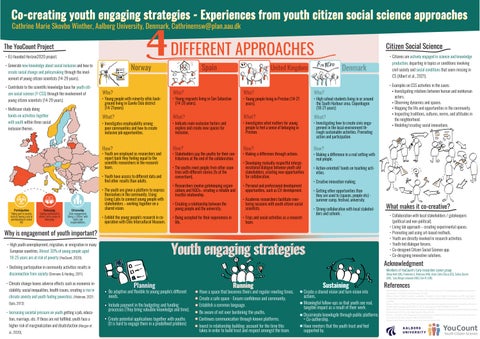
4DIFFERENT APPROACHES
Cathrine Marie Skovbo Winther, Aalborg University, Denmark, Cathrinemsw@plan.aau.dk
The YouCount Project • EU-founded Horizon2020 project.
Spain
Norway
• Generate new knowledge about social inclusion and how to create social change and policymaking through the invol-
Citizen Social Science • Citizens are actively engaged in science and knowledge
Denmark
United Kingdom
vement of young citizen scientists (14-29 years).
• Contribute to the scientific knowledge base for youth citizen social science (Y-CSS) through the involvement of young citizen scientists (14-29 years). • Multicase study doing
hands-on activities together
with youth within three social inclusion themes.
Who?
Citizenship Civic engagement. Being a ’citizen’ with rights and responsibilities.
Who?
• Young migrants living in San Sebastian (14-26 years).
• Young people living in Preston (14-21 years).
• High school students living in or around the South Harbour area, Copenhagen (18-21 years)
What?
What?
What?
What?
• Investigates employability among poor communities and how to create inclusive job opportunities.
• Indicate main exclusion factors and explore and create new spaces for inclusion.
• Investigates what matters for young people to feel a sense of belonging in Preston.
• Investigating how to create civic engagement in the local environment through sustainable activities. Promoting action and participation.
How?
How?
How?
How?
• Youth have access to different data and find other results than adults.
Belonging Feeling connected to others, and a sence of belonging.
Who?
• Young people with minority ethic background living in Gamle Oslo district (14-21years)
• Youth are employed as researchers and report back they feeling equal to the scientific researchers in the research team.
Participation Taking part in society, such as having a job or participating in social life.
Who?
• The youth are given a platform to express themselves in the community. Using Living Labs to connect young people with stakeholders – working together on a shared vision. • Exhibit the young people's research in cooperation with Oslo Intercultural Museum.
Why is engagement of youth important?
• Stakeholders pay the youths for their contributions at the end of the collaboration. • The youths meet people from other countries with different stories (fx at the consortium). • Researchers involve gatekeeping organizations and NGOs– creating a reliable and trustful relationship.
• Making a difference through actions. • Developing mutually respectful intergenerational dialogue between youth and stakeholders, creating new opportunities for collaboration. • Personal and professional development opportunities, such as CV development.
• Creating a relationship between the young people and the university.
• Academic researchers facilitate mentoring sessions with youth citizen social scientists.
• Being accepted for their experiences in life.
• Trips and social activities as a research team.
European countries. Almost 30% of young people aged 18-25 years are at risk of poverty (YouCount, 2020).
• Getting other opportunities than they are used to (spaces, people etc) summer camp, festival, university • Strong collaboration with local stakeholders and schools .
Planning
Be adaptive and flexible to young people's different needs.
Ojala, 2013)
Include payment in the budgeting and funding processes (They bring valuable knowledge and time).
tion, marriage, etc. If these are not fulfilled, youth face a
higher risk of marginalization and disatisfaction (Morgan et al., 2020).
What makes it co-creative? • Collaboration with local stakeholders / gatekeepers (political and non-political). • Living lab approach – creating experimental spaces. • Promoting and using art-based methods. • Youth are directly involved in research activities. • Youth-led dialogue forums. • Co-designed Citizen Social Science app. • Co-designing innovative solutions.
Acknowledgment
Members of YouCount’s Early researcher career group:
stability, social inequalities, health issues, creating a rise in
• Increasing societal pressure on youth getting a job, educa-
• Examples on CSS activities in the cases: ▪ Investigating relations between human and nonhuman actors. ▪ Observing dynamics and spaces. ▪ Mapping the life and opportunities in the community. ▪ Inspecting traditions, cultures, norms, and attitudes in the neighborhood. ▪ Modeling/creating social innovations.
• Creative innovation making.
disconnection from society (Simmons & Harding, 2011).
climate anxiety and youth feeling powerless. (Hickman, 2021;
CS (Albert et al., 2021).
• Action-oriented/ hands on teaching activities.
• Declining participation in community activities results in • Climate change leaves adverse effects such as economic in-
civil society and social conditions that seem missing in
• Making a difference in a real setting with real people.
Youth engaging strategies
• High youth unemployment, migration, or emigration in many
production, departing in topics or conditions involving
Create potential applications together with youths (It is hard to engage them in a predefined problem)
Running
Have a space that becomes theirs and regular meeting times. Create a safe space - Ensure confidence and community. Establish a common language.
Be aware of not over burdening the youths. Continues communication through known platforms.
Invest in relationship building; account for the time this takes in order to build trust and respect amongst the team.
Sustaining
Create a shared vision and turn vision into actions. Meaningful follow-ups so that youth see real, tangible impact as a result of their work. Dissiminate knowlegde through public platforms + Co-authership. Have mentors that the youth trust and feel supported by.
Gilian Holt (UK), Frederick A. Reiersen (NO), Asier Zafra Elorza (ES), Salma Qasim (UK), Sara Berge Loranzen (NO), Ceri H. (UK).
References
Albert, A., Balázs, B., Butkevičienė, E., Mayer, K., & Perelló, J. (2021). Citizen social science: New and established approaches to participation in social research. . In The Science of Citizen Science (pp. 119–138). Hickman, C., Marks, E., Pihkala, P., Clayton, S., Lewandowski, E. R., Mayall, E. E., Wray, B., Mellor, C., & van Susteren, L. (2021). Young People’s Voices on Climate Anxiety, Government Betrayal and Moral Injury: A Global Phenomenon. SSRN Electronic Journal. https://doi.org/10.2139/ssrn.3918955 Morgan, H., Parker, A., & Marturano, N. (2020). Community-based intervention and marginalised youth: inclusion, social mobility and life-course transition. Journal of Education and Work, 33(5–6), 327–342. https://doi.org/10.1080/13639080.2020.1767765 Ojala, M. (2013). Coping with climate change among adolescents: Implications for subjective well-being and environmental engagement. Sustainability (Switzerland), 5(5), 2191–2209. https://doi.org/10.3390/su5052191 Simmons, L., & Harding, S. (2011). Engaging youth in community practice-an imperative for the future. In Journal of Community Practice (Vol. 19, Issue 3, pp. 229–233). https://doi.org/10.1080/10705422.2011.595361 YouCount. (2020). Proposal Submission Forms How to fill in the forms Horizon 2020.