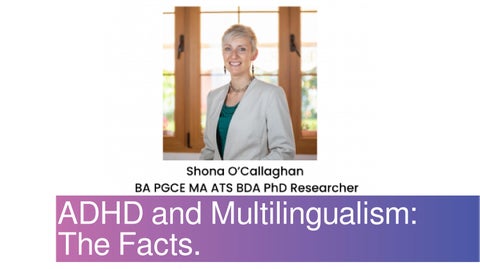
ADHD and Multilingualism: The Facts.
Empowering Creative Minds has published a new article entitled ADHD and Multilingualism: Breaking Barriers, which sheds light on the most important aspects of ADHD in Multilingual Learners: the article covers some of the important aspects of breaking down barriers, stigma and building on strengths.
This should be of particular interest to school directors and educators because there is an unsubstantiated myth that reducing the amount of languages for ADHD learners is a good way to help stop 'confusion'.
One of the most important pieces of information the article tries to convey and communicate is research has found that ADHD alone does not have a large negative influence on language learning.
It is the limited ability to pay attention to grammar or vocabulary which can hinder the learning process, especially in younger learners.
So it is particularly important to 1) check for dyslexia or another learning difference and 2) make learning multisensory, interesting and in short bursts. The best example of this is perhaps found in the following extract: 'With ADHD, the brain may juggle multiple thoughts at once, leading to a unique learning path that can be incredibly adaptive.
This can manifest as an ability to make unconventional connections between languages, or a heightened auditory processing that aids in distinguishing subtle nuances in pronunciation and intonation.
It's important to recognize that ADHD leads to difficulties with executive functions such as working memory, organization, and sustained attention.
' Empowering Creative Minds now welcomes comments and questions from readers, in relation to the article, as they are intent on reflecting on everyone's unique journey and learning from each other to support neurodivergent multilingual learners and educators.
The reason is simply because it will generate a greater understanding of the subject as a whole for everyone involved.
Find Out More: https://empoweringcrea tiveminds.com/